EP0648741B1 - 1,2,3,4-Tetrahydronaphthalin-, Chroman- und Thiochroman-Derivate als Antithrombotika - Google Patents
1,2,3,4-Tetrahydronaphthalin-, Chroman- und Thiochroman-Derivate als Antithrombotika Download PDFInfo
- Publication number
- EP0648741B1 EP0648741B1 EP94402299A EP94402299A EP0648741B1 EP 0648741 B1 EP0648741 B1 EP 0648741B1 EP 94402299 A EP94402299 A EP 94402299A EP 94402299 A EP94402299 A EP 94402299A EP 0648741 B1 EP0648741 B1 EP 0648741B1
- Authority
- EP
- European Patent Office
- Prior art keywords
- formula
- compound
- yield
- group
- compounds
- Prior art date
- Legal status (The legal status is an assumption and is not a legal conclusion. Google has not performed a legal analysis and makes no representation as to the accuracy of the status listed.)
- Expired - Lifetime
Links
- 0 *c1cc(CC(CC2)S(N=O)=C)c2c(C(N=*)=C)c1* Chemical compound *c1cc(CC(CC2)S(N=O)=C)c2c(C(N=*)=C)c1* 0.000 description 10
- LQJJZECNTSDMIK-UHFFFAOYSA-N CC(C(C)=C1)OC(CCC2)=C1C2=O Chemical compound CC(C(C)=C1)OC(CCC2)=C1C2=O LQJJZECNTSDMIK-UHFFFAOYSA-N 0.000 description 1
- XUXTUBFSPCLMTP-UHFFFAOYSA-N Cc1cc(C(C(CC2)N)=O)c2c(C(O)=O)c1 Chemical compound Cc1cc(C(C(CC2)N)=O)c2c(C(O)=O)c1 XUXTUBFSPCLMTP-UHFFFAOYSA-N 0.000 description 1
Classifications
-
- C—CHEMISTRY; METALLURGY
- C07—ORGANIC CHEMISTRY
- C07D—HETEROCYCLIC COMPOUNDS
- C07D335/00—Heterocyclic compounds containing six-membered rings having one sulfur atom as the only ring hetero atom
- C07D335/04—Heterocyclic compounds containing six-membered rings having one sulfur atom as the only ring hetero atom condensed with carbocyclic rings or ring systems
- C07D335/06—Benzothiopyrans; Hydrogenated benzothiopyrans
-
- A—HUMAN NECESSITIES
- A61—MEDICAL OR VETERINARY SCIENCE; HYGIENE
- A61P—SPECIFIC THERAPEUTIC ACTIVITY OF CHEMICAL COMPOUNDS OR MEDICINAL PREPARATIONS
- A61P43/00—Drugs for specific purposes, not provided for in groups A61P1/00-A61P41/00
-
- A—HUMAN NECESSITIES
- A61—MEDICAL OR VETERINARY SCIENCE; HYGIENE
- A61P—SPECIFIC THERAPEUTIC ACTIVITY OF CHEMICAL COMPOUNDS OR MEDICINAL PREPARATIONS
- A61P7/00—Drugs for disorders of the blood or the extracellular fluid
- A61P7/02—Antithrombotic agents; Anticoagulants; Platelet aggregation inhibitors
-
- A—HUMAN NECESSITIES
- A61—MEDICAL OR VETERINARY SCIENCE; HYGIENE
- A61P—SPECIFIC THERAPEUTIC ACTIVITY OF CHEMICAL COMPOUNDS OR MEDICINAL PREPARATIONS
- A61P9/00—Drugs for disorders of the cardiovascular system
-
- C—CHEMISTRY; METALLURGY
- C07—ORGANIC CHEMISTRY
- C07C—ACYCLIC OR CARBOCYCLIC COMPOUNDS
- C07C311/00—Amides of sulfonic acids, i.e. compounds having singly-bound oxygen atoms of sulfo groups replaced by nitrogen atoms, not being part of nitro or nitroso groups
- C07C311/15—Sulfonamides having sulfur atoms of sulfonamide groups bound to carbon atoms of six-membered aromatic rings
- C07C311/20—Sulfonamides having sulfur atoms of sulfonamide groups bound to carbon atoms of six-membered aromatic rings having the nitrogen atom of at least one of the sulfonamide groups bound to a carbon atom of a ring other than a six-membered aromatic ring
-
- C—CHEMISTRY; METALLURGY
- C07—ORGANIC CHEMISTRY
- C07D—HETEROCYCLIC COMPOUNDS
- C07D213/00—Heterocyclic compounds containing six-membered rings, not condensed with other rings, with one nitrogen atom as the only ring hetero atom and three or more double bonds between ring members or between ring members and non-ring members
- C07D213/02—Heterocyclic compounds containing six-membered rings, not condensed with other rings, with one nitrogen atom as the only ring hetero atom and three or more double bonds between ring members or between ring members and non-ring members having three double bonds between ring members or between ring members and non-ring members
- C07D213/04—Heterocyclic compounds containing six-membered rings, not condensed with other rings, with one nitrogen atom as the only ring hetero atom and three or more double bonds between ring members or between ring members and non-ring members having three double bonds between ring members or between ring members and non-ring members having no bond between the ring nitrogen atom and a non-ring member or having only hydrogen or carbon atoms directly attached to the ring nitrogen atom
- C07D213/24—Heterocyclic compounds containing six-membered rings, not condensed with other rings, with one nitrogen atom as the only ring hetero atom and three or more double bonds between ring members or between ring members and non-ring members having three double bonds between ring members or between ring members and non-ring members having no bond between the ring nitrogen atom and a non-ring member or having only hydrogen or carbon atoms directly attached to the ring nitrogen atom with substituted hydrocarbon radicals attached to ring carbon atoms
- C07D213/54—Radicals substituted by carbon atoms having three bonds to hetero atoms with at the most one bond to halogen, e.g. ester or nitrile radicals
- C07D213/55—Acids; Esters
-
- C—CHEMISTRY; METALLURGY
- C07—ORGANIC CHEMISTRY
- C07D—HETEROCYCLIC COMPOUNDS
- C07D311/00—Heterocyclic compounds containing six-membered rings having one oxygen atom as the only hetero atom, condensed with other rings
- C07D311/02—Heterocyclic compounds containing six-membered rings having one oxygen atom as the only hetero atom, condensed with other rings ortho- or peri-condensed with carbocyclic rings or ring systems
- C07D311/04—Benzo[b]pyrans, not hydrogenated in the carbocyclic ring
- C07D311/58—Benzo[b]pyrans, not hydrogenated in the carbocyclic ring other than with oxygen or sulphur atoms in position 2 or 4
Definitions
- the present invention relates to new 1,2,3,4-tetrahydronaphthalene derivatives, their preparation process and the pharmaceutical compositions containing them.
- the compounds described in the present invention have antithromboxane A 2 properties both as antagonists of thromboxane A 2 receptors (TXA 2 ) and as inhibitors of the activity of the enzyme responsible for the synthesis of thromboxane A 2 : thromboxane A 2 -synthase.
- Thromboxane A 2 is a metabolite of arachidonic acid produced by blood platelets which causes significant constriction of blood vessels and induces platelet aggregation.
- the production of thromboxane A 2 is increased in diseases such as angina or stroke and it plays a very important role in all the processes leading to thrombotic diseases.
- thromboxane A 2 are therefore useful as antagonists to thromboxane A 2 and as inhibitors of thromboxane A 2 -synthase in the treatment or prevention of diseases in which thromboxane A 2 is involved such as for example cardio and cerebrovascular diseases and thrombotic diseases as well as the vascular complications which accompany pathological conditions involving either thromboxane A 2 or substances which interact with the TXA 2 receptor (such as, for example, vascular complications in diabetes).
- These thromboxane A 2 antagonists also have protective properties for the gastric wall (ML OGLETREE et al., J. Pharm. And Exp. Therap., 263 (1), 374-380).
- the invention also extends to the process for the preparation of the compounds of formula (I).
- the isomers of the compounds of formula (I) can be obtained by a conventional separation technique at the end of the synthesis or at any stage of the synthesis allowing such separation.
- the compounds of formula (I) have very interesting pharmacological properties.
- they are capable of inhibiting the platelet aggregation induced by U46619 (9,11-dideoxy-11 ⁇ 9 ⁇ -epoxymethanoprostaglandin F 2 ⁇ ), agonist of the TXA 2 receptors, of inhibiting the contractions caused by U46619 on the trachea guinea pig and prevent in vivo the bronchoconstrictions induced by U46619 in guinea pigs.
- the compounds inhibit the synthesis of TXA 2 in the blood of rabbits.
- the compounds of the invention have clearly more intense pharmacological activities than those of a reference compound, BAY U3405 (Drug of the Future, 16 (8), 701-705, 1991).
- the present invention also relates to pharmaceutical compositions containing as active principle at least one compound of formula (I) alone or in combination with one or more inert non-toxic excipients or vehicles.
- compositions according to the invention there may be mentioned more particularly those which are suitable for oral, parenteral, nasal administration, simple or coated tablets, sublingual tablets, capsules, tablets, suppositories, creams, ointments, dermal gels, etc.
- the useful dosage varies according to the age and weight of the patient, the nature and severity of the condition and the route of administration. This can be oral, nasal, rectal or parenteral. In general, the unit dosage ranges from 10 to 200 mg for a treatment in 1 to 3 doses per 24 hours.
- the starting materials used are known products or prepared according to known procedures.
- the chemical structures of the compounds described in the examples were determined according to the usual spectroscopic techniques (nuclear magnetic resonance of Proton and carbon 13, mass spectrum %)
- Stage G methyl 6- (4-Chlorophenylsulfonyl) amino-2-methyl-5,6,7,8-tetrahydronapht-1-yl-carboxylate
- This compound is obtained according to the method described in Synthetic Communications, 21 (3), 419-425, 1991.
- 440 mmol of 4-benzylpyridinium dichromate are placed under stirring in 225 ml of dichloromethane.
- 7 mmol of the compound obtained in the preceding stage in 10 ml of dichloromethane are then added and the whole is stirred for one hour at room temperature.
- 200 ml of an ether / hexane mixture (1/1) are added to the whole.
- the precipitate formed is filtered.
- the filtrates are recovered, evaporated and the expected product is obtained after purification of the residue by chromatography on a silica column using a cyclohexane / ethyl acetate mixture (80/20) as eluent.
- Stage K methyl 3- [6- (4-Chlorophenylsulfonyl) amino-2-methyl-5,6,7,8-tetrahydronapht-1-yl] propanoate
- This compound is obtained according to the process described in JACS, 2693-2698, 1980.
- Stages A to D are identical to stages A to D of Example 1.
- the expected product is obtained according to the process described in Stage E of Example 1 by replacing the (carbomethoxymethylidene) triphenylphosphorane with the (carbethoxyethylidene) triphenylphosphorane.
- the expected product is obtained by proceeding as in Stage F of Example 1 starting from the compound obtained in the preceding stage.
- Stage G methyl 6- (4-Chlorophenylsulfonyl) amino-2,3-dimethyl-5,6,7,8-tetrahydronapht-1-yl-carboxylate
- the operating mode is identical to that described in stage I of example 1.
- the operating mode is identical to that described in stage J of example 1.
- Stage K methyl 3- [6- (4-Chlorophenylsulfonyl) amino-2,3-dimethyl-5,6,7,8-tetrahydronapht-1-yl] propanoate
- the expected product is obtained according to the process described in Example 1, replacing in Step C 4-chlorophenylsulfonyl chloride with 4-fluorophenylsulfonyl chloride.
- the purity and structure of the expected product are verified by HPLC and NMR.
- Stages C to K are identical to stages D to L of Example 1 but in stage D, the (carbomethoxymethylene) triphenylphosphorane is replaced by the (carbomethoxychloromethylene) triphenylphosphorane.
- the purity and structure of the expected product are verified by HPLC and NMR.
- the compound obtained in the preceding stage is subjected to a sulfonylation reaction according to the process described in stage A of Example 5.
- the product is purified by chromatography on a silica column using as eluent a cyclohexane / ethyl acetate mixture (80 / 20).
- Stage F 3- ⁇ 6 - [(4-chlorophenylsulfonyl) amino] -5,6,7,8-tetrahydronapht-1-yl ⁇ propionic acid, sodium salt
- the compound of Example 1 in the form of free acid can also be obtained according to the following process:
- Stages A and B These stages are identical to stages A and B of Example 5.
- Stages C, D and E are identical to stages D, E and F of Example 1.
- Stage F Ethyl [6- (4-Chlorophenylsulfonyl) amino-2-trimethylsilyl-5,6,7,8-tetrahydronapht-1-yl] carboxylate
- Stage H ethyl 2- (4-Chlorophenylsulfonyl) amino-2-methyl-5,6,7,8-tetrahydronapht-1-yl] carboxylate
- Stages I, J, K and L are identical to stages H, I, J, K of Example 1.
- the stages A to H are identical to the stages A to H of Example 7.
- Stages K, L, M and N are identical to stages H, I, J and K of Example 1.
- Stage O This stage is identical to stage M of Example 7.
- Stages C, D and E The products expected in these stages are obtained according to the methods described in stages D, E and F of Example 1.
- Stage F methyl [6- (1-Naphtylsulfonyl) amino-2-methyl-5,6,7,8-tetrahydronapht-1-yl] carboxylate
- Stages G, H, I, J and K The products expected in these stages are obtained according to the methods described in stages I, J, K, L and M of Example 7.
- the stages A, B, C and D are identical to the stages A, B, C and D of Example 6.
- the expected product is obtained according to the procedure described in Stage E of Example 6, replacing the sulfonyl chloride with the chloride of paratoluene sulfonic acid.
- the expected product is obtained in the form of an oil according to the process described in Tet. Lett., 39, 3407, 1975 by reaction of 0.99 mole of cyclohexan-1,3-dione and 1.19 mole of tiglic aldehyde in pyridine.
- Stage B ethyl (3-methyl-5-oxo-5,6,7,8-tetrahydronapth-1-yl) carboxylate
- the expected product is obtained according to the method described in J. Med. Chem., 863, 1972 from the compound obtained in the preceding stage and from hydroxylamine.
- Stage D ethyl (3-methyl-5-tosyloxyimino-5,6,7,8-tetrahydronapth-1-yl) carboxylate
- the expected product is obtained according to the method described in J. Med. Chem., 863, 1972 from the compound described in the preceding stage and tosyl chloride.
- Stage E ethyl (3-methyl-5-oxo-6-amino-5,6,7,8-tetrahydronapht-1-yl) carboxylate, hydrochloride
- 35 mmol of the compound obtained in the preceding stage are hydrogenated in 80 ml of acetic acid in the presence of 3 g of palladium hydroxide on carbon at 10%. After absorption of an equivalent of hydrogen, 3 ml of 70% perchloric acid are added and the hydrogenolysis is continued. The catalyst is then filtered and 2.1 g of potassium acetate in 20 ml of acetic acid are added to the filtrate. After filtration of the precipitate, the filtrate is evaporated. The residue obtained is then amidified by the addition of 35 mmol of 4-chlorophenylsulfonic acid chloride in chloroform in the presence of 70 mmol of triethylamine. After evaporation, the oil obtained is purified by chromatography on a silica column using a dichloromethane / methanol (99/1) mixture as eluent.
- the expected product is obtained according to the process described in Stage H of Example 1.
- Stage H 6- (4-Chlorophenylsulfonyl) amino-3-methyl-5,6,7,8-tetrahydronapht-1-yl-carboxaldehyde
- the expected product is obtained according to the method described in Stage I of Example 1.
- the expected product is obtained according to the process described in stage J of Example 1.
- the expected product is obtained according to the process described in Stage K of Example 1.
- Stage K 3- ⁇ 6 - [(4-chlorophenylsulfonyl) amino] 3-methyl-5,6,7,8-tetrahydronapht-1-yl ⁇ propionic acid
- Stages A to F are identical to stages A to F of Example 1.
- Stage G methyl [6- (4-Chlorophenylsulfonyl) amino-2-tributylstannanyl-5,6,7,8-tetrahydronapht-1-yl] carboxylate
- the expected product is obtained according to the process described in Stage G of Example 1, replacing methyl but-2-ynoate with methyl 3-tributylstannanyl propynoate.
- Stages I to M These stages are identical to stages I to M of Example 7 and lead to the title product.
- the stages A to F are identical to the stages A to F of Example 1.
- the expected product is obtained according to the process described in Stage H of Example 1.
- the operating mode is identical to that described in stage I of example 1.
- Stage K 6- (4-Chlorophenylsulfonyl) amino-3- (pyridin-3-yl) methyl-5,6,7,8-tetrahydronapht-1-yl-carboxaldehyde
- the expected product is obtained according to the process described in Example 14 by replacing, in Stage H, methyl propynoate with methyl but-2-ynoate.
- 1 mol of potassium salt of 3-bromopropionic acid and 1 mol of potassium 2-bromophenate are brought to reflux in 1 liter of ethanol and 200 ml of water. After evaporation of the solvents and recovery of the residue with water, the pH is brought to 7.2. The aqueous phase is washed with ethyl acetate, acidified and the expected product is obtained by filtration of the precipitate formed.
- Stages D, E and F are identical to stages C, D and E of Example 10 and lead to methyl 3- (3-amino-4-oxo-chroman-8-yl) prop-2-enate .
- the compound obtained in the preceding stage is hydrogenated in acetic acid at 70 ° C at a pressure of 3 bars in the presence of palladium on carbon.
- acetic acid at 70 ° C at a pressure of 3 bars in the presence of palladium on carbon.
- perchloric acid at 70 ° C. and the hydrogenolysis is continued.
- the product is then treated under the same conditions as those described in Stage F of Example 10.
- the expected product is obtained by saponification of the compound described in the preceding stage under the conditions described in stage K of Example 10.
- Rabbits (2-3 kg) are anesthetized with pentobarbital sodium (30 mg / kg iv). After cannulation of the left carotid artery, the blood is taken from sodium citrate (0.109 M) (1 vol. Of citrate for 9 vol. Of blood). Platelet rich plasma (PRP) is obtained by centrifugation (20 ° C) at 250 g for 20 minutes and platelet poor plasma (PPP) by centrifugation at 1000 g (10 min). The number of platelets (PL) in the PRP is adjusted between 300-350000 PL / mm 3 by dilution with autologous PPP. The PRP is stored at room temperature until the time of testing and is used within 4 hours of collection. Platelet aggregation is carried out at 37 ° C.
- the PRP and the PL are agitated at 1000 rpm (revolution per minute).
- the PRP is incubated for 1 min at 37 ° C., then the antagonist is added for a period of 3 min before the addition of the agonist U46619 (1 ⁇ M).
- the final volume of the tank is then 250 ⁇ l.
- the intensity of platelet aggregation is established by taking the maximum amplitude of aggregating traces and is expressed as a percentage of light transmission (% T).
- the activity of the antagonists is expressed in IC 50 , that is to say the concentration of the substance which induces 50% inhibition of the aggregating response induced by U46619.
- the compounds of the invention inhibit the platelet aggregation induced by the agonist TXA 2 , U46619.
- the IC 50s illustrated in the table below show that the compounds of the invention have an activity equal to or greater than that of the reference compound BAY U3405.
- Example IC 50 ( ⁇ M) Rabbit ex. 1 0.24 ex. 2 0.82 ex. 3 0.27 ex. 4 0.16 ex. 6 0.060 ex. 9 0.32 ex. 10 0.18 ex. 11 0.67 ex. 12 0.097 ex. 13 0.16 ex. 16 0.25 ex. 17 1.1 BAY U3405 1.10
- the PRP is incubated at 37 ° C in the presence of the antagonist to be tested for 3 minutes. Aggregation is then obtained by the addition of adrenaline (10 ⁇ M) followed by that of U46619 (1 ⁇ M) 30 seconds later. The effect of the antagonists is measured and the IC 50 is determined as the concentration of the antagonist necessary to produce 50% inhibition of the aggregating responses to U46619 + adrenaline.
- the compounds of the invention inhibit the platelet aggregation induced by the agonist TXA 2 , U46619.
- the IC 50s illustrated in the table below show that the compounds of the invention have an activity equal to or greater than that of the reference compound BAY U3405.
- EXAMPLE 20 Platelet aggregation in humans :
- Venous blood is obtained from human volunteers who had not taken aspirin for at least 14 days prior to the experiment.
- the blood is taken from sodium citrate (0.109 M) (1 vol. Of citrate out of 9 vol. Of blood).
- Platelet-rich plasma (PRP) is obtained after centrifugation (20 ° C) at 200 g for 10 minutes. The number of platelets is on average 250,000 PL / mm 3 .
- the PRP is kept at room temperature until the time of the test and is used within 2 hours of collection.
- the antagonists are tested according to the procedure described in Example 19 using U46619 at a concentration of 0.3 ⁇ M.
- the compounds of the invention inhibit the platelet aggregation induced by the agonist TXA 2 , U46619.
- the IC 50 of the compound of Example 1 is 84 nM while that of the reference product BAY U3405 is 180 nM.
- the specific binding tests on the platelet TXA 2 receptors are carried out using as ligand 3 H-SQ29548 (according to the protocol described by A. Hedberg et al. J. Pharm. Exp. Ther., 245, 786-792, 1988 ).
- the experiments take place at a temperature of 25 ° C. in a final reaction volume of 0.2 ml in the presence of 0.1 mg of platelet membranes prepared from human platelets washed, crushed and centrifuged.
- the activity of the products of the invention is determined by competition experiments, in which increasing concentrations of product are brought into contact with a fixed concentration of 3 H-SQ29548. This protocol makes it possible to produce inhibition curves for each antagonist studied.
- the 50% inhibitory concentration is determined by non-linear regression by the "Simplex" method described by MS CACECI and coll. (BYTE, 340-362, May 1984) calculated according to the model of the law of mass action of C. Michaelis et al. (Biochem. Zeitschrifft, 49, 333-369, 1913). The inhibition constant is then determined using the formula of Cheng and Prusoff (Biochem. Pharmacol., 22, 3099-3108, 1973).
- the substances of the invention inhibit the specific binding of 3 H-SQ29548.
- the Ki of the compound of Example 1 is 0.96 nM demonstrating a strong affinity for the platelet TXA 2 receptors. This activity is more important than that of the reference, the BAY U3405, which has a Ki of 3.61 nM in this same test.
- the products of the invention completely inhibit the ex vivo platelet aggregation induced by U46619.
- the compound of Example 1 at doses of 10 to 3000 ⁇ g / kg completely inhibits platelet aggregation with U46619 for at least 3 days, and for the highest dose, up to 11 days. Afterwards, the pro-aggregating activity of U46619 gradually returns.
- the compound of Example 1 at a dose of 10 ⁇ g / kg per os completely inhibits platelet aggregation with U 46619 for at least 3 days. At the highest dose of 100 ⁇ g / kg per os, it inhibits platelet aggregation with U 46619 for at least 8 days.
- the compound of Example 10 at a dose of 100 ⁇ g / kg per os inhibits the platelet aggregation induced by U 46619 for 5 days.
- the anti-aggregating effect of the compounds of the invention is more durable than that observed with BAY U3405. Indeed, at a dose of 100 ⁇ g / kg per os, complete inhibition of the aggregation obtained with BAY U3405 lasts only 6 hours.
- the compounds of the invention are well absorbed per gold and have a very long duration of action at the level of the platelet receptors for TXA 2 .
- CFVs are counted during 2 periods of 20 min: during the first period, there are 9 ⁇ 1 CFV / 20 min, during the second period, there are 8 ⁇ 1 CFV / 20 min.
Landscapes
- Chemical & Material Sciences (AREA)
- Organic Chemistry (AREA)
- Health & Medical Sciences (AREA)
- Life Sciences & Earth Sciences (AREA)
- General Health & Medical Sciences (AREA)
- Veterinary Medicine (AREA)
- Chemical Kinetics & Catalysis (AREA)
- General Chemical & Material Sciences (AREA)
- Medicinal Chemistry (AREA)
- Nuclear Medicine, Radiotherapy & Molecular Imaging (AREA)
- Bioinformatics & Cheminformatics (AREA)
- Pharmacology & Pharmacy (AREA)
- Engineering & Computer Science (AREA)
- Animal Behavior & Ethology (AREA)
- Public Health (AREA)
- Heart & Thoracic Surgery (AREA)
- Cardiology (AREA)
- Diabetes (AREA)
- Hematology (AREA)
- Pharmaceuticals Containing Other Organic And Inorganic Compounds (AREA)
- Organic Low-Molecular-Weight Compounds And Preparation Thereof (AREA)
- Acyclic And Carbocyclic Compounds In Medicinal Compositions (AREA)
- Heterocyclic Carbon Compounds Containing A Hetero Ring Having Oxygen Or Sulfur (AREA)
- Heterocyclic Compounds Containing Sulfur Atoms (AREA)
- Pyrane Compounds (AREA)
Claims (11)
- Verbindungen der Formel (I):
 R1 und R2, die gleichartig oder verschieden sein können, jeweils ein Wasserstoffatom, ein Halogenatom, eine geradkettige oder Verzweigte (C1-C6)-Alkylgruppe, eine Phenylgruppe (die gegebenenfalls durch eines oder mehrere Halogenatome oder geradkettige oder verzweigte (C1-C6)-Alkylgruppen, geradkettige oder Verzweigte (C1-C6)-Alkoxygruppen oder Trihalogenomethylgruppen substituiert ist), eine Benzylgruppe, eine Pyridylmethylgruppe oder eine Imidazolylmethylgruppe, Thiazolylmethylgruppe, Pyridylgruppe, Imidazolylgruppe oder Thiazolylgruppe bedeuten,oderR1 und R2 gemeinsam mit den Kohlenstoffatomen, an die sie gebunden sind, einen Cyclopentan- oder Cyclohexan-ring bildenR3 eine Hydroxylgruppe, eine geradkettige oder verzweigte (C1-C6)-Alkoxygruppe oder eine Aminogruppe (die gegebenenfalls durch eine oder zwei geradkettige oder verzweigte (C1-C6)-Alkylgruppen substituiert ist), darstellt,R4 eine geradkettige oder verzweigte (C1-C6)-Alkylgruppe, eine Phenylgruppe (die gegebenenfalls durch ein oder mehrere Halogenatome, geradkettige oder verzweigte (C1-C6)-Alkylgruppen, geradkettige oder verzweigte (C1-C6)-Alkoxygruppen, Trihalogenomethylgruppen oder Hydroxylgruppen substituiert ist), eine Naphthylgruppe, eine Pyridylgruppe, eine Thienylgruppe oder eine Thiazolylgruppe darstellt undX eine Methylengruppe, ein Sauerstoffatom oder ein Schwefelatom bedeutet,deren Enantiomere sowie deren Additionssalze mit einer pharmazeutisch annehmbaren Base.
 - Verbindungen der Formel (I) nach Anspruch 1, worin R1 ein Wasserstoffatom oder eine Methylgruppe darstellt.
- Verbindungen der Formel (I) nach Anspruch 1, worin R2 eine Methylgruppe bedeutet.
- Verbindungen der Formel (I) nach Anspruch 1, worin X eine Methylengruppe darstellt.
- Verbindungen der Formel (I) nach Anspruch 1, nämlich {6-[(4-Chlorphenylsulfonyl)-amino]-2-methyl-5,6,7,8-tetrahydronaphth-1-yl)-propionsäure sowie deren Additionssalze mit einer pharmazeutisch annehmbaren Base.
- Verfahren zur Herstellung der Verbindungen der Formel (I) nach Anspruch 1, in der X eine Methylengruppe darstellt, dadurch gekennzeichnet, daß man als Ausgangsprodukt ein Sulfonylchlorid der Formel (II) einsetzt:
R4 - SO2Cl (II)
in der R4 die bezuglich der Formel (I) angegebenen Bedeutungen besitzt, welches man in basischem Mediumentweder mit einem Cyclohexylamin der Formel (III) (welches man ausgehend von dem entsprechenden Cyclohexanon durch Reaktion mit Benzylamin in Gegenwart von Natriumtriacetoxyborhydrid unter einer inerten Atmosphäre und anschließende Hydrogenolyse hergestellt hat) umsetzt:
 oder mit 4-Aminocyclohexanol umsetzt,man mit Ameisensäureethylester in Gegenwart von Natriumhydrid umsetzt zur Bildung der Verbindung der Formel (VI):
zur Bildung der Verbindung der Formel (V):
welche man mit Hilfe des Jones-Reagens (Chromsäure in Aceton und wäßriger Schwefelsäure) oxidiert,
zur Bildung der oben beschriebenen Verbindung der Formel (IV), welche Verbindung der Formel (IV)
welche man anschließend in Abhängigkeit von der Art der herzustellenden Verbindungen der Formel (I) der Einwirkung eines Carbalkoxymethylen-triphenylphosphorans, das gegebenenfalls in der α-Stellung der Estergruppe durch ein Halogenatom, eine geradkettige oder verzweigte (C1-C6)-Alkylgruppe, eine Phenylgruppe (die gegebenenfalls durch ein oder mehrere Halogenatome, geradkettige oder verzweigte (C1-C6)-Alkylgruppen, geradkettige oder verzweigte (C1-C6)-Alkoxygruppen oder Trihalogenomethylgruppen substituiert ist), eine Benzylgruppe, eine Pyridylmethylgruppe oder eine Imidazolylmethylgruppe substituiert ist, unterwirft,
zur Bildung der Verbindung der Formel (VII):
welche man anschließend mit p-Toluolsulfonsäure oder Trifluoressigsäure umsetzt
zur Bildung der Verbindung der Formel (VIII):
welche man einer Diels-Alder-Reaktion mit einem in geeigneter Weise substituierten Alk-2-in-säurealkylester unterzieht,
so daß man nach eventuellen Umwandlungen die Verbindung der Formel (IX) erhält:
welche man der Einwirkung von Lithiumaluminiumhydrid in wasserfreiem Medium unterwirft
zur Bildung der Verbindung der Formel (X):
welche man mit einem Oxidationsmittel, wie 4-Benzylpyridinium-dichromat umsetzt
zur Bildung des Aldehyds der Formel (XI):
welchen man mit (Carbomethoxymethylen)-triphenylphosphoran umsetzt
zur Bildung der Verbindung der Formel (XII):
welche man mit Samariumiodid in Gegenwart von Methanol reduziert
zur Bildung der Verbindung der Formel (XIII):
welche man anschließend mit Hilfe einer klassischen Methode der organischen Chemie in die entsprechende Säure, den entsprechenden Ester oder das entsprechende Amid umwandelt
zur Bildung der Verbindung der Formel (I/a), einem Sonderfall der Verbindungen der Formel (I): - welche man gegebenenfalls mit Hilfe einer klassischen Reinigungsmethode reinigt,- welche man gegebenenfalls mit Hilfe einer klassischen Trennmethode in die Isomeren auftrennt oder- welche man gewünschtenfalls in die Additionssalze mit einer pharmazeutisch annehmbaren Base überführt.
 - Verfahren zur Herstellung der Verbindungen der Formel (I) nach Anspruch 1, in der R1 und R2 ein Wasserstoffatom und X eine Methylengruppe bedeuten, dadurch gekennzeichnet, daß man als Ausgangsprodukt eine Verbindung der Formel (XIV) einsetzt:

zur Bildung der Verbindung der Formel (XV):


R4SO2Cl (II)
in der R4 die gleiche Bedeutung besitzt wie in der Formel (I),
zur Bildung der Verbindung der Formel (XVIII):
welche man anschließend mit Hilfe einer klassischen Methode der organischen Chemie in die entsprechende Säure, den entsprechenden Ester oder das entsprechende Amid umwandelt,
zur Bildung der Verbindung der Formel (I/b), einem Sonderfall der Verbindungen der Formel (I): - welche man gegebenenfalls mit Hilfe einer klassischen Reinigungsmethode reinigt,- welche man gegebenenfalls mit Hilfe einer klassischen Trennmethode in die Isomeren auftrennt oder- welche man gewünschtenfalls in die Additionssalze mit einer pharmazeutisch annehmbaren Base überführt.
 - Verfahren zur Herstellung der Verbindungen der Formel (I) nach Anspruch 1, in der X = X' ein Schwefelatom oder ein Sauerstoffatom bedeutet, dadurch gekennzeichnet, daß man als Ausgangsprodukt eine Verbindung der Formel (XIX) einsetzt:

welche man in Gegenwart von Polyphosphorsäure cyclisiert zur Bildung der Verbindung der Formel (XX):
zur Bildung der Verbindung der Formel (XXI):
welche man mit Hydroxylamin und dann mit Tosylchlorid umsetzt und schließlich einer Néber-Umwandlung unterzieht zur Bildung der Verbindung der Formel (XXII):
welche man dann in Gegenwart eines Katalysators reduziert zur Bildung der Verbindung der Formel (XXIII):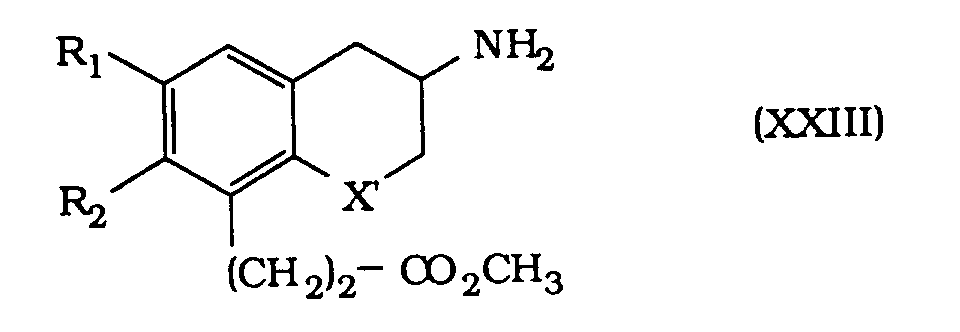
welche man mit einem Sulfonylchlorid der Formel (II) in basischem Medium umsetzt:
R4SO2Cl (II)
in der R4 die gleiche Bedeutung besitzt wie in der Formel (I),
zur Bildung der Verbindung der Formel (XXIV):
welche man anschließend mit Hilfe einer klassischen Methode der organischen Chemie in die entsprechende Säure, den entsprechenden Ester oder das entsprechende Amid umwandelt,
zur Bildung der Verbindung der Formel (I/c), einem Sonderfall der Verbindungen der Formel (I): - welche man gegebenenfalls mit Hilfe einer klassischen Reinigungsmethode reinigt,- welche man gegebenenfalls mit Hilfe einer klassischen Trennmethode in die Isomeren auftrennt oder- welche man gewünschtenfalls in die Additionssalze mit einer pharmazeutisch annehmbaren Base überführt.
 - Verfahren zur Herstellung der Verbindungen der Formel (I) nach Anspruch 1, in der X eine Methylengruppe, R1 eine Methylgruppe und R2 ein Wasserstoffatom bedeuten, dadurch gekennzeichnet, daß man als Ausgangsprodukt 1,3-Cyclohexandion verwendet, welches man mit Tiglinaldehyd umsetzt zur Bildung der Verbindung der Formel (XXV):

zur Bildung der Verbindung der Formel (XXVII):
zur Bildung der Verbindung der Formel (XXVIII):
welche Verbindung der Formel (XVIII) man anschließend den Reaktionen gemäß Anspruch 6 bezüglich der Umwandlung der Verbindung der Formel (IX) in die Verbindung der Formel (I/a) unterwirft, was zu der entsprechenden Verbindung der Formel (I) führt. - Pharmazeutische Zubereitungen enthaltend als Wirkstoff mindestens eine Verbindung nach einem der Ansprüche 1 bis 5 allein oder in Kombination mit einem oder mehreren inerten, nichttoxischen, pharmazeutisch annehmbaren Trägermaterialien.
- Pharmazeutische Zubereitung nach Anspruch 10 enthaltend mindestens einen Wirkstoff gemäß einem der Ansprüche 1 bis 5 als Antithrombotikum.
Applications Claiming Priority (2)
| Application Number | Priority Date | Filing Date | Title |
|---|---|---|---|
| FR9312237A FR2711139B1 (fr) | 1993-10-15 | 1993-10-15 | Nouveaux dérivés de 1,2,3,4-tétrahydronaphtalène, leur procédé de préparation et les compositions pharmaceutiques qui les contiennent. |
| FR9312237 | 1993-10-15 |
Publications (2)
| Publication Number | Publication Date |
|---|---|
| EP0648741A1 EP0648741A1 (de) | 1995-04-19 |
| EP0648741B1 true EP0648741B1 (de) | 1996-12-18 |
Family
ID=9451827
Family Applications (1)
| Application Number | Title | Priority Date | Filing Date |
|---|---|---|---|
| EP94402299A Expired - Lifetime EP0648741B1 (de) | 1993-10-15 | 1994-10-13 | 1,2,3,4-Tetrahydronaphthalin-, Chroman- und Thiochroman-Derivate als Antithrombotika |
Country Status (15)
| Country | Link |
|---|---|
| US (1) | US5472979A (de) |
| EP (1) | EP0648741B1 (de) |
| JP (1) | JP2859138B2 (de) |
| AT (1) | ATE146454T1 (de) |
| AU (1) | AU676377B2 (de) |
| CA (1) | CA2118102C (de) |
| CY (1) | CY2141B1 (de) |
| DE (1) | DE69401190T2 (de) |
| DK (1) | DK0648741T3 (de) |
| ES (1) | ES2098109T3 (de) |
| FR (1) | FR2711139B1 (de) |
| GR (1) | GR3022637T3 (de) |
| HK (1) | HK64397A (de) |
| NZ (1) | NZ264703A (de) |
| ZA (1) | ZA948082B (de) |
Families Citing this family (17)
| Publication number | Priority date | Publication date | Assignee | Title |
|---|---|---|---|---|
| GB9509156D0 (en) * | 1995-05-05 | 1995-06-28 | Sandoz Ltd | Organic compounds |
| DE19647000A1 (de) * | 1996-11-14 | 1998-05-20 | Hoechst Ag | 3-Amido-chromanylsulfonyl(thio)harnstoffe, Verfahren zu ihrer Herstellung, ihre Verwendung und sie enthaltende pharmazeutische Präparate |
| DE19707656A1 (de) * | 1997-02-26 | 1998-08-27 | Hoechst Ag | Sulfonamid-substituierte anellierte 7-Ring-Verbindungen, Verfahren zu ihrer Herstellung, ihre Verwendung als Medikament oder Diagnostikum sowie sie enthaltende pharmazeutische Zubereitungen |
| FR2760235B1 (fr) * | 1997-02-28 | 1999-04-09 | Adir | Nouveaux derives de benzenesulfonylamine, leur procede de preparation et les compositions pharmaceutiques qui les contiennent |
| FR2803848B1 (fr) * | 2000-01-19 | 2002-02-15 | Adir | Nouveaux derives de benzenesulfonamide, leur procede de preparation et les compositions pharmaceutiques qui les contiennent |
| JP4490543B2 (ja) * | 2000-03-07 | 2010-06-30 | 日本曹達株式会社 | α−アミノケトン類の製造方法 |
| FR2838057B1 (fr) * | 2002-04-05 | 2005-07-08 | Servier Lab | Nouvelle association d'un antithrombotique et d'aspirine |
| RU2226392C1 (ru) * | 2002-10-23 | 2004-04-10 | Биологический факультет Московского государственного университета им. М.В. Ломоносова | Способ ингибирования агрегации тромбоцитов |
| FR2857593B1 (fr) * | 2003-07-18 | 2005-10-14 | Servier Lab | Composition pharmaceutique orodispersible d'un compose antithrombotique |
| FR2860436B1 (fr) * | 2003-10-03 | 2006-01-20 | Servier Lab | Nouvelle association d'un anti-atherothrombotique et d'un antiagregant plaquettaire |
| FR2899473B1 (fr) * | 2006-04-07 | 2008-06-13 | Servier Lab | Utilisation d'un compose anti-atherothrombotique pour l'obtention de medicaments destines au traitement des troubles vasculaires |
| FR2920772B1 (fr) * | 2007-09-11 | 2009-10-23 | Servier Lab | Association entre un anti-atherothrombotique et un inhibiteur de l'enzyme de conversion de l'angiotensine |
| EP2098511A1 (de) | 2008-03-07 | 2009-09-09 | Solvias AG | Verfahren zur Herstellung von Verbindungen mit einer Hydronaphtalinstruktur mit einem asymmetrisch substituierten Benzolring |
| WO2012015944A2 (en) * | 2010-07-29 | 2012-02-02 | The Trustees Of The University Of Pennsylvania | Novel tetrahydronaphalene antagonists to the thromboxane a2 (tp) receptor |
| CN103102292B (zh) * | 2011-11-14 | 2015-05-20 | 上海医药工业研究院 | 一种快速无污染由伯醇氧化为醛的方法 |
| US9643919B2 (en) | 2013-04-04 | 2017-05-09 | The Trustees Of The University Of Pennsylvania | Cycloalkyl-dione derivatives and methods of their use |
| CN108707115B (zh) * | 2018-07-17 | 2020-09-01 | 成都道合尔医药技术有限公司 | 一种丙烯酸衍生物的合成方法 |
Family Cites Families (4)
| Publication number | Priority date | Publication date | Assignee | Title |
|---|---|---|---|---|
| PH22076A (en) * | 1983-08-25 | 1988-05-20 | Daiichi Seiyaku Co | Benzocycloalkane derivative |
| DE3623941A1 (de) * | 1986-07-16 | 1988-01-28 | Bayer Ag | Substituierte amino-5,6,7,8-tetrahydronaphthyl-oxyessigsaeuren, verfahren zu deren herstellung sowie die verwendung als arzneimittel |
| US5206428A (en) * | 1989-11-16 | 1993-04-27 | Tanabe Seiyaku Co., Ltd. | Tetrahydronaphthalene derivatives and preparation thereof |
| JPH05178814A (ja) * | 1991-05-14 | 1993-07-20 | Tanabe Seiyaku Co Ltd | 医薬組成物 |
-
1993
- 1993-10-15 FR FR9312237A patent/FR2711139B1/fr not_active Expired - Fee Related
-
1994
- 1994-10-13 EP EP94402299A patent/EP0648741B1/de not_active Expired - Lifetime
- 1994-10-13 DE DE69401190T patent/DE69401190T2/de not_active Expired - Lifetime
- 1994-10-13 CA CA002118102A patent/CA2118102C/fr not_active Expired - Fee Related
- 1994-10-13 AT AT94402299T patent/ATE146454T1/de active
- 1994-10-13 AU AU75820/94A patent/AU676377B2/en not_active Ceased
- 1994-10-13 DK DK94402299.5T patent/DK0648741T3/da active
- 1994-10-13 ES ES94402299T patent/ES2098109T3/es not_active Expired - Lifetime
- 1994-10-14 JP JP6249589A patent/JP2859138B2/ja not_active Expired - Fee Related
- 1994-10-14 ZA ZA948082A patent/ZA948082B/xx unknown
- 1994-10-14 US US08/323,508 patent/US5472979A/en not_active Expired - Lifetime
- 1994-10-14 NZ NZ264703A patent/NZ264703A/en not_active IP Right Cessation
-
1997
- 1997-02-21 GR GR970400323T patent/GR3022637T3/el unknown
- 1997-05-15 HK HK64397A patent/HK64397A/xx not_active IP Right Cessation
-
1999
- 1999-11-19 CY CY9900037A patent/CY2141B1/xx unknown
Also Published As
| Publication number | Publication date |
|---|---|
| CY2141B1 (en) | 2002-06-21 |
| FR2711139A1 (fr) | 1995-04-21 |
| DK0648741T3 (da) | 1997-06-09 |
| DE69401190D1 (de) | 1997-01-30 |
| EP0648741A1 (de) | 1995-04-19 |
| CA2118102A1 (fr) | 1995-04-16 |
| JPH07188155A (ja) | 1995-07-25 |
| HK64397A (en) | 1997-05-23 |
| GR3022637T3 (en) | 1997-05-31 |
| AU676377B2 (en) | 1997-03-06 |
| AU7582094A (en) | 1995-05-11 |
| ATE146454T1 (de) | 1997-01-15 |
| US5472979A (en) | 1995-12-05 |
| ES2098109T3 (es) | 1997-04-16 |
| DE69401190T2 (de) | 1997-07-03 |
| NZ264703A (en) | 1995-09-26 |
| CA2118102C (fr) | 2000-11-07 |
| ZA948082B (en) | 1995-06-05 |
| JP2859138B2 (ja) | 1999-02-17 |
| FR2711139B1 (fr) | 1995-12-01 |
Similar Documents
| Publication | Publication Date | Title |
|---|---|---|
| CA2118102C (fr) | Nouveaux derives de 1,2,3,4-tetrahydronaphtalene, leur procede de preparation et les compositions pharmaceutiques qui les contiennent | |
| EP0591057B1 (de) | Arylalkyl(thio)amide mit Melatonin-Rezeptor-Selektivität und Prozess zu ihrer Darstellung | |
| EP0526342B1 (de) | Isochinolin-5-yl-Sulfonsäureamide, Verfahren zu ihrer Herstellung und pharmazeutische Zusammensetzungen, die sie enthalten | |
| EP0557171A1 (de) | Azaindole, deren Herstellungsverfahren und sie enthaltende Arzneimittel | |
| FR2674522A1 (fr) | Nouveaux derives de l'indole, procedes de preparation et medicaments les contenant. | |
| EP0001534B1 (de) | Pyrrolderivate, Verfahren zu ihrer Herstellung und ihre therapeutischen Verwendungen | |
| EP0624575A1 (de) | Substituierte Indole und diese enthaltende Arzneimittel | |
| EP0887350A1 (de) | Chromenderivate, Verfahren zu ihrer Herstellung und diese enthaltende pharmazeutische Zubereitungen | |
| EP0549407B1 (de) | Neue Pyrrolidinderivate, Verfahren zu ihrer Herstellung und diese enthaltende Arzneimittel | |
| EP0998471B1 (de) | Heterozyclische verbindungen, ihr herstellungsverfahren und diese enthaltende pharmazeutische zusammensetzungen | |
| EP0556119B1 (de) | In der 3-Position durch einen gesättigten oder ungesättigten Fettsäurerest substituierte Pyrrolidinderivate, Verfahren zu ihrer Herstellung und diese enthaltende Arzneimittel mit Thromboxan-A2 inhibierender Aktivität | |
| EP0338895B1 (de) | Heteroarotinoid-Derivate, Verfahren zu deren Herstellung und diese enthaltende pharmazeutische Zusammenstellungen | |
| FR2758329A1 (fr) | Derives d'imidazole-4-butane boronique, leur preparation et leur utilisation en therapeutique | |
| EP0385848A1 (de) | Benzoxazolinon-Derivate, Verfahren zu deren Herstellung und pharmazeutische Zusammensetzungen, die sie enthalten | |
| WO1998025913A1 (fr) | Nouveaux derives [3h]-benzoxazole-2-thiones et [3h]-benzothiazole-2-thiones substitues, leur procede de preparation et les compositions pharmaceutiques qui les contiennent | |
| FR2713644A1 (fr) | Nouveaux analogues de l'éburnane, leur procédé de préparation et les compositions pharmaceutiques qui les contiennent. | |
| EP0570263B1 (de) | Neue Alkencarbonsäurederivate, Verfahren zu ihrer Herstellung und sie enthaltende pharmazeutische Zusammensetzungen | |
| EP0504017A1 (de) | Benzopyranderivate, Verfahren zu ihrer Herstellung und diese enthaltende pharmazeutische Zubereitungen | |
| FR2560873A1 (fr) | Medicaments a base de derives de la piperidine, nouveaux derives de la piperidine et leurs procedes de preparation | |
| EP0412898A1 (de) | Oxazolopyridinderivate, Verfahren zu ihrer Herstellung und diese enthaltende pharmazeutische Zubereitungen | |
| EP0864561B1 (de) | Benzolsulfonylamin-Derivate, Verfahren zu ihrer Herstellung und diese enthaltende pharmazeutische Zusammensetzungen | |
| FR2722193A1 (fr) | Derives n-oxydes de 1-(7-chloro-4-quinoleinyl)pyrazole-3-carboxamides substitues, procede pour leur preparation et les compositions pharmaceitiques les contenant | |
| FR2489328A1 (fr) | Nouveaux esters de l'acide benzoique substitue, notamment pour le traitement de la douleur et de l'inflammation | |
| FR2712592A1 (fr) | Nouveaux dérivés tricycliques azotés, leur procédé de préparation et les compositions pharmaceutiques qui les contiennent. | |
| BE895586A (fr) | Nouveaux derives de l'indoline, leur preparation et leur utilisation comme medicaments |
Legal Events
| Date | Code | Title | Description |
|---|---|---|---|
| PUAI | Public reference made under article 153(3) epc to a published international application that has entered the european phase |
Free format text: ORIGINAL CODE: 0009012 |
|
| 17P | Request for examination filed |
Effective date: 19941017 |
|
| AK | Designated contracting states |
Kind code of ref document: A1 Designated state(s): AT BE CH DE DK ES FR GB GR IE IT LI LU NL PT SE |
|
| GRAG | Despatch of communication of intention to grant |
Free format text: ORIGINAL CODE: EPIDOS AGRA |
|
| GRAH | Despatch of communication of intention to grant a patent |
Free format text: ORIGINAL CODE: EPIDOS IGRA |
|
| GRAH | Despatch of communication of intention to grant a patent |
Free format text: ORIGINAL CODE: EPIDOS IGRA |
|
| 17Q | First examination report despatched |
Effective date: 19960528 |
|
| GRAA | (expected) grant |
Free format text: ORIGINAL CODE: 0009210 |
|
| AK | Designated contracting states |
Kind code of ref document: B1 Designated state(s): AT BE CH DE DK ES FR GB GR IE IT LI LU NL PT SE |
|
| REF | Corresponds to: |
Ref document number: 146454 Country of ref document: AT Date of ref document: 19970115 Kind code of ref document: T |
|
| REG | Reference to a national code |
Ref country code: CH Ref legal event code: NV Representative=s name: A. BRAUN, BRAUN, HERITIER, ESCHMANN AG PATENTANWAE |
|
| REF | Corresponds to: |
Ref document number: 69401190 Country of ref document: DE Date of ref document: 19970130 |
|
| REG | Reference to a national code |
Ref country code: IE Ref legal event code: FG4D Free format text: 71123 |
|
| ITF | It: translation for a ep patent filed | ||
| GBT | Gb: translation of ep patent filed (gb section 77(6)(a)/1977) |
Effective date: 19970321 |
|
| REG | Reference to a national code |
Ref country code: ES Ref legal event code: FG2A Ref document number: 2098109 Country of ref document: ES Kind code of ref document: T3 |
|
| REG | Reference to a national code |
Ref country code: GR Ref legal event code: FG4A Free format text: 3022637 |
|
| REG | Reference to a national code |
Ref country code: DK Ref legal event code: T3 |
|
| PLBE | No opposition filed within time limit |
Free format text: ORIGINAL CODE: 0009261 |
|
| STAA | Information on the status of an ep patent application or granted ep patent |
Free format text: STATUS: NO OPPOSITION FILED WITHIN TIME LIMIT |
|
| 26N | No opposition filed | ||
| REG | Reference to a national code |
Ref country code: CH Ref legal event code: PFA Free format text: ADIR ET COMPAGNIE TRANSFER- LES LABORATOIRES SERVIER |
|
| REG | Reference to a national code |
Ref country code: FR Ref legal event code: TP |
|
| REG | Reference to a national code |
Ref country code: GB Ref legal event code: 732E |
|
| REG | Reference to a national code |
Ref country code: GB Ref legal event code: IF02 |
|
| NLS | Nl: assignments of ep-patents |
Owner name: LES LABORATOIRES SERVIER |
|
| REG | Reference to a national code |
Ref country code: PT Ref legal event code: PC4A Free format text: LES LABORATOIRES SERVIER FR Effective date: 20011105 |
|
| REG | Reference to a national code |
Ref country code: CH Ref legal event code: PFA Owner name: LES LABORATOIRES SERVIER Free format text: LES LABORATOIRES SERVIER#22, RUE GARNIER#92200 NEUILLY-SUR-SEINE (FR) -TRANSFER TO- LES LABORATOIRES SERVIER#22, RUE GARNIER#92200 NEUILLY-SUR-SEINE (FR) |
|
| PGFP | Annual fee paid to national office [announced via postgrant information from national office to epo] |
Ref country code: IE Payment date: 20120827 Year of fee payment: 19 Ref country code: LU Payment date: 20120925 Year of fee payment: 19 |
|
| PGFP | Annual fee paid to national office [announced via postgrant information from national office to epo] |
Ref country code: GR Payment date: 20120919 Year of fee payment: 19 |
|
| PGFP | Annual fee paid to national office [announced via postgrant information from national office to epo] |
Ref country code: DK Payment date: 20121025 Year of fee payment: 19 |
|
| PGFP | Annual fee paid to national office [announced via postgrant information from national office to epo] |
Ref country code: CH Payment date: 20121030 Year of fee payment: 19 Ref country code: BE Payment date: 20120927 Year of fee payment: 19 Ref country code: FR Payment date: 20121127 Year of fee payment: 19 Ref country code: DE Payment date: 20121031 Year of fee payment: 19 Ref country code: PT Payment date: 20120413 Year of fee payment: 19 |
|
| PGFP | Annual fee paid to national office [announced via postgrant information from national office to epo] |
Ref country code: IT Payment date: 20121025 Year of fee payment: 19 Ref country code: ES Payment date: 20121129 Year of fee payment: 19 Ref country code: SE Payment date: 20121024 Year of fee payment: 19 Ref country code: GB Payment date: 20121010 Year of fee payment: 19 |
|
| PGFP | Annual fee paid to national office [announced via postgrant information from national office to epo] |
Ref country code: AT Payment date: 20120920 Year of fee payment: 19 Ref country code: NL Payment date: 20121024 Year of fee payment: 19 |
|
| REG | Reference to a national code |
Ref country code: PT Ref legal event code: MM4A Free format text: LAPSE DUE TO NON-PAYMENT OF FEES Effective date: 20140414 |
|
| BERE | Be: lapsed |
Owner name: LES LABORATOIRES *SERVIER Effective date: 20131031 |
|
| REG | Reference to a national code |
Ref country code: NL Ref legal event code: V1 Effective date: 20140501 |
|
| REG | Reference to a national code |
Ref country code: DK Ref legal event code: EBP Effective date: 20131031 |
|
| REG | Reference to a national code |
Ref country code: CH Ref legal event code: PL |
|
| REG | Reference to a national code |
Ref country code: SE Ref legal event code: EUG |
|
| REG | Reference to a national code |
Ref country code: AT Ref legal event code: MM01 Ref document number: 146454 Country of ref document: AT Kind code of ref document: T Effective date: 20131013 |
|
| GBPC | Gb: european patent ceased through non-payment of renewal fee |
Effective date: 20131013 |
|
| REG | Reference to a national code |
Ref country code: GR Ref legal event code: ML Ref document number: 970400323 Country of ref document: GR Effective date: 20140505 |
|
| REG | Reference to a national code |
Ref country code: IE Ref legal event code: MM4A |
|
| PG25 | Lapsed in a contracting state [announced via postgrant information from national office to epo] |
Ref country code: GB Free format text: LAPSE BECAUSE OF NON-PAYMENT OF DUE FEES Effective date: 20131013 Ref country code: LI Free format text: LAPSE BECAUSE OF NON-PAYMENT OF DUE FEES Effective date: 20131031 Ref country code: CH Free format text: LAPSE BECAUSE OF NON-PAYMENT OF DUE FEES Effective date: 20131031 |
|
| REG | Reference to a national code |
Ref country code: FR Ref legal event code: ST Effective date: 20140630 |
|
| REG | Reference to a national code |
Ref country code: DE Ref legal event code: R119 Ref document number: 69401190 Country of ref document: DE Effective date: 20140501 |
|
| PG25 | Lapsed in a contracting state [announced via postgrant information from national office to epo] |
Ref country code: NL Free format text: LAPSE BECAUSE OF NON-PAYMENT OF DUE FEES Effective date: 20140501 Ref country code: DE Free format text: LAPSE BECAUSE OF NON-PAYMENT OF DUE FEES Effective date: 20140501 Ref country code: PT Free format text: LAPSE BECAUSE OF NON-PAYMENT OF DUE FEES Effective date: 20140414 Ref country code: IT Free format text: LAPSE BECAUSE OF NON-PAYMENT OF DUE FEES Effective date: 20131013 Ref country code: GR Free format text: LAPSE BECAUSE OF NON-PAYMENT OF DUE FEES Effective date: 20140505 Ref country code: SE Free format text: LAPSE BECAUSE OF NON-PAYMENT OF DUE FEES Effective date: 20131014 Ref country code: FR Free format text: LAPSE BECAUSE OF NON-PAYMENT OF DUE FEES Effective date: 20131031 Ref country code: AT Free format text: LAPSE BECAUSE OF NON-PAYMENT OF DUE FEES Effective date: 20131013 |
|
| PG25 | Lapsed in a contracting state [announced via postgrant information from national office to epo] |
Ref country code: BE Free format text: LAPSE BECAUSE OF NON-PAYMENT OF DUE FEES Effective date: 20131031 |
|
| REG | Reference to a national code |
Ref country code: PT Ref legal event code: MM4A Free format text: MAXIMUM VALIDITY LIMIT REACHED Effective date: 20141013 |
|
| PG25 | Lapsed in a contracting state [announced via postgrant information from national office to epo] |
Ref country code: IE Free format text: LAPSE BECAUSE OF NON-PAYMENT OF DUE FEES Effective date: 20131013 Ref country code: DK Free format text: LAPSE BECAUSE OF NON-PAYMENT OF DUE FEES Effective date: 20131031 |
|
| REG | Reference to a national code |
Ref country code: ES Ref legal event code: FD2A Effective date: 20141107 |
|
| PG25 | Lapsed in a contracting state [announced via postgrant information from national office to epo] |
Ref country code: PT Free format text: LAPSE BECAUSE OF EXPIRATION OF PROTECTION Effective date: 20141021 Ref country code: ES Free format text: LAPSE BECAUSE OF NON-PAYMENT OF DUE FEES Effective date: 20131014 |
|
| PG25 | Lapsed in a contracting state [announced via postgrant information from national office to epo] |
Ref country code: LU Free format text: LAPSE BECAUSE OF NON-PAYMENT OF DUE FEES Effective date: 20131013 Ref country code: PT Free format text: LAPSE BECAUSE OF EXPIRATION OF PROTECTION Effective date: 20140423 |