EP0649250A2 - Digitales Filter zur Rauschentfernung in einem Videosignal - Google Patents
Digitales Filter zur Rauschentfernung in einem Videosignal Download PDFInfo
- Publication number
- EP0649250A2 EP0649250A2 EP94307486A EP94307486A EP0649250A2 EP 0649250 A2 EP0649250 A2 EP 0649250A2 EP 94307486 A EP94307486 A EP 94307486A EP 94307486 A EP94307486 A EP 94307486A EP 0649250 A2 EP0649250 A2 EP 0649250A2
- Authority
- EP
- European Patent Office
- Prior art keywords
- filter
- frame
- block
- pixels
- current frame
- Prior art date
- Legal status (The legal status is an assumption and is not a legal conclusion. Google has not performed a legal analysis and makes no representation as to the accuracy of the status listed.)
- Withdrawn
Links
Images

Classifications
-
- H—ELECTRICITY
- H04—ELECTRIC COMMUNICATION TECHNIQUE
- H04N—PICTORIAL COMMUNICATION, e.g. TELEVISION
- H04N5/00—Details of television systems
- H04N5/14—Picture signal circuitry for video frequency region
- H04N5/21—Circuitry for suppressing or minimising disturbance, e.g. moiré or halo
-
- G—PHYSICS
- G06—COMPUTING OR CALCULATING; COUNTING
- G06T—IMAGE DATA PROCESSING OR GENERATION, IN GENERAL
- G06T5/00—Image enhancement or restoration
- G06T5/10—Image enhancement or restoration using non-spatial domain filtering
-
- G—PHYSICS
- G06—COMPUTING OR CALCULATING; COUNTING
- G06T—IMAGE DATA PROCESSING OR GENERATION, IN GENERAL
- G06T5/00—Image enhancement or restoration
- G06T5/20—Image enhancement or restoration using local operators
-
- G—PHYSICS
- G06—COMPUTING OR CALCULATING; COUNTING
- G06T—IMAGE DATA PROCESSING OR GENERATION, IN GENERAL
- G06T5/00—Image enhancement or restoration
- G06T5/50—Image enhancement or restoration using two or more images, e.g. averaging or subtraction
-
- G—PHYSICS
- G06—COMPUTING OR CALCULATING; COUNTING
- G06T—IMAGE DATA PROCESSING OR GENERATION, IN GENERAL
- G06T5/00—Image enhancement or restoration
- G06T5/70—Denoising; Smoothing
-
- H—ELECTRICITY
- H04—ELECTRIC COMMUNICATION TECHNIQUE
- H04N—PICTORIAL COMMUNICATION, e.g. TELEVISION
- H04N19/00—Methods or arrangements for coding, decoding, compressing or decompressing digital video signals
- H04N19/50—Methods or arrangements for coding, decoding, compressing or decompressing digital video signals using predictive coding
- H04N19/503—Methods or arrangements for coding, decoding, compressing or decompressing digital video signals using predictive coding involving temporal prediction
- H04N19/51—Motion estimation or motion compensation
- H04N19/53—Multi-resolution motion estimation; Hierarchical motion estimation
-
- H—ELECTRICITY
- H04—ELECTRIC COMMUNICATION TECHNIQUE
- H04N—PICTORIAL COMMUNICATION, e.g. TELEVISION
- H04N19/00—Methods or arrangements for coding, decoding, compressing or decompressing digital video signals
- H04N19/80—Details of filtering operations specially adapted for video compression, e.g. for pixel interpolation
-
- H—ELECTRICITY
- H04—ELECTRIC COMMUNICATION TECHNIQUE
- H04N—PICTORIAL COMMUNICATION, e.g. TELEVISION
- H04N5/00—Details of television systems
- H04N5/14—Picture signal circuitry for video frequency region
- H04N5/144—Movement detection
- H04N5/145—Movement estimation
-
- G—PHYSICS
- G06—COMPUTING OR CALCULATING; COUNTING
- G06T—IMAGE DATA PROCESSING OR GENERATION, IN GENERAL
- G06T2207/00—Indexing scheme for image analysis or image enhancement
- G06T2207/10—Image acquisition modality
- G06T2207/10016—Video; Image sequence
-
- G—PHYSICS
- G06—COMPUTING OR CALCULATING; COUNTING
- G06T—IMAGE DATA PROCESSING OR GENERATION, IN GENERAL
- G06T2207/00—Indexing scheme for image analysis or image enhancement
- G06T2207/20—Special algorithmic details
- G06T2207/20048—Transform domain processing
- G06T2207/20056—Discrete and fast Fourier transform, [DFT, FFT]
-
- G—PHYSICS
- G06—COMPUTING OR CALCULATING; COUNTING
- G06T—IMAGE DATA PROCESSING OR GENERATION, IN GENERAL
- G06T2207/00—Indexing scheme for image analysis or image enhancement
- G06T2207/20—Special algorithmic details
- G06T2207/20172—Image enhancement details
- G06T2207/20182—Noise reduction or smoothing in the temporal domain; Spatio-temporal filtering
Definitions
- This invention relates to video signal processing and is concerned with removing noise from a sequence of images such as a sequence of frames comprising a motion picture.
- noise reduction has been presented during the last two decades or so. Many motion compensated noise reduction methods have also been proposed.
- the types of noise that we are particularly concerned with are noise such as white Gaussian noise, noise which is equivalent to what one would see on a television if the channel were not tuned properly, and noise such as the graininess one sees when watching an old movie (strictly speaking this graininess is due in part to film grain noise which is not necessarily Gaussian distributed).
- Î n (i,j) represents the value of the output pixel which is supposed to be an estimate of the clean image.
- Î n-1 (i,j) is the previous output image pixel and g n (i,j) the current noisy image pixel. Therefore the output frame at time k is the average of all the previous k frames. If the frame contains a stationary scene, this would be fine, since the noise would be averaged out. However this is not normally the case and moving objects are blurred by this operation.
- a motion compensated averager such as is disclosed in the article by J. Boyce, 'Noise Reduction of Image Sequences Using Adaptive Motion Compensated Frame Averaging' in IEEE ICASSP, Volume 3, pages 461-464, 1992, works much better, as expected.
- the averaging operation is then directed along motion trajectories and so does not blur motion.
- This operation is a purely temporal one and so is sensitive to errors in motion estimation.
- greater noise attenuation can be obtained by using the spatial information in each frame.
- a method of removing noise from a current frame f of an image sequence having a plurality of frames comprising applying a 3-dimensional Wiener filtering operation involving 3-dimensional correlations to a data set corresponding to or being produced from the values of a plurality of pixels in the current frame f and the values of a corresponding plurality of pixels in a succeeding frame f+1 and/or a preceding frame f-1 of the image sequence, whereby the values resulting from the filtering operation are each a function of said data set.
- 'frames' we mean to include individual images of a sequence, which may be, for example, frames of a cinematographic film or frames or fields of a television picture.
- Said data set may correspond on a one to one basis with the values of pixels in the current frame and the values of pixels in a succeeding and/or preceding frame in which case the filtering operation may be of the finite impulse response (FIR) type involving 3D correlations of the pixel values in its processing.
- FIR finite impulse response
- the filtering operation is carried out in the frequency domain and may be, or may approximate, an infinite impulse response (IIR) filtering operation, said data set being obtained by Fourier transforming said values of pixels in the current frame and said values of pixels in the succeeding and/or preceding frame.
- IIR infinite impulse response
- a method of filtering noise from a video image sequence wherein the images are subject to a Wiener filtering operation in a 3D Fourier transform domain.
- the space/time image sequence is transformed into the 3D frequency domain and the various frequency components are then attenuated by the filter to produce a modified 3D Fourier frequency expression of the signal which represents a noise reduced film sequence.
- a further step involves the inverse 3D Fourier transform which transforms the 3D Fourier transform expression into the space/time restored image sequence.
- the filtering operation in this case may be applied so as to attenuate the power spectral density of frequency components within the data set with the level of attenuation being a function of the power spectral density itself.
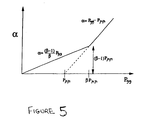
- Frequency components having a spectral power density below a threshold level ⁇ P ⁇ where ⁇ is a constant greater than 1 and P ⁇ is the power spectral density of a noise signal associated with each frequency component, may be attenuated by a a non-negative factor which reduces as P gg reduces,e.g. a factor which is a function of ⁇ .
- a method of removing noise from a current frame f of an image sequence having a plurality of frames comprising applying a Wiener filtering operation to a data set, obtained by Fourier transforming the values of a plurality of pixels in the current frame f, to attenuate frequency components within the data set having a spectral power density below a threshold level ⁇ P ⁇ , where ⁇ is a constant greater than 1 and P ⁇ is the power spectral density of a noise signal associated with each frequency component, by a factor which is a function of ⁇ and/or a non-negative factor which reduces as P gg reduces.
- a digital filter for removing noise from a current frame f of an image sequence having a plurality of frames may comprise:
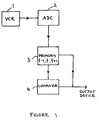
- FIG. 1 is a block diagram of a system suitable for carrying out an embodiment of the invention in the form of a digital filter as represented generally by Figure 4.
- the system comprises an analogue to digital converter 2 for digitising an analogue input signal representing an image sequence comprising a plurality of frames, supplied by a VCR 1, a memory 3 for storing pixel location and intensity for three consecutive frames, f-1, f, and f+1, of the input image sequence in digital form, and a computer 4 for processing the currently stored frame f of the image sequence.
- the most recently processed frame f is fed back to the memory as frame f+1 for the next cycle, frame f-1 is designated frame f, and a new frame f-1 is read into the memory via the analogue to digital converter.
- the most recently processed frame f may be supplied in digital form to a digital memory device which retains all of the processed frames for use later or may be passed through a digital to analogue converter to an analogue storage device, e.g. a further VCR, or directly to a display.
- a digital to analogue converter to an analogue storage device, e.g. a further VCR, or directly to a display.
- the frames f-1, f, and f+1 are stored in the memory as 2-D arrays of intensity values, the address of the intensity values in memory corresponding to the location of the corresponding pixel in the image frame.
- the input sequence could convey information additional to intensity values, for example colour information, but, in the interest of clarity, such considerations will be omitted in the following and the discussion limited to black and white signals.
- the digital filter is represented in the form of its funtional structure in Figure 4; the main steps implemented by this digital filter can be set out as follows:
- step 1 motion estimation may be carried out using any one the known methods, see for example the methods disclosed in the article by J. Biemond et al, entitled 'A Pel-Recursive Wiener based displacement estimation algorithm' in Signal Processing, 13:pages 399-412, 1987.
- a preferred embodiment of the present invention makes use of the method disclosed in United Kingdom patent application No. 9316153.7. For completeness, a description of this method is repeated hereinafter.
- the motion estimation algorithm assign to each pixel or cluster of pixels (having coordinates x,y) in the current frame two displacement vectors d f-1 (x,y,f) and d f+1 (x,y,f) which define respectively the displacement of that pixel or cluster between the current and preceding frame and between the current and the succeeding frame respectively.
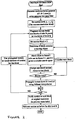
- FIG. 2 is a flow diagram showing the steps involved.
- a first estimate of displacement is obtained from a coarse, or low resolution, level Ln.
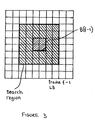
- a second improved estimate is obtained from a higher resolution level Ln-1 using the first estimate to reduce the area which must be searched to match areas of the current frame f with corresponding areas of the surrounding frames f-1 and f+1.
- the estimate is further improved by considering still higher resolution levels until finally a satisfactory estimate is obtained.
- n 3.
- Level L1 is generated by operating on the original frame with a low pass filter, i.e. in effect passing a low pass filter mask of given window size over the original frame (which corresponds to level L0).
- the mask is placed over a portion of the frame to be processed and a value is then generated which is a function of the value of pixels in the area extracted by the mask window.
- the generated value corresponds to the pixel located in the centre of the mask window and is stored in a new array.
- R 4 and p and q are in the range -4 to +4.
- ⁇ is a constant defining the Gaussian function. The mask is moved pixel by pixel across the entire frame until the new array is completely filled.
- Level LO is extended at its edges by a strip of pixels having intensity values equal to zero, i.e. black, so that the filter mask can be applied to the pixels around the edges.
- the resulting filtered frame is subsampled in both the horizontal and vertical directions by a factor of two, i.e. only every other pixel is used in each row of the processed level L0.
- the result is a frame at level L1.
- level L1 would comprise a smaller array of 128 x 128 pixels providing an image which is slightly blurred in comparison to the image provided by level L0 and which has in effect a lower resolution.
- the process of filtering and subsampling is then carried out on level L1 to produce a level L2 having 64 x 64 pixels and finally on level L2 to produce a level L3 having 32 x 32 pixels.
- the displacement vector field propagated from level L1 is checked for so-called motion haloes. This is achieved by repeating the process of step (a) for all the blocks of level L0 without taking into account the propagated displacement vectors. If MAE O with no motion compensation is less than MAE O with motion compensation then the pixels of the block are assigned a displacement vector of [0,0] and the propagated displacement vector is ignored. This prevents stationary background regions from being assigned erroneous displacement vectors.
- Wiener filtering is a well known technique for the reduction of noise in degraded signals. It has previously been used to good effect for reducing the noise in archived gramophone recordings.
- the filter can be applied both in the frequency domain, effectively as an IIR (infinite impulse response) filter, or in the spatio-temporal domain as an FIR (finite impulse response) filter.
- the embodiment shortly to be described uses a digital 3D filtering operation on data from three motion compensated frames in a sequence.
- the data in a block of N X N pixels in each frame is extracted, compensated for motion as described above, to give a data volume of 3 blocks, one each from frame n-1, n, and n+1, and the block is filtered to suppress noise in the central frame.
- the filter is derived by first of all deciding on a filter structure, either FIR or IIR, and then finding the coefficients which minimize the expected value of the squared error between the filter output and the original, clean, signal.
- the Wiener filter has been used as an effective method for noise and blur reduction in degraded signals.
- the form of the filter for image sequences proposed herein is an extension of the 1-D result; however the limited amount of temporal information available implies different considerations in the implementation of the method. This following passage makes explicit the various forms of the filter that can be used.
- the theory presented here ignores motion between frames as motion has been considered above.
- the present discussion is also limited to the problem of noise reduction in image sequences, blur is not considered.
- the Wiener filter attempts to produce the best estimate for I(i,j,n), denoted Î(i,j,n). It does so by minimizing the expected squared error which is given by equation (7) below.
- This estimate may be achieved using either an IIR or FIR Wiener filter, which operates on the observed noisy signal.
- Equations (8) and (9) below show respectively IIR and FIR estimators.
- the filter mask (or support) is a symmetric volume around the filtered location of SIZE(2n1 + 1) x (2n2 + 1) x (2n3 + 1).
- the IDFT is the inverse 3D DFT, and G( ⁇ 1, ⁇ 2, ⁇ 3) is the 3D DFT of the observed signal, g(i,j,n).
- the filter is therefore defined by the signal power spectrum and the noise variance.
- the FIR filter gives an estimate of the clean pixel by using only a restricted local set of pixels just around the pixel to be estimated (like the 3D AR model support of UK Patent Application No. 9316153.7).
- the IIR filter uses all pixels in the data volume to give an estimate of the clean signal. It is found that the FIR filter is generally less successful than the IIR filter and so the preferred embodiment using the IIR will now be discussed.
- the IIR form of the filter yields a frequency domain expression which requires an estimate of the Power Spectrum of the original, clean, data to yield the attenuation factor required for each frequency bin.
- the 3D Wiener filter in the frequency domain is as given by equation (17) below, where A( ⁇ 1, ⁇ 2, ⁇ 3) defines the frequency response of the filter, and P gg ,P ⁇ refer to the Power spectral densities of the degraded and noise signals respectively.
- the arguments to the functions refer to discrete frequency bins as gained via the 3D FFT (the n-dimensional FFT is a separable operation and is implemented as a recursive FFT operation in orthogonal directions).
- the situation is exactly the same along the temporal axis.
- the activity along the temporal axis depends on the accuracy of motion estimation.
- the filter will automatically reduce the contribution of the temporal information to the noise reduction. This property makes the filter robust to even large errors in motion estimation. Of course the amount by which it reduces the attenuation when this problem occurs may not correspond to an optimal result visually.
- the filter has an advantage in this respect in comparison with motion compensated frame averaging which tends to blur the image when the motion is not correctly estimated.
- the final data therefore, after this sum/overlap process at the edge of blocks is created by summing windowed data from one block with windowed data from another block.
- the window used is called the synthesis window because it is used to sum the blocks in the restoration, i.e. synthesize the restoration. Whilst there are more direct ways of solving problems with non-homogeneous signals the above described method is a practical solution which works well.
- Subtracting the mean is carried out because the Wiener filter used is defined for zero mean signals only. If one adds a random noise to an image patch, the mean value (or average brightness) cannot be affected because taking the mean of the picture elements has the effect of averaging out the noise added.
- the DFT Discrete Fourier Transform
- I ⁇ n ( i,j ) 1 n [( n - 1) I ⁇ n -1 ( i,j ) + g n ( i,j )]
- E [( e ( i,j,n ))2] E [( I ( i,j,n ) - I ⁇ ( i,j,n ))2]
- E [ e ( i,j,n ) g ( i + k 1, j + k 2, n + k 3)] 0 ⁇ k 1, k 2, k 3
Landscapes
- Engineering & Computer Science (AREA)
- Multimedia (AREA)
- Signal Processing (AREA)
- Physics & Mathematics (AREA)
- General Physics & Mathematics (AREA)
- Theoretical Computer Science (AREA)
- Image Processing (AREA)
- Compression Or Coding Systems Of Tv Signals (AREA)
- Picture Signal Circuits (AREA)
Applications Claiming Priority (2)
| Application Number | Priority Date | Filing Date | Title |
|---|---|---|---|
| GB939321372A GB9321372D0 (en) | 1993-10-15 | 1993-10-15 | Video signal processing |
| GB9321372 | 1993-10-15 |
Publications (2)
| Publication Number | Publication Date |
|---|---|
| EP0649250A2 true EP0649250A2 (de) | 1995-04-19 |
| EP0649250A3 EP0649250A3 (de) | 1995-07-19 |
Family
ID=10743663
Family Applications (1)
| Application Number | Title | Priority Date | Filing Date |
|---|---|---|---|
| EP94307486A Withdrawn EP0649250A3 (de) | 1993-10-15 | 1994-10-12 | Digitales Filter zur Rauschentfernung in einem Videosignal. |
Country Status (3)
| Country | Link |
|---|---|
| US (1) | US5500685A (de) |
| EP (1) | EP0649250A3 (de) |
| GB (1) | GB9321372D0 (de) |
Cited By (4)
| Publication number | Priority date | Publication date | Assignee | Title |
|---|---|---|---|---|
| WO1997004588A1 (en) * | 1995-07-21 | 1997-02-06 | Innovision Limited | Improved correlation processing for motion estimation |
| EP0777388A3 (de) * | 1995-12-08 | 2000-04-12 | Kabushiki Kaisha Toshiba | Videokodierer und -dekodierer mit Rauschreduktion |
| WO2002037420A3 (en) * | 2000-11-03 | 2002-08-01 | Clayton John Christopher | Motion compensation of images |
| WO2010065060A1 (en) * | 2008-11-25 | 2010-06-10 | Thomson Licensing | Methods and apparatus for sparsity-based de-artifact filtering for video encoding and decoding |
Families Citing this family (58)
| Publication number | Priority date | Publication date | Assignee | Title |
|---|---|---|---|---|
| US5729631A (en) * | 1993-11-30 | 1998-03-17 | Polaroid Corporation | Image noise reduction system using a wiener variant filter in a pyramid image representation |
| US5592227A (en) * | 1994-09-15 | 1997-01-07 | Vcom, Inc. | Method and apparatus for compressing a digital signal using vector quantization |
| US5802218A (en) * | 1994-11-04 | 1998-09-01 | Motorola, Inc. | Method, post-processing filter, and video compression system for suppressing mosquito and blocking atrifacts |
| US5612745A (en) * | 1995-07-24 | 1997-03-18 | Motorola, Inc. | Method and apparatus for detecting occlusion |
| US5574663A (en) * | 1995-07-24 | 1996-11-12 | Motorola, Inc. | Method and apparatus for regenerating a dense motion vector field |
| US5717463A (en) * | 1995-07-24 | 1998-02-10 | Motorola, Inc. | Method and system for estimating motion within a video sequence |
| US5974192A (en) * | 1995-11-22 | 1999-10-26 | U S West, Inc. | System and method for matching blocks in a sequence of images |
| EP0823149A2 (de) * | 1996-02-27 | 1998-02-11 | Koninklijke Philips Electronics N.V. | Verfahren und vorrichtung zur kodierung und dekodierung von signalen |
| US6866789B1 (en) * | 1997-07-15 | 2005-03-15 | Silverbrook Research Pty Ltd | Method of manufacture of a gear driven shutter ink jet printer |
| US7434915B2 (en) * | 1997-07-15 | 2008-10-14 | Silverbrook Research Pty Ltd | Inkjet printhead chip with a side-by-side nozzle arrangement layout |
| US7360872B2 (en) * | 1997-07-15 | 2008-04-22 | Silverbrook Research Pty Ltd | Inkjet printhead chip with nozzle assemblies incorporating fluidic seals |
| US6014468A (en) * | 1997-07-31 | 2000-01-11 | The Regents Of The University Of California | Apparatus and methods for image and signal processing |
| US6360021B1 (en) | 1998-07-30 | 2002-03-19 | The Regents Of The University Of California | Apparatus and methods of image and signal processing |
| EP0957367A1 (de) * | 1998-04-14 | 1999-11-17 | THOMSON multimedia | Verfahren zur Schätzung des Rauschpegels in einer Videosequenz |
| US7145607B1 (en) * | 1999-11-11 | 2006-12-05 | Stmicroelectronics Asia Pacific Pte. Ltd. | Spatio-temporal video noise reduction system |
| CA2309002A1 (en) * | 2000-05-23 | 2001-11-23 | Jonathan Martin Shekter | Digital film grain reduction |
| EP1358629A1 (de) * | 2001-01-26 | 2003-11-05 | Koninklijke Philips Electronics N.V. | Räumlich-zeitliche filtereinheit und bildanzeigevorrichtung mit einer solchen räumlichzeitlichen filtereinheit |
| US20030021487A1 (en) * | 2001-07-24 | 2003-01-30 | Baer Richard L. | Digital fir filter for CCD imaging systems |
| AU2002323591A1 (en) * | 2001-09-05 | 2003-03-18 | Emblaze Systems Ltd. | Method for reducing blocking artifacts |
| DE60209773T2 (de) * | 2001-11-07 | 2006-11-30 | Koninklijke Philips Electronics N.V. | Vorrichtung und verfahren zum erkennen von verdeckung |
| US6993204B1 (en) | 2002-01-04 | 2006-01-31 | Pixon Llc | High speed signal enhancement using pixons |
| KR20040086399A (ko) * | 2002-02-21 | 2004-10-08 | 코닌클리케 필립스 일렉트로닉스 엔.브이. | 데이터 소자의 저장 방법 |
| WO2003085599A1 (en) * | 2002-04-11 | 2003-10-16 | Koninklijke Philips Electronics N.V. | Motion estimation unit and method of estimating a motion vector |
| US7254277B2 (en) * | 2002-12-30 | 2007-08-07 | Texas Instruments Incorporated | Image processing with minimization of ringing artifacts and noise |
| US7606417B2 (en) | 2004-08-16 | 2009-10-20 | Fotonation Vision Limited | Foreground/background segmentation in digital images with differential exposure calculations |
| US7680342B2 (en) * | 2004-08-16 | 2010-03-16 | Fotonation Vision Limited | Indoor/outdoor classification in digital images |
| TWI228240B (en) * | 2003-11-25 | 2005-02-21 | Benq Corp | Image processing method for reducing jaggy-effect |
| US7506267B2 (en) * | 2003-12-23 | 2009-03-17 | Intel Corporation | Compose rate reduction for displays |
| US7616220B2 (en) * | 2003-12-23 | 2009-11-10 | Intel Corporation | Spatio-temporal generation of motion blur |
| US20060139494A1 (en) * | 2004-12-29 | 2006-06-29 | Samsung Electronics Co., Ltd. | Method of temporal noise reduction in video sequences |
| US7535517B2 (en) * | 2005-04-14 | 2009-05-19 | Samsung Electronics Co., Ltd. | Method of motion compensated temporal noise reduction |
| US8514332B2 (en) * | 2005-12-20 | 2013-08-20 | Broadcom Corporation | Method and system for non-linear blending in motion-based video processing |
| US7692696B2 (en) * | 2005-12-27 | 2010-04-06 | Fotonation Vision Limited | Digital image acquisition system with portrait mode |
| IES20060559A2 (en) * | 2006-02-14 | 2006-11-01 | Fotonation Vision Ltd | Automatic detection and correction of non-red flash eye defects |
| US7469071B2 (en) * | 2006-02-14 | 2008-12-23 | Fotonation Vision Limited | Image blurring |
| US8189934B2 (en) * | 2006-03-27 | 2012-05-29 | Panasonic Corporation | Image coding apparatus and image decoding apparatus |
| US8090210B2 (en) * | 2006-03-30 | 2012-01-03 | Samsung Electronics Co., Ltd. | Recursive 3D super precision method for smoothly changing area |
| IES20060564A2 (en) * | 2006-05-03 | 2006-11-01 | Fotonation Vision Ltd | Improved foreground / background separation |
| CN100433795C (zh) * | 2006-09-01 | 2008-11-12 | 上海大学 | 基于变换域数学形态学的图像降噪方法 |
| EP2448270A1 (de) * | 2006-10-10 | 2012-05-02 | Nippon Telegraph And Telephone Corporation | Videokodierungs- und -dekodierungsverfahren, Vorrichtungen und Programm dafür und Speichermedien zum Aufzeichnen der Programme |
| US20080204598A1 (en) * | 2006-12-11 | 2008-08-28 | Lance Maurer | Real-time film effects processing for digital video |
| US7952646B2 (en) * | 2006-12-27 | 2011-05-31 | Intel Corporation | Method and apparatus for content adaptive spatial-temporal motion adaptive noise reduction |
| US8396313B2 (en) * | 2007-04-25 | 2013-03-12 | Pixon Imaging, Inc. | Image compression and decompression using the PIXON method |
| US20100026897A1 (en) * | 2008-07-30 | 2010-02-04 | Cinnafilm, Inc. | Method, Apparatus, and Computer Software for Modifying Moving Images Via Motion Compensation Vectors, Degrain/Denoise, and Superresolution |
| JP5060447B2 (ja) * | 2008-10-07 | 2012-10-31 | 株式会社東芝 | ノイズキャンセル処理回路および固体撮像装置 |
| CN101582984B (zh) * | 2009-04-14 | 2014-04-16 | 公安部物证鉴定中心 | 一种消除图像噪声的方法及装置 |
| WO2011060159A2 (en) * | 2009-11-11 | 2011-05-19 | Cinnafilm, Inc. | Single frame artifact filtration and motion estimation |
| GB2489632A (en) * | 2009-12-16 | 2012-10-03 | Ibm | Video coding using pixel-streams |
| US8760466B1 (en) * | 2010-01-18 | 2014-06-24 | Pixar | Coherent noise for non-photorealistic rendering |
| US8472517B2 (en) | 2010-10-20 | 2013-06-25 | Harris Corporation | Systems and methods for reducing the total number of bits required to be transferred over a communications link for an image |
| WO2013056200A1 (en) * | 2011-10-14 | 2013-04-18 | Brightsentry, Inc. | Method and apparatus for video compression of stationary scenes |
| US9326008B2 (en) | 2012-04-10 | 2016-04-26 | Google Inc. | Noise reduction for image sequences |
| WO2014204830A2 (en) * | 2013-06-17 | 2014-12-24 | Immedia Semiconductor, Inc. | Image processing and motion compensation |
| CN115278229B (zh) * | 2015-11-11 | 2024-12-10 | 三星电子株式会社 | 对视频进行解码的设备和对视频进行编码的设备 |
| US10181181B2 (en) * | 2017-05-10 | 2019-01-15 | Southwest Research Institute | Denoising with three dimensional fourier transform for three dimensional images, including image sequences |
| US10674045B2 (en) * | 2017-05-31 | 2020-06-02 | Google Llc | Mutual noise estimation for videos |
| US11308585B2 (en) | 2017-12-05 | 2022-04-19 | Google Llc | Noise reduction method for high dynamic range videos |
| CN117789166A (zh) * | 2023-12-27 | 2024-03-29 | 广东工业大学 | 一种基于随机优化的移动目标速度识别方法 |
Family Cites Families (8)
| Publication number | Priority date | Publication date | Assignee | Title |
|---|---|---|---|---|
| US4504864A (en) * | 1982-12-30 | 1985-03-12 | International Business Machines Corporation | Nonlinear filtering of gray scale images |
| WO1987005769A1 (en) * | 1986-03-19 | 1987-09-24 | British Broadcasting Corporation | Tv picture motion measurement |
| US5121445A (en) * | 1986-07-01 | 1992-06-09 | Konica Corporation | Method and apparatus for reading image |
| EP0525408A3 (en) * | 1991-07-01 | 1993-12-22 | Eastman Kodak Co | Method for multiframe wiener restoration of noisy and blurred image sequences |
| US5245677A (en) * | 1991-08-08 | 1993-09-14 | Hughes Aircraft Company | Directional running average segmentation |
| US5237413A (en) * | 1991-11-19 | 1993-08-17 | Scientific-Atlanta, Inc. | Motion filter for digital television system |
| US5414782A (en) * | 1992-12-16 | 1995-05-09 | The United States Of Amercia As Represented By The Secretary Of Commerce | Procedure for digital image restoration |
| US5398079A (en) * | 1993-01-27 | 1995-03-14 | General Instrument Corporation | Half-pixel interpolation for a motion compensated digital video system |
-
1993
- 1993-10-15 GB GB939321372A patent/GB9321372D0/en active Pending
-
1994
- 1994-10-12 EP EP94307486A patent/EP0649250A3/de not_active Withdrawn
- 1994-10-14 US US08/323,507 patent/US5500685A/en not_active Expired - Fee Related
Cited By (9)
| Publication number | Priority date | Publication date | Assignee | Title |
|---|---|---|---|---|
| WO1997004588A1 (en) * | 1995-07-21 | 1997-02-06 | Innovision Limited | Improved correlation processing for motion estimation |
| US6057892A (en) * | 1995-07-21 | 2000-05-02 | Innovision, Plc. | Correlation processing for motion estimation |
| EP0777388A3 (de) * | 1995-12-08 | 2000-04-12 | Kabushiki Kaisha Toshiba | Videokodierer und -dekodierer mit Rauschreduktion |
| WO2002037420A3 (en) * | 2000-11-03 | 2002-08-01 | Clayton John Christopher | Motion compensation of images |
| WO2010065060A1 (en) * | 2008-11-25 | 2010-06-10 | Thomson Licensing | Methods and apparatus for sparsity-based de-artifact filtering for video encoding and decoding |
| CN102292990A (zh) * | 2008-11-25 | 2011-12-21 | 汤姆森特许公司 | 对视频编码和解码进行基于稀疏性的去伪像滤波的方法和装置 |
| CN102292990B (zh) * | 2008-11-25 | 2016-10-05 | 汤姆森特许公司 | 对视频编码和解码进行基于稀疏性的去伪像滤波的方法和装置 |
| KR101680915B1 (ko) | 2008-11-25 | 2016-11-29 | 톰슨 라이센싱 | 비디오 인코딩 및 디코딩을 위한 희소성-기반 아티팩트 제거 필터링 방법 및 장치 |
| US9723330B2 (en) | 2008-11-25 | 2017-08-01 | Thomson Licensing Dtv | Method and apparatus for sparsity-based de-artifact filtering for video encoding and decoding |
Also Published As
| Publication number | Publication date |
|---|---|
| US5500685A (en) | 1996-03-19 |
| EP0649250A3 (de) | 1995-07-19 |
| GB9321372D0 (en) | 1993-12-08 |
Similar Documents
| Publication | Publication Date | Title |
|---|---|---|
| US5500685A (en) | Wiener filter for filtering noise from a video signal | |
| Viero et al. | Three-dimensional median-related filters for color image sequence filtering | |
| Kokaram et al. | Interpolation of missing data in image sequences | |
| EP0961229B1 (de) | Nichtlinearer adaptiver Filter zur Verminderung von Blockstörungen | |
| US5802218A (en) | Method, post-processing filter, and video compression system for suppressing mosquito and blocking atrifacts | |
| Kokaram et al. | Detection of missing data in image sequences | |
| US5844627A (en) | Structure and method for reducing spatial noise | |
| EP0261137B1 (de) | Fernsehbild-bewegungsmessung | |
| Tan et al. | A multi-metric objective picture-quality measurement model for MPEG video | |
| US5708693A (en) | Image processing for noise reduction | |
| KR970009469B1 (ko) | 더블스무딩(Double Smoothing) 기능을 갖는 비월/순차주사변환장치 및 그 방법 | |
| EP1550981B1 (de) | System und Methode zur Reduktion des Bildrauschens mittels eines räumlich-zeitlich rekursiven Filters | |
| van Roosmalen et al. | Correction of intensity flicker in old film sequences | |
| US7929031B2 (en) | Image processing apparatus and image processing method | |
| JPH07274044A (ja) | 時間可変フィルタ係数を用いたビデオ信号ノイズ低減システムおよびノイズ低減方法 | |
| US20130290849A1 (en) | Scene Change Detection and Handling for Preprocessing Video with Overlapped 3D Transforms | |
| KR20060076176A (ko) | 비디오 시퀀스에서 시간적 잡음 제거 방법 및 시스템 | |
| US6122016A (en) | Video signal processing | |
| EP0637887A1 (de) | Bildverarbeitung | |
| US7003037B1 (en) | Process, device and use for evaluating coded images | |
| EP0588934B1 (de) | Geraet und verfahren zur glaettung von bildern | |
| Van Roosmalen et al. | Restoration and Storage of Film and Video | |
| Comes et al. | Postprocessing of images by filtering the unmasked coding noise | |
| CN101283586A (zh) | 视频运动检测 | |
| US7495805B1 (en) | Enhancing an image, such as an image having bi-valued pixel values |
Legal Events
| Date | Code | Title | Description |
|---|---|---|---|
| PUAI | Public reference made under article 153(3) epc to a published international application that has entered the european phase |
Free format text: ORIGINAL CODE: 0009012 |
|
| AK | Designated contracting states |
Kind code of ref document: A2 Designated state(s): DE ES FR GB IT |
|
| PUAL | Search report despatched |
Free format text: ORIGINAL CODE: 0009013 |
|
| AK | Designated contracting states |
Kind code of ref document: A3 Designated state(s): DE ES FR GB IT |
|
| 17P | Request for examination filed |
Effective date: 19960111 |
|
| STAA | Information on the status of an ep patent application or granted ep patent |
Free format text: STATUS: THE APPLICATION HAS BEEN WITHDRAWN |
|
| 18W | Application withdrawn |
Withdrawal date: 19961216 |