EP0649643A1 - Vibrationszusammengepresste Stoffe für orthopädische versteifende Bandagen - Google Patents
Vibrationszusammengepresste Stoffe für orthopädische versteifende Bandagen Download PDFInfo
- Publication number
- EP0649643A1 EP0649643A1 EP94116691A EP94116691A EP0649643A1 EP 0649643 A1 EP0649643 A1 EP 0649643A1 EP 94116691 A EP94116691 A EP 94116691A EP 94116691 A EP94116691 A EP 94116691A EP 0649643 A1 EP0649643 A1 EP 0649643A1
- Authority
- EP
- European Patent Office
- Prior art keywords
- fabric
- yarn
- orthopedic casting
- elastomeric yarn
- resin
- Prior art date
- Legal status (The legal status is an assumption and is not a legal conclusion. Google has not performed a legal analysis and makes no representation as to the accuracy of the status listed.)
- Granted
Links
- 239000004744 fabric Substances 0.000 title claims abstract description 211
- 230000000399 orthopedic effect Effects 0.000 title claims abstract description 53
- 238000005266 casting Methods 0.000 title claims description 49
- 229920005989 resin Polymers 0.000 claims abstract description 99
- 239000011347 resin Substances 0.000 claims abstract description 99
- 239000011152 fibreglass Substances 0.000 claims abstract description 60
- 239000000835 fiber Substances 0.000 claims abstract description 17
- 238000000034 method Methods 0.000 claims description 45
- 238000009940 knitting Methods 0.000 claims description 23
- PPBRXRYQALVLMV-UHFFFAOYSA-N Styrene Chemical compound C=CC1=CC=CC=C1 PPBRXRYQALVLMV-UHFFFAOYSA-N 0.000 claims description 22
- 238000009998 heat setting Methods 0.000 claims description 16
- 229920001577 copolymer Polymers 0.000 claims description 14
- 238000000576 coating method Methods 0.000 claims description 12
- -1 ethylene, propylene Chemical group 0.000 claims description 11
- KAKZBPTYRLMSJV-UHFFFAOYSA-N Butadiene Chemical compound C=CC=C KAKZBPTYRLMSJV-UHFFFAOYSA-N 0.000 claims description 10
- RRHGJUQNOFWUDK-UHFFFAOYSA-N Isoprene Chemical compound CC(=C)C=C RRHGJUQNOFWUDK-UHFFFAOYSA-N 0.000 claims description 10
- 239000011248 coating agent Substances 0.000 claims description 10
- 239000007788 liquid Substances 0.000 claims description 10
- 150000001993 dienes Chemical class 0.000 claims description 6
- 229920003052 natural elastomer Polymers 0.000 claims description 6
- 229920001194 natural rubber Polymers 0.000 claims description 6
- 229920002635 polyurethane Polymers 0.000 claims description 6
- 239000004814 polyurethane Substances 0.000 claims description 6
- NLHHRLWOUZZQLW-UHFFFAOYSA-N Acrylonitrile Chemical compound C=CC#N NLHHRLWOUZZQLW-UHFFFAOYSA-N 0.000 claims description 5
- 238000004519 manufacturing process Methods 0.000 claims description 5
- 239000000178 monomer Substances 0.000 claims description 5
- 229920001400 block copolymer Polymers 0.000 claims description 4
- 229920000620 organic polymer Polymers 0.000 claims description 4
- 150000002902 organometallic compounds Chemical class 0.000 claims description 4
- 229920001897 terpolymer Polymers 0.000 claims description 4
- VGGSQFUCUMXWEO-UHFFFAOYSA-N Ethene Chemical compound C=C VGGSQFUCUMXWEO-UHFFFAOYSA-N 0.000 claims description 3
- 239000005977 Ethylene Substances 0.000 claims description 3
- 244000043261 Hevea brasiliensis Species 0.000 claims description 3
- 229920001730 Moisture cure polyurethane Polymers 0.000 claims description 3
- 229920001155 polypropylene Polymers 0.000 claims description 3
- 229920003051 synthetic elastomer Polymers 0.000 claims description 3
- 229920000181 Ethylene propylene rubber Polymers 0.000 claims description 2
- 239000005062 Polybutadiene Substances 0.000 claims description 2
- YACLQRRMGMJLJV-UHFFFAOYSA-N chloroprene Chemical compound ClC(=C)C=C YACLQRRMGMJLJV-UHFFFAOYSA-N 0.000 claims description 2
- 229920001084 poly(chloroprene) Polymers 0.000 claims description 2
- 229920002857 polybutadiene Polymers 0.000 claims description 2
- 229920001195 polyisoprene Polymers 0.000 claims description 2
- QQONPFPTGQHPMA-UHFFFAOYSA-N propylene Natural products CC=C QQONPFPTGQHPMA-UHFFFAOYSA-N 0.000 claims description 2
- 125000004805 propylene group Chemical group [H]C([H])([H])C([H])([*:1])C([H])([H])[*:2] 0.000 claims description 2
- 229920001410 Microfiber Polymers 0.000 abstract description 7
- 239000003658 microfiber Substances 0.000 abstract description 7
- 239000000945 filler Substances 0.000 abstract description 6
- 238000011084 recovery Methods 0.000 abstract description 2
- 239000000463 material Substances 0.000 description 53
- 238000005056 compaction Methods 0.000 description 27
- 230000008569 process Effects 0.000 description 21
- XLYOFNOQVPJJNP-UHFFFAOYSA-N water Substances O XLYOFNOQVPJJNP-UHFFFAOYSA-N 0.000 description 18
- 230000033001 locomotion Effects 0.000 description 14
- OSGAYBCDTDRGGQ-UHFFFAOYSA-L calcium sulfate Inorganic materials [Ca+2].[O-]S([O-])(=O)=O OSGAYBCDTDRGGQ-UHFFFAOYSA-L 0.000 description 13
- ZOMBKNNSYQHRCA-UHFFFAOYSA-J calcium sulfate hemihydrate Chemical compound O.[Ca+2].[Ca+2].[O-]S([O-])(=O)=O.[O-]S([O-])(=O)=O ZOMBKNNSYQHRCA-UHFFFAOYSA-J 0.000 description 13
- 239000011507 gypsum plaster Substances 0.000 description 13
- 238000002485 combustion reaction Methods 0.000 description 9
- 229920000642 polymer Polymers 0.000 description 9
- 150000003077 polyols Chemical class 0.000 description 9
- 238000004513 sizing Methods 0.000 description 8
- 125000003118 aryl group Chemical group 0.000 description 7
- 238000009990 desizing Methods 0.000 description 7
- 239000012948 isocyanate Substances 0.000 description 7
- 150000002513 isocyanates Chemical class 0.000 description 7
- 239000000203 mixture Substances 0.000 description 7
- 229920005862 polyol Polymers 0.000 description 7
- 238000004804 winding Methods 0.000 description 7
- UPMLOUAZCHDJJD-UHFFFAOYSA-N 4,4'-Diphenylmethane Diisocyanate Chemical compound C1=CC(N=C=O)=CC=C1CC1=CC=C(N=C=O)C=C1 UPMLOUAZCHDJJD-UHFFFAOYSA-N 0.000 description 6
- 150000001875 compounds Chemical class 0.000 description 6
- 125000000753 cycloalkyl group Chemical group 0.000 description 6
- 238000005187 foaming Methods 0.000 description 6
- 150000002430 hydrocarbons Chemical group 0.000 description 6
- 229920001228 polyisocyanate Polymers 0.000 description 6
- 239000005056 polyisocyanate Substances 0.000 description 6
- 230000008901 benefit Effects 0.000 description 5
- 239000010410 layer Substances 0.000 description 5
- 238000011068 loading method Methods 0.000 description 5
- 239000011368 organic material Substances 0.000 description 5
- 239000000126 substance Substances 0.000 description 5
- 150000001408 amides Chemical class 0.000 description 4
- 239000002518 antifoaming agent Substances 0.000 description 4
- 210000000988 bone and bone Anatomy 0.000 description 4
- 239000003054 catalyst Substances 0.000 description 4
- 238000009833 condensation Methods 0.000 description 4
- 230000005494 condensation Effects 0.000 description 4
- 230000008602 contraction Effects 0.000 description 4
- 229910052760 oxygen Inorganic materials 0.000 description 4
- 229920001451 polypropylene glycol Polymers 0.000 description 4
- 230000002829 reductive effect Effects 0.000 description 4
- 239000011342 resin composition Substances 0.000 description 4
- 125000000041 C6-C10 aryl group Chemical group 0.000 description 3
- KXDHJXZQYSOELW-UHFFFAOYSA-M Carbamate Chemical compound NC([O-])=O KXDHJXZQYSOELW-UHFFFAOYSA-M 0.000 description 3
- JOYRKODLDBILNP-UHFFFAOYSA-N Ethyl urethane Chemical compound CCOC(N)=O JOYRKODLDBILNP-UHFFFAOYSA-N 0.000 description 3
- WSFSSNUMVMOOMR-UHFFFAOYSA-N Formaldehyde Chemical compound O=C WSFSSNUMVMOOMR-UHFFFAOYSA-N 0.000 description 3
- 125000002252 acyl group Chemical group 0.000 description 3
- QVGXLLKOCUKJST-UHFFFAOYSA-N atomic oxygen Chemical compound [O] QVGXLLKOCUKJST-UHFFFAOYSA-N 0.000 description 3
- IISBACLAFKSPIT-UHFFFAOYSA-N bisphenol A Chemical compound C=1C=C(O)C=CC=1C(C)(C)C1=CC=C(O)C=C1 IISBACLAFKSPIT-UHFFFAOYSA-N 0.000 description 3
- OHJMTUPIZMNBFR-UHFFFAOYSA-N biuret Chemical class NC(=O)NC(N)=O OHJMTUPIZMNBFR-UHFFFAOYSA-N 0.000 description 3
- 239000003795 chemical substances by application Substances 0.000 description 3
- 238000010276 construction Methods 0.000 description 3
- 230000000694 effects Effects 0.000 description 3
- 238000010438 heat treatment Methods 0.000 description 3
- 229910052739 hydrogen Inorganic materials 0.000 description 3
- IQPQWNKOIGAROB-UHFFFAOYSA-N isocyanate group Chemical group [N-]=C=O IQPQWNKOIGAROB-UHFFFAOYSA-N 0.000 description 3
- ZFSLODLOARCGLH-UHFFFAOYSA-N isocyanuric acid Chemical class OC1=NC(O)=NC(O)=N1 ZFSLODLOARCGLH-UHFFFAOYSA-N 0.000 description 3
- 230000000670 limiting effect Effects 0.000 description 3
- 239000001301 oxygen Substances 0.000 description 3
- 230000035699 permeability Effects 0.000 description 3
- 229920001296 polysiloxane Polymers 0.000 description 3
- 239000000047 product Substances 0.000 description 3
- 230000009257 reactivity Effects 0.000 description 3
- DVKJHBMWWAPEIU-UHFFFAOYSA-N toluene 2,4-diisocyanate Chemical compound CC1=CC=C(N=C=O)C=C1N=C=O DVKJHBMWWAPEIU-UHFFFAOYSA-N 0.000 description 3
- 238000009736 wetting Methods 0.000 description 3
- 125000003837 (C1-C20) alkyl group Chemical group 0.000 description 2
- 125000004169 (C1-C6) alkyl group Chemical group 0.000 description 2
- FTJHKZQHQDKPFJ-UHFFFAOYSA-N (carbamoylamino)carbamic acid Chemical compound NC(=O)NNC(O)=O FTJHKZQHQDKPFJ-UHFFFAOYSA-N 0.000 description 2
- LIKMAJRDDDTEIG-UHFFFAOYSA-N 1-hexene Chemical compound CCCCC=C LIKMAJRDDDTEIG-UHFFFAOYSA-N 0.000 description 2
- PAYRUJLWNCNPSJ-UHFFFAOYSA-N Aniline Chemical compound NC1=CC=CC=C1 PAYRUJLWNCNPSJ-UHFFFAOYSA-N 0.000 description 2
- CURLTUGMZLYLDI-UHFFFAOYSA-N Carbon dioxide Chemical compound O=C=O CURLTUGMZLYLDI-UHFFFAOYSA-N 0.000 description 2
- 235000014676 Phragmites communis Nutrition 0.000 description 2
- 206010040880 Skin irritation Diseases 0.000 description 2
- XSQUKJJJFZCRTK-UHFFFAOYSA-N Urea Chemical compound NC(N)=O XSQUKJJJFZCRTK-UHFFFAOYSA-N 0.000 description 2
- 125000003342 alkenyl group Chemical group 0.000 description 2
- 125000000217 alkyl group Chemical group 0.000 description 2
- XAGFODPZIPBFFR-UHFFFAOYSA-N aluminium Chemical group [Al] XAGFODPZIPBFFR-UHFFFAOYSA-N 0.000 description 2
- 229910052782 aluminium Inorganic materials 0.000 description 2
- 238000010923 batch production Methods 0.000 description 2
- 230000015572 biosynthetic process Effects 0.000 description 2
- 239000004202 carbamide Substances 0.000 description 2
- 230000015556 catabolic process Effects 0.000 description 2
- 230000008859 change Effects 0.000 description 2
- 238000006243 chemical reaction Methods 0.000 description 2
- 230000007423 decrease Effects 0.000 description 2
- 238000006731 degradation reaction Methods 0.000 description 2
- 150000002009 diols Chemical class 0.000 description 2
- 239000006185 dispersion Substances 0.000 description 2
- 239000003822 epoxy resin Substances 0.000 description 2
- 239000012530 fluid Substances 0.000 description 2
- 239000011888 foil Substances 0.000 description 2
- 239000011521 glass Substances 0.000 description 2
- VOZRXNHHFUQHIL-UHFFFAOYSA-N glycidyl methacrylate Chemical compound CC(=C)C(=O)OCC1CO1 VOZRXNHHFUQHIL-UHFFFAOYSA-N 0.000 description 2
- LNEPOXFFQSENCJ-UHFFFAOYSA-N haloperidol Chemical compound C1CC(O)(C=2C=CC(Cl)=CC=2)CCN1CCCC(=O)C1=CC=C(F)C=C1 LNEPOXFFQSENCJ-UHFFFAOYSA-N 0.000 description 2
- 239000001257 hydrogen Substances 0.000 description 2
- 125000004435 hydrogen atom Chemical group [H]* 0.000 description 2
- 238000007654 immersion Methods 0.000 description 2
- 239000012784 inorganic fiber Substances 0.000 description 2
- 230000007794 irritation Effects 0.000 description 2
- 238000003475 lamination Methods 0.000 description 2
- 230000004048 modification Effects 0.000 description 2
- 238000012986 modification Methods 0.000 description 2
- 230000035515 penetration Effects 0.000 description 2
- 230000000704 physical effect Effects 0.000 description 2
- 239000011505 plaster Substances 0.000 description 2
- 229920000647 polyepoxide Polymers 0.000 description 2
- 238000012545 processing Methods 0.000 description 2
- 238000007665 sagging Methods 0.000 description 2
- 239000007787 solid Substances 0.000 description 2
- 238000003860 storage Methods 0.000 description 2
- 238000012360 testing method Methods 0.000 description 2
- 125000000008 (C1-C10) alkyl group Chemical group 0.000 description 1
- 125000006273 (C1-C3) alkyl group Chemical group 0.000 description 1
- OZCMOJQQLBXBKI-UHFFFAOYSA-N 1-ethenoxy-2-methylpropane Chemical compound CC(C)COC=C OZCMOJQQLBXBKI-UHFFFAOYSA-N 0.000 description 1
- LFSYUSUFCBOHGU-UHFFFAOYSA-N 1-isocyanato-2-[(4-isocyanatophenyl)methyl]benzene Chemical compound C1=CC(N=C=O)=CC=C1CC1=CC=CC=C1N=C=O LFSYUSUFCBOHGU-UHFFFAOYSA-N 0.000 description 1
- PLXOUIVCSUBZIX-UHFFFAOYSA-N 2,2,3,3,4,4,4-heptafluorobutyl prop-2-enoate Chemical compound FC(F)(F)C(F)(F)C(F)(F)COC(=O)C=C PLXOUIVCSUBZIX-UHFFFAOYSA-N 0.000 description 1
- SMZOUWXMTYCWNB-UHFFFAOYSA-N 2-(2-methoxy-5-methylphenyl)ethanamine Chemical compound COC1=CC=C(C)C=C1CCN SMZOUWXMTYCWNB-UHFFFAOYSA-N 0.000 description 1
- JAHNSTQSQJOJLO-UHFFFAOYSA-N 2-(3-fluorophenyl)-1h-imidazole Chemical compound FC1=CC=CC(C=2NC=CN=2)=C1 JAHNSTQSQJOJLO-UHFFFAOYSA-N 0.000 description 1
- OEPOKWHJYJXUGD-UHFFFAOYSA-N 2-(3-phenylmethoxyphenyl)-1,3-thiazole-4-carbaldehyde Chemical compound O=CC1=CSC(C=2C=C(OCC=3C=CC=CC=3)C=CC=2)=N1 OEPOKWHJYJXUGD-UHFFFAOYSA-N 0.000 description 1
- JKNCOURZONDCGV-UHFFFAOYSA-N 2-(dimethylamino)ethyl 2-methylprop-2-enoate Chemical compound CN(C)CCOC(=O)C(C)=C JKNCOURZONDCGV-UHFFFAOYSA-N 0.000 description 1
- GOXQRTZXKQZDDN-UHFFFAOYSA-N 2-Ethylhexyl acrylate Chemical compound CCCCC(CC)COC(=O)C=C GOXQRTZXKQZDDN-UHFFFAOYSA-N 0.000 description 1
- NIXOWILDQLNWCW-UHFFFAOYSA-N 2-Propenoic acid Natural products OC(=O)C=C NIXOWILDQLNWCW-UHFFFAOYSA-N 0.000 description 1
- QKPKBBFSFQAMIY-UHFFFAOYSA-N 2-ethenyl-4,4-dimethyl-1,3-oxazol-5-one Chemical compound CC1(C)N=C(C=C)OC1=O QKPKBBFSFQAMIY-UHFFFAOYSA-N 0.000 description 1
- RUMACXVDVNRZJZ-UHFFFAOYSA-N 2-methylpropyl 2-methylprop-2-enoate Chemical compound CC(C)COC(=O)C(C)=C RUMACXVDVNRZJZ-UHFFFAOYSA-N 0.000 description 1
- XDLMVUHYZWKMMD-UHFFFAOYSA-N 3-trimethoxysilylpropyl 2-methylprop-2-enoate Chemical compound CO[Si](OC)(OC)CCCOC(=O)C(C)=C XDLMVUHYZWKMMD-UHFFFAOYSA-N 0.000 description 1
- BESKSSIEODQWBP-UHFFFAOYSA-N 3-tris(trimethylsilyloxy)silylpropyl 2-methylprop-2-enoate Chemical compound CC(=C)C(=O)OCCC[Si](O[Si](C)(C)C)(O[Si](C)(C)C)O[Si](C)(C)C BESKSSIEODQWBP-UHFFFAOYSA-N 0.000 description 1
- WTSZPGPMXVFMCG-UHFFFAOYSA-N 4-[2-(2-morpholin-4-ylethoxy)propyl]morpholine Chemical compound C1COCCN1CCOC(C)CN1CCOCC1 WTSZPGPMXVFMCG-UHFFFAOYSA-N 0.000 description 1
- HRPVXLWXLXDGHG-UHFFFAOYSA-N Acrylamide Chemical compound NC(=O)C=C HRPVXLWXLXDGHG-UHFFFAOYSA-N 0.000 description 1
- ZOXJGFHDIHLPTG-UHFFFAOYSA-N Boron Chemical group [B] ZOXJGFHDIHLPTG-UHFFFAOYSA-N 0.000 description 1
- 239000004322 Butylated hydroxytoluene Substances 0.000 description 1
- NLZUEZXRPGMBCV-UHFFFAOYSA-N Butylhydroxytoluene Chemical compound CC1=CC(C(C)(C)C)=C(O)C(C(C)(C)C)=C1 NLZUEZXRPGMBCV-UHFFFAOYSA-N 0.000 description 1
- 125000006374 C2-C10 alkenyl group Chemical group 0.000 description 1
- VEXZGXHMUGYJMC-UHFFFAOYSA-M Chloride anion Chemical compound [Cl-] VEXZGXHMUGYJMC-UHFFFAOYSA-M 0.000 description 1
- 229920000742 Cotton Polymers 0.000 description 1
- JIGUQPWFLRLWPJ-UHFFFAOYSA-N Ethyl acrylate Chemical compound CCOC(=O)C=C JIGUQPWFLRLWPJ-UHFFFAOYSA-N 0.000 description 1
- VQTUBCCKSQIDNK-UHFFFAOYSA-N Isobutene Chemical group CC(C)=C VQTUBCCKSQIDNK-UHFFFAOYSA-N 0.000 description 1
- VVQNEPGJFQJSBK-UHFFFAOYSA-N Methyl methacrylate Chemical compound COC(=O)C(C)=C VVQNEPGJFQJSBK-UHFFFAOYSA-N 0.000 description 1
- WHNWPMSKXPGLAX-UHFFFAOYSA-N N-Vinyl-2-pyrrolidone Chemical compound C=CN1CCCC1=O WHNWPMSKXPGLAX-UHFFFAOYSA-N 0.000 description 1
- RVGRUAULSDPKGF-UHFFFAOYSA-N Poloxamer Chemical compound C1CO1.CC1CO1 RVGRUAULSDPKGF-UHFFFAOYSA-N 0.000 description 1
- 229920003171 Poly (ethylene oxide) Polymers 0.000 description 1
- 239000004743 Polypropylene Substances 0.000 description 1
- 229920002396 Polyurea Polymers 0.000 description 1
- 239000004113 Sepiolite Substances 0.000 description 1
- XUIMIQQOPSSXEZ-UHFFFAOYSA-N Silicon Chemical group [Si] XUIMIQQOPSSXEZ-UHFFFAOYSA-N 0.000 description 1
- 206010048625 Skin maceration Diseases 0.000 description 1
- RTAQQCXQSZGOHL-UHFFFAOYSA-N Titanium Chemical group [Ti] RTAQQCXQSZGOHL-UHFFFAOYSA-N 0.000 description 1
- 229920001807 Urea-formaldehyde Polymers 0.000 description 1
- XTXRWKRVRITETP-UHFFFAOYSA-N Vinyl acetate Chemical compound CC(=O)OC=C XTXRWKRVRITETP-UHFFFAOYSA-N 0.000 description 1
- 239000003377 acid catalyst Substances 0.000 description 1
- 230000002378 acidificating effect Effects 0.000 description 1
- 150000001252 acrylic acid derivatives Chemical class 0.000 description 1
- 230000002411 adverse Effects 0.000 description 1
- 125000001931 aliphatic group Chemical group 0.000 description 1
- 230000004075 alteration Effects 0.000 description 1
- AZDRQVAHHNSJOQ-UHFFFAOYSA-N alumane Chemical group [AlH3] AZDRQVAHHNSJOQ-UHFFFAOYSA-N 0.000 description 1
- 238000000137 annealing Methods 0.000 description 1
- 230000003466 anti-cipated effect Effects 0.000 description 1
- 239000007864 aqueous solution Substances 0.000 description 1
- 229920003235 aromatic polyamide Polymers 0.000 description 1
- 238000003287 bathing Methods 0.000 description 1
- PASDCCFISLVPSO-UHFFFAOYSA-N benzoyl chloride Chemical compound ClC(=O)C1=CC=CC=C1 PASDCCFISLVPSO-UHFFFAOYSA-N 0.000 description 1
- GCTPMLUUWLLESL-UHFFFAOYSA-N benzyl prop-2-enoate Chemical compound C=CC(=O)OCC1=CC=CC=C1 GCTPMLUUWLLESL-UHFFFAOYSA-N 0.000 description 1
- 229910052796 boron Inorganic materials 0.000 description 1
- 229940095259 butylated hydroxytoluene Drugs 0.000 description 1
- 235000010354 butylated hydroxytoluene Nutrition 0.000 description 1
- 125000001951 carbamoylamino group Chemical group C(N)(=O)N* 0.000 description 1
- 239000001569 carbon dioxide Substances 0.000 description 1
- 229910002092 carbon dioxide Inorganic materials 0.000 description 1
- 239000000919 ceramic Substances 0.000 description 1
- 239000003638 chemical reducing agent Substances 0.000 description 1
- UUAGAQFQZIEFAH-UHFFFAOYSA-N chlorotrifluoroethylene Chemical group FC(F)=C(F)Cl UUAGAQFQZIEFAH-UHFFFAOYSA-N 0.000 description 1
- 239000012612 commercial material Substances 0.000 description 1
- 230000006835 compression Effects 0.000 description 1
- 238000007906 compression Methods 0.000 description 1
- 239000007859 condensation product Substances 0.000 description 1
- 239000000470 constituent Substances 0.000 description 1
- 238000004320 controlled atmosphere Methods 0.000 description 1
- 230000001276 controlling effect Effects 0.000 description 1
- NLCKLZIHJQEMCU-UHFFFAOYSA-N cyano prop-2-enoate Chemical class C=CC(=O)OC#N NLCKLZIHJQEMCU-UHFFFAOYSA-N 0.000 description 1
- 230000007547 defect Effects 0.000 description 1
- 239000008367 deionised water Substances 0.000 description 1
- 229910021641 deionized water Inorganic materials 0.000 description 1
- 150000001991 dicarboxylic acids Chemical class 0.000 description 1
- 238000009792 diffusion process Methods 0.000 description 1
- 238000007598 dipping method Methods 0.000 description 1
- 239000004815 dispersion polymer Substances 0.000 description 1
- 229920001971 elastomer Polymers 0.000 description 1
- 239000000806 elastomer Substances 0.000 description 1
- 230000032050 esterification Effects 0.000 description 1
- 238000005886 esterification reaction Methods 0.000 description 1
- AFSIMBWBBOJPJG-UHFFFAOYSA-N ethenyl octadecanoate Chemical compound CCCCCCCCCCCCCCCCCC(=O)OC=C AFSIMBWBBOJPJG-UHFFFAOYSA-N 0.000 description 1
- FWDBOZPQNFPOLF-UHFFFAOYSA-N ethenyl(triethoxy)silane Chemical compound CCO[Si](OCC)(OCC)C=C FWDBOZPQNFPOLF-UHFFFAOYSA-N 0.000 description 1
- WOXXJEVNDJOOLV-UHFFFAOYSA-N ethenyl-tris(2-methoxyethoxy)silane Chemical compound COCCO[Si](OCCOC)(OCCOC)C=C WOXXJEVNDJOOLV-UHFFFAOYSA-N 0.000 description 1
- RTZKZFJDLAIYFH-UHFFFAOYSA-N ether Substances CCOCC RTZKZFJDLAIYFH-UHFFFAOYSA-N 0.000 description 1
- 238000001704 evaporation Methods 0.000 description 1
- 230000008020 evaporation Effects 0.000 description 1
- 238000011049 filling Methods 0.000 description 1
- 239000006260 foam Substances 0.000 description 1
- 125000000524 functional group Chemical group 0.000 description 1
- 239000003365 glass fiber Substances 0.000 description 1
- 235000003642 hunger Nutrition 0.000 description 1
- 230000007062 hydrolysis Effects 0.000 description 1
- 238000006460 hydrolysis reaction Methods 0.000 description 1
- 230000002209 hydrophobic effect Effects 0.000 description 1
- 125000002887 hydroxy group Chemical group [H]O* 0.000 description 1
- 230000003100 immobilizing effect Effects 0.000 description 1
- 239000011147 inorganic material Substances 0.000 description 1
- 238000005304 joining Methods 0.000 description 1
- 239000000314 lubricant Substances 0.000 description 1
- FPYJFEHAWHCUMM-UHFFFAOYSA-N maleic anhydride Chemical compound O=C1OC(=O)C=C1 FPYJFEHAWHCUMM-UHFFFAOYSA-N 0.000 description 1
- 150000002734 metacrylic acid derivatives Chemical class 0.000 description 1
- RBQRWNWVPQDTJJ-UHFFFAOYSA-N methacryloyloxyethyl isocyanate Chemical compound CC(=C)C(=O)OCCN=C=O RBQRWNWVPQDTJJ-UHFFFAOYSA-N 0.000 description 1
- LVHBHZANLOWSRM-UHFFFAOYSA-N methylenebutanedioic acid Natural products OC(=O)CC(=C)C(O)=O LVHBHZANLOWSRM-UHFFFAOYSA-N 0.000 description 1
- 229940088644 n,n-dimethylacrylamide Drugs 0.000 description 1
- YLGYACDQVQQZSW-UHFFFAOYSA-N n,n-dimethylprop-2-enamide Chemical compound CN(C)C(=O)C=C YLGYACDQVQQZSW-UHFFFAOYSA-N 0.000 description 1
- XFHJDMUEHUHAJW-UHFFFAOYSA-N n-tert-butylprop-2-enamide Chemical compound CC(C)(C)NC(=O)C=C XFHJDMUEHUHAJW-UHFFFAOYSA-N 0.000 description 1
- 229910052757 nitrogen Inorganic materials 0.000 description 1
- 231100000252 nontoxic Toxicity 0.000 description 1
- 230000003000 nontoxic effect Effects 0.000 description 1
- 150000001451 organic peroxides Chemical class 0.000 description 1
- 239000007800 oxidant agent Substances 0.000 description 1
- 230000001590 oxidative effect Effects 0.000 description 1
- 238000002559 palpation Methods 0.000 description 1
- 239000002245 particle Substances 0.000 description 1
- PNJWIWWMYCMZRO-UHFFFAOYSA-N pent‐4‐en‐2‐one Natural products CC(=O)CC=C PNJWIWWMYCMZRO-UHFFFAOYSA-N 0.000 description 1
- 229920001610 polycaprolactone Polymers 0.000 description 1
- 239000004632 polycaprolactone Substances 0.000 description 1
- 229920000728 polyester Polymers 0.000 description 1
- 229920005906 polyester polyol Polymers 0.000 description 1
- 239000002952 polymeric resin Substances 0.000 description 1
- 238000006116 polymerization reaction Methods 0.000 description 1
- 229920000909 polytetrahydrofuran Polymers 0.000 description 1
- 229920005749 polyurethane resin Polymers 0.000 description 1
- 230000001681 protective effect Effects 0.000 description 1
- 230000003134 recirculating effect Effects 0.000 description 1
- 239000012966 redox initiator Substances 0.000 description 1
- 230000009467 reduction Effects 0.000 description 1
- 230000001105 regulatory effect Effects 0.000 description 1
- 230000002040 relaxant effect Effects 0.000 description 1
- 230000008439 repair process Effects 0.000 description 1
- 238000011160 research Methods 0.000 description 1
- 238000007789 sealing Methods 0.000 description 1
- 238000007493 shaping process Methods 0.000 description 1
- 229910052710 silicon Inorganic materials 0.000 description 1
- 239000010703 silicon Chemical group 0.000 description 1
- 239000002356 single layer Substances 0.000 description 1
- 206010040872 skin infection Diseases 0.000 description 1
- 230000036556 skin irritation Effects 0.000 description 1
- 231100000475 skin irritation Toxicity 0.000 description 1
- 239000000243 solution Substances 0.000 description 1
- 239000003381 stabilizer Substances 0.000 description 1
- 230000037351 starvation Effects 0.000 description 1
- 125000001424 substituent group Chemical group 0.000 description 1
- 239000000758 substrate Substances 0.000 description 1
- 229910052717 sulfur Inorganic materials 0.000 description 1
- 239000000725 suspension Substances 0.000 description 1
- 229920003002 synthetic resin Polymers 0.000 description 1
- MUTNCGKQJGXKEM-UHFFFAOYSA-N tamibarotene Chemical compound C=1C=C2C(C)(C)CCC(C)(C)C2=CC=1NC(=O)C1=CC=C(C(O)=O)C=C1 MUTNCGKQJGXKEM-UHFFFAOYSA-N 0.000 description 1
- 150000003512 tertiary amines Chemical class 0.000 description 1
- 238000010998 test method Methods 0.000 description 1
- 229920002803 thermoplastic polyurethane Polymers 0.000 description 1
- 229920001187 thermosetting polymer Polymers 0.000 description 1
- 229910052719 titanium Chemical group 0.000 description 1
- 239000010936 titanium Chemical group 0.000 description 1
- RUELTTOHQODFPA-UHFFFAOYSA-N toluene 2,6-diisocyanate Chemical compound CC1=C(N=C=O)C=CC=C1N=C=O RUELTTOHQODFPA-UHFFFAOYSA-N 0.000 description 1
- 231100000331 toxic Toxicity 0.000 description 1
- 230000002588 toxic effect Effects 0.000 description 1
- 229920002554 vinyl polymer Polymers 0.000 description 1
- 238000009156 water cure Methods 0.000 description 1
- 230000037303 wrinkles Effects 0.000 description 1
Images

Classifications
-
- A—HUMAN NECESSITIES
- A61—MEDICAL OR VETERINARY SCIENCE; HYGIENE
- A61F—FILTERS IMPLANTABLE INTO BLOOD VESSELS; PROSTHESES; DEVICES PROVIDING PATENCY TO, OR PREVENTING COLLAPSING OF, TUBULAR STRUCTURES OF THE BODY, e.g. STENTS; ORTHOPAEDIC, NURSING OR CONTRACEPTIVE DEVICES; FOMENTATION; TREATMENT OR PROTECTION OF EYES OR EARS; BANDAGES, DRESSINGS OR ABSORBENT PADS; FIRST-AID KITS
- A61F13/00—Bandages or dressings; Absorbent pads
- A61F13/04—Plaster of Paris bandages; Other stiffening bandages
Definitions
- This invention relates to sheet materials coated with a curable or hardenable polymeric resin. More particularly, this invention relates to a curable or hardenable resin coated sheet material useful in preparing an orthopedic bandage.
- plaster of Paris bandages consisting of a mesh fabric (e.g., cotton gauze) with plaster incorporated into the openings and onto the surface of the mesh fabric.
- Plaster of Paris casts have a number of attendant disadvantages, including a low strength-to-weight ratio, resulting in a finished cast which is very heavy and bulky. Furthermore, plaster of Paris casts typically disintegrate in water, thus making it necessary to avoid bathing, showering, or other activities involving contact with water. In addition, plaster of Paris casts are not air permeable, thus do not allow for the circulation of air beneath the cast which greatly facilitates the evaporation and removal of moisture trapped between cast and skin. This often leads to skin maceration, irritation, or infection. Such disadvantages, as well as others, stimulated research in the orthopedic casting art for casting materials having improved properties over plaster of Paris.
- 4,502,479 provide significant advancement over the plaster of Paris orthopedic casts, including a higher strength-to-weight ratio and greater air permeability.
- such orthopedic casting materials tend not to permit tactile manipulation or palpation of the fine bone structure beneath the cast to the extent possible when applying a plaster of Paris cast.
- knit fiberglass materials are not as compressible as plaster, and tend to mask the fine structure of the bone as the cast is applied, e.g., the care provider may be limited in "feeling" the bone during reduction of the fracture.
- Fiberglass backings have further disadvantages.
- fiberglass backings are comprised of fibers which have essentially no elongation. Because the fiber elongation is essentially nil, glass fabrics do not stretch unless they are constructed with very loose loops which can deform upon application of tension, thereby providing stretching of the fabric. Knitting with loosely formed chain stitches imparts extensibility by virtue of its system of interlocking knots and loose loops.
- U.S. Patent No. 4,668,563 (Buese) describes a conformable fiberglass casting tape comprising a combination of high modulus fibers and an elastomeric extensible fiber.
- permanently elastic fabrics can exhibit significant rebound force when stretched and therefore have the potential to cause undesirable constriction forces when wrapped around a limb. This is especially undesirable considering that the constriction forces are then "locked" into place upon curing and cannot be easily relieved by the wearer.
- U.S. Pat. No. 5,014,403 (Buese) describes a method of making a stretchable orthopedic fiberglass casting tape by knitting an elastic yarn under tension into the fiberglass fabric in the length direction, releasing the tension from the elastic yarn to compact the fabric and removing the elastic yarn from the fabric.
- fabrics having a sufficient basis weight to be useful in orthopedic casting applications are irregularly compacted by this method and contain regions of varying extensibility. This irregularity not only provides a bad aesthetic appearance but also produces a rough surface in the finished cast.
- the present invention provides an article comprising a compacted fiberglass fabric sheet and a curable or hardenable resin coated onto the fabric sheet.
- the fabric sheet is compacted using an elastomeric yarn and a vibration process and is heat treated or "set” thereby removing the elastomeric yarn and providing extensibility to the fabric.
- the article may be in the form of an orthopedic bandage.
- the article may also be in the form of a water-hardenable medical dressing capable of immobilizing and/or supporting a body part.
- This hardenable dressing can be used in tape, sheet, film, slab, or tubular form to prepare orthopedic casts, splints, braces, supports, protective shields, orthotics, and the like. Additionally, other constructions in prefabricated shapes can be used.
- the terms "orthopedic support material” or “orthopedic casting material” are used to encompass any of these forms of dressings, and “cast” or “support” are used to include any of these orthopedic support structures.
- the present invention also provides a method of producing a highly extensible high modulus fabric, such as a fiberglass fabric, comprising the steps of: warp knitting a fabric comprised of a high modulus yarn, e.g., fiberglass, and stretched elastomeric yarn; releasing the tension on the elastomeric yarn as the fabric comes off the knitting machine; vibrating the fabric, thereby allowing the fabric to uniformly compact; heat setting the compacted fabric; and coating the fabric with a curable or hardenable resin.
- a highly extensible high modulus fabric such as a fiberglass fabric
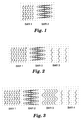
- FIG. 1 is a two bar Raschel knit in which bar one performs a simple chain stitch and bar two performs lapping motions to lay in yarn.
- FIG. 2 is a three bar Raschel knit in which bar one performs a simple chain stitch and bars two and three perform lapping motions to lay in yarn, and wherein bar three illustrates the lay in of an elastomeric yarn.
- FIG. 3 is a four bar Raschel knit in which bar one performs a simple chain stitch and bars two, three and four perform lapping motions to lay in yarn, and wherein bar four illustrates the lay in of an elastomeric yarn.
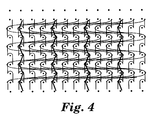
- FIG. 4 is a depiction of a three bar Raschel knit in which bar one performs a simple chain stitch, bar two performs lapping motion to lay in yarn, and bar three performs lapping motions to lay in an elastomeric yarn. The bars are depicted in a overlapping view.
- FIG. 5 is a depiction of a three bar "latch hook” Raschel knitter in which four needles are shown knitting four chain stitches and two guidebars providing lay-in yarns.
- a "compound needle” Raschel knitter which is not shown.
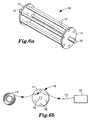
- FIG. 6 is a depiction of a "beater bar" apparatus comprising a plurality of vibrational elements.
- a "beater bar" apparatus comprising a plurality of vibrational elements.
- any suitable means to transmit a vibratory motion to the knit fabric might be employed.
- the present invention relates to orthopedic casting materials and methods for preparing such orthopedic casting materials, wherein the materials comprise a fiberglass backing or fabric which is impregnated with a curable or hardenable liquid resin.
- the fabrics employed in the present invention have important characteristics and physical properties which allow the fabrics to be made highly extensible.
- One element of this invention is a flexible sheet upon which a curable or hardenable resin can be coated to reinforce the sheet when the resin is cured or hardened thereon.
- the sheet is preferably porous such that the sheet is at least partially impregnated with the resin.
- suitable sheets are knit fabrics comprised of inorganic fibers or materials such as fiberglass.
- the sheet may alternatively be referred to as the "scrim" or the "backing.”
- the present invention involves compacting a fabric sheet using an elastomeric yarn and a vibration process to impart stretchability and conformability to the fabric while minimizing undesirable recovery forces.
- Suitable fabrics, after compaction, have important characteristics and physical properties which allow the fabrics to be loaded with resin to the extent needed to provide proper strength as an orthopedic casting material, while providing necessary porosity as well as improved extensibility leading to improved conformability, tactile manipulability, moldability, and palpability.
- Several important criteria for choosing a fabric which will provide the characteristics necessary for purposes of the present invention include: (1) lengthwise extensibility and conformability after compaction, and the related characteristics of moldability, tactility, and palpability once the fabric has been resin impregnated; (2) resin loading capacity; and (3) porosity. It is important that each of these parameters be carefully controlled in providing fabrics which will successfully form orthopedic casting materials (e.g., casts having high strength and good layer-to-layer lamination strength) within the scope of the present invention.
- Extensibility is important from the standpoint that the fabric must be extensible enough along its length, i.e., in the elongated direction, so that the resultant orthopedic casting material can be made to substantially conform to the body part to which it is applied. Materials which are not sufficiently extensible in the elongated direction do not conform well to the body part when wrapped therearound, often resulting in undesirable wrinkles or folds in the material. On the other hand, the extensibility of the fabric in the elongated direction should not be so high that the material is too stretchy, resulting in a material structure which may be deformed to the extent that strength is substantially reduced.
- the coated fabric after compaction and after being coated with a curable liquid resin, should have from about 10% to about 200% extensibility in the elongated direction when a 2.63 N load or force is applied per 1 cm wide section of the fabric, and preferably from about 25% to about 75% extensibility in the elongated direction when a 2.63 N load or force is applied per 1 cm wide section of the fabric, and more preferably from about 35% to about 65% extensibility in the elongated direction when a 2.63 N load or force is applied per 1 cm wide section of the fabric.
- the fabric employed have some extensibility along its width, i.e., in the direction transverse to the elongated direction.
- the fabric may have from 0% to 100% extensibility in the transverse direction, it is presently preferable to use a fabric having from about 1% to about 30% extensibility in the transverse direction when a 2.63 N load or force is applied per 1 cm wide section of the fabric.
- the compaction process described herein principally imparts extensibility in the elongated direction. However, it is anticipated that one might compact a fabric in the elongated direction and in the transverse direction, thereby imparting biaxial extensibility.
- the fabrics of the present invention after compaction, although stretchable, are preferably not overly elastic or resilient. Fabrics which are overly elastic, when used as backings for orthopedic bandages, tend to cause undesirable constriction forces around the wrapped limb or body part. Thus, once the resin impregnated fabric has been stretched and applied around a body part, the stretched material preferably maintains its shape and does not resort back to its unstretched position.
- the resin loading capacity or ability of the fabric to hold resin is important from the standpoint of providing an orthopedic casting material which has sufficient strength to efficaciously immobilize a body part.
- the surface structure of the fabric, including the fibers, interstices, and apertures, is very important in providing proper resin loading for purposes of the present invention.
- the interstices between the fibers of each fiber bundle must provide sufficient volume or space to hold an adequate amount of resin within the fiber bundle to provide the strength necessary; while at the same time, the apertures between fiber bundles preferably remain sufficiently unoccluded such that adequate porosity is preserved once the cast is applied.
- the interstices between fibers are important in providing the necessary resin loading capacity, while the apertures are important in providing the necessary porosity for the finished cast.
- the coated fabric should have preferably between about 6 and 70 openings (i.e., apertures) per square cm, more preferably between about 10 and 50 openings per square cm, and most preferably between about 20 and 40 openings per square cm when measured under a tensile load of 2.63 N/cm width.
- openings is defined as the area defined by adjacent wales and inlay members. The number of openings per unit area is therefore determined by multiplying the number of wales by the number of courses and dividing by the area.
- a "compacted" fiberglass sheet is one in which extensibility is imparted to the fabric due to the structural overlapping of successive loops and/or the structural relaxation of loops by the “vibration compaction” processes described herein.
- the compaction process is believed to impart extensibility to the fabric by "compacting" the loops of the knit as described herein.
- the inside surfaces of two adjacent rows of loops are in contact or nearly in contact and the loops are distorted in the lengthwise direction (e.g., in the shape of an oval). This contact and/or distortion is the result of the fabric being under tension while the knit is being formed.
- Each successive row of loops (i.e., chain stitches) is, in effect, formed against the preceding row of loops.
- the compaction process of the present invention imparts fabric compaction by overlapping adjacent rows of loops (i.e., to a "non-contacting" position) and/or relaxing the strained loops to a lower stress (e.g., more circular) configuration and setting or annealing the fabric in the compacted form. Extensibility is imparted to the fabric due to the overlap of the rows and/or the greater ability of the more circular loops to be deformed.
- the loops can return to their original "contacting" position, i.e., the position they occupied when originally knit.
- Raschel and tricot Raschel knitting is described in "Raschel Lace Production” by B. Wheatley (published by the National Knitted Outerwear Association, 51 Madison Avenue, New York, N.Y. 10010) and “Warp Knitting Production” by Dr. S. Raz (published by Heidelberger Verlagsanstadt und Druckmaschine GmbH, Hauptstr. 23, D-6900 Heidelberg, Germany).
- Two, three and four bar Raschel knits can be produced by regulating the amount of yarn in each stitch.
- Orthopedic casting tape fabrics are generally two bar Raschel knits although extra bars may be employed.
- Factors which affect the extensibility of fiberglass Raschel knits are the size of the loops in the "chain” stitch, especially in relation to the diameter(s) of the yarn(s) which passes through them, and the amount of a loose yarn in the "lay-in” or "laid-in” stitch(es). If a chain loop is formed and two strands of lay-in yarn pass through it which nearly fill the loop, then the loop resists deformation and little stretch will be observed. Conversely, if the lay-in yarns do not fill the loop, then application of tension will deform the loop to the limits of the lay-in yarn diameter and stretch will be observed.
- FIG. 1 is a two bar Raschel knit in which bar one performs a simple chain stitch and bar two performs lapping motions to lay in yarn.
- FIG. 2 is a three bar Raschel knit in which bar one performs a simple chain stitch and bars two and three perform lapping motions to lay in yarn, and wherein bar three illustrates the lay in of an elastomeric yarn.
- FIG. 3 is a four bar Raschel knit in which bar one performs a simple chain stitch and bars two, three and four perform lapping motions to lay in yarn, and wherein bar four illustrates the lay in of an elastomeric yarn.
- FIG. 4 is a depiction of a three bar Raschel knit in which bar one performs a simple chain stitch, bar two performs lapping motion to lay in yarn, and bar three performs lapping motions to lay in an elastomeric yarn. The bars are depicted in a overlapping view.
- FIG. 5 is a depiction of a three bar "latch hook” Raschel knitter in which four needles are shown knitting four chain stitches and two lay-in stitches.
- a "compound needle” Raschel knitter which is not shown.
- Fig 2 may be modified by employing fewer or more elastomeric yarns.
- the elastomeric yarn may be laid in one or more of the wales of the fabric or more than one elastomeric yarn may be laid in a single wale.
- the fabrics of the present invention are knit ordinarily using a 3 bar construction although constructions with greater than 3 bars are possible.
- the "front bar” may contain a high modulus yarn, e.g., a fiberglass yarn, and form the chain stitch.
- a "back bar” may contain a high modulus yarn and form the lay-in stitch that may transverse 1 to 10 needles but preferably traverses 2 to 6 needles and most preferably 3 to 4 needles.
- An organic elastomeric yarn is normally inserted as an additional in-lay using a "middle bar”. Note also that it is possible to insert the elastomeric yarn using the back bar and make the fiberglass in-lay stitch using the middle bar. This is not preferred, however, due to the rougher texture of the fabric produced.
- the elastomeric yarn is laid in under tension (i.e., stretched) such that when the fabric comes off the knitting machine an internal compaction force is generated due to contraction of the elastic yarn.
- the fabric selected (preferably fiberglass), in addition to having the extensibility requirement noted above, should be of a suitable thickness and mesh size to insure good penetration of the curing agent (e.g., water) into the roll of resin-coated tape and to provide a finished cast with adequate strength and porosity.
- the curing agent e.g., water
- Such fabric parameters are well-known to those skilled in the art and are described in U.S. Pat. No. 4,502,479.
- the present invention is to a method of compacting high modulus knits by the "vibration compaction" processes described herein to achieve a highly extensible high strength fabric. It is presently believed that this process will work for a variety of high modulus materials including fiberglass, ceramic fibers such as NextelTM, and polyaramides fibers such as KevlarTM. While not being bound to any theory, the process is believed to result in fabric compaction due to, in part, the high modulus yarns moving to a lower stress configuration as a result of the vibration of the fabric and the release of the tension of the stretched elastomeric yarns.
- fiberglass fabrics typically have oval shaped loops in the wale stitch resulting from the tension applied by the take up rollers when removing the fabric from the needle bed.
- the "vibration compaction” process comprises the steps of: knitting a high modulus yarn and a stretched elastomeric yarn to form a fabric comprising adjacent rows of loops; releasing the tension on the elastomeric yarn; vibrating the fabric to uniformly compact the fabric; and heat setting the fabric thereby removing the elastomeric yarn.
- suitable elastomeric yarns are made of fibers which combust at temperatures lower than the degradation temperature of the inorganic fibers (e.g., glass fibers) of the fabric.
- the combustion temperatures of the elastomeric yarn are less than or equal to the temperature commonly used for heat setting fiberglass yarns. More preferably the combustion temperature of the elastomeric yarn is between about 200 °C and 540 °C. Most preferably the combustion temperature of the elastomeric yarn is between about 300 °C and 500 °C. Heating the fabric to temperatures above about 540 °C should be avoided as subjecting the fiberglass to temperatures of greater than about 540 °C can weaken the fiberglass yarns in the fabric which may result in reduced strength of casts made from such fabrics.
- Suitable elastomeric yarns for use in the present invention include yarns which when present in a sufficient quantity are capable of compacting the fabric.
- Preferred elastomeric yarns are between 70 and 800 denier but are more preferably between 200 and 600 denier and most preferably between 350 and 550 denier.
- the elastomeric yarn may be any yarn which when incorporated into the knit generates a sufficient contraction force to compact the fabric.
- Suitable elastomeric yarns include synthetic elastomers or natural elastomers.
- Suitable synthetic elastomers include yarns made from: polybutadiene; polychloroprene; polyisoprene; polyurethane (e.g., aliphatic or aromatic polyurethanes including commercial materials such as SpandexTM and LycraTM); copolymers of chloroprene and other monomers; copolymers of a diene and styrene; copolymers of a diene and acrylonitrile; copolymers of styrene and acrylonitrile; copolymers and block copolymers of styrene and butadiene; copolymers and block copolymers of styrene and isoprene; terpolymers of styrene, butadiene and isoprene (e.g., KratonTM); and ethylene propylene elast
- Suitable natural elastomers include yarns made from natural rubber. Preferred yarns are inexpensive and have a high force to weight ratio and low heats of combustion. Preferred yarns include polyurethane yarns and natural rubber yarns. The most preferred yarns are polyurethane yarns.
- the elastomeric yarn(s) may be knit into the fabric either as a lay-in stitch or as a chain stitch.
- the elastomeric yarn is knit into the fabric as a lay-in stitch.
- the essential requirements of an elastomeric yarn are that it be capable of knitting with the fabric yarn and that it compact the fabric. Therefore, when the tension on the elastomeric yarn is released and the fabric vibrated and then the elastomeric yarn combusted, e.g., through application of heat, the fabric remains present in the form of a compacted, heat set fabric.
- the elastomeric yarn is preferably knit into the fabric such that the knit is compacted at least 10%, more preferably at least 14 %, and most preferably at least 18%.
- the elastomeric yarn When the elastomeric yarn is present as laid-in yarns it is preferably knitted through a single wale.
- This embodiment is illustrated, for example, in Figure 2.
- a third bar is depicted knitting an elastomeric yarn across a single chain stitch (bar 1). Additional lay-in yarns are knitted into the fabric using bar 2.
- the elastic yarn may be in-laid "in-phase” or "out-of-phase” with respect to the fiberglass in-lay.
- the elastomeric yarn is in-laid in-phase with respect to the fiberglass in-lay. This orientation has been found to produce fabrics with fewer compaction defects.
- the elastomeric yarn may cross more than one chain stitch. It is believed that this embodiment will produce a fabric with biaxial compaction.
- the elastomeric yarn should be positioned in the knit so as to minimize the amount required and maximize the force generated during contraction. If the yarn is placed in as a wale in addition to the fiberglass wales (i.e., as an additional wale since after desizing some wales would need to be present) a significant amount of organic material is added which could result in a brittle tape after heat treatment. If the yarn is placed as a lay-in and maximum lengthwise compaction is desired then the yarn is preferably laid in across a single needle in order to ensure that most of the shrinkage force of the laid-in yarn is used to compact the tape in the length direction.
- the elastomeric yarn may be knitted through each wale (not shown in Fig 2) or through fewer than all the wales (as shown in Fig 2). Notably, there need not be an elastomeric yarn for every wale.
- the elastomeric yarn need only be present in the fabric in an amount sufficient to give the desired compaction to the fabric when the yarn is relaxed and the fabric vibrated. It has been found that knitting the elastomeric yarn through every third or fourth wale is preferred. Having too many elastomeric yarns increases the potential for undesirable localized heating of the fiberglass during the combustion step. Having too few elastomeric yarns results in uneven compaction or inadequate compaction.
- elastomeric yarns The exact number of elastomeric yarns needed will depend upon the fabric weight and knit pattern employed, the weight and tensile properties of the elastomeric yarn employed, and the desired amount of compaction. In general, for typical fiberglass fabrics the elastomeric yarns are preferably laid in every second to every sixth wale and most preferably every third or fourth wale.
- the elastomeric yarn may also be in the form of a chain stitch yarn.
- a chain stitch yarn When the elastomeric yarn is knitted in the form of a chain stitch it is preferable to lay in noncombustible yarns (e.g., fiberglass yarns) across the elastomeric chain stitch yarn and thereby connect adjacent noncombustible chain stitches.
- noncombustible yarns e.g., fiberglass yarns
- the fabric is vibrated. Any suitable vibration method may be employed so long as the vibration does not overly damage the relatively fragile fiberglass yarns. For example, it is preferred that rough surfaces or surfaces with edges that can "snag" the fabric be avoided. It is preferred that objects that contact the fabric to impart vibration have generally smooth surfaces and/or dull or rounded edges.
- a presently preferred method of vibration consists of passing the fabric over a rotating "beater bar”. A preferred beater bar is illustrated in Figure 6.
- the beater bar may be of any suitable diameter and may contain any number of vibrational elements 10 so long as the vibration imparted to the fabric is sufficient to ensure uniform and complete compaction.
- the rotational speed of the beater bar will depend on the geometry and number of vibrational elements.
- a preferred beater bar (see Ex. 1) rotates at 300 to 400 rpm.
- the beater bar preferably rotates in the direction of fabric movement to assist in forcing the knit elements together.
- a length of fabric is heat-set while the fabric is in a compacted form.
- the fabric is compacted and then wound onto a cylindrical core so large batches ("jumbo rolls") can be heat set at one time in a single oven. Care must be taken to avoid applying undue tension to the fabric (particularly after combustion of the elastomeric yarn and before the heat set has occurred) which would distort the knots and loops.
- the fabric is preferably surface wound using a winder which isolates the weight of the fabric from the winding process.
- a preferred winder uses a center shaft to support the roll.
- Additional layers of fabric are added to the roll by a surface winding element (i.e., a roller which contacts the outer edge of the fabric roll).
- the surface winding element rotates thereby rotating the fabric roll. This is in contrast to a winder which merely drives the center shaft of the fabric roll.
- the jumbo roll can be placed in the oven on its side (i.e., one edge of the cylinder down). This orientation minimizes "tear dropping" of the roll, i.e., sagging of the fabric, which distorts the round roll.
- the jumbo roll can be otherwise supported to prevent such sagging.
- a continuous heat-setting process may also be used in which a length of fabric is first compacted by the vibration process described herein and then the compacted fabric is supported on a moving conveyor system and passed through an oven for a sufficient time and temperature to achieve heat setting of the fabric.
- the ends of the elastomeric yarn should be held in relation to the ends of the fiberglass yarns so as to cause compaction. Otherwise the elastomeric yarns may merely slip against the fabric as they relax and not cause compaction of the knit fabric.
- the heat-setting step may be performed in a number of conventional ways known to the art.
- a temperature of 425 °C for three minutes has been found to be sufficient.
- Equivalent setting at lower temperatures is possible, but longer time is required.
- batch processes require a longer residence time at the selected temperature due to the mass of glass fabric which must be heated and the need to remove all traces of sizing material which may undesirably color the final fabric.
- a preferred heat desizing cycle raises the oven temperature to about 430°C and maintains that temperature until the tape is clean (e.g., about 6-8 hours in a recirculating oven).
- the tape's temperature is affected by both the heat of the oven and the heat of combustion resulting from burning the sizing and/or any organic yarn (i.e., the elastomeric yarn) which may be present.
- Controlling the exotherm from organic material in the knit is essential and can be accomplished most easily and economically by limiting the total amount of added organic material (e.g., sizing and elastomeric yarn) which must be removed.
- organic material e.g., sizing and elastomeric yarn
- a sizing is preferably present.
- the amount of sizing utilized is the minimum level necessary to prevent damage during knitting.
- a preferred amount of sizing is between 0.75 and 1.35% (based on weight of the fabric).
- an elastomeric yarn is added to the fabric. Since this yarn adds substantially to the total level of organic material in the fabric it is important to limit the amount added. This can be accomplished by several methods.
- the knit has an elastomeric yarn in-laid across the tape only in wales spaced 2 to 6 needles apart.
- the knit has an elastomeric yarn in-laid across the tape only in wales spaced 3 to 4 needles apart. Normally, the spacing is uniform across the web but since the preferred pattern used crosses only a single needle it can be varied without modification to the knitting machine.
- the denier of the elastomeric yarn Preferably, the lowest denier yarn which when stretched has sufficient tensile force to compact the tape should be used.
- the preferred elastomeric yarns are about 100 to 500 denier, more preferably about 200 to 300 denier measured in the relaxed condition.
- the elastomeric yarns are knit into the fabric under tension.
- the yarns are stretched between 50 and 600% during knitting, more preferably the yarns are stretched between 100 and 500%, and most preferably the yarns are stretched between 200 and 400%.
- the fabric is preferably cooled prior to application of the resin.
- the resin selected to apply to the heat-set fabric is dictated by the end-use of the product.
- suitable resins are well-known and described for example, in U.S. Pat. Nos. 4,376,438; 4,433,680; 4,502,479; and 4,667,661.
- the presently most preferred resins are the moisture-curable isocyanate-terminated polyurethane prepolymers described in the aforementioned patents.
- one may employ one of the resin systems described herein.
- the amount of such resin applied to the fiberglass tape to form an orthopedic casting material is typically an amount sufficient to constitute 35 to 50 percent by weight of the final "coated” tape.
- coated or “coating” as used herein with respect to the resin refers generically to all conventional processes for applying resins to fabrics and is not intended to be limiting.
- the heat set fabrics of this invention are preferably coated with a curable resin using a low tension coating process. It is particularly critical to avoid applying tension to the fabric after the resin has been applied to the tape and allowed to wet into the fabric as the resin may act as a lubricant thereby facilitating movement of the fabric yarns.
- the tension on the fabric is kept below 0.05 N/mm width after coating and wetting with the resin. More preferably, the tension on the fabric is kept below 0.017 N/mm width after coating and wetting with the resin.
- Prior to coating with the resin higher tensions may be used since the frictional forces required to move the yarns relative to one another are higher.
- the preferred coating methods are those which require no tension and/or wound up very rapidly after the resin coating is applied.
- a fiberglass fabric which further comprises a plurality of elastomeric yarns is knit and compacted according to the process described herein, and then heat set in the compacted form while also removing the elastomeric yarns.
- the compacted fabric is then coated with a curable resin.
- the fabric produced by this method has increased extensionability.
- the elastomeric yarn when in its unstretched state, provides support to the fabric during subsequent collecting operations (such as when winding a large jumbo roll) thereby preventing undesirable extension of the fabric prior to it being heat set.
- the finished fabric of this embodiment comprises only noncombustible yarns and retains its compacted form as a result of the heat setting of the fiberglass yarns.
- Suitable fabrics after compaction, are compacted to between about 30 and 90 percent of their original dimension. More preferably, the fabric is compacted to between about 50 and 80 percent of its original dimension. Most preferably, the fabric is compacted to between about 60 and 75 percent of its original dimension.
- the curable or hardenable resins useful in this invention are resins which can be used to coat a sheet material and which can then be cured or hardened to reinforce the sheet material.
- the resin is curable to a crosslinked thermoset state.
- the preferred curable or hardenable resins are fluids, i.e., compositions having viscosities between about 5 Pa s and about 500 Pa s, preferably about 10 Pa s to about 100 Pa s.
- the resin used in the casting material of the invention is preferably any curable or hardenable resin which will satisfy the functional requirements of an orthopedic cast.
- the resin must be nontoxic in the sense that it does not give off significant amounts of toxic vapors during curing which may be harmful to either the patient or the person applying the cast and also that it does not cause skin irritation either by chemical irritation or the generation of excessive heat during cure.
- the resin must be sufficiently reactive with the curing agent to insure rapid hardening of the cast once it is applied but not so reactive that it does not allow sufficient working time to apply and shape the cast. Initially, the casting material must be pliable and formable and should adhere to itself.
- the material must undergo a change of state from a fluid-like condition to a solid condition in a matter of minutes.
- the preferred resins are those cured with water.
- urethane resins cured by the reaction of a polyisocyanate and a polyol such as those disclosed in U.S. Patent No. 4,131,114.
- a number of classes of water-curable resins known in the art are suitable, including polyurethanes, cyanoacrylate esters, epoxy resins (when combined with moisture sensitive catalysts), and prepolymers terminated at their ends with trialkoxy- or trihalosilane groups.
- U.S. Pat. No. 3,932,526 discloses that 1,1-bis(perfluoromethylsulfonyl)-2-aryl ethylenes cause epoxy resins containing traces of moisture to become polymerized.
- Resin systems other that those which are water-curable may be used, although the use of water to activate the hardening of an orthopedic casting tape is most convenient, safe and familiar to orthopedic surgeons and medical casting personnel.
- Resin systems such as that disclosed in U.S. Patent No. 3,908,644 in which a bandage is impregnated with difunctional acrylates or methacrylates, such as the bis-methacrylate ester derived from the condensation of glycidyl methacrylate and bisphenol A (4,4'-isopropylidenediphenol) are suitable.
- the resin is hardened upon wetting with solutions of a tertiary amine and an organic peroxide.
- the water may contain a catalyst.
- 3,630,194 proposes an orthopedic tape impregnated with acrylamide monomers whose polymerization is initiated by dipping the bandage in an aqueous solution of oxidizing and reducing agents (known in the art as a redox initiator system).
- oxidizing and reducing agents known in the art as a redox initiator system.
- the strength, rigidity and rate of hardening of such a bandage is subjected to the factors disclosed herein.
- hardenable polymer dispersions such as the aqueous polymer dispersion disclosed in U.S. Patent No. 5,169,698 may be used in the present invention.
- Some presently more preferred resins for use in the present invention are water-curable, isocyanate-functional prepolymers. Suitable systems of this type are disclosed, for example, in U.S. Patent No. 4,411,262, and in U.S. Patent No. 4,502,479. Preferred resin systems are disclosed in U.S. Patent No. 4,667,661 and U.S. Patent Application Serial No. 07/376,421. The following disclosure relates primarily to the preferred embodiment of the invention wherein water-curable isocyanate-functional prepolymers are employed as the curable resin.
- a water-curable isocyanate-functional prepolymer as used herein means a prepolymer derived from polyisocyanate, preferably aromatic, and a reactive hydrogen compound or oligomer.
- the prepolymer has sufficient isocyanate-functionality to cure (i.e., to set or change from a liquid state to a solid state) upon exposure to water, e.g., moisture vapor, or preferably liquid water.
- Suitable isocyanates include 2,4-toluene diisocyanate, 2,6-toluene diisocyanate, mixture of these isomers, 4,4'-diphenylmethane diisocyanate, 2,4'-diphenylmethane diisocyanate, mixture of these isomers together with possible small quantities of 2,2'-diphenylmethane diisocyanate (typical of commercially available diphenylmethane diisocyanate), and aromatic polyisocyanates and their mixtures such as are derived from phosgenation of the condensation product of aniline and formaldehyde.
- Typical polyols for use in the prepolymer system include polypropylene ether glycols (available from Arco Chemical Co.
- An example of a resin useful in the casting material of the invention uses an isocyanate known as IsonateTM 2143L available from the Upjohn Company (a mixture containing about 73% of MDI) and a polypropylene oxide polyol from Arco known as ArcolTM PPG725. To prolong the shelf life of the material, it is preferred to include from 0.01 to 1.0 percent by weight of benzoyl chloride or another suitable stabilizer.
- the reactivity of the resin once it is exposed to the water curing agent can be controlled by the use of a proper catalyst.
- the reactivity must not be so great that: (1) a hard film quickly forms on the resin surface preventing further penetration of the water into the bulk of the resin; or (2) the cast becomes rigid before the application and shaping is complete.
- Good results have been achieved using 4-[2-[1-methyl-2-(4-morpholinyl)ethoxy]ethyl] morpholine (MEMPE) prepared as described in U.S. Pat. No. 4,705,840 at a concentration of about 0.05 to about 5 percent by weight.
- Foaming of the resin should be minimized since it reduces the porosity of the cast and its overall strength. Foaming occurs because carbon dioxide is released when water reacts with isocyanate groups.
- One way to minimize foaming is to reduce the concentration of isocyanate groups in the prepolymer. However, to have reactivity, workability, and ultimate strength, an adequate concentration of isocyanate groups is necessary. Although foaming is less at low resin contents, adequate resin content is required for desirable cast characteristics such as strength and resistance to peeling.
- the most satisfactory method of minimizing foaming is to add a foam suppressor such as silicone Antifoam A (Dow Corning), or Antifoam 1400 silicone fluid (Dow Corning) to the resin.
- a silicone liquid such as Dow Corning Antifoam 1400 at a concentration of about 0.05 to 1.0 percent by weight.
- Water-curable resins containing a stable dispersion of hydrophobic polymeric particles such as disclosed in U.S. Patent Application Ser. No. 07/376,421 and laid open as European Published Patent Application EPO 0 407 056, may also be used to reduce foaming.
- non-isocyanate resins such as water reactive liquid organometallic compounds. These resins are especially preferred as an alternative to isocyanate resin systems.
- Water-curable resin compositions suitable for use in an orthopedic cast consist of a water-reactive liquid organometallic compound and an organic polymer.
- the organometallic compound is a compound of the formula (R1O) x MR2 (y-x) wherein: each R1 is independently a C1-C100 hydrocarbon group, optionally interrupted in the backbone by 1-50 nonperoxide -O-, -S-, -C(O)-, or groups; each R2 is independently selected from the group consisting of hydrogen and a C1-C100 hydrocarbon group, optionally interrupted in the backbone by 1-50 nonperoxide -O-, -S-, -C(O)-, or groups; x is an integer between 1 and y, inclusive; y is the valence of M; and M is boron, aluminum, silicon, or titanium.
- the organic polymer is either an addition polymer or a condensation polymer.
- Addition polymers are preferably utilized as the organic polymer constituent.
- Particularly useful addition polymers are those made from ethylenically unsaturated monomers.
- Commercially available monomers, from which such addition polymers can be formed include but are not limited to, ethylene, isobutylene, 1-hexene, chlorotrifluoroethylene, vinylidene chloride, butadiene, isoprene, styrene, vinyl napthalene, ethyl acrylate, 2-ethylhexyl acrylate, tetrahydrofurfuryl acrylate, benzyl acrylate, poly(ethylene oxide) monoacrylate, heptafluorobutyl acrylate, acrylic acid, methyl methacrylate, 2-dimethylaminoethyl methacrylate, 3-methacryloxypropyltris(trimethylsiloxy)silane, isobut
- alkoxysilane terminated resins i.e., prepolymers or oligomers, having a number average molecular weight of about 400-10,000, preferably about 500-3,000.
- a polymer forms upon contacting the alkoxysilane terminated prepolymer with water as a result of condensation of molecules of this prepolymer with other molecules of the same prepolymer.
- Each molecule of the prepolymer or oligomer contains at least one hydrolyzable terminal alkoxysilane group.
- Compounds of Formula I useful in the resin compositions of the present invention may contain one to six terminal alkoxysilane groups per molecule.
- the alkoxysilane terminated resin is a urethane-based resin, i.e., a prepolymer containing -NH-C(O)-O-group(s), or a urea resin, i.e., a prepolymer containing group(s), or a resin containing both urea and urethane groups. More preferably, the resin is urea/urethane-based.
- the water-reactive alkoxysilane terminated resin having at least one hydrolyzable terminal alkoxysilane group per molecule is preferably a compound of the formula (Formula I): wherein: Q is a polyol residue; W is -NH-C(O)-X(R2 2-n-q )- or -X-C(O)-NH-; X is -O-, or -S-; Y is -O-, -S-, carbamylthio (-S-C(O)-NH-), carbamate (-O-C(O)-NH-), or substituted or N-substituted ureido (-N(C(O)-NH-)-); R1 is a substituted or unsubstituted divalent bridging C1-C200 hydrocarbon group, optionally interrupted in the backbone by 1-50 nonperoxide -O-, -C(O)-, -S-, -SO2-, -NR
- each "R3-Si(R5) 3-m (OR4) m " moiety can be the same or different.
- the Y and R1 groups that are not symmetric, e.g., amide (-C(O)-NH-) and carbamylthio (-S-C(O)-NH-) groups are not limited to being bound to adjacent groups in the manner in which these groups are represented herein. That is, for example, if R1 is carbamate (represented as -O-C(O)-NH-), it can be bound to Y and W in either of two manners: -Y-O-C(O)-NH-W- and -W-O-C(O)-NH-Y-.
- each R5 and R7 is “independently” some substituent group, it is meant that generally there is no requirement that all R5 groups be the same, nor is there a requirement that all R7 groups be the same.
- substituted means that one or more hydrogen atoms are replaced by a functional group that is nonreactive, e.g., to hydrolysis and/or condensation and noninterfering with the formation of the cured polymer.
- R1 is selected from the group consisting of a substituted or unsubstituted C1-C200 alkyl, a substituted or unsubstituted C1-C200 acyl, and groups of up to 50 multiples of a C3-C18 cycloalkyl, a C7-C20 aralkyl, and a C6-C18 aryl.
- R1 can be a long chain containing, for example, up to 50 repeating C6-C18 aryl groups.
- R1 is selected from the group consisting of a substituted or unsubstituted C1-C100 alkyl, a substituted or unsubstituted C1-C100 acyl, and groups of up to 30 multiples of a C5-C8 cycloalkyl, and a C6-C10 aryl. Most preferably, R1 is selected from the group consisting of a C1-C20 alkyl, a C1-C8 acyl, and groups of up to 5 multiples of a C5-C8 cycloalkyl, and a C6-C10 aryl.
- the backbone is optionally interrupted by 1-20 nonperoxide -O-, -C(O)-, -S, -SO2-, -NR6-, amide, ureido, carbamate, carbamylthio, allophonate, biuret, and isocyanurate groups.
- the backbone is optionally interrupted by 1-10 nonperoxide -O-, -C(O)-, -S-, -SO2-, -NR6-, amide, ureido, carbamate, carbamylthio, allophonate, biuret, and isocyanurate groups.
- the backbone of each of the R1 groups is not interrupted by any of these groups.
- each of R2 and R3 is independently selected from the group consisting of a substituted or unsubstituted C1-C20 alkyl, a substituted or unsubstituted C2-C18 alkenyl, and groups of up to 10 multiples of a C3-C18 cycloalkyl and a C6-C18 aryl. More preferably, each R2 and R3 is independently selected from the group consisting of a substituted or unsubstituted C1-C10 alkyl, a substituted or unsubstituted C2-C10 alkenyl, a C5-C8 cycloalkyl, and a C6-C10 aryl.
- each R2 and R3 is independently selected from the group consisting of a C1-C6 alkyl, a C2 alkenyl, a C5-C8 cycloalkyl, and a C6 aryl.
- the backbone is optionally interrupted by 1-5 nonperoxide -O-, -C(O)-, -S-, -SO2-, and -NR6- groups. In optimal resins, the backbone of each of the R2 and R3 groups is not interrupted by any of these groups.
- each of R4, R5, R6, and R7 is independently a C1-C6 alkyl group. More preferably, each is a C1-C3 alkyl group.
- a single prepolymer according to Formula I can be used in the resin composition of the present invention. Alternatively, a mixture of several different prepolymers according to Formula I can be used in the resin composition.
- the scrims of the present invention are coated with a resin which incorporates microfiber fillers.
- resins which incorporate microfiber fillers exhibit: a dramatic increase in strength when coated on the backings of the present invention; an increased "early strength" upon curing; an improved durability and increased modulus; better layer-to-layer lamination strength; a lower exotherm upon setting; and a lower effective resin cost compared to resins which do not incorporate such microfiber fillers.
- resin suspensions employing the microfiber fillers of the present invention exhibit generally very little increase in resin viscosity - thereby ensuring easy unwind of the casting bandage and good handling properties such as drapability.
- Suitable microfibers for use in the present invention include those microfiber fillers disclosed in U.S. Patent Application Serial No. 08/008,755.
- other uses may include wrapping and/or joining pipes, cables or the like; patching or bridging gaps to provide a surface for filling and repairs; etc.
- Ring strength was measured as described in the following procedure.
- a cylindrical ring comprising 6 layers of the resin-coated material was formed by taking a roll of the resin-coated material from its storage pouch and immersing the roll completely in deionized water having a temperature of about 27 °C for about 30 seconds.
- the width of the ring formed was the same as the width of the resin-coated material employed, namely, 7.62 cm or 10.2 cm.
- the roll of resin-coated material was then removed from the water and the material was wrapped around a 5.08 cm diameter mandrel covered with a thin stockinet (such as 3M Synthetic Stockinet MS02) to form 6 complete uniform layers using a controlled wrapping tension of about 45 grams per centimeter width of material.
- a thin stockinet such as 3M Synthetic Stockinet MS02
- Each cylinder was completely wound within 30 seconds after its removal from the water. After 7 to 20 minutes from the initial immersion in water, the cured cylinder was removed from the mandrel. Ring strength was determined 24 hours after initial immersion in water, i.e., those samples were allowed to cure for 24 hours in a controlled atmosphere of 25°C ⁇ 2°C and 55% ⁇ 5% relative humidity prior to testing.
- each cylinder was then placed in a fixture in a commercial testing machine, e.g., an Instron 1122 instrument, and compression loads were applied to the cylindrical ring sample along its exterior and parallel to its axis.
- the cylindrical ring was placed lengthwise between the two bottom bars of the fixture (the bars being 1.9 cm wide, 1.3 cm in height, and 15.2 cm long), with the bars spaced about 4 cm apart.
- the inside edges of the bars were machined to form a curved surface having a 0.31 cm radius.
- a third bar (0.63 cm wide, 2.5 cm high, and 15.2 cm long) was then centered over the top of the cylinder, also parallel to its axis.
- the bottom or contacting edge of the third bar was machined to form a curved surface having a 0.31 cm radius.
- the third bar was brought down to bear against and crush the cylinder at a speed of about 5 cm/min.
- the maximum force which was applied while crushing the cylinder was then recorded and divided by the width to yield the "ring strength," which in this particular instance is the “dry strength” (expressed in terms of force per unit length of the cylinder, i.e., newtons/cm).
- dry strength expressed in terms of force per unit length of the cylinder, i.e., newtons/cm
- a knit fiberglass fabric (of 76 mm or 102 mm width) containing Cleerspan S-5 490 denier elastomeric yarn was produced with the following parameters: PPG fiberglass ECG 75 1/0 0.7 Z (available from PPG Fiberglass, Pittsburgh, PA); Cleerspan S-5 490 denier elastomeric yarn (available from Globe Manufacturing, Fall River, MA); Mayer Raschel knitter 229 cm 18 gauge (7.1 needles/cm); knit pattern: 2/0, 0/2 (front bar); 0/0, 2/2 (middle bar); and 0/0, 8/8 (back bar); thread up: front and back - full, middle bar: single needle in-lay spaced every third wale; front runner length (fiberglass chain stitch) 419 cm; back runner length (fiberglass lay-in stitch traversing 4 needles) 350 cm; middle bar runner length (elastomeric lay-in stitch traversing one needle) 24.1 cm.
- the elastomeric yarn was in-laid in phase with the fiberglass inlay and across a single needle in an alternating pattern of: one wale in and the next two wales out. More specifically, the middle bar was threaded so that the elastomeric yarn was placed in every third wale beginning at the second wale from the edge of the fabric. With a runner length of 24.1 cm the elastomeric yarn was elongated approximately 300 to 400 percent during knitting.
- the aforementioned knit fabric 13 after exiting the knitter 15 was wrapped around the rotating beater bar so as to cover approximately 180 to 220 degrees of the circumference of said bar.
- the knit had a surface speed of approximately 0.9 meters per minute as it came off the beater bar.
- the compacted knit was collected on a center supported surface winder 14 and wound under low tension. Rolls having approximately 166 - 185 linear meters of fabric had a circumference of approximately 41 cm.
- Fabric samples prior to heat setting had elongations (percent stretch) when measured under a 22 N load of 56.9% and 52.5% for the 76 mm and 102 mm fabrics respectively (avg. of 10 samples).
- the percent stretch of the 102 mm fabric is illustrated below in Table 1a.
- the compacted fabric was heat set by hanging the rolls from the center aluminum core and placing the rolls on racks in a recirculated oven.
- the oven was heated to 315°C and held for 3 hours before increasing the temperature to 427°C for 6.5 hours.
- the heat set/compacted fabric was coated with a moisture curable polyurethane resin having a theoretical NCO/OH ratio of 3.84 and an isocyanate equivalent weight of 357 as described in Table 1b.
- the heat set fabric was coated using a very low tension coater. Table 1b Chemical Manufacturer Eqwt. Wt.
- the resin was coated on the 7.6 and 10.2 cm wide fabrics produced as described above at a coating weight of 40% by weight.
- the product was rolled up under low tension on a 1.27 cm diameter polyethylene core into individual rolls having a circumference of approximately 177 mm and were sealed in conventional moisture proof aluminum foil laminate pouches.
- the product was tested for the properties listed below in Table 1c according to the test methods described above. All values are the mean of 10 samples unless otherwise noted.
Landscapes
- Health & Medical Sciences (AREA)
- Animal Behavior & Ethology (AREA)
- Public Health (AREA)
- Heart & Thoracic Surgery (AREA)
- Vascular Medicine (AREA)
- Life Sciences & Earth Sciences (AREA)
- Engineering & Computer Science (AREA)
- General Health & Medical Sciences (AREA)
- Biomedical Technology (AREA)
- Veterinary Medicine (AREA)
- Materials For Medical Uses (AREA)
- Knitting Of Fabric (AREA)
- Treatment Of Fiber Materials (AREA)
- Treatments For Attaching Organic Compounds To Fibrous Goods (AREA)
- Woven Fabrics (AREA)
Applications Claiming Priority (2)
| Application Number | Priority Date | Filing Date | Title |
|---|---|---|---|
| US14217793A | 1993-10-25 | 1993-10-25 | |
| US142177 | 1993-10-25 |
Publications (2)
| Publication Number | Publication Date |
|---|---|
| EP0649643A1 true EP0649643A1 (de) | 1995-04-26 |
| EP0649643B1 EP0649643B1 (de) | 2000-08-09 |
Family
ID=22498854
Family Applications (1)
| Application Number | Title | Priority Date | Filing Date |
|---|---|---|---|
| EP94116691A Expired - Lifetime EP0649643B1 (de) | 1993-10-25 | 1994-10-22 | Vibrationszusammengepresste Stoffe für orthopädische versteifende Bandagen |
Country Status (5)
| Country | Link |
|---|---|
| US (1) | US5553366A (de) |
| EP (1) | EP0649643B1 (de) |
| JP (1) | JPH07178157A (de) |
| CA (1) | CA2117875A1 (de) |
| DE (1) | DE69425466T2 (de) |
Cited By (1)
| Publication number | Priority date | Publication date | Assignee | Title |
|---|---|---|---|---|
| FR2751548A1 (fr) * | 1996-07-29 | 1998-01-30 | Smith & Nephew | Materiaux pour moulages et attelles orthopediques |
Families Citing this family (4)
| Publication number | Priority date | Publication date | Assignee | Title |
|---|---|---|---|---|
| US5733601A (en) * | 1996-04-16 | 1998-03-31 | Cuenod; Ronald P. | Method of and article for applying agent to a substrate |
| US9944763B2 (en) * | 2009-12-01 | 2018-04-17 | Gates Corporation | Polyurea-urethane cord treatment for power transmission belt and belt |
| CN116296698B (zh) * | 2023-05-19 | 2023-10-20 | 中国科学技术大学 | 一种棉纤维定型拆分设备 |
| GB2641218A (en) * | 2024-05-16 | 2025-11-26 | Scott & Fyfe Ltd | Material for use in lining pipes |
Citations (2)
| Publication number | Priority date | Publication date | Assignee | Title |
|---|---|---|---|---|
| US4663106A (en) * | 1984-05-01 | 1987-05-05 | Kimberly-Clark Corporation | Formation of elasticized portions of disposable garments and other articles |
| US5014403A (en) * | 1990-02-07 | 1991-05-14 | Johnson & Johnson Orthopaedics, Inc. | Method of making a stretchable orthopaedic fiberglass casting tape |
Family Cites Families (40)
| Publication number | Priority date | Publication date | Assignee | Title |
|---|---|---|---|---|
| US2765513A (en) * | 1954-12-09 | 1956-10-09 | Richard R Walton | Method of treating textile materials |
| US3077655A (en) * | 1961-05-09 | 1963-02-19 | Stevens & Co Inc J P | Method and apparatus for imparting stretch to wool fabric |
| US3421501A (en) * | 1965-09-22 | 1969-01-14 | Leroy E Beightol | Method and application of orthopedic appliances with an ultraviolet curable plastic impregnated bandage |
| US3793686A (en) * | 1969-12-29 | 1974-02-26 | Carolina Narrow Fabric Co | Method of forming glass fabric suitable for casts, bandages, and the like |
| US3686725A (en) * | 1969-12-29 | 1972-08-29 | Carolina Narrow Fabric Co | Method of forming glass fabric suitable for casts, bandages, and the like |
| US3787272A (en) * | 1969-12-29 | 1974-01-22 | Carolina Narrow Fab Co | Glass fabric suitable for casts, bandages, and the like |
| US3630194A (en) * | 1970-05-22 | 1971-12-28 | Johnson & Johnson | Orthopedic bandage |
| US3932526A (en) * | 1972-10-25 | 1976-01-13 | Minnesota Mining And Manufacturing Company | Fluoroaliphaticsulfonyl substituted ethylenes |
| US3837338A (en) * | 1972-11-24 | 1974-09-24 | Kendall & Co | Conformable nonwoven bandage |
| US3908644A (en) * | 1974-06-24 | 1975-09-30 | Allied Chem | Lightweight orthopedic cast material |
| US4020832A (en) * | 1974-12-24 | 1977-05-03 | Reichhold Chemicals, Inc. | Package and method for preparing orthopedic cast-making materials |
| US3972323A (en) * | 1975-01-31 | 1976-08-03 | Johnson & Johnson | Orthopedic bandage |
| US4041581A (en) * | 1976-10-07 | 1977-08-16 | Compax Corporation | Method for compacting woven gauze bandages |
| DE2651089C3 (de) * | 1976-11-09 | 1980-06-12 | Bayer Ag, 5090 Leverkusen | Selbsthältendes Material für Stutzverbände |
| US4134397A (en) * | 1977-06-02 | 1979-01-16 | Johnson & Johnson | Orthopedic bandage |
| US4411262A (en) * | 1978-04-21 | 1983-10-25 | Bayer Aktiengesellschaft | Constructional material |
| US4502479A (en) * | 1979-09-04 | 1985-03-05 | Minnesota Mining And Manufacturing Company | Water-activated casting material |
| US4433680A (en) * | 1982-02-10 | 1984-02-28 | Johnson & Johnson Products, Inc. | Polyurethane casting material |
| US4704113A (en) * | 1983-05-03 | 1987-11-03 | The Kendall Company | Dressing |
| US4473671A (en) * | 1983-09-01 | 1984-09-25 | Johnson & Johnson Products, Inc. | Formable orthopedic casts and splints |
| US4609578A (en) * | 1984-11-06 | 1986-09-02 | Minnesota Mining And Manufacturing Company | Resin-coated extensible heat-set fiberglass knit tape |
| US4667661A (en) * | 1985-10-04 | 1987-05-26 | Minnesota Mining And Manufacturing Company | Curable resin coated sheet having reduced tack |
| US4705840A (en) * | 1985-10-04 | 1987-11-10 | Minnesota Mining And Manufacturing Company | Catalysts for the curing of a water-curable isocyanate-functional prepolymer |
| US4668563A (en) * | 1986-06-12 | 1987-05-26 | Johnson & Johnson Products, Inc. | Conformable fiberglass casting tape |
| US4745912A (en) * | 1986-11-21 | 1988-05-24 | Mcmurray Fabrics, Inc. | Orthopedic casting bandage |
| US4800872A (en) * | 1987-01-20 | 1989-01-31 | Johnson & Johnson Orthopaedics, Inc. | Ravel-free orthopaedic casting tapes |
| US5060349A (en) * | 1987-04-02 | 1991-10-29 | Richard R. Walton | Compressive treatment of webs |
| GB8708721D0 (en) * | 1987-04-11 | 1987-05-20 | Smith & Nephew Ass | Bandages |
| US4841958A (en) * | 1987-05-05 | 1989-06-27 | Minnesota Mining And Manufacturing Company | Nonwoven orthopedic casting materials with apertures |
| DE3726268A1 (de) * | 1987-06-24 | 1989-01-05 | Bayer Ag | Textiles flaechengebilde mit reaktivharz |
| US4947839A (en) * | 1988-08-18 | 1990-08-14 | Carapace | Orthopedic casting material having reduced tack and reduced slip |
| JP2606803B2 (ja) * | 1988-09-07 | 1997-05-07 | アルケア株式会社 | 整形外科用キヤステイングテープ |
| CA1334640C (en) * | 1988-09-09 | 1995-03-07 | Smith And Nephew Plc | Conformable bandage |
| CA2018589C (en) * | 1989-07-07 | 2002-04-02 | Charles C. Polta | Curable resins with reduced foaming characteristics and articles incorporating same |
| DE3927030A1 (de) * | 1989-08-16 | 1991-02-21 | Johnson & Johnson Medical | Verbundwerkstoff zur verwendung in der medizin |
| US5088484A (en) * | 1990-10-05 | 1992-02-18 | Carolina Narrow Fabric Company | Orthopedic casting bandage |
| US5405643A (en) * | 1993-01-25 | 1995-04-11 | Minnesota Mining And Manufacturing Company | Microcreping of fabrics for orthopedic casting tapes |
| US5382445A (en) * | 1993-01-25 | 1995-01-17 | Minnesota Mining And Manufacturing Company | Mechanically compacted fabrics for orthopedic casting tapes |
| US5354259A (en) * | 1993-01-25 | 1994-10-11 | Minnesota Mining And Manufacturing Company | Microfiber fillers for orthopedic casting tapes |
| US5370927A (en) * | 1993-10-25 | 1994-12-06 | Minnesota Mining And Manufacturing Company | Wet compacting of fabrics for orthopedic casting tapes |
-
1994
- 1994-10-11 CA CA002117875A patent/CA2117875A1/en not_active Abandoned
- 1994-10-19 JP JP6253639A patent/JPH07178157A/ja active Pending
- 1994-10-22 EP EP94116691A patent/EP0649643B1/de not_active Expired - Lifetime
- 1994-10-22 DE DE69425466T patent/DE69425466T2/de not_active Expired - Fee Related
-
1995
- 1995-03-27 US US08/411,013 patent/US5553366A/en not_active Expired - Fee Related
Patent Citations (2)
| Publication number | Priority date | Publication date | Assignee | Title |
|---|---|---|---|---|
| US4663106A (en) * | 1984-05-01 | 1987-05-05 | Kimberly-Clark Corporation | Formation of elasticized portions of disposable garments and other articles |
| US5014403A (en) * | 1990-02-07 | 1991-05-14 | Johnson & Johnson Orthopaedics, Inc. | Method of making a stretchable orthopaedic fiberglass casting tape |
Cited By (1)
| Publication number | Priority date | Publication date | Assignee | Title |
|---|---|---|---|---|
| FR2751548A1 (fr) * | 1996-07-29 | 1998-01-30 | Smith & Nephew | Materiaux pour moulages et attelles orthopediques |
Also Published As
| Publication number | Publication date |
|---|---|
| DE69425466T2 (de) | 2001-04-19 |
| DE69425466D1 (de) | 2000-09-14 |
| JPH07178157A (ja) | 1995-07-18 |
| EP0649643B1 (de) | 2000-08-09 |
| US5553366A (en) | 1996-09-10 |
| CA2117875A1 (en) | 1995-04-26 |
Similar Documents
| Publication | Publication Date | Title |
|---|---|---|
| US5498232A (en) | Microcreping of fabrics for orthopedic casting tapes | |
| US5474522A (en) | Microfiber fillers for orthopedic casting tapes | |
| EP0725610B1 (de) | Zusammengepresste stoffe für orthopädisch versteifende lagen | |
| EP0680527B1 (de) | Rückenbeschichtung für orthopädisches stützmaterial | |
| EP0326285B2 (de) | Bandagen | |
| US5449550A (en) | Mechanically compacted fabrics for orthopedic casting tapes | |
| US5370927A (en) | Wet compacting of fabrics for orthopedic casting tapes | |
| EP0407055A1 (de) | Material für orthopädische Stützverbände mit verbesserten Schichtenbildungseigenschaften und Verfahren zur Herstellung | |
| EP0649643B1 (de) | Vibrationszusammengepresste Stoffe für orthopädische versteifende Bandagen | |
| WO1999065433A1 (en) | Orthopaedic casting tape and a method for preparing thereof | |
| AU744267B2 (en) | Fabric backing for orthopedic support materials |
Legal Events
| Date | Code | Title | Description |
|---|---|---|---|
| PUAI | Public reference made under article 153(3) epc to a published international application that has entered the european phase |
Free format text: ORIGINAL CODE: 0009012 |
|
| AK | Designated contracting states |
Kind code of ref document: A1 Designated state(s): DE FR GB IT |
|
| 17P | Request for examination filed |
Effective date: 19951012 |
|
| 17Q | First examination report despatched |
Effective date: 19970401 |
|
| GRAG | Despatch of communication of intention to grant |
Free format text: ORIGINAL CODE: EPIDOS AGRA |
|
| GRAG | Despatch of communication of intention to grant |
Free format text: ORIGINAL CODE: EPIDOS AGRA |
|
| GRAH | Despatch of communication of intention to grant a patent |
Free format text: ORIGINAL CODE: EPIDOS IGRA |
|
| GRAH | Despatch of communication of intention to grant a patent |
Free format text: ORIGINAL CODE: EPIDOS IGRA |
|
| GRAA | (expected) grant |
Free format text: ORIGINAL CODE: 0009210 |
|
| AK | Designated contracting states |
Kind code of ref document: B1 Designated state(s): DE FR GB IT |
|
| PG25 | Lapsed in a contracting state [announced via postgrant information from national office to epo] |
Ref country code: IT Free format text: LAPSE BECAUSE OF FAILURE TO SUBMIT A TRANSLATION OF THE DESCRIPTION OR TO PAY THE FEE WITHIN THE PRE;WARNING: LAPSES OF ITALIAN PATENTS WITH EFFECTIVE DATE BEFORE 2007 MAY HAVE OCCURRED AT ANY TIME BEFORE 2007. THE CORRECT EFFECTIVE DATE MAY BE DIFFERENT FROM THE ONE RECORDED.SCRIBED TIME-LIMIT Effective date: 20000809 Ref country code: FR Free format text: LAPSE BECAUSE OF FAILURE TO SUBMIT A TRANSLATION OF THE DESCRIPTION OR TO PAY THE FEE WITHIN THE PRESCRIBED TIME-LIMIT Effective date: 20000809 |
|
| REF | Corresponds to: |
Ref document number: 69425466 Country of ref document: DE Date of ref document: 20000914 |
|
| EN | Fr: translation not filed | ||
| PLBE | No opposition filed within time limit |
Free format text: ORIGINAL CODE: 0009261 |
|
| STAA | Information on the status of an ep patent application or granted ep patent |
Free format text: STATUS: NO OPPOSITION FILED WITHIN TIME LIMIT |
|
| 26N | No opposition filed | ||
| REG | Reference to a national code |
Ref country code: GB Ref legal event code: IF02 |
|
| PGFP | Annual fee paid to national office [announced via postgrant information from national office to epo] |
Ref country code: GB Payment date: 20021016 Year of fee payment: 9 |
|
| PGFP | Annual fee paid to national office [announced via postgrant information from national office to epo] |
Ref country code: DE Payment date: 20021031 Year of fee payment: 9 |
|
| PG25 | Lapsed in a contracting state [announced via postgrant information from national office to epo] |
Ref country code: GB Free format text: LAPSE BECAUSE OF NON-PAYMENT OF DUE FEES Effective date: 20031022 |
|
| PG25 | Lapsed in a contracting state [announced via postgrant information from national office to epo] |
Ref country code: DE Free format text: LAPSE BECAUSE OF NON-PAYMENT OF DUE FEES Effective date: 20040501 |
|
| GBPC | Gb: european patent ceased through non-payment of renewal fee |
Effective date: 20031022 |