EP0649909A2 - Mélanges liquides stabilisés pour le marquage d'acides nucléiques - Google Patents
Mélanges liquides stabilisés pour le marquage d'acides nucléiques Download PDFInfo
- Publication number
- EP0649909A2 EP0649909A2 EP94116385A EP94116385A EP0649909A2 EP 0649909 A2 EP0649909 A2 EP 0649909A2 EP 94116385 A EP94116385 A EP 94116385A EP 94116385 A EP94116385 A EP 94116385A EP 0649909 A2 EP0649909 A2 EP 0649909A2
- Authority
- EP
- European Patent Office
- Prior art keywords
- labeling
- reaction
- dna
- composition according
- radioactive
- Prior art date
- Legal status (The legal status is an assumption and is not a legal conclusion. Google has not performed a legal analysis and makes no representation as to the accuracy of the status listed.)
- Withdrawn
Links
Images
Classifications
-
- C—CHEMISTRY; METALLURGY
- C12—BIOCHEMISTRY; BEER; SPIRITS; WINE; VINEGAR; MICROBIOLOGY; ENZYMOLOGY; MUTATION OR GENETIC ENGINEERING
- C12N—MICROORGANISMS OR ENZYMES; COMPOSITIONS THEREOF; PROPAGATING, PRESERVING, OR MAINTAINING MICROORGANISMS; MUTATION OR GENETIC ENGINEERING; CULTURE MEDIA
- C12N9/00—Enzymes; Proenzymes; Compositions thereof; Processes for preparing, activating, inhibiting, separating or purifying enzymes
- C12N9/96—Stabilising an enzyme by forming an adduct or a composition; Forming enzyme conjugates
-
- C—CHEMISTRY; METALLURGY
- C12—BIOCHEMISTRY; BEER; SPIRITS; WINE; VINEGAR; MICROBIOLOGY; ENZYMOLOGY; MUTATION OR GENETIC ENGINEERING
- C12N—MICROORGANISMS OR ENZYMES; COMPOSITIONS THEREOF; PROPAGATING, PRESERVING, OR MAINTAINING MICROORGANISMS; MUTATION OR GENETIC ENGINEERING; CULTURE MEDIA
- C12N9/00—Enzymes; Proenzymes; Compositions thereof; Processes for preparing, activating, inhibiting, separating or purifying enzymes
- C12N9/10—Transferases (2.)
- C12N9/12—Transferases (2.) transferring phosphorus containing groups, e.g. kinases (2.7)
-
- C—CHEMISTRY; METALLURGY
- C12—BIOCHEMISTRY; BEER; SPIRITS; WINE; VINEGAR; MICROBIOLOGY; ENZYMOLOGY; MUTATION OR GENETIC ENGINEERING
- C12N—MICROORGANISMS OR ENZYMES; COMPOSITIONS THEREOF; PROPAGATING, PRESERVING, OR MAINTAINING MICROORGANISMS; MUTATION OR GENETIC ENGINEERING; CULTURE MEDIA
- C12N9/00—Enzymes; Proenzymes; Compositions thereof; Processes for preparing, activating, inhibiting, separating or purifying enzymes
- C12N9/10—Transferases (2.)
- C12N9/12—Transferases (2.) transferring phosphorus containing groups, e.g. kinases (2.7)
- C12N9/1241—Nucleotidyltransferases (2.7.7)
-
- C—CHEMISTRY; METALLURGY
- C12—BIOCHEMISTRY; BEER; SPIRITS; WINE; VINEGAR; MICROBIOLOGY; ENZYMOLOGY; MUTATION OR GENETIC ENGINEERING
- C12Q—MEASURING OR TESTING PROCESSES INVOLVING ENZYMES, NUCLEIC ACIDS OR MICROORGANISMS; COMPOSITIONS OR TEST PAPERS THEREFOR; PROCESSES OF PREPARING SUCH COMPOSITIONS; CONDITION-RESPONSIVE CONTROL IN MICROBIOLOGICAL OR ENZYMOLOGICAL PROCESSES
- C12Q1/00—Measuring or testing processes involving enzymes, nucleic acids or microorganisms; Compositions therefor; Processes of preparing such compositions
- C12Q1/68—Measuring or testing processes involving enzymes, nucleic acids or microorganisms; Compositions therefor; Processes of preparing such compositions involving nucleic acids
-
- C—CHEMISTRY; METALLURGY
- C12—BIOCHEMISTRY; BEER; SPIRITS; WINE; VINEGAR; MICROBIOLOGY; ENZYMOLOGY; MUTATION OR GENETIC ENGINEERING
- C12Q—MEASURING OR TESTING PROCESSES INVOLVING ENZYMES, NUCLEIC ACIDS OR MICROORGANISMS; COMPOSITIONS OR TEST PAPERS THEREFOR; PROCESSES OF PREPARING SUCH COMPOSITIONS; CONDITION-RESPONSIVE CONTROL IN MICROBIOLOGICAL OR ENZYMOLOGICAL PROCESSES
- C12Q1/00—Measuring or testing processes involving enzymes, nucleic acids or microorganisms; Compositions therefor; Processes of preparing such compositions
- C12Q1/68—Measuring or testing processes involving enzymes, nucleic acids or microorganisms; Compositions therefor; Processes of preparing such compositions involving nucleic acids
- C12Q1/6813—Hybridisation assays
- C12Q1/6816—Hybridisation assays characterised by the detection means
-
- C—CHEMISTRY; METALLURGY
- C12—BIOCHEMISTRY; BEER; SPIRITS; WINE; VINEGAR; MICROBIOLOGY; ENZYMOLOGY; MUTATION OR GENETIC ENGINEERING
- C12Q—MEASURING OR TESTING PROCESSES INVOLVING ENZYMES, NUCLEIC ACIDS OR MICROORGANISMS; COMPOSITIONS OR TEST PAPERS THEREFOR; PROCESSES OF PREPARING SUCH COMPOSITIONS; CONDITION-RESPONSIVE CONTROL IN MICROBIOLOGICAL OR ENZYMOLOGICAL PROCESSES
- C12Q1/00—Measuring or testing processes involving enzymes, nucleic acids or microorganisms; Compositions therefor; Processes of preparing such compositions
- C12Q1/68—Measuring or testing processes involving enzymes, nucleic acids or microorganisms; Compositions therefor; Processes of preparing such compositions involving nucleic acids
- C12Q1/6844—Nucleic acid amplification reactions
- C12Q1/6846—Common amplification features
Definitions
- the invention relates to compositions for labeling nucleic acids, the required components being present in a mixture in liquid form. These mixtures preferably contain glycerol.
- radioactive e.g. with P-32, S-35 or H-3
- labeled nucleic acids DNA or RNA
- nick translation Rigby, PWJ et al. (1977) J. Mol. Biol. 133 , 237-251
- random primed DNA labeling Feinberg, AP and Vogelstein, B. (1983), Anal. Biochem.
- feedstocks required for these methods such as enzymes, buffers, stabilizers, nucleotides, detergents, etc., are commercially available.
- an inorganic pyrophosphatase When used for DNA sequencing or RNA synthesis, an inorganic pyrophosphatase is also occasionally added in order to obtain a uniform band intensity by reducing the product inhibition in DNA sequencing and a higher yield in RNA synthesis (Tabor, p and Richardson, CC (1990) J. Biol. Chem. 265 , 8322-8328; Cunningham, PR and Ofengard,, J. (1990), BioTechniques 9 , 713-714).
- kits or sets with several components have to be manufactured, assembled and stored. This is with increased effort for material. Packaging, storage and labor connected. Corresponding storage capacity (usually - 20 ° C cabinet) is also required by the user.
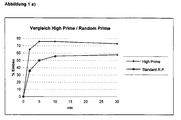
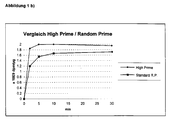
- a further disadvantage is that the random primed reaction with radioactive labeling is already very effective (> 60% incorporation of the radioactive nucleotide in 30 minutes), but the reproducibility, the speed and the yield of the reaction still require optimization.
- the spontaneous renaturation of the template DNA leads to lower labeling yields than is theoretically possible.
- the renaturation is time and temperature dependent. The addition of several components takes time and therefore involves the risk of renaturation.
- the invention is therefore based on the object of eliminating the disadvantages mentioned, i. H. to offer all the reaction components already mixed in liquid form, so that the user only has to add an aliquot of a labeling mix to his DNA in a single pipetting step.
- the object is achieved by providing a composition which, for the individual marking methods mentioned, contains all the components mixed with one another in the optimal mixing ratio and stable form. Preferably at least 30% (v / v) glycerol is added to this mixture. Between 40% and 50% (v / v) glycerol have proven to be particularly suitable.
- the liquid mixtures have a particular stability between approximately - 20 ° C and + 4 ° C.
- the individual components are essentially a labeling enzyme, reaction buffer, optionally at least one nucleoside triphosphate (nucleoside triphosphate should stand for ribonucleoside triphosphate, deoxyribonuceloside triphosphate or dideoxyribonucleoside triphosphate) as well as other additives customary for single-enzyme reactions.
- nucleoside triphosphate should stand for ribonucleoside triphosphate, deoxyribonuceloside triphosphate or dideoxyribonucleoside triphosphate
- coli DNA polymerase holoenzyme T4, Spn, Taq, Tne, Tth, Bca
- RNA polymerases T3, T7, SP6 or terminal transferases
- labeling enzymes pH 7.0 buffering substance preferably a divalent one cationic salt and as nucleoside triphosphates the generally conventional ones such as dATP, dCTP, dGTP, dTTP, ATP, CTP, GTP, UTP, ddATP, ddCTP, ddGTP, ddTTP or suitable modified nucleoside triphosphates, such as e.g. B. corresponding Desaza compounds.
- stabilizers such as bovine serum albumin (RSA) or gelatin, spermidine, dithiothreitol (or mercaptoethanol) and / or detergents, such as in particular Triton X-100, thesite, Tween 20, NP40 and Brij 35 or inhibitor substances, such as, for example, an RNase inhibitor be present.
- a random primer in particular 12-mer, 15-mer, 9-mer and 6-mer
- sequence-specific primer a labeled nucleoside triphosphate, for example with digoxin gene, biotin, fluorescein, Rhodamine, aminocoumarin (AMCA), or radioactively labeled with P-32, S-35, H-3 etc. may be present in the mixture.
- compositions according to the invention advantageously contain the various components in certain concentration ranges.
- the labeling enzyme is used in a concentration range from 0.20 to 5 kU / ml, preferably from 0.5 to 2.5 kU / ml. It has proven particularly suitable to contain 0.5 kU / ml of the labeling enzyme in the reaction mixture.
- the terminal transferase to be used for the final labeling is used in the mixtures according to the invention between about 10 and 15 kU / ml.
- a polymerase concentration of 50 to 500 U / mil has been found to be suitable, preferably of approximately 125 U / ml.
- HEPES, TRIS, CAPS and TAPS or also phosphate buffers have proven to be particularly suitable as buffer substances; as these substances have a buffering capacity between pH 6.5 and 8.5.
- a concentration range between 50 and 500 mM is preferably selected here, a concentration of approximately 250 mM has proven to be particularly suitable here. It is also advantageous if at least 0.1 mM of a divalent cationic salt, such as MgCl2, is added.
- the optimal concentration ranges are, depending on the respective salt, 25 to 100 mM or approx. 1 to 20 mM for the PCR.
- RSA and gelatin are preferably contained between 0.1 and 5 mg / ml in the reaction mixture; A concentration of approximately 1 mg / ml has proven advantageous here.
- Spermidine is advantageously in a concentration up to max. 30 mM added, about 10 mM are preferred.
- concentration of mercaptoethanol or other SH reagents can be between 0.1 and 300 mM, a range from 5 to 50 mM is preferred for mercaptoethanol and from 100 to 300 mM for dithiothreitol.
- the detergents mentioned have proven to be suitable in a concentration range of 0.05 and 1.0% and in particular between 0.25 and 0.75%.
- a concentration range of approx. 15 to 80 OD / ml (OD optical density) is selected for the different random primers. Depending on the length of the primer, a content of 30 to 60 OD / ml has proven to be optimal.
- the nucleotides are advantageously added up to a concentration of approximately 20 mM; has proven to be suitable if it is between 0.01 and 20 mM; Concentrations between 0.1 and 1.0 mM are particularly suitable for all possible reactions - apart from RNA labeling.
- the addition of the enzyme pyrophosphatase to corresponding nucleic acid labels or syntheses brings about an additional advantage in that the speed and yield of the reaction are significantly increased compared to previously known methods.
- 1 to 100 U / ml of the enzyme are added, preferably between 1-50 U / ml, particularly preferably 2.5 U / ml. About 25 U / ml have proven to be suitable for RNA labeling.
- a pH range from 6.5 to 8.5 and a reaction temperature from 25 to 45 ° C. have proven to be optimal for the composition according to the invention.
- the optimal temperature is between 65 and 75 ° C.
- the mixtures mentioned with many different components are stable at all.
- the mixture for the radioactive and non-radioactive random priming labeling method has proven to be stable over a longer period (12 months).
- the temperatures are between - 20 ° C to + 4 ° C.
- ready mixes can, however, also be created for the other enzymatic nucleic acid labeling methods, such as nick translation, 3'-end or 5'-end labeling, PCR reaction and in vitro transcription in a stable, liquid form.
- the DNA sample can contain up to approx. 5000 ng of DNA, which can be linearized or supercoiled and can contain 100 to 70,000 bases (b) in the random primed method.
- composition 5x mix for radioactive labeling 250mM Hepes, pH 7.0 50 mM MgCl2 0.5 mM DTE 10 mM spermidine 0.125 mM per dATP, dGTP, dTTP 0.5% Triton X-100 2.5 U / ml inorganic pyrophosphatase 1 mg / ml bovine serum albumin, mol. biol.
- composition 5 x mixes for nick translation for radioactive DNA labeling
- Components Conc pH Tris-HCl 250 mM 7.8 MgCl2 25 mM DTT 50 mM BSA 0.25 mg / ml Nucleotides dATP 0.1 mM dGTP 0.1 mM dTTP 0.1 mM Triton X-100 0.5% inorg. Pyrosphosphatase 2.5 U / ml Enzymes: Temp.
- DNA polymerase I 1 kU / ml 15 ° C
- DNase I 0.1 ⁇ g / ml Glycerin 45% Reaction volume 20 ⁇ l Amount of DNA 100 ng
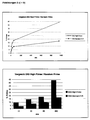
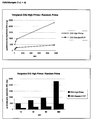
- the kinetics of the installation could be followed by removing 1 ⁇ l aliquots at different incubation times and by determining the proportion that could be precipitated with trichloroacetic acid.
- the standard reaction with the BM Nick Translations Kit (order no. 976776) according to the information in the package insert served as a comparison.
- the results are analogous to the High Prime test series: faster and higher installation rates of radioactivity.
- composition of the 5 x mix for nick translation for non-radioactive labels Components concentration Tris-HCl pH 7.8 250 mM MgCl2 25 mM DTT 50 mM BSA 0.25 mg / ml Nucleotides dATP 1 mm dCTP 1 mm dGTP 1 mm dTTP 0.65 mM DIG-dUTP or biotin-dUTP or fluorescein-dUTP or rhodamine-dUTP or AMCA-dUTP 0.35 mM Triton X-100 0.5% inorg.
- human genomic DNA 100 ng
- specific PCR primers e.g. B. for a specific human gene (cystic fibrosis, factor IX or the like), each 1 ⁇ M, in 80 ⁇ l sterile bidist.
- Water plus 20 ⁇ l 5 x PCR mix incubated in a thermal cycler.
- Cycle program e.g. B. 1 min 95 ° C, 1 min 55 ° C. 1 min 72 ° C etc., 30 cycles, at the end 5 min 72 ° C.
- An aliquot of the reaction mixture was analyzed in an ethidium bromide agarose gel.
- the 5 x PCR labeling mix has the same composition as above, except that 0.65 mM dTTP and 0.35 mM DIG-dUTP are contained instead of 1 mM dTTP.
- the proportions of DIG-dUTP / dTTP can also be varied so that only 0.05 mM DIG-dUTP and 0.95 mM dTTP are mixed.
- the PCR reaction proceeds as described above.
- the DIG-labeled PCR product can either be used as a hybridization sample or it is transferred to a membrane (nylon, positively charged) for analysis after gel electrophoresis and processed according to the usual DIG detection method. Color or chemiluminescent method detected.
- DIG oligonucleotide 3 'end label Composition of the 5 x mix * and 5 x potassium cacodylate * Components concentration CoCl2 * 25 mM Tris-HCl pH 6.6 125 mM BSA 1.25 mg / ml Terminal transferase 12500 U / ml DIG ddUTP 0.25 mM Glycerin 45% Amount of oligonucleotide 100 pmol * Note: CoCl2 and potassium cacodylate cannot be mixed in a 5 x mix d) DIG oligonucleotide 3 'end label, standard reaction Analogous to the radioactive 3 'end label, without 32 P ddATP; Incubation 15 min at 37 ° C.
- DIG oligonucleotide tailing Composition of the 5 x mix * and 5 x potassium cacodylate * (1 M) Components concentration CoCl2 * 25 mM Tris-HCl pH 6.6 125 mM BSA 1.25 mg / ml Terminal transferase 12500 U / ml dATP 2.5 mM DIG-11-dUTP 0.25 mM Glycerin 45% Amount of oligonucleotide 100 pmol f) DIG oligonucleotide tailing, standard reaction Analogous to the DIG oligonucleotide 3 'end label in 20 ⁇ l total volume. Incubate at 37 ° C for 15 min. 5 x potassium cacodylate: 1 M * 5 x potassium cacodylate: 1 M *
- An installation rate determination (as described in Example 1) can be carried out using trichloroacetic acid precipitation c) DIG RNA labeling Composition of the 5 x mix Components concentration Hepes, pH 7.6 400mM MgCl2 60mM DTT 200mM Spermidine 10mM RNase inhibitor 2.5kU / ml inorg.
Landscapes
- Chemical & Material Sciences (AREA)
- Life Sciences & Earth Sciences (AREA)
- Organic Chemistry (AREA)
- Health & Medical Sciences (AREA)
- Wood Science & Technology (AREA)
- Zoology (AREA)
- Engineering & Computer Science (AREA)
- Bioinformatics & Cheminformatics (AREA)
- Genetics & Genomics (AREA)
- Proteomics, Peptides & Aminoacids (AREA)
- General Health & Medical Sciences (AREA)
- Biotechnology (AREA)
- Molecular Biology (AREA)
- Biochemistry (AREA)
- General Engineering & Computer Science (AREA)
- Microbiology (AREA)
- Biophysics (AREA)
- Physics & Mathematics (AREA)
- Analytical Chemistry (AREA)
- Medicinal Chemistry (AREA)
- Biomedical Technology (AREA)
- Immunology (AREA)
- Chemical Kinetics & Catalysis (AREA)
- Measuring Or Testing Involving Enzymes Or Micro-Organisms (AREA)
Applications Claiming Priority (2)
| Application Number | Priority Date | Filing Date | Title |
|---|---|---|---|
| DE4336266 | 1993-10-23 | ||
| DE4336266A DE4336266A1 (de) | 1993-10-23 | 1993-10-23 | Stabilisierte flüssige Mischungen für die Markierung von Nukleinsäuren |
Publications (2)
| Publication Number | Publication Date |
|---|---|
| EP0649909A2 true EP0649909A2 (fr) | 1995-04-26 |
| EP0649909A3 EP0649909A3 (fr) | 1999-03-31 |
Family
ID=6500897
Family Applications (1)
| Application Number | Title | Priority Date | Filing Date |
|---|---|---|---|
| EP94116385A Withdrawn EP0649909A3 (fr) | 1993-10-23 | 1994-10-18 | Mélanges liquides stabilisés pour le marquage d'acides nucléiques |
Country Status (4)
| Country | Link |
|---|---|
| US (1) | US5814502A (fr) |
| EP (1) | EP0649909A3 (fr) |
| JP (1) | JPH07194398A (fr) |
| DE (1) | DE4336266A1 (fr) |
Cited By (2)
| Publication number | Priority date | Publication date | Assignee | Title |
|---|---|---|---|---|
| WO1998021362A3 (fr) * | 1996-11-14 | 1998-07-02 | Boehringer Mannheim Gmbh | Solutions aqueuses stabilisees de triphosphates de nucleosides |
| WO1999005308A3 (fr) * | 1997-07-22 | 1999-05-27 | Rapigene Inc | Appareil et procedes pour realiser une dispersion matricielle d'une solution sur un support solide |
Families Citing this family (13)
| Publication number | Priority date | Publication date | Assignee | Title |
|---|---|---|---|---|
| EP2264045B1 (fr) * | 1996-08-14 | 2015-10-21 | Life Technologies Corporation | Composition pour l'amplification et pour la séquenciation de l'ADN |
| US6140086A (en) * | 1997-08-15 | 2000-10-31 | Fox; Donna K. | Methods and compositions for cloning nucleic acid molecules |
| ATE526418T1 (de) * | 2002-08-05 | 2011-10-15 | Quanta Biosciences Inc | Verbesserte zusammensetzungen zur in-vitro- amplifikation von nukleinsäuren |
| AU2003268397A1 (en) * | 2002-09-03 | 2004-03-29 | Quanta Biosciences, Inc. | Improved compositions and methods for cdna synthesis |
| JP5608997B2 (ja) * | 2009-03-31 | 2014-10-22 | 東洋紡株式会社 | 保存安定性に優れた核酸増幅検出試薬キット |
| WO2012018639A2 (fr) | 2010-07-26 | 2012-02-09 | Biomatrica, Inc. | Compositions de stabilisation d'adn, d'arn, de protéines salivaires et d'autres échantillons biologiques lors du transport et du stockage à températures ambiantes |
| EP2598660B1 (fr) | 2010-07-26 | 2017-03-15 | Biomatrica, INC. | Compositions de stabilisation d'adn, d'arn, de protéines dans le sang et d'autres échantillons biologiques lors du transport et du stockage à températures ambiantes |
| US9567628B2 (en) | 2011-06-08 | 2017-02-14 | Life Technologies Corporation | Polymerization of nucleic acids using proteins having low isoelectric points |
| FI3461807T3 (fi) | 2011-06-08 | 2023-09-07 | Life Technologies Corp | Uudenlaisten detergenttien suunnittelu ja kehitys pcr-järjestelmissä käyttöä varten |
| US9725703B2 (en) | 2012-12-20 | 2017-08-08 | Biomatrica, Inc. | Formulations and methods for stabilizing PCR reagents |
| EP3539944A1 (fr) | 2013-10-25 | 2019-09-18 | Life Technologies Corporation | Nouveaux composés à utiliser dans des systèmes acp et applications correspondantes |
| ES2786373T3 (es) | 2014-06-10 | 2020-10-09 | Biomatrica Inc | Estabilización de trombocitos a temperaturas ambiente |
| KR20250047404A (ko) | 2015-12-08 | 2025-04-03 | 바이오매트리카 인코포레이티드 | 적혈구 침강 속도의 감소 |
Family Cites Families (10)
| Publication number | Priority date | Publication date | Assignee | Title |
|---|---|---|---|---|
| US4762780A (en) * | 1984-04-17 | 1988-08-09 | The Regents Of The University Of California | Method and composition for screening and diagnosing "HCMV" |
| CA1254525A (fr) * | 1983-04-13 | 1989-05-23 | Christine L. Brakel | Trousse pour le marquage chimique de l'adn en terminaison de chaine |
| US4749647A (en) * | 1984-06-22 | 1988-06-07 | Genetic Systems Corporation | Polymerization-induced separation assay using recognition pairs |
| US4769319A (en) * | 1985-05-31 | 1988-09-06 | Salk Institute Biotechnology Industrial Associates, Inc. | Nucleic acid probes for prenatal sexing |
| CA1338457C (fr) * | 1986-08-22 | 1996-07-16 | Henry A. Erlich | Enzyme thermostable purifiee |
| WO1990008839A1 (fr) * | 1989-02-06 | 1990-08-09 | Eastman Kodak Company | Concentre de reaction de mise en sequence d'adn polymerase thermostable |
| US5198543A (en) * | 1989-03-24 | 1993-03-30 | Consejo Superior Investigaciones Cientificas | PHI29 DNA polymerase |
| AU638246B2 (en) * | 1989-04-12 | 1993-06-24 | President And Fellows Of Harvard College | Improved primer extension reactions |
| US5108892A (en) * | 1989-08-03 | 1992-04-28 | Promega Corporation | Method of using a taq dna polymerase without 5'-3'-exonuclease activity |
| US5256555A (en) * | 1991-12-20 | 1993-10-26 | Ambion, Inc. | Compositions and methods for increasing the yields of in vitro RNA transcription and other polynucleotide synthetic reactions |
-
1993
- 1993-10-23 DE DE4336266A patent/DE4336266A1/de not_active Withdrawn
-
1994
- 1994-10-18 EP EP94116385A patent/EP0649909A3/fr not_active Withdrawn
- 1994-10-21 JP JP6257160A patent/JPH07194398A/ja active Pending
-
1996
- 1996-03-11 US US08/613,997 patent/US5814502A/en not_active Expired - Lifetime
Cited By (3)
| Publication number | Priority date | Publication date | Assignee | Title |
|---|---|---|---|---|
| WO1998021362A3 (fr) * | 1996-11-14 | 1998-07-02 | Boehringer Mannheim Gmbh | Solutions aqueuses stabilisees de triphosphates de nucleosides |
| WO1999005308A3 (fr) * | 1997-07-22 | 1999-05-27 | Rapigene Inc | Appareil et procedes pour realiser une dispersion matricielle d'une solution sur un support solide |
| US6365349B1 (en) | 1997-07-22 | 2002-04-02 | Qiagen Genomics, Inc. | Apparatus and methods for arraying solution onto a solid support |
Also Published As
| Publication number | Publication date |
|---|---|
| DE4336266A1 (de) | 1995-04-27 |
| US5814502A (en) | 1998-09-29 |
| JPH07194398A (ja) | 1995-08-01 |
| EP0649909A3 (fr) | 1999-03-31 |
Similar Documents
| Publication | Publication Date | Title |
|---|---|---|
| DE69716966T2 (de) | Verfahren zur direkten, exponentiellen Amplifikation und Sequenzierung von DNA-Molekülen und seine Anwendung | |
| DE60034878T2 (de) | Verfahren zur Amplifizierung einer Nukleinsäuresequenz unter Verwendung eines chimären Primers | |
| DE3687287T2 (de) | Verfahren zur amplifikation von nukleinsaeuresequenzen. | |
| DE60220025T2 (de) | Methoden und zusammensetzungen zur vervielfältigung von rna sequenzen | |
| DE69128077T2 (de) | Nuklein-säure amplifikation mit dns abhängigen rns polymerasen aktivität von rns-replikasen | |
| DE69520917T2 (de) | Dns-sequenzierung durch stufenweise ligierung und spaltung | |
| DE60123980T2 (de) | Amplifizierung von nukleinsäuresequenzen mittels multiplex priming | |
| DE69223755T2 (de) | Verfahren zur Herstellung eines Polynukleotids zum Gebrauch in "single-primer" Amplifizierung und Phosphorothioat-enthaltende Oligonukleotide als Primer in Nukleinsäureamplifizierung | |
| DE3650762T2 (de) | Kit zur Verwendung bei der Amplifizierung und beim Nachweis von Nukleinsäuresequenzen | |
| EP0649909A2 (fr) | Mélanges liquides stabilisés pour le marquage d'acides nucléiques | |
| DE69233458T2 (de) | Nukleinsäuretypisierung durch polymeraseverlängerung von oligonukleotiden unter verwendung von terminator-mischungen | |
| EP0324474B1 (fr) | Procédé pour détecter des acides nucléiques | |
| DE69307503T3 (de) | Chemisches verfahren zur analyse von dns-sequenzen | |
| DE69916877T2 (de) | Ligations-vermittelte assemblierung und nachweis von polynukleotiden auf einem festträger | |
| DE60009323T2 (de) | Methoden und zusammensetzungen zur linearen isothermalen amplifikation von polynukleotidsequenzen | |
| AT402203B (de) | Verfahren zur transkriptionsfreien amplifizierung von nucleinsäuren | |
| DE69028325T2 (de) | Nukleinsäure-Amplifikation unter Verwendung eines Einzelprimers | |
| DE60029961T2 (de) | Verankerte strangverdrängungs-amplifizierung auf einem elektronisch adressierbaren mikrochip | |
| EP0826067A1 (fr) | Sequencage simultane d'acides nucleiques | |
| WO2008020008A1 (fr) | Procédé permettant la synthèse d'un adnc dans un échantillon présent dans une réaction enzymatique | |
| EP0718408A2 (fr) | Méthode sensible pour détecter des acides nucléiques | |
| DE3930312A1 (de) | Verfahren zur direkten sequenzierung von nukleinsaeureketten | |
| EP0437774B1 (fr) | Procédé pour la préparation d'acides nucléiques modifiés | |
| DE3910151A1 (de) | 5'-bromo-2'-desoxyuridinmarkierte dna- oder rna- sonden | |
| DE4428651C1 (de) | Verfahren zur Herstellung und Amplifikation von Nukleinsäuren |
Legal Events
| Date | Code | Title | Description |
|---|---|---|---|
| PUAI | Public reference made under article 153(3) epc to a published international application that has entered the european phase |
Free format text: ORIGINAL CODE: 0009012 |
|
| AK | Designated contracting states |
Kind code of ref document: A2 Designated state(s): AT BE CH DE DK ES FR GB GR IE IT LI LU NL PT SE |
|
| PUAL | Search report despatched |
Free format text: ORIGINAL CODE: 0009013 |
|
| RAP3 | Party data changed (applicant data changed or rights of an application transferred) |
Owner name: ROCHE DIAGNOSTICS GMBH |
|
| AK | Designated contracting states |
Kind code of ref document: A3 Designated state(s): AT BE CH DE DK ES FR GB GR IE IT LI LU NL PT SE |
|
| 17P | Request for examination filed |
Effective date: 19990930 |
|
| 17Q | First examination report despatched |
Effective date: 20011210 |
|
| STAA | Information on the status of an ep patent application or granted ep patent |
Free format text: STATUS: THE APPLICATION IS DEEMED TO BE WITHDRAWN |
|
| 18D | Application deemed to be withdrawn |
Effective date: 20020423 |