EP0650134B1 - Lecteur de codes à barres et méthode d'utilisation - Google Patents
Lecteur de codes à barres et méthode d'utilisation Download PDFInfo
- Publication number
- EP0650134B1 EP0650134B1 EP94115763A EP94115763A EP0650134B1 EP 0650134 B1 EP0650134 B1 EP 0650134B1 EP 94115763 A EP94115763 A EP 94115763A EP 94115763 A EP94115763 A EP 94115763A EP 0650134 B1 EP0650134 B1 EP 0650134B1
- Authority
- EP
- European Patent Office
- Prior art keywords
- scanning
- article
- scanner
- light beam
- scanned surface
- Prior art date
- Legal status (The legal status is an assumption and is not a legal conclusion. Google has not performed a legal analysis and makes no representation as to the accuracy of the status listed.)
- Expired - Lifetime
Links
Images

Classifications
-
- G—PHYSICS
- G06—COMPUTING OR CALCULATING; COUNTING
- G06K—GRAPHICAL DATA READING; PRESENTATION OF DATA; RECORD CARRIERS; HANDLING RECORD CARRIERS
- G06K7/00—Methods or arrangements for sensing record carriers, e.g. for reading patterns
- G06K7/10—Methods or arrangements for sensing record carriers, e.g. for reading patterns by electromagnetic radiation, e.g. optical sensing; by corpuscular radiation
Definitions
- the invention relates to a method for operating a Barcode reader according to the preamble of claim 1 and a barcode reader according to the preamble of claim 4.
- Barcode readers of this type are used in the transportation of General cargo, e.g. when conveying parcels or pieces of luggage on a conveyor belt, used to on the conveyed good recognize the appropriate bar codes and accordingly To be able to process the material being conveyed.
- Such barcode readers are generally next to the trajectory of the Conveyed goods arranged, and there is no problem that Side surfaces or the top surface of a funded Scanning the object with a scanner.
- Barcode readers give one to the Scanning surface of the object directed scanning light beam a double scanning movement perpendicular to each other standing directions, such that initially a high Frequency of e.g. 1 KHz along a scan line Scanning light beam a linear area on the Scanned area and that the scan line thus formed slow, i.e. for example within 0.1 to 2 seconds in the direction perpendicular to the scanning line over the Scanning surface is advanced so that each point of the Scanned area captured at least once by the scanning light beam becomes.
- a high Frequency e.g. 1 KHz along a scan line Scanning light beam a linear area on the Scanned area and that the scan line thus formed slow, i.e. for example within 0.1 to 2 seconds in the direction perpendicular to the scanning line over the Scanning surface is advanced so that each point of the Scanned area captured at least once by the scanning light beam becomes.
- the scanning light beam according to the invention now obliquely from in front or at an angle from behind onto the front and / or back scanning surface falls, changes during the scanning process the distance between the scanner and the scanning surface.
- the one on the Scanned light beam focused must therefore be a have sufficient depth of field, so also with yourself changing scanning distances always a sufficient sharpness of the There is a scanning light spot on the scanning surface.
- the Generation of a scanning light beam with great depth of field requires a high optical effort, which also with a comparatively voluminous structure of the scanner is linked.
- the aim of the present invention is to provide a another barcode reader and another method for his To create operation.
- the problem of Depth of field of such a barcode reader when scanning the front and / or rear scanning surface of a moving Object to be solved in a low-cost manner.
- the idea of the invention is that the Speed of movement of the objects Conveyor and the feed rate of the scanning line or the scanning area, in particular the scanning sector, so be coordinated so that the scan line is in each phase of the scanning process at least substantially the same distance from the scanner. That way dispenses with a scanner with a large depth of field be, so that a scanner of simple optical construction is sufficient for the purposes of the invention.
- the Synchronization of conveyor speed and Feed rate of the scanning line can be increased simple way by detecting the front or rear Scanning area of the object and the control of the Scan line feed depending on the Realize the speed of movement of the object.
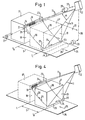
- 1 is an object 17 on a conveyor belt 35 arranged to from the in solid lines reproduced position in a direction of movement 26 to be promoted. At 17 'the same item is after the feed by a distance S a second time reproduced.
- a barcode stuck on which contains information necessary for e.g. a later sorting of the items 17 is important. It can e.g. information about the destination act on a checked package. So that the package 17 can be sorted correctly later, must be from the sorting point read the location information contained in barcode 16 and be recognized.
- S is in front of the reading range above Path of motion 20 of objects 17 preferably with arranged a laser-equipped scanner 12, which one Scanning light beam 11 in the direction of the front surface 18 sends out.
- the scanning light beam 11 leads in the direction of arrow 24 a scanning movement with a frequency of e.g. 1 KHz off and generated by the over the front surface 18th current scanning light spot a scanning line 23.
- the scanning light beam 11 is essential lower frequency of e.g. 0.1 to 2 Hz in the direction of Arrow 25 deflected downward such that the scan line 23 along the circular cylindrical surface 36 with the center in Scanner 12 down towards the conveyor belt 35 is pivoted.
- a light barrier 28 consisting of a light source 27 and a light receiver is provided above the conveyor belt 35, which informs the scanner 12 via a control line 37 as soon as the front surface 18 of an object 17 enters the reading section S at time T 0 .
- the inventive method now consists in that after the light barrier 27, 28 the entry of the front surface 18 of the object 17 in the reading range S recognizes the Laser scanner 12 is controlled via the control line 37 is that the scanning line 23 is initially in the upper region 21 is located near the front upper edge of the article 17. With increasing feed of the object 17 in the direction of Arrow 26 then pivots the scan line 23 controlled by Incremental encoder 29 via the control line 38 along the Circular cylinder surface 36 down until at time T1, to which the scanning surface 18 is the rear end of the reading distance S has reached the lower area 22 in the area has reached the front lower edge of the article 17. This state is in Fig. 1 in dashed lines at 17 ' indicated.
- the length of the reading distance S is now like this chosen that the scanning line 23 in each phase of movement of the Item 17 within the reading range S itself substantially the same distance from the center of the Scanning light beam 11 is located inside the scanner 12.
- the scanning light spot located on the scanning line 23, the at the beginning of the reading section S in the upper area 21 of the Object 17 is shown sharply, so remains during the total feed movement in the direction of arrow 25 sharp even when the depth of field of the Illustration of the scanning light spot is minimal.
- the reading distance S and the feed speed of the Scanning line 23 in the direction of arrow 25 ensures that the distance of the scanning light beam 11 from the center of the Scanning movement within the laser scanner 12 to front surface 18 of the moving object 17 at least in remains essentially constant.
- FIG. 1 A practical embodiment of the scanner 12 according to FIG. 1 is shown schematically in Figs. 2 and 3.
- a laser 39 does not have one Optics shown generated sharply focused light beam 33 runs through a semi-transparent mirror 40 a mirror wheel 32 which is about an axis 41 to a continuous rotation in the direction of the arrow is driven.
- the light beam 33 is at one of the Facets of the mirror wheel deflected by 90 °, for example, um as a reflected light beam 34 to an elongated Swinging mirror 31 to arrive, the length of which is so great that the whole by two dashed lines 34 ', 34' ' limited scanning range of the reflected light beam 34 is detected.
- the oscillating mirror 31 guides the reflected light beam 34 again, towards the front Scanning surface 18 of the object 17, where the barcode 16 is appropriate.
- a drive 30 gives the oscillating mirror 31 a back and forth Movement around one in the direction of its longitudinal axis extending pivot axis 42 in the direction of the double arrow.
- the swinging mirror 31 becomes the front surface 18 cast scanning light beam 11 in a in FIG. 3rd dashed indicated angle range from 11 'to 11' 'back and forth swung here.
- That reflected from the front surface 18 of the object 17 Light is z. B. in autocollimation via the oscillating mirror 31 and the mirror wheel 32 for partially permeable Mirror 40 thrown back and from this to a photo receiver 15 redirected to an evaluation and control electronics 14 is connected.
- the photo receiver 15 and the Evaluation and control electronics 14 together form one Signal processing arrangement 13, the content of the bar code 16 recognize and on a only schematically arranged at 43 Device delivers.
- the evaluation and control electronics 14 is also on the Control line 37 the output signal of the light barrier 27, 28th and via the control line 38 the output signal of the Incremental encoder 29 supplied. Via a control line 44 acts on the evaluation and control electronics 14 Drive unit 30 of the oscillating mirror 31.
- the incremental encoder 29 can be dispensed with and instead of the known feed rate corresponding fixed value in the evaluation and Control electronics 14 are entered.
- the oscillating mirror 31 begins its the advance of the scan line 23 along the Circular cylinder surface 36 causing movement in the area 21 of the Item 17 (Fig. 1) as soon as the light barrier 27, 28th the entry of the front surface 18 into the reading distance S recognized.
- Evaluation and control electronics 14 causes the drive 30 of the oscillating mirror 31 via the control line 44 so to drive that the distance of the scanning light beam 11 from the front surface 18 during the feed in Direction of arrow 25 remains essentially constant.
- the photoreceiver 15 receives because of the Scanning remains the same sharp scanning light spot perfect barcode signal, which is then in the connected evaluation and control electronics 14 safely can be evaluated and recognized.
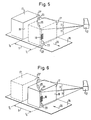
- FIG. 4 to 6 denote the same reference numerals corresponding parts as in Figs. 1 and 2.
- Fig. 4th to 6 are not all of the components shown in FIG. 1 are shown, shown; however, they are the same Way as in the embodiment of FIG. 1 available.
- the direction of movement 26 of the conveyor belt 35 is reversed, such that the scanner 12 now scans the rear surface 19 of the object 17.
- the scanning line 23 is laid down at the time T 0 at the beginning of the reading path S and then swivels upwards in the direction of the arrow 25 at a speed predetermined according to the invention along the circular cylinder surface 36.
- FIG. 5 is the Direction of movement 26 of the objects again the same as in Fig. 1. Again, the front surface 18 of the Objects 17 are scanned, but the scanning line 23 now perpendicular to the direction of the scan line 23 Fig. 1 stands and therefore the feed direction 25 for the Scanning line 23 takes place in the lateral direction.
- the area 21 ', where the scan begins, is thus in Conveying direction seen on the left front edge of the Items 17 during the end portion 22 'of the scan in the area of the front right edge of the objects located.
- FIG. 6 largely corresponds to that 4, but analogous to FIG. 5 again lateral feed movement of the scanning line 23 by one Initial area 21 'on the rear left edge of the Item 17 to an area 22 'on the rear right Edge of the object 17 takes place.
- the Scans perpendicular to each other according to FIG. 4 and 6 preferably used in combination. It is also possible, depending on the shape and attachment of the barcode 16 several z. B. arrange three scanners at an angle of 60 ° each.
- the alignment of the scan lines 23 to a side edge of the preferably cuboid objects 17 is preferred, but fundamentally other directions are also Scanning line 23, for example possible in the diagonal direction. If two scans are used simultaneously, then in any case, they are perpendicular to each other.
Landscapes
- Engineering & Computer Science (AREA)
- Physics & Mathematics (AREA)
- General Physics & Mathematics (AREA)
- Theoretical Computer Science (AREA)
- Toxicology (AREA)
- Electromagnetism (AREA)
- Artificial Intelligence (AREA)
- Computer Vision & Pattern Recognition (AREA)
- Health & Medical Sciences (AREA)
- General Health & Medical Sciences (AREA)
- Mechanical Optical Scanning Systems (AREA)
- Discharge Of Articles From Conveyors (AREA)
- Length Measuring Devices By Optical Means (AREA)
- Cash Registers Or Receiving Machines (AREA)
- Control Of Conveyors (AREA)
- Sorting Of Articles (AREA)
Claims (6)
- Procédé d'utilisation d'un lecteur de codes à barres pour la détection des codages (16) appliqués sur un objet (17) se déplaçant au moins sensiblement dans une direction (26), à l'aide d'un dispositif à balayage (12) qui produit un faisceau lumineux explorateur (11) parcourant ligne par ligne une zone analysée (18, 19) de l'objet (17), et qui présente un agencement récepteur de lumière (13), comportant une électronique d'évaluation et de commande (14), au moyen de laquelle peut être reconnu le code à barres (16) appliqué sur la zone analysée (18, 19) de l'objet (17) et exploré par le faisceau lumineux explorateur (11), le dispositif à balayage étant disposé en dehors du chemin de déplacement (20) de l'objet (17) et étant dirigé vers la zone analysée (18, 19), située sur l'avant ou sur l'arrière de l'objet (17) dans le sens du déplacement,
caractérisé en ce que
le faisceau lumineux explorateur (11) est orienté, avant le début du balayage, lorsque l'objet (17) est prévu pour un déplacement en direction du dispositif à balayage (12), sur la partie (21) de la zone analysée (18) située le plus près du dispositif à balayage (12) et/ou, lorsque l'objet (17) s'éloigne du dispositif à balayage (12), le faisceau est orienté sur la partie (22) de la zone analysée (19) située le plus loin du dispositif à balayage (12), et en ce que l'avance (25) de la ligne de balayage (22), servant à l'exploration ligne par ligne, et s'effectuant sensiblement perpendiculairement au sens d'exploration (24), est synchronisée avec la vitesse de déplacement de l'objet (17) de telle manière que la distance entre le dispositif à balayage (12) et la ligne de balayage (23) sur la zone analysée (18, 19) de l'objet (17) demeure, du moins sensiblement, constante. - Procédé selon la revendication 1,
caractérisé en ce que
la ligne de balayage (23) s'étend horizontalement ou verticalement et en ce que son avance (25) est, en conséquence, verticale ou bien horizontale. - Procédé selon la revendication 1 ou 2,
caractérisé en ce que
deux dispositifs à balayage (12) sont utilisés, leurs lignes de balayage (23) étant, au moins sensiblement, perpendiculaires l'une à l'autre. - Procédé selon la revendication 1 ou 2,
caractérisé en ce que
trois dispositifs à balayage (12) ou davantage sont utilisés, leurs lignes de balayage (23) s'étendant en formant respectivement entre elles, au moins sensiblement un angle de 60° ou des angles plus petits. - Lecteur de codes à barres pour la détection des codages (16) appliqués sur un objet (17) se déplaçant au moins sensiblement dans une direction (26), et comprenant un dispositif à balayage (12) qui produit un faisceau lumineux explorateur (11) parcourant ligne par ligne une zone analysée (18, 19) de l'objet (17), et qui présente un agencement récepteur de lumière (13), comportant une électronique d'évaluation et de commande (14), au moyen de laquelle peut être reconnu le code à barres (16) appliqué sur la zone analysée (18, 19) de l'objet (17) et exploré par le faisceau lumineux (11), le dispositif à balayage étant disposé en dehors du chemin de déplacement (20) de l'objet (17) et étant dirigé vers la zone analysée (18, 19), située sur l'avant ou sur l'arrière de l'objet (17) dans le sens du déplacement, notamment pour la mise en oeuvre du procédé selon l'une des revendications 1 à 3,
caractérisé en ce que
sont prévus un moyen récepteur (27, 28) pour l'emplacement de la zone analysée (18, 19), au niveau duquel doit commencer l'exploration, et un moyen d'entrée ou de détection (29) pour la vitesse de déplacement de l'objet (17), qui sont reliés à l'électronique d'évaluation et de commande (14), et en ce que l'électronique d'évaluation et de commande (14) agit sur un moyen d'avance (30, 31) pour le déplacement de la ligne de balayage (23) de telle manière que la distance entre le dispositif à balayage (12) et la ligne de balayage (23) sur la zone analysée (18, 19) de l'objet (17) demeure, du moins sensiblement, constante. - Dispositif selon la revendication 5,
caractérisé en ce que
le dispositif à balayage (12) comprend un moyen de déflexion de lumière (32), notamment un élément rotatif à miroirs (32), recevant un faisceau lumineux (33) et produisant le mouvement de balayage, et un moyen de pivotement du faisceau, notamment un miroir oscillant (31), recevant le faisceau lumineux (34) réfléchi par le moyen de déflexion de lumière (32) et produisant l'avance (25), et qui dirige la lumière vers la surface analysée (18, 19) et forme la ligne de balayage (23) à l'emplacement déterminé par l'électronique d'évaluation et de commande (14).
Applications Claiming Priority (2)
| Application Number | Priority Date | Filing Date | Title |
|---|---|---|---|
| DE4336137 | 1993-10-22 | ||
| DE4336137A DE4336137A1 (de) | 1993-10-22 | 1993-10-22 | Barcodeleser und Verfahren zu seinem Betrieb |
Publications (3)
| Publication Number | Publication Date |
|---|---|
| EP0650134A2 EP0650134A2 (fr) | 1995-04-26 |
| EP0650134A3 EP0650134A3 (fr) | 1998-08-12 |
| EP0650134B1 true EP0650134B1 (fr) | 1999-08-04 |
Family
ID=6500813
Family Applications (1)
| Application Number | Title | Priority Date | Filing Date |
|---|---|---|---|
| EP94115763A Expired - Lifetime EP0650134B1 (fr) | 1993-10-22 | 1994-10-06 | Lecteur de codes à barres et méthode d'utilisation |
Country Status (4)
| Country | Link |
|---|---|
| US (1) | US5481096A (fr) |
| EP (1) | EP0650134B1 (fr) |
| JP (1) | JPH07282176A (fr) |
| DE (2) | DE4336137A1 (fr) |
Families Citing this family (20)
| Publication number | Priority date | Publication date | Assignee | Title |
|---|---|---|---|---|
| JP3072465B2 (ja) | 1995-10-25 | 2000-07-31 | 富士通株式会社 | バーコード読取装置 |
| IT1289438B1 (it) * | 1996-12-11 | 1998-10-15 | Datalogic Spa | Lettore a scansione di un codice ottico posto su un articolo in movimento e metodo di scansione di detto codice ottico mediante detto |
| DE19700281A1 (de) * | 1997-01-07 | 1998-07-09 | Sick Ag | Optischer Codeleser mit einer optischen Abtastvorrichtung |
| JP3186696B2 (ja) * | 1998-05-28 | 2001-07-11 | 日本電気株式会社 | 光学式記号読取装置 |
| US6304660B1 (en) | 1998-05-29 | 2001-10-16 | Welch Allyn Data Collection, Inc. | Apparatuses for processing security documents |
| DE29811486U1 (de) | 1998-06-26 | 1998-10-08 | Sick AG, 79183 Waldkirch | Optoelektronischer Sensor |
| DE19840455A1 (de) * | 1998-09-04 | 2000-03-09 | Sick Ag | Verfahren zum Betreiben eines Strichcodelesers |
| US6502750B1 (en) * | 1999-11-24 | 2003-01-07 | Microscan Systems, Inc. | Scanning beam system and method for reading information symbols |
| DE10050368A1 (de) * | 2000-10-11 | 2002-04-18 | Sick Ag | Vorrichtung und Verfahren zur Erkennung von Codes |
| US6749110B2 (en) | 2001-07-03 | 2004-06-15 | Accu-Sort Systems, Inc. | Synchronously sweeping line scan imager |
| DE10222518B4 (de) * | 2002-05-22 | 2004-04-15 | Leuze Electronic Gmbh + Co Kg | Optoelektronische Vorrichtung |
| US6878896B2 (en) * | 2002-07-24 | 2005-04-12 | United Parcel Service Of America, Inc. | Synchronous semi-automatic parallel sorting |
| US7063256B2 (en) * | 2003-03-04 | 2006-06-20 | United Parcel Service Of America | Item tracking and processing systems and methods |
| US7090134B2 (en) * | 2003-03-04 | 2006-08-15 | United Parcel Service Of America, Inc. | System for projecting a handling instruction onto a moving item or parcel |
| US7561717B2 (en) * | 2004-07-09 | 2009-07-14 | United Parcel Service Of America, Inc. | System and method for displaying item information |
| US9233470B1 (en) * | 2013-03-15 | 2016-01-12 | Industrial Perception, Inc. | Determining a virtual representation of an environment by projecting texture patterns |
| US8579196B1 (en) * | 2013-03-15 | 2013-11-12 | Ray Lowe | Enhanced utility tag scan method |
| US10471478B2 (en) | 2017-04-28 | 2019-11-12 | United Parcel Service Of America, Inc. | Conveyor belt assembly for identifying an asset sort location and methods of utilizing the same |
| CN111157757A (zh) * | 2019-12-27 | 2020-05-15 | 苏州博田自动化技术有限公司 | 基于视觉的履带速度检测装置及方法 |
| CN114092020B (zh) * | 2022-01-20 | 2022-08-19 | 诚天国际供应链(深圳)有限公司 | 控制系统及基于控制系统的一体式仓储装置 |
Family Cites Families (7)
| Publication number | Priority date | Publication date | Assignee | Title |
|---|---|---|---|---|
| US4064390A (en) * | 1976-04-19 | 1977-12-20 | Spectra-Physics, Inc. | Method and apparatus for reading coded labels |
| SU907564A1 (ru) * | 1980-02-11 | 1982-02-23 | Предприятие П/Я В-8420 | Оптическое устройство распознавани номера движущегос объекта |
| US4483615A (en) * | 1981-12-18 | 1984-11-20 | Owens-Illinois, Inc. | Method and apparatus for detecting checks in glass tubes |
| FR2594982A1 (fr) * | 1986-02-21 | 1987-08-28 | Eram Sarl Manuf Fse Chaussures | Mode de realisation de codes a lecture optique, procede de lecture desdits codes et installation pour la mise en oeuvre du procede |
| DE3728211A1 (de) * | 1987-08-24 | 1989-03-16 | Sick Optik Elektronik Erwin | Scanner zur erfassung von strichcodes auf gegenstaenden |
| US5185822A (en) * | 1988-06-16 | 1993-02-09 | Asahi Kogaku Kogyo K.K. | Focusing structure in an information reading apparatus |
| DE4041336A1 (de) * | 1990-12-21 | 1992-07-02 | Siemens Nixdorf Inf Syst | Verfahren zum lesen einer code-markierung auf gegenstaenden |
-
1993
- 1993-10-22 DE DE4336137A patent/DE4336137A1/de not_active Withdrawn
-
1994
- 1994-10-06 DE DE59408574T patent/DE59408574D1/de not_active Expired - Lifetime
- 1994-10-06 EP EP94115763A patent/EP0650134B1/fr not_active Expired - Lifetime
- 1994-10-20 US US08/325,974 patent/US5481096A/en not_active Expired - Lifetime
- 1994-10-24 JP JP6258166A patent/JPH07282176A/ja active Pending
Also Published As
| Publication number | Publication date |
|---|---|
| EP0650134A3 (fr) | 1998-08-12 |
| JPH07282176A (ja) | 1995-10-27 |
| DE59408574D1 (de) | 1999-09-09 |
| EP0650134A2 (fr) | 1995-04-26 |
| DE4336137A1 (de) | 1995-04-27 |
| US5481096A (en) | 1996-01-02 |
Similar Documents
| Publication | Publication Date | Title |
|---|---|---|
| EP0650134B1 (fr) | Lecteur de codes à barres et méthode d'utilisation | |
| DE68929222T2 (de) | Automatischer Abtaster von Verpackungsetiketten | |
| EP0338376B1 (fr) | Procédé de lecture optique de marques sur des objets et dispositif pour sa mise en oeuvre | |
| DE69009742T2 (de) | Abtastsystem mit einer anordnung von laserabtastmodulen, um ein kompliziertes abtastmuster zu erzeugen. | |
| DE69938437T2 (de) | Hängend angeordnete Sortiervorrichtung für Förderer | |
| EP0286080B1 (fr) | Dispositif pour diriger le transfert d'objets | |
| DE69703213T2 (de) | Vorrichtung und Verfahren zur Fokusierung eines Laserstrahls für optische Codes | |
| DE2541813A1 (de) | Einrichtung zum ordnen einer anzahl ungeordnet herangefuehrter behaelter zu einer einzigen sich fortbewegenden reihe | |
| DE2530886C3 (de) | Vorrichtung zum Ordnen vereinzelter, in entgegengesetzten Richtungen ungeordnet orientierter Gegenstände | |
| DE19840455A1 (de) | Verfahren zum Betreiben eines Strichcodelesers | |
| DE69315894T2 (de) | Strichkodeleser | |
| DE3706836C2 (fr) | ||
| EP0574471A1 (fr) | Procede et dispositif de codage. | |
| EP0203290B1 (fr) | Installation de transport avec système de lecture de codes | |
| EP0653365B1 (fr) | Dispositif pour composer des commandes d'articles | |
| DE4427477C2 (de) | Stauförderer für Transportkisten | |
| DE3874093T2 (de) | Verfahren zum zaehlen von artikeln, die auf einem foerderband zufaellig verteilt sind. | |
| DE3245981A1 (de) | Verfahren und vorrichtung zum drehen von auf einem foerderer transportierten gegenstaenden um ihre hochachse aus einer anfangs- in eine endstelle | |
| DE2710683A1 (de) | Foerderer zum transportieren von gefaessen | |
| DE2200095A1 (de) | Lesevorrichtung fuer optisch erkennbare Zeichen | |
| EP0623835B1 (fr) | Procédé et dispositif pour ajuster l'angle d'un scanner des lignes | |
| DE4424008C2 (de) | Optoelektronische Vorrichtung zum Erkennen von Marken | |
| EP0643362B2 (fr) | Appareil de lecture d'informations | |
| DE68905783T2 (de) | Uebergabevorrichtung fuer gegenstaende von einem ersten foerderer an einen zweiten foerderer. | |
| DE4313829B4 (de) | Vorrichtung zum Prüfen von Formteilen |
Legal Events
| Date | Code | Title | Description |
|---|---|---|---|
| PUAI | Public reference made under article 153(3) epc to a published international application that has entered the european phase |
Free format text: ORIGINAL CODE: 0009012 |
|
| AK | Designated contracting states |
Kind code of ref document: A2 Designated state(s): DE FR GB IT |
|
| RAP1 | Party data changed (applicant data changed or rights of an application transferred) |
Owner name: SICK AG |
|
| PUAL | Search report despatched |
Free format text: ORIGINAL CODE: 0009013 |
|
| AK | Designated contracting states |
Kind code of ref document: A3 Designated state(s): DE FR GB IT |
|
| 17P | Request for examination filed |
Effective date: 19981012 |
|
| GRAG | Despatch of communication of intention to grant |
Free format text: ORIGINAL CODE: EPIDOS AGRA |
|
| 17Q | First examination report despatched |
Effective date: 19981215 |
|
| GRAG | Despatch of communication of intention to grant |
Free format text: ORIGINAL CODE: EPIDOS AGRA |
|
| GRAH | Despatch of communication of intention to grant a patent |
Free format text: ORIGINAL CODE: EPIDOS IGRA |
|
| GRAH | Despatch of communication of intention to grant a patent |
Free format text: ORIGINAL CODE: EPIDOS IGRA |
|
| GRAA | (expected) grant |
Free format text: ORIGINAL CODE: 0009210 |
|
| ITF | It: translation for a ep patent filed | ||
| AK | Designated contracting states |
Kind code of ref document: B1 Designated state(s): DE FR GB IT |
|
| GBT | Gb: translation of ep patent filed (gb section 77(6)(a)/1977) |
Effective date: 19990805 |
|
| REF | Corresponds to: |
Ref document number: 59408574 Country of ref document: DE Date of ref document: 19990909 |
|
| ET | Fr: translation filed | ||
| PLBE | No opposition filed within time limit |
Free format text: ORIGINAL CODE: 0009261 |
|
| STAA | Information on the status of an ep patent application or granted ep patent |
Free format text: STATUS: NO OPPOSITION FILED WITHIN TIME LIMIT |
|
| 26N | No opposition filed | ||
| PGFP | Annual fee paid to national office [announced via postgrant information from national office to epo] |
Ref country code: GB Payment date: 20000922 Year of fee payment: 7 |
|
| PGFP | Annual fee paid to national office [announced via postgrant information from national office to epo] |
Ref country code: FR Payment date: 20001017 Year of fee payment: 7 |
|
| PG25 | Lapsed in a contracting state [announced via postgrant information from national office to epo] |
Ref country code: GB Free format text: LAPSE BECAUSE OF NON-PAYMENT OF DUE FEES Effective date: 20011006 |
|
| REG | Reference to a national code |
Ref country code: GB Ref legal event code: IF02 |
|
| GBPC | Gb: european patent ceased through non-payment of renewal fee |
Effective date: 20011006 |
|
| PG25 | Lapsed in a contracting state [announced via postgrant information from national office to epo] |
Ref country code: FR Free format text: LAPSE BECAUSE OF NON-PAYMENT OF DUE FEES Effective date: 20020628 |
|
| REG | Reference to a national code |
Ref country code: FR Ref legal event code: ST |
|
| PG25 | Lapsed in a contracting state [announced via postgrant information from national office to epo] |
Ref country code: IT Free format text: LAPSE BECAUSE OF NON-PAYMENT OF DUE FEES;WARNING: LAPSES OF ITALIAN PATENTS WITH EFFECTIVE DATE BEFORE 2007 MAY HAVE OCCURRED AT ANY TIME BEFORE 2007. THE CORRECT EFFECTIVE DATE MAY BE DIFFERENT FROM THE ONE RECORDED. Effective date: 20051006 |
|
| PGFP | Annual fee paid to national office [announced via postgrant information from national office to epo] |
Ref country code: DE Payment date: 20131024 Year of fee payment: 20 |
|
| REG | Reference to a national code |
Ref country code: DE Ref legal event code: R071 Ref document number: 59408574 Country of ref document: DE |
|
| REG | Reference to a national code |
Ref country code: DE Ref legal event code: R071 Ref document number: 59408574 Country of ref document: DE |