EP0650207B1 - Verfahren zur Herstellung von Nickelhydroxid für eine Nickelelektrode, Verfahren zur Herstellung der Nickelelektrode und eine alkalische Sekundärbatterie die diese Nickelelektrode enthält - Google Patents
Verfahren zur Herstellung von Nickelhydroxid für eine Nickelelektrode, Verfahren zur Herstellung der Nickelelektrode und eine alkalische Sekundärbatterie die diese Nickelelektrode enthält Download PDFInfo
- Publication number
- EP0650207B1 EP0650207B1 EP94116554A EP94116554A EP0650207B1 EP 0650207 B1 EP0650207 B1 EP 0650207B1 EP 94116554 A EP94116554 A EP 94116554A EP 94116554 A EP94116554 A EP 94116554A EP 0650207 B1 EP0650207 B1 EP 0650207B1
- Authority
- EP
- European Patent Office
- Prior art keywords
- nickel
- electrode
- nickel hydroxide
- nickel electrode
- hydroxide
- Prior art date
- Legal status (The legal status is an assumption and is not a legal conclusion. Google has not performed a legal analysis and makes no representation as to the accuracy of the status listed.)
- Expired - Lifetime
Links
- PXHVJJICTQNCMI-UHFFFAOYSA-N Nickel Chemical compound [Ni] PXHVJJICTQNCMI-UHFFFAOYSA-N 0.000 title claims description 154
- BFDHFSHZJLFAMC-UHFFFAOYSA-L nickel(ii) hydroxide Chemical compound [OH-].[OH-].[Ni+2] BFDHFSHZJLFAMC-UHFFFAOYSA-L 0.000 title claims description 86
- 229910052759 nickel Inorganic materials 0.000 title claims description 74
- 238000000034 method Methods 0.000 title claims description 45
- 238000004519 manufacturing process Methods 0.000 title claims description 14
- 229910021645 metal ion Inorganic materials 0.000 claims description 45
- 239000011149 active material Substances 0.000 claims description 30
- 239000000843 powder Substances 0.000 claims description 24
- 238000010828 elution Methods 0.000 claims description 23
- 239000000463 material Substances 0.000 claims description 13
- XLYOFNOQVPJJNP-UHFFFAOYSA-N water Substances O XLYOFNOQVPJJNP-UHFFFAOYSA-N 0.000 claims description 11
- 239000011230 binding agent Substances 0.000 claims description 10
- 239000004020 conductor Substances 0.000 claims description 10
- 150000002500 ions Chemical class 0.000 claims description 10
- 229910052751 metal Inorganic materials 0.000 claims description 10
- 239000002184 metal Substances 0.000 claims description 10
- 239000000243 solution Substances 0.000 claims description 10
- 229910052793 cadmium Inorganic materials 0.000 claims description 8
- 239000002243 precursor Substances 0.000 claims description 8
- 239000002562 thickening agent Substances 0.000 claims description 8
- 229910052725 zinc Inorganic materials 0.000 claims description 8
- 229910052791 calcium Inorganic materials 0.000 claims description 7
- 229910052802 copper Inorganic materials 0.000 claims description 7
- 229910052749 magnesium Inorganic materials 0.000 claims description 7
- 229910052748 manganese Inorganic materials 0.000 claims description 7
- -1 polytetrafluoroethylene Polymers 0.000 claims description 7
- 238000010438 heat treatment Methods 0.000 claims description 6
- 229920002134 Carboxymethyl cellulose Polymers 0.000 claims description 5
- 239000007864 aqueous solution Substances 0.000 claims description 5
- 239000001768 carboxy methyl cellulose Substances 0.000 claims description 5
- 235000010948 carboxy methyl cellulose Nutrition 0.000 claims description 5
- 239000008112 carboxymethyl-cellulose Substances 0.000 claims description 5
- 229920001343 polytetrafluoroethylene Polymers 0.000 claims description 5
- 239000004810 polytetrafluoroethylene Substances 0.000 claims description 5
- 238000000465 moulding Methods 0.000 claims description 4
- 230000003213 activating effect Effects 0.000 claims description 3
- GUTLYIVDDKVIGB-UHFFFAOYSA-N cobalt atom Chemical compound [Co] GUTLYIVDDKVIGB-UHFFFAOYSA-N 0.000 claims description 3
- LBFUKZWYPLNNJC-UHFFFAOYSA-N cobalt(ii,iii) oxide Chemical compound [Co]=O.O=[Co]O[Co]=O LBFUKZWYPLNNJC-UHFFFAOYSA-N 0.000 claims description 2
- KWYUFKZDYYNOTN-UHFFFAOYSA-M Potassium hydroxide Chemical compound [OH-].[K+] KWYUFKZDYYNOTN-UHFFFAOYSA-M 0.000 description 24
- 230000000052 comparative effect Effects 0.000 description 14
- HEMHJVSKTPXQMS-UHFFFAOYSA-M Sodium hydroxide Chemical compound [OH-].[Na+] HEMHJVSKTPXQMS-UHFFFAOYSA-M 0.000 description 9
- 150000002815 nickel Chemical class 0.000 description 7
- WMFOQBRAJBCJND-UHFFFAOYSA-M Lithium hydroxide Chemical compound [Li+].[OH-] WMFOQBRAJBCJND-UHFFFAOYSA-M 0.000 description 6
- 239000003792 electrolyte Substances 0.000 description 5
- 238000005259 measurement Methods 0.000 description 4
- 239000000203 mixture Substances 0.000 description 4
- 239000006104 solid solution Substances 0.000 description 4
- 150000001875 compounds Chemical class 0.000 description 3
- 238000011068 loading method Methods 0.000 description 3
- 150000002739 metals Chemical class 0.000 description 3
- 239000003513 alkali Substances 0.000 description 2
- 229910045601 alloy Inorganic materials 0.000 description 2
- 239000000956 alloy Substances 0.000 description 2
- 229910000428 cobalt oxide Inorganic materials 0.000 description 2
- IVMYJDGYRUAWML-UHFFFAOYSA-N cobalt(ii) oxide Chemical compound [Co]=O IVMYJDGYRUAWML-UHFFFAOYSA-N 0.000 description 2
- 239000013078 crystal Substances 0.000 description 2
- 230000007423 decrease Effects 0.000 description 2
- 230000007547 defect Effects 0.000 description 2
- 229910052739 hydrogen Inorganic materials 0.000 description 2
- 239000001257 hydrogen Substances 0.000 description 2
- 229910000480 nickel oxide Inorganic materials 0.000 description 2
- 238000012856 packing Methods 0.000 description 2
- 230000000452 restraining effect Effects 0.000 description 2
- 238000012360 testing method Methods 0.000 description 2
- QTBSBXVTEAMEQO-UHFFFAOYSA-M Acetate Chemical compound CC([O-])=O QTBSBXVTEAMEQO-UHFFFAOYSA-M 0.000 description 1
- VEXZGXHMUGYJMC-UHFFFAOYSA-M Chloride anion Chemical compound [Cl-] VEXZGXHMUGYJMC-UHFFFAOYSA-M 0.000 description 1
- UFHFLCQGNIYNRP-UHFFFAOYSA-N Hydrogen Chemical compound [H][H] UFHFLCQGNIYNRP-UHFFFAOYSA-N 0.000 description 1
- 229910021586 Nickel(II) chloride Inorganic materials 0.000 description 1
- 239000004677 Nylon Substances 0.000 description 1
- QAOWNCQODCNURD-UHFFFAOYSA-L Sulfate Chemical compound [O-]S([O-])(=O)=O QAOWNCQODCNURD-UHFFFAOYSA-L 0.000 description 1
- MQRWBMAEBQOWAF-UHFFFAOYSA-N acetic acid;nickel Chemical compound [Ni].CC(O)=O.CC(O)=O MQRWBMAEBQOWAF-UHFFFAOYSA-N 0.000 description 1
- 230000002411 adverse Effects 0.000 description 1
- 238000009835 boiling Methods 0.000 description 1
- 230000000694 effects Effects 0.000 description 1
- 230000005611 electricity Effects 0.000 description 1
- 238000000921 elemental analysis Methods 0.000 description 1
- 150000002431 hydrogen Chemical class 0.000 description 1
- 238000010348 incorporation Methods 0.000 description 1
- 239000012212 insulator Substances 0.000 description 1
- 238000006386 neutralization reaction Methods 0.000 description 1
- 229940078494 nickel acetate Drugs 0.000 description 1
- QMMRZOWCJAIUJA-UHFFFAOYSA-L nickel dichloride Chemical compound Cl[Ni]Cl QMMRZOWCJAIUJA-UHFFFAOYSA-L 0.000 description 1
- 229910000652 nickel hydride Inorganic materials 0.000 description 1
- LGQLOGILCSXPEA-UHFFFAOYSA-L nickel sulfate Chemical compound [Ni+2].[O-]S([O-])(=O)=O LGQLOGILCSXPEA-UHFFFAOYSA-L 0.000 description 1
- 229910000363 nickel(II) sulfate Inorganic materials 0.000 description 1
- KBJMLQFLOWQJNF-UHFFFAOYSA-N nickel(ii) nitrate Chemical compound [Ni+2].[O-][N+]([O-])=O.[O-][N+]([O-])=O KBJMLQFLOWQJNF-UHFFFAOYSA-N 0.000 description 1
- 229920001778 nylon Polymers 0.000 description 1
- 239000002245 particle Substances 0.000 description 1
- 150000003839 salts Chemical class 0.000 description 1
- 239000007787 solid Substances 0.000 description 1
- 239000010935 stainless steel Substances 0.000 description 1
- 229910001220 stainless steel Inorganic materials 0.000 description 1
- 230000008961 swelling Effects 0.000 description 1
Images
Classifications
-
- H—ELECTRICITY
- H01—ELECTRIC ELEMENTS
- H01M—PROCESSES OR MEANS, e.g. BATTERIES, FOR THE DIRECT CONVERSION OF CHEMICAL ENERGY INTO ELECTRICAL ENERGY
- H01M4/00—Electrodes
- H01M4/02—Electrodes composed of, or comprising, active material
- H01M4/24—Electrodes for alkaline accumulators
- H01M4/32—Nickel oxide or hydroxide electrodes
-
- H—ELECTRICITY
- H01—ELECTRIC ELEMENTS
- H01M—PROCESSES OR MEANS, e.g. BATTERIES, FOR THE DIRECT CONVERSION OF CHEMICAL ENERGY INTO ELECTRICAL ENERGY
- H01M4/00—Electrodes
- H01M4/02—Electrodes composed of, or comprising, active material
- H01M4/36—Selection of substances as active materials, active masses, active liquids
- H01M4/48—Selection of substances as active materials, active masses, active liquids of inorganic oxides or hydroxides
- H01M4/52—Selection of substances as active materials, active masses, active liquids of inorganic oxides or hydroxides of nickel, cobalt or iron
-
- Y—GENERAL TAGGING OF NEW TECHNOLOGICAL DEVELOPMENTS; GENERAL TAGGING OF CROSS-SECTIONAL TECHNOLOGIES SPANNING OVER SEVERAL SECTIONS OF THE IPC; TECHNICAL SUBJECTS COVERED BY FORMER USPC CROSS-REFERENCE ART COLLECTIONS [XRACs] AND DIGESTS
- Y02—TECHNOLOGIES OR APPLICATIONS FOR MITIGATION OR ADAPTATION AGAINST CLIMATE CHANGE
- Y02E—REDUCTION OF GREENHOUSE GAS [GHG] EMISSIONS, RELATED TO ENERGY GENERATION, TRANSMISSION OR DISTRIBUTION
- Y02E60/00—Enabling technologies; Technologies with a potential or indirect contribution to GHG emissions mitigation
- Y02E60/10—Energy storage using batteries
-
- Y—GENERAL TAGGING OF NEW TECHNOLOGICAL DEVELOPMENTS; GENERAL TAGGING OF CROSS-SECTIONAL TECHNOLOGIES SPANNING OVER SEVERAL SECTIONS OF THE IPC; TECHNICAL SUBJECTS COVERED BY FORMER USPC CROSS-REFERENCE ART COLLECTIONS [XRACs] AND DIGESTS
- Y10—TECHNICAL SUBJECTS COVERED BY FORMER USPC
- Y10T—TECHNICAL SUBJECTS COVERED BY FORMER US CLASSIFICATION
- Y10T29/00—Metal working
- Y10T29/49—Method of mechanical manufacture
- Y10T29/49002—Electrical device making
- Y10T29/49108—Electric battery cell making
Definitions
- the present invention relates to a preparing method for a nickel hydroxide used as an active material for a nickel electrode, operating as a positive electrode in an alkaline secondary battery, a manufacturing method for the nickel electrode using this nickel hydroxide, and an alkaline secondary battery incorporating this nickel electrode as its positive electrode therein. More specifically, the invention relates to a preparing method for a nickel hydroxide adapted for use as an active material for a positive electrode, operating as a positive electrode in an alkaline secondary battery and enjoying satisfactory discharge characteristics and cycle life performance.
- the batteries of this type act with hydrogen as an active material for a negative electrode, and have negative and positive electrodes arranged in layers with a separator between them.
- the negative electrode is formed of a current collector and a hydrogen-occlusive alloy which can reversibly occlude and release hydrogen, being supported on the current collector, while the positive electrode is formed of a similar current collector and nickel hydroxide as an active material for a positive electrode, being supported on the current collector.
- the negative and positive electrodes constitute an electricity generating element, which is disposed in an alkaline electrolyte, such as potassium hydroxide, and the whole structure is sealed.
- a sintered nickel electrode has been the prevailing material for the positive electrode of these batteries.
- a current collector made of sintered body of nickel powder is filled with an active material compound which consists mainly of nickel hydroxide which is an active material for a positive electrode.
- the packing density of the activating material compound is low because the sintered nickel material as the current collector has a low porosity. Accordingly, this nickel electrode cannot effectively meet the recent demand for higher-capacity alkaline secondary batteries.
- the nickel electrode is formed as follows. A powder of nickel hydroxide, conductive material powder such as nickel powder or cobalt powder, and a binding powder such as polytetrafluoroethylene powder are mixed in predetermined ratios. A given amount of a thickener such as an aqueous solution of carboxymethylcellulose is added to the resulting powder mixture to prepare an active material paste. A current collector with high porosity, e.g., a spongy expanded nickel plate, is filled with the active material paste. Thereafter, the whole resulting structure is dried and pressurized so that the individual powders are bound together by means of the binder and carried in the current collector. Since the current collector used for this nickel electrode has a high porosity, the packing density of the active material compound is high.
- Jpn. Pat. Appln. KOKAI Publication No. 2-30061 for example, a method in which ions of other metals than Ni, such as Zn and Cd, are previously added in the state of solid solution during the manufacture of a nickel hydroxide, and the resulting nickel hydroxide is used as an active material for a positive electrode.
- the loadings of the metal ions should be limited in order to increase the discharge capacity. In this case, however, the deformation or expansion of the positive electrode cannot be restrained fully effectively. If the metal ion loadings are increased to restrain the deformation or expansion of the positive electrode, on the other hand, then reduction of the discharge capacity of the battery will be caused.
- Nickel hydroxyde loaded with other metal ions as an active material for a nickel electrode is also known from EP-A-353 837.
- the nickel hydroxide particles are coated with cobalt oxyhydroxide in order to improve electrical conductivity between them.
- An object of the present invention is to provide a manufacturing method for a nickel electrode, in which deformation or expansion of a positive electrode during charge/discharge operation can be restrained without lowering the discharge capacity of a battery.
- Another object of the invention is to provide a preparing method for a nickel hydroxide adapted for use as an active material for the positive nickel electrode described above.
- Still another object of the invention is to provide an alkaline secondary battery incorporationg the aforesaid nickel electrode as its positive electrode therein.
- a preparing method for a nickel hydroxide for a nickel electrode said nickel electrode to be used for the manufacture of an alkaline secondary battery, said method comprising the following steps to be carried out before the nickel electrode is inserted into a battery:
- a manufacturing method for a nickel elctrode said nickel electrode to be used for the manufacture of an alkaline secondary battery, said method comprising the following steps to be carried out before the nickel electrode is inserted into a battery:
- a manufacturing method for a nickel electrode said nickel electrode to be used for the manufacture of an alkaline secondary battery, said method comprising the following steps to be carried out before the nickel electrode is inserted into a battery:
- an alkaline secondary battery which incorporates the aforesaid nickel electrode as a positive electrode therein.
- a nickel hydroxide containing metal ions solidly dissolved therein is prepared first.
- the solidly dissolved metal ions are some other ions than Ni ions, e.g., ions of one or two or more metals selected from a group including Zn, Cd, Mg, Ca, Mn, Co, Cu, and Al.
- the nickel hydroxide containing the metal ions solidly dissolved therein is prepared in the following manner.
- a predetermined amount of nickel salt, such as nickel sulfate, nickel nitrate, nickel chloride, or nickel acetate, and a predetermined amount of a sulfate, chloride, or acetate of one of the aforesaid metals are mixed and dissolved in water, and alkali such as sodium hydroxide is added to the resulting water solution to neutralize it.
- alkali such as sodium hydroxide
- the nickel hydroxide is produced and precipitated, and a predetermined amount of the metal ions are dissolved in a solid state in a crystal of nickel hydroxide.
- the content of the solid solution of the metal ions in the nickel hydroxide depends on the metal ion concentration of metal salts dissolved together with nickel salt.
- the content of the solid solution of the metal ions in the nickel hydroxide is not restricted in particular. If the solid solution content is too high, however, operation (mentioned later) at the time of elution requires unreasonable time and labor. If the content is too low, the effect of restraining deformation or expansion of the positive electrode to be manufactured cannot be enjoyed fully. Usually, it is desirable to dissolve about 3 to 10% by weight of the metal ions as compared with the total amount of the nickel hydroxide to be prepared. The nickel hydroxide containing the metal ions thus dissolved is then subjected to a metal ion elution process, whereupon a partial of amount of the metal ions are eluted.
- the nickel hydroxide becomes to include voids as traces of the eluted metal ions, and lattice defects in its crystal. These voids and defects serve as cushions when the nickel hydroxide is deformed or expanded during the charge/discharge operation, thereby restraining the deformation or expansion of the nickel electrode.
- the nickel hydroxide prepared in this manner is dispersed in an aqueous solution of alkali, such as potassium hydroxide, sodium hydroxide, or lithium hydroxide, and the whole resulting solution is stirred.
- the alkaline aqueous solution is heated to a temperature of about 40 to 110°C, in this case, the elution of the metal ions can be accelerated, that is, the operation for the elution can be efficiently carried out in a short time.
- the elution process should be executed in a manner such that the content of the metal ions remaining in the nickel hydroxide after the process is 5% or less by weight as compared with the total amount of the metal ions. If the residual metal ion content of the nickel hydroxide is 5% or more by weight, the discharge capacity of a battery using this nickel hydroxide is extremely small.
- the elution process is not limited to the method described above, and may be a process in which elution of the metal ions solidly dissolved in the nickel hydroxide is accelerated by keeping the nickel hydroxide with the metal ions therein at a suitable potential, in an alkaline electrolyte, such as potassium hydroxide, sodium hydroxide, or lithium hydroxide.
- an alkaline electrolyte such as potassium hydroxide, sodium hydroxide, or lithium hydroxide.
- the nickel electrode according to the present invention is manufactured in the following manner.
- a powder of the nickel hydroxide prepared in the aforementioned manner, a conductive material such as nickel powder, cobalt powder, or cobalt oxide powder, and a binder such as polytetrafluoroethylene powder are mixed in predetermined ratios, and a predetermined amount of a thickener such as an aqueous solution of carboxymethylcellulose is added to the resulting mixture, whereupon an active material paste is obtained.
- a current collector with a predetermined porosity e.g., a spongy expanded nickel plate, is filled with the paste, and the paste is dried.
- the whole resulting structure is molded into a desired shape by heating and pressurization.
- a nickel electrode can be manufactured in the following manner.
- the nickel hydroxide with the metal ions solidly dissolved therein is first prepared, and its powder, conductive material, binder, and thickener are mixed to prepare an active material paste.
- the current collector is filled with the paste to form a precursor of the nickel electrode.
- This precursor is subjected to the aforesaid metal ion elution process.
- a partial amount of the metal ions dissolved in the nickel hydroxide are eluted. After a given amount of the metal ions are allowed to remain, therefore, the whole resulting structure is molded into a nickel electrode of the desired shape by heating and pressurization.
- the nickel hydroxide as the active material is subjected to the aforesaid process. If the nickel electrode is incorporated as a positive electrode in a battery, its deformation or expansion during the charge/discharge operation is small, and at the same time, reduction of the discharge capacity of the battery can be restrained.
- An alkaline secondary battery according to the present invention is manufactured by incorporating the above-described nickel electrode as the positive electrode. Even though the charge/discharge operation is repeated, therefore, the nickel electrode cannot be easily deformed or expanded, reduction of the battery capacity is not caused, and the discharge characteristics and cycle life performance are excellent.
- Nickel hydroxide powders were prepared in which metal ions shown in Table 1 were solidly dissolved at a content of 5% by weight. Ten grams of each of these powders was put into 600 milliliters of a 30% water solution of potassium hydroxide, and was stirred as it was boiled for 6 hours. Thereupon, a nickel hydroxide to be filled into the current collector was obtained. After the treated powders were washed in water and dried, the amounts of the residual metal ions were determined by elemental analysis. Table 1 shows the results of the determination.
- Each electrode plate was dipped in a 30% water solution of potassium hydroxide, charge and discharge were effected with use of a current of 50 milliamperes per one gram of the nickel hydroxide in the active material paste filling the nickel plate as a counter electrode, and the discharge capacity was measured.
- the discharge termination potential used was +0.15 volt as compared with a single-electrode potential of Hg/HgO.
- the thickness (t 0 ) of the electrode plate before the start of the charge discharge operation and the electrode plate thickness (t) after 12 charge/discharge cycles were measured, and the thickness expansion coefficient was calculated according to a formula, 100 ⁇ (t - t 0 )/t 0 (%). Table 1 shows the results of these measurements collectively.
- the thickness expansion coefficient is lower, although the discharge capacity is a little smaller.
- the discharge capacity is much smaller than in the cases of the embodiments if the pure nickel hydroxide is only boiled in the water solution of potassium hydroxide. This indicates the same effectiveness of the metal ion elution process as in the embodiments.
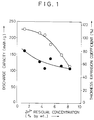
- Embodiments 1 The boiling time for Embodiments 1 was changed for nickel hydroxide materials containing 10% by weight of Zn 2+ dissolved therein, whereupon various nickel hydroxide materials with different residual Zn 2+ concentrations were obtained.
- Electrode plates similar to the ones according to Embodiments 1 to 8 were molded by using these nickel hydroxide materials, and the discharge capacity and thickness expansion coefficient were measured with use of these electrode plates in the same manner as in Embodiment 1.
- FIG. 1 shows the relationships with the residual Zn 2+ concentration.
- white and black circles represent the discharge capacity and the thickness expansion coefficient, respectively.
- the thickness expansion coefficient decreases gradually, while the discharge capacity of the battery lowers suddenly. It is advisable, therefore, to restrict the residual content of Zn 2+ in the nickel hydroxide to 5% or less by weight.
- Nickel hydroxide powders were prepared containing 5% by weight of Zn 2+ solidly dissolved therein. One hundred grams of each of these powders was put into 5 liters of a 30% water solution of potassium hydroxide, and was stirred as it was boiled for 10 hours. The residual Zn 2+ concentration was 3.1% by weight.
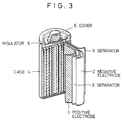
- an AA-size alkaline secondary battery with a rated capacity of 1,100 mAh was assembled by using this positive electrode, as follows: First, a nylon sheet as a separator 3 was interposed between the positive electrode 1 and a negative electrode 2 on which a hydrogen-occlusive alloy was supported, and the entire structure was rolled and then contained in a case 4 made of stainless steel plated with nickel. A water solution of potassium hydroxide was poured into the case 4 as an electrolyte, and the case 4 was hermetically sealed by a cover 5 with an insulator 5 therebetween.
- a similar positive electrode was manufactured with use of a nickel hydroxide powder obtained without the elution process and pure nickel hydroxide, and a similar battery was assembled by using this positive electrode.
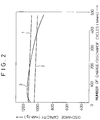
- alkaline secondary batteries were subjected to a charge/discharge cycle test under conditions including a current of 1,100 milliamperes, charging time of 1.2 hours, discharge termination voltage of 1.00 volt.
- FIG. 2 shows the relationships between the number of charge/discharge cycles and the discharge capacity.
- curves 1, 2 and 3 represent cases where the nickel hydroxide material subjected to the elution process was used, where the nickel hydroxide material obtained without the elution process was used, and where pure nickel hydroxide was used, respectively.
- the battery using the nickel hydroxide according to the present invention can maintain a high discharge capacity for a long period of time.
Landscapes
- Chemical & Material Sciences (AREA)
- Chemical Kinetics & Catalysis (AREA)
- Electrochemistry (AREA)
- General Chemical & Material Sciences (AREA)
- Inorganic Chemistry (AREA)
- Battery Electrode And Active Subsutance (AREA)
- Secondary Cells (AREA)
Claims (9)
- Herstellungsverfahren für ein Nickelhydroxid für eine Nickelelektrode, wobei die Nickelelektrode zur Herstellung einer alkalischen Sekundärbatterie verwendbar ist, wobei das Verfahren die folgenden Schritte umfaßt, die ausgeführt werden müssen, bevor die Nickelelektrode in eine Batterie eingefügt wird:einen Schritt zur Herstellung eines Nickelhydroxids, das Ionen mindestens eines Metalls enthält, das aus einer Gruppe bestehend aus Zn, Cd, Mg, Ca, Mn, Co, Cu und Al ausgewählt wird, die darin als feste Lösung vorliegen; undeinen Schritt des Herauslösens einer Teilmenge der Metallionen aus dem Nickelhydroxid in einem derartigen Ausmaß, daß das Gewicht der Metallionen, die nach dem Herauslösungsverfahren im Nickelhydroxid verbleiben, 5% oder weniger vom Gewicht des Nickelhydroxids beträgt.
- Verfahren nach Anspruch 1, worin das Herauslösungsverfahren durchgeführt wird, indem eine alkalische wäßrige Lösung verwendet wird.
- Herstellungsverfahren für eine Nickelelektrode, wobei die Nickelelektrode zur Herstellung einer alkalischen Sekundärbatterie verwendbar ist, wobei das Verfahren die folgenden Schritte umfaßt, die durchgeführt werden müssen, bevor die Nickelelektrode in eine Batterie eingefügt wird:einen Schritt zur Herstellung eines Nickelhydroxids, das Ionen mindestens eines Metalls enthält, das aus einer Gruppe bestehend aus Zn, Cd, Mg, Ca, Mn, Co, Cu und Al ausgewählt wird, die darin als feste Lösung vorliegen, und daraufhin das Herauslösen einer Teilmenge der Metallionen aus dem Nickelhydroxid in einem derartigen Ausmaß, daß das Gewicht der Metallionen, die nach dem Herauslösungsverfahren im Nickelhydroxid verbleiben, 5% oder weniger vom Gewicht des Nickelhydroxids beträgt, wodurch ein Nickelhydroxid hergestellt wird, das in einen Stromkollektor gefüllt werden muß;einen Schritt des Vermischens des in einen Stromkollektor zu füllenden Nickelhydroxids, eines stromleitenden Materials, eines Bindemittels und eines Eindickmittels, um eine Paste aus aktivem Material herzustellen; undeinen Schritt des Füllens des porösen Stromkollektors mit der Paste aus aktivem Material und des Formens der Nickelelektrode durch Erhitzung und Druckbeaufschlagung.
- Herstellungsverfahren für eine Nickelelektrode, wobei die Nickelelektrode zur Herstellung einer alkalischen Sekundärbatterie verwendbar ist, wobei das Verfahren die folgenden Schritte umfaßt, die ausgeführt werden müssen, bevor die Nickelelektrode in eine Batterie eingefügt wird:einen Schritt zur Herstellung eines Nickelhydroxids, das Ionen mindestens eines Metalls enthält, das aus einer Gruppe bestehend aus Zn, Cd, Mg, Ca, Mn, Co, Cu und Al ausgewählt wird, die darin als feste Lösung vorliegen;einen Schritt des Vermischens der Nickelelektrode, eines stromleitenden Materials, eines Bindemittels und eines Eindickmittels, um eine Paste aus aktivem Material herzustellen;einen Schritt des Füllens eines porösen Stromkollektors mit der Paste aus aktivem Material, um einen Vorläufer der Nickelelektrode zu bilden;einen Schritt des Herauslösens einer Teilmenge der Metallionen aus dem Nickelhydroxid, die im Vorläufer der Nickelelektrode enthalten sind, und zwar in einem solchen Ausmaß, daß das Gewicht der Metallionen, die nach dem Herauslösungsverfahren im Nickelhydroxid verbleiben, 5% oder weniger vom Gewicht des Nickelhydroxids beträgt; undeinen Schritt des Formens des Nickelelektroden-Vorläufers in eine Nickelelektrode durch Erhitzen und Druckbeaufschlagung.
- Verfahren nach Anspruch 3 oder 4, worin das stromleitende Material ein Material ist, das aus der Gruppe bestehend aus Nickelpulver, Kobaltpulver und Kobaltoxidpulver ausgewählt wird.
- Verfahren nach Anspruch 3 oder 4, worin das Bindemittel Polytetrafluorethylenpulver ist.
- Verfahren nach Anspruch 3 oder 4, worin das Eindickmittel eine wässerige Lösung von Carboxymethylcellulose ist.
- Verfahren nach Anspruch 3 oder 4, worin der Stromkollektor ein expandierter Nickelschwamm ist.
- Eine alkalische Sekundärbatterie, die als eine positive Elektrode die durch das Verfahren nach Anspruch 3 oder 4 hergestellte Nickelelektrode umfaßt.
Applications Claiming Priority (2)
| Application Number | Priority Date | Filing Date | Title |
|---|---|---|---|
| JP5266544A JPH07122271A (ja) | 1993-10-25 | 1993-10-25 | ニッケル極用水酸化ニッケルの製造方法、およびその水酸化ニッケルを用いたニッケル極の製造方法、ならびにそのニッケル極を組込んだアルカリ二次電池 |
| JP266544/93 | 1993-10-25 |
Publications (2)
| Publication Number | Publication Date |
|---|---|
| EP0650207A1 EP0650207A1 (de) | 1995-04-26 |
| EP0650207B1 true EP0650207B1 (de) | 1998-04-29 |
Family
ID=17432335
Family Applications (1)
| Application Number | Title | Priority Date | Filing Date |
|---|---|---|---|
| EP94116554A Expired - Lifetime EP0650207B1 (de) | 1993-10-25 | 1994-10-20 | Verfahren zur Herstellung von Nickelhydroxid für eine Nickelelektrode, Verfahren zur Herstellung der Nickelelektrode und eine alkalische Sekundärbatterie die diese Nickelelektrode enthält |
Country Status (4)
| Country | Link |
|---|---|
| US (1) | US5549992A (de) |
| EP (1) | EP0650207B1 (de) |
| JP (1) | JPH07122271A (de) |
| DE (1) | DE69409909T2 (de) |
Families Citing this family (13)
| Publication number | Priority date | Publication date | Assignee | Title |
|---|---|---|---|---|
| DE69505911T2 (de) * | 1994-08-04 | 1999-04-08 | Sanyo Electric Co., Ltd., Moriguchi, Osaka | Aktivmasse Pulver für nichtgesinterte Nickelelektrode, nichtgesinterte Nickelelektrode für alkalische Batterie und Verfahren zu ihrer Herstellung |
| US5674643A (en) * | 1995-02-14 | 1997-10-07 | Sanyo Electric Co., Ltd. | Non-sintered nickel electrode for alkaline storage cell |
| KR100373721B1 (ko) * | 1995-11-17 | 2003-04-26 | 삼성에스디아이 주식회사 | 니켈전극활물질및이를채용하고있는니켈전극 |
| EP0801431A4 (de) * | 1995-11-22 | 1999-02-24 | Matsushita Electric Industrial Co Ltd | Aktive materialien auf nickel-hydroxidbasis für alkalische speicherbatterie und positive platte |
| DE69626495T2 (de) * | 1995-11-22 | 2003-12-24 | Matsushita Electric Industrial Co., Ltd. | Elektrode mit aktivem material für positive platte eines akkus |
| DE69712582T2 (de) | 1996-09-20 | 2003-01-09 | Matsushita Electric Industrial Co., Ltd. | Aktives Material für die positive Elektrode alkalischer Speicherbatterien |
| US6042753A (en) * | 1996-10-06 | 2000-03-28 | Matsushita Electric Industrial Co., Ltd. | Active materials for the positive electrode in alkaline storage batteries |
| FR2760567B1 (fr) | 1997-03-06 | 1999-04-16 | Alsthom Cge Alcatel | Matiere active positive pour electrode de nickel d'accumulateur a electrolyte alcalin |
| JP3489960B2 (ja) * | 1997-04-01 | 2004-01-26 | 松下電器産業株式会社 | アルカリ蓄電池 |
| FR2764442B1 (fr) * | 1997-06-05 | 1999-07-30 | Alsthom Cge Alcatel | Electrode de nickel empatee |
| JP3923157B2 (ja) * | 1997-12-11 | 2007-05-30 | 松下電器産業株式会社 | アルカリ蓄電池 |
| JP3685704B2 (ja) * | 2000-10-03 | 2005-08-24 | 三洋電機株式会社 | アルカリ蓄電池用ニッケル極の製造方法 |
| JP4569068B2 (ja) * | 2003-02-25 | 2010-10-27 | 株式会社Gsユアサ | ニッケル電極用増粘剤、ニッケル電極及びその製造方法、並びに、アルカリ蓄電池 |
Family Cites Families (6)
| Publication number | Priority date | Publication date | Assignee | Title |
|---|---|---|---|---|
| US4330603A (en) * | 1981-01-29 | 1982-05-18 | The United States Of America As Represented By The United States Department Of Energy | High capacity nickel battery material doped with alkali metal cations |
| EP0271043B1 (de) * | 1986-12-08 | 1992-01-22 | Matsushita Electric Industrial Co., Ltd. | Gasdichter Akkumulator und Verfahren zur Herstellung seiner Elektrode |
| JPH0724218B2 (ja) * | 1988-04-11 | 1995-03-15 | 株式会社ユアサコーポレーション | アルカリ電池用ニッケル電極及びこれを用いた電池 |
| EP0353837B1 (de) * | 1988-07-19 | 1994-07-27 | Yuasa Corporation | Nickelelektrode für eine alkalische Batterie |
| JPH04337246A (ja) * | 1991-05-14 | 1992-11-25 | Japan Storage Battery Co Ltd | ニッケル−亜鉛電池 |
| US5366831A (en) * | 1991-06-14 | 1994-11-22 | Yuasa Corporation | Nickel electrode for alkaline battery |
-
1993
- 1993-10-25 JP JP5266544A patent/JPH07122271A/ja active Pending
-
1994
- 1994-10-11 US US08/320,863 patent/US5549992A/en not_active Expired - Fee Related
- 1994-10-20 DE DE69409909T patent/DE69409909T2/de not_active Expired - Fee Related
- 1994-10-20 EP EP94116554A patent/EP0650207B1/de not_active Expired - Lifetime
Also Published As
| Publication number | Publication date |
|---|---|
| US5549992A (en) | 1996-08-27 |
| JPH07122271A (ja) | 1995-05-12 |
| DE69409909T2 (de) | 1998-10-22 |
| DE69409909D1 (de) | 1998-06-04 |
| EP0650207A1 (de) | 1995-04-26 |
Similar Documents
| Publication | Publication Date | Title |
|---|---|---|
| EP0523284B1 (de) | Aktivmasse aus Nickelhydroxidpulver, positive Nickelelektrode, und ihre Verwendung in einer alkalischen Speicherbatterie | |
| JP2575840B2 (ja) | 水素吸蔵合金電極の乾式製造方法 | |
| US5707764A (en) | Alkali secondary battery | |
| EP0284333B1 (de) | Gasdichte Nickel-Hydridbatterie und Verfahren zur Herstellung | |
| KR100281729B1 (ko) | 니켈 양극 및 이것을 사용한 알칼리 축전지 | |
| EP0477461B1 (de) | Nickel-Wasserstoff-Akkumulator und Verfahren zu seiner Herstellung | |
| EP0650207B1 (de) | Verfahren zur Herstellung von Nickelhydroxid für eine Nickelelektrode, Verfahren zur Herstellung der Nickelelektrode und eine alkalische Sekundärbatterie die diese Nickelelektrode enthält | |
| JP3173973B2 (ja) | アルカリ蓄電池 | |
| EP0696822B1 (de) | Gasdichte alkalische Batterie | |
| US5840442A (en) | Method for activating an alkaline rechargeable battery | |
| EP0696825A1 (de) | Methode zur Herstellung einer Nickel-Metall-Hydridbatterie | |
| EP0765705B1 (de) | Verfahren zur Herstellung von Wasserstoffspeicherlegierungspulver für Batterien | |
| JP3200822B2 (ja) | ニッケル−金属水素化物蓄電池 | |
| JP2989877B2 (ja) | ニッケル水素二次電池 | |
| US20070072079A1 (en) | Hydrogen-absorbing alloy electrode, alkaline storage battery, and method of manufacturing the alkaline storage battery | |
| JP3404758B2 (ja) | ニッケル−金属水素化物蓄電池およびこの製造方法 | |
| JP2733230B2 (ja) | 水素吸蔵合金を用いた密閉形ニッケル・水素蓄電池 | |
| JP3369148B2 (ja) | アルカリ蓄電池 | |
| JP3392700B2 (ja) | アルカリ二次電池 | |
| JPH11191412A (ja) | アルカリ蓄電池 | |
| JPH04328252A (ja) | 水素吸蔵電極 | |
| JP3011386B2 (ja) | アルカリ二次電池用ペースト式電極 | |
| JPH04284369A (ja) | ニッケル・金属水素化物蓄電池 | |
| JP2854920B2 (ja) | ニッケル水素蓄電池 | |
| JP3377576B2 (ja) | アルカリ二次電池の製造方法 |
Legal Events
| Date | Code | Title | Description |
|---|---|---|---|
| PUAI | Public reference made under article 153(3) epc to a published international application that has entered the european phase |
Free format text: ORIGINAL CODE: 0009012 |
|
| AK | Designated contracting states |
Kind code of ref document: A1 Designated state(s): DE FR GB |
|
| 17P | Request for examination filed |
Effective date: 19950414 |
|
| 17Q | First examination report despatched |
Effective date: 19951204 |
|
| GRAG | Despatch of communication of intention to grant |
Free format text: ORIGINAL CODE: EPIDOS AGRA |
|
| GRAG | Despatch of communication of intention to grant |
Free format text: ORIGINAL CODE: EPIDOS AGRA |
|
| GRAH | Despatch of communication of intention to grant a patent |
Free format text: ORIGINAL CODE: EPIDOS IGRA |
|
| GRAH | Despatch of communication of intention to grant a patent |
Free format text: ORIGINAL CODE: EPIDOS IGRA |
|
| GRAA | (expected) grant |
Free format text: ORIGINAL CODE: 0009210 |
|
| AK | Designated contracting states |
Kind code of ref document: B1 Designated state(s): DE FR GB |
|
| REF | Corresponds to: |
Ref document number: 69409909 Country of ref document: DE Date of ref document: 19980604 |
|
| ET | Fr: translation filed | ||
| PLBE | No opposition filed within time limit |
Free format text: ORIGINAL CODE: 0009261 |
|
| STAA | Information on the status of an ep patent application or granted ep patent |
Free format text: STATUS: NO OPPOSITION FILED WITHIN TIME LIMIT |
|
| 26N | No opposition filed | ||
| PGFP | Annual fee paid to national office [announced via postgrant information from national office to epo] |
Ref country code: FR Payment date: 19991011 Year of fee payment: 6 |
|
| PGFP | Annual fee paid to national office [announced via postgrant information from national office to epo] |
Ref country code: GB Payment date: 19991020 Year of fee payment: 6 |
|
| PGFP | Annual fee paid to national office [announced via postgrant information from national office to epo] |
Ref country code: DE Payment date: 19991022 Year of fee payment: 6 |
|
| PG25 | Lapsed in a contracting state [announced via postgrant information from national office to epo] |
Ref country code: GB Free format text: LAPSE BECAUSE OF NON-PAYMENT OF DUE FEES Effective date: 20001020 |
|
| GBPC | Gb: european patent ceased through non-payment of renewal fee |
Effective date: 20001020 |
|
| PG25 | Lapsed in a contracting state [announced via postgrant information from national office to epo] |
Ref country code: FR Free format text: LAPSE BECAUSE OF NON-PAYMENT OF DUE FEES Effective date: 20010629 |
|
| PG25 | Lapsed in a contracting state [announced via postgrant information from national office to epo] |
Ref country code: DE Free format text: LAPSE BECAUSE OF NON-PAYMENT OF DUE FEES Effective date: 20010703 |
|
| REG | Reference to a national code |
Ref country code: FR Ref legal event code: ST |