EP0650672A1 - Dispositif pour prolonger la longueur des cheveux humains - Google Patents
Dispositif pour prolonger la longueur des cheveux humains Download PDFInfo
- Publication number
- EP0650672A1 EP0650672A1 EP19940250264 EP94250264A EP0650672A1 EP 0650672 A1 EP0650672 A1 EP 0650672A1 EP 19940250264 EP19940250264 EP 19940250264 EP 94250264 A EP94250264 A EP 94250264A EP 0650672 A1 EP0650672 A1 EP 0650672A1
- Authority
- EP
- European Patent Office
- Prior art keywords
- elements
- hair
- adhesive
- another
- pressure surfaces
- Prior art date
- Legal status (The legal status is an assumption and is not a legal conclusion. Google has not performed a legal analysis and makes no representation as to the accuracy of the status listed.)
- Granted
Links
Images

Classifications
-
- A—HUMAN NECESSITIES
- A41—WEARING APPAREL
- A41G—ARTIFICIAL FLOWERS; WIGS; MASKS; FEATHERS
- A41G5/00—Hair pieces, inserts, rolls, pads, or the like; Toupées
- A41G5/004—Hairpieces, e.g. hair extensions
- A41G5/0086—Applicators or tools for applying hairpieces to the user
-
- B—PERFORMING OPERATIONS; TRANSPORTING
- B29—WORKING OF PLASTICS; WORKING OF SUBSTANCES IN A PLASTIC STATE IN GENERAL
- B29C—SHAPING OR JOINING OF PLASTICS; SHAPING OF MATERIAL IN A PLASTIC STATE, NOT OTHERWISE PROVIDED FOR; AFTER-TREATMENT OF THE SHAPED PRODUCTS, e.g. REPAIRING
- B29C65/00—Joining or sealing of preformed parts, e.g. welding of plastics materials; Apparatus therefor
- B29C65/02—Joining or sealing of preformed parts, e.g. welding of plastics materials; Apparatus therefor by heating, with or without pressure
- B29C65/18—Joining or sealing of preformed parts, e.g. welding of plastics materials; Apparatus therefor by heating, with or without pressure using heated tools
-
- B—PERFORMING OPERATIONS; TRANSPORTING
- B29—WORKING OF PLASTICS; WORKING OF SUBSTANCES IN A PLASTIC STATE IN GENERAL
- B29C—SHAPING OR JOINING OF PLASTICS; SHAPING OF MATERIAL IN A PLASTIC STATE, NOT OTHERWISE PROVIDED FOR; AFTER-TREATMENT OF THE SHAPED PRODUCTS, e.g. REPAIRING
- B29C65/00—Joining or sealing of preformed parts, e.g. welding of plastics materials; Apparatus therefor
- B29C65/02—Joining or sealing of preformed parts, e.g. welding of plastics materials; Apparatus therefor by heating, with or without pressure
- B29C65/18—Joining or sealing of preformed parts, e.g. welding of plastics materials; Apparatus therefor by heating, with or without pressure using heated tools
- B29C65/24—Joining or sealing of preformed parts, e.g. welding of plastics materials; Apparatus therefor by heating, with or without pressure using heated tools characterised by the means for heating the tool
- B29C65/30—Electrical means
- B29C65/305—Electrical means involving the use of cartridge heaters
-
- B—PERFORMING OPERATIONS; TRANSPORTING
- B29—WORKING OF PLASTICS; WORKING OF SUBSTANCES IN A PLASTIC STATE IN GENERAL
- B29C—SHAPING OR JOINING OF PLASTICS; SHAPING OF MATERIAL IN A PLASTIC STATE, NOT OTHERWISE PROVIDED FOR; AFTER-TREATMENT OF THE SHAPED PRODUCTS, e.g. REPAIRING
- B29C66/00—General aspects of processes or apparatus for joining preformed parts
- B29C66/69—General aspects of joining filaments
-
- B—PERFORMING OPERATIONS; TRANSPORTING
- B29—WORKING OF PLASTICS; WORKING OF SUBSTANCES IN A PLASTIC STATE IN GENERAL
- B29C—SHAPING OR JOINING OF PLASTICS; SHAPING OF MATERIAL IN A PLASTIC STATE, NOT OTHERWISE PROVIDED FOR; AFTER-TREATMENT OF THE SHAPED PRODUCTS, e.g. REPAIRING
- B29C66/00—General aspects of processes or apparatus for joining preformed parts
- B29C66/80—General aspects of machine operations or constructions and parts thereof
- B29C66/82—Pressure application arrangements, e.g. transmission or actuating mechanisms for joining tools or clamps
- B29C66/822—Transmission mechanisms
- B29C66/8221—Scissor or lever mechanisms, i.e. involving a pivot point
-
- B—PERFORMING OPERATIONS; TRANSPORTING
- B29—WORKING OF PLASTICS; WORKING OF SUBSTANCES IN A PLASTIC STATE IN GENERAL
- B29C—SHAPING OR JOINING OF PLASTICS; SHAPING OF MATERIAL IN A PLASTIC STATE, NOT OTHERWISE PROVIDED FOR; AFTER-TREATMENT OF THE SHAPED PRODUCTS, e.g. REPAIRING
- B29C66/00—General aspects of processes or apparatus for joining preformed parts
- B29C66/80—General aspects of machine operations or constructions and parts thereof
- B29C66/83—General aspects of machine operations or constructions and parts thereof characterised by the movement of the joining or pressing tools
- B29C66/832—Reciprocating joining or pressing tools
- B29C66/8324—Joining or pressing tools pivoting around one axis
- B29C66/83241—Joining or pressing tools pivoting around one axis cooperating pivoting tools
-
- B—PERFORMING OPERATIONS; TRANSPORTING
- B29—WORKING OF PLASTICS; WORKING OF SUBSTANCES IN A PLASTIC STATE IN GENERAL
- B29C—SHAPING OR JOINING OF PLASTICS; SHAPING OF MATERIAL IN A PLASTIC STATE, NOT OTHERWISE PROVIDED FOR; AFTER-TREATMENT OF THE SHAPED PRODUCTS, e.g. REPAIRING
- B29C66/00—General aspects of processes or apparatus for joining preformed parts
- B29C66/80—General aspects of machine operations or constructions and parts thereof
- B29C66/84—Specific machine types or machines suitable for specific applications
- B29C66/861—Hand-held tools
- B29C66/8614—Tongs, pincers or scissors
-
- B—PERFORMING OPERATIONS; TRANSPORTING
- B29—WORKING OF PLASTICS; WORKING OF SUBSTANCES IN A PLASTIC STATE IN GENERAL
- B29C—SHAPING OR JOINING OF PLASTICS; SHAPING OF MATERIAL IN A PLASTIC STATE, NOT OTHERWISE PROVIDED FOR; AFTER-TREATMENT OF THE SHAPED PRODUCTS, e.g. REPAIRING
- B29C66/00—General aspects of processes or apparatus for joining preformed parts
- B29C66/90—Measuring or controlling the joining process
- B29C66/91—Measuring or controlling the joining process by measuring or controlling the temperature, the heat or the thermal flux
- B29C66/914—Measuring or controlling the joining process by measuring or controlling the temperature, the heat or the thermal flux by controlling or regulating the temperature, the heat or the thermal flux
- B29C66/9141—Measuring or controlling the joining process by measuring or controlling the temperature, the heat or the thermal flux by controlling or regulating the temperature, the heat or the thermal flux by controlling or regulating the temperature
- B29C66/91431—Measuring or controlling the joining process by measuring or controlling the temperature, the heat or the thermal flux by controlling or regulating the temperature, the heat or the thermal flux by controlling or regulating the temperature the temperature being kept constant over time
-
- B—PERFORMING OPERATIONS; TRANSPORTING
- B29—WORKING OF PLASTICS; WORKING OF SUBSTANCES IN A PLASTIC STATE IN GENERAL
- B29C—SHAPING OR JOINING OF PLASTICS; SHAPING OF MATERIAL IN A PLASTIC STATE, NOT OTHERWISE PROVIDED FOR; AFTER-TREATMENT OF THE SHAPED PRODUCTS, e.g. REPAIRING
- B29C66/00—General aspects of processes or apparatus for joining preformed parts
- B29C66/90—Measuring or controlling the joining process
- B29C66/91—Measuring or controlling the joining process by measuring or controlling the temperature, the heat or the thermal flux
- B29C66/914—Measuring or controlling the joining process by measuring or controlling the temperature, the heat or the thermal flux by controlling or regulating the temperature, the heat or the thermal flux
- B29C66/9161—Measuring or controlling the joining process by measuring or controlling the temperature, the heat or the thermal flux by controlling or regulating the temperature, the heat or the thermal flux by controlling or regulating the heat or the thermal flux, i.e. the heat flux
- B29C66/91641—Measuring or controlling the joining process by measuring or controlling the temperature, the heat or the thermal flux by controlling or regulating the temperature, the heat or the thermal flux by controlling or regulating the heat or the thermal flux, i.e. the heat flux the heat or the thermal flux being non-constant over time
-
- B—PERFORMING OPERATIONS; TRANSPORTING
- B29—WORKING OF PLASTICS; WORKING OF SUBSTANCES IN A PLASTIC STATE IN GENERAL
- B29C—SHAPING OR JOINING OF PLASTICS; SHAPING OF MATERIAL IN A PLASTIC STATE, NOT OTHERWISE PROVIDED FOR; AFTER-TREATMENT OF THE SHAPED PRODUCTS, e.g. REPAIRING
- B29C66/00—General aspects of processes or apparatus for joining preformed parts
- B29C66/90—Measuring or controlling the joining process
- B29C66/91—Measuring or controlling the joining process by measuring or controlling the temperature, the heat or the thermal flux
- B29C66/919—Measuring or controlling the joining process by measuring or controlling the temperature, the heat or the thermal flux characterised by specific temperature, heat or thermal flux values or ranges
- B29C66/9192—Measuring or controlling the joining process by measuring or controlling the temperature, the heat or the thermal flux characterised by specific temperature, heat or thermal flux values or ranges in explicit relation to another variable, e.g. temperature diagrams
- B29C66/91921—Measuring or controlling the joining process by measuring or controlling the temperature, the heat or the thermal flux characterised by specific temperature, heat or thermal flux values or ranges in explicit relation to another variable, e.g. temperature diagrams in explicit relation to another temperature, e.g. to the softening temperature or softening point, to the thermal degradation temperature or to the ambient temperature
- B29C66/91931—Measuring or controlling the joining process by measuring or controlling the temperature, the heat or the thermal flux characterised by specific temperature, heat or thermal flux values or ranges in explicit relation to another variable, e.g. temperature diagrams in explicit relation to another temperature, e.g. to the softening temperature or softening point, to the thermal degradation temperature or to the ambient temperature in explicit relation to the fusion temperature or melting point of the material of one of the parts to be joined
-
- B—PERFORMING OPERATIONS; TRANSPORTING
- B29—WORKING OF PLASTICS; WORKING OF SUBSTANCES IN A PLASTIC STATE IN GENERAL
- B29C—SHAPING OR JOINING OF PLASTICS; SHAPING OF MATERIAL IN A PLASTIC STATE, NOT OTHERWISE PROVIDED FOR; AFTER-TREATMENT OF THE SHAPED PRODUCTS, e.g. REPAIRING
- B29C66/00—General aspects of processes or apparatus for joining preformed parts
- B29C66/90—Measuring or controlling the joining process
- B29C66/96—Measuring or controlling the joining process characterised by the method for implementing the controlling of the joining process
- B29C66/961—Measuring or controlling the joining process characterised by the method for implementing the controlling of the joining process involving a feedback loop mechanism, e.g. comparison with a desired value
Definitions
- the invention relates to a device of the type specified in the preamble of claim 1.
- a method for lengthening human hair is known from US-A-4,982,748.
- a device is used which mechanically compresses sections of the hair to be lengthened, which are previously connected by braiding to additional hair, between rod-shaped elements at the connection point and is simultaneously subjected to the action of heat. This is to create a firm connection between the hair pieces.
- the device used in the method described above has the disadvantage that only aftertreatment of hair components already connected by a previous braiding process can be carried out in order to achieve an additional increase in the strength of the connection at the connection point.
- connecting individual hairs to the device described above is not possible or is possible only with difficulty.
- the invention has for its object to provide a device of the type mentioned, through which individual hair and / or strands of hair consisting of individual hairs can be permanently connected to additional hair elements with ease of handling.
- the invention includes the finding that in a device for lengthening hair, wherein the contacting of the hair to be connected is made between the free ends of two elements, a substantial relief in handling the device is ensured in particular when the device is essentially rod-shaped trained elements are connected to each other in an area and can be pivoted against each other around this area until the free ends of the elements touch.
- the area can either consist of a rotary bearing or a fixed connection, in which case the necessary relative movement of the elements gripping the hair can then be generated by the elasticity of the legs carrying the elements.
- the device can be safely guided manually, with the guide also allowing the working area and the contact pressure to be selected in a precisely metered manner, which is particularly important when connecting hair pieces. This requires a secure hand and precise guidance, since otherwise no precise connections can be made.
- the device for fastening natural hair is also suitable in each case on only a single hair in the area of the scalp.
- the device has two essentially rod-shaped elements which are designed like pliers or scissors and connected to one another at a common pivot point are.
- the size of the pivoting movement of the paired free ends of the elements can be determined by the choice of the position of the common pivot point.
- a first pair of free ends is provided for contacting the hair to be connected, and the second pair of free ends are designed as grip pieces, via which the pivoting movement of the second pair of ends can be coordinated.
- the free ends used to contact the hair to be connected are each enlarged in a favorable manner to form a substantially flat surface.
- the surfaces of the second pair of ends are moved towards one another by the pivoting movement and lie flat against one another at the end of the pivoting movement.
- the planar design of the ends of the elements advantageously ensures that the hair sections to be connected can be positioned in a suitable manner in the remaining free space between the ends of the elements before the hair sections are contacted in the case of adjoining end surfaces.
- thermoplastic adhesive which is provided on at least one of the surfaces before the hair to be connected is inserted into the space between the pivotable, free ends with correspondingly selected sections.
- one of the pivotably arranged elements of the device according to the invention is designed to be heatable.
- an element in the form of an electric soldering iron is particularly favorable.
- the thermoplastic adhesive is advantageously in tablet form and can thereby can be easily accommodated by means of the pivotable ends of the device.
- the amount of heat supplied via one of the pivotable ends causes the adhesive to melt, as a result of which both are wetted by the adhesive in the case of superimposed surfaces.
- the hair ends which are subsequently to be introduced between the pair of surfaces of the pivotable ends wetted with adhesive are joined together advantageously by the influence of heat and the action of the adhesive by recombining the surfaces.
- At least one of the enlarged ends of the pivotable elements has an opening which is open towards the surface plane and which corresponds in shape and size to the tableting of the thermoplastic adhesive.
- the flat expansion of the free ends of the pivotable elements serves to fix the position of the individual hair or strands of hair before the ends of these elements are brought together again after the adhesive has melted.
- a resilient element is provided between the grips, which adjusts the starting position of the elements as required when the grips are relieved.
- the use of a torsion spring with a spring constant of a suitable size is favorable here.
- thermoplastic adhesive is supplied from a suitably designed storage container, which is attached to one of the pivotable elements of the device whose common pivot point and the area-widened end is provided.
- the adhesive is led from the storage container to the corresponding pressure surface via a connecting line.
- an upwardly open storage container serves as a reservoir for the adhesive, which is kept liquid by heating.
- thermostatting by means of a suitable control circuit is favorable, in which a temperature sensor is provided in the area of the pressure surface or the adhesive supply, which triggers heating when the adhesive temperature has dropped to a value below the melting temperature is.
- the pivotable elements of the device are connected like a pair of tweezers at a common point.
- the elements each have a flat surface section at their free end, which lie on one another at the end of a swiveling process, in which position the connection of the hair is made between them using an adhesive when exposed to heat.
- the essentially rod-shaped elements In order to bring the elements of the device back into their starting position after the hair connection has taken place, it is necessary that the essentially rod-shaped elements have a certain elasticity. This elasticity is required at least at the end sections of the elements which are connected at a common point.
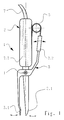
- the device 1 shown in FIG. 1 for lengthening a human hair with a hair part by connecting with a hot-melt adhesive has two elements provided with actuating elements that touch and can be pressed against each other, between which a connection of the ends of the hair and hair part while melting one Amount of adhesive and then glued.
- the device 1 is provided with two essentially rod-shaped elements 2 and 3, which are connected to one another in the form of pliers or scissors at a common pivot point 4.
- the rod-shaped Element 2 is heatable in the form of an electric soldering iron with a line connection 7.
- the handle 2.2 of the element 2, which has a heating cartridge in the manner of an electric soldering iron, is elastically connected to an end of the element 3 designed as a handle 3.2, via a spring element 5.
- the spring element 5 is designed as a torsion spring and ensures that the elements 2 and 3 of the device 1 are returned to their starting position shown in FIG. 1 if hair has been lengthened by connecting their ends.
- the pincer-shaped elements consist of a first part which extends essentially rectilinearly from a grip part to a heatable element and a second part which is pivotably mounted in a central region of the first part and is not provided with a heating device, the second part being two has parts extending substantially in a straight direction parallel to the first part, which are connected in the region of the pivot bearing by means of a bridge crossing the first part.
- the possible movements of the elements are shown symbolically by arrows.
- the hair sections are connected between the free ends 2.1 and 3.1 of the elements 2 and 3, the hair or strands of hair to be connected (compare position 13 according to FIG. 3) essentially perpendicular to the longitudinal axis of the device 1 in the between the free ends 2.1, 3.1 available space have been spent.
- the free ends 2.1, 3.1 are in particular widened in a plate-like manner and have pressure surfaces on their inner sides which lie flat against one another, when the elements have reached their end position.
- the hair sections are connected using a thermoplastic adhesive, which is liquefied by the heat input through the heating cartridge, envelops the hair sections concerned, solidifies again after pivoting back the free ends 2.1 and 3.1 into the starting position, and thereby permanently the individual hairs for the purpose of hair extension connects.
- the hair is always connected in such a way that the hair to be lengthened is connected to the additional hair in the area close to the head.
- the two hairs are connected taking into account the same direction of growth. If necessary, it is also necessary to manually process the hair sections wetted with the adhesive.
- the pivotable elements 2, 3 are expanded at their ends 2.1, 3.1 and have an essentially flat surface on the sides facing each other. At the end of the swiveling process, these surfaces lie one on top of the other, so that the adhesive is distributed evenly in a favorable manner and adhesive spots with only a relatively small thickness arise.
- FIG. 2 shows two elements 2 'and 3' which can be pivoted relative to one another and which are connected to one another at one point 11 in the form of tweezers 1 ', each with one of their ends.
- Both elements 2 'and 3' are also in the form of heating cartridges with a surrounding handle part in the manner of an electric soldering iron formed and each have a connecting line 7 '.
- the free ends 2.1 'and 3.1' are of identical design and have a flat surface on the opposite side.
- the connection of the hair ends to lengthen the hair is carried out in accordance with the explanations for FIG. 1.
- the use of two heated, pivotable elements - regardless of the manufacturing advantage - favorably causes uniform heating of the area in which the hair sections are connected.
- the possible movements of the swiveling elements are symbolically represented by arrows.
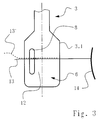
- FIG. 3 shows, as a detail of the devices 1, 1 ′ shown schematically in FIGS. 1 and 2, a free end 3.1 of the element 3 which is expanded in terms of area, with a view of the inside thereof.
- the hair 13 to be extended and the extension hair 13 'to be connected to it can be conveniently positioned on the flat surface 6 at the end of the element 3 - essentially transversely to its longitudinal axis.
- the hair connection is preferably made in the area near the head (scalp 14) of the hair 13 to be lengthened.
- the essentially cuboid recess 8 is used for short-term interim storage of a thermoplastic adhesive (not shown) which is used for connecting the hair ends.
- the adhesive is in tablet or granular form and is picked up from a storage container with the forceps, scissors or tweezers-like device 1, 1 'and positioned in the recess 8.
- the adhesive is heated to such an extent that it is evenly distributed in the recesses 12 of the profiling. Then the hair ends 13 are positioned in the manner shown and the free ends are briefly brought together again by pivoting, so that the adhesive uniformly envelops the hair ends to be connected.
- the surface 6 of the pivotable free end 3.1 is treated in this way, for example coated, so that the adhesive cannot adhere to it and the "removal" of the elongated hair is possible without problems.
- the recess 8 is small compared to the surface 6.
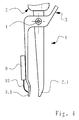
- FIG. 4 shows a favorable further development of the device 1 shown in FIG. 1 in a schematic form.
- a storage container 9 of a suitable size is provided on one of the free ends of the pivotable elements 2, 3.
- the adhesive passes directly via a supply line 10 to the inside of the free end 3.1 and can be used there for connecting the hair in the manner described above. It is particularly advantageous here if the discharge of the adhesive is controlled via the pivoting movement of the elements 2, 3 of the device 1.
- an upwardly open storage container serves as a reservoir for the adhesive which is kept liquid by heating.
- a suitable control circuit in which a temperature sensor is provided in the area of the pressure surface or the adhesive supply, which triggers heating when the adhesive temperature has dropped to a value below the melting temperature.
- the embodiment of the invention is not limited to the preferred exemplary embodiment specified above. Rather, a number of variants are conceivable which make use of the solution shown, even in the case of fundamentally different types.
Landscapes
- Engineering & Computer Science (AREA)
- Textile Engineering (AREA)
- Hair Curling (AREA)
- Cleaning And Drying Hair (AREA)
Priority Applications (1)
| Application Number | Priority Date | Filing Date | Title |
|---|---|---|---|
| DE9421648U DE9421648U1 (de) | 1993-10-31 | 1994-10-31 | Vorrichtung zur Verlängerung von menschlichem Haar |
Applications Claiming Priority (4)
| Application Number | Priority Date | Filing Date | Title |
|---|---|---|---|
| DE4337538 | 1993-10-31 | ||
| DE4337538 | 1993-10-31 | ||
| DE19944408634 DE4408634A1 (de) | 1993-10-31 | 1994-03-09 | Vorrichtung zur Verlängerung von menschlichem Haar |
| DE4408634 | 1994-03-09 |
Publications (2)
| Publication Number | Publication Date |
|---|---|
| EP0650672A1 true EP0650672A1 (fr) | 1995-05-03 |
| EP0650672B1 EP0650672B1 (fr) | 1998-01-21 |
Family
ID=25930949
Family Applications (1)
| Application Number | Title | Priority Date | Filing Date |
|---|---|---|---|
| EP19940250264 Expired - Lifetime EP0650672B1 (fr) | 1993-10-31 | 1994-10-31 | Dispositif pour prolonger la longueur des cheveux humains |
Country Status (2)
| Country | Link |
|---|---|
| EP (1) | EP0650672B1 (fr) |
| AT (1) | ATE162370T1 (fr) |
Cited By (4)
| Publication number | Priority date | Publication date | Assignee | Title |
|---|---|---|---|---|
| WO2002098250A1 (fr) * | 2001-06-07 | 2002-12-12 | Indorata-Servicos E Gestao Lda | Procede et systeme pour augmenter le volume des cheveux |
| WO2003061416A1 (fr) * | 2002-01-23 | 2003-07-31 | Indorata - Serviços E Gestão, Lda | Applicateur d'extensions de cheveux |
| WO2005107518A1 (fr) * | 2004-05-07 | 2005-11-17 | Hui-Suk Choe | Dispositif permettant de fixer un postiche a l'aide d'un adhesif |
| DE202021106612U1 (de) | 2021-12-03 | 2022-01-14 | Dörthe Bayer | Haarverlängerung |
Families Citing this family (3)
| Publication number | Priority date | Publication date | Assignee | Title |
|---|---|---|---|---|
| USD1120474S1 (en) | 2024-01-19 | 2026-03-24 | Holly Lynn Wyrembelski | Grooved head electric plier for hair extensions |
| USD1120473S1 (en) | 2024-01-19 | 2026-03-24 | Holly Lynn Wyrembelski | Smooth head electric plier for hair extensions |
| USD1119496S1 (en) | 2024-01-19 | 2026-03-24 | Holly Lynn Wyrembelski | Toothed head electric plier for hair extensions |
Citations (3)
| Publication number | Priority date | Publication date | Assignee | Title |
|---|---|---|---|---|
| US3642010A (en) * | 1969-12-17 | 1972-02-15 | Ultrasonic Systems | Ultrasonic method for hair joining |
| US4982748A (en) * | 1988-04-04 | 1991-01-08 | Trimarchi Adriana L | Method for lengthening normal hair |
| US5072745A (en) * | 1990-06-29 | 1991-12-17 | Cheh Byung J | Hair extension process |
Family Cites Families (2)
| Publication number | Priority date | Publication date | Assignee | Title |
|---|---|---|---|---|
| FR1379083A (fr) * | 1963-10-11 | 1964-11-20 | Appareil chauffant pour défriser ou décrêper la chevelure et pour sa mise en forme | |
| US4426567A (en) * | 1979-06-18 | 1984-01-17 | Andrew Turrissi | Electric hair curling iron |
-
1994
- 1994-10-31 EP EP19940250264 patent/EP0650672B1/fr not_active Expired - Lifetime
- 1994-10-31 AT AT94250264T patent/ATE162370T1/de not_active IP Right Cessation
Patent Citations (3)
| Publication number | Priority date | Publication date | Assignee | Title |
|---|---|---|---|---|
| US3642010A (en) * | 1969-12-17 | 1972-02-15 | Ultrasonic Systems | Ultrasonic method for hair joining |
| US4982748A (en) * | 1988-04-04 | 1991-01-08 | Trimarchi Adriana L | Method for lengthening normal hair |
| US5072745A (en) * | 1990-06-29 | 1991-12-17 | Cheh Byung J | Hair extension process |
Cited By (9)
| Publication number | Priority date | Publication date | Assignee | Title |
|---|---|---|---|---|
| WO2002098250A1 (fr) * | 2001-06-07 | 2002-12-12 | Indorata-Servicos E Gestao Lda | Procede et systeme pour augmenter le volume des cheveux |
| EA005430B1 (ru) * | 2001-06-07 | 2005-02-24 | Индората - Сервисош Э Жештан Лда | Способ и комплект для увеличения объема и длины волос |
| US6935348B2 (en) | 2001-06-07 | 2005-08-30 | Indorata Servicos E Gestao Lda | Method and assembly for increasing hair volume |
| AU2002233355B2 (en) * | 2001-06-07 | 2007-05-31 | Indorata - Servicos E Gestao Lda | Method and assembly for increasing hair volume |
| WO2003061416A1 (fr) * | 2002-01-23 | 2003-07-31 | Indorata - Serviços E Gestão, Lda | Applicateur d'extensions de cheveux |
| AU2003201321B2 (en) * | 2002-01-23 | 2007-06-07 | Indorata-Servicos E Gestao, Lda | Hair extension applicator |
| CN100350861C (zh) * | 2002-01-23 | 2007-11-28 | 因多拉塔服务和管理有限公司 | 毛发增设器 |
| WO2005107518A1 (fr) * | 2004-05-07 | 2005-11-17 | Hui-Suk Choe | Dispositif permettant de fixer un postiche a l'aide d'un adhesif |
| DE202021106612U1 (de) | 2021-12-03 | 2022-01-14 | Dörthe Bayer | Haarverlängerung |
Also Published As
| Publication number | Publication date |
|---|---|
| EP0650672B1 (fr) | 1998-01-21 |
| ATE162370T1 (de) | 1998-02-15 |
Similar Documents
| Publication | Publication Date | Title |
|---|---|---|
| DE60006737T2 (de) | Knochenklemme für dynamische und nicht-dynamische Frakturkompression | |
| DE3537016C2 (fr) | ||
| EP2800533B1 (fr) | Instrument électrochirurgical et partie de mâchoire pour ledit instrument | |
| DE602004012166T2 (de) | Wimpernbehandlungsvorrichtung | |
| DE3885903T2 (de) | Abziehanordnung. | |
| DE3010421A1 (de) | Instrument zum halten und einsetzen der tibiaplateaus fuer eine kniegelenk-gleitflaechenprothese | |
| DE20203301U1 (de) | Vorrichtung zur Haarverlängerung und zur Haarverdichtung | |
| EP0513525A1 (fr) | Dispositif pour la pose de marques d'oreille | |
| DE4117454A1 (de) | Anschlussapplikator zum anbringen elektrischer anschluesse sowie crimphoehen-einstellplatte dafuer | |
| EP0650672A1 (fr) | Dispositif pour prolonger la longueur des cheveux humains | |
| DE2547286B2 (de) | Haarpinzette | |
| DE202012100017U1 (de) | Elektrochirurgisches Instrument und Maulteil hierfür | |
| DE19504199C2 (de) | Scherenheizgerät sowie Verfahren zum Versiegeln der beim Schneiden von Haaren entstehenden Schnittstellen | |
| DE3412769A1 (de) | Spannelement fuer getrennte knochenteile | |
| DE9421648U1 (de) | Vorrichtung zur Verlängerung von menschlichem Haar | |
| DE60018625T2 (de) | Vorrichtung zur Wärmezufuhr an einen Kleber | |
| DE4408634A1 (de) | Vorrichtung zur Verlängerung von menschlichem Haar | |
| EP0012916B1 (fr) | Dispositif d'enroulement et de découpage | |
| DE68918906T2 (de) | Kniehebelklammer für Pulsadergeschwulst. | |
| DE2919271C2 (de) | Chirurgisches Instrument, insbesondere für die medizinisch-technische Anwendung | |
| DE102005039147B3 (de) | Nagelkorrekturspange sowie Werkzeug zur Anbringung einer solchen Spange an einem Nagel, insbesondere einem Fußnagel | |
| DE3430058C2 (fr) | ||
| DE612488C (de) | Haarwellgeraet | |
| DE19915410C2 (de) | Vorrichtung zum Verbinden der Enden polymerer Cerclagen | |
| DE3238711C2 (fr) |
Legal Events
| Date | Code | Title | Description |
|---|---|---|---|
| PUAI | Public reference made under article 153(3) epc to a published international application that has entered the european phase |
Free format text: ORIGINAL CODE: 0009012 |
|
| AK | Designated contracting states |
Kind code of ref document: A1 Designated state(s): AT BE CH DE DK ES FR GB GR IE IT LI LU MC NL PT SE |
|
| 17P | Request for examination filed |
Effective date: 19951023 |
|
| 17Q | First examination report despatched |
Effective date: 19960328 |
|
| GRAG | Despatch of communication of intention to grant |
Free format text: ORIGINAL CODE: EPIDOS AGRA |
|
| GRAG | Despatch of communication of intention to grant |
Free format text: ORIGINAL CODE: EPIDOS AGRA |
|
| GRAH | Despatch of communication of intention to grant a patent |
Free format text: ORIGINAL CODE: EPIDOS IGRA |
|
| GRAH | Despatch of communication of intention to grant a patent |
Free format text: ORIGINAL CODE: EPIDOS IGRA |
|
| GRAA | (expected) grant |
Free format text: ORIGINAL CODE: 0009210 |
|
| AK | Designated contracting states |
Kind code of ref document: B1 Designated state(s): AT BE CH DE DK ES FR GB GR IE IT LI LU MC NL PT SE |
|
| PG25 | Lapsed in a contracting state [announced via postgrant information from national office to epo] |
Ref country code: NL Free format text: LAPSE BECAUSE OF FAILURE TO SUBMIT A TRANSLATION OF THE DESCRIPTION OR TO PAY THE FEE WITHIN THE PRESCRIBED TIME-LIMIT Effective date: 19980121 Ref country code: GR Free format text: LAPSE BECAUSE OF FAILURE TO SUBMIT A TRANSLATION OF THE DESCRIPTION OR TO PAY THE FEE WITHIN THE PRESCRIBED TIME-LIMIT Effective date: 19980121 Ref country code: FR Free format text: LAPSE BECAUSE OF FAILURE TO SUBMIT A TRANSLATION OF THE DESCRIPTION OR TO PAY THE FEE WITHIN THE PRESCRIBED TIME-LIMIT Effective date: 19980121 Ref country code: ES Free format text: THE PATENT HAS BEEN ANNULLED BY A DECISION OF A NATIONAL AUTHORITY Effective date: 19980121 |
|
| REF | Corresponds to: |
Ref document number: 162370 Country of ref document: AT Date of ref document: 19980215 Kind code of ref document: T |
|
| REG | Reference to a national code |
Ref country code: CH Ref legal event code: EP |
|
| REF | Corresponds to: |
Ref document number: 59405086 Country of ref document: DE Date of ref document: 19980226 |
|
| ITF | It: translation for a ep patent filed | ||
| PG25 | Lapsed in a contracting state [announced via postgrant information from national office to epo] |
Ref country code: SE Free format text: LAPSE BECAUSE OF FAILURE TO SUBMIT A TRANSLATION OF THE DESCRIPTION OR TO PAY THE FEE WITHIN THE PRESCRIBED TIME-LIMIT Effective date: 19980421 Ref country code: PT Free format text: LAPSE BECAUSE OF FAILURE TO SUBMIT A TRANSLATION OF THE DESCRIPTION OR TO PAY THE FEE WITHIN THE PRESCRIBED TIME-LIMIT Effective date: 19980421 Ref country code: DK Free format text: LAPSE BECAUSE OF FAILURE TO SUBMIT A TRANSLATION OF THE DESCRIPTION OR TO PAY THE FEE WITHIN THE PRESCRIBED TIME-LIMIT Effective date: 19980421 |
|
| GBT | Gb: translation of ep patent filed (gb section 77(6)(a)/1977) |
Effective date: 19980430 |
|
| REG | Reference to a national code |
Ref country code: IE Ref legal event code: FG4D Free format text: 78551 |
|
| EN | Fr: translation not filed | ||
| NLV1 | Nl: lapsed or annulled due to failure to fulfill the requirements of art. 29p and 29m of the patents act | ||
| PG25 | Lapsed in a contracting state [announced via postgrant information from national office to epo] |
Ref country code: IE Free format text: LAPSE BECAUSE OF NON-PAYMENT OF DUE FEES Effective date: 19980824 |
|
| REG | Reference to a national code |
Ref country code: IE Ref legal event code: FD4D Ref document number: 78551 Country of ref document: IE |
|
| PG25 | Lapsed in a contracting state [announced via postgrant information from national office to epo] |
Ref country code: LU Free format text: LAPSE BECAUSE OF NON-PAYMENT OF DUE FEES Effective date: 19981031 Ref country code: BE Free format text: LAPSE BECAUSE OF NON-PAYMENT OF DUE FEES Effective date: 19981031 |
|
| PLBE | No opposition filed within time limit |
Free format text: ORIGINAL CODE: 0009261 |
|
| STAA | Information on the status of an ep patent application or granted ep patent |
Free format text: STATUS: NO OPPOSITION FILED WITHIN TIME LIMIT |
|
| REG | Reference to a national code |
Ref country code: CH Ref legal event code: NV Representative=s name: SCHMAUDER & PARTNER AG PATENTANWALTSBUERO |
|
| 26N | No opposition filed | ||
| BERE | Be: lapsed |
Owner name: DORTEZ CARLYLE L. Effective date: 19981031 |
|
| PG25 | Lapsed in a contracting state [announced via postgrant information from national office to epo] |
Ref country code: MC Free format text: LAPSE BECAUSE OF NON-PAYMENT OF DUE FEES Effective date: 19990430 |
|
| PGFP | Annual fee paid to national office [announced via postgrant information from national office to epo] |
Ref country code: GB Payment date: 20001013 Year of fee payment: 7 |
|
| PG25 | Lapsed in a contracting state [announced via postgrant information from national office to epo] |
Ref country code: GB Free format text: LAPSE BECAUSE OF NON-PAYMENT OF DUE FEES Effective date: 20011031 |
|
| REG | Reference to a national code |
Ref country code: GB Ref legal event code: IF02 |
|
| GBPC | Gb: european patent ceased through non-payment of renewal fee |
Effective date: 20011031 |
|
| PGFP | Annual fee paid to national office [announced via postgrant information from national office to epo] |
Ref country code: AT Payment date: 20021022 Year of fee payment: 9 |
|
| PGFP | Annual fee paid to national office [announced via postgrant information from national office to epo] |
Ref country code: CH Payment date: 20021023 Year of fee payment: 9 |
|
| PG25 | Lapsed in a contracting state [announced via postgrant information from national office to epo] |
Ref country code: LI Free format text: LAPSE BECAUSE OF NON-PAYMENT OF DUE FEES Effective date: 20031031 Ref country code: CH Free format text: LAPSE BECAUSE OF NON-PAYMENT OF DUE FEES Effective date: 20031031 Ref country code: AT Free format text: LAPSE BECAUSE OF NON-PAYMENT OF DUE FEES Effective date: 20031031 |
|
| REG | Reference to a national code |
Ref country code: CH Ref legal event code: PL |
|
| PG25 | Lapsed in a contracting state [announced via postgrant information from national office to epo] |
Ref country code: IT Free format text: LAPSE BECAUSE OF NON-PAYMENT OF DUE FEES Effective date: 20051031 |
|
| PGFP | Annual fee paid to national office [announced via postgrant information from national office to epo] |
Ref country code: DE Payment date: 20101105 Year of fee payment: 17 |
|
| PG25 | Lapsed in a contracting state [announced via postgrant information from national office to epo] |
Ref country code: DE Free format text: LAPSE BECAUSE OF NON-PAYMENT OF DUE FEES Effective date: 20130501 |
|
| REG | Reference to a national code |
Ref country code: DE Ref legal event code: R119 Ref document number: 59405086 Country of ref document: DE Effective date: 20130501 |