EP0651355A2 - Procédé et appareil de compression, de stockage, et de récupération d'images sur cartes de transaction magnétiques - Google Patents
Procédé et appareil de compression, de stockage, et de récupération d'images sur cartes de transaction magnétiques Download PDFInfo
- Publication number
- EP0651355A2 EP0651355A2 EP94420290A EP94420290A EP0651355A2 EP 0651355 A2 EP0651355 A2 EP 0651355A2 EP 94420290 A EP94420290 A EP 94420290A EP 94420290 A EP94420290 A EP 94420290A EP 0651355 A2 EP0651355 A2 EP 0651355A2
- Authority
- EP
- European Patent Office
- Prior art keywords
- image
- pixel
- group
- groups
- signal
- Prior art date
- Legal status (The legal status is an assumption and is not a legal conclusion. Google has not performed a legal analysis and makes no representation as to the accuracy of the status listed.)
- Withdrawn
Links
Images

Classifications
-
- G—PHYSICS
- G06—COMPUTING OR CALCULATING; COUNTING
- G06T—IMAGE DATA PROCESSING OR GENERATION, IN GENERAL
- G06T9/00—Image coding
- G06T9/008—Vector quantisation
-
- G—PHYSICS
- G07—CHECKING-DEVICES
- G07C—TIME OR ATTENDANCE REGISTERS; REGISTERING OR INDICATING THE WORKING OF MACHINES; GENERATING RANDOM NUMBERS; VOTING OR LOTTERY APPARATUS; ARRANGEMENTS, SYSTEMS OR APPARATUS FOR CHECKING NOT PROVIDED FOR ELSEWHERE
- G07C9/00—Individual registration on entry or exit
- G07C9/20—Individual registration on entry or exit involving the use of a pass
- G07C9/22—Individual registration on entry or exit involving the use of a pass in combination with an identity check of the pass holder
- G07C9/25—Individual registration on entry or exit involving the use of a pass in combination with an identity check of the pass holder using biometric data, e.g. fingerprints, iris scans or voice recognition
- G07C9/253—Individual registration on entry or exit involving the use of a pass in combination with an identity check of the pass holder using biometric data, e.g. fingerprints, iris scans or voice recognition visually
-
- G—PHYSICS
- G07—CHECKING-DEVICES
- G07F—COIN-FREED OR LIKE APPARATUS
- G07F7/00—Mechanisms actuated by objects other than coins to free or to actuate vending, hiring, coin or paper currency dispensing or refunding apparatus
- G07F7/08—Mechanisms actuated by objects other than coins to free or to actuate vending, hiring, coin or paper currency dispensing or refunding apparatus by coded identity card or credit card or other personal identification means
- G07F7/10—Mechanisms actuated by objects other than coins to free or to actuate vending, hiring, coin or paper currency dispensing or refunding apparatus by coded identity card or credit card or other personal identification means together with a coded signal, e.g. in the form of personal identification information, like personal identification number [PIN] or biometric data
Definitions
- This invention relates generally to the field of image compression and, more particularly to the apparatus and techniques for producing an image of sufficient quality to enable recognition of a person.
- the image is stored within the data capacity constraints of a conventional 210 bpi swipe-readable magnetic media such as those described by ISO 7811/2 standards.
- identification/transaction/access card such as a credit card, debit card, voter registration card, or a health care access card.
- Many of these cards have incorporated thereon a stripe of magnetic material on which information has been written by the issuer of the card to aid in either access to services and/or identification of the card holder.
- Such cards are referred to, hereinafter, as transaction cards.
- Fraudulent use of transaction cards occurs when an individual presents an unauthorized card issued to another at a transaction point in order to gain access to services or resources. This problem is addressed by the present invention.
- Fraud in the credit industry can be used to illustrate the problem.
- One method of reducing fraud focuses on the confirmation of the identity of the person presenting a card at the transaction point as the individual to whom the card was authorized by the issuer. Images of card holders are useful in this identification process. Images of card holders are now printed on some of the poly-vinyl chloride (PVC)card stock of financial transaction cards such as the PhotoCard from the Citibank Corporation.
- PVC poly-vinyl chloride
- Magnetic data densities on financial transaction cards are very low in comparison to modern magnetic media used for computer data storage as in the common 3 1/2 inch micro diskettes.
- the high-density track of a financial transaction card has been written with 210 bits per inch on a track less than 3 inches long.
- Financial cards are formatted with a maximum of three data tracks, one of which has an even lower density of 75 bits per inch.
- Total storage capacity if all tracks were high density would be less than 2000 bits, or under 250 bytes. It is desired to only use a single track for digital image storage for several reasons, such as the need to store account information, and keeping the magnetic head assembly inexpensive. Data capacity of single track of the conventional credit card in use today is less than 600 bits.
- a system is for enabling "identification quality" digital images to be stored completely in compressed form on a single track of a ISO-7811 series magnetic card format.
- the system involves the representation of an image by a matrix of pixels and the division of the image pixel matrix into a plurality of image pixel blocks.
- Each image pixel block is compared to a set of reference pixel blocks in a codebook.
- Each reference pixel block is identified by a reference signal group.
- the signal group identifying the reference pixel block most closely related to the portion of the image represented by the image pixel block is selected.
- the selected signal groups provide a compressed representation of the pixel image.
- a version of the original pixel image can be reconstructed by assembling the reference pixel groups identified by the reference signal groups.
- the disclosed image storage system advantageously permits an identifiable image to be stored in a small amount of space.
- an identifiable facial image can be stored on a transaction card within the constraints identified by the ISO-7811/2 standards.
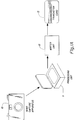
- FIG. 1A the apparatus for encoding image information on a magnetic stripe of a transaction card 13 is illustrated.
- An image is captured by an image capture apparatus 10 in a form capable of being stored and transformed into digital logic signals.
- the image can be captured, for example, on photographic film or can be stored as a set of analog electrical signals.
- the image capture apparatus 10 includes a film reader to provide a set of analog signals.
- the analog signals can be applied to an analog-to-digital converter.
- the digital signals from the image capture apparatus 10 are applied to a processing unit 11 wherein the image information is compressed.
- the resulting digital signals are applied to a writer 12 wherein the digital signals are encoded as electrical signals whereby the writer 12 generates a storage pattern on a storage material on the transaction card 13.
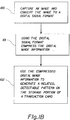
- step 100 an image is captured and is transformed into an ordered set of digital signals.
- the digital signals are then compressed in step 101.
- the compressed digital signals are used to generate a recognizable pattern on a storage material associated with the transaction card.
- FIG. 2A the apparatus for retrieving encoded information from the storage portion of a transaction card 20 is shown.
- the reader 21 recognized the patterns in the storage area of the transaction card 20 and converts the patterns to a set of digital signals.
- the digital signals retrieved from the transaction card are stored in card data storage unit 22.
- the data from the card data storage unit 22 is applied to the processing unit 23.
- digital signals are restored (i.e., decompressed) using the codebook memory unit 24.
- the codebook memory unit 24 is typically a memory unit, but can have a plurality of implementations.
- the digital signals of the restored image are applied to the image unit 25.
- the image unit 25 converts the signals comprising the restored image into signals appropriate for driving a visual display unit 26 or a printer unit 27.
- the processor unit 23 can transfer data, (e.g., the compressed image digital signals to a remote processing unit 28.
- data e.g., the compressed image digital signals
- the images stored on the transaction card 20 can be compared with information stored in card data storage 29. This comparison can take place when the transaction at a remote location has a problem associated therewith.
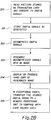
- step 200 a reader interacts with the transaction card and translates the pattern stored in the storage area of the transaction card into digital signals.
- the digital signals are stored, in step 201, as the signals are identified by the reader.
- step 202 the digital signals are restored, i.e., are decompressed.
- the decompressed digital signals are assembled into a "restored" image in step 203.
- step 203 can include additional processing such as artifact removal.
- step 204 the signals representing a restored image are applied to the driver circuits of an image display unit or a printer and the restored image is provided for visual examination or comparison.
- step 205 the image stored on the transaction card, or a portion thereof can be transferred to a remote location for comparison, verification, etc. with an archival copy of the image stored on the transaction card.
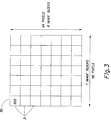
- an image pixel matrix is converted into a matrix of pixels.
- the image matrix 30 is 64 pixels by 56 pixels.
- the pixel matrix 30 is divided into image blocks 31 of 8 pixels by 8 pixels.
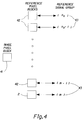
- the image pixel block 41 has associated therewith a plurality of reference pixel blocks 42.
- Each reference pixel block has a reference signal group 43 associated therewith.
- the set of reference signal blocks 42 do not include all possible pixel combinations identified therein. Therefore, based on a predetermined criteria, the reference pixel block most closely associated with the image pixel block is selected and the identifying signal group 43 is used to identify the image at the location of the image pixel block.
- the set of signal groups resulting from the comparison of the image pixel block and the reference pixel block is a compressed representation of the image pixel matrix. This representation can stored on the transaction card. In order to reconstruct the image, at the station reading the transaction card, the set of signal groups is identified and the associated reference pixel group placed in the position of the image pixel block generating the reference signal group.
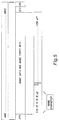
- FIG. 5 the data format structure of the transaction card of the preferred embodiment is shown.
- ISO 7811 standards for magnetic encoding on credit cards permits up to 79 "characters" where each character is comprised of a seven-bit string.
- the data format has 553 raw data bits, the m th bit in the resulting string will be denoted by b(m).
- the first character or first 7 bits is a special character known as a start sentinel (STX) which denotes the start of the string of data bits.
- STX start sentinel
- Bit b(8) through bit b(539) are known as the image and image parity bits.
- the image and parity bits are interleaved such that after every sixth image bit there is a parity bit.
- the seventh bit is determined by the other six bits according to the relationship:
- EX end sentinel character
- LRC longitudinal redundancy check
- the seventh bit of the LRC, LRC7 is determined by the equation:
- the present invention is a system for enabling "identification quality" digital images to be stored completely in compressed form on a single track of a ISO-7811 series magnetic card format. This includes the ability to 1) process a portrait image into a compressed image which can be stored within the data storage limitations of the 210 bpi track of a conventional transaction card, 2) transfer data to a magnetic card track, 3) read of the track with a transaction reader, 4) decompress back into the image, and 5) display of the image.
- Image display can occur, but is not limited to, a printed form on a receipt printer or as a multi-level image on a video display terminal.
- the information capacity of a magnetic stripe on a transaction card is quite small in comparison to a digitized photographic portrait.
- the total storage capacity of the high-density track on financial transaction cards is 553 bits, and 97 of these bits are reserved for parity checks and control characters. This leaves 456 bits. There are also a few characters reserved as control characters, the effect of which is to reduce the actual number of information bits to 451 bits.
- the preferred embodiment of this invention is a compression scheme which block encodes the image into 442 bits, leaving the additional 14 bits to circumvent the use of reserved characters in the ISO-7811 character set.
- Variable bit-rate image compression methods such as Huffman coding are not well-suited for this application as there is a fixed number of bits available (see R. J. McEliece, The Theory of Information and Coding , Addison-Wesley, Reading, Mass., 1977). While on average, for a given quality level variable rate methods compress images to smaller numbers of bits, there will be instances where the methods yield a larger number of bits than available.
- a fixed bit-rate compression method is preferred to insure the compressed image will fits onto the stripe.
- Lossy compression methods are also required as the image information, known as entropy, is greater than the existing information capacity of the magnetic card. This is even the case if the image has been preprocessed to reduce the number of levels a pixel can attain. Entropy for a simple bi-tonal image can easily require 1000 bits and there is no known lossy compression methods for bi-tonal imagery.
- VQ vector quantization
- the current invention a far greater amount of prior information is possible than in conventional adaptive techniques.
- the images are known to be portraits.
- a far greater amount of information can be anticipated by the compression process as a result of a high degree of correlation between image blocks in different images.
- the compressor might know where to locate certain image features such as the location and orientation of the eyes.
- the original portrait images are processed. This is not a requirement, but leads to great improvements in quality.
- Image processing helps standardize the characteristics of the images and adds to their predictability. This predictability leads to improved quality and higher compression ratios.
- a 56 x 64 pixel sub-image is extracted from an original digital image with a minimum size of 128 x 128 pixels. Images are processed to enhance contrast and to normalize statistical descriptions of the image.
- One such method is histogram equalization.
- a desirable sub-image would be the result of manipulating the image in order to locate the eyes of the person depicted in the portrait image in order to position one of the eyes at a predetermined pixel location and to cause the other eye to be in a predetermined orientation, e.g., horizontal, from the eye at a given location.
- the distance between eyes can be predetermined and the image can either be zoomed or reduced to accomplish this.
- the eyes are found in the original image either manually or via an automated feature extraction method. Given the pixel coordinates in the original image, a transformation to the standardized image format can be found. (This image manipulation would involve a combination of a translation, zoom, and rotation of the original image.) This method can be accomplished either mechanically with the original image or using digital methods with a prescanned image.
- Codebooks are determined by forming a collection a number of representative images, known as the training set. Images are structured into patches as shown in Figure 1. The patches are then considered as vectors in a high-dimensional vector space, e.g., for an 8x8 patch, the space has 64 dimensions. In the preferred embodiment the patches are selected from predetermined regions within the image.
- clusters e.g., cluster centroids
- representative elements are assigned to each cluster. The clusters are determined in such a manner to minimize the overall combined distances between a member of the training set and the representative for the cluster the member is assigned.
- LBG Linde-Buzo-Gray
- the number of clusters is determined by the number of bits budgeted for a block. If n bits are budgeted, then the codebook can contain up to 2n cluster representatives or codevectors.
- the image size is 56 pixels across and 64 pixels high.
- the image is partitioned into blocks where each block consists of a region 8 pixels wide and 8 pixels high and is displayed in Figure 1.
- the codevalues are either a seven-bit or nine-bit value, with a total length of 442 bits.
- the bit stream has to be reformatted in the following manner. This string of bits has to be split into six-bit segments. An odd parity bit is then inserted after the sixth bit to comprise a character able to be encoded on the magnetic stripe.
- there are three special characters in the 64 character font which are used as control characters.
- the magnetic card In order to recover the image the magnetic card is passed through a standard ISO compliant magnetic reader and the bit stream is reassembled in the obvious manner.
- the architecture of image is employed and the same codebooks are referenced to reassemble the image in the obvious manner.
- One of the image artifacts that results from VQ is known as block artifacts. This appears as window panes in the object and are visually objectionable.
- a digital filter is applied across the block boundaries with the purpose of smoothing the artifacts.
- the smoothing filter is given by the vector (0.25, 0.5, 0.25). The filter is applied both horizontally and vertically.
- the resulting image can then be displayed on a video display unit or is printed on a printer. If the image is to be printed then the preferred printing methods use a method of digital half-toning.
- the particular half-toning method depends upon the resolution of the printer, properties such as ink spreading on paper, to name a couple considerations.
- the compressed image could be transmitted over a communications link.
- the purpose of this would be to transmit the image of a person presenting himself as a cardholder, but does not meet some card validation criteria.
- an image can be retrieved and stored in a relatively small storage space. Because the image is stored on the card itself, image transmission from a central file location is avoided. In addition, because of the small storage capacity required, the image associated with the transaction can be stored at a local transaction site and transmitted, in a compressed or uncompressed form, to a central location only upon the occurrence of an exceptional situation.
- the system uses commercially available equipment with the exception of the processing equipment for performing the data compression.
Landscapes
- Engineering & Computer Science (AREA)
- Physics & Mathematics (AREA)
- General Physics & Mathematics (AREA)
- Human Computer Interaction (AREA)
- Multimedia (AREA)
- Theoretical Computer Science (AREA)
- Signal Processing For Digital Recording And Reproducing (AREA)
- Image Processing (AREA)
- Television Signal Processing For Recording (AREA)
- Compression Or Coding Systems Of Tv Signals (AREA)
- Compression, Expansion, Code Conversion, And Decoders (AREA)
Applications Claiming Priority (2)
| Application Number | Priority Date | Filing Date | Title |
|---|---|---|---|
| US08/145,051 US5466918A (en) | 1993-10-29 | 1993-10-29 | Method and apparatus for image compression, storage, and retrieval on magnetic transaction cards |
| US145051 | 1993-10-29 |
Publications (2)
| Publication Number | Publication Date |
|---|---|
| EP0651355A2 true EP0651355A2 (fr) | 1995-05-03 |
| EP0651355A3 EP0651355A3 (fr) | 1999-05-12 |
Family
ID=22511376
Family Applications (1)
| Application Number | Title | Priority Date | Filing Date |
|---|---|---|---|
| EP94420290A Withdrawn EP0651355A3 (fr) | 1993-10-29 | 1994-10-25 | Procédé et appareil de compression, de stockage, et de récupération d'images sur cartes de transaction magnétiques |
Country Status (3)
| Country | Link |
|---|---|
| US (1) | US5466918A (fr) |
| EP (1) | EP0651355A3 (fr) |
| JP (1) | JP2766200B2 (fr) |
Cited By (2)
| Publication number | Priority date | Publication date | Assignee | Title |
|---|---|---|---|---|
| EP0718807A3 (fr) * | 1994-12-21 | 1996-07-10 | Eastman Kodak Co | |
| EP0736860A3 (fr) * | 1995-04-07 | 1999-09-01 | Kodak Limited | Améliorations dans la sécurité de pièces d'identité au moyen de l'enregistrement d'une image digitalisée dans une couche magnétique appliquée invisiblement dans une partie de la pièce d'identité |
Families Citing this family (48)
| Publication number | Priority date | Publication date | Assignee | Title |
|---|---|---|---|---|
| US6938825B1 (en) | 1989-04-24 | 2005-09-06 | Ultracard, Inc. | Data system |
| US20040057581A1 (en) * | 1993-11-18 | 2004-03-25 | Rhoads Geoffrey B. | Method and apparatus for transaction card security utilizing embedded image data |
| ES2105936B1 (es) * | 1994-03-21 | 1998-06-01 | I D Tec S L | Perfeccionamientos introducidos en la patente de invencion n. p-9400595/8 por: procedimiento biometrico de seguridad y autentificacion de tarjetas de identidad y de credito, visados, pasaportes y reconocimiento facial. |
| GB9524319D0 (en) * | 1995-11-23 | 1996-01-31 | Kodak Ltd | Improvements in or relating to the recording of images |
| US6070141A (en) * | 1995-05-08 | 2000-05-30 | Image Data, Llc | System and method of assessing the quality of an identification transaction using an identificaion quality score |
| US6040783A (en) * | 1995-05-08 | 2000-03-21 | Image Data, Llc | System and method for remote, wireless positive identity verification |
| US6202055B1 (en) | 1996-08-21 | 2001-03-13 | Image Data, Llc | Positive identification display device and scanner for low cost collection and display of graphic and text data in a secure manner |
| US5657389A (en) * | 1995-05-08 | 1997-08-12 | Image Data, Llc | Positive identification system and method |
| US5710719A (en) * | 1995-10-19 | 1998-01-20 | America Online, Inc. | Apparatus and method for 2-dimensional data compression |
| US20030195848A1 (en) | 1996-06-05 | 2003-10-16 | David Felger | Method of billing a purchase made over a computer network |
| US7555458B1 (en) | 1996-06-05 | 2009-06-30 | Fraud Control System.Com Corporation | Method of billing a purchase made over a computer network |
| US8229844B2 (en) | 1996-06-05 | 2012-07-24 | Fraud Control Systems.Com Corporation | Method of billing a purchase made over a computer network |
| AU3806497A (en) * | 1996-07-19 | 1998-02-10 | Identification Technologies International, Inc. | System for object verification and identification |
| US5789726A (en) * | 1996-11-25 | 1998-08-04 | Eastman Kodak Company | Method and apparatus for enhanced transaction card compression employing interstitial weights |
| US6786420B1 (en) | 1997-07-15 | 2004-09-07 | Silverbrook Research Pty. Ltd. | Data distribution mechanism in the form of ink dots on cards |
| US6618117B2 (en) | 1997-07-12 | 2003-09-09 | Silverbrook Research Pty Ltd | Image sensing apparatus including a microcontroller |
| AUPO850597A0 (en) | 1997-08-11 | 1997-09-04 | Silverbrook Research Pty Ltd | Image processing method and apparatus (art01a) |
| US7110024B1 (en) | 1997-07-15 | 2006-09-19 | Silverbrook Research Pty Ltd | Digital camera system having motion deblurring means |
| US6879341B1 (en) | 1997-07-15 | 2005-04-12 | Silverbrook Research Pty Ltd | Digital camera system containing a VLIW vector processor |
| AUPO802797A0 (en) | 1997-07-15 | 1997-08-07 | Silverbrook Research Pty Ltd | Image processing method and apparatus (ART54) |
| US6690419B1 (en) | 1997-07-15 | 2004-02-10 | Silverbrook Research Pty Ltd | Utilising eye detection methods for image processing in a digital image camera |
| US6624848B1 (en) | 1997-07-15 | 2003-09-23 | Silverbrook Research Pty Ltd | Cascading image modification using multiple digital cameras incorporating image processing |
| US20040119829A1 (en) | 1997-07-15 | 2004-06-24 | Silverbrook Research Pty Ltd | Printhead assembly for a print on demand digital camera system |
| SG112833A1 (en) * | 1997-07-15 | 2005-07-28 | Silverbrook Res Pty Ltd | Re-writable optical card reader/writer unit using ink dots data storage |
| US6985207B2 (en) | 1997-07-15 | 2006-01-10 | Silverbrook Research Pty Ltd | Photographic prints having magnetically recordable media |
| US6084977A (en) * | 1997-09-26 | 2000-07-04 | Dew Engineering And Development Limited | Method of protecting a computer system from record-playback breaches of security |
| US6016480A (en) * | 1997-11-07 | 2000-01-18 | Image Data, Llc | Merchandise return fraud prevention system and method |
| US6871787B1 (en) | 1998-07-10 | 2005-03-29 | Ultracard, Inc. | Data storage card having a glass substrate and data surface region and method for using same |
| AUPP702098A0 (en) | 1998-11-09 | 1998-12-03 | Silverbrook Research Pty Ltd | Image creation method and apparatus (ART73) |
| US6321981B1 (en) | 1998-12-22 | 2001-11-27 | Eastman Kodak Company | Method and apparatus for transaction card security utilizing embedded image data |
| AUPQ056099A0 (en) | 1999-05-25 | 1999-06-17 | Silverbrook Research Pty Ltd | A method and apparatus (pprint01) |
| US8397998B1 (en) | 1999-10-23 | 2013-03-19 | Ultracard, Inc. | Data storage device, apparatus and method for using same |
| US7036739B1 (en) | 1999-10-23 | 2006-05-02 | Ultracard, Inc. | Data storage device apparatus and method for using same |
| US7487908B1 (en) | 1999-10-23 | 2009-02-10 | Ultracard, Inc. | Article having an embedded accessible storage member, apparatus and method for using same |
| US6698653B1 (en) * | 1999-10-28 | 2004-03-02 | Mel Diamond | Identification method, especially for airport security and the like |
| US6513709B1 (en) | 1999-12-22 | 2003-02-04 | Norman F. Hansen | Optical transaction card system |
| US6969006B1 (en) | 2000-09-15 | 2005-11-29 | Ultracard, Inc. | Rotable portable card having a data storage device, apparatus and method for using same |
| US7535582B1 (en) * | 2000-10-20 | 2009-05-19 | Silverbrook Research Pty Ltd | Digital photographic duplication system with image quality restoration |
| US7996318B2 (en) * | 2001-10-09 | 2011-08-09 | Robert Victor Marcon | Multi-function electronic transaction card |
| CN1327391C (zh) * | 2001-11-30 | 2007-07-18 | 环球安全设计公司 | 图像特征的识别信号产生方法 |
| US20040098276A1 (en) * | 2002-11-15 | 2004-05-20 | Eastman Kodak Company | Method and system for passenger and baggage security control in a tansportation system |
| US7474770B2 (en) * | 2005-06-28 | 2009-01-06 | Beigi Homayoon S M | Method and apparatus for aggressive compression, storage and verification of the dynamics of handwritten signature signals |
| US20070100664A1 (en) * | 2005-11-03 | 2007-05-03 | Seib Christopher D | Integrated healthcare and financial card |
| AU2005248949B2 (en) * | 2005-12-23 | 2010-04-01 | Canon Kabushiki Kaisha | Efficient Halftone Image Compression |
| US8942473B2 (en) * | 2012-07-25 | 2015-01-27 | Ko Hung Lin | Image processing method and display apparatus |
| US9262808B2 (en) * | 2013-02-07 | 2016-02-16 | Mitsubishi Electric Research Laboratories, Inc. | Denoising of images with nonstationary noise |
| US9922680B2 (en) * | 2015-02-10 | 2018-03-20 | Nokia Technologies Oy | Method, an apparatus and a computer program product for processing image sequence tracks |
| US10873585B2 (en) | 2018-08-20 | 2020-12-22 | Bank Of America Corporation | System for detecting unauthorized access via card characteristic verification |
Family Cites Families (10)
| Publication number | Priority date | Publication date | Assignee | Title |
|---|---|---|---|---|
| US3569619A (en) * | 1968-06-27 | 1971-03-09 | Luther G Simjian | Verification system using coded identifying and storage means |
| GB8528143D0 (en) * | 1985-11-14 | 1985-12-18 | British Telecomm | Image encoding & synthesis |
| US4712103A (en) * | 1985-12-03 | 1987-12-08 | Motohiro Gotanda | Door lock control system |
| US4754487A (en) * | 1986-05-27 | 1988-06-28 | Image Recall Systems, Inc. | Picture storage and retrieval system for various limited storage mediums |
| FR2606188B1 (fr) * | 1986-11-03 | 1989-09-29 | Cornille Jean Louis | Carte a puce avec photo du titulaire incorporee en memoire |
| US4995081A (en) * | 1988-03-21 | 1991-02-19 | Leighton Frank T | Method and system for personal identification using proofs of legitimacy |
| US4879747A (en) * | 1988-03-21 | 1989-11-07 | Leighton Frank T | Method and system for personal identification |
| US5241600A (en) * | 1991-07-16 | 1993-08-31 | Thinking Machines Corporation | Vertification system for credit or bank card or the like |
| US5268963A (en) * | 1992-06-09 | 1993-12-07 | Audio Digital Imaging Inc. | System for encoding personalized identification for storage on memory storage devices |
| US5321751A (en) * | 1993-02-18 | 1994-06-14 | Eastman Kodak Company | Method and apparatus for credit card verification |
-
1993
- 1993-10-29 US US08/145,051 patent/US5466918A/en not_active Expired - Lifetime
-
1994
- 1994-10-24 JP JP6258563A patent/JP2766200B2/ja not_active Expired - Lifetime
- 1994-10-25 EP EP94420290A patent/EP0651355A3/fr not_active Withdrawn
Cited By (2)
| Publication number | Priority date | Publication date | Assignee | Title |
|---|---|---|---|---|
| EP0718807A3 (fr) * | 1994-12-21 | 1996-07-10 | Eastman Kodak Co | |
| EP0736860A3 (fr) * | 1995-04-07 | 1999-09-01 | Kodak Limited | Améliorations dans la sécurité de pièces d'identité au moyen de l'enregistrement d'une image digitalisée dans une couche magnétique appliquée invisiblement dans une partie de la pièce d'identité |
Also Published As
| Publication number | Publication date |
|---|---|
| JPH07210618A (ja) | 1995-08-11 |
| JP2766200B2 (ja) | 1998-06-18 |
| EP0651355A3 (fr) | 1999-05-12 |
| US5466918A (en) | 1995-11-14 |
Similar Documents
| Publication | Publication Date | Title |
|---|---|---|
| EP0651355A2 (fr) | Procédé et appareil de compression, de stockage, et de récupération d'images sur cartes de transaction magnétiques | |
| US4703347A (en) | Individuality discriminating system | |
| US5574573A (en) | Compression method for a standardized image library | |
| US20020094127A1 (en) | Enhanced compression of documents | |
| EP0130415A2 (fr) | Compression de données pour images graphiques | |
| US20030044076A1 (en) | Managing image storage size | |
| JPS6118381B2 (fr) | ||
| JP2002538530A (ja) | バイオメトリック情報を格納するための2次元のプリントコードおよびそれを読み取るための装置 | |
| JPS6343036B2 (fr) | ||
| JP2004511378A (ja) | 写真上のフォールトトレラントデータ格納 | |
| CA2089579C (fr) | Systeme de securite pour documents | |
| US20050093999A1 (en) | Photographed subject authentication system | |
| JP2901906B2 (ja) | 複数品質取引カード画像の方法及び装置 | |
| US5473327A (en) | Method and apparatus for data encoding with reserved values | |
| AU2126088A (en) | Identification information storage and retrieval | |
| EP0661674A1 (fr) | Procédé et appareil pour faire une certification au moment de la vente à l'aide des images à demi-teintes | |
| CA1327242C (fr) | Systeme d'imagerie numerique a double densite | |
| EP0718807B1 (fr) | Procédé pour comprimer et décomprimer des images portrait standardisées | |
| EP0760559A1 (fr) | Méthode et dispositif pour l'encodage de données comportant des valeurs réservées | |
| Kirovski et al. | Cryptographically secure identity certificates | |
| HK1011123A (en) | Method and apparatus for data encoding with reserved values | |
| Kirovski et al. | Tamper-resistant biometric IDs | |
| JPH1117959A (ja) | 2値画像のランレングス符号化方法およびランレングス符号化プログラムを記録した記録媒体 | |
| Hsu | Interleaving Technique for Block Coding of Black-and-white Facsimile Data� | |
| HK1010760A (en) | Method for compressing and decompressing standardized portrait images |
Legal Events
| Date | Code | Title | Description |
|---|---|---|---|
| PUAI | Public reference made under article 153(3) epc to a published international application that has entered the european phase |
Free format text: ORIGINAL CODE: 0009012 |
|
| AK | Designated contracting states |
Kind code of ref document: A2 Designated state(s): DE FR GB |
|
| PUAL | Search report despatched |
Free format text: ORIGINAL CODE: 0009013 |
|
| AK | Designated contracting states |
Kind code of ref document: A3 Designated state(s): DE FR GB |
|
| STAA | Information on the status of an ep patent application or granted ep patent |
Free format text: STATUS: THE APPLICATION IS DEEMED TO BE WITHDRAWN |
|
| 18D | Application deemed to be withdrawn |
Effective date: 19991114 |