EP0651736B1 - VERFAHREN ZUR HERSTELLUNG ENANTIOMERENREINER beta-SUBSTITUIERTER gamma-AMINOBUTTERSÄUREDERIVATE, NEUE ENANTIOMERENREINE ZWISCHENSTUFEN DIESES VERFAHRENS UND DEREN VERWENDUNG - Google Patents
VERFAHREN ZUR HERSTELLUNG ENANTIOMERENREINER beta-SUBSTITUIERTER gamma-AMINOBUTTERSÄUREDERIVATE, NEUE ENANTIOMERENREINE ZWISCHENSTUFEN DIESES VERFAHRENS UND DEREN VERWENDUNG Download PDFInfo
- Publication number
- EP0651736B1 EP0651736B1 EP93915975A EP93915975A EP0651736B1 EP 0651736 B1 EP0651736 B1 EP 0651736B1 EP 93915975 A EP93915975 A EP 93915975A EP 93915975 A EP93915975 A EP 93915975A EP 0651736 B1 EP0651736 B1 EP 0651736B1
- Authority
- EP
- European Patent Office
- Prior art keywords
- compound
- atoms
- group
- general formula
- tert
- Prior art date
- Legal status (The legal status is an assumption and is not a legal conclusion. Google has not performed a legal analysis and makes no representation as to the accuracy of the status listed.)
- Expired - Lifetime
Links
- 0 CCC(C1)C([*+])N(*)C1O Chemical compound CCC(C1)C([*+])N(*)C1O 0.000 description 5
Classifications
-
- C—CHEMISTRY; METALLURGY
- C07—ORGANIC CHEMISTRY
- C07D—HETEROCYCLIC COMPOUNDS
- C07D207/00—Heterocyclic compounds containing five-membered rings not condensed with other rings, with one nitrogen atom as the only ring hetero atom
- C07D207/02—Heterocyclic compounds containing five-membered rings not condensed with other rings, with one nitrogen atom as the only ring hetero atom with only hydrogen or carbon atoms directly attached to the ring nitrogen atom
- C07D207/18—Heterocyclic compounds containing five-membered rings not condensed with other rings, with one nitrogen atom as the only ring hetero atom with only hydrogen or carbon atoms directly attached to the ring nitrogen atom having one double bond between ring members or between a ring member and a non-ring member
- C07D207/22—Heterocyclic compounds containing five-membered rings not condensed with other rings, with one nitrogen atom as the only ring hetero atom with only hydrogen or carbon atoms directly attached to the ring nitrogen atom having one double bond between ring members or between a ring member and a non-ring member with hetero atoms or with carbon atoms having three bonds to hetero atoms with at the most one bond to halogen, e.g. ester or nitrile radicals, directly attached to ring carbon atoms
- C07D207/24—Oxygen or sulfur atoms
- C07D207/26—2-Pyrrolidones
-
- C—CHEMISTRY; METALLURGY
- C07—ORGANIC CHEMISTRY
- C07C—ACYCLIC OR CARBOCYCLIC COMPOUNDS
- C07C227/00—Preparation of compounds containing amino and carboxyl groups bound to the same carbon skeleton
- C07C227/22—Preparation of compounds containing amino and carboxyl groups bound to the same carbon skeleton from lactams, cyclic ketones or cyclic oximes, e.g. by reactions involving Beckmann rearrangement
-
- C—CHEMISTRY; METALLURGY
- C07—ORGANIC CHEMISTRY
- C07C—ACYCLIC OR CARBOCYCLIC COMPOUNDS
- C07C227/00—Preparation of compounds containing amino and carboxyl groups bound to the same carbon skeleton
- C07C227/30—Preparation of optical isomers
- C07C227/32—Preparation of optical isomers by stereospecific synthesis
-
- C—CHEMISTRY; METALLURGY
- C07—ORGANIC CHEMISTRY
- C07D—HETEROCYCLIC COMPOUNDS
- C07D207/00—Heterocyclic compounds containing five-membered rings not condensed with other rings, with one nitrogen atom as the only ring hetero atom
- C07D207/02—Heterocyclic compounds containing five-membered rings not condensed with other rings, with one nitrogen atom as the only ring hetero atom with only hydrogen or carbon atoms directly attached to the ring nitrogen atom
- C07D207/18—Heterocyclic compounds containing five-membered rings not condensed with other rings, with one nitrogen atom as the only ring hetero atom with only hydrogen or carbon atoms directly attached to the ring nitrogen atom having one double bond between ring members or between a ring member and a non-ring member
- C07D207/22—Heterocyclic compounds containing five-membered rings not condensed with other rings, with one nitrogen atom as the only ring hetero atom with only hydrogen or carbon atoms directly attached to the ring nitrogen atom having one double bond between ring members or between a ring member and a non-ring member with hetero atoms or with carbon atoms having three bonds to hetero atoms with at the most one bond to halogen, e.g. ester or nitrile radicals, directly attached to ring carbon atoms
- C07D207/24—Oxygen or sulfur atoms
- C07D207/26—2-Pyrrolidones
- C07D207/273—2-Pyrrolidones with hetero atoms or with carbon atoms having three bonds to hetero atoms with at the most one bond to halogen, e.g. ester or nitrile radicals, directly attached to other ring carbon atoms
- C07D207/277—Carbon atoms having three bonds to hetero atoms with at the most one bond to halogen, e.g. ester or nitrile radicals
- C07D207/28—2-Pyrrolidone-5- carboxylic acids; Functional derivatives thereof, e.g. esters, nitriles
-
- C—CHEMISTRY; METALLURGY
- C07—ORGANIC CHEMISTRY
- C07F—ACYCLIC, CARBOCYCLIC OR HETEROCYCLIC COMPOUNDS CONTAINING ELEMENTS OTHER THAN CARBON, HYDROGEN, HALOGEN, OXYGEN, NITROGEN, SULFUR, SELENIUM OR TELLURIUM
- C07F7/00—Compounds containing elements of Groups 4 or 14 of the Periodic Table
- C07F7/02—Silicon compounds
- C07F7/08—Compounds having one or more C—Si linkages
- C07F7/18—Compounds having one or more C—Si linkages as well as one or more C—O—Si linkages
- C07F7/1804—Compounds having Si-O-C linkages
-
- C—CHEMISTRY; METALLURGY
- C07—ORGANIC CHEMISTRY
- C07F—ACYCLIC, CARBOCYCLIC OR HETEROCYCLIC COMPOUNDS CONTAINING ELEMENTS OTHER THAN CARBON, HYDROGEN, HALOGEN, OXYGEN, NITROGEN, SULFUR, SELENIUM OR TELLURIUM
- C07F7/00—Compounds containing elements of Groups 4 or 14 of the Periodic Table
- C07F7/02—Silicon compounds
- C07F7/08—Compounds having one or more C—Si linkages
- C07F7/18—Compounds having one or more C—Si linkages as well as one or more C—O—Si linkages
- C07F7/1804—Compounds having Si-O-C linkages
- C07F7/1872—Preparation; Treatments not provided for in C07F7/20
- C07F7/1892—Preparation; Treatments not provided for in C07F7/20 by reactions not provided for in C07F7/1876 - C07F7/1888
-
- Y—GENERAL TAGGING OF NEW TECHNOLOGICAL DEVELOPMENTS; GENERAL TAGGING OF CROSS-SECTIONAL TECHNOLOGIES SPANNING OVER SEVERAL SECTIONS OF THE IPC; TECHNICAL SUBJECTS COVERED BY FORMER USPC CROSS-REFERENCE ART COLLECTIONS [XRACs] AND DIGESTS
- Y02—TECHNOLOGIES OR APPLICATIONS FOR MITIGATION OR ADAPTATION AGAINST CLIMATE CHANGE
- Y02P—CLIMATE CHANGE MITIGATION TECHNOLOGIES IN THE PRODUCTION OR PROCESSING OF GOODS
- Y02P20/00—Technologies relating to chemical industry
- Y02P20/50—Improvements relating to the production of bulk chemicals
- Y02P20/55—Design of synthesis routes, e.g. reducing the use of auxiliary or protecting groups
Definitions
- the present invention relates to a method for manufacturing enantiomerically pure ⁇ -substituted ⁇ -aminobutyric acid derivatives, especially of R-Baclofen, new enantiomerically pure Intermediate stages of this process and their Use for the production of enantiomerically pure substituted Proline and glutamic acid derivatives.
- the object of the present invention is a method to create that the synthesis of enantiomerically pure substituted Amino acid derivatives, especially of ⁇ -substituted ones ⁇ -aminobutyric acid derivatives including R-Baclofen, starting from readily available starting substances by chemical means in good yields and high Purity allows.
- (IIa) activates the acceptor property of the Boc group (tert-butoxycarbonyl group) on the amide nitrogen the ⁇ , ⁇ -unsaturated System for the conjugate addition of Gilman cuprates in the desired sense (see the basic reaction: T. J. Hagen, Synlett. 1990, 63-66; P. Somfai, H. Ming He and D. Tanner, Tetrahedron Lett. 1991, 32, 283-286; K. Itoh, H. Nagashima, N. Ozaki and M.
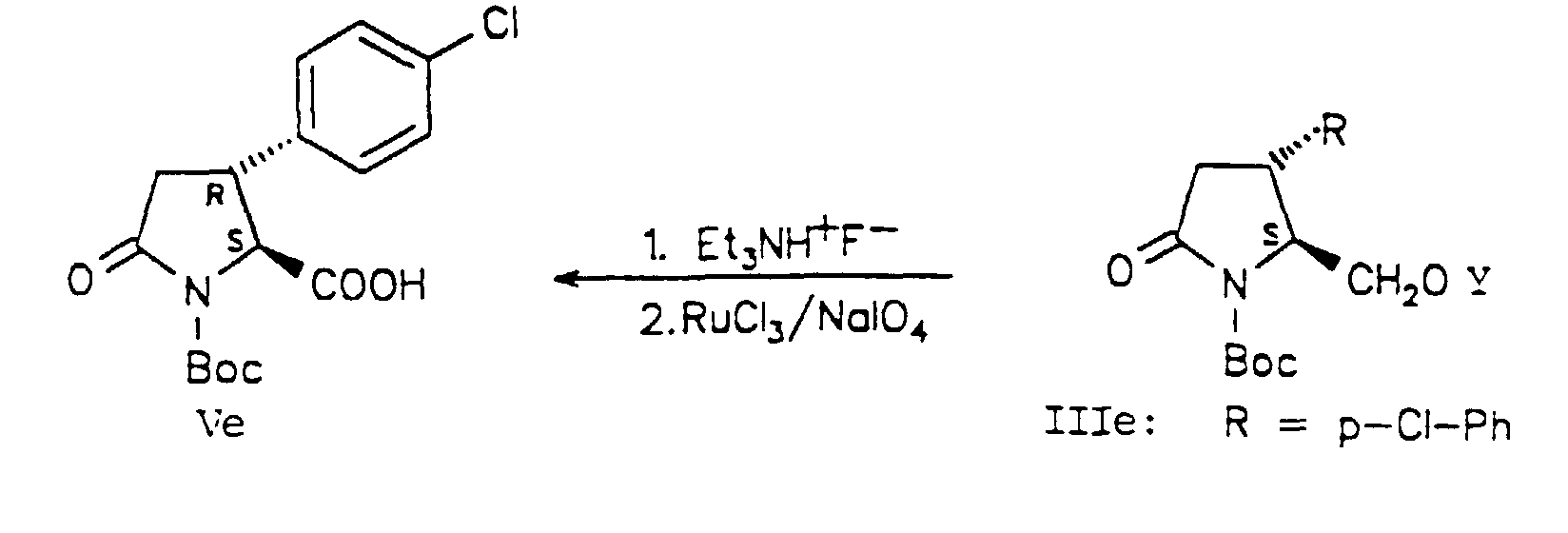
- the silyl protective group was split off and the OH function was released without loss of the Boc group using triethylammonium fluoride (S. Hünig and G. Wehner, Synthesis, 1975, 180-182) in THF. Despite the long reaction time (4 days), this reagent is highly chemoselective.
- the usual removal of the silyl protective group by tetrabutylammonium fluoride in THF resulted in ring opening due to the high nucleophilicity of the fluoride ion.
- the primary OH function was oxidized to the pyroglutamic acid derivative (Ve) in one step using the Sharpless method (KB Sharpless, PHJ Carlsen, T. Katsuki and VS Martin, J. Org.
- the concentrated eluate is dissolved in 50 ml EtOAc and mixed with 15 ml 30% H 2 O 2 solution. After approx. 45 min the solution is only slightly yellow to colorless and after dilution with EtOAc is washed with saturated NaHCO 3 solution until the water phase is no longer colored red. It is washed once more with saturated NaCl solution, dried over Na 2 SO 4 and concentrated in vacuo. A yellowish oil remains, which is mixed with diisopropyl ether and boiled. In the heat, approximately the same volume of petroleum ether is added and crystallization is initiated by rubbing with a glass rod. 4.4 g of almost colorless crystals precipitate out, the mother liquor is treated again in the same way and still provides 0.45 g of crystals of the same melting point.
- Step 1-A 4S, 5S-1-tert-butoxycarbonyl-5-tert-butyl-diphenylsilyloxymethyl-4-methylpyrrolidin-2-one (IIIa)
- Step 1-B 4S, 5S-1-tert-butoxycarbonyl-4-butyl-5-tert-butyldiphenylsilyloxymethylpyrrolidin-2-one (IIIb)
- Step 1-C 4R, 5S-1-tert-butoxycarbonyl-5-tert-butyldiphenylsilyloxymethyl-4-phenylpyrro-lidin-2-one (IIIc)
- Stage 1-D 4R, 5S-1-tert-butoxycarbonyl-5-tert-butyldiphenylsilyloxymethyl-4-vinyl-pyrroli-din-2-one ( IIId )
- Step 1-E 4R, 5S-1-tert-butoxycarbonyl-5-tert-butyldiphenylsilyloxymethyl-4- (4-chlorophenyl) pyrro lidin-2-one (IIIe)
- Step 1-F 4S, 5S-4-allyl-1-tert.butoxycarbonyl-5-tert.butyldiphenylsilyloxymethylpyrrolidin-2-one (IIIf)
- Step 2-E 4R, 5S-1-tert-butoxycarbonyl-4- (4-chlorophenyl) -5-hydroxymethylpyrrolidin-2-one (IVe)
- Step 3-E 2S, 3R-1-tert-butoxycarbonyl-3- (4-chlorophenyl) -5-oxopyrrolidine-2-carboxylic acid (Ve)
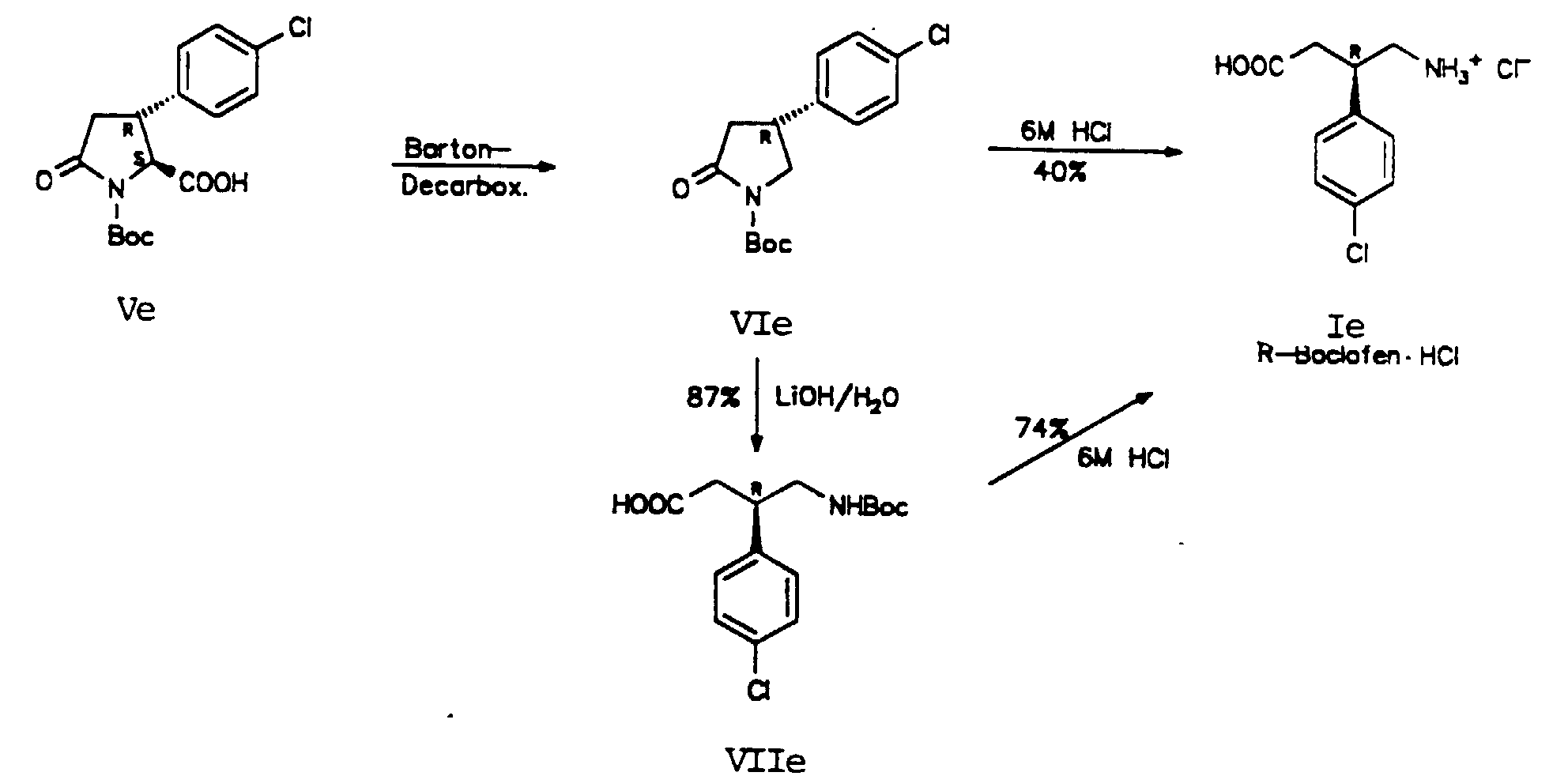
- Step 4-E 4R-1-tert-butoxycarbonyl-4- (4-chlorophenyl) pyr rolidin-2-one (VIe)
- the resulting hydrochloride is suctioned off using a reversible frit, avoiding exposure to light, washed with THF and 0.9 ml (10 mmol) of tert-butyl mercaptan are added to the filtrate.
- This solution is irradiated with two 100 W lamps under inert gas in a water bath at RT for 1 h. The yellow color largely disappears.
- the mixture is diluted with ether and washed with semi-saturated NaHCO 3 solution, water, 0.5 N HCl, water and saturated NaCl solution. It is dried over Na 2 SO 4 and the solvent is stripped off. The residue is purified by means of SC on SiO 2 using EtOAc / PE 1 + 2.
- Step 6-E 3R-4-amino-3- (4-chlorophenyl) butanoic acid hydrochloride (Ie)
Landscapes
- Chemical & Material Sciences (AREA)
- Organic Chemistry (AREA)
- Chemical Kinetics & Catalysis (AREA)
- Organic Low-Molecular-Weight Compounds And Preparation Thereof (AREA)
- Pharmaceuticals Containing Other Organic And Inorganic Compounds (AREA)
- Acyclic And Carbocyclic Compounds In Medicinal Compositions (AREA)
Description


Allgemeines: THF wurde vor dem Gebrauch über Lithiumaluminiumhydrid destilliert, anschließend über Na-Draht unter Stickstoff. Organometall-Reaktionen wurden in ausgeflammtem Kolben unter trockenem und O2 freiem Stickstoff durchgeführt. Dünnschichtchromatographie wurde auf Merck Silicagel Platten 60 F-254 durchgeführt. 1H-NMR und 13C-NMR Spektren wurden auf einem Bruker AC 200 Gerät gemessen. Abkürzungen: FM: Fließmittel für DC, PE: Petrolether, EtOAc. Ethylacetat, THF: Tetrahydrofuran, Boc: tert.-Butoxycarbonyl, TMSCl: Trimethylsilylchlorid, SC: Säulenchromatographie.

Schmp.: 96°C (Diisopropylether/PE)
IR (KBr): 2900, 1725 (C=O Urethan), 1690 (C=O Lactam), 1450, 1420, 1360, 1340, 1310, 1145, 1110, 910, 795, 730, 700 cm-1
1H-NMR (CDCl3): d (ppm) =1.03 (9H, s, t-Bu-Si) 1.44 (9 H, s, t-Bu-O), 3.83 (1 H, dd, Jgem=9,7 Hz, J5-6a=6,4 Hz, H-6), 4.12 (1 H, dd, Jgem=9,7 Hz, J5-6b =3, 5 Hz, H-6), 4.64 (1 H, m, H-5), 6.17 (1 H, dd, J3-4= 6,13 Hz, J3-5=1,5 Hz, H-3), 7.26 (1 H, dd, J3-4=6,1 Hz, J4-5=2,05 Hz, H-4), 7.38 (6 H, m, H-Ar), 7.60 (4 H, m, H-Ar)
13C-NMR (CDCl3): d (ppm) = 19.2 (SiC(CH3)3), 26.67 (SiC(CH3)3), 27.97 (OC(CH3)3), 62.93 (C-5), 63.42 (C-6), 82.65 (OC(CH3)3), 127.32 (C-3), 127.79 (Ar), 129.69 (C-4), 132.64 (Ar), 132.86 (Ar), 135.43 (Ar), 149.29 (C=O Urethan), 169.48 (C-2)
[α]D 20 = -124 (c=0, 23 /CHCl3)
| C26H33NO4Si 451,64 | ||||||
| ber. | C | 69,14% | H | 7,36% | N | 3,10% |
| gef. | C | 69,61% | H | 7,70% | N | 3,09% |

Ausbeute: 190 mg (81%) weiße Kristalle (Rf=0,3 FM: Et2O/PE 2+3)
Smp: 85°C (EtOAC/n-Hexan)
IR (KBr): 3080, 2950, 2860, 1790, 1750, 1715, 1590, 1470, 1430, 1370, 1310, 1160, 1110, 780, 700 cm-1
1H-NMR (CDCl3): d (ppm) = 1.04 (9 H, s, t-Bu-Si), 1.14 (3 H, d, J=7,1 Hz, CH3), 1.43 (9 H, s, t-Bu-O), 2.07 (1 H, dd, J3a-4=1,8 Hz, Jgem=17,5 Hz, H-3), 2.44 (1 H, quin, J=7,2 Hz, H-4), 2.98 (1 H, dd, J3b-4=8,6 Hz, Jgem= 17,5 Hz, H-3), 3.72 (2 H, m, H-5 und H-6), 3.86 (1 H, m, H-6), 7.39 (6 H, m, H-Ar), 7.61 (4 H, m, H-Ar),
13C-NMR (CDCl3): d (ppm) = 19.2 (SiC(CH3)3), 21.44 (CH3), 28.81 (SiC(CH3)3), 28.02 (OC(CH3)3), 28.26 (C-4), 40.47 (C-3), 64.23 (C-5), 66.21 (C-6), 82.72 (OC(CH3)3), 127.85 (C-Ar), 129.89 (C-Ar), 135.11 (C-Ar), 135.56 (C-Ar), 150.03 (Urethan), 174.39 (Lactam)
[α]D 20 = -33 (c=0,4/CHCl3)
| C27H37NO4Si 467,68 | ||||||
| ber. | C | 69,34% | H | 7,97% | N | 2,99% |
| gef. | C | 69,28% | H | 7,93% | N | 3,00% |

Ausbeute: 484 mg (95%) farbloses Öl (Rf = 0,5 FM: Et2O/PE 2+3)
IR (Film): 3080, 2950, 2860, 1790, 1750, 1710, 1590, 1470, 1430, 1370, 1310, 1150, 1110, 790, 700 cm-1
1H-NMR (CDCl3): d (ppm) = 0.90 (3 H, t, J=6,5 Hz, CH3-Bu), 1.04 (9 H, s, t-Bu-Si), 1.29 (6 H, m, CH2-Bu), 1.44 (9 H, s, t-Bu-O), 2.16 (1 H, dd, J3a-4= 1,8 Hz, Jgem=17,5 Hz, H-3), 2.26 (1 H, m, H-4), 2.91 (1 H, dd, J3b-4= 8,6 Hz, Jgem=17,6 Hz, H-3), 3.69 (1 H, dd, J6a-5=4,4 Hz, Jgem= 12,1 Hz, H-6), 3.83 (2 H, m, H-5 und H-6), 7.39 (6 H, m, H-Ar), 7.62 (4 H, m, H-Ar)
13C-NMR (CDCl3): d (ppm) = 13.96 (CH3-nBu), 19.18 (SiC(CH3)3), 22.51 ( CH2-nBu), 26.76 (SiC(CH3)3), 27.99 (OC(CH3)3), 29.00 (C-4), 33.28 (CH2-nBu), 35.04 (CH2-nBu), 38.66 (C-3), 64.48 (C-5), 64.54 (C-6), 82.74 (OC(CH3)3), 127.80 (C-Ar), 129.85 (C-Ar), 133.07 (C-Ar), 135.50 (C-Ar), 150.04 (Urethan), 174.55 (Lactam) [α]D 20 = -31 (c=O,22/CHCl3)
| C30H43NO4Si 509,76 | ||||||
| ber. | C | 70,69% | H | 8,50% | N | 2,75% |
| gef. | C | 70,63% | H | 8,74% | N | 2,71% |

Ausbeute: 160 mg (60%) farbloses Harz, (Rf = 0,44 FM: Et2O/PE 2+3)
IR (Film): 3080, 2950, 2860, 1790, 1750, 1715, 1610, 1590, 1430, 1370, 1310, 1150, 1110, 790, 700 cm-1
1H-NMR (CDCl3): d (ppm) = 1.09 (9 H, s, Si-t-Bu), 1.42 (9 H, s, O-t-Bu), 2.57 (1 H, dd, J3a-4=2,63 Hz, Jgem=17,8 Hz, H-3), 3.21 (1 H, dd, J3b-4=9,6 Hz, Jgem=17,8 Hz, H-3), 3.50 (1 H, dt, J3a-4J4-5=2,3 Hz, J3b-4=9,5 Hz, H-4), 3.81 (1 H, dd, J6a-5=2,3 Hz, Jgem=10,5 Hz, H-6), 3.98 (1 H, dd, J6b-5= 4,25 Hz, Jgem=10,5 Hz, H-6), 4.12 (1 H, m, H-5), 7.32 (11 H, m, H-Ph und H-Ar-Si), 7.66 (4 H, m, H-Ar-Si)
13C-NMR (CDCl3): d (ppm) = 19.22 (SiC(CH3)3), 26.85 (SiC(CH3)3), 27.95 (OC(CH3)3), 38.68 (C-4), 39.91 (C-3), 64.22 (C-5), 66.62 (C-6), 83.04 (OC(CH3)3), 126.39 (C-Ar), 127.13 (C-Ar), 127.88 (C-Ar), 129.06 (C-Ar), 129.95 (C-Ar), 132.57 (C-Ar), 132.93 (C-Ar), 135.55 (C-Ar), 144.03 (C-Ar), 149.62 (Urethan), 174.12 (Lactam) [α]D 20 = -27 (c=0,23/CHCl3)
| C32H39NO4Si 529,75 | ||||||
| ber. | C | 72,55% | H | 7,42% | N | 2,64% |
| gef. | C | 72,67% | H | 7,64% | N | 2,51% |

IR (Film): 3070, 2930, 2850, 1790, 1750, 1710, 1590, 1470, 1425, 1360, 1310, 1150, 1110, 970, 920, 870, 780, 700 cm-1 1H-NMR (CDCl3): d (ppm) = 1.05 (9 H, s, tBuSi), 1.43 (9 H, s, tBuO), 2.33 (1 H, dd, J3a-4= 6,3 Hz, Jgem=20,9 Hz, H-3), 3.00 (2 H, m, J3b-4=9 Hz, Jgem=21 Hz, H-3 und H-4), 3.74 (1 H, dd, J5-6a=3,65 Hz, Jgem=11,8 Hz, H-6), 3.93 (1 H, m, J5-6b=4,1 Hz, Jgem=11,85 Hz, H-5 und H-6), 5.08 (2 H, m, =CH2), 5.87 (1 H, ddd, Jtrans=17,4 Hz, Jcis=10 Hz, J4-Vinyl=7,4 Hz, -CH=), 7.41 (6 H, m, H-Ar), 7.63 (4 H, m, H-Ar)
13C-NMR (CDCl3): d (ppm) =19.18 (SiC(CH3)3), 26.79 (SiC(CH3)3), 27.97 (OC(CH3)3), 37.03 (C-4), 37.92 (C-3), 63.93 (C-5), 64.35 (C-6), 82.88 (OC(CH3)3), 115.20 (=CH2), 127.85 (C-Ar), 129.91 (C-Ar), 132.58 (C-Ar), 132.95 (C-Ar), 135.52 (C-Ar), 139.15
(-CH=), 149,74 (Urethan), 173.80 (Lactam)
[α]D 20 = -23 (c=0,21/CHCl3)
| C28H37NO4Si 479, 69 | ||||||
| ber. | C | 70,11% | H | 7,77% | N | 2,92% |
| gef. | C | 70,12% | H | 7,78% | N | 2,92% |

IR (Film): 2930, 1790, 1750, 1710, 1500, 1430, 1370, 1310, 1150, 1110, 700 cm-1
1H-NMR (CDCl3): d (ppm) = 1.09 (9 H, s, t-Bu-Si), 1.42 (9 H, s, t-Bu-O), 2.53 (1 H, dd, Jgem=17,8 Hz, J3a-4=2,5 Hz,
H-3), 3.20 (1 H, dd, Jgem=17,8 Hz, J3b-4=9,5 Hz, H-3), 3.48 (1 H, dt, J3b-4=9,5 Hz, J3a-4J4-5=2,1 Hz, H-4), 3.80 (1 H, dd, J5-6a=2,3 Hz, Jgem=10,43 Hz, H-6), 3.97 (1 H, dd, J5-6b=4,31 Hz, Jgem=10,43 Hz, H-6), 4.05 (1 H, m, H-5), 7.08 (2 H, dd, JAB=8,4 Hz, H-Ar-p-Cl), 7.28 (2 H, dd, JAB=8,4 Hz, H-Ar-p-Cl), 7.40 (6 H, m, H-Ar-Si), 7.64 (4 H, m, H-Ar-Si)
13C-NMR (CDCl3): d (ppm) = 19.22 (SiC(CH3)3), 26.87 (SiC(CH3)3), 27.96 (OC(CH3)3), 38.16 (C-4), 39.71 (C-3), 64.14 (C-5), 66.51 (C-6), 83.21 (OC(CH3)3), 127.76 (Ar), 127.91 (Ar), 129.19 (Ar), 130.0 (Ar), 132.55 (Ar), 133.0 (Ar), 135.54 (Ar), 142.44 (Ar), 149.59 (C=O Urethan), 173.54 (C=O Lactam)
[α]D 20 = -26,5 (c=0,226/CHCl3)
| C32H38ClNO4Si 564,19 | ||||||
| ber. | C | 68,12% | H | 6,79% | N | 2,48% |
| gef. | C | 67,90% | H | 6,97% | N | 2,40% |

Ausbeute: 150 mg (60%) farbloses Öl, (Rf=0,3 FM: Et2O/PE 2+3)
IR (Film): 3040, 2940, 2860, 1790, 1750, 1715, 1650, 1590, 1470, 1430, 1370, 1310, 1150, 1110, 790, 760, 700 cm-1 1H-NMR (CDCl3): d (ppm) = 1.03 (9 H, s, Si-t-Bu), 1.42 (9 H, s, O-t-Bu), 2.17 (3 H, m, H-3 und CH2-Allyl), 2.36 (1 H, quin, J=7,3 Hz, H-4), 2.91 (1 H, dd, J3-4=8,6 Hz, Jgem=17,7 Hz, H-3), 3.67 (1 H, dd, J6a-5=4 Hz, Jgem=11,9 Hz, H-6), 3.86 (2 H, m, H-5 und H-6), 5.05 (2 H, m, =CH2), 5.70 (1 H, m, -CH=), 7.37 (6 H, m, H-Ar), 7.59 (4 H, m, H-Ar)
13C-NMR (CDCl3): d (ppm) = 19.16 (SiC(CH3)3), 26.80 (SiC(CH3)3), 27.99 (OC(CH3)3), 32.78 (C-4), 38.11 (C-3), 39.38 (CH2-Allyl), 63.72 (C-5), 64.61 (C-6), 82.72 (OC(CH3)3), 117.88 (=CH-), 127.81 (C-Ar), 129.86 (C-Ar), 132.68 (C-Ar), 113.05 (C-Ar), 134.71 (C-Ar), 135.51 (=CH2), 149.90 (Urethan), 174.10 (Lactam)
[α]D 20 = -32,7 (c=0,22/CHCl3)
| C29H39NO4Si 439,72 | ||||||
| ber. | C | 70,55% | H | 7,96% | N | 2,84% |
| gef. | C | 70,91% | H | 8,27% | N | 2,60% |

Ausbeute: 400mg (62%) farblose Kristalle (Rf = 0,37 FM: EtOAc/PE 2+1)
Smp.: 137°C (EtOAc/n-Hexan)
IR (KBr): 3400 (O-H), 2980-2940, 1790 (C=O), 1500, 1370, 1310, 1170, 1080, 1015, 770 cm-1
1H-NMR (CDCl3): d (ppm) = 1.53 (9 H, s, t-Bu), 2.53 (1 H, dd, J3a-4=3,91 Hz, Jgem=17,8 Hz, H-3), 2.93 (1 H, t, J =5,31 Hz, O-H), 3.14 (1 H, dd, J3b-4= 9,33 Hz, Jgem=17,8 Hz, H-3), 3.43 (1 H, dt, J3a-4J4-5=3,7 Hz, J3b-4=9,2 Hz, H-4), 3.80 (1 H, m, H-6), 3.96 (1 H, m, H-6), 4.08 (1 H, q, J=3,4 Hz, H-5), 7.15 (2 H, d, JAB=8,5 Hz, H-Ar), 7.31 (2 H, d, JAB=8,5 Hz, H-Ar)
13C-NMR (CDCl3): d (ppm) = 27.99 (C(CH3)3), 38.07(C-4), 39.72 (C-3), 63.41 (C-5), 66.91 (C-6), 83.79 (C(CH3)3), 127.95 (C-Ar), 129.21 (C-Ar), 133.08 (C-Ar), 141.54 (C-Ar), 150.35 (Urethan), 173.73 (Lactam)
[α]D 20 = - 43 (c=0,073/CHCl3)
| C16H20ClNO4 325,79 | ||||||
| ber. | C | 58,98% | H | 6,19% | N | 4,30% |
| gef. | C | 58,69% | H | 6,02% | N | 4,30% |

Ausbeute: 500 mg (80%) weiße, feine Kristalle (Rf =0,15 FM: EtOAc/CH2Cl2/HAC 8+2+1)
Smp.: 141°C (CHCl3/PE)
IR (KBr): 3200 (breit, O-H), 2970, 1795 (C=O), 1770 (C=O), 1730 (C=O), 1490 (Ar), 1310, 1250, 1155, 830 cm-1
1H-NMR (CDCl3): d (ppm) = 1.49 (9 H, s, t-Bu), 2.68 (1 H, dd, J4a-3=4,5 Hz, Jgem=17,8 Hz, H-4), 3.09 (1 H, dd, J4b-3=9,2 Hz, Jgem=17,8 Hz, H-4), 3.54 (1H, m, H-3), 4.56 (1 H, d, J=3,75 Hz) 7.20 (2 H, d, JAB=8,5 Hz, H-Ar), 7.36 (2 H, d, JAB=8,5 Hz, H-Ar), 9.44 (1 H, s, COOH)
13C-NMR (CDCl3): d (ppm) = 27.84 (C(CH3)3), 38.77 (C-3), 39.05 (C-4), 65.89 (C-2), 84.59 (C(CH3)3), 127.92 (C-Ar), 129.48 (C-Ar), 133.99 (C-Ar), 139.24 (C-Ar), 149.15 (Urethan), 172.10 (COOH), 175.29 (Lactam)
[α]D 20 = +33,7 (c=0,162/CHCl3)
| C16H18NO5Cl 339,78 | ||||||
| ber. | C | 56,39% | H | 5,32% | N | 4,11% |
| gef. | C | 56,69% | H | 5,44% | N | 4,24% |

Ausbeute: 190 mg (64%) farblose Nadeln (Rf = 0,5 FM: EtOAc/PE 1+2)
Smp.: (Iso2O/PE): 103°C
IR (KBr): 2990, 1780 (C=O), 1500, 1370, 1290, 1150, 1090, 1015, 840, 780 cm-1
1H-NMR (CDCl3): d (ppm) = 1.54 (9 H, s, t-Bu), 2.66 (1 H, dd, J3a-4=9,5 Hz, Jgem=17,3 Hz, H-3), 2.90 (1 H, dd, J3b-4=8,2 Hz, Jgem=17,3 Hz, H-3), 3.51 (1 H, quin, J3a-4J3b-4J5a-4J5b-4=8,3 Hz, H-4), 3.65 (1 H, dd, J5a-4=8,2 Hz, Jgem=10,7 Hz, H-5), 4.15 (1 H, dd, J5b-4=7,5 Hz, Jgem=10,5 Hz, H-5), 7.17 (2 H, dt, J=1,9 Hz, JAB=8,4 Hz, H-Ar), 7.33 (2 H, dt, J=2 Hz, JAB=8,5 Hz, H-Ar)
13C-NMR (CDCl3): d (ppm) = 28.01 (OC(CH3)3), 35.83 (C-4), 40.19 (C-3), 52.87 (C-5), 83.17 (OC(CH3)3), 128.08 (C-Ar), 129.13 (C-Ar), 133.27 (C-Ar), 139.14 (C-Ar), 149.82 (Urethan), 172.41 (Lactam)
[α]D 20 = +4,5 (c=0,2/CHCl3)
| C15H18NO3Cl 295,76 | ||||||
| ber. | C | 60,92% | H | 6,13% | N | 4,74% |
| gef. | C | 60,94% | H | 6,31% | N | 4,80% |

Smp: 135°-138°C (CHCl3/PE)
IR (KBr): 3390 (N-H), 3000-2900 und 2630 (COOH), 1690 (C=O), 1530, 1500, 1410, 1370, 1250, 1180, 1020, 830 cm-1 1H-NMR (CDCl3/d6-DMSO): d (ppm) = 1.39 (9 H, s, t-Bu), 2.50 (1 H, dd, J2a-3=8,4 Hz, Jgem=15,9 Hz, H-2), 2.69 (1 H, dd, J2b-3=4,3 Hz, Jgem = 16,1 Hz, H-2), 3.28 (3 H, m, H-3 und H-4), 5.87 (1 H, s breit, N-H), 7.19 (2 H, d, JAB=8,66 Hz, H-Ar), 7.26 (2 H, d, JAB=8,67 Hz, H-Ar)
13C-NMR (CDCl3/d6-DMSO): d (ppm) = 28.29 (C(CH3)3), 37.93 (C-3), 41.59 (C-2), 45.44 (C-4), 78.46 (C(CH3)3), 128.28 (C-Ar), 129.29 (C-Ar), 131.83 (C-Ar), 140.78 (C-Ar), 155.95 (Urethan), 173.44 (COOH)
[α]D 20 = +14 (c=0.234/MeOH)
| C15H20NO4Cl 313,7 | ||||||
| ber. | C | 57,42% | H | 6,42% | N | 4,46% |
| gef. | C | 57,24% | H | 6,43% | N | 4,32% |

Ausbeute: 62 mg (74%) farblose Kristalle
Smp.: 219°C
IR (KBr): 3000 (NH3 +, COOH), 1720 (COOH), 1580 (NH3 +), 1490, 1410, 1400, 1200, 1180, 1125, 1010, 950, 825 cm-1
1H-NMR (D2O/d4-Methanol): d (ppm) = 2.63 (1 H, dd, J2a-3=8,7 Hz, Jgem=16,4 Hz, H-2), 2.78 (1 H, dd, J2b-3=5,6 Hz, Jgem=16,3 Hz, H-2), 3.24 (3 H, m, H-3 und H-4), 7.25 (2 H, d, JAB=8,5 Hz, H-Ar), 7.34 (2 H, d, JAB=8,55 Hz, H-Ar)
13C-NMR: (D2O/d4-Methanol): d (ppm) =39.10 (C-3), 40.41 (C-2), 44.62 (C-4), 130.19 (C-Ar), 130.37 (C-Ar), 134.38 (C-Ar), 138.16 (C-Ar), 175.67 (COOH)
[α]D 20 = -2 (c=0,2/H2O) Lit.: -1,5 (c=0,2/H2O)
| C10H13NO2Cl2 250,12 | ||||||
| ber. | C | 48,02% | H | 5,24% | N | 5,60% |
| gef. | C | 47,65% | H | 5,19% | N | 5,44% |
Claims (12)
- Verfahren zur Herstellung von enantiomerenreinen β-substituierten γ-Aminobuttersäurederivaten der Formel (I)in der R für eine geradkettige oder verzweigtkettige Alkylgruppe mit 1 bis 6 C-Atomen, eine Alkenylgruppe mit 2 bis 6 C-Atomen oder einen gegebenenfalls substituierten Phenylrest steht, der als Substituenten einen oder zwei Substituenten aufweisen kann, die ausgewählt sind aus den Halogenatomen F, Cl, Br, I, Alkylresten mit 1 bis 4 C-Atomen und Alkoxy- oder Cycloalkoxyresten mit 1 bis 6 C-Atomen,

dadurch gekennzeichnet, daß man ein S-Pyroglutaminsäurederivat der allgemeinen Formel (II)in der Y für eine an sich bekannte sterisch anspruchsvolle OH-Schutzgruppe steht,
mit einem metallorganischen Reagens, das die Einführung eines Restes R selektiv in die der Gruppe -CH2OY benachbarte 4-Position der Verbindung der allgemeinen Formel (II) ermöglicht, zu einer Verbindung der allgemeinen Formel (III) umsetztund aus dieser durch an sich bekannte schonende Abspaltung der OH-Schutzgruppe, Oxidation der dabei gebildeten freien Methylolgruppe zu einer Carboxylgruppe und Bildung einer Verbindung der allgemeinen Formel (V), anschließende Decarboxylierung dieser Verbindung der allgemeinen Formel (V) und anschließende hydrolytische Ringöffnung der dabei gebildeten, in 4-Position substituierten γ-Lactamringverbindung der allgemeinen Formel (VI)
 vor oder nach der Abspaltung der tert.-Butoxycarbonylgruppe die Verbindung der allgemeinen Formel (I) in Form eines Säureadditionssalzes oder in freier Form gewinnt.
- Verfahren nach Anspruch 1, dadurch gekennzeichnet, daß die OH-Schutzgruppe Y ausgewählt ist aus tert.-Butyldiphenylsilyl-, tert.-Butyldimethylsilyl- und Tritylresten.
- Verfahren nach Anspruch 1 oder 2, dadurch gekennzeichnet, daß die metallorganischen Reagenzien zur Einführung des Restes R aus Cu-organische und Zn-organische Verbindungen enthaltenden Reagenzien ausgewählt sind.
- Verfahren nach Anspruch 3, dadurch gekennzeichnet, daß das Cu- oder Zn-organische Reagens ausgewählt ist aus Reagenzien, die eine Verbindung mit einer der Formeln R2CuMgX, in der X für eines der Halogenatome Cl, Br, I steht, R2CuLi, R2Zn oder R2CuZnCl, in denen R jeweils wie bei Formel (I) definiert ist, umfassen.
- Verfahren nach einem der Ansprüche 1 bis 4, dadurch gekennzeichnet, daß R jeweils für einen p-Cl-Phenylrest steht und die erhaltene Verbindung der Formel (I) R-Baclofen (Ie) ist.
- Verfahren nach einem der Ansprüche 1 bis 5, dadurch gekennzeichnet, daß man die Oxidation der Methylolgruppe der nach Abspaltung der Schutzgruppe aus der Verbindung der Formel (III) erhaltenen Verbindung mit NaIO4 in Gegenwart von RuCl3 oder mit gasförmigem Sauerstoff in Anwesenheit eines Platinmetallkatalysators durchführt.
- Verfahren nach Anspruch 6, dadurch gekennzeichnet, daß man als Platinmetallkatalysator PtO2 verwendet.
- Verfahren nach einem der Ansprüche 1 bis 7, dadurch gekennzeichnet, daß man die Decarboxylierung der Verbindung der Formel (V) nach ihrer Umsetzung mit Isobutylchloroformat und N-Hydroxy-2-thiopyridon photolytisch in Gegenwart von tert.-Butylmercaptan durchführt (Barton Reaktion).
- Verfahren nach einem der Ansprüche 1 bis 8, dadurch gekennzeichnet, daß man die hydrolytische Ringöffnung der Verbindung der Formel (VI) dadurch durchführt, daß man diese Verbindung mit LiOH umsetzt und danach zur Gewinnung der Verbindung der Formel (I) die tert.-Butoxycarbonylgruppe abspaltet.
- Ein enantiomerenreines Pyroglutaminsäurederivat der allgemeinen Formel (III)in der R für eine geradkettige oder verzweigtkettige Alkylgruppe mit 1 bis 6 C-Atomen, eine Alkenylgruppe mit 2 bis 6 C-Atomen oder einen gegebenenfalls substituierten Phenylrest steht, der als Substituenten einen oder zwei Substituenten aufweisen kann, die ausgewählt sind aus den Halogenatomen F, Cl, Br, I, Alkylresten mit 1 bis 4 C-Atomen und Alkoxy- oder Cycloalkoxyresten mit 1 bis 6 C-Atomen steht und Y für eine OH-Schutzgruppe steht, die ausgewählt ist aus tert.-Butyldiphenylsilyl-, tert.-Butyldimethylsilyl- und Tritylresten.

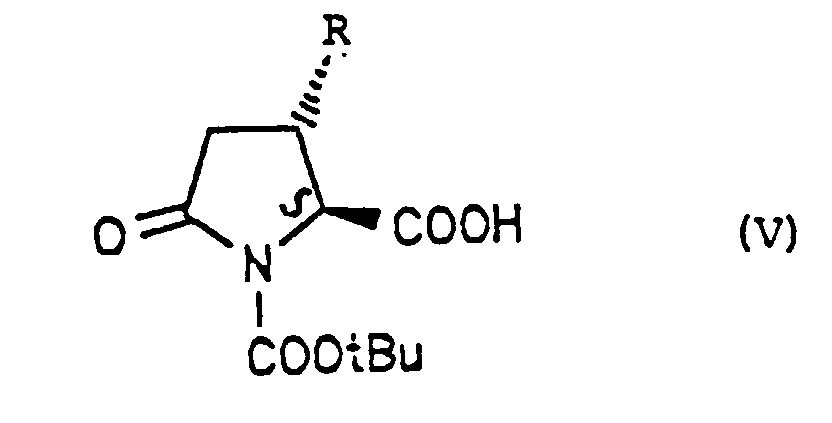
- Ein enantiomerenreines Pyroglutaminsäurederivat der allgemeinen Formel (V)in der R für eine geradkettige oder verzweigtkettige Alkylgruppe mit 1 bis 6 C-Atomen, eine Alkenylgruppe mit 2 bis 6 C-Atomen oder einen gegebenenfalls substituierten Phenylrest steht, der als Substituenten einen oder zwei Substituenten aufweisen kann, die ausgewählt sind aus den Halogenatomen F, Cl, Br, I, Alkylresten mit 1 bis 4 C-Atomen und Alkoxy- oder Cycloalkoxyresten mit 1 bis 6 C-Atomen steht.
- Verwendung einer Verbindung der allgemeinen Formel (V) gemäß Anspruch 11 zur Herstellung enantiomerenreiner γ-Aminobuttersäurederivat der Formel (I).
Applications Claiming Priority (3)
| Application Number | Priority Date | Filing Date | Title |
|---|---|---|---|
| DE4224342 | 1992-07-23 | ||
| DE4224342A DE4224342A1 (de) | 1992-07-23 | 1992-07-23 | Verfahren zur Herstellung enantiomerenreiner ß-substituierter Ï-Aminobuttersäurederivate, neue enantiomerenreine Zwischenstufen dieses Verfahrens und deren Verwendung |
| PCT/EP1993/001949 WO1994002443A2 (de) | 1992-07-23 | 1993-07-22 | VERFAHREN ZUR HERSTELLUNG ENANTIOMERENREINER β-SUBSTITUIERTER η-AMINOBUTTERSÄUREDERIVATE, NEUE ENANTIOMERENREINE ZWISCHENSTUFEN DIESES VERFAHRENS UND DEREN VERWENDUNG |
Publications (2)
| Publication Number | Publication Date |
|---|---|
| EP0651736A1 EP0651736A1 (de) | 1995-05-10 |
| EP0651736B1 true EP0651736B1 (de) | 1998-01-14 |
Family
ID=6463931
Family Applications (1)
| Application Number | Title | Priority Date | Filing Date |
|---|---|---|---|
| EP93915975A Expired - Lifetime EP0651736B1 (de) | 1992-07-23 | 1993-07-22 | VERFAHREN ZUR HERSTELLUNG ENANTIOMERENREINER beta-SUBSTITUIERTER gamma-AMINOBUTTERSÄUREDERIVATE, NEUE ENANTIOMERENREINE ZWISCHENSTUFEN DIESES VERFAHRENS UND DEREN VERWENDUNG |
Country Status (4)
| Country | Link |
|---|---|
| EP (1) | EP0651736B1 (de) |
| AT (1) | ATE162179T1 (de) |
| DE (2) | DE4224342A1 (de) |
| WO (1) | WO1994002443A2 (de) |
Families Citing this family (5)
| Publication number | Priority date | Publication date | Assignee | Title |
|---|---|---|---|---|
| CA2240937C (en) * | 1995-12-20 | 2004-06-01 | Farmarc Nederland B.V. | A process for the optical resolution of 3-(p-chlorophenyl)-glutaramide |
| KR20110097942A (ko) | 2003-08-20 | 2011-08-31 | 제노포트 인코포레이티드 | 아실옥시알킬 카르바메이트 프로드러그, 합성 및 사용 방법 |
| EP2354120A1 (de) | 2003-08-20 | 2011-08-10 | XenoPort, Inc. | Synthese von Acyloxyalkylcarbamat-Prodrugs und Zwischenprodukten davon |
| CN101979378B (zh) * | 2010-10-13 | 2012-06-27 | 中国科学院上海有机化学研究所 | 一种手性γ-内酰胺化合物的合成方法 |
| FR3054218B1 (fr) | 2016-07-22 | 2020-03-06 | Universite De Rouen | Procede de dedoublement de sels de baclofene |
-
1992
- 1992-07-23 DE DE4224342A patent/DE4224342A1/de not_active Withdrawn
-
1993
- 1993-07-22 EP EP93915975A patent/EP0651736B1/de not_active Expired - Lifetime
- 1993-07-22 AT AT93915975T patent/ATE162179T1/de not_active IP Right Cessation
- 1993-07-22 DE DE59307998T patent/DE59307998D1/de not_active Expired - Fee Related
- 1993-07-22 WO PCT/EP1993/001949 patent/WO1994002443A2/de not_active Ceased
Also Published As
| Publication number | Publication date |
|---|---|
| WO1994002443A3 (de) | 1994-03-17 |
| DE4224342A1 (de) | 1994-01-27 |
| EP0651736A1 (de) | 1995-05-10 |
| WO1994002443A2 (de) | 1994-02-03 |
| ATE162179T1 (de) | 1998-01-15 |
| DE59307998D1 (de) | 1998-02-19 |
Similar Documents
| Publication | Publication Date | Title |
|---|---|---|
| DE69208144T2 (de) | Verfahren zur diastereoselektiven Synthese von Nukleosiden | |
| Herdeis et al. | Synthesis of homochiral R-Baclofen from S-glutamic acid. | |
| DE69619067T2 (de) | Verfahren zur Herstellung von 3-Amino-2-oxo-1-Halogenpropan-Derivaten | |
| EP0288764B1 (de) | Optisch aktive alpha-Aminoaldehyde, Verfahren zu ihrer Herstellung und ihre Verwendung zur stereoselektiven Herstellung optisch aktiver beta-Aminoalkohole | |
| AT392781B (de) | Verfahren zur herstellung von (s)-alpha-ethyl-2- oxo-1-pyrrolidinacetamid | |
| EP0571870A1 (de) | Cyclopentan- und -penten-beta-Aminosäuren | |
| EP0651736B1 (de) | VERFAHREN ZUR HERSTELLUNG ENANTIOMERENREINER beta-SUBSTITUIERTER gamma-AMINOBUTTERSÄUREDERIVATE, NEUE ENANTIOMERENREINE ZWISCHENSTUFEN DIESES VERFAHRENS UND DEREN VERWENDUNG | |
| WO2005113495A1 (de) | Verfahren zur herstellung von diphenyl-azetidinon-derivaten | |
| DE2311131B2 (de) | Amidinopenicillansäureester, Verfahren zu deren Herstellung und pharmazeutische Mittel | |
| EP0222163B1 (de) | Verfahren zur Herstellung von gamma-Butyrolactamen | |
| DE102006059317A1 (de) | Verfahren zur Herstellung von β-Amino-α-hydroxy-carbonsäureamiden | |
| DE69019007T2 (de) | Cyclohexanacetamid-Derivate. | |
| DE69811893T2 (de) | Verfahren zur herstellung von azetidin-2-carbonsäure und zwischenprodukten davon | |
| DE60007835T2 (de) | Verfahren zur herstellung von chiralen aminosäuren | |
| DE19533617A1 (de) | Neues Verfahren zur Herstellung von optisch aktiven alpha-Aminosäuren und alpha-Aminosäure-Derivaten | |
| CS214837B2 (en) | Method of making the pyrrolidine derivatives | |
| DE102004025071B4 (de) | Verfahren zur Herstellung von Diphenylazetidinon-Derivaten | |
| DE69008130T2 (de) | Glutarsäurederivate und ihre Herstellung. | |
| DE69613256T2 (de) | Verfahren zur Herstellung von Ketonitril-Derivaten und Hexenon-Derivaten | |
| DE3527504C2 (de) | ||
| DE69124485T2 (de) | Verfahren zur Herstellung von 4-Acetoxyazetidinonen | |
| DE69514115T2 (de) | Verfahren zur herstellung von levobupivacain und analogue aus l-lysin | |
| DE60024540T2 (de) | Synthese von alpha-amino-alpha',alpha'-dihaloketonen und verfahren zur herstellung von beta)-aminosäurederivaten durch verwendung derselben | |
| DE69333903T2 (de) | Optisch aktive 1-Phenylpyrrolidonderivate | |
| EP1293494B1 (de) | Verfahren zur Herstellung von alpha-Halogenketonen |
Legal Events
| Date | Code | Title | Description |
|---|---|---|---|
| PUAI | Public reference made under article 153(3) epc to a published international application that has entered the european phase |
Free format text: ORIGINAL CODE: 0009012 |
|
| 17P | Request for examination filed |
Effective date: 19941205 |
|
| AK | Designated contracting states |
Kind code of ref document: A1 Designated state(s): AT BE CH DE FR GB IT LI |
|
| 17Q | First examination report despatched |
Effective date: 19960716 |
|
| GRAG | Despatch of communication of intention to grant |
Free format text: ORIGINAL CODE: EPIDOS AGRA |
|
| GRAG | Despatch of communication of intention to grant |
Free format text: ORIGINAL CODE: EPIDOS AGRA |
|
| GRAH | Despatch of communication of intention to grant a patent |
Free format text: ORIGINAL CODE: EPIDOS IGRA |
|
| GRAH | Despatch of communication of intention to grant a patent |
Free format text: ORIGINAL CODE: EPIDOS IGRA |
|
| GRAA | (expected) grant |
Free format text: ORIGINAL CODE: 0009210 |
|
| AK | Designated contracting states |
Kind code of ref document: B1 Designated state(s): AT BE CH DE FR GB IT LI |
|
| PG25 | Lapsed in a contracting state [announced via postgrant information from national office to epo] |
Ref country code: IT Free format text: LAPSE BECAUSE OF FAILURE TO SUBMIT A TRANSLATION OF THE DESCRIPTION OR TO PAY THE FEE WITHIN THE PRE;WARNING: LAPSES OF ITALIAN PATENTS WITH EFFECTIVE DATE BEFORE 2007 MAY HAVE OCCURRED AT ANY TIME BEFORE 2007. THE CORRECT EFFECTIVE DATE MAY BE DIFFERENT FROM THE ONE RECORDED.SCRIBED TIME-LIMIT Effective date: 19980114 Ref country code: GB Free format text: LAPSE BECAUSE OF FAILURE TO SUBMIT A TRANSLATION OF THE DESCRIPTION OR TO PAY THE FEE WITHIN THE PRESCRIBED TIME-LIMIT Effective date: 19980114 Ref country code: FR Free format text: LAPSE BECAUSE OF FAILURE TO SUBMIT A TRANSLATION OF THE DESCRIPTION OR TO PAY THE FEE WITHIN THE PRESCRIBED TIME-LIMIT Effective date: 19980114 |
|
| REF | Corresponds to: |
Ref document number: 162179 Country of ref document: AT Date of ref document: 19980115 Kind code of ref document: T |
|
| REG | Reference to a national code |
Ref country code: CH Ref legal event code: EP |
|
| REF | Corresponds to: |
Ref document number: 59307998 Country of ref document: DE Date of ref document: 19980219 |
|
| REG | Reference to a national code |
Ref country code: CH Ref legal event code: NV Representative=s name: REBMANN-KUPFER & CO. PATENTANWAELTE |
|
| EN | Fr: translation not filed | ||
| PGFP | Annual fee paid to national office [announced via postgrant information from national office to epo] |
Ref country code: AT Payment date: 19980714 Year of fee payment: 6 |
|
| GBV | Gb: ep patent (uk) treated as always having been void in accordance with gb section 77(7)/1977 [no translation filed] |
Effective date: 19980114 |
|
| PG25 | Lapsed in a contracting state [announced via postgrant information from national office to epo] |
Ref country code: BE Free format text: LAPSE BECAUSE OF NON-PAYMENT OF DUE FEES Effective date: 19980731 |
|
| PGFP | Annual fee paid to national office [announced via postgrant information from national office to epo] |
Ref country code: DE Payment date: 19980930 Year of fee payment: 6 |
|
| PGFP | Annual fee paid to national office [announced via postgrant information from national office to epo] |
Ref country code: CH Payment date: 19981102 Year of fee payment: 6 |
|
| PLBE | No opposition filed within time limit |
Free format text: ORIGINAL CODE: 0009261 |
|
| 26N | No opposition filed | ||
| BERE | Be: lapsed |
Owner name: HERDEIS CLAUS Effective date: 19980731 |
|
| PG25 | Lapsed in a contracting state [announced via postgrant information from national office to epo] |
Ref country code: AT Free format text: LAPSE BECAUSE OF NON-PAYMENT OF DUE FEES Effective date: 19990722 |
|
| PG25 | Lapsed in a contracting state [announced via postgrant information from national office to epo] |
Ref country code: LI Free format text: LAPSE BECAUSE OF NON-PAYMENT OF DUE FEES Effective date: 19990731 Ref country code: CH Free format text: LAPSE BECAUSE OF NON-PAYMENT OF DUE FEES Effective date: 19990731 |
|
| REG | Reference to a national code |
Ref country code: CH Ref legal event code: PL |
|
| PG25 | Lapsed in a contracting state [announced via postgrant information from national office to epo] |
Ref country code: DE Free format text: LAPSE BECAUSE OF NON-PAYMENT OF DUE FEES Effective date: 20000503 |