EP0652465A1 - Appareil photographique pour l'enregistrement d'informations digitales et d'informations picturales sur un film photographique - Google Patents
Appareil photographique pour l'enregistrement d'informations digitales et d'informations picturales sur un film photographique Download PDFInfo
- Publication number
- EP0652465A1 EP0652465A1 EP94116132A EP94116132A EP0652465A1 EP 0652465 A1 EP0652465 A1 EP 0652465A1 EP 94116132 A EP94116132 A EP 94116132A EP 94116132 A EP94116132 A EP 94116132A EP 0652465 A1 EP0652465 A1 EP 0652465A1
- Authority
- EP
- European Patent Office
- Prior art keywords
- film
- information
- camera
- recording
- digital
- Prior art date
- Legal status (The legal status is an assumption and is not a legal conclusion. Google has not performed a legal analysis and makes no representation as to the accuracy of the status listed.)
- Withdrawn
Links
- 230000003287 optical effect Effects 0.000 claims abstract description 9
- 238000000034 method Methods 0.000 claims description 9
- 230000008569 process Effects 0.000 claims description 5
- 238000003491 array Methods 0.000 claims description 4
- 239000003086 colorant Substances 0.000 claims description 4
- JBRZTFJDHDCESZ-UHFFFAOYSA-N AsGa Chemical compound [As]#[Ga] JBRZTFJDHDCESZ-UHFFFAOYSA-N 0.000 claims description 3
- 239000011521 glass Substances 0.000 claims description 3
- 230000006872 improvement Effects 0.000 claims description 3
- 229910001218 Gallium arsenide Inorganic materials 0.000 claims description 2
- 230000003139 buffering effect Effects 0.000 claims description 2
- 230000001360 synchronised effect Effects 0.000 claims description 2
- 238000001429 visible spectrum Methods 0.000 claims description 2
- 230000003213 activating effect Effects 0.000 claims 1
- 230000005540 biological transmission Effects 0.000 description 5
- 230000006870 function Effects 0.000 description 4
- 230000003595 spectral effect Effects 0.000 description 4
- 230000000737 periodic effect Effects 0.000 description 3
- 230000002093 peripheral effect Effects 0.000 description 3
- 238000003825 pressing Methods 0.000 description 3
- 238000012545 processing Methods 0.000 description 3
- 230000004913 activation Effects 0.000 description 2
- 238000004891 communication Methods 0.000 description 2
- 238000010586 diagram Methods 0.000 description 2
- 230000004044 response Effects 0.000 description 2
- 239000004065 semiconductor Substances 0.000 description 2
- 238000012546 transfer Methods 0.000 description 2
- 238000012795 verification Methods 0.000 description 2
- 238000007792 addition Methods 0.000 description 1
- 230000008901 benefit Effects 0.000 description 1
- 238000000701 chemical imaging Methods 0.000 description 1
- 238000013500 data storage Methods 0.000 description 1
- 230000009849 deactivation Effects 0.000 description 1
- 230000000593 degrading effect Effects 0.000 description 1
- 238000000151 deposition Methods 0.000 description 1
- 238000009792 diffusion process Methods 0.000 description 1
- 230000005577 local transmission Effects 0.000 description 1
- 239000000203 mixture Substances 0.000 description 1
- 238000012986 modification Methods 0.000 description 1
- 230000004048 modification Effects 0.000 description 1
- 230000001235 sensitizing effect Effects 0.000 description 1
- 238000000926 separation method Methods 0.000 description 1
- 238000001228 spectrum Methods 0.000 description 1
- 230000000007 visual effect Effects 0.000 description 1
Images


Classifications
-
- G—PHYSICS
- G03—PHOTOGRAPHY; CINEMATOGRAPHY; ANALOGOUS TECHNIQUES USING WAVES OTHER THAN OPTICAL WAVES; ELECTROGRAPHY; HOLOGRAPHY
- G03B—APPARATUS OR ARRANGEMENTS FOR TAKING PHOTOGRAPHS OR FOR PROJECTING OR VIEWING THEM; APPARATUS OR ARRANGEMENTS EMPLOYING ANALOGOUS TECHNIQUES USING WAVES OTHER THAN OPTICAL WAVES; ACCESSORIES THEREFOR
- G03B31/00—Associated working of cameras or projectors with sound-recording or sound-reproducing means
- G03B31/06—Associated working of cameras or projectors with sound-recording or sound-reproducing means in which sound track is associated with successively-shown still pictures
-
- G—PHYSICS
- G03—PHOTOGRAPHY; CINEMATOGRAPHY; ANALOGOUS TECHNIQUES USING WAVES OTHER THAN OPTICAL WAVES; ELECTROGRAPHY; HOLOGRAPHY
- G03B—APPARATUS OR ARRANGEMENTS FOR TAKING PHOTOGRAPHS OR FOR PROJECTING OR VIEWING THEM; APPARATUS OR ARRANGEMENTS EMPLOYING ANALOGOUS TECHNIQUES USING WAVES OTHER THAN OPTICAL WAVES; ACCESSORIES THEREFOR
- G03B17/00—Details of cameras or camera bodies; Accessories therefor
- G03B17/24—Details of cameras or camera bodies; Accessories therefor with means for separately producing marks on the film, e.g. title, time of exposure
-
- G—PHYSICS
- G03—PHOTOGRAPHY; CINEMATOGRAPHY; ANALOGOUS TECHNIQUES USING WAVES OTHER THAN OPTICAL WAVES; ELECTROGRAPHY; HOLOGRAPHY
- G03B—APPARATUS OR ARRANGEMENTS FOR TAKING PHOTOGRAPHS OR FOR PROJECTING OR VIEWING THEM; APPARATUS OR ARRANGEMENTS EMPLOYING ANALOGOUS TECHNIQUES USING WAVES OTHER THAN OPTICAL WAVES; ACCESSORIES THEREFOR
- G03B2217/00—Details of cameras or camera bodies; Accessories therefor
- G03B2217/24—Details of cameras or camera bodies; Accessories therefor with means for separately producing marks on the film
- G03B2217/242—Details of the marking device
- G03B2217/243—Optical devices
-
- G—PHYSICS
- G03—PHOTOGRAPHY; CINEMATOGRAPHY; ANALOGOUS TECHNIQUES USING WAVES OTHER THAN OPTICAL WAVES; ELECTROGRAPHY; HOLOGRAPHY
- G03B—APPARATUS OR ARRANGEMENTS FOR TAKING PHOTOGRAPHS OR FOR PROJECTING OR VIEWING THEM; APPARATUS OR ARRANGEMENTS EMPLOYING ANALOGOUS TECHNIQUES USING WAVES OTHER THAN OPTICAL WAVES; ACCESSORIES THEREFOR
- G03B2217/00—Details of cameras or camera bodies; Accessories therefor
- G03B2217/24—Details of cameras or camera bodies; Accessories therefor with means for separately producing marks on the film
- G03B2217/246—Details of the markings
Definitions
- the present invention relates to cameras for recording digital and pictorial images.
- Still camera users frequently desire to enhance or document individual pictures, with supplementary information, such as captions or brief audio segments that can be conveniently accessed during viewing of the image.
- supplementary information such as captions or brief audio segments that can be conveniently accessed during viewing of the image.
- the need for audio segments has been previously recognized, for example, in U.S. Patent No. 3,920,862 which teaches a method of recording sound magnetically in association with still pictures. Nonetheless, such camera systems are not in common use today, owing to the fact that most methods suffer disadvantages due to cumbersome peripheral recording devices, specialized data storage systems, and/or cumbersome playback systems, and to the difficulty of synchronizing these functions with image display (see for example U.S. Patent No. 5,128,700). Recording of sound directly on film eliminates the need for separate storage means but may require specialized film layers, such as magnetic layers. Also, previous camera systems have been restrictive in the type of non-pictorial information recorded and presented upon viewing, being aimed primarily at sound or at simple bar code frame identification and not
- Another object is to provide the camera user with the option of using any proportion of film space for the purpose of non-pictorial information recording; to apprise the user of the amount and type of information he has chosen for recording, and the percentage of film occupied by this information, and to enable enhanced modes of non-pictorial information display.
- a photographic camera system for recording images of a subject in a first location on a photographic film, the improvement comprising:
- An advantage of this invention is to enable users to choose from a variety of non-pictorial information sources.
- a camera system in accordance with this invention affords a user control over the spatial location and data encoding method of the digital information recorded and does not require the use of specialized photographic films.
- the present invention minimizes required camera-associated peripheral equipment while still allowing for use of optional peripheral equipment for specialized information recording.
- the present invention permits a standardized format for in-camera digital information acquisition.
- the enhanced features are transparent to users practicing only conventional photography.
- region 18 of photographic film strip 10 typically exposed in accordance with this invention is shown to contain a conventional photographic image.
- An image record shown in film cross section region 19 is established in each of the three color sensitive layers 12, 14, and 16 which superimpose to provide full spectral image content as is well known in the photographic art.
- Region 20 of FIG. 4 has been used in accordance with this invention to store digital data on film strip 10 in color sensitive layers 12, 14, and 16 in response to a particular information source chosen by the user, as shown in cross section in region 21. In the case drawn, the film space taken by this information is equivalent to that occupied by about one and one-half conventional pictures.
- a particular series of digital data at the beginning 24 and the end 26 of region 20 specifies coding formats and start and termination points of this data, as is commonly practiced in digital data stream transmission.
- the recorded digital information in region 20 is contained in three separate color layers, 12, 14, 16, it is to be recognized that the format for recording and decoding this information in these layers may be accomplished in an arbitrary number of ways.
- the total digital information content of one line of information recorded in spatially overlapping layers 12, 14, and 16 might be encoded and interpreted as sequential records of information, each record corresponding to the information in one color layer.
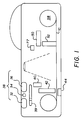
- the still camera depicted in top view FIG. 1 and back view FIG. 2 and the circuit diagram of FIG. 5, includes the following capabilities: (i) image capability in the conventional photographic sense, (ii) electronic and optomechanical capability for decoding, storing, and writing information in color digitally on film strip 10, and (iii) receiving capability for acquiring non-pictorial information from a variety of sources. It will be appreciated by those skilled in the art that the digital electronic capabilities can be implemented in many ways using conventional semiconductor components. The interconnection of the various circuits is shown in FIG. 5.
- the camera shown in FIGS. 1 and 2 has a microphone 30 for audio recording and communication, circuitry 38 for receiving digital data from at least one external source type, such as an intensity modulated infra-red signal source receiver 32, a radio frequency source receiver 34, or a direct electrical or optical interconnect port 36.
- the signal from any one of these sources is user selected by a selector switch 39 on the camera, is processed digitally by processing circuit 40, and is stored in a data buffer 42 for subsequent optical encoding on a portion of a film strip 10.
- the direction of film motion during recording of digital data may be either forward or backward.
- the data may be recorded anywhere along film strip 10 of FIG. 4 by coordinating film advance and rewind functions with the record function using electronic logic circuit 44.
- Electronic logic circuit 44 also ensures that the buffer contents are periodically encoded on the film in a way which can be chosen by format switch 77 not to interfere with the size or quality of any conventional pictures which may be taken at will by the user. For example, digital data might be recorded between pictorial images or in a strip above or below a pictorial image of restricted size. Frame advance automatically occurs after conventional pictures are taken. The periodic transfer of the contents of the partially filled buffer to the film minimally disrupts the option to take pictures and is transparent to the user unless the option to discard the buffer contents before recording is desired.
- Data available display 76 indicates whether data from the selected source is available to be recorded as, for example, would be indicated by the presence of a modulated infrared beam in case the infrared mode of capture were selected by switch 39.
- Record button 74 activates and deactivates recording of digital data, and record on display 72 indicates whether the recording process is activated. It is understood that the timing of the recording sequence may be very different depending on the type of information source selected and thus that the function of record button 74 may differ accordingly. For example, if the user elects to record sound, record button 74 acts as a simple start/stop button.
- record button 74 may activate a waiting mode in which recording begins only at the start of the broadcast and terminates automatically upon repeat of the broadcast or manually upon deactivation of the record mode.
- the precise sequence of data buffering may depend on the information source selected.
- Buffer display 78 displays the percentage of buffer memory used, when the total information exceeds the buffer capacity, the buffer contents or a part thereof are automatically written to the film.
- buffer display 78 If, however, the information recorded at the end of recording does not exceed the buffer capacity, buffer display 78 so indicates, enabling the user to verify the validity of the data by text display 80 (for textual information) or by speaker 82 (for audio information) before either enabling the recording sequence on film using record button 90 or discarding the buffered information using discard button 92.
- Audio enable button 84 enables the audio verification process.
- Digital information generated within the camera may also be optionally recorded on the film strip 10, either in association with particular frames of conventional images or with segments of non-pictorial information.
- user activated button 94 causes data and time information to be recorded digitally in association with the information most recently acquired.
- certain information generated in the camera be recorded digitally on film automatically and without user activation, for example the date and time of conventional image and non-pictorial information recorded, data relating to camera settings, and data relating to camera system measurables, such as scene luminance, etc. which may be of use in subsequent documentation, filing, and display.
- Data recording may be accomplished during forward or reverse (rewind) directions of film motion.
- Optical recording of the information selected onto conventional film in the camera of FIGS. 1 and 2 in the form of an array of spatially separated dots shown in FIG. 4 may be accomplished by a variety of means.
- recording is accomplished by recording module 54 comprising a high density array of planar wave guides 52 fabricated by means practiced commonly in the art, such as ion diffusion in glass, in end contact with the front surface of the film 10 in proximity to the camera exposure gate 41.
- the waveguides convey light from an array 53 of gallium arsenide phosphide light emitters whose intensities are individually controlled by module 50 comprising semiconductor driver circuit 51 connected by wirebonds 55 to light emitting array 53, in response to the information received and which is to be recorded as selected by selector switch 39 of FIG.
- Support 57 provides mechanical integrity for recording module 54.
- alternative means of modulating the light emitters such as optical switches in the light guides, may also serve the purpose of optical exposure.
- the individual light emitters of light emitting array 53 may be controlled by driver 51 to emit at any one of several intensities of light causing gray scale information to be recorded in each spatially isolated dot.
- Logic circuit 44 of FIG. 5 ensures that activation of the emitters is synchronized with the film advance system 58 so that the individual bits of information recorded on the film are spaced from one another to produce a two-dimensional array of recorded "dots" to be described.
- the logic circuit 44 preferentially controls the rate of film advance during digital recording so that film motion is slower and more precise during recording than during frame advance. This procedure ensures that the digital data is recorded in as small a space as possible.
- the light array emitters 53 preferably form a line array with spacing preferably in the range 2 to 200 microns and emitting over only a narrow visible spectral range, for example over a range of ⁇ 20 nm.
- a multiplicity of recording modules 154 similar to recording module 54 but emitting in other spectral ranges are positioned so as to record additional information on the film which may lie in the same spatial region as that recorded by the first array but preferentially sensitizing different layers of the film due to their spectral separation.
- Such a multiplicity of emitter modules may preferably be comprised of organic electroluminescent devices emitting in the red, green, and blue portions of the spectrum which are deposited directly on waveguide arrays with deposition techniques well known in the art. It is to be recognized by those familiar with film exposure that arrangements other than spatially separated line arrays may be employed to record digital information in each of the film color layers, for example tunable emitters or colinear laser arrays could be employed to this end.
- information transmitter 110 which is capable of receiving information from external sources and of processing and transmitting this information or modifications of this information to cameras 100.
- information transmitter 110 may include a computer 112 into which information in the form of tables, charts, or text 114 may be input by typing on keyboard 113 or by a remote data link such as modem 115 or by transportable disk 116 and which can process and store information into binary data for local transmission by means of modulated infrared source 120 whose range of transmission extends at least to the position of still cameras 100.
- Information transmitter 110 may be entirely separate from the cameras and is typically programmed and operated by persons other than camera users.
- the information transmission channel is a modulated infra-red beam which may be aimed toward intended receivers or which may be aimed divergently or adjusted to scatter from selected surfaces such as walls in order to cover a broad area where many users of cameras made in accordance with this invention are likely to be found.
- digital information may also be transmitted by means other than infra-red beams, for example by short range radio frequency or ultrasonic means or by plug-in cable.
- the stream of digital information is broadcast repeatedly in cycles with a standard "start" format code at the beginning of the data stream and a standard format "stop” code at the end for the purpose of enabling cameras 100 to automatically record a single cycle of digital information.
- the data stream broadcast from modulated infrared source 120 preferably contains periodic patterns of digital bits in addition to start and stop codes which serve to alert the camera to the presence of data available for recording through data available display 76.
- identifying line descriptors are transmitted with associated digital information segments.
- the data stream is divided into subsections with headers which specify the importance, type, or hierarchy of detail in the subsection next to be transmitted in order to optionally allow the receiving cameras to record only that information of a selected importance or type.
- a mode of operation of the camera system may be illustrated by reference to FIG. 6.
- the user first elects to document the name and location of the fashion show by a brief audio recording, pressing the record button 74 of FIG. 2 after selecting the voice option using selector switch 39 on still cameras 100. Because the audio information is brief, the electronic buffer in the camera does not entirely fill and the user chooses to hear the voice recording using verification button 94 before allowing it to be recorded on film.
- the user elects to digitally encode the time and date as well using button 94.
- the announcer at the fashion show begins to introduce the models, the camera user chooses to record this event as a mixture of conventional images and an extended amount of audio information. He proceeds to record several minutes of the announcer's voice.
- segments of the audio are periodically transferred from the electronic buffer to the film. This process repeats, controlled by camera logic circuit 44, until the non-pictorial information acquisition is ceased by the camera user by pressing record button 74. Interspersed with this extended audio recording, the user takes several conventional pictures of the models. Logic circuitry 44 in the camera automatically advances the film at the correct pace so that pictorial and non-pictorial data do not overlap and yet no film space is wasted.
- the only non-pictorial information the user has thus far recorded is audio.
- the user next desires to acquire textual information and waits for it to become available. This occurs at some point in the fashion show when the announcer signals that information on colors, pricing, and inventory levels of the merchandise being advertised is being transmitted throughout the room in digital form.
- the user is equally apprised of the availability of information by the data available display 76 on the camera. Since the user's camera is designed to receive these signals, he elects to receive information on colors, pricing, and inventory levels by selecting the infrared receiving mode using selector switch 39 and then pressing record button 74 on his camera which enables circuitry to record the infrared pulses.
- Recording in the preferred embodiment begins only when a standard "start" format code is received, and is terminated when a standard format "stop” code is received.
- line numbers are associated with information segments and recording proceeds at the first line number transmission and terminates at repeat of this line number.
- logic circuitry 44 monitors the amount of film remaining and informs the user on readout display 60 of the number Of available pictures remaining to be taken. Periodic transfer of the contents of the buffer to the film does not interrupt the non-pictorial recording capability and is transparent to the user save for the display update of the remaining picture space available. In this example, the user has maximized the amount of non-pictorial information desired to be recorded without degrading image size or quality of conventional pictures.
- the invention further includes user selectable format for choosing the location of the recorded digital data on the film relative to pictures including a choice of recording format which does not interfere with or degrade the pictorial images.
- the recorded digital data may lie in a strip above and/or below the pictorial images which images are restricted in size.
- the recorded data lies in the area normally occupied by pictures.
- the recorded data lies between frames of pictorial data.
- the invention further includes camera means of notifying the user of the availability of data being transmitted from sources spaced from the camera.
- the system wherein the retrieved digital information corresponds to textual information which is visually displayed.
- the system wherein the retrieved digital information corresponds to audio information which is displayed along with the displayed visual image.
- a photographic camera system for recording images of a subject in a first location on a photographic film, the improvement comprising:
Landscapes
- Physics & Mathematics (AREA)
- General Physics & Mathematics (AREA)
- Camera Data Copying Or Recording (AREA)
Applications Claiming Priority (2)
| Application Number | Priority Date | Filing Date | Title |
|---|---|---|---|
| US08/146,347 US5389989A (en) | 1993-10-29 | 1993-10-29 | Camera for recording digital and pictorial images on photographic film |
| US146347 | 2002-05-15 |
Publications (1)
| Publication Number | Publication Date |
|---|---|
| EP0652465A1 true EP0652465A1 (fr) | 1995-05-10 |
Family
ID=22516967
Family Applications (1)
| Application Number | Title | Priority Date | Filing Date |
|---|---|---|---|
| EP94116132A Withdrawn EP0652465A1 (fr) | 1993-10-29 | 1994-10-13 | Appareil photographique pour l'enregistrement d'informations digitales et d'informations picturales sur un film photographique |
Country Status (3)
| Country | Link |
|---|---|
| US (1) | US5389989A (fr) |
| EP (1) | EP0652465A1 (fr) |
| JP (1) | JPH07181592A (fr) |
Families Citing this family (23)
| Publication number | Priority date | Publication date | Assignee | Title |
|---|---|---|---|---|
| US5678084A (en) * | 1994-04-20 | 1997-10-14 | Asahi Kogaku Kogyo Kabushiki Kaisha | Data recording apparatus for camera |
| JPH07333714A (ja) * | 1994-06-03 | 1995-12-22 | Konica Corp | データ写し込みカメラ |
| US5530501A (en) * | 1994-06-29 | 1996-06-25 | Eastman Kodak Company | Photographic camera with data recording on film |
| US5634156A (en) * | 1994-12-15 | 1997-05-27 | Eastman Kodak Company | Printing exposure reference |
| DE69629071T2 (de) * | 1995-03-29 | 2004-04-22 | Eastman Kodak Co. | Vorrichtung zum Drucken, Speichern und Wiederauffinden eines aufgezeichneten Bildes |
| DE19619519A1 (de) * | 1995-05-25 | 1996-11-28 | Eastman Kodak Co | Bilderfassungsvorrichtung mit Tonaufzeichnungsmöglichkeit |
| US5812899A (en) * | 1995-07-28 | 1998-09-22 | Eastman Kodak Company | Method and apparatus for providing an automated narration for a plurality of images |
| US6111523A (en) | 1995-11-20 | 2000-08-29 | American Traffic Systems, Inc. | Method and apparatus for photographing traffic in an intersection |
| US6750902B1 (en) | 1996-02-13 | 2004-06-15 | Fotonation Holdings Llc | Camera network communication device |
| WO1997030375A1 (fr) * | 1996-02-13 | 1997-08-21 | Obsidian Imaging, Inc. | Procede et appareil de configuration d'un appareil photographique par un moyen exterieur |
| US5948038A (en) | 1996-07-31 | 1999-09-07 | American Traffic Systems, Inc. | Traffic violation processing system |
| US5842063A (en) * | 1996-10-30 | 1998-11-24 | Eastman Kodak Company | Camera and film for recording overlapping images |
| JPH11183994A (ja) * | 1997-12-24 | 1999-07-09 | Canon Inc | 位置情報記録可能なカメラ |
| US6147742A (en) * | 1998-02-26 | 2000-11-14 | Eastman Kodak Company | Photofinishing system and method for automated advanced services including image and associated audio data processing |
| US7324133B2 (en) * | 1998-11-06 | 2008-01-29 | Fotomedia Technologies, Llc | Method and apparatus for controlled camera useability |
| US6081670A (en) * | 1999-03-05 | 2000-06-27 | Lifetouch National School Studies Inc. | Depth-of-field indicator for a camera |
| JP2001066687A (ja) * | 1999-08-31 | 2001-03-16 | Asahi Optical Co Ltd | カメラ |
| US7248934B1 (en) | 2000-10-31 | 2007-07-24 | Creative Technology Ltd | Method of transmitting a one-dimensional signal using a two-dimensional analog medium |
| US7106369B2 (en) * | 2001-08-17 | 2006-09-12 | Hewlett-Packard Development Company, L.P. | Continuous audio capture in an image capturing device |
| US6963973B2 (en) | 2001-10-17 | 2005-11-08 | Hewlett-Packard Development Company, L.P. | Chain of custody system and method |
| TWI463806B (zh) * | 2003-12-19 | 2014-12-01 | Creative Tech Ltd | 處理數位影像之方法及系統 |
| TWI342126B (en) * | 2003-12-19 | 2011-05-11 | Creative Tech Ltd | Still camera with audio decoding and coding, a printable audio format, and method |
| DE102005040413A1 (de) * | 2005-08-26 | 2007-03-15 | Fraunhofer-Gesellschaft zur Förderung der angewandten Forschung e.V. | Vorrichtung zum Aufzeichnen von Daten auf einer lichtempfindlichen Datenträgeranordnung |
Citations (4)
| Publication number | Priority date | Publication date | Assignee | Title |
|---|---|---|---|---|
| US3795902A (en) * | 1966-09-01 | 1974-03-05 | Battelle Development Corp | Method and apparatus for synchronizing photographic records of digital information |
| US3932032A (en) * | 1974-04-03 | 1976-01-13 | Weinstein Stephen B | Motion picture sound synchronization |
| JPH01217336A (ja) * | 1988-02-26 | 1989-08-30 | Kazutaka Kitahara | 音情報をもった二次元画像の形成方法 |
| US4983996A (en) * | 1988-09-02 | 1991-01-08 | Casio Computer Co., Ltd. | Data recording apparatus for still camera |
Family Cites Families (10)
| Publication number | Priority date | Publication date | Assignee | Title |
|---|---|---|---|---|
| US3920862A (en) * | 1972-05-01 | 1975-11-18 | Eastman Kodak Co | Process by which at least one stripe of one material is incorporated in a layer of another material |
| JPS5184632A (en) * | 1975-01-24 | 1976-07-24 | Canon Kk | Deetakirokusochi |
| US4797609A (en) * | 1981-05-22 | 1989-01-10 | The Perkin-Elmer Corporation | LED monitoring without external light detection |
| US5128702A (en) * | 1986-09-02 | 1992-07-07 | Canon Kabushiki Kaisha | Data imprinting device for camera |
| US4905029A (en) * | 1988-09-28 | 1990-02-27 | Kelley Scott A | Audio still camera system |
| US5128700A (en) * | 1989-05-12 | 1992-07-07 | Minolta Camera Kabushiki Kaisha | Camera capable of recording sounds relevant to the photographing |
| US5221939A (en) * | 1990-07-09 | 1993-06-22 | Minolta Camera Kabushiki Kaisha | Photographic camera |
| US5247574A (en) * | 1990-07-19 | 1993-09-21 | Xel Communications, Inc. | Adaptive no balance DX signalling circuit |
| DE4132846B4 (de) * | 1990-10-04 | 2006-06-14 | Fuji Photo Film Co., Ltd., Minami-Ashigara | Verfahren zur Zusammenstellung eines entwickelten Photofilms mit einem Satz von Photoabzügen |
| US5276472A (en) * | 1991-11-19 | 1994-01-04 | Eastman Kodak Company | Photographic film still camera system with audio recording |
-
1993
- 1993-10-29 US US08/146,347 patent/US5389989A/en not_active Expired - Fee Related
-
1994
- 1994-10-13 EP EP94116132A patent/EP0652465A1/fr not_active Withdrawn
- 1994-10-21 JP JP6257092A patent/JPH07181592A/ja active Pending
Patent Citations (4)
| Publication number | Priority date | Publication date | Assignee | Title |
|---|---|---|---|---|
| US3795902A (en) * | 1966-09-01 | 1974-03-05 | Battelle Development Corp | Method and apparatus for synchronizing photographic records of digital information |
| US3932032A (en) * | 1974-04-03 | 1976-01-13 | Weinstein Stephen B | Motion picture sound synchronization |
| JPH01217336A (ja) * | 1988-02-26 | 1989-08-30 | Kazutaka Kitahara | 音情報をもった二次元画像の形成方法 |
| US4983996A (en) * | 1988-09-02 | 1991-01-08 | Casio Computer Co., Ltd. | Data recording apparatus for still camera |
Non-Patent Citations (1)
| Title |
|---|
| PATENT ABSTRACTS OF JAPAN vol. 013, no. 530 (P - 966) 27 November 1989 (1989-11-27) * |
Also Published As
| Publication number | Publication date |
|---|---|
| JPH07181592A (ja) | 1995-07-21 |
| US5389989A (en) | 1995-02-14 |
Similar Documents
| Publication | Publication Date | Title |
|---|---|---|
| US5389989A (en) | Camera for recording digital and pictorial images on photographic film | |
| US4517598A (en) | Method and apparatus for electronic publishing | |
| US4642700A (en) | Method of and apparatus for producing video signal associated with photographic image | |
| US4489351A (en) | Electronic still camera with individual non-volatile memory units | |
| US5040068A (en) | Electronic imaging apparatus with interchangeable pickup units | |
| EP0500898B1 (fr) | Systeme de photofinissage d'imagerie numerique de multiresolution | |
| EP0503041B1 (fr) | Systeme avec memoire auxiliaire amovible permettant de stocker des donnees de parametres d'images | |
| US5440401A (en) | Image database incorporating low resolution index image data | |
| US4357624A (en) | Interactive video production system | |
| KR960016845B1 (ko) | 스틸 카메라가 부착된 비디오 카메라 | |
| US4641198A (en) | Method of and apparatus for recording video signal associated with photographic image | |
| US20090040385A1 (en) | Methods and systems for controlling video compositing in an interactive entertainment system | |
| JPS5983470A (ja) | 画像合成装置 | |
| US6549236B2 (en) | Image reproduction apparatus with multiple-screen display mode | |
| GB2095949A (en) | Television burst service | |
| US7411604B2 (en) | Synchronization of a stereoscopic camera | |
| US5713022A (en) | Image data supply system for selectively supplying a number of image data | |
| JPH11331879A (ja) | 立体画像プロジェクタおよび画像立体視用治具 | |
| US4496946A (en) | Programmable electronic display | |
| EP0712031A1 (fr) | Dispositif et méthode d'affichage des image sur un film | |
| WO1990012470A1 (fr) | Traitement subliminal audio et video pour television en temps reel | |
| EP0378542A1 (fr) | Procede et dispositifs de delimitation | |
| US4384786A (en) | Recording apparatus | |
| JPH0863899A (ja) | 磁気情報の記録方法 | |
| WO1994009588A1 (fr) | Imprimante video |
Legal Events
| Date | Code | Title | Description |
|---|---|---|---|
| PUAI | Public reference made under article 153(3) epc to a published international application that has entered the european phase |
Free format text: ORIGINAL CODE: 0009012 |
|
| AK | Designated contracting states |
Kind code of ref document: A1 Designated state(s): DE FR GB |
|
| 17P | Request for examination filed |
Effective date: 19951109 |
|
| 17Q | First examination report despatched |
Effective date: 19980129 |
|
| STAA | Information on the status of an ep patent application or granted ep patent |
Free format text: STATUS: THE APPLICATION HAS BEEN WITHDRAWN |
|
| 18W | Application withdrawn |
Withdrawal date: 19990629 |