EP0652647A1 - Konstruktionsverfahren eines Spreizkodes zugeordnet zu einem Anwender eines digitalen Übertragungssystem mit Direktsequenz-Kodemultiplexvielfachzugriffe und entsprechendes Verfahren zur Erzeugung einer Tabelle - Google Patents
Konstruktionsverfahren eines Spreizkodes zugeordnet zu einem Anwender eines digitalen Übertragungssystem mit Direktsequenz-Kodemultiplexvielfachzugriffe und entsprechendes Verfahren zur Erzeugung einer Tabelle Download PDFInfo
- Publication number
- EP0652647A1 EP0652647A1 EP94402507A EP94402507A EP0652647A1 EP 0652647 A1 EP0652647 A1 EP 0652647A1 EP 94402507 A EP94402507 A EP 94402507A EP 94402507 A EP94402507 A EP 94402507A EP 0652647 A1 EP0652647 A1 EP 0652647A1
- Authority
- EP
- European Patent Office
- Prior art keywords
- codes
- code
- sub
- spreading
- family
- Prior art date
- Legal status (The legal status is an assumption and is not a legal conclusion. Google has not performed a legal analysis and makes no representation as to the accuracy of the status listed.)
- Withdrawn
Links
- 238000000034 method Methods 0.000 title claims abstract description 37
- 238000010276 construction Methods 0.000 title description 7
- 230000007480 spreading Effects 0.000 claims abstract description 109
- 230000005540 biological transmission Effects 0.000 claims abstract description 30
- PCHJSUWPFVWCPO-UHFFFAOYSA-N gold Chemical compound [Au] PCHJSUWPFVWCPO-UHFFFAOYSA-N 0.000 claims description 5
- 239000010931 gold Substances 0.000 claims description 5
- 229910052737 gold Inorganic materials 0.000 claims description 5
- 108010003272 Hyaluronate lyase Proteins 0.000 description 16
- 230000006870 function Effects 0.000 description 8
- 238000001914 filtration Methods 0.000 description 4
- 238000001228 spectrum Methods 0.000 description 4
- 230000001360 synchronised effect Effects 0.000 description 4
- 230000008569 process Effects 0.000 description 3
- 208000025048 Action myoclonus-renal failure syndrome Diseases 0.000 description 2
- 239000008186 active pharmaceutical agent Substances 0.000 description 2
- 208000027025 progressive myoclonus epilepsy 4 Diseases 0.000 description 2
- 230000004044 response Effects 0.000 description 2
- 230000001427 coherent effect Effects 0.000 description 1
- 238000002592 echocardiography Methods 0.000 description 1
- 230000001747 exhibiting effect Effects 0.000 description 1
- 238000007620 mathematical function Methods 0.000 description 1
- 238000005457 optimization Methods 0.000 description 1
- 238000012772 sequence design Methods 0.000 description 1
Images
Classifications
-
- H—ELECTRICITY
- H04—ELECTRIC COMMUNICATION TECHNIQUE
- H04J—MULTIPLEX COMMUNICATION
- H04J13/00—Code division multiplex systems
- H04J13/10—Code generation
- H04J13/102—Combining codes
- H04J13/107—Combining codes by concatenation
-
- H—ELECTRICITY
- H04—ELECTRIC COMMUNICATION TECHNIQUE
- H04L—TRANSMISSION OF DIGITAL INFORMATION, e.g. TELEGRAPHIC COMMUNICATION
- H04L27/00—Modulated-carrier systems
- H04L27/26—Systems using multi-frequency codes
- H04L27/30—Systems using multi-frequency codes wherein each code element is represented by a combination of frequencies
-
- H—ELECTRICITY
- H04—ELECTRIC COMMUNICATION TECHNIQUE
- H04B—TRANSMISSION
- H04B1/00—Details of transmission systems, not covered by a single one of groups H04B3/00 - H04B13/00; Details of transmission systems not characterised by the medium used for transmission
- H04B1/69—Spread spectrum techniques
- H04B1/707—Spread spectrum techniques using direct sequence modulation
-
- H—ELECTRICITY
- H04—ELECTRIC COMMUNICATION TECHNIQUE
- H04J—MULTIPLEX COMMUNICATION
- H04J13/00—Code division multiplex systems
- H04J13/0007—Code type
- H04J13/0022—PN, e.g. Kronecker
- H04J13/0029—Gold
-
- H—ELECTRICITY
- H04—ELECTRIC COMMUNICATION TECHNIQUE
- H04J—MULTIPLEX COMMUNICATION
- H04J13/00—Code division multiplex systems
- H04J13/0007—Code type
- H04J13/0022—PN, e.g. Kronecker
- H04J13/0033—Kasami
Definitions
- the field of the invention is that of digital transmissions, in particular to mobiles. More specifically, the invention relates to a method of constructing a spreading code associated with a user of a digital transmission system with Multiple Access by Distribution by Code and with Direct Sequence, system called CDMA-SD (DS-CDMA in Anglo-Saxon).
- CDMA-SD DS-CDMA in Anglo-Saxon
- AMRF AMRF
- TDMA TDMA
- CDMA CDMA
- AMRF Frequency division multiple access
- AMRT Multiple Time Division Access
- TDMA systems notably pose difficult equalization problems when the transmission channel is disturbed by echoes or jammers.
- CDMA code division multiple access
- the decoding on reception is carried out by combining the received signal with a local replica of g (t) synchronized on the transmission.
- the spreading codes of the same family must be numerous so as to have a large number of users each having a separate spreading code. These spreading codes must also be long enough to ensure minimum security against intentional interference, as well as confidentiality of the transmission.
- the invention applies mainly to the case where the receiving device is a diversity receiver, also called a rake receiver.
- Partial here means that the correlation is not performed over the entire period of the spreading code.
- Aperiodic means that the correlation is not carried out by simple shift of two codes and correlation on a predetermined number of elements, but by correlation between elements corresponding to the same bits.
- the partial aperiodic auto-correlation, on a maximum number G of elements (with G the spreading factor), of a code noted ai, for a starting index k1 and an offset k2, can for example be defined at using the following formula: mod represents the mathematical function "modulo".
- the partial aperiodic inter-correlation, on a maximum number G of elements, between two codes denoted a i and a m , for a starting index k1 and an offset k bracket can for example be defined using of the formula next :
- the known spreading codes generally used in conventional DS-CDMA systems have correlation properties only when the correlations are performed over the entire period of the spreading code.
- These known spreading codes described in particular in the document "Coherent Spread Spectrum Systems, J.K Holmes, Wiley Interscience 1992", are for example Gold codes, or Kasami codes.
- L is the period of the starting sub-code, there are L possible circular permutations.
- the period L 'of the structured code is therefore at most equal to L2 (L' ⁇ L2). Structured codes therefore have the disadvantage of being relatively short, and do not ensure good confidentiality.
- the maximum number of structured codes of the same family, and therefore the maximum number of users is limited by K, the number of cyclically distinct sub-codes available.
- K the number of cyclically distinct sub-codes available.
- the invention particularly aims to overcome these various drawbacks of the state of the art.
- an objective of the invention is to provide a method of constructing a spreading code family for a DS-CDMA system, these spreading codes of the same family being able to be numerous, of considerable length and exhibiting properties of aperiodic self and partial correlations.
- the invention therefore aims to provide spreading codes which optimize the performance of a rake receiver, in particular in the presence of multi-user interference and interference between symbols.
- the invention therefore consists in constructing the spreading codes (or long codes) by concatenating sub-codes (or short codes) obtained from basic sub-codes belonging to the same family of sub-codes but distinct from each other. others.
- sub-codes are either basic sub-codes or secondary sub-codes obtained by circular permutation of one of the basic sub-codes.
- the basic sub-codes of the same family are cyclically different, that is to say different from each other even if circular permutations are carried out.
- making a partial aperiodic intercorrelation between two spreading codes for starting indices multiple of the spreading factor amounts to making an aperiodic intercorrelation between the two sub-codes forming part of these two spreading codes and corresponding at the instants defined by these indices.
- a partial aperiodic intercorrelation for multiple starting indices of the spreading factor is therefore equal either to an aperiodic intercorrelation between two different sub-codes, or to an aperiodic autocorrelation on a sub-code.
- the spreading codes (or long codes) therefore inherit the properties of aperiodic inter or autocorrelations from the sub-codes (or short codes) for partial aperiodic intercorrelations of spreading codes.
- making a partial aperiodic autocorrelation on a spreading code amounts to making an aperiodic autocorrelation on a subcode.
- the autocorrelations must be as weak as possible for a non-zero offset and the weakest possible inter-correlations for two different codes.
- the period of said sub-codes is equal to the spread gain of said transmission system.
- the partial correlations which are made over the length of the sub-codes, are carried out over a length corresponding to the spreading factor.
- these codes have very good aperiodic correlation properties (inter and auto) over their entire period. They can therefore be used as basic sub-codes to build a family of spreading codes which has good auto properties and partial aperiodic intercorrelations.
- a spreading code is defined by n couples (p k (q), c k (q)), where q ⁇ [0, n-1] .
- said method comprises a step of associating a couple (p k (q), c k (q)) with each value of q.
- said step of associating a couple (p k (q), c k q)) with each value of q is such that the same sub-code cannot have the same rank of concatenation in said code d spreading and in any other spreading code of said family of spreading codes.
- said step of associating a pair (p k (q), c k (q)) with each value of q is such that the same sub-code cannot be present for more than one included in said spreading code (3).
- the spreading codes of the invention are therefore longer and more numerous per family than the structured codes.
- N the period of the sub-codes (also equal to the band expansion factor), and K the number of cyclically different basic sub-codes (that is to say which cannot be equaled, even by permutation circular)
- the maximum period of each spreading code is N2K. Indeed, one can make N permutations on the basic sub-codes since their period is N. There are therefore NK possible pairs (p k , c k ), that is to say NK distinct sub-codes in total .
- N (N) N2.
- said step of associating a couple (p k (q), c k (q)) with each value of q consists in calculating said values p k (q) and c k (q) using a function parameterized by said index k of said spreading code in said family.
- said step of associating a couple (p k (q), c k (q)) with each value of q consists in reading said values p k (q) and c k (q) in a table previously generated using a function parameterized by said index k of said spreading code in said family.
- this construction step is iterative and makes it possible to calculate the set of couples (p k (q), c k (q)) necessary for the construction of the spreading codes. It should be noted that such a table can be used in the second preferred embodiment of a method for constructing a spreading code according to the invention.
- the invention also relates to the result obtained by the application of the method of construction of a spreading code, namely, a family of spreading codes for a digital transmission system with multiple access by code distribution and direct sequence, comprising a plurality of distinct codes, in which each of these codes is derived from this process.
- the invention also relates to a device for allocating a spreading code in a digital transmission system with multiple access by code distribution and direct sequence, comprising means for assigning a code specific to a user, this clean code resulting from the process mentioned above.
- the invention therefore relates to a method of constructing a spreading code associated with a user of a direct-access code division multiple distribution digital transmission system (DS system - CDMA).
- DS system - CDMA direct-access code division multiple distribution digital transmission system
- Such a DS - CDMA transmission system is for example used in a digital radiocommunication system.
- a separate spreading code is associated with each mobile station (that is to say with each subscriber) connected to a base station.
- a spreading code is in the form of a pseudo-random binary sequence, characterized by its frequency, called the chip frequency, and by the repetition period of the pseudo-random sequence, called the code period. .
- a data signal to be transmitted is in the form of a binary signal, characterized by its bit frequency.
- the bit frequency is a multiple of the chip frequency and the spreading factor of a spreading code is by definition the ratio G between the chip frequency and the bit frequency.
- the maximum number of elements on which the correlations are performed is equal to this spreading factor G.
- the data signal On transmission, the data signal is combined with the spreading code, for example by a module addition or by a multiplication according to the nature of these signals.
- the signal obtained is filtered and then transmitted through a channel.
- the decoding is carried out by combining the received signal with a local replica of the spreading code synchronized on the transmission.
- the spreading codes must have certain characteristics.
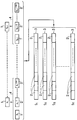
- the single figure illustrates the method according to the invention for constructing a family of spreading codes having such properties of partial aperiodic inter and auto-correlations.
- This family of basic sub-codes 1 is for example a family of Gold codes, or a family of Kasami codes.
- the basic sub-codes are for example obtained by using the same pair of generator polynomials.
- the secondary sub-codes 2 are obtained by circular permutation of the basic sub-codes 1.
- a spreading code 3 is obtained by concatenating basic sub-codes 1 as such, or of which the phase has been turned (in the latter case, the sub-codes thus obtained are then called secondary sub-codes 2).
- the k th spreading code can also be defined by a sequence of n couples (p k (q), c k (q)).
- Compliance with the first criterion allows that the same sub-code does not have the same concatenation rank in two separate spreading codes.
- Compliance with the second criterion enables the same sub-code not to be present several times in the same spreading code.
- N is also generally the spreading factor of the transmission system in which the spreading codes are used.
- c k (q) takes its values in the set ⁇ 0, ..., K-1 ⁇ , with K the number of different basic sub-codes (but equal to a permutation near).
- making a partial aperiodic intercorrelation between two spreading codes, for multiple start indices of the spreading factor amounts to making an aperiodic intercorrelation on the two sub-codes constituting the spreading codes for the instants pN, with whole p.
- the beginning indices are multiple of the spreading factor, one thus recovers the properties of aperiodic inter and auto-correlations of the sub-codes for the partial aperiodic inter and auto-correlations of the spreading codes, with a correlation length maximum equal to the period of a sub-code.
- start indices are multiple of the spreading factor, we therefore also recover the properties of aperiodic auto and inter-correlations of the sub-codes for the partial aperiodic auto-correlations of the spreading codes, with a length of maximum correlation equal to the period of a sub-code.
- the step of concatenating several sub-codes for building a spreading code is preceded by a step of associating a couple (p k (q), c k (q)) with each value of q.
- this step of associating a couple (p k (q), c k (q)) with each value of q can consist in calculating the values p k (q) and c k ( q) using a function parameterized by the index k.
- this step of associating a couple (p k (q), c k (q)) with each value of q can consist in reading the values p k (q) and c k (q ) in a table previously generated using a function parameterized by the index k.
- the devices for allocating spreading codes in a digital transmission system with multiple access by code division and direct sequence are part of the state of the art, they will therefore not be detailed.
- the invention also provides for adding to these devices means for assigning a user a specific code resulting from the method of constructing a spreading code described above.
- the available codes are stored in a memory.
Landscapes
- Engineering & Computer Science (AREA)
- Computer Networks & Wireless Communication (AREA)
- Signal Processing (AREA)
- Mobile Radio Communication Systems (AREA)
Applications Claiming Priority (2)
| Application Number | Priority Date | Filing Date | Title |
|---|---|---|---|
| FR9313477 | 1993-11-10 | ||
| FR9313477A FR2712444B1 (fr) | 1993-11-10 | 1993-11-10 | Procédé de construction d'un code d'étalement associé à un utilisateur d'un système de transmission numérique à accès multiple par répartition par codes et à séquence directe, et procédé correspondant de génération d'un tableau. |
Publications (1)
| Publication Number | Publication Date |
|---|---|
| EP0652647A1 true EP0652647A1 (de) | 1995-05-10 |
Family
ID=9452763
Family Applications (1)
| Application Number | Title | Priority Date | Filing Date |
|---|---|---|---|
| EP94402507A Withdrawn EP0652647A1 (de) | 1993-11-10 | 1994-11-07 | Konstruktionsverfahren eines Spreizkodes zugeordnet zu einem Anwender eines digitalen Übertragungssystem mit Direktsequenz-Kodemultiplexvielfachzugriffe und entsprechendes Verfahren zur Erzeugung einer Tabelle |
Country Status (10)
| Country | Link |
|---|---|
| US (1) | US5559829A (de) |
| EP (1) | EP0652647A1 (de) |
| JP (1) | JPH07202752A (de) |
| KR (1) | KR950016119A (de) |
| CN (1) | CN1124439A (de) |
| AU (1) | AU683694B2 (de) |
| CA (1) | CA2135459A1 (de) |
| FI (1) | FI945230A7 (de) |
| FR (1) | FR2712444B1 (de) |
| NZ (1) | NZ264805A (de) |
Cited By (4)
| Publication number | Priority date | Publication date | Assignee | Title |
|---|---|---|---|---|
| WO1996036137A3 (en) * | 1995-05-12 | 1997-01-30 | Philips Electronics Nv | A direct-sequence spread spectrum communication system, a primary radio station, and a secondary radio station |
| EP0845887A1 (de) * | 1996-11-29 | 1998-06-03 | Commissariat A L'energie Atomique | Verfahren zur Nachrichtenübertragung mittels direktem Spreizband und Erzeugung und Optimalisierung der Sequenzen |
| US5943330A (en) * | 1995-10-26 | 1999-08-24 | Nokia Mobile Phones Ltd. | Data transmission method, transmitter, and receiver |
| EP0767544A3 (de) * | 1995-10-04 | 2002-02-27 | Interuniversitair Micro-Elektronica Centrum Vzw | Programmierbare Modem unter verwendung von Spreizspektrumnachrichtenübertragung |
Families Citing this family (25)
| Publication number | Priority date | Publication date | Assignee | Title |
|---|---|---|---|---|
| US6185244B1 (en) | 1997-08-29 | 2001-02-06 | Telefonaktiebolaget Lm Ericsson | Cell searching in a CDMA communications system |
| ZA987427B (en) * | 1997-08-29 | 1999-08-13 | Ericsson Telefon Ab L M | Cell searching in a CDMA communications system. |
| US6181729B1 (en) | 1997-12-19 | 2001-01-30 | Supergold Communication Limited | Spread spectrum communication |
| CN1286844A (zh) * | 1997-12-19 | 2001-03-07 | 超级金通讯有限公司 | 用于扩频通信的链接码 |
| US7301983B1 (en) * | 1998-01-05 | 2007-11-27 | Intel Corporation | Method for using codebook indexing to achieve high bit densities in a direct-sequence CDMA spread spectrum communication system |
| US6266331B1 (en) | 1998-07-01 | 2001-07-24 | Lucent Technologies, Inc. | Device for generating multiple spreading sequences in reverse high speed data channels |
| BR9913505B1 (pt) * | 1998-09-08 | 2013-04-02 | processo para a sincronizaÇço de uma estaÇço rÁdio base com uma estaÇço màvel, estaÇço rÁdio base, estaÇço màvel, e sequÊncia de sinais. | |
| GB2342251A (en) | 1998-09-29 | 2000-04-05 | Secr Defence | Proximity measuring apparatus |
| FI982203A7 (fi) | 1998-10-09 | 2000-04-10 | Nokia Networks Oy | Menetelmä ja generaattori generoida CDMA-radiojärjestelmän ortogonaalinen hajotuskoodi |
| US6434163B1 (en) * | 1998-10-10 | 2002-08-13 | Agere Systems Guardian Corp. | Transverse correlator structure for a rake receiver |
| EP1129524A1 (de) * | 1999-09-10 | 2001-09-05 | Koninklijke Philips Electronics N.V. | Spreizspektrumübertragungssystem mit verminderung der intersymbolstörung |
| US6643280B1 (en) * | 1999-10-27 | 2003-11-04 | Lucent Technologies Inc. | Method and apparatus for generation of CDMA long codes |
| IES20000064A2 (en) * | 2000-01-25 | 2001-07-25 | Supergold Comm Ltd | Improved Spread Spectrum Communication |
| KR100498919B1 (ko) * | 2000-11-21 | 2005-07-04 | 삼성전자주식회사 | 무선통신시스템에서의 프리엠블 시퀀스 생성장치 및 방법 |
| FR2827971B1 (fr) * | 2001-07-27 | 2003-10-10 | Thales Sa | Reseau de communications optiques, multi-utilisateurs, reconfigurable a faible temps de latence |
| KR100450936B1 (ko) * | 2001-08-27 | 2004-10-02 | 삼성전자주식회사 | 직교 주파수 분할 다중 방식을 사용하는 광대역 무선 접속통신시스템에서 프리앰블 시퀀스 생성 장치 및 방법 |
| EP1535405A1 (de) * | 2002-09-03 | 2005-06-01 | Nokia Corporation | Ein drahtloses system |
| GB2394867B (en) * | 2002-11-01 | 2005-06-01 | Ipwireless Inc | Arrangement and method for sequence production in a spread spectrum communication system |
| KR100520158B1 (ko) * | 2003-10-27 | 2005-10-10 | 삼성전자주식회사 | 프리앰블 시퀀스 그룹 생성방법 |
| KR100547723B1 (ko) * | 2004-01-14 | 2006-01-31 | 삼성전자주식회사 | 이동통신시스템에서 인접 셀 경계 인식장치 및 방법 |
| CN101147347B (zh) * | 2004-12-17 | 2014-10-01 | 欧洲太空署 | 用于卫星导航系统的扩展码 |
| US7873097B1 (en) * | 2006-09-20 | 2011-01-18 | Interstate Electronics Corporation | Systems and methods for concatenation in spread spectrum systems |
| US9130734B1 (en) | 2007-09-20 | 2015-09-08 | Interstate Electronics Corporation | Multi-tone concatenated spread spectrum communications |
| GB2477918B (en) * | 2010-02-15 | 2012-09-19 | Toshiba Res Europ Ltd | Wireless communications apparatus and method |
| US10666374B2 (en) | 2018-05-11 | 2020-05-26 | At&T Intellectual Property I, L.P. | Non-orthogonal multiple access for uplink data transmission for 5G or other next generation network |
Citations (5)
| Publication number | Priority date | Publication date | Assignee | Title |
|---|---|---|---|---|
| WO1987000370A1 (en) * | 1985-07-01 | 1987-01-15 | The Secretary Of State For Defence In Her Britanni | A serial data highway system |
| JPS6223634A (ja) * | 1985-07-24 | 1987-01-31 | Nec Home Electronics Ltd | スペクトラム拡散電力線搬送通信方法および装置 |
| JPH04179324A (ja) * | 1990-11-14 | 1992-06-26 | Yamaha Corp | スペクトラム拡散多元接続通信装置 |
| US5210770A (en) * | 1991-09-27 | 1993-05-11 | Lockheed Missiles & Space Company, Inc. | Multiple-signal spread-spectrum transceiver |
| EP0563020A2 (de) * | 1992-03-25 | 1993-09-29 | Ericsson Inc. | RAKE-Empfänger mit Kombination von selektiven Signalstrahlen |
Family Cites Families (7)
| Publication number | Priority date | Publication date | Assignee | Title |
|---|---|---|---|---|
| NL8700930A (nl) * | 1987-04-17 | 1988-11-16 | Hollandse Signaalapparaten Bv | Systeem van orthogonaal werkende codegeneratoren, radio's voorzien van een codegenerator en codegeneratoren van zo'n systeem. |
| US4755987A (en) * | 1987-06-05 | 1988-07-05 | Bell Communications Research, Inc. | High speed scrambling at lower clock speeds |
| JP2719681B2 (ja) * | 1987-07-31 | 1998-02-25 | 株式会社 アドバンテスト | 擬似ランダムパターン発生器 |
| US5166952A (en) * | 1990-05-24 | 1992-11-24 | Cylink Corporation | Method and apparatus for the reception and demodulation of spread spectrum radio signals |
| US5157686A (en) * | 1990-05-24 | 1992-10-20 | Cylink Corporation | Method and apparatus for the modulation of spread spectrum radio signals |
| FR2681199B1 (fr) * | 1991-09-11 | 1993-12-03 | Agence Spatiale Europeenne | Procede et dispositif pour multiplexer des signaux de donnees. |
| US5313457A (en) * | 1992-04-14 | 1994-05-17 | Trimble Navigation Limited | Code position modulation system and method for multiple user satellite communications |
-
1993
- 1993-11-10 FR FR9313477A patent/FR2712444B1/fr not_active Expired - Fee Related
-
1994
- 1994-10-28 NZ NZ264805A patent/NZ264805A/en unknown
- 1994-10-31 AU AU77529/94A patent/AU683694B2/en not_active Ceased
- 1994-11-07 FI FI945230A patent/FI945230A7/fi unknown
- 1994-11-07 EP EP94402507A patent/EP0652647A1/de not_active Withdrawn
- 1994-11-09 US US08/338,114 patent/US5559829A/en not_active Expired - Fee Related
- 1994-11-09 CA CA002135459A patent/CA2135459A1/fr not_active Abandoned
- 1994-11-10 CN CN94118191A patent/CN1124439A/zh active Pending
- 1994-11-10 JP JP6276799A patent/JPH07202752A/ja active Pending
- 1994-11-10 KR KR1019940029846A patent/KR950016119A/ko not_active Ceased
Patent Citations (5)
| Publication number | Priority date | Publication date | Assignee | Title |
|---|---|---|---|---|
| WO1987000370A1 (en) * | 1985-07-01 | 1987-01-15 | The Secretary Of State For Defence In Her Britanni | A serial data highway system |
| JPS6223634A (ja) * | 1985-07-24 | 1987-01-31 | Nec Home Electronics Ltd | スペクトラム拡散電力線搬送通信方法および装置 |
| JPH04179324A (ja) * | 1990-11-14 | 1992-06-26 | Yamaha Corp | スペクトラム拡散多元接続通信装置 |
| US5210770A (en) * | 1991-09-27 | 1993-05-11 | Lockheed Missiles & Space Company, Inc. | Multiple-signal spread-spectrum transceiver |
| EP0563020A2 (de) * | 1992-03-25 | 1993-09-29 | Ericsson Inc. | RAKE-Empfänger mit Kombination von selektiven Signalstrahlen |
Non-Patent Citations (4)
| Title |
|---|
| KARKKAINEN & LEPPANEN: "Comparison of the performance of some linear spreading code families for asynchronous DS/SSMA systems", MILCOM 91, CONFERENCE RECORD, vol. 2, 1991, pages 784 - 790, XP000273811 * |
| PATENT ABSTRACTS OF JAPAN vol. 11, no. 198 (E - 519) 25 June 1987 (1987-06-25) * |
| PATENT ABSTRACTS OF JAPAN vol. 16, no. 488 (E - 1277) 9 October 1992 (1992-10-09) * |
| SOLJANIN ET AL: "Spread-Spectrum road-automobile communications", PROC. OF THE 1991 AMERICAN CONTROL CONF., vol. 3, 28 June 1991 (1991-06-28), BOSTON, MA,US, pages 2557 - 2562, XP000269090 * |
Cited By (4)
| Publication number | Priority date | Publication date | Assignee | Title |
|---|---|---|---|---|
| WO1996036137A3 (en) * | 1995-05-12 | 1997-01-30 | Philips Electronics Nv | A direct-sequence spread spectrum communication system, a primary radio station, and a secondary radio station |
| EP0767544A3 (de) * | 1995-10-04 | 2002-02-27 | Interuniversitair Micro-Elektronica Centrum Vzw | Programmierbare Modem unter verwendung von Spreizspektrumnachrichtenübertragung |
| US5943330A (en) * | 1995-10-26 | 1999-08-24 | Nokia Mobile Phones Ltd. | Data transmission method, transmitter, and receiver |
| EP0845887A1 (de) * | 1996-11-29 | 1998-06-03 | Commissariat A L'energie Atomique | Verfahren zur Nachrichtenübertragung mittels direktem Spreizband und Erzeugung und Optimalisierung der Sequenzen |
Also Published As
| Publication number | Publication date |
|---|---|
| FR2712444A1 (fr) | 1995-05-19 |
| JPH07202752A (ja) | 1995-08-04 |
| CN1124439A (zh) | 1996-06-12 |
| AU683694B2 (en) | 1997-11-20 |
| FR2712444B1 (fr) | 1995-12-29 |
| US5559829A (en) | 1996-09-24 |
| AU7752994A (en) | 1995-05-18 |
| NZ264805A (en) | 1996-11-26 |
| FI945230A7 (fi) | 1995-05-11 |
| KR950016119A (ko) | 1995-06-17 |
| FI945230A0 (fi) | 1994-11-07 |
| CA2135459A1 (fr) | 1995-05-11 |
Similar Documents
| Publication | Publication Date | Title |
|---|---|---|
| FR2712444A1 (fr) | Procédé de construction d'un code d'étalement associé à un utilisateur d'un système de transmission numérique à accès multiple par répartition par codes et à séquence directe, et procédé correspondant de génération d'un tableau. | |
| EP1195924B1 (de) | Verfahren zur Synchronisation von Basisstationen | |
| EP0718983A1 (de) | Spreizspektrumdifferenzmodulation | |
| FR2756692A1 (fr) | Procede de transmission a etalement de spectre par sequence directe, avec generation et optimisation des sequences | |
| EP1260071B1 (de) | Verfahren und vorrichtung für kanalschäztung | |
| EP1085689A1 (de) | Zuweisung von Spreizfolgen in einem MCCDMA-System | |
| EP0945996B1 (de) | CDMA-Empfänger mit paraleller Interferenzunterdrückung und -gewichtung | |
| EP3931991A1 (de) | Verfahren und vorrichtung zur modulierung mit zadoff-chu-sequenzen | |
| EP2639967A1 (de) | Verfahren zur Blindschätzung von einem verschlüsselungscode eines CDMA2000 Aufwärtskanals | |
| EP0820157B1 (de) | Verfahren zur digitalen Differenzialdemodulation | |
| EP0778678B1 (de) | Differentialempfänger für Direktsequenzspreizspektrumsignale | |
| EP2161847A1 (de) | Datenübertragungsverfahren mit sich wiederholenden Spreizsequenzsätzen und entsprechender Sender und Empfänger | |
| EP0629059B1 (de) | Digitales Spreizspektrumübertragungssystem mit Niederfrequenz-Pseudozufallkodierung von Nutzinformation und Verfahren zur Spektrumsspreizung und Spektrumskomprimierung zur Verwendung in einem solchen System | |
| EP1050987B1 (de) | CDMA-Vielfachzugriffverfahren mit verbesserter Kapazität | |
| EP2168336A1 (de) | Verfahren zur erkennung des vorhandenseins spektral gespreizter signale | |
| EP0994580B1 (de) | Übertragungsverfahren in einem Funkkommunikationssystem mit Vielfachzugriff | |
| EP1065849B1 (de) | Übertragungsverfahren für multi-MOK Modulation/Demodulation | |
| FR3056863A1 (fr) | Procede permettant une discrimination de communications montantes ou descendantes | |
| FR2843504A1 (fr) | Procede et systeme pour la determination aveugle de caracteristiques de systeme a sauts de frequence et pour la synchronisation avec celui-ci. | |
| FR2823623A1 (fr) | Procede de transmission bidirectionnelle de signaux multiporteuses, systeme terminal de communication et signal correspondants | |
| WO2005109708A1 (fr) | Procede de determination de codes d’etalement utilises dans un signal cdma et dispositif de communication correspondant. | |
| FR2759519A1 (fr) | Procede de transmission de signaux numeriques, emetteur et recepteur correspondants | |
| WO2007051952A1 (fr) | Dispositif de génération de séquences d'éléments de codage pour un équipement de transmission d'un réseau de communication de type cdma | |
| EP3281298A1 (de) | Verfahren zur übertragung von binären informationen über eine funkverbindung mittels ultrabreitbandmodulation | |
| EP1693969A2 (de) | CDMA-Empfangsverfahren mit paralleler Interferenzunterdrückung, entsprechende Stufe und Empfänger |
Legal Events
| Date | Code | Title | Description |
|---|---|---|---|
| PUAI | Public reference made under article 153(3) epc to a published international application that has entered the european phase |
Free format text: ORIGINAL CODE: 0009012 |
|
| AK | Designated contracting states |
Kind code of ref document: A1 Designated state(s): AT BE CH DE DK ES FR GB IT LI NL SE |
|
| 17P | Request for examination filed |
Effective date: 19950921 |
|
| 17Q | First examination report despatched |
Effective date: 19991207 |
|
| STAA | Information on the status of an ep patent application or granted ep patent |
Free format text: STATUS: THE APPLICATION IS DEEMED TO BE WITHDRAWN |
|
| 18D | Application deemed to be withdrawn |
Effective date: 20000418 |