EP0653630A2 - Pyrogenes Siliziumdioxid enthaltende anionenselektive Elektroden - Google Patents
Pyrogenes Siliziumdioxid enthaltende anionenselektive Elektroden Download PDFInfo
- Publication number
- EP0653630A2 EP0653630A2 EP94117011A EP94117011A EP0653630A2 EP 0653630 A2 EP0653630 A2 EP 0653630A2 EP 94117011 A EP94117011 A EP 94117011A EP 94117011 A EP94117011 A EP 94117011A EP 0653630 A2 EP0653630 A2 EP 0653630A2
- Authority
- EP
- European Patent Office
- Prior art keywords
- selective
- chloride
- anion
- electrode
- membrane
- Prior art date
- Legal status (The legal status is an assumption and is not a legal conclusion. Google has not performed a legal analysis and makes no representation as to the accuracy of the status listed.)
- Granted
Links
Images

Classifications
-
- G—PHYSICS
- G01—MEASURING; TESTING
- G01N—INVESTIGATING OR ANALYSING MATERIALS BY DETERMINING THEIR CHEMICAL OR PHYSICAL PROPERTIES
- G01N27/00—Investigating or analysing materials by the use of electric, electrochemical, or magnetic means
- G01N27/26—Investigating or analysing materials by the use of electric, electrochemical, or magnetic means by investigating electrochemical variables; by using electrolysis or electrophoresis
- G01N27/28—Electrolytic cell components
- G01N27/30—Electrodes, e.g. test electrodes; Half-cells
- G01N27/333—Ion-selective electrodes or membranes
- G01N27/3335—Ion-selective electrodes or membranes the membrane containing at least one organic component
Definitions
- This invention relates to anion selective electrodes for performing potentiometric anion determinations and more particularly to anion selective electrodes having membranes containing fumed silica.
- Electrochemical measurements are widely used to determine the concentration of specific substances in fluids. These devices, referred to as ion-selective electrodes (ISEs), can be employed in a wide variety of potentiometric ion determinations, including, for example, the activity of fluoride ion in drinking water, the pH of process streams, and the determination of electrolytes in serum.
- ISEs ion-selective electrodes
- ISEs are commonly used to measure the activity or concentration of various ions and metabolites present in blood plasma, serum and other biological fluids.
- ISEs are typically used to determine Na+, Ca++, Mg++, K+, Cl ⁇ , Li+, pH, and carbon dioxide content in such fluids.
- Ion selective electrodes are typically composed of an ion selective membrane, an internal filling solution or electrolyte, and an internal reference electrode.
- Ion selective electrodes can be classified according to the nature of the membrane material, and include solid state membrane electrodes, glass membrane electrodes, liquid membrane electrodes having charged ion-selective agents, and neutral liquid membrane electrodes having membranes formed from an organic solution containing an electrically neutral, ion-selective agent such as an ionophore held in an inert polymer matrix.
- An external reference electrode used in conjunction with the ISE is typically a metal/metal halide electrode such as Ag/AgCl.
- An ion selective electrode exposed or subjected to a sample solution, such as a biological sample, and an external reference electrode comprise a potentiometric cell assembly.
- a potential difference is generated.
- the potential difference is a linear function of the logarithm of the activity ratio of the ion of interest in the two solutions contacting the membrane (Nernst equation).
- a semi-empirical extension of the Nernst Equation (Nikolskii Eisenmann equation) for EMF may be utilized for non-ideal conditions.
- EMF is meant the electrical potential difference between the internal ion sensing and external reference electrode, the electrodes being electrolytically connected by means of the sample solution at zero or near zero current flow.
- ISEs are typically bulky, expensive, difficult to clean and maintain, and tend to require an undesirably large volume of biological fluid. For these reasons, much attention has been directed towards developing more reliable ISEs of smaller size.
- These relatively small ISEs referred to as ion-selective sensors or biosensors, can be inexpensively mass produced using techniques similar to these employed in the manufacture of electronic components, including for example, photolithography, screen printing, and ion-implantation.
- Ion-selective sensors and biosensors can be manufactured at much lower production cost than conventional ISEs, making it economically feasible to offer a single-use or limited-use disposable device, thereby eliminating the difficulty of cleaning and maintaining conventional ISEs.
- the reduced size of ion-selective sensors further serves to reduce the required volume of patient sample.
- a sensor can be either a miniature version of a conventional electrode or a device constructed using one or more of the above mentioned techniques. Maximum accuracy of the analytical or diagnostic result is obtained when the sensor responds only to the concentration or activity of the component of interest and has a response independent of the presence of interfering ions and/or underlying membrane matrix effects.
- the desired selectivity is often achieved by an ion-selective membrane containing an ion selective agent such as an ionophore positioned over an electrical conductor.
- ion-selective membranes are formed from a plasticized polymer matrix, such as polyvinyl chloride, which contains the ionophore selective for the ion of interest.
- a plasticized polymer matrix such as polyvinyl chloride
- the ionophore valinomycin has been incorporated into a layer of membrane selective for potassium ions and trifluoroacetyl-p-butylbenzene or other trifluoroacetophenone derivatives have been used as ionophores selective for carbonate ions.
- Electrodes are generally comprised of certain basic components including a solution of a polymer, such as polyvinylchloride (PVC) in a solvent such as cyclohexanone or tetrahydrofuran, an ionophore or ion selective component for selectively interacting with the chloride ion present in a sample solution, an optional plasticizing agent for rendering the membrane soft and pliable, and a reversible membrane conductor interface.
- PVC polyvinylchloride
- Ionophores for chloride selective electrodes include various quaternary ammonium compounds, such as "Aliquat 336" (believed to be methyltricaprylcylammonium chloride) and tridodecylmethylammonium chloride (TDMAC) or quaternary phosphonium compounds.
- Aliquat 336 (believed to be methyltricaprylcylammonium chloride) and tridodecylmethylammonium chloride (TDMAC) or quaternary phosphonium compounds.
- TDMAC tridodecylmethylammonium chloride
- Ion selective membranes are routinely prepared by allowing the solvent present in the polymer to evaporate, thus providing for a membrane which can be molded from this mixture to a particular geometric design.
- composition of ion selective electrodes vary with respect to the amounts of polymer, plasticizer, and ionophore present in their formulations. In some electrodes, no plasticizer at all is present.
- U.S. Patent No. 4,670,127 issued June 2, 1987, to Ritter et al. discloses a chloride sensitive membrane having at least 50% electroactive component (ionophore) and no plasticizer at all.
- U.S. Patent No. 4,349,426 issued September 14, 1982 to Sugahara et al. discloses a membrane having a concentration of TDMAC from 10 to 20 percent by weight and that of PVC of from 20 to 40 percent by weight.
- One such interfering substance is salicylate, which is known to interfere with chloride selective electrode determinations.
- Other interfering substances include bromide, ascorbate, and lipophilic anions such as rhodanide.
- the anion selective electrode of the present invention overcomes many of the disadvantages of known anion selective electrodes.
- the present invention provides for the surprising and unexpected finding that the presence of fumed silica in an anion selective electrode, such as a chloride selective electrode, reduces or minimizes interference due to the presence of various interfering substances, such as salicylate.
- the anion selective electrode of the present invention provide for improved membrane physical characteristics including membrane thickness, thixotropy, life, and manufacturability.
- the invention is related to an anion-selective electrode for determining an anion in a biological sample which comprises an electrical conductor and an anion selective membrane wherein the membrane comprises:
- Another aspect of the invention is related to a chloride selective electrode for determining chloride in a biological sample which comprises an electrical conductor and an anion selective membrane wherein the membrane comprises:
- Yet another aspect of the invention is related to a chloride selective electrode for determining chloride in a biological sample which comprises an electrical conductor and an anion selective membrane wherein the membrane comprises:
- a further aspect of the invention is related to a multisensor cell assembly for determining an anion of interest in a biological sample
- a multisensor cell assembly for determining an anion of interest in a biological sample
- an electrically insulative substrate having a surface with a reference electrode and at least one ion selective electrode formed thereon, wherein one ion selective electrode has an anion selective membrane comprising a polymer material, an anion-selective agent and from about 5% to about 50% by weight fumed silica; and an elastomeric component positioned on the surface of the substrate defining a reference and sensor flow channel, the reference flow channel having means for passing reference liquids over the reference electrode, the sensor flow channel having means for passing sample liquids over each ion selective electrode, the reference and sensor flow channels defining a common outlet for removing liquids from the cell.
- the enhanced selectivity anion selective electrode of the present invention has a membrane which comprises a polymer material, an anion selective agent, and fumed silica.
- the electrode further comprises an electrically conductive material (electrical conductor) and is useful for the potentiometric determination of various anions of interest in biological samples such as blood, urine, plasma, saliva, spinal fluid, and serum.
- Such samples often contain various interfering substances such as other anions and lipophilic ions which interfere with the determination of an anion of interest, i.e., the anion to be determined. Interference with the determination of chloride ion due to the presence of salicylate in biological samples can be particularly troublesome.
- ISE ion-selective electrode
- ISE a potentiometric electrochemical sensor, the potential of which is related to the activity or concentration of an ion of interest in a sample.
- the potential is linearly dependent on the logarithm of the activity of the ion of interest.
- the activity of an ion of interest is defined as its concentration multiplied by an activity coefficient, where the activity coefficient is generally known or available in the art.
- anion-selective electrode an ISE where the ion of interest is an anion.
- biological sample any fluid of biological origin including fluids which have been chemically and/or physically treated, diluted, or concentrated prior to analysis.
- biological samples include serum, urine, plasma, whole blood, cerebrospinal fluid, amniotic fluid, and saliva.
- ion of interest an ion to be determined in a biological sample using an ion selective electrode.
- anion of interest is meant an anion to be determined in a biological sample using an anion selective electrode.
- Various anions of interest include but are not limited to carbonate (CO32 ⁇ ), chloride (Cl ⁇ ), bromide (Br ⁇ ), and phosphate (HPO3 ⁇ ).
- the preferred anion selective electrode of the present invention is a chloride selective electrode for the determination of chloride ion (Cl ⁇ ).
- polymer material any polymer suitable for use in preparing anion-selective electrodes.
- a variety of polymers can be utilized, including, but not limited to, polymethyl acrylate and other acrylates, silicone rubbers, polycarbonate cellulose, cellulose ester, poly(vinyl acetate), polyurethane, poly(vinyl butyral), polyvinyl chloride, carboxylated polyvinyl chloride, and other copolymers of vinyl chloride.
- cellulose ester is meant all ester derivatives of cellulose, including, but not limited to, cellulose acetate, cellulose butyrate, and other members of a homologous series.
- poly(vinyl butyral) is meant a copolymer of vinyl butyral, vinyl alcohol, and vinyl acetate. Carboxylated polyvinyl chloride is preferred.
- the amount of polymer material used is that amount sufficient to produce a membrane of suitable thickness and structural integrity for use as an anion selective electrode.
- the preferred amount of polymer material utilized in the anion-selective electrode of the present invention is about 20% by weight.
- the thickness of the anion selective membrane of the present invention can vary from about 1 ⁇ to about 1000 ⁇ in thickness and is preferably about 20 ⁇ in thickness.
- anion-selective agent any substance which provides for selective interaction with the anion of interest, i.e., the anion to be determined in the sample.
- anion-selective agents include quaternary ammonium compounds (chlorides) and quaternary phosphonium chlorides.
- chlorides quaternary ammonium compounds
- quaternary phosphonium chlorides examples of particular anion-selective agents for use in the determination of chloride ion.
- Aliquat 336 believed to be methyltricaprylcyl ammonium chloride and tridodecylmethylammonium chloride (TDMAC).
- TDMAC tridodecylmethylammonium chloride
- the preferred chloride selective agent for use in the chloride selective electrode of the present invention is TDMAC.
- the amount of anion-selective agent used is that amount sufficient to provide for maximum selectivity of the membrane without altering or destroying the structural integrity of the membrane.
- the amount of anion-selective agent can vary from about 0.01% by weight to about 65% by weight. A concentration of about 40% by weight anion-selective agent is preferred.
- fumed silica silica (SiO2) particles having a size range of from about 5nm to about 100nm. Such fumed silica particles may have been subjected to various chemical treatments which alter the hydrophobicity or hydrophilicity characteristics of the particles. Hydrophobic fumed silica particles are preferred.
- a suitable source of fumed silica is commercially available under the tradename Aerosil R as Aerosil R972, from the DeGussa Corp., N.J., U.S. Aerosil R972 particles have been rendered hydrophobic by the reaction of some of the silanol groups of the particles with dimethyldichlorosilane.
- the amount of fumed silica contained in the anion selective electrode of the present invention can vary from about 5% by weight to about 50% by weight; 40% by weight is preferred.
- the anion selective membrane of the anion selective electrode of the present invention can be prepared by mixing a suitable amount of polymer material dissolved in an appropriate solvent with a suitable amount of anion-selective agent to produce an anion selective polymer material.
- the solvent used can be any solvent commonly used to prepare conventional membranes and can include, for example, isophorone, dimethyl adipate, and cyclohexanone.
- a suitable amount of fumed silica can then be added to the anion selective polymer material using any of a variety of means, provided that the fumed silica is thoroughly dispersed in the anion selective polymer material.
- the fumed silica can be added to the anion-selective polymer material using, for example, a muller or high shear mixer.
- Various commercially available mullers can be used to achieve this purpose such as the Hoover Automatic Muller Model M5 (N.J., U.S.). When using the Hoover Automatic Muller Model M5 three cycles of 20 revolutions each is
- any order of mixing for the polymer material, anion selective agent, and fumed silica can be used in preparing the anion selective membrane of the present invention.
- the resulting fumed silica containing anion selective polymer material can then be used to prepare anion selective membranes which, in turn, can be used to prepare enhanced selectivity anion selective electrodes.
- the production of such electrodes can be achieved using known techniques and methodology.
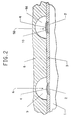
- the enhanced anion selective electrode 5b depicted in Figures 1 and 2 is preferred.
- Enhanced selectivity anion selective electrodes of the present invention can be utilized with other ISEs in multisensor assemblies.
- Figures 1 and 2 depict a multisensor flow cell having an enhanced selectivity anion selective electrode.
- the enhanced selectivity anion selective electrode is formed on an electrically insulative ceramic substrate 1 which is available commercially and can, for example, be purchased from the Coors Ceramics Co.
- the ceramic substrate 1 has a surface which has been appropriately screen printed with a suitable electrically conductive material (electrical conductor 2) to provide for appropriate electrical contacts for each ion selective electrode 5, 5A, 5B, and a reference electrode 6.
- Ion selective electrode 5b is an enhanced electivity chloride selective ion selective electrode of the present invention having a membrane containing fumed silica, sensor electrodes 5A and 5 are potassium and sodium ion selective membrane electrodes, respectively.
- the electrical conductor 2 can be formed from a silver paste, also available commercially as, for example, silver paste QS175 (E.I. du Pont de Nemours and Company, De., U.S.).
- a dielectric layer 3 serves to electrically isolate the electrical conductor 2 and to provide a well for the electrical conductor 2 and the chloride selective membrane 10.
- a layer composed of a mixture of silver and silver chloride (Ag/AgCl) 4 is screen printed on the electrical conductor 2 for the ion selective electrode 5b and the reference electrode 6.
- a fumed silica-containing chloride selective polymer material prepared, as described above, is positioned onto the silver/silver chloride layer 4 to form the chloride selective membrane 10.
- the multisensor assembly can be appropriately fired using known thick film belt techniques after each layer is added.
- An elastomeric component 8 contacts with the surface of the ceramic substrate 1 to define a reference flow channel 9 and a sensor flow channel 9A.
- the reference flow channel 9 and sensor flow channel 9A define means for passing reference liquids and sample liquids over the reference 6 and ion selective electrodes 5, 5A and 5B, respectively.
- the reference flow channel 9 and sensor flow channel 9A define a common outlet 11, for removing liquids from the cell.
- the elastomeric component 8 of the multisensor cell assembly of the present invention can be of any form suitable for defining flow channels 9 and 9A.
- the multisensor cell assembly of the present invention can be used in conjunction with the disposable sensor assembly or cartridge disclosed in copending application serial no. 07/916,231.
- the preferred anion selective electrode of the present invention is a chloride selective electrode.
- the preferred chloride selective membrane contains about 40% by weight fumed silica, about 40% by weight TDMAC as a chloride-selective agent, and about 20% by weight carboxylated polyvinyl chloride.
- a 400 milliliter (ml) beaker containing 88 grams (g) of the solvent isophorone (Fluka Chemical Co., N.Y., U.S.A.) was added 12g of carboxylated polyvinyl chloride (CPVC) (Aldrich Chemical Co., Wisconsin, U.S.A.).
- CPVC carboxylated polyvinyl chloride
- the resulting suspension was covered to prevent evaporation of the solvent and heated using a hot plate/stirrer over a period of about 15 to 20 minutes to a temperature of about 60°C. When the suspension becomes transparent, the heat was turned off and stirring was continued for an additional 5 minutes.
- the resulting polymer material was transferred to a sealed container for subsequent use in preparing a chloride selective membrane.
- the chloride selective polymer material prepared as described above in A was incorporated into the multisensor flow assembly of Figure 1 as a chloride selective electrode as follows.
- the multisensor flow assembly illustrated in Figure 1 was prepared as follows. Ceramic substrates (Coors Ceramics Co., U.S.) were ultrasonically cleaned and dried. A silver pattern serving as a conductor 2 was screen printed onto the ceramic substrate using silver paste QS175 (E.I. du Pont de Nemours and Company, De., U.S.). The ceramic substrates were then fired in a thick film belt furnace such as that commonly used in thick film technology, employing a heating rate of 95°C per minute to 850°C, at 850°C the ceramic substrates were held for ten (10) minutes and then cooled at a rate of 95°C per minute. Three layers of thick film dielectric QS482 (E.I.
- du Pont de Nemours and Company, De., U.S. were then screen printed onto the ceramic substrate and dried.
- the ceramic substrate containing the three dielectric layers was then fired in the thick film belt furnace by employing a heating rate of 95°C per minute to 850°C, at 850°C the ceramic substrates were held for ten (10) minutes and then cooled at a rate of 95°C per minute.
- a mixture of silver and silver chloride (80% silver and 20% silver chloride by weight) was then screen printed as layer 4 on the electrical conductor 2 as shown in Figure 2.
- the ceramic substrate was then fired by heating at 100°C per minute to 600°C, holding at 600°C for ten minutes and cooling at 100°C per minute.
- the resulting finished ceramic substrate was then stored in nitrogen until used as follows.
- the chloride selective polymer material prepared as described above in Part A above was dispensed onto the ceramic substrate using a syringe to form the chloride selective membrane 10 of the chloride selective electrode 5b depicted in the multisensor flow assembly shown in Figures 1 and 2.
- the dispensed chloride selective polymer material was then cured by heating the ceramic substrate at 80°C for 90 minutes to form the chloride selective membrane.
- the resulting ceramic substrate assembly was then exposed to an ultraviolet source at an intensity of 750 millijoules per square centimeter.
- the cured ceramic substrate assembly was then mounted in a cartridge having an elastomer component 8, Fig. 2, which is pressed against the finished ceramic substrate so as to define reference and sensor flow channels 9 and 9A respectively (Fig.
- An air detect 7 for the multisensor flow assembly provides a means for detecting interfering air bubbles which may be present in the reference and/or sample liquids.
- the sodium selective electrode 5 and potassium selective electrode 5a were similarly prepared by dispensing sodium and potassium selective polymer materials onto the finished ceramic substrate.
- Chloride ion selective electrodes were prepared using the procedure described above (but with varying amounts of silica, TDMAC, and CPVC as shown in Table 1 below) and tested for their selectivity to chloride ion.
- the membrane compositions prepared were as follows: Table 1 Membrane % Silica (by weight) % TDMAC (by weight) % CPVC (by weight) 1 0 60 40 2 10 54 36 3-9 40 40 20
- the ion selective electrode in which the membrane formulation did not contain silica was prepared using exactly the same procedure as was used in preparing the ion selective electrode with the fumed silica containing membrane formulation with the exception that the mulling step which provided for the addition of the fumed silica was omitted in preparation of the ion selective electrode in which the membrane formulation did not contain silica.
- the multisensor cell assembly of Figure 1 was used to compare the enhanced selectivity chloride selective membrane electrode of the present invention with chloride selective electrodes having known membrane formulations.
- the voltage which changes with varying Cl ⁇ concentrations is located at the junction between the sample solution or liquid and the ion selective membrane.
- the voltage, E is given by the Nernst equation and results from a space charge layer of Cl ⁇ ions temporarily attracted to the ion selective agent TDMAC present in the chloride selective electrode.
- the chloride selective electrode prepared as described above was calibrated using standard solutions containing known concentrations of chloride ions, two standard solutions were used contained 112 and 50 millimols per liter (mmol/lit) and were chosen so as bracket the concentrations of chloride ions likely to be encountered in test samples.
- the calibration was done by exposing the Cl ⁇ electrode first to one standard solution and then to the other.
- a Cl ⁇ concentration versus voltage calibration curve was constructed and the test samples described below were tested for Cl ⁇ concentrations. The Cl ⁇ concentration for the test sample solutions were interpolated from the calibration curve.
- Membrane electrode 1 was tested with Test Solution Nos. 1 and 2 and membrane electodes 2-9 were tested with Test Solution Nos. 3 and 4 and the amount of chloride determined. The results are shown in Table 3 below.
Landscapes
- Chemical & Material Sciences (AREA)
- Life Sciences & Earth Sciences (AREA)
- Health & Medical Sciences (AREA)
- Biochemistry (AREA)
- Chemical Kinetics & Catalysis (AREA)
- Electrochemistry (AREA)
- Physics & Mathematics (AREA)
- Analytical Chemistry (AREA)
- Molecular Biology (AREA)
- General Health & Medical Sciences (AREA)
- General Physics & Mathematics (AREA)
- Immunology (AREA)
- Pathology (AREA)
- Investigating Or Analysing Biological Materials (AREA)
- Compositions Of Macromolecular Compounds (AREA)
- Measurement Of The Respiration, Hearing Ability, Form, And Blood Characteristics Of Living Organisms (AREA)
Applications Claiming Priority (2)
| Application Number | Priority Date | Filing Date | Title |
|---|---|---|---|
| US151098 | 1993-11-12 | ||
| US08/151,098 US5421983A (en) | 1993-11-12 | 1993-11-12 | Anion selective electrodes containing fumed silica |
Publications (3)
| Publication Number | Publication Date |
|---|---|
| EP0653630A2 true EP0653630A2 (de) | 1995-05-17 |
| EP0653630A3 EP0653630A3 (de) | 1996-05-29 |
| EP0653630B1 EP0653630B1 (de) | 1998-12-30 |
Family
ID=22537310
Family Applications (1)
| Application Number | Title | Priority Date | Filing Date |
|---|---|---|---|
| EP94117011A Expired - Lifetime EP0653630B1 (de) | 1993-11-12 | 1994-10-27 | Pyrogenes Siliziumdioxid enthaltende chloridselektive Elektroden |
Country Status (4)
| Country | Link |
|---|---|
| US (1) | US5421983A (de) |
| EP (1) | EP0653630B1 (de) |
| JP (1) | JPH07198676A (de) |
| DE (1) | DE69415644T2 (de) |
Cited By (2)
| Publication number | Priority date | Publication date | Assignee | Title |
|---|---|---|---|---|
| WO1998020333A1 (en) * | 1996-11-07 | 1998-05-14 | Sensalyse Holdings Limited | Membrane for a sensor |
| WO2005005975A1 (en) * | 2003-07-10 | 2005-01-20 | Radiometer Medical Aps | Chloride selective electrode membrane |
Families Citing this family (22)
| Publication number | Priority date | Publication date | Assignee | Title |
|---|---|---|---|---|
| GB9401356D0 (en) * | 1994-01-25 | 1994-03-23 | Univ Manchester | Sensor device |
| JP3487396B2 (ja) * | 1997-01-31 | 2004-01-19 | 松下電器産業株式会社 | バイオセンサとその製造方法 |
| JP4203206B2 (ja) * | 2000-03-24 | 2008-12-24 | 株式会社日立国際電気 | 基板処理装置 |
| KR100358933B1 (ko) * | 2000-03-27 | 2002-10-31 | 차근식 | 평면형 기준 전극 |
| DE10156098A1 (de) * | 2001-11-16 | 2003-05-28 | Schellbach Winfried | Mehrfachsensorsystem |
| USRE49221E1 (en) | 2002-06-14 | 2022-09-27 | Parker Intangibles, Llc | Single-use manifolds for automated, aseptic handling of solutions in bioprocessing applications |
| CA2558275A1 (en) * | 2004-03-01 | 2005-09-15 | Hach Company | Ion-selective electrodes |
| US20060065527A1 (en) * | 2004-09-24 | 2006-03-30 | Sendx Medical, Inc. | Polymeric reference electrode |
| US7857506B2 (en) * | 2005-12-05 | 2010-12-28 | Sencal Llc | Disposable, pre-calibrated, pre-validated sensors for use in bio-processing applications |
| US10914698B2 (en) | 2006-11-16 | 2021-02-09 | General Electric Company | Sensing method and system |
| US9658178B2 (en) | 2012-09-28 | 2017-05-23 | General Electric Company | Sensor systems for measuring an interface level in a multi-phase fluid composition |
| US9538657B2 (en) | 2012-06-29 | 2017-01-03 | General Electric Company | Resonant sensor and an associated sensing method |
| US9536122B2 (en) | 2014-11-04 | 2017-01-03 | General Electric Company | Disposable multivariable sensing devices having radio frequency based sensors |
| US9589686B2 (en) | 2006-11-16 | 2017-03-07 | General Electric Company | Apparatus for detecting contaminants in a liquid and a system for use thereof |
| US8542023B2 (en) | 2010-11-09 | 2013-09-24 | General Electric Company | Highly selective chemical and biological sensors |
| WO2014022422A1 (en) * | 2012-07-30 | 2014-02-06 | The Regents Of The University Of California | Biomolecular detection test strip design |
| DE112013004129T5 (de) | 2012-08-22 | 2015-05-21 | General Electric Company | Drahtloses System und Verfahren zum Messen einer Betriebsbedingung einer Maschine |
| US10598650B2 (en) | 2012-08-22 | 2020-03-24 | General Electric Company | System and method for measuring an operative condition of a machine |
| US10684268B2 (en) | 2012-09-28 | 2020-06-16 | Bl Technologies, Inc. | Sensor systems for measuring an interface level in a multi-phase fluid composition |
| CN108732217A (zh) * | 2018-04-28 | 2018-11-02 | 深圳市西尔曼科技有限公司 | 铵离子微电极及其制作方法 |
| US11199519B2 (en) * | 2018-06-14 | 2021-12-14 | Nok Corporation | Method for producing silver-silver chloride electrode |
| KR102169586B1 (ko) * | 2018-12-17 | 2020-10-23 | 서울대학교산학협력단 | 칼륨 이온 측정을 위한 스트립 구조체 |
Family Cites Families (10)
| Publication number | Priority date | Publication date | Assignee | Title |
|---|---|---|---|---|
| US3772175A (en) * | 1971-06-28 | 1973-11-13 | Gen Electric | Univalent cation-selective electrode |
| JPS5510521A (en) * | 1978-07-10 | 1980-01-25 | Hitachi Ltd | Anion selective electrode |
| JPS5663246A (en) * | 1979-10-26 | 1981-05-29 | Hitachi Ltd | Anion selective electrode |
| JPS5968360A (ja) * | 1982-10-12 | 1984-04-18 | Bridgestone Corp | ポリマ−アロイ |
| AT380741B (de) * | 1985-01-31 | 1986-06-25 | Avl Ges F R Verbrennungskraftm | Ionensensitive membranelektrode |
| JPS61181955A (ja) * | 1985-02-08 | 1986-08-14 | Seitai Kinou Riyou Kagakuhin Shinseizou Gijutsu Kenkyu Kumiai | 電界効果型トランジスタイオンセンサ |
| JPS61181956A (ja) * | 1985-02-08 | 1986-08-14 | Seitai Kinou Riyou Kagakuhin Shinseizou Gijutsu Kenkyu Kumiai | マルチイオン感応性電界効果型トランジスタの製造方法 |
| JPS6234044A (ja) * | 1985-08-08 | 1987-02-14 | Olympus Optical Co Ltd | 塩素イオン選択性電極 |
| JPS6450943A (en) * | 1987-08-21 | 1989-02-27 | Hitachi Ltd | Anion selecting electrode |
| US5284568A (en) * | 1992-07-17 | 1994-02-08 | E. I. Du Pont De Nemours And Company | Disposable cartridge for ion selective electrode sensors |
-
1993
- 1993-11-12 US US08/151,098 patent/US5421983A/en not_active Expired - Lifetime
-
1994
- 1994-10-27 DE DE69415644T patent/DE69415644T2/de not_active Expired - Lifetime
- 1994-10-27 EP EP94117011A patent/EP0653630B1/de not_active Expired - Lifetime
- 1994-11-11 JP JP6277628A patent/JPH07198676A/ja active Pending
Cited By (4)
| Publication number | Priority date | Publication date | Assignee | Title |
|---|---|---|---|---|
| WO1998020333A1 (en) * | 1996-11-07 | 1998-05-14 | Sensalyse Holdings Limited | Membrane for a sensor |
| US6387232B1 (en) | 1996-11-07 | 2002-05-14 | Sensalyse Holdings Limited | Membrane for a sensor |
| WO2005005975A1 (en) * | 2003-07-10 | 2005-01-20 | Radiometer Medical Aps | Chloride selective electrode membrane |
| US7384523B2 (en) | 2003-07-10 | 2008-06-10 | Radiometer Medical Aps | Chloride ion selective membrane and sensor |
Also Published As
| Publication number | Publication date |
|---|---|
| EP0653630A3 (de) | 1996-05-29 |
| EP0653630B1 (de) | 1998-12-30 |
| US5421983A (en) | 1995-06-06 |
| DE69415644T2 (de) | 1999-05-20 |
| DE69415644D1 (de) | 1999-02-11 |
| JPH07198676A (ja) | 1995-08-01 |
Similar Documents
| Publication | Publication Date | Title |
|---|---|---|
| EP0653630B1 (de) | Pyrogenes Siliziumdioxid enthaltende chloridselektive Elektroden | |
| JP3667639B2 (ja) | 自己診断機能を持った小型固体状参照電極 | |
| EP1193495B1 (de) | Polymermembran für Bezugselektrode und Bezugselektrode mit solch einer Membran | |
| EP2361380B1 (de) | Planarsensor | |
| EP0551769B1 (de) | Ionenselektive Festkörperelektroden auf Graphitbasis mit Polymermembran | |
| EP0282349A2 (de) | Ionenempfindliche Fühler | |
| US5522978A (en) | Monensin amides for sodium-selective electrodes | |
| JPS62116252A (ja) | 電気化学分析の方法及び装置 | |
| EP0603742B1 (de) | Verfahren zur potentiometrischen Bestimmung von Ionen unter Verwendung einer asymmetrischen ionenselektiven Membranelektrode mit erhöhter Selektivität | |
| Lutze et al. | Stabilized potentiometric solid-state polyion sensors using silver-calixarene complexes as additives within ion-exchanger-based polymeric films | |
| US6508921B1 (en) | Lithium ion-selective electrode for clinical applications | |
| US7384523B2 (en) | Chloride ion selective membrane and sensor | |
| Cosofret et al. | Aliphatic polyurethane as a matrix for pH sensors: Effects of native sites and added proton carrier on electrical and potentiometric properties | |
| AU2001247614A1 (en) | Lithium ion-selective electrode for clinical applications | |
| Al Attas | Construction and analytical application of ion selective bromazepam sensor | |
| EP0886774A1 (de) | Natrium-selektive elektrodenmembran mit verlängerter lebensdauer | |
| KR101163678B1 (ko) | 크레아틴의 방해영향을 줄인 크레아티닌 바이오센서 | |
| EP0138150A2 (de) | Membrane für Diagnoseelektroden mit spezifischen Enzym/Ionophor-Paaren | |
| AU5944490A (en) | Electrochemical cell, reference electrode and electrochemical method | |
| KR100483628B1 (ko) | 다공성 고분자 기준전극막 및 이를 포함하는 기준전극 | |
| US20060091009A1 (en) | Ion selective electrode with integral sealing surface | |
| KR100434870B1 (ko) | 고분자 기준전극막용 조성물 및 이를 이용한 기준전극 | |
| JPH0465666A (ja) | 参照電極 | |
| Mochizuki et al. | Disposable glucose sensor plate and disposable multi-ion sensor plate | |
| GB2501245A (en) | Solid state ion detection system |
Legal Events
| Date | Code | Title | Description |
|---|---|---|---|
| PUAI | Public reference made under article 153(3) epc to a published international application that has entered the european phase |
Free format text: ORIGINAL CODE: 0009012 |
|
| AK | Designated contracting states |
Kind code of ref document: A2 Designated state(s): DE FR IT |
|
| PUAL | Search report despatched |
Free format text: ORIGINAL CODE: 0009013 |
|
| AK | Designated contracting states |
Kind code of ref document: A3 Designated state(s): DE FR IT |
|
| RAP1 | Party data changed (applicant data changed or rights of an application transferred) |
Owner name: DADE CHEMISTRY SYSTEMS INC. |
|
| 17P | Request for examination filed |
Effective date: 19960920 |
|
| 17Q | First examination report despatched |
Effective date: 19970203 |
|
| GRAG | Despatch of communication of intention to grant |
Free format text: ORIGINAL CODE: EPIDOS AGRA |
|
| GRAG | Despatch of communication of intention to grant |
Free format text: ORIGINAL CODE: EPIDOS AGRA |
|
| GRAH | Despatch of communication of intention to grant a patent |
Free format text: ORIGINAL CODE: EPIDOS IGRA |
|
| GRAH | Despatch of communication of intention to grant a patent |
Free format text: ORIGINAL CODE: EPIDOS IGRA |
|
| GRAA | (expected) grant |
Free format text: ORIGINAL CODE: 0009210 |
|
| AK | Designated contracting states |
Kind code of ref document: B1 Designated state(s): DE FR IT |
|
| REF | Corresponds to: |
Ref document number: 69415644 Country of ref document: DE Date of ref document: 19990211 |
|
| ET | Fr: translation filed | ||
| ITF | It: translation for a ep patent filed | ||
| PLBE | No opposition filed within time limit |
Free format text: ORIGINAL CODE: 0009261 |
|
| STAA | Information on the status of an ep patent application or granted ep patent |
Free format text: STATUS: NO OPPOSITION FILED WITHIN TIME LIMIT |
|
| 26N | No opposition filed | ||
| PGFP | Annual fee paid to national office [announced via postgrant information from national office to epo] |
Ref country code: IT Payment date: 20101027 Year of fee payment: 17 |
|
| PG25 | Lapsed in a contracting state [announced via postgrant information from national office to epo] |
Ref country code: IT Free format text: LAPSE BECAUSE OF NON-PAYMENT OF DUE FEES Effective date: 20111027 |
|
| PGFP | Annual fee paid to national office [announced via postgrant information from national office to epo] |
Ref country code: FR Payment date: 20131015 Year of fee payment: 20 Ref country code: DE Payment date: 20131219 Year of fee payment: 20 |
|
| REG | Reference to a national code |
Ref country code: DE Ref legal event code: R071 Ref document number: 69415644 Country of ref document: DE |