EP0654062B1 - Verfahren zur herstellung von harten polyurethanschaumstoffen - Google Patents
Verfahren zur herstellung von harten polyurethanschaumstoffen Download PDFInfo
- Publication number
- EP0654062B1 EP0654062B1 EP93917627A EP93917627A EP0654062B1 EP 0654062 B1 EP0654062 B1 EP 0654062B1 EP 93917627 A EP93917627 A EP 93917627A EP 93917627 A EP93917627 A EP 93917627A EP 0654062 B1 EP0654062 B1 EP 0654062B1
- Authority
- EP
- European Patent Office
- Prior art keywords
- und
- process according
- polyol
- pct
- bis
- Prior art date
- Legal status (The legal status is an assumption and is not a legal conclusion. Google has not performed a legal analysis and makes no representation as to the accuracy of the status listed.)
- Expired - Lifetime
Links
- 229920005830 Polyurethane Foam Polymers 0.000 title claims abstract description 9
- 239000011496 polyurethane foam Substances 0.000 title claims abstract description 9
- 238000000034 method Methods 0.000 title claims description 15
- 229920001228 polyisocyanate Polymers 0.000 claims abstract description 16
- 239000005056 polyisocyanate Substances 0.000 claims abstract description 16
- 150000001875 compounds Chemical class 0.000 claims abstract description 12
- 239000002904 solvent Substances 0.000 claims abstract description 11
- 150000005828 hydrofluoroalkanes Chemical class 0.000 claims abstract description 6
- 238000006243 chemical reaction Methods 0.000 claims abstract description 4
- 125000004435 hydrogen atom Chemical group [H]* 0.000 claims abstract description 4
- 125000004400 (C1-C12) alkyl group Chemical group 0.000 claims abstract description 3
- 125000003107 substituted aryl group Chemical group 0.000 claims abstract description 3
- 239000004604 Blowing Agent Substances 0.000 claims description 13
- 239000000126 substance Substances 0.000 claims description 13
- CXIGIYYQHHRBJC-UHFFFAOYSA-N 1,1,1,4,4,4-hexafluorobutane Chemical compound FC(F)(F)CCC(F)(F)F CXIGIYYQHHRBJC-UHFFFAOYSA-N 0.000 claims description 9
- 239000000654 additive Substances 0.000 claims description 5
- STCOOQWBFONSKY-UHFFFAOYSA-N tributyl phosphate Chemical compound CCCCOP(=O)(OCCCC)OCCCC STCOOQWBFONSKY-UHFFFAOYSA-N 0.000 claims description 5
- DQWPFSLDHJDLRL-UHFFFAOYSA-N triethyl phosphate Chemical compound CCOP(=O)(OCC)OCC DQWPFSLDHJDLRL-UHFFFAOYSA-N 0.000 claims description 5
- LVGUZGTVOIAKKC-UHFFFAOYSA-N 1,1,1,2-tetrafluoroethane Chemical compound FCC(F)(F)F LVGUZGTVOIAKKC-UHFFFAOYSA-N 0.000 claims description 4
- 239000012948 isocyanate Substances 0.000 claims description 4
- 150000002513 isocyanates Chemical class 0.000 claims description 4
- YFMFNYKEUDLDTL-UHFFFAOYSA-N 1,1,1,2,3,3,3-heptafluoropropane Chemical compound FC(F)(F)C(F)C(F)(F)F YFMFNYKEUDLDTL-UHFFFAOYSA-N 0.000 claims description 2
- 239000006260 foam Substances 0.000 abstract description 9
- 125000000753 cycloalkyl group Chemical group 0.000 abstract description 2
- 125000003837 (C1-C20) alkyl group Chemical group 0.000 abstract 1
- 239000004088 foaming agent Substances 0.000 abstract 1
- 229910052736 halogen Inorganic materials 0.000 abstract 1
- 125000005843 halogen group Chemical group 0.000 abstract 1
- IQPQWNKOIGAROB-UHFFFAOYSA-N isocyanate group Chemical group [N-]=C=O IQPQWNKOIGAROB-UHFFFAOYSA-N 0.000 abstract 1
- 229920005862 polyol Polymers 0.000 description 28
- 150000003077 polyols Chemical class 0.000 description 28
- GOOHAUXETOMSMM-UHFFFAOYSA-N Propylene oxide Chemical compound CC1CO1 GOOHAUXETOMSMM-UHFFFAOYSA-N 0.000 description 10
- 229930195733 hydrocarbon Natural products 0.000 description 7
- 150000002430 hydrocarbons Chemical class 0.000 description 7
- 238000004519 manufacturing process Methods 0.000 description 7
- 239000000203 mixture Substances 0.000 description 7
- DNIAPMSPPWPWGF-UHFFFAOYSA-N Propylene glycol Chemical compound CC(O)CO DNIAPMSPPWPWGF-UHFFFAOYSA-N 0.000 description 6
- -1 haloalkyl phosphates Chemical class 0.000 description 6
- XLYOFNOQVPJJNP-UHFFFAOYSA-N water Chemical compound O XLYOFNOQVPJJNP-UHFFFAOYSA-N 0.000 description 6
- 239000003063 flame retardant Substances 0.000 description 5
- 239000003381 stabilizer Substances 0.000 description 5
- 125000004432 carbon atom Chemical group C* 0.000 description 4
- 239000004872 foam stabilizing agent Substances 0.000 description 4
- 238000005187 foaming Methods 0.000 description 4
- 238000009413 insulation Methods 0.000 description 4
- 239000011541 reaction mixture Substances 0.000 description 4
- VEXZGXHMUGYJMC-UHFFFAOYSA-N Hydrochloric acid Chemical compound Cl VEXZGXHMUGYJMC-UHFFFAOYSA-N 0.000 description 3
- 239000012190 activator Substances 0.000 description 3
- 239000003054 catalyst Substances 0.000 description 3
- 239000003795 chemical substances by application Substances 0.000 description 3
- 235000013870 dimethyl polysiloxane Nutrition 0.000 description 3
- 239000003995 emulsifying agent Substances 0.000 description 3
- 125000002887 hydroxy group Chemical group [H]O* 0.000 description 3
- 229920003023 plastic Polymers 0.000 description 3
- 239000004033 plastic Substances 0.000 description 3
- 229920000435 poly(dimethylsiloxane) Polymers 0.000 description 3
- 229920000570 polyether Polymers 0.000 description 3
- IAYPIBMASNFSPL-UHFFFAOYSA-N Ethylene oxide Chemical compound C1CO1 IAYPIBMASNFSPL-UHFFFAOYSA-N 0.000 description 2
- PIICEJLVQHRZGT-UHFFFAOYSA-N Ethylenediamine Chemical compound NCCN PIICEJLVQHRZGT-UHFFFAOYSA-N 0.000 description 2
- 239000005909 Kieselgur Substances 0.000 description 2
- 238000005684 Liebig rearrangement reaction Methods 0.000 description 2
- CBENFWSGALASAD-UHFFFAOYSA-N Ozone Chemical compound [O-][O+]=O CBENFWSGALASAD-UHFFFAOYSA-N 0.000 description 2
- 239000004721 Polyphenylene oxide Substances 0.000 description 2
- CZMRCDWAGMRECN-UGDNZRGBSA-N Sucrose Chemical compound O[C@H]1[C@H](O)[C@@H](CO)O[C@@]1(CO)O[C@@H]1[C@H](O)[C@@H](O)[C@H](O)[C@@H](CO)O1 CZMRCDWAGMRECN-UGDNZRGBSA-N 0.000 description 2
- 229930006000 Sucrose Natural products 0.000 description 2
- GSEJCLTVZPLZKY-UHFFFAOYSA-N Triethanolamine Chemical compound OCCN(CCO)CCO GSEJCLTVZPLZKY-UHFFFAOYSA-N 0.000 description 2
- 125000001931 aliphatic group Chemical group 0.000 description 2
- 125000003118 aryl group Chemical group 0.000 description 2
- TZCXTZWJZNENPQ-UHFFFAOYSA-L barium sulfate Chemical compound [Ba+2].[O-]S([O-])(=O)=O TZCXTZWJZNENPQ-UHFFFAOYSA-L 0.000 description 2
- 230000001413 cellular effect Effects 0.000 description 2
- 238000010276 construction Methods 0.000 description 2
- 239000004205 dimethyl polysiloxane Substances 0.000 description 2
- 239000000975 dye Substances 0.000 description 2
- 239000000945 filler Substances 0.000 description 2
- 230000001408 fungistatic effect Effects 0.000 description 2
- 239000007789 gas Substances 0.000 description 2
- 239000004014 plasticizer Substances 0.000 description 2
- 229920000728 polyester Polymers 0.000 description 2
- 229920005903 polyol mixture Polymers 0.000 description 2
- 239000004814 polyurethane Substances 0.000 description 2
- 229920002635 polyurethane Polymers 0.000 description 2
- 239000005720 sucrose Substances 0.000 description 2
- RUELTTOHQODFPA-UHFFFAOYSA-N toluene 2,6-diisocyanate Chemical compound CC1=C(N=C=O)C=CC=C1N=C=O RUELTTOHQODFPA-UHFFFAOYSA-N 0.000 description 2
- LFSYUSUFCBOHGU-UHFFFAOYSA-N 1-isocyanato-2-[(4-isocyanatophenyl)methyl]benzene Chemical compound C1=CC(N=C=O)=CC=C1CC1=CC=CC=C1N=C=O LFSYUSUFCBOHGU-UHFFFAOYSA-N 0.000 description 1
- RNFJDJUURJAICM-UHFFFAOYSA-N 2,2,4,4,6,6-hexaphenoxy-1,3,5-triaza-2$l^{5},4$l^{5},6$l^{5}-triphosphacyclohexa-1,3,5-triene Chemical compound N=1P(OC=2C=CC=CC=2)(OC=2C=CC=CC=2)=NP(OC=2C=CC=CC=2)(OC=2C=CC=CC=2)=NP=1(OC=1C=CC=CC=1)OC1=CC=CC=C1 RNFJDJUURJAICM-UHFFFAOYSA-N 0.000 description 1
- 239000004215 Carbon black (E152) Substances 0.000 description 1
- ZAMOUSCENKQFHK-UHFFFAOYSA-N Chlorine atom Chemical compound [Cl] ZAMOUSCENKQFHK-UHFFFAOYSA-N 0.000 description 1
- FBPFZTCFMRRESA-FSIIMWSLSA-N D-Glucitol Natural products OC[C@H](O)[C@H](O)[C@@H](O)[C@H](O)CO FBPFZTCFMRRESA-FSIIMWSLSA-N 0.000 description 1
- FBPFZTCFMRRESA-JGWLITMVSA-N D-glucitol Chemical compound OC[C@H](O)[C@@H](O)[C@H](O)[C@H](O)CO FBPFZTCFMRRESA-JGWLITMVSA-N 0.000 description 1
- 241001295925 Gegenes Species 0.000 description 1
- 241001092142 Molina Species 0.000 description 1
- SVYKKECYCPFKGB-UHFFFAOYSA-N N,N-dimethylcyclohexylamine Chemical compound CN(C)C1CCCCC1 SVYKKECYCPFKGB-UHFFFAOYSA-N 0.000 description 1
- 229910019142 PO4 Inorganic materials 0.000 description 1
- 229910018503 SF6 Chemical class 0.000 description 1
- VYPSYNLAJGMNEJ-UHFFFAOYSA-N Silicium dioxide Chemical compound O=[Si]=O VYPSYNLAJGMNEJ-UHFFFAOYSA-N 0.000 description 1
- YSMRWXYRXBRSND-UHFFFAOYSA-N TOTP Chemical compound CC1=CC=CC=C1OP(=O)(OC=1C(=CC=CC=1)C)OC1=CC=CC=C1C YSMRWXYRXBRSND-UHFFFAOYSA-N 0.000 description 1
- 230000002378 acidificating effect Effects 0.000 description 1
- 230000032683 aging Effects 0.000 description 1
- 150000001335 aliphatic alkanes Chemical class 0.000 description 1
- 125000000217 alkyl group Chemical group 0.000 description 1
- 229910052782 aluminium Inorganic materials 0.000 description 1
- XAGFODPZIPBFFR-UHFFFAOYSA-N aluminium Chemical compound [Al] XAGFODPZIPBFFR-UHFFFAOYSA-N 0.000 description 1
- 125000003277 amino group Chemical group 0.000 description 1
- 125000002029 aromatic hydrocarbon group Chemical group 0.000 description 1
- 239000012298 atmosphere Substances 0.000 description 1
- 239000000022 bacteriostatic agent Substances 0.000 description 1
- 230000003385 bacteriostatic effect Effects 0.000 description 1
- OHJMTUPIZMNBFR-UHFFFAOYSA-N biuret Chemical group NC(=O)NC(N)=O OHJMTUPIZMNBFR-UHFFFAOYSA-N 0.000 description 1
- VPKDCDLSJZCGKE-UHFFFAOYSA-N carbodiimide group Chemical group N=C=N VPKDCDLSJZCGKE-UHFFFAOYSA-N 0.000 description 1
- 125000003178 carboxy group Chemical group [H]OC(*)=O 0.000 description 1
- 239000000460 chlorine Substances 0.000 description 1
- 229910052801 chlorine Inorganic materials 0.000 description 1
- 125000001309 chloro group Chemical group Cl* 0.000 description 1
- KYKAJFCTULSVSH-UHFFFAOYSA-N chloro(fluoro)methane Chemical class F[C]Cl KYKAJFCTULSVSH-UHFFFAOYSA-N 0.000 description 1
- 230000005494 condensation Effects 0.000 description 1
- 238000009833 condensation Methods 0.000 description 1
- 238000001816 cooling Methods 0.000 description 1
- 229920001577 copolymer Polymers 0.000 description 1
- 238000005516 engineering process Methods 0.000 description 1
- 239000003822 epoxy resin Substances 0.000 description 1
- 150000002191 fatty alcohols Chemical class 0.000 description 1
- 238000010097 foam moulding Methods 0.000 description 1
- DYDNPESBYVVLBO-UHFFFAOYSA-N formanilide Chemical compound O=CNC1=CC=CC=C1 DYDNPESBYVVLBO-UHFFFAOYSA-N 0.000 description 1
- 238000009472 formulation Methods 0.000 description 1
- 238000010438 heat treatment Methods 0.000 description 1
- 125000000623 heterocyclic group Chemical group 0.000 description 1
- 239000001257 hydrogen Substances 0.000 description 1
- 229910052739 hydrogen Inorganic materials 0.000 description 1
- ZFSLODLOARCGLH-UHFFFAOYSA-N isocyanuric acid Chemical group OC1=NC(O)=NC(O)=N1 ZFSLODLOARCGLH-UHFFFAOYSA-N 0.000 description 1
- 239000012263 liquid product Substances 0.000 description 1
- 229910052751 metal Inorganic materials 0.000 description 1
- 239000002184 metal Substances 0.000 description 1
- 231100000252 nontoxic Toxicity 0.000 description 1
- 230000003000 nontoxic effect Effects 0.000 description 1
- 150000002902 organometallic compounds Chemical class 0.000 description 1
- 238000005191 phase separation Methods 0.000 description 1
- 235000021317 phosphate Nutrition 0.000 description 1
- 239000000049 pigment Substances 0.000 description 1
- 239000002984 plastic foam Substances 0.000 description 1
- 229920000647 polyepoxide Polymers 0.000 description 1
- 229920005906 polyester polyol Polymers 0.000 description 1
- 229920005871 reactive polyether polyol Polymers 0.000 description 1
- 229920002545 silicone oil Polymers 0.000 description 1
- 239000010802 sludge Substances 0.000 description 1
- 239000004071 soot Substances 0.000 description 1
- 239000000600 sorbitol Substances 0.000 description 1
- 239000005437 stratosphere Substances 0.000 description 1
- SFZCNBIFKDRMGX-UHFFFAOYSA-N sulfur hexafluoride Chemical class FS(F)(F)(F)(F)F SFZCNBIFKDRMGX-UHFFFAOYSA-N 0.000 description 1
- 229960000909 sulfur hexafluoride Drugs 0.000 description 1
- 125000003396 thiol group Chemical group [H]S* 0.000 description 1
- CYRMSUTZVYGINF-UHFFFAOYSA-N trichlorofluoromethane Chemical compound FC(Cl)(Cl)Cl CYRMSUTZVYGINF-UHFFFAOYSA-N 0.000 description 1
- 229940029284 trichlorofluoromethane Drugs 0.000 description 1
- XSQUKJJJFZCRTK-UHFFFAOYSA-N urea group Chemical group NC(=O)N XSQUKJJJFZCRTK-UHFFFAOYSA-N 0.000 description 1
- AVWRKZWQTYIKIY-UHFFFAOYSA-N urea-1-carboxylic acid Chemical group NC(=O)NC(O)=O AVWRKZWQTYIKIY-UHFFFAOYSA-N 0.000 description 1
- JOYRKODLDBILNP-UHFFFAOYSA-N urethane group Chemical group NC(=O)OCC JOYRKODLDBILNP-UHFFFAOYSA-N 0.000 description 1
Classifications
-
- C—CHEMISTRY; METALLURGY
- C08—ORGANIC MACROMOLECULAR COMPOUNDS; THEIR PREPARATION OR CHEMICAL WORKING-UP; COMPOSITIONS BASED THEREON
- C08J—WORKING-UP; GENERAL PROCESSES OF COMPOUNDING; AFTER-TREATMENT NOT COVERED BY SUBCLASSES C08B, C08C, C08F, C08G or C08H
- C08J9/00—Working-up of macromolecular substances to porous or cellular articles or materials; After-treatment thereof
- C08J9/04—Working-up of macromolecular substances to porous or cellular articles or materials; After-treatment thereof using blowing gases generated by a previously added blowing agent
- C08J9/12—Working-up of macromolecular substances to porous or cellular articles or materials; After-treatment thereof using blowing gases generated by a previously added blowing agent by a physical blowing agent
- C08J9/14—Working-up of macromolecular substances to porous or cellular articles or materials; After-treatment thereof using blowing gases generated by a previously added blowing agent by a physical blowing agent organic
- C08J9/143—Halogen containing compounds
- C08J9/144—Halogen containing compounds containing carbon, halogen and hydrogen only
- C08J9/146—Halogen containing compounds containing carbon, halogen and hydrogen only only fluorine as halogen atoms
-
- C—CHEMISTRY; METALLURGY
- C08—ORGANIC MACROMOLECULAR COMPOUNDS; THEIR PREPARATION OR CHEMICAL WORKING-UP; COMPOSITIONS BASED THEREON
- C08L—COMPOSITIONS OF MACROMOLECULAR COMPOUNDS
- C08L75/00—Compositions of polyureas or polyurethanes; Compositions of derivatives of such polymers
- C08L75/04—Polyurethanes
-
- C—CHEMISTRY; METALLURGY
- C08—ORGANIC MACROMOLECULAR COMPOUNDS; THEIR PREPARATION OR CHEMICAL WORKING-UP; COMPOSITIONS BASED THEREON
- C08J—WORKING-UP; GENERAL PROCESSES OF COMPOUNDING; AFTER-TREATMENT NOT COVERED BY SUBCLASSES C08B, C08C, C08F, C08G or C08H
- C08J2375/00—Characterised by the use of polyureas or polyurethanes; Derivatives of such polymers
- C08J2375/04—Polyurethanes
Definitions
- Closed-cell rigid polyurethane foams have been used for many years due to their excellent thermal insulation properties in the insulation of refrigerators and freezers, industrial plants, tank farms, pipelines, in shipbuilding and in numerous insulation tasks in the construction industry.
- the thermal conductivity of the rigid polyurethane foam which largely has closed cells, depends to a large extent on the type of blowing agent or cell gas used.
- Perhalogenated chlorofluorocarbons CFCs
- R11 trichlorofluoromethane
- these substances are chemically inert, consequently non-toxic and non-flammable.
- the perhalogenated chlorofluorocarbons enter the stratosphere due to their high stability, where they decompose due to their chlorine content of the ozone present there should contribute (e.g. Molina, Rowland Mature 249 (1974) 810; First interim report of the Bundestag Enquete Commission "Precaution to protect the Earth's atmosphere” from November 2nd, 1988, German Bundestag, Public Relations Unit, Bonn).
- hydrofluoroalkanes such as 1,1,1,4,4,4-hexafluorobutane
- blowing agents for plastic foams including polyurethane foams instead of the perhalogenated chlorofluorocarbon (cf. EP-PS 344 537, US Pat. No. 4,931 482).
- Partially fluorinated hydrocarbons are very non-polar due to their chemical structure and therefore mix poorly with the polyols commonly used for rigid foam production. However, this is an important prerequisite for the usual production technology in which the polyol and isocyanate components are mixed with one another by machine.
- the polyol component also contains the blowing agent and the auxiliaries such as activators, emulsifiers and stabilizers in dissolved form. There is therefore a single-phase mixture on the polyol side.
- the low solubility of the partially fluorinated hydrocarbons leads to an equimolar exchange of conventional blowing agents such as R11 against the new, environmentally friendly compounds in commercially available formulations to form two phases that can no longer be processed conventionally.
- EP-A-0 351 614 describes the production of polyurethane foams using perfluorinated or partially fluorinated hydrocarbons or sulfur hexafluoride as blowing agents. Tricresyl phosphate and certain haloalkyl phosphates are proposed as flame retardants for these compositions.
- the object of the invention was therefore to increase the solubility of partially fluorinated hydrocarbons in polyols, so that a single-phase polyol component is obtained with equimolar replacement of R11 by these substances.
- the reaction components are reacted by the one-step process, the prepolymer process or the semi-prepolymer process, which are known per se, machine equipment often being used, for example those described in US Pat. No. 2,764,565. Details on processing devices that are also suitable according to the invention are described in the plastics manual, volume VIII, edited by Vieweg and Höchtlen, Carl-Hanser-Verlag, Kunststoff 1966, for example on pages 121 to 205.
- work is carried out in the range from 100 to 300, preferably 100 to 130.
- foaming can also be carried out in closed molds according to the invention.
- the reaction mixture is introduced into a mold.
- Metal e.g. Aluminum
- plastic e.g. Epoxy resin
- the foamable reaction mixture foams in the mold and forms the shaped body.
- the foam molding can be carried out so that the molded part has a cell structure on its surface. But it can also be carried out so that the molded part has a compact skin and a cellular core. According to the invention, one can proceed in this connection in such a way that so much foamable reaction mixture is introduced into the mold that the foam formed just fills the mold. However, it is also possible to work by adding more foamable reaction mixture to the mold than is necessary to fill the interior of the mold with foam. In the latter case, “over-charging" is used; such a procedure is e.g. known from U.S. Patent Nos. 3,178,490 and 3,182,104.
- the method according to the invention is preferably used for the foaming of cooling and refrigerating devices.
- foams can also be produced by block foaming or by the double conveyor belt process known per se.
- the rigid foams obtainable according to the invention are used, for example, in construction and for the insulation of district heating pipes and containers.
- Examples 1 and 2 according to the invention clearly show that the soluble amounts of 1,1,1,4,4,4-hexafluorobutane in the polyol could be increased significantly compared to the comparison.
Landscapes
- Chemical & Material Sciences (AREA)
- Health & Medical Sciences (AREA)
- Chemical Kinetics & Catalysis (AREA)
- Medicinal Chemistry (AREA)
- Polymers & Plastics (AREA)
- Organic Chemistry (AREA)
- Engineering & Computer Science (AREA)
- Materials Engineering (AREA)
- Polyurethanes Or Polyureas (AREA)
- Manufacture Of Porous Articles, And Recovery And Treatment Of Waste Products (AREA)
Description
- Geschlossenzellige Polyurethan-Hartschaumstoffe finden schon seit vielen Jahren aufgrund ihrer hervorragenden Wärmedämmeigenschaften Anwendung bei der Dämmung von Kühl- und Gefriergeräten, von industriellen Anlagen, Tanklagern, Rohrleitungen, im Schiffsbau sowie bei zahlreichen Dämmaufgaben in der Bauindustrie.
- Die Wärmeleitfähigkeit des Polyurethan-Hartschaumstoffes, der weitgehend geschlossene Zellen aufweist, ist in starkem Maße abhängig von der Art des verwendeten Treibmittels bzw. Zellgases. Als besonders geeignet hatten sich hierzu die perhalogenierten Fluorchlorkohlenwasserstoffe (FCKW) erwiesen, insbesondere Trichlorfluormethan (R11), welches eine besonders geringe Wärmeleitfähigkeit aufweist. Diese Stoffe sind chemisch inert, infolgedessen ungiftig und nicht brennbar. Die perhalogenierten Fluorchlorkohlenwasserstoffe gelangen jedoch infolge ihrer hohen Stabilität in die Stratosphäre, wo sie aufgrund ihres Gehaltes an Chlor zum Abbau des dort vorhandenen Ozons beitragen sollen (z.B. Molina, Rowland Mature 249 (1974) 810; Erster Zwischenbericht der Bundestags-Enquete-Kommision "Vorsorge zum Schutz der Erdatmosphäre" vom 02.11.1988, Deutscher Bundestag, Referat Öffentlichkeitsarbeit, Bonn).
- Man hat daher vorgeschlagen, anstelle des perhalogenierten Fluorchlorkohlenwasserstoff teilfluorierte Kohlenwasserstoffe (Hydrofluoralkane) wie 1,1,1,4,4,4-Hexafluorbutan als Treibmittel für Kunststoffschaumstoffe einschließlich Polyurethanschaumstoffe zu verwenden (vergl. EP-PS 344 537, US-PS 4 931 482).
- Die Hydrofluoralkane, die noch mindestens eine Kohlenstoff-Wasserstoff-Bindung aufweisen, enthalten keine Chloratome mehr und weisen infolgedessen einen ODP-Wert (Ozone Depletion Potential) von Null auf. (Zum Vergleich: R11 : ODP = 1)
- Typische Vertreter dieser Substanzklasse sind neben dem 1,1,1,4,4,4-Hexafluorbutan (R356) das 1,1,1,2-Tetrafluorethan (R134a).
- Teilfluorierte Kohlenwasserstoffe sind aufgrund ihres chemischen Aufbaus sehr unpolar und mischen sich insofern schlecht mit den für die Hartschaumstoffherstellung gebräuchlichen Polyolen. Dies ist aber eine für die übliche Herstellungstechnik wichtige Voraussetzung, bei der die Polyol- und Isocyanatkomponenten maschinell miteinander vermischt werden.
- Die Polyolkomponente enthält außer den reaktiven Polyether- oder Polyesterpolyolen auch das Treibmittel und die Hilfsstoffe wie Aktivatoren, Emulgatoren und Stabilisatoren in gelöster Form. Auf der Polyolseite liegt also ein einphasiges Gemisch vor.
- Die geringe Löslichkeit der teilfluorierten Kohlenwasserstoffe führt bei äquimolarem Austausch von herkömmlichen Treibmitteln wie z.B. R11 gegen die neuen, umweltfreundlichen Verbindungen in handelsüblichen Formulierungen zur Bildung zweier Phasen, die sich konventionell nicht mehr verarbeiten lassen.
- EP-A-0 351 614 beschreibt die Herstellung von Polyurethanschäumen wobei perfluorierte oder teilfluorierte Kohlenwasserstoffe oder Schwefelhexafluorid als Treibmittel verwendet werden. Als Flammschutzmittel für diese Massen werden Trikresylphosphat und gewisse Halogenalkylphosphate vorgeschlagen.
- Aufgabe der Erfindung war daher, die Löslichkeit von teilfluorierten Kohlenwasserstoffen in Polyolen zu erhöhen, so daß bei äquimolarem Ersatz von R11 durch diese Stoffe eine einphasige Polyolkomponente erhalten wird.
- Überraschenderweise wurde gefunden, daß bei Zugabe von bestimmten Lösungsvermittlern die Löslichkeit an teilfluorierten Alkanen im Polyol deutlich erhöht wird.
- Gegenstand der Erfindung ist ein Verfahren zur Herstellung von harten Polyurethanschaumstoffen durch Umsetzung von
- 1) Polyisocyanaten mit
- 2) Verbindungen vom Molekulargewicht 92 bis 10.000, welche mindestens zwei gegenüber Isocyanaten aktive Wasserstoffatome aufweisen, in Gegenwart von
- 3) Hydrofluoralkanen als Treibmittel und von
- 4) Lösungsvermittlern sowie gegebenenfalls in Gegenwart von
- 5) weiteren an sich bekannten Hilfs- und Zusatzstoffen,
- Für die Herstellung der harten Polyurethanschaumstoffe werden als Ausgangskomponenten eingesetzt:
- 1. Aliphatische, cycloaliphatische, araliphatische, aromatische und heterocyclische Polyisocyanate, wie sie z.B. von W. Siefken in Justus Liebigs Annalen der Chemie, 562 Seiten 75 bis 136, beschrieben werden, beispielsweise solche der Formel,
Q(NCO)n,
in der- n
- 2 bis 4, vorzugsweise 2, und
- Q
- einen aliphatischen Kohlenwasserstoffrest mit 2 bis 18, vorzugsweise 6 bis 10 C-Atomen, einen cycloaliphatischen Kohlenwasserstoffrest mit 4 bis 15, vorzugsweise 5 bis 10 C-Atomen, einen aromatischen Kohlenwasserstoffrest mit 6 bis 15, vorzugsweise 6 bis 13 C-Atomen oder einen araliphatischen Kohlenwasserstoffrest mit 8 bis 15, vorzugsweise 8 bis 13 C-Atomen bedeuten,
Besonders bevorzugt werden in der Regel die technisch leicht zugänglichen Polyisocyanate, z.B. das 2,4- und 2,6-Toluylendiisocyanat sowie beliebige Gemische dieser Isomeren ("TDI"), Polyphenylpolymethylenpolyisocyanate, wie sie durch Anilin-Formaldehyd-Kondensation und anschließende Phosgenierung hergestellt werden ("rohes MDI") und Carbodiimidgruppen, Urethangruppen, Allophanatgruppen, Isocyanuratgruppen, Harnstoffgruppen oder Biuretgruppen aufweisende Polyisocyanate ("modifizierte Polyisocyanate"), insbesondere solche modifizierten Polyisocyanate, die sich vom 2,4- und/oder 2,6-Toluylendiisocyanat bzw. vom 4,4'- und/oder 2,4'-Diphenylmethandiisocyanat ableiten. - 2. Ausgangskomponenten sind ferner Verbindungen mit mindestens zwei gegenüber Isocyanaten reaktionsfähigen Wasserstoffatomen und einem Molekulargewicht von 92 bis 10 000. Hierunter versteht man neben Aminogruppen, Thiolgruppen oder Carboxylgruppen aufweisenden Verbindungen, vorzugsweise Hydroxylgruppen aufweisende Verbindungen, insbesondere 2 bis 8 Hydroxylgruppen aufweisende Verbindungen, speziell solche vom Molekulargewicht 200 bis 1200, vorzugsweise 250 bis 500, z.B. derartige, mindestens 2, in der Regel 2 bis 8, vorzugsweise 2 bis 6, Hydroxylgruppen aufweisende Polyether und Polyester, wie sie für die Herstellung von homogenen und von zellförmigen Polyurethanen an sich bekannt sind und wie sie z.B. in der DE-OS 2 832 253, Seiten 11 bis 18, beschrieben werden.
- 3. Als Treibmittel werden leicht flüchtige teilfluorierte Kohlenwasserstoffe (Hydrofluoralkane) verwendet, vorzugsweise 1,1,1,4,4,4-Hexafluorbutan (R356), 1,1,1,2-Tetrafluorethan (R134a) und/oder 1,1,1,2,3,3,3-Heptafluorpropan (R227).
Gegebenenfalls werden anteilig Wasser und/oder weitere leicht flüchtige organische Substanzen als Treibmittel mitverwendet. - 4. Erfindungsgemäß werden die bereits genannten Lösungsvermittler eingesetzt, vorzugsweise in Mengen von 1 bis 10 Gew.-Teilen, insbesondere von 3 bis 5 Gew.- Teilen, bezogen auf 100 Gew.-Teile der Komponente 2).
Bevorzugte Verbindungen sind Triethylphosphat und Tributylphosphat. - 5. Gegebenenfalls mitverwendet werden weitere an sich bekannte Hilfs- und Zusatzstoffe, wie Flammschutzmittel, Katalysatoren und Schaumstabilisatoren.
Als Flammschutzmittel werden an sich bekannte Flammschutzmittel, vorzugsweise bei 20°C flüssige Produkte, verwendet.
Als Schaumstabilisatoren kommen vor allem Polyethersiloxane, speziell wasserlösliche Vertreter, in Frage. Diese Verbindungen sind im allgemeinen so aufgebaut, daß ein Copolymerisat aus Ethylenoxid und Propylenoxid mit einem Polydimethylsiloxanrest verbunden ist. Derartige Schaumstabilisatoren sind z.B. in den US-PS 2 834 748, 2 917 480 und 3 629 308 beschrieben. Als Katalysatoren kommen die aus der Polyurethanchemie an sich bekannten Katalysatoren wie tert.-Amine und/oder metallorganische Verbindungen in Frage.
Auch Reaktionsverzögerer, z.B. sauer reagierende Stoffe wie Salzsäure oder organische Säurehalogenide, ferner Zellregler der an sich bekannten Art wie Paraffine oder Fettalkohole oder Dimethylpolysiloxane sowie Pigmente oder Farbstoffe, ferner Stabilisatoren gegen Alterungs- und Witterungseinflüsse, Weichmacher und fungistatisch und bakteriostatisch wirkende Substanzen sowie Füllstoffe wie Bariumsulfat, Kieselgur, Ruß oder Schlämmkreide, können mitverwendet werden.
Weitere Beispiele von gegebenenfalls erfindungsgemäß mitzuverwendenden oberflächenaktiven Zusatzstoffen und Schaumstabilisatoren sowie Zellreglern, Reaktionsverzögerern, Stabilisatoren, flammhemmenden Substanzen, Weichmachern, Farbstoffen und Füllstoffen sowie fungistatisch und bakteriostatisch wirksamen Substanzen sowie Einzelheiten über Verwendungs- und Wirkungsweise dieser Zusatzmittel sind im Kunststoff-Handbuch, Band VII, herausgegeben von Vieweg und Höchtlen, Carl-Hanser-Verlag, München 1966, z.B. auf den Seiten 103 bis 113, beschrieben. - Durchführung des erfindungsgemäßen Verfahrens:
- Die Reaktionskomponenten werden erfindungsgemäß nach dem an sich bekannten Einstufenverfahren, dem Prepolymerverfahren oder dem Semiprepolymerverfahren zur Umsetzung gebracht, wobei man sich oft maschineller Einrichtungen bedient, z.B. solche, die in der US-PS 2 764 565 beschrieben werden. Einzelheiten über Verarbeitungseinrichtungen, die auch erfindungsgemäß in Frage kommen, werden im Kunststoff-Handbuch, Band VIII, herausgegeben von Vieweg und Höchtlen, Carl-Hanser-Verlag, München 1966, z.B. auf den Seiten 121 bis 205 beschrieben.
- Erfindungsgemäß wird im Kennzahlbereich von 100 bis 300, vorzugsweise 100 bis 130 gearbeitet.
- Bei der Schaumherstellung kann erfindungsgemäß die Verschäumung auch in geschlossenen Formen durchgeführt werden. Dabei wird das Reaktionsgemisch in eine Form eingetragen. Als Formmaterial kommt Metall, z.B. Aluminium, oder Kunststoff, z.B. Epoxidharz, in Frage.
- In der Form schäumt das schäumfähige Reaktionsgemisch auf und bildet den Formkörper. Die Formverschäumung kann dabei so durchgeführt werden, daß das Formteil an seiner Oberfläche Zellstruktur aufweist. Sie kann aber auch so durchgeführt werden, daß das Formteil eine kompakte Haut und einen zelligen Kern aufweist. Erfindungsgemäß kann man in diesem Zusammenhang so vorgehen, daß man in die Form so viel schäumfähiges Reaktionsgemisch einträgt, daß der gebildete Schaumstoff die Form gerade ausfüllt. Man kann aber auch so arbeiten, daß man mehr schäumfähiges Reaktionsgemisch in die Form einträgt, als zur Ausfüllung des Forminneren mit Schaumstoff notwendig ist. Im letztgenannten Fall wird somit unter "over-charging" gearbeitet; eine derartige Verfahrensweise ist z.B. aus den US-PS 3 178 490 und 3 182 104 bekannt.
- Bei der Formverschäumung werden vielfach an sich bekannte "äußere Trennmittel", wie Siliconöle, mitverwendet. Man kann aber auch sogenannte "innere Trennmittel", gegebenenfalls im Gemisch mit äußeren Trennmitteln, verwenden, wie sie z.B. aus den DE-OS 2 121 670 und 2 307 589 bekanntgeworden sind.
- Vorzugsweise wird das erfindungsgemäße Verfahren zur Ausschäumung von Kühl- und Kältegeräten verwendet.
- Selbstverständlich können aber auch Schaumstoffe durch Blockverschäumung oder nach dem an sich bekannten Doppeltransportbandverfahren hergestellt werden.
- Die nach der Erfindung erhältlichen Hartschaumstoffe finden Anwendung z.B. im Bauwesen sowie für die Dämmung von Fernwärmerohren und Containern.
- 100 g einer Polyolmischung, bestehend aus Grundpolyol, Aktivator, Stabilisator und Wasser wird solange mit 1,1,1,4,4,4-Hexafluorbutan versetzt, bis eine Phasentrennung zu verzeichnen ist. Diese Menge wird als Grenzkonzentration der Löslichkeit in der jeweiligen Polyolabmischung bezeichnet.
- Die beispielhaften Polyolabmischungen bestehen jeweils 95 g Grundpolyol, 1 g Aktivator (Dimethylcyclohexylamin), 2 g Stabilisator B 8421 (Goldschmidt AG) und 2 g Wasser. Zusätzlich werden 5 g der erfindungsgemäßen Emulgatoren zugesetzt.
- Polyol 1:
- Polyol auf Basis von Sucrose, Propylenglykol, Wasser, Propylenoxid mit mittlerem Molekulargewicht von 850 g/mol
- Polyol 2:
- Polyol auf Basis Sorbit, Propylenglykol, Propylenoxid mit mittlerem Molekulargewicht von 750 g/mol
- Polyol 3:
- Polyol auf Basis von Ethylendiamin, Propylenoxid mit mittlerem Molekulargewicht von 480 g/mol
- Polyol 4:
- Polyol auf Basis von Triethanolamin und Propylenoxid mit mittlerem Molekulargewicht von 1.100 g/mol
- Hierbei ist Emulgator
- 1: Triethylphosphat
- 2: Tributylphosphat
- Löslichkeit von 1,1,1,4,4,4-Hexafluorbutan [g]
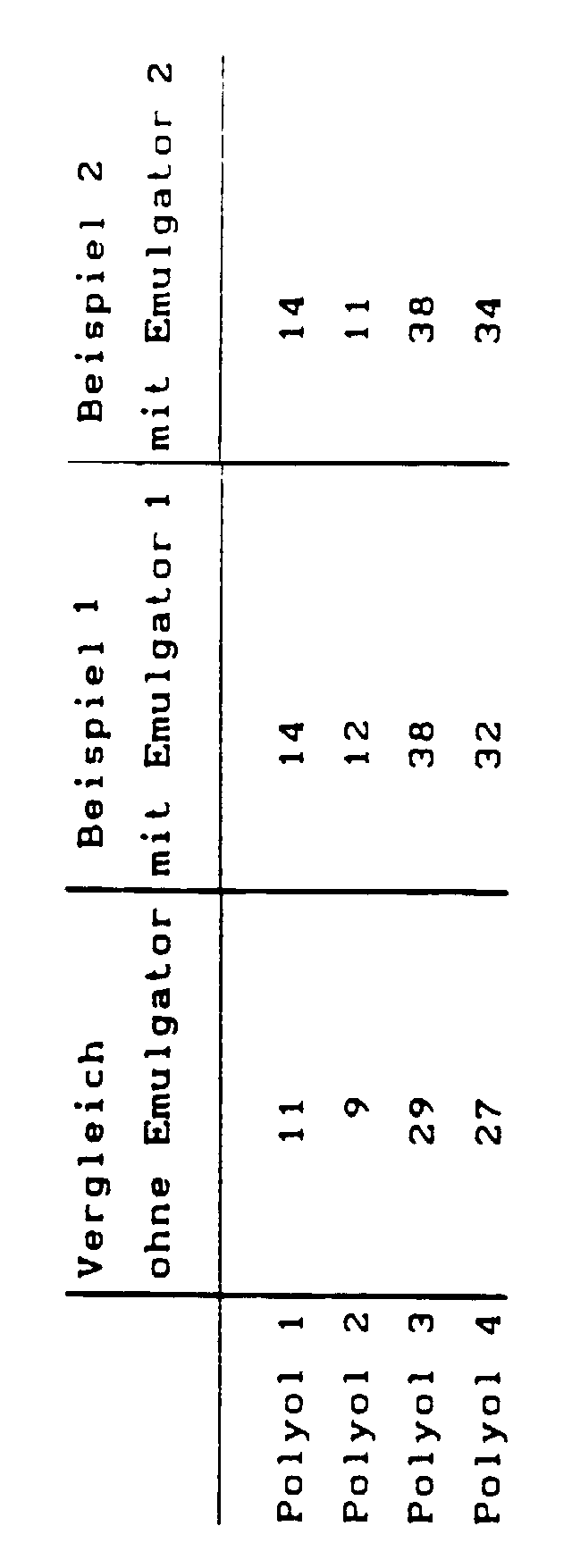
- Die erfindungsgemßen Beispiele 1 und 2 zeigen ganz deut-lich, daß die löslichen Mengen von 1,1,1,4,4,4-Hexafluorbutan im Polyol gegenüber dem Vergleich deutlich gesteigert werden konnten.
- Je höher die lösliche Menge des Treibmittels im Polyol, um so höher ist sein Anteil im Zellgas des darauf gefertigten Hartschaumstoffes und um so geringer ist damit auch die Wärmeleitzahl.

verwendet wird.
Claims (7)
- Verfahren zur Herstellung von harten Polyurethanschaumstoffen durch Umsetzung von1) Polyisocyanaten mit2) Verbindungen vom Molekulargewicht 92 bis 10.000, welche mindestens zwei gegenüber Isocyanaten aktive Wasserstoffatome aufweisen, in Gegenwart von3) Hydrofluoralkanen als Treibmittel und von4) Lösungsvermittlern sowie gegebenenfalls in Gegenwart von5) weiteren an sich bekannten Hilfs- und Zusatzstoffen,dadurch gekennzeichnet, daß als Lösungsvermittler die folgende Verbindung

verwendet wird. - Verfahren gemäß Anspruch 1, dadurch gekennzeichnet, daß das als Lösungsvermittler Triethylphosphat verwendet wird.
- Verfahren gemäß Anspruch 1, dadurch gekennzeichnet, daß als Lösungsvermittler Tributylphosphat verwendet wird.
- Verfahren nach Anspruch 1 bis 3, dadurch gekennzeichnet, daß die Lösungsvermittler in Mengen von 1 bis 10 Gewichtsteilen pro 100 Gewichtsteilen der Komponenten 2) eingesetzt werden.
- Verfahren gemäß Anspruch 1 bis 4, dadurch gekennzeichnet, daß als Treibmittel 1,1,1,4,4,4,-Hexafluorbutan verwendet wird.
- Verfahren nach Anspruch 1 bis 4, dadurch gekennzeichnet, daß als Treibmittel 1,1,1,2-Tetrafluorethan verwendet wird.
- Verfahren nach Anspruch 1 bis 4, dadurch gekennzeichnet, daß als Treibmittel 1,1,1,2,3,3,3-Heptafluorpropan verwendet wird.
Applications Claiming Priority (3)
| Application Number | Priority Date | Filing Date | Title |
|---|---|---|---|
| DE4225765 | 1992-08-04 | ||
| DE4225765A DE4225765C1 (de) | 1992-08-04 | 1992-08-04 | |
| PCT/EP1993/001957 WO1994003532A1 (de) | 1992-08-04 | 1993-07-22 | Verfahren zur herstellung von harten polyurethanschaumstoffen |
Publications (3)
| Publication Number | Publication Date |
|---|---|
| EP0654062A1 EP0654062A1 (de) | 1995-05-24 |
| EP0654062B1 true EP0654062B1 (de) | 1997-11-05 |
| EP0654062B2 EP0654062B2 (de) | 2001-01-17 |
Family
ID=6464818
Family Applications (1)
| Application Number | Title | Priority Date | Filing Date |
|---|---|---|---|
| EP93917627A Expired - Lifetime EP0654062B2 (de) | 1992-08-04 | 1993-07-22 | Verfahren zur herstellung von harten polyurethanschaumstoffen |
Country Status (18)
| Country | Link |
|---|---|
| US (1) | US5578651A (de) |
| EP (1) | EP0654062B2 (de) |
| JP (1) | JP3383308B2 (de) |
| KR (1) | KR100269082B1 (de) |
| AT (1) | ATE159965T1 (de) |
| AU (1) | AU4701793A (de) |
| BR (1) | BR9306837A (de) |
| CA (1) | CA2141736C (de) |
| CZ (1) | CZ289141B6 (de) |
| DE (2) | DE4225765C1 (de) |
| DK (1) | DK0654062T4 (de) |
| ES (1) | ES2108877T5 (de) |
| FI (1) | FI109424B (de) |
| GR (2) | GR3025545T3 (de) |
| HU (1) | HU217786B (de) |
| RU (1) | RU95108738A (de) |
| SI (1) | SI9300413B (de) |
| WO (1) | WO1994003532A1 (de) |
Families Citing this family (16)
| Publication number | Priority date | Publication date | Assignee | Title |
|---|---|---|---|---|
| DE69112970T2 (de) * | 1990-09-28 | 1996-03-21 | Kao Corp | Nichtionische pulverförmige Detergentzusammensetzung. |
| DE4339702A1 (de) * | 1993-11-22 | 1995-05-24 | Bayer Ag | Verfahren zur Herstellung von harten Polyurethanschaumstoffen |
| DE19526979A1 (de) * | 1995-07-25 | 1997-01-30 | Basf Ag | Verfahren zur Herstellung von Hartschaumstoffen auf Isocyanatbasis |
| EP1023367B1 (de) * | 1997-07-25 | 2003-10-01 | Huntsman International Llc | Flammwidrige polyurethanhartschaumstoffe, gebläht mittels fluorkohlenwasserstoffen |
| US6086788A (en) | 1999-03-15 | 2000-07-11 | Alliedsignal Inc. | Hydrofluorocarbon blown foam and method for preparation thereof |
| US6420443B1 (en) | 1999-09-09 | 2002-07-16 | Crompton Corporation | Additives for enhanced hydrocarbon compatibility in rigid polyurethane foam systems |
| CA2386931C (en) * | 2000-03-16 | 2009-09-15 | Honeywell International Inc. | Improved hydrofluorocarbon blown foam and method for preparation thereof |
| US6866923B2 (en) * | 2000-11-15 | 2005-03-15 | Atlas Roofing Corporation | Thermosetting plastic foams and methods of production thereof using adhesion additives |
| US6751973B2 (en) * | 2002-04-17 | 2004-06-22 | Tecumseh Products Company | Low profile condensing unit |
| WO2003099919A1 (en) * | 2002-05-20 | 2003-12-04 | Pabu Services, Inc. | Blends of (alkyl substituted) triaryl phosphate esters with phosphorus-containing flame retardants for polyurethane foams |
| CN101142265B (zh) * | 2005-03-21 | 2012-09-05 | 大湖化学公司 | 阻燃剂和阻燃聚合物 |
| EP1984415B1 (de) * | 2006-02-15 | 2011-01-05 | Stepan Company | Verträglichmachende tenside für polyurethanpolyole und harze |
| US7671025B2 (en) * | 2006-02-24 | 2010-03-02 | Sarentis Therapeutics, Inc. | Neurotensin receptor agonists and opioid receptor agonists |
| US8129457B2 (en) * | 2006-03-22 | 2012-03-06 | Chemtura Corporation | Flame retardant blends for flexible polyurethane foam |
| US20100216903A1 (en) | 2009-02-20 | 2010-08-26 | Bayer Materialscience Llc | Foam-forming system with reduced vapor pressure |
| US8476329B2 (en) | 2009-06-11 | 2013-07-02 | Basf Se | Bioresin composition for use in forming a rigid polyurethane foam article |
Citations (2)
| Publication number | Priority date | Publication date | Assignee | Title |
|---|---|---|---|---|
| EP0344537A1 (de) * | 1988-06-01 | 1989-12-06 | Bayer Ag | Verwendung von 1,1,1,4,4,4-Hexafluorbutan als Treib- und Dämmgas für die Herstellung von Kunststoff-Schaumstoffen |
| EP0450308A2 (de) * | 1990-03-06 | 1991-10-09 | Hoechst Aktiengesellschaft | Verfahren zur Herstellung von Schaumstoffen mit Hilfe von fluorierten Treibmitteln |
Family Cites Families (15)
| Publication number | Priority date | Publication date | Assignee | Title |
|---|---|---|---|---|
| US3034996A (en) † | 1959-06-12 | 1962-05-15 | Allied Chem | Preparation of low density polyurethane foam |
| US4169922A (en) * | 1977-12-27 | 1979-10-02 | Monsanto Company | Rigid polyurethane foam-forming compositions |
| DE3367782D1 (en) † | 1982-10-12 | 1987-01-08 | Ciba Geigy Ag | Fire-retarding compositions |
| US4568702A (en) * | 1985-04-15 | 1986-02-04 | Atlantic Richfield Company | Method for the preparation of semi-rigid polyurethane modified polyurea foam compositions |
| US4621105A (en) * | 1985-08-20 | 1986-11-04 | Atlantic Richfield Company | Preparation of fire retardant flexible polyurethane foams having reduced discoloration and scorch |
| JPH0284421A (ja) * | 1988-06-04 | 1990-03-26 | Achilles Corp | 衝撃吸収性ポリウレタンフォーム及びその製造方法 |
| US5028635A (en) * | 1988-06-28 | 1991-07-02 | Mobay Corporation | Polyurea-cyclic carbonate RIM systems having improved flow properties |
| DE3824354A1 (de) * | 1988-07-19 | 1990-01-25 | Basf Ag, 67063 Ludwigshafen | Verfahren zur herstellung von zellhaltigen kunststoffen nach dem polyisocyanat-polyadditionsverfahren mittels lagerstabiler, treibmittelhaltiger emulsionen und diese emulsionen |
| DE3903336A1 (de) † | 1989-02-04 | 1990-08-09 | Bayer Ag | Verwendung von c(pfeil abwaerts)3(pfeil abwaerts)- bis c(pfeil abwaerts)5(pfeil abwaerts)-polyfluoralkanen als treibgase |
| EP0432672B1 (de) * | 1989-12-12 | 1997-03-19 | SOLVAY (Société Anonyme) | Verfahren zur Herstellung von Schaumstoffen mit Hilfe von Fluoralkanen |
| US5130345A (en) * | 1990-06-29 | 1992-07-14 | Allied-Signal Inc. | Method of preparing foam using a partially fluorinated alkane having a tertiary structure as a blowing agent |
| DE4026893A1 (de) † | 1990-08-24 | 1992-02-27 | Hans Wilhelm Huetzen | Halogenkohlenwasserstofffreier polyurethanschaumstoff mit dauerhaften brandschutz- und waermeisolationseigenschaften und verfahren zu seiner herstellung |
| IT1243425B (it) † | 1990-09-26 | 1994-06-10 | Montedipe Srl | Procedimento per la preparazione di corpi formati in schiume poliuretaniche e corpi formati cosi' ottenuti. |
| US5137929A (en) * | 1991-06-21 | 1992-08-11 | Allied-Signal Inc. | Additives which stabilize hydrohalocarbon blowing agent in polyurethane and polyisocyanurate foam formulations during polymerization |
| BE1006188A5 (fr) * | 1992-09-29 | 1994-06-07 | Solvay | Compositions stabilisees comprenant des hydrofluoroalcanes, premelanges destines a la preparation de mousses polymeriques et mousses polymeriques obtenues par leur mise en oeuvre. |
-
1992
- 1992-08-04 DE DE4225765A patent/DE4225765C1/de not_active Expired - Fee Related
-
1993
- 1993-07-22 AU AU47017/93A patent/AU4701793A/en not_active Abandoned
- 1993-07-22 JP JP50495194A patent/JP3383308B2/ja not_active Expired - Fee Related
- 1993-07-22 DK DK93917627T patent/DK0654062T4/da active
- 1993-07-22 EP EP93917627A patent/EP0654062B2/de not_active Expired - Lifetime
- 1993-07-22 WO PCT/EP1993/001957 patent/WO1994003532A1/de not_active Ceased
- 1993-07-22 DE DE59307650T patent/DE59307650D1/de not_active Expired - Lifetime
- 1993-07-22 BR BR9306837A patent/BR9306837A/pt not_active IP Right Cessation
- 1993-07-22 AT AT93917627T patent/ATE159965T1/de not_active IP Right Cessation
- 1993-07-22 US US08/374,747 patent/US5578651A/en not_active Expired - Lifetime
- 1993-07-22 ES ES93917627T patent/ES2108877T5/es not_active Expired - Lifetime
- 1993-07-22 CA CA002141736A patent/CA2141736C/en not_active Expired - Fee Related
- 1993-07-22 HU HU9500329A patent/HU217786B/hu not_active IP Right Cessation
- 1993-07-22 KR KR1019950700374A patent/KR100269082B1/ko not_active Expired - Fee Related
- 1993-07-22 RU RU95108738/04A patent/RU95108738A/ru unknown
- 1993-07-22 CZ CZ1995214A patent/CZ289141B6/cs not_active IP Right Cessation
- 1993-08-04 SI SI9300413A patent/SI9300413B/sl not_active IP Right Cessation
-
1995
- 1995-02-02 FI FI950460A patent/FI109424B/fi not_active IP Right Cessation
-
1997
- 1997-12-02 GR GR970403194T patent/GR3025545T3/el unknown
-
2001
- 2001-03-15 GR GR20010400435T patent/GR3035591T3/el not_active IP Right Cessation
Patent Citations (2)
| Publication number | Priority date | Publication date | Assignee | Title |
|---|---|---|---|---|
| EP0344537A1 (de) * | 1988-06-01 | 1989-12-06 | Bayer Ag | Verwendung von 1,1,1,4,4,4-Hexafluorbutan als Treib- und Dämmgas für die Herstellung von Kunststoff-Schaumstoffen |
| EP0450308A2 (de) * | 1990-03-06 | 1991-10-09 | Hoechst Aktiengesellschaft | Verfahren zur Herstellung von Schaumstoffen mit Hilfe von fluorierten Treibmitteln |
Also Published As
| Publication number | Publication date |
|---|---|
| ES2108877T5 (es) | 2001-04-01 |
| HUT69071A (en) | 1995-08-28 |
| FI950460A0 (fi) | 1995-02-02 |
| CZ21495A3 (en) | 1995-07-12 |
| SI9300413B (sl) | 2002-02-28 |
| JPH07509516A (ja) | 1995-10-19 |
| AU4701793A (en) | 1994-03-03 |
| DK0654062T4 (da) | 2001-03-19 |
| JP3383308B2 (ja) | 2003-03-04 |
| ATE159965T1 (de) | 1997-11-15 |
| DE59307650D1 (de) | 1997-12-11 |
| CZ289141B6 (cs) | 2001-11-14 |
| EP0654062B2 (de) | 2001-01-17 |
| ES2108877T3 (es) | 1998-01-01 |
| EP0654062A1 (de) | 1995-05-24 |
| CA2141736A1 (en) | 1995-01-25 |
| GR3025545T3 (en) | 1998-03-31 |
| BR9306837A (pt) | 1998-12-08 |
| DE4225765C1 (de) | 1993-09-16 |
| FI950460A7 (fi) | 1995-02-02 |
| KR100269082B1 (ko) | 2000-10-16 |
| FI109424B (fi) | 2002-07-31 |
| WO1994003532A1 (de) | 1994-02-17 |
| US5578651A (en) | 1996-11-26 |
| HU9500329D0 (en) | 1995-03-28 |
| DK0654062T3 (da) | 1998-07-27 |
| GR3035591T3 (en) | 2001-06-29 |
| CA2141736C (en) | 2004-05-18 |
| HU217786B (hu) | 2000-04-28 |
| RU95108738A (ru) | 1997-03-20 |
| KR950702596A (ko) | 1995-07-29 |
| SI9300413A (en) | 1995-02-28 |
Similar Documents
| Publication | Publication Date | Title |
|---|---|---|
| EP0730619B1 (de) | Verfahren zur herstellung von harten polyurethanschaumstoffen | |
| EP0654054B1 (de) | Verwendung von aktive Wasserstoffatome aufweisenden Verbindungen | |
| EP0381986B1 (de) | Verwendung von C3- bis C5- Polyfluoralkanen als Treibgase | |
| EP0654062B2 (de) | Verfahren zur herstellung von harten polyurethanschaumstoffen | |
| EP0805831B1 (de) | Verwendung von Toluylendiamin gestarteten Propylenoxid Polyolen in Polyurethan Hartschaumstoffen | |
| EP0346670B1 (de) | Verfahren zur Herstellung von Polyurethan-Weichblockschaumstoffen | |
| DE69910627T2 (de) | Auf polyurethan basierender und expandierbaren graphit enthaltender schaum sowie verfahren zu dessen herstellung | |
| EP1142941B1 (de) | Halogenfreier, flammwidriger Polyurethanhartschaum und ein Verfahren zu seiner Herstellung | |
| EP0450308A2 (de) | Verfahren zur Herstellung von Schaumstoffen mit Hilfe von fluorierten Treibmitteln | |
| EP0431542A2 (de) | Verfahren zur Herstellung von Schaumstoffen | |
| EP0463493B1 (de) | Verfahren zur Herstellung von Urethan- und überwiegend Isocyanuratgruppen aufweisenden Hartschaumstoffen und deren Verwendung als Dämmaterialien | |
| EP0472080B1 (de) | Verfahren zur Herstellung von harten Polyurethanschaumstoffen | |
| EP0649440B1 (de) | Verfahren zur herstellung von harten urethangruppen und überwiegend isocyanuratgruppen aufweisenden schaumstoffen | |
| EP1246858B1 (de) | Flammwidriger hr-kaltformschaum mit reduzierter rauchgasintensität und -toxizität | |
| DE4328383A1 (de) | Verfahren zur Herstellung von Schaumstoffen auf Isocyanatbasis | |
| EP0610752B1 (de) | Verfahren zur Herstellung von Schaumstoffen auf Isocyanatbasis | |
| WO2001036509A1 (de) | Flammwidriger hr-kaltformschaum mit reduzierter rauchgasdichte und -toxizität | |
| EP0535358A1 (de) | Verfahren zur Herstellung von flammgeschützten Urethangruppen aufweisenden Hartschaumstoffen | |
| DE4317531B4 (de) | Verfahren zur Herstellung von harten Polyurethanschaumstoffen | |
| DE4005373A1 (de) | Verfahren zur herstellung von flammwidrigen polyurethan-schaumstoffen mit einer gegebenenfalls im wesentlichen zellfreien randzone und niedrigviskose flammschutzmittelgemisch-polyether-polyoldispersionen hierfuer | |
| DD298419A5 (de) | Verwendung von c tief 3- bis c tief 5-polyflouralkanen als treibgase | |
| DE19836662A1 (de) | Verfahren zur Herstellung von Polyurethanintegralschaumstoffen (Polyurethanformkörpern) | |
| DE4303659A1 (de) | Verwendung von Gemischen aus Kohlenwasserstoffen und Caprolactamhydrat als Treibmittel bei der Herstellung von Kunststoff-Schaumstoffen |
Legal Events
| Date | Code | Title | Description |
|---|---|---|---|
| PUAI | Public reference made under article 153(3) epc to a published international application that has entered the european phase |
Free format text: ORIGINAL CODE: 0009012 |
|
| 17P | Request for examination filed |
Effective date: 19950123 |
|
| AK | Designated contracting states |
Kind code of ref document: A1 Designated state(s): AT BE CH DE DK ES FR GB GR IE IT LI NL PT SE |
|
| 17Q | First examination report despatched |
Effective date: 19960515 |
|
| GRAG | Despatch of communication of intention to grant |
Free format text: ORIGINAL CODE: EPIDOS AGRA |
|
| GRAH | Despatch of communication of intention to grant a patent |
Free format text: ORIGINAL CODE: EPIDOS IGRA |
|
| GRAH | Despatch of communication of intention to grant a patent |
Free format text: ORIGINAL CODE: EPIDOS IGRA |
|
| GRAA | (expected) grant |
Free format text: ORIGINAL CODE: 0009210 |
|
| AK | Designated contracting states |
Kind code of ref document: B1 Designated state(s): AT BE CH DE DK ES FR GB GR IE IT LI NL PT SE |
|
| REF | Corresponds to: |
Ref document number: 159965 Country of ref document: AT Date of ref document: 19971115 Kind code of ref document: T |
|
| REG | Reference to a national code |
Ref country code: CH Ref legal event code: NV Representative=s name: E. BLUM & CO. PATENTANWAELTE Ref country code: CH Ref legal event code: EP |
|
| ITF | It: translation for a ep patent filed | ||
| REF | Corresponds to: |
Ref document number: 59307650 Country of ref document: DE Date of ref document: 19971211 |
|
| REG | Reference to a national code |
Ref country code: ES Ref legal event code: FG2A Ref document number: 2108877 Country of ref document: ES Kind code of ref document: T3 |
|
| GBT | Gb: translation of ep patent filed (gb section 77(6)(a)/1977) |
Effective date: 19971212 |
|
| ET | Fr: translation filed | ||
| REG | Reference to a national code |
Ref country code: IE Ref legal event code: FG4D Free format text: 77292 |
|
| REG | Reference to a national code |
Ref country code: PT Ref legal event code: SC4A Free format text: AVAILABILITY OF NATIONAL TRANSLATION Effective date: 19980114 |
|
| REG | Reference to a national code |
Ref country code: DK Ref legal event code: T3 |
|
| PLBQ | Unpublished change to opponent data |
Free format text: ORIGINAL CODE: EPIDOS OPPO |
|
| PLBI | Opposition filed |
Free format text: ORIGINAL CODE: 0009260 |
|
| PLBF | Reply of patent proprietor to notice(s) of opposition |
Free format text: ORIGINAL CODE: EPIDOS OBSO |
|
| 26 | Opposition filed |
Opponent name: IMPERIAL CHEMICAL INDUSTRIES PLC Effective date: 19980723 |
|
| NLR1 | Nl: opposition has been filed with the epo |
Opponent name: IMPERIAL CHEMICAL INDUSTRIES PLC |
|
| PLBF | Reply of patent proprietor to notice(s) of opposition |
Free format text: ORIGINAL CODE: EPIDOS OBSO |
|
| PLBF | Reply of patent proprietor to notice(s) of opposition |
Free format text: ORIGINAL CODE: EPIDOS OBSO |
|
| PLBQ | Unpublished change to opponent data |
Free format text: ORIGINAL CODE: EPIDOS OPPO |
|
| PLAB | Opposition data, opponent's data or that of the opponent's representative modified |
Free format text: ORIGINAL CODE: 0009299OPPO |
|
| PLAW | Interlocutory decision in opposition |
Free format text: ORIGINAL CODE: EPIDOS IDOP |
|
| R26 | Opposition filed (corrected) |
Opponent name: HUNTSMAN ICI CHEMICALS, LLC Effective date: 19980723 |
|
| NLR1 | Nl: opposition has been filed with the epo |
Opponent name: HUNTSMAN ICI CHEMICALS, LLC |
|
| PLAW | Interlocutory decision in opposition |
Free format text: ORIGINAL CODE: EPIDOS IDOP |
|
| PUAH | Patent maintained in amended form |
Free format text: ORIGINAL CODE: 0009272 |
|
| STAA | Information on the status of an ep patent application or granted ep patent |
Free format text: STATUS: PATENT MAINTAINED AS AMENDED |
|
| 27A | Patent maintained in amended form |
Effective date: 20010117 |
|
| AK | Designated contracting states |
Kind code of ref document: B2 Designated state(s): AT BE CH DE DK ES FR GB GR IE IT LI NL PT SE |
|
| REG | Reference to a national code |
Ref country code: CH Ref legal event code: AEN Free format text: AUFRECHTERHALTUNG DES PATENTES IN GEAENDERTER FORM |
|
| NLR2 | Nl: decision of opposition | ||
| ITF | It: translation for a ep patent filed | ||
| PG25 | Lapsed in a contracting state [announced via postgrant information from national office to epo] |
Ref country code: GR Free format text: THE PATENT HAS BEEN ANNULLED BY A DECISION OF A NATIONAL AUTHORITY Effective date: 20010315 |
|
| REG | Reference to a national code |
Ref country code: DK Ref legal event code: T4 |
|
| REG | Reference to a national code |
Ref country code: ES Ref legal event code: DC2A Kind code of ref document: T5 Effective date: 20010228 |
|
| ET3 | Fr: translation filed ** decision concerning opposition | ||
| GBPR | Gb: patent revoked under art. 102 of the ep convention designating the uk as contracting state |
Free format text: 971105 |
|
| GBTA | Gb: translation of amended ep patent filed (gb section 77(6)(b)/1977) | ||
| NLR3 | Nl: receipt of modified translations in the netherlands language after an opposition procedure | ||
| REG | Reference to a national code |
Ref country code: GB Ref legal event code: IF02 |
|
| PGFP | Annual fee paid to national office [announced via postgrant information from national office to epo] |
Ref country code: IE Payment date: 20040617 Year of fee payment: 12 |
|
| PGFP | Annual fee paid to national office [announced via postgrant information from national office to epo] |
Ref country code: GR Payment date: 20040625 Year of fee payment: 12 |
|
| PGFP | Annual fee paid to national office [announced via postgrant information from national office to epo] |
Ref country code: CH Payment date: 20040629 Year of fee payment: 12 |
|
| PGFP | Annual fee paid to national office [announced via postgrant information from national office to epo] |
Ref country code: PT Payment date: 20040630 Year of fee payment: 12 Ref country code: NL Payment date: 20040630 Year of fee payment: 12 |
|
| PGFP | Annual fee paid to national office [announced via postgrant information from national office to epo] |
Ref country code: AT Payment date: 20040707 Year of fee payment: 12 |
|
| PGFP | Annual fee paid to national office [announced via postgrant information from national office to epo] |
Ref country code: GB Payment date: 20040721 Year of fee payment: 12 |
|
| PGFP | Annual fee paid to national office [announced via postgrant information from national office to epo] |
Ref country code: BE Payment date: 20040728 Year of fee payment: 12 |
|
| PG25 | Lapsed in a contracting state [announced via postgrant information from national office to epo] |
Ref country code: IE Free format text: LAPSE BECAUSE OF NON-PAYMENT OF DUE FEES Effective date: 20050722 Ref country code: GB Free format text: LAPSE BECAUSE OF NON-PAYMENT OF DUE FEES Effective date: 20050722 Ref country code: AT Free format text: LAPSE BECAUSE OF NON-PAYMENT OF DUE FEES Effective date: 20050722 |
|
| PG25 | Lapsed in a contracting state [announced via postgrant information from national office to epo] |
Ref country code: LI Free format text: LAPSE BECAUSE OF NON-PAYMENT OF DUE FEES Effective date: 20050731 Ref country code: CH Free format text: LAPSE BECAUSE OF NON-PAYMENT OF DUE FEES Effective date: 20050731 Ref country code: BE Free format text: LAPSE BECAUSE OF NON-PAYMENT OF DUE FEES Effective date: 20050731 |
|
| PG25 | Lapsed in a contracting state [announced via postgrant information from national office to epo] |
Ref country code: PT Free format text: LAPSE BECAUSE OF NON-PAYMENT OF DUE FEES Effective date: 20060123 |
|
| PG25 | Lapsed in a contracting state [announced via postgrant information from national office to epo] |
Ref country code: NL Free format text: LAPSE BECAUSE OF NON-PAYMENT OF DUE FEES Effective date: 20060201 |
|
| REG | Reference to a national code |
Ref country code: CH Ref legal event code: PL |
|
| GBPC | Gb: european patent ceased through non-payment of renewal fee |
Effective date: 20050722 |
|
| NLV4 | Nl: lapsed or anulled due to non-payment of the annual fee |
Effective date: 20060201 |
|
| REG | Reference to a national code |
Ref country code: IE Ref legal event code: MM4A |
|
| BERE | Be: lapsed |
Owner name: *BAYER A.G. Effective date: 20050731 |
|
| EUG | Se: european patent has lapsed | ||
| PG25 | Lapsed in a contracting state [announced via postgrant information from national office to epo] |
Ref country code: SE Free format text: LAPSE BECAUSE OF NON-PAYMENT OF DUE FEES Effective date: 20070723 |
|
| PGFP | Annual fee paid to national office [announced via postgrant information from national office to epo] |
Ref country code: SE Payment date: 20060705 Year of fee payment: 14 |
|
| PLAB | Opposition data, opponent's data or that of the opponent's representative modified |
Free format text: ORIGINAL CODE: 0009299OPPO |
|
| PGFP | Annual fee paid to national office [announced via postgrant information from national office to epo] |
Ref country code: ES Payment date: 20100813 Year of fee payment: 18 |
|
| PGFP | Annual fee paid to national office [announced via postgrant information from national office to epo] |
Ref country code: IT Payment date: 20100722 Year of fee payment: 18 Ref country code: FR Payment date: 20100805 Year of fee payment: 18 Ref country code: DE Payment date: 20100702 Year of fee payment: 18 |
|
| PGFP | Annual fee paid to national office [announced via postgrant information from national office to epo] |
Ref country code: DK Payment date: 20100712 Year of fee payment: 18 |
|
| REG | Reference to a national code |
Ref country code: DK Ref legal event code: EBP |
|
| REG | Reference to a national code |
Ref country code: FR Ref legal event code: ST Effective date: 20120330 |
|
| PG25 | Lapsed in a contracting state [announced via postgrant information from national office to epo] |
Ref country code: DE Free format text: LAPSE BECAUSE OF NON-PAYMENT OF DUE FEES Effective date: 20120201 Ref country code: FR Free format text: LAPSE BECAUSE OF NON-PAYMENT OF DUE FEES Effective date: 20110801 |
|
| REG | Reference to a national code |
Ref country code: DE Ref legal event code: R119 Ref document number: 59307650 Country of ref document: DE Effective date: 20120201 |
|
| PG25 | Lapsed in a contracting state [announced via postgrant information from national office to epo] |
Ref country code: IT Free format text: LAPSE BECAUSE OF NON-PAYMENT OF DUE FEES Effective date: 20110722 |
|
| PG25 | Lapsed in a contracting state [announced via postgrant information from national office to epo] |
Ref country code: DK Free format text: LAPSE BECAUSE OF NON-PAYMENT OF DUE FEES Effective date: 20110731 |
|
| REG | Reference to a national code |
Ref country code: ES Ref legal event code: FD2A Effective date: 20130417 |
|
| PG25 | Lapsed in a contracting state [announced via postgrant information from national office to epo] |
Ref country code: ES Free format text: LAPSE BECAUSE OF NON-PAYMENT OF DUE FEES Effective date: 20110723 |