EP0654085B1 - Proteines fusionnees monomeres et dimeres a fragments d'anticorps - Google Patents
Proteines fusionnees monomeres et dimeres a fragments d'anticorps Download PDFInfo
- Publication number
- EP0654085B1 EP0654085B1 EP93902206A EP93902206A EP0654085B1 EP 0654085 B1 EP0654085 B1 EP 0654085B1 EP 93902206 A EP93902206 A EP 93902206A EP 93902206 A EP93902206 A EP 93902206A EP 0654085 B1 EP0654085 B1 EP 0654085B1
- Authority
- EP
- European Patent Office
- Prior art keywords
- fragment
- peptide
- antibody
- monomeric
- protein
- Prior art date
- Legal status (The legal status is an assumption and is not a legal conclusion. Google has not performed a legal analysis and makes no representation as to the accuracy of the status listed.)
- Expired - Lifetime
Links
Images


Classifications
-
- C—CHEMISTRY; METALLURGY
- C12—BIOCHEMISTRY; BEER; SPIRITS; WINE; VINEGAR; MICROBIOLOGY; ENZYMOLOGY; MUTATION OR GENETIC ENGINEERING
- C12N—MICROORGANISMS OR ENZYMES; COMPOSITIONS THEREOF; PROPAGATING, PRESERVING, OR MAINTAINING MICROORGANISMS; MUTATION OR GENETIC ENGINEERING; CULTURE MEDIA
- C12N15/00—Mutation or genetic engineering; DNA or RNA concerning genetic engineering, vectors, e.g. plasmids, or their isolation, preparation or purification; Use of hosts therefor
- C12N15/09—Recombinant DNA-technology
- C12N15/11—DNA or RNA fragments; Modified forms thereof; Non-coding nucleic acids having a biological activity
- C12N15/62—DNA sequences coding for fusion proteins
-
- C—CHEMISTRY; METALLURGY
- C07—ORGANIC CHEMISTRY
- C07K—PEPTIDES
- C07K16/00—Immunoglobulins [IG], e.g. monoclonal or polyclonal antibodies
-
- C—CHEMISTRY; METALLURGY
- C07—ORGANIC CHEMISTRY
- C07K—PEPTIDES
- C07K16/00—Immunoglobulins [IG], e.g. monoclonal or polyclonal antibodies
- C07K16/46—Hybrid immunoglobulins
- C07K16/468—Immunoglobulins having two or more different antigen binding sites, e.g. multifunctional antibodies
-
- A—HUMAN NECESSITIES
- A61—MEDICAL OR VETERINARY SCIENCE; HYGIENE
- A61K—PREPARATIONS FOR MEDICAL, DENTAL OR TOILETRY PURPOSES
- A61K38/00—Medicinal preparations containing peptides
-
- C—CHEMISTRY; METALLURGY
- C07—ORGANIC CHEMISTRY
- C07K—PEPTIDES
- C07K2319/00—Fusion polypeptide
- C07K2319/01—Fusion polypeptide containing a localisation/targetting motif
- C07K2319/02—Fusion polypeptide containing a localisation/targetting motif containing a signal sequence
-
- C—CHEMISTRY; METALLURGY
- C07—ORGANIC CHEMISTRY
- C07K—PEPTIDES
- C07K2319/00—Fusion polypeptide
- C07K2319/70—Fusion polypeptide containing domain for protein-protein interaction
- C07K2319/73—Fusion polypeptide containing domain for protein-protein interaction containing coiled-coiled motif (leucine zippers)
Definitions
- the present invention describes a new class of antigen binding molecules which contain Fv-fragments of an antibody but do not use the constant antibody domains. They can also dimerize with other antibody fragment molecules or with non-antibody fragment molecules to form bi- or multifunctional antibody-fragment fusion proteins and so-called mininantibodies, respectively.
- the new fusion proteins can be used in the broad field of diagnostic and therapeutical medicine.
- the Fv fragment however, has a tendency to dissociate into V H and V L and therefore, it is advantageous to link the two domains covalently.
- One particular way of linking them is by designing a peptide linker between them, either in the orientation V H -linker-V L or V L -linker-V H (Bird et al.,1988, Science 242, 423; Huston et al., 1988, Proc. Natl. Acad. Sci. USA 85, 5879)
- the resulting fragments are called single-chain Fv fragments.
- Antibody fragments of small size are of particular advantage in many applications.
- diagnostic applications e. g. ELISA, RIA, etc.
- the smaller molecules surface decreases the problems of nonspecific interactions, which are known to frequently involve the constant domains.
- the same is true in using antibody fragments as ligands in affinity chromatography.
- Expression yields and secretion efficiency of recombinant proteins are also a function of chain size (Skerra & Plückthun, 1991, Protein Eng. 4, 971) and smaller proteins are preferred for this reason. Therefore, molecules of a small size are advantageous for several reasons.
- Bifunctional antibodies may be defined as having two different specificities for either two different antigens or for two epitopes of the same antigen.
- the second previous method involved the fusion of two hybridomas to give a so-called heterohybridoma or "quadroma".
- any light chain can pair with any heavy chain, and the two heavy chains can give homodimers or heterodimers resulting in very complicated product mixtures (Milstein & Cuello, 1983, Nature 305, 537).
- the third method is related to the second and consists of transfecting two expression plasmids into a hybridoma cell, encoding the heavy and light chain of the second antibody (Lenz & Weidle, 1990, Gene 87, 213) or a retroviral vector ( De Monte et al., 1990, Acad. Sci. 87, 2941-2945). However, once introduced, the product mixture is identical as in the second procedure.
- this problem is solved by (i) covalently linking corresponding VH and VL domain in a scFv fragment and (ii) using dimerization domains only allowing the formation of heterodimers, such as certain leucine zippers and derivatives.
- Another important consideration in the present invention was the desire to make the MW of the bispecific antibody as small as possible for reasons explained above in detail. This was achieved by using scFv fragments.
- bispecific antibodies are of great interest in tumor therapy.
- One arm of the antibody may bind to a tumor marker, the other arm to a T-cell epitope, a toxin, or a radionuclide binding peptide or protein to bring a killing function close to the tumor cell.
- one arm may bind to the analyte of interest and the other to a principle which can easily be quantified, e. g. an enzyme.
- it may be advantageous to obtain higher selectivity in binding if two different epitopes or the same protein complex can be recognized or if two different proteins can be recognized on the same cell surface.
- Object of the invention is, therefore, a monomeric antibody-fragment fusion protein essentially consisting of a Fv-fragment of an antibody and a peptide which is capable to dimerize with another peptide by noncovalent interaction.
- noncovalent interaction means every existing under normal condititions stable linkage which is not related to a covalent binding, for example linkage by Van der Waal's forces, (steric) interdigitation of amphiphilic peptides, especially peptide helices, or peptides bearing opposite charges of amino acid residues.
- the correspondingly effective peptides are called above and below interactive or intercalating peptides.
- the amphiphilic peptides consist of up to 50 amino acids. Preferrably they consist of 10 to 30 amino acids.
- the interactive peptide is a peptide helix bundle (comprising of a helix, a turn and another helix, see above).
- the interactive peptide is a leucine zipper consisting of a peptide having several repeating amino acids, in which every seventh amino acid is a leucine residue.
- the peptide bear positively or negatively charged residues, e.g. lysine (positively charged) or glutamic acid (negatively charged) in a way that this peptide can bind to another peptide (of a second monomeric unit) bearing opposite charges.
- the Fv-fragment and the intercalating peptide are linked together either directly or by a linker peptide, preferrably by a linker peptide.
- the linker peptide is a hinge region sequence of an antibody.
- the Fv-fragment consists of the V L and V H region of an antibody.
- the Fv-fragment according to the invention is preferrably a single chain fragment. Single chain fragments can be obtained by standard techniques using standard linker molecules.
- object of the invention is a dimeric fusion protein essentially consisting of two monomeric fusion proteins, wherein the linkage of the monomeric units bases on noncovalent interaction of identical or different peptides, characterized in that at least one monomeric unit is an antibody-Fv-fragment fusion protein as defined above.
- the Fv-fragments may be the same (identical antigen binding sites) or may be different (different antigen binding sites).
- mono- and bispecific (Fv)- miniantibodies can be obtained. According to the invention bispecific mini-antibodies are preferred.
- the interactive peptides may be the same or may be different; preferrably, they are identical.
- the intercalating peptides may be associated in parallel or in antiparallel fashion.
- Object of the invention is, therefore, above all, a dimeric fusion protein consisting of two Fv-fragments with different specificity (antigen binding sites) and identical intercalating helix peptides, the antibody fragments and the peptides are linked together by a hinge region sequence.
- object of the invention is a dimer consisting of a monomeric unit containing a Fv-fragment and another monomeric unit wherein the Fv-Fragment was replaced by a non-antibody peptide.
- the non-antibody peptide may be a toxin, like ricin, a chelator- or metal binding peptide, or an enzyme (e.g. marker enzyme), or a peptide bearing a detectable lable (e.g. a radioisotope).
- the non-antibody peptide can also bear a corresponding binding site for said groups, binding sites directed to T-cells or T-cell fragments included.
- the invention relates to monomers and dimers, as defined above, wherein the interactive peptide(s) is (are) additionally fused at the C-terminus to target proteins/peptides as mentioned above, the corresponding binding sites included.
- the resulting fusion proteins and miniantibodies, respectively are multifunctional.
- the invention relates, furthermore, to a process for preparation of a monomeric antibody fusion protein as defined above, characterized in that the genes coding for the Fv-fragment, the interactive peptide and, if desired, the linking peptide are cloned into one expression plasmid, a host cell is transformed with said expression plasmid and cultivated in a nutrient solution, and the monomeric fusion protein is expressed in the cell or secreted into the medium.
- Object of the invention is, finally, a process for preparation of a dimeric fusion protein as defined above, characterized in that the genes coding for the complete monomeric fusion proteins or parts of it are cloned at least into one expression plasmid, a host cell is transformed with said expression plasmid(s) and cultivated in a nutrient solution, and either the complete dimeric fusion protein is expressed in the cell or into the medium, or the monomeric fusion proteins are separately expressed and the noncovalent linkage between the two monomeric units is performed in the medium or in vitro, and in the case that only parts of the fusion proteins were cloned, protein engineering steps are additionally performed according to standard techniques.
- the dimeric Fv-fragments containing fusion proteins according to the invention show a high avidity against corresponding antigens and a satisfying stability.
- These novel bivalent or bifunctional molecules can be prepared as folded and assembled molecules in E. coli. These miniantibodies are compatible with functional expression by secretion.
- the oligomerization domains were selected for having a fairly small molecular weight and for being compatible with transport of the fusion protein through the membrane. They are based on two different types of amphiphilic helices.
- Amphiphilic helices are known to predominantly, but not exclusively, associate in two different molecular structures: Four helix bundles and coiled coils.
- the design and formation of helix bundles has been studied previously (Eisenberg et al., 1986, Proteins 1, 16-22; Ho and deGrado, 1987, J. Am. Chem. Soc. 109, 6751-6758; Regan and deGrado, 1988, Science 241, 976-978 ; Hill et al., 1990, Science 294, 543-546 ).
- This molecule association is also known from natural proteins (Richardson, 1981, Adv. Prot. Chem. 34, 167).
- the four helix bundle may be formed from either four separate molecules (each contributing one helix), two molecules containing two helices each (connected as helix-turn-helix) or one molecule containing a helix-turn-helix-turn-helix-turn-helix motif. For dimerization or multimerization, only the first two are suitable.
- peptides are used which can form so-called coiled-coil structures.
- Such peptides occur in transcription factors such as e. g. GCN4 from yeast and have been called leucine zippers (Landschulz et al., 1988, Science 240, 1759-1764 ).
- the crystal structure of this has been solved recently (O'Shea et al., 1991, Science 254, 539-544) and showed a parallel arrangement of the helices.
- a covalent attachment of the helices is possible by a small peptide extension, again containing a cystein. Since the helices are now parallel, the peptide extension can be much shorter, since the distance is much smaller.
- the various dimerization devices were however not fused to the antibody domain directly. It is advantageous to introduce a flexible peptide between the end of the scFv fragment and the beginning of the helix.
- the upper hinge region of mouse IgG3 has been used.
- a variety of hinges can be used. It is not required for dimerization per se, but provides a spacing of the two scFv domains similar to the antigen binding sites of a whole antibody. This way, the two binding sites span a greater distance in space and therefore can reach neighboring antigens on a solid surface.
- hinges of antibodies are preferred embodiments of hinges in bivalent miniantibodies.
- the hinges may be shorter, since frequently molecules from different surfaces are to be crosslinked as close as possible, and flexibilty of the dimer is not necessary.
- the choice of the hinge is governed by the desired residue sequence, l ength (Argos, 1990, J. Mol. Biol. 211, 943-958), compatibility with folding and stability of the amphiphilic helices (Richardson & Richardson, 1988, Science 240, 1648-1652), secretion and resistance against proteases .
- the present invention deals with peptides as dimerization devices, which should be as small as possible.
- One preferred embodiment is the use of peptides which can form amphipathic helices. Such helices shield the hydrophobic surface by dimerization or even multimerization.
- Helices of this type are characterized by their having hydrophobic patches on one face of the helix, and containing a sufficient number of helix-forming residues. Rules for such peptides are discussed in Eisenberg et al. 1986, O'Shea et al.,.1991 (Science 254, 539-544),1992 (Cell 68, 699-708).
- Natural peptides of this type are found as the so-called leucine zippers, characterized by a periodic occurence of leucine (every seventh residue) and other hydrophilic residues (e. g. valine) also every seventh residue.
- leucine zippers characterized by a periodic occurence of leucine (every seventh residue) and other hydrophilic residues (e. g. valine) also every seventh residue.
- sequence alteration can e. g. involve the incorporation of charge bridges, such that in the homodimers, like charges repel each other and in the heterodimer, opposite charges attract each other (see below).
- the present invention can also be extended to bifunctional miniantibodies.
- dimerization devices intercalation peptides
- a preferred embodiment of this part of the invention are two different coiled-coil helices, such as in naturally occuring leucine zippers, e. g. from the transcription factor proteins jun and fos (O'Shea et al., 1989, Science 245, 646-648 ).
- the constant scFv-hinge-helix can be extended at the C-terminus to result in a fusion protein.
- a fusion to an enzyme may be made to use such bivalent constructs in diagnostics.
- Such enzymes are e. g. alkaline phosphatase, luciferase or horse radish peroxidase.
- the advantage of such a antibody-enzyme fusion protein would be that the bivalence of the antibody would lead to an enhanced binding to the surface-bound antigen.
- the advantage over a fusion protein prepared by conventional technology i. e. chemical coupling of the antibody to the enzyme of choice
- miniantibodies may be extended at the C-terminus to incorporate a toxin.
- immunotoxins would be bivalent or even bispecific and thus combine the advantages of such antibody fragments linked above with the advantages in tumor therapy known for immunotoxins.
- a metal binding peptide or protein could be linked genetically to be used in radioimmunotherapy or in tumor imaging. The same advantages for any genetically encoded hybrid protein hold true as given above for the antibody-enzyme fusions.
- a construct of the type scFv-hinge-helix may be made to dimerize with another protein fused to a dimerization domain, in complete analogy as described above for the formation of bispecific miniantibodies.
- the scFv fragment would e. g. be fitted with the helix of the fos protein.
- Such foreign protein which could be made to form heterodimers with the scFv fragment, include enzymes useful in diagnosis, toxins, metal-binding peptides or proteins useful in radioimmunotherapy or radio-imaging.
- the dimerization domains presented here can also serve for purification purposes.
- a recombinant protein of any kind can be fused to a dimerization domain, e.g. to hinge-fos-zipper.
- the heterodimer can be purified in one step with an affinity column for the scFv-specificity.
- the 'opposite' zipper linked to a column support, 'catches' the protein-hinge-zipper when passing through the column as a crude cell extract.
- the elution of the pure fusion protein from the column is possible using the unfolding temperature of the zipper.
- a subsequent separation from the dimerization domain is achievable by introduction of a proteolytic site, e.g. for blood clotting factor Xa, into the hinge (Nagai & Thogerson, 1987, Meth. Enyzmol. 152,,461-481).
- a particular advantage of the miniantibodies described in this invention is the ability to assemble functionally in Escherichia coli.
- a dimerization principle is used which allows the formation of homodimers.
- Examples described above include the coiled-coil helix (leucine zipper) of the yeast protein GCN4 or the helices from an antiparallel 4-helix bundle.
- the scFv fragment is expressed in the presence of a bacterial signal sequence and carries at the end of the gene of the scFv fragment the codons for a hinge and the dimerization helix or helix-turn-helix.
- the helices are compatible with secretion to the periplasmic space in E. coli, where protein folding, disulfide formation and assembly occurs. Under these conditions, the homodimeric proteins form by themselves and can directly be isolated in the dimeric form.
- both proteins to be assembled are expressed in the same cell, preferably on the same plasmid, preferably as a dicistronic operon.
- the design of artificial dicistronic operons is explained e.g. in Skerra et al. (1991, Protein Eng. 4, 971). Since the assembly must take place in the periplasm, because the scFv fragment can only fold in the oxidizing milieu, both proteins must be transported and both must be fitted with a signal sequence.
- the dimerization peptides must be chosen such that they promote the association of two different proteins, but prevent the association of the respective homodimers. Examples of such proteins are the leucine zipper peptides of the proteins fos and jun (see above).
- the different scFv-hinge-zipper constructs When not expressed in the same cell, the different scFv-hinge-zipper constructs have to be mixed together as a crude cell extract or purified protein and treated with raised temperature.
- a scFv-hinge-jun-zipper construct In absence of the 'opposite' zipper, e.g. a scFv-hinge-jun-zipper construct is able to form homodimers. After short heating to the melting temperature of around 40 ⁇ C, the zippers of the unwanted homodimer unfold and form a much more stable heterodimer (O'Shea et al., 1992, Cell 68, 699-708). Without raising the temperature, formation of heterodimers in vitro is not possible, as tested in experiments.
- Example 1 Construction of vectors for secreted single-chain fragments, containing a restriction site for introducing genes for intercalating peptides.
- the gene for the single-chain Fv fragment is designed as follows: The nucleotide sequence of a V H domain is directly followed by a linker sequence encoding preferably about 15 residues, preferably of the sequence (Gly 4 Ser) 3 , followed directly by the sequence of the V L domain. Alternatively, the sequence of the V L domain may be directly followed by the sequence of the linker, followed by the sequence of the V H domain.
- the complete gene of the scFv fragment may be assembled from synthetic oligonucleotides.
- a detailed experimental procedure for such a gene synthesis of an antibody gene is e.g. given in Plückthun et al. (1987, Cold Spring Harbor Symp. Quant. Biol. 52, 105-112).
- the gene for the scFv fragment may be assembled from restriction fragments.
- a restriction fragment encoding most of the V H domain may be excised from another plasmid, and a fragment encoding most of the V L domain may be excised from a plasmid.
- the remaining pieces of V L and V H and the linker for the scFv fragment can be provided by cassettes of synthetic oligonucleotides, which need to be ligated by standard methodology (Sambrook et al., 1989, literature cited). The mixture of fragments is ligated into the vector pASK40 or a similar plasmid containing a pair of suitable restriction sites.
- the genes of the antibody may be directly obtained from the hybridoma cell producing the antibody by the polymerase chain reaction (PCR; PCR methodology is described in McPherson et al., 1991, PCR-A Practical Approach Oxford University Press, New York). Primers suitable for amplification of V H and V L domains have been given by Orlandi et al., 1989, Proc. Natl. Acad. Sci. USA 86, 3833-3837; Huse et al., 1989, Science 246, 1275-1281; Larrick et al., 1989, Bio-technology 7, 934-938. The methodology of obtaining mRNA from hybridoma is described in these references as well. The separate V H and V L genes may be cloned into separate vectors, and the scFv gene assembled according to the principles explained above.
- a precise fusion with the signal sequence codons resident on the plasmid may be generated by site directed mutagenesis.
- the design of the oligonucleotides and the execution is possible for anyone skilled in the art.
- the scFv expression plasmid so obtained contains the codons for a bacterial signal sequence, directly followed by the first variable domain (V H or V L ), a linker and the second variable domain (V L or V H ) under the control of a regulatable promotor.
- a unique restriction site is introduced into the expression plasmid to allow insertion of cassettes coding for the intercalating peptides.
- the restriction site is introduced by site directed mutagenesis using the method of Kunkel (1987, Meth. Enzymol. 154, 367-382).
- Example 2 Design and construction of a gene cassette encoding intercalating peptides of a leucine zipper.
- the gene cassette fitted with restriction sites to be compatible with the restriction site at the 3' end of the scFv fragment gene, must encode the sequence of a hinge (connection the scFv fragment to the intercalating peptide) and the intercalation peptide itself.
- the hinge region may however also be obmitted.
- sequence of the upper hinge region of mouse IgG3 (Dangl et al., 1988, EMBO J. 7, 1989-1994)
- the sequence of the leucine zipper sequence of the yeast protein GCN4 (Oas et al., 1990, Biochemistry T29, 2891-2894)
- Oligonucleotides are synthesized, and ligated into the vector pLISC-SE, previously digested with EcoRI and Hind III.
- Example 3 Design and construction of a gene cassette encoding intercalating peptides of a four-helix bundle.
- Example 4 Design and construction two gene cassettes encoding intercalating peptides of a leucine zipper and their co-expression.
- Example 2 Analogous to Example 2, the sequence of the upper hinge region of mouse IgG3 followed by the sequence of the zipper sequence of the jun protein (O'Shea et al., 1992, literature cited), is backtranslated into frequently used E. coli codons (S.I.N.: 4). Oligonucleotides are synthesized, and ligated into the vector pLISC-SE, previously digested with EcoRI and Hind III.
- the whole scFv-hinge-zipper gene of the fos-containing product is excised from the vector as a Xba I-Hind III fragment and ligated into the vector, pLISC-SE-scFv-jun, containing already the scFv gene of the other antibody.
- the newly obtained vector expresses the scFv 1 -linker 1 -fos-zipper and the scFv 2 -linker 2 -jun-zipper from a single promoter as a dicistronic operon.
- Example 5 Purification of bivalent miniantibody from E. coli.
- E. coli JM83 harboring a plasmid constructed as in examples II and III, are grown to an O.D. 550 of 0.5 and induced with IPTG at a final concentration of 1 mM.
- the cells are centrifuged, resuspended in BBS buffer ( 200 mM Na-borate, 160 mM NaCl, pH 8.0) and the suspension is passed through a French press.
- BBS buffer 200 mM Na-borate, 160 mM NaCl, pH 8.0
- a phosphorylcholine binding miniantibody is used.
- the miniantibody is purified by passage over a phosphorylcholine affinity chromatography as described (Chesebro and Metzger, 1972, Biochemistry 11, 766-771).
- Example 6 Purification of a bispecific miniantibody from E. coli
- E. coli JM83 harboring a plasmid constructed as in examples II and III and containing a dicistronic structural gene for two different scFv (Fig. 2), are grown to an O.D. 550 of 0.5 and induced with IPTG at a final concentration of 1mM.
- the cells are centrifuged, resuspended in BBS buffer (200 mM Na-borate, 160 mM NaCl, pH 8.0) and the suspension is passed through a French press.
- BBS buffer 200 mM Na-borate, 160 mM NaCl, pH 8.0
- a bispecific miniantibody is used containing both a specificity for phosphorylcholine as well as benzoylampicillin.
- the miniantibody is purified by passage over a phosphorylcholine affinity chromatography as described (Chesebro and Metzger, 1972, literature cited).
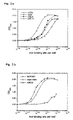
- the ELISA-plates (Nunc, Macrosorp) were coated with 400 ⁇ g/ml phosphocholine-BSA in PBS buffer (20 mM phosphate, pH 7.2, 115 mM NaCl).
- the hapten reagent was prepared from nitrophenyl phosphocholine (Sigma), which was reduced and diazotized essentially as described (Chesebro & Metzger, 1972, literature cited), and reacted by azo-coupling to BSA (Sigma) in borate-saline buffer (52.5 mM sodium borate, pH 9, 120 mM NaCl) at 4 ⁇ C for 48 hours with subsequent dialysis against PBS.
- thermodynamic affinity of the natural antibody to soluble phosphocholine is about 1.6 $ 10 5 M -1 and thus relatively weak (Metzger et al., 1971, Proceedings of the I st Congress of Imunology. Academic Press, New York, pp. 253-267), and this is apparently not sufficient for a monomeric fragment-hapten complex to survive the repeated washing steps of a functional ELISA (Kemeny & Challacombe, 1988, "ELISA and other solid phase immunoassays", Wiley & Sons, New York).
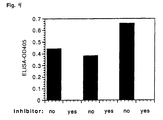
- Coexpressed bifunctional miniantibodies recognizing phosphorylcholine with one arm and lysozyme with the other arm were purified by phosphocholine (PC) affinity chromatography and tested for lysozyme specificity.
- An ELISA-plate was coated with lysozyme, the ELISA was carried out as described in Example VII.Three different preparations show binding to the antigen-surface, which is completely inhibitible with soluble lysozyme (Fig. 4).
Landscapes
- Health & Medical Sciences (AREA)
- Chemical & Material Sciences (AREA)
- Organic Chemistry (AREA)
- Genetics & Genomics (AREA)
- Immunology (AREA)
- Life Sciences & Earth Sciences (AREA)
- Molecular Biology (AREA)
- Biochemistry (AREA)
- Biophysics (AREA)
- General Health & Medical Sciences (AREA)
- Engineering & Computer Science (AREA)
- Medicinal Chemistry (AREA)
- Proteomics, Peptides & Aminoacids (AREA)
- Biomedical Technology (AREA)
- Wood Science & Technology (AREA)
- Biotechnology (AREA)
- General Engineering & Computer Science (AREA)
- Zoology (AREA)
- Bioinformatics & Cheminformatics (AREA)
- Physics & Mathematics (AREA)
- Microbiology (AREA)
- Plant Pathology (AREA)
- Peptides Or Proteins (AREA)
- Preparation Of Compounds By Using Micro-Organisms (AREA)
- Medicines Containing Antibodies Or Antigens For Use As Internal Diagnostic Agents (AREA)
Claims (24)
- Protéine de fusion à fragment d'anticorps monomérique consistant en un fragment Fv d'un anticorps et en un peptide qui est capable de se dimériser avec un autre peptide par interaction non covalente.
- Monomère selon la revendication 1, caractérisé en ce que le fragment Fv est un fragment monocaténaire.
- Monomère selon la revendication 1 ou 2, caractérisé en ce que le peptide interactif consiste en 10 à 50, de préférence 10 à 30 acides aminés.
- Monomère selon l'une des revendications 1 ou 3, caractérisé en ce que le peptide se compose d'au moins une hélice.
- Monomère selon la revendication 4, caractérisé en ce que le peptide en hélice se compose d'une hélice, d'un coude et d'une autre hélice.
- Monomère selon la revendication 4, caractérisé en ce que le peptide contient une molécule de fermeture ("zipper") à leucine, ayant plusieurs acides aminés répétés, dans laquelle un acide aminé sur sept est une leucine.
- Monomère selon la revendication 4, caractérisé en ce que le peptide porte des résidus chargés.
- Monomère selon l'une des revendications 1 à 7, caractérisé en ce qu'un peptide de liaison se trouve entre le fragment Fv et le peptide.
- Monomère selon la revendication 8, caractérisé en ce que le peptide de liaison est une séquence de région charnière d'un anticorps ou d'un de ses fragments.
- Procédé de préparation d'une protéine de fusion à anticorps monomérique telle que définie dans les revendications 1 à 9, caractérisé en ce qu'on clone les gènes codant pour le fragment Fv, le peptide interactif et, si on le désire, le peptide de liaison, dans un plasmide d'expression, en ce qu'on transforme une cellule hôte avec ledit plasmide d'expression et en ce qu'on la cultive dans une solution nutritive, et en ce qu'on exprime la protéine de fusion monomérique dans la cellule ou en ce qu'on la sécrète dans le milieu.
- Procédé selon la revendication 10, caractérisé en ce que la cellule hôte est E. coli.
- Protéine de fusion dimérique consistant en deux protéines de fusion monomériques, dans laquelle la liaison des unités monomériques se fonde sur l'interaction non covalente de peptides identiques ou différents, caractérisée en ce qu'au moins une unité monomérique est une protéine de fusion à fragment d'anticorps telle que définie dans les revendications 1 à 9.
- Protéine de fusion dimérique selon la revendication 12 dans laquelle les peptides interactifs sont les mêmes.
- Dimère selon la revendication 12 ou 13, caractérisé en ce que la seconde unité monomérique est une protéine de fusion à fragment d'anticorps telle que définie dans les revendications 1 à 9 ayant une spécificité différente.
- Dimère selon la revendication 12 ou 13, caractérisé en ce que la seconde unité monomérique est une protéine de fusion telle que définie dans les revendication 1 à 9, dans laquelle le fragment d'anticorps (Fv) est remplacé par une protéine ou un peptide non-anticorps.
- Dimère selon la revendication 15, caractérisé en ce que la protéine ou le peptide est une toxine, un peptide chélateur, une protéine de liaison à un métal ou une enzyme, ou a le site de liaison spécifique correspondant.
- Dimère selon la revendication 15, caractérisé en ce que la protéine ou le peptide a un site de liaison spécifique à une cellule T, ou à un fragment de cellule T.
- Dimère selon l'une des revendications 12 à 17, dans lequel une autre protéine est fusionnée à l'extrémité C-terminale d'un ou des deux peptides intercalants.
- Dimère selon la revendication 18, dans lequel la protéine fusionnée est une toxine, un peptide chélateur, une protéine de liaison à un métal ou une enzyme, ou a le site de liaison spécifique corresponddant, ou a un site de liaison spécifique à une cellule T (fragment).
- Procédé de préparation d'une protéine de fusion dimérique définie dans les revendications 12 à 19, caractérisé en ce qu'on clone les gènes codant pour les protéines de fusion monomériques complètes ou des parties de ces protéines au moins dans un plasmide d'expression, en ce qu'on transforme une cellule hôte avec le(s)dit(s) plasmide(s) d'expression et qu'on la cultive dans une solution nutritive, et soit qu'on exprime la protéine de fusion dimérique complète dans la cellule ou dans le milieu, soit qu'on exprime séparément les protéines de fusion monomériques et qu'on effectue la liaison non covalente entre les deux unités monomériques dans le milieu ou in vitro, et dans le cas où l'on ne clone que des parties des protéines de fusion, on effectue en outre des étapes de génie protéique.
- Procédé selon la revendication 20, caractérisé en ce qu'on clone le gène codant pour la première protéine de fusion monomérique dans un premier plasmide d'expression, et en ce qu'on clone le gène codant pour la seconde protéine de fusion monomérique dans un second plasmide d'expression.
- Procédé selon la revendication 20, caractérisé en ce qu'on effectue in vitro la liaison non covalente entre les unités monomériques formant la protéine de fusion dimérique.
- Procédé selon l'une des revendications 20 à 22, caractérisé en ce que la cellule hôte est E. coli.
- Trousse de construction pour la préparation de dimères sélectifs de protéines de fusion à fragments d'anticorps telles que définies dans les revendications 12 à 19, contenant (a) une protéine de fusion à fragment d'anticorps monomérique telle que définie dans les revendications 1 à 8, et (b) une seconde protéine de fusion monomérique telle définie en (a), dans laquelle le fragment d'anticorps a une spécificité antigénique identique ou différente, ou bien dans laquelle l'unité fragment d'anticorps est remplacé par une protéine/un peptide non-anticorps.
Priority Applications (1)
| Application Number | Priority Date | Filing Date | Title |
|---|---|---|---|
| EP93902206A EP0654085B1 (fr) | 1992-01-23 | 1993-01-15 | Proteines fusionnees monomeres et dimeres a fragments d'anticorps |
Applications Claiming Priority (4)
| Application Number | Priority Date | Filing Date | Title |
|---|---|---|---|
| EP92101069 | 1992-01-23 | ||
| EP92101069 | 1992-01-23 | ||
| EP93902206A EP0654085B1 (fr) | 1992-01-23 | 1993-01-15 | Proteines fusionnees monomeres et dimeres a fragments d'anticorps |
| PCT/EP1993/000082 WO1993015210A1 (fr) | 1992-01-23 | 1993-01-15 | Proteines fusionnees monomeres et dimeres a fragments d'anticorps |
Publications (2)
| Publication Number | Publication Date |
|---|---|
| EP0654085A1 EP0654085A1 (fr) | 1995-05-24 |
| EP0654085B1 true EP0654085B1 (fr) | 1997-04-02 |
Family
ID=8209260
Family Applications (1)
| Application Number | Title | Priority Date | Filing Date |
|---|---|---|---|
| EP93902206A Expired - Lifetime EP0654085B1 (fr) | 1992-01-23 | 1993-01-15 | Proteines fusionnees monomeres et dimeres a fragments d'anticorps |
Country Status (16)
| Country | Link |
|---|---|
| US (1) | US5910573A (fr) |
| EP (1) | EP0654085B1 (fr) |
| JP (2) | JP3490437B2 (fr) |
| KR (1) | KR100254759B1 (fr) |
| AT (1) | ATE151113T1 (fr) |
| AU (1) | AU676150B2 (fr) |
| CA (1) | CA2128511C (fr) |
| CZ (1) | CZ287296B6 (fr) |
| DE (1) | DE69309472T2 (fr) |
| DK (1) | DK0654085T3 (fr) |
| ES (1) | ES2102007T3 (fr) |
| GR (1) | GR3023860T3 (fr) |
| HU (1) | HU215180B (fr) |
| NO (1) | NO942750L (fr) |
| RU (1) | RU2128709C1 (fr) |
| WO (1) | WO1993015210A1 (fr) |
Cited By (2)
| Publication number | Priority date | Publication date | Assignee | Title |
|---|---|---|---|---|
| US7696324B2 (en) | 1998-11-30 | 2010-04-13 | Perlan Therapeutics, Inc. | Humanized antibodies |
| US8394771B1 (en) | 2001-07-19 | 2013-03-12 | Perlan Therapeutics, Inc. | Multimeric proteins and methods of making and using same |
Families Citing this family (253)
| Publication number | Priority date | Publication date | Assignee | Title |
|---|---|---|---|---|
| US6416738B1 (en) | 1973-12-07 | 2002-07-09 | Neorx Corporation | Pretargeting methods and compounds |
| US6075010A (en) * | 1992-06-09 | 2000-06-13 | Neorx Corporation | Small molecular weight ligand-hexose containing clearing agents |
| US5576195A (en) * | 1985-11-01 | 1996-11-19 | Xoma Corporation | Vectors with pectate lyase signal sequence |
| US5618920A (en) * | 1985-11-01 | 1997-04-08 | Xoma Corporation | Modular assembly of antibody genes, antibodies prepared thereby and use |
| US5869620A (en) * | 1986-09-02 | 1999-02-09 | Enzon, Inc. | Multivalent antigen-binding proteins |
| US6027725A (en) * | 1991-11-25 | 2000-02-22 | Enzon, Inc. | Multivalent antigen-binding proteins |
| CA2372813A1 (fr) | 1992-02-06 | 1993-08-19 | L.L. Houston | Proteine fixatrice biosynthetique pour marqueur du cancer |
| US6217869B1 (en) | 1992-06-09 | 2001-04-17 | Neorx Corporation | Pretargeting methods and compounds |
| US6358490B2 (en) | 1992-06-09 | 2002-03-19 | Neorx Corporation | Three-step pretargeting methods and compounds |
| US5911969A (en) | 1992-06-09 | 1999-06-15 | Neorx Corporation | Pretargeting protocols for enhanced localization of active agents to target sites |
| US6329507B1 (en) * | 1992-08-21 | 2001-12-11 | The Dow Chemical Company | Dimer and multimer forms of single chain polypeptides |
| WO1994012520A1 (fr) * | 1992-11-20 | 1994-06-09 | Enzon, Inc. | Segment de liaison pour polypeptides fusionnes lies |
| GB9225453D0 (en) | 1992-12-04 | 1993-01-27 | Medical Res Council | Binding proteins |
| US6015897A (en) * | 1993-12-07 | 2000-01-18 | Neorx Corporation | Biotinamido-n-methylglycyl-seryl-o-succinamido-benzyl dota |
| CA2178477A1 (fr) * | 1993-12-07 | 1995-06-15 | Louis J. Theodore | Procede et composes permettant un ciblage prealable |
| US20050214309A1 (en) * | 1994-03-18 | 2005-09-29 | Hinrichs Steven H | Methods and compositions for modulating transcription factor activity |
| SE9401460D0 (sv) * | 1994-04-28 | 1994-04-28 | Ferring Ab | Antigen/antibody specificity exhanger |
| US6040137A (en) | 1995-04-27 | 2000-03-21 | Tripep Ab | Antigen/antibody specification exchanger |
| US6660842B1 (en) | 1994-04-28 | 2003-12-09 | Tripep Ab | Ligand/receptor specificity exchangers that redirect antibodies to receptors on a pathogen |
| US6933366B2 (en) | 1996-12-27 | 2005-08-23 | Tripep Ab | Specificity exchangers that redirect antibodies to bacterial adhesion receptors |
| JP3659261B2 (ja) | 1994-10-20 | 2005-06-15 | モルフォシス・アクチェンゲゼルシャフト | 組換体タンパク質の多機能性複合体への標的化ヘテロ結合 |
| US6172045B1 (en) | 1994-12-07 | 2001-01-09 | Neorx Corporation | Cluster clearing agents |
| US6908903B1 (en) | 1994-12-07 | 2005-06-21 | Aletheon Pharmaceuticals, Inc. | Cluster clearing agents |
| US7399837B2 (en) * | 1995-12-22 | 2008-07-15 | Smithkline Beecham Corporation | Recombinant IL-5 antagonists useful in treatment of IL-5 mediated disorders |
| US5683892A (en) * | 1994-12-23 | 1997-11-04 | Smithkline Beecham Corporation | DNA encoding recombinant IL-5 antagonists useful in treatment of IL-5 mediated disorders |
| WO1996037621A2 (fr) * | 1995-05-23 | 1996-11-28 | Morphosys Gesellschaft Für Proteinoptimierung Mbh | Proteines multimeres |
| US7105307B2 (en) | 1997-08-30 | 2006-09-12 | Cyclacel, Ltd. | Compositions and methods for screening for modulators of enzymatic activity |
| GB9718358D0 (en) * | 1997-08-30 | 1997-11-05 | Univ Leeds | Chemical modification |
| ES2245052T3 (es) * | 1997-12-01 | 2005-12-16 | Fang Fang | Anticuerpos de recombinacion multivalentes destinados para el tratamiento de infecciones debidas al rinovirus humano (hrv). |
| US6204537B1 (en) | 1998-10-01 | 2001-03-20 | Micron Technology, Inc. | ESD protection scheme |
| US20040009535A1 (en) | 1998-11-27 | 2004-01-15 | Celltech R&D, Inc. | Compositions and methods for increasing bone mineralization |
| US6432673B1 (en) * | 1998-12-07 | 2002-08-13 | Zymogenetics, Inc. | Growth factor homolog ZVEGF3 |
| US7550143B2 (en) * | 2005-04-06 | 2009-06-23 | Ibc Pharmaceuticals, Inc. | Methods for generating stably linked complexes composed of homodimers, homotetramers or dimers of dimers and uses |
| SK782002A3 (en) | 1999-07-21 | 2003-08-05 | Lexigen Pharm Corp | FC fusion proteins for enhancing the immunogenicity of protein and peptide antigens |
| WO2001010912A1 (fr) * | 1999-08-09 | 2001-02-15 | Lexigen Pharmaceuticals Corp. | Complexes d'anticorps contenant plusieurs cytokines |
| US7569542B2 (en) | 1999-08-20 | 2009-08-04 | The Regents Of The University Of California | Anti-microbial targeting chimeric pharmaceutical |
| US20030143234A1 (en) * | 1999-08-20 | 2003-07-31 | Wenyuan Shi | Anti-microbial targeting chimeric pharmaceutical |
| PL362324A1 (en) * | 2001-02-19 | 2004-10-18 | Merck Patent Gmbh | Artificial fusion proteins with reduced immunogenicity |
| IL159177A0 (en) * | 2001-06-20 | 2004-06-01 | Prochon Biotech Ltd | Antibodies that block receptor protein tyrosine kinase activation, methods of screening for and uses thereof |
| US7022323B2 (en) | 2001-06-26 | 2006-04-04 | Progenics Pharmaceuticals, Inc. | Uses of DC-SIGN and DC-SIGNR for inhibiting hepatitis C virus infection |
| DE10133071A1 (de) * | 2001-07-07 | 2003-03-06 | Alexander Cherkasky | Antigene, Rezeptoren, Liganden oder ihre Regionen kombiniert mit proteolytischer Aktivität |
| US6833441B2 (en) | 2001-08-01 | 2004-12-21 | Abmaxis, Inc. | Compositions and methods for generating chimeric heteromultimers |
| WO2003018749A2 (fr) * | 2001-08-22 | 2003-03-06 | Shengfeng Li | Compositions et procedes destines a generer des unites de liaison a l'antigene |
| US7175983B2 (en) * | 2001-11-02 | 2007-02-13 | Abmaxis, Inc. | Adapter-directed display systems |
| US20050069549A1 (en) | 2002-01-14 | 2005-03-31 | William Herman | Targeted ligands |
| US7335359B2 (en) | 2003-02-06 | 2008-02-26 | Tripep Ab | Glycosylated specificity exchangers |
| CN1747970A (zh) | 2003-02-06 | 2006-03-15 | 三肽公司 | 抗原/抗体或配体/受体糖基化的特异性交换剂 |
| SI1624891T2 (sl) * | 2003-05-06 | 2013-09-30 | Biogen Idec Hemophilia Inc. | Strjevalni faktor-FC himerni proteini za zdravljenje hemofilije |
| WO2004100882A2 (fr) * | 2003-05-06 | 2004-11-25 | Syntonix Pharmaceuticals, Inc. | Inhibition de medicament se liant a la serumalbumine |
| TWI353991B (en) | 2003-05-06 | 2011-12-11 | Syntonix Pharmaceuticals Inc | Immunoglobulin chimeric monomer-dimer hybrids |
| US7348004B2 (en) * | 2003-05-06 | 2008-03-25 | Syntonix Pharmaceuticals, Inc. | Immunoglobulin chimeric monomer-dimer hybrids |
| US9481878B2 (en) | 2004-02-13 | 2016-11-01 | Immunomedics, Inc. | Compositions and methods of use of immunotoxins comprising ranpirnase (Rap) show potent cytotoxic activity |
| US8551480B2 (en) * | 2004-02-13 | 2013-10-08 | Immunomedics, Inc. | Compositions and methods of use of immunotoxins comprising ranpirnase (Rap) show potent cytotoxic activity |
| US7875598B2 (en) * | 2004-03-04 | 2011-01-25 | The Regents Of The University Of California | Compositions useful for the treatment of microbial infections |
| AU2005276117C1 (en) | 2004-08-23 | 2013-04-18 | Yeda Research And Development Co. Ltd. At The Weizmann Institute Of Science | Peptide inhibitors for mediating stress responses |
| AU2005302083A1 (en) * | 2004-11-04 | 2006-05-11 | Fibron Limited | Treatment of B-cell malignancies |
| US20120276100A1 (en) * | 2005-04-06 | 2012-11-01 | Ibc Pharmaceuticals, Inc. | Compositions and Methods of Use of Immunotoxins Comprising Ranpirnase (Rap) Show Potent Cytotoxic Activity |
| US8034902B2 (en) * | 2005-05-04 | 2011-10-11 | Quark Pharmaceuticals, Inc. | Recombinant antibodies against CD55 and CD59 and uses thereof |
| US7989219B2 (en) | 2005-05-31 | 2011-08-02 | Canon Kabushiki Kaisha | Bispecific capturing molecule |
| KR100832773B1 (ko) | 2005-11-18 | 2008-05-27 | 주식회사 아이지세라피 | 기능성 Fv 항체 절편 제조 방법 |
| DE602007009954D1 (de) | 2006-03-22 | 2010-12-02 | Viral Logic Systems Technology | Verfahren zur identifizierung von polypeptid-targets |
| TWI428448B (zh) * | 2006-03-24 | 2014-03-01 | Syntonix Pharmaceuticals Inc | 作為第九因子(factor ix)原肽處理酶之pc5 |
| US8377448B2 (en) * | 2006-05-15 | 2013-02-19 | The Board Of Trustees Of The Leland Standford Junior University | CD47 related compositions and methods for treating immunological diseases and disorders |
| WO2007133811A2 (fr) * | 2006-05-15 | 2007-11-22 | Viral Logic Systems Technology Corp. | Compositions associées au cd47 et procédés destinés au traitement de maladies et de troubles immunologiques |
| US8101721B2 (en) * | 2006-06-15 | 2012-01-24 | Fibron Ltd. | Antibodies blocking fibroblast growth factor receptor activation and methods of use thereof |
| EP2471816A1 (fr) | 2006-08-30 | 2012-07-04 | Genentech, Inc. | Anticorps multi-spécifiques |
| CA2661634C (fr) | 2006-09-06 | 2017-03-28 | The Regents Of The University Of California | Peptides antimicrobiens cibles selectivement et leur utilisation |
| EP2072527A1 (fr) | 2007-12-21 | 2009-06-24 | Altonabiotec AG | Procédé et système pour fournir des services de communications sur un terminal mobile, et terminal mobile |
| KR20100134702A (ko) | 2008-03-28 | 2010-12-23 | 글락소스미스클라인 엘엘씨 | 치료 방법 |
| AR073538A1 (es) | 2008-09-03 | 2010-11-17 | Genentech Inc | Anticuerpos multiespecificos que se unen especificamente al receptor del factor de crecimiento epidermico humano 2 (her2) y al factor de crecimiento endotelial vascular (vegf) |
| TWI513466B (zh) * | 2010-01-20 | 2015-12-21 | Boehringer Ingelheim Int | 抗凝血劑解毒劑 |
| WO2012069466A1 (fr) | 2010-11-24 | 2012-05-31 | Novartis Ag | Molécules multi-spécifiques |
| EA201301090A1 (ru) | 2011-03-30 | 2014-05-30 | Бёрингер Ингельхайм Интернациональ Гмбх | Антидоты антикоагулянтов |
| EP3263127B1 (fr) | 2011-05-23 | 2019-08-21 | Yeda Research and Development Co. Ltd | Utilisation de la phosphorylation akt en tant que biomarqueur de pronostic de maladies neurodégénératives et le traitement de ceux-ci |
| WO2013054320A1 (fr) | 2011-10-11 | 2013-04-18 | Tel Hashomer Medical Research Infrastructure And Services Ltd. | Anticorps dirigés contre la molécule d'adhésion cellulaire associée à l'antigène carcino-embryonnaire (ceacam) |
| WO2013078425A1 (fr) * | 2011-11-22 | 2013-05-30 | University Of Maryland, Baltimore | Anticorps monoclonaux de la lamproie avec une affinité et une sélectivité élevées pour des glycanes et leurs utilisations |
| MX359411B (es) | 2012-01-13 | 2018-09-27 | Univ Wuerzburg J Maximilians | Complementación funcional bipartita inducida por antígenos, dual. |
| ES2702278T3 (es) | 2012-04-01 | 2019-02-28 | Technion Res & Dev Foundation | Péptidos de inductor de metaloproteinasa de matriz extracelular (emmprin) y anticuerpos de unión |
| SG11201505926VA (en) | 2013-03-15 | 2015-09-29 | Biogen Ma Inc | Factor ix polypeptide formulations |
| EP3027204B1 (fr) | 2013-07-29 | 2022-01-05 | 2seventy bio, Inc. | Protéines de signalisation multipartites et leurs utilisations |
| US9243294B2 (en) | 2013-09-30 | 2016-01-26 | Hadasit Medical Research Services And Development Ltd. | Modulation of NLGn4 expression, NK cell activity in non-alcoholic fatty liver disease (NAFLD) |
| ES2980417T3 (es) | 2013-11-25 | 2024-10-01 | Famewave Ltd | Composiciones que comprenden anticuerpos anti-CEACAM1 y anti-PD para la terapia del cáncer |
| UA122479C2 (uk) | 2014-01-24 | 2020-11-25 | Дана-Фарбер Кенсер Інстітьют, Інк. | Виділена молекула антитіла, яка зв’язується з людським білком програмованої смерті-1 (pd-1) |
| US9993472B2 (en) | 2014-01-28 | 2018-06-12 | Unity Biotechnology, Inc. | Treatment for osteoarthritis in a joint by administering a means for inhibiting MDM2 |
| PL3099717T3 (pl) | 2014-01-31 | 2019-10-31 | Novartis Ag | Cząsteczki przeciwciała dla TIM-3 i ich zastosowanie |
| EA201691765A1 (ru) | 2014-03-14 | 2016-12-30 | Новартис Аг | Молекулы антител против lag-3 и их применения |
| CN122399016A (zh) | 2014-03-15 | 2026-07-17 | 诺华股份有限公司 | 使用嵌合抗原受体治疗癌症 |
| EP3122768A2 (fr) | 2014-03-27 | 2017-02-01 | Yeda Research and Development Co. Ltd. | Récepteur de cellules t cdr3, peptides et anticorps |
| US11427647B2 (en) | 2014-04-27 | 2022-08-30 | Famewave Ltd. | Polynucleotides encoding humanized antibodies against CEACAM1 |
| JP6805428B2 (ja) | 2014-04-27 | 2021-01-06 | フェイムウェイヴ リミテッド | Ceacam1に対するヒト化抗体 |
| JP2016002009A (ja) * | 2014-06-13 | 2016-01-12 | 国立大学法人名古屋大学 | タグ付抗体 |
| AU2015292744C1 (en) | 2014-07-21 | 2021-01-21 | Novartis Ag | Treatment of cancer using humanized anti-BCMA chimeric antigen receptor |
| JP2017528433A (ja) | 2014-07-21 | 2017-09-28 | ノバルティス アーゲー | 低い免疫増強用量のmTOR阻害剤とCARの組み合わせ |
| WO2016014553A1 (fr) | 2014-07-21 | 2016-01-28 | Novartis Ag | Récepteurs d'antigènes chimères synthétisés par l'intermédiaire d'une sortase |
| JP6831777B2 (ja) | 2014-07-21 | 2021-02-17 | ノバルティス アーゲー | Cd33キメラ抗原受容体を使用する癌の処置 |
| WO2016019300A1 (fr) | 2014-07-31 | 2016-02-04 | Novartis Ag | Sous-ensemble optimisé de lymphocytes t contenant un récepteur d'antigène chimère |
| EP3180359A1 (fr) | 2014-08-14 | 2017-06-21 | Novartis AG | Traitement du cancer à l'aide du récepteur d'antigène chimérique gfr alpha-4 |
| EP3712171A1 (fr) | 2014-08-19 | 2020-09-23 | Novartis AG | Traitement du cancer à l'aide d'un récepteur d'antigène chimérique cd123 |
| US10577417B2 (en) | 2014-09-17 | 2020-03-03 | Novartis Ag | Targeting cytotoxic cells with chimeric receptors for adoptive immunotherapy |
| SG11201702401RA (en) | 2014-10-14 | 2017-04-27 | Novartis Ag | Antibody molecules to pd-l1 and uses thereof |
| US20180334490A1 (en) | 2014-12-03 | 2018-11-22 | Qilong H. Wu | Methods for b cell preconditioning in car therapy |
| EP3277306B1 (fr) | 2015-04-01 | 2023-02-22 | Hadasit Medical Research Services and Development Ltd. | Inhibiteurs de l'interaction protéine-protéine neuroligine 4-neurexine 1-bêta pour l'utilisation dans le traitement de troubles hépatiques |
| PL3280729T3 (pl) | 2015-04-08 | 2022-08-22 | Novartis Ag | Terapie cd20, terapie cd22 i terapie skojarzone komórką eksprymującą chimeryczny receptor antygenowy (car) cd19 |
| WO2016172583A1 (fr) | 2015-04-23 | 2016-10-27 | Novartis Ag | Traitement du cancer à l'aide de protéine récepteur antigénique chimérique et un inhibiteur de protéine kinase |
| EP3328418A1 (fr) | 2015-07-29 | 2018-06-06 | Novartis AG | Traitements combinés comprenant des molécules d'anticorps qui se lient à pd-1 |
| US20180207273A1 (en) | 2015-07-29 | 2018-07-26 | Novartis Ag | Combination therapies comprising antibody molecules to tim-3 |
| US20180340025A1 (en) | 2015-07-29 | 2018-11-29 | Novartis Ag | Combination therapies comprising antibody molecules to lag-3 |
| US10946095B2 (en) | 2015-09-02 | 2021-03-16 | Yissum Research Development Company Of The Hebrew University Of Jerusalem Ltd. | Antibodies specific to human T-cell immunoglobulin and ITIM domain (TIGIT) |
| US11161912B2 (en) | 2015-10-13 | 2021-11-02 | Technion Research & Development Foundation Limited | Heparanase-neutralizing monoclonal antibodies |
| CN108495651A (zh) | 2015-12-17 | 2018-09-04 | 诺华股份有限公司 | 抗pd-1的抗体分子及其用途 |
| CN108697794A (zh) | 2015-12-17 | 2018-10-23 | 诺华股份有限公司 | C-met抑制剂和抗pd-1抗体分子的组合及其用途 |
| PT3393504T (pt) | 2015-12-22 | 2025-12-30 | Novartis Ag | Recetor de antigénio quimérico (car) de mesotelina e anticorpo contra o inibidor de pd-l1 para utilização combinada em terapia anticancerígena |
| EP3851457A1 (fr) | 2016-01-21 | 2021-07-21 | Novartis AG | Molécules multispécifiques ciblant cll-1 |
| RU2756275C2 (ru) | 2016-03-01 | 2021-09-29 | Юссум Рисёрч Девелопмент Компани Оф Зэ Хибру Юниверсити Оф Иерусалим Лтд. | Антитела, специфические к рецептору полиовируса (pvr) человека |
| SG11201807489PA (en) | 2016-03-04 | 2018-09-27 | Novartis Ag | Cells expressing multiple chimeric antigen receptor (car) molecules and uses therefore |
| EP3432924A1 (fr) | 2016-03-23 | 2019-01-30 | Novartis AG | Mini-corps sécrétés par des cellules et leurs usages |
| US20230071283A1 (en) | 2016-04-15 | 2023-03-09 | Aimee S. Payne | Compositions and methods for selective protein expression |
| GB201609235D0 (en) | 2016-05-25 | 2016-07-06 | Univ Cape Town | Production of a horseradish peroxidase-IGG fusion protein |
| WO2017210617A2 (fr) | 2016-06-02 | 2017-12-07 | Porter, David, L. | Régimes thérapeutiques pour cellules exprimant un récepteur antigénique chimérique (car) |
| EP3484455A2 (fr) | 2016-07-15 | 2019-05-22 | Novartis AG | Traitement et prévention du syndrome de libération de cytokine à l'aide d'un récepteur d'antigène chimérique en combinaison avec un inhibiteur de kinase |
| KR20230100748A (ko) | 2016-07-28 | 2023-07-05 | 노파르티스 아게 | 키메라 항원 수용체 및 pd-1 억제제의 조합 요법 |
| SG11201900885VA (en) | 2016-08-01 | 2019-02-27 | Novartis Ag | Treatment of cancer using a chimeric antigen receptor in combination with an inhibitor of a pro-m2 macrophage molecule |
| JP7467117B2 (ja) | 2016-10-07 | 2024-04-15 | ノバルティス アーゲー | 癌の治療のためのキメラ抗原受容体 |
| US11535662B2 (en) | 2017-01-26 | 2022-12-27 | Novartis Ag | CD28 compositions and methods for chimeric antigen receptor therapy |
| WO2018160731A1 (fr) | 2017-02-28 | 2018-09-07 | Novartis Ag | Compositions d'inhibiteur shp et utilisations pour une thérapie de récepteur d'antigène chimère |
| EP3615055A1 (fr) | 2017-04-28 | 2020-03-04 | Novartis AG | Cellules exprimant un récepteur antigénique chimérique ciblant le bcma, et polythérapie comprenant un inhibiteur de gamma sécrétase |
| EP3615068A1 (fr) | 2017-04-28 | 2020-03-04 | Novartis AG | Agent ciblant le bcma et polythérapie incluant un inhibiteur de gamma-sécrétase |
| CN110913887A (zh) | 2017-06-06 | 2020-03-24 | 葛兰素史克有限责任公司 | 用于儿科患者的生物药物组合物和方法 |
| UY37758A (es) | 2017-06-12 | 2019-01-31 | Novartis Ag | Método de fabricación de anticuerpos biespecíficos, anticuerpos biespecíficos y uso terapéutico de dichos anticuerpos |
| MX2019015885A (es) | 2017-06-22 | 2020-09-10 | Novartis Ag | Moleculas de anticuerpo que se unen a cd73 y usos de las mismas. |
| CN111050791A (zh) | 2017-06-27 | 2020-04-21 | 诺华股份有限公司 | 用于抗tim-3抗体的给药方案及其用途 |
| WO2019018730A1 (fr) | 2017-07-20 | 2019-01-24 | Novartis Ag | Régimes posologiques pour des anticorps anti-lag3 et leurs utilisations |
| MX2020004756A (es) | 2017-11-16 | 2020-08-20 | Novartis Ag | Terapias de combinacion. |
| CA3084551A1 (fr) | 2017-12-14 | 2019-06-20 | Bluebird Bio, Inc. | Recepteurs de l'interleukine darique |
| EP3708661A4 (fr) * | 2017-12-22 | 2021-12-01 | Hanmi Pharm. Co., Ltd. | Protéine de fusion d'enzyme thérapeutique à nouvelle structure et son utilisation |
| US12247060B2 (en) | 2018-01-09 | 2025-03-11 | Marengo Therapeutics, Inc. | Calreticulin binding constructs and engineered T cells for the treatment of diseases |
| AU2019215031C1 (en) | 2018-01-31 | 2026-02-26 | Novartis Ag | Combination therapy using a chimeric antigen receptor |
| EP3765517A1 (fr) | 2018-03-14 | 2021-01-20 | Elstar Therapeutics, Inc. | Molécules multifonctionnelles se liant à calréticuline et utilisations associees |
| US20210147547A1 (en) | 2018-04-13 | 2021-05-20 | Novartis Ag | Dosage Regimens For Anti-Pd-L1 Antibodies And Uses Thereof |
| US20210047405A1 (en) | 2018-04-27 | 2021-02-18 | Novartis Ag | Car t cell therapies with enhanced efficacy |
| US12077583B2 (en) | 2018-05-09 | 2024-09-03 | Nectin Therapeutics Ltd. | Antibodies specific to human NECTIN4 |
| CN112384534A (zh) | 2018-05-21 | 2021-02-19 | 指南针制药有限责任公司 | 用于增强nk细胞对靶细胞的杀死的组合物和方法 |
| WO2019226658A1 (fr) | 2018-05-21 | 2019-11-28 | Compass Therapeutics Llc | Compositions multispécifiques de liaison à l'antigène et procédés d'utilisation |
| US20210213063A1 (en) | 2018-05-25 | 2021-07-15 | Novartis Ag | Combination therapy with chimeric antigen receptor (car) therapies |
| WO2019232244A2 (fr) | 2018-05-31 | 2019-12-05 | Novartis Ag | Molécules d'anticorps anti-cd73 et leurs utilisations |
| PE20210320A1 (es) | 2018-06-01 | 2021-02-16 | Novartis Ag | Moleculas de union contra bcma y usos de las mismas |
| IL279367B2 (en) | 2018-06-13 | 2026-05-01 | Novartis Ag | BCMA chimeric antigen receptors and their uses |
| CA3104295A1 (fr) | 2018-06-19 | 2019-12-26 | Atarga, Llc | Molecules d'anticorps se liant au composant du complement 5 et leurs utilisations |
| WO2020010250A2 (fr) | 2018-07-03 | 2020-01-09 | Elstar Therapeutics, Inc. | Molécules d'anticorps anti-tcr et leurs utilisations |
| AR116109A1 (es) | 2018-07-10 | 2021-03-31 | Novartis Ag | Derivados de 3-(5-amino-1-oxoisoindolin-2-il)piperidina-2,6-diona y usos de los mismos |
| JP2021531306A (ja) | 2018-07-25 | 2021-11-18 | アドバンスド アクセラレーター アプリケーションズ エスエー | 神経内分泌腫瘍の処置の方法 |
| KR20210099614A (ko) | 2018-12-04 | 2021-08-12 | 노파르티스 아게 | Cd3에 대한 결합 분자 및 이의 용도 |
| WO2020123947A1 (fr) | 2018-12-14 | 2020-06-18 | Bluebird Bio, Inc. | Complexes d'immunorécepteurs régulés par un agent de dimérisation |
| WO2020123938A1 (fr) | 2018-12-14 | 2020-06-18 | Bluebird Bio, Inc. | Complexes d'immunorécepteurs régulés par un agent de dimérisation |
| US20210386763A1 (en) | 2018-12-20 | 2021-12-16 | Novartis Ag | Pharmaceutical combinations |
| AU2019402189B2 (en) | 2018-12-20 | 2023-04-13 | Novartis Ag | Dosing regimen and pharmaceutical combination comprising 3-(1-oxoisoindolin-2-yl)piperidine-2,6-dione derivatives |
| EP3908372A1 (fr) | 2019-01-13 | 2021-11-17 | Yissum Research and Development Company of the Hebrew University of Jerusalem Ltd. | Anticorps spécifiques à la nectine-2 humaine |
| US10871640B2 (en) | 2019-02-15 | 2020-12-22 | Perkinelmer Cellular Technologies Germany Gmbh | Methods and systems for automated imaging of three-dimensional objects |
| EP3924054B1 (fr) | 2019-02-15 | 2025-04-02 | Novartis AG | Dérivés de 3-(1-oxo-5-(pipéridin-4-yl)isoindolin-2-yl)pipéridine-2,6-dione et leurs utilisations |
| CA3123519A1 (fr) | 2019-02-15 | 2020-08-20 | Novartis Ag | Derives de 3-(1-oxoisoindoline-2-yl)piperidine-2,6-dione substitues et leurs utilisations |
| AU2020226893B2 (en) | 2019-02-21 | 2025-02-27 | Marengo Therapeutics, Inc. | Multifunctional molecules that bind to T cell related cancer cells and uses thereof |
| JP7579795B2 (ja) | 2019-02-21 | 2024-11-08 | マレンゴ・セラピューティクス,インコーポレーテッド | NKp30に結合する抗体分子およびその使用 |
| EP3927371A1 (fr) | 2019-02-22 | 2021-12-29 | Novartis AG | Polythérapies à base de récepteurs d'antigènes chimériques egfrviii et d'inhibiteurs de pd -1 |
| PH12021552414A1 (en) | 2019-03-29 | 2022-07-25 | Atarga Llc | Anti fgf23 antibody |
| KR20220004751A (ko) | 2019-05-04 | 2022-01-11 | 인히브릭스, 인크. | CLEC12a 결합 폴리펩타이드 및 이의 용도 |
| WO2020227475A1 (fr) | 2019-05-08 | 2020-11-12 | Bluebird Bio, Inc. | Immunothérapies ciblant cll -1 |
| AU2020279224B2 (en) | 2019-05-21 | 2024-12-05 | Novartis Ag | Trispecific binding molecules against BCMA and uses thereof |
| US12037378B2 (en) | 2019-05-21 | 2024-07-16 | Novartis Ag | Variant CD58 domains and uses thereof |
| UY38701A (es) | 2019-05-21 | 2020-12-31 | Novartis Ag | Moléculas de unión a cd19, conjugados, composiciones que las comprenden y usos de las mismas |
| CN114585651A (zh) | 2019-08-08 | 2022-06-03 | 再生元制药公司 | 新型抗原结合分子形式 |
| KR20220082007A (ko) | 2019-10-08 | 2022-06-16 | 넥틴 테라퓨틱스 리미티드 | 폴리오바이러스 수용체(pvr)에 대한 항체 및 이의 용도 |
| CN114786679A (zh) | 2019-10-21 | 2022-07-22 | 诺华股份有限公司 | 具有维奈托克和tim-3抑制剂的组合疗法 |
| WO2021079195A1 (fr) | 2019-10-21 | 2021-04-29 | Novartis Ag | Inhibiteurs de tim-3 et leurs utilisations |
| AU2020379735A1 (en) | 2019-11-05 | 2022-05-26 | Regeneron Pharmaceuticals, Inc. | N-terminal SCFV multispecific binding molecules |
| WO2021108661A2 (fr) | 2019-11-26 | 2021-06-03 | Novartis Ag | Récepteurs antigéniques chimériques et leurs utilisations |
| US20230057071A1 (en) | 2019-12-20 | 2023-02-23 | Novartis Ag | Combination of anti tim-3 antibody mbg453 and anti tgf-beta antibody nis793, with or without decitabine or the anti pd-1 antibody spartalizumab, for treating myelofibrosis and myelodysplastic syndrome |
| IL293978A (en) | 2019-12-20 | 2022-08-01 | Regeneron Pharma | New il2 agonists and methods of using them |
| WO2021138474A2 (fr) | 2020-01-03 | 2021-07-08 | Marengo Therapeutics, Inc. | Molécules d'anticorps anti-tcr et leurs utilisations |
| EP4090335A1 (fr) | 2020-01-17 | 2022-11-23 | Novartis AG | Polythérapies comprenant un inhibiteur tim-3 et un agent d'hypométhylation à utiliser dans le traitement du syndrome myélodysplasique ou de la leucémie myélomonocytaire chronique |
| CN115298322A (zh) | 2020-01-17 | 2022-11-04 | 贝克顿迪金森公司 | 用于单细胞分泌组学的方法和组合物 |
| IL295878A (en) | 2020-02-27 | 2022-10-01 | Novartis Ag | Methods for producing cells expressing a chimeric antigen receptor |
| WO2021195513A1 (fr) | 2020-03-27 | 2021-09-30 | Novartis Ag | Polythérapie bispécifique pour traiter des maladies prolifératives et des troubles auto-immuns |
| KR20220164787A (ko) | 2020-04-06 | 2022-12-13 | 이슘 리서치 디벨롭먼트 컴퍼니 오브 더 히브루 유니버시티 오브 예루살렘 엘티디. | 암 및 감염의 치료를 위한 NKp46에 대한 항체 및 이의 작제물 |
| US20230242647A1 (en) | 2020-05-01 | 2023-08-03 | Novartis Ag | Engineered immunoglobulins |
| KR20230009430A (ko) | 2020-05-12 | 2023-01-17 | 리제너론 파아마슈티컬스, 인크. | 신규 il10 효능제 및 그의 사용 방법 |
| EP4168007A1 (fr) | 2020-06-23 | 2023-04-26 | Novartis AG | Schéma posologique comprenant des dérivés de 3-(1-oxoisoindoline-2-yl) pipéridine-2,6-dione |
| CA3182945A1 (fr) | 2020-07-06 | 2022-01-13 | Israel Vlodavsky | Anticorps monoclonal a54 neutralisant l'heparanase |
| CA3176556A1 (fr) | 2020-07-16 | 2022-01-20 | Novartis Ag | Anticorps anti-betacelluline, fragments de ceux-ci et molecules de liaison multi-specifiques |
| WO2022026592A2 (fr) | 2020-07-28 | 2022-02-03 | Celltas Bio, Inc. | Molécules d'anticorps contre le coronavirus et leurs utilisations |
| EP4188549A1 (fr) | 2020-08-03 | 2023-06-07 | Novartis AG | Dérivés de 3-(1-oxoisoindolin-2-yl)pipéridine-2,6-dione substitués par hétéroaryle et leurs utilisations |
| WO2022044010A1 (fr) | 2020-08-26 | 2022-03-03 | Yissum Research Development Company Of The Hebrew University Of Jerusalem Ltd. | Anticorps anti-lymphocyte t et domaine itim (tigit) pour le traitement d'infections fongiques |
| WO2022043558A1 (fr) | 2020-08-31 | 2022-03-03 | Advanced Accelerator Applications International Sa | Méthode de traitement de cancers exprimant le psma |
| US20230321285A1 (en) | 2020-08-31 | 2023-10-12 | Advanced Accelerator Applications International Sa | Method of treating psma-expressing cancers |
| WO2022097065A2 (fr) | 2020-11-06 | 2022-05-12 | Novartis Ag | Variants fc d'anticorps |
| US20250215081A1 (en) | 2020-11-06 | 2025-07-03 | Novartis Ag | Anti-cd19 agent and b cell targeting agent combination therapy for treating b cell malignancies |
| AU2021373366A1 (en) | 2020-11-06 | 2023-06-01 | Novartis Ag | Cd19 binding molecules and uses thereof |
| KR20230107617A (ko) | 2020-11-13 | 2023-07-17 | 노파르티스 아게 | 키메라 항원 수용체(car)-발현 세포를 사용한 병용 요법 |
| EP4284510A1 (fr) | 2021-01-29 | 2023-12-06 | Novartis AG | Régimes posologiques d'anticorps anti-cd73 et anti-entpd2 et leurs utilisations |
| KR20230159823A (ko) | 2021-02-11 | 2023-11-22 | 넥틴 테라퓨틱스 리미티드 | Cd112r에 대한 항체 및 이의 용도 |
| TW202304979A (zh) | 2021-04-07 | 2023-02-01 | 瑞士商諾華公司 | 抗TGFβ抗體及其他治療劑用於治療增殖性疾病之用途 |
| CN117597365A (zh) | 2021-05-04 | 2024-02-23 | 再生元制药公司 | 多特异性fgf21受体激动剂及其应用 |
| BR112023022878A2 (pt) | 2021-05-04 | 2024-01-23 | Regeneron Pharma | Agonistas do receptor fgf21 multiespecíficos e seus usos |
| AR125874A1 (es) | 2021-05-18 | 2023-08-23 | Novartis Ag | Terapias de combinación |
| WO2022269451A1 (fr) | 2021-06-22 | 2022-12-29 | Novartis Ag | Anticorps bispécifiques destinés à être utilisés dans le traitement de l'hidrosadénite suppurée |
| AU2022314734A1 (en) | 2021-07-19 | 2024-02-08 | Regeneron Pharmaceuticals, Inc. | Il12 receptor agonists and methods of use thereof |
| CA3229369A1 (fr) | 2021-08-16 | 2023-02-23 | Regeneron Pharmaceuticals, Inc. | Nouveaux agonistes du recepteur d'il27 et procedes d'utilisation associes |
| WO2023044483A2 (fr) | 2021-09-20 | 2023-03-23 | Voyager Therapeutics, Inc. | Compositions et procédés pour le traitement du cancer positif her2 |
| US20250011428A1 (en) | 2021-10-28 | 2025-01-09 | Novartis Ag | Engineered fc variants |
| US12559576B2 (en) | 2021-11-11 | 2026-02-24 | Regeneron Pharmaceuticals, Inc. | CD20-PD1 binding molecules and methods of use thereof |
| WO2023092004A1 (fr) | 2021-11-17 | 2023-05-25 | Voyager Therapeutics, Inc. | Compositions et méthodes pour le traitement de troubles liés à tau |
| WO2023105528A1 (fr) | 2021-12-12 | 2023-06-15 | Yissum Research Development Company Of The Hebrew University Of Jerusalem Ltd. | Anticorps spécifiques de ceacam1 |
| TW202342548A (zh) | 2022-02-07 | 2023-11-01 | 美商威特拉公司 | 抗獨特型(anti-idiotype)抗體分子及其用途 |
| WO2023148707A1 (fr) | 2022-02-07 | 2023-08-10 | Yeda Research And Development Co. Ltd. | Anticorps anti-quiescine sulfhydryle oxydase 1 (qsox1) humanisés et leurs utilisations |
| CA3243763A1 (fr) | 2022-02-28 | 2023-08-31 | Nectin Therapeutics Ltd. | Anticorps humanisés dirigés contre la nectine-2 et conjugués médicamenteux de ceux-ci |
| IL316174A (en) | 2022-04-26 | 2024-12-01 | Novartis Ag | Multiple specific antibodies targeting IL-13 and IL-18 |
| IL316892A (en) | 2022-05-11 | 2025-01-01 | Regeneron Pharma | Multispecific proprotein binding molecules and their uses |
| WO2023220695A2 (fr) | 2022-05-13 | 2023-11-16 | Voyager Therapeutics, Inc. | Compositions et procédés pour le traitement du cancer her2 positif |
| JP2025519158A (ja) | 2022-05-27 | 2025-06-24 | リジェネロン・ファーマシューティカルズ・インコーポレイテッド | インターロイキン-2プロタンパク質及びその使用 |
| CN119654338A (zh) | 2022-06-04 | 2025-03-18 | 再生元制药公司 | 白细胞介素-2蛋白质原及其用途 |
| CA3263767A1 (fr) | 2022-08-03 | 2024-02-08 | Voyager Therapeutics, Inc. | Compositions et procédés permettant le franchissement de la barrière hémato-encéphalique |
| US20240067691A1 (en) | 2022-08-18 | 2024-02-29 | Regeneron Pharmaceuticals, Inc. | Interferon receptor agonists and uses thereof |
| KR20250048583A (ko) | 2022-08-18 | 2025-04-09 | 리제너론 파아마슈티컬스, 인크. | 인터페론 전구단백질 및 이의 용도 |
| CA3272953A1 (fr) | 2022-11-10 | 2024-05-16 | Famewave Ltd. | Anticorps contre la molécule d’adhérence cellulaire liée à l’antigène carcinoembryonnaire 1 (ceacam1) aux fins d’inhibition des activités médiées par la nétose |
| JP2026500017A (ja) | 2022-12-16 | 2026-01-05 | リジェネロン・ファーマシューティカルズ・インコーポレイテッド | Aav粒子に結合する抗原結合分子及びその使用 |
| EP4638729A1 (fr) | 2022-12-23 | 2025-10-29 | Regeneron Pharmaceuticals, Inc. | Protéines de fusion ace2 et leurs utilisations |
| AU2024207005A1 (en) | 2023-01-13 | 2025-08-28 | Regeneron Pharmaceuticals, Inc. | Il12 receptor agonists and methods of use thereof |
| CN121002062A (zh) | 2023-01-13 | 2025-11-21 | 再生元制药公司 | Fgfr3结合分子及其使用方法 |
| WO2024168061A2 (fr) | 2023-02-07 | 2024-08-15 | Ayan Therapeutics Inc. | Molécules d'anticorps se liant au sars-cov-2 |
| IL322890A (en) | 2023-02-28 | 2025-10-01 | Regeneron Pharma | Multispecific molecules containing an MHC-peptide complex containing an MHC domain and an antigenic peptide and a partially targeted immune cell antigen |
| CN121057744A (zh) | 2023-02-28 | 2025-12-02 | 再生元制药公司 | 多价抗刺突蛋白结合分子及其用途 |
| WO2024233926A1 (fr) | 2023-05-10 | 2024-11-14 | Regeneron Pharmaceuticals, Inc. | Molécules de liaison cd20-pd1 et leurs procédés d'utilisation |
| KR20260026098A (ko) | 2023-05-12 | 2026-02-25 | 리제너론 파아마슈티컬스, 인크. | 인터페론 수용체 길항제 및 이의 용도 |
| CN121646605A (zh) | 2023-06-11 | 2026-03-10 | 再生元制药公司 | 环化抗体分子 |
| WO2025042428A1 (fr) | 2023-08-18 | 2025-02-27 | Regeneron Pharmaceuticals, Inc. | Molécules bispécifiques de liaison à l'antigène et leurs utilisations |
| WO2025068957A1 (fr) | 2023-09-29 | 2025-04-03 | Novartis Ag | Anticorps bispécifiques destinés à être utilisés dans l'abaissement du risque d'événements de maladie cardiovasculaire chez des sujets connus pour être un support d'expansion clonale de lignées cellulaires hématopoïétiques avec des mutations somatiques |
| KR20260113057A (ko) | 2023-11-14 | 2026-07-21 | 리제너론 파아마슈티컬스, 인크. | 조작된 중쇄 가변 도메인 및 이의 용도 |
| WO2025122614A1 (fr) | 2023-12-05 | 2025-06-12 | Regeneron Pharmaceuticals, Inc. | Agonistes du récepteur il18 et leurs procédés d'utilisation |
| WO2025122634A1 (fr) | 2023-12-05 | 2025-06-12 | Voyager Therapeutics, Inc. | Compositions et méthodes pour le traitement de troubles liés à la protéine tau |
| WO2025199243A1 (fr) | 2024-03-20 | 2025-09-25 | Regeneron Pharmaceuticals, Inc. | Molécules de liaison multispécifiques trivalentes et leurs procédés d'utilisation |
| WO2025240335A1 (fr) | 2024-05-13 | 2025-11-20 | Regeneron Pharmaceuticals, Inc. | Molécules de liaison au fgfr3 et leurs procédés d'utilisation |
| US20250361309A1 (en) | 2024-05-24 | 2025-11-27 | Regeneron Pharmaceuticals, Inc. | Tumor-targeted split il12 receptor agonists |
| WO2025255480A1 (fr) | 2024-06-07 | 2025-12-11 | Regeneron Pharmaceuticals, Inc. | Molécules de liaison multispécifiques tétravalentes et leurs méthodes d'utilisation |
| WO2025255452A2 (fr) | 2024-06-07 | 2025-12-11 | Regeneron Pharmaceuticals, Inc. | Molécules de liaison à l'antigène qui se lient à des particules d'aav et leurs utilisations |
| US20260055171A1 (en) | 2024-06-11 | 2026-02-26 | Regeneron Pharmaceuticals, Inc. | Vegf antagonists and methods of use thereof |
| WO2026025058A1 (fr) | 2024-07-25 | 2026-01-29 | Regeneron Pharmaceuticals, Inc. | Particules virales d'aav reciblées sur des cellules cancéreuses exprimant le r-egf |
| WO2026036047A1 (fr) | 2024-08-08 | 2026-02-12 | Altus Enterprises, Inc. | Molécules d'anticorps se liant à fixa et fx et leurs utilisations |
| WO2026039791A1 (fr) | 2024-08-16 | 2026-02-19 | Regeneron Pharmaceuticals, Inc. | Agonistes de récepteur d'il2 scindé ciblant les tumeurs |
| US20260167709A1 (en) | 2024-09-11 | 2026-06-18 | Novartis Ag | Antibodies targeting il-31 |
| WO2026075989A1 (fr) | 2024-10-01 | 2026-04-09 | Regeneron Pharmaceuticals, Inc. | Molécules d'igg modifiées et leurs procédés d'utilisation |
| WO2026076013A1 (fr) | 2024-10-01 | 2026-04-09 | Regeneron Pharmaceuticals, Inc. | Agonistes du récepteur il2 ciblant une tumeur et activateurs de lymphocytes t multispécifiques |
| WO2026102093A1 (fr) | 2024-11-07 | 2026-05-15 | Voyager Therapeutics, Inc. | Compositions et procédés pour le traitement de troubles liés à la protéine tau |
| WO2026136279A1 (fr) | 2024-12-16 | 2026-06-25 | Regeneron Pharmaceuticals, Inc. | Constructions d'anticorps à domaine unique modifiés et leurs procédés d'utilisation |
| WO2026151679A1 (fr) | 2025-01-07 | 2026-07-16 | Compass Therapeutics, Llc. | Constructions de liaison multispécifiques ciblant pd-1 et vegf et utilisations associées |
Family Cites Families (7)
| Publication number | Priority date | Publication date | Assignee | Title |
|---|---|---|---|---|
| US5132405A (en) * | 1987-05-21 | 1992-07-21 | Creative Biomolecules, Inc. | Biosynthetic antibody binding sites |
| DE3920358A1 (de) * | 1989-06-22 | 1991-01-17 | Behringwerke Ag | Bispezifische und oligospezifische, mono- und oligovalente antikoerperkonstrukte, ihre herstellung und verwendung |
| DE69034022T2 (de) * | 1989-09-20 | 2003-07-10 | Abbott Laboratories, Abbott Park | Verfahren zur Herstellung von Fusionsproteinen |
| GB8925590D0 (en) * | 1989-11-13 | 1990-01-04 | Central Blood Lab Authority | Monoclonal antibodies |
| EP0453554A4 (en) * | 1989-11-13 | 1993-02-17 | Xoma Corporation | Chimeric mouse human antibodies with specificity to hiv antigens |
| EP0610286B1 (fr) * | 1991-09-30 | 2000-03-15 | THE UNITED STATES OF AMERICA, as represented by the Secretary of the Department of Health and Human Services | Immunotoxines recombinees |
| US5932448A (en) * | 1991-11-29 | 1999-08-03 | Protein Design Labs., Inc. | Bispecific antibody heterodimers |
-
1993
- 1993-01-15 CA CA002128511A patent/CA2128511C/fr not_active Expired - Lifetime
- 1993-01-15 HU HU9402167A patent/HU215180B/hu not_active IP Right Cessation
- 1993-01-15 KR KR1019940702517A patent/KR100254759B1/ko not_active Expired - Lifetime
- 1993-01-15 AT AT93902206T patent/ATE151113T1/de active
- 1993-01-15 ES ES93902206T patent/ES2102007T3/es not_active Expired - Lifetime
- 1993-01-15 CZ CZ19941757A patent/CZ287296B6/cs unknown
- 1993-01-15 RU RU94045249A patent/RU2128709C1/ru active
- 1993-01-15 DK DK93902206.7T patent/DK0654085T3/da active
- 1993-01-15 DE DE69309472T patent/DE69309472T2/de not_active Expired - Lifetime
- 1993-01-15 AU AU34100/93A patent/AU676150B2/en not_active Expired
- 1993-01-15 US US08/256,790 patent/US5910573A/en not_active Expired - Lifetime
- 1993-01-15 JP JP51288993A patent/JP3490437B2/ja not_active Expired - Lifetime
- 1993-01-15 EP EP93902206A patent/EP0654085B1/fr not_active Expired - Lifetime
- 1993-01-15 WO PCT/EP1993/000082 patent/WO1993015210A1/fr not_active Ceased
-
1994
- 1994-07-22 NO NO942750A patent/NO942750L/no not_active Application Discontinuation
-
1997
- 1997-06-20 GR GR970401501T patent/GR3023860T3/el unknown
-
2003
- 2003-08-29 JP JP2003306222A patent/JP2004041221A/ja active Pending
Cited By (3)
| Publication number | Priority date | Publication date | Assignee | Title |
|---|---|---|---|---|
| US7696324B2 (en) | 1998-11-30 | 2010-04-13 | Perlan Therapeutics, Inc. | Humanized antibodies |
| US8586712B2 (en) | 1998-11-30 | 2013-11-19 | Perlan Therapeutics, Inc. | Humanized antibodies |
| US8394771B1 (en) | 2001-07-19 | 2013-03-12 | Perlan Therapeutics, Inc. | Multimeric proteins and methods of making and using same |
Also Published As
| Publication number | Publication date |
|---|---|
| US5910573A (en) | 1999-06-08 |
| KR100254759B1 (ko) | 2000-05-01 |
| NO942750L (no) | 1994-09-13 |
| CA2128511A1 (fr) | 1993-08-05 |
| AU676150B2 (en) | 1997-03-06 |
| DE69309472T2 (de) | 1997-10-23 |
| HUT68798A (en) | 1995-07-28 |
| CZ287296B6 (en) | 2000-10-11 |
| DK0654085T3 (da) | 1997-09-22 |
| RU2128709C1 (ru) | 1999-04-10 |
| HU9402167D0 (en) | 1994-10-28 |
| AU3410093A (en) | 1993-09-01 |
| KR950700419A (ko) | 1995-01-16 |
| JP2004041221A (ja) | 2004-02-12 |
| RU94045249A (ru) | 1996-05-27 |
| EP0654085A1 (fr) | 1995-05-24 |
| ATE151113T1 (de) | 1997-04-15 |
| JP3490437B2 (ja) | 2004-01-26 |
| ES2102007T3 (es) | 1997-07-16 |
| CZ175794A3 (en) | 1994-12-15 |
| GR3023860T3 (en) | 1997-09-30 |
| WO1993015210A1 (fr) | 1993-08-05 |
| NO942750D0 (no) | 1994-07-22 |
| HU215180B (hu) | 1998-10-28 |
| CA2128511C (fr) | 2006-11-07 |
| JPH07503366A (ja) | 1995-04-13 |
| DE69309472D1 (de) | 1997-05-07 |
Similar Documents
| Publication | Publication Date | Title |
|---|---|---|
| KR100254759B1 (ko) | 단량체 및 이량체 항체-단편 융합 단백질 | |
| US5837821A (en) | Antibody construct | |
| JP3659261B2 (ja) | 組換体タンパク質の多機能性複合体への標的化ヘテロ結合 | |
| JP3312357B2 (ja) | 多価の一本鎖抗体 | |
| US5856456A (en) | Linker for linked fusion polypeptides | |
| JP3210342B2 (ja) | 全合成親和性試薬 | |
| JP3720353B2 (ja) | 多価および多重特異性の結合タンパク質、それらの製造および使用 | |
| EP1456651B1 (fr) | Nouvelles molecules d'auto-assemblage | |
| Schlehuber et al. | Duocalins: engineered ligand-binding proteins with dual specificity derived from the lipocalin fold | |
| AU2004218675B2 (en) | Protein scaffolds for antibody mimics and other binding proteins | |
| EP0894135B1 (fr) | Proteine, polyvalente et a specificites multiples, de fixation sur un antigene | |
| CA1341411C (fr) | Procede de production de fragments fv dans les cellules eucaryotes | |
| Fernández | Prokaryotic expression of antibodies and affibodies | |
| US20040220388A1 (en) | Novel heterodimeric fusion proteins | |
| Tomlinson et al. | [28] Methods for generating multivalent and bispecific antibody fragments | |
| AU4238993A (en) | Chimeric multivalent protein analogues and methods of use thereof | |
| Anand et al. | Synthesis and expression in Escherichia coli of cistronic DNA encoding an antibody fragment specific for a Salmonella serotype B O-antigen | |
| JP2006333825A (ja) | 標的物質捕捉用タンパク質の製造方法及びその構成材料の選択方法 | |
| US20080280346A1 (en) | System For the Production of Dimeric Proteins Based on the Transport System of Hemolysin of Escherichia Coli | |
| White et al. | Targeting mucosal sites by polymeric immunoglobulin receptor-directed peptides | |
| Markiv et al. | Expression of recombinant multi-coloured fluorescent antibodies in gor-/trxB-E. coli cytoplasm | |
| Sawyer | Expression of engineered antibody derivatives in the periplasm of Escherichia coli | |
| HK1019014B (en) | Multivalent single chain antibodies |
Legal Events
| Date | Code | Title | Description |
|---|---|---|---|
| PUAI | Public reference made under article 153(3) epc to a published international application that has entered the european phase |
Free format text: ORIGINAL CODE: 0009012 |
|
| 17P | Request for examination filed |
Effective date: 19940712 |
|
| AK | Designated contracting states |
Kind code of ref document: A1 Designated state(s): AT BE CH DE DK ES FR GB GR IE IT LI LU NL PT SE |
|
| GRAG | Despatch of communication of intention to grant |
Free format text: ORIGINAL CODE: EPIDOS AGRA |
|
| 17Q | First examination report despatched |
Effective date: 19960514 |
|
| GRAH | Despatch of communication of intention to grant a patent |
Free format text: ORIGINAL CODE: EPIDOS IGRA |
|
| GRAH | Despatch of communication of intention to grant a patent |
Free format text: ORIGINAL CODE: EPIDOS IGRA |
|
| GRAH | Despatch of communication of intention to grant a patent |
Free format text: ORIGINAL CODE: EPIDOS IGRA |
|
| GRAA | (expected) grant |
Free format text: ORIGINAL CODE: 0009210 |
|
| AK | Designated contracting states |
Kind code of ref document: B1 Designated state(s): AT BE CH DE DK ES FR GB GR IE IT LI LU NL PT SE |
|
| REF | Corresponds to: |
Ref document number: 151113 Country of ref document: AT Date of ref document: 19970415 Kind code of ref document: T |
|
| REG | Reference to a national code |
Ref country code: CH Ref legal event code: EP |
|
| REF | Corresponds to: |
Ref document number: 69309472 Country of ref document: DE Date of ref document: 19970507 |
|
| ITF | It: translation for a ep patent filed | ||
| ET | Fr: translation filed | ||
| REG | Reference to a national code |
Ref country code: CH Ref legal event code: NV Representative=s name: BOVARD AG PATENTANWAELTE |
|
| REG | Reference to a national code |
Ref country code: ES Ref legal event code: FG2A Ref document number: 2102007 Country of ref document: ES Kind code of ref document: T3 |
|
| REG | Reference to a national code |
Ref country code: IE Ref legal event code: FG4D Free format text: 73034 |
|
| ET1 | Fr: translation filed ** revision of the translation of the patent or the claims | ||
| REG | Reference to a national code |
Ref country code: GR Ref legal event code: FG4A Free format text: 3023860 |
|
| REG | Reference to a national code |
Ref country code: DK Ref legal event code: T3 |
|
| REG | Reference to a national code |
Ref country code: PT Ref legal event code: SC4A Free format text: AVAILABILITY OF NATIONAL TRANSLATION Effective date: 19970625 |
|
| PLBE | No opposition filed within time limit |
Free format text: ORIGINAL CODE: 0009261 |
|
| STAA | Information on the status of an ep patent application or granted ep patent |
Free format text: STATUS: NO OPPOSITION FILED WITHIN TIME LIMIT |
|
| 26N | No opposition filed | ||
| REG | Reference to a national code |
Ref country code: GB Ref legal event code: IF02 |
|
| PGFP | Annual fee paid to national office [announced via postgrant information from national office to epo] |
Ref country code: PT Payment date: 20030106 Year of fee payment: 11 |
|
| PGFP | Annual fee paid to national office [announced via postgrant information from national office to epo] |
Ref country code: GR Payment date: 20030130 Year of fee payment: 11 |
|
| PG25 | Lapsed in a contracting state [announced via postgrant information from national office to epo] |
Ref country code: PT Free format text: LAPSE BECAUSE OF NON-PAYMENT OF DUE FEES Effective date: 20040731 |
|
| PG25 | Lapsed in a contracting state [announced via postgrant information from national office to epo] |
Ref country code: GR Free format text: LAPSE BECAUSE OF NON-PAYMENT OF DUE FEES Effective date: 20040804 |
|
| PG25 | Lapsed in a contracting state [announced via postgrant information from national office to epo] |
Ref country code: IT Free format text: LAPSE BECAUSE OF NON-PAYMENT OF DUE FEES;WARNING: LAPSES OF ITALIAN PATENTS WITH EFFECTIVE DATE BEFORE 2007 MAY HAVE OCCURRED AT ANY TIME BEFORE 2007. THE CORRECT EFFECTIVE DATE MAY BE DIFFERENT FROM THE ONE RECORDED. Effective date: 20050115 |
|
| PGRI | Patent reinstated in contracting state [announced from national office to epo] |
Ref country code: IT Effective date: 20080301 |
|
| REG | Reference to a national code |
Ref country code: CH Ref legal event code: PFA Owner name: MERCK PATENT GMBH Free format text: MERCK PATENT GMBH#FRANKFURTER STRASSE 250#D-64271 DARMSTADT (DE) -TRANSFER TO- MERCK PATENT GMBH#FRANKFURTER STRASSE 250#D-64271 DARMSTADT (DE) |
|
| PGFP | Annual fee paid to national office [announced via postgrant information from national office to epo] |
Ref country code: LU Payment date: 20110215 Year of fee payment: 19 |
|
| PGFP | Annual fee paid to national office [announced via postgrant information from national office to epo] |
Ref country code: IE Payment date: 20120110 Year of fee payment: 20 Ref country code: CH Payment date: 20120112 Year of fee payment: 20 Ref country code: FR Payment date: 20120202 Year of fee payment: 20 |
|
| PGFP | Annual fee paid to national office [announced via postgrant information from national office to epo] |
Ref country code: DE Payment date: 20120111 Year of fee payment: 20 |
|
| PGFP | Annual fee paid to national office [announced via postgrant information from national office to epo] |
Ref country code: BE Payment date: 20120117 Year of fee payment: 20 Ref country code: DK Payment date: 20120111 Year of fee payment: 20 Ref country code: GB Payment date: 20120111 Year of fee payment: 20 Ref country code: SE Payment date: 20120112 Year of fee payment: 20 Ref country code: IT Payment date: 20120118 Year of fee payment: 20 |
|
| PGFP | Annual fee paid to national office [announced via postgrant information from national office to epo] |
Ref country code: NL Payment date: 20120117 Year of fee payment: 20 |
|
| REG | Reference to a national code |
Ref country code: DE Ref legal event code: R071 Ref document number: 69309472 Country of ref document: DE |
|
| REG | Reference to a national code |
Ref country code: DE Ref legal event code: R071 Ref document number: 69309472 Country of ref document: DE |
|
| REG | Reference to a national code |
Ref country code: DK Ref legal event code: EUP |
|
| REG | Reference to a national code |
Ref country code: NL Ref legal event code: V4 Effective date: 20130115 |
|
| BE20 | Be: patent expired |
Owner name: *MERCK PATENT G.M.B.H. Effective date: 20130115 |
|
| REG | Reference to a national code |
Ref country code: CH Ref legal event code: PL |
|
| REG | Reference to a national code |
Ref country code: GB Ref legal event code: PE20 Expiry date: 20130114 |
|
| REG | Reference to a national code |
Ref country code: CH Ref legal event code: PL |
|
| REG | Reference to a national code |
Ref country code: SE Ref legal event code: EUG |
|
| REG | Reference to a national code |
Ref country code: AT Ref legal event code: MK07 Ref document number: 151113 Country of ref document: AT Kind code of ref document: T Effective date: 20130115 |
|
| PGFP | Annual fee paid to national office [announced via postgrant information from national office to epo] |
Ref country code: AT Payment date: 20111229 Year of fee payment: 20 |
|
| PG25 | Lapsed in a contracting state [announced via postgrant information from national office to epo] |
Ref country code: GB Free format text: LAPSE BECAUSE OF EXPIRATION OF PROTECTION Effective date: 20130114 Ref country code: DE Free format text: LAPSE BECAUSE OF EXPIRATION OF PROTECTION Effective date: 20130116 |
|
| PGFP | Annual fee paid to national office [announced via postgrant information from national office to epo] |
Ref country code: ES Payment date: 20120213 Year of fee payment: 20 |
|
| REG | Reference to a national code |
Ref country code: IE Ref legal event code: MK9A |
|
| PG25 | Lapsed in a contracting state [announced via postgrant information from national office to epo] |
Ref country code: IE Free format text: LAPSE BECAUSE OF EXPIRATION OF PROTECTION Effective date: 20130115 |
|
| REG | Reference to a national code |
Ref country code: ES Ref legal event code: FD2A Effective date: 20140827 |
|
| PG25 | Lapsed in a contracting state [announced via postgrant information from national office to epo] |
Ref country code: ES Free format text: LAPSE BECAUSE OF EXPIRATION OF PROTECTION Effective date: 20130116 |