EP0655210A1 - Table métallique à châssis étanche - Google Patents
Table métallique à châssis étanche Download PDFInfo
- Publication number
- EP0655210A1 EP0655210A1 EP94420265A EP94420265A EP0655210A1 EP 0655210 A1 EP0655210 A1 EP 0655210A1 EP 94420265 A EP94420265 A EP 94420265A EP 94420265 A EP94420265 A EP 94420265A EP 0655210 A1 EP0655210 A1 EP 0655210A1
- Authority
- EP
- European Patent Office
- Prior art keywords
- frame
- plate
- lower plate
- table according
- shaped
- Prior art date
- Legal status (The legal status is an assumption and is not a legal conclusion. Google has not performed a legal analysis and makes no representation as to the accuracy of the status listed.)
- Granted
Links
- 230000002093 peripheral effect Effects 0.000 claims abstract description 19
- 229910052751 metal Inorganic materials 0.000 claims abstract description 16
- 239000002184 metal Substances 0.000 claims abstract description 16
- 239000002023 wood Substances 0.000 claims abstract description 7
- 239000011093 chipboard Substances 0.000 claims abstract description 3
- 238000007789 sealing Methods 0.000 claims abstract 2
- 238000010079 rubber tapping Methods 0.000 claims description 2
- 230000000630 rising effect Effects 0.000 claims 1
- 238000003466 welding Methods 0.000 description 4
- 238000004026 adhesive bonding Methods 0.000 description 3
- 238000002360 preparation method Methods 0.000 description 3
- 241000894006 Bacteria Species 0.000 description 2
- 230000001174 ascending effect Effects 0.000 description 2
- 229910001220 stainless steel Inorganic materials 0.000 description 2
- 239000010935 stainless steel Substances 0.000 description 2
- 239000000853 adhesive Substances 0.000 description 1
- 230000001070 adhesive effect Effects 0.000 description 1
- 229910052782 aluminium Inorganic materials 0.000 description 1
- XAGFODPZIPBFFR-UHFFFAOYSA-N aluminium Chemical compound [Al] XAGFODPZIPBFFR-UHFFFAOYSA-N 0.000 description 1
- 238000005520 cutting process Methods 0.000 description 1
- 238000005304 joining Methods 0.000 description 1
- 239000000463 material Substances 0.000 description 1
- 230000035515 penetration Effects 0.000 description 1
- 230000000284 resting effect Effects 0.000 description 1
Images

Classifications
-
- A—HUMAN NECESSITIES
- A47—FURNITURE; DOMESTIC ARTICLES OR APPLIANCES; COFFEE MILLS; SPICE MILLS; SUCTION CLEANERS IN GENERAL
- A47B—TABLES; DESKS; OFFICE FURNITURE; CABINETS; DRAWERS; GENERAL DETAILS OF FURNITURE
- A47B13/00—Details of tables or desks
- A47B13/003—Connecting table tops to underframes
-
- A—HUMAN NECESSITIES
- A47—FURNITURE; DOMESTIC ARTICLES OR APPLIANCES; COFFEE MILLS; SPICE MILLS; SUCTION CLEANERS IN GENERAL
- A47B—TABLES; DESKS; OFFICE FURNITURE; CABINETS; DRAWERS; GENERAL DETAILS OF FURNITURE
- A47B77/00—Kitchen cabinets
- A47B77/02—General layout, e.g. relative arrangement of compartments, working surface or surfaces, supports for apparatus
- A47B77/022—Work tops
-
- A—HUMAN NECESSITIES
- A47—FURNITURE; DOMESTIC ARTICLES OR APPLIANCES; COFFEE MILLS; SPICE MILLS; SUCTION CLEANERS IN GENERAL
- A47B—TABLES; DESKS; OFFICE FURNITURE; CABINETS; DRAWERS; GENERAL DETAILS OF FURNITURE
- A47B77/00—Kitchen cabinets
- A47B77/02—General layout, e.g. relative arrangement of compartments, working surface or surfaces, supports for apparatus
- A47B77/022—Work tops
- A47B2077/027—Work tops with integrated backsplash
Definitions
- the present invention relates to metal tables used for culinary preparation in collective kitchens, comprising a metal upper plate generally made of stainless steel fitted on a frame-shaped frame provided with feet for resting on the floor.
- the metal table structures usually used require long and expensive welding operations to fix the metal plate on a stiffening frame with feet.
- the stiffening frame itself must be made of a material compatible with sanitary requirements, and in particular there must be no gaps likely to receive food or other matter and allow the development of bacteria.
- the entire table must be jet cleanable.
- the problem proposed by the present invention is to design a new metal table structure. for food preparation, in which the assembly of the tray, the frame and the legs does not require any welding operation, while having the qualities required for food hygiene.
- Another object of the invention is to design such a table structure in which the upper metal plate is stiffened by a lower plate made of wood or agglomerated wood.
- a lower plate is laminated on its two main faces, but its edge is generally not laminated, and therefore not protected from moisture.
- it is essential to completely protect the edge of the lower plate in chipboard or wood, to prevent any penetration of moisture or bacteria.
- the object of the invention is thus to protect the edge of the lower plate, and this without requiring any welding operation during assembly.
- the food preparation table according to the invention must therefore be able to be produced at low cost, without requiring the intervention of qualified personnel and specialists in stainless steel welding.
- the corner pieces themselves have a central part with an upper support surface for the lower plate and with an outer peripheral lip.
- the central part is further shaped to receive and retain a foot substantially perpendicular to the plane of the frame.
- the central part is extended by two lateral end pieces shaped and arranged to penetrate with little play and to be fixed in the respective upright and cross member adjacent to the corner piece.
- a metal table according to the invention comprises a metal upper plate 1, for example formed by a flat central surface 2 intended to be horizontal and connecting to a rear backrest 3, to lateral lower edges such as edge 4 and an anterior lower edge 5.
- the upper metal plate 1 is stiffened by a lower plate 6 made of wood or agglomerated wood.
- the lower face of the upper plate 1 rests on the upper face of the lower plate 6, being secured to it, for example by gluing. Bonding can be carried out for example by interposing a double-sided adhesive between the upper plate 1 and the lower plate 6.
- the lower plate 6 is itself secured to a stiffening and support frame 7, itself formed of side members such as the side member 8 and cross members such as the cross member 9 connected by corner pieces such as the corner piece 10 receiving the feet such as feet 11, 12 and 13.
- the frame 7 has an upper bearing surface 14 shaped to receive and support the peripheral surface area of the lower plate 6, to which it is secured.
- the frame 7 comprises, bordering its bearing surface 14, an outer peripheral lip 15 continues ascending, with a height slightly less than the thickness of the lower plate 6.
- the upper plate 1 has an overhanging part 16.
- a seal 17 connects the peripheral lip 15 and the lower face 18 of the projecting part 16 of the upper plate 1.
- the lower plate 6 is secured to the upper support surface 14 of the frame 7, for example by screwing, by means of self-tapping screws 49 screwed from the upper face 19 of the lower plate 6. Naturally, the screws 49 are placed before bonding the upper plate 1, and they pass through the thickness of the lower plate 6 and the upper wall 20 of the frame 7.
- the upper support face 14 of the frame 7 comprises an intermediate groove 21 adapted for the embedding of seal means coming to bear both in the intermediate groove 21 and against the lower face 22 of the lower plate 6.
- edge 23 of the lower plate 6 is thus enclosed in a sealed peripheral compartment formed by the upper wall 20 of the frame 7, the peripheral lip 15 and the metal upper plate 1.
- the longitudinal members 8 and crosspieces 9 are advantageously formed of a hollow tubular profile, for example of generally rectangular section limited by an upper wall 20, a lower wall 24 and two side walls 25 and 26
- the profile forming the side members 8 and cross members 9 can advantageously be made of aluminum.
- the longitudinal members 8 and cross members 9 are obtained by cutting a section of great length.
- the corner piece 10 has a central portion 27 with an upper surface constituting the upper bearing surface 14 in continuity with the corresponding surface of the side members 8 and crosspieces 9, and with a outer peripheral lip constituting the outer peripheral lip 15 in continuity with the corresponding lip of the side members 8 and crosspieces 9.
- the central part 27 is shaped to receive and retain a foot 11 substantially perpendicular to the plane of the frame 7.
- the central part 27 comprises a housing 28, preferably conical, open towards the bottom and receiving the upper end of the foot 11 which is forced into the housing 28.
- the central part 27 is extended by two lateral end pieces 29 and 30 shaped and arranged to penetrate with little play and to be fixed in the hollow tubular profiles forming the respective longitudinal members 8 and crosspieces 9 adjacent to the corner piece 10.
- the end pieces 29 and 30 each comprise a lower housing such as the housing 31 of the end piece 29, visible in FIG. 4, placed in an intermediate position along the length of the end piece 29, and communicating with an upper housing 32 by a hole 33 formed in an intermediate wall 34.
- the housing lower 31 is adapted to receive the head 35 of a locking screw.
- the upper housing 32 is adapted to receive a tightening nut, allowing its longitudinal sliding but preventing the rotation of the nut.
- the hole 33 is suitable for the passage of the locking screw rod.
- the end piece 29 is engaged in the profile forming the cross member 9.
- the head 35 of the locking screw is housed in the housing 31, and remains accessible from the outside for its tightening by passing a tool through an access hole 36 formed in the lower wall 24 of the cross-section profile 9.
- the rod 37 of the locking screw passes through the hole 33, and is screwed into the nut 38 arranged and blocked in rotation in the housing 32.
- the free end of the rod 37 of the locking screw comes under the upper wall 20 of the cross section 9 with possible interposition of a plate support 39 free.
- the nut 38 itself forces the end piece 29 in abutment against the bottom wall 24 of the cross-section 9, so that the end-piece 29 is fixed in the cross-member 9.
- a similar fixing is provided for securing the part corner to a side member 8.
- a plug 40 makes it possible to close the access hole 36 of the profile after tightening the locking screw.
- the lower face 24 of the longitudinal members 8 and crosspieces 9 is provided with a longitudinal groove 41, flared inwards, for receiving and retaining tabs 42 allowing the attachment of various added elements, for example drawer slides.
Landscapes
- Furniture Connections (AREA)
- Tables And Desks Characterized By Structural Shape (AREA)
- Apparatus For Radiation Diagnosis (AREA)
Abstract
Description
- La présente invention concerne les tables métalliques utilisées pour la préparation culinaire dans les cuisines de collectivités, comprenant un plateau supérieur métallique généralement en acier inoxydable adapté sur un châssis en forme de cadre muni de pieds pour reposer sur le sol.
- Les structures de tables métalliques habituellement utilisées nécessitent des opérations longues et onéreuses de soudure pour la fixation du plateau métallique sur un cadre de rigidification avec des pieds. Le cadre de rigidification lui-même doit être réalisé en un matériau compatible avec les exigences sanitaires, et en particulier il ne doit pas exister d'interstices susceptibles de recevoir des matières alimentaires ou autres et de permettre le développement de bactéries. L'ensemble de la table doit pouvoir être nettoyé au jet.
- Le problème proposé par la présente invention est de concevoir une nouvelle structure de table métallique. pour la préparation alimentaire, dans laquelle l'assemblage du plateau, du cadre et des pieds ne nécessite aucune opération de soudure, tout en présentant les qualités requises pour l'hygiène alimentaire.
- Un autre objet de l'invention est de concevoir une telle structure de table dans laquelle le plateau supérieur métallique est rigidifié par un plateau inférieur en bois ou aggloméré de bois. Un tel plateau inférieur est stratifié sur ses deux faces principales, mais sa tranche est généralement non stratifiée, et donc non protégée de l'humidité. Pour une application dans les cuisines de collectivités, il est indispensable de protéger complètement la tranche du plateau inférieur en aggloméré ou en bois, pour empêcher toute pénétration d'humidité ou de bactéries. L'invention a ainsi pour objet de protéger la tranche du plateau inférieur, et cela sans nécessiter aucune opération de soudure lors de l'assemblage.
- La table de préparation alimentaire selon l'invention doit ainsi pouvoir être réalisée à moindre coût, sans nécessiter l'intervention de personnels qualifiés et spécialistes des soudures d'acier inoxydable.
- Pour atteindre ces objets ainsi que d'autres, la structure de table métallique selon l'invention comprend un plateau supérieur métallique adapté sur un châssis en forme de cadre muni de pieds, et est telle que :
- le plateau supérieur métallique est solidarisé selon sa surface inférieure à un plateau inférieur en bois ou aggloméré stratifié dont les bords sont en retrait des bords du plateau supérieur, cette première solidarisation étant assurée de préférence par collage,
- le cadre est formé de longerons et de traverses reliés par des pièces de coin recevant elles-mêmes les pieds,
- le cadre présente une surface supérieure d'appui conformée pour recevoir et supporter la zone périphérique de surface inférieure de plateau inférieur à laquelle elle est solidarisée, cette seconde solidarisation pouvant être assurée par collage ou, de préférence, par vissage,
- le cadre présente une lèvre périphérique extérieure continue ascendante, surmontant la surface supérieure d'appui selon une hauteur un peu inférieure à l'épaisseur du plateau inférieur,
- un joint d'étanchéité relie la lèvre périphérique extérieure et la face inférieure de partie débordante du plateau supérieur, de sorte que la tranche du plateau inférieur est enfermée dans un compartiment périphérique étanche formé par le cadre, la lèvre périphérique, le joint d'étanchéité et la partie débordante du plateau supérieur.
- Les pièces de coin comportent elles-mêmes une partie centrale à surface supérieure d'appui de plateau inférieur et à lèvre périphérique extérieure. La partie centrale est en outre conformée pour recevoir et retenir un pied sensiblement perpendiculaire au plan du cadre. Pour sa fixation aux longeron et traverse respectifs adjacents, la partie centrale se prolonge par deux embouts latéraux conformés et disposés pour pénétrer à faible jeu et se fixer dans les montant et traverse respectifs adjacents à la pièce de coin.
- D'autres objets, caractéristiques et avantages de la présente invention ressortiront de la description suivante de modes de réalisation particuliers, faite en relation avec les figures jointes, parmi lesquelles:
- la figure 1 est une vue en perspective partiellement écorchée d'une table métallique selon un mode de réalisation de la présente invention ;
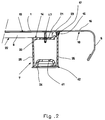
- la figure 2 est une vue en coupe transversale montrant l'assemblage du plateau supérieur, du plateau inférieur et d'un profilé formant le cadre de rigidification ;
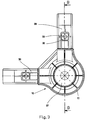
- la figure 3 est une vue de dessus d'une pièce de coin selon un mode de réalisation de l'invention ;
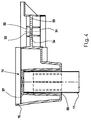
- la figure 4 est une vue de côté en coupe selon le plan B-B de la figure 3 ; et
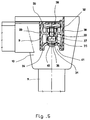
- la figure 5 est une coupe transversale montrant l'assemblage d'un longeron et de l'embout d'une pièce de coin.
- Comme le représente schématiquement la figure 1, une table métallique selon l'invention comprend un plateau supérieur métallique 1, par exemple formé d'une surface centrale 2 plane destinée à être horizontale et se raccordant à un dosseret postérieur 3, à des rebords inférieurs latéraux tels que le rebord 4 et à un rebord inférieur antérieur 5.
- Le plateau supérieur métallique 1 est rigidifié par un plateau inférieur 6 en bois ou aggloméré de bois. La face inférieure du plateau supérieur 1 repose sur la face supérieure du plateau inférieur 6, en lui étant solidarisée par exemple par collage. Le collage peut être réalisé par exemple en interposant un adhésif double face entre le plateau supérieur 1 et le plateau inférieur 6.
- Le plateau inférieur 6 est lui-même solidarisé à un cadre de rigidification et de support 7, formé lui-même de longerons tels que le longeron 8 et de traverses telles que la traverse 9 reliés par des pièces de coin telles que la pièce de coin 10 recevant les pieds tels que les pieds 11, 12 et 13.
- Le cadre 7 présente une surface supérieure d'appui 14 conformée pour recevoir et supporter la zone périphérique de surface inférieure du plateau inférieur 6, à laquelle elle est solidarisée.
- Comme on le voit plus nettement sur la figure 2, le cadre 7 comprend, bordant sa surface d'appui 14, une lèvre périphérique extérieure 15 continue ascendante, de hauteur un peu inférieure à l'épaisseur du plateau inférieur 6.
- Par le fait que les bords du plateau inférieur 6 sont en retrait des bords du plateau supérieur 1, le plateau supérieur 1 comporte une partie débordante 16.
- Un joint d'étanchéité 17 relie la lèvre périphérique 15 et la face inférieure 18 de partie débordante 16 du plateau supérieur 1.
- Le plateau inférieur 6 est solidarisé à la surface supérieure d'appui 14 de cadre 7 par exemple par vissage, au moyen de vis autotaraudeuses 49 vissées depuis la face supérieure 19 du plateau inférieur 6. Naturellement, les vis 49 sont posées avant collage du plateau supérieur 1, et elles traversent l'épaisseur du plateau inférieur 6 et la paroi supérieure 20 du cadre 7.
- Dans le mode de réalisation représenté, la face supérieure d'appui 14 du cadre 7 comporte une gorge intermédiaire 21 adaptée pour l'encastrement de moyens de joint d'étanchéité venant en appui à la fois dans la gorge intermédiaire 21 et contre la face inférieure 22 du plateau inférieur 6.
- La tranche 23 du plateau inférieur 6 se trouve ainsi enfermée dans un compartiment périphérique étanche formé par la paroi supérieure 20 du cadre 7, la lèvre périphérique 15 et le plateau supérieur métallique 1.
- Dans le mode de réalisation représenté sur les figures, les longerons 8 et traverses 9 sont avantageusement formés d'un profilé tubulaire creux, par exemple à section généralement rectangulaire limitée par une paroi supérieure 20, une paroi inférieure 24 et deux parois latérales 25 et 26. Le profilé formant les longerons 8 et traverses 9 peut avantageusement être réalisé en aluminium. Les longerons 8 et traverses 9 sont obtenus par tronçonnage d'un profilé de grande longueur.
- Dans le mode de réalisation représenté sur les figures 3 à 5, la pièce de coin 10 comporte une partie centrale 27 à surface supérieure constituant la surface supérieure d'appui 14 en continuité avec la surface correspondante des longerons 8 et traverses 9, et avec une lèvre périphérique extérieure constituant la lèvre périphérique extérieure 15 en continuité avec la lèvre correspondante des longerons 8 et traverses 9. La partie centrale 27 est conformée pour recevoir et retenir un pied 11 sensiblement perpendiculaire au plan du cadre 7. Pour cela, la partie centrale 27 comprend un logement 28 de préférence conique ouvert vers le bas et recevant l'extrémité supérieure du pied 11 venant s'emmancher en force dans le logement 28.
- La partie centrale 27 se prolonge par deux embouts latéraux 29 et 30 conformés et disposés pour pénétrer à faible jeu et se fixer dans les profilés tubulaires creux formant les longerons 8 et traverses 9 respectifs adjacents à la pièce de coin 10.
- Pour leur fixation au profilé correspondant, les embouts 29 et 30 comprennent chacun un logement inférieur tel que le logement 31 de l'embout 29, visible sur la figure 4, placé en position intermédiaire sur la longueur de l'embout 29, et communiquant avec un logement supérieur 32 par un trou 33 ménagé dans une paroi intermédiaire 34. Le logement inférieur 31 est adapté pour recevoir la tête 35 d'une vis de blocage. Le logement supérieur 32 est adapté pour recevoir un écrou de serrage, en permettant son coulissement longitudinal mais en interdisant la rotation de l'écrou. Le trou 33 est adapté pour le passage de la tige de vis de blocage.
- Comme on le voit plus clairement sur la figure 5, l'embout 29 est engagé dans le profilé formant la traverse 9. La tête 35 de la vis de blocage est logée dans le logement 31, et reste accessible depuis l'extérieur pour son serrage par passage d'un outil à travers un trou d'accès 36 ménagé dans la paroi inférieure 24 du profilé de traverse 9. La tige 37 de la vis de blocage traverse le trou 33, et se visse dans l'écrou 38 disposé et bloqué en rotation dans le logement 32. Lors de son serrage dans l'écrou 38, l'extrémité libre de la tige 37 de vis de blocage vient porter sous la paroi supérieure 20 du profilé de traverse 9 avec interposition éventuelle d'une plaque d'appui 39 libre. L'écrou 38 force lui-même l'embout 29 en appui contre la paroi inférieure 24 du profilé de traverse 9, de sorte que l'embout 29 est fixé dans la traverse 9. Une fixation similaire est prévue pour la solidarisation de la pièce de coin à un longeron 8.
- Un bouchon 40 permet d'obturer le trou d'accès 36 du profilé après serrage de la vis de blocage.
- Dans le mode de réalisation représenté sur les figures, la face inférieure 24 des longerons 8 et traverses 9 est munie d'une rainure longitudinale 41, évasée vers l'intérieur, pour recevoir et retenir des taquets 42 permettant la fixation de divers éléments rapportés, par exemple des glissières de tiroirs.
- La présente invention n'est pas limitée aux modes de réalisation qui ont été explicitement décrits, mais elle en inclut les diverses variantes et généralisations contenues dans le domaine des revendications ci-après.
Claims (9)
Applications Claiming Priority (2)
| Application Number | Priority Date | Filing Date | Title |
|---|---|---|---|
| FR9312529A FR2711306B1 (fr) | 1993-10-18 | 1993-10-18 | Table métallique à chassis étanche. |
| FR9312529 | 1993-10-18 |
Publications (2)
| Publication Number | Publication Date |
|---|---|
| EP0655210A1 true EP0655210A1 (fr) | 1995-05-31 |
| EP0655210B1 EP0655210B1 (fr) | 1998-02-04 |
Family
ID=9452056
Family Applications (1)
| Application Number | Title | Priority Date | Filing Date |
|---|---|---|---|
| EP19940420265 Expired - Lifetime EP0655210B1 (fr) | 1993-10-18 | 1994-10-04 | Table métallique à châssis étanche |
Country Status (4)
| Country | Link |
|---|---|
| EP (1) | EP0655210B1 (fr) |
| DE (1) | DE69408412T2 (fr) |
| ES (1) | ES2115184T3 (fr) |
| FR (1) | FR2711306B1 (fr) |
Families Citing this family (1)
| Publication number | Priority date | Publication date | Assignee | Title |
|---|---|---|---|---|
| CN100567746C (zh) * | 2007-12-01 | 2009-12-09 | 陈敏 | 桌子用的连接器 |
Citations (7)
| Publication number | Priority date | Publication date | Assignee | Title |
|---|---|---|---|---|
| BE543158A (fr) * | ||||
| US2654648A (en) * | 1950-09-01 | 1953-10-06 | Avco Mfg Corp | Severable counter top for kitchen cabinet installation |
| FR1118692A (fr) * | 1955-02-04 | 1956-06-08 | Ateliers De Const Metalliques | Système d'assemblage, avec le dessus, des autres éléments d'un bureau ou d'une table |
| US2890919A (en) * | 1956-03-15 | 1959-06-16 | Congoleum Nairn Inc | Counter construction |
| NL6612586A (fr) * | 1965-09-30 | 1967-03-31 | ||
| FR1548239A (fr) * | 1966-12-30 | 1968-11-29 | ||
| DE4026763A1 (de) * | 1990-08-24 | 1992-02-27 | Miele & Cie | Arbeitsplatte insbesondere kuechenarbeitsplatte mit am plattenueberstand vorgesehener tropfkante |
-
1993
- 1993-10-18 FR FR9312529A patent/FR2711306B1/fr not_active Expired - Lifetime
-
1994
- 1994-10-04 ES ES94420265T patent/ES2115184T3/es not_active Expired - Lifetime
- 1994-10-04 EP EP19940420265 patent/EP0655210B1/fr not_active Expired - Lifetime
- 1994-10-04 DE DE1994608412 patent/DE69408412T2/de not_active Expired - Lifetime
Patent Citations (7)
| Publication number | Priority date | Publication date | Assignee | Title |
|---|---|---|---|---|
| BE543158A (fr) * | ||||
| US2654648A (en) * | 1950-09-01 | 1953-10-06 | Avco Mfg Corp | Severable counter top for kitchen cabinet installation |
| FR1118692A (fr) * | 1955-02-04 | 1956-06-08 | Ateliers De Const Metalliques | Système d'assemblage, avec le dessus, des autres éléments d'un bureau ou d'une table |
| US2890919A (en) * | 1956-03-15 | 1959-06-16 | Congoleum Nairn Inc | Counter construction |
| NL6612586A (fr) * | 1965-09-30 | 1967-03-31 | ||
| FR1548239A (fr) * | 1966-12-30 | 1968-11-29 | ||
| DE4026763A1 (de) * | 1990-08-24 | 1992-02-27 | Miele & Cie | Arbeitsplatte insbesondere kuechenarbeitsplatte mit am plattenueberstand vorgesehener tropfkante |
Also Published As
| Publication number | Publication date |
|---|---|
| DE69408412T2 (de) | 1998-08-27 |
| DE69408412D1 (de) | 1998-03-12 |
| FR2711306A1 (fr) | 1995-04-28 |
| EP0655210B1 (fr) | 1998-02-04 |
| FR2711306B1 (fr) | 1995-12-08 |
| ES2115184T3 (es) | 1998-06-16 |
Similar Documents
| Publication | Publication Date | Title |
|---|---|---|
| EP0649205B1 (fr) | Liaison d'angle pour armoire, et armoire électrique comportant de telles liaisons | |
| FR2773571A1 (fr) | Construction de cloison et procede de montage d'un tableau de marquage sur un chassis de cloison | |
| EP0517617A1 (fr) | Rayonnage modulaire | |
| EP0655210B1 (fr) | Table métallique à châssis étanche | |
| EP0267843A1 (fr) | Lisse profilée destinée à supporter des charges, notamment pour casiers de stockage | |
| EP0805904B1 (fr) | Plateau d'echafaudage | |
| EP0738485B1 (fr) | Rayonnage modulaire adaptable | |
| FR2958378A1 (fr) | Installation solaire destinee a etre posee sur une partie de la surface d'une structure support en pente | |
| CA1302658C (fr) | Cabine de douche a ossature bois | |
| FR2706156A1 (fr) | Caisse démontable. | |
| BE1007497A6 (fr) | Poutre en bois. | |
| EP1044864B1 (fr) | Véhicule comportant un plancher non métallique sous contrainte | |
| FR2727274A3 (fr) | Chassis | |
| EP0325568B1 (fr) | Sommier avec douves à lames et chassis tubulaire | |
| FR2629533A1 (fr) | Assemblage de coin pour table de decoupe | |
| FR2758700A1 (fr) | Composant d'un meuble de cuisine professionnelle et table comportant un tel composant | |
| KR20250077845A (ko) | 가구용 금속프레임 조립구조 | |
| FR2801066A1 (fr) | Panneau sandwich resistant au feu | |
| FR2881025A1 (fr) | Table de jardinage polyvalente | |
| FR2750841A1 (fr) | Cadre de lit double a deux sommiers | |
| EP1707707A1 (fr) | Structure pour piscine hors sol et piscine hors sol en comportant application | |
| FR2679301A1 (fr) | Profiles pour la realisation de mobilier et notamment de vitrines. | |
| EP0647419B1 (fr) | Table métallique à pieces de coin rapportées | |
| FR2601570A1 (fr) | Dispositif pour l'assemblage de deux rayonnages s'etendant perpendiculairement l'un a l'autre. | |
| FR2674915A1 (fr) | Dispositif d'assemblage des elements d'une structure demontable et structure demontable dont au moins certains elements sont assembles a l'aide de tels dispositifs. |
Legal Events
| Date | Code | Title | Description |
|---|---|---|---|
| PUAI | Public reference made under article 153(3) epc to a published international application that has entered the european phase |
Free format text: ORIGINAL CODE: 0009012 |
|
| AK | Designated contracting states |
Kind code of ref document: A1 Designated state(s): BE CH DE ES GB IT LI NL |
|
| 17P | Request for examination filed |
Effective date: 19950622 |
|
| 17Q | First examination report despatched |
Effective date: 19960904 |
|
| GRAG | Despatch of communication of intention to grant |
Free format text: ORIGINAL CODE: EPIDOS AGRA |
|
| GRAG | Despatch of communication of intention to grant |
Free format text: ORIGINAL CODE: EPIDOS AGRA |
|
| GRAH | Despatch of communication of intention to grant a patent |
Free format text: ORIGINAL CODE: EPIDOS IGRA |
|
| GRAH | Despatch of communication of intention to grant a patent |
Free format text: ORIGINAL CODE: EPIDOS IGRA |
|
| GRAA | (expected) grant |
Free format text: ORIGINAL CODE: 0009210 |
|
| AK | Designated contracting states |
Kind code of ref document: B1 Designated state(s): BE CH DE ES GB IT LI NL |
|
| PG25 | Lapsed in a contracting state [announced via postgrant information from national office to epo] |
Ref country code: NL Free format text: LAPSE BECAUSE OF FAILURE TO SUBMIT A TRANSLATION OF THE DESCRIPTION OR TO PAY THE FEE WITHIN THE PRESCRIBED TIME-LIMIT Effective date: 19980204 |
|
| REG | Reference to a national code |
Ref country code: CH Ref legal event code: EP |
|
| REF | Corresponds to: |
Ref document number: 69408412 Country of ref document: DE Date of ref document: 19980312 |
|
| ITF | It: translation for a ep patent filed | ||
| GBT | Gb: translation of ep patent filed (gb section 77(6)(a)/1977) |
Effective date: 19980429 |
|
| REG | Reference to a national code |
Ref country code: ES Ref legal event code: FG2A Ref document number: 2115184 Country of ref document: ES Kind code of ref document: T3 |
|
| NLV1 | Nl: lapsed or annulled due to failure to fulfill the requirements of art. 29p and 29m of the patents act | ||
| PG25 | Lapsed in a contracting state [announced via postgrant information from national office to epo] |
Ref country code: LI Free format text: LAPSE BECAUSE OF NON-PAYMENT OF DUE FEES Effective date: 19981031 Ref country code: CH Free format text: LAPSE BECAUSE OF NON-PAYMENT OF DUE FEES Effective date: 19981031 Ref country code: BE Free format text: LAPSE BECAUSE OF NON-PAYMENT OF DUE FEES Effective date: 19981031 |
|
| PLBE | No opposition filed within time limit |
Free format text: ORIGINAL CODE: 0009261 |
|
| STAA | Information on the status of an ep patent application or granted ep patent |
Free format text: STATUS: NO OPPOSITION FILED WITHIN TIME LIMIT |
|
| 26N | No opposition filed | ||
| BERE | Be: lapsed |
Owner name: S.A. TOURNUS EQUIPEMENT Effective date: 19981031 |
|
| REG | Reference to a national code |
Ref country code: CH Ref legal event code: PL |
|
| REG | Reference to a national code |
Ref country code: GB Ref legal event code: IF02 |
|
| PGFP | Annual fee paid to national office [announced via postgrant information from national office to epo] |
Ref country code: GB Payment date: 20050914 Year of fee payment: 12 |
|
| GBPC | Gb: european patent ceased through non-payment of renewal fee |
Effective date: 20061004 |
|
| PG25 | Lapsed in a contracting state [announced via postgrant information from national office to epo] |
Ref country code: GB Free format text: LAPSE BECAUSE OF NON-PAYMENT OF DUE FEES Effective date: 20061004 |
|
| PGFP | Annual fee paid to national office [announced via postgrant information from national office to epo] |
Ref country code: ES Payment date: 20130920 Year of fee payment: 20 |
|
| PGFP | Annual fee paid to national office [announced via postgrant information from national office to epo] |
Ref country code: IT Payment date: 20131025 Year of fee payment: 20 |
|
| PGFP | Annual fee paid to national office [announced via postgrant information from national office to epo] |
Ref country code: DE Payment date: 20131228 Year of fee payment: 20 |
|
| REG | Reference to a national code |
Ref country code: DE Ref legal event code: R071 Ref document number: 69408412 Country of ref document: DE |
|
| REG | Reference to a national code |
Ref country code: ES Ref legal event code: FD2A Effective date: 20150107 |
|
| PG25 | Lapsed in a contracting state [announced via postgrant information from national office to epo] |
Ref country code: ES Free format text: LAPSE BECAUSE OF EXPIRATION OF PROTECTION Effective date: 20141005 |