EP0655682B1 - Recheneinheit mit mehreren ausführbaren Tasks - Google Patents
Recheneinheit mit mehreren ausführbaren Tasks Download PDFInfo
- Publication number
- EP0655682B1 EP0655682B1 EP93119187A EP93119187A EP0655682B1 EP 0655682 B1 EP0655682 B1 EP 0655682B1 EP 93119187 A EP93119187 A EP 93119187A EP 93119187 A EP93119187 A EP 93119187A EP 0655682 B1 EP0655682 B1 EP 0655682B1
- Authority
- EP
- European Patent Office
- Prior art keywords
- task
- priority
- hpt
- arithmetic unit
- communication
- Prior art date
- Legal status (The legal status is an assumption and is not a legal conclusion. Google has not performed a legal analysis and makes no representation as to the accuracy of the status listed.)
- Expired - Lifetime
Links
Images

Classifications
-
- G—PHYSICS
- G06—COMPUTING OR CALCULATING; COUNTING
- G06F—ELECTRIC DIGITAL DATA PROCESSING
- G06F9/00—Arrangements for program control, e.g. control units
- G06F9/06—Arrangements for program control, e.g. control units using stored programs, i.e. using an internal store of processing equipment to receive or retain programs
- G06F9/46—Multiprogramming arrangements
- G06F9/48—Program initiating; Program switching, e.g. by interrupt
- G06F9/4806—Task transfer initiation or dispatching
- G06F9/4812—Task transfer initiation or dispatching by interrupt, e.g. masked
- G06F9/4831—Task transfer initiation or dispatching by interrupt, e.g. masked with variable priority
- G06F9/4837—Task transfer initiation or dispatching by interrupt, e.g. masked with variable priority time dependent
Definitions
- the present invention relates to a computing unit, in particular a central unit of a modular programmable logic controller Control, with a high priority task, one low-priority, always executable task and other tasks with Priorities between high and low priority tasks, the tasks being executable by the computing unit, the computing unit only at a given time can perform one of the tasks, at least the high priority Task and the other tasks each a request and a termination condition are assigned, the computing unit when the termination condition occurs at the moment executed task the execution of the currently executed Task ended and execution of the task with the next lower priority Takes priority, its request condition fulfilled and the termination condition is not fulfilled.
- Such computing units are programmable as central processing units Controls widely used. In such Central units always run the highest priority task until it is either fully completed or from an even higher priority task is displaced, its request condition occurs while the task is running. This method is disadvantageous in that the computing unit can be blocked by the highest of all tasks.
- Computing units are also known in which all tasks Time slices are assigned by the computing unit so that all tasks from time to time according to the time slices to which they are entitled be carried out.
- the tasks are prioritized only possible because some tasks have more time slices be assigned as others. It is not against that possible to react immediately to requests of high priority tasks.
- pages 4354 to 4356 is an electronic one System known that can perform multiple tasks. Any task a priority is assigned. As a rule, the Task with highest priority executed. After a However, the maximum time is forced to switch to another task. The maximum time is the same for all tasks.
- a similar computing unit is known from US-A-4 145 735, but in addition the maximum time all the more is shorter, the higher the priority of a task. About that In addition, a task can no longer be called if its Maximum time has expired.
- the object of the present invention is a To provide computing unit, on the one hand a quick response to requesting high priority tasks is guaranteed and is nevertheless also guaranteed that the arithmetic unit is not by the high priority task is blocked.
- the object is solved by the features of claim 1. If the maximum computing time can be specified by the user, the user can set the maximum computing tent as required.
- Every complex electronic system can be based on one Block system error itself.
- Such a blockage the computing unit due to an internal error in the computing unit is recognizable from the outside, usually can even be remedied if the high priority task of communicating with others units connected to the computing unit via a bus system sends and communication orders from the other units receives. This ensures that the computing unit remains accessible from the outside, even if it is blocked itself internally.
- the other tasks have at least one high-priority communication task include who is assigned the second highest priority and the high priority communication task of the high-priority task evaluates received communication jobs and at least partially edited, it is guaranteed that received communication orders from the computing unit too to be edited.
- the task to be repeated cyclically the second lowest and the lower priority communication task assigned the lowest priority are the lower priority communication task of the high-priority communication task
- Communication jobs transmitted the low priority communication task of the high priority communication task transmitted communication orders edited and to be repeated cyclically when the Task the processing unit to execute the cyclical task to be repeated aborts after a cycle computing time and the execution of the low priority communication task records, can evaluate and edit the Communication orders through the high-priority communication task on processing high-priority communication orders be restricted. Nevertheless, it is guaranteed that all communication orders processed gradually become.
- a modular programmable logic controller Control from a central unit 1 and peripheral modules 2, which are interconnected via a device bus 3 are.
- the central unit can via the peripheral modules 2 1 States of a technical system, not shown 4 query and issue control commands to system 4.
- the central unit 1 of the programmable logic controller internally has a microprocessor 5, which is a user program processed.
- the user program is in memory 6 stored, which is a random access memory (RAM).
- RAM random access memory
- the memory 6 not only the user program is stored in the memory 6, but also the so-called process image, i.e. the input signals read by the peripheral units 2 and the output signals to be output to the peripheral units 2. Furthermore, the memory 6 also serves as a working and Cache. In memory 8, the read-only memory (e.g. as an EEPROM), the operating system is the Microprocessor 5 stored.
- the read-only memory e.g. as an EEPROM
- the operating system is the Microprocessor 5 stored.
- the central unit also has a timer module 9 and a communication interface 10. Via the timer 9 5 times are made available to the processor, so that he e.g. knows what time since a certain event has passed. Via the communication interface 11 can the processor 5 access the network bus 11. Thereby the central unit 1 can communicate with other units.
- the other units can be, for example Programming device for programming and / or monitoring the Central unit 1. Likewise, the other units even central units of programmable logic controllers his.
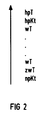
- the tasks to be processed are the responsibility of the individual Tasks divided into separate tasks by the central unit 1 can be executed. Every task is assigned a priority. The tasks are with their associated priorities shown in FIG 2.
- the task with the highest priority is the high priority Task hpT.
- This task has the job of communication jobs to others, with the central unit 1 via the Network bus 11 connected units to send and communication jobs received by these units.
- the task with the second highest priority is the high priority Communication task hpKt.
- This task evaluates that of the high priority task received communication orders from and then decides whether the received communication jobs are high or low priority. Are the received communication orders high priority, this is how the high priority task works the communication orders received themselves. Otherwise it transmits the received communication orders to the low priority communication task npKt.
- the low priority communication task npKt processes the low-priority communication orders, that of the high priority communication task hpKt be transmitted.
- the low priority communication task npKt is assigned the lowest priority.
- the high priority communication task hpKt is in the present Case implemented as a separate task. But it could also be part of the high-priority task hpT.
- the task with the second lowest priority is the so-called Cyclic task to be repeated, which is always cyclical is executed again if no higher priority task is to be executed is.
- central unit 1 has a number of further tasks wT executable, not discussed in more detail below becomes.
- These tasks include, for example, the timer refresh via timer module 9, time alarms of various types, Process alarms from the controlled technical system 4 and Central unit alarms.
- the microprocessor 5 of the central unit 1 can be a specific one Execute only one of the tasks at the time. Any task - except for the cyclically repeated task zwT - is therefore associated with a request and a termination condition.
- the central unit 1 ends the execution of the currently executed task and starts executing the task, whose request condition has just occurred.
- the Execution of this task is usually only ended when if the request condition of a task with even higher Priority occurs or when the termination condition the task occurs.
- the central unit 1 therefore carries out the tasks event-driven.
- the Computing unit the central unit of an automation system. It may therefore happen that the Central unit 1 very quickly to a changed process condition must react. On the other hand, those of the high-priority task hpT processed communication orders may take a long time. Therefore, to ensure that the central unit 1 is timely under all circumstances will react quickly enough to changed process conditions proceed as follows:
- a time counter in timer block 9 started. If the time measured by this time counter is a exceeds the maximum computing time specified by the user, breaks the central unit 1 executes the high-priority task hpT from. The high-priority task hpT is canceled after Expiration of the maximum computing time regardless of whether the termination condition the high-priority task hpT has occurred or not. The central unit 1 then takes the execution the task with the next lower priority, whose Requirement condition is met. This ensures the central unit despite extensive communication orders 1 can react to changed process states. Execution the high-priority task hpT is only after a lock time resumed, which can also be specified by the user.
- this is cyclical repetitive task between the second lowest and the low priority communication task npKt the lowest Priority assigned. Since, on the other hand, the one to be repeated cyclically Task is always executable, would be pure event-driven central unit 1 the low priority communication task npKt never run. Therefore - analogous to canceling the high-priority task hpT - at the Execution of the task to be repeated cyclically between the times recorded during which this task is executed. If the Execution time a cycle computing time that can be specified by the user exceeds, the execution will be repeated cyclically Task aborted and execution of low priority communication task npKt added.
- the times T z and T k during which the central unit 1 previously carried out the cyclically repeating task zwT or the low-priority communication task npKt are recorded and temporarily stored in the memory 6.
- the cycle computing time can therefore, for example, be kept at zero in the manner of a two-point controller if the ratio of the times T z and T k exceeds a certain upper limit and is kept at infinity or a fixed time if the ratio of the times T z and T k is one Falls below the lower limit.
- the low-priority communication task npKt one Assign time slice of preselectable length.
- the lower priorities Communication task npKt is always after the Execution of a cycle of the task to be repeated cyclically partly called and executed.
Landscapes
- Engineering & Computer Science (AREA)
- Software Systems (AREA)
- Theoretical Computer Science (AREA)
- Physics & Mathematics (AREA)
- General Engineering & Computer Science (AREA)
- General Physics & Mathematics (AREA)
- Programmable Controllers (AREA)
- Debugging And Monitoring (AREA)
- Computer And Data Communications (AREA)
- Electrophonic Musical Instruments (AREA)
- Advance Control (AREA)
Description
- FIG 1
- ein Blockschaltbild einer speicherprogrammierbaren Steuerung und
- FIG 2
- die Reihenfolge der Tasks.
Claims (7)
- Recheneinheit, insbesondere Zentraleinheit einer modularen speicherprogrammierbaren Steuerung, mit einer hochprioren Task (hpT), einer niederprioren, stets ausführbaren Task (zwT) und weiteren Tasks (z.B. hpKt, wT) mit Prioritäten zwischen der hoch- und der niederprioren Task (hpT, zwT),wobei die Tasks (hpT, hpKt, wT, zwT) durch die Recheneinheit (1) ausführbar sind,wobei die Recheneinheit (1) zu einem bestimmten Zeitpunkt nur eine der Tasks (hpT, hpKt, wT, zwT) ausführen kann,wobei zumindest der hochprioren Task (hpT) und den weiteren Tasks (hpKt, wT) je eine Anforderungs- und eine Beendigungsbedingung zugeordnet sind, wobei die Recheneinheit (1) bei Auftreten der Beendigungsbedingung der momentan ausgeführten Task (z.B. hpKt) die Ausführung der momentan ausgeführten Task (hpKt) beendet und die Ausführung der Task (z.B. wT) mit der nächstniedrigeren Priorität aufnimmt, deren Anforderungsbedingung erfüllt und deren Beendigungsbedingung nicht erfüllt ist,wobei die Recheneinheit (1) die Ausführung einer Task (z.B. wT), die nicht die hochpriore Task (hpT) ist, bei Auftreten einer Anforderungsbedingung einer Task (z.B. hpT) mit höherer Priorität abbricht und die Ausführung der höherprioren Task (hpT) aufnimmt,wobei die Recheneinheit (1) die Ausführung der hochprioren Task (hpT) nach einer Maximalrechenzeit abbricht und die Ausführung der Task (z.B. wT) mit der nächstniedrigeren Priorität aufnimmt, deren Anforderungsbedingung erfüllt und deren Beendigungsbedingung nicht erfüllt ist, auch wenn die Beendigungsbedingung der hochprioren Task (hpT) nicht aufgetreten ist,wobei die Recheneinheit (1) die Ausführung der hochprioren Task (hpT) nach einer Sperrzeit wieder aufnimmt.
- Recheneinheit nach Anspruch 1,
dadurch gekennzeichnet,daß die Maximalrechenzeit vom Anwender vorgebbar ist. - Recheneinheit nach Anspruch 1 oder 2,
dadurch gekennzeichnet,daß die hochpriore Task (hpT) Kommunikationsaufträge zu anderen, mit der Recheneinheit (1) über ein Bussystem (11) verbundenen Einheiten sendet und Kommunikationsaufträge von den anderen Einheiten empfängt. - Recheneinheit nach Anspruch 3,
dadurch gekennzeichnet,daß die weiteren Tasks (wT) zumindest eine hochpriore Kommunikationstask (hpKt) umfassen, der die zweithöchste Priorität zugeordnet ist unddaß die hochpriore Kommunikationstask (hpKt) von der hochprioren Task (hpT) empfangene Kommunikationsaufträge auswertet und zumindest teilweise bearbeitet. - Recheneinheit nach Anspruch 4,
dadurch gekennzeichnet,daß die weiteren Tasks (wT) eine zyklisch zu wiederholende Task (zwT) und eine niederpriore Kommunikationstask (npKt) umfassen, wobei der zyklisch zu wiederholenden Task (zwT) die Zweitniedrigste und der niederprioren Kommunikationstask (npKt) die niedrigste Priorität zugeordnet sind,daß der niederprioren Kommunikationstask von der hochprioren Kommunikationstask (hpKt) Kommunikationsaufträge übermittelt werden,daß die niederpriore Kommunikationstask (npKt) von der hochprioren Kommunikationstask (hpKt) übermittelte Kommunikationsaufträge bearbeitet unddaß bei Ausführung der zyklisch zu wiederholenden Task (zwT) die Recheneinheit (1) die Ausführung der zyklisch zu wiederholenden Task (zwT) nach einer Zyklusrechenzeit abbricht und die Ausführung der niederprioren Kommunikationstask (npKt) aufnimmt. - Recheneinheit nach Anspruch 5,
dadurch gekennzeichnet,daß die Zyklusrechenzeit von den Zeiten (Tz,Tk) abhängt, während derer die Recheneinheit (1) zuvor die zyklisch zu wiederholende Task (zwT) bzw. die niederpriore Kommunikationstask (npKt) ausgeführt hat. - Automatisierungssystem, insbesondere modulare speicherprogrammierbare Steuerung, mit einer Recheneinheit (1) nach einem der Ansprüche 1 bis 6.
Priority Applications (4)
| Application Number | Priority Date | Filing Date | Title |
|---|---|---|---|
| DE59310052T DE59310052D1 (de) | 1993-11-26 | 1993-11-26 | Recheneinheit mit mehreren ausführbaren Tasks |
| EP93119187A EP0655682B1 (de) | 1993-11-26 | 1993-11-26 | Recheneinheit mit mehreren ausführbaren Tasks |
| AT93119187T ATE193607T1 (de) | 1993-11-26 | 1993-11-26 | Recheneinheit mit mehreren ausführbaren tasks |
| US08/341,813 US6148322A (en) | 1993-11-26 | 1994-11-18 | Processing unit with an improved ability to coordinate the execution of multiple tasks with varying priorities |
Applications Claiming Priority (1)
| Application Number | Priority Date | Filing Date | Title |
|---|---|---|---|
| EP93119187A EP0655682B1 (de) | 1993-11-26 | 1993-11-26 | Recheneinheit mit mehreren ausführbaren Tasks |
Publications (2)
| Publication Number | Publication Date |
|---|---|
| EP0655682A1 EP0655682A1 (de) | 1995-05-31 |
| EP0655682B1 true EP0655682B1 (de) | 2000-05-31 |
Family
ID=8213451
Family Applications (1)
| Application Number | Title | Priority Date | Filing Date |
|---|---|---|---|
| EP93119187A Expired - Lifetime EP0655682B1 (de) | 1993-11-26 | 1993-11-26 | Recheneinheit mit mehreren ausführbaren Tasks |
Country Status (4)
| Country | Link |
|---|---|
| US (1) | US6148322A (de) |
| EP (1) | EP0655682B1 (de) |
| AT (1) | ATE193607T1 (de) |
| DE (1) | DE59310052D1 (de) |
Families Citing this family (35)
| Publication number | Priority date | Publication date | Assignee | Title |
|---|---|---|---|---|
| JPH10328163A (ja) | 1997-05-28 | 1998-12-15 | Siemens Ag | 核スピン断層撮影装置のためのパルスシーケンスの制御方法及び装置 |
| JP3508513B2 (ja) * | 1997-11-07 | 2004-03-22 | 株式会社日立製作所 | 計算機システムの運用管理方法 |
| US6704763B1 (en) * | 1998-06-09 | 2004-03-09 | Advanced Micro Devices, Inc. | Hardware enforcement mechanism for an isochronous task scheduler |
| US6421702B1 (en) | 1998-06-09 | 2002-07-16 | Advanced Micro Devices, Inc. | Interrupt driven isochronous task scheduler system |
| US6418459B1 (en) | 1998-06-09 | 2002-07-09 | Advanced Micro Devices, Inc. | Isochronous task scheduling structure for a non-real-time operating system |
| US6502123B1 (en) | 1998-06-09 | 2002-12-31 | Advanced Micro Devices, Inc. | Isochronous system using certified drivers to ensure system stability |
| US7577958B1 (en) * | 1999-12-09 | 2009-08-18 | Nortel Networks Limited | Expediting an operation in a computer system |
| US7099855B1 (en) | 2000-01-13 | 2006-08-29 | International Business Machines Corporation | System and method for electronic communication management |
| US9699129B1 (en) | 2000-06-21 | 2017-07-04 | International Business Machines Corporation | System and method for increasing email productivity |
| US6408277B1 (en) * | 2000-06-21 | 2002-06-18 | Banter Limited | System and method for automatic task prioritization |
| US8290768B1 (en) | 2000-06-21 | 2012-10-16 | International Business Machines Corporation | System and method for determining a set of attributes based on content of communications |
| US6622259B1 (en) * | 2000-07-14 | 2003-09-16 | International Business Machines Corporation | Non-disruptive migration of coordinator services in a distributed computer system |
| US7644057B2 (en) | 2001-01-03 | 2010-01-05 | International Business Machines Corporation | System and method for electronic communication management |
| US20020147967A1 (en) * | 2001-02-14 | 2002-10-10 | Ncr Corporation | Operating software scheduling priority recorder |
| US7093253B2 (en) * | 2001-11-06 | 2006-08-15 | International Business Machines Corporation | Method, computer program product, and system for a self-throttled computing task |
| US7305675B1 (en) * | 2002-01-11 | 2007-12-04 | Advanced Micro Devices, Inc. | Processing tasks with failure recovery |
| US7299346B1 (en) | 2002-06-27 | 2007-11-20 | William K. Hollis | Method and apparatus to minimize computer apparatus initial program load and exit/shut down processing |
| TWI245514B (en) * | 2002-12-20 | 2005-12-11 | Hon Hai Prec Ind Co Ltd | System and method for displaying relevant events of networking devices |
| US7798312B2 (en) * | 2002-12-31 | 2010-09-21 | Shuttleworth, Inc. | Compression passing roller |
| US7389230B1 (en) | 2003-04-22 | 2008-06-17 | International Business Machines Corporation | System and method for classification of voice signals |
| US20050187913A1 (en) | 2003-05-06 | 2005-08-25 | Yoram Nelken | Web-based customer service interface |
| US8495002B2 (en) | 2003-05-06 | 2013-07-23 | International Business Machines Corporation | Software tool for training and testing a knowledge base |
| US8726282B1 (en) | 2006-05-01 | 2014-05-13 | Open Invention Network, Llc | Job scheduler for remote maintenance of servers and workstations |
| US8266624B2 (en) * | 2006-11-30 | 2012-09-11 | Red Hat, Inc. | Task dispatch utility coordinating the execution of tasks on different computers |
| US8024739B2 (en) * | 2007-01-09 | 2011-09-20 | International Business Machines Corporation | System for indicating and scheduling additional execution time based on determining whether the execution unit has yielded previously within a predetermined period of time |
| US20090100430A1 (en) * | 2007-10-15 | 2009-04-16 | Marco Valentin | Method and system for a task automation tool |
| JP2009282907A (ja) * | 2008-05-26 | 2009-12-03 | Seiko Epson Corp | データベースアクセスサーバおよびデータベースアクセスシステム |
| US9588715B2 (en) * | 2009-06-03 | 2017-03-07 | Hewlett-Packard Development Company, L.P. | Scheduling realtime information storage system access requests |
| DE102013217616B4 (de) | 2012-09-14 | 2024-03-07 | International Business Machines Corporation | Verwalten von Ressourcen innerhalb einer Datenverarbeitungsumgebung |
| US9021493B2 (en) | 2012-09-14 | 2015-04-28 | International Business Machines Corporation | Management of resources within a computing environment |
| US9436739B2 (en) * | 2013-12-13 | 2016-09-06 | Vmware, Inc. | Dynamic priority-based query scheduling |
| US9674302B1 (en) * | 2014-06-13 | 2017-06-06 | Amazon Technologies, Inc. | Computing resource transition notification and pending state |
| CN110008123B (zh) * | 2019-03-28 | 2022-04-26 | 武汉达梦数据库股份有限公司 | 一种自动部署测试软件的方法以及相应的装置 |
| US11966825B2 (en) * | 2019-10-30 | 2024-04-23 | Servicenow Canada Inc. | System and method for executing an operation container |
| CN113810479B (zh) * | 2021-08-31 | 2023-11-07 | 山石网科通信技术股份有限公司 | 服务协调系统以及服务协调方法 |
Citations (1)
| Publication number | Priority date | Publication date | Assignee | Title |
|---|---|---|---|---|
| EP0534884A1 (de) * | 1991-09-26 | 1993-03-31 | International Business Machines Corporation | Schutz gegen Überschreitung der Prozesslaufzeit in einem Vielfachprozess-Echtzeitsystem |
Family Cites Families (9)
| Publication number | Priority date | Publication date | Assignee | Title |
|---|---|---|---|---|
| FR2253428A5 (de) * | 1973-11-30 | 1975-06-27 | Honeywell Bull Soc Ind | |
| US4145735A (en) * | 1977-02-02 | 1979-03-20 | Nippon Steel Corporation | Monitor for priority level of task in information processing system |
| US4414624A (en) * | 1980-11-19 | 1983-11-08 | The United States Of America As Represented By The Secretary Of The Navy | Multiple-microcomputer processing |
| US4488258A (en) * | 1982-09-20 | 1984-12-11 | Allen-Bradley | Programmable controller with control program comments |
| US4779194A (en) * | 1985-10-15 | 1988-10-18 | Unisys Corporation | Event allocation mechanism for a large data processing system |
| US5065310A (en) * | 1989-05-10 | 1991-11-12 | International Business Machines Corporation | Reducing cache-reload transient at a context swap |
| EP0537721B1 (de) * | 1991-10-15 | 1998-11-25 | Hewlett-Packard Company | Hardwarekonfiguriertes Betriebssystemkern für einen Multitaskprozessor |
| FR2684467B1 (fr) * | 1991-11-29 | 1994-03-04 | Sextant Avionique | Procede pour le test et, eventuellement, la validation des primitives d'un executif temps reel. |
| US5528513A (en) * | 1993-11-04 | 1996-06-18 | Digital Equipment Corp. | Scheduling and admission control policy for a continuous media server |
-
1993
- 1993-11-26 EP EP93119187A patent/EP0655682B1/de not_active Expired - Lifetime
- 1993-11-26 DE DE59310052T patent/DE59310052D1/de not_active Expired - Lifetime
- 1993-11-26 AT AT93119187T patent/ATE193607T1/de not_active IP Right Cessation
-
1994
- 1994-11-18 US US08/341,813 patent/US6148322A/en not_active Expired - Lifetime
Patent Citations (1)
| Publication number | Priority date | Publication date | Assignee | Title |
|---|---|---|---|---|
| EP0534884A1 (de) * | 1991-09-26 | 1993-03-31 | International Business Machines Corporation | Schutz gegen Überschreitung der Prozesslaufzeit in einem Vielfachprozess-Echtzeitsystem |
Also Published As
| Publication number | Publication date |
|---|---|
| DE59310052D1 (de) | 2000-07-06 |
| US6148322A (en) | 2000-11-14 |
| ATE193607T1 (de) | 2000-06-15 |
| EP0655682A1 (de) | 1995-05-31 |
Similar Documents
| Publication | Publication Date | Title |
|---|---|---|
| EP0655682B1 (de) | Recheneinheit mit mehreren ausführbaren Tasks | |
| DE4135749B4 (de) | Prozessormodul für eine programmierbare Steuerung mit einer intelligenten Funktionsmodulschnittstelle | |
| DE69023018T2 (de) | Prozessor-Unterbrechungssteuerung. | |
| DE3300261C2 (de) | ||
| EP0636956B1 (de) | Aufdatverfahren | |
| WO2011061046A1 (de) | Parallelisierte programmsteuerung | |
| DE69222468T2 (de) | Vorrichtung zur Steigerung der Leistung eines einer Multiprozessorstruktur mit einer möglicherweise hohen Anzahl von Prozessoren zugeordneten Echtzeitsteuerprogrammkerns | |
| DE4005042C2 (de) | Mehrrechnersystem zur Durchführung von Bewegungssteuerungen | |
| EP0799441B1 (de) | Verfahren zur steuerung von technischen vorgängen | |
| EP1514180A2 (de) | Reaktionszeit-beschränkung eines software-prozesses | |
| EP0590175B1 (de) | Prozesssteuerungssystem | |
| DE3789197T2 (de) | Verfahren zum initialisieren von parametern in einer regeleinrichtung einer programmierbaren maschine. | |
| EP3214511B1 (de) | Kontrollierte bereitstellung von steuerungsdaten | |
| DE2932394A1 (de) | Intelligente, programmierbare prozessteueranordnung | |
| EP0525214B1 (de) | Verfahren zum Betreiben eines Automatisierungsgeräts | |
| WO1997049032A1 (de) | Aufdatverfahren | |
| EP0113379A1 (de) | Rechnerkopplung | |
| EP1282274A2 (de) | Teilnehmer für ein synchrones Master-Slave Netzwerk | |
| DE2845218B1 (de) | Mikroprogrammgesteuerte Ein-/Ausgabeeinrichtung und Verfahren zum Durchfuehren von Ein-/Ausgabeoperationen | |
| DE102006052757A1 (de) | Automatisierungsgerät mit einer Verarbeitungseinheit und Verwendung einer Verarbeitungseinheit in einem Automatisierungsgerät | |
| DE69028811T2 (de) | Extern erweiterbare speicherprogrammierbare steuerung | |
| EP0698837B1 (de) | Verfahren und Einrichtung zur periodischen Datenübertragung mit Broadcast-Funktion zum unabhängigen Datenaustausch zwischen externen Einheiten | |
| DE112021007470T5 (de) | Steuervorrichtung und steuersystem | |
| DE10229520A1 (de) | Verfahren und Vorrichtung sowie Betriebssystem zur Steuerung von Vorgängen bei einem Fahrzeug | |
| EP1151368B1 (de) | Verfahren zum gesicherten zugriff auf zumindest eine variable in einem präemptiv multitasking-gesteuerten prozessorsystem |
Legal Events
| Date | Code | Title | Description |
|---|---|---|---|
| PUAI | Public reference made under article 153(3) epc to a published international application that has entered the european phase |
Free format text: ORIGINAL CODE: 0009012 |
|
| 17P | Request for examination filed |
Effective date: 19940819 |
|
| AK | Designated contracting states |
Kind code of ref document: A1 Designated state(s): AT CH DE FR GB IT LI NL SE |
|
| 17Q | First examination report despatched |
Effective date: 19980325 |
|
| GRAG | Despatch of communication of intention to grant |
Free format text: ORIGINAL CODE: EPIDOS AGRA |
|
| GRAG | Despatch of communication of intention to grant |
Free format text: ORIGINAL CODE: EPIDOS AGRA |
|
| GRAH | Despatch of communication of intention to grant a patent |
Free format text: ORIGINAL CODE: EPIDOS IGRA |
|
| GRAH | Despatch of communication of intention to grant a patent |
Free format text: ORIGINAL CODE: EPIDOS IGRA |
|
| GRAA | (expected) grant |
Free format text: ORIGINAL CODE: 0009210 |
|
| AK | Designated contracting states |
Kind code of ref document: B1 Designated state(s): AT CH DE FR GB IT LI NL SE |
|
| PG25 | Lapsed in a contracting state [announced via postgrant information from national office to epo] |
Ref country code: NL Free format text: LAPSE BECAUSE OF FAILURE TO SUBMIT A TRANSLATION OF THE DESCRIPTION OR TO PAY THE FEE WITHIN THE PRESCRIBED TIME-LIMIT Effective date: 20000531 Ref country code: IT Free format text: LAPSE BECAUSE OF FAILURE TO SUBMIT A TRANSLATION OF THE DESCRIPTION OR TO PAY THE FEE WITHIN THE PRE;WARNING: LAPSES OF ITALIAN PATENTS WITH EFFECTIVE DATE BEFORE 2007 MAY HAVE OCCURRED AT ANY TIME BEFORE 2007. THE CORRECT EFFECTIVE DATE MAY BE DIFFERENT FROM THE ONE RECORDED.SCRIBED TIME-LIMIT Effective date: 20000531 |
|
| REF | Corresponds to: |
Ref document number: 193607 Country of ref document: AT Date of ref document: 20000615 Kind code of ref document: T |
|
| REG | Reference to a national code |
Ref country code: CH Ref legal event code: NV Representative=s name: SIEMENS SCHWEIZ AG Ref country code: CH Ref legal event code: EP |
|
| REF | Corresponds to: |
Ref document number: 59310052 Country of ref document: DE Date of ref document: 20000706 |
|
| GBT | Gb: translation of ep patent filed (gb section 77(6)(a)/1977) |
Effective date: 20000704 |
|
| PG25 | Lapsed in a contracting state [announced via postgrant information from national office to epo] |
Ref country code: SE Free format text: LAPSE BECAUSE OF FAILURE TO SUBMIT A TRANSLATION OF THE DESCRIPTION OR TO PAY THE FEE WITHIN THE PRESCRIBED TIME-LIMIT Effective date: 20000831 |
|
| ET | Fr: translation filed | ||
| NLV1 | Nl: lapsed or annulled due to failure to fulfill the requirements of art. 29p and 29m of the patents act | ||
| PLBE | No opposition filed within time limit |
Free format text: ORIGINAL CODE: 0009261 |
|
| STAA | Information on the status of an ep patent application or granted ep patent |
Free format text: STATUS: NO OPPOSITION FILED WITHIN TIME LIMIT |
|
| 26N | No opposition filed | ||
| REG | Reference to a national code |
Ref country code: GB Ref legal event code: IF02 |
|
| PGFP | Annual fee paid to national office [announced via postgrant information from national office to epo] |
Ref country code: CH Payment date: 20050204 Year of fee payment: 12 |
|
| PGFP | Annual fee paid to national office [announced via postgrant information from national office to epo] |
Ref country code: AT Payment date: 20051019 Year of fee payment: 13 |
|
| PG25 | Lapsed in a contracting state [announced via postgrant information from national office to epo] |
Ref country code: LI Free format text: LAPSE BECAUSE OF NON-PAYMENT OF DUE FEES Effective date: 20051130 Ref country code: CH Free format text: LAPSE BECAUSE OF NON-PAYMENT OF DUE FEES Effective date: 20051130 |
|
| REG | Reference to a national code |
Ref country code: CH Ref legal event code: PL |
|
| PG25 | Lapsed in a contracting state [announced via postgrant information from national office to epo] |
Ref country code: AT Free format text: LAPSE BECAUSE OF NON-PAYMENT OF DUE FEES Effective date: 20061126 |
|
| PGFP | Annual fee paid to national office [announced via postgrant information from national office to epo] |
Ref country code: GB Payment date: 20121115 Year of fee payment: 20 |
|
| PGFP | Annual fee paid to national office [announced via postgrant information from national office to epo] |
Ref country code: FR Payment date: 20121214 Year of fee payment: 20 |
|
| PGFP | Annual fee paid to national office [announced via postgrant information from national office to epo] |
Ref country code: DE Payment date: 20130118 Year of fee payment: 20 |
|
| REG | Reference to a national code |
Ref country code: DE Ref legal event code: R071 Ref document number: 59310052 Country of ref document: DE |
|
| REG | Reference to a national code |
Ref country code: GB Ref legal event code: PE20 Expiry date: 20131125 |
|
| PG25 | Lapsed in a contracting state [announced via postgrant information from national office to epo] |
Ref country code: DE Free format text: LAPSE BECAUSE OF EXPIRATION OF PROTECTION Effective date: 20131127 Ref country code: GB Free format text: LAPSE BECAUSE OF EXPIRATION OF PROTECTION Effective date: 20131125 |