EP0655872B1 - Funkrufnachrichterverarbeitung - Google Patents
Funkrufnachrichterverarbeitung Download PDFInfo
- Publication number
- EP0655872B1 EP0655872B1 EP94308443A EP94308443A EP0655872B1 EP 0655872 B1 EP0655872 B1 EP 0655872B1 EP 94308443 A EP94308443 A EP 94308443A EP 94308443 A EP94308443 A EP 94308443A EP 0655872 B1 EP0655872 B1 EP 0655872B1
- Authority
- EP
- European Patent Office
- Prior art keywords
- microprocessor
- mcu
- dsp
- signal processor
- paging message
- Prior art date
- Legal status (The legal status is an assumption and is not a legal conclusion. Google has not performed a legal analysis and makes no representation as to the accuracy of the status listed.)
- Expired - Lifetime
Links
- 238000012545 processing Methods 0.000 title claims description 8
- 238000000034 method Methods 0.000 claims description 11
- 230000009977 dual effect Effects 0.000 claims description 7
- 230000008569 process Effects 0.000 claims description 2
- 230000003213 activating effect Effects 0.000 claims 4
- 230000004044 response Effects 0.000 claims 1
- 230000001413 cellular effect Effects 0.000 abstract description 20
- 230000026676 system process Effects 0.000 abstract 1
- 238000004891 communication Methods 0.000 description 4
- 230000000694 effects Effects 0.000 description 2
- 238000012546 transfer Methods 0.000 description 2
- 230000008901 benefit Effects 0.000 description 1
- 230000005540 biological transmission Effects 0.000 description 1
- 238000010586 diagram Methods 0.000 description 1
- 239000000945 filler Substances 0.000 description 1
- 230000006870 function Effects 0.000 description 1
- 230000006872 improvement Effects 0.000 description 1
- 238000012986 modification Methods 0.000 description 1
- 230000004048 modification Effects 0.000 description 1
- 230000002093 peripheral effect Effects 0.000 description 1
Images

Classifications
-
- H—ELECTRICITY
- H04—ELECTRIC COMMUNICATION TECHNIQUE
- H04W—WIRELESS COMMUNICATION NETWORKS
- H04W52/00—Power management, e.g. Transmission Power Control [TPC] or power classes
- H04W52/02—Power saving arrangements
- H04W52/0209—Power saving arrangements in terminal devices
- H04W52/0225—Power saving arrangements in terminal devices using monitoring of external events, e.g. the presence of a signal
- H04W52/0229—Power saving arrangements in terminal devices using monitoring of external events, e.g. the presence of a signal where the received signal is a wanted signal
-
- H—ELECTRICITY
- H04—ELECTRIC COMMUNICATION TECHNIQUE
- H04W—WIRELESS COMMUNICATION NETWORKS
- H04W52/00—Power management, e.g. Transmission Power Control [TPC] or power classes
- H04W52/02—Power saving arrangements
- H04W52/0209—Power saving arrangements in terminal devices
- H04W52/0212—Power saving arrangements in terminal devices managed by the network, e.g. network or access point is leader and terminal is follower
- H04W52/0216—Power saving arrangements in terminal devices managed by the network, e.g. network or access point is leader and terminal is follower using a pre-established activity schedule, e.g. traffic indication frame
-
- Y—GENERAL TAGGING OF NEW TECHNOLOGICAL DEVELOPMENTS; GENERAL TAGGING OF CROSS-SECTIONAL TECHNOLOGIES SPANNING OVER SEVERAL SECTIONS OF THE IPC; TECHNICAL SUBJECTS COVERED BY FORMER USPC CROSS-REFERENCE ART COLLECTIONS [XRACs] AND DIGESTS
- Y02—TECHNOLOGIES OR APPLICATIONS FOR MITIGATION OR ADAPTATION AGAINST CLIMATE CHANGE
- Y02D—CLIMATE CHANGE MITIGATION TECHNOLOGIES IN INFORMATION AND COMMUNICATION TECHNOLOGIES [ICT], I.E. INFORMATION AND COMMUNICATION TECHNOLOGIES AIMING AT THE REDUCTION OF THEIR OWN ENERGY USE
- Y02D30/00—Reducing energy consumption in communication networks
- Y02D30/70—Reducing energy consumption in communication networks in wireless communication networks
Definitions
- the present invention relates to an apparatus and method for processing paging messages received by portable devices such as radio telephones or message pages.
- the portable devices are paged by radio transmitted paging messages.
- the so-called paging messages are transmitted using paging channels of the communication system to the portable devices, e.g. cellular telephone, inside a given cell in different systems.
- the cellular telephone recognizes, on the basis of these messages, whether or not there is an incoming call for that cellular telephone i.e., whether certain parts of the cellular telephone should be activated.
- These paging messages are typically transmitted, for example, as signal blocks, signal bursts or as an FSK-modulation bit stream, using a continuous carrier wave. The particular implementation depends on the communication system.
- DRX discontinuous reception
- the power consumption of cellular telephones is mainly due to the receiving and handling of paging messages.
- the power consumption is reduced by the power being switched off between paging message blocks, but power consumption should be minimized also during paging message blocks or bursts.
- the reception of paging messages is carried out in the following manner. Paging messages are received and decoded in a digital signal processor (DSP) and the decoded bits are subsequently analyzed in the microprocessor (MCU). A parallel or serial bus is generally provided between the microprocessor and the digital signal processor. A drawback in this process is that the whole reception chain is switched on during or after the reception of a paging message block. Additionally, the majority of paging messages do not require any activity from the cellular telephone because they are either so-called empty messages or paging messages for other cellular telephones.
- DSP digital signal processor
- MCU microprocessor
- a known improvement on the above method is one where relevant paging messages are partly detected in the signal processor DSP and any blocks which require activity are then forwarded to the microprocessor for full processing.
- a drawback here is that because the signal processor has to transmit the information to the microprocessor, this information is written into the memory twice, the first time into the memory of the DSP and the second time the same information is written into the memory of the MCU. Therefore, both the microprocessor and the signal processor have to be switched on or they have to use a higher clock frequency for a longer period of time if the microprocessor is one which does not have a halt mode.
- MCU and/or its peripheral interface circuits have to be activated in order to transfer the paging information into the memory of the MCU.
- the MCU can start processing the data only after the whole message has been transferred to the RAM area for the received messages.
- a method and apparatus in accordance with the present invention has the advantage that unnecessary data transmission between the signal processor and microprocessor is reduced thereby reducing power consumption and increasing battery life. Additionally, the processing time of the signals is reduced.
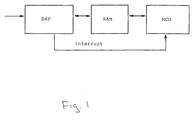
- the dual port RAM is a fast device and thus the signal processor can fully activate microprocessor at the very moment the data to be processed is available.
- a paging message transmitted by a base station on a paging channel is received in the RF section of a cellular telephone, after which the detected signal is transferred to the digital signal processor DSP illustrated in Figure 1.
- the paging message contains the identity number of a cellular telephone.
- Paging messages are not received continuously and generally the pause between the messages is longer than the actual messages.
- a paging message block is transmitted at intervals of 0.5 - 2 seconds while the length of the actual block is about 20 milliseconds (the block contains four bursts of 0.577 ms each, where the gap between each burst is 4.615 ms). If there is no need to search for or page a cellular telephone, an empty frame of a predetermined type can be used.
- the cellular telephone When the cellular telephone is in stand-by, it has to receive paging messages at predetermined moments and the receiving circuit can be switched off between these moments either partially or completely.
- the paging message is received in the RF section of the cellular telephone and then sent to the signal processor DSP where it is decoded and transferred to the dual-port RAM memory.
- the microprocessor is activated only when needed. The operation of apparatus in accordance with the invention is shown in Figure 2.
- the cellular telephone is in standby mode, and at 202 a paging message is expected and the MCU is in a lower power mode.
- the MCU transmits the identifier of the mobile station (for instance, identity number TMSI or IMSI) or a part thereof to the DSP.
- the DSP receives and decodes the paging message block 204 and places it in the dual-port RAM memory 205.
- the identifier received via the RF part from the outside is compared in the DSP with the identifier obtained internally from the MCU at step 206.
- the DSP activates the MCU through the interrupt and the MCU further directs the other necessary parts of the mobile station to be switched on 207, 201 and if the identifiers are not congruent, the DSP does not activate the MCU, and the MCU remains on as low a power level as possible in its standby mode. After having completed whatever functions are necessary having been fully activated, the MCU returns to its standby mode.
- the identity number can be, for instance, in the GSM system a so-called IMSI (International Mobile Subscriber Identity) or a TMSI (Temporary Mobile Subscriber Identity).
- IMSI International Mobile Subscriber Identity
- TMSI Temporal Mobile Subscriber Identity
- the DSP verifies this and ignores the block.
- the MCU can be on a low power level until it receives an interrupt signal from the DSP.
- the interrupt signal can be transmitted to the MCU by other means providing the DSP has first compared the identifiers or parts thereof.
- the invention can be applied both in digital and analog cellular telephone systems.
- this dual-port RAM can be a separate circuit or it can constitute a part of any IC of the cellular phone, and dual-port RAM memory can also be used to transfer other messages between the MCU and the DSP.
Landscapes
- Engineering & Computer Science (AREA)
- Computer Networks & Wireless Communication (AREA)
- Signal Processing (AREA)
- Mobile Radio Communication Systems (AREA)
- Gyroscopes (AREA)
- Dental Tools And Instruments Or Auxiliary Dental Instruments (AREA)
- Telephone Function (AREA)
Claims (10)
- Verfahren zum Verarbeiten von Funkrufnachrichten, dadurch gekennzeichnet, dass es die folgenden Schritte beinhaltet:Übertragen (203) einer ersten Kennungsnummer von einem Mikroprozessor (MCU) an einen Signalprozessor (DSP);Decodieren (204) einer empfangenen Funkrufnachricht an den Signalprozessor (DSP) ;Einschreiben (205) der decodierten, empfangenen Funkrufnachricht in einen Doppelport-RAM (RAM) ;Vergleichen (206), nachdem die decodierte, empfangene Funkrufnachricht in den Doppelport-RAM (RAM) eingeschrieben wurde, einer zweiten Kennungsnummer innerhalb der decodierten, empfangenen Funkrufnachricht mit der ersten Kennungsnummer im Signalprozessor (DSP) ;wobei dann, wenn herausgefunden wird, dass die zweite Kennungsnummer der ersten entspricht (207),der Mikroprozessor (MCU) von einem teilweise aktivierten Zustand aus vollständig aktiviert wird (208); undin der im Doppelport-RAM (RAM) abgespeicherten decodierten, empfangenen Funkrufnachricht enthaltene Daten vom Mikroprozessor (MCU) verarbeitet werden.
- Verfahren nach Anspruch 1, dadurch gekennzeichnet, dass es zum Schritt des vollständigen Aktivierens (208) des Mikroprozessors (MCU) von einem teilweise aktivierten Zustand aus gehört, dass der Signalprozessor (DSP) ein Interruptsignal zum vollständigen Aktivieren des Mikroprozessors (MCU) verwendet.
- Verfahren nach Anspruch 1 oder 2, dadurch gekennzeichnet, dass als Teil des Verfahrens leere Funkrufnachrichten vom Signalprozessor (DSP) erkannt werden und vom Mikroprozessor (MCU) nicht verarbeitet werden.
- Verfahren nach einem der vorstehenden Ansprüche, dadurch gekennzeichnet, dass die Funkrufnachricht in Intervallen als Signalcluster empfangen wird.
- Vorrichtung zum Verarbeiten von Funkrufnachrichten, mit:dadurch gekennzeichnet, dass:einem Signalprozessor (DSP) undeinem Mikroprozessor (MCU) ;sie einen gemeinsamen Doppelport-RAM (RAM) aufweist, der mit dem Signalprozessor (DSP) und dem Mikroprozessor (MCU) verbunden ist;der Signalprozessor (DSP) eine Einrichtung zum Einschreiben der decodierten, empfangenen Funkrufnachricht in den Doppelport-RAM (RAM), eine Einrichtung zum Vergleichen, nachdem eine decodierte, empfangene Funkrufnachricht in den Doppelport-RAM eingeschrieben wurde, einer in der empfangenen und decodierten Funkrufnachricht enthaltenen Kennungsnummer mit einer ersten, vom Mikroprozessor (MCU) erhaltenen Kennungsnummer, und eine Steuerungseinrichtung zum vollständigen Aktivieren des Mikroprozessors (MCU) ausgehend von einem teilweise aktivierten Zustand aus, wenn herausgefunden wird, dass die erste Kennungsnummer der in der Funkrufnachricht enthaltenen Kennungsnummer entspricht, aufweist; undder Mikroprozessor so ausgebildet ist, dass er auf ein Aktivierungssignal von der Steuerungseinrichtung hin in der im Doppelport-RAM (RAM) abgespeicherten decodierten, empfangenen Funkrufnachricht enthaltene Daten verarbeitet.
- Vorrichtung nach Anspruch 5, dadurch gekennzeichnet, dass der Doppelport-RAM (RAM) so ausgebildet ist, dass er zwischen dem Signalprozessor (DSP) und dem Mikroprozessor (MCU) parallele Signale überträgt und vom Signalprozessor (DSP) empfangene Nachrichten empfängt.
- Vorrichtung nach Anspruch 5 oder 6, dadurch gekennzeichnet, dass der Mikroprozessor (MCU) so ausgebildet ist, dass er durch ein Interruptsignal vom Signalprozessor (DSP) vollständig aktiviert wird.
- Vorrichtung nach einem der Ansprüche 5 bis 7, dadurch gekennzeichnet, dass der Doppelport-RAM (RAM) eine vom Signalprozessor (DSP) und vom Mikroprozessor (MCU) getrennte Schaltung ist.
- Vorrichtung nach einem der Ansprüche 5 bis 7, dadurch gekennzeichnet, dass der Doppelport-RAM (RAM) integral mit dem Signalprozessor (DSP) oder dem Mikroprozessor (MCU) ausgebildet ist.
- Vorrichtung nach einem der Ansprüche 5 bis 9, dadurch gekennzeichnet, dass sie so ausgebildet ist, dass sie Funkrufnachrichten periodisch als Signalcluster empfängt.
Applications Claiming Priority (2)
| Application Number | Priority Date | Filing Date | Title |
|---|---|---|---|
| FI935270 | 1993-11-26 | ||
| FI935270A FI97765C (fi) | 1993-11-26 | 1993-11-26 | Menetelmä sekä kytkentäjärjestely kutsuviestien käsittelemiseksi matkaviestimessä |
Publications (3)
| Publication Number | Publication Date |
|---|---|
| EP0655872A2 EP0655872A2 (de) | 1995-05-31 |
| EP0655872A3 EP0655872A3 (de) | 1997-12-29 |
| EP0655872B1 true EP0655872B1 (de) | 2002-07-17 |
Family
ID=8539019
Family Applications (1)
| Application Number | Title | Priority Date | Filing Date |
|---|---|---|---|
| EP94308443A Expired - Lifetime EP0655872B1 (de) | 1993-11-26 | 1994-11-15 | Funkrufnachrichterverarbeitung |
Country Status (5)
| Country | Link |
|---|---|
| US (1) | US5581244A (de) |
| EP (1) | EP0655872B1 (de) |
| AT (1) | ATE220843T1 (de) |
| DE (1) | DE69430979T2 (de) |
| FI (1) | FI97765C (de) |
Families Citing this family (30)
| Publication number | Priority date | Publication date | Assignee | Title |
|---|---|---|---|---|
| US5566357A (en) * | 1994-10-06 | 1996-10-15 | Qualcomm Incorporated | Power reduction in a cellular radiotelephone |
| US5930706A (en) * | 1995-11-29 | 1999-07-27 | Ericsson Inc. | Detecting messages transmitted over a communications channel such as a paging channel |
| GB2308531B (en) * | 1995-12-22 | 2000-03-08 | Nokia Mobile Phones Ltd | Radio telephone |
| FI101669B1 (fi) | 1996-02-23 | 1998-07-31 | Nokia Mobile Phones Ltd | Monipalvelumatkaviestin |
| US5722071A (en) * | 1996-03-27 | 1998-02-24 | Sony Corporation | Portable receiver including transducer for notifying user of messages received in a remote mobile communications device |
| US6067460A (en) * | 1996-05-23 | 2000-05-23 | Nokia Mobile Phones Limited | Mobile station having enhanced standby mode |
| FI963818A7 (fi) | 1996-09-25 | 1998-03-26 | Nokia Mobile Phones Ltd | Menetelmä ja järjestely matkaviestinlaitteen toiminnan ohjaamiseksi power-off-tilassa |
| GB2318673A (en) * | 1996-10-23 | 1998-04-29 | Nokia Mobile Phones Ltd | Radiotelephone proximity detector |
| FI104920B (fi) | 1996-10-31 | 2000-04-28 | Nokia Mobile Phones Ltd | Elektroniikkalaite, korttiliitäntä ja laajennuskortti |
| US5978366A (en) * | 1996-12-20 | 1999-11-02 | Ericsson Inc. | Methods and systems for reduced power operation of cellular mobile terminals |
| GB2322041B (en) | 1997-02-05 | 2001-09-19 | Nokia Mobile Phones Ltd | Intelligent network searching for a multi mode phone |
| DE19708979B4 (de) * | 1997-03-05 | 2006-08-24 | Nokia Mobile Phones Ltd. | System zur Datenkommunikation über einen optischen Bus und Verfahren zur Steuerung des Systems |
| FR2766319B1 (fr) * | 1997-07-15 | 2000-08-04 | Alsthom Cge Alcatel | Appareil electronique, en particulier appareil de radiocommunication, du type susceptible de basculer entre au moins deux modes de fonctionnement |
| US6041217A (en) * | 1997-07-29 | 2000-03-21 | Vlsi Technology, Inc. | Personal handyphone system hardware checking of broadcasting reception indication |
| US6240304B1 (en) | 1998-02-11 | 2001-05-29 | Nokia Mobile Phones Ltd. | Mobile terminal having RF power consumption optimization of extended standby mode |
| US6148177A (en) * | 1998-04-20 | 2000-11-14 | Motorola, Inc. | Subscriber unit and method for linking a message to an application |
| US6628946B1 (en) * | 1999-05-20 | 2003-09-30 | Telefonaktiebolaget Lm Ericsson (Publ) | Method and apparatus for broadcasting system information in a cellular communications network |
| JP3819242B2 (ja) | 2001-02-09 | 2006-09-06 | 株式会社日立製作所 | 断続信号を扱う無線通信装置 |
| JP4012391B2 (ja) * | 2001-10-30 | 2007-11-21 | 株式会社エヌ・ティ・ティ・ドコモ | 移動局、移動通信システム、ハンドオーバー制御方法、ハンドオーバー制御プログラム、及び記録媒体 |
| KR100480048B1 (ko) * | 2002-04-25 | 2005-03-30 | 엘지전자 주식회사 | 광대역 부호분할다중접속 단말 시스템의 페이징 분석 장치 |
| US7099679B2 (en) * | 2002-07-18 | 2006-08-29 | Intel Corporation | Method of saving power by reducing active reception time in standby mode |
| JP3708095B2 (ja) | 2003-08-12 | 2005-10-19 | 株式会社東芝 | 無線通信装置および無線通信方法 |
| JP2005259321A (ja) * | 2004-03-15 | 2005-09-22 | Nec Electronics Corp | フレキシブル・マルチエリア・メモリ及び該メモリを用いた電子機器 |
| JP2005259320A (ja) * | 2004-03-15 | 2005-09-22 | Nec Electronics Corp | パーシャル・デュアル・ポート・メモリ及び該メモリを用いた電子機器 |
| US7158795B2 (en) * | 2004-12-08 | 2007-01-02 | Spreadtrum Communications Corporation | Dummy PCH block detection for power saving in GSM handset |
| US7594144B2 (en) * | 2006-08-14 | 2009-09-22 | International Business Machines Corporation | Handling fatal computer hardware errors |
| US8787989B2 (en) * | 2008-02-15 | 2014-07-22 | Qualcomm Incorporated | Efficient sleep mode operation for OFDMA systems |
| KR101275469B1 (ko) * | 2009-02-13 | 2013-06-17 | 미쓰비시덴키 가부시키가이샤 | 통신 장치, 통신 시스템 및 자국 장치 |
| US8533809B1 (en) * | 2009-05-29 | 2013-09-10 | Sprint Spectrum L.P. | Forced state-change to facilitate blacklist evaluation |
| TWI582573B (zh) * | 2012-09-14 | 2017-05-11 | 宏碁股份有限公司 | 電腦系統及電源管理方法 |
Family Cites Families (11)
| Publication number | Priority date | Publication date | Assignee | Title |
|---|---|---|---|---|
| US4769642A (en) * | 1985-12-31 | 1988-09-06 | Motorola, Inc. | Paging receiver with LPC speech synthesizer |
| US4845491A (en) * | 1987-05-15 | 1989-07-04 | Newspager Corporation Of America | Pager based information system |
| US5187471A (en) * | 1988-06-24 | 1993-02-16 | Kabushiki Kaisha Toshiba | Radio telecommunication apparatus |
| US5638375A (en) * | 1988-11-30 | 1997-06-10 | Motorola, Inc. | AGC isolation of information in TDMA systems |
| JPH04504340A (ja) * | 1989-03-20 | 1992-07-30 | モトローラ・インコーポレーテッド | 電力要求が低減されたdspベースの無線機 |
| US5224152A (en) * | 1990-08-27 | 1993-06-29 | Audiovox Corporation | Power saving arrangement and method in portable cellular telephone system |
| US5153903A (en) * | 1990-11-05 | 1992-10-06 | Motorola, Inc. | Integrated paging and radiotelephone system having improved paging reliability |
| FI88657C (fi) * | 1991-02-12 | 1993-06-10 | Nokia Mobile Phones Ltd | Foerfarande foer att minska stroemfoerbrukningen i en mobiltelefon |
| US5378935A (en) * | 1991-06-18 | 1995-01-03 | Nokia Mobile Phones Ltd. | Clock frequency adjustment of an electrical circuit |
| US5471655A (en) * | 1993-12-03 | 1995-11-28 | Nokia Mobile Phones Ltd. | Method and apparatus for operating a radiotelephone in an extended stand-by mode of operation for conserving battery power |
| US5491718A (en) * | 1994-01-05 | 1996-02-13 | Nokia Mobile Phones Ltd. | CDMA radiotelephone having optimized slotted mode and long code operation |
-
1993
- 1993-11-26 FI FI935270A patent/FI97765C/fi not_active IP Right Cessation
-
1994
- 1994-11-10 US US08/336,976 patent/US5581244A/en not_active Expired - Lifetime
- 1994-11-15 EP EP94308443A patent/EP0655872B1/de not_active Expired - Lifetime
- 1994-11-15 AT AT94308443T patent/ATE220843T1/de not_active IP Right Cessation
- 1994-11-15 DE DE69430979T patent/DE69430979T2/de not_active Expired - Lifetime
Also Published As
| Publication number | Publication date |
|---|---|
| DE69430979D1 (de) | 2002-08-22 |
| ATE220843T1 (de) | 2002-08-15 |
| EP0655872A3 (de) | 1997-12-29 |
| US5581244A (en) | 1996-12-03 |
| FI97765C (fi) | 1997-02-10 |
| DE69430979T2 (de) | 2003-02-27 |
| FI935270L (fi) | 1995-05-27 |
| EP0655872A2 (de) | 1995-05-31 |
| FI97765B (fi) | 1996-10-31 |
| FI935270A0 (fi) | 1993-11-26 |
Similar Documents
| Publication | Publication Date | Title |
|---|---|---|
| US5581244A (en) | Paging message processing | |
| EP0784909B1 (de) | Verfahren zur energieeinsparung für ein zellulares funktelefongerät | |
| US4679244A (en) | Method of transmitting terminating call signals within a restricted duration and a base station and a portable unit for use in the same | |
| WO1996008941A3 (en) | Efficient paging system | |
| GB2201866B (en) | Improvements in or relating to cellular telephone apparatus and a cellular communications system | |
| JPH06177824A (ja) | 移動無線装置 | |
| EP1459584B1 (de) | Zuverlässige dekodierung eines schnellen funkrufkanals | |
| JPH11136158A (ja) | 無線基地局 | |
| US6195573B1 (en) | Radio telephone receiver with quick quiescent mode | |
| WO1999033306A1 (en) | A method of increasing battery life in mobile communications devices which use paging channel displacement | |
| AU752795B2 (en) | Integration of mobile station channel measurement with paging channel displacement operation in wireless communications system | |
| US6275680B1 (en) | Hardware PCH checking for personal handyphone system portable station | |
| GB2280086A (en) | Implementing power-saving in a microwave communications network | |
| AU6174599A (en) | A method of receiving signals, in particular signaling | |
| KR20060008571A (ko) | 이동통신 단말기의 전원을 절약하는 장치 및 방법 | |
| JPS645780B2 (de) | ||
| US5903828A (en) | Personal handyphone system hardware checking of SA-field | |
| JPH06177811A (ja) | 移動無線装置 | |
| JPH0518491B2 (de) | ||
| JP3307537B2 (ja) | 無線呼出付携帯電話装置 | |
| JPH04304043A (ja) | 無線選択呼出受信機 | |
| JPH04355524A (ja) | 携帯型無線端末 | |
| KR970010239B1 (en) | Mobile telecommunication | |
| JPS5966231A (ja) | バツテリセ−ビング方式 | |
| JPH11234193A (ja) | 携帯端末装置及びその制御方法 |
Legal Events
| Date | Code | Title | Description |
|---|---|---|---|
| PUAI | Public reference made under article 153(3) epc to a published international application that has entered the european phase |
Free format text: ORIGINAL CODE: 0009012 |
|
| AK | Designated contracting states |
Kind code of ref document: A2 Designated state(s): AT DE FR GB SE |
|
| PUAL | Search report despatched |
Free format text: ORIGINAL CODE: 0009013 |
|
| AK | Designated contracting states |
Kind code of ref document: A3 Designated state(s): AT DE FR GB SE |
|
| 17P | Request for examination filed |
Effective date: 19980629 |
|
| 17Q | First examination report despatched |
Effective date: 20001020 |
|
| GRAG | Despatch of communication of intention to grant |
Free format text: ORIGINAL CODE: EPIDOS AGRA |
|
| GRAG | Despatch of communication of intention to grant |
Free format text: ORIGINAL CODE: EPIDOS AGRA |
|
| GRAH | Despatch of communication of intention to grant a patent |
Free format text: ORIGINAL CODE: EPIDOS IGRA |
|
| RAP1 | Party data changed (applicant data changed or rights of an application transferred) |
Owner name: NOKIA CORPORATION |
|
| GRAH | Despatch of communication of intention to grant a patent |
Free format text: ORIGINAL CODE: EPIDOS IGRA |
|
| GRAA | (expected) grant |
Free format text: ORIGINAL CODE: 0009210 |
|
| AK | Designated contracting states |
Kind code of ref document: B1 Designated state(s): AT DE FR GB SE |
|
| PG25 | Lapsed in a contracting state [announced via postgrant information from national office to epo] |
Ref country code: AT Free format text: LAPSE BECAUSE OF FAILURE TO SUBMIT A TRANSLATION OF THE DESCRIPTION OR TO PAY THE FEE WITHIN THE PRESCRIBED TIME-LIMIT Effective date: 20020717 |
|
| REF | Corresponds to: |
Ref document number: 220843 Country of ref document: AT Date of ref document: 20020815 Kind code of ref document: T |
|
| REG | Reference to a national code |
Ref country code: GB Ref legal event code: FG4D |
|
| REF | Corresponds to: |
Ref document number: 69430979 Country of ref document: DE Date of ref document: 20020822 |
|
| PG25 | Lapsed in a contracting state [announced via postgrant information from national office to epo] |
Ref country code: SE Free format text: LAPSE BECAUSE OF FAILURE TO SUBMIT A TRANSLATION OF THE DESCRIPTION OR TO PAY THE FEE WITHIN THE PRESCRIBED TIME-LIMIT Effective date: 20021017 |
|
| ET | Fr: translation filed | ||
| PLBE | No opposition filed within time limit |
Free format text: ORIGINAL CODE: 0009261 |
|
| STAA | Information on the status of an ep patent application or granted ep patent |
Free format text: STATUS: NO OPPOSITION FILED WITHIN TIME LIMIT |
|
| 26N | No opposition filed |
Effective date: 20030422 |
|
| PGFP | Annual fee paid to national office [announced via postgrant information from national office to epo] |
Ref country code: FR Payment date: 20101123 Year of fee payment: 17 |
|
| PGFP | Annual fee paid to national office [announced via postgrant information from national office to epo] |
Ref country code: GB Payment date: 20101110 Year of fee payment: 17 |
|
| GBPC | Gb: european patent ceased through non-payment of renewal fee |
Effective date: 20111115 |
|
| REG | Reference to a national code |
Ref country code: FR Ref legal event code: ST Effective date: 20120731 |
|
| PG25 | Lapsed in a contracting state [announced via postgrant information from national office to epo] |
Ref country code: GB Free format text: LAPSE BECAUSE OF NON-PAYMENT OF DUE FEES Effective date: 20111115 |
|
| PG25 | Lapsed in a contracting state [announced via postgrant information from national office to epo] |
Ref country code: FR Free format text: LAPSE BECAUSE OF NON-PAYMENT OF DUE FEES Effective date: 20111130 |
|
| PGFP | Annual fee paid to national office [announced via postgrant information from national office to epo] |
Ref country code: DE Payment date: 20131113 Year of fee payment: 20 |
|
| REG | Reference to a national code |
Ref country code: DE Ref legal event code: R071 Ref document number: 69430979 Country of ref document: DE |