EP0655949B1 - Catalyseur d'epoxydation - Google Patents
Catalyseur d'epoxydation Download PDFInfo
- Publication number
- EP0655949B1 EP0655949B1 EP93921127A EP93921127A EP0655949B1 EP 0655949 B1 EP0655949 B1 EP 0655949B1 EP 93921127 A EP93921127 A EP 93921127A EP 93921127 A EP93921127 A EP 93921127A EP 0655949 B1 EP0655949 B1 EP 0655949B1
- Authority
- EP
- European Patent Office
- Prior art keywords
- catalyst
- ligand
- carrier
- molybdenum
- catalyst according
- Prior art date
- Legal status (The legal status is an assumption and is not a legal conclusion. Google has not performed a legal analysis and makes no representation as to the accuracy of the status listed.)
- Expired - Lifetime
Links
- 239000003054 catalyst Substances 0.000 title claims abstract description 66
- 238000006735 epoxidation reaction Methods 0.000 title claims abstract description 16
- 150000001336 alkenes Chemical class 0.000 claims abstract description 24
- ZOKXTWBITQBERF-UHFFFAOYSA-N Molybdenum Chemical compound [Mo] ZOKXTWBITQBERF-UHFFFAOYSA-N 0.000 claims abstract description 16
- 229910052750 molybdenum Inorganic materials 0.000 claims abstract description 16
- 239000011733 molybdenum Substances 0.000 claims abstract description 16
- 229910052751 metal Inorganic materials 0.000 claims abstract description 11
- 239000002184 metal Substances 0.000 claims abstract description 11
- RTAQQCXQSZGOHL-UHFFFAOYSA-N Titanium Chemical compound [Ti] RTAQQCXQSZGOHL-UHFFFAOYSA-N 0.000 claims abstract description 10
- 229910021645 metal ion Inorganic materials 0.000 claims abstract description 10
- 229910052719 titanium Inorganic materials 0.000 claims abstract description 10
- 239000010936 titanium Substances 0.000 claims abstract description 10
- 239000013110 organic ligand Substances 0.000 claims abstract description 9
- WFKWXMTUELFFGS-UHFFFAOYSA-N tungsten Chemical compound [W] WFKWXMTUELFFGS-UHFFFAOYSA-N 0.000 claims abstract description 8
- 229910052720 vanadium Inorganic materials 0.000 claims abstract description 8
- 238000000034 method Methods 0.000 claims abstract description 7
- 125000004432 carbon atom Chemical group C* 0.000 claims abstract description 5
- 150000002739 metals Chemical class 0.000 claims abstract description 5
- 238000002360 preparation method Methods 0.000 claims abstract description 5
- LEONUFNNVUYDNQ-UHFFFAOYSA-N vanadium atom Chemical compound [V] LEONUFNNVUYDNQ-UHFFFAOYSA-N 0.000 claims abstract 4
- 239000003446 ligand Substances 0.000 claims description 33
- 238000006243 chemical reaction Methods 0.000 claims description 24
- LFQSCWFLJHTTHZ-UHFFFAOYSA-N Ethanol Chemical compound CCO LFQSCWFLJHTTHZ-UHFFFAOYSA-N 0.000 claims description 20
- 239000007787 solid Substances 0.000 claims description 9
- 150000002500 ions Chemical class 0.000 claims description 7
- 229910052721 tungsten Inorganic materials 0.000 claims description 7
- 239000010937 tungsten Substances 0.000 claims description 7
- 125000003178 carboxy group Chemical group [H]OC(*)=O 0.000 claims description 5
- 229910052760 oxygen Inorganic materials 0.000 claims description 5
- IJGRMHOSHXDMSA-UHFFFAOYSA-N Atomic nitrogen Chemical compound N#N IJGRMHOSHXDMSA-UHFFFAOYSA-N 0.000 claims description 4
- 125000003118 aryl group Chemical group 0.000 claims description 4
- 229910052757 nitrogen Inorganic materials 0.000 claims description 4
- RTZKZFJDLAIYFH-UHFFFAOYSA-N Diethyl ether Chemical compound CCOCC RTZKZFJDLAIYFH-UHFFFAOYSA-N 0.000 claims description 3
- QVGXLLKOCUKJST-UHFFFAOYSA-N atomic oxygen Chemical compound [O] QVGXLLKOCUKJST-UHFFFAOYSA-N 0.000 claims description 3
- 229910052799 carbon Inorganic materials 0.000 claims description 3
- 239000000203 mixture Substances 0.000 claims description 3
- 239000001301 oxygen Substances 0.000 claims description 3
- 125000004642 (C1-C12) alkoxy group Chemical group 0.000 claims description 2
- 125000004400 (C1-C12) alkyl group Chemical group 0.000 claims description 2
- 125000000923 (C1-C30) alkyl group Chemical group 0.000 claims description 2
- 125000004209 (C1-C8) alkyl group Chemical group 0.000 claims description 2
- XUIMIQQOPSSXEZ-UHFFFAOYSA-N Silicon Chemical compound [Si] XUIMIQQOPSSXEZ-UHFFFAOYSA-N 0.000 claims description 2
- NINIDFKCEFEMDL-UHFFFAOYSA-N Sulfur Chemical group [S] NINIDFKCEFEMDL-UHFFFAOYSA-N 0.000 claims description 2
- 125000002877 alkyl aryl group Chemical group 0.000 claims description 2
- 239000004411 aluminium Substances 0.000 claims description 2
- 229910052782 aluminium Inorganic materials 0.000 claims description 2
- XAGFODPZIPBFFR-UHFFFAOYSA-N aluminium Chemical compound [Al] XAGFODPZIPBFFR-UHFFFAOYSA-N 0.000 claims description 2
- 150000004982 aromatic amines Chemical class 0.000 claims description 2
- 125000003710 aryl alkyl group Chemical group 0.000 claims description 2
- 125000004429 atom Chemical group 0.000 claims description 2
- 150000004696 coordination complex Chemical class 0.000 claims description 2
- 125000004122 cyclic group Chemical group 0.000 claims description 2
- 239000010703 silicon Substances 0.000 claims description 2
- 229910052710 silicon Inorganic materials 0.000 claims description 2
- 229910052717 sulfur Inorganic materials 0.000 claims description 2
- QXYJCZRRLLQGCR-UHFFFAOYSA-N dioxomolybdenum Chemical compound O=[Mo]=O QXYJCZRRLLQGCR-UHFFFAOYSA-N 0.000 claims 2
- UCKMPCXJQFINFW-UHFFFAOYSA-N Sulphide Chemical compound [S-2] UCKMPCXJQFINFW-UHFFFAOYSA-N 0.000 claims 1
- 150000001299 aldehydes Chemical class 0.000 claims 1
- 229910052809 inorganic oxide Inorganic materials 0.000 claims 1
- 150000002576 ketones Chemical class 0.000 claims 1
- 150000003141 primary amines Chemical class 0.000 claims 1
- 150000003335 secondary amines Chemical class 0.000 claims 1
- 150000003512 tertiary amines Chemical class 0.000 claims 1
- KWKAKUADMBZCLK-UHFFFAOYSA-N 1-octene Chemical compound CCCCCCC=C KWKAKUADMBZCLK-UHFFFAOYSA-N 0.000 description 14
- HGCIXCUEYOPUTN-UHFFFAOYSA-N cyclohexene Chemical compound C1CCC=CC1 HGCIXCUEYOPUTN-UHFFFAOYSA-N 0.000 description 12
- CIHOLLKRGTVIJN-UHFFFAOYSA-N tert‐butyl hydroperoxide Chemical compound CC(C)(C)OO CIHOLLKRGTVIJN-UHFFFAOYSA-N 0.000 description 12
- VYPSYNLAJGMNEJ-UHFFFAOYSA-N Silicium dioxide Chemical compound O=[Si]=O VYPSYNLAJGMNEJ-UHFFFAOYSA-N 0.000 description 11
- YXFVVABEGXRONW-UHFFFAOYSA-N Toluene Chemical compound CC1=CC=CC=C1 YXFVVABEGXRONW-UHFFFAOYSA-N 0.000 description 9
- TVMXDCGIABBOFY-UHFFFAOYSA-N n-Octanol Natural products CCCCCCCC TVMXDCGIABBOFY-UHFFFAOYSA-N 0.000 description 7
- 239000011541 reaction mixture Substances 0.000 description 7
- 238000002474 experimental method Methods 0.000 description 6
- FGGJBCRKSVGDPO-UHFFFAOYSA-N hydroperoxycyclohexane Chemical compound OOC1CCCCC1 FGGJBCRKSVGDPO-UHFFFAOYSA-N 0.000 description 6
- 239000012299 nitrogen atmosphere Substances 0.000 description 6
- 150000002978 peroxides Chemical class 0.000 description 6
- 239000000047 product Substances 0.000 description 6
- CUJRVFIICFDLGR-UHFFFAOYSA-N acetylacetonate Chemical compound CC(=O)[CH-]C(C)=O CUJRVFIICFDLGR-UHFFFAOYSA-N 0.000 description 5
- 150000002466 imines Chemical class 0.000 description 5
- SMQUZDBALVYZAC-UHFFFAOYSA-N salicylaldehyde Chemical class OC1=CC=CC=C1C=O SMQUZDBALVYZAC-UHFFFAOYSA-N 0.000 description 5
- 239000002904 solvent Substances 0.000 description 5
- XDTMQSROBMDMFD-UHFFFAOYSA-N Cyclohexane Chemical compound C1CCCCC1 XDTMQSROBMDMFD-UHFFFAOYSA-N 0.000 description 4
- 238000010992 reflux Methods 0.000 description 4
- 239000000377 silicon dioxide Substances 0.000 description 4
- GPPXJZIENCGNKB-UHFFFAOYSA-N vanadium Chemical compound [V]#[V] GPPXJZIENCGNKB-UHFFFAOYSA-N 0.000 description 4
- WSLDOOZREJYCGB-UHFFFAOYSA-N 1,2-Dichloroethane Chemical compound ClCCCl WSLDOOZREJYCGB-UHFFFAOYSA-N 0.000 description 3
- UHOVQNZJYSORNB-UHFFFAOYSA-N Benzene Chemical compound C1=CC=CC=C1 UHOVQNZJYSORNB-UHFFFAOYSA-N 0.000 description 3
- OKKJLVBELUTLKV-UHFFFAOYSA-N Methanol Chemical compound OC OKKJLVBELUTLKV-UHFFFAOYSA-N 0.000 description 3
- 238000004458 analytical method Methods 0.000 description 3
- 238000001914 filtration Methods 0.000 description 3
- XYFCBTPGUUZFHI-UHFFFAOYSA-N phosphine group Chemical group P XYFCBTPGUUZFHI-UHFFFAOYSA-N 0.000 description 3
- POILWHVDKZOXJZ-ARJAWSKDSA-M (z)-4-oxopent-2-en-2-olate Chemical compound C\C([O-])=C\C(C)=O POILWHVDKZOXJZ-ARJAWSKDSA-M 0.000 description 2
- ZGEGCLOFRBLKSE-UHFFFAOYSA-N 1-Heptene Chemical compound CCCCCC=C ZGEGCLOFRBLKSE-UHFFFAOYSA-N 0.000 description 2
- LIKMAJRDDDTEIG-UHFFFAOYSA-N 1-hexene Chemical compound CCCCC=C LIKMAJRDDDTEIG-UHFFFAOYSA-N 0.000 description 2
- RYPKRALMXUUNKS-UHFFFAOYSA-N 2-Hexene Natural products CCCC=CC RYPKRALMXUUNKS-UHFFFAOYSA-N 0.000 description 2
- WWUVJRULCWHUSA-UHFFFAOYSA-N 2-methyl-1-pentene Chemical compound CCCC(C)=C WWUVJRULCWHUSA-UHFFFAOYSA-N 0.000 description 2
- CSCPPACGZOOCGX-UHFFFAOYSA-N Acetone Chemical compound CC(C)=O CSCPPACGZOOCGX-UHFFFAOYSA-N 0.000 description 2
- MHAJPDPJQMAIIY-UHFFFAOYSA-N Hydrogen peroxide Chemical compound OO MHAJPDPJQMAIIY-UHFFFAOYSA-N 0.000 description 2
- UIIMBOGNXHQVGW-UHFFFAOYSA-M Sodium bicarbonate Chemical compound [Na+].OC([O-])=O UIIMBOGNXHQVGW-UHFFFAOYSA-M 0.000 description 2
- PPBRXRYQALVLMV-UHFFFAOYSA-N Styrene Chemical compound C=CC1=CC=CC=C1 PPBRXRYQALVLMV-UHFFFAOYSA-N 0.000 description 2
- DKGAVHZHDRPRBM-UHFFFAOYSA-N Tert-Butanol Chemical compound CC(C)(C)O DKGAVHZHDRPRBM-UHFFFAOYSA-N 0.000 description 2
- XXROGKLTLUQVRX-UHFFFAOYSA-N allyl alcohol Chemical compound OCC=C XXROGKLTLUQVRX-UHFFFAOYSA-N 0.000 description 2
- 238000006555 catalytic reaction Methods 0.000 description 2
- 230000000052 comparative effect Effects 0.000 description 2
- 150000001875 compounds Chemical class 0.000 description 2
- JHIVVAPYMSGYDF-UHFFFAOYSA-N cyclohexanone Chemical compound O=C1CCCCC1 JHIVVAPYMSGYDF-UHFFFAOYSA-N 0.000 description 2
- LPIQUOYDBNQMRZ-UHFFFAOYSA-N cyclopentene Chemical compound C1CC=CC1 LPIQUOYDBNQMRZ-UHFFFAOYSA-N 0.000 description 2
- 238000004817 gas chromatography Methods 0.000 description 2
- 239000002638 heterogeneous catalyst Substances 0.000 description 2
- 125000004433 nitrogen atom Chemical group N* 0.000 description 2
- 150000002924 oxiranes Chemical class 0.000 description 2
- YWAKXRMUMFPDSH-UHFFFAOYSA-N pentene Chemical compound CCCC=C YWAKXRMUMFPDSH-UHFFFAOYSA-N 0.000 description 2
- QMMOXUPEWRXHJS-UHFFFAOYSA-N pentene-2 Natural products CCC=CC QMMOXUPEWRXHJS-UHFFFAOYSA-N 0.000 description 2
- 239000012429 reaction media Substances 0.000 description 2
- 239000000758 substrate Substances 0.000 description 2
- 239000000725 suspension Substances 0.000 description 2
- 238000005406 washing Methods 0.000 description 2
- XLYOFNOQVPJJNP-UHFFFAOYSA-N water Substances O XLYOFNOQVPJJNP-UHFFFAOYSA-N 0.000 description 2
- KMOUUZVZFBCRAM-OLQVQODUSA-N (3as,7ar)-3a,4,7,7a-tetrahydro-2-benzofuran-1,3-dione Chemical compound C1C=CC[C@@H]2C(=O)OC(=O)[C@@H]21 KMOUUZVZFBCRAM-OLQVQODUSA-N 0.000 description 1
- YCTDZYMMFQCTEO-FNORWQNLSA-N (E)-3-octene Chemical compound CCCC\C=C\CC YCTDZYMMFQCTEO-FNORWQNLSA-N 0.000 description 1
- OFKLSPUVNMOIJB-VMPITWQZSA-N (e)-3-methylhept-2-ene Chemical compound CCCC\C(C)=C\C OFKLSPUVNMOIJB-VMPITWQZSA-N 0.000 description 1
- CHRJZRDFSQHIFI-UHFFFAOYSA-N 1,2-bis(ethenyl)benzene;styrene Chemical compound C=CC1=CC=CC=C1.C=CC1=CC=CC=C1C=C CHRJZRDFSQHIFI-UHFFFAOYSA-N 0.000 description 1
- GQNOPVSQPBUJKQ-UHFFFAOYSA-N 1-hydroperoxyethylbenzene Chemical compound OOC(C)C1=CC=CC=C1 GQNOPVSQPBUJKQ-UHFFFAOYSA-N 0.000 description 1
- 238000005160 1H NMR spectroscopy Methods 0.000 description 1
- JFJNVIPVOCESGZ-UHFFFAOYSA-N 2,3-dipyridin-2-ylpyridine Chemical compound N1=CC=CC=C1C1=CC=CN=C1C1=CC=CC=N1 JFJNVIPVOCESGZ-UHFFFAOYSA-N 0.000 description 1
- HIXDQWDOVZUNNA-UHFFFAOYSA-N 2-(3,4-dimethoxyphenyl)-5-hydroxy-7-methoxychromen-4-one Chemical compound C=1C(OC)=CC(O)=C(C(C=2)=O)C=1OC=2C1=CC=C(OC)C(OC)=C1 HIXDQWDOVZUNNA-UHFFFAOYSA-N 0.000 description 1
- OTTZHAVKAVGASB-HYXAFXHYSA-N 2-Heptene Chemical compound CCCC\C=C/C OTTZHAVKAVGASB-HYXAFXHYSA-N 0.000 description 1
- QKHUXWLXTLMABH-UHFFFAOYSA-N 2-butyl-3-ethyloxirane Chemical compound CCCCC1OC1CC QKHUXWLXTLMABH-UHFFFAOYSA-N 0.000 description 1
- CSDSSGBPEUDDEE-UHFFFAOYSA-N 2-formylpyridine Chemical compound O=CC1=CC=CC=N1 CSDSSGBPEUDDEE-UHFFFAOYSA-N 0.000 description 1
- OTTZHAVKAVGASB-UHFFFAOYSA-N 2-heptene Natural products CCCCC=CC OTTZHAVKAVGASB-UHFFFAOYSA-N 0.000 description 1
- SGJUFIMCHSLMRJ-UHFFFAOYSA-N 2-hydroperoxypropane Chemical compound CC(C)OO SGJUFIMCHSLMRJ-UHFFFAOYSA-N 0.000 description 1
- SNAUWGUVQBOHMZ-UHFFFAOYSA-N 2-methyl-3-pentyloxirane Chemical compound CCCCCC1OC1C SNAUWGUVQBOHMZ-UHFFFAOYSA-N 0.000 description 1
- MHNNAWXXUZQSNM-UHFFFAOYSA-N 2-methylbut-1-ene Chemical group CCC(C)=C MHNNAWXXUZQSNM-UHFFFAOYSA-N 0.000 description 1
- RCBGGJURENJHKV-UHFFFAOYSA-N 2-methylhept-1-ene Chemical compound CCCCCC(C)=C RCBGGJURENJHKV-UHFFFAOYSA-N 0.000 description 1
- ILPBINAXDRFYPL-UHFFFAOYSA-N 2-octene Chemical compound CCCCCC=CC ILPBINAXDRFYPL-UHFFFAOYSA-N 0.000 description 1
- QDMFTFWKTYXBIW-UHFFFAOYSA-N 3-Methyl-1-heptene Chemical compound CCCCC(C)C=C QDMFTFWKTYXBIW-UHFFFAOYSA-N 0.000 description 1
- ZQDPJFUHLCOCRG-UHFFFAOYSA-N 3-hexene Chemical compound CCC=CCC ZQDPJFUHLCOCRG-UHFFFAOYSA-N 0.000 description 1
- LDTAOIUHUHHCMU-UHFFFAOYSA-N 3-methylpent-1-ene Chemical compound CCC(C)C=C LDTAOIUHUHHCMU-UHFFFAOYSA-N 0.000 description 1
- SJECZPVISLOESU-UHFFFAOYSA-N 3-trimethoxysilylpropan-1-amine Chemical compound CO[Si](OC)(OC)CCCN SJECZPVISLOESU-UHFFFAOYSA-N 0.000 description 1
- ROFVEXUMMXZLPA-UHFFFAOYSA-N Bipyridyl Chemical compound N1=CC=CC=C1C1=CC=CC=N1 ROFVEXUMMXZLPA-UHFFFAOYSA-N 0.000 description 1
- 239000004215 Carbon black (E152) Substances 0.000 description 1
- VEXZGXHMUGYJMC-UHFFFAOYSA-M Chloride anion Chemical compound [Cl-] VEXZGXHMUGYJMC-UHFFFAOYSA-M 0.000 description 1
- VGGSQFUCUMXWEO-UHFFFAOYSA-N Ethene Chemical compound C=C VGGSQFUCUMXWEO-UHFFFAOYSA-N 0.000 description 1
- 239000005977 Ethylene Substances 0.000 description 1
- VEXZGXHMUGYJMC-UHFFFAOYSA-N Hydrochloric acid Chemical compound Cl VEXZGXHMUGYJMC-UHFFFAOYSA-N 0.000 description 1
- VQTUBCCKSQIDNK-UHFFFAOYSA-N Isobutene Chemical group CC(C)=C VQTUBCCKSQIDNK-UHFFFAOYSA-N 0.000 description 1
- QYKIQEUNHZKYBP-UHFFFAOYSA-N Vinyl ether Chemical class C=COC=C QYKIQEUNHZKYBP-UHFFFAOYSA-N 0.000 description 1
- DGEZNRSVGBDHLK-UHFFFAOYSA-N [1,10]phenanthroline Chemical compound C1=CN=C2C3=NC=CC=C3C=CC2=C1 DGEZNRSVGBDHLK-UHFFFAOYSA-N 0.000 description 1
- 125000003158 alcohol group Chemical class 0.000 description 1
- 125000003172 aldehyde group Chemical group 0.000 description 1
- XYLMUPLGERFSHI-UHFFFAOYSA-N alpha-Methylstyrene Chemical compound CC(=C)C1=CC=CC=C1 XYLMUPLGERFSHI-UHFFFAOYSA-N 0.000 description 1
- PNEYBMLMFCGWSK-UHFFFAOYSA-N aluminium oxide Inorganic materials [O-2].[O-2].[O-2].[Al+3].[Al+3] PNEYBMLMFCGWSK-UHFFFAOYSA-N 0.000 description 1
- 150000001408 amides Chemical class 0.000 description 1
- 229940111121 antirheumatic drug quinolines Drugs 0.000 description 1
- 238000010533 azeotropic distillation Methods 0.000 description 1
- 150000001555 benzenes Chemical class 0.000 description 1
- 239000001273 butane Substances 0.000 description 1
- IAQRGUVFOMOMEM-UHFFFAOYSA-N butene Natural products CC=CC IAQRGUVFOMOMEM-UHFFFAOYSA-N 0.000 description 1
- 239000006227 byproduct Substances 0.000 description 1
- 238000001354 calcination Methods 0.000 description 1
- 238000005810 carbonylation reaction Methods 0.000 description 1
- 230000003197 catalytic effect Effects 0.000 description 1
- 239000007795 chemical reaction product Substances 0.000 description 1
- 239000003153 chemical reaction reagent Substances 0.000 description 1
- 238000001816 cooling Methods 0.000 description 1
- 229910052593 corundum Inorganic materials 0.000 description 1
- 230000008878 coupling Effects 0.000 description 1
- 238000010168 coupling process Methods 0.000 description 1
- 238000005859 coupling reaction Methods 0.000 description 1
- YQHLDYVWEZKEOX-UHFFFAOYSA-N cumene hydroperoxide Chemical compound OOC(C)(C)C1=CC=CC=C1 YQHLDYVWEZKEOX-UHFFFAOYSA-N 0.000 description 1
- 125000004093 cyano group Chemical group *C#N 0.000 description 1
- -1 cyclic alkene Chemical class 0.000 description 1
- HYPABJGVBDSCIT-UPHRSURJSA-N cyclododecene Chemical compound C1CCCCC\C=C/CCCC1 HYPABJGVBDSCIT-UPHRSURJSA-N 0.000 description 1
- ZXIJMRYMVAMXQP-UHFFFAOYSA-N cycloheptene Chemical compound C1CCC=CCC1 ZXIJMRYMVAMXQP-UHFFFAOYSA-N 0.000 description 1
- HPXRVTGHNJAIIH-UHFFFAOYSA-N cyclohexanol Chemical compound OC1CCCCC1 HPXRVTGHNJAIIH-UHFFFAOYSA-N 0.000 description 1
- URYYVOIYTNXXBN-UPHRSURJSA-N cyclooctene Chemical compound C1CCC\C=C/CC1 URYYVOIYTNXXBN-UPHRSURJSA-N 0.000 description 1
- 239000004913 cyclooctene Substances 0.000 description 1
- 230000007423 decrease Effects 0.000 description 1
- 230000001419 dependent effect Effects 0.000 description 1
- RAABOESOVLLHRU-UHFFFAOYSA-N diazene Chemical compound N=N RAABOESOVLLHRU-UHFFFAOYSA-N 0.000 description 1
- 229910000071 diazene Inorganic materials 0.000 description 1
- 230000000694 effects Effects 0.000 description 1
- 150000002148 esters Chemical class 0.000 description 1
- 125000001033 ether group Chemical group 0.000 description 1
- CNUDBTRUORMMPA-UHFFFAOYSA-N formylthiophene Chemical compound O=CC1=CC=CS1 CNUDBTRUORMMPA-UHFFFAOYSA-N 0.000 description 1
- 238000002290 gas chromatography-mass spectrometry Methods 0.000 description 1
- WZHKDGJSXCTSCK-UHFFFAOYSA-N hept-3-ene Chemical compound CCCC=CCC WZHKDGJSXCTSCK-UHFFFAOYSA-N 0.000 description 1
- 229930195733 hydrocarbon Natural products 0.000 description 1
- 150000002430 hydrocarbons Chemical class 0.000 description 1
- 125000002887 hydroxy group Chemical group [H]O* 0.000 description 1
- 150000003949 imides Chemical class 0.000 description 1
- 229910003480 inorganic solid Inorganic materials 0.000 description 1
- 125000000468 ketone group Chemical group 0.000 description 1
- 229910000476 molybdenum oxide Inorganic materials 0.000 description 1
- WGYKZJWCGVVSQN-UHFFFAOYSA-N mono-n-propyl amine Natural products CCCN WGYKZJWCGVVSQN-UHFFFAOYSA-N 0.000 description 1
- IJDNQMDRQITEOD-UHFFFAOYSA-N n-butane Chemical compound CCCC IJDNQMDRQITEOD-UHFFFAOYSA-N 0.000 description 1
- OFBQJSOFQDEBGM-UHFFFAOYSA-N n-pentane Natural products CCCCC OFBQJSOFQDEBGM-UHFFFAOYSA-N 0.000 description 1
- 229910000510 noble metal Inorganic materials 0.000 description 1
- IRUCBBFNLDIMIK-UHFFFAOYSA-N oct-4-ene Chemical compound CCCC=CCCC IRUCBBFNLDIMIK-UHFFFAOYSA-N 0.000 description 1
- 239000003921 oil Substances 0.000 description 1
- 230000003647 oxidation Effects 0.000 description 1
- 238000007254 oxidation reaction Methods 0.000 description 1
- PQQKPALAQIIWST-UHFFFAOYSA-N oxomolybdenum Chemical compound [Mo]=O PQQKPALAQIIWST-UHFFFAOYSA-N 0.000 description 1
- RGSFGYAAUTVSQA-UHFFFAOYSA-N pentamethylene Natural products C1CCCC1 RGSFGYAAUTVSQA-UHFFFAOYSA-N 0.000 description 1
- 229920001223 polyethylene glycol Polymers 0.000 description 1
- 125000002924 primary amino group Chemical group [H]N([H])* 0.000 description 1
- HJWLCRVIBGQPNF-UHFFFAOYSA-N prop-2-enylbenzene Chemical compound C=CCC1=CC=CC=C1 HJWLCRVIBGQPNF-UHFFFAOYSA-N 0.000 description 1
- 125000006308 propyl amino group Chemical group 0.000 description 1
- QQONPFPTGQHPMA-UHFFFAOYSA-N propylene Natural products CC=C QQONPFPTGQHPMA-UHFFFAOYSA-N 0.000 description 1
- 125000004805 propylene group Chemical group [H]C([H])([H])C([H])([*:1])C([H])([H])[*:2] 0.000 description 1
- 150000003248 quinolines Chemical class 0.000 description 1
- 239000000376 reactant Substances 0.000 description 1
- 230000008929 regeneration Effects 0.000 description 1
- 238000011069 regeneration method Methods 0.000 description 1
- 239000011347 resin Substances 0.000 description 1
- 229920005989 resin Polymers 0.000 description 1
- 125000000467 secondary amino group Chemical class [H]N([*:1])[*:2] 0.000 description 1
- 229910052814 silicon oxide Inorganic materials 0.000 description 1
- 125000005373 siloxane group Chemical group [SiH2](O*)* 0.000 description 1
- 238000005245 sintering Methods 0.000 description 1
- 229910000030 sodium bicarbonate Inorganic materials 0.000 description 1
- 239000012279 sodium borohydride Substances 0.000 description 1
- 229910000033 sodium borohydride Inorganic materials 0.000 description 1
- BDHFUVZGWQCTTF-UHFFFAOYSA-M sulfonate Chemical compound [O-]S(=O)=O BDHFUVZGWQCTTF-UHFFFAOYSA-M 0.000 description 1
- 125000001302 tertiary amino group Chemical group 0.000 description 1
- 125000000383 tetramethylene group Chemical group [H]C([H])([*:1])C([H])([H])C([H])([H])C([H])([H])[*:2] 0.000 description 1
- 150000003568 thioethers Chemical group 0.000 description 1
- 150000004670 unsaturated fatty acids Chemical class 0.000 description 1
- 235000021122 unsaturated fatty acids Nutrition 0.000 description 1
- 229910001845 yogo sapphire Inorganic materials 0.000 description 1
Classifications
-
- B—PERFORMING OPERATIONS; TRANSPORTING
- B01—PHYSICAL OR CHEMICAL PROCESSES OR APPARATUS IN GENERAL
- B01J—CHEMICAL OR PHYSICAL PROCESSES, e.g. CATALYSIS OR COLLOID CHEMISTRY; THEIR RELEVANT APPARATUS
- B01J31/00—Catalysts comprising hydrides, coordination complexes or organic compounds
- B01J31/16—Catalysts comprising hydrides, coordination complexes or organic compounds containing coordination complexes
- B01J31/18—Catalysts comprising hydrides, coordination complexes or organic compounds containing coordination complexes containing nitrogen, phosphorus, arsenic or antimony as complexing atoms, e.g. in pyridine ligands, or in resonance therewith, e.g. in isocyanide ligands C=N-R or as complexed central atoms
- B01J31/1805—Catalysts comprising hydrides, coordination complexes or organic compounds containing coordination complexes containing nitrogen, phosphorus, arsenic or antimony as complexing atoms, e.g. in pyridine ligands, or in resonance therewith, e.g. in isocyanide ligands C=N-R or as complexed central atoms the ligands containing nitrogen
-
- B—PERFORMING OPERATIONS; TRANSPORTING
- B01—PHYSICAL OR CHEMICAL PROCESSES OR APPARATUS IN GENERAL
- B01J—CHEMICAL OR PHYSICAL PROCESSES, e.g. CATALYSIS OR COLLOID CHEMISTRY; THEIR RELEVANT APPARATUS
- B01J31/00—Catalysts comprising hydrides, coordination complexes or organic compounds
- B01J31/16—Catalysts comprising hydrides, coordination complexes or organic compounds containing coordination complexes
- B01J31/1616—Coordination complexes, e.g. organometallic complexes, immobilised on an inorganic support, e.g. ship-in-a-bottle type catalysts
- B01J31/1625—Coordination complexes, e.g. organometallic complexes, immobilised on an inorganic support, e.g. ship-in-a-bottle type catalysts immobilised by covalent linkages, i.e. pendant complexes with optional linking groups
- B01J31/1633—Coordination complexes, e.g. organometallic complexes, immobilised on an inorganic support, e.g. ship-in-a-bottle type catalysts immobilised by covalent linkages, i.e. pendant complexes with optional linking groups covalent linkages via silicon containing groups
-
- B—PERFORMING OPERATIONS; TRANSPORTING
- B01—PHYSICAL OR CHEMICAL PROCESSES OR APPARATUS IN GENERAL
- B01J—CHEMICAL OR PHYSICAL PROCESSES, e.g. CATALYSIS OR COLLOID CHEMISTRY; THEIR RELEVANT APPARATUS
- B01J31/00—Catalysts comprising hydrides, coordination complexes or organic compounds
- B01J31/16—Catalysts comprising hydrides, coordination complexes or organic compounds containing coordination complexes
- B01J31/22—Organic complexes
- B01J31/2204—Organic complexes the ligands containing oxygen or sulfur as complexing atoms
- B01J31/2208—Oxygen, e.g. acetylacetonates
- B01J31/2226—Anionic ligands, i.e. the overall ligand carries at least one formal negative charge
- B01J31/223—At least two oxygen atoms present in one at least bidentate or bridging ligand
- B01J31/2234—Beta-dicarbonyl ligands, e.g. acetylacetonates
-
- B—PERFORMING OPERATIONS; TRANSPORTING
- B01—PHYSICAL OR CHEMICAL PROCESSES OR APPARATUS IN GENERAL
- B01J—CHEMICAL OR PHYSICAL PROCESSES, e.g. CATALYSIS OR COLLOID CHEMISTRY; THEIR RELEVANT APPARATUS
- B01J31/00—Catalysts comprising hydrides, coordination complexes or organic compounds
- B01J31/16—Catalysts comprising hydrides, coordination complexes or organic compounds containing coordination complexes
- B01J31/22—Organic complexes
- B01J31/2204—Organic complexes the ligands containing oxygen or sulfur as complexing atoms
- B01J31/2208—Oxygen, e.g. acetylacetonates
- B01J31/2226—Anionic ligands, i.e. the overall ligand carries at least one formal negative charge
- B01J31/2243—At least one oxygen and one nitrogen atom present as complexing atoms in an at least bidentate or bridging ligand
-
- B—PERFORMING OPERATIONS; TRANSPORTING
- B01—PHYSICAL OR CHEMICAL PROCESSES OR APPARATUS IN GENERAL
- B01J—CHEMICAL OR PHYSICAL PROCESSES, e.g. CATALYSIS OR COLLOID CHEMISTRY; THEIR RELEVANT APPARATUS
- B01J31/00—Catalysts comprising hydrides, coordination complexes or organic compounds
- B01J31/16—Catalysts comprising hydrides, coordination complexes or organic compounds containing coordination complexes
- B01J31/22—Organic complexes
- B01J31/2204—Organic complexes the ligands containing oxygen or sulfur as complexing atoms
- B01J31/226—Sulfur, e.g. thiocarbamates
-
- B—PERFORMING OPERATIONS; TRANSPORTING
- B01—PHYSICAL OR CHEMICAL PROCESSES OR APPARATUS IN GENERAL
- B01J—CHEMICAL OR PHYSICAL PROCESSES, e.g. CATALYSIS OR COLLOID CHEMISTRY; THEIR RELEVANT APPARATUS
- B01J2231/00—Catalytic reactions performed with catalysts classified in B01J31/00
- B01J2231/70—Oxidation reactions, e.g. epoxidation, (di)hydroxylation, dehydrogenation and analogues
- B01J2231/72—Epoxidation
-
- B—PERFORMING OPERATIONS; TRANSPORTING
- B01—PHYSICAL OR CHEMICAL PROCESSES OR APPARATUS IN GENERAL
- B01J—CHEMICAL OR PHYSICAL PROCESSES, e.g. CATALYSIS OR COLLOID CHEMISTRY; THEIR RELEVANT APPARATUS
- B01J2531/00—Additional information regarding catalytic systems classified in B01J31/00
- B01J2531/40—Complexes comprising metals of Group IV (IVA or IVB) as the central metal
- B01J2531/46—Titanium
-
- B—PERFORMING OPERATIONS; TRANSPORTING
- B01—PHYSICAL OR CHEMICAL PROCESSES OR APPARATUS IN GENERAL
- B01J—CHEMICAL OR PHYSICAL PROCESSES, e.g. CATALYSIS OR COLLOID CHEMISTRY; THEIR RELEVANT APPARATUS
- B01J2531/00—Additional information regarding catalytic systems classified in B01J31/00
- B01J2531/50—Complexes comprising metals of Group V (VA or VB) as the central metal
- B01J2531/56—Vanadium
-
- B—PERFORMING OPERATIONS; TRANSPORTING
- B01—PHYSICAL OR CHEMICAL PROCESSES OR APPARATUS IN GENERAL
- B01J—CHEMICAL OR PHYSICAL PROCESSES, e.g. CATALYSIS OR COLLOID CHEMISTRY; THEIR RELEVANT APPARATUS
- B01J2531/00—Additional information regarding catalytic systems classified in B01J31/00
- B01J2531/60—Complexes comprising metals of Group VI (VIA or VIB) as the central metal
- B01J2531/64—Molybdenum
-
- B—PERFORMING OPERATIONS; TRANSPORTING
- B01—PHYSICAL OR CHEMICAL PROCESSES OR APPARATUS IN GENERAL
- B01J—CHEMICAL OR PHYSICAL PROCESSES, e.g. CATALYSIS OR COLLOID CHEMISTRY; THEIR RELEVANT APPARATUS
- B01J2531/00—Additional information regarding catalytic systems classified in B01J31/00
- B01J2531/60—Complexes comprising metals of Group VI (VIA or VIB) as the central metal
- B01J2531/66—Tungsten
Definitions
- the invention relates to a catalyst for the epoxidation of alkenes using alkylhydroperoxide, the catalyst comprising an ion of one or more of the metals molybdenum, tungsten, titanium or vanadium on a solid inorganic carrier.
- EP-A-193682 describes the use of molybdenum in a homogeneous catalysed reaction.
- EP-A-421781 describes a molybdenum oxide on a solid silica carrier.
- Such a catalyst presents the drawback that the yield of the epoxidation reaction decreases if the same catalyst is used several times in succession.
- catalysts of this type are calcined. Calcination often causes sintering of the surface, which makes such a catalyst less readily regenerable. Furthermore, catalyst is lost in regeneration.
- the invention provides a solution to these problems by providing a catalyst with which the metal (ion) is bound to the inorganic carrier via a polydentate organic ligand.
- the catalyst according to the invention appears to combine a very high activity with a high selectivity in comparison with the catalyst described in EP-A-421781, and to be very stable as well.
- the solid carrier is preferably an oxide of silicon, aluminium, titanium, or mixtures hereof; silicon oxide in particular is preferred because it is available in many types.
- the inorganic carrier has polydentate organic ligands, to which a suitable metal ion is coordinated.
- An ion chosen from the group of metals comprising molybdenum, tungsten, titanium or vanadium is chosen as the metal ion.
- metal ion Preferably use is made of molybdenum.
- the polydentate ligand is preferably bi-, tri- or tetradentate. With particular preference use is made of di- or tridentate ligands. Higher-dentate ligands may shield the metal ion, which could make it less active.
- the ligand preferably has oxygen, nitrogen or sulphur atoms as coordinating atoms for the metal ion. With more preference oxygen and/or nitrogen atoms are chosen. With particular preference the polydentate ligand has at least one coordinating nitrogen atom.
- the coordinating ligands are preferably in the form of an alcohol group, a ketone group, an aldehyde group, an ether group, a carboxyl group, a primary, secondary or tertiary amine group, an aromatic amine group or a sulphide group.
- the polyligand has a great stability with respect to the reaction medium, in this case the alkylhydroperoxide solution at a temperature of usually between 20 and 200°C.
- the polydentate ligand is bound to a substrate via a siloxane group, the substrate being the inorganic solid carrier.
- the carrier preferably has groups according to Formula I: where:
- Examples of suitable groups of polydentate ligands are salenes, bipyridines, diethylacetonates and quinolines.
- polydentate ligands examples include: 2,2'-bipyridine, 1,10-phenanthroline, terpyridine, derivatives of salicylaldehyde, pyridinecarboxaldehyde and thiophenealdehyde, such as salicylaldehyde-2-hydroxyanile, bisbis(salicylaldehyde)ethylene diimine.
- the latter two compounds are preferably used in a hydrogenated form so that the imine functions are hydrogenated.
- the metal ion of the catalyst according to the invention is also usually coördinated with a weak coördinating ligand before being fed to the reaction. During the reaction this ligand will dissociate in order to create a free coördinating place on which the reactants can coördinate.
- the metal ion on the catalyst can be described according to the following formula in which as an example the preferred Mo(IV)oxide is used: wherein L 1 and L 2 represent the polydentate organic ligands which ligands are connected in some way to the solid inorganic carrier and L 3 represents the weakly co-ordinated ligand. L 1 and L 2 can be, for example, X and Y of formula (I).
- This weakly co-ordinated ligand L 3 can be every ligand that will dissociate under reaction conditions.
- Examples of these weakly co-ordinated ligands are acetylacetonate, halogenides like chloride and sulfonate.
- EP-A-332970 Catalysts similar to the catalyst according to the invention are described in EP-A-332970.
- EP-A-332970 describes a heterogeneous catalyst wherein the active metal is bound to the carrier via a polydentate organic ligand. These catalysts are however catalysts for carbonylation reactions and the catalysts contain noble metals from group VIII.
- all the examples in EP-A-332970 describe ligands containing phosphine groups. These phosphine groups will react with alkylhydroperoxide if these catalysts are used in an epoxidation according to the invention and are therefore not suitable as a catalyst for these kind of epoxidation reactions.
- the polydentate organic ligand according to the invention preferably does not contain phosphine groups.
- the invention also relates to a process for the epoxidation of an alkene having 3 or more carbon atoms, under the influence of a catalyst containing a metal ion, with an alkylhydroperoxide, using a catalyst with which an ion of molybdenum, tungsten, titanium or vanadium is bound to inorganic carrier via a polydentate ligand.
- a linear, branched or cyclic alkene with 3-30 carbon atoms is chosen as the alkene.
- Very suitable are for example propylene, 1-butylene, 2-butylene, isobutylene, 1-pentene, 2-pentene, cyclopentene, 1-hexene, 2-hexene, 2-methyl-1-butylene, 3-hexene, 2-methyl-1-pentene, 3-methyl-1-pentene, 1-heptene, 2-heptene, 3-heptene, 1-octene, 2-octene, 2-methyl-1-heptene, 3-methyl-1-heptene, 3-methyl-2-heptene, 3-octene, 4-octene, cyclohexene, cycloheptene, cyclooctene, cyclododecene, styrene, alpha-methylstyrene and vinyl toluene.
- alkenes that are substituted with a hydroxyl group, a carboxyl group or a cyano group can be used.
- Alkenes containing amide, imide, ether or esters can also be used.
- suitable substituted alkenes are allyl alcohol, vinyl ethers, unsaturated fatty acids, unsaturated oils and tetrahydrophthalic anhydride and 1,4-(bistetrahydrophthalimide)butane.
- alkylhydroperoxide having 3-30 carbon atoms preferably 3-18
- alkylhydroperoxide having 3-30 carbon atoms, preferably 3-18
- Very suitable are for example 2-propylhydroperoxide, cyclohexylhydroperoxide, t-butylhydroperoxide, cumylhydroperoxide and ethylbenzenehydroperoxide.
- a hydrocarbon such as cyclohexane, benzene or chlorinated benzene can be used as a solvent.
- the alkene or the alcohol formed in the oxidation are also very suitable. If use is made of for example t-butylhydroperoxide, t-butanol is a very suitable solvent.
- the alkene or the hydroperoxide can be used in excess.
- the ratio of the two will usually lie between 5:1 and 1:5, preferably between 2:1 and 1:2, in particular between 1.2:1 and 1:1.2. If a solvent is used, it will usually have a volume that is 0.1-10 times that of the reagents.
- the epoxidation reaction is usually carried out using 0.0005-0.1 mol of metal complex relative to the alkene. Preferably use is made of 0.005-0.01 mol.
- the reaction usually takes place at a temperature of between 0 and 200°C, preferably at a temperature of above 20°C, in particular above 40°C.
- the temperature is preferably chosen to be lower than 150°C, in particular lower than 100°C.
- reaction can be carried out batch-wise or in continuous mode.
- a continuous embodiment will usually be chosen, for example in a packed-bed reactor.
- the reaction can take place at autogenous pressure, but also at elevated pressure, for example between 0.1 and 2 MPa.
- a pressure higher than atmospheric pressure will be chosen in particular if a component that is gaseous or very volatile at the desired reaction temperature is chosen as the alkene or as the solvent.
- the catalyst was prepared by refluxing 10 g of carrier with ligand A with 3.3 g of Mo(O) 2 (acac) 2 [acac is the abbreviation for acetylacetonate] in ethanol (in a nitrogen atmosphere) for 4 hours. Then the reaction mixture was cooled, filtered, extracted in refluxing ethanol and dried. 11.2 g of yellow product remained.
- Catalyst I can be described with the following formula:
- the reaction mixture was heated for 8 hours at 50°C. Then the reaction mixture was cooled to room temperature, filtered, washed using 3 portions of 40 ml of 1 N HCl, followed by washing with a diluted NaHCO 3 solution, H 2 O and ethanol, and then dried.
- the yield was 0.860 g of product.
- the catalyst was then prepared in a manner analogous to that described above using 0.850 g of carrier with ligand b and 0.300 g of Mo(O) 2 (acac) 2 in ethanol. The yield was 0.944 g.
- Catalyst A was prepared by absorbing molybdenum onto silica that had been modified with propylamine as described in the first paragraph of Example I.
- This carrier hence has monodentate ligands.
- the catalyst was prepared by refluxing 2 g of modified silica with 0.726 g (2.2 mmole) of Mo(O) 2 (acac) 2 in 20 ml of ethanol, in a nitrogen atmosphere, for 3 hours. After cooling, filtering and extracting using ethanol 2.267 g of green product was obtained. Element analysis (in mass %): C, 7.2; H, 1.8; N, 1.4; Mo, 5.5.
- the degree of conversion of hydroperoxide was iodometrically determined after each reaction.
- Cyclohexylhydroperoxide and t-butylhydroperoxide were used as alkylhydroperoxides. Cyclohexylhydroperoxide was used as a mixture consisting of 46.5 wt.% cyclohexylhydroperoxide, 20 wt.% cyclohexanol and 13 wt.% cyclohexanone in cyclohexane. t-Butylhydroperoxide was prepared free from water via azeotropic distillation. After all the water had been removed, 1,2-dichloroethane was added to the residue until a solution of 58 wt.% was obtained.
- Epoxidation reactions were carried out using cyclohexene and 1-octene as the alkene (alkenes obtained from Aldrich p.a.).
- Tables 1 and 2 show that catalyst II almost quantitatively epoxidizes cyclohexene and 1-octene with t-butylhydroperoxide and yields better results than catalyst I or catalyst A.
- Catalyst A with Mo(O) 2 (acac) is also selective but it is much slower than catalyst I or catalyst II.
- Table 2 shows that the epoxidation of 1-octene using catalyst II and t-butylhydroperoxide leads to very high degrees of conversion and selectivities.
- the only byproduct obtained was 2-octene oxide (approx. 3%).
- 3-octene oxide was not observed.
- Catalyst II was found to be a very stable complex under the reaction conditions.
Landscapes
- Chemical & Material Sciences (AREA)
- Organic Chemistry (AREA)
- Inorganic Chemistry (AREA)
- Engineering & Computer Science (AREA)
- Materials Engineering (AREA)
- Chemical Kinetics & Catalysis (AREA)
- Catalysts (AREA)
- Epoxy Compounds (AREA)
- Organic Low-Molecular-Weight Compounds And Preparation Thereof (AREA)
- Low-Molecular Organic Synthesis Reactions Using Catalysts (AREA)
Abstract
Claims (12)
- Catalyseur pour l'époxydation d'alcènes employant un hydroperoxyde d'alkyle, le catalyseur comprenant un ion d'un ou de plusieurs des métaux molybdène, tungstène, titane ou vanadium sur un support minéral solide, caractérisé en ce que l'ion métallique est lié au support minéral de type oxyde par l'intermédiaire d'un ligand organique polydenté.
- Catalyseur selon la revendication 1, caractérisé en ce que le support solide est un oxyde de silicium, d'aluminium, de titane ou des mélanges de ceux-ci.
- Catalyseur selon la revendication 1 ou la revendication 2, caractérisé en ce que l'ion métallique est lié à un support solide par l'intermédiaire d'un ligand bi-, tri- ou tétra-denté.
- Catalyseur selon l'une quelconque des revendications 1-3, caractérisé en ce que le ligand, qui est au moins bidenté, contient des atomes d'oxygène, d'azote ou de soufre comme atomes de coordination.
- Catalyseur selon l'une quelconque des revendications 1-4, caractérisé en ce que l'on choisit comme ligand de coordination un alcool, un éther, une cétone, un aldéhyde, un groupe carboxyle, une amine primaire, secondaire ou tertiaire, une amine aromatique ou un sulfure.
- Catalyseur selon l'une quelconque des revendications 1-5, caractérisé en ce que le ligand, qui est au moins bidenté, ne contient pas de groupes C=N ou C=C.
- Catalyseur selon l'une quelconque des revendications 1-6, caractérisé en ce que le support contient des groupes répondant à la formule I :
 M = un métal choisi dans le groupe constitué par le molybdène, le tungstène, le titane et le vanadium;n = 0, 1 ou 2 ; m = 0, 1 ou 2, n + m étant égal à 2 ;R = H, ou un groupe alkyle en C1-C12 ou alcoxy en C1X, Y = indépendamment l'un de l'autre, O, S ou NR4, R4 ayant la signification de R3;R1 = un groupe alkyle, alkaryle, aralkyle ou aryle en C1-C30;R2 = un résidu organique en C2-C20, contenant éventuellement des groupes C=O, COOH, COH ou CNHR4;R3 = H, ou un groupe alkyle en C1-C8 ou R5-Z, R5 ayant la signification de R2 et Z ayant la signification de X;où R1 et R2 et/ou R2 et R3 peuvent constituer conjointement un système de noyau (aromatique).
 - Catalyseur selon l'une quelconque des revendications 1-7, caractérisé en ce que le métal est représenté par un oxyde de molybdène (IV), et que le métal est coordonné de la manière suivante :
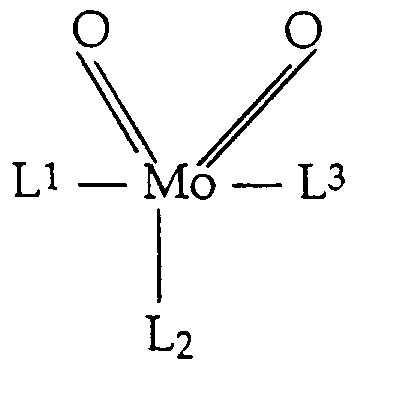
- Procédé de préparation d'un oxyde d'alcène par époxydation d'un alcène comportant 3 atomes de carbone ou plus, avec un hydroperoxyde d'alkyle, sous l'influence d'un catalyseur contenant un ion d'un ou de plusieurs des métaux molybdène, tungstène, titane ou vanadium, caractérisé en ce que le catalyseur utilisé est un catalyseur selon l'une quelconque des revendications 1-8.
- Procédé selon la revendication 9, caractérisé en ce que le catalyseur contient un ion molybdène.
- Procédé selon l'une quelconque des revendications 9-10, caractérisé en ce que la réaction est réalisée à l'aide de 0,005-0,01 mol d'un complexe métallique par rapport à l'alcane .
- Procédé selon l'une quelconque des revendications 9-11, caractérisé en ce que la température se situe entre 20 et 150°C.
Applications Claiming Priority (3)
| Application Number | Priority Date | Filing Date | Title |
|---|---|---|---|
| NL9201482A NL9201482A (nl) | 1992-08-20 | 1992-08-20 | Epoxidatie Katalysator. |
| NL9201482 | 1992-08-20 | ||
| PCT/NL1993/000172 WO1994004268A1 (fr) | 1992-08-20 | 1993-08-16 | Catalyseur d'epoxydation |
Publications (2)
| Publication Number | Publication Date |
|---|---|
| EP0655949A1 EP0655949A1 (fr) | 1995-06-07 |
| EP0655949B1 true EP0655949B1 (fr) | 1996-11-20 |
Family
ID=19861193
Family Applications (1)
| Application Number | Title | Priority Date | Filing Date |
|---|---|---|---|
| EP93921127A Expired - Lifetime EP0655949B1 (fr) | 1992-08-20 | 1993-08-16 | Catalyseur d'epoxydation |
Country Status (9)
| Country | Link |
|---|---|
| US (1) | US5620938A (fr) |
| EP (1) | EP0655949B1 (fr) |
| JP (1) | JPH08500286A (fr) |
| AU (1) | AU4835793A (fr) |
| CA (1) | CA2142852A1 (fr) |
| DE (1) | DE69306117T2 (fr) |
| NL (1) | NL9201482A (fr) |
| SG (1) | SG48986A1 (fr) |
| WO (1) | WO1994004268A1 (fr) |
Families Citing this family (7)
| Publication number | Priority date | Publication date | Assignee | Title |
|---|---|---|---|---|
| GB2314517A (en) * | 1996-06-28 | 1998-01-07 | Contract Chemicals Limited | Catalyst and its use in epoxidation |
| US6380266B1 (en) | 1997-06-13 | 2002-04-30 | California Institute Of Technology | Amorphous silica having discrete voids and spatially organized functionalities formed therein |
| MXPA02004322A (es) * | 1999-11-01 | 2002-11-07 | W R Grace & Co Cohn | Catalizador de polimerizacion de olefinas bidentado o tridentado soporte heterogeneo activo. |
| US6485949B1 (en) | 2001-01-29 | 2002-11-26 | The United States Of America As Represented By The Secretary Of Agriculture | Epoxidation of carbon-carbon double bond with membrane bound peroxygenase |
| GB0103817D0 (en) * | 2001-02-16 | 2001-04-04 | Ici Plc | Catalysts |
| US20040024263A1 (en) * | 2002-08-02 | 2004-02-05 | Boriack Clinton J. | Process for preparing aryl allyl ethers |
| CN116490268B (zh) * | 2020-09-14 | 2026-01-13 | 切弗朗菲利浦化学公司 | 由烃通过过渡金属催化生产醇和羰基化合物 |
Family Cites Families (15)
| Publication number | Priority date | Publication date | Assignee | Title |
|---|---|---|---|---|
| GB1342876A (en) * | 1969-12-19 | 1974-01-03 | British Petroleum Co | Catalyst supports and transition metal catalysts supported thereon |
| US3829392A (en) * | 1970-10-01 | 1974-08-13 | Shell Oil Co | Heterogeneous catalysts for olefin epoxidation |
| US3907852A (en) * | 1972-06-23 | 1975-09-23 | Exxon Research Engineering Co | Silylhydrocarbyl phosphines and related compounds |
| US3980583A (en) * | 1974-02-19 | 1976-09-14 | Mobil Oil Corporation | Complexed metals bonded to inorganic oxides |
| GB8327810D0 (en) * | 1983-10-18 | 1983-11-16 | Bp Chem Int Ltd | Organo metallic complexes |
| IT1180483B (it) * | 1984-04-20 | 1987-09-23 | Mira Lanza Spa | Processo di epossidazione catalitica di olefine a basso peso molecolare e catalizzatore per la sua attuazione |
| DE3440647A1 (de) * | 1984-11-07 | 1986-05-07 | Hoechst Ag, 6230 Frankfurt | Verfahren zur herstellung von monocarbonsaeureanhydriden |
| US4626596A (en) * | 1984-12-31 | 1986-12-02 | Texaco Inc. | Synthesis of molybdenum/alkylene glycol complexes useful as epoxidation catalysts |
| IL78187A (en) * | 1985-04-04 | 1991-05-12 | Massachusetts Inst Technology | Catalytic asymmetric epoxidation |
| GB2203741A (en) * | 1987-03-25 | 1988-10-26 | Shell Int Research | Nitrogen-containing bidentate compound immobilized on a solid inorganic carrier; organic silicon and organic lithium intermediates |
| DE3808868A1 (de) * | 1988-03-17 | 1989-09-28 | Hoechst Ag | Traegerkatalysator fuer die herstellung von monocarbonsaeureanhydriden |
| US5081267A (en) * | 1989-10-05 | 1992-01-14 | Arco Chemical Technology, Inc. | Epoxidation process |
| JPH0732877B2 (ja) * | 1990-07-10 | 1995-04-12 | 工業技術院長 | 固定化金属錯体 |
| GB9114127D0 (en) * | 1991-06-29 | 1991-08-14 | Laporte Industries Ltd | Epoxidation |
| GB9309458D0 (en) * | 1993-05-07 | 1993-06-23 | Bp Chem Int Ltd | Process |
-
1992
- 1992-08-20 NL NL9201482A patent/NL9201482A/nl not_active Application Discontinuation
-
1993
- 1993-08-16 CA CA002142852A patent/CA2142852A1/fr not_active Abandoned
- 1993-08-16 EP EP93921127A patent/EP0655949B1/fr not_active Expired - Lifetime
- 1993-08-16 AU AU48357/93A patent/AU4835793A/en not_active Abandoned
- 1993-08-16 DE DE69306117T patent/DE69306117T2/de not_active Expired - Fee Related
- 1993-08-16 WO PCT/NL1993/000172 patent/WO1994004268A1/fr not_active Ceased
- 1993-08-16 SG SG1996004860A patent/SG48986A1/en unknown
- 1993-08-16 US US08/387,742 patent/US5620938A/en not_active Expired - Fee Related
- 1993-08-16 JP JP6506125A patent/JPH08500286A/ja active Pending
Also Published As
| Publication number | Publication date |
|---|---|
| EP0655949A1 (fr) | 1995-06-07 |
| NL9201482A (nl) | 1994-03-16 |
| SG48986A1 (en) | 1998-05-18 |
| DE69306117T2 (de) | 1997-06-19 |
| JPH08500286A (ja) | 1996-01-16 |
| CA2142852A1 (fr) | 1994-03-03 |
| DE69306117D1 (de) | 1997-01-02 |
| AU4835793A (en) | 1994-03-15 |
| US5620938A (en) | 1997-04-15 |
| WO1994004268A1 (fr) | 1994-03-03 |
Similar Documents
| Publication | Publication Date | Title |
|---|---|---|
| JPH08500285A (ja) | 可燃ガスから粒状物質を分離する方法および装置 | |
| EP0577709B1 (fr) | Procede de preparation d'un alcanone et/ou d'un alcanol | |
| US5155247A (en) | Use of organorhenium compounds for the oxidation of multiple C--C-bonds, oxidation processes based theron and novel organorhenium compounds | |
| US5166372A (en) | Epoxidation process | |
| JPH069593A (ja) | エポキシドの一貫製造方法 | |
| RU2176930C2 (ru) | Катализатор для эпоксидирования олефинов и способ получения эпоксидов | |
| EP0522841B1 (fr) | Décomposition d'hydroperoxydes organiques | |
| EP0421781B1 (fr) | Procédé d'époxydation | |
| Thiel et al. | Metal catalyzed oxidations. Part 2. Molybdenum catalyzed olefin epoxidation in nonpolar solvents | |
| EP0655949B1 (fr) | Catalyseur d'epoxydation | |
| JPH11501250A (ja) | 空気又は酸素でオレフィンを酸化することによって製造されるエポキシド | |
| US4446074A (en) | Preparation of rhodium complex compounds | |
| US3716562A (en) | Process for preparing olefin oxides | |
| KR20070089060A (ko) | 시클로알칸올 및/또는 시클로알카논의 제조 방법 | |
| US5118822A (en) | Olefin epoxidation using a perrhenate catalyst and an organic hydroperoxide | |
| US6303828B1 (en) | Process for selective catalytic oxidation of olefins to aldehydes, ketones with cleavage of C=C bonds | |
| US5103027A (en) | Olefin expoxidation using an oxorhenium porphyrin complex catalyst and an organic hydroperoxide | |
| US6251851B1 (en) | Process for the selective oxidation of organic compounds | |
| US5670674A (en) | Production of oxirane compounds | |
| US4093636A (en) | Epoxidation of olefinic compounds | |
| JP3177666B2 (ja) | オレフィン類の酸化反応法 | |
| WO1999064376A1 (fr) | Procede d'oxydation en presence de dioxyde de carbone | |
| US6326502B1 (en) | Method for producing epoxides through olefin oxidation with air or oxygen | |
| KR100762862B1 (ko) | 탄소-탄소 이중결합의 산화방법 및 산화 화합물의 제조방법 | |
| JP3347568B2 (ja) | アジピン酸の製造方法 |
Legal Events
| Date | Code | Title | Description |
|---|---|---|---|
| PUAI | Public reference made under article 153(3) epc to a published international application that has entered the european phase |
Free format text: ORIGINAL CODE: 0009012 |
|
| 17P | Request for examination filed |
Effective date: 19950214 |
|
| AK | Designated contracting states |
Kind code of ref document: A1 Designated state(s): BE DE FR GB IT NL |
|
| 17Q | First examination report despatched |
Effective date: 19950630 |
|
| GRAG | Despatch of communication of intention to grant |
Free format text: ORIGINAL CODE: EPIDOS AGRA |
|
| GRAH | Despatch of communication of intention to grant a patent |
Free format text: ORIGINAL CODE: EPIDOS IGRA |
|
| GRAH | Despatch of communication of intention to grant a patent |
Free format text: ORIGINAL CODE: EPIDOS IGRA |
|
| GRAA | (expected) grant |
Free format text: ORIGINAL CODE: 0009210 |
|
| AK | Designated contracting states |
Kind code of ref document: B1 Designated state(s): BE DE FR GB IT NL |
|
| REF | Corresponds to: |
Ref document number: 69306117 Country of ref document: DE Date of ref document: 19970102 |
|
| ITF | It: translation for a ep patent filed | ||
| ET | Fr: translation filed | ||
| ET | Fr: translation filed |
Free format text: CORRECTIONS |
|
| PLBE | No opposition filed within time limit |
Free format text: ORIGINAL CODE: 0009261 |
|
| STAA | Information on the status of an ep patent application or granted ep patent |
Free format text: STATUS: NO OPPOSITION FILED WITHIN TIME LIMIT |
|
| 26N | No opposition filed | ||
| PGFP | Annual fee paid to national office [announced via postgrant information from national office to epo] |
Ref country code: BE Payment date: 19990706 Year of fee payment: 7 |
|
| PGFP | Annual fee paid to national office [announced via postgrant information from national office to epo] |
Ref country code: NL Payment date: 19990712 Year of fee payment: 7 |
|
| PGFP | Annual fee paid to national office [announced via postgrant information from national office to epo] |
Ref country code: FR Payment date: 19990728 Year of fee payment: 7 |
|
| PGFP | Annual fee paid to national office [announced via postgrant information from national office to epo] |
Ref country code: GB Payment date: 19990802 Year of fee payment: 7 |
|
| PGFP | Annual fee paid to national office [announced via postgrant information from national office to epo] |
Ref country code: DE Payment date: 19991025 Year of fee payment: 7 |
|
| PG25 | Lapsed in a contracting state [announced via postgrant information from national office to epo] |
Ref country code: GB Free format text: LAPSE BECAUSE OF NON-PAYMENT OF DUE FEES Effective date: 20000816 |
|
| PG25 | Lapsed in a contracting state [announced via postgrant information from national office to epo] |
Ref country code: BE Free format text: LAPSE BECAUSE OF NON-PAYMENT OF DUE FEES Effective date: 20000831 |
|
| BERE | Be: lapsed |
Owner name: DSM N.V. Effective date: 20000831 |
|
| PG25 | Lapsed in a contracting state [announced via postgrant information from national office to epo] |
Ref country code: NL Free format text: LAPSE BECAUSE OF NON-PAYMENT OF DUE FEES Effective date: 20010301 |
|
| GBPC | Gb: european patent ceased through non-payment of renewal fee |
Effective date: 20000816 |
|
| PG25 | Lapsed in a contracting state [announced via postgrant information from national office to epo] |
Ref country code: FR Free format text: LAPSE BECAUSE OF NON-PAYMENT OF DUE FEES Effective date: 20010430 |
|
| NLV4 | Nl: lapsed or anulled due to non-payment of the annual fee |
Effective date: 20010301 |
|
| PG25 | Lapsed in a contracting state [announced via postgrant information from national office to epo] |
Ref country code: DE Free format text: LAPSE BECAUSE OF NON-PAYMENT OF DUE FEES Effective date: 20010501 |
|
| REG | Reference to a national code |
Ref country code: FR Ref legal event code: ST |
|
| PG25 | Lapsed in a contracting state [announced via postgrant information from national office to epo] |
Ref country code: IT Free format text: LAPSE BECAUSE OF NON-PAYMENT OF DUE FEES Effective date: 20050816 |