EP0655952B1 - Ionenaustauschverbundstoff, herstellung und verwendung davon - Google Patents
Ionenaustauschverbundstoff, herstellung und verwendung davon Download PDFInfo
- Publication number
- EP0655952B1 EP0655952B1 EP93917311A EP93917311A EP0655952B1 EP 0655952 B1 EP0655952 B1 EP 0655952B1 EP 93917311 A EP93917311 A EP 93917311A EP 93917311 A EP93917311 A EP 93917311A EP 0655952 B1 EP0655952 B1 EP 0655952B1
- Authority
- EP
- European Patent Office
- Prior art keywords
- support
- porous
- particles
- metal
- ion
- Prior art date
- Legal status (The legal status is an assumption and is not a legal conclusion. Google has not performed a legal analysis and makes no representation as to the accuracy of the status listed.)
- Expired - Lifetime
Links
- 239000000463 material Substances 0.000 title claims abstract description 47
- 239000002131 composite material Substances 0.000 title claims abstract description 17
- 238000005342 ion exchange Methods 0.000 title claims description 14
- 238000002360 preparation method Methods 0.000 title description 6
- 239000002245 particle Substances 0.000 claims abstract description 47
- OKTJSMMVPCPJKN-UHFFFAOYSA-N Carbon Chemical compound [C] OKTJSMMVPCPJKN-UHFFFAOYSA-N 0.000 claims abstract description 46
- 239000011148 porous material Substances 0.000 claims abstract description 39
- BPQQTUXANYXVAA-UHFFFAOYSA-N Orthosilicate Chemical compound [O-][Si]([O-])([O-])[O-] BPQQTUXANYXVAA-UHFFFAOYSA-N 0.000 claims abstract description 14
- 239000002244 precipitate Substances 0.000 claims abstract description 12
- 238000005507 spraying Methods 0.000 claims abstract description 11
- 239000000243 solution Substances 0.000 claims description 38
- 229910052751 metal Inorganic materials 0.000 claims description 22
- 239000002184 metal Substances 0.000 claims description 22
- 238000000034 method Methods 0.000 claims description 19
- 150000003839 salts Chemical class 0.000 claims description 12
- 239000007788 liquid Substances 0.000 claims description 6
- 239000007864 aqueous solution Substances 0.000 claims description 4
- 230000002378 acidificating effect Effects 0.000 claims description 3
- 239000000203 mixture Substances 0.000 claims description 2
- 230000003472 neutralizing effect Effects 0.000 claims description 2
- 239000011238 particulate composite Substances 0.000 claims description 2
- 229910021645 metal ion Inorganic materials 0.000 claims 2
- 229910052799 carbon Inorganic materials 0.000 abstract description 32
- 239000000499 gel Substances 0.000 abstract description 20
- 229910052914 metal silicate Inorganic materials 0.000 abstract description 11
- 229910044991 metal oxide Inorganic materials 0.000 abstract description 10
- 150000004706 metal oxides Chemical class 0.000 abstract description 10
- 239000010936 titanium Substances 0.000 abstract description 7
- RTAQQCXQSZGOHL-UHFFFAOYSA-N Titanium Chemical compound [Ti] RTAQQCXQSZGOHL-UHFFFAOYSA-N 0.000 abstract description 5
- 229910052719 titanium Inorganic materials 0.000 abstract description 5
- 238000001556 precipitation Methods 0.000 abstract description 4
- 150000001455 metallic ions Chemical class 0.000 abstract description 3
- 239000003929 acidic solution Substances 0.000 abstract description 2
- GNKTZDSRQHMHLZ-UHFFFAOYSA-N [Si].[Si].[Si].[Ti].[Ti].[Ti].[Ti].[Ti] Chemical compound [Si].[Si].[Si].[Ti].[Ti].[Ti].[Ti].[Ti] GNKTZDSRQHMHLZ-UHFFFAOYSA-N 0.000 description 37
- HEMHJVSKTPXQMS-UHFFFAOYSA-M Sodium hydroxide Chemical compound [OH-].[Na+] HEMHJVSKTPXQMS-UHFFFAOYSA-M 0.000 description 27
- XLYOFNOQVPJJNP-UHFFFAOYSA-N water Substances O XLYOFNOQVPJJNP-UHFFFAOYSA-N 0.000 description 18
- 229910001868 water Inorganic materials 0.000 description 17
- VYPSYNLAJGMNEJ-UHFFFAOYSA-N Silicium dioxide Chemical compound O=[Si]=O VYPSYNLAJGMNEJ-UHFFFAOYSA-N 0.000 description 16
- 239000003153 chemical reaction reagent Substances 0.000 description 15
- VNWKTOKETHGBQD-UHFFFAOYSA-N methane Chemical compound C VNWKTOKETHGBQD-UHFFFAOYSA-N 0.000 description 15
- 238000012360 testing method Methods 0.000 description 13
- IJGRMHOSHXDMSA-UHFFFAOYSA-N Atomic nitrogen Chemical compound N#N IJGRMHOSHXDMSA-UHFFFAOYSA-N 0.000 description 10
- GWEVSGVZZGPLCZ-UHFFFAOYSA-N Titan oxide Chemical compound O=[Ti]=O GWEVSGVZZGPLCZ-UHFFFAOYSA-N 0.000 description 10
- 239000000047 product Substances 0.000 description 10
- 239000000460 chlorine Substances 0.000 description 9
- 239000002585 base Substances 0.000 description 8
- 239000002594 sorbent Substances 0.000 description 8
- 239000012855 volatile organic compound Substances 0.000 description 8
- 229910052801 chlorine Inorganic materials 0.000 description 7
- 239000000377 silicon dioxide Substances 0.000 description 7
- 239000011248 coating agent Substances 0.000 description 6
- 238000000576 coating method Methods 0.000 description 6
- 239000008187 granular material Substances 0.000 description 6
- QSHDDOUJBYECFT-UHFFFAOYSA-N mercury Chemical compound [Hg] QSHDDOUJBYECFT-UHFFFAOYSA-N 0.000 description 6
- 229910052753 mercury Inorganic materials 0.000 description 6
- 239000007921 spray Substances 0.000 description 6
- 238000005406 washing Methods 0.000 description 6
- ZAMOUSCENKQFHK-UHFFFAOYSA-N Chlorine atom Chemical compound [Cl] ZAMOUSCENKQFHK-UHFFFAOYSA-N 0.000 description 5
- 235000013162 Cocos nucifera Nutrition 0.000 description 5
- 244000060011 Cocos nucifera Species 0.000 description 5
- 230000008901 benefit Effects 0.000 description 5
- 229910052681 coesite Inorganic materials 0.000 description 5
- 229910052906 cristobalite Inorganic materials 0.000 description 5
- 239000003651 drinking water Substances 0.000 description 5
- 238000005470 impregnation Methods 0.000 description 5
- RLJMLMKIBZAXJO-UHFFFAOYSA-N lead nitrate Chemical compound [O-][N+](=O)O[Pb]O[N+]([O-])=O RLJMLMKIBZAXJO-UHFFFAOYSA-N 0.000 description 5
- 150000002739 metals Chemical class 0.000 description 5
- 229910052757 nitrogen Inorganic materials 0.000 description 5
- 239000006069 physical mixture Substances 0.000 description 5
- 238000001179 sorption measurement Methods 0.000 description 5
- 229910052682 stishovite Inorganic materials 0.000 description 5
- 239000000758 substrate Substances 0.000 description 5
- 239000011135 tin Substances 0.000 description 5
- 229910052905 tridymite Inorganic materials 0.000 description 5
- 239000004115 Sodium Silicate Substances 0.000 description 4
- VSCWAEJMTAWNJL-UHFFFAOYSA-K aluminium trichloride Chemical compound Cl[Al](Cl)Cl VSCWAEJMTAWNJL-UHFFFAOYSA-K 0.000 description 4
- XFVGXQSSXWIWIO-UHFFFAOYSA-N chloro hypochlorite;titanium Chemical compound [Ti].ClOCl XFVGXQSSXWIWIO-UHFFFAOYSA-N 0.000 description 4
- 238000005259 measurement Methods 0.000 description 4
- 238000000746 purification Methods 0.000 description 4
- 238000005067 remediation Methods 0.000 description 4
- 238000004626 scanning electron microscopy Methods 0.000 description 4
- GCLGEJMYGQKIIW-UHFFFAOYSA-H sodium hexametaphosphate Chemical compound [Na]OP1(=O)OP(=O)(O[Na])OP(=O)(O[Na])OP(=O)(O[Na])OP(=O)(O[Na])OP(=O)(O[Na])O1 GCLGEJMYGQKIIW-UHFFFAOYSA-H 0.000 description 4
- NTHWMYGWWRZVTN-UHFFFAOYSA-N sodium silicate Chemical compound [Na+].[Na+].[O-][Si]([O-])=O NTHWMYGWWRZVTN-UHFFFAOYSA-N 0.000 description 4
- 229910052911 sodium silicate Inorganic materials 0.000 description 4
- LLZRNZOLAXHGLL-UHFFFAOYSA-J titanic acid Chemical compound O[Ti](O)(O)O LLZRNZOLAXHGLL-UHFFFAOYSA-J 0.000 description 4
- KKCBUQHMOMHUOY-UHFFFAOYSA-N Na2O Inorganic materials [O-2].[Na+].[Na+] KKCBUQHMOMHUOY-UHFFFAOYSA-N 0.000 description 3
- 235000012206 bottled water Nutrition 0.000 description 3
- 239000000969 carrier Substances 0.000 description 3
- 238000006243 chemical reaction Methods 0.000 description 3
- 238000009826 distribution Methods 0.000 description 3
- -1 e.g. Substances 0.000 description 3
- 238000001914 filtration Methods 0.000 description 3
- 150000002500 ions Chemical class 0.000 description 3
- 238000006386 neutralization reaction Methods 0.000 description 3
- 239000010955 niobium Substances 0.000 description 3
- 238000002459 porosimetry Methods 0.000 description 3
- 230000008569 process Effects 0.000 description 3
- 238000009736 wetting Methods 0.000 description 3
- HEDRZPFGACZZDS-UHFFFAOYSA-N Chloroform Chemical compound ClC(Cl)Cl HEDRZPFGACZZDS-UHFFFAOYSA-N 0.000 description 2
- FAPWRFPIFSIZLT-UHFFFAOYSA-M Sodium chloride Chemical compound [Na+].[Cl-] FAPWRFPIFSIZLT-UHFFFAOYSA-M 0.000 description 2
- ATJFFYVFTNAWJD-UHFFFAOYSA-N Tin Chemical compound [Sn] ATJFFYVFTNAWJD-UHFFFAOYSA-N 0.000 description 2
- 239000002253 acid Substances 0.000 description 2
- RHZUVFJBSILHOK-UHFFFAOYSA-N anthracen-1-ylmethanolate Chemical compound C1=CC=C2C=C3C(C[O-])=CC=CC3=CC2=C1 RHZUVFJBSILHOK-UHFFFAOYSA-N 0.000 description 2
- 239000003830 anthracite Substances 0.000 description 2
- 229910052785 arsenic Inorganic materials 0.000 description 2
- RQNWIZPPADIBDY-UHFFFAOYSA-N arsenic atom Chemical compound [As] RQNWIZPPADIBDY-UHFFFAOYSA-N 0.000 description 2
- 230000015572 biosynthetic process Effects 0.000 description 2
- 229910052793 cadmium Inorganic materials 0.000 description 2
- BDOSMKKIYDKNTQ-UHFFFAOYSA-N cadmium atom Chemical compound [Cd] BDOSMKKIYDKNTQ-UHFFFAOYSA-N 0.000 description 2
- 239000003518 caustics Substances 0.000 description 2
- 230000001427 coherent effect Effects 0.000 description 2
- 239000011246 composite particle Substances 0.000 description 2
- 238000010276 construction Methods 0.000 description 2
- 230000001419 dependent effect Effects 0.000 description 2
- 230000008021 deposition Effects 0.000 description 2
- 235000020188 drinking water Nutrition 0.000 description 2
- 238000002474 experimental method Methods 0.000 description 2
- 239000000706 filtrate Substances 0.000 description 2
- 229910001385 heavy metal Inorganic materials 0.000 description 2
- 238000011065 in-situ storage Methods 0.000 description 2
- 239000011368 organic material Substances 0.000 description 2
- 230000001376 precipitating effect Effects 0.000 description 2
- 239000002243 precursor Substances 0.000 description 2
- 239000013049 sediment Substances 0.000 description 2
- 230000007480 spreading Effects 0.000 description 2
- 238000003892 spreading Methods 0.000 description 2
- 229910052718 tin Inorganic materials 0.000 description 2
- PNEYBMLMFCGWSK-UHFFFAOYSA-N Alumina Chemical compound [O-2].[O-2].[O-2].[Al+3].[Al+3] PNEYBMLMFCGWSK-UHFFFAOYSA-N 0.000 description 1
- OYPRJOBELJOOCE-UHFFFAOYSA-N Calcium Chemical compound [Ca] OYPRJOBELJOOCE-UHFFFAOYSA-N 0.000 description 1
- VEXZGXHMUGYJMC-UHFFFAOYSA-M Chloride anion Chemical compound [Cl-] VEXZGXHMUGYJMC-UHFFFAOYSA-M 0.000 description 1
- VYZAMTAEIAYCRO-UHFFFAOYSA-N Chromium Chemical compound [Cr] VYZAMTAEIAYCRO-UHFFFAOYSA-N 0.000 description 1
- 229920000742 Cotton Polymers 0.000 description 1
- KRHYYFGTRYWZRS-UHFFFAOYSA-M Fluoride anion Chemical compound [F-] KRHYYFGTRYWZRS-UHFFFAOYSA-M 0.000 description 1
- FYYHWMGAXLPEAU-UHFFFAOYSA-N Magnesium Chemical compound [Mg] FYYHWMGAXLPEAU-UHFFFAOYSA-N 0.000 description 1
- PWHULOQIROXLJO-UHFFFAOYSA-N Manganese Chemical compound [Mn] PWHULOQIROXLJO-UHFFFAOYSA-N 0.000 description 1
- 229910002651 NO3 Inorganic materials 0.000 description 1
- 229910019804 NbCl5 Inorganic materials 0.000 description 1
- NHNBFGGVMKEFGY-UHFFFAOYSA-N Nitrate Chemical compound [O-][N+]([O-])=O NHNBFGGVMKEFGY-UHFFFAOYSA-N 0.000 description 1
- 239000004677 Nylon Substances 0.000 description 1
- 229910010270 TiOCl2 Inorganic materials 0.000 description 1
- 229910021627 Tin(IV) chloride Inorganic materials 0.000 description 1
- 238000002441 X-ray diffraction Methods 0.000 description 1
- HCHKCACWOHOZIP-UHFFFAOYSA-N Zinc Chemical compound [Zn] HCHKCACWOHOZIP-UHFFFAOYSA-N 0.000 description 1
- QCWXUUIWCKQGHC-UHFFFAOYSA-N Zirconium Chemical compound [Zr] QCWXUUIWCKQGHC-UHFFFAOYSA-N 0.000 description 1
- YKTSYUJCYHOUJP-UHFFFAOYSA-N [O--].[Al+3].[Al+3].[O-][Si]([O-])([O-])[O-] Chemical compound [O--].[Al+3].[Al+3].[O-][Si]([O-])([O-])[O-] YKTSYUJCYHOUJP-UHFFFAOYSA-N 0.000 description 1
- 238000005299 abrasion Methods 0.000 description 1
- 239000002250 absorbent Substances 0.000 description 1
- 230000002745 absorbent Effects 0.000 description 1
- 230000009471 action Effects 0.000 description 1
- 125000000129 anionic group Chemical group 0.000 description 1
- 150000001450 anions Chemical class 0.000 description 1
- 239000003637 basic solution Substances 0.000 description 1
- 239000011324 bead Substances 0.000 description 1
- 230000002599 biostatic effect Effects 0.000 description 1
- 239000006227 byproduct Substances 0.000 description 1
- 239000011575 calcium Substances 0.000 description 1
- 229910052791 calcium Inorganic materials 0.000 description 1
- 239000003575 carbonaceous material Substances 0.000 description 1
- 239000003610 charcoal Substances 0.000 description 1
- 150000003841 chloride salts Chemical class 0.000 description 1
- 229910052804 chromium Inorganic materials 0.000 description 1
- 239000011651 chromium Substances 0.000 description 1
- 230000000052 comparative effect Effects 0.000 description 1
- 230000008602 contraction Effects 0.000 description 1
- 239000002178 crystalline material Substances 0.000 description 1
- 230000001186 cumulative effect Effects 0.000 description 1
- 239000008367 deionised water Substances 0.000 description 1
- 229910021641 deionized water Inorganic materials 0.000 description 1
- 238000007865 diluting Methods 0.000 description 1
- 238000001035 drying Methods 0.000 description 1
- 238000011156 evaluation Methods 0.000 description 1
- 239000002223 garnet Substances 0.000 description 1
- 230000005484 gravity Effects 0.000 description 1
- 239000003673 groundwater Substances 0.000 description 1
- 238000010438 heat treatment Methods 0.000 description 1
- 239000004009 herbicide Substances 0.000 description 1
- 230000002209 hydrophobic effect Effects 0.000 description 1
- 238000007654 immersion Methods 0.000 description 1
- 239000004615 ingredient Substances 0.000 description 1
- 238000011068 loading method Methods 0.000 description 1
- 239000011777 magnesium Substances 0.000 description 1
- 229910052749 magnesium Inorganic materials 0.000 description 1
- 230000014759 maintenance of location Effects 0.000 description 1
- 229910052748 manganese Inorganic materials 0.000 description 1
- 239000011572 manganese Substances 0.000 description 1
- 238000013507 mapping Methods 0.000 description 1
- 229910001510 metal chloride Inorganic materials 0.000 description 1
- 150000002736 metal compounds Chemical class 0.000 description 1
- 229910000000 metal hydroxide Inorganic materials 0.000 description 1
- 150000004692 metal hydroxides Chemical class 0.000 description 1
- 239000005300 metallic glass Substances 0.000 description 1
- 238000012986 modification Methods 0.000 description 1
- 230000004048 modification Effects 0.000 description 1
- 229910052758 niobium Inorganic materials 0.000 description 1
- GUCVJGMIXFAOAE-UHFFFAOYSA-N niobium atom Chemical compound [Nb] GUCVJGMIXFAOAE-UHFFFAOYSA-N 0.000 description 1
- BBTXSTYZFZSWQW-UHFFFAOYSA-N niobium(5+);pentasilicate Chemical class [Nb+5].[Nb+5].[Nb+5].[Nb+5].[O-][Si]([O-])([O-])[O-].[O-][Si]([O-])([O-])[O-].[O-][Si]([O-])([O-])[O-].[O-][Si]([O-])([O-])[O-].[O-][Si]([O-])([O-])[O-] BBTXSTYZFZSWQW-UHFFFAOYSA-N 0.000 description 1
- 229920001778 nylon Polymers 0.000 description 1
- 238000000643 oven drying Methods 0.000 description 1
- 230000000149 penetrating effect Effects 0.000 description 1
- YHBDIEWMOMLKOO-UHFFFAOYSA-I pentachloroniobium Chemical compound Cl[Nb](Cl)(Cl)(Cl)Cl YHBDIEWMOMLKOO-UHFFFAOYSA-I 0.000 description 1
- 230000000737 periodic effect Effects 0.000 description 1
- 239000000575 pesticide Substances 0.000 description 1
- 230000000704 physical effect Effects 0.000 description 1
- 238000012545 processing Methods 0.000 description 1
- 230000009467 reduction Effects 0.000 description 1
- 239000012266 salt solution Substances 0.000 description 1
- 239000004576 sand Substances 0.000 description 1
- 238000013341 scale-up Methods 0.000 description 1
- 238000000926 separation method Methods 0.000 description 1
- 150000004760 silicates Chemical class 0.000 description 1
- 229910052709 silver Inorganic materials 0.000 description 1
- 239000004332 silver Substances 0.000 description 1
- 239000011734 sodium Substances 0.000 description 1
- 239000011780 sodium chloride Substances 0.000 description 1
- 239000007787 solid Substances 0.000 description 1
- 230000002269 spontaneous effect Effects 0.000 description 1
- 238000010561 standard procedure Methods 0.000 description 1
- 239000006228 supernatant Substances 0.000 description 1
- 239000008399 tap water Substances 0.000 description 1
- 235000020679 tap water Nutrition 0.000 description 1
- 238000010998 test method Methods 0.000 description 1
- 239000012085 test solution Substances 0.000 description 1
- HPGGPRDJHPYFRM-UHFFFAOYSA-J tin(iv) chloride Chemical compound Cl[Sn](Cl)(Cl)Cl HPGGPRDJHPYFRM-UHFFFAOYSA-J 0.000 description 1
- XJDNKRIXUMDJCW-UHFFFAOYSA-J titanium tetrachloride Chemical compound Cl[Ti](Cl)(Cl)Cl XJDNKRIXUMDJCW-UHFFFAOYSA-J 0.000 description 1
- 238000012546 transfer Methods 0.000 description 1
- 229910052725 zinc Inorganic materials 0.000 description 1
- 239000011701 zinc Substances 0.000 description 1
- 229910052726 zirconium Inorganic materials 0.000 description 1
Images

Classifications
-
- B—PERFORMING OPERATIONS; TRANSPORTING
- B01—PHYSICAL OR CHEMICAL PROCESSES OR APPARATUS IN GENERAL
- B01J—CHEMICAL OR PHYSICAL PROCESSES, e.g. CATALYSIS OR COLLOID CHEMISTRY; THEIR RELEVANT APPARATUS
- B01J39/00—Cation exchange; Use of material as cation exchangers; Treatment of material for improving the cation exchange properties
- B01J39/02—Processes using inorganic exchangers
-
- B—PERFORMING OPERATIONS; TRANSPORTING
- B01—PHYSICAL OR CHEMICAL PROCESSES OR APPARATUS IN GENERAL
- B01J—CHEMICAL OR PHYSICAL PROCESSES, e.g. CATALYSIS OR COLLOID CHEMISTRY; THEIR RELEVANT APPARATUS
- B01J47/00—Ion-exchange processes in general; Apparatus therefor
- B01J47/018—Granulation; Incorporation of ion-exchangers in a matrix; Mixing with inert materials
Definitions
- amorphous hydrated metal oxide and amorphous metal silicate gels to remove various metals from aqueous solutions is notoriously old in the art.
- the patent and technical literature contains many examples of such techniques. It was recently discovered that certain amorphous titanium and tin silicate gels demonstrated remarkable rates of uptake for heavy metal species such as lead, cadmium, zinc, chromium and mercury which are an order of magnitude greater than that of prior art absorbents or ion exchangers under the conditions tested which include the presence of competing ions such as calcium and magnesium.
- Granular activated carbon is also used in water purification or remediation processes, in some cases in combination with inorganic metal ion-exchangers. GAC improves taste, odor and smell by adsorbing ionic metals, organic molecules and colloidal particles. GAC also removes chlorine by reducing the chlorine to chloride ions.
- the adsorption properties of GAC are dependent upon the pore volume and pore size distribution of the material.
- Small organic materials e.g., volatile organic compounds (VOC) such as chloroform, are adsorbed into the micropores (pores less than 20 angstroms in diameter).
- Larger organic materials e.g., herbicides or pesticides or colloidal particles are adsorbed in the mesopores (pores between 20 and 500 angstroms).
- the macropores pores between 500 and 2K angstroms are least important for adsorption, but do trap larger sediment particles.
- the present invention provides a composite material comprising porous particles of a support material and, superficially coated on said porous particles, a precipitated inorganic ion-exchange material which does not encapsulate said particles and which is not significantly deposited in the pores of the support.
- the invention also provides a method for preparing a composite particulate material which comprises providing porous particles of a support material, adding thereto a solution of a basic material, thereafter adding a concentrated acidic aqueous solution of a salt of a metal which is capable of rapidly reacting with and neutralizing said solution of base to form a gelatinous precipitate, the quantities of said basic material and salt of a metal being such as to surface coat said particles of porous support material surface with said gelatinous precipitate without encapsulating said porous particles and without reducing the volume of micro and mesopores in said support.
- Figure 1 is a schematic drawing of a composite particle containing porous support material superficially coated with inorganic ion-exchange material, in accordance with the invention.
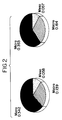
- Figure 2 is a graphic presentation of the pore size distribution of granular activated carbon (GAC) before and after being superficially coated with a representative metal ion-exchange material.
- GAC granular activated carbon
- hydrated metal oxide and metal silicate gels are admirably suited to remove metallic ions in water, such as, for example, lead from drinking water in the presence of competing ions normally found in drinking water, when small amounts of the gels are supported on the surface of granular particles of porous material by rapid precipitation thereon without significant deposit within pores of the support and without encapsulating the particles of porous support material, whereby pores in the support material are available to remove materials not removed by the inorganic gel.
- the phrase "superficially coated” refers to this condition.
- Hydrated metal oxides and metal silicate gels within the scope of the invention are known ion-exchangers. Most preferred gels are those of titanium. Preferred porous particles are composed of granular active carbon.
- novel composite material useful for water purification is prepared by adding an aqueous basic material to the porous particles, preferably by spraying, and then immediately adding, also preferably by spraying, a concentrated aqueous acidic solution of a source of suitable metallic ions so as to rapidly form a gelatinous precipitate of sorbent on the surface only of the porous particles, without encapsulating the particles.
- the precursors of the gelatinous precipitate are not wicked into pores, at least small pores, of the porous particles.
- Our invention represents a radical departure from prior art composites based on a porous support containing an inorganic ion-exchanger.
- We employ processing steps including, inter alia , reversal of order of addition of base and metal salts used by Weller as well as differences in quantities of reagents used.
- an inorganic gel ion-exchanger can be formed in situ primarily on the surface of the porous carbon granules used as a support material.
- a very small amount of the amorphous gel sorbent may form in the large macropores of the support. This is illustrated in the attached Figure 2. Porosity data supporting this is shown in Example 6. Nonpenetration of inorganic ion-exchanger into GAC represents an important advantage.
- Composite sorbents of the invention useful in potable water applications for remediating lead to under the 15 ppb action level set by the EPA for public water systems, are typically from 841 - 177 ⁇ m (20 - 80 mesh U.S. Standard).
- the composite sorbent product could be utilized by filter producers who would incorporate the composite sorbent into custom designed filters and POU devices (point of use), e.g. countertop units, carafes and end of tap units.
- POU devices point of use
- such users would be concerned with eliminating or minimizing taste, odor and chlorine properties. These latter concerns are directly related to performance in removing VOC as well as THM (trihalomethanes).
- THM trihalomethanes
- Wetting properties will determine whether reagents wick into pores of a particle or not. Wetting properties are dependent upon interfacial free energies of solid-liquid interfaces and are best illustrated by contact angle values, where an angle close to zero represents spontaneous spreading and an angle over 90° indicates that liquids bead up and run off of surfaces (non-wetting). Physical properties such as viscosity and hydrophobicity may be adjusted to influence the contact angle. For example, diluting the impregnating liquid with water may reduce its viscosity to the point that the impregnating liquid can wick into the porous substrate. Conversely, use of concentrated reagents minimizes or avoids wicking.
- the time allowed and/or method of addition of the reagents to the porous substrate are important to prevent wicking. For example, immersing the porous substrate into a solution of the reagent and heating for one hour (as in example 1 of Weller, US 4,692,431) or for 24 hours (as in example 1 of Fujita et al., US 4,178,270) will allow sufficient time for impregnation of the reagents into the pores. Spraying concentrated reagents onto the surface of a porous substrate does not allow sufficient time for wicking especially if the second reagent is added immediately after the first, thus causing the neutralization reaction to proceed upon the surface of the substrate, before any wicking into the pores can begin. Thus one has process variables such as contact time, temperature, pressure or concentration which may be adjusted to minimize wicking.
- reagent combinations which favor non-wicking may be utilized. For instance, if the carrier is organic (hydrophobic) in nature, use of a hydrophilic reagent or solution would minimize wicking into the pores of the carrier.
- Inorganic ionic exchangers within the scope of the invention are amorphous by x-ray analysis and include hydrous metal oxides and silicate of metals of Groups IVa, Va, VIIa and IVb of the Periodic Table (previous IUPAC form), Cotton and Wilkinson "Advanced Inorganic Chemistry", Fifth Edition.
- Preferred metals are titanium, zirconium, niobium, manganese and tin. Mixtures of metals may be employed. In some cases minor amounts of crystalline material may be present in the amorphous gel.
- chloride salts are employed although salts of other anions such as nitrate and fluoride may be utilized.
- Carriers or supports may be any porous material such as kieselguhr, dehydrated aluminas, chromias, charcoal, porous silicas and aluminas, gamma alumina, etc.
- the support material should be in the form of coherent particles which are sufficiently chemically inert towards reagents used to produce the gelatinous precipitate to maintain coherent form during and after formation of that precipitate.
- total porosity pore sizes between 0.1 and 1.0 cc/g.
- porosity exceeds 0.6 cc/g, the particles may lack requisite integrity to survive forces of attrition to which they are subjected during use.
- porosity is less than about 0.1 cc/g, VOC performance may be insufficient.
- carriers having total porosity between about 0.2 and 0.6 cc/g.
- total porosity refers to values obtained by nitrogen adsorption (for micro and mesopores) as well as mercury intrusion for larger pores.
- micropore refers to pores having diameters below 20 Angstrom units as determined by nitrogen porosimetry.
- Micropores refers to pores having diameters in the range of 20 to 500 Angstrom units (nitrogen adsorption).
- Macropores refers to pores having diameters in the range of 500 to 20,000 Angstrom units (mercury porosimetry). Techniques and equipment used to make these measurements are described in US 4,628,042.
- metal silicates such as titanium silicate
- the molar ratio of metal/SiO 2 added is about unity prior to washing. Normally some silica is removed following washing. In all cases sufficient metal salt is added to neutralize previously applied base.
- Use of concentrated base and concentrated acid, both being introduced by spraying rather than immersion, is conducive to avoidance of wicking. Because the metal compounds used rapidly form precipitates, deposition on the surface only of support particles is facilitated.
- a feature of the invention is that sufficient base is used to neutralize the subsequently added source of metal. This would be sodium hydroxide (to produce hydrated metal oxide) or sodium silicate, possibly enriched with sodium hydroxide if the Na 2 O/SiO 2 of the silicate is low (to precipitate metal silicate).
- Spraying of basic solution followed by spraying of metal salt solution can be repeated two or more times, provided the total level of hydrated metal oxide or silicate added is not so great that the support is not encapsulated and micro and mesopores are not filled.
- the particles After precipitation of the inorganic ion-exchanger, the particles should be thoroughly washed to remove by-product salts.
- Useful amounts of metal hydroxides or silicates to be superficially coated on the porous carrier particles are set forth in the accompanying examples. Higher levels than those used in examples could possibly enhance the ion exchange capacity, but may cause an increase in fines due to lower adhesion and abrasion of the superficial coating from the support. At some point the concentration of precipitate will be so high that it will encapsulate the support particles and thus block entry into the pores, resulting in a drop off of VOC performance. Total amounts of precipitated gels may vary with the particle size and pore structure of the support particles and are readily determined by carrying out porosity measurements.
- the observed experimental variation in the pore size distribution between untreated coconut shell carbon and the same carbon superficially coated in accordance with this invention is represented in Figure 2.
- the micropore volume difference of 0.353 vs. 0.342 cc/g is within experimental error of the measurement.
- the mesopore volume remains unchanged (0.057 vs. 0.058 cc/g).
- Only the macropore volume shows a reduction, from 0.164 in the untreated carbon to 0.139 cc/g in the superficially coated carbon.
- a superficial coating of amorphous titanium silicate was applied to the surface of porous activated carbon granules via an initial impregnation with sodium silicate solution, followed by a second impregnation with titanium oxychloride solution, TiOCl 2 .
- the combination of these reagents resulted in an exothermic neutralization reaction with the net result being formation of amorphous titanium silicate gel and sodium chloride (which was later removed by washing).
- the amounts of reagents added to the carbon granules were adjusted to result in a 1:1 molar ratio of SiO 2 :TiO 2 .
- Additional caustic in the form of NaOH was added to the sodium silicate solution so that neutralization resulted, i.e., the resultant molar ratio of Na:Cl was 1.0.
- Bituminous carbon granules [200g, Calgon Corp. type TOG, 841 x 297 ⁇ m (20 x 50 mesh)] were spray impregnated with a viscous solution containing 28.2g N® brand sodium silicate solution (8.93% Na 2 O, 29.2% SiO 2 ), 32.8g of a 50% NaOH solution, and 6.0g H 2 O. Following this, 50.0g of commercial (Kemira, Inc.) titanium oxychloride solution (21.9% TiO 2 , 34.8% Cl) was spray impregnated onto the silicate-containing carbon granules. This resulted in an exothermic reaction upon contact, with the liberation of water vapor, yielding a product dry in appearance and free-flowing.
- Kemira, Inc. titanium oxychloride solution
- the impregnated carbon granules were slurried in 1 liter H 2 O, yielding a pH of 7.8. Fines generated during impregnation were removed by multiple decanting with deionized water, until a clear supernatant was obtained. The product was washed and wet-screened to 250 ⁇ m (60 mesh) prior to oven drying.
- the finished titanium silicate coated carbon granules showed a uniform surface coating upon SEM examination and Si/Ti mapping via EDX.
- This example illustrates a 2x laboratory scale-up of the titanium silicate coated carbon preparation described in Example 1.
- the reagents and methodology used in this example were identical to those used in Example 1 with the following modifications: 400g carbon granules, 56.4g N-Brand silicate solution, 65.6g of 50% NaOH solution, 12 ml H 2 0, 100g TiOCL 2 ; 151.5g of the coated carbon granules thus prepared - 841 x250 ⁇ m (20 x 60 mesh) - was packed into a 10cm (4 in) O.D.
- a performance comparison between the process of the invention using titanium silicate and physical mixtures was shown by a comparable side-by-side experiment.
- a filter housing with a 10cm (4 in) O.D. x 2.5 (1 in) depth was filled completely with 118.7 grams of the titanium silicate/carbon composite described in Example 2.
- This sample contained an estimated 12 grams of pure titanium silicate ion-exchanger (based on the loss of ignition test described in Example 1).
- a second filter housing of identical dimensions and construction was filled with 20g of Engelhard ATSTM sorbent (titanium silicate granules, 841 x 250 ⁇ m (20 x 60 mesh), prepared according to US Patent 5,053,139) and 100g of activated carbon of the identical type used to prepare the titanium silicate/carbon composite.
- the sample for this experiment was screened to 841 to 250 ⁇ m (-20 +60 mesh) on US standard sieves.
- the above-filled filter cartridges were challenged with a lead test solution prepared according to the "Twenty-five Gallon Lead Test Procedure" described in U.S. Patent 5,053,139, except that the solution was prepared to 303l (80 gallons) using the same proportions of ingredients.
- a 0.4l (1 gallon) container with a 10cm (4 in) bottom opening was attached to hold influent solution.
- the above-described challenge solution was pumped into each container at a controlled rate of 0.4l/min (0.1 GPM) typical for household carafe type purification devices.
- Carbon-supported aluminum silicate gel was prepared in a manner similar to that reported in Example 1 using the same grade of GAC, with the principal exception that aluminum chloride was substituted for titanium oxychloride. For this, as well as subsequent preparations, the total moles of silica impregnated was maintained constant, as was the M/Si molar ratio (at unity). Sufficient caustic was added in each case to neutralize completely the respective metal chloride. For convenience in making a comparison, refer to Example 1.
- Carbon granules (200g Calgon TOG 841 x 297 ⁇ m (20 x 50 mesh)) was spray impregnated with a solution containing a 28.2g N-Brand silicate solution (8.93% Na 2 O, 29.2% SiO 2 ), 15.2g of a 50% NaOH solution and 23.6g H 2 O. Following this, the granules were spray impregnated with a solution containing 33.1g AlCl 3 ⁇ 6H 2 O dissolved in H 2 O to a total volume of 50ml. Following reaction, the material was washed, screened and dried as previously reported in Example 1.
- the Al/Si/C sample thus prepared was evaluated for lead removal effectiveness via carafe testing similar to that described in Example 2 at 0.4l/min (0.1 GPM) using a 10cm (4 in) O.D. x 1.9cm (0.75 in) deep bed and the NSF-53 "high pH/high TDS" testing conditions with a lead influent concentration of 150 ppb.
- the results are shown by the data below : Performance of Al/Si/C Sample l (gallons) ppb Effluent Lead 64 (17) 35 95 (25) 20 121 (32) 29
- a sample of the titanium silicate/C prepared in accordance with the subject invention performed for at least 758l (200 gallons).
- the equilibrium lead uptake of the Sn/Si/C was 2.0%, similar to that realized with titanium silicate/C.
- a carbon-supported niobium silicate analogue was prepared similarly, using a 200g carbon granule sample onto which was sprayed a solution containing a 28.2g N-Brand silicate, 27.8g 50% NaOH solution, and 11.0g H 2 O. Following this, the granule sample was then sprayed with a solution containing 37.0g NbCl 5 in a total volume of 50ml H 2 O. This sample was not as effective as the titanium silicate/C when evaluated under the same test conditions. Performance of Nb/Si/C Sample l (gallons) Effluent ppb Lead 38 (10 12 95 (25) 12 144 (38) 10
- SEM Scanning electron microscopy
- a composite sorbent such as the one of Example 1 has shown limited effectiveness for removing mercury and cadmium as well as anionic arsenic from water.
- arsenic remediation of ground water in the western US might become a reality at water utility companies by utilizing titania gel impregnated anthracite carbon.
- This type of carbon does not have high micropore volume and is used primarily for filtering sediment (rather than removing VOCs).
- a larger granule size is more applicable (usually 2000 x 595 ⁇ m (10 x 30 mesh)).
- Other, less preferred materials which may be used as the support material for this application are those that are less expensive than high purity porous carbon or a material which would allow easy separation from the other system components, e.g., garnet, filter sand and anthracite.
Landscapes
- Chemical & Material Sciences (AREA)
- Organic Chemistry (AREA)
- Chemical Kinetics & Catalysis (AREA)
- Inorganic Chemistry (AREA)
- Solid-Sorbent Or Filter-Aiding Compositions (AREA)
- Silicates, Zeolites, And Molecular Sieves (AREA)
- Manufacture Of Macromolecular Shaped Articles (AREA)
- Catalysts (AREA)
- Organic Low-Molecular-Weight Compounds And Preparation Thereof (AREA)
Claims (12)
- Ein Verbundstoff, der poröse Teilchen eines Trägermaterials und, oberflächlich auf die porösen Teilchen aufgetragen, ein ausgefälltes anorganisches Ionenaustauschmaterial, das die Teilchen nicht einkapselt und das nicht in bedeutendem Maß in den Poren des Trägers abgeschieden ist, enthält.
- Der Stoff nach Anspruch 1, der eines, zwei oder alle der Merkmale:(a) der poröse Träger ist Aktivkohle,(b) das ausgefällte Ionenaustauschmaterial ist ausgewählt aus hydratisiertem Oxid und Silicat wenigstens eines Metalls (z.B. Ti) der Gruppen IVa, Va, VIIa, IVb,(c) das Ionenaustauschmaterial ist amorph, besitzt.
- Der Stoff nach Anspruch 1 oder 2, worin die Poren des Trägermaterials vorwiegend Mikroporen sind.
- Der Stoff nach Anspruch 1, 2 oder 3, worin der Träger Mikro-, Meso- und Makroporen enthält und das Volumen der Mikro- und Mesoporen des Trägers als Folge des darauf befindlichen Ionenaustauschmaterials im wesentlichen unverändert ist.
- Ein Verfahren zur Herstellung eines teilchenförmigen Verbundstoffes, umfassend die Bereitstellung poröser Teilchen eines Trägermaterials, die Hinzugabe einer Lösung eines basischen Materials dazu, anschließend die Zugabe einer konzentrierten sauren wäßrigen Metallsalzlösung, die in der Lage ist, rasch mit der Basenlösung zu reagieren und diese zu neutralisieren, um einen gallertartigen Niederschlag zu bilden, wobei die Mengen des basischen Materials und des Metallsalzes derart sind, daß die Oberfläche der porösen Trägermaterialteilchen mit dem gallertartigen Niederschlag oberflächenbeschichtet wird, ohne die porösen Teilchen einzukapseln und ohne das Volumen der Mikro- und Mesoporen in dem Träger zu verringern.
- Das Verfahren nach Anspruch 5, worin der Niederschlag einen pH-Wert von etwa 7 hat.
- Das Verfahren nach Anspruch 5 oder 6, worin (a) der poröse Träger Aktivkohle ist und/oder (b) das ausgefällte Ionenaustauschmaterial ausgewählt ist aus hydratisiertem Oxid und Silicat wenigstens eines Metalls (z.B. Ti) der Gruppen IVa, Va, VIIa, IVb und/oder (c) das Ionenaustauschmaterial amorph ist.
- Das Verfahren nach Anspruch 5, 6 oder 7, worin die Poren des Trägermaterials vorwiegend Mikroporen sind.
- Das Verfahren nach irgendeinem der Ansprüche 5 bis 8, worin der Träger Mikro-, Meso- und Makroporen enthält.
- Ein Verfahren gemäß irgendeinem der Ansprüche 5 bis 9, worin die Lösung eines basischen Materials durch Sprühen zu den porösen Teilchen zugegeben wird.
- Ein Verfahren gemäß irgendeinem der Ansprüche 5 bis 10, worin die konzentrierte saure wäßrige Metallsalzlösung durch Sprühen zugegeben wird.
- Ein Verfahren zur Entfernung von Metallionen, oder Metallionen und flüchtigen organischen Verbindungen, aus einer wäßrigen Flüssigkeit, umfassend das Inkontaktbringen der Flüssigkeit mit der Zusammensetzung nach irgendeinem der Ansprüche 1 bis 4.
Applications Claiming Priority (3)
| Application Number | Priority Date | Filing Date | Title |
|---|---|---|---|
| US934084 | 1992-08-21 | ||
| US07/934,084 US5277931A (en) | 1992-08-21 | 1992-08-21 | Composite ion-exchange material, preparation and use thereof |
| PCT/US1993/006866 WO1994004271A1 (en) | 1992-08-21 | 1993-07-14 | Composite ion-exchange material, preparation and use thereof |
Publications (2)
| Publication Number | Publication Date |
|---|---|
| EP0655952A1 EP0655952A1 (de) | 1995-06-07 |
| EP0655952B1 true EP0655952B1 (de) | 1998-09-16 |
Family
ID=25464938
Family Applications (1)
| Application Number | Title | Priority Date | Filing Date |
|---|---|---|---|
| EP93917311A Expired - Lifetime EP0655952B1 (de) | 1992-08-21 | 1993-07-14 | Ionenaustauschverbundstoff, herstellung und verwendung davon |
Country Status (7)
| Country | Link |
|---|---|
| US (1) | US5277931A (de) |
| EP (1) | EP0655952B1 (de) |
| AT (1) | ATE171083T1 (de) |
| AU (1) | AU666966B2 (de) |
| CA (1) | CA2145075C (de) |
| DE (1) | DE69321128T2 (de) |
| WO (1) | WO1994004271A1 (de) |
Cited By (1)
| Publication number | Priority date | Publication date | Assignee | Title |
|---|---|---|---|---|
| CN108136362A (zh) * | 2015-08-14 | 2018-06-08 | 巴斯夫公司 | 吸附剂和制造和使用吸附剂的方法 |
Families Citing this family (24)
| Publication number | Priority date | Publication date | Assignee | Title |
|---|---|---|---|---|
| US5399535A (en) * | 1993-08-17 | 1995-03-21 | Rohm And Haas Company | Reticulated ceramic products |
| US5795555A (en) * | 1994-11-24 | 1998-08-18 | Alive; Keshavaraja | Micro-meso porous amorphous titanium silicates and a process for preparing the same |
| US5639550A (en) * | 1995-06-21 | 1997-06-17 | Specialty Media Corporation | Composite particulate material and process for preparing same |
| US5879796A (en) * | 1996-09-05 | 1999-03-09 | E. I. Du Pont De Nemours And Company | Organic/inorganic particulates |
| AU5930198A (en) * | 1997-02-21 | 1998-09-09 | Engelhard Corporation | Composite material based on zeolite and active carbon, preparation and use thereof in water treatment |
| US6383395B1 (en) | 2000-01-04 | 2002-05-07 | Luxfer Group Limited | Water treatment method and apparatus |
| US6827874B2 (en) | 2000-06-27 | 2004-12-07 | The Procter & Gamble Co. | Water treatment compositions |
| US6919029B2 (en) * | 2002-02-14 | 2005-07-19 | Trustees Of Stevens Institute Of Technology | Methods of preparing a surface-activated titanium oxide product and of using same in water treatment processes |
| US7473369B2 (en) * | 2002-02-14 | 2009-01-06 | The Trustees Of The Stevens Institute Of Technology | Methods of preparing a surface-activated titanium oxide product and of using same in water treatment processes |
| EP1487561B1 (de) * | 2002-03-23 | 2010-07-21 | Omnipure Filter Company | Filtermedium mit körnern einer binder-agglomerierten aktiven komponente |
| US20050221089A1 (en) * | 2002-03-23 | 2005-10-06 | Reid Roger P | Filtration media comprising granules of binder-agglomerated active component |
| US20050172808A1 (en) * | 2002-12-09 | 2005-08-11 | Ye Yi | Method and apparatus for removing VOCs from water |
| US7615194B2 (en) * | 2005-01-26 | 2009-11-10 | Nichias Corporation | Purification composition and filter for ozone-containing exhaust gas |
| US7378372B2 (en) * | 2005-10-11 | 2008-05-27 | Layne Christensen Company | Filter and sorbent for removal of contaminants from a fluid |
| US20080047902A1 (en) * | 2006-08-28 | 2008-02-28 | Basf Catalysts Llc | Media for the removal of heavy metals and volatile byproducts from drinking water |
| EP2150493A1 (de) * | 2007-04-27 | 2010-02-10 | Board Of Regents Of The University Of Texas | Poröse partikel und herstellungsverfahren dafür |
| US20110139701A1 (en) * | 2009-12-14 | 2011-06-16 | Pur Water Purification Products, Inc. | Filters comprising an activated carbon particle coated with pdadmac and methods of making same |
| US10519046B2 (en) * | 2012-03-30 | 2019-12-31 | Selecto, Inc. | High flow-through gravity purification system for water |
| US9901918B2 (en) | 2015-03-04 | 2018-02-27 | Graver Technologies Llc | Hybrid ion exchange material and method for making the same |
| CN106835455A (zh) * | 2015-10-26 | 2017-06-13 | 乐清市华尊电气有限公司 | 一种便于拆装导纱器的绞边张力器 |
| CN110013828B (zh) * | 2019-03-19 | 2021-09-21 | 杭州电子科技大学 | 一种用于烟气脱汞的改性活性炭材料的制备方法 |
| CN114173883A (zh) * | 2019-06-29 | 2022-03-11 | 阿奎盖德斯技术有限公司 | 多孔过滤介质的形成工艺 |
| JP7409221B2 (ja) * | 2020-05-14 | 2024-01-09 | Dic株式会社 | 表面凹凸分布の測定方法 |
| CN121648883B (zh) * | 2026-02-07 | 2026-05-08 | 陇东学院 | 一种用于重金属吸附的改性锰氧化物复合材料及制备方法 |
Family Cites Families (30)
| Publication number | Priority date | Publication date | Assignee | Title |
|---|---|---|---|---|
| US1584716A (en) * | 1924-10-01 | 1926-05-18 | Internat Filter Co | Adsorbent material and process of making same |
| US1868565A (en) * | 1930-11-22 | 1932-07-26 | Silica Gel Corp | Process of preparing adsorbent materials |
| US2165578A (en) * | 1935-04-29 | 1939-07-11 | Johns Manville | Hydrous silicate gel and method of making the same |
| US3522187A (en) * | 1965-01-28 | 1970-07-28 | Kurt A Kraus | Hydrous oxide cation exchangers |
| US3663283A (en) * | 1969-10-02 | 1972-05-16 | Richard A Hebert | Process and apparatus for the production of finely-divided metal oxides |
| US3864142A (en) * | 1971-04-26 | 1975-02-04 | Nalco Chemical Co | Metal oxide sols |
| US4177142A (en) * | 1974-04-04 | 1979-12-04 | Ecodyne Corporation | Mixture of oppositely charged filter aid material |
| GB1517888A (en) * | 1975-05-01 | 1978-07-19 | Mizusawa Industrial Chem | Method of treating raw materials containing components of titanium and/or zirconium |
| JPS53106682A (en) * | 1977-03-01 | 1978-09-16 | Hitachi Ltd | Supporting method for hydrated metal oxide on carrier |
| JPS6051381B2 (ja) * | 1978-09-29 | 1985-11-13 | 株式会社日立製作所 | 高温水用無機吸着剤及びその製造方法 |
| US4362626A (en) * | 1979-08-16 | 1982-12-07 | Takeda Chemical Industries, Ltd. | Ion exchanger of hydrated oxide of Ti, Zr, or Sn and cured polyester, and exchange method |
| US4400305A (en) * | 1980-02-25 | 1983-08-23 | Takeda Chemical Industries, Ltd. | Adsorbents comprising hydrated ferrites of Ti, Zr, and Sn and cured thermosetting resins |
| US4801386A (en) * | 1981-06-19 | 1989-01-31 | Mitsubishi Rayon Co., Ltd. | Process of using a porous water-treating material |
| US4802985A (en) * | 1981-06-19 | 1989-02-07 | Mitsubishi Rayon Company Ltd. | Porous water-treating material |
| US4364908A (en) * | 1981-07-24 | 1982-12-21 | Nl Industries, Inc. | Method for purifying titanyl hydrate |
| JPS5962343A (ja) * | 1982-10-01 | 1984-04-09 | Hitachi Ltd | 無機吸着剤とその製造方法およびその使用方法 |
| US4591455A (en) * | 1982-11-24 | 1986-05-27 | Pedro B. Macedo | Purification of contaminated liquid |
| US4628042A (en) * | 1983-06-20 | 1986-12-09 | Engelhard Corporation | Porous mullite |
| US4563298A (en) * | 1983-06-30 | 1986-01-07 | Nalco Chemical Company | Metal oxide/silica sols |
| US4692431A (en) * | 1985-12-16 | 1987-09-08 | The Dow Chemical Company | Hydrous oxide activated charcoal |
| US4929582A (en) * | 1986-04-09 | 1990-05-29 | The United States Of American As Represented By The United States Department Of Energy | Hydrous oxide ion-exchange compound catalysts |
| US4855059A (en) * | 1986-04-11 | 1989-08-08 | Lithium Corporation Of America | Purification of brines with hydrous metal oxide ion exchangers |
| US5051189A (en) * | 1989-01-31 | 1991-09-24 | University Of Florida | Method of removing an unwanted impurity from an aqueous material |
| EP0261560B1 (de) * | 1986-09-22 | 1992-04-01 | Ishihara Sangyo Kaisha, Ltd. | Titandioxydsol und Verfahren zur seiner Herstellung |
| GB8625656D0 (en) * | 1986-10-27 | 1986-11-26 | British Nuclear Fuels Plc | Inorganic ion exchange material |
| DE3834743A1 (de) * | 1988-10-12 | 1990-04-19 | Degussa | Verfahren zur herstellung einer grobporigen formkohle |
| ES2043854T3 (es) * | 1988-12-06 | 1994-01-01 | Engelhard Corp | Zeolitas para tamices moleculares de titanio cristalino de poros peque\os. |
| JPH0621031B2 (ja) * | 1990-01-05 | 1994-03-23 | 科学技術庁無機材質研究所長 | ナトリウムとカリウムをイオン交換分離する方法 |
| US5133871A (en) * | 1990-06-12 | 1992-07-28 | Ehud Levy | Water filter |
| US5053139A (en) * | 1990-12-04 | 1991-10-01 | Engelhard Corporation | Removal of heavy metals, especially lead, from aqueous systems containing competing ions utilizing amorphous tin and titanium silicates |
-
1992
- 1992-08-21 US US07/934,084 patent/US5277931A/en not_active Expired - Lifetime
-
1993
- 1993-07-14 CA CA002145075A patent/CA2145075C/en not_active Expired - Lifetime
- 1993-07-14 AT AT93917311T patent/ATE171083T1/de active
- 1993-07-14 DE DE69321128T patent/DE69321128T2/de not_active Expired - Lifetime
- 1993-07-14 EP EP93917311A patent/EP0655952B1/de not_active Expired - Lifetime
- 1993-07-14 AU AU46866/93A patent/AU666966B2/en not_active Ceased
- 1993-07-14 WO PCT/US1993/006866 patent/WO1994004271A1/en not_active Ceased
Cited By (2)
| Publication number | Priority date | Publication date | Assignee | Title |
|---|---|---|---|---|
| CN108136362A (zh) * | 2015-08-14 | 2018-06-08 | 巴斯夫公司 | 吸附剂和制造和使用吸附剂的方法 |
| CN108136362B (zh) * | 2015-08-14 | 2022-01-11 | 巴斯夫公司 | 吸附剂和制造和使用吸附剂的方法 |
Also Published As
| Publication number | Publication date |
|---|---|
| CA2145075C (en) | 2004-06-08 |
| WO1994004271A1 (en) | 1994-03-03 |
| DE69321128T2 (de) | 1999-05-20 |
| AU4686693A (en) | 1994-03-15 |
| AU666966B2 (en) | 1996-02-29 |
| CA2145075A1 (en) | 1994-03-03 |
| EP0655952A1 (de) | 1995-06-07 |
| ATE171083T1 (de) | 1998-10-15 |
| US5277931A (en) | 1994-01-11 |
| DE69321128D1 (de) | 1998-10-22 |
Similar Documents
| Publication | Publication Date | Title |
|---|---|---|
| US5277931A (en) | Composite ion-exchange material, preparation and use thereof | |
| US5053139A (en) | Removal of heavy metals, especially lead, from aqueous systems containing competing ions utilizing amorphous tin and titanium silicates | |
| US9102551B2 (en) | Media for the removal of heavy metals and volatile byproducts from drinking water | |
| Lenoble et al. | Arsenic adsorption onto pillared clays and iron oxides | |
| US7473369B2 (en) | Methods of preparing a surface-activated titanium oxide product and of using same in water treatment processes | |
| JP6641286B2 (ja) | ハイブリッドイオン交換材料およびその作成方法 | |
| CA2507571A1 (en) | Improved arsenic removal media | |
| GB2424221A (en) | A surface-activated crystalline anatase | |
| US7497952B2 (en) | Methods of preparing a surface-activated titanium oxide product and of using same in water treatment processes | |
| Shah et al. | Zeolitic bagasse fly ash as a low-cost sorbent for the sequestration of p-nitrophenol: equilibrium, kinetics, and column studies | |
| Guo et al. | Removal of fluoride by carbohydrate-based material embedded with hydrous zirconium oxide nanoparticles | |
| US20070095758A1 (en) | pH ADJUSTER-BASED SYSTEM FOR TREATING LIQUIDS | |
| US7169297B2 (en) | pH adjuster-based system for treating liquids | |
| JPH0217220B2 (de) | ||
| JP3291994B2 (ja) | ヒ酸イオンの除去方法 | |
| JP3412455B2 (ja) | 砒酸イオン吸着用活性アルミナおよびこれを用いてなる水溶液中からの砒酸イオンの吸着処理方法 | |
| Saint Charles Dehou et al. | Improvement of Fe (II)-adsorption capacity of FeOOH-coated brick in solutions, and kinetics aspects | |
| JP3754274B2 (ja) | 廃液中のフッ素の除去方法 | |
| Granados-Correa et al. | Synthetic alkaline-earth hydroxyapatites: Influence of their structural, textural, and morphological properties over Co2+ ion adsorption capacity | |
| KR101699349B1 (ko) | 폐정수슬러지 기반 입상형 흡착여재 및 그 제조방법 | |
| JP7419952B2 (ja) | 新規シリコチタネート組成物及びその製造方法 | |
| JP2820274B2 (ja) | 水道水用浄化剤 | |
| JPS6150010B2 (de) | ||
| JPH07275850A (ja) | 鉛除去用活性炭及びその製法 | |
| AA et al. | PURIFICATION OF UNDERGROUND WATER FROM FERROUS AND MANGANOUS IONS USING ACTIVATED CARBON DERIVED FROM RICE HUSK (CASE STUDY) |
Legal Events
| Date | Code | Title | Description |
|---|---|---|---|
| PUAI | Public reference made under article 153(3) epc to a published international application that has entered the european phase |
Free format text: ORIGINAL CODE: 0009012 |
|
| 17P | Request for examination filed |
Effective date: 19950321 |
|
| AK | Designated contracting states |
Kind code of ref document: A1 Designated state(s): AT BE CH DE DK ES FR GB GR IE IT LI LU MC NL PT SE |
|
| 17Q | First examination report despatched |
Effective date: 19960125 |
|
| GRAG | Despatch of communication of intention to grant |
Free format text: ORIGINAL CODE: EPIDOS AGRA |
|
| GRAG | Despatch of communication of intention to grant |
Free format text: ORIGINAL CODE: EPIDOS AGRA |
|
| GRAG | Despatch of communication of intention to grant |
Free format text: ORIGINAL CODE: EPIDOS AGRA |
|
| GRAH | Despatch of communication of intention to grant a patent |
Free format text: ORIGINAL CODE: EPIDOS IGRA |
|
| GRAH | Despatch of communication of intention to grant a patent |
Free format text: ORIGINAL CODE: EPIDOS IGRA |
|
| GRAA | (expected) grant |
Free format text: ORIGINAL CODE: 0009210 |
|
| AK | Designated contracting states |
Kind code of ref document: B1 Designated state(s): AT BE CH DE DK ES FR GB GR IE IT LI LU MC NL PT SE |
|
| PG25 | Lapsed in a contracting state [announced via postgrant information from national office to epo] |
Ref country code: NL Free format text: LAPSE BECAUSE OF FAILURE TO SUBMIT A TRANSLATION OF THE DESCRIPTION OR TO PAY THE FEE WITHIN THE PRESCRIBED TIME-LIMIT Effective date: 19980916 Ref country code: LI Free format text: LAPSE BECAUSE OF FAILURE TO SUBMIT A TRANSLATION OF THE DESCRIPTION OR TO PAY THE FEE WITHIN THE PRESCRIBED TIME-LIMIT Effective date: 19980916 Ref country code: IT Free format text: LAPSE BECAUSE OF FAILURE TO SUBMIT A TRANSLATION OF THE DESCRIPTION OR TO PAY THE FEE WITHIN THE PRE;WARNING: LAPSES OF ITALIAN PATENTS WITH EFFECTIVE DATE BEFORE 2007 MAY HAVE OCCURRED AT ANY TIME BEFORE 2007. THE CORRECT EFFECTIVE DATE MAY BE DIFFERENT FROM THE ONE RECORDED.SCRIBED TIME-LIMIT Effective date: 19980916 Ref country code: GR Free format text: LAPSE BECAUSE OF NON-PAYMENT OF DUE FEES Effective date: 19980916 Ref country code: FR Free format text: LAPSE BECAUSE OF FAILURE TO SUBMIT A TRANSLATION OF THE DESCRIPTION OR TO PAY THE FEE WITHIN THE PRESCRIBED TIME-LIMIT Effective date: 19980916 Ref country code: ES Free format text: THE PATENT HAS BEEN ANNULLED BY A DECISION OF A NATIONAL AUTHORITY Effective date: 19980916 Ref country code: CH Free format text: LAPSE BECAUSE OF FAILURE TO SUBMIT A TRANSLATION OF THE DESCRIPTION OR TO PAY THE FEE WITHIN THE PRESCRIBED TIME-LIMIT Effective date: 19980916 Ref country code: BE Free format text: LAPSE BECAUSE OF FAILURE TO SUBMIT A TRANSLATION OF THE DESCRIPTION OR TO PAY THE FEE WITHIN THE PRESCRIBED TIME-LIMIT Effective date: 19980916 Ref country code: AT Free format text: LAPSE BECAUSE OF FAILURE TO SUBMIT A TRANSLATION OF THE DESCRIPTION OR TO PAY THE FEE WITHIN THE PRESCRIBED TIME-LIMIT Effective date: 19980916 |
|
| REF | Corresponds to: |
Ref document number: 171083 Country of ref document: AT Date of ref document: 19981015 Kind code of ref document: T |
|
| REG | Reference to a national code |
Ref country code: CH Ref legal event code: EP |
|
| REF | Corresponds to: |
Ref document number: 69321128 Country of ref document: DE Date of ref document: 19981022 |
|
| REG | Reference to a national code |
Ref country code: IE Ref legal event code: FG4D |
|
| PG25 | Lapsed in a contracting state [announced via postgrant information from national office to epo] |
Ref country code: SE Free format text: LAPSE BECAUSE OF FAILURE TO SUBMIT A TRANSLATION OF THE DESCRIPTION OR TO PAY THE FEE WITHIN THE PRESCRIBED TIME-LIMIT Effective date: 19981216 Ref country code: DK Free format text: LAPSE BECAUSE OF FAILURE TO SUBMIT A TRANSLATION OF THE DESCRIPTION OR TO PAY THE FEE WITHIN THE PRESCRIBED TIME-LIMIT Effective date: 19981216 |
|
| PG25 | Lapsed in a contracting state [announced via postgrant information from national office to epo] |
Ref country code: PT Free format text: LAPSE BECAUSE OF FAILURE TO SUBMIT A TRANSLATION OF THE DESCRIPTION OR TO PAY THE FEE WITHIN THE PRESCRIBED TIME-LIMIT Effective date: 19981218 |
|
| EN | Fr: translation not filed | ||
| NLV1 | Nl: lapsed or annulled due to failure to fulfill the requirements of art. 29p and 29m of the patents act | ||
| REG | Reference to a national code |
Ref country code: CH Ref legal event code: PL |
|
| PG25 | Lapsed in a contracting state [announced via postgrant information from national office to epo] |
Ref country code: LU Free format text: LAPSE BECAUSE OF NON-PAYMENT OF DUE FEES Effective date: 19990714 Ref country code: IE Free format text: LAPSE BECAUSE OF NON-PAYMENT OF DUE FEES Effective date: 19990714 |
|
| PLBE | No opposition filed within time limit |
Free format text: ORIGINAL CODE: 0009261 |
|
| STAA | Information on the status of an ep patent application or granted ep patent |
Free format text: STATUS: NO OPPOSITION FILED WITHIN TIME LIMIT |
|
| 26N | No opposition filed | ||
| PG25 | Lapsed in a contracting state [announced via postgrant information from national office to epo] |
Ref country code: MC Free format text: LAPSE BECAUSE OF NON-PAYMENT OF DUE FEES Effective date: 20000131 |
|
| REG | Reference to a national code |
Ref country code: IE Ref legal event code: MM4A |
|
| REG | Reference to a national code |
Ref country code: GB Ref legal event code: IF02 |
|
| PGFP | Annual fee paid to national office [announced via postgrant information from national office to epo] |
Ref country code: GB Payment date: 20120731 Year of fee payment: 20 |
|
| PGFP | Annual fee paid to national office [announced via postgrant information from national office to epo] |
Ref country code: DE Payment date: 20121001 Year of fee payment: 20 |
|
| REG | Reference to a national code |
Ref country code: DE Ref legal event code: R071 Ref document number: 69321128 Country of ref document: DE |
|
| REG | Reference to a national code |
Ref country code: DE Ref legal event code: R071 Ref document number: 69321128 Country of ref document: DE |
|
| REG | Reference to a national code |
Ref country code: GB Ref legal event code: PE20 Expiry date: 20130713 |
|
| PG25 | Lapsed in a contracting state [announced via postgrant information from national office to epo] |
Ref country code: DE Free format text: LAPSE BECAUSE OF EXPIRATION OF PROTECTION Effective date: 20130716 |
|
| PG25 | Lapsed in a contracting state [announced via postgrant information from national office to epo] |
Ref country code: GB Free format text: LAPSE BECAUSE OF EXPIRATION OF PROTECTION Effective date: 20130713 |