EP0656809B1 - PROCEDE D'ELIMINATION PAR ABSORPTION DU NOx DES GAZ DE LA ZONE DE COMBUSTION - Google Patents
PROCEDE D'ELIMINATION PAR ABSORPTION DU NOx DES GAZ DE LA ZONE DE COMBUSTION Download PDFInfo
- Publication number
- EP0656809B1 EP0656809B1 EP93920037A EP93920037A EP0656809B1 EP 0656809 B1 EP0656809 B1 EP 0656809B1 EP 93920037 A EP93920037 A EP 93920037A EP 93920037 A EP93920037 A EP 93920037A EP 0656809 B1 EP0656809 B1 EP 0656809B1
- Authority
- EP
- European Patent Office
- Prior art keywords
- gas
- adsorbent
- catalyst
- nitrogen
- oxide
- Prior art date
- Legal status (The legal status is an assumption and is not a legal conclusion. Google has not performed a legal analysis and makes no representation as to the accuracy of the status listed.)
- Expired - Lifetime
Links
- 239000007789 gas Substances 0.000 title claims abstract description 64
- 238000000034 method Methods 0.000 title claims abstract description 60
- 230000008569 process Effects 0.000 title claims abstract description 54
- 238000002485 combustion reaction Methods 0.000 title claims description 8
- 238000001179 sorption measurement Methods 0.000 title abstract description 18
- 239000003054 catalyst Substances 0.000 claims abstract description 60
- 239000003463 adsorbent Substances 0.000 claims abstract description 52
- 230000009467 reduction Effects 0.000 claims abstract description 34
- IJGRMHOSHXDMSA-UHFFFAOYSA-N Atomic nitrogen Chemical compound N#N IJGRMHOSHXDMSA-UHFFFAOYSA-N 0.000 claims abstract description 30
- XLYOFNOQVPJJNP-UHFFFAOYSA-N water Substances O XLYOFNOQVPJJNP-UHFFFAOYSA-N 0.000 claims abstract description 28
- 229910052757 nitrogen Inorganic materials 0.000 claims abstract description 15
- 229920006395 saturated elastomer Polymers 0.000 claims abstract description 3
- 239000000567 combustion gas Substances 0.000 claims abstract 4
- QGZKDVFQNNGYKY-UHFFFAOYSA-N Ammonia Chemical compound N QGZKDVFQNNGYKY-UHFFFAOYSA-N 0.000 claims description 28
- QVGXLLKOCUKJST-UHFFFAOYSA-N atomic oxygen Chemical compound [O] QVGXLLKOCUKJST-UHFFFAOYSA-N 0.000 claims description 16
- 239000001301 oxygen Substances 0.000 claims description 16
- 229910052760 oxygen Inorganic materials 0.000 claims description 16
- AMWRITDGCCNYAT-UHFFFAOYSA-L hydroxy(oxo)manganese;manganese Chemical compound [Mn].O[Mn]=O.O[Mn]=O AMWRITDGCCNYAT-UHFFFAOYSA-L 0.000 claims description 14
- 229910021529 ammonia Inorganic materials 0.000 claims description 13
- 239000000203 mixture Substances 0.000 claims description 12
- VYPSYNLAJGMNEJ-UHFFFAOYSA-N Silicium dioxide Chemical compound O=[Si]=O VYPSYNLAJGMNEJ-UHFFFAOYSA-N 0.000 claims description 11
- 239000003513 alkali Substances 0.000 claims description 7
- 239000001257 hydrogen Substances 0.000 claims description 7
- 229910052739 hydrogen Inorganic materials 0.000 claims description 7
- UGFAIRIUMAVXCW-UHFFFAOYSA-N Carbon monoxide Chemical compound [O+]#[C-] UGFAIRIUMAVXCW-UHFFFAOYSA-N 0.000 claims description 6
- GWEVSGVZZGPLCZ-UHFFFAOYSA-N Titan oxide Chemical compound O=[Ti]=O GWEVSGVZZGPLCZ-UHFFFAOYSA-N 0.000 claims description 6
- MCMNRKCIXSYSNV-UHFFFAOYSA-N Zirconium dioxide Chemical compound O=[Zr]=O MCMNRKCIXSYSNV-UHFFFAOYSA-N 0.000 claims description 6
- TWNQGVIAIRXVLR-UHFFFAOYSA-N oxo(oxoalumanyloxy)alumane Chemical compound O=[Al]O[Al]=O TWNQGVIAIRXVLR-UHFFFAOYSA-N 0.000 claims description 6
- UFHFLCQGNIYNRP-UHFFFAOYSA-N Hydrogen Chemical compound [H][H] UFHFLCQGNIYNRP-UHFFFAOYSA-N 0.000 claims description 5
- 239000003546 flue gas Substances 0.000 claims description 5
- 239000000377 silicon dioxide Substances 0.000 claims description 5
- BVKZGUZCCUSVTD-UHFFFAOYSA-L Carbonate Chemical compound [O-]C([O-])=O BVKZGUZCCUSVTD-UHFFFAOYSA-L 0.000 claims description 4
- QVQLCTNNEUAWMS-UHFFFAOYSA-N barium oxide Chemical compound [Ba]=O QVQLCTNNEUAWMS-UHFFFAOYSA-N 0.000 claims description 4
- 238000003795 desorption Methods 0.000 claims description 4
- -1 mangesia Chemical compound 0.000 claims description 4
- 150000002431 hydrogen Chemical class 0.000 claims description 3
- 238000011065 in-situ storage Methods 0.000 claims description 3
- 239000011734 sodium Substances 0.000 claims description 3
- QLOKJRIVRGCVIM-UHFFFAOYSA-N 1-[(4-methylsulfanylphenyl)methyl]piperazine Chemical compound C1=CC(SC)=CC=C1CN1CCNCC1 QLOKJRIVRGCVIM-UHFFFAOYSA-N 0.000 claims description 2
- ODINCKMPIJJUCX-UHFFFAOYSA-N Calcium oxide Chemical compound [Ca]=O ODINCKMPIJJUCX-UHFFFAOYSA-N 0.000 claims description 2
- 241000907788 Cordia gerascanthus Species 0.000 claims description 2
- DGAQECJNVWCQMB-PUAWFVPOSA-M Ilexoside XXIX Chemical compound C[C@@H]1CC[C@@]2(CC[C@@]3(C(=CC[C@H]4[C@]3(CC[C@@H]5[C@@]4(CC[C@@H](C5(C)C)OS(=O)(=O)[O-])C)C)[C@@H]2[C@]1(C)O)C)C(=O)O[C@H]6[C@@H]([C@H]([C@@H]([C@H](O6)CO)O)O)O.[Na+] DGAQECJNVWCQMB-PUAWFVPOSA-M 0.000 claims description 2
- ZLMJMSJWJFRBEC-UHFFFAOYSA-N Potassium Chemical compound [K] ZLMJMSJWJFRBEC-UHFFFAOYSA-N 0.000 claims description 2
- 229910052792 caesium Inorganic materials 0.000 claims description 2
- TVFDJXOCXUVLDH-UHFFFAOYSA-N caesium atom Chemical compound [Cs] TVFDJXOCXUVLDH-UHFFFAOYSA-N 0.000 claims description 2
- 239000000292 calcium oxide Substances 0.000 claims description 2
- 235000012255 calcium oxide Nutrition 0.000 claims description 2
- 229910052747 lanthanoid Inorganic materials 0.000 claims description 2
- 150000002602 lanthanoids Chemical class 0.000 claims description 2
- 229910052700 potassium Inorganic materials 0.000 claims description 2
- 239000011591 potassium Substances 0.000 claims description 2
- 239000012286 potassium permanganate Substances 0.000 claims description 2
- 229910052701 rubidium Inorganic materials 0.000 claims description 2
- IGLNJRXAVVLDKE-UHFFFAOYSA-N rubidium atom Chemical compound [Rb] IGLNJRXAVVLDKE-UHFFFAOYSA-N 0.000 claims description 2
- 229910052708 sodium Inorganic materials 0.000 claims description 2
- ZCUFMDLYAMJYST-UHFFFAOYSA-N thorium dioxide Chemical compound O=[Th]=O ZCUFMDLYAMJYST-UHFFFAOYSA-N 0.000 claims description 2
- KMUONIBRACKNSN-UHFFFAOYSA-N potassium dichromate Chemical compound [K+].[K+].[O-][Cr](=O)(=O)O[Cr]([O-])(=O)=O KMUONIBRACKNSN-UHFFFAOYSA-N 0.000 claims 2
- 150000004649 carbonic acid derivatives Chemical class 0.000 claims 1
- 125000004122 cyclic group Chemical group 0.000 claims 1
- 238000007599 discharging Methods 0.000 claims 1
- QJGQUHMNIGDVPM-UHFFFAOYSA-N nitrogen group Chemical group [N] QJGQUHMNIGDVPM-UHFFFAOYSA-N 0.000 claims 1
- MWUXSHHQAYIFBG-UHFFFAOYSA-N Nitric oxide Chemical compound O=[N] MWUXSHHQAYIFBG-UHFFFAOYSA-N 0.000 description 144
- 238000006722 reduction reaction Methods 0.000 description 31
- BWHMMNNQKKPAPP-UHFFFAOYSA-L potassium carbonate Chemical compound [K+].[K+].[O-]C([O-])=O BWHMMNNQKKPAPP-UHFFFAOYSA-L 0.000 description 20
- PNEYBMLMFCGWSK-UHFFFAOYSA-N aluminium oxide Inorganic materials [O-2].[O-2].[O-2].[Al+3].[Al+3] PNEYBMLMFCGWSK-UHFFFAOYSA-N 0.000 description 11
- CURLTUGMZLYLDI-UHFFFAOYSA-N Carbon dioxide Chemical compound O=C=O CURLTUGMZLYLDI-UHFFFAOYSA-N 0.000 description 10
- CDBYLPFSWZWCQE-UHFFFAOYSA-L Sodium Carbonate Chemical compound [Na+].[Na+].[O-]C([O-])=O CDBYLPFSWZWCQE-UHFFFAOYSA-L 0.000 description 10
- 229910000027 potassium carbonate Inorganic materials 0.000 description 10
- 239000002002 slurry Substances 0.000 description 10
- 239000000243 solution Substances 0.000 description 10
- RAHZWNYVWXNFOC-UHFFFAOYSA-N Sulphur dioxide Chemical compound O=S=O RAHZWNYVWXNFOC-UHFFFAOYSA-N 0.000 description 8
- 230000008929 regeneration Effects 0.000 description 8
- 238000011069 regeneration method Methods 0.000 description 8
- 238000012360 testing method Methods 0.000 description 8
- OKTJSMMVPCPJKN-UHFFFAOYSA-N Carbon Chemical compound [C] OKTJSMMVPCPJKN-UHFFFAOYSA-N 0.000 description 7
- 239000008187 granular material Substances 0.000 description 7
- 229910052815 sulfur oxide Inorganic materials 0.000 description 7
- 229910002092 carbon dioxide Inorganic materials 0.000 description 6
- 238000006243 chemical reaction Methods 0.000 description 6
- VNWKTOKETHGBQD-UHFFFAOYSA-N methane Chemical compound C VNWKTOKETHGBQD-UHFFFAOYSA-N 0.000 description 6
- XEEYBQQBJWHFJM-UHFFFAOYSA-N Iron Chemical compound [Fe] XEEYBQQBJWHFJM-UHFFFAOYSA-N 0.000 description 5
- 239000001569 carbon dioxide Substances 0.000 description 5
- 239000003638 chemical reducing agent Substances 0.000 description 5
- 238000010438 heat treatment Methods 0.000 description 5
- 229910000029 sodium carbonate Inorganic materials 0.000 description 5
- PWHULOQIROXLJO-UHFFFAOYSA-N Manganese Chemical compound [Mn] PWHULOQIROXLJO-UHFFFAOYSA-N 0.000 description 4
- PXHVJJICTQNCMI-UHFFFAOYSA-N Nickel Chemical compound [Ni] PXHVJJICTQNCMI-UHFFFAOYSA-N 0.000 description 4
- KDLHZDBZIXYQEI-UHFFFAOYSA-N Palladium Chemical compound [Pd] KDLHZDBZIXYQEI-UHFFFAOYSA-N 0.000 description 4
- FJDQFPXHSGXQBY-UHFFFAOYSA-L caesium carbonate Chemical compound [Cs+].[Cs+].[O-]C([O-])=O FJDQFPXHSGXQBY-UHFFFAOYSA-L 0.000 description 4
- 238000010586 diagram Methods 0.000 description 4
- 238000001035 drying Methods 0.000 description 4
- 239000000446 fuel Substances 0.000 description 4
- 229910052748 manganese Inorganic materials 0.000 description 4
- 239000011572 manganese Substances 0.000 description 4
- 239000000463 material Substances 0.000 description 4
- BASFCYQUMIYNBI-UHFFFAOYSA-N platinum Chemical compound [Pt] BASFCYQUMIYNBI-UHFFFAOYSA-N 0.000 description 4
- 239000000843 powder Substances 0.000 description 4
- RYGMFSIKBFXOCR-UHFFFAOYSA-N Copper Chemical compound [Cu] RYGMFSIKBFXOCR-UHFFFAOYSA-N 0.000 description 3
- 238000004458 analytical method Methods 0.000 description 3
- 229910017052 cobalt Inorganic materials 0.000 description 3
- 239000010941 cobalt Substances 0.000 description 3
- GUTLYIVDDKVIGB-UHFFFAOYSA-N cobalt atom Chemical compound [Co] GUTLYIVDDKVIGB-UHFFFAOYSA-N 0.000 description 3
- 229910052802 copper Inorganic materials 0.000 description 3
- 239000010949 copper Substances 0.000 description 3
- 239000012065 filter cake Substances 0.000 description 3
- 229910052742 iron Inorganic materials 0.000 description 3
- 239000010970 precious metal Substances 0.000 description 3
- 239000000047 product Substances 0.000 description 3
- QGZKDVFQNNGYKY-UHFFFAOYSA-O Ammonium Chemical compound [NH4+] QGZKDVFQNNGYKY-UHFFFAOYSA-O 0.000 description 2
- ATRRKUHOCOJYRX-UHFFFAOYSA-N Ammonium bicarbonate Chemical compound [NH4+].OC([O-])=O ATRRKUHOCOJYRX-UHFFFAOYSA-N 0.000 description 2
- 229910000013 Ammonium bicarbonate Inorganic materials 0.000 description 2
- VYZAMTAEIAYCRO-UHFFFAOYSA-N Chromium Chemical compound [Cr] VYZAMTAEIAYCRO-UHFFFAOYSA-N 0.000 description 2
- FYYHWMGAXLPEAU-UHFFFAOYSA-N Magnesium Chemical compound [Mg] FYYHWMGAXLPEAU-UHFFFAOYSA-N 0.000 description 2
- CPLXHLVBOLITMK-UHFFFAOYSA-N Magnesium oxide Chemical compound [Mg]=O CPLXHLVBOLITMK-UHFFFAOYSA-N 0.000 description 2
- 229910002651 NO3 Inorganic materials 0.000 description 2
- NHNBFGGVMKEFGY-UHFFFAOYSA-N Nitrate Chemical compound [O-][N+]([O-])=O NHNBFGGVMKEFGY-UHFFFAOYSA-N 0.000 description 2
- KJTLSVCANCCWHF-UHFFFAOYSA-N Ruthenium Chemical compound [Ru] KJTLSVCANCCWHF-UHFFFAOYSA-N 0.000 description 2
- NINIDFKCEFEMDL-UHFFFAOYSA-N Sulfur Chemical compound [S] NINIDFKCEFEMDL-UHFFFAOYSA-N 0.000 description 2
- 230000002411 adverse Effects 0.000 description 2
- 235000012538 ammonium bicarbonate Nutrition 0.000 description 2
- 239000001099 ammonium carbonate Substances 0.000 description 2
- 229910000024 caesium carbonate Inorganic materials 0.000 description 2
- 229910052799 carbon Inorganic materials 0.000 description 2
- CETPSERCERDGAM-UHFFFAOYSA-N ceric oxide Chemical compound O=[Ce]=O CETPSERCERDGAM-UHFFFAOYSA-N 0.000 description 2
- 229910000420 cerium oxide Inorganic materials 0.000 description 2
- 229910000422 cerium(IV) oxide Inorganic materials 0.000 description 2
- 239000003795 chemical substances by application Substances 0.000 description 2
- 229910052804 chromium Inorganic materials 0.000 description 2
- 239000011651 chromium Substances 0.000 description 2
- PHFQLYPOURZARY-UHFFFAOYSA-N chromium trinitrate Chemical compound [Cr+3].[O-][N+]([O-])=O.[O-][N+]([O-])=O.[O-][N+]([O-])=O PHFQLYPOURZARY-UHFFFAOYSA-N 0.000 description 2
- 238000010908 decantation Methods 0.000 description 2
- 230000001419 dependent effect Effects 0.000 description 2
- QDOXWKRWXJOMAK-UHFFFAOYSA-N dichromium trioxide Chemical compound O=[Cr]O[Cr]=O QDOXWKRWXJOMAK-UHFFFAOYSA-N 0.000 description 2
- 239000012153 distilled water Substances 0.000 description 2
- 230000000694 effects Effects 0.000 description 2
- 238000011156 evaluation Methods 0.000 description 2
- 230000002209 hydrophobic effect Effects 0.000 description 2
- 239000004615 ingredient Substances 0.000 description 2
- 150000002500 ions Chemical class 0.000 description 2
- 239000011777 magnesium Substances 0.000 description 2
- 229910052749 magnesium Inorganic materials 0.000 description 2
- PPNAOCWZXJOHFK-UHFFFAOYSA-N manganese(2+);oxygen(2-) Chemical class [O-2].[Mn+2] PPNAOCWZXJOHFK-UHFFFAOYSA-N 0.000 description 2
- 229910052759 nickel Inorganic materials 0.000 description 2
- 229910000480 nickel oxide Inorganic materials 0.000 description 2
- 229910000069 nitrogen hydride Inorganic materials 0.000 description 2
- BMMGVYCKOGBVEV-UHFFFAOYSA-N oxo(oxoceriooxy)cerium Chemical compound [Ce]=O.O=[Ce]=O BMMGVYCKOGBVEV-UHFFFAOYSA-N 0.000 description 2
- GNRSAWUEBMWBQH-UHFFFAOYSA-N oxonickel Chemical compound [Ni]=O GNRSAWUEBMWBQH-UHFFFAOYSA-N 0.000 description 2
- 229910052763 palladium Inorganic materials 0.000 description 2
- 230000037361 pathway Effects 0.000 description 2
- 229910052697 platinum Inorganic materials 0.000 description 2
- 238000011160 research Methods 0.000 description 2
- 238000012827 research and development Methods 0.000 description 2
- 229910000026 rubidium carbonate Inorganic materials 0.000 description 2
- WPFGFHJALYCVMO-UHFFFAOYSA-L rubidium carbonate Chemical compound [Rb+].[Rb+].[O-]C([O-])=O WPFGFHJALYCVMO-UHFFFAOYSA-L 0.000 description 2
- 229910052707 ruthenium Inorganic materials 0.000 description 2
- 150000003839 salts Chemical class 0.000 description 2
- GEHJYWRUCIMESM-UHFFFAOYSA-L sodium sulfite Chemical compound [Na+].[Na+].[O-]S([O-])=O GEHJYWRUCIMESM-UHFFFAOYSA-L 0.000 description 2
- 239000000126 substance Substances 0.000 description 2
- 229910052717 sulfur Inorganic materials 0.000 description 2
- 239000011593 sulfur Substances 0.000 description 2
- 239000011135 tin Substances 0.000 description 2
- 229910052718 tin Inorganic materials 0.000 description 2
- XNDZQQSKSQTQQD-UHFFFAOYSA-N 3-methylcyclohex-2-en-1-ol Chemical compound CC1=CC(O)CCC1 XNDZQQSKSQTQQD-UHFFFAOYSA-N 0.000 description 1
- BVKZGUZCCUSVTD-UHFFFAOYSA-M Bicarbonate Chemical class OC([O-])=O BVKZGUZCCUSVTD-UHFFFAOYSA-M 0.000 description 1
- HIBWGGKDGCBPTA-UHFFFAOYSA-N C=CC1=CC=CC=C1.C=CC1=CC=CC=C1 Chemical compound C=CC1=CC=CC=C1.C=CC1=CC=CC=C1 HIBWGGKDGCBPTA-UHFFFAOYSA-N 0.000 description 1
- QPLDLSVMHZLSFG-UHFFFAOYSA-N Copper oxide Chemical compound [Cu]=O QPLDLSVMHZLSFG-UHFFFAOYSA-N 0.000 description 1
- 239000005751 Copper oxide Substances 0.000 description 1
- 241000264877 Hippospongia communis Species 0.000 description 1
- ZOKXTWBITQBERF-UHFFFAOYSA-N Molybdenum Chemical compound [Mo] ZOKXTWBITQBERF-UHFFFAOYSA-N 0.000 description 1
- QAOWNCQODCNURD-UHFFFAOYSA-L Sulfate Chemical compound [O-]S([O-])(=O)=O QAOWNCQODCNURD-UHFFFAOYSA-L 0.000 description 1
- ATJFFYVFTNAWJD-UHFFFAOYSA-N Tin Chemical compound [Sn] ATJFFYVFTNAWJD-UHFFFAOYSA-N 0.000 description 1
- WGLPBDUCMAPZCE-UHFFFAOYSA-N Trioxochromium Chemical compound O=[Cr](=O)=O WGLPBDUCMAPZCE-UHFFFAOYSA-N 0.000 description 1
- HCHKCACWOHOZIP-UHFFFAOYSA-N Zinc Chemical compound [Zn] HCHKCACWOHOZIP-UHFFFAOYSA-N 0.000 description 1
- SMWBYMCBJUJHDP-UHFFFAOYSA-N [O-2].[Al+3].[O-2].[Mn+2] Chemical compound [O-2].[Al+3].[O-2].[Mn+2] SMWBYMCBJUJHDP-UHFFFAOYSA-N 0.000 description 1
- 229910052783 alkali metal Inorganic materials 0.000 description 1
- 150000001340 alkali metals Chemical class 0.000 description 1
- 229910052782 aluminium Inorganic materials 0.000 description 1
- 239000007864 aqueous solution Substances 0.000 description 1
- 230000015572 biosynthetic process Effects 0.000 description 1
- 230000005587 bubbling Effects 0.000 description 1
- 238000001354 calcination Methods 0.000 description 1
- 239000011575 calcium Substances 0.000 description 1
- 239000000378 calcium silicate Substances 0.000 description 1
- 229910052918 calcium silicate Inorganic materials 0.000 description 1
- OYACROKNLOSFPA-UHFFFAOYSA-N calcium;dioxido(oxo)silane Chemical compound [Ca+2].[O-][Si]([O-])=O OYACROKNLOSFPA-UHFFFAOYSA-N 0.000 description 1
- 229910002091 carbon monoxide Inorganic materials 0.000 description 1
- 230000003197 catalytic effect Effects 0.000 description 1
- 238000010531 catalytic reduction reaction Methods 0.000 description 1
- 229910000423 chromium oxide Inorganic materials 0.000 description 1
- 239000003245 coal Substances 0.000 description 1
- 229910000428 cobalt oxide Inorganic materials 0.000 description 1
- IVMYJDGYRUAWML-UHFFFAOYSA-N cobalt(ii) oxide Chemical compound [Co]=O IVMYJDGYRUAWML-UHFFFAOYSA-N 0.000 description 1
- 238000010960 commercial process Methods 0.000 description 1
- 230000000052 comparative effect Effects 0.000 description 1
- 239000012141 concentrate Substances 0.000 description 1
- JGDFBJMWFLXCLJ-UHFFFAOYSA-N copper chromite Chemical compound [Cu]=O.[Cu]=O.O=[Cr]O[Cr]=O JGDFBJMWFLXCLJ-UHFFFAOYSA-N 0.000 description 1
- 229910000431 copper oxide Inorganic materials 0.000 description 1
- 229910052593 corundum Inorganic materials 0.000 description 1
- 230000001351 cycling effect Effects 0.000 description 1
- 238000000354 decomposition reaction Methods 0.000 description 1
- 230000006866 deterioration Effects 0.000 description 1
- 238000011161 development Methods 0.000 description 1
- 230000018109 developmental process Effects 0.000 description 1
- SOCTUWSJJQCPFX-UHFFFAOYSA-N dichromate(2-) Chemical compound [O-][Cr](=O)(=O)O[Cr]([O-])(=O)=O SOCTUWSJJQCPFX-UHFFFAOYSA-N 0.000 description 1
- 238000009826 distribution Methods 0.000 description 1
- 238000001983 electron spin resonance imaging Methods 0.000 description 1
- 230000008030 elimination Effects 0.000 description 1
- 238000003379 elimination reaction Methods 0.000 description 1
- 238000005516 engineering process Methods 0.000 description 1
- 229910001938 gadolinium oxide Inorganic materials 0.000 description 1
- 229940075613 gadolinium oxide Drugs 0.000 description 1
- CMIHHWBVHJVIGI-UHFFFAOYSA-N gadolinium(iii) oxide Chemical compound [O-2].[O-2].[O-2].[Gd+3].[Gd+3] CMIHHWBVHJVIGI-UHFFFAOYSA-N 0.000 description 1
- 230000008570 general process Effects 0.000 description 1
- PCHJSUWPFVWCPO-UHFFFAOYSA-N gold Chemical compound [Au] PCHJSUWPFVWCPO-UHFFFAOYSA-N 0.000 description 1
- 229910052737 gold Inorganic materials 0.000 description 1
- 239000010931 gold Substances 0.000 description 1
- 238000005984 hydrogenation reaction Methods 0.000 description 1
- 238000013101 initial test Methods 0.000 description 1
- 238000009434 installation Methods 0.000 description 1
- 238000011835 investigation Methods 0.000 description 1
- 238000005342 ion exchange Methods 0.000 description 1
- FZLIPJUXYLNCLC-UHFFFAOYSA-N lanthanum atom Chemical compound [La] FZLIPJUXYLNCLC-UHFFFAOYSA-N 0.000 description 1
- MRELNEQAGSRDBK-UHFFFAOYSA-N lanthanum oxide Inorganic materials [O-2].[O-2].[O-2].[La+3].[La+3] MRELNEQAGSRDBK-UHFFFAOYSA-N 0.000 description 1
- 239000007788 liquid Substances 0.000 description 1
- 239000000395 magnesium oxide Substances 0.000 description 1
- MIVBAHRSNUNMPP-UHFFFAOYSA-N manganese(2+);dinitrate Chemical compound [Mn+2].[O-][N+]([O-])=O.[O-][N+]([O-])=O MIVBAHRSNUNMPP-UHFFFAOYSA-N 0.000 description 1
- 238000004519 manufacturing process Methods 0.000 description 1
- 229910052751 metal Inorganic materials 0.000 description 1
- 239000002184 metal Substances 0.000 description 1
- 150000002739 metals Chemical class 0.000 description 1
- 229910052750 molybdenum Inorganic materials 0.000 description 1
- 239000011733 molybdenum Substances 0.000 description 1
- 239000003345 natural gas Substances 0.000 description 1
- AOPCKOPZYFFEDA-UHFFFAOYSA-N nickel(2+);dinitrate;hexahydrate Chemical compound O.O.O.O.O.O.[Ni+2].[O-][N+]([O-])=O.[O-][N+]([O-])=O AOPCKOPZYFFEDA-UHFFFAOYSA-N 0.000 description 1
- 150000002823 nitrates Chemical class 0.000 description 1
- 239000003921 oil Substances 0.000 description 1
- SOQBVABWOPYFQZ-UHFFFAOYSA-N oxygen(2-);titanium(4+) Chemical class [O-2].[O-2].[Ti+4] SOQBVABWOPYFQZ-UHFFFAOYSA-N 0.000 description 1
- 231100000572 poisoning Toxicity 0.000 description 1
- 230000000607 poisoning effect Effects 0.000 description 1
- 239000004848 polyfunctional curative Substances 0.000 description 1
- 239000011736 potassium bicarbonate Substances 0.000 description 1
- 229910000028 potassium bicarbonate Inorganic materials 0.000 description 1
- TYJJADVDDVDEDZ-UHFFFAOYSA-M potassium hydrogencarbonate Chemical compound [K+].OC([O-])=O TYJJADVDDVDEDZ-UHFFFAOYSA-M 0.000 description 1
- 239000002244 precipitate Substances 0.000 description 1
- 238000001556 precipitation Methods 0.000 description 1
- 238000002360 preparation method Methods 0.000 description 1
- 239000010453 quartz Substances 0.000 description 1
- 238000011084 recovery Methods 0.000 description 1
- 238000004064 recycling Methods 0.000 description 1
- 239000011347 resin Substances 0.000 description 1
- 229920005989 resin Polymers 0.000 description 1
- 210000003660 reticulum Anatomy 0.000 description 1
- 238000012216 screening Methods 0.000 description 1
- HBMJWWWQQXIZIP-UHFFFAOYSA-N silicon carbide Chemical compound [Si+]#[C-] HBMJWWWQQXIZIP-UHFFFAOYSA-N 0.000 description 1
- 229910010271 silicon carbide Inorganic materials 0.000 description 1
- 235000010265 sodium sulphite Nutrition 0.000 description 1
- 238000002336 sorption--desorption measurement Methods 0.000 description 1
- 238000005728 strengthening Methods 0.000 description 1
- 239000006228 supernatant Substances 0.000 description 1
- 230000000153 supplemental effect Effects 0.000 description 1
- 238000012956 testing procedure Methods 0.000 description 1
- 239000010936 titanium Substances 0.000 description 1
- 229910052719 titanium Inorganic materials 0.000 description 1
- OGIDPMRJRNCKJF-UHFFFAOYSA-N titanium oxide Inorganic materials [Ti]=O OGIDPMRJRNCKJF-UHFFFAOYSA-N 0.000 description 1
- WFKWXMTUELFFGS-UHFFFAOYSA-N tungsten Chemical compound [W] WFKWXMTUELFFGS-UHFFFAOYSA-N 0.000 description 1
- 229910052721 tungsten Inorganic materials 0.000 description 1
- 239000010937 tungsten Substances 0.000 description 1
- 238000011144 upstream manufacturing Methods 0.000 description 1
- 238000005406 washing Methods 0.000 description 1
- 229910001845 yogo sapphire Inorganic materials 0.000 description 1
- 229910052725 zinc Inorganic materials 0.000 description 1
- 239000011701 zinc Substances 0.000 description 1
- 229910052726 zirconium Inorganic materials 0.000 description 1
Images

Classifications
-
- B—PERFORMING OPERATIONS; TRANSPORTING
- B01—PHYSICAL OR CHEMICAL PROCESSES OR APPARATUS IN GENERAL
- B01D—SEPARATION
- B01D53/00—Separation of gases or vapours; Recovering vapours of volatile solvents from gases; Chemical or biological purification of waste gases, e.g. engine exhaust gases, smoke, fumes, flue gases, aerosols
- B01D53/34—Chemical or biological purification of waste gases
- B01D53/92—Chemical or biological purification of waste gases of engine exhaust gases
- B01D53/94—Chemical or biological purification of waste gases of engine exhaust gases by catalytic processes
- B01D53/9481—Catalyst preceded by an adsorption device without catalytic function for temporary storage of contaminants, e.g. during cold start
-
- B—PERFORMING OPERATIONS; TRANSPORTING
- B01—PHYSICAL OR CHEMICAL PROCESSES OR APPARATUS IN GENERAL
- B01D—SEPARATION
- B01D53/00—Separation of gases or vapours; Recovering vapours of volatile solvents from gases; Chemical or biological purification of waste gases, e.g. engine exhaust gases, smoke, fumes, flue gases, aerosols
- B01D53/02—Separation of gases or vapours; Recovering vapours of volatile solvents from gases; Chemical or biological purification of waste gases, e.g. engine exhaust gases, smoke, fumes, flue gases, aerosols by adsorption, e.g. preparative gas chromatography
- B01D53/04—Separation of gases or vapours; Recovering vapours of volatile solvents from gases; Chemical or biological purification of waste gases, e.g. engine exhaust gases, smoke, fumes, flue gases, aerosols by adsorption, e.g. preparative gas chromatography with stationary adsorbents
- B01D53/0454—Controlling adsorption
-
- B—PERFORMING OPERATIONS; TRANSPORTING
- B01—PHYSICAL OR CHEMICAL PROCESSES OR APPARATUS IN GENERAL
- B01D—SEPARATION
- B01D53/00—Separation of gases or vapours; Recovering vapours of volatile solvents from gases; Chemical or biological purification of waste gases, e.g. engine exhaust gases, smoke, fumes, flue gases, aerosols
- B01D53/34—Chemical or biological purification of waste gases
- B01D53/74—General processes for purification of waste gases; Apparatus or devices specially adapted therefor
- B01D53/86—Catalytic processes
- B01D53/8621—Removing nitrogen compounds
- B01D53/8625—Nitrogen oxides
- B01D53/8631—Processes characterised by a specific device
-
- F—MECHANICAL ENGINEERING; LIGHTING; HEATING; WEAPONS; BLASTING
- F23—COMBUSTION APPARATUS; COMBUSTION PROCESSES
- F23J—REMOVAL OR TREATMENT OF COMBUSTION PRODUCTS OR COMBUSTION RESIDUES; FLUES
- F23J15/00—Arrangements of devices for treating smoke or fumes
- F23J15/02—Arrangements of devices for treating smoke or fumes of purifiers, e.g. for removing noxious material
- F23J15/022—Arrangements of devices for treating smoke or fumes of purifiers, e.g. for removing noxious material for removing solid particulate material from the gasflow
- F23J15/027—Arrangements of devices for treating smoke or fumes of purifiers, e.g. for removing noxious material for removing solid particulate material from the gasflow using cyclone separators
Definitions
- U.S. Patent Nos. 4,182,745 and 4,282,115 are of interest.
- U.S. Patent No. 4,182,745 issued to Nishida, et al. describes a typical method used for removal of nitrogen oxide by selective conversion by reaction of the nitrogen oxide with ammonia in the presence of oxygen. This process is described and other background information given in column 1, lines 10 through 51.
- the present invention uses no ammonia, whereas, the SCR process uses ammonia as a selective reducing agent.
- the catalyst and adsorbent of the present invention preferably operate at less than 300°C, which is a typical commercially economic condition.
- the catalyst in question in the SCR process must operate above 350°, and the single example shows it operating at 400°C, thus entailing a substantial commercial liability for heating the flue gas or heat exchanging after the reduction.
- the permissible space velocity is 3,000 to 8,000 where as in the present invention the space velocity preferably is 12,000 to 18,000 making for lower capital costs.
- the present invention relates to a process whereby nitrogen oxides generally identified as NO x are removed from exhaust gases also containing oxygen, such as those from gas powered turbines and electric power generating stations. These gases contain nitrogen oxide either derived from the fuel or from the extremely high temperatures to which nitrogen and oxygen in the flue gas are simultaneously heated.
- the NO x content may be in the range of 50 to 1000 parts per million and the O 2 from 0 to 21%.
- a process for removing NO x is provided as defined in claim 1.
- the adsorbed nitrogen oxides after a period of adsorption, are removed from the adsorbent by regeneration for reuse of the adsorbent.
- the adsorbent will remove the nitrogen oxides to the extent of 100% at a space velocity preferably exceeding 15,000 and a temperature preferably in the range of 150-300°C.
- the nitrogen oxides can be quickly reduced in situ or be evolved from the adsorbent as a concentrated stream by passing a gas containing N 2 , water vapor and hydrogen (preferably 0.5 to 10%) at a temperature of preferably 300 to 350°C over the saturated adsorbent.
- the nitrogen oxides in the concentrated stream are reduced to nitrogen and water at this temperature.
- This reduction of NO x is also 100% complete over a reduction catalyst comprising, for example, chromium, copper, cobalt or nickel oxides supported on gamma alumina or even the same composition as the adsorbent.
- the adsorbent can be utilized repeatedly in the adsorption-desorption cycle without loss of effectiveness.
- Both the catalyst-adsorbent and reducing catalyst are resistant to small quantities of SO x which may be in the exhaust stream. The process is unique because it can be utilized for adsorption over a period of hours in a gas stream containing oxygen and can readily be regenerated for reuse.
- An embodiment is described whereby NO x can be removed from a gas stream containing oxygen to the extent of essentially 100%.
- the process consists of first adsorbing the nitrogen oxide on a highly efficient adsorbent at approximately 200°C, then desorbing the nitrogen oxide at a slightly higher temperature using a gas stream which contains hydrogen, water vapor and nitrogen, but no oxygen.
- the nitrogen oxide can be simultaneously desorbed and reduced to nitrogen and water vapor either by the adsorbent itself acting as a reducing catalyst.
- a separate reactor and catalyst type is provided in this embodiment downstream from the adsorbent which reduces the nitrogen oxide to elemental nitrogen and water vapor.
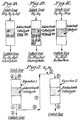
- Figures 1-2 illustrate reactors which could be used.
- the desorption reactor can be eliminated by placing the reduction catalyst downstream from the adsorbent in the adsorption reactor.
- the designation 1 is the pathway for the adsorption step where the inlet gas is NO, N 2 , O 2 , H 2 O and the outlet gas is N 2 , O 2 , H 2 O.
- the designation 2 is the pathway for the desorption-reduction step where the inlet gas is N 2 , H 2 and the outlet gas is N 2 , H 2 O. It is noted that there is an N 2 , H 2 addition before the second reactor.
- Figure 3 is a block diagram depicting the complete scheme of NO x abatement from a large volume of gas containing low concentration of NO x and also containing O 2 .
- the designation X is used to indicate the control valves directing and controlling flow through the system.
- the catalyst-adsorbent materials are resistant to sulfur dioxide, but the catalyst is most efficient in the absence of sulfur dioxide in the gas from which the nitrogen oxides are to be removed.
- the most effective agent for the adsorption is manganese and aluminum oxide co-precipitated to produce a 50/50 mixture of finely divided mixed manganese and aluminum oxides powder.
- This powder is milled in a ball mill to produce a paste comprising water, the aluminum oxide-manganese oxide powder and some colloidal cerium oxide to act as strengthening agent for the dried milled paste.
- the granules are derived by crushing and screening the dried paste.
- the granules are further treated by adding a solution of potassium carbonate which, on drying, leaves the potassium carbonate completely covering the interior and exterior of the granules.
- the adsorbent now containing more than 0.2% NO x by weight is regenerated for reuse by passing a gas containing from .05 to 10% hydrogen in nitrogen; both carbon dioxide and water vapor can also be present.
- the catalyst and reactor are heated to 300°C and the aforementioned gas is passed through, simultaneously reducing the nitrogen oxide in situ on the adsorbent.
- the reduction catalyst can either be in the downstream portion of the same reactor or in a separate downstream reactor, as shown in Figure 2. Economics favor the single reactor.
- the catalyst After regeneration, the catalyst can be used for adsorption and experience indicates that the amount of nitrogen oxide removed in the second use of the catalyst can exceed the nine hours previously reported for the first use.
- one of the most effective adsorbent catalysts is a 50% manganese oxide 50% aluminum oxide co-precipitated from the nitrate.
- all the ratios of manganese to alumina can be used with good performance being obtained from 20% manganese oxide to 80% of the aluminum oxide, and 80% manganese oxide and 20% aluminum oxide.
- manganese oxides appear to be relatively unique as being the most effective, adequately effective materials can also be made by combinations of the manganese oxide with oxides of iron, nickel, cobalt, zinc, copper and molybdenum and tungsten. Such combinations of these oxides plus manganese oxides also are very effective and also have some tolerance to SO x in the gas stream from which the nitrogen oxides are being removed.
- alumina one can use silica, thoria, magnesia, calcia, strontia, titania, zirconia, stania or baria or their mixtures or oxides of the lanthanides.
- the alkali carbonate can be that of sodium, rubidium or cesium. Potassium permanganate, potassium chromate or dichromate or their mixture can also be used and have some advantages.
- the quantity of alkali can vary from 5 to 50% of the total weight of the adsorbent.
- the second stage catalysts that are effective for the reduction of the concentrated nitrogen oxide stream are oxides of nickel, cobalt, iron and tin combined with chromium oxide, gadolinium oxide supported on alumina, silica, titania, ceria, zirconia and others. Many other hydrogenation catalysts are effective including the precious metals and the moderated precious metals.
- the temperature of adsorption is described above as approximately 200°, the temperature can be varied from approximately 100° to 500°.
- the reduction can be conducted at 200° to as high as 500°. Problems may be encountered when the adsorption is at too low or too high a temperature, and also the reduction of the nitrogen oxide may be adversely influenced (may form a small amount of NH 3 ) if the reduction is conducted at temperatures in excess of 350°C.
- the present invention differs importantly from the SCR process in that no ammonia is used in the reduction of the NO x .
- Ammonia is objectionable because it may in itself produce nitrogen oxides or it may be incompletely reacted in the course of the nitrogen oxide abatement, and, as a consequence, produce adverse atmospheric affects.
- the adsorbent-catalyst has a uniquely high capacity, in that it will function for long periods of time experimentally determined to be over nine hours.
- the regeneration of this catalyst can be accomplished in as short a time as twenty minutes, by choosing the proper gas type and temperature conditions. This makes it possible for the process to be operated on a cycling basis, with high efficiency of NO x adsorption, and high efficiency of reduction of the nitrogen oxide so the gas streams involved can, after adsorption and also after reduction, be exhausted to the atmosphere as pure gases.
- a third point of difference is that the temperatures employed are all either relatively low or a very small volume of gas is heated preferably to the 350-500°C range. This is in contrast to the aforementioned background processes at which the gas may be heated as high as 800°C, and in huge volume. Always, in the background processes, the heating or secondary heat recovery is performed on the entire gas stream, whereas in the present process a small stream is used for the regeneration process. This gas stream may be from 1-3% of the volume of the gas from which the nitrogen oxide is removed.
- the temperature used for the adsorption in the present embodiment is very close to if not equal to the temperature at which the gas would be exhausted from a boiler or compressor. This means that it would be unnecessary to heat or reheat large volume of gas because the low temperature of adsorption is essentially identical to that of the flue gas exhaust. As for the reduction gas, as pointed out previously, this is of such low volume that the cost of heating it to the 300°-400° desired is economically of little concern.
- Example 1 is as follows:
- the reduction catalyst is made by the following procedure:
- the adsorbent was again used and was examined for adsorption characteristics and these proved to be at least as effective as the initial test.
- the adsorbent and reduction catalyst were used, reused and regenerated for a total of 12 cycles with little to no deterioration in performance.
- the NO x reduction catalysts are to be used in that portion of the abatement system represented by the next to the last block of the block diagram of Fig. 3. As explained herein before, if the two reactors are combined into a single reactor this reduction catalyst would be in the down-stream portion of that reactor. Thus the reduction catalyst, e.g. NO x + H 2 > H 2 O + N 2 and its possible components are much broader than for the catalyst adsorbent.
- the preferred reduction catalyst are comprised of copper oxide and chromia or probably some copper chromite.
- This catalyst is preferred because it has little if any, tendency for the formation of NH 3 .
- many other elements can be substituted for both the copper and chromium.
- elements can be substituted for both the copper and chromium.
- These ingredients as soluble salts, preferably nitrates, are processed as described in Example 1 to produce a granular product.
- the ingredients can also be impregnated onto and into a support such as alumina, silica, silica alumina, activated carbon, silicon carbide, and others well known to the art.
- the form of the supports can be granules, cylinders, rings, honey combs, rods, spheres and others also known to the art. These same forms are suitable also for the adsorbent.
Landscapes
- Engineering & Computer Science (AREA)
- Chemical & Material Sciences (AREA)
- Analytical Chemistry (AREA)
- Chemical Kinetics & Catalysis (AREA)
- Oil, Petroleum & Natural Gas (AREA)
- General Chemical & Material Sciences (AREA)
- Environmental & Geological Engineering (AREA)
- Health & Medical Sciences (AREA)
- Biomedical Technology (AREA)
- Combustion & Propulsion (AREA)
- Materials Engineering (AREA)
- Mechanical Engineering (AREA)
- General Engineering & Computer Science (AREA)
- Catalysts (AREA)
- Treating Waste Gases (AREA)
- Exhaust Gas Treatment By Means Of Catalyst (AREA)
- Solid-Sorbent Or Filter-Aiding Compositions (AREA)
Claims (8)
- Procédé pour éliminer les NOx de gaz produits de combustion contenant des NOx et de l'oxygène, comprenant les étapes consistant :a) à envoyer les NOx, dans un courant de gaz de charge exempt d'ammoniac, sur un adsorbant-catalyseur à une température de 100 à 500°C, l'adsorbant-catalyseur comprenant un mélange d'oxyde de manganèse et d'oxyde d'aluminium, où le mélange contient de 80 à 20 % en poids d'oxyde de manganèse et de 20 à 80 % d'oxyde d'aluminium,b) quand l'adsorbant-catalyseur est saturé, à désorber les NOx à une température légèrement plus élevée, par utilisation d'un courant gazeux qui contient de l'hydrogène, de la vapeur d'eau et de l'azote, mais pas d'oxygène,c) à créer un mélange à partir de l'effluent de la désorption et d'un gaz réducteur,d) à faire passer le mélange sur un catalyseur de réduction pour réduire les NOx en eau et azote élémentaire, et à envoyer à l'atmosphère le gaz inoffensif obtenu.
- Procédé selon la revendication 1, dans lequel les NOx sont désorbés par contact avec un gaz réducteur, les gaz obtenus étant envoyés sur un catalyseur de réduction, où la plus grande partie des NOx est réduite en H2O et N2 élémentaire et l'effluent gazeux, s'il contient encore des NOx non-réduits, étant renvoyé dans la zone de combustion où NOx est diminué.
- Procédé selon la revendication 2, dans lequel le gaz de la zone de combustion est utilisé pour une chaudière ou un autre besoin utilisant de la chaleur, puis est évacué sous forme de gaz de combustion.
- Procédé selon la revendication 1, dans lequel les NOx sont simultanément désorbés et réduits par l'adsorbant-catalyseur lui-même, jouant le rôle de catalyseur de réduction.
- Procédé selon la revendication 1, dans lequel ledit adsorbant-catalyseur comprend en outre un carbonate d'un métal alcalin ou du permanganate de potassium, du chromate de potassium ou du dichromate de potassium, le carbonate d'un métal alcalin étant choisi dans le groupe constitué par les carbonates de potassium, de sodium, de rubidium et de césium, la teneur en métal alcalin étant de 5 à 50 % par rapport au poids total de l'adsorbant, les oxydes comprenant en outre un oxyde choisi dans le groupe constitué par silice, l'oxyde de thorium, la magnésie, l'oxyde de calcium, l'oxyde de strontium, l'oxyde de titane, l'oxyde de zirconium, l'oxyde d'étain, l'oxyde de bore et leurs mélanges, ou encore les oxydes des lanthanides.
- Procédé selon la revendication 5, dans lequel, quand le gaz de combustion contenant des NOx n'est plus amené sur l'adsorbant, le gaz amené sur l'adsorbant est modifié en gaz hydrogène contenant de l'azote, et la température est élevée, ce qui réduit les NOx adsorbés in situ en N2 et H2O, une certaine quantité de NOx étant désorbée.
- Procédé selon la revendication 5, dans lequel le gaz de combustion est un gaz d'échappement d'un compresseur ou d'une turbine.
- Procédé selon la revendication 5, qui comprend en outre les étapes consistantà envoyer sur un ou deux adsorbeurs le gaz de combustion contenant les NOx, selon un programme cyclique,après un certain laps de temps, à interrompre l'écoulement du gaz contenant les NOx, etpuis à envoyer un gaz d'épuration contenant un gaz réducteur sur les adsorbeurs, où les NOx adsorbés sont simultanément désorbés et réduits en H2O et N2 élémentaire.
Applications Claiming Priority (3)
| Application Number | Priority Date | Filing Date | Title |
|---|---|---|---|
| US07/935,207 US5362463A (en) | 1992-08-26 | 1992-08-26 | Process for removing NOx from combustion zone gases by adsorption |
| US935207 | 1992-08-26 | ||
| PCT/US1993/007631 WO1994004258A1 (fr) | 1992-08-26 | 1993-08-18 | Procede d'elimination par absorption du nox des gaz de la zone de combustion |
Publications (3)
| Publication Number | Publication Date |
|---|---|
| EP0656809A1 EP0656809A1 (fr) | 1995-06-14 |
| EP0656809A4 EP0656809A4 (fr) | 1995-08-30 |
| EP0656809B1 true EP0656809B1 (fr) | 1999-04-07 |
Family
ID=25466713
Family Applications (1)
| Application Number | Title | Priority Date | Filing Date |
|---|---|---|---|
| EP93920037A Expired - Lifetime EP0656809B1 (fr) | 1992-08-26 | 1993-08-18 | PROCEDE D'ELIMINATION PAR ABSORPTION DU NOx DES GAZ DE LA ZONE DE COMBUSTION |
Country Status (8)
| Country | Link |
|---|---|
| US (1) | US5362463A (fr) |
| EP (1) | EP0656809B1 (fr) |
| JP (1) | JPH08503880A (fr) |
| AT (1) | ATE178501T1 (fr) |
| AU (1) | AU675455B2 (fr) |
| CA (1) | CA2140366A1 (fr) |
| DE (1) | DE69324365T2 (fr) |
| WO (1) | WO1994004258A1 (fr) |
Families Citing this family (45)
| Publication number | Priority date | Publication date | Assignee | Title |
|---|---|---|---|---|
| JP2605556B2 (ja) * | 1992-10-13 | 1997-04-30 | トヨタ自動車株式会社 | 内燃機関の排気浄化装置 |
| US5406790A (en) * | 1992-12-11 | 1995-04-18 | Toyota Jidosha Kabushiki Kaisha | Exhaust gas purification device for an engine |
| US5451558A (en) * | 1994-02-04 | 1995-09-19 | Goal Line Environmental Technologies | Process for the reaction and absorption of gaseous air pollutants, apparatus therefor and method of making the same |
| US6345378B1 (en) * | 1995-03-23 | 2002-02-05 | Lsi Logic Corporation | Synthesis shell generation and use in ASIC design |
| US6080377A (en) * | 1995-04-27 | 2000-06-27 | Engelhard Corporation | Method of abating NOx and a catalytic material therefor |
| US6471924B1 (en) | 1995-07-12 | 2002-10-29 | Engelhard Corporation | Method and apparatus for NOx abatement in lean gaseous streams |
| US6001319A (en) * | 1995-09-19 | 1999-12-14 | Ngk Spark Plug Co., Ltd. | Method of removing nitrogen oxides using material for absorbing nitrogen oxides |
| US6548032B1 (en) | 1995-09-20 | 2003-04-15 | Rhodia Chimie | Process for the treatment of gases with high oxygen content, with a view to controlling nitrogen oxide emissions, using a catalytic composition comprising cerium oxide and/or zirconium oxide |
| US5837212A (en) * | 1995-09-21 | 1998-11-17 | Ford Global Technologies, Inc. | Potassium/manganese nitrogen oxide traps for lean-burn engine operation |
| US5656244A (en) * | 1995-11-02 | 1997-08-12 | Energy And Environmental Research Corporation | System for reducing NOx from mobile source engine exhaust |
| US6696389B1 (en) | 1996-02-23 | 2004-02-24 | Daimlerchrysler Ag | Process and apparatus for cleaning a gas flow |
| DE19606657C1 (de) * | 1996-02-23 | 1997-07-10 | Basf Ag | Verfahren und Vorrichtung zum Reinigen von Gasen |
| DE19607862C2 (de) * | 1996-03-01 | 1998-10-29 | Volkswagen Ag | Verfahren und Vorrichtungen zur Abgasreinigung |
| EP0944428B1 (fr) | 1996-08-19 | 2013-06-26 | Volkswagen Aktiengesellschaft | Methode pour opérer un moteur à combustion interne |
| JP2000516681A (ja) | 1996-08-19 | 2000-12-12 | フォルクスワーゲン・アクチェンゲゼルシャフト | NOx吸収体を備えた火花点火式内燃機関 |
| DE59711876D1 (de) | 1996-09-05 | 2004-09-30 | Volkswagen Ag | Abgasreinigungsverfahren für eine brennkraftmaschine |
| DE19636790A1 (de) | 1996-09-11 | 1998-03-12 | Volkswagen Ag | NOx-Abgasreinigungsverfahren |
| DE19640161A1 (de) * | 1996-09-28 | 1998-04-02 | Volkswagen Ag | NOx-Abgasreinigungsverfahren |
| JP3702924B2 (ja) * | 1997-05-14 | 2005-10-05 | 三菱自動車工業株式会社 | 排気浄化装置 |
| DE19724545A1 (de) | 1997-06-11 | 1998-12-24 | Basf Ag | Speicherkatalysator |
| DE19740702C1 (de) * | 1997-09-16 | 1998-11-19 | Siemens Ag | Verfahren und Vorrichtung zum Betrieb einer mit Luftüberschuß arbeitenden Brennkraftmaschine |
| EP1032754A2 (fr) * | 1997-11-19 | 2000-09-06 | AlliedSignal Inc. | APPAREIL D'EVACUATION DES NOx COMPRENANT UN SUPPORT EN DIOXYDE DE MANGANESE ET OXYDE DE CUIVRE |
| FR2771306B1 (fr) * | 1997-11-25 | 2000-02-04 | Rhodia Chimie Sa | Composition a base de manganese et utilisation comme piege a nox pour le traitement de gaz d'echappement |
| US6471937B1 (en) * | 1998-09-04 | 2002-10-29 | Praxair Technology, Inc. | Hot gas reactor and process for using same |
| DE19842625C2 (de) * | 1998-09-17 | 2003-03-27 | Daimler Chrysler Ag | Verfahren zum Betrieb einer Verbrennungsmotoranlage mit schwefelanreichernder Abgasreinigungskomponente und damit betreibbare Verbrennungsmotoranlage |
| US6855297B2 (en) * | 1998-11-16 | 2005-02-15 | Honeywell International Inc. | NOx filter |
| CA2373080A1 (fr) * | 1999-05-07 | 2000-11-16 | Rhodia Chimie | Compose utilisable comme piege a nox, associant deux compositions a base de manganese et d'un autre element choisi parmi les alcalins, les alcalino-terreux et les terres rares et son utilisation dans le traitement des gaz d'echappement |
| FR2793162B1 (fr) * | 1999-05-07 | 2001-07-27 | Ecia Equip Composants Ind Auto | COMPOSE A ACTIVITE CATALYTIQUE OU A ACTIVITE DE PIEGEAGE, UTILISABLE COMME PIEGE A NOx ASSOCIANT DEUX COMPOSITIONS A BASE DE MANGANESE ET D'UN AUTRE ELEMENT CHOISI PARMI LES ALCALINS, LES ALCALINO-TERREUX ET LES TERRES RARES. |
| FR2793161B1 (fr) * | 1999-05-07 | 2001-10-12 | Renault | Dispositif d'epuration des gaz d'echappement pour moteur a combustion interne |
| US6887438B2 (en) * | 2000-12-21 | 2005-05-03 | Delphi Technologies, Inc. | NOx control |
| DE10132890A1 (de) * | 2001-07-06 | 2003-01-16 | Daimler Chrysler Ag | Feststoff und Verfahren zur Adsorption und Desorption von Stickoxiden in Abgasen von Verbrennungskraftmaschinen |
| FR2845932A1 (fr) * | 2002-10-17 | 2004-04-23 | Rhodia Elect & Catalysis | Composition catalytique a base d'alume, de manganese, de potassium, de rubidium ou de cesium et de platine et son utilisation comme piege a nox dans le traitement de gaz |
| WO2005037412A1 (fr) * | 2003-10-21 | 2005-04-28 | Osaka Industrial Promotion Organization | Procede et dispositif destines au traitement des gaz d'echappement |
| US7399729B2 (en) | 2003-12-22 | 2008-07-15 | General Electric Company | Catalyst system for the reduction of NOx |
| ITMI20070742A1 (it) * | 2007-04-12 | 2008-10-13 | Milano Politecnico | Apparato e procedimento per la riduzione del contenuto degli ossidi di azoto nei gas esausti di sistemi di combustione. |
| JP5711017B2 (ja) * | 2010-03-29 | 2015-04-30 | 国立大学法人北海道大学 | 亜酸化窒素含有ガスの処理方法及び処理装置 |
| WO2013112619A1 (fr) | 2012-01-23 | 2013-08-01 | Battelle Memorial Institute | Appareil et procédés de séparation et/ou séquestration |
| EP2724766A1 (fr) | 2012-10-26 | 2014-04-30 | Alstom Technology Ltd | Procédé de traitement d'un gaz de combustion riche en dioxyde de carbone et système de traitement de gaz de combustion |
| CN105050688B (zh) | 2012-12-31 | 2017-03-15 | 英温提斯热力技术有限公司 | 用于从燃烧气体中集成式分离二氧化碳气体的系统和方法 |
| EP3256247A4 (fr) | 2015-02-09 | 2018-08-22 | BASF Corporation | Catalyseur d'oxydation de diesel |
| US11911740B2 (en) * | 2016-10-14 | 2024-02-27 | Liwei Huang | Noxious gas purificant and its preparation and purification method thereof |
| CN110743313A (zh) * | 2019-10-29 | 2020-02-04 | 中国华能集团有限公司 | 一种烟气低温吸附脱硝方法 |
| FR3135212B1 (fr) * | 2022-05-09 | 2024-03-22 | Air Liquide | Procédé et appareil de purification d’un flux gazeux contenant au moins un oxyde d’azote |
| GB2622259A (en) * | 2022-09-09 | 2024-03-13 | Edwards Ltd | NOx reduction |
| CN115814573A (zh) * | 2022-11-29 | 2023-03-21 | 四川力达世环保技术有限公司 | 用于生产矿源硝基腐植酸与硝基黄腐酸的综合处理系统 |
Family Cites Families (9)
| Publication number | Priority date | Publication date | Assignee | Title |
|---|---|---|---|---|
| US3880618A (en) * | 1973-03-02 | 1975-04-29 | Donald H Mccrea | Simultaneously removing sulfur and nitrogen oxides from gases |
| US4182745A (en) * | 1974-08-06 | 1980-01-08 | Jgc Corporation | Catalyst for reducing nitrogen oxides in a waste gas and a process for catalytically reducing nitrogen oxides contained in a waste gas |
| US4186109A (en) * | 1976-09-30 | 1980-01-29 | Mitsubishi Jukogyo Kabushiki Kaisha | Catalyst for selectively reducing nitrogen oxides from oxygen-containing exhaust gases |
| US4258020A (en) * | 1978-04-10 | 1981-03-24 | Uop Inc. | Process for the simultaneous separation of sulfur and nitrogen oxides from a gaseous mixture |
| US4268488A (en) * | 1979-05-10 | 1981-05-19 | Uop Inc. | Process for the catalytic reduction of nitrogen oxides in gaseous mixtures |
| DE3663452D1 (en) * | 1986-01-21 | 1989-06-29 | Adsorptionstech Lab | Process for removing nitrogen oxides and sulfur oxides from a waste gas |
| US5154901A (en) * | 1987-03-31 | 1992-10-13 | Kabushiki Kaisha Riken | Method of cleaning an exhaust gas containing nitrogen oxides and fine carbon-containing particulates |
| DE3716334A1 (de) * | 1987-05-15 | 1988-12-01 | Kernforschungsanlage Juelich | Verfahren zur no(pfeil abwaerts)x(pfeil abwaerts)-abscheidung aus abgasstroemen in kontakt mit einer regenerierbaren feststoffschicht |
| JP2783074B2 (ja) * | 1991-10-29 | 1998-08-06 | トヨタ自動車株式会社 | 内燃機関の排気浄化装置 |
-
1992
- 1992-08-26 US US07/935,207 patent/US5362463A/en not_active Expired - Fee Related
-
1993
- 1993-08-18 CA CA002140366A patent/CA2140366A1/fr not_active Abandoned
- 1993-08-18 DE DE69324365T patent/DE69324365T2/de not_active Expired - Fee Related
- 1993-08-18 AT AT93920037T patent/ATE178501T1/de not_active IP Right Cessation
- 1993-08-18 WO PCT/US1993/007631 patent/WO1994004258A1/fr not_active Ceased
- 1993-08-18 EP EP93920037A patent/EP0656809B1/fr not_active Expired - Lifetime
- 1993-08-18 AU AU50100/93A patent/AU675455B2/en not_active Ceased
- 1993-08-18 JP JP6506426A patent/JPH08503880A/ja active Pending
Also Published As
| Publication number | Publication date |
|---|---|
| AU675455B2 (en) | 1997-02-06 |
| CA2140366A1 (fr) | 1994-03-03 |
| JPH08503880A (ja) | 1996-04-30 |
| EP0656809A1 (fr) | 1995-06-14 |
| EP0656809A4 (fr) | 1995-08-30 |
| WO1994004258A1 (fr) | 1994-03-03 |
| DE69324365D1 (de) | 1999-05-12 |
| US5362463A (en) | 1994-11-08 |
| AU5010093A (en) | 1994-03-15 |
| DE69324365T2 (de) | 1999-11-04 |
| ATE178501T1 (de) | 1999-04-15 |
Similar Documents
| Publication | Publication Date | Title |
|---|---|---|
| US5362463A (en) | Process for removing NOx from combustion zone gases by adsorption | |
| EP0947234B1 (fr) | Procédé catalytique sec à une étape pour la séparation simultanée de dioxyde de soufre et d'oxydes d'azote de courant gazeux | |
| US5591417A (en) | Removing SOx, CO and NOx from flue gases | |
| JP3589529B2 (ja) | 燃焼排ガスの処理方法及び装置 | |
| CN106268296B (zh) | 一种掺杂的镧基钙钛矿型复合氧化物催化还原同时脱硫脱硝的烟气处理方法 | |
| US5458861A (en) | Desulfurizing a gas stream | |
| CN102836717B (zh) | 一种尖晶石型氧化物的应用及催化脱硫脱硝的方法 | |
| CN102049257B (zh) | Co同时还原so2和no的催化剂及其制备和应用 | |
| US5514351A (en) | Desulfurizing tailgas from sulfur recovery unit | |
| US3931390A (en) | Catalytic process for removing sulfur dioxide from gas streams | |
| EP1060000B1 (fr) | Procede de traitement de flux a faible teneur en sulfure d'hydrogene par combustion partielle du flux d'alimentation | |
| US5023063A (en) | Acid rain abatement | |
| US5176888A (en) | Acid rain abatement | |
| CN110694470A (zh) | 一种用甲烷进行烟气脱硫脱硝的系统及方法 | |
| CZ5399A3 (cs) | Nanesený katalyzátor obsahující oxidy kovů a způsob katalytického rozkladu amoniaku a kyanovodíku v koksárenském plynu | |
| EP1062025B1 (fr) | PROCEDE PERFECTIONNE DE TRAITEMENT DE COURANTS PAUVRES EN H2S, AVEC RECYCLAGE DU SOx PROVENANT DU BRULEUR | |
| US3755550A (en) | Process for reduction of so2 | |
| EP1455925A1 (fr) | Systeme de filtration et de traitement des gaz d'echappement pour piles a combustible a carbonate fondu | |
| JP3433137B2 (ja) | 窒素酸化物および/または硫黄酸化物の吸着剤 | |
| JPS6251135B2 (fr) | ||
| Stiles et al. | Selective catalytic reduction of NOx in the presence of oxygen | |
| Ngwenya et al. | Catalytic removal of SO2 from coal-fired flue gas | |
| KR100481007B1 (ko) | 여러가지 x형과 y형 제올라이트가 혼합된 금속산화물 촉매를 이용한 h2s의 원소황으로의 선택적 산화반응. | |
| CN117942704A (zh) | 烟气净化及资源化利用的方法及其装置 | |
| Cengiz et al. | Development of durable and reactive regenerable sorbents for high temperature flue gas desulphurisation |
Legal Events
| Date | Code | Title | Description |
|---|---|---|---|
| PUAI | Public reference made under article 153(3) epc to a published international application that has entered the european phase |
Free format text: ORIGINAL CODE: 0009012 |
|
| 17P | Request for examination filed |
Effective date: 19950221 |
|
| AK | Designated contracting states |
Kind code of ref document: A1 Designated state(s): AT BE CH DE DK ES FR GB GR IE IT LI NL PT SE |
|
| A4 | Supplementary search report drawn up and despatched | ||
| AK | Designated contracting states |
Kind code of ref document: A4 Designated state(s): AT BE CH DE DK ES FR GB GR IE IT LI NL PT SE |
|
| 17Q | First examination report despatched |
Effective date: 19971014 |
|
| GRAG | Despatch of communication of intention to grant |
Free format text: ORIGINAL CODE: EPIDOS AGRA |
|
| GRAG | Despatch of communication of intention to grant |
Free format text: ORIGINAL CODE: EPIDOS AGRA |
|
| GRAH | Despatch of communication of intention to grant a patent |
Free format text: ORIGINAL CODE: EPIDOS IGRA |
|
| GRAH | Despatch of communication of intention to grant a patent |
Free format text: ORIGINAL CODE: EPIDOS IGRA |
|
| GRAA | (expected) grant |
Free format text: ORIGINAL CODE: 0009210 |
|
| AK | Designated contracting states |
Kind code of ref document: B1 Designated state(s): AT BE CH DE DK ES FR GB GR IE IT LI NL PT SE |
|
| PG25 | Lapsed in a contracting state [announced via postgrant information from national office to epo] |
Ref country code: SE Free format text: THE PATENT HAS BEEN ANNULLED BY A DECISION OF A NATIONAL AUTHORITY Effective date: 19990407 Ref country code: NL Free format text: LAPSE BECAUSE OF FAILURE TO SUBMIT A TRANSLATION OF THE DESCRIPTION OR TO PAY THE FEE WITHIN THE PRESCRIBED TIME-LIMIT Effective date: 19990407 Ref country code: LI Free format text: LAPSE BECAUSE OF FAILURE TO SUBMIT A TRANSLATION OF THE DESCRIPTION OR TO PAY THE FEE WITHIN THE PRESCRIBED TIME-LIMIT Effective date: 19990407 Ref country code: GR Free format text: LAPSE BECAUSE OF NON-PAYMENT OF DUE FEES Effective date: 19990407 Ref country code: ES Free format text: THE PATENT HAS BEEN ANNULLED BY A DECISION OF A NATIONAL AUTHORITY Effective date: 19990407 Ref country code: CH Free format text: LAPSE BECAUSE OF FAILURE TO SUBMIT A TRANSLATION OF THE DESCRIPTION OR TO PAY THE FEE WITHIN THE PRESCRIBED TIME-LIMIT Effective date: 19990407 Ref country code: BE Free format text: LAPSE BECAUSE OF FAILURE TO SUBMIT A TRANSLATION OF THE DESCRIPTION OR TO PAY THE FEE WITHIN THE PRESCRIBED TIME-LIMIT Effective date: 19990407 Ref country code: AT Free format text: LAPSE BECAUSE OF FAILURE TO SUBMIT A TRANSLATION OF THE DESCRIPTION OR TO PAY THE FEE WITHIN THE PRESCRIBED TIME-LIMIT Effective date: 19990407 |
|
| REF | Corresponds to: |
Ref document number: 178501 Country of ref document: AT Date of ref document: 19990415 Kind code of ref document: T |
|
| REG | Reference to a national code |
Ref country code: CH Ref legal event code: EP |
|
| REG | Reference to a national code |
Ref country code: IE Ref legal event code: FG4D |
|
| REF | Corresponds to: |
Ref document number: 69324365 Country of ref document: DE Date of ref document: 19990512 |
|
| ET | Fr: translation filed | ||
| PG25 | Lapsed in a contracting state [announced via postgrant information from national office to epo] |
Ref country code: PT Free format text: LAPSE BECAUSE OF FAILURE TO SUBMIT A TRANSLATION OF THE DESCRIPTION OR TO PAY THE FEE WITHIN THE PRESCRIBED TIME-LIMIT Effective date: 19990707 Ref country code: DK Free format text: LAPSE BECAUSE OF FAILURE TO SUBMIT A TRANSLATION OF THE DESCRIPTION OR TO PAY THE FEE WITHIN THE PRESCRIBED TIME-LIMIT Effective date: 19990707 |
|
| PGFP | Annual fee paid to national office [announced via postgrant information from national office to epo] |
Ref country code: FR Payment date: 19990802 Year of fee payment: 7 Ref country code: DE Payment date: 19990802 Year of fee payment: 7 |
|
| PGFP | Annual fee paid to national office [announced via postgrant information from national office to epo] |
Ref country code: GB Payment date: 19990803 Year of fee payment: 7 |
|
| PG25 | Lapsed in a contracting state [announced via postgrant information from national office to epo] |
Ref country code: IE Free format text: LAPSE BECAUSE OF NON-PAYMENT OF DUE FEES Effective date: 19990818 |
|
| NLV1 | Nl: lapsed or annulled due to failure to fulfill the requirements of art. 29p and 29m of the patents act | ||
| REG | Reference to a national code |
Ref country code: CH Ref legal event code: PL |
|
| PLBE | No opposition filed within time limit |
Free format text: ORIGINAL CODE: 0009261 |
|
| STAA | Information on the status of an ep patent application or granted ep patent |
Free format text: STATUS: NO OPPOSITION FILED WITHIN TIME LIMIT |
|
| 26N | No opposition filed | ||
| PG25 | Lapsed in a contracting state [announced via postgrant information from national office to epo] |
Ref country code: GB Free format text: LAPSE BECAUSE OF NON-PAYMENT OF DUE FEES Effective date: 20000818 |
|
| REG | Reference to a national code |
Ref country code: IE Ref legal event code: MM4A |
|
| GBPC | Gb: european patent ceased through non-payment of renewal fee |
Effective date: 20000818 |
|
| PG25 | Lapsed in a contracting state [announced via postgrant information from national office to epo] |
Ref country code: FR Free format text: LAPSE BECAUSE OF NON-PAYMENT OF DUE FEES Effective date: 20010430 |
|
| PG25 | Lapsed in a contracting state [announced via postgrant information from national office to epo] |
Ref country code: DE Free format text: LAPSE BECAUSE OF NON-PAYMENT OF DUE FEES Effective date: 20010501 |
|
| REG | Reference to a national code |
Ref country code: FR Ref legal event code: ST |
|
| PG25 | Lapsed in a contracting state [announced via postgrant information from national office to epo] |
Ref country code: IT Free format text: LAPSE BECAUSE OF NON-PAYMENT OF DUE FEES;WARNING: LAPSES OF ITALIAN PATENTS WITH EFFECTIVE DATE BEFORE 2007 MAY HAVE OCCURRED AT ANY TIME BEFORE 2007. THE CORRECT EFFECTIVE DATE MAY BE DIFFERENT FROM THE ONE RECORDED. Effective date: 20050818 |