EP0656897B1 - Chinuclidine derivate als squalen synthase inhibitoren - Google Patents
Chinuclidine derivate als squalen synthase inhibitoren Download PDFInfo
- Publication number
- EP0656897B1 EP0656897B1 EP93919477A EP93919477A EP0656897B1 EP 0656897 B1 EP0656897 B1 EP 0656897B1 EP 93919477 A EP93919477 A EP 93919477A EP 93919477 A EP93919477 A EP 93919477A EP 0656897 B1 EP0656897 B1 EP 0656897B1
- Authority
- EP
- European Patent Office
- Prior art keywords
- formula
- compound
- hydroxy
- hydrogen
- alkyl
- Prior art date
- Legal status (The legal status is an assumption and is not a legal conclusion. Google has not performed a legal analysis and makes no representation as to the accuracy of the status listed.)
- Expired - Lifetime
Links
- 0 C(C1)C2*CN1CC2 Chemical compound C(C1)C2*CN1CC2 0.000 description 9
- TYCHQBRUARUTCL-UHFFFAOYSA-N C1OC11C(CC2)CCN2C1 Chemical compound C1OC11C(CC2)CCN2C1 TYCHQBRUARUTCL-UHFFFAOYSA-N 0.000 description 1
Classifications
-
- C—CHEMISTRY; METALLURGY
- C07—ORGANIC CHEMISTRY
- C07D—HETEROCYCLIC COMPOUNDS
- C07D453/00—Heterocyclic compounds containing quinuclidine or iso-quinuclidine ring systems, e.g. quinine alkaloids
- C07D453/02—Heterocyclic compounds containing quinuclidine or iso-quinuclidine ring systems, e.g. quinine alkaloids containing not further condensed quinuclidine ring systems
-
- A—HUMAN NECESSITIES
- A61—MEDICAL OR VETERINARY SCIENCE; HYGIENE
- A61P—SPECIFIC THERAPEUTIC ACTIVITY OF CHEMICAL COMPOUNDS OR MEDICINAL PREPARATIONS
- A61P9/00—Drugs for disorders of the cardiovascular system
- A61P9/10—Drugs for disorders of the cardiovascular system for treating ischaemic or atherosclerotic diseases, e.g. antianginal drugs, coronary vasodilators, drugs for myocardial infarction, retinopathy, cerebrovascula insufficiency, renal arteriosclerosis
Definitions
- This invention concerns heterocyclic compounds which are useful in inhibiting squalene synthase, processes for their preparation and pharmaceutical compositions containing them.
- the present invention is also concerned with methods of using such heterocyclic compounds in treating diseases and medical conditions where inhibition of squalene synthase is desirable, for example in treating diseases or medical conditions such as hypercholesterolemia and atherosclerosis.
- HMG CoA reductase which is essential for the production of cholesterol
- agents which inhibit the enzyme HMG CoA reductase have been reported to reduce levels of serum cholesterol.
- HMG CoA reductase inhibitor known as lovastatin which is disclosed in US Patent No 4,231,938.
- Other agents which are reported to lower serum cholesterol include those which act by complexing with bile acids in the intestinal system and which are hence termed "bile acid sequestrants". It is believed that many of such agents act by sequestering bile acids within the intestinal tract.
- Squalene synthase (also referred to in the art as squalene synthetase) is a microsomal enzyme which catalyses the first committed step of cholesterol biosynthesis.
- Two molecules of farnesyl pyrophosphate (FPP) are condensed in the presence of the reduced form of nicotinamide adenine dinucleotide phosphate (NADPH) to form squalene.
- FPP farnesyl pyrophosphate
- NADPH nicotinamide adenine dinucleotide phosphate
- Elevated cholesterol levels are known to be one of the main risk factors for ischaemic cardiovacsular disease.
- an agent which inhibits squalene synthase should be useful in treating diseases and medical conditions in which a reduction in the levels of cholesterol is desirable, for example hypercholesterolemia and atherosclerosis.
- squalene synthase inhibitors have concentrated on the preparation of analogues of the substrate farnesyl pyrophosphate (FPP), and hence on compounds which contain phosphorus groups .
- FPP farnesyl pyrophosphate
- the preparation of phosphorous-containing squalene synthase inhibitors is reported in published European Patent Application No. 409,181; and the preparation of isoprenoid (phosphinylmethyl)phosphonates as inhibitors of squalene synthase is reported by Biller et al, J. Med. Chem., 1988, 31, 1869.
- the present invention is based on the discovery that certain heterocyclic compounds are inhibitors of squalene synthase, and are hence useful in treating diseases and medical conditions in which inhibition of squalene synthase is desirable.
- the compounds of the invention may exist in, and be isolated in, optically active or racemic form.
- the invention includes any optically active or racemic form of a compound of formula I which possesses the beneficial pharmacological effect of inhibiting squalene synthase.
- the synthesis of optically active forms may be carried out by standard techniques of organic chemistry well known in the art, for example by, resolution of a racemic form, by synthesis from optically active starting materials or by asymmetric synthesis.
- the present invention includes any tautomeric form of a compound of formula I which possesses the beneficial pharmacological effect of inhibiting squalene synthase.
- alkyl include both the straight chain and branched chain groups such as butyl and tert-butyl.
- butyl when a specific term such as “butyl” is used, it is specific for the straight chain or "normal” butyl group, branched chain isomers such as " t -butyl” being referred to specifically when intended.
- heteroaryl encompasses monocyclic aromatic heterocycles which contain (in addition to carbon atoms) one, two, three or four heteroatoms selected from nitrogen, oxygen and sulphur; bicyclic aromatic heterocycles of about 8 to 10 ring atoms and containing one, two, three or four heteroatoms selected from nitrogen, oxygen and sulphur, and in particular benz-derivatives of said monocyclic aromatic heterocycles.
- Suitable values for Ar 2 include, for example, a 5-membered or 6-membered aromatic (that is, fully unsaturated) heterocyclic ring containing one, two, three or four heteroatoms (and in particular one, two or three heteroatoms) selected from nitrogen, oxygen and sulphur, and a 5-membered or 6-membered aromatic heterocyclic ring containing one, two, three or four heteroatoms (and in particular one, two or three heteroatoms) selected from nitrogen, oxygen and sulphur which is fused to a benzene ring.
- Ar 2 may comprise a heteroaryl moiety containing up to three heteroatoms selected from nitrogen, oxygen and sulphur.
- the heteroaryl moiety may comprise a fully unsaturated heterocyclic ring which contains one, two or three heteroatoms selected from nitrogen, oxygen and sulphur as ring atoms, and may be attached to Ar 1 through any available ring atom.
- Suitable values for Ar 1 , the phenylene moiety include 1,2-phenylene; 1,3-phenylene and 1,4-phenylene.
- a particular value for an optional substituent which may be present on Ar 1 or Ar 2 is, for example,
- Ar 2 include, for example, furyl, pyrrolyl, thienyl, pyridyl, pyrazinyl, pyrimidinyl, pyridazinyl, imidazolyl, oxazolyl, isooxazolyl, thiazolyl, isothiazolyl, oxadiazolyl, triazolyl, tetrazolyl, benzfuranyl, quinolyl, isoquinolyl, benzimidazolyl, indolyl, pyrazolyl, thiadiazolyl, benzthiazolyl and benzoxazolyl.
- Ar 2 More particular values of Ar 2 include, for example, pyridyl, pyrazolyl, thiadiazolyl, benzthiadiazolyl and oxadiazolyl.
- Ar 2 is a 5-membered or 6-membered heteroaryl ring containing (in addition to carbon atoms) one, two or three heteroatoms selected from nitrogen, oxygen and sulphur.
- preferred values for Ar 2 will include, for example, pyridyl, thiadiazolyl or oxadiazolyl (especially pyridyl or oxadiazolyl).
- Ar 1 is, for example, 1,3-phenylene or 1,4-phenylene.
- Ar 1 is 1,4-phenylene.
- Ar 1 is optionally unsubstituted or substituted by one, two or three substituents independently selected from those mentioned above; and that Ar 2 is optionally unsubstituted or substituted by one, two or three substituents from those mentioned above.
- Ar 1 and Ar 2 may optionally bear one or more substituents selected from halogeno, hydroxy, nitro, (1-6C)alkyl, (2-6C)alkenyl, (1-6C)alkoxy, (1-6C)alkylthio, (1-6C)alkylsulphinyl, (1-6C)alkoxycarbonyl, (1-6C)alkylsulphonyl, (1-6C)alkanoylamino and halogeno-(1-6C)alkyl.
- substituents selected from halogeno, hydroxy, nitro, (1-6C)alkyl, (2-6C)alkenyl, (1-6C)alkoxy, (1-6C)alkylthio, (1-6C)alkylsulphinyl, (1-6C)alkoxycarbonyl, (1-6C)alkylsulphonyl, (1-6C)alkanoylamino and halogeno-(1-6C)alkyl.
- R 1 is hydroxy and R 2 is hydrogen.
- Ar 2 (optionally substituted as hereinbefore defined) include, for example, 2-pyridyl, 3-pyridyl, 4-pyridyl, 1-pyrrolyl, 5-pyrimidinyl, 2-indolyl, 2-quinolyl, 3-pyazolyl, 1-imidazolyl, 2-methyl-tetrazol-5-yl, 1-pyrazolyl, 2-oxazolyl, 5-isoxazolyl, 2-thiazolyl, 1,2,4-thiadiazol-5-yl, 2-benz-1,3-oxazolyl, 2-benz-1,3-thiazolyl, 1,2,4-oxadiazol-3-yl, 1,2,4-oxadiazol-5-yl and 1,3,4-oxadiazol-2-yl.
- substituents for Ar 2 include hydroxy, (1-6C)alkyl such as methyl, ethyl or isopropyl, (1-6C)alkoxy such as methoxy and (1-6C)alkoxycarbonyl such as ethoxycarbonyl.
- Ar 2 include, for example, 2-thienyl, 2-pyridyl, 3-pyridyl, 4-pyridyl, 2-pyrimidyl, 5-pyrimidyl, 3-pyrazinyl, 2-pyridazinyl, 1-imidazolyl, 2-imidazolyl, 3-pyrazinyl, 2-pyridazinyl, 1,2,3-triazol-1-yl, 1,2,3-triazol-3-y, 3-quinolyl, 4-quinolyl, 3-isoquinolyl, 4-isoquinolyl, 1-benzimidazolyl, 2-indolyl and 3-indolyl, which may optionally bear one or two substituents independently selected from fluoro, chloro, bromo, iodo, hydroxy, nitro, methyl, ethyl, propyl, isopropyl, butyl, isobutyl, sec-butyl, allyl, methoxy, ethoxy, propoxy,
- Ar 1 include, for example, an unsubstituted 1,4-phenylene moiety and a 1,4-phenylene moiety having one or two substituents independently selected from fluoro, chloro, bromo, iodo, hydroxy, nitro, methyl, ethyl, propyl, isopropyl, butyl, isobutyl, sec-butyl, allyl, methoxy, ethoxy, propoxy, isopropoxy, butoxy, methylthio, ethylthio, propylthio, isopropylthio, butylthio, methylsulphinyl, ethylsulphinyl, propylsulphinyl, isopropylsulphinyl, butylsulphinyl, methylsulphonyl, ethylsulphonyl, propylsulphonyl, isoproylsulphonyl, butylsulphonyl,
- a preferred optional substituent for Ar 1 is for example, (2-6C)alkenyl such as allyl.
- Ar 1 and Ar 2 are both unsubstituted.
- R 1 and R 2 are both hydrogen; and Ar 1 and Ar 2 have any of the meanings defined above.
- R 1 is hydroxy; R 2 is hydrogen; and Ar 1 and Ar 2 have any of the meanings defined above.
- R 1 and R 2 are joined together so that CR 1 -CR 2 is a double bond; and Ar 1 and Ar 2 have any of the meanings defined above.
- R 1 is hydroxy and R 2 is hydrogen.
- Ar 1 and Ar 2 may optionally bear one or more substituents selected from halogeno, hydroxy, nitro, (1-6C)alkyl, (2-6C)alkenyl, (1-6C)alkoxy, (1-6C)alkylthio, (1-6C)alkylsulphinyl, (1-6C)alkylsulphonyl, (1-6C)alkanoylamino and halogeno-(1-6C)alkyl.
- Ar 2 is, for example, furyl, pyrrolyl, thienyl, pyridyl, pyrazinyl, primidinyl, pyridazinyl, imidazolyl, oxazolyl, isooxazolyl, thiazolyl, isothiazolyl, oxadiazolyl, thiazolyl, 1,2,3-triazolyl, 1,2,4-triazolyl, benzfuranyl, quinolyl, isoquinolyl, benzimidazolyl and indolyl.
- a further group of values for Ar 2 of interest is, for example, pyridyl, pyrazinyl, primidinyl, pyridazinyl and imidazolyl (especially pyridyl such as 2-pyridyl or 3-pyridyl and imidazolyl such as 1-imidazolyl).
- the present invention provides a compound of formula I, or a pharmaceutically acceptable salt thereof, wherein:
- the present invention provides a compound of formula I, or a pharmaceutically acceptable salt thereof, wherein:
- the present invention provides a compound of formula I, or a pharmaceutically acceptable salt thereof, wherein:
- a suitable pharmaceutically-acceptable salt of the present invention comprises an acid-addition salt derived from an inorganic or organic acid which provides a pharmaceutically-acceptable anion.
- salts of the present invention include acid-addition salts with hydrochloric, hydrobromic, nitric, sulphuric, phosphoric, trifluoroacetic, citric, tartaric, succinic, maleic, fumaric or acetic acid.
- suitable pharmaceutically-acceptable salts include [where the compound of formula I is sufficiently acidic, for example where the compound of formula I bears an acidic substituent such as carboxy] those formed with a base which affords a pharmaceutically acceptable cation.
- Suitable bases include an alkali metal salt (such as a sodium or potassium salt), an alkaline earth metal salt (such as a calcium or magnesium salt), an ammonium salt or a salt with an organic base which affords a physiologically-acceptable cation such as a salt with methylamine, dimethylamine, triethylamine, piperidine or morpholine.
- an alkali metal salt such as a sodium or potassium salt
- an alkaline earth metal salt such as a calcium or magnesium salt
- an ammonium salt or a salt with an organic base which affords a physiologically-acceptable cation such as a salt with methylamine, dimethylamine, triethylamine, piperidine or morpholine.
- the compounds of the present invention may be obtained by standard procedures of organic chemistry already known to be applicable to the preparation of structurally analogous compounds. Such procedures for the preparation of the compounds of formula I, or pharmaceutically acceptable salts thereof, are provided as a further feature of the present invention and are illustrated by the following processes in which the various generic radicals, for example, R 1 , R 2 , X, Ar 1 and Ar 2 may take any of the meanings hereinbefore defined.
- test compound is incubated at a concentration of 25 micromolar in 200 ⁇ l of a buffered solution containing potassium phosphate (50mM), MgCl 2 (4.95mM), KF (9.9mM), NADPH (0.9mM) and rat liver microsomal protein (20 ⁇ g).
- Rat liver microsomes are prepared by the method described in published European Patent Application No. 324,421 and stored in liquid nitrogen prior to assay. Assay vials are kept at 37°C throughout the incubation.
- the reaction is started with the addition of the substrate (1-[ 3 H]-farnesyl pyrophosphate), final concentration 20 ⁇ M, and stopped after 15 minutes reaction time with the addition of 50 ⁇ l of 4% KOH.
- the reaction products are separated from unreacted substrate after application to a C-18 octadecyl 1ccBond column (Analytichem Int product No. 617101).
- An aqueous fraction is eluted with 250 ⁇ l of 0.1M KOH.
- Squalene is then eluted with 1.0 ml 10% ethylacetate in hexane and radioactivity determined. The difference in radioactivity in the presence and absence of the test compound is used to determine the level of inhibition.
- test compound inhibits at greater than about 70% at 25 micromolar, it is generally re-tested at 25 and 2.5 micromolar.
- concentration which results in a 50% inhibition of squalene production can be determined by testing the compound at several, for example five, concentrations predicted from the two concentration results. The IC 50 can then be determined from a plot of percentage inhibition against concentration of test compound.
- compounds of formula I show significant inhibition in the above test at a concentration in the range of about 0.001 to 25 ⁇ M.
- mice Female rats (35 - 55 g) are housed in reverse lighting conditions (red light from 0200h - 1400h) for a period of about 2 weeks prior to test. Animals are allowed free access to chow and drinking water throughout this period. At test, animals should weigh 125 - 150 g.
- Test compounds may be administered by oral gavage, dissolved or suspended in 0.5% polysorbate, or by ip or iv dosing. Control animals receive vehicle alone. After 1 hour the rats are injected ip with 25 ⁇ Ci [2- 14 C]-acetate (NEN DUPONT. specific activity, 45-60mCi/mmol NEC-085H, or AMERSHAM specific activity, 50-60mCi/mmol CFA 14) in a volume of 0.25 ml saline (100 ⁇ Ci/ml). After a further hour, rats are terminally anaesthetised with halothane and a blood sample obtained from the abdominal vena cava.
- 1ml of plasma is lyophilised and then saponified in 2ml ethanolic KOH (1 part 33% KOH, 9 parts ethanol) at 75°C for 2 hours.
- ethanolic KOH 1 part 33% KOH, 9 parts ethanol
- non-saponifiable lipids are extracted with two 5ml volumes of hexane.
- the hexane extracts are evaporated to dryness and the residues dissolved in ethanol to determine cholesterol specific radioactivity.
- ED 50 values can be determined in the standard way.
- compounds of formula I show activity in the range of about 0.1 to 100 mg/kg.
- the compounds of the present invention are squalene synthase inhibitors and hence possess the property of inhibiting cholesterol biosynthesis.
- the compounds of the present invention will be useful in treating diseases or medical conditions in which an inhibition of squalene synthase is desirable, for example those in which a lowering of the level of cholesterol is blood plasma is desirable.
- the compounds of the present invention will be useful in treating hypercholesterolemia and/or ischaemic diseases associated with atheromatous vascular degeneration such as atherosclerosis.
- the compounds of the present invention will also be useful in treating fungal infections.
- a method of inhibiting squalene synthase in a warm-blooded animals (such as man) requiring such treatment comprises administering to said animal an effective amount of a compound of formula I (as herein defined), or a pharmaceutically-acceptable salt thereof.
- the present invention provides a method of inhibiting cholesterol biosynthesis, and more particularly to a method of treating hypercholesterolemia and atheromatous vascular degeneration (such as atherosclerosis).
- the present invention also provides the use of a compound of formula I (as herein defined), or a pharmaceutically-acceptable salt thereof, for the manufacture of a medicament for treating diseases or medical conditions in which a lowering of the level of cholesterol in blood plasma is desirable (such as hypercholesterolemia and atherosclerosis).
- a compound of formula I (or a pharmaceutically acceptable salt thereof) will be administered orally, intravenously, or by some other medically acceptable route so that a dose in the general range of, for example, 0.01 to 50 mg per kg body weight is received.
- a dose in the general range of, for example, 0.01 to 50 mg per kg body weight is received.
- the precise dose administered will necessarily vary according to the nature and severity of the disease, the age and sex of the patient being treated and the route of administration.
- the compounds of formula I (or a pharmaceutically-acceptable salt thereof) will usually be administered in the form of a pharmaceutical composition, that is together with a pharmaceutically acceptable diluent or carrier, and such a composition is provided as a further feature of the present invention.
- a pharmaceutical composition of the present invention may be in a variety of dosage forms.
- it may be in the form of tablets, capsules, solutions or suspensions for oral administration, in the form of a suppository for rectal administration; in the form of a sterile solution or suspension for parenteral administration such as by intravenous or intramuscular injection.
- a composition may be obtained by conventional procedures using pharmaceutically acceptable diluents and carriers well known in the art.
- Tablets and capsules for oral administration may conveniently be formed with a coating, such as an enteric coating (for example, one based on cellulose acetate phthalate), to minimise dissolution of the active ingredient of formula I (or a pharmaceutically-acceptable salt thereof) in the stomach or to mask unpleasant taste.
- a coating such as an enteric coating (for example, one based on cellulose acetate phthalate), to minimise dissolution of the active ingredient of formula I (or a pharmaceutically-acceptable salt thereof) in the stomach or to mask unpleasant taste.
- the compounds of the present invention may, if desired, be administered together with (or sequentially to) one or more other pharmacological agents known to be useful in the treatment of cardiovascular disease, for example, together with agents such as HMG-CoA reductase inhibitors, bile acid sequestrants, other hypocholesterolaemic agents such as fibrates, for example gemfibrozil, and drugs for the treatment of coronary heart disease.
- agents such as HMG-CoA reductase inhibitors, bile acid sequestrants, other hypocholesterolaemic agents such as fibrates, for example gemfibrozil, and drugs for the treatment of coronary heart disease.
- the compounds of the present invention may, if desired, be administered together with (or sequentially to) an angiotensin converting enzyme (ACE) inhibitor, such as captopril, lisinopril, zofenopril or enalapril.
- ACE angiotensin converting enzyme
- the compounds of the present invention may also find utility as antifungal agents, and so the present invention also provides a method of treating fungal infections which comprises administration to an a warm blooded animal, such as man, in need of such treatment an effective amount of a compound of formula I, or a pharmaceutically acceptable salt thereof.
- a warm blooded animal such as man
- an effective amount of a compound of formula I, or a pharmaceutically acceptable salt thereof may be used in this way.
- the compounds of the present invention may, in addition to the formulations mentioned above, be adapted for topical administration and such a composition is provided as a further feature of the present invention.
- Such compositions may be in a variety of forms, for example creams or lotions.
- the ethyl acetate extracts were combined, and then extracted with 2N aqueous hydrochloric acid (3 x 20 ml).
- the acidic extracts were combined, cooled by the addition of ice and basified by the addition of sodium hydroxide solution to give a pH of 9.
- the mixture was then extracted with ethyl acetate (3 x 30 ml).
- the 2-(4-bromophenyl)pyridine used as starting material was obtained using the procedure described in Example 1 for the preparaion of 3-(4-bromophenyl)pyridine, but using 2-bromopyridine in place of 3-bromopyridine. There was thus obtained 2-(4-bromophenyl)pyridine as an oil, NMR (CDCl 3 ): 7.25(1H, m), 7.6(2H, d), 7.7-7.8(2H, m), 7.9(1H, d), 8.5(1H, d of d).
- Triflic anhydride (2.82 g) was added dropwise to a mixture of 4-(1-imidazolyl)phenol (Aldrich Chemical Company) and triethylamine (1.1 g) in dichloromethane (30 ml). The mixture was stirred for 18 hours. The mixture was evaporated and the residue partitioned between diethyl ether and water. The organic phase was separated, washed with water, dried (MgSO 4 ) and evaported. The residue was triturated with cyclohexane to give crude 4-(1-imidazolyl)phenyl triflate (1.7 g) as a solid, which was used without further purification; m/Z 293 (M+H).
- the 3-ethenyl-3-hydroxyquinuclidine used as starting material was prepared as follows:-
- Powdered trimethyl sulphoxonium iodide (24.4 g) was added portionwise to a stirred, ice-cooled, suspension of sodium hydride (60% w/w dispersion in mineral oil, 4.4g; the oil was removed by washing the solid with petroleum ether) in dry dimethylformamide (140 ml) under an atmosphere of argon whilst maintaining the temperature at 10 to 15°C. The mixture was allowed to warm to room temperature. Solid 3-quinuclidinone borane complex (15.5 g) was added to the stirred mixture whilst maintaining the temperature at 25 to 30°C using an ice-bath. The mixture was then stirred at room temperature for 16 hours. The mixture was poured into water (1400 ml) and the mixture was extracted with ethyl acetate (4 x 400 ml).
- Solid potassium carbonate (2.21 g) was added to a solution of 4-(3-pyridyl)phenol (1.37 g) and 3-methylenequinuclidine oxide borane complex (1.22 g) in dry dimethylformamide (10 ml) under an atmosphere of argon. The mixture was stirred for 64 hours at room temperature followed by 3 hours at 70°C. The mixture was poured into water (100 ml) and the mixture extracted with ethyl acetate (3 x 70 ml, 1 x 40 ml).
- the ethyl acetate extracts were combined, washed successively with water (3 x 60 ml) and aqueous 2M sodium hydroxide solution (1 x 60 ml, 1 x 30 ml) and then extracted with aqueous 2M hydrochloric acid solution (2 x 50 ml, 1 x 30 ml).
- the acidic aqueous extracts were combined, washed with ethyl acetate (2 x 50 ml) and then basified by addition of solid sodium carbonate to precipitate an oil which was extracted with ethyl acetate (3 x 70 ml).
- Acetyl chloride (1.62ml) was added to a solution of 4-iodobenzamidoxime (5.24g) in pyridine (35ml) at ambient temparature. The reaction mixture was heated at reflux for 3 hours. The mixture was cooled to ambient temperature, evaporated and ice-water was added to the residue. The solid was collected by filtration, washed with water and recrystallised from acetonitrile to give 3-(4-iodophenyl)-5-methyl-1,2,4-oxadiazole (4.43g), m.p.
- the compound of formula 2 used as starting material was prepared as follows.
- the acidic extract was cooled and basified by the addition of aqueous sodium hydroxide solution to give a pH of 9.
- the mixture was then extracted with ethyl acetate (5 x 50ml).
- the ethyl acetate extracts were combined, dried (MgSO 4 ) and evaporated to give 4-(pyrid-4-yl)bromobenzene as a solid (0.71g), m.p. 123-124°C; microanalysis, found: C, 56.4; H, 3.4; N, 5.9%; C 11 H 8 BrN requires: C, 56.4; H, 3.4; N, 6.0%; m/z 234(M+H).
- Acetamidoxime hydrochloride (1.5g) was added portionwise to an ice-cooled suspension of sodium hydride (1.18g of a 60% dispersion in oil) in dry tetrahydrofuran (40ml) under an atmosphere of argon.
- Molecular sieve type 4A (8-12 mesh) were added followed by a solution of ethyl 4-iodobenzoate (3.73g) in tetrahydrofuran (10ml). The mixture was heated at 65°C for 3 hours. The mixture was cooled to ambient temperature and partitioned between ethyl acetate and water. The organic extract was separated, washed with saturated brine, dried (MgSO 4 ) and evaporated.
- the compound of formula 2 was prepared as follows.
- the compound of formula 2, 2-(4-bromophenyl)quinoline, used as starting material was prepared using the method of Suzuki et al, Sn. Comm., 11 , (1981), 513 as a solid, m.p. 115°C.
- the compound of formula 2, 2-(4-bromophenyl)indole, used as starting material was prepared from 4-bromoacetophenone using the method described in J. Med. Chem., 7 , (1964), 737 as a solid, m.p. 210-212°C.
- the 3-(4-bromophenyl)-5-hydroxy)-5-hydroxy-1-methylpyrazole was prepared using the method of Veibel et al., Acta. Chem. Scand., 8 , (1954) 774 but using ethyl 4-bromobenzoyl acetate as starting material. There was thus obtained 3-(4-bromophenyl)-5-hydroxy-1-methylpyrazole (73% yield) as a solid, m.p. 196-199°C; NMR: 3.6(3H,s), 5.8(1H,s) and 7.5-7.7(4H,dd).
- the compound of formula 2 used as starting material was prepared as follows.
- the compound of formula 2 used as starting material was prepared as follows.
- the compound of formula 2 (Z iodo), 5-ethoxycarbonyl-3-(4-iodophenyl)-1,2,4-oxadiazole, used as starting material, was prepared by the method described in Example 8 for the preparation of 3-(4-iodophenyl)-5-methyl-1,2,4-oxadiazole but using ethyl oxalyl chloride in place of acetyl chloride. There was thus obtained 5-ethoxycarbonyl-3-(4-iodophenyl)-1,2,4-oxadiazole as a solid, which was recrystallised from acetonitrile, m.p.
- the compound of formula 2 2-(4-bromophenyl)-5-methyl-1,3,4-oxadiazole, used as starting material was prepared using the method described in Example 32 for the preparation of 2-(4-bromophenyl)-5-ethyl-1,3,4-oxadiazole but using triethylorthoacetate in place of triethylorthopropionate. There was thus obtained 2-(4-bromophenyl)-5-methyl-1,3,4-oxadiazole as a solid m.p.
- the compound of formula 2 used as starting material was prepared as follows.
- the compound of formula 2 was prepared as follows.
- the 5-bromo-2-methoxypyridine was reacted with 4-bromobenzeneboronic acid using the procedure described in Example 25 for the preparation of the compound of formula 2.
- the product was purified by flash column chromatography on silica gel using a gradient of n-pentane to 3% ethyl acetate in n-pentane to give 5-(4-bromophenyl)-2-methoxypyridine as an oil (0.56g), NMR: 3.9(3H,s), 6.9(1H,d), 7.61(4H,s), 8.0(1H,dd) and 8.5(1H,d).
- the compound of formula 2 was prepared using the method described in Example 25 for the preparation of the compound of formula 2 but using ethyl-5-bromonicotinate (1.15g) in place of 6-iodo-2-picolin-5-ol. There was thus obtained, after trituration with n-pentane, ethyl-5-(4-bromophenyl)nicotrinate (1.0g) as a solid, m.p. 72-76°C; NMR: 1.37(3H,t), 4.4(2H,q), 7.75(4H,m), 8.45(1H,t), 9.1(2H,d); m/z 306 and 308(M+H).
- the compound of formula 2 was prepared using the method described in Example 25 for the preparation of the compound of formula 2 but using 5-bromo-2-ethylpyridine (1.86g) in place of 6-iodo-2-picolin-5-ol. There was thus obtained 5-(4-bromophenyl)-2-ethylpyridine which was purified by flash column chromatography on silica gel using a gradient of 2% to 10% ethyl acetate in n-pentane as eluent to give an oil (1.2g), NMR: 1.3(3H,t), 2.8(2H,q), 7.35(1H,d), 7.68(4H,s), 8.0(1H,d) and 8.8(1H,d), m/z 262 and 264 (M+H).
- the 5-bromo-2-ethyl pyridine was prepared by the method of Tilley, J. W. et al, JOC, 53, (1988), 386-390.
- the compound of formula 2 was prepared as follows.
- a suspension of pig liver esterase (8.0ml, 9200 units,in 3.2M aqueous ammonium sulphate solution at pH8; Sigma Chemical Company Ltd) was added to the reaction mixture and the mixture was stirred at ambient temperature whilst maintaining the pH at 7.0 using 0.1M aqueous sodium hydroxide solution (dispensed by a pH autotitrater).
- the ( ⁇ )-3-ethynyl-3-butyryloxyquinuclidine used as starting material was prepared as follows.
- Example 33 The procedure described in Example 33 was repeated using (-)-3-ethynyl-3-hydroxyquinuclidine in place of (+)-3-ethynyl-3-hydroxyquinuclidine to give (-)-3-[2-(4-[5-methyl-1,2,4-oxadiazol-3-yl]phenyl)ethynyl]-3-hydroxy quinuclidine as a solid, m.p.
- the (-)-3-ethynyl-3-hydroxyquinuclidine was prepared as follows.
- Example 2 The procedure described in Example 1 was repeated but using 3-methyl-5-(3-allyl-4-trifluoromethylsulphonyloxyphenyl-1,2,4-oxadiazole in place of 3-(4-bromophenyl)pyridine. There was thus obtained, after recrystallisation from acetonitrile, 3-[2-(2-allyl-4-(3-methyl-1,2,4-oxazdiazol-5-yl)phenylethynyl]-3-hydroxyquinuclidine as a solid, m.p.
- the 3-methyl-5-(3-allyl-4-trifluoromethylsulphonyloxyphenyl)-1,2,4-oxadiazole was prepared by treating 3-methyl-5-(3-allyl-4-hydroxyphenyl)-1,2,4-oxadiazole with triflic anhydride in pyridine at 0°C using the procedure described in Example 43 to give an oil which was used without further purification.
- Acetamide oxime hydrochloride (10.9g) was added portionwise to a stirred, ice-cooled, suspension of sodium hydride (60% w/w dispersion in mineral oil, 7.9g; the oil was removed by washing the solid with petroleum ether) in dry tetrahydrofuran (250ml) under an atmosphere of argon, whilst maintaining the temperature at 5°C. The mixture was stirred at 5 to 10°C for 40 minutes.
- Example 38 The procedure described in Example 38 was repeated using 3-[2-allyl-4-(5-methyl-1,2,4-oxadiazol-3-yl)phenoxymethyl]-3-hydroxyquinuclidine borane complex (0.85g) instead of 3-[2-allyl-4-(3-methyl-1,2,4-oxadiazol-5-yl)phenoxymethyl]-3-hydroxyquinuclidine borane complex. There was thus obtained, after recrystallisation from isopropanol, 3-[2-allyl-4-(5-methyl-1,2,4-oxadiazol-3-yl)phenoxymethyl]-3-hydroxyquinuclidine hydrochloride as a solid (0.60g), m.p.
- the 2-allyl-4-cyanophenol was prepared as follows.
- Acetyl chloride (2.28ml) was added dropwise to a solution of 3-allyl-4-hydroxybenzamidoxime (5.4g) in pyridine (48ml). The solution was heated at reflux for 16 hours, cooled to ambient temperature and evaporated. The residue was dissolved in ethyl acetate and the solution was washed with saturated aqueous sodium carbonate solution, dried (MgSO 4 ) and evaporated, to give 2-allyl-4-(5-methyl-1,2,4-oxadiazol-3-yl)phenol as a low-melting solid (3.8g), m/z 217 (M+H).
- Example 38 The procedure described in Example 38 was repeated using 2-allyl-4-(5-methyl-1,2,4-oxadiazol-3-yl)phenol instead of 2-allyl-4-(3-methyl-1,2,4-oxadiazol-5-yl)phenol. There was thus obtained, after flash column chromatography on silica gel using a gradient of 0 to 2% ethyl acetate/dichloromethane as eluent, 3-[2-allyl-4-(5-methyl-1,2,4-oxadiazol-3-yl)phenoxymethyl]-3-hydroxyquinuclidine borane complex as a colourless solid, m.p.
- Example 38 The procedure described in Example 38 was repeated using (E)-3-[4-(3-methyl-1,2,4-oxadiazol-5-yl)-2-propenylphenoxymethyl]-3-hydroxyquinuclidine borane complex instead of 3-[2-allyl-4-(3-methyl-1,2,4-oxadiazol-5-yl)phenoxymethyl]-3-hydroxy quinuclidine borane complex. There was thus obtained (E)-3-[4-(3-methyl-1,2,4-oxadiazol-5-yl)-2-propenylphenoxymethyl]-3-hydroxyquinuclidine hydrochloride as a solid, m.p.
- Acetamide oxime hydrochloride (0.44g) was added in one portion to a stirred suspension of sodium hydride (60% w/w dispersion in mineral oil, 0.32g; the oil was removed by washing the solid with petroleum ether) in dry tetrahydrofuran (20ml) under an atmosphere of argon. The mixture was stirred at ambient temperature for 30 minutes.
- Example 41 The procedure described in Example 41 was repeated but using 3-iodo-5-isopropyl-1,2,4-oxadiazole in place of 3-iodo-5-methyl-1,2,4-oxadiazole to give 3-[2-(E)-(4-[5-isopropyl-1,2,4-oxadiazol-3-yl]phenyl)ethenyl]-3-hydrox y quinuclidine as a solid, m.p.
- Example 2 The procedure described in Example 1 was repeated but using 5-methyl-3-(3-allyl-4-trifluoromethylsulphonyloxyphenyl)-1,2,4-oxadiazole in place of 3-(4-bromophenyl)pyridine. There was thus obtained, after purification by flash column chromatography on silica gel using 10% methanol in dichloromethane containing 1% ammonia followed by recrystallisation from acetonitrile, 3-[2-(2-allyl-4-(5-methyl-1,2,4-oxadiazol-5-yl)ethynyl]-3-hydroxy-quinuclidine as a solid, m.p.
- the 5-methyl-3-(3-allyl-4-trifluoromethylsulphonyloxyphenyl)-1,2,4-oxadiazole was prepared as follows.
- Triflic anhydride (1.4ml) was added dropwise to a stirred solution of 5-methyl-3-(3-allyl-4-hydroxyphenyl)1,2,4-oxadiazole (1.2g) in pyridine (10ml) cooled in an ice-bath. The mixture was stirred for 45 minutes. The mixture was diluted with 1M aqueous hydrochloric acid (200ml) and extracted with ethyl acetate (200ml).
- Example 4 The procedure described in Example 4 was repeated using 3-(4-iodophenyl)-5-methyl-1,2,4-oxadiazole in place of 3-(4-bromophenyl)pyridine to give 3-[2-(4-(5-methyl-1,2,4-oxadiazol-3-yl)phenyl)ethenyl]-3-hydroxyquinuclidine which was purified by flash column chromatography on silica gel using a gradient of 10% to 20% methanol in dichloromethane containing 1% ammonia (density, 0.88g/cm 3 ) followed by recrystallisation from acetone to give a solid with m.p.
- 3HCl requires: C, 56.6; H, 6.5 N, 10.4%; NMR(DMSO-d 6 /CD 3 CO 2 D): 1.68-2.10(3H,m), 2.22-2.44(lH,m), 2.65(1H,m), 3.12-3.38(3H,m), 3.44-3.65(2H,m), 3.70(3H,t), 3.68-3.90(1H,m), 4.38(2H,s), 7.84-8.00(4H,m), 8.00-8.10(1H,m), 8.78(1H,d), 8.86(1H,d) and 9.20(1H,s).
- the starting aldehyde was obtained as follows:- Diethyl 3-pyridylborane (1.51g), powdered potassium hydroxide (1.71g) and teteramethylammonium bromide (330mg) were added to a solution of tetrakistriphenylphosphine palladium [0] (528mg) and 4-bromobenzaldehyde dimethyl acetal (3.55g) in anhydrous tetrahydrofuran (60ml). The mixture was heated at reflux for 2 hours, the THF evaporated and the residue dissolved in ether (200ml).
- the 2-(4-bromophenyl)-1,3,4-oxadiazole used as starting material was obtained as follows:
- Illustrative pharmaceutical dosage forms suitable for presenting the compounds of the invention for therapeutic or prophylactic use include the following tablet and capsule formulations, which may be obtained by conventional procedures well known in the art of pharmacy and are suitable for therapeutic or prophylactic use in humans:- (a) Tablet I mg/tablet Compound Z* 1.0 Lactose Ph. Eur. 93.25 Croscarmellose sodium 4.0 Maize starch paste (5% w/v aqueous paste) 0.75 Magnesium stearate 1.0 (b) Tablet II mg/tablet Compound Z* 50 Lactose Ph.
- the tablet compostions (a) - (c) may be enteric coated by conventional means, for example, with cellulose acetate phthalate
Landscapes
- Chemical & Material Sciences (AREA)
- Organic Chemistry (AREA)
- Health & Medical Sciences (AREA)
- Engineering & Computer Science (AREA)
- Bioinformatics & Cheminformatics (AREA)
- Nuclear Medicine, Radiotherapy & Molecular Imaging (AREA)
- Life Sciences & Earth Sciences (AREA)
- Cardiology (AREA)
- Heart & Thoracic Surgery (AREA)
- Chemical Kinetics & Catalysis (AREA)
- General Chemical & Material Sciences (AREA)
- Medicinal Chemistry (AREA)
- Urology & Nephrology (AREA)
- Pharmacology & Pharmacy (AREA)
- Vascular Medicine (AREA)
- Animal Behavior & Ethology (AREA)
- General Health & Medical Sciences (AREA)
- Public Health (AREA)
- Veterinary Medicine (AREA)
- Pharmaceuticals Containing Other Organic And Inorganic Compounds (AREA)
- Nitrogen And Oxygen Or Sulfur-Condensed Heterocyclic Ring Systems (AREA)
- Plural Heterocyclic Compounds (AREA)
- Enzymes And Modification Thereof (AREA)
- Acyclic And Carbocyclic Compounds In Medicinal Compositions (AREA)
- Nitrogen Condensed Heterocyclic Rings (AREA)
Claims (16)
- Verbindung der Formel I oder ein pharmazeutisch akzeptables Salz davon:worin:
 und worin eine oder beide Gruppen Ar1 und Ar2 gegebenenfalls einen oder mehrere Substituenten tragen können, welche unabhängig ausgewählt werden aus Halogen, Hydroxy, Amino, Nitro, Cyano, Carboxy, Carbamoyl, (1-6C)Alkyl, (2-6C)Alkenyl, (2-6C)Alkinyl, (1-6C)Alkoxy, (1-6C)Alkylamino, Di-[(1-6C)alkyl]amino, N-(1-6C)Alkylcarbamoyl, Di-N,N-[(1-6C)alkyl]carbamoyl, (1-6C)Alkoxycarbonyl, (1-6C)Alkylthio, (1-6C)Alkylsulfinyl, (1-6C)Alkylsulfonyl, Halogen(1-6C)alkyl, Carboxy-(1-6C)alkyl und (1-6C)Alkanoylamino;R1 Wasserstoff oder Hydroxy ist;R2 Wasserstoff ist; oderR1 und R2 miteinander verbunden sind, so daß CR1-CR2 eine Doppelbindung ist;X ausgewählt ist aus -CH2CH2-, -CH=CH-, -C≡C-, -CH2O-, -CH2NH-, -NHCH2-, -CH2CO-, -COCH2-, -CH2S- und -SCH2-;Ar1 eine Phenylen-Einheit ist;Ar2 eine Heteroaryl-Einheit ist, die ausgewählt wird aus einem monocyclischen aromatischen Heterocyclus, der (neben Kohlenstoffatomen) 1, 2, 3 oder 4 Heteroatome ausgewählt aus Stickstoff, Sauerstoff und Schwefel enthält; und einem bicyclischen aromatischen Heterocyclus mit 8 bis 10 Ringatomen, der 1, 2 oder 3 oder 4 Heteroatome ausgewählt aus Stickstoff, Sauerstoff und Schwefel enthält;
mit der Maßgabe, daß wenn R1 Hydroxy ist, X nicht aus -NHCH2- und -SCH2- ausgewählt ist. - Verbindung gemäß Anspruch 1, worin Ar2 eine Heteroaryl-Einheit ist, die bis zu 3 Heteroatome enthält, die unabhängig aus Stickstoff, Sauerstoff und Schwefel ausgewählt werden.
- Verbindung gemäß Anspruch 1 oder 2, worin X ausgewählt wird aus -CH2CH2-, -CH=CH-, -C≡C-, -CH2O-, -CH2NH- oder -CH2S-.
- Verbindung gemäß einem der vorhergehenden Ansprüche, worin X ausgewählt wird aus -CH2CH2-, -CH=CH-, -C≡C- und -CH2O-.
- Verbindung gemäß einem der Ansprüche 1, 2 oder 3, worin R1 Hydroxy und R2 Wasserstoff ist.
- Verbindung gemäß einem der vorhergehenden Ansprüche, worin Ar2 ausgewählt wird aus Furyl, Pyrrolyl, Thienyl, Pyridyl, Pyrazinyl, Pyrimidinyl, Pyridazinyl, Imidazolyl, Oxazolyl, Isooxazolyl, Thiazolyl, Isothiazolyl, Oxadiazolyl, Triazolyl, Benzfuranyl, Chinolyl, Isochinolyl, Benzimidazolyl, Indolyl, Pyrazolyl, Thiadiazolyl, Benzthiazolyl und Benzoxazolyl.
- Verbindung gemäß einem der vorhergehenden Ansprüche, worin Ar2 ein 5-gliedriger oder 6-gliedriger Heteroaryl-Ring ist, der (neben Kohlenstoffatomen) 1, 2 oder 3 Heteroatome ausgewählt aus Stickstoff, Sauerstoff und Schwefel enthält.
- Verbindung gemäß einem der vorhergehenden Ansprüche, worin Ar1 1,4-Phenylen ist.
- Verbindung gemäß einem der vorhergehenden Ansprüche, worin Ar2 eine Oxadiazolyl-Einheit ist.
- Verbindung mit der Formel I oder ein pharmazeutisch akzeptables Salz davon, worin R1 Hydroxy ist, R2 Wasserstoff ist; X ausgewählt wird aus -CH2CH2-, -CH=CH-, -C≡C- und -CH2O-; Ar1 eine 1,4-Phenylen-Einheit ist; Ar2 eine Heteroaryl-Einheit ist, die ausgewählt wird aus einem monocyclischen aromatischen Heterocyclus, der (neben Kohlenstoffatomen) 1, 2, 3 oder 4 Heteroatome, ausgewählt aus Stickstoff, Sauerstoff und Schwefel enthält; und einem bicyclischen aromatischen Heterocyclus mit 8 bis 10 Ringatomen, der 1, 2, 3 oder 4 Heteroatome, ausgewählt aus Stickstoff, Sauerstoff und Schwefel enthält; und worin eine oder beide Gruppen Ar1 und Ar2 gegebenenfalls einen oder mehrere Substituenten tragen können, welche unabhängig ausgewählt werden aus Halogen, Hydroxy, Amino, Nitro, Cyano, Carboxy, Carbamoyl, (1-6C)Alkyl, (2-6C)Alkenyl, (2-6C)Alkinyl, (1-6C)Alkoxy, (1-6C)Alkylamino, Di-[(1-6C)alkyl]amino, N-(1-6C)Alkylcarbamoyl, Di-N,N-[(1-6C)alkyl]carbamoyl, (1-6C)Alkoxycarbonyl, (1-6C)Alkylthio, (1-6C)Alkylsulfinyl, (1-6C)Alkylsulfonyl, Halogen(1-6C)alkyl, Carboxy-(1-6C)alkyl und (1-6C)Alkanoylamino.
- Verbindung gemäß Anspruch 10, worin R1 Hydroxy ist, R2 Wasserstoff ist, Ar1 eine 1,4-Phenylen-Einheit ist; undund worin eine oder beide Gruppen Ar1 und Ar2 gegebenenfalls einen oder mehrere Substituenten tragen können, die unabhängig ausgewählt werden aus Halogen, Hydroxy, Amino, Nitro, Cyano, Carboxy, Carbamoyl, (1-6C)Alkyl, (2-6C)Alkenyl, (2-6C)Alkinyl, (1-6C)Alkoxy, (1-6C)Alkylamino, Di-[(l-6C)alkyl]amino, N-(1-6C)Alkylcarbamoyl, Di-N,N-[(1-6C)alkyl]carbamoyl, (1-6C)Alkoxycarbonyl, (1-6C)Alkylthio, (1-6C)Alkylsulfinyl, (1-6C)Alkylsulfonyl, Halogen(1-6C)alkyl, Carboxy-(1-6C)alkyl und (1-6C)Alkanoylamino.(a) X -C≡C- ist und Ar2 eine 5- oder 6-gliedrige Heteroaryl-Einheit ist, die bis zu 3 Heteroatome enthält, die unabhängig aus Stickstoff, Sauerstoff und Schwefel ausgewählt werden;(b) X ausgewählt wird aus -CH2CH2-, -CH=CH-, -C≡C- und -CH2O-; und Ar2 eine Oxadiazolyl-Einheit ist; oder(c) X -CH2O- ist und Ar2 eine 5- oder 6-gliedrige Heteroaryl-Einheit ist, die bis zu 3 Heteroatome enthält, welche unabhängig aus Stickstoff, Sauerstoff und Schwefel ausgewählt werden;
- Verbindung gemäß Anspruch 1, welche ausgewählt wird aus:und pharmazeutisch akzeptable Salze davon.3-[2-(4-[3-Pyridyl]phenyl)ethenyl]-3-hydroxychinuclidin;3-[2-(4-(5-Methyl-1,2,4-oxadiazol-3-yl)phenylethinyl]-3-hydroxychinuclidin;3-[2-(4-(3-Methyl-1,2,4-oxadiazol-5-yl)phenylethinyl]-3-hydroxychinuclidin;3-[2-(4-[3-Methyl-1,2,4-thiadiazol-5-yl]phenyl)ethinyl]-3-hydroxychinuclidin;3-[2-(4-(2-Ethyl-1,3,4-oxadiazol-5-yl)phenyl)ethinyl]-3-hydroxychinuclidin;(+)-3-[2-(4-[5-Methyl-1,2,4-oxadiazol-3-yl]phenyl)ethinyl]-3-hydroxychinuclidin;(-)-3-[2-(4-[5-Methyl-1,2,4-oxadiazol-3-yl]phenyl)ethinyl]-3-hydroxychinuclidin;3-[2-(E)-(4-[5-Ethyl-1,2,4-oxadiazol-3-yl]phenyl)ethenyl]-3-hydroxychinuclidin;3-[2-(2-Allyl-4-(5-methyl-1,2,4-oxadiazol-5-yl)ethinyl]-3-hydroxychinuclidin;3-[2-(4-(5-Methyl-1,2,4-oxadiazol-3-yl)phenyl)ethenyl]-3-hydroxychinuclidin;3-[2-(4-(2-Methyl-tetrazol-5-yl)phenyl)ethinyl]-3-hydroxychinuclidin;
- Verfahren zur Herstellung einer Verbindung der Formel I oder eines pharmazeutisch akzeptablen Salzes davon gemäß einem der vorhergehenden Ansprüche, ausgewählt aus:und danach, wenn ein pharmazeutisch akzeptables Salz gewünscht wird, Umsetzung der Verbindung der Formel I mit einer Säure, die ein physiologisch akzeptables Anion liefert, oder einer Base, die ein physiologisch akzeptables Kation liefert.(a) für solche Verbindungen der Formel I, in denen R1 und R2 beide Wasserstoff sind, Reduktion einer Verbindung der Formel I, worin R1 und R2 miteinander verbunden sind, so daß CR1-CR2 eine Doppelbindung ist;(b) für Verbindungen der Formel I, in denen R1 und R2 miteinander verbunden sind, so daß CR1-CR2 eine Doppelbindung ist, Dehydratisierung einer Verbindung der Formel I, worin R1 Hydroxy und R2 Wasserstoff ist;(c) für Verbindungen der Formel I, in denen R1 und R2 miteinander verbunden sind, so daß CR1-CR2 eine Doppelbindung ist, Behandlung einer Verbindung der Formel IIworin Z eine Abgangsgruppe ist, mit einer Base;
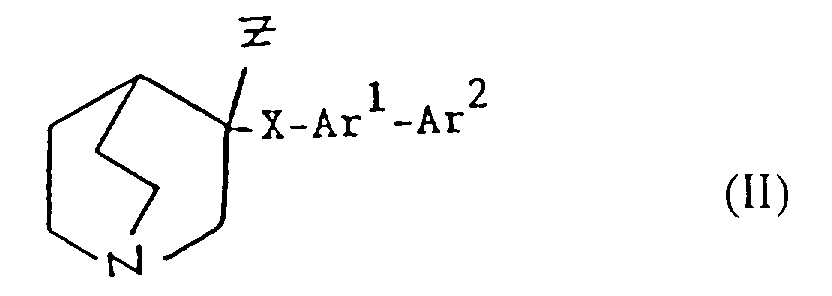 (d) für solche Verbindungen der Formel I, in denen X -CH2CO- ist, Umsetzung einer metallorganischen Verbindung der Formel Ar2-Ar1-M, worin M ein Metallatom ist, oder eines Derivats davon mit einer Verbindung der Formel III
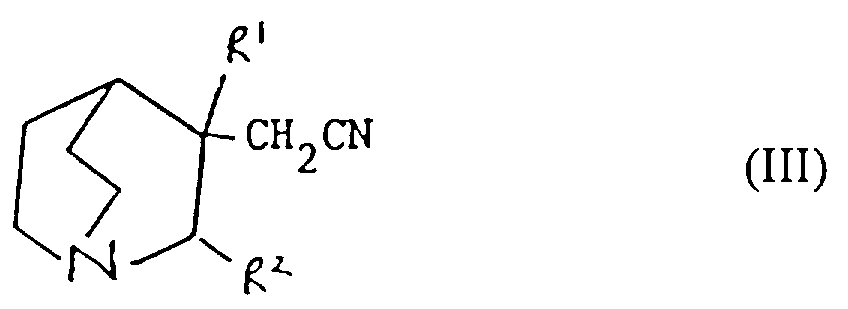 (e) für solche Verbindungen der Formel I, in denen X -CH2NH- oder -NHCH2- ist, Reduktion einer Verbindung der Formel I, worin X -CH=N- oder -N=CH- (wie entsprechend) ist;(f) für solche Verbindungen der Formel I, in denen X -CH2NH-, -CH2O-, -CH2S- ist, R1 Hydroxy und R2 Wasserstoff ist, Umsetzung einer Verbindung der Formel Ar2-Ar1-Z, worin Z entsprechend -NH2, -OH oder SH ist, mit einer Verbindung der Formel VI
 (g) für Verbindungen der Formel I, worin X -CH=CH- ist, Umsetzung einer Verbindung der Formel VIImit einer Verbindung der Formel IV
 in Gegenwart einer Base;
 (h) für solche Verbindungen der Formel I, worin X -CH2CH2- ist, Reduktion einer Verbindung der Formel I, worin X -CH=CH- ist;(i) für Verbindungen der Formel I, worin X -COCH2- ist, Umsetzung einer Verbindung der Formel Ar2-Ar1-CH2-M, worin M ein Metallatom ist, oder eines Derivats davon mit einer Verbindung der Formel VIII
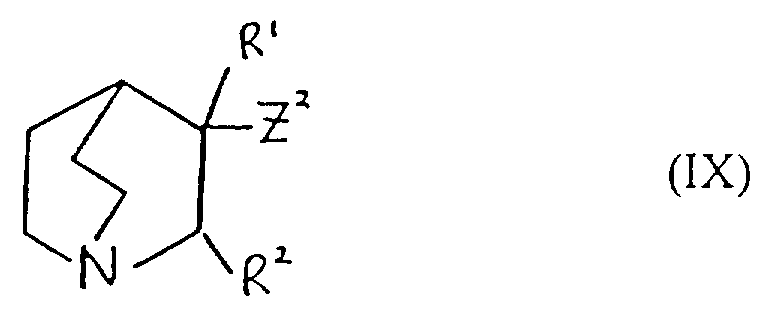
 (j) für solche Verbindungen der Formel I, worin X -CH2O- oder -CH2S- ist und R1 und R2 Wasserstoff sind, Umsetzung einer Verbindung der Formel Ar2-Ar1-CH2-Z1 mit einer Verbindung der Formel IXworin Z1 eine Abgangsgruppe ist und Z2 -YM ist oder Z1 -YM ist und Z2 eine Abgangsgruppe ist und worin Y Sauerstoff oder Schwefel (je nach dem) ist und M ein Metallatom ist;
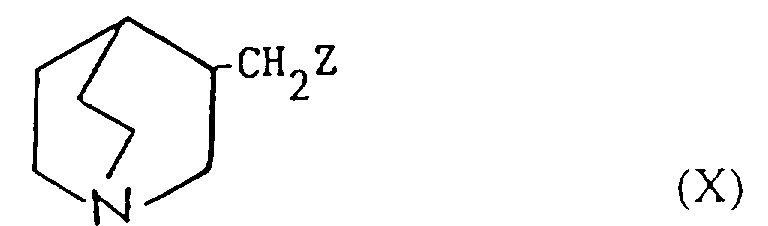
 (k) für solche Verbindungen der Formel I, in denen X -CH2O- oder -CH2S- ist und R1 und R2 beide Wasserstoff sind, Umsetzung einer Verbindung der Formel Ar2-Ar1-YH, worin Y je nach dem Sauerstoff oder Schwefel ist, mit einer Verbindung der Formel Xworin Z eine Abgangsgruppe ist;
 (l) für Verbindungen der Formel I, worin X -SCH2-, -CH2O- oder -CH2S- ist, Entschützen einer Verbindung der Formel XIworin Q eine Schutzgruppe ist, R1 Wasserstoff oder Hydroxy ist, und R2 Wasserstoff ist;
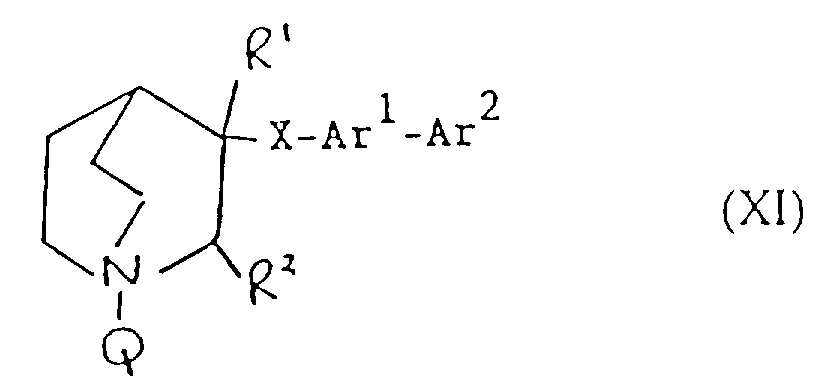 (m) für solche Verbindungen der Formel I, worin X -C≡C- ist, Umsetzung einer Verbindung der Formel I, worin X -CH=CH- ist, mit einem Halogen, gefolgt von Behandlung mit einer Base;(n) für solche Verbindungen der Formel I, worin R1 Hydroxy ist, R2 Wasserstoff ist und X -C≡C- ist, Umsetzung einer Verbindung der Formel Ar2-Ar1-C≡C-M, worin M ein Metallatom ist, mit Chinuclidin-3-on;(o) für solche Verbindungen der Formel I, in denen R1 und R2 Wasserstoff sind und X -C≡C- ist, Umsetzung einer Verbindung der Formel Ar2-Ar1-C≡C-M, worin M ein Metallatom ist, mit einer Verbindung der Formel IXworin Z eine Abgangsgruppe ist und R1 und R2 Wasserstoff sind;
 (p) für solche Verbindungen der Formel I, in denen X -C≡C- ist und R1 Wasserstoff oder Hydroxy ist und R2 Wasserstoff ist, Umsetzung einer Verbindung der Formel XIIworin R1 Wasserstoff oder Hydroxy ist und R2 Wasserstoff ist, mit einer Verbindung der Formel Ar2-Ar1-Z, worin Z eine Abgangsgruppe ist, in Gegenwart eines Katalysators;
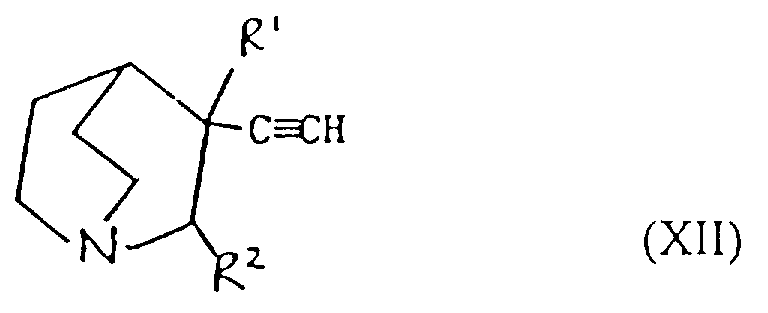 (q) für solche Verbindungen der Formel I, in denen X -C=C- ist und R1 Wasserstoff oder Hydroxy ist und R2 Wasserstoff ist, Umsetzung einer Verbindung der Formel XIIIworin R1 Wasserstoff oder Hydroxy ist und R2 Wasserstoff ist, mit einer Verbindung der Formel Ar2-Ar1-Z, worin Z eine Abgangsgruppe ist, in Gegenwart eines Katalysators;
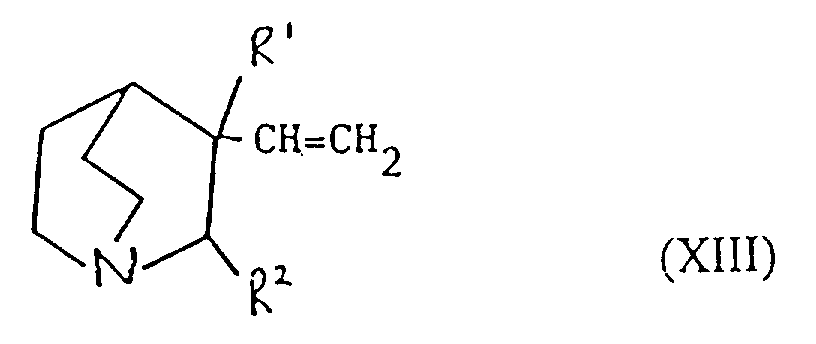 (r) für solche Verbindungen der Formel I, in denen R1 Wasserstoff oder Hydroxy ist und R2 Wasserstoff ist, Umsetzung einer Verbindung der Formel Ar2M, worin M ein Metallatom oder ein Metallatom mit geeigneten Liganden ist, mit einer Verbindung der Formel XIVworin Z eine Abgangsgruppe ist, in Gegenwart eines Katalysators;
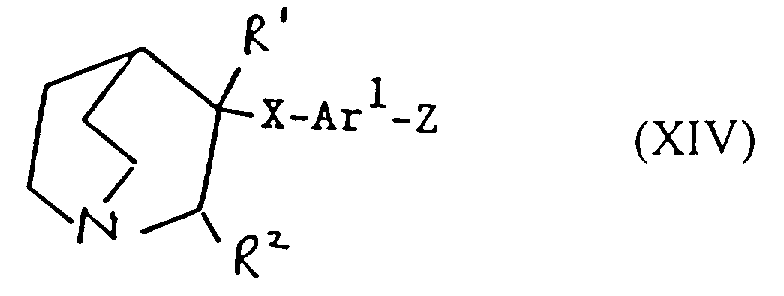 (s) für solche Verbindungen der Formel I, in denen R1 Wasserstoff oder Hydroxy ist und R2 Wasserstoff ist, Umsetzung einer Verbindung der Formel XVworin M ein Metallatom oder ein Metallatom mit geeigneten Liganden ist, mit einer Verbindung der Formel Ar2Z, worin Z eine Abgangsgruppe ist, in Gegenwart eines Katalysators;
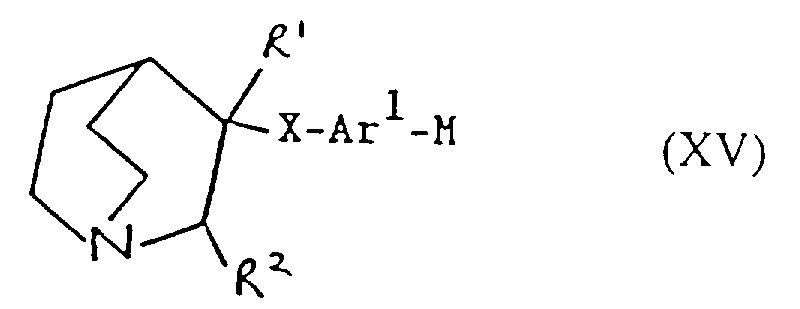 (t) für solche Verbindungen der Formel I, in denen X -CH=CH- ist, Umsetzung einer Verbindung der Formel XVIworin L ein geeigneter Ligand ist, mit einer Verbindung der Formel Ar2-Ar1-Z, worin Z eine Abgangsgruppe ist, in Gegenwart eines Katalysators;
- Pharmazeutische Zusammensetzung, umfassend eine Verbindung der Formel I oder ein pharmazeutisch akzeptables Salz davon gemäß einem der vorhergehenden Ansprüche zusammen mit einem pharmazeutisch akzeptablen Verdünnungsmittel oder Träger.
- Verwendung einer Verbindung der Formel I oder eines pharmazeutisch akzeptablen Salzes davon gemäß einem der Ansprüche 1 bis 11 zur Herstellung eines Medikaments zur Inhibierung der Cholesterinbiosynthese.
- Verwendung gemäß Anspruch 15, wobei das Medikament zur Behandlung von Hypercholesterinämie oder Atherosklerose dient.
Applications Claiming Priority (3)
| Application Number | Priority Date | Filing Date | Title |
|---|---|---|---|
| GB9218334 | 1992-08-28 | ||
| GB929218334A GB9218334D0 (en) | 1992-08-28 | 1992-08-28 | Heterocyclic compounds |
| PCT/GB1993/001802 WO1994005660A1 (en) | 1992-08-28 | 1993-08-24 | Quinuclidine derivatives as squalene synthase inhibitors |
Publications (2)
| Publication Number | Publication Date |
|---|---|
| EP0656897A1 EP0656897A1 (de) | 1995-06-14 |
| EP0656897B1 true EP0656897B1 (de) | 1998-01-07 |
Family
ID=10721113
Family Applications (1)
| Application Number | Title | Priority Date | Filing Date |
|---|---|---|---|
| EP93919477A Expired - Lifetime EP0656897B1 (de) | 1992-08-28 | 1993-08-24 | Chinuclidine derivate als squalen synthase inhibitoren |
Country Status (13)
| Country | Link |
|---|---|
| US (1) | US5714496A (de) |
| EP (1) | EP0656897B1 (de) |
| JP (1) | JPH08502731A (de) |
| AT (1) | ATE161843T1 (de) |
| AU (1) | AU4969193A (de) |
| CA (2) | CA2143430A1 (de) |
| DE (1) | DE69316224D1 (de) |
| FI (1) | FI950893A7 (de) |
| GB (2) | GB9218334D0 (de) |
| IL (1) | IL106797A0 (de) |
| TW (1) | TW231293B (de) |
| WO (1) | WO1994005660A1 (de) |
| ZA (1) | ZA936201B (de) |
Families Citing this family (37)
| Publication number | Priority date | Publication date | Assignee | Title |
|---|---|---|---|---|
| US5385912A (en) * | 1991-03-08 | 1995-01-31 | Rhone-Poulenc Rorer Pharmaceuticals Inc. | Multicyclic tertiary amine polyaromatic squalene synthase inhibitors |
| CA2102179C (en) * | 1991-05-31 | 1998-10-27 | Fumitaka Ito | Quinuclidine derivatives |
| IL109451A0 (en) * | 1993-04-29 | 1994-07-31 | Zeneca Ltd | Heterocyclic derivatives |
| DE4417837A1 (de) * | 1994-05-20 | 1995-11-23 | Basf Ag | Substituierte 3-Phenylpyrazole |
| GB9412145D0 (en) * | 1994-06-17 | 1994-08-10 | Zeneca Ltd | Heterocycles |
| AU7871498A (en) * | 1996-12-20 | 1998-07-17 | Novo Nordisk A/S | A method of treating hypercholesterolemia and related disorders |
| US6472528B1 (en) * | 1999-08-10 | 2002-10-29 | Neurocrine Biosciences, Inc. | Synthesis of substituted pyrazolopyrimidines |
| ATE312100T1 (de) * | 1999-09-28 | 2005-12-15 | Eisai Co Ltd | Chinuclidin-verbindungen und medikamente die diese als aktive wirkstoffe enthalten |
| CA2420235A1 (en) * | 2000-08-21 | 2002-02-28 | Georgetown University | 2-3-disubstituted quinuclidines as modulators of monoamine transporters and therapeutic and diagnostic methods based thereon |
| US7112593B2 (en) | 2001-03-27 | 2006-09-26 | Eisai Co., Ltd. | N-aryl-substituted cyclic amine derivative and medicine containing the same as active ingredient |
| RU2004110717A (ru) * | 2001-10-17 | 2005-10-20 | Юсиби, С.А. (Be) | Производные хинуклидина, способы их получения и их применение в качестве и нгибиторов м2- и/или м3- мускариновых рецепторов |
| GB0127731D0 (en) * | 2001-11-20 | 2002-01-09 | Coin Controls | Coin handling apparatus |
| ATE401334T1 (de) * | 2002-05-07 | 2008-08-15 | Neurosearch As | Neue azacyclische ethinylderivate |
| ATE405840T1 (de) | 2002-12-19 | 2008-09-15 | Scripps Research Inst | Zusammensetzungen und verfahren zur stabilisierung von transthyretin und zur hemmung von transthyretin-fehlfaltung |
| RU2417225C2 (ru) | 2004-03-25 | 2011-04-27 | Мемори Фармасьютиклз Корпорейшн | Индазолы, бензотиазолы, бензоизотиазолы, бензизоксазолы и их получение и применение |
| JP2007538103A (ja) | 2004-05-20 | 2007-12-27 | ザ スクリップス リサーチ インスティテュート | トランスサイレチン安定化 |
| US7868037B2 (en) * | 2004-07-14 | 2011-01-11 | Ptc Therapeutics, Inc. | Methods for treating hepatitis C |
| US7781478B2 (en) * | 2004-07-14 | 2010-08-24 | Ptc Therapeutics, Inc. | Methods for treating hepatitis C |
| EP1771169A1 (de) * | 2004-07-14 | 2007-04-11 | PTC Therapeutics, Inc. | Verfahren zur behandlung von hepatitis c |
| US7772271B2 (en) * | 2004-07-14 | 2010-08-10 | Ptc Therapeutics, Inc. | Methods for treating hepatitis C |
| JP2008507518A (ja) * | 2004-07-22 | 2008-03-13 | ピーティーシー セラピューティクス,インコーポレーテッド | C型肝炎を治療するためのチエノピリジン |
| CA2584485C (en) | 2004-10-20 | 2013-12-31 | Resverlogix Corp. | Stilbenes and chalcones for the prevention and treatment of cardiovascular diseases |
| JP5368792B2 (ja) | 2005-07-29 | 2013-12-18 | レスバーロジックス コーポレイション | 複合疾患の予防および処置のための薬学的組成物および挿入可能な医療用デバイスによるその送達 |
| US8106066B2 (en) | 2005-09-23 | 2012-01-31 | Memory Pharmaceuticals Corporation | Indazoles, benzothiazoles, benzoisothiazoles, benzisoxazoles, pyrazolopyridines, isothiazolopyridines, and preparation and uses thereof |
| WO2008034016A2 (en) * | 2006-09-15 | 2008-03-20 | Foldrx Pharmaceuticals, Inc. | Assays for detecting native-state proteins and identifying compounds that modulate the stability of native-state proteins |
| DK2118074T3 (en) | 2007-02-01 | 2014-03-10 | Resverlogix Corp | Compounds for the prevention and treatment of cardiovascular diseases |
| KR101629356B1 (ko) | 2008-06-26 | 2016-06-13 | 리스버로직스 코퍼레이션 | 퀴나졸리논 유도체의 제조방법 |
| NZ594332A (en) | 2009-01-08 | 2013-09-27 | Resverlogix Corp | Compounds for the prevention and treatment of cardiovascular disease |
| KR101709492B1 (ko) | 2009-03-18 | 2017-02-23 | 리스버로직스 코퍼레이션 | 신규한 소염제 |
| US9757368B2 (en) | 2009-04-22 | 2017-09-12 | Resverlogix Corp. | Anti-inflammatory agents |
| RU2586330C2 (ru) | 2011-09-16 | 2016-06-10 | Пфайзер Инк. | Твердые формы ингибитора диссоциации транстиретина |
| RU2640115C2 (ru) | 2011-11-01 | 2017-12-26 | Ресверлоджикс Корп. | Фармацевтические композиции замещенных хиназолинонов |
| US8859553B2 (en) * | 2012-07-30 | 2014-10-14 | Astar Biotech Llc | Protein kinase inhibitors |
| WO2014080291A2 (en) | 2012-11-21 | 2014-05-30 | Rvx Therapeutics Inc. | Biaryl derivatives as bromodomain inhibitors |
| US9073878B2 (en) | 2012-11-21 | 2015-07-07 | Zenith Epigenetics Corp. | Cyclic amines as bromodomain inhibitors |
| US9271978B2 (en) | 2012-12-21 | 2016-03-01 | Zenith Epigenetics Corp. | Heterocyclic compounds as bromodomain inhibitors |
| US10111885B2 (en) | 2015-03-13 | 2018-10-30 | Resverlogix Corp. | Compositions and therapeutic methods for the treatment of complement-associated diseases |
Family Cites Families (33)
| Publication number | Priority date | Publication date | Assignee | Title |
|---|---|---|---|---|
| US3405134A (en) * | 1965-08-17 | 1968-10-08 | Colgate Palmolive Co | Quinuclidyl esters of aromatic acids |
| NL6715600A (de) * | 1966-12-02 | 1968-06-04 | ||
| US3534053A (en) * | 1967-05-24 | 1970-10-13 | American Home Prod | Quinuclidine derivatives |
| US3763168A (en) * | 1968-09-09 | 1973-10-02 | Sterling Drug Inc | N-(3-quinuclidinyl) acylanilides |
| US3655675A (en) * | 1968-09-09 | 1972-04-11 | Sterling Drug Inc | N-(n-heteryl)-acylanilides |
| US3725410A (en) * | 1970-07-15 | 1973-04-03 | American Home Prod | 3-aminomethyl-3-quinuclidinols |
| US3679690A (en) * | 1971-03-18 | 1972-07-25 | Sterling Drug Inc | Certain n-(pyridyl) propionanilides |
| FR2183565B1 (de) * | 1972-05-10 | 1975-12-26 | Cerm Cent Europ Rech Mauvernay | |
| CA1014958A (en) * | 1973-10-05 | 1977-08-02 | Jacques Moleyre | .alpha.-QUINUCLIDYLMETHYL PHENYL KETONES |
| US4038402A (en) * | 1974-03-05 | 1977-07-26 | Mikhail Emmanuilovich Kaminka | Method of effecting antihistaminic, antiserotonin and antiallergic actions |
| SU495310A1 (ru) * | 1974-03-05 | 1975-12-15 | Всесоюзный Научно-Исследовательский Химико-Фармацевтический Институт Им.С.Орджоникидзе | Хинуклидил-3-диарал(гетерил) карбинолы, про вл ющие антигистаминную, антисеротониновую и антиаллергическую активность и способ их получени |
| US4599344A (en) * | 1984-10-31 | 1986-07-08 | Schering A.G. | Quinuclidines and quinuclidinium salts as antiarrhythmic agents |
| CH667657A5 (de) * | 1985-01-07 | 1988-10-31 | Sandoz Ag | Carbocyclische und heterocyclische carbonylmethylen- und methylpiperidine und -pyrrolidine. |
| NZ225999A (en) * | 1987-09-10 | 1992-04-28 | Merck Sharp & Dohme | Azacyclic- or azabicyclic-substituted thiadiazole derivatives and pharmaceutical compositions |
| IE63906B1 (en) * | 1987-11-13 | 1995-06-14 | Novo Nordisk As | Azabicyclic compounds and their preparation and use |
| EP0322182A3 (de) * | 1987-12-22 | 1992-01-02 | Beecham Group Plc | Azabicyclische-Verbindungen, Verfahren zu ihrer Herstellung und diese enthaltende pharmazeutische Zubereitungen |
| DK730588A (da) * | 1988-02-03 | 1989-08-04 | Asta Pharma Ag | Anvendelse af pyridin-2-ethere eller pyridin-2-thioethere med en nitrogenholdig cycloalifatisk ring som antidepressivt laegemiddel |
| NZ227841A (en) * | 1988-02-12 | 1991-08-27 | Merck Sharp & Dohme | Heterocyclic compounds with at least two non-condensed five membered rings and pharmaceutical compositions |
| DE68919508T2 (de) * | 1988-04-01 | 1995-07-20 | Sankyo Co | 2-(Heterocyclylthio)carbapenemderivate, deren Herstellung und deren Verwendung als Antibiotika. |
| US5242914A (en) * | 1988-04-01 | 1993-09-07 | Sankyo Company, Limited | 2-(heterocyclylthio) carbapenem derivatives, their preparation and their use as antibiotics |
| US5286864A (en) * | 1988-11-22 | 1994-02-15 | Boehringer Ingelheim Kg | Quinuclidines, their use as medicaments and processes for their preparation |
| DE8817121U1 (de) * | 1988-11-22 | 1993-02-04 | Boehringer Ingelheim Kg, 55218 Ingelheim | Neue Quinuclidine |
| GB8918061D0 (en) * | 1989-08-08 | 1989-09-20 | Merck Sharp & Dohme | Therapeutic agents |
| YU84791A (sh) * | 1990-05-19 | 1994-06-10 | Boehringer Ingelheim Kg. | Biciklicni 1-aza-cikloalkalni |
| DE4116582A1 (de) * | 1990-05-19 | 1991-11-21 | Boehringer Ingelheim Kg | Bicyclische 1-aza-cycloalkane |
| ZA92278B (en) * | 1991-02-01 | 1992-10-28 | Akzo Nv | 3-quinuclidine derivatives |
| CA2105655A1 (en) * | 1991-03-08 | 1992-09-09 | Kent Neuenschwander | Multicyclic tertiary amine polyaromatic squalene synthetase inhibitors |
| US5385912A (en) * | 1991-03-08 | 1995-01-31 | Rhone-Poulenc Rorer Pharmaceuticals Inc. | Multicyclic tertiary amine polyaromatic squalene synthase inhibitors |
| US5135935A (en) * | 1991-05-17 | 1992-08-04 | Merck & Co., Inc. | Squalene synthetase inhibitors |
| GB9127279D0 (en) * | 1991-12-23 | 1992-02-19 | Ici Plc | Heterocyclic derivatives |
| GB9201749D0 (en) * | 1992-01-28 | 1992-03-11 | Smithkline Beecham Plc | Medicaments |
| GB9202443D0 (en) * | 1992-02-05 | 1992-03-18 | Fujisawa Pharmaceutical Co | A novel substituted-acetamide compound and a process for the preparation thereof |
| GB9211796D0 (en) * | 1992-06-04 | 1992-07-15 | Ici Plc | Heterocyclic derivatives |
-
1992
- 1992-08-28 GB GB929218334A patent/GB9218334D0/en active Pending
-
1993
- 1993-08-18 GB GB939317153A patent/GB9317153D0/en active Pending
- 1993-08-24 JP JP6506955A patent/JPH08502731A/ja active Pending
- 1993-08-24 WO PCT/GB1993/001802 patent/WO1994005660A1/en not_active Ceased
- 1993-08-24 AU AU49691/93A patent/AU4969193A/en not_active Abandoned
- 1993-08-24 AT AT93919477T patent/ATE161843T1/de not_active IP Right Cessation
- 1993-08-24 EP EP93919477A patent/EP0656897B1/de not_active Expired - Lifetime
- 1993-08-24 ZA ZA936201A patent/ZA936201B/xx unknown
- 1993-08-24 CA CA002143430A patent/CA2143430A1/en not_active Abandoned
- 1993-08-24 DE DE69316224T patent/DE69316224D1/de not_active Expired - Lifetime
- 1993-08-25 IL IL106797A patent/IL106797A0/xx unknown
- 1993-08-25 US US08/392,928 patent/US5714496A/en not_active Expired - Fee Related
- 1993-08-27 CA CA002104981A patent/CA2104981A1/en not_active Abandoned
- 1993-08-31 TW TW082107086A patent/TW231293B/zh active
-
1995
- 1995-02-27 FI FI950893A patent/FI950893A7/fi not_active Application Discontinuation
Also Published As
| Publication number | Publication date |
|---|---|
| AU4969193A (en) | 1994-03-29 |
| ZA936201B (en) | 1994-02-28 |
| GB9317153D0 (en) | 1993-10-06 |
| ATE161843T1 (de) | 1998-01-15 |
| EP0656897A1 (de) | 1995-06-14 |
| TW231293B (de) | 1994-10-01 |
| JPH08502731A (ja) | 1996-03-26 |
| CA2104981A1 (en) | 1994-03-01 |
| US5714496A (en) | 1998-02-03 |
| FI950893A0 (fi) | 1995-02-27 |
| GB9218334D0 (en) | 1992-10-14 |
| IL106797A0 (en) | 1993-12-08 |
| WO1994005660A1 (en) | 1994-03-17 |
| CA2143430A1 (en) | 1994-03-17 |
| DE69316224D1 (de) | 1998-02-12 |
| FI950893A7 (fi) | 1995-02-27 |
Similar Documents
| Publication | Publication Date | Title |
|---|---|---|
| US5714496A (en) | Quinuclidine derivatives as squalene synthase inhibitors | |
| JP3123562B2 (ja) | ピラゾロピリジン化合物およびその製造法 | |
| EP0674637B1 (de) | Quinuclidin derivate als squalene synthase inhibitoren | |
| US5612352A (en) | Heterocyclic compounds | |
| SK173397A3 (en) | Aromatic compounds and pharmaceutical compositions containing them | |
| US5654315A (en) | Quinuclidine compounds useful in treating diseases | |
| US5554613A (en) | Heterocyclic derivatives | |
| EP0654032B1 (de) | Chinuclidine derivate als squalen synthase inhibitoren | |
| EP0569564B1 (de) | Diphenylylchinuclidine als squalen-synthetase-inhibitoren | |
| EP0674635B1 (de) | Chinuclidin derivate als squalen synthase inhibitoren | |
| WO1995035295A1 (en) | Quinuclidine derivatives as squalene synthase inhibitors | |
| EP0674636A1 (de) | Quinuclidinderivate als squalene synthese inhibitoren | |
| HK1096548A1 (zh) | 作为可诱导的no合成酶抑制剂的咪唑并吡啶衍生物 | |
| HK1096548B (en) | Imidazopyridine-derivatives as inductible no-synthase inhibitors |
Legal Events
| Date | Code | Title | Description |
|---|---|---|---|
| PUAI | Public reference made under article 153(3) epc to a published international application that has entered the european phase |
Free format text: ORIGINAL CODE: 0009012 |
|
| 17P | Request for examination filed |
Effective date: 19950213 |
|
| AK | Designated contracting states |
Kind code of ref document: A1 Designated state(s): AT BE CH DE DK ES FR GB GR IE IT LI LU MC NL PT SE |
|
| 17Q | First examination report despatched |
Effective date: 19960917 |
|
| GRAG | Despatch of communication of intention to grant |
Free format text: ORIGINAL CODE: EPIDOS AGRA |
|
| GRAG | Despatch of communication of intention to grant |
Free format text: ORIGINAL CODE: EPIDOS AGRA |
|
| GRAG | Despatch of communication of intention to grant |
Free format text: ORIGINAL CODE: EPIDOS AGRA |
|
| GRAH | Despatch of communication of intention to grant a patent |
Free format text: ORIGINAL CODE: EPIDOS IGRA |
|
| GRAH | Despatch of communication of intention to grant a patent |
Free format text: ORIGINAL CODE: EPIDOS IGRA |
|
| GRAA | (expected) grant |
Free format text: ORIGINAL CODE: 0009210 |
|
| AK | Designated contracting states |
Kind code of ref document: B1 Designated state(s): AT BE CH DE DK ES FR GB GR IE IT LI LU MC NL PT SE |
|
| PG25 | Lapsed in a contracting state [announced via postgrant information from national office to epo] |
Ref country code: NL Free format text: LAPSE BECAUSE OF FAILURE TO SUBMIT A TRANSLATION OF THE DESCRIPTION OR TO PAY THE FEE WITHIN THE PRESCRIBED TIME-LIMIT Effective date: 19980107 Ref country code: LI Free format text: LAPSE BECAUSE OF FAILURE TO SUBMIT A TRANSLATION OF THE DESCRIPTION OR TO PAY THE FEE WITHIN THE PRESCRIBED TIME-LIMIT Effective date: 19980107 Ref country code: IT Free format text: LAPSE BECAUSE OF FAILURE TO SUBMIT A TRANSLATION OF THE DESCRIPTION OR TO PAY THE FEE WITHIN THE PRESCRIBED TIME-LIMIT;WARNING: LAPSES OF ITALIAN PATENTS WITH EFFECTIVE DATE BEFORE 2007 MAY HAVE OCCURRED AT ANY TIME BEFORE 2007. THE CORRECT EFFECTIVE DATE MAY BE DIFFERENT FROM THE ONE RECORDED. Effective date: 19980107 Ref country code: GR Free format text: LAPSE BECAUSE OF FAILURE TO SUBMIT A TRANSLATION OF THE DESCRIPTION OR TO PAY THE FEE WITHIN THE PRESCRIBED TIME-LIMIT Effective date: 19980107 Ref country code: FR Free format text: LAPSE BECAUSE OF FAILURE TO SUBMIT A TRANSLATION OF THE DESCRIPTION OR TO PAY THE FEE WITHIN THE PRESCRIBED TIME-LIMIT Effective date: 19980107 Ref country code: ES Free format text: THE PATENT HAS BEEN ANNULLED BY A DECISION OF A NATIONAL AUTHORITY Effective date: 19980107 Ref country code: CH Free format text: LAPSE BECAUSE OF FAILURE TO SUBMIT A TRANSLATION OF THE DESCRIPTION OR TO PAY THE FEE WITHIN THE PRESCRIBED TIME-LIMIT Effective date: 19980107 Ref country code: BE Free format text: LAPSE BECAUSE OF FAILURE TO SUBMIT A TRANSLATION OF THE DESCRIPTION OR TO PAY THE FEE WITHIN THE PRESCRIBED TIME-LIMIT Effective date: 19980107 Ref country code: AT Free format text: LAPSE BECAUSE OF FAILURE TO SUBMIT A TRANSLATION OF THE DESCRIPTION OR TO PAY THE FEE WITHIN THE PRESCRIBED TIME-LIMIT Effective date: 19980107 |
|
| REF | Corresponds to: |
Ref document number: 161843 Country of ref document: AT Date of ref document: 19980115 Kind code of ref document: T |
|
| REG | Reference to a national code |
Ref country code: CH Ref legal event code: EP |
|
| REF | Corresponds to: |
Ref document number: 69316224 Country of ref document: DE Date of ref document: 19980212 |
|
| PG25 | Lapsed in a contracting state [announced via postgrant information from national office to epo] |
Ref country code: SE Free format text: LAPSE BECAUSE OF FAILURE TO SUBMIT A TRANSLATION OF THE DESCRIPTION OR TO PAY THE FEE WITHIN THE PRESCRIBED TIME-LIMIT Effective date: 19980407 Ref country code: PT Free format text: LAPSE BECAUSE OF FAILURE TO SUBMIT A TRANSLATION OF THE DESCRIPTION OR TO PAY THE FEE WITHIN THE PRESCRIBED TIME-LIMIT Effective date: 19980407 Ref country code: DK Free format text: LAPSE BECAUSE OF FAILURE TO SUBMIT A TRANSLATION OF THE DESCRIPTION OR TO PAY THE FEE WITHIN THE PRESCRIBED TIME-LIMIT Effective date: 19980407 |
|
| PG25 | Lapsed in a contracting state [announced via postgrant information from national office to epo] |
Ref country code: DE Free format text: LAPSE BECAUSE OF FAILURE TO SUBMIT A TRANSLATION OF THE DESCRIPTION OR TO PAY THE FEE WITHIN THE PRESCRIBED TIME-LIMIT Effective date: 19980408 |
|
| NLV1 | Nl: lapsed or annulled due to failure to fulfill the requirements of art. 29p and 29m of the patents act | ||
| REG | Reference to a national code |
Ref country code: IE Ref legal event code: FG4D Free format text: 78227 |
|
| EN | Fr: translation not filed | ||
| REG | Reference to a national code |
Ref country code: CH Ref legal event code: PL |
|
| PG25 | Lapsed in a contracting state [announced via postgrant information from national office to epo] |
Ref country code: LU Free format text: LAPSE BECAUSE OF NON-PAYMENT OF DUE FEES Effective date: 19980824 Ref country code: IE Free format text: LAPSE BECAUSE OF NON-PAYMENT OF DUE FEES Effective date: 19980824 |
|
| PLBE | No opposition filed within time limit |
Free format text: ORIGINAL CODE: 0009261 |
|
| STAA | Information on the status of an ep patent application or granted ep patent |
Free format text: STATUS: NO OPPOSITION FILED WITHIN TIME LIMIT |
|
| 26N | No opposition filed | ||
| PG25 | Lapsed in a contracting state [announced via postgrant information from national office to epo] |
Ref country code: MC Free format text: LAPSE BECAUSE OF NON-PAYMENT OF DUE FEES Effective date: 19990228 |
|
| PGFP | Annual fee paid to national office [announced via postgrant information from national office to epo] |
Ref country code: GB Payment date: 20000823 Year of fee payment: 8 |
|
| REG | Reference to a national code |
Ref country code: GB Ref legal event code: 732E |
|
| PG25 | Lapsed in a contracting state [announced via postgrant information from national office to epo] |
Ref country code: GB Free format text: LAPSE BECAUSE OF NON-PAYMENT OF DUE FEES Effective date: 20010824 |
|
| GBPC | Gb: european patent ceased through non-payment of renewal fee |
Effective date: 20010824 |