EP0657172A1 - Endoparasitizide Mittel auf Basis von offenkettigen Tetradepsipeptiden - Google Patents
Endoparasitizide Mittel auf Basis von offenkettigen Tetradepsipeptiden Download PDFInfo
- Publication number
- EP0657172A1 EP0657172A1 EP94118680A EP94118680A EP0657172A1 EP 0657172 A1 EP0657172 A1 EP 0657172A1 EP 94118680 A EP94118680 A EP 94118680A EP 94118680 A EP94118680 A EP 94118680A EP 0657172 A1 EP0657172 A1 EP 0657172A1
- Authority
- EP
- European Patent Office
- Prior art keywords
- alkyl
- spp
- aminoalkyl
- amino
- methyl
- Prior art date
- Legal status (The legal status is an assumption and is not a legal conclusion. Google has not performed a legal analysis and makes no representation as to the accuracy of the status listed.)
- Granted
Links
- 0 BC(C(*)OC(C(*)N(*)C(C(*)OC(C(*)N(*)*)=O)=O)=O)=O Chemical compound BC(C(*)OC(C(*)N(*)C(C(*)OC(C(*)N(*)*)=O)=O)=O)=O 0.000 description 8
Classifications
-
- C—CHEMISTRY; METALLURGY
- C07—ORGANIC CHEMISTRY
- C07C—ACYCLIC OR CARBOCYCLIC COMPOUNDS
- C07C235/00—Carboxylic acid amides, the carbon skeleton of the acid part being further substituted by oxygen atoms
- C07C235/02—Carboxylic acid amides, the carbon skeleton of the acid part being further substituted by oxygen atoms having carbon atoms of carboxamide groups bound to acyclic carbon atoms and singly-bound oxygen atoms bound to the same carbon skeleton
- C07C235/32—Carboxylic acid amides, the carbon skeleton of the acid part being further substituted by oxygen atoms having carbon atoms of carboxamide groups bound to acyclic carbon atoms and singly-bound oxygen atoms bound to the same carbon skeleton the carbon skeleton containing six-membered aromatic rings
- C07C235/34—Carboxylic acid amides, the carbon skeleton of the acid part being further substituted by oxygen atoms having carbon atoms of carboxamide groups bound to acyclic carbon atoms and singly-bound oxygen atoms bound to the same carbon skeleton the carbon skeleton containing six-membered aromatic rings having the nitrogen atoms of the carboxamide groups bound to hydrogen atoms or to acyclic carbon atoms
-
- A—HUMAN NECESSITIES
- A61—MEDICAL OR VETERINARY SCIENCE; HYGIENE
- A61P—SPECIFIC THERAPEUTIC ACTIVITY OF CHEMICAL COMPOUNDS OR MEDICINAL PREPARATIONS
- A61P33/00—Antiparasitic agents
-
- A—HUMAN NECESSITIES
- A61—MEDICAL OR VETERINARY SCIENCE; HYGIENE
- A61P—SPECIFIC THERAPEUTIC ACTIVITY OF CHEMICAL COMPOUNDS OR MEDICINAL PREPARATIONS
- A61P33/00—Antiparasitic agents
- A61P33/10—Anthelmintics
-
- C—CHEMISTRY; METALLURGY
- C07—ORGANIC CHEMISTRY
- C07C—ACYCLIC OR CARBOCYCLIC COMPOUNDS
- C07C235/00—Carboxylic acid amides, the carbon skeleton of the acid part being further substituted by oxygen atoms
- C07C235/02—Carboxylic acid amides, the carbon skeleton of the acid part being further substituted by oxygen atoms having carbon atoms of carboxamide groups bound to acyclic carbon atoms and singly-bound oxygen atoms bound to the same carbon skeleton
- C07C235/04—Carboxylic acid amides, the carbon skeleton of the acid part being further substituted by oxygen atoms having carbon atoms of carboxamide groups bound to acyclic carbon atoms and singly-bound oxygen atoms bound to the same carbon skeleton the carbon skeleton being acyclic and saturated
- C07C235/12—Carboxylic acid amides, the carbon skeleton of the acid part being further substituted by oxygen atoms having carbon atoms of carboxamide groups bound to acyclic carbon atoms and singly-bound oxygen atoms bound to the same carbon skeleton the carbon skeleton being acyclic and saturated having the nitrogen atom of at least one of the carboxamide groups bound to an acyclic carbon atom of a hydrocarbon radical substituted by carboxyl groups
Definitions
- the present invention relates to the use of open-chain tetradepsipeptides for controlling endoparasites.
- Open-chain tetradepsipeptides as starting materials for endoparasiticidal cyclic depsipeptides with 28 ring atoms are the subject of previous, but not previously published patent applications (German patent application P 43 17 457.4; P 43 17 432.9; P 43 17 458.2).
- the compounds of the general formula (I) can exist in optically active, stereoisomeric forms or as racemic mixtures. However, the optically active forms of the compounds of the general formula (I) are preferably used.
- the didepsipeptides according to the invention used as starting compounds can be prepared by conventional methods, for example those as described by H.-G. Lerchen and H. Kunz (Tetrahedron Lett. 26 (43) (1958) pp. 5257-5260; 28 (17) (1987) pp. 1873-1876) using the esterification method according to B.F. Gisin (Helv. Chim. Acta 56 (1973) p. 1476).
- N-methyl-amino acids and 2-halocarboxylic acid derivatives used as starting materials are known (cf., for example, N-methyl-amino acids: R. Bowmann et al., J. Chem. Soc. (1950), p. 1346; JR McDermott et al., Can. J. Chem. 51 (1973) p. 1915; H. Wurziger et al., contacts (Merck, Darmstadt) 3 (1987) p. 8; 2-halocarboxylic acid derivatives: SM Birnbaum et al., J. Amer. Chem. Soc. 76 (1954), p. 6054, CS Rondestvedt, Jr. et al., Org. Reactions 11 (1960) p. 189 (review)) or can be obtained by the processes described therein.
- the active ingredients are suitable for combating pathogenic endoparasites, which occur in humans and in animal husbandry and animal breeding in useful, breeding, zoo, laboratory, experimental and hobby animals, with favorable warm-blooded toxicity. They are effective against all or individual stages of development of the pests and against resistant and normally sensitive species. By combating the pathogenic endoparasites, illness, deaths and reduced performance (e.g. in the production of meat, milk, wool, hides, eggs, honey, etc.) are to be reduced, so that the use of the active ingredients enables more economical and simple animal husbandry.
- Pathogenic endoparasites include cestodes, trematodes, nematodes, acantocephals, in particular:
- Cyclophyllidea for example: Mesocestoides spp., Anoplocephala spp., Paranoplocephala spp., Moniezia spp., 'Thysanosomsa spp., Thysaniezia spp., Avitellina spp., Stilesia spp., Cittotaenia spp., Andyella spp., Bertella spp ., Taenia spp., Echinococcus spp., Hydatigera spp., Davainea spp., Raillietina spp., Hymenolepis spp., Echinolepis spp., Echinocotyle spp., Diorchis spp., Dipylidium spp., Joyeuxiella spp., Diplopylid
- Echinochasmus spp. Hypoderaeum spp., Fasciola spp., Fasciolides spp., Fasciolopsis spp., Cyclocoelum spp., Typhlocoelum spp., Paramphistomum spp., Calicophoron spp., Cotylophoron spp., Gigantocotyle spp., Notocotylus spp., Catatropis spp., Plagiorchis spp., Prosthogonimus spp., Dicrocoelium spp., Eurytrema spp., Troglotrema spp., Paragonimus spp., Collyriclum spp., Nanophyetus spp., Opisthorchisch. , Metorchis spp., Heterophyes spp., Metagonism spp.
- Stronylus spp. Triodontophorus spp., Oesophagodontus spp., Trichonema spp., Gyalocephalus spp., Cylindropharynx spp., Poteriostomum spp., Cyclococercus spp., Cylicostephanus sppum, spp., Oesophag.
- Stephanurus spp. Ancylostoma spp., Uncinaria spp., Bunostomum spp., Globocephalus spp., Syngamus spp., Cyathostoma spp., Metastrongylus spp., Dictyocaulus spp., Muellerius spp., Protostrongylus spp., Neostr spp., Pneumostrongylus spp., Spicocaulus spp., Elaphostrongylus spp., Parelaphostrongylus spp., Crenosoma spp., Paracrenosoma spp., Angiostrongylus spp., Aelurostrongylus spp., Filaroides spp., Parafilaroides spp., Trichostrongylus spp., Haemonchus spp., Ostertagia spp.
- Oxyuris spp. Enterobius spp., Passalurus spp., Syphacia spp., Aspiculuris spp., Heterakis spp ..
- Ascaridia for example: Ascaris spp., Toxascaris spp., Toxocara spp., Parascaris spp., Anisakis spp., Ascaridia spp ..
- Livestock and breeding animals include mammals such as Cattle, horses, sheep, pigs, goats, camels, water buffalos, donkeys, rabbits, fallow deer, reindeer, fur animals such as Mink, chinchilla, raccoon, birds such as Chickens, geese, turkeys, ducks, fresh and salt water fish such as Trout, carp, eels, reptiles, insects such as Honey bee and silkworm.
- mammals such as Cattle, horses, sheep, pigs, goats, camels, water buffalos, donkeys, rabbits, fallow deer, reindeer, fur animals such as Mink, chinchilla, raccoon, birds such as Chickens, geese, turkeys, ducks, fresh and salt water fish such as Trout, carp, eels, reptiles, insects such as Honey bee and silkworm.
- Laboratory and experimental animals include mice, rats, guinea pigs, golden hamsters, dogs and cats.
- the pets include dogs and cats.
- the application can be prophylactic as well as therapeutic.
- the active ingredients are used directly or in the form of suitable preparations enterally, parenterally, dermally, nasally, by treating the environment or with the aid of shaped articles containing active ingredients, e.g. Strips, plates, ribbons, collars, ear tags, limb straps, marking devices.
- the enteral application of the active ingredients takes place e.g. orally in the form of powder, tablets, capsules, pastes, drinkers, granules, orally applicable solutions, suspensions and emulsions, boluses, medicated feed or drinking water.
- the dermal application happens e.g. in the form of diving (dipping), spraying (spraying) or pouring on (pour-on and spot-on).
- Parenteral use happens e.g. in the form of injection (intramuscular, subcutaneous, intravenous, intraperitoneal) or by implants.
- Suitable preparations are: Solutions such as solutions for injection, oral solutions, concentrates for oral administration after dilution, solutions for use on the skin or in body cavities, pour-on formulations, gels; Emulsions and suspensions for oral or dermal use and for injection; semi-solid preparations; Formulations in which the active ingredient is processed in an ointment base or in an oil in water or water in oil emulsion base; Solid preparations such as powders, premixes or concentrates, granules, pellets, tablets, boluses, capsules; Aerosols and inhalants, molded articles containing active ingredients.
- Solutions for injection are administered intravenously, intramuscularly and subcutaneously.
- Injection solutions are prepared by dissolving the active ingredient in a suitable solvent and possibly adding additives such as solubilizers, acids, bases, buffer salts, antioxidants, preservatives.
- additives such as solubilizers, acids, bases, buffer salts, antioxidants, preservatives.
- the solutions are sterile filtered and filled.
- solvents physiologically compatible solvents such as water, alcohols such as ethanol, butanol, benzyl alcohol, glycerol, propylene glycol, polyethylene glycols, N-methyl-pyrrolidone, and mixtures thereof.
- the active compounds can also be dissolved in physiologically tolerable vegetable or synthetic oils which are suitable for injection.
- solubilizers solvents which promote the dissolution of the active ingredient in the main solvent or prevent its precipitation.
- solvents which promote the dissolution of the active ingredient in the main solvent or prevent its precipitation.
- examples are polyvinyl pyrrolidone, polyoxyethylated castor oil, polyoxyethylated sorbitan esters.
- Preservatives are: benzyl alcohol, trichlorobutanol, p-hydroxybenzoic acid ester, n-butanol.
- Oral solutions are applied directly. Concentrates are used orally after previous dilution to the application concentration. Oral solutions and concentrates are prepared as described above for the injection solutions, whereby sterile work can be dispensed with.
- Solutions for use on the skin are dripped on, spread on, rubbed in, sprayed on or sprayed on. These solutions are prepared as described above for the injection solutions.
- Thickeners are: inorganic thickeners such as bentonites, colloidal silica, aluminum monostearate, organic thickeners such as cellulose derivatives, polyvinyl alcohols and their copolymers, acrylates and methacrylates.
- Gels are applied to or spread on the skin or placed in body cavities. Gels are produced by adding enough thickening agent to solutions which have been prepared as described for the injection solutions to form a clear mass with an ointment-like consistency.
- the thickeners specified above are used as thickeners.
- Pour-on formulations are poured or sprayed onto limited areas of the skin, the active ingredient penetrating the skin and acting systemically.
- pour-on formulations are prepared by dissolving, suspending or emulsifying the active ingredient in suitable solvents or solvent mixtures that are compatible with the skin. If necessary, other auxiliaries such as dyes, absorption-promoting substances, antioxidants, light stabilizers and adhesives are added.
- solvents water, alkanols, glycols, polyethylene glycols, polypropylene glycols, glycerin, aromatic alcohols such as benzyl alcohol, phenylethanol, phenoxyethanol, esters such as ethyl acetate, butyl acetate, benzyl benzoate, ethers such as alkylene glycol alkyl ethers such as dipropylene glycol monomethyl ether, diethylene glycol, methyl butyl glycol, methyl butyl acetate, methyl butyl glycol, methyl butyl acetate, aromatic and / or aliphatic hydrocarbons, vegetable or synthetic oils, DMF, dimethylacetamide, N-methylpyrrolidone, 2,2-dimethyl-4-oxy-methylene-1,3-dioxolane.
- aromatic alcohols such as benzyl alcohol, phenylethanol, phenoxyethanol
- esters such as ethyl acetate, butyl acetate
- Dyes are all dyes approved for use on animals, which can be dissolved or suspended.
- Absorbing substances are e.g. DMSO, spreading oils such as isopropyl myristate, dipropylene glycol pelargonate, silicone oils, fatty acid esters, triglycerides, fatty alcohols.
- spreading oils such as isopropyl myristate, dipropylene glycol pelargonate, silicone oils, fatty acid esters, triglycerides, fatty alcohols.
- Antioxidants are sulfites or metabisulfites such as potassium metabisulfite, ascorbic acid, butylated hydroxytoluene, butylated hydroxyanisole, tocopherol.
- Light stabilizers are e.g. Novantisol acid.
- Adhesives are e.g. Cellulose derivatives, starch derivatives, polyacrylates, natural polymers such as alginates, gelatin.
- Emulsions can be used orally, dermally or as injections.
- Emulsions are either water in oil or oil in water.
- hydrophobic phase may be mentioned: paraffin oils, silicone oils, natural vegetable oils such as sesame oil, almond oil, castor oil, synthetic triglycerides such as caprylic / capric acid biglyceride, triglyceride mixture with vegetable fatty acids of chain length C8 ⁇ 12 or other specially selected natural fatty acids, partial glyceride saturated or unsaturated mixtures also also hydroxyl-containing fatty acids, mono- and diglycerides of C8 / C10 fatty acids.
- Fatty acid esters such as ethyl stearate, di-n-butyryl adipate, lauric acid hexyl ester, dipropylene glycol pelargonate, esters of a branched fatty acid of medium chain length with saturated fatty alcohols of chain length C16-C18, isopropyl myristate, isopropyl palmitate, capryl / capric acid ester of saturated fatty alkanolate C1st , Oleic acid oleyl ester, oleic acid decyl ester, ethyl oleate, lactic acid ethyl ester, waxy fatty acid esters such as artificial duckling gland fat, dibutyl phthalate, adipic acid diisopropyl ester, the latter related ester mixtures and others
- Fatty alcohols such as isotridecyl alcohol, 2-octyldodecanol, cetylstearyl alcohol, oleyl alcohol.
- Fatty acids such as Oleic acid and its mixtures.
- hydrophilic phase Water, alcohols such as propylene glycol, glycerin, sorbitol and their mixtures.
- nonionic surfactants for example polyoxyethylated castor oil, polyoxyethylated sorbitan monooleate, sorbitan monostearate, glycerol monostearate, polyoxyethyl stearate, alkylphenol polyglycol ether; ampholytic surfactants such as di-Na-N-lauryl- ⁇ -iminodipropionate or lecithin; anionic surfactants such as Na lauryl sulfate, fatty alcohol ether sulfates, mono / dialkyl polyglycol ether orthophosphoric acid ester monoethynolamine salt;
- Other auxiliaries that may be mentioned are: viscosity-increasing and emulsion-stabilizing substances such as carboxymethyl cellulose, methyl cellulose and other cellulose and starch derivatives, polyacrylates, alginates, gelatin, gum arabic, polyvinyl pyrroli
- Suspensions can be used orally, dermally or as an injection. They are produced by suspending the active ingredient in a carrier liquid, optionally with the addition of further auxiliaries such as wetting agents, dyes, absorption-promoting substances, preservatives, antioxidants, and light stabilizers.
- the surfactants specified above may be mentioned as wetting agents (dispersants).
- Semi-solid preparations can be administered orally or dermally. They differ from the suspensions and emulsions described above only in their higher viscosity.
- the active ingredient is mixed with suitable carriers, if appropriate with the addition of auxiliaries, and brought into the desired shape.
- Inorganic and organic substances serve as such.
- Inorganic substances are, for example, table salt, carbonates such as calcium carbonate, hydrogen carbonates, aluminum oxides, Silicas, clays, precipitated or colloidal silicon dioxide, phosphates.
- Organic substances are e.g. Sugar, cellulose, food and feed such as milk powder, animal meal, cereal flour and meal, starches.
- Excipients are preservatives, antioxidants, dyes, which have already been listed above.
- auxiliaries are lubricants and lubricants such as Magnesium stearate, stearic acid, talc, bentonite, decay-promoting substances such as starch or cross-linked polyvinylpyrrolidone, binders such as e.g. Starch, gelatin or linear polyvinylpyrrolidone and dry binders such as microcrystalline cellulose.
- lubricants and lubricants such as Magnesium stearate, stearic acid, talc, bentonite, decay-promoting substances such as starch or cross-linked polyvinylpyrrolidone, binders such as e.g. Starch, gelatin or linear polyvinylpyrrolidone and dry binders such as microcrystalline cellulose.
- the active substances can also be present in the preparations in a mixture with synergists or with other active substances which act against pathogenic endoparasites.
- Such agents are e.g. L-2,3,5,6-tetrahydro-6-phenylimidazothiazole, benzimidazole carbamate, praziquantel, pyrantel, febantel.
- Ready-to-use preparations contain the active ingredient in concentrations of 10 ppm to 20 percent by weight, preferably 0.1 to 10 percent by weight.
- Preparations which are diluted before use contain the active ingredient in concentrations of 0.5-90% by weight, preferably 5-50% by weight.
- the efficiency is determined by quantitatively counting the worm eggs excreted in the faeces before and after the treatment.
- a complete suspension of egg excretion after treatment means that the worms have been aborted or are so damaged that they no longer produce eggs (effective dose).
- the cesium salt (77.7 g, 0.212 mol) in the Bzl-L-MeLeu-OH was placed in dimethyl sulfoxide (530 ml) and at room temperature with tert-butyl 2-chloropropionate (34.76 g, 0.212 mol) transferred. It was stirred for 20 hours at room temperature, in sat. Poured saline solution and extracted four times with ethyl acetate. The combined organic extracts were once with little Washed water, dried over sodium sulfate and concentrated.
Landscapes
- Organic Chemistry (AREA)
- Chemical & Material Sciences (AREA)
- Health & Medical Sciences (AREA)
- Veterinary Medicine (AREA)
- Nuclear Medicine, Radiotherapy & Molecular Imaging (AREA)
- Animal Behavior & Ethology (AREA)
- General Chemical & Material Sciences (AREA)
- Medicinal Chemistry (AREA)
- Tropical Medicine & Parasitology (AREA)
- Pharmacology & Pharmacy (AREA)
- Life Sciences & Earth Sciences (AREA)
- Chemical Kinetics & Catalysis (AREA)
- General Health & Medical Sciences (AREA)
- Public Health (AREA)
- Pharmaceuticals Containing Other Organic And Inorganic Compounds (AREA)
- Peptides Or Proteins (AREA)
- Medicines That Contain Protein Lipid Enzymes And Other Medicines (AREA)
- Acyclic And Carbocyclic Compounds In Medicinal Compositions (AREA)
- Plural Heterocyclic Compounds (AREA)
Abstract

sowie deren optische Isomere und Racemate,
zur Bekämpfung von Endoparasiten in der Medizin und Tiermedizin.
Description
- Die vorliegende Erfindung betrifft die Verwendung von offenkettigen Tetradepsipeptiden zur Bekämpfung von Endoparasiten.
- Offenkettige Tetradepsipeptide sind als Ausgangsstoffe für endoparasitizid wirksame cyclische Depsipeptide mit 28 Ringatomen Gegenstand vorgängiger, jedoch nicht vorveröffentlichter Patentanmeldungen (Deutsche Patentanmeldung P 43 17 457.4; P 43 17 432.9; P 43 17 458.2).
- Über eine Verwendung dieser Verbindungen gegen Endoparasiten ist nichts bekannt.
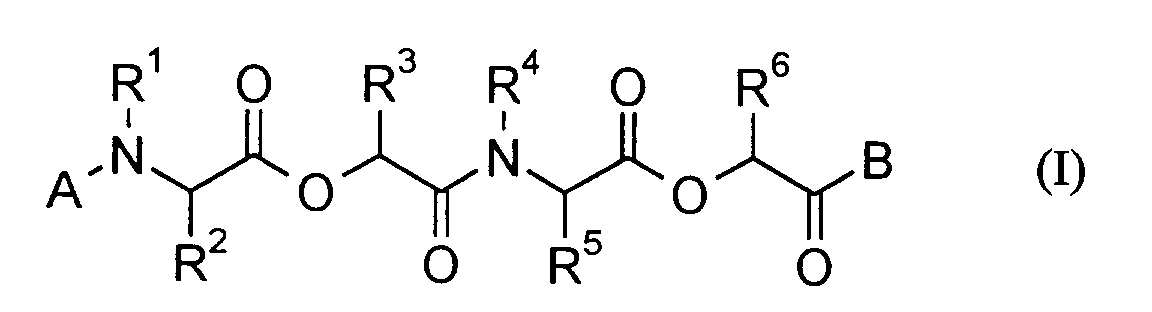
- Es wurde nun gefunden, daß die offenkettigen Tetradepsipeptide der allgemeinen Formel (I)

in welcher - A
- für Wasserstoff, Alkyl, Aralkyl oder einen Acylrest insbesondere der Formel -CO-R⁹ steht, wobei
- R⁹
- für geradkettiges oder verzweigtes Alkyl, Alkoxy, Aralkyl oder Aralkoxy mit bis zu 6 C-Atomen im Alkylteil steht,
- R¹ und R⁴
- unabhängig voneinander für Wasserstoff, C₁-C₈-Alkyl, C₃-C₆-Cycloalkyl oder Aralkyl stehen,
- R² und R⁵
- unabhängig voneinander für Wasserstoff, geradkettiges oder verzweigtes Alkyl mit bis zu 8 Kohlenstoffatomen, Hydroxyalkyl, Alkanoyloxyalkyl, Alkoxyalkyl, Aryloxyalkyl, Mercaptoalkyl, Alkylthioalkyl, Alkylsulfinylalkyl, Alkylsulfonylalkyl, Carboxyalkyl, Alkoxycarbonylalkyl, Arylalkoxycarbonylalkyl, Carbamoylalkyl, Aminoalkyl, Alkylaminoalkyl, Dialkylaminoalkyl, Guanidinoalkyl, das gegebenenfalls durch einen oder zwei Benzyloxycarbonylreste oder durch einen, zwei, drei oder vier Alkylreste substituiert sein kann, Alkoxycarbonylaminoalkyl, 9-Fluorenylmethoxycarbonyl(Fmoc)aminoalkyl, Alkenyl, Cycloalkyl, Cycloalkylalkyl sowie gegebenenfalls substituiertes Aryl, Arylalkyl oder Hetarylmethyl, wobei als Substituenten genannt seien Halogen, Hydroxy, Alkyl, Alkoxy, Nitro oder ein Rest NR¹⁰R¹¹, wobei R¹⁰ und R¹¹ unabhängig voneinander für Wasserstoff oder Alkyl stehen oder R¹⁰ und R¹¹ gemeinsam mit dem angrenzenden N-Atom für einen carbocyclischen 5-, 6-, 7- oder 8-gliedrigen Ring stehen, der gegebenenfalls auch durch O, S und N unterbrochen sein kann und gegebenenfalls durch C₁-C₄-Alkyl substituiert ist, stehen,
- R³ und R⁶
- unabhängig voneinander für Wasserstoff, geradkettiges oder verzweigtes Alkyl mit bis zu 8 Kohlenstoffatomen, Hydroxyalkyl, Alkanoyloxyalkyl, Alkoxyalkyl, Aryloxyalkyl, Alkylthioalkyl, Alkylsulfinylalkyl, Alkysulfonylalkyl, Carboxyalkyl, Alkoxycarbonylalkyl, Arylalkoxycarbonylalkyl, Carbamoylalkyl, Aminoalkyl, Alkylaminoalkyl, Dialkylaminoalkyl, Alkoxycarbonylaminoalkyl, Alkenyl, Cycloalkyl, Cycloalkylalkyl sowie gegebenenfalls substituiertes Aryl, Arylalkyl oder Hetarylmethyl, wobei als Substituenten genannt seien Halogen, Hydroxy, Alkyl, Alkoxy, Nitro oder ein Rest NR¹⁰R¹¹, wobei R¹⁰ und R¹¹ unabhängig voneinander für Wasserstoff oder Alkyl stehen oder R¹⁰ und R¹¹ gemeinsam mit dem angrenzenden N-Atom für einen carbocyclischen 5-, 6-, 7- oder 8-gliedrigen Ring stehen, der gegebenenfalls auch durch O, S und N unterbrochen sein kann und gegebenenfalls durch C₁-C₄-Alkyl substituiert ist, stehen,
- B
- für Hydroxy, Alkoxy mit bis zu 4 Kohlenstoffatomen oder den Rest NR⁷R⁸ steht, wobei
- R⁷ und R⁸
- für Wasserstoff, Alkyl, Aralkyl oder Aryl stehen,
sowie deren optische Isomere und Racemate, - Die erfindungsgemäß zu verwendenden offenkettigen Tetradepsipeptide sind durch die Formel (I) allgemein definiert. Vorzugsweise werden erfindungsgemäß diejenigen Verbindungen der Formel (I) verwendet, in welcher
- A
- für Wasserstoff oder C₁₋₄-Alkyl oder Benzyl steht,
oder für eine Gruppe der Formel -CO-R⁹ steht,
worin - R⁹
- für geradkettiges oder verzweigtes C₁₋₄-Alkyl, C₂₋₄-Alkenyl, C₁₋₄-Alkoxy oder Phenylalkoxy mit bis zu 6 Kohlenstoffatomen im Alkylteil, insbesondere für tert.-Butoxy, Benzyloxy, Ethoxy, Allyloxy, Fluorenyl-9-methoxy oder Methoxy steht,
- R¹ und R⁴
- unabhängig voneinander für Wasserstoff, C₁₋₆-Alkyl, C₃₋₆-Cycloalkyl, Phenyl-C₁₋₄-alkyl stehen,
- R² und R⁵
- unabhängig voneinander für Wasserstoff, geradkettiges oder verzweigtes C₁₋₈-Alkyl, insbesondere Methyl, Ethyl, Propyl, Isopropyl, Butyl, Isobutyl, sec.-Butyl, tert.-Butyl, Pentyl, Isopentyl, sec.-Pentyl, Hexyl, Isohexyl, sec.-Hexyl, Heptyl, Isoheptyl, sec.-Heptyl, tert.-Heptyl, Octyl, Isooctyl, sec.-Octyl, Hydroxy-C₁-C₆-alkyl, insbesondere Hydroxymethyl, 1-Hydroxyethyl, C₁-C₄-Alkanoyloxy-C₁-C₆-alkyl, insbesondere Acetoxymethyl, 1-Acetoxyethyl, C₁-C₄-Alkoxy-C₁-C₆-alkyl, insbesondere Methoxymethyl, 1-Methoxyethyl, Aryl-C₁-C₄-alkyloxy-C₁-C₆-alkyl, insbesondere Benzyloxymethyl, 1-Benzyloxy-ethyl, Mercapto-C₁-C₆-alkyl, insbesondere Mercaptomethyl, C₁-C₄-Alkylthio-C₁-C₆-alkyl, insbesondere Methylthioethyl, C₁-C₄-Alkylsulfinyl-C₁-C₆-alkyl, insbesondere Methylsulfinylethyl, C₁-C₄-Alkylsulfonyl-C₁-C₆-alkyl, insbesondere Methylsulfonylethyl, Carboxy-C₁-C₆-alkyl, insbesondere Carboxymethyl, Carboxyethyl, C₁-C₄-Alkoxycarbonyl-C₁-C₆-alkyl, insbesondere Methoxycarbonylmethyl, Ethoxycarbonylethyl, C₁-C₄-Arylalkoxycarbonyl-C₁-C₆-alkyl, insbesondere Benzyloxycarbonylmethyl, Carbamoyl-C₁-C₆-alkyl, insbesondere Carbamoylmethyl, Carbamoylethyl, Amino-C₁-C₆-alkyl, insbesondere Aminopropyl, Aminobutyl, C₁-C₄-Alkylamino-C₁-C₆-alkyl, insbesondere Methylaminopropyl, Methylaminobutyl, C₁-C₄-Dialkylamino-C₁-C₆-alkyl, insbesondere Dimethylaminopropyl, Dimethylaminobutyl, Guanido-C₁-C₆-alkyl, insbesondere Guanidopropyl, C₁-C₄-Alkoxycarbonylamino-C₁-C₆-alkyl, insbesondere tert.-Butoxycarbonylaminopropyl, tert.-Butoxycarbonylaminobutyl, 9-Fluorenylmethoxycarbonyl(Fmoc)aminopropyl, 9-Fluorenylmethoxycarbonyl(Fmoc)aminobutyl, C₂-C₈-Alkenyl, insbesondere Vinyl, Allyl, Butenyl, C₃-C₇-Cycloalkyl, insbesondere Cyclopentyl, Cyclohexyl, Cycloheptyl, C₃-C₇-Cycloalkyl-C₁-C₄-alkyl, insbesondere Cyclopentylmethyl, Cyclohexylmethyl, Cycloheptylmethyl, Aryl, Phenyl-C₁-C₄-alkyl, insbesondere Phenylmethyl, das gegebenenfalls durch Reste aus der Reihe Halogen, insbesondere Fluor, Chlor, Brom oder Iod, Hydroxy, C₁-C₄-Alkoxy, insbesondere Methoxy oder Ethoxy, C₁-C₄-Alkyl, insbesondere Methyl, Nitro oder einen Rest -NR¹⁰R¹¹ substituiert sein kann, wobei R¹⁰ und R¹¹ unabhängig voneinander für Wasserstoff oder Alkyl stehen oder R¹⁰ und R¹¹ gemeinsam mit dem angrenzenden N-Atom für einen carbocyclischen 5-, 6-, 7- oder 8-gliedrigen Ring stheen, der gegebenenfalls durch C₁-C₄-Alkyl substituiert ist, Hetarylmethyl, insbesondere Benzo[b]thien-2-yl-methyl, Benzo[b]thien-3-yl-methyl, Naphth-1-yl-methyl, Naphth-2-yl-methyl, Pyrid-2-yl-methyl, Pyrid-3-yl-methyl, Fur-2-yl-methyl, Fur-3-yl-methyl, Indol-3-yl-methyl, N-Methyl-indol-3-yl-methyl, imidazol-4-yl-methyl, N-Methyl-imidazol-4-yl-methyl, stehen,
- R³ und R⁶
- unabhängig voneinander für Wasserstoff, geradkettiges oder verzweigtes C₁-C₈-Alkyl, insbesondere Methyl, Ethyl, Propyl, Isopropyl, Butyl, Isobutyl, sec.-Butyl, tert.-Butyl, Pentyl, Isopentyl, sec.-Pentyl, Hexyl, Isohexyl, sec.-Hexyl, Heptyl, Isoheptyl, sec.-Heptyl, tert.-Heptyl, Octyl, Isooctyl, sec.-Octyl, Hydroxy-C₁-C₆-alkyl, insbesondere Hydroxymethyl, 1-Hydroxyethyl, C₁-C₄-Alkanoyloxy-C₁-C₆-alkyl, insbesondere Acetoxymethyl, 1-Acetoxyethyl, C₁-C₄-Alkoxy-C₁-C₆-alkyl, insbesondere Methoxymethyl, 1-Methoxyethyl, Aryl-C₁-C₄-alkyloxy-C₁-C₆-alkyl, insbesondere Benzyloxymethyl, 1-Benzyloxyethyl, Mercapto-C₁-C₆-alkyl, insbesondere Mercaptomethyl, C₁-C₄-Alkylthio-C₁-C₆-alkyl, insbesondere Methylthioethyl, C₁-C₄-Alkylsulfinyl-C₁-C₆-alkyl, insbesondere Methylsulfinylethyl, C₁-C₄-Alkylsulfonyl-C₁-C₆-alkyl, insbesondere Methylsulfonylethyl, Carboxy-C₁-C₆-alkyl, insbesondere Carboxymethyl, Carboxyethyl, C₁-C₄-Alkoxycarbonyl-C₁-C₆-alkyl, insbesondere Methoxycarbonylmethyl, Ethoxycarbonylethyl, C₁-C₄-Arylalkoxycarbonyl-C₁-C₆-alkyl, insbesondere Benzyloxycarbonylmethyl, Carbamoyl-C₁-C₆-alkyl, insbesondere Carbamoylmethyl, Carbamoylethyl, Amino-C₁-C₆-alkyl, insbesondere Aminopropyl, Aminobutyl, C₁-C₄-Alkylamino-C₁-C₆-alkyl, insbesondere Methylaminopropyl, Methylaminobutyl, C₁-C₄-Dialkylamino-C₁-C₆-alkyl, insbesondere Dimethylaminopropyl, Dimethylaminobutyl, C₂-C₈-Alkenyl, insbesondere Vinyl, Allyl, Butenyl, C₃-C₇-Cycloalkyl, insbesondere Cyclopentyl, Cyclohexyl, Cycloheptyl, C₃-C₇-Cycloalkyl-C₁-C₄-alkyl, insbesondere Cyclopentylmethyl, Cyclohexylmethyl, Cycloheptylmethyl, Aryl, Phenyl-C₁-C₄-alkyl, insbesondere Phenylmethyl, das gegebenenfalls durch Reste aus der Reihe Halogen, insbesondere Fluor, Chlor, Brom oder Iod, Hydroxy, C₁-C₄-Alkoxy, insbesondere Methoxy oder Ethoxy, C₁-C₄-Alkyl, insbesondere Methyl, Nitro oder einen Rest -NR¹⁰R¹¹ substituiert sein kann, wobei R¹⁰ und R¹¹ unabhängig voneinander für Wasserstoff oder Alkyl stehen oder R¹⁰ und R¹¹ gemeinsam mit dem angrenzenden N-Atom für einen carbocyclischen 5-, 6-, 7- oder 8-gliedrigen Ring stheen, der gegebenenfalls durch C₁-C₄-Alkyl substituiert ist, Hetarylmethyl, insbesondere Benzo[b]thien-2-yl-methyl, Benzo[b]thien-3-yl-methyl, Naphth-1-yl-methyl, Naphth-2-yl-methyl, Pyrid-2-yl-methyl, Pyrid-3-yl-methyl, Fur-2-yl-methyl, Fur-3-yl-methyl, Indol-3-yl-methyl, N-Methyl-indol-3-yl-methyl, imidazol-4-yl-methyl, N-Methyl-imidazol-4-yl-methyl, stehen.
- B
- für Hydroxy, tert.-Butoxy oder den Rest NR⁷R⁸ steht wobei
- R⁷ und R⁸
- unabhängig voneinander für Wasserstoff, geradkettiges oder verzweigtes C₁₋₆-Alkyl insbesondere Methyl, Ethyl, Isopropyl, tert-Butyl, Benzyl, Cyclopropyl, Cyclohexyl, Phenyl stehen
sowie deren optische Isomere und Racemate. - Besonders bevorzugt werden erfindungsgemäß diejenigen Verbindungen der Formel (I) verwendet, in welcher
- A
- für Wasserstoff, Benzyl oder eine Gruppe COR⁹ steht,
- R⁹
- für geradkettiges oder verzweigtes Alkoxy oder Arylalkoxy mit bis zu 6 Kohlenstoffatomen im Alkylteil, insbesondere für tert.-Butoxy, Benzyloxy steht,
- R¹ und R⁴
- unabhängig voneinander für Wasserstoff, C₁-C₄-Alkyl, C₃-C₆-Cycloalkyl oder Benzyl stehen,
- R² und R⁵
- unabhängig voneinander für Wasserstoff, geradkettiges oder verzweigtes C₁-C₈-Alkyl, insbesondere Methyl, Ethyl, Propyl, Isopropyl, Butyl, Isobutyl, sec.-Butyl, Pentyl, Isopentyl, sec.-Pentyl, Hexyl, Isohexyl, sec.-Hexyl, Heptyl, Isoheptyl, sec.-Heptyl, Octyl, Isooctyl, sec.-Octyl, Hydroxy-C₁-C₆-alkyl, insbesondere Hydroxymethyl, 1-Hydroxyethyl, C₁-C₄-Alkanoyloxy-C₁-C₆-alkyl, insbesondere Acetoxymethyl, 1-Acetoxyethyl, C₁-C₄-Alkoxy-C₁-C₆-alkyl, insbesondere Methoxymethyl, 1-Methoxyethyl, Aryl-C₁-C₄-alkyloxy-C₁-C₆-alkyl, insbesondere Benzyloxymethyl, 1-Benzyloxyethyl, C₁-C₄-Alkoxycarbonylamino-C₁-C₆-alkyl, insbesondere tert.-Butoxycarbonylaminopropyl, tert.-Butoxycarbonylaminobutyl, C₂-C₈-Alkenyl, insbesondere Vinyl, Allyl, C₃-C₇-Cycloalkyl, insbesondere Cyclopentyl, Cyclohexyl, Cycloheptyl, C₃-C₇-Cycloalkyl-C₁-C₄-alkyl, insbesondere Cyclopentylmethyl, Cyclohexylmethyl, Cycloheptylmethyl, Phenyl, Pyridyl, Phenyl-C₁-C₄-alkyl, insbesondere Phenylmethyl, die gegebenenfalls durch einen oder mehrere gleiche oder verschiedene der oben angegebenen Reste substituiert sein können, stehen,
- R³ und R⁶
- unabhängig voneinander für Wasserstoff, geradkettiges oder verzweigtes C₁-C₈-Alkyl, insbesondere Methyl, Ethyl, Propyl, Isopropyl, Butyl, Isobutyl, sec.-Butyl, tert.-Butyl, Pentyl, Isopentyl, sec.-Pentyl, Hexyl, Isohexyl, sec.-Hexyl, Heptyl, Isoheptyl, sec.-Heptyl, tert.-Heptyl, Octyl, Isooctyl, sec.-Octyl, Hydroxy-C₁-C₆-alkyl, insbesondere Hydroxymethyl, Aryl-C₁-C₄-alkyloxy-C₁-C₆-alkyl, insbesondere Benzyloxymethyl, 1-Benzyloxyethyl, Carboxy-C₁-C₆-alkyl, insbesondere Carboxymethyl, Carboxyethyl, C₁-C₄-Alkoxycarbonyl-C₁-C₆-alkyl, insbesondere Methoxycarbonylmethyl, Ethoxycarbonylethyl, C₁-C₄-Arylalkoxycarbonyl-C₁-C₆-alkyl, insbesondere Benzyloxycarbonylmethyl, C₁-C₄-Alkylamino-C₁-C₆-alkyl, insbesondere Methylaminopropyl, Methylaminobutyl, C₁-C₄-Dialkylamino-C₁-C₆-alkyl, insbesondere Dimethylaminopropyl, Dimethylaminobutyl, C₂-C₈-Alkenyl, insbesondere Vinyl, Allyl, Butenyl, C₃-C₇-Cycloalkyl, insbesondere Cyclopentyl, Cyclohexyl, Cycloheptyl, C₃-C₇-Cycloalkyl-C₁-C₄-alkyl, insbesondere Cyclopentylmethyl, Cyclohexylmethyl, Cycloheptylmethyl, Hetaryl, Phenyl, Pyridylmethyl, Phenyl-C₁-C₄-alkyl, insbesondere Phenylmethyl die gegebenenfalls durch einen oder mehrere gleiche oder verschiedene der oben angegebenen Reste substituiert sein können stehen,
- B
- für Hydroxy oder tert.-Butoxy steht,
- Ganz besonders bevorzugt werden erfindungsgemäß diejenigen Verbindungen der Formel (I) verwendet,
in welcher - A
- für Wasserstoff oder Benzyl steht,
- R¹ und R⁴
- unabhängig voneinander für Wasserstoff, Methyl, Ethyl, Propyl und iso-Propyl stehen,
- R² und R⁵
- unabhängig voneinander für Wasserstoff, geradkettiges oder verzweigtes C₁-C₈-Alkyl, insbesondere Methyl, Ethyl, Propyl, Isopropyl, Butyl, Isobutyl, sec.-Butyl, Pentyl, Isopentyl, sec.-Pentyl, Hexyl, Isohexyl, sec.-Hexyl, Heptyl, Isoheptyl, sec.-Heptyl, Octyl, Isooctyl, sec.-Octyl, C₂-C₈-Alkenyl, insbesondere Allyl, C₃-C₇-Cycloalkyl-C₁-C₄-alkyl, insbesondere Cyclohexylmethyl, Phenyl-C₁-C₄-alkyl, insbesondere Phenylmethyl stehen,
- R³ und R⁶
- unabhängig voneinander für Wasserstoff, geradkettiges oder verzweigtes C₁-C₈-Alkyl, insbesondere Methyl, Ethyl, Propyl, Isopropyl, Butyl, Isobutyl, sec.-Butyl, Pentyl, Isopentyl, sec.-Pentyl, Hexyl, Isohexyl, sec.-Hexyl, Heptyl, Isoheptyl, sec.-Heptyl, Octyl, Isooctyl, sec.-Octyl, C₂-C₈-Alkenyl, insbesondere Vinyl, Allyl, C₃-C₇-Cycloalkyl-C₁-C₄-alkyl, insbesondere Cyclohexylmethyl, Pyridylmethyl, Phenyl-C₁-C₄-alkyl, insbesondere Phenylmethyl, die gegebenenfalls durch einen oder mehrere gleiche oder verschiedene der oben angegebenen Reste substituiert sein können,
- B
- für Hydroxy oder tert.-Butoxy steht,
- Im einzenen seien folgende Verbindungen der allgemeinen Formel (I) genannt, in welcher die Reste A, R¹ bis R⁶ und B die in der folgenden Tabelle angegebenen Bedeutungen haben:


- Die Verbindungen der allgemeinen Formel (I) können in optisch aktiven, stereoisomeren Formen oder als racemische Gemische vorliegen. Vorzugsweise werden jedoch die optisch aktiven Formen der Verbindungen der allgemeinen Formel (I) verwendet.
- Die Herstellung der erfindungsgemäß zu verwendenden offenkettigen Tetradepsipeptide der allgemeinen Formel (I) ist in vorgängigen, jedoch nicht vorveröffentlichten Patentanmeldungen beschrieben (vgl. Deutsche Patentanmeldungen P 43 17 457.4; P 43 17 432.9, P 43 17 458.2).
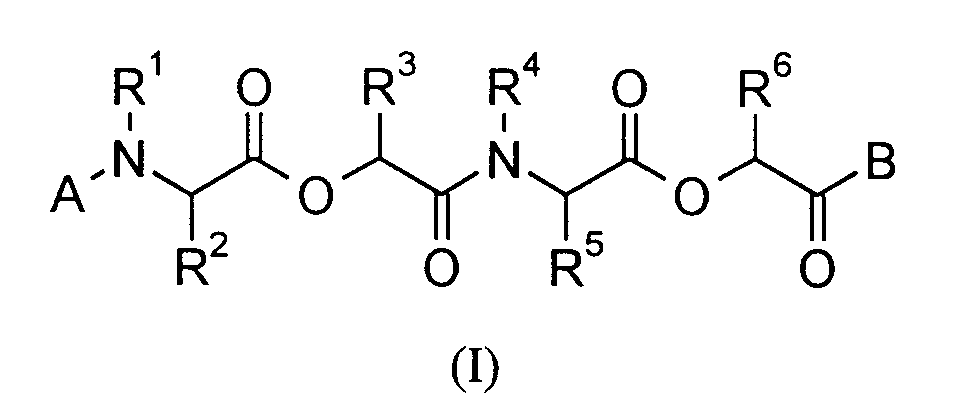
- Man erhält Verbindungen der Formel (I)

in welcher
A, R¹ bis R⁶ und B die oben angegebene Bedeutung besitzen,
wenn man beispielsweise
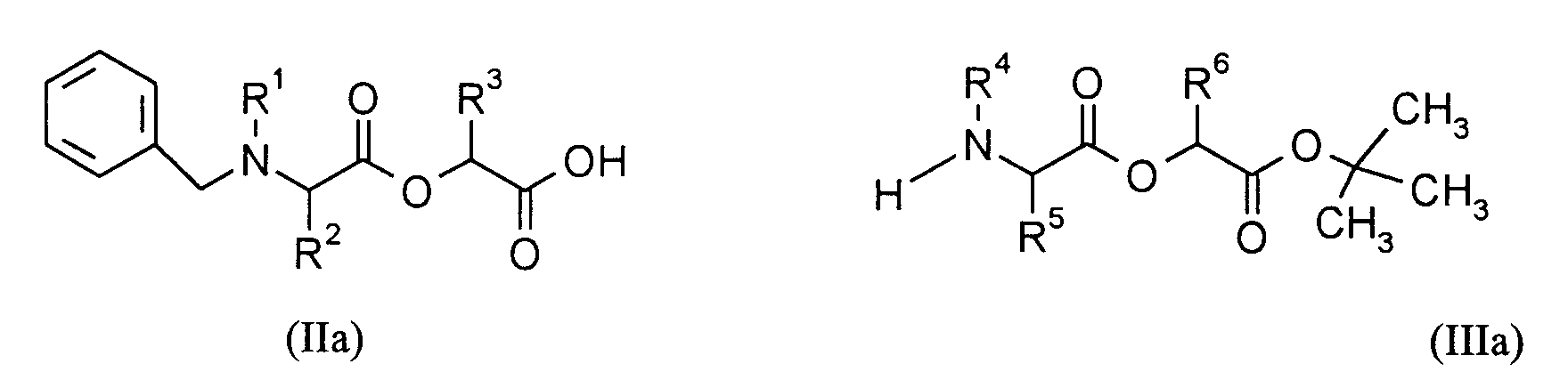
Didepsipeptide der allgemeinen Formel (IIa)
in welcher
A, R¹ bis R³ die oben angegebene Bedeutung haben,
mit Didepsipeptiden der allgemeinen Formel (IIIa)
in welcher
B, R⁴ bis R⁶ die weiter oben angegebene Bedeutung besitzen,
in Gegenwart geeigneter Kupplungsreagenzien, in Gegenwart eines basischen Reaktionshilfsmittels und in Gegenwart eines Verdünnungsmittels zu den Tetradepsipeptiden der allgemeinen Formel (I) umsetzt. - Die als Ausgangsverbindungen verwendeten, erfindungsgemäßen Didepsipeptide können nach klassischen Verfahren hergestellt werden, beispielsweise demjenigen, wie es von H.-G. Lerchen und H. Kunz (Tetrahedron Lett. 26 (43) (1958) S. 5257-5260; 28 (17) (1987) S. 1873-1876) unter Ausnutzung der Veresterungsmethode nach B.F. Gisin (Helv. Chim. Acta 56 (1973) S. 1476) beschrieben ist.
- Die als Ausgangsmaterialien verwendeten N-Methyl-aminosäuren und 2-Halogencarbonsäurederivate sind teilweise bekannt (vgl. z.B. N-Methyl-aminosäuren: R. Bowmann et al., J. Chem. Soc. (1950), S. 1346; J.R. McDermott et al., Can. J. Chem. 51 (1973) S. 1915; H. Wurziger et al., Kontakte (Merck, Darmstadt) 3 (1987) S. 8; 2-Halogencarbonsäurederivate: S. M. Birnbaum et al., J. Amer. Chem. Soc. 76 (1954), S. 6054, C.S. Rondestvedt, Jr. Et al., Org. Reactions 11 (1960) S. 189 (Review)) bzw. können nach den dort beschriebenen Verfahren erhalten werden.
- Für die Kupplungsreaktion der als Ausgangsverbindungen eingesetzten Didepsipeptide (IIa), (IIa) finden alle Kupplungsreagenzien, die zur Herstellung einer Amidbindung geeignet sind (vgl. z.B.: Houben-Weyl, Methoden der organischen Chemie, Band 15/2; Bodanszky et al., Peptide Synthesis 2nd ed. (Wiley & Sons, New York 1976) oder Gross, Meienhofer, The Peptides: Analysis synthesis, biology (AWcademic Press, New York 1979), Verwendung.
- Die offenkettigen Tetradepsipeptide der Formel (I) können somit nach einer Reaktionssequenz erhalten werden, die die folgenden Stufen umfaßt:
- a) Synthese der Didepsipeptide der Formeln (II) und (III):

- Dies entspricht beispielsweise für Formel (II) dem folgenden Reaktionsschema:

Die Herstellung der enantiomerenreinen Verbindungen der Formeln (II) und (III) kann gegebenenfalls auch über die Trennung der Diastereomere nach üblichen Methoden wie beispielsweise Kristallisation, durch Säulenchromatographie oder durch Craig-Verteilung erfolgen. Welches das optimale Verfahren ist, muß von Fall zu Fall entschieden werden, manchmal ist es auch zweckmäßig, Kombinationen der einzelnen Verfahren zu benutzen. - Am Ende dieser Stufe kann entweder eine Entfernung der N-terminalen Schutzgruppe aus den Derivaten der Formel (III) in an sich bekannter Weise durchgeführt werden, beispielsweise durch katalytische Hydrierung, zur Herstellung der Derivate der Formel (IIIa) oder es kann in an sich bekannter Weise eine Abspaltung der C-terminalen Schutzgruppe aus den Derivaten der Formel (II), vorzugsweise durch Acidolyse, zur Darstellung der Derivate (IIa) erfolgen:
- b) Synthese des Tetradepsipeptids der Formel (I)
- Die Wirkstoffe eignen sich bei günstiger Warmblütertoxizität zur Bekämpfung von pathogenen Endoparasiten, die bei Menschen und in der Tierhaltung und Tierzucht bei Nutz-, Zucht-, Zoo-, Labor-, Versuchs- und Hobbytieren vorkommen. Sie sind dabei gegen alle oder einzelne Entwicklungsstadien der Schädlinge sowie gegen resistente und normal sensible Arten wirksam. Durch die Bekämpfung der pathogenen Endoparasiten sollen Krankheit, Todesfälle und Leistungsminderungen (z.B. bei der Produktion von Fleisch, Milch, Wolle, Häuten, Eiern, Honig usw.) vermindert werden, so daß durch den Einsatz der Wirkstoffe eine wirtschaftlichere und einfachere Tierhaltung möglich ist. Zu den pathogenen Endoparasiten zählen Cestoden, Trematoden, Nematoden, Acantocephalen, insbesondere:
- Aus der Ordnung der Pseudophyllidea z.B.: Diphyllobothrium spp., Spirometra spp., Schistocephalus spp., Ligula spp., Bothridium spp., Diphlogonoporus spp..
- Aus der Ordnung der Cyclophyllidea z.B.: Mesocestoides spp., Anoplocephala spp., Paranoplocephala spp., Moniezia spp., 'Thysanosomsa spp., Thysaniezia spp., Avitellina spp., Stilesia spp., Cittotaenia spp., Andyra spp., Bertiella spp., Taenia spp., Echinococcus spp., Hydatigera spp., Davainea spp., Raillietina spp., Hymenolepis spp., Echinolepis spp., Echinocotyle spp., Diorchis spp., Dipylidium spp., Joyeuxiella spp., Diplopylidium spp..
- Aus der Unterklasse der Monogenea z.B.: Gyrodactylus spp., Dactylogyrus spp., Polystoma spp..
- Aus der Unterklasse der Digenea z.B.: Diplostomum spp., Posthodiplostomum spp., Schistosoma spp., Trichobilharzia spp., Ornithobilharzia spp., Austrobilharzia spp., Gigantobilharzia spp., Leucochloridium spp., Brachylaima spp., Echinostoma spp., Echinoparyphium spp., Echinochasmus spp., Hypoderaeum spp., Fasciola spp., Fasciolides spp., Fasciolopsis spp., Cyclocoelum spp., Typhlocoelum spp., Paramphistomum spp., Calicophoron spp., Cotylophoron spp., Gigantocotyle spp., Fischoederius spp., Gastrothylacus spp., Notocotylus spp., Catatropis spp., Plagiorchis spp., Prosthogonimus spp., Dicrocoelium spp., Eurytrema spp., Troglotrema spp., Paragonimus spp., Collyriclum spp., Nanophyetus spp., Opisthorchis spp., Clonorchis spp., Metorchis spp., Heterophyes spp., Metagonismus spp..
- Aus der Ordnung der Enoplida z.B.: Trichuris spp., Capillaria spp., Trichomosoides spp., Trichinella spp..
- Aus der Ordnung der Rhabditia z.B.: Micronema spp., Strongyloides spp..
- Aus der Ordnung der Strongylida z.B.: Stronylus spp., Triodontophorus spp., Oesophagodontus spp., Trichonema spp., Gyalocephalus spp., Cylindropharynx spp., Poteriostomum spp., Cyclococercus spp., Cylicostephanus spp., Oesophagostomum spp., Chabertia spp., Stephanurus spp., Ancylostoma spp., Uncinaria spp., Bunostomum spp., Globocephalus spp., Syngamus spp., Cyathostoma spp., Metastrongylus spp., Dictyocaulus spp., Muellerius spp., Protostrongylus spp., Neostrongylus spp., Cystocaulus spp., Pneumostrongylus spp., Spicocaulus spp., Elaphostrongylus spp., Parelaphostrongylus spp., Crenosoma spp., Paracrenosoma spp., Angiostrongylus spp., Aelurostrongylus spp., Filaroides spp., Parafilaroides spp., Trichostrongylus spp., Haemonchus spp., Ostertagia spp., Marshallagia spp., Cooperia spp., Nematodirus spp., Hyostrongylus spp., Obeliscoides spp., Amidostomum spp., Ollulanus spp..
- Aus der Ordnung der Oxyurida z.B.: Oxyuris spp., Enterobius spp., Passalurus spp., Syphacia spp., Aspiculuris spp., Heterakis spp..
- Aus der Ordnung der Ascaridia z.B.: Ascaris spp., Toxascaris spp., Toxocara spp., Parascaris spp., Anisakis spp., Ascaridia spp..
- Aus der Ordnung der Spirurida z.B.: Gnathostoma spp., Physaloptera spp., Thelazia spp., Gongylonema spp., Habronema spp., Parabronema spp., Draschia spp., Dracunculus spp..
- Aus der Ordnung der Filariida z.B.: Stephanofilaria spp., Parafilaria spp., Setaria spp., Loa spp., Dirofilaria spp., Litomosoides spp., Brugia spp., Wuchereria spp., Onchocerca spp..
- Aus der Ordnung der Gigantorhynchida z.B.: Filicollis spp., Moniliformis spp., Macracanthorhynchus spp., Prosthenorchis spp..
- Zu den Nutz- und Zuchttieren gehören Säugetiere wie z.B. Rinder, Pferde, Schafe, Schweine, Ziegen, Kamele, Wasserbüffel, Esel, Kaninchen, Damwild, Rentiere, Pelztiere wie z.B. Nerze, Chinchilla, Waschbär, Vögel wie z.B. Hühner, Gänse, Puten, Enten, Süß- und Salzwasserfische wie z.B. Forellen, Karpfen, Aale, Reptilien, Insekten wie z.B. Honigbiene und Seidenraupe.
- Zu Labor- und Versuchstieren gehören Mäuse, Ratten, Meerschweinchen, Goldhamster, Hunde und Katzen.
- Zu den Hobbytieren gehören Hunde und Katzen.
- Die Anwendung kann sowohl prophylaktisch als auch therapeutisch erfolgen.
- Die Anwendung der Wirkstoffe erfolgt direkt oder in Form von geeigneten Zubereitungen enteral, parenteral, dermal, nasal, durch Behandlung der Umgebung oder mit Hilfe wirkstoffhaltiger Formkörper wie z.B. Streifen, Platten, Bänder, Halsbänder, Ohrmarken, Gliedmaßenbänder, Markierungsvorrichtungen.
- Die enterale Anwendung der Wirkstoffe geschieht z.B. oral in Form von Pulver, Tabletten, Kapseln, Pasten, Tränken, Granulaten, oral applizierbaren Lösungen, Suspensionen und Emulsionen, Boli, medikiertem Futter oder Trinkwasser. Die dermale Anwendung geschieht z.B. in Form des Tauchens (Dippen), Sprühens (Sprayen) oder Aufgießens (pour-on and spot-on). Die parenterale Anwendung geschieht z.B. in Form der Injektion (intramusculär, subcutan, intravenös, intraperitoneal) oder durch Implantate.
- Geeignete Zubereitungen sind:
Lösungen wie Injektionslösungen, orale Lösungen, Konzentrate zur oralen Verabreichung nach Verdünnung, Lösungen zum Gebrauch auf der Haut oder in Körperhöhlen, Aufgußformulierungen, Gele;
Emulsionen und Suspensionen zur oralen oder dermalen Anwendung sowie zur Injektion; halbfeste Zubereitungen;
Formulierungen, bei denen der Wirkstoff in einer Salbengrundlage oder in einer Öl in Wasser oder Wasser in Öl Emulsionsgrundlage verarbeitet ist;
Feste Zubereitungen wie Pulver, Premixe oder Konzentrate, Granulate, Pellets, Tabletten, Boli, Kapseln; Aerosole und Inhalate, wirkstoffhaltige Formkörper. - Injektionslösungen werden intravenös, intramuskulär und subcutan verabreicht.
- Injektionslösungen werden hergestellt, indem der Wirkstoff in einem geeigneten Lösungsmittel gelöst wird und eventuell Zusätze wie Lösungsvermittler, Säuren, Basen, Puffersalze, Antioxidantien, Konservierungsmittel zugefügt werden. Die Lösungen werden steril filtriert und abgefüllt.
- Als Lösungsmittel seien genannt: Physiologisch verträgliche Lösungsmittel wie Wasser, Alkohole wie Ethanol, Butanol, Benzylalkohol, Glycerin, Propylenglykol, Polyethylenglykole, N-Methyl-pyrrolidon, sowie Gemische derselben.
- Die Wirkstoffe lassen sich gegebenenfalls auch in physiologisch verträglichen pflanzlichen oder synthetischen Ölen, die zur Injektion geeignet sind, lösen.
- Als Lösungsvermittler seien genannt: Lösungsmittel, die die Lösung des Wirkstoffs im Hauptlösungsmittel fördern oder sein Ausfallen verhindern. Beispiele sind Polyvinylpyrrolidon, polyoxyethyliertes Rhizinusöl, polyoxyethylierte Sorbitanester.
- Konservierungsmittel sind: Benzylalkohol, Trichlorbutanol, p-Hydroxybenzoesäureester, n-Butanol.
- Orale Lösungen werden direkt angewendet. Konzentrate werden nach vorheriger Verdünnung auf die Anwendungskonzentration oral angewendet. Orale Lösungen und Konzentrate werden wie oben bei den Injektionslösungen beschrieben hergestellt, wobei auf steriles Arbeiten verzichtet werden kann.
- Lösungen zum Gebrauch auf der Haut werden aufgeträufelt, aufgestrichen, eingerieben, aufgespritzt oder aufgesprüht. Diese Lösungen werden wie oben bei den Injektionslösungen beschrieben hergestellt.
- Es kann vorteilhaft sein, bei der Herstellung Verdickungsmittel zuzufügen. Verdickungsmittel sind: Anorganische Verdickungsmittel wie Bentonite, kolloidale Kieselsäure, Aluminiummonostearat, organische Verdickungsmittel wie Cellulose-derivate, Polyvinylalkohole und deren Copolymere, Acrylate und Methacrylate.
- Gele werden auf die Haut aufgetragen oder aufgestrichen oder in Körperhöhlen eingebracht. Gele werden hergestellt, indem Lösungen, die wie bei den Injektionslösungen beschrieben hergestellt worden sind, mit soviel Verdickungsmittel versetzt werden, daß eine klare Masse mit salbenartiger Konsistenz entsteht. Als Verdickungsmittel werden die weiter oben angegebenen Verdickungsmittel eingesetzt.
- Aufgieß-Formulierungen werden auf begrenzte Bereiche der Haut aufgegossen oder aufgespritzt, wobei der Wirkstoff die Haut durchdringt und systemisch wirkt.
- Aufgieß-Formulierungen werden hergestellt, indem der Wirkstoff in geeigneten hautverträglichen Lösungsmitteln oder Lösungsmittelgemischen gelöst, suspendiert oder emulgiert wird. Gegebenenfalls werden weitere Hilfsstoffe wie Farbstoffe, resorptionsfördernde Stoffe, Antioxidantien, Lichtschutzmittel, Haftmittel zugefügt.
- Als Lösungsmittel seien genannt: Wasser, Alkanole, Glycole, Polyethylenglycole, Polypropylenglycole, Glycerin, aromatische Alkohole wie Benzylalkohol, Phenylethanol, Phenoxyethanol, Ester wie Essigester, Butylacetat, Benzylbenzoat, Ether wie Alkylenglykolalkylether wie Dipropylenglykolmonomethylether, Diethylenglykolmono-butylether, Ketone wie Aceton, Methylethylketon, aromatische und/oder aliphatische Kohlenwasserstoffe, pflanzliche oder synthetische Öle, DMF, Dimethylacetamid, N-Methylpyrrolidon, 2,2-Dimethyl-4-oxy-methylen-1,3-dioxolan.
- Farbstoffe sind alle zur Anwendung am Tier zugelassenen Farbstoffe, die gelöst oder suspendiert sein können.
- Resorptionsfördernde Stoffe sind z.B. DMSO, spreitende Öle wie Isopropylmyristat, Dipropylenglykolpelargonat, Silikonöle, Fettsäureester, Triglyceride, Fettalkohole.
- Antioxidantien sind Sulfite oder Metabisulfite wie Kaliummetabisulfit, Ascorbinsäure, Butylhydroxytoluol, Butylhydroxyanisol, Tocopherol.
- Lichtschutzmittel sind z.B. Novantisolsäure.
- Haftmittel sind z.B. Cellulosederivate, Stärkederivate, Polyacrylate, natürliche Polymere wie Alginate, Gelatine.
- Emulsionen können oral, dermal oder als Injektionen angewendet werden.
- Emulsionen sind entweder vom Typ Wasser in Öl oder vom Typ Öl in Wasser.
- Sie werden hergestellt, indem man den Wirkstoff entweder in der hydrophoben oder in der hydrophilen Phase löst und diese unter Zuhilfenahme geeigneter Emulgatoren und gegebenenfalls weiterer Hilfsstoffe wie Farbstoffe, resorptionsfördernde Stoffe, Konservierungsstoffe, Antioxidantien, Lichtschutzmittel, viskositätserhöhende Stoffe, mit dem Lösungsmittel der anderen Phase homogenisiert.
- Als hydrophobe Phase (Öle) seien genannt: Paraffinöle, Silikonöle, natürliche Pflanzenöle wie Sesamöl, Mandelöl, Rizinusöl, synthetische Triglyceride wie Capryl / Caprinsäure-biglycerid, Triglyceridgemisch mit Pflanzenfettsäuren der Kettenlänge C₈₋₁₂ oder anderen speziell ausgewählten natürlichen Fettsäuren, Partialglyceridgemische gesättigter oder ungesättigter ebentuell auch hydroxylgruppenhaltiger Fettsäuren, Mono- und Diglyceride der C₈/C₁₀-Fettsäuren.
- Fettsäureester wie Ethylstearat, Di-n-butyryl-adipat, Laurinsäurehexylester, Dipropylen-glykolpelargonat, Ester einer verzweigten Fettsäure mittlerer Kettenlänge mit gesättigten Fettalkoholen der Kettenlänge C₁₆-C₁₈, Isopropylmyristat, Isopropylpalmitat, Capryl/Caprinsäureester von gesättigten Fettalkoholen der Kettenlänge C₁₂-C₁₈, Isopropylstearat, Ölsäureoleylester, Ölsäuredecylester, Ethyloleat, Milchsäureethylester, wachsartige Fettsäureester wie künstliches Entenbürzeldrüsenfett, Dibutylphthalat, Adipinsäurediisopropylester, letzterem verwandte Estergemische u.a.
- Fettalkohole wie Isotridecylalkohol, 2-Octyldodecanol, Cetylstearyl-alkohol, Oleyl-alkohol.
- Fettsäuren wie z.B. Ölsäure und ihre Gemische.
- Als hydrophile Phase seien genannt:
Wasser, Alkohole wie z.B. Propylenglycol, Glycerin, Sorbitol und ihre Gemische. - Als Emulgatoren seien genannt: nichtionogene Tenside, z.B. polyoxyethyliertes Rizinusöl, polyoxyethyliertes Sorbitan-monooleat, Sorbitanmonostearat, Glycerinmonostearat, Polyoxyethylstearat, Alkylphenolpolyglykolether;
ampholytische Tenside wie Di-Na-N-lauryl-β-iminodipropionat oder Lecithin;
anionaktive Tenside, wie Na-Laurylsulfat, Fettalkoholethersulfate, Mono/Dialkylpolyglykoletherorthophosphorsäureester-monoethynolaminsalz;
Als weitere Hilfsstoffe seien genannt: Viskositätserhöhende und die Emulsion stabilisierende Stoffe wie Carboxymethylcellulose, Methylcellulose und andere Cellulose- und Stärke-Derivate, Polyacrylate, Alginate, Gelatine, Gummi-arabicum, Polyvinylpyrrolidon, Polyvinylalkohol, Copolymere aus Methylvinylether und Maleinsäureanhydrid, Polyethylenglykole, Wachse, kolloidale Kieselsäure oder Gemische der aufgeführten Stoffe. - Suspensionen können oral, dermal oder als Injektion angewendet werden. Sie werden hergestellt, indem man den Wirkstoff in einer Trägerflüssigkeit gegebenenfalls unter Zusatz weiterer Hilfsstoffe wie Netzmittel, Farbstoffe, resorptionsfördernde Stoffe, Konservierungsstoffe, Antioxidantien Lichtschutzmittel suspendiert.
- Als Trägerflüssigkeiten seien alle homogenen Lösungsmittel und Lösungsmittelgemische genannt.
- Als Netzmittel (Dispergiermittel) seien die weiter oben angegebenen Tenside ganannt.
- Als weitere Hilfsstoffe seien die weiter oben angegebenen genannt.
- Halbfeste Zubereitungen können oral oder dermal verabreicht werden. Sie unterscheiden sich von den oben beschriebenen Suspensionen und Emulsionen nur durch ihre höhere Viskosität.
- Zur Herstellung fester Zubereitungen wird der Wirkstoff mit geeigneten Trägerstoffen gegebenenfalls unter Zusatz von Hilfsstoffen vermischt und in die gewünschte Form gebracht.
- Als Trägerstoffe seien genannt alle physiologisch verträglichen festen Inertstoffe. Als solche dienen anorganische und organische Stoffe. Anorganische Stoffe sind z.B. Kochsalz, Carbonate wie Calciumcarbonat, Hydrogencarbonate, Aluminiumoxide, Kieselsäuren, Tonerden, gefälltes oder kolloidales Siliciumdioxid, Phosphate.
- Organische Stoffe sind z.B. Zucker, Zellulose, Nahrungs- und Futtermittel wie Milchpulver, Tiermehle, Getreidemehle und -schrote, Stärken.
- Hilfsstoffe sind Konservierungsstoffe, Antioxidantien, Farbstoffe, die bereits weiter oben aufgeführt worden sind.
- Weitere geeignete Hilfsstoffe sind Schmier- und Gleitmittel wie z.B. Magnesiumstearat, Stearinsäure, Talkum, Bentonite, zerfallsfördernde Substanzen wie Stärke oder quervernetztes Polyvinylpyrrolidon, Bindemittel wie z.B. Stärke, Gelatine oder lineares Polyvinylpyrrolidon sowie Trockenbindemittel wie mikrokristalline Cellulose.
- Die Wirkstoffe können in den Zubereitungen auch in Mischung mit Synergisten oder mit anderen Wirkstoffen, die gegen pathogene Endoparasiten wirken, vorliegen. Solche Wirkstoffe sind z.B. L-2,3,5,6-Tetrahydro-6-phenylimidazothiazol, Benzimidazolcarbamate, Praziquantel, Pyrantel, Febantel.
- Anwendungsfertige Zubereitungen enthalten den Wirkstoff in Konzentrationen von 10 ppm - 20 Gewichtsprozent, bevorzugt von 0,1 - 10 Gewichtsprozent.
- Zubereitungen, die vor Anwendung verdünnt werden, enthalten den Wirkstoff in Konzentrationen von 0,5 - 90 Gew.-%, bevorzugt von 5 - 50 Gew.-%.
- Im allgemeinen hat es sich als vorteilhaft erwiesen, Mengen von etwa 1 bis etwa 100 mg Wirkstoff je kg Körpergewicht pro Tag zur Erzielung wirksamer Ergebnisse zu verabreichen.
- Experimentell mit Haemonchus contortus infizierte Schafe wurden nach Ablauf der Präpatenzzeit des Parasiten behandelt. Die Wirkstoffe wurden als reiner Wirkstoff oral und/oder intravenös appliziert.
- Der Wirkungsgrad wird dadurch bestimmt, daß man die mit dem Kot ausgeschiedenen Wurmeier vor und nach der Behandlung quantitativ auszählt.
- Ein völliges Sistieren der Eiausscheidung nach der Behandlung bedeutet, daß die Würmer abgetrieben wurden oder so geschädigt sind, daß sie keine Eier mehr produzieren (Dosis effectiva).
- Geprüfte Wirkstoffe und wirksame Dosierungen (Dosis effectiva) sind aus der nachfolgenden Tabelle ersichtlich:
Wirkstoff Beispiel Nr. Dosis effectiva in mg/kg 1 10 2 10 3 10 - Eine Lösung von Benzyl-L-EtLeu-D-Lac-L-EtLeu-D-PheLac-OtBu (7,83 g, 11,7 mmol) in Dioxan (50 ml) wurde mit Palladiumhydroxid (0,73 g, 20 %ig/Kohle) versetzt und bis zur Beendigung der Wasserstoffaufnahme bei Raumtemperatur und Normaldruck hydriert. Nach Filtration über Celite wurden 7,48 g (98 %) reines H-L-EtLeu-D-Lac-L-EtLeu-D-PheLac-OtBu erhalten.
FAB-MS m/z (%): 577 (62, (M+H)+), 158 (100). - In eine Lösung von Bzl-L-PrLeu-D-Lac-L-PrLeu-D-PheLac-OtBu (9,12 g, 13,2 mmol) in Dichlormethan (235 ml) wurde bei 0°C 2 Stunden HCl(g) eingeleitet und über Nacht bei Raumtemperatur nachgerührt. Anschließend wurde eingeengt und zweimal mit Dichlormethan codestilliert. Der Rückstand wurde in MeOH-H₂O = 4:1 aufgenommen, mit 5,5 g basischem Ionenaustauscher versetzt und 2 Stunden gerührt. Nach Abfiltrieren des Ionenaustauschers und Einengen verblieben 8,1 g (96 %) Bzl-L-PrLeu-D-Lac-L-PrLeu-D-PheLac-OH.
- FAB-MS m/z (%): 639 (32, M+H)+), 262 (92 %), 218 (108).
- Eine Lösung von Bzl-L-MePhe-D-Lac-L-MePhe-D-PheLac-OtBu (3,2 g, 4,53 mmol) in Ethanol (20 ml) wird mit Pd(OH)₂/C (20 %, 320 mg) versetzt und bei Raumtemperatur und Normaldruck bis zur Beendigung der Wasserstoffaufnahme hydriert. Nach Filtration über Celite werden 2,29 g (82 %) H-L-MePhe-D-Lac-L-MePhe-D-PheLac-OtBu erhalten.
- Eine auf 0°C gekühlte Lösung von H-L-MeLeu-D-PheLac-OtBu (8,0 g, 22,9 mmol) und Bzl-L-MeLeu-D-Lac-OH (8,44 g, 27,5 mmol) in Dichlormethan (80 ml) wurde mit Diisopropylethylamin (9,98 ml, 57,3 mmol) und Bis-(2-oxo-3-oxazolidinyl)-phosphorylchlorid (7,59 g, 29,8 mmol) versetzt, 1 Stunde bei 0°C und 1 Stunde bei Raumtemperatur gerührt. Nach Abfiltrieren des Niederschlages wurde die Lösung mit Dichlormethan verdünnt, dreimal mit wenig Wasser gewaschen, über Natriumsulfat getrocknet und eingeengt. Flash-Chromatographie an Kieselgel mit dem Laufmittel Cyclohexan-Ethylacetat = 15:1 lieferte 11,6 g (80 %) Bzl-L-MeLeu-D-Lac-L-MeLeu-D-PheLac-OtBu.
FAB-MS m/z (%): 639 (37, (M+H)+), 190 (100). - Analog können die in der nachstehenden Tabelle 2 aufgeführten Verbindungen der allgemeinen Formel (I) als LDLD-Stereoisomere hergestellt werden.


- Das Cäsiumsalz (77,7 g, 0,212 mol) im Bzl-L-MeLeu-OH wurde in Dimethylsulfoxid (530 ml) vorgelegt und bei Raumtemperatur mit 2-Chlor-propionsäure-tert.-butylester (34,76 g, 0,212 mol) versetzt. Es wurde 20 Stunden bei Raumtemperatur gerührt, in ges. Kochsalzlösung eingegossen und viermal mit Ethylacetat extrahiert. Die vereinigten organischen Extrakte wurden einmal mit wenig Wasser gewaschen, über Natriumsulfat getrocknet und eingeengt. Säulenchromatographie des Rückstandes an Kieselgel mit dem Laufmittel Cyclohexan-Ethylacetat = 60:1 ergab 63,5 g (82 %) Bzl-L-MeLeu-D-Lac-OtBu.
Ei-MS m/z (%): 363 (M⁺, 1), 190 (100). - Bzl-L-MeLeu-OH (50,0 g, 0,212 mol) wurde in Ethanol (1 000 ml) Wasser (100 ml) gelöst, mit einer 20 %igen Cäsiumcarbonatlösung (41,5 g, 0,127 Mol) in Wasser versetzt und 5 Stunden bei Raumtemperatur gerührt. Anschließend wurde eingeengt, zweimal mit je 250 ml DMF codestilliert und über Nacht bei 80°C im Hochvakuum getrocknet. Das Cäsiumsalz (77,7 g, 0,212 mol) wurde in Dimethylsulfoxid (530 ml) vorgelegt, bei Raumtemperatur mit 2-Chlor-3-phenylpropionsäure-tert.-butylester (51,0 g, 0,212 mol) versetzt und 20 Stunden bei Raumtemperatur gerührt.
- Die Lösung wurde in gesättigte Kochsalzlösung eingegossen, viermal mit Ethylacetat extrahiert, über Natriumsulfat getrocknet und eingeengt. Säulenchromatographie des Rückstandes an Kieselgel mit dem Laufmittel Cyclohexan-Ethylacetat = 100:1 lieferte 26,6 g (29 %) sauberes Bzl-L-MeLeu-D-PheLac-OtBu sowie 48,9 g (52 %) einer mit Zimtsäure-tert.-butylester verunreinigten Mischfraktion.
Ei-MS m/z (%): 363 (1), 190 (100). - Analog können die in der nachstehenden Tabelle aufgeführten Verbindungen als L-D Stereoisomere hergestellt werden.


Man kann anschließend eine Entfernung der N-terminalen Schutzgruppe aus den Derivaten der Formel (Ia) durchführen, beispielsweise durch katalytische Hydrierung wie oben angegeben, zur Herstellung der Derivate der Formel (Ic), oder

es kann in an sich bekannter Weise eine Abspaltung der C-terminalen Schutzgruppe, vorzugsweise durch Acidolyse, zur Darstellung der Derivate (Ib) erfolgen

Die anfallenden Produkte lassen sich in üblicher Weise durch Umkristallisieren oder Säulenchromatographie reinigen (vgl. auch die Herstellungsbeispiele).
Claims (4)
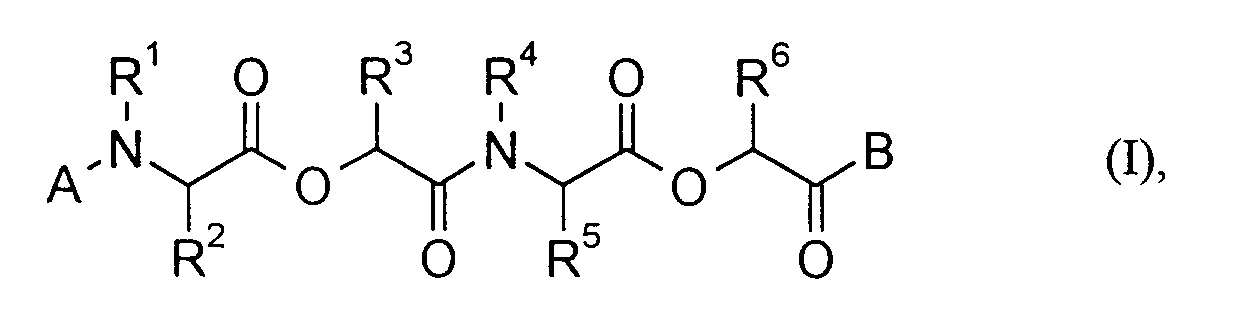
- Verwendung von offenkettigen Tetradepsipeptiden der allgemeinen Formel (I)
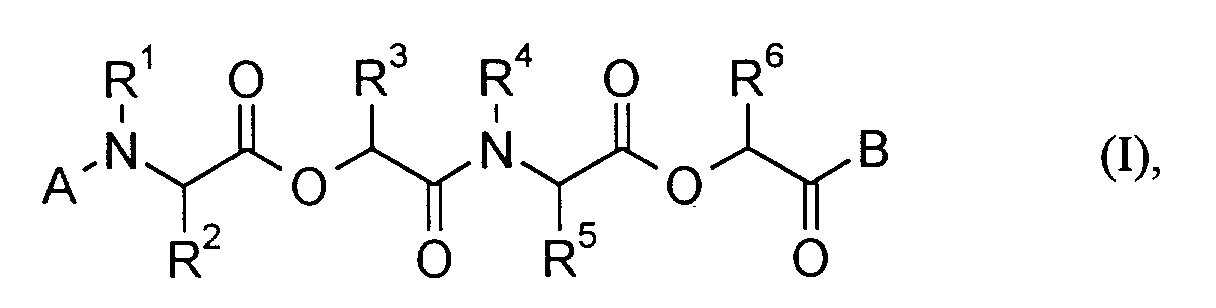 A für Wasserstoff, Alkyl, Aralkyl oder einen Acylrest insbesondere der Formel -CO-R⁹ steht, wobeiR⁹ für geradkettiges oder verzweigtes Alkyl, Alkoxy, Aralkyl oder Aralkoxy mit bis zu 6 C-Atomen im Alkylteil steht,R¹ und R⁴ unabhängig voneinander für Wasserstoff, C₁-C₈-Alkyl, C₃-C₆-Cycloalkyl oder Aralkyl stehen,R² und R⁵ unabhängig voneinander für Wasserstoff, geradkettiges oder verzweigtes Alkyl mit bis zu 8 Kohlenstoffatomen, Hydroxyalkyl, Alkanoyloxyalkyl, Alkoxyalkyl, Aryloxyalkyl, Mercaptoalkyl, Alkylthioalkyl, Alkylsulfinylalkyl, Alkylsulfonylalkyl, Carboxyalkyl, Alkoxycarbonylalkyl, Arylalkoxycarbonylalkyl, Carbamoylalkyl, Aminoalkyl, Alkylaminoalkyl, Dialkylaminoalkyl, Guanidinoalkyl, das gegebenenfalls durch einen oder zwei Benzyloxycarbonylreste oder durch einen, zwei, drei oder vier Alkylreste substituiert sein kann, Alkoxycarbonylaminoalkyl, 9-Fluorenylmethoxycarbonyl(Fmoc)aminoalkyl, Alkenyl, Cycloalkyl, Cycloalkylalkyl sowie gegebenenfalls substituiertes Aryl, Arylalkyl oder Hetarylmethyl, wobei als Substituenten genannt seien Halogen, Hydroxy, Alkyl, Alkoxy, Nitro, oder ein Rest -NR¹⁰R¹¹, wobei R¹⁰ und R¹¹ unabhängig voneinander für Wasserstoff oder Alkyl stehen oder R¹⁰ und R¹¹ gemeinsam mit dem angrenzenden N-Atom für einen carbocyclischen 5-, 6-, 7- oder 8-gliedrigen Ring stehen, der gegebenenfalls durch O, S oder N unterbrochen sein kann und gegebenenfalls durch C₁-C₄-Alkyl substituiert ist, stehen,R³ und R⁶ unabhängig voneinander für Wasserstoff, geradkettiges oder verzweigtes Alkyl mit bis zu 8 Kohlenstoffatomen, Hydroxyalkyl, Alkanoyloxyalkyl, Alkoxyalkyl, Aryloxyalkyl, Alkylthioalkyl, Alkylsulfinylalkyl, Alkysulfonylalkyl, Carboxyalkyl, Alkoxycarbonylalkyl, Arylalkoxycarbonylalkyl, Carbamoylalkyl, Aminoalkyl, Alkylaminoalkyl, Dialkylaminoalkyl, Alkoxycarbonylaminoalkyl, Alkenyl, Cycloalkyl, Cycloalkylalkyl sowie gegebenenfalls substituiertes Aryl, Arylalkyl oder Hetarylmethyl, wobei als Substituenten genannt seien Halogen, Hydroxy, Alkyl, Alkoxy,Nitro, oder ein Rest -NR¹⁰R¹¹, wobei R¹⁰ und R¹¹ unabhängig voneinander für Wasserstoff oder Alkyl stehen oder R¹⁰ und R¹¹ gemeinsam mit dem angrenzenden N-Atom für einen carbocyclischen 5-, 6-, 7- oder 8-gliedrigen Ring stehen, der gegebenenfalls durch O, S oder N unterbrochen sein kann und gegebenenfalls durch C₁-C₄-Alkyl substituiert ist, stehen,B für Hydroxy, Alkoxy mit bis zu 4 Kohlenstoffatomen oder den Rest NR⁷R⁸ steht, wobeiR⁷ und R⁸ für Wasserstoff, Alkyl, Aralkyl oder Aryl stehen,sowie deren optische Isomere und Racemate,
zur Bekämpfung von Endoparasiten in der Medizin und Tiermedizin. - Endoparasitizide Mittel, gekennzeichnet durch einen Gehalt an mindestens einer Verbindung der Formel (I) gemäß Anspruch 1.
- Verfahren zur Herstellung endoparasitizider Mittel, dadurch gekennzeichnet, daß man Verbindungen der Formel (I) gemäß Anspruch 1 mit Streckmitteln und/oder oberflächenaktiven Mitteln vermischt.
- Verwendung von Verbindungen der Formel (I) gemäß Anspruch 1 zur Herstellung von endoparasitiziden Mitteln.
Applications Claiming Priority (2)
| Application Number | Priority Date | Filing Date | Title |
|---|---|---|---|
| DE4341992 | 1993-12-09 | ||
| DE4341992A DE4341992A1 (de) | 1993-12-09 | 1993-12-09 | Endoparasitizide Mittel auf Basis von offenkettigen Tetradepsipeptiden |
Publications (2)
| Publication Number | Publication Date |
|---|---|
| EP0657172A1 true EP0657172A1 (de) | 1995-06-14 |
| EP0657172B1 EP0657172B1 (de) | 1999-05-12 |
Family
ID=6504573
Family Applications (1)
| Application Number | Title | Priority Date | Filing Date |
|---|---|---|---|
| EP94118680A Expired - Lifetime EP0657172B1 (de) | 1993-12-09 | 1994-11-28 | Endoparasitizide Mittel auf Basis von offenkettigen Tetradepsipeptiden |
Country Status (5)
| Country | Link |
|---|---|
| US (1) | US5571793A (de) |
| EP (1) | EP0657172B1 (de) |
| JP (1) | JP3798825B2 (de) |
| DE (2) | DE4341992A1 (de) |
| ES (1) | ES2133468T3 (de) |
Cited By (1)
| Publication number | Priority date | Publication date | Assignee | Title |
|---|---|---|---|---|
| CN1053657C (zh) * | 1995-08-11 | 2000-06-21 | 拜尔公司 | 基于二缩酚酸肽的内寄生虫组合物,新的二缩酚酸肽及其制备方法 |
Families Citing this family (4)
| Publication number | Priority date | Publication date | Assignee | Title |
|---|---|---|---|---|
| DE19962145A1 (de) * | 1999-12-22 | 2001-06-28 | Bayer Ag | Schädlingsbekämpfungsmittel/Depsipeptide |
| DE19962147A1 (de) * | 1999-12-22 | 2001-06-28 | Bayer Ag | Schädlingsbekämpfungsmittel / PF 1022-221 |
| DE10032880A1 (de) * | 2000-07-06 | 2002-01-17 | Bayer Ag | Anthelmintika zur Verhinderung von parasitären Infektionen bei Mensch und Tier IV |
| EP2509967B1 (de) | 2009-12-11 | 2016-02-17 | Bayer Intellectual Property GmbH | Neue 24-gliedrige cyclooctadepsipeptide aus pilzstämmen und ihre verwendung als anthelmintika oder endoparasitizide |
Citations (3)
| Publication number | Priority date | Publication date | Assignee | Title |
|---|---|---|---|---|
| DE4317458A1 (de) * | 1992-06-11 | 1993-12-16 | Bayer Ag | Verwendung von cyclischen Depsipeptiden mit 18 Ringatomen zur Bekämpfung von Endoparasiten, neue cyclische Depsipeptide mit 18 Ringatomen und Verfahren zu ihrer Herstellung |
| EP0626376A1 (de) * | 1993-05-26 | 1994-11-30 | Bayer Ag | Octacyclodepsipeptide mit endoparasitizider Wirkung |
| EP0626375A1 (de) * | 1993-05-26 | 1994-11-30 | Bayer Ag | Octacylodepsideptide mit endoparasitizider Wirkung |
-
1993
- 1993-12-09 DE DE4341992A patent/DE4341992A1/de not_active Withdrawn
-
1994
- 1994-11-28 DE DE59408241T patent/DE59408241D1/de not_active Expired - Lifetime
- 1994-11-28 ES ES94118680T patent/ES2133468T3/es not_active Expired - Lifetime
- 1994-11-28 EP EP94118680A patent/EP0657172B1/de not_active Expired - Lifetime
- 1994-12-02 US US08/348,420 patent/US5571793A/en not_active Expired - Lifetime
- 1994-12-05 JP JP32920994A patent/JP3798825B2/ja not_active Expired - Fee Related
Patent Citations (3)
| Publication number | Priority date | Publication date | Assignee | Title |
|---|---|---|---|---|
| DE4317458A1 (de) * | 1992-06-11 | 1993-12-16 | Bayer Ag | Verwendung von cyclischen Depsipeptiden mit 18 Ringatomen zur Bekämpfung von Endoparasiten, neue cyclische Depsipeptide mit 18 Ringatomen und Verfahren zu ihrer Herstellung |
| EP0626376A1 (de) * | 1993-05-26 | 1994-11-30 | Bayer Ag | Octacyclodepsipeptide mit endoparasitizider Wirkung |
| EP0626375A1 (de) * | 1993-05-26 | 1994-11-30 | Bayer Ag | Octacylodepsideptide mit endoparasitizider Wirkung |
Cited By (1)
| Publication number | Priority date | Publication date | Assignee | Title |
|---|---|---|---|---|
| CN1053657C (zh) * | 1995-08-11 | 2000-06-21 | 拜尔公司 | 基于二缩酚酸肽的内寄生虫组合物,新的二缩酚酸肽及其制备方法 |
Also Published As
| Publication number | Publication date |
|---|---|
| DE59408241D1 (de) | 1999-06-17 |
| JPH07196487A (ja) | 1995-08-01 |
| JP3798825B2 (ja) | 2006-07-19 |
| ES2133468T3 (es) | 1999-09-16 |
| US5571793A (en) | 1996-11-05 |
| EP0657172B1 (de) | 1999-05-12 |
| DE4341992A1 (de) | 1995-06-14 |
Similar Documents
| Publication | Publication Date | Title |
|---|---|---|
| EP0644883B1 (de) | Enniatine und enniatinderivate zur bekämpfung von endoparasiten | |
| EP0790988B1 (de) | Verwendung von dioxomorpholinen zur bekämpfung von endoparasiten, neue dioxomorpholine und verfahren zu ihrer herstellung | |
| EP0626375B1 (de) | Octacylodepsideptide mit endoparasitizider Wirkung | |
| EP0626376A1 (de) | Octacyclodepsipeptide mit endoparasitizider Wirkung | |
| EP0662326B1 (de) | Endoparasitizide Mittel die Praziquantel und Epsiprantel enthalten | |
| EP0664297B1 (de) | Verwendung von cyclischen Depsipeptiden mit 12 Ringatomen zur Bekämpfung von Endoparasiten, neue cyclische Depsipeptide mit 12 Ringatomen und Verfahren zu ihrer Herstellung | |
| EP0658551B1 (de) | Neue cyclische Depsipeptide mit 18 Ringatomen und ihre Verwendung zur Bekämpfung von Endoparasiten | |
| EP1189615B1 (de) | Endoparasitizide synergistische kombination enthaltend cyclische depsipeptide und piperazine | |
| EP0657171B1 (de) | Endoparasitizide Mittel auf Basis von Offenkettigen Octadepsipeptiden | |
| EP0657172B1 (de) | Endoparasitizide Mittel auf Basis von offenkettigen Tetradepsipeptiden | |
| EP0657173B1 (de) | Endoparasitizide Mittel auf Basis von offenkettigen Hexadepsipeptiden | |
| DE19828047A1 (de) | Substituierte Cyclooctadepsipeptide | |
| EP0327924A1 (de) | Verwendung von schwefelhaltigen N-Organooxycarbamidsäureestern zur Bekämpfung von Endoparasiten, neue N-Organooxycarbamidsäureester und Verfahren zu ihrer Herstellung | |
| DE19545044A1 (de) | Endoparasitizide Mittel | |
| EP0421208A2 (de) | Substituierte 1,3,4-Thiadiazolinone, Verfahren zu ihrer Herstellung und ihre Verwendung zur Bekämpfung von Endoparasiten | |
| EP0483631A1 (de) | 3-Oxy-substituierte Isoxazoline, Verfahren zu ihrer Herstellung und ihre Verwendung zur Bekämpfung von Endparasiten |
Legal Events
| Date | Code | Title | Description |
|---|---|---|---|
| PUAI | Public reference made under article 153(3) epc to a published international application that has entered the european phase |
Free format text: ORIGINAL CODE: 0009012 |
|
| AK | Designated contracting states |
Kind code of ref document: A1 Designated state(s): BE CH DE ES FR GB IT LI NL |
|
| 17P | Request for examination filed |
Effective date: 19951030 |
|
| GRAG | Despatch of communication of intention to grant |
Free format text: ORIGINAL CODE: EPIDOS AGRA |
|
| GRAG | Despatch of communication of intention to grant |
Free format text: ORIGINAL CODE: EPIDOS AGRA |
|
| GRAH | Despatch of communication of intention to grant a patent |
Free format text: ORIGINAL CODE: EPIDOS IGRA |
|
| 17Q | First examination report despatched |
Effective date: 19981020 |
|
| GRAH | Despatch of communication of intention to grant a patent |
Free format text: ORIGINAL CODE: EPIDOS IGRA |
|
| GRAA | (expected) grant |
Free format text: ORIGINAL CODE: 0009210 |
|
| AK | Designated contracting states |
Kind code of ref document: B1 Designated state(s): BE CH DE ES FR GB IT LI NL |
|
| REG | Reference to a national code |
Ref country code: CH Ref legal event code: NV Representative=s name: E. BLUM & CO. PATENTANWAELTE Ref country code: CH Ref legal event code: EP |
|
| GBT | Gb: translation of ep patent filed (gb section 77(6)(a)/1977) |
Effective date: 19990517 |
|
| REF | Corresponds to: |
Ref document number: 59408241 Country of ref document: DE Date of ref document: 19990617 |
|
| ET | Fr: translation filed | ||
| REG | Reference to a national code |
Ref country code: ES Ref legal event code: FG2A Ref document number: 2133468 Country of ref document: ES Kind code of ref document: T3 |
|
| PLBE | No opposition filed within time limit |
Free format text: ORIGINAL CODE: 0009261 |
|
| STAA | Information on the status of an ep patent application or granted ep patent |
Free format text: STATUS: NO OPPOSITION FILED WITHIN TIME LIMIT |
|
| 26N | No opposition filed | ||
| REG | Reference to a national code |
Ref country code: GB Ref legal event code: IF02 |
|
| REG | Reference to a national code |
Ref country code: CH Ref legal event code: PFA Owner name: BAYER AG Free format text: BAYER AG# #51368 LEVERKUSEN (DE) -TRANSFER TO- BAYER AG# #51368 LEVERKUSEN (DE) |
|
| REG | Reference to a national code |
Ref country code: CH Ref legal event code: PUE Owner name: BAYER ANIMAL HEALTH GMBH Free format text: BAYER AG# #51368 LEVERKUSEN (DE) -TRANSFER TO- BAYER ANIMAL HEALTH GMBH# #51368 LEVERKUSEN (DE) |
|
| NLS | Nl: assignments of ep-patents |
Owner name: BAYER ANIMAL HEALTH GMBH Effective date: 20090622 |
|
| REG | Reference to a national code |
Ref country code: GB Ref legal event code: 732E Free format text: REGISTERED BETWEEN 20090917 AND 20090923 |
|
| REG | Reference to a national code |
Ref country code: FR Ref legal event code: TP |
|
| PGFP | Annual fee paid to national office [announced via postgrant information from national office to epo] |
Ref country code: ES Payment date: 20091201 Year of fee payment: 16 Ref country code: DE Payment date: 20091103 Year of fee payment: 16 Ref country code: CH Payment date: 20091113 Year of fee payment: 16 |
|
| PGFP | Annual fee paid to national office [announced via postgrant information from national office to epo] |
Ref country code: NL Payment date: 20091104 Year of fee payment: 16 |
|
| PGFP | Annual fee paid to national office [announced via postgrant information from national office to epo] |
Ref country code: IT Payment date: 20091119 Year of fee payment: 16 Ref country code: GB Payment date: 20091125 Year of fee payment: 16 Ref country code: FR Payment date: 20091123 Year of fee payment: 16 |
|
| PGFP | Annual fee paid to national office [announced via postgrant information from national office to epo] |
Ref country code: BE Payment date: 20091130 Year of fee payment: 16 |
|
| BERE | Be: lapsed |
Owner name: BAYER ANIMAL HEALTH G.M.B.H. Effective date: 20101130 |
|
| REG | Reference to a national code |
Ref country code: NL Ref legal event code: V1 Effective date: 20110601 |
|
| REG | Reference to a national code |
Ref country code: CH Ref legal event code: PL |
|
| GBPC | Gb: european patent ceased through non-payment of renewal fee |
Effective date: 20101128 |
|
| PG25 | Lapsed in a contracting state [announced via postgrant information from national office to epo] |
Ref country code: CH Free format text: LAPSE BECAUSE OF NON-PAYMENT OF DUE FEES Effective date: 20101130 Ref country code: LI Free format text: LAPSE BECAUSE OF NON-PAYMENT OF DUE FEES Effective date: 20101130 |
|
| REG | Reference to a national code |
Ref country code: DE Ref legal event code: R119 Ref document number: 59408241 Country of ref document: DE Effective date: 20110601 Ref country code: DE Ref legal event code: R119 Ref document number: 59408241 Country of ref document: DE Effective date: 20110531 |
|
| REG | Reference to a national code |
Ref country code: FR Ref legal event code: ST Effective date: 20110801 |
|
| PG25 | Lapsed in a contracting state [announced via postgrant information from national office to epo] |
Ref country code: BE Free format text: LAPSE BECAUSE OF NON-PAYMENT OF DUE FEES Effective date: 20101130 Ref country code: NL Free format text: LAPSE BECAUSE OF NON-PAYMENT OF DUE FEES Effective date: 20110601 |
|
| PG25 | Lapsed in a contracting state [announced via postgrant information from national office to epo] |
Ref country code: DE Free format text: LAPSE BECAUSE OF NON-PAYMENT OF DUE FEES Effective date: 20110531 |
|
| PG25 | Lapsed in a contracting state [announced via postgrant information from national office to epo] |
Ref country code: FR Free format text: LAPSE BECAUSE OF NON-PAYMENT OF DUE FEES Effective date: 20101130 |
|
| PG25 | Lapsed in a contracting state [announced via postgrant information from national office to epo] |
Ref country code: GB Free format text: LAPSE BECAUSE OF NON-PAYMENT OF DUE FEES Effective date: 20101128 |
|
| PG25 | Lapsed in a contracting state [announced via postgrant information from national office to epo] |
Ref country code: IT Free format text: LAPSE BECAUSE OF NON-PAYMENT OF DUE FEES Effective date: 20101128 |
|
| REG | Reference to a national code |
Ref country code: ES Ref legal event code: FD2A Effective date: 20120110 |
|
| PG25 | Lapsed in a contracting state [announced via postgrant information from national office to epo] |
Ref country code: ES Free format text: LAPSE BECAUSE OF NON-PAYMENT OF DUE FEES Effective date: 20101129 |