EP0657247B1 - Herstellung von optischen Fasern mit poliertem Ende - Google Patents
Herstellung von optischen Fasern mit poliertem Ende Download PDFInfo
- Publication number
- EP0657247B1 EP0657247B1 EP94309278A EP94309278A EP0657247B1 EP 0657247 B1 EP0657247 B1 EP 0657247B1 EP 94309278 A EP94309278 A EP 94309278A EP 94309278 A EP94309278 A EP 94309278A EP 0657247 B1 EP0657247 B1 EP 0657247B1
- Authority
- EP
- European Patent Office
- Prior art keywords
- optical fiber
- polishing
- ferrule
- face
- axis
- Prior art date
- Legal status (The legal status is an assumption and is not a legal conclusion. Google has not performed a legal analysis and makes no representation as to the accuracy of the status listed.)
- Expired - Lifetime
Links
Images





Classifications
-
- B—PERFORMING OPERATIONS; TRANSPORTING
- B24—GRINDING; POLISHING
- B24B—MACHINES, DEVICES, OR PROCESSES FOR GRINDING OR POLISHING; DRESSING OR CONDITIONING OF ABRADING SURFACES; FEEDING OF GRINDING, POLISHING, OR LAPPING AGENTS
- B24B19/00—Single-purpose machines or devices for particular grinding operations not covered by any other main group
- B24B19/22—Single-purpose machines or devices for particular grinding operations not covered by any other main group characterised by a special design with respect to properties of the material of non-metallic articles to be ground
- B24B19/226—Single-purpose machines or devices for particular grinding operations not covered by any other main group characterised by a special design with respect to properties of the material of non-metallic articles to be ground of the ends of optical fibres
-
- G—PHYSICS
- G02—OPTICS
- G02B—OPTICAL ELEMENTS, SYSTEMS OR APPARATUS
- G02B6/00—Light guides; Structural details of arrangements comprising light guides and other optical elements, e.g. couplings
- G02B6/24—Coupling light guides
- G02B6/36—Mechanical coupling means
- G02B6/38—Mechanical coupling means having fibre to fibre mating means
- G02B6/3807—Dismountable connectors, i.e. comprising plugs
- G02B6/381—Dismountable connectors, i.e. comprising plugs of the ferrule type, e.g. fibre ends embedded in ferrules, connecting a pair of fibres
- G02B6/3818—Dismountable connectors, i.e. comprising plugs of the ferrule type, e.g. fibre ends embedded in ferrules, connecting a pair of fibres of a low-reflection-loss type
- G02B6/3822—Dismountable connectors, i.e. comprising plugs of the ferrule type, e.g. fibre ends embedded in ferrules, connecting a pair of fibres of a low-reflection-loss type with beveled fibre ends
-
- G—PHYSICS
- G02—OPTICS
- G02B—OPTICAL ELEMENTS, SYSTEMS OR APPARATUS
- G02B6/00—Light guides; Structural details of arrangements comprising light guides and other optical elements, e.g. couplings
- G02B6/24—Coupling light guides
- G02B6/36—Mechanical coupling means
- G02B6/38—Mechanical coupling means having fibre to fibre mating means
- G02B6/3807—Dismountable connectors, i.e. comprising plugs
- G02B6/3833—Details of mounting fibres in ferrules; Assembly methods; Manufacture
- G02B6/3863—Details of mounting fibres in ferrules; Assembly methods; Manufacture fabricated by using polishing techniques
Definitions
- Present invention relates to a method for manufacturing optical fiber assembly with polished end face, an end face polishing apparatus for improving the connection characteristics of optical fibers in assemblies of the sort used in analog image communications like CATV (CAble TeleVision), very high speed communications and optical amplifiers, or optical fiber assemblies having isolator functions.
- CATV CAble TeleVision
- very high speed communications and optical amplifiers or optical fiber assemblies having isolator functions.
- the end faces of the ferrules f and f' of these optical fibers are polished to form oblique spherical surfaces q and q' in such a way that, the line joining the centers of curvature C and C' of the said oblique spherical surfaces q and q' makes an angle of 8° with respect to the optical axes L and L' of said optical fibers.
- the foregoing method improves the coincidence of the optical axes of the fibers s and s' and enables light reflected back to the source to be minimized.
- the convex spherical surface q is formed according to the procedure mentioned below.
- the optical fiber s and the ferrule f with a conically tapered tip Ft are bonded by reinforced adhesive.
- the ferrule f is rotated around a vertical axis of rotation after inclining it by an angle of 8° on a polishing disc (not shown in the figure), thereby forming an oblique horizontal surface F at the tip of the ferrule f. Because the ferrule f has a conically tapered tip, the center Ft of the oblique horizontal surface F is offset from the point P where the optical axis of the optical fiber s intersects with the surface F.
- the ferrule f in its inclined position is rotated around a vertical axis of rotation on a polishing disc with an elastic abrasive disc mounted (not shown in the figure) on it, thereby forming a oblique convex spherical surface q at the tip of it.
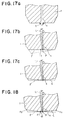
- the center qt of the oblique convex spherical surface q is offset from the point P, as shown in FIG. 18, because the position of qt, the center of the said surface affects Ft, the center of the horizontal surface F, and because the contact with the polishing disc mounted with an elastic abrasive disc creates an unbalance due to the inclination of the ferrule f (for instance, when the angles at the corners fa and fb are different).
- US-A-5007209 discloses a method for manufacturing an optical fiber with a polished end face and an end face polishing apparatus, in which an optical fiber assembly is formed consisting of an optical fibre and a ferrule, with the ferrule having a conical tapered tip, and the optical fiber assembly is polished to form a convex spherical surface at the end face.
- an optical fiber assembly is formed consisting of an optical fibre and a ferrule, with the ferrule having a conical tapered tip, and the optical fiber assembly is polished to form a convex spherical surface at the end face.
- JP-A-1-121805 It is also known from JP-A-1-121805 to form an optical fiber with a polished end surface in which the end surface is an oblique convex spherical surface.
- a method for manufacturing an optical fiber assembly with a polished end face comprising polishing said optical fiber assembly consisting of an optical fiber and a ferrule to form a convex spherical surface at the end face, wherein before polishing to form said convex spherical surface, said ferrule has a conical tapered tip with a taper angle of ⁇ °; characterised in that:
- end face polishing apparatus comprising; a rotatable polishing disc having a horizontal polishing surface, a spindle retaining a ferrule or an optical fiber assembly consisting of an optical fiber and a ferrule, and a shifting means that can bring into contact an end face of the ferrule or the optical fiber assembly retained by said spindle with said rotatable polishing surface and part the end face from said rotatable polishing surface; characterised in that:
- the apparatus comprises a rotatable polishing disc having a concave polishing surface or an elastic abrasive disc mounted polishing surface, a spindle rotatable around an axis of rotation which coincides with a line vertically erected on said polishing surface at the polishing point, said spindle retaining an optical fiber assembly consisting of an optical fiber and a ferrule wherein optical axis of said optical fiber makes an inclination of ⁇ ° with respect to said axis of rotation, a shifting means that can bring into contact the optical fiber assembly retained by said spindle with said polishing surface or alienate the optical fiber assembly retained by said spindle from said polishing surface.
- the apparatus has a rotation reverse means which prevents the twisting of the optical fiber cable by reversing the rotation of the spindle.
- the rotation reverse means may reverse the rotation of the spindle in synchronization with a change in the orientation of the ferrule or the optical fiber assembly consisting of an optical fiber and a ferrule with respect to the direction of rotation of the polishing disc.
- the method provides a step for examining the end point of end-face polishing process of the optical fiber, wherein while said optical fiber assembly consisting of an optical fiber and a ferrule is being polished to form a conical surface at the end face such that, central axis of said conical surface makes an inclination of ⁇ ° with respect to the optical axis of said optical fiber, top of said conical surface coincides with the optical axis of said optical fiber, and has a taper angle of ⁇ ° , a laser beam is passed through the non-polishing end of the optical fiber and the coincidence of the top of said conical surface with the optical axis of said optical fiber is examined by detecting any change in the light reflected at the polishing end.
- the end face polishing apparatus preferably has a laser beam passing means for passing a laser beam through the other end of the optical fiber during oblique conical surface polishing of one end, a reflected light detecting means for detecting any change in the light reflected at the polishing end of the fiber, and thus enabling an examination of the coincidence of the top of said conical surface with the optical axis of said optical fiber by detecting any change in the light reflected at the polishing end.
- end face of a ferrule or an optical fiber assembly consisting of an optical fiber and a ferrule is polished to form a conical surface at said end face such that, central axis of said conical surface makes an inclination of ⁇ ° with respect to the optical axis of said optical fiber, top of said conical surface coincides with the optical axis of said optical fiber, and has a taper-angle of ⁇ ° .
- said optical fiber assembly consisting of an optical fiber and a ferrule is further polished to form a convex spherical surface at said end face such that, central axis of said convex spherical surface makes an inclination of ⁇ ° with respect to the optical axis of said optical fiber.
- the polishing process is carried out from both the top and the edge of the conical surface, thereby forming an oblique convex spherical surface with satisfactory balance, having a center which is not offset from the optical axis point of the optical fiber, and enabling the insertion loss and light reflected back to the source to be stabilized and minimized.
- end face polishing apparatus because the twisting of the optical fiber cable is prevented by reversing the direction of rotation of the optical fiber assembly consisting of an optical fiber and a ferrule, end face of said optical fiber assembly can be polished satisfactorily even with the optical fiber cable attached to said optical fiber assembly.
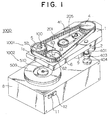
- FIG. 1 is a perspective view of the end face polishing apparatus according to the first embodiment of this invention.
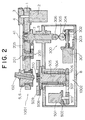
- FIG. 2 is a cross section view of the end face polishing apparatus shown in FIG. 1.
- FIG. 3 is an exploded view in perspective of the collet chuck sleeve shown in FIG. 1.
- FIG. 4 is a cross section view of the collet chuck sleeve shown in FIG. 1.
- FIG. 5 (a) is the cross section view at A-A' shown in FIG. 4, (b) is the cross section view at B-B' shown in FIG. 4, (c) is the cross section view at C-C' shown in FIG. 4, finally, (d) is the cross section view at D-D' shown in Fig. 4.
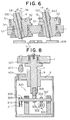
- FIG. 6 is a cross section view in the vicinity of the reversible spindle.
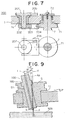
- FIG. 7 is a cross section view of the jig plate shaking device.
- FIG. 8 is a cross section view of the jig unit raising/lowering device.
- FIG. 9 is a cross section view in the vicinity of the reversible spindle used in the oblique conical surface polishing process.
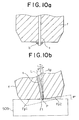
- FIG. 10 is a cross section view for explaining the oblique conical surface polishing process.
- FIG. 11 is a cross section view in the vicinity of the reversible spindle used in the spherical surface polishing process.
- FIG. 12 is a cross section view used for explaining the spherical surface polishing process.
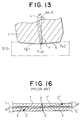
- FIG. 13 is a cross section view after completion of the polishing process.
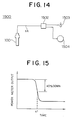
- FIG. 14 is a schematic block diagram of the apparatus for examining the polishing condition.
- FIG. 15 is a graph showing the change in the power of reflected light detected by the power meter of FIG. 14.
- FIG. 16 is an explanatory drawing showing the tips of fiber assemblies comprising of an optical fiber and a ferrule in the mutually-connected condition.
- FIG. 17 is an explanatory drawing of the prior art of polishing the assembly consisting of an optical fiber and a ferrule.
- FIG. 18 is a cross section view of the tip of the assembly obtained by the method of polishing an assembly consisting of an optical fiber and a ferrule according to prior art.
- FIG. 19 is a cross section view of the tip of the ferrule.
- FIG. 20 is a perspective view showing the setting jig.
- FIG. 21 is a perspective view of the setting jig shown in FIG. 20 after the collet chuck sleeve inserted in it.
- FIG. 22 is a cross section view of the setting jig shown in FIG. 20 after the collet chuck sleeve inserted in it.
- FIG. 23 is an explanatory drawing showing the measurement method of the pull-in distance.
- FIG. 1 is a perspective view of the end face polishing apparatus according to the first embodiment of the present invention and FIG. 2 is a cross sectional view of said end face polishing apparatus.
- the end face polishing apparatus 1000 comprises a jig unit 1001 and a polishing unit 1002.
- Reference numeral 8 designates a case
- reference numeral 11 designates a power switch
- reference numeral 12 designates a start switch.
- the jig unit 1001 comprises a jig plate 1, with a reversible motor 2 mounted thereon.
- a spindle pulley 4 is mounted on motor shaft 3 of said reversible motor 2.
- Reference numeral 1a is an oblique surface. This oblique surface 1a makes an angle of 2° with respect to a polishing disc 509, however, said jig plate 1 is horizontal with respect to said polishing disc 509.
- the oblique surface 1a comprises a reversible spindle 5 for polishing into an oblique conical surface. Accordingly, axis of rotation (Ap in FIG. 6) of the reversible spindle 5 is inclined at an angle of 2° with respect to a line (V in FIG. 6) vertically erected on the polishing disc 509. Said jig plate 1 also comprises a reversible spindle 6 for polishing into a spherical surface. However, axis of rotation (As in FIG. 6) of said reversible spindle 6 coincides with the line V.
- Tooth profiles have been cut in the said spindle pulley 4 and the reversible spindles 5 and 6, and a timing belt 41 is stretched around said spindle pulley 4 and said spindles 5 and 6.
- An idler (not shown in the figures) may be provided if necessary.
- Reference numeral 100 designates a collet chuck sleeve (mounted on the reversible spindle 5 in FIG. 1) which can be freely mounted on or dismounted from the reversible spindles 5 or 6.
- Reference numeral 51 (not shown in FIG. 1 and FIG. 2. Refer to FIG. 6), and reference numeral 61 designate insertion holes wherein said collet chuck sleeve 100 can be inserted.
- Reference numerals 52 and 62 designate bolt holes to accommodate bolts (not shown in the figures) for securing said collet chuck sleeve 100.
- Reference numerals 53 (not shown in the figures) and 63 designate key slots for locking the rotation of the collet chuck sleeve 100.
- FIG. 3 is an exploded view in perspective of the collet chuck sleeve 100.
- FIG. 4 is a cross section view of the assembly of said collet chuck sleeve 100.
- This collet chuck sleeve 100 comprises an optical connector positioning sleeve 110, a collet unit sleeve 120 and collet tightening nut 130, a sleeve 150 and a collet chuck sleeve height-adjusting nut 160.
- k is an optical connector
- f is a ferrule
- t is a collar of the ferrule f
- m is a slot in the said collar t.
- s is an optical fiber and sk is an optical fiber cable.
- Said optical connector positioning sleeve 110 has a key slot 111, a ferrule slot 112, and a collar 113.
- a protruding claw 114 is provided on the side opposite to the collar 113 which couples the collar 113 and the slot m of the optical connector k.
- a collet 121, a key 122 (protruding inward), and a key slot 123 are provided in said collet unit sleeve 120.
- a key 151 (protruding inward) and a key 152 are provided in the said sleeve 150.
- a bolt hole 160a (bolt is 160b in FIG. 4) is provided in said collet chuck sleeve height-adjusting nut 160 to lock said nut and to prevent it from rotation with respect to said sleeve 150.
- the collet unit sleeve 120 is inserted in the sleeve 150, such that the key 151 is positioned in the key slot 123 (refer to FIG. 5(a), which is the cross section view at A-A' shown in FIG. 4).
- the collet chuck sleeve height-adjusting nut 160 is screwed in until the- specified position on the sleeve 150, and secured by bolt 160b.
- the collet tightening nut 130 is loosely screwed on said collet unit sleeve 120.
- optical connector k is held in place in the optical connector positioning sleeve 110 by engaging the claw in the said slot m (refer to FIG. 5(b), which is the cross section view at B-B' shown in FIG. 4), while inserting the optical fiber cable sk in the tube section of the optical connector positioning sleeve 110 through key slot 111 and ferrule slot 112.
- said optical connector positioning sleeve 110 is inserted in said collet unit sleeve 120, while positioning said sleeve 110 such that the key 122 is engaged with the key slot 111 (refer to FIG. 5(c), which is the cross section view at C-C' shown in FIG. 4).
- loosely-screwed collet tightening nut 130 is screwed firmly so that the ferrule f is tightened and secured in the collet 121 (refer to FIG. 5(d), which is the cross section view at D-D' shown in FIG. 4).
- the collet chuck sleeve 100 is inserted in the insertion hole 51 to fit said collet chuck sleeve 100 in the end-face polishing apparatus 1000, and key 152 is engaged in the key slot 53 so that the collet chuck sleeve 100 and reversible spindle 5 are positioned.
- the collet chuck sleeve 100 is inserted in the insertion hole 61 for spherical polishing described below, key 152 is engaged in the key slot 63 so that the collet chuck sleeve 100 and reversing spindle 6 are positioned.
- FIG. 6 is a cross section view in the vicinity of the reversible spindles 5 and 6.
- the figure shows the collet chuck sleeve 100 fitted to both the reversible spindles 5 and 6.
- Central axis Lp (same as the optical axis L of optical connector k) of insertion hole 51 is inclined at an angle of 8° with respect to the axis of rotation Ap of the reversible spindle 5. Furthermore, the axis of rotation Ap of the reversible spindle 5, is inclined at an angle of 2° with respect to the line V vertically erected on the polishing disc 509. Therefore, the central axis Lp of the insertion hole 51 makes a total inclination of 10° with respect to said line V.
- Central axis Ls (same as the optical axis L of the optical connector k) of the insertion opening 61 is inclined at an angle of 8° with respect to the axis of rotation As of the reversing spindle 6. The axis of rotation As of the reversible spindle 6 coincides with said line V. Therefore, the central axis Ls of the insertion opening 61 makes only an angle of 8° with respect to said line.
- the jig plate 1 is supported by the feed shaft 7 which can shake the jig plate 1 transversely or move the jig plate 1 vertically.
- Transverse shaking is performed by a jig plate shaking device 200.
- Vertical movement is performed by jig unit raising/lowering device 300.
- FIG. 7 is a cross section view of the jig plate shaking device 200.
- a pulley 201 is supported by a slide bearing 1c of said jig plate 1.
- An eccentric disc 203 is fixed on a pulley shaking shaft 202.
- a fork 204 is secured to the collar 71 of the feed shaft 7 by bolts.
- a shaking cam is formed by comprising said fork 204 and said eccentric disc 203.
- a rubber belt 205 is stretched around said pulley 201 and the spindle pulley 4.
- the spindle pulley 4 rotates due to a drive of the reversible motor 2, the pulley 201; the pulley shaking shaft 202; and the eccentric disc 203 rotates.
- the pulley shaking shaft 202 starts shaking because of the eccentric disc 203 being constrained by the fork 204, thereby causing the jig plate 1 to be shacked transversely.
- FIG. 8 is a schematic cross section view of the jig unit raising/lowering device 300.
- a roller 306 supported by a cam 305 is fitted at the bottom end of the feed shaft 7.
- Said cam 305 fitted to a cam shaft 307 is provided with a worm wheel 304.
- Said worm wheel 304 is engaged with a worm 303 fitted on the motor shaft 302.
- cam 308 meant for detecting a top position, detects the top position and presses a micro-switch 310, a top position detected signal is output.
- cam 309 meant for detecting a bottom position, detects the bottom position and presses a micro-switch 311, a bottom position detected signal is output.
- Stopper shaft 401 is secured by screws to the jig plate 1. Bottom end of this stopper shaft 401 is provided with a micrometer head 403. Said micrometer head 403 is stopped by a stopper plate 404 provided on the upper surface of the case 8.
- the polishing disc 509 and a polishing disc stand 508 are secured to the upper end flange of the polishing disc shaft 505 by a retaining plate 510 and a bolt.
- the polishing disc shaft 505 is rotatably retained in the cylinder 504 which is inserted through the upper surface of the case 8 and secured.
- a belt pulley 506 is provided at the lower end of the polishing disc shaft 505.
- Motor shaft 502 of the polishing disc drive motor 501 is also provided with a belt pulley 503.
- a flat belt 507 is stretched around the belt pulleys 503 and 506.
- the belt pulley 506 rotates by a transmission through the flat belt 507, thereby causing the polishing disc shaft 505; the polishing disc stand 508 and the polishing disc 509 to rotate.
- FIG. 9 is a schematic cross section view for explaining the polishing process into an oblique conical surface.
- Optical connector k is secured in the collet chuck sleeve 100 and inserted in the insertion hole 51 of the reversible spindle 5 for polishing into an oblique conical surface.
- Optical axis L of the optical connector k is inclined at an angle of 8° with respect to Ap, the axis of rotation of the reversible spindle 5.
- said axis of rotation Ap is inclined at an angle of 2° with respect to line V vertically erected on the polishing disc 509.
- the position of the end face of the optical connector k is adjusted using the collet chuck sleeve height-adjusting nut 160. Said position of the end face of the optical connector k is so adjusted that, the point P where the optical axis L intersects with the end face coincides with the axis of rotation Ap of the reversible spindle 5.
- the polishing disc 509 has a rotation speed of 66 m/second at the polishing point and a rotation period of 15 seconds.
- Reversible spindle 5 switches the direction and rotates in the reverse direction every second. Said reverse rotation is essentially to avoid any twisting of the optical fiber cable sk. If there is no possibility of twisting the optical fiber cable sk, the spindle may be allowed to be rotated in a single direction only.
- the jig plate 1 is made to shake transversely to avoid a coincidence of the polishing point at a single location of the polishing disc 509.
- the start switch 12 is turned on, the jig unit lowering/raising device 300 lowers the jig unit 1001 and the tip of the ferrule f is brought in contact with the polishing disc 509 where it is polished.
- a completion of the process of polishing into an oblique conical surface can be checked by introducing a laser beam of wavelength 1.3 ⁇ m through the other end of the optical fiber cable sk and detecting a change in the power of the returned beam at the interface according to the change in angle of the end face of the optical fiber s.
- FIG. 10(a) is the cross section view of the tip of the optical connector k before it is polished into an oblique conical surface, showing the optical fiber s and the tapered tip edge part of the ferrule f bonded by an adhesive b.
- FIG. 10(b) is the cross section view of the tip of the optical connector k after completion of the process of polishing into oblique conical surface, showing the tip of the ferrule f cut to a conical surface with a taper angle of 2° with respect to the axis of rotation Ap taken as the central axis, and the top Ft of the conical surfaces Fp1 and Fp2 coinciding with a point P where the optical axis L of the optical fiber s coincides with said conical surface.
- FIG. 11 is a schematic cross section view for explaining the process of polishing into a spherical surface.
- the power switch 11 is turned off.
- Collet chuck sleeve 100 is removed from the reversible spindle 5 and inserted in the insertion hole 61 of the reversible spindle 6.
- the optical axis L of the optical connector k is inclined at an angle of 8° with respect to As, the axis of rotation of the reversible spindle 6, and this axis of rotation As coincides with the line V vertically erected on the polishing disc 509.
- an elastic abrasive disc 512 is mounted on said polishing disc 509.
- the position of the end face of the optical connector k can be adjusted using the collet chuck sleeve height-adjusting nut 160. Said position of the end face of the optical connector k is adjusted to such a height that, when said end face is polished obliquely into a spherical surface, the point P where the optical axis L intersects with the end face and the axis of rotation As of the reversible spindle 6 coincide. However, this adjustment can be made unnecessary if the heights of each component are set accurately beforehand.
- the power switch 11 is turned on to operate the reversible spindle 6, the elastic abrasive disc 512, and the jig plate shaking device 200 and alike.
- the start switch 12 is turned on, the jig unit lowering/raising device 300 lowers the jig unit 1001 and the tip of the ferrule f is brought in contact with the elastic abrasive disc 512 where it is polished.
- the angle of inclination of the axis of rotation Ap of the oblique conical surface was taken as 2° with respect to a line V vertically erected on the polishing disc 509, however, any angle in the range 1.5° to 3° may be used. If the angle is smaller than 1.5° , polishing the top Ft at the center becomes difficult, and there will be no change from the prior art. If the angle is larger than 3° , the amount to be polished becomes large, and the polishing time increases thereby. Furthermore, the top Ft may become excessively sharp-pointed and may damage the elastic abrasive disc 512.
- a polishing disc with a concave spherical surface may be used for spherical surface polishing instead of said elastic abrasive disc 512.
- oblique convex spherical surface qt with a radius of 20 mm was formed.
- the mean value of curvature symmetry (offset angle between the center qt of the oblique convex spherical surface q and the point P where the optical axis of the optical fiber s coincides with said conical surface of the optical fiber s) after polishing a sum of 50 connectors was 0.014° and the standard deviation was 0.003°.
- the mean value of RL was found to be 68 dB and its standard deviation was 1 dB.
- the connector k was then connected to a master connector and it was found this time that, the return loss RL was 64 dB, the standard deviation was 1 dB, and also that all the 50 tested optical connectors had a return loss RL of at least 60 dB. Said connector k was then removed from the master connector and the end face of the master connector end face was brought in contact with the air layer. The return loss RL measured in this case was 48 dB. This shows that, a physical contact is maintained in mutual connections of the tested connector.
- the return loss RL from single mode optical fiber deteriorates by 4 dB, however, this is due to a large difference in refractive index, and also due to an increase in the return power because of Rayleigh scattering from the optical fiber s.
- Measurement of insertion loss CL gave a mean value of 0.15 dB, with the worst value as 0.35 dB.
- Fig. 14 is the schematic block diagram of the apparatus for checking the polishing condition.
- the polishing condition checking apparatus 1500 comprises; a collet chuck sleeve 100, an optical connector k inserted therein, an optical fiber cable sk connected thereto, end of said optical fiber cable sk connected to a laser diode 1503 and a power meter 1504 through an optical fiber coupler 1502.
- Said collet chuck sleeve 100 is inserted in the reversible spindle 5 and polishing of the oblique conical surface is started.
- a laser beam of wavelength 1.3 ⁇ m is passed through the optical fiber cable sk from the laser diode 1503.
- the polishing of the oblique conical surface is continued, when the top Ft of the conical surface and the point P of the optical fiber s coincide, the power of the light reflected back to source changes abruptly, as shown in FIG. 15. If this change is detected by the power meter 1504, the end point of polishing process of the oblique conical surface can considered to be accomplished.
- FIG. 15 is a graph showing a change in the power of light reflected back to the source detected by the power meter during the oblique conical surface polishing process. If, for instance, the power of light reflected back to the source has reduced to approximately 40% of the power at the start of polishing (in time S1) in this graph, since the optical axis point of the optical fiber and the top Ft of the conical surface has coincided, the polishing process of the oblique conical surface may be judged as completed.
- the polishing process can be carried out while practically confirming the coincidence of the top Ft of the conical surface and the optical axis point P of the optical fiber s. If the apparatus is connected to the jig unit raising/lowering device 300, the polishing process can be completed automatically, thereby improving the working efficiency.
- the inventors of the present invention investigated the causes of this offset in depth and found that, while the ferrule f is tightened by the collet 121 and gripped in position, the optical fiber assembly is set in the collet chuck sleeve 100 and the ferrule f is pulled into the collet sleeve 120 because of the nature of construction of the collet chuck. Therefore, the ferrule protuberance (i.e. the length of the ferrule f which protrudes from the collet 121 as shown in FIG. 4) becomes smaller than the required value, resulting in inadequate polishing of the ferrule f.
- the inventors of the present invention have invented a setting jig.
- the setting jig comprises the first sleeve, through which passes the optical fiber from the rear end of the ferrule inserted and secured in the optical fiber assembly, and which is in contact with the said ferrule, the second sleeve wherein the said first sleeve with a collet at the front end which grips the tip of the said ferule is inserted, a tightening nut screwed at the rear end of the second sleeve, and the third sleeve wherein the said second sleeve is inserted, and containing a tapered front end for enclosing the said collet.
- the setting jig is characterized by the fact that it is used for setting the said optical fiber assembly in the polishing jig which grips the front end of the ferrule in the said-collet after the said tightening nut is tightened and the said second sleeve is inserted in the said third sleeve and the collet is closed, and comprises a hole wherein is inserted the polishing jig loosely gripping the said optical fiber assembly, a holder with securing means for securing the third sleeve of the polishing jig which is inserted in the said hole, a stopper in contact with the tip of the ferrule or optical fiber of the optical fiber assembly loosely gripped in the polishing jig retained in the said holder, and a clamp for preventing retreat of the said optical fiber assembly in contact with the rear end of the first sleeve of the polishing jig retained in the said holder.
- the tightening nut is loosely tightened with the ferrule protuberance adjusted at the required value, and the optical fiber assembly is loosely gripped in the polishing jig.
- the polishing jig is inserted in the hole of the holder of the setting jig, and the polishing jig is pushed out until the tip of the ferrule touches the stopper, and the third sleeve is secured using the securing means.
- the clamp is then brought in contact with the rear end of the first sleeve of the polishing jig to prevent the said optical fiber assembly from retreating. In this condition, the tightening nut is firmly tightened, and the optical fiber assembly is gripped firmly in the polishing jig.
- FIG. 20 is a perspective view showing the setting jig.
- the setting jig 2010 comprises a base 2001, which is a C-shaped metallic block.
- the holder 2001a forms one side of the base 2001, provided with hole 2002 for inserting the collet chuck sleeve 100 shown in FIG. 3, and a lock screw 2006 for securing the collet chuck sleeve 100.
- the type of fit between the said hole 2002 and the collet chuck sleeve 100 is a high-level clearance fit complying with H8/f6 of the Japanese Industrial Standards.
- the outside wall surface surrounding the hole 2002 becomes the vertical reference plane for the collet chuck sleeve 100, therefore, the said surface is machined to a smoothness of 1.6S of the Japanese Industrial Standards.
- the other side of the base 2001 comprises the stopper 2001b, the stopper screw 2003 in contact with the tip of the ferrule f or optical fiber s shown in FIG. 3, and the lock screw 2007 for securing the stopper screw 2003.
- the surface 2003a in contact with the optical fiber s or tip of the ferrule f is machined to a smoothness of 1.6s of the Japanese Industrial Standards.
- the threaded part of the stopper screw 2003 is provided with fine threads to reduce backlash to a minimum.
- Clamp screw 2004 is a clamp screw. This clamp screw 2004 pushes against the flange 113 of the optical connector positioning sleeve 110 shown in FIG. 3, and prevents the retreat of the said optical connector positioning sleeve 110.
- Clamp screw 2004 is provided with a turning rod hole 2004a. The tip 2005a of the turning rod 2005 is inserted in the turning rod hole 2004a and the clamp screw 2004 is rotated.
- the collet chuck sleeve 100 is assembled (refer to FIG. 3 and FIG. 4). During this assembly, the collet tightening nut 130 is to be temporarily tightened with the protuberance of the ferrule f adjusted at the required value.
- the stopper screw 2003 is rotated and the distance from the outside wall surface surrounding the hole 2002 of the holder 2001a to the contact surface 2003a of the stopper screw 2003 is adjusted to the required vertical reference value. After adjustment, the stopper screw 2003 is secured by using the lock screw 2007.
- the clamp screw 2004 is removed and the collet chuck sleeve 100 is inserted in the hole 2002, aligning the key slot 2002a of the hole 2002 and the key 152 (refer to FIG. 3) of the collet chuck sleeve 100.
- the clamp screw 2004 is fitted, and screwed in lightly until it touches the flange 113 of the optical connector positioning sleeve 110. Furthermore, the clamp screw 2004 is screwed in loosely, the flange 113 of the optical connector positioning sleeve 110 pushed, and the tip of the ferrule f brought in contact with the contact surface 2003a of the stopper screw 2003.
- the turning rod 2005 is inserted in the turning rod hole 2004a of the clamp screw 2004, and tightened with appropriate force so that unnecessary clearance does not remain.
- the collet chuck sleeve 100 is secured in position by the lock screw 2006 so that it does not move in the axial direction.
- the collet chuck sleeve height adjustment nut 160 is tightened with appropriate force so that it comes in close contact with the outside wall surface surrounding the hole 2002 of the holder 2001a.
- the collet chuck sleeve vertical adjustment nut 160 is secured in position by the bolt 160b so that it does not rotate.
- the collet tightening nut 130 is screwed in firmly, the ferrule f is gripped by the collet 121, and the optical fiber assembly k is gripped firmly in the collet chuck sleeve 100.
- the optical fiber assembly is set in the collet chuck sleeve 100. At this stage, a constant tightening force is maintained on the clamp screw 2004 and the collet tightening nut 130.
- the setting jig 2010 is erected on the level block as shown in FIG. 23, lock screw 2006 is loosened, the collet chuck sleeve 100 is pulled up held in position using a spacer 2041 of the required height.
- a dial gauge 2042 with a 2/1000 mm scale is installed on the level block, the terminal of the dial gauge 2042 is brought into contact with the tip of the ferrule f, and the reading on the dial gauge is taken.
- the optical fiber assembly was set in the collet chuck sleeve 100 without using the setting jig 2010.
- the collet chuck sleeve was maintained at a fixed position, and the position of the tip of the ferrule f was measured using a height gauge.
- the tip of the ferrule of the fiber-ferrule assembly is polished to a conical surface, which is thereafter polished to s spherical surface, therefore, during the spherical surface polishing process, the polishing of the top of the conical surface proceeds faster from both edges of the conical surface, and gives a satisfactory balance, enabling a satisfactory, oblique convex spherical surface to be formed. Therefore, there is no offset between the optical axis point of the optical fiber and the center of the oblique convex spherical surface, thereby the insertion loss and the light reflected back to the source can be stabilized and minimized.
Landscapes
- Engineering & Computer Science (AREA)
- Mechanical Engineering (AREA)
- Grinding And Polishing Of Tertiary Curved Surfaces And Surfaces With Complex Shapes (AREA)
Claims (12)
- Verfahren zur Herstellung einer optischen Faseranordnung mit polierter Endfläche, umfassend das Polieren der optischen Faseranordnung, die aus einer optischen Faser (s) und einem Klemmkörper (f) besteht, um eine konvexe sphärische Oberfläche (q) an der Endfläche zu bilden, worin vor dem Polieren zur Bildung der konvexen sphärischen Oberfläche (q) der Klemmkörper (f) eine konische Spitze mit einem Verjüngungswinkel von ∝° besitzt;
dadurch gekennzeichnet, daß:vor dem Polieren zur Bildung der konvexen sphärischen Oberfläche (q) der Klemmkörper (f) mit konischer Spitze oder die optische Faseranordnung, die aus der optischen Faser (s) und dem Klemmkörper (f) mit konischer Spitze besteht, poliert wird, um eine schräge konische Oberfläche (Fp1, Fp2) an der Endfläche zu bilden, sodaß die Mittelachse (Ap) der schrägen konischen Oberfläche (Fpa, Fp2) einen Winkel von ° in bezug auf die optische Achse der optischen Faser (s) bildet, wobei die Spitze (Ft) der schrägen konischen Oberfläche (Fp1, Fp2) mit der optischen Achse (L) der optischen Faser (s) zusammenfällt; unddas Polieren der optischen Faseranordnung solcherart erfolgt, daß die konvexe sphärische Oberfläche (q) schräg verläuft und eine Neigung von ° in bezug auf die optische Achse (L) der optischen Faser (s) aufweist. - Verfahren zur Herstellung einer optischen Faseranordnung mit polierter Endfläche nach Anspruch 1, worin die Neigung zumindest 8° und höchstens 12° beträgt.
- Verfahren zur Herstellung einer optischen Faseranordnung mit polierter Endfläche nach Anspruch 1 oder 2, worin der Winkel α° zumindest 1,5° und nicht mehr als 3° beträgt.
- Verfahren nach einem der Ansprüche 1 bis 3, worin während des Polierens der aus einer optischen Faser (s) und einem Klemmkörper (f) bestehenden optischen Faseranordnung zur Bildung der konischen Oberfläche (Fp1, Fp2) ein Laserstrahl durch das Nicht-Polierende der optischen Faser geleitet und die Koinzidenz der Spitze (Ft) der konischen Oberfläche (Fp1, Fp2) mit der optischen Achse (L) der optischen Faser (s) durch Detektieren jeglicher Änderung des am Polierende reflektierten Lichts untersucht wird.
- Endflächenpoliervorrichtung, umfassend: eine drehbare Polierscheibe (509) mit einer horizontalen Polierfläche, eine Spindel (5), die einen Klemmkörper (f) oder eine optische Faseranordnung, die aus einer optischen Faser (s) und einem Klemmkörper (f) besteht, festhält, und ein Verlagerungsmittel (300), das ein Ende des Klemmkörpers (f) oder die optische Faseranordnung, der bzw. die durch die Spindel (5) gehalten wird, mit der drehbaren Polierfläche in und außer Kontakt bringen kann;
dadurch gekennzeichnet, daß:die Spindel (5) um eine Rotationsachse (Ap) drehbar ist, die einen Winkel von α° in bezug auf eine Linie (V) bildet, die vertikal auf die Polierfläche steht, und den Klemmkörper (f) mit einer konischen Spitze oder eine optische Faseranordnung, die aus einer optischen Faser (s) und einem Klemmkörper (f) mit konischer Spitze besteht, in einem Einsetzloch festhält, wobei die Achse (L, p) des Einsetzlochs oder die optische Achse (L) der optischen Faser eine Neigung von ° in bezug auf die Rotationsachse (Ap) aufweist. - Endflächenpoliervorrichtung nach Anspruch 5, weiters umfassend eine drehbare Polierscheibe (509) mit einer konkaven Polierfläche oder eine Polierfläche an einer elastischen Schleifscheibe, eine Spindel (6), die um eine Rotationsachse drehbar ist, die mit einer Linie (V) zusammenfällt, die am Polierpunkt vertikal auf die Polierfläche steht, wobei die Spindel (6) eine optische Faseranordnung festhält, die aus einer optischen Faser (s) und einem Klemmkörper (f) besteht, worin die optische Achse (L) der optischen Faser (s) eine Neigung von ° in bezug auf die Rotationsachse aufweist, und ein Verlagerungsmittel (300), das die durch die Spindel (6) festgehaltene optische Faseranordnung mit der Polierfläche in und außer Kontakt bringen kann.
- Endflächenpoliervorrichtung nach Anspruch 5 oder 6, weiters umfassend ein Rotationsumkehrmittel, das das Verdrehen der optischen Faser (f) durch Umkehr der Drehung der Spindel (5, 6) verhindert.
- Endflächenpoliervorrichtung nach Anspruch 7, worin das Rotationsumkehrmittel angeordnet ist, die Drehung der Spindel (5, 6) synchron mit einer Änderung der Ausrichtung des Klemmkörpers (f) oder der aus einer optischen Faser (s) und einem Klemmkörper (f) bestehenden optischen Faseranordnung in bezug auf die Drehrichtung der Polierscheibe (509) umzukehren.
- Endflächenpoliervorrichtung nach einem der Ansprüche 5 bis 8, umfassend ein Schüttelmittel (200), das den Klemmkörper (f) oder die aus der optischen Faser (s) und dem Klemmkörper (f) bestehende optische Faseranordnung schüttelt, um den Polierpunkt auf der Polierfläche zu verlagern und somit eine örtliche Abnützung der Polierfläche am Polierpunkt zu verhindern.
- Endflächenpoliervorrichtung nach einem der Ansprüche 5 bis 9, worin die Neigung ° zumindest 8° und höchstens 12° beträgt.
- Endflächenpoliervorrichtung nach einem der Ansprüche 8 bis 10, worin der Winkel ∝° zumindest 1,5° und höchstens 3° beträgt.
- Endflächenpoliervorrichtung (1000) nach einem der Ansprüche 5 bis 11, umfassend ein Laserstrahlleitmittel (1503), um einen Laserstrahl durch das andere Ende der optischen Faser (s) während des Polierens der schrägen konischen Oberfläche eines Endes zu leiten, und ein Detektormittel (1504) für reflektiertes Licht, um jegliche Änderung des am Polierende der optischen Faser (s) reflektierten Lichts zu detektieren, wodurch eine Untersuchung der Koinzidenz der Spitze (Ft) der konischen Oberfläche mit der optischen Achse (L) der optischen Faser (s) durch Detektieren jeglicher Änderung des am Polierende reflektierten Lichts ermöglicht wird.
Applications Claiming Priority (2)
| Application Number | Priority Date | Filing Date | Title |
|---|---|---|---|
| JP5310265A JP2896481B2 (ja) | 1993-12-10 | 1993-12-10 | 端面研磨光ファイバ組立体の製造方法および端面研磨装置および光ファイバ端面研磨終点確認方法 |
| JP310265/93 | 1993-12-10 |
Publications (3)
| Publication Number | Publication Date |
|---|---|
| EP0657247A2 EP0657247A2 (de) | 1995-06-14 |
| EP0657247A3 EP0657247A3 (de) | 1995-09-06 |
| EP0657247B1 true EP0657247B1 (de) | 1998-04-22 |
Family
ID=18003164
Family Applications (1)
| Application Number | Title | Priority Date | Filing Date |
|---|---|---|---|
| EP94309278A Expired - Lifetime EP0657247B1 (de) | 1993-12-10 | 1994-12-12 | Herstellung von optischen Fasern mit poliertem Ende |
Country Status (4)
| Country | Link |
|---|---|
| US (1) | US5559916A (de) |
| EP (1) | EP0657247B1 (de) |
| JP (1) | JP2896481B2 (de) |
| DE (1) | DE69409767T2 (de) |
Families Citing this family (27)
| Publication number | Priority date | Publication date | Assignee | Title |
|---|---|---|---|---|
| JPH0875952A (ja) * | 1994-09-08 | 1996-03-22 | Whitaker Corp:The | 光コネクタ及びその端面研磨方法 |
| JP3078713B2 (ja) * | 1994-10-07 | 2000-08-21 | 株式会社精工技研 | 複数種類の光ファイバを研磨する光ファイバ端面研磨装置 |
| JP3659671B2 (ja) * | 1994-10-13 | 2005-06-15 | セイコーインスツル株式会社 | 光ファイバ端面研磨機及び研磨方法 |
| US5674114A (en) * | 1994-11-10 | 1997-10-07 | The Whitaker Corporation | Universal polishing plate for polishing machine |
| WO1996014960A2 (en) * | 1994-11-10 | 1996-05-23 | The Whitaker Corporation | Universal polishing fixture for polishing optical fiber connectors |
| US5643064A (en) * | 1995-09-08 | 1997-07-01 | The Whitaker Corporation | Universal polishing fixture for polishing optical fiber connectors |
| US5711701A (en) * | 1996-06-19 | 1998-01-27 | The Whitaker Corporation | Universal polishing fixture for holding connectors |
| US6415087B1 (en) | 1997-06-04 | 2002-07-02 | Corning Laserton, Inc. | Polished fused optical fiber endface |
| US6302763B1 (en) * | 1998-06-29 | 2001-10-16 | Mike Buzzetti | Apparatus for polishing |
| US6454631B1 (en) | 1998-06-29 | 2002-09-24 | Mike Buzzetti | Polishing apparatus and method |
| US6712526B1 (en) | 2000-07-13 | 2004-03-30 | Corning Cable Systems Llc | Angled physical contact ferrule and associated method and apparatus for fabricating same |
| US6488567B1 (en) | 2000-11-09 | 2002-12-03 | Axsun Technologies, Inc. | System and method for automated fiber polishing |
| US6433924B1 (en) * | 2000-11-14 | 2002-08-13 | Optical Coating Laboratory, Inc. | Wavelength-selective optical amplifier |
| JP2003019649A (ja) * | 2001-07-05 | 2003-01-21 | Seiko Instruments Inc | 端面研磨装置 |
| US6599030B1 (en) * | 2002-02-08 | 2003-07-29 | Adc Telecommunications, Inc. | Method for polishing a fiber optic connector |
| US6890243B2 (en) * | 2002-04-23 | 2005-05-10 | Nippon Telegraph And Telephone Corporation | Processing method and apparatus of distal end of optical fiber |
| US6896418B1 (en) * | 2002-06-21 | 2005-05-24 | Realm Communications Group, Inc. | Planar polishing fixture |
| US6918816B2 (en) | 2003-01-31 | 2005-07-19 | Adc Telecommunications, Inc. | Apparatus and method for polishing a fiber optic connector |
| US7365405B2 (en) * | 2004-04-27 | 2008-04-29 | Potochnik Stephen J | Metrology structure and methods |
| US7209629B2 (en) * | 2004-06-14 | 2007-04-24 | Adc Telecommunications, Inc. | System and method for processing fiber optic connectors |
| US7352938B2 (en) * | 2004-06-14 | 2008-04-01 | Adc Telecommunications, Inc. | Drive for system for processing fiber optic connectors |
| US7068906B2 (en) * | 2004-06-14 | 2006-06-27 | Adc Telecommunications, Inc. | Fixture for system for processing fiber optic connectors |
| US7192197B2 (en) * | 2004-09-27 | 2007-03-20 | Neptec Optical Solutions, Inc. | Planetary cleaning motion optical connector cleaner |
| JP2010266580A (ja) * | 2009-05-13 | 2010-11-25 | Hoya Corp | 共焦点光学システム |
| CN102848307B (zh) * | 2012-09-13 | 2014-09-17 | 黄石晨信光电有限责任公司 | 一种非标光纤连接头研磨专用工模夹具 |
| US10866368B2 (en) * | 2018-08-31 | 2020-12-15 | Corning Incorporated | Apparatus for processing a ferrule and associated method |
| CN109986440B (zh) * | 2019-04-30 | 2024-02-13 | 武汉楚星光纤应用技术有限公司 | 锥形光纤自动抛磨设备及抛磨方法 |
Family Cites Families (9)
| Publication number | Priority date | Publication date | Assignee | Title |
|---|---|---|---|---|
| US4787698A (en) * | 1985-11-27 | 1988-11-29 | American Telephone And Telegraph Co., At&T Bell Labs | Methods of and apparatus for reconfiguring optical fiber connector components and products produced thereby |
| JPS63102862A (ja) * | 1986-10-21 | 1988-05-07 | Nippon Telegr & Teleph Corp <Ntt> | 光フアイバフエル−ル端面研磨装置 |
| US5007209A (en) * | 1987-06-26 | 1991-04-16 | K.K. Sankyo Seiki Seisakusho | Optical fiber connector polishing apparatus and method |
| JP2603640B2 (ja) * | 1987-07-15 | 1997-04-23 | 松下電工株式会社 | 照明器具 |
| JPH01121805A (ja) * | 1987-11-06 | 1989-05-15 | Seiko Giken:Kk | 光コネクタ用組立体およびその研磨治具並びに光ファイバの接続方法 |
| US4999955A (en) * | 1988-01-14 | 1991-03-19 | K.K. Sankyo Seiki Seisakusho | Method and apparatus for conically machining optical fiber connectors |
| US5131745A (en) * | 1990-11-02 | 1992-07-21 | The Charles Stark Draper Lab., Inc. | Method and apparatus for aligning the optical axis of a fiber optic element with the axis of rotation |
| JP3116124B2 (ja) * | 1991-08-23 | 2000-12-11 | 東京特殊電線株式会社 | 光ファイバ接続体 |
| US5412747A (en) * | 1994-03-07 | 1995-05-02 | Emit Seiko Co., Ltd. | Apparatus for and method of polishing optical connectors |
-
1993
- 1993-12-10 JP JP5310265A patent/JP2896481B2/ja not_active Expired - Lifetime
-
1994
- 1994-12-08 US US08/352,258 patent/US5559916A/en not_active Expired - Fee Related
- 1994-12-12 EP EP94309278A patent/EP0657247B1/de not_active Expired - Lifetime
- 1994-12-12 DE DE69409767T patent/DE69409767T2/de not_active Expired - Fee Related
Also Published As
| Publication number | Publication date |
|---|---|
| JP2896481B2 (ja) | 1999-05-31 |
| US5559916A (en) | 1996-09-24 |
| DE69409767T2 (de) | 1998-10-08 |
| EP0657247A3 (de) | 1995-09-06 |
| EP0657247A2 (de) | 1995-06-14 |
| DE69409767D1 (de) | 1998-05-28 |
| JPH07164299A (ja) | 1995-06-27 |
Similar Documents
| Publication | Publication Date | Title |
|---|---|---|
| EP0657247B1 (de) | Herstellung von optischen Fasern mit poliertem Ende | |
| EP0662366B1 (de) | An ihrem Ende polierte Steckerhülse und ihr Herstellungsverfahren | |
| US6848836B2 (en) | Optical fiber connector with a base end threaded ferrule | |
| US8256970B2 (en) | Re-terminable LC connector assembly and cam termination tool | |
| US5501385A (en) | Large core fiber optic cleaver | |
| CN1176785C (zh) | 用于光纤端面研磨装置的联接套夹持件 | |
| US7252130B2 (en) | Apparatus for fabricating a multi-fiber polarization-maintaining fiber assembly | |
| US5131745A (en) | Method and apparatus for aligning the optical axis of a fiber optic element with the axis of rotation | |
| GB2287552A (en) | Curved-angle cleaving of optical fibers | |
| US6712526B1 (en) | Angled physical contact ferrule and associated method and apparatus for fabricating same | |
| US20150177460A1 (en) | Optical fiber cleaving mechanism and method of use | |
| EP0105909A1 (de) | Präzisionsspalten optischer fasern. | |
| CN1093942C (zh) | 光导基片端平行度调节设备 | |
| US6817931B2 (en) | End face polishing apparatus | |
| CN209774327U (zh) | 回转盘、光纤端面研磨装置及光纤端面检测装置 | |
| CN117471616B (zh) | 一种保偏双光纤尾纤及其自动对轴设备和自动对轴方法 | |
| JPH073493B2 (ja) | 定偏波光ファイバの融着接続方法 | |
| US20040106362A1 (en) | Jig plate and end face polishing method | |
| JP2006047466A (ja) | 光ファイバアライメント装置 | |
| JP3929659B2 (ja) | 端面研磨装置 | |
| US20030073379A1 (en) | Endface polishing method and endface polishing apparatus | |
| JP4084230B2 (ja) | 光コネクタプラグの研磨装置 | |
| JPH07112356A (ja) | 光コネクタの研磨装置 | |
| JPS62140756A (ja) | 光フアイバ・コネクタ端面研磨機 | |
| CN120405833A (zh) | 保偏光纤阵列组装设备及保偏光纤阵列组装方法 |
Legal Events
| Date | Code | Title | Description |
|---|---|---|---|
| PUAI | Public reference made under article 153(3) epc to a published international application that has entered the european phase |
Free format text: ORIGINAL CODE: 0009012 |
|
| AK | Designated contracting states |
Kind code of ref document: A2 Designated state(s): CH DE FR GB LI |
|
| PUAL | Search report despatched |
Free format text: ORIGINAL CODE: 0009013 |
|
| AK | Designated contracting states |
Kind code of ref document: A3 Designated state(s): CH DE FR GB LI |
|
| 17P | Request for examination filed |
Effective date: 19951102 |
|
| 17Q | First examination report despatched |
Effective date: 19960903 |
|
| GRAG | Despatch of communication of intention to grant |
Free format text: ORIGINAL CODE: EPIDOS AGRA |
|
| GRAG | Despatch of communication of intention to grant |
Free format text: ORIGINAL CODE: EPIDOS AGRA |
|
| GRAH | Despatch of communication of intention to grant a patent |
Free format text: ORIGINAL CODE: EPIDOS IGRA |
|
| GRAH | Despatch of communication of intention to grant a patent |
Free format text: ORIGINAL CODE: EPIDOS IGRA |
|
| GRAA | (expected) grant |
Free format text: ORIGINAL CODE: 0009210 |
|
| AK | Designated contracting states |
Kind code of ref document: B1 Designated state(s): CH DE FR GB LI |
|
| REG | Reference to a national code |
Ref country code: CH Ref legal event code: EP |
|
| REF | Corresponds to: |
Ref document number: 69409767 Country of ref document: DE Date of ref document: 19980528 |
|
| ET | Fr: translation filed | ||
| REG | Reference to a national code |
Ref country code: CH Ref legal event code: PUEA Free format text: TOTOKU ELECTRIC CO., LTD.;EMIT SEIKO CO., LTD. TRANSFER- TOTOKU ELECTRIC CO., LTD.;NOMURA JIMUSHO INC., |
|
| REG | Reference to a national code |
Ref country code: GB Ref legal event code: 732E |
|
| REG | Reference to a national code |
Ref country code: FR Ref legal event code: CD |
|
| PLBE | No opposition filed within time limit |
Free format text: ORIGINAL CODE: 0009261 |
|
| STAA | Information on the status of an ep patent application or granted ep patent |
Free format text: STATUS: NO OPPOSITION FILED WITHIN TIME LIMIT |
|
| 26N | No opposition filed | ||
| PGFP | Annual fee paid to national office [announced via postgrant information from national office to epo] |
Ref country code: GB Payment date: 20001201 Year of fee payment: 7 |
|
| PGFP | Annual fee paid to national office [announced via postgrant information from national office to epo] |
Ref country code: FR Payment date: 20001214 Year of fee payment: 7 |
|
| PGFP | Annual fee paid to national office [announced via postgrant information from national office to epo] |
Ref country code: DE Payment date: 20001218 Year of fee payment: 7 Ref country code: CH Payment date: 20001218 Year of fee payment: 7 |
|
| PG25 | Lapsed in a contracting state [announced via postgrant information from national office to epo] |
Ref country code: GB Free format text: LAPSE BECAUSE OF NON-PAYMENT OF DUE FEES Effective date: 20011212 |
|
| PG25 | Lapsed in a contracting state [announced via postgrant information from national office to epo] |
Ref country code: LI Free format text: LAPSE BECAUSE OF NON-PAYMENT OF DUE FEES Effective date: 20011231 Ref country code: CH Free format text: LAPSE BECAUSE OF NON-PAYMENT OF DUE FEES Effective date: 20011231 |
|
| REG | Reference to a national code |
Ref country code: GB Ref legal event code: IF02 |
|
| PG25 | Lapsed in a contracting state [announced via postgrant information from national office to epo] |
Ref country code: DE Free format text: LAPSE BECAUSE OF NON-PAYMENT OF DUE FEES Effective date: 20020702 |
|
| GBPC | Gb: european patent ceased through non-payment of renewal fee |
Effective date: 20011212 |
|
| REG | Reference to a national code |
Ref country code: CH Ref legal event code: PL |
|
| PG25 | Lapsed in a contracting state [announced via postgrant information from national office to epo] |
Ref country code: FR Free format text: LAPSE BECAUSE OF NON-PAYMENT OF DUE FEES Effective date: 20020830 |
|
| REG | Reference to a national code |
Ref country code: FR Ref legal event code: ST |