EP0657264A1 - Procédé et dispositif pour la production d'une lentille de contact - Google Patents
Procédé et dispositif pour la production d'une lentille de contact Download PDFInfo
- Publication number
- EP0657264A1 EP0657264A1 EP94810690A EP94810690A EP0657264A1 EP 0657264 A1 EP0657264 A1 EP 0657264A1 EP 94810690 A EP94810690 A EP 94810690A EP 94810690 A EP94810690 A EP 94810690A EP 0657264 A1 EP0657264 A1 EP 0657264A1
- Authority
- EP
- European Patent Office
- Prior art keywords
- mold
- contact lens
- mold half
- unhydrated
- still
- Prior art date
- Legal status (The legal status is an assumption and is not a legal conclusion. Google has not performed a legal analysis and makes no representation as to the accuracy of the status listed.)
- Granted
Links
- 238000004519 manufacturing process Methods 0.000 title claims abstract description 14
- 238000000034 method Methods 0.000 title claims description 30
- 239000000463 material Substances 0.000 claims abstract description 23
- 238000007493 shaping process Methods 0.000 claims abstract description 16
- 238000004040 coloring Methods 0.000 claims description 6
- 230000036571 hydration Effects 0.000 claims description 6
- 238000006703 hydration reaction Methods 0.000 claims description 6
- 238000003851 corona treatment Methods 0.000 claims description 4
- 238000005496 tempering Methods 0.000 claims description 3
- 239000003086 colorant Substances 0.000 claims description 2
- 230000000887 hydrating effect Effects 0.000 claims description 2
- 238000007649 pad printing Methods 0.000 claims description 2
- 238000004043 dyeing Methods 0.000 claims 3
- 230000003287 optical effect Effects 0.000 description 5
- 238000012545 processing Methods 0.000 description 5
- 238000001746 injection moulding Methods 0.000 description 4
- 238000000137 annealing Methods 0.000 description 3
- 238000006116 polymerization reaction Methods 0.000 description 3
- 235000001674 Agaricus brunnescens Nutrition 0.000 description 2
- 229920000742 Cotton Polymers 0.000 description 2
- 238000013461 design Methods 0.000 description 2
- 229920003229 poly(methyl methacrylate) Polymers 0.000 description 2
- 239000004926 polymethyl methacrylate Substances 0.000 description 2
- 230000000717 retained effect Effects 0.000 description 2
- WFKWXMTUELFFGS-UHFFFAOYSA-N tungsten Chemical compound [W] WFKWXMTUELFFGS-UHFFFAOYSA-N 0.000 description 2
- 229910052721 tungsten Inorganic materials 0.000 description 2
- 239000010937 tungsten Substances 0.000 description 2
- 239000004743 Polypropylene Substances 0.000 description 1
- 239000004793 Polystyrene Substances 0.000 description 1
- 238000005266 casting Methods 0.000 description 1
- 238000006243 chemical reaction Methods 0.000 description 1
- 238000012937 correction Methods 0.000 description 1
- 229910003460 diamond Inorganic materials 0.000 description 1
- 239000010432 diamond Substances 0.000 description 1
- 230000000694 effects Effects 0.000 description 1
- 238000005516 engineering process Methods 0.000 description 1
- 238000002347 injection Methods 0.000 description 1
- 239000007924 injection Substances 0.000 description 1
- 150000002500 ions Chemical class 0.000 description 1
- 239000004417 polycarbonate Substances 0.000 description 1
- 229920000515 polycarbonate Polymers 0.000 description 1
- -1 polypropylene Polymers 0.000 description 1
- 229920001155 polypropylene Polymers 0.000 description 1
- 229920002223 polystyrene Polymers 0.000 description 1
- 238000012360 testing method Methods 0.000 description 1
Images




Classifications
-
- B—PERFORMING OPERATIONS; TRANSPORTING
- B29—WORKING OF PLASTICS; WORKING OF SUBSTANCES IN A PLASTIC STATE IN GENERAL
- B29C—SHAPING OR JOINING OF PLASTICS; SHAPING OF MATERIAL IN A PLASTIC STATE, NOT OTHERWISE PROVIDED FOR; AFTER-TREATMENT OF THE SHAPED PRODUCTS, e.g. REPAIRING
- B29C33/00—Moulds or cores; Details thereof or accessories therefor
- B29C33/44—Moulds or cores; Details thereof or accessories therefor with means for, or specially constructed to facilitate, the removal of articles, e.g. of undercut articles
-
- B—PERFORMING OPERATIONS; TRANSPORTING
- B29—WORKING OF PLASTICS; WORKING OF SUBSTANCES IN A PLASTIC STATE IN GENERAL
- B29C—SHAPING OR JOINING OF PLASTICS; SHAPING OF MATERIAL IN A PLASTIC STATE, NOT OTHERWISE PROVIDED FOR; AFTER-TREATMENT OF THE SHAPED PRODUCTS, e.g. REPAIRING
- B29C37/00—Component parts, details, accessories or auxiliary operations, not covered by group B29C33/00 or B29C35/00
- B29C37/0003—Discharging moulded articles from the mould
-
- B—PERFORMING OPERATIONS; TRANSPORTING
- B29—WORKING OF PLASTICS; WORKING OF SUBSTANCES IN A PLASTIC STATE IN GENERAL
- B29C—SHAPING OR JOINING OF PLASTICS; SHAPING OF MATERIAL IN A PLASTIC STATE, NOT OTHERWISE PROVIDED FOR; AFTER-TREATMENT OF THE SHAPED PRODUCTS, e.g. REPAIRING
- B29C59/00—Surface shaping of articles, e.g. embossing; Apparatus therefor
- B29C59/10—Surface shaping of articles, e.g. embossing; Apparatus therefor by electric discharge treatment
-
- B—PERFORMING OPERATIONS; TRANSPORTING
- B29—WORKING OF PLASTICS; WORKING OF SUBSTANCES IN A PLASTIC STATE IN GENERAL
- B29D—PRODUCING PARTICULAR ARTICLES FROM PLASTICS OR FROM SUBSTANCES IN A PLASTIC STATE
- B29D11/00—Producing optical elements, e.g. lenses or prisms
- B29D11/00009—Production of simple or compound lenses
- B29D11/00038—Production of contact lenses
- B29D11/00057—Production of contact lenses characterised by the shape or surface condition of the edge, e.g. flashless, burrless, smooth
-
- B—PERFORMING OPERATIONS; TRANSPORTING
- B29—WORKING OF PLASTICS; WORKING OF SUBSTANCES IN A PLASTIC STATE IN GENERAL
- B29L—INDEXING SCHEME ASSOCIATED WITH SUBCLASS B29C, RELATING TO PARTICULAR ARTICLES
- B29L2031/00—Other particular articles
- B29L2031/757—Moulds, cores, dies
Definitions
- the invention relates to a method and a device according to the preamble of the respective independent patent claim.
- contact lenses are usually produced in such a way that a certain amount of a polymerizable contact lens material is dispensed into the mother mold half.
- the mold is then closed by putting on the male mold half, a mold cavity being enclosed between the two shaping surfaces.
- the previously dispensed contact lens material which is polymerized into a still unhydrated contact lens, is located in this mold cavity.
- the mold is then opened and the polymerized, but still unhydrated contact lens is removed and processed further.
- mold inserts are usually used in injection molding.
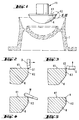
- Such mold inserts F1 belong to the prior art.
- the example shown here has the shape of a mushroom. They are manufactured, for example, using turning technology.
- the surface K1 is first rotated (FIG. 2), then the surface K2 (FIG. 3). This results - due to the turning with the rotating diamond D - in each case a ridge G1 or G2 (Fig. 2, Fig. 3), which must be removed after completion of the turning process.
- the burr G1 or G2 is removed, for example, using a cotton swab W (FIG. 4). This creates a small rounding R at the point where the ridge has been removed, the deviation of which deviates from the ideal, burr-free corner, the deviation from the ideal shape being in the range of a few micrometers (FIG. 5).
- a condition here is that the optically effective area of the contact lens is not influenced by such measures, since otherwise the optical correction effect of the contact lens can change or the contact lens can even become completely unusable.
- this object is achieved in that the shaping surface is pretreated by one of the two mold halves in an area outside the optically active zone of the contact lens before it is used, such that when the mold is opened the contact lens adheres to the pretreated mold half.
- This mold half together with the contact lens can then be used automatically for the further processing of the contact lens, so there is no need to check on or in which mold half the lens is located.
- This enables a further process simplification, since the mold half to which the contact lens adheres can be directly processed further together with the contact lens adhering to it. Since the contact lens also only in an area outside its optically effective area on the pretreated mold half adheres, the optical effect of the contact lens is fully preserved in any case.
- the mold half is pretreated in the area in question by means of corona discharge.
- This pretreatment is technically uncomplicated and ensures that the contact lens adheres securely to the mold half in question.
- the male mold half is preferably pretreated, since then the further processing of the contact lens is particularly simple.
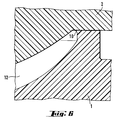
- the contact lens adhering to the male mold half can slide reliably over the projection 10 (FIG. 6) of the female mold half described at the beginning, and the further processing process can therefore be tailored to the male mold half with the contact lens adhering to it.
- the unhydrated contact lens adhering to the mold half is tempered in an additional process step with the mold still closed, the mold is then opened and then the mold half to which the still unhydrated contact lens adheres is fed to a hydration station, where the unhydrated contact lens is removed from the mold half is detached and hydrated.
- a hydration station By annealing the contact lens, any existing material tensions are reduced and the polymerization is finally completed.
- the lens is detached from the mold half and swollen.
- the still unhydrated contact lens adhering to the male mold half is colored after opening the mold in the iris area.
- the pad printing process which has already proven itself in the coloring of contact lenses, is preferably used for coloring the still unhydrated contact lens.
- the object of the invention is achieved in that a device for pretreatment is provided which pretreates the shaping surface of one mold half in a region outside the optically active zone of the contact lens in such a way that when the mold is opened the contact lens adheres to the pretreated mold half.
- This mold half together with the contact lens can then be used automatically for the further processing of the contact lens, so that a check of which mold half the lens is in or in which way is unnecessary.
- This enables simplification of the device, since the mold half on which the Contact lens adheres, can be further processed directly together with the contact lens adhering to it, that is, the device can be tailored specifically for the further processing of this mold half.
- the contact lens since the contact lens only adheres to the pretreated mold half in an area outside of its optically effective area, the optical effect of the contact lens is fully retained in any case.
- a corona treatment device for the pretreatment of one mold half, which has two electrodes which are arranged at a distance from one another and between which the relevant mold half is arranged during the pretreatment, the electrode facing the shaping surface of the mold half to be treated has an annular surface which extends substantially over the area of the mold half to be treated.
- the mold half to be treated is preferably the male mold half, and the annular surface of the electrode facing the shaping surface is concave. This design of the electrodes ensures uniform adhesion of the contact lens to the male mold half in the area outside the optically effective area, the optical effect of the contact lens thus remains unaffected.
- the device has a tempering furnace for the still closed mold with the unhydrated contact lens adhering to one mold half, and a hydration device for detaching and hydrating the still unhydrated contact lens.
- a tempering furnace for the still closed mold with the unhydrated contact lens adhering to one mold half
- a hydration device for detaching and hydrating the still unhydrated contact lens.
- the device can comprise a device for coloring, which colors the still unhydrated contact lens adhering to the male mold half in the iris region. This makes it possible to produce contact lenses that have the desired color impression of the iris produce.
- a device is particularly suitable which comprises a coloring pad which can be pressed onto this area of the contact lens for coloring the iris area.
- Figures 1-6 are only used to better illustrate the problems that arise in the production of contact lenses in the full mold process and which result from the manufacturing technique of the molds. These problems have already been explained at the beginning.
- a ridge G1 or G2 is created, which then e.g. is removed with a cotton swab W.
- this can result in the contact lens either adhering to the male mold half when the mold is opened or remaining in the female mold half due to the projection 10; a sufficiently reliable statement cannot be made about this.
- FIG. 7 shows a generator 3 which is connected to an electrode 4 and which supplies this electrode 4 with high voltage. Furthermore, a counter electrode 5 can be seen which is arranged at a distance from the electrode which is connected to the generator 3.
- the mold half to be pretreated here a male mold half 2
- the electrode 4 has an annular surface 40 which extends essentially over the area 20 of the male mold half 2 to be treated and is concave.
- the convex counter electrode 5 is located on the other side of the male mold half 2.
- the area 20 of the shaping surface of the male mold half 2 is bombarded with electrons or ions, which emerge from the electrode 4 and act on the area 20 of the male mold halves 2 and produce charge changes in this area.
- polar groups are generated on the surface of non-polar materials, such as, for example, on the shaping surface of polypropylene molds, which ensure the adhesion of the contact lens formed later on this surface.
- Polystyrene, PMMA (polymethyl methacrylate) or polycarbonate can also be used as the material for the molds. Since only the optically ineffective area 20 is bombarded, the contact lens formed later adheres to the male mold half 2 only in this area 20.
- the bombardment time can be approximately one second
- the frequency can range from approximately 20 kHz to 40 kHz
- the voltage between the electrodes can be approximately 10 kV to 20 kV.
- the electrode 4, which is connected to the generator 3 is advantageously made of tungsten, at least on the annular surface 40 which faces the region 20 of the male mold half 2. This is advantageous insofar as there should be the slightest deposits on the contact lens that was later produced with the aid of this mold half. Then the reaction of the eye is avoided by the choice of tungsten.
- FIG. 8 An injection molding machine M is shown in FIG. 8, with which the mold halves are produced.
- the "heart" of the machine is shown schematically in FIG. 9, since it illustrates the first process step in the manufacture of contact lenses.
- the two mold halves, the mother mold half 1 and the father mold half 2 are produced with the aid of the corresponding mold inserts F1 and F2.
- the male mold half is then exposed to the corona treatment, with only the area 20 outside the optically active area of the contact lens which is subsequently produced using this mold half being pretreated.
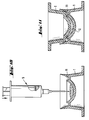
- a certain amount of a polymerizable material is dispensed into the mother mold half 1 by means of a dispensing device 6 and then the male mold half 2 is placed on and the mold is closed (FIG. 11).
- the mold cavity 12 formed between the shaping surfaces of the two mold halves 1 and 2 defines the shape of the contact lenses formed later. Any excess unpolymerized contact lens material is pressed into an overflow 11 which is provided on the mother mold half 1 when the mold is closed.
- the closed mold together with the unpolymerized contact lens material enclosed in the mold is exposed to light from a light source 7 at least in the region of the mold cavity 12 (FIG. 12).
- the mother mold half 1 must of course consist of a material that is transparent to this light.
- the contact lens material located in the mold cavity 12 is polymerized into a still unhydrated contact lens CL.
- contact lens material possibly located in the overflow 11 can also be polymerized. This is advantageous in that when the mold is opened, the excess polymerized contact lens material then remains in the overflow 11 of the mother mold half 1, while the contact lens CL adhering to the male mold half 2, together with the male mold half 2, can be removed and further processed.
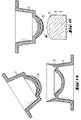
- the still closed mold together with the contact lens CL inside it, is placed in an annealing furnace for tempering and tempered at a temperature of around 120 ° C for a while, whereby any material stresses that may be present are relieved and the polymerization is finally completed (Fig. 13).
- the still unhydrated contact lens can then, but this is only optional, e.g. by means of a tampon 8 (FIG. 15), which is provided with a dye 80, in the iris region of the lens in order to achieve a desired color impression.
- a tampon 8 (FIG. 15) which is provided with a dye 80, in the iris region of the lens in order to achieve a desired color impression.
- the tampon 8 is pressed onto the contact lens CL over a defined period of time.
- the contact lens CL adhering to the male mold half 2 is then fed to a hydration device 9, where the contact lens CL is detached from the male mold half and hydrated (FIG. 16).
- This hydration device 9 can be designed as a magazine so that several contact lenses can be detached and hydrated at the same time. This also applies accordingly to the other facilities described above.
- the female mold half 1 can also be pretreated, with the result that the contact lens then adheres to the female mold half 1 and the female mold half 1 with the contact lens located therein then has to be processed further.
Landscapes
- Engineering & Computer Science (AREA)
- Mechanical Engineering (AREA)
- Health & Medical Sciences (AREA)
- Manufacturing & Machinery (AREA)
- Ophthalmology & Optometry (AREA)
- Eyeglasses (AREA)
- Moulds For Moulding Plastics Or The Like (AREA)
- Casting Or Compression Moulding Of Plastics Or The Like (AREA)
- Encapsulation Of And Coatings For Semiconductor Or Solid State Devices (AREA)
- Manufacture Of Switches (AREA)
Priority Applications (2)
| Application Number | Priority Date | Filing Date | Title |
|---|---|---|---|
| EP94810690A EP0657264B1 (fr) | 1993-12-13 | 1994-12-05 | Procédé et dispositif pour la production d'une lentille de contact |
| GR990402645T GR3031552T3 (en) | 1993-12-13 | 1999-10-15 | Process and device for the production of a contact lens. |
Applications Claiming Priority (3)
| Application Number | Priority Date | Filing Date | Title |
|---|---|---|---|
| EP93810872 | 1993-12-13 | ||
| EP93810872 | 1993-12-13 | ||
| EP94810690A EP0657264B1 (fr) | 1993-12-13 | 1994-12-05 | Procédé et dispositif pour la production d'une lentille de contact |
Publications (2)
| Publication Number | Publication Date |
|---|---|
| EP0657264A1 true EP0657264A1 (fr) | 1995-06-14 |
| EP0657264B1 EP0657264B1 (fr) | 1999-07-21 |
Family
ID=8215087
Family Applications (1)
| Application Number | Title | Priority Date | Filing Date |
|---|---|---|---|
| EP94810690A Expired - Lifetime EP0657264B1 (fr) | 1993-12-13 | 1994-12-05 | Procédé et dispositif pour la production d'une lentille de contact |
Country Status (15)
| Country | Link |
|---|---|
| EP (1) | EP0657264B1 (fr) |
| JP (1) | JP3110268B2 (fr) |
| CN (1) | CN1110212A (fr) |
| AT (1) | ATE182287T1 (fr) |
| AU (1) | AU694145B2 (fr) |
| CA (1) | CA2137765A1 (fr) |
| DE (1) | DE59408513D1 (fr) |
| DK (1) | DK0657264T3 (fr) |
| ES (1) | ES2136721T3 (fr) |
| FI (1) | FI945797A7 (fr) |
| GR (1) | GR3031552T3 (fr) |
| IL (1) | IL111873A (fr) |
| NO (1) | NO944807L (fr) |
| NZ (1) | NZ270119A (fr) |
| ZA (1) | ZA949862B (fr) |
Cited By (1)
| Publication number | Priority date | Publication date | Assignee | Title |
|---|---|---|---|---|
| EP0888871A1 (fr) * | 1997-06-30 | 1999-01-07 | Wöhlk Contact-Linsen GmbH | Dispositif pour la fabrication d'objets à partir d'un mélange polymérisable et une lentille de contact fabriquée avec ce dispositif |
Families Citing this family (12)
| Publication number | Priority date | Publication date | Assignee | Title |
|---|---|---|---|---|
| JP4544710B2 (ja) * | 1999-08-27 | 2010-09-15 | 株式会社メニコン | 眼用レンズ物品の成形型及び眼用レンズ物品の製造方法 |
| DE602005006996D1 (de) * | 2004-03-24 | 2008-07-03 | Novartis Ag | Verfahren zur herstellung von kontaktlinsen |
| MY144506A (en) * | 2005-05-04 | 2011-09-30 | Novartis Ag | Automated inspection of colored contact lenses |
| US7320587B2 (en) * | 2005-08-09 | 2008-01-22 | Cooper Vision, Inc. | Contact lens molds and systems and methods for producing same |
| JP4335225B2 (ja) * | 2006-04-19 | 2009-09-30 | 株式会社日本製鋼所 | 樹脂成形体の製造方法および装置 |
| US7875217B2 (en) * | 2006-09-29 | 2011-01-25 | Johnson & Johnson Vision Care, Inc. | Excess polymer ring removal during ophthalmic lens manufacture |
| TW200918294A (en) * | 2007-10-17 | 2009-05-01 | Unicon Optical Co Ltd | Method and die for forming contact lens |
| US9878473B2 (en) | 2012-06-19 | 2018-01-30 | Menicon Nect Co., Ltd | Multilayer contact lens and production process therefor |
| WO2015001584A1 (fr) * | 2013-07-02 | 2015-01-08 | 株式会社メニコン | Lentille de contact et procédé de fabrication de lentille de contact |
| US20170165050A1 (en) * | 2014-02-11 | 2017-06-15 | The Manchester Metropolitan University | Artificial eyes and manufacture thereof |
| MY190699A (en) * | 2015-12-22 | 2022-05-11 | Alcon Inc | Process for manufacturing contact lenses |
| EP3526017B1 (fr) | 2016-10-14 | 2025-11-26 | Alcon Inc. | Procédé de production de lentilles de contact |
Citations (5)
| Publication number | Priority date | Publication date | Assignee | Title |
|---|---|---|---|---|
| DE1052290B (de) * | 1953-12-02 | 1959-03-05 | Rieter Werke Haendle | Verfahren und Vorrichtung zum Abloesen gepresster Formkoerper aus einer Metallform |
| FR1497746A (fr) * | 1965-10-21 | 1967-10-13 | Continental Can Co | Procédé de moulage électrostatique et appareils |
| US4257755A (en) * | 1974-06-25 | 1981-03-24 | Lemelson Jerome H | Molding system and method |
| EP0472303A2 (fr) * | 1990-08-02 | 1992-02-26 | Pilkington Barnes Hind, Inc. | Coulage de lentilles de contact |
| EP0588660A1 (fr) * | 1992-09-18 | 1994-03-23 | JOHNSON & JOHNSON VISION PRODUCTS, INC. | Démoulage de lentilles ophtalmiques assisté par laser |
Family Cites Families (2)
| Publication number | Priority date | Publication date | Assignee | Title |
|---|---|---|---|---|
| GB8601967D0 (en) * | 1986-01-28 | 1986-03-05 | Coopervision Optics | Manufacturing contact lenses |
| US5326505A (en) * | 1992-12-21 | 1994-07-05 | Johnson & Johnson Vision Products, Inc. | Method for treating an ophthalmic lens mold |
-
1994
- 1994-12-05 DK DK94810690T patent/DK0657264T3/da active
- 1994-12-05 ES ES94810690T patent/ES2136721T3/es not_active Expired - Lifetime
- 1994-12-05 DE DE59408513T patent/DE59408513D1/de not_active Expired - Lifetime
- 1994-12-05 EP EP94810690A patent/EP0657264B1/fr not_active Expired - Lifetime
- 1994-12-05 AT AT94810690T patent/ATE182287T1/de not_active IP Right Cessation
- 1994-12-05 IL IL111873A patent/IL111873A/xx not_active IP Right Cessation
- 1994-12-09 FI FI945797A patent/FI945797A7/fi not_active Application Discontinuation
- 1994-12-09 CA CA002137765A patent/CA2137765A1/fr not_active Abandoned
- 1994-12-09 JP JP06306122A patent/JP3110268B2/ja not_active Expired - Lifetime
- 1994-12-12 AU AU80373/94A patent/AU694145B2/en not_active Ceased
- 1994-12-12 NO NO944807A patent/NO944807L/no unknown
- 1994-12-12 NZ NZ270119A patent/NZ270119A/en unknown
- 1994-12-12 CN CN94119314A patent/CN1110212A/zh active Pending
- 1994-12-12 ZA ZA949862A patent/ZA949862B/xx unknown
-
1999
- 1999-10-15 GR GR990402645T patent/GR3031552T3/el unknown
Patent Citations (5)
| Publication number | Priority date | Publication date | Assignee | Title |
|---|---|---|---|---|
| DE1052290B (de) * | 1953-12-02 | 1959-03-05 | Rieter Werke Haendle | Verfahren und Vorrichtung zum Abloesen gepresster Formkoerper aus einer Metallform |
| FR1497746A (fr) * | 1965-10-21 | 1967-10-13 | Continental Can Co | Procédé de moulage électrostatique et appareils |
| US4257755A (en) * | 1974-06-25 | 1981-03-24 | Lemelson Jerome H | Molding system and method |
| EP0472303A2 (fr) * | 1990-08-02 | 1992-02-26 | Pilkington Barnes Hind, Inc. | Coulage de lentilles de contact |
| EP0588660A1 (fr) * | 1992-09-18 | 1994-03-23 | JOHNSON & JOHNSON VISION PRODUCTS, INC. | Démoulage de lentilles ophtalmiques assisté par laser |
Cited By (1)
| Publication number | Priority date | Publication date | Assignee | Title |
|---|---|---|---|---|
| EP0888871A1 (fr) * | 1997-06-30 | 1999-01-07 | Wöhlk Contact-Linsen GmbH | Dispositif pour la fabrication d'objets à partir d'un mélange polymérisable et une lentille de contact fabriquée avec ce dispositif |
Also Published As
| Publication number | Publication date |
|---|---|
| NO944807L (no) | 1995-06-14 |
| IL111873A (en) | 1997-06-10 |
| ZA949862B (en) | 1995-06-14 |
| NZ270119A (en) | 1996-06-25 |
| CA2137765A1 (fr) | 1995-06-14 |
| EP0657264B1 (fr) | 1999-07-21 |
| FI945797A0 (fi) | 1994-12-09 |
| ES2136721T3 (es) | 1999-12-01 |
| JPH07195558A (ja) | 1995-08-01 |
| JP3110268B2 (ja) | 2000-11-20 |
| CN1110212A (zh) | 1995-10-18 |
| NO944807D0 (no) | 1994-12-12 |
| IL111873A0 (en) | 1995-03-15 |
| AU8037394A (en) | 1995-06-22 |
| FI945797A7 (fi) | 1995-06-14 |
| ATE182287T1 (de) | 1999-08-15 |
| GR3031552T3 (en) | 2000-01-31 |
| DE59408513D1 (de) | 1999-08-26 |
| AU694145B2 (en) | 1998-07-16 |
| DK0657264T3 (da) | 2000-02-07 |
Similar Documents
| Publication | Publication Date | Title |
|---|---|---|
| DE69913589T2 (de) | Verfahren und Vorrichtung zur Herstellung von Linsen und mit deren hergestellte Linsen | |
| EP0657264B1 (fr) | Procédé et dispositif pour la production d'une lentille de contact | |
| EP0458734B1 (fr) | Procédé pour la fabrication de lentilles de contact | |
| DE69405275T2 (de) | Düse zum Wegräumen von Lösungen | |
| DE69211820T2 (de) | Dichtung für eine Giessform für ophthalmische Linsen | |
| EP0671249B1 (fr) | Procédé et dispositif pour la fabrication de lentilles optiques | |
| EP0061619A2 (fr) | Moule pour la fabrication de pièces en matière thermoplastique | |
| DE2711384C3 (de) | Vorrichtung zur Herstellung von Rohlingen für afokale Linsen | |
| DE2518905A1 (de) | Verfahren und vorrichtung zur herstellung optischer linsen | |
| DE3836744A1 (de) | Verfahren zur herstellung von formkoerpern durch verformen eines aushaertbaren materials und vorrichtung zur durchfuehrung des verfahrens | |
| EP3170652A1 (fr) | Procédé de fabrication et de revêtement de lentille | |
| DE60210798T2 (de) | Giessformhälfte und giessform zur herstellung von kontaktlinsen | |
| DE69026189T2 (de) | Spritzgiessdruckverfahren für CD-Platten oder dergleichen | |
| DE2828926A1 (de) | Verfahren zur herstellung eines brillenteils aus kunststoff | |
| DE4017541A1 (de) | Zusammengesetzter optischer gegenstand und verfahren zu seiner herstellung | |
| DE69721663T2 (de) | Mehrfach-Spritzgiessform mit Oberflächenkrümmung hergestellt aus einem Kunststoff-Stuck | |
| DE102023101513A1 (de) | Projektionslinse für einen Kraftfahrzeugscheinwerfer sowie Spritzwerkzeug und Verfahren zu ihrer Herstellung | |
| DE60319293T2 (de) | Verfahren zur Behandlung eines Formwerkzeuges oder einer Formhälfte für die Herstellung von ophthalmischen Linsen | |
| DE3906564A1 (de) | Verfahren und vorrichtung zum herstellen von gegenstaenden, insbesondere optischen linsen | |
| DE2354987C2 (de) | Gießform zur Fertigung von Kunststofflinsen mit optischer Oberflächenqualität sowie Vorrichtung zu ihrer Herstellung | |
| DE1704614C3 (de) | Verfahren und Einrichtung zum Herstellen einer Verschraubungssicherung auf einem Gewindeglied | |
| DE19602736A1 (de) | Verfahren und Vorrichtung zur Herstellung von optischen Linsen und optischen Linsenarrays | |
| DE4214259C1 (en) | Gradient optic mfg. - rotates crucible with molten glass or plastics to disperse heavier mols evenly and radially outwards for refractive index change | |
| EP1124766A1 (fr) | Panneaux de verre quartzeux a indice de refraction tres homogene | |
| DE1922232A1 (de) | Form zum Pressen von thermoplastischem Material |
Legal Events
| Date | Code | Title | Description |
|---|---|---|---|
| PUAI | Public reference made under article 153(3) epc to a published international application that has entered the european phase |
Free format text: ORIGINAL CODE: 0009012 |
|
| AK | Designated contracting states |
Kind code of ref document: A1 Designated state(s): AT BE CH DE DK ES FR GB GR IE IT LI LU NL PT SE |
|
| 17P | Request for examination filed |
Effective date: 19951130 |
|
| RAP1 | Party data changed (applicant data changed or rights of an application transferred) |
Owner name: NOVARTIS AG |
|
| 17Q | First examination report despatched |
Effective date: 19970502 |
|
| GRAG | Despatch of communication of intention to grant |
Free format text: ORIGINAL CODE: EPIDOS AGRA |
|
| GRAG | Despatch of communication of intention to grant |
Free format text: ORIGINAL CODE: EPIDOS AGRA |
|
| GRAH | Despatch of communication of intention to grant a patent |
Free format text: ORIGINAL CODE: EPIDOS IGRA |
|
| GRAG | Despatch of communication of intention to grant |
Free format text: ORIGINAL CODE: EPIDOS AGRA |
|
| GRAH | Despatch of communication of intention to grant a patent |
Free format text: ORIGINAL CODE: EPIDOS IGRA |
|
| RAP1 | Party data changed (applicant data changed or rights of an application transferred) |
Owner name: NOVARTIS-ERFINDUNGEN VERWALTUNGSGESELLSCHAFT M.B.H |
|
| RAP1 | Party data changed (applicant data changed or rights of an application transferred) |
Owner name: NOVARTIS-ERFINDUNGEN VERWALTUNGSGESELLSCHAFT M.B. Owner name: NOVARTIS AG |
|
| GRAH | Despatch of communication of intention to grant a patent |
Free format text: ORIGINAL CODE: EPIDOS IGRA |
|
| GRAA | (expected) grant |
Free format text: ORIGINAL CODE: 0009210 |
|
| AK | Designated contracting states |
Kind code of ref document: B1 Designated state(s): AT BE CH DE DK ES FR GB GR IE IT LI LU NL PT SE |
|
| REF | Corresponds to: |
Ref document number: 182287 Country of ref document: AT Date of ref document: 19990815 Kind code of ref document: T |
|
| RIN1 | Information on inventor provided before grant (corrected) |
Inventor name: ZANG, PETER Inventor name: STEFFAN, WERNER Inventor name: SCHAEFER, HORST, DR. Inventor name: HAASE, LOTHAR Inventor name: BONEBERGER, KARLHEINZ |
|
| REG | Reference to a national code |
Ref country code: CH Ref legal event code: EP |
|
| REF | Corresponds to: |
Ref document number: 59408513 Country of ref document: DE Date of ref document: 19990826 |
|
| REG | Reference to a national code |
Ref country code: IE Ref legal event code: FG4D Free format text: GERMAN |
|
| ITF | It: translation for a ep patent filed | ||
| GBT | Gb: translation of ep patent filed (gb section 77(6)(a)/1977) |
Effective date: 19990927 |
|
| ET | Fr: translation filed | ||
| PGFP | Annual fee paid to national office [announced via postgrant information from national office to epo] |
Ref country code: BE Payment date: 19991118 Year of fee payment: 6 |
|
| PGFP | Annual fee paid to national office [announced via postgrant information from national office to epo] |
Ref country code: NL Payment date: 19991122 Year of fee payment: 6 Ref country code: LU Payment date: 19991122 Year of fee payment: 6 |
|
| PGFP | Annual fee paid to national office [announced via postgrant information from national office to epo] |
Ref country code: IE Payment date: 19991123 Year of fee payment: 6 Ref country code: GR Payment date: 19991123 Year of fee payment: 6 Ref country code: CH Payment date: 19991123 Year of fee payment: 6 Ref country code: AT Payment date: 19991123 Year of fee payment: 6 |
|
| PGFP | Annual fee paid to national office [announced via postgrant information from national office to epo] |
Ref country code: PT Payment date: 19991125 Year of fee payment: 6 |
|
| REG | Reference to a national code |
Ref country code: ES Ref legal event code: FG2A Ref document number: 2136721 Country of ref document: ES Kind code of ref document: T3 |
|
| PGFP | Annual fee paid to national office [announced via postgrant information from national office to epo] |
Ref country code: SE Payment date: 19991206 Year of fee payment: 6 |
|
| PGFP | Annual fee paid to national office [announced via postgrant information from national office to epo] |
Ref country code: DK Payment date: 19991209 Year of fee payment: 6 |
|
| PGFP | Annual fee paid to national office [announced via postgrant information from national office to epo] |
Ref country code: ES Payment date: 19991216 Year of fee payment: 6 |
|
| REG | Reference to a national code |
Ref country code: PT Ref legal event code: SC4A Free format text: AVAILABILITY OF NATIONAL TRANSLATION Effective date: 19991015 |
|
| REG | Reference to a national code |
Ref country code: DK Ref legal event code: T3 |
|
| PLBQ | Unpublished change to opponent data |
Free format text: ORIGINAL CODE: EPIDOS OPPO |
|
| PLAV | Examination of admissibility of opposition |
Free format text: ORIGINAL CODE: EPIDOS OPEX |
|
| PLBI | Opposition filed |
Free format text: ORIGINAL CODE: 0009260 |
|
| PLAV | Examination of admissibility of opposition |
Free format text: ORIGINAL CODE: EPIDOS OPEX |
|
| PLBF | Reply of patent proprietor to notice(s) of opposition |
Free format text: ORIGINAL CODE: EPIDOS OBSO |
|
| 26 | Opposition filed |
Opponent name: JOHNSON & JOHNSON VISION CARE, INC. Effective date: 20000420 |
|
| NLR1 | Nl: opposition has been filed with the epo |
Opponent name: JOHNSON & JOHNSON VISION CARE, INC. |
|
| PLBF | Reply of patent proprietor to notice(s) of opposition |
Free format text: ORIGINAL CODE: EPIDOS OBSO |
|
| PG25 | Lapsed in a contracting state [announced via postgrant information from national office to epo] |
Ref country code: LU Free format text: LAPSE BECAUSE OF NON-PAYMENT OF DUE FEES Effective date: 20001205 Ref country code: IE Free format text: LAPSE BECAUSE OF NON-PAYMENT OF DUE FEES Effective date: 20001205 Ref country code: DK Free format text: LAPSE BECAUSE OF NON-PAYMENT OF DUE FEES Effective date: 20001205 Ref country code: AT Free format text: LAPSE BECAUSE OF NON-PAYMENT OF DUE FEES Effective date: 20001205 |
|
| PG25 | Lapsed in a contracting state [announced via postgrant information from national office to epo] |
Ref country code: SE Free format text: LAPSE BECAUSE OF NON-PAYMENT OF DUE FEES Effective date: 20001206 |
|
| PLBF | Reply of patent proprietor to notice(s) of opposition |
Free format text: ORIGINAL CODE: EPIDOS OBSO |
|
| PG25 | Lapsed in a contracting state [announced via postgrant information from national office to epo] |
Ref country code: LI Free format text: LAPSE BECAUSE OF NON-PAYMENT OF DUE FEES Effective date: 20001231 Ref country code: GR Free format text: LAPSE BECAUSE OF NON-PAYMENT OF DUE FEES Effective date: 20001231 Ref country code: CH Free format text: LAPSE BECAUSE OF NON-PAYMENT OF DUE FEES Effective date: 20001231 Ref country code: BE Free format text: LAPSE BECAUSE OF NON-PAYMENT OF DUE FEES Effective date: 20001231 |
|
| PLBF | Reply of patent proprietor to notice(s) of opposition |
Free format text: ORIGINAL CODE: EPIDOS OBSO |
|
| BERE | Be: lapsed |
Owner name: NOVARTIS A.G. Effective date: 20001231 |
|
| PG25 | Lapsed in a contracting state [announced via postgrant information from national office to epo] |
Ref country code: PT Free format text: LAPSE BECAUSE OF NON-PAYMENT OF DUE FEES Effective date: 20010630 |
|
| PG25 | Lapsed in a contracting state [announced via postgrant information from national office to epo] |
Ref country code: NL Free format text: LAPSE BECAUSE OF NON-PAYMENT OF DUE FEES Effective date: 20010701 |
|
| RAP2 | Party data changed (patent owner data changed or rights of a patent transferred) |
Owner name: NOVARTIS-ERFINDUNGEN VERWALTUNGSGESELLSCHAFT M.B. Owner name: NOVARTIS AG |
|
| EUG | Se: european patent has lapsed |
Ref document number: 94810690.1 |
|
| REG | Reference to a national code |
Ref country code: CH Ref legal event code: PL |
|
| REG | Reference to a national code |
Ref country code: DK Ref legal event code: EBP |
|
| NLV4 | Nl: lapsed or anulled due to non-payment of the annual fee |
Effective date: 20010701 |
|
| REG | Reference to a national code |
Ref country code: IE Ref legal event code: MM4A |
|
| PG25 | Lapsed in a contracting state [announced via postgrant information from national office to epo] |
Ref country code: ES Free format text: LAPSE BECAUSE OF NON-PAYMENT OF DUE FEES Effective date: 20011206 |
|
| REG | Reference to a national code |
Ref country code: GB Ref legal event code: IF02 |
|
| PLBO | Opposition rejected |
Free format text: ORIGINAL CODE: EPIDOS REJO |
|
| PLBN | Opposition rejected |
Free format text: ORIGINAL CODE: 0009273 |
|
| APBP | Date of receipt of notice of appeal recorded |
Free format text: ORIGINAL CODE: EPIDOSNNOA2O |
|
| PLAE | Information related to rejection of opposition modified |
Free format text: ORIGINAL CODE: 0009299REJO |
|
| APBQ | Date of receipt of statement of grounds of appeal recorded |
Free format text: ORIGINAL CODE: EPIDOSNNOA3O |
|
| 27O | Opposition rejected |
Effective date: 20030327 |
|
| D27O | Information related to the rejection of opposition deleted | ||
| REG | Reference to a national code |
Ref country code: ES Ref legal event code: FD2A Effective date: 20020112 |
|
| APAA | Appeal reference recorded |
Free format text: ORIGINAL CODE: EPIDOS REFN |
|
| APAH | Appeal reference modified |
Free format text: ORIGINAL CODE: EPIDOSCREFNO |
|
| APBU | Appeal procedure closed |
Free format text: ORIGINAL CODE: EPIDOSNNOA9O |
|
| PLAE | Information related to rejection of opposition modified |
Free format text: ORIGINAL CODE: 0009299REJO |
|
| STAA | Information on the status of an ep patent application or granted ep patent |
Free format text: STATUS: OPPOSITION REJECTED |
|
| R27O | Information related to the rejection of opposition modified: opposition rejected |
Effective date: 20051025 |
|
| PGFP | Annual fee paid to national office [announced via postgrant information from national office to epo] |
Ref country code: DE Payment date: 20131127 Year of fee payment: 20 Ref country code: GB Payment date: 20131204 Year of fee payment: 20 |
|
| PGFP | Annual fee paid to national office [announced via postgrant information from national office to epo] |
Ref country code: FR Payment date: 20131209 Year of fee payment: 20 Ref country code: IT Payment date: 20131209 Year of fee payment: 20 |
|
| REG | Reference to a national code |
Ref country code: DE Ref legal event code: R071 Ref document number: 59408513 Country of ref document: DE |
|
| REG | Reference to a national code |
Ref country code: GB Ref legal event code: PE20 Expiry date: 20141204 |
|
| PG25 | Lapsed in a contracting state [announced via postgrant information from national office to epo] |
Ref country code: GB Free format text: LAPSE BECAUSE OF EXPIRATION OF PROTECTION Effective date: 20141204 |