EP0657436A2 - Verfahren zur Herstellung von Perylen-3,4-dicarbonsäurederivaten, die so hergestellten Derivate und deren Verwendung - Google Patents
Verfahren zur Herstellung von Perylen-3,4-dicarbonsäurederivaten, die so hergestellten Derivate und deren Verwendung Download PDFInfo
- Publication number
- EP0657436A2 EP0657436A2 EP94810637A EP94810637A EP0657436A2 EP 0657436 A2 EP0657436 A2 EP 0657436A2 EP 94810637 A EP94810637 A EP 94810637A EP 94810637 A EP94810637 A EP 94810637A EP 0657436 A2 EP0657436 A2 EP 0657436A2
- Authority
- EP
- European Patent Office
- Prior art keywords
- perylene
- dicarboxylic acid
- formula
- mmol
- alkyl
- Prior art date
- Legal status (The legal status is an assumption and is not a legal conclusion. Google has not performed a legal analysis and makes no representation as to the accuracy of the status listed.)
- Granted
Links
- 150000001875 compounds Chemical class 0.000 title claims abstract description 39
- 238000002360 preparation method Methods 0.000 title claims abstract description 31
- 238000000034 method Methods 0.000 title claims abstract description 28
- 230000008569 process Effects 0.000 title claims abstract description 21
- JVURVJHBFHCOQX-UHFFFAOYSA-N perylene-3,4-dicarboxylic acid Chemical class C=12C3=CC=CC2=CC=CC=1C1=CC=C(C(O)=O)C2=C1C3=CC=C2C(=O)O JVURVJHBFHCOQX-UHFFFAOYSA-N 0.000 title claims abstract description 12
- -1 perylene-3,4-dicarboxylic acid amidines Chemical class 0.000 claims abstract description 106
- XLYOFNOQVPJJNP-UHFFFAOYSA-N water Substances O XLYOFNOQVPJJNP-UHFFFAOYSA-N 0.000 claims abstract description 41
- SXMCIQXYGMZFMH-UHFFFAOYSA-N perylene-3,4-dicarboxylic anhydride Chemical compound C=12C3=CC=CC2=CC=CC=1C1=CC=C2C(=O)OC(=O)C4=CC=C3C1=C42 SXMCIQXYGMZFMH-UHFFFAOYSA-N 0.000 claims abstract description 38
- 239000007850 fluorescent dye Substances 0.000 claims abstract description 6
- 239000011368 organic material Substances 0.000 claims abstract description 5
- 238000004040 coloring Methods 0.000 claims abstract description 4
- 238000004519 manufacturing process Methods 0.000 claims abstract description 4
- 238000000518 rheometry Methods 0.000 claims abstract description 4
- 239000000990 laser dye Substances 0.000 claims abstract description 3
- 108091008695 photoreceptors Proteins 0.000 claims abstract description 3
- RAXXELZNTBOGNW-UHFFFAOYSA-N imidazole Natural products C1=CNC=N1 RAXXELZNTBOGNW-UHFFFAOYSA-N 0.000 claims description 58
- 238000006243 chemical reaction Methods 0.000 claims description 32
- LBOJSACZVLWUHN-UHFFFAOYSA-N perylene-3,4-dicarboximide Chemical class C=12C3=CC=CC2=CC=CC=1C1=CC=C2C(=O)NC(=O)C4=CC=C3C1=C42 LBOJSACZVLWUHN-UHFFFAOYSA-N 0.000 claims description 31
- 125000000217 alkyl group Chemical group 0.000 claims description 20
- 125000003710 aryl alkyl group Chemical group 0.000 claims description 14
- 125000000753 cycloalkyl group Chemical group 0.000 claims description 14
- 125000002837 carbocyclic group Chemical group 0.000 claims description 12
- SMWDFEZZVXVKRB-UHFFFAOYSA-N anhydrous quinoline Natural products N1=CC=CC2=CC=CC=C21 SMWDFEZZVXVKRB-UHFFFAOYSA-N 0.000 claims description 11
- 125000001424 substituent group Chemical group 0.000 claims description 9
- XEEYBQQBJWHFJM-UHFFFAOYSA-N Iron Chemical compound [Fe] XEEYBQQBJWHFJM-UHFFFAOYSA-N 0.000 claims description 8
- 150000003839 salts Chemical class 0.000 claims description 7
- WKBOTKDWSSQWDR-UHFFFAOYSA-N Bromine atom Chemical group [Br] WKBOTKDWSSQWDR-UHFFFAOYSA-N 0.000 claims description 6
- 125000004432 carbon atom Chemical group C* 0.000 claims description 6
- 125000001997 phenyl group Chemical group [H]C1=C([H])C([H])=C(*)C([H])=C1[H] 0.000 claims description 6
- HCHKCACWOHOZIP-UHFFFAOYSA-N Zinc Chemical compound [Zn] HCHKCACWOHOZIP-UHFFFAOYSA-N 0.000 claims description 5
- GDTBXPJZTBHREO-UHFFFAOYSA-N bromine Chemical group BrBr GDTBXPJZTBHREO-UHFFFAOYSA-N 0.000 claims description 5
- 229910052794 bromium Inorganic materials 0.000 claims description 5
- 229910052791 calcium Inorganic materials 0.000 claims description 5
- 239000011575 calcium Substances 0.000 claims description 5
- 230000007062 hydrolysis Effects 0.000 claims description 5
- 238000006460 hydrolysis reaction Methods 0.000 claims description 5
- 239000011133 lead Substances 0.000 claims description 5
- 125000001037 p-tolyl group Chemical group [H]C1=C([H])C(=C([H])C([H])=C1*)C([H])([H])[H] 0.000 claims description 5
- FVDOBFPYBSDRKH-UHFFFAOYSA-N perylene-3,4,9,10-tetracarboxylic acid Chemical compound C=12C3=CC=C(C(O)=O)C2=C(C(O)=O)C=CC=1C1=CC=C(C(O)=O)C2=C1C3=CC=C2C(=O)O FVDOBFPYBSDRKH-UHFFFAOYSA-N 0.000 claims description 5
- 125000002924 primary amino group Chemical class [H]N([H])* 0.000 claims description 5
- 125000002030 1,2-phenylene group Chemical group [H]C1=C([H])C([*:1])=C([*:2])C([H])=C1[H] 0.000 claims description 4
- OYPRJOBELJOOCE-UHFFFAOYSA-N Calcium Chemical compound [Ca] OYPRJOBELJOOCE-UHFFFAOYSA-N 0.000 claims description 4
- JUJWROOIHBZHMG-UHFFFAOYSA-N Pyridine Chemical compound C1=CC=NC=C1 JUJWROOIHBZHMG-UHFFFAOYSA-N 0.000 claims description 4
- ZOIORXHNWRGPMV-UHFFFAOYSA-N acetic acid;zinc Chemical compound [Zn].CC(O)=O.CC(O)=O ZOIORXHNWRGPMV-UHFFFAOYSA-N 0.000 claims description 4
- 230000029936 alkylation Effects 0.000 claims description 4
- 238000005804 alkylation reaction Methods 0.000 claims description 4
- YGTFLFINQODLIC-UHFFFAOYSA-N perylene-1-carboximidamide Chemical class C1=CC(C=2C(C(=N)N)=CC=C3C=2C2=CC=C3)=C3C2=CC=CC3=C1 YGTFLFINQODLIC-UHFFFAOYSA-N 0.000 claims description 4
- 239000011701 zinc Substances 0.000 claims description 4
- 229910052725 zinc Inorganic materials 0.000 claims description 4
- 239000004246 zinc acetate Substances 0.000 claims description 4
- JIAARYAFYJHUJI-UHFFFAOYSA-L zinc dichloride Chemical compound [Cl-].[Cl-].[Zn+2] JIAARYAFYJHUJI-UHFFFAOYSA-L 0.000 claims description 4
- 125000005073 adamantyl group Chemical group C12(CC3CC(CC(C1)C3)C2)* 0.000 claims description 3
- 125000003282 alkyl amino group Chemical group 0.000 claims description 3
- 125000004202 aminomethyl group Chemical group [H]N([H])C([H])([H])* 0.000 claims description 3
- 150000003863 ammonium salts Chemical class 0.000 claims description 3
- 125000001769 aryl amino group Chemical group 0.000 claims description 3
- 125000003118 aryl group Chemical group 0.000 claims description 3
- 125000000113 cyclohexyl group Chemical group [H]C1([H])C([H])([H])C([H])([H])C([H])(*)C([H])([H])C1([H])[H] 0.000 claims description 3
- 125000000640 cyclooctyl group Chemical group [H]C1([H])C([H])([H])C([H])([H])C([H])([H])C([H])(*)C([H])([H])C([H])([H])C1([H])[H] 0.000 claims description 3
- 125000001511 cyclopentyl group Chemical group [H]C1([H])C([H])([H])C([H])([H])C([H])(*)C1([H])[H] 0.000 claims description 3
- 125000001559 cyclopropyl group Chemical group [H]C1([H])C([H])([H])C1([H])* 0.000 claims description 3
- 125000006222 dimethylaminomethyl group Chemical group [H]C([H])([H])N(C([H])([H])[H])C([H])([H])* 0.000 claims description 3
- 229910052751 metal Inorganic materials 0.000 claims description 3
- 239000002184 metal Substances 0.000 claims description 3
- XQOWMZUKZHRNDV-UHFFFAOYSA-N perylene-3,4-dicarboxamide Chemical class C=12C3=CC=CC2=CC=CC=1C1=CC=C(C(N)=O)C2=C1C3=CC=C2C(=O)N XQOWMZUKZHRNDV-UHFFFAOYSA-N 0.000 claims description 3
- 125000005837 1,2-cyclopentylene group Chemical group [H]C1([H])C([H])([H])C([H])([*:1])C([H])([*:2])C1([H])[H] 0.000 claims description 2
- 125000003031 C5-C7 cycloalkylene group Chemical group 0.000 claims description 2
- 150000001350 alkyl halides Chemical class 0.000 claims description 2
- 238000006254 arylation reaction Methods 0.000 claims description 2
- 125000001309 chloro group Chemical group Cl* 0.000 claims description 2
- 125000004093 cyano group Chemical group *C#N 0.000 claims description 2
- 125000000582 cycloheptyl group Chemical group [H]C1([H])C([H])([H])C([H])([H])C([H])([H])C([H])(*)C([H])([H])C1([H])[H] 0.000 claims description 2
- 229910052736 halogen Inorganic materials 0.000 claims description 2
- 150000002367 halogens Chemical group 0.000 claims description 2
- 150000002460 imidazoles Chemical class 0.000 claims description 2
- 229940046892 lead acetate Drugs 0.000 claims description 2
- 159000000003 magnesium salts Chemical class 0.000 claims description 2
- 150000002696 manganese Chemical class 0.000 claims description 2
- RTWNYYOXLSILQN-UHFFFAOYSA-N methanediamine Chemical compound NCN RTWNYYOXLSILQN-UHFFFAOYSA-N 0.000 claims description 2
- 125000004957 naphthylene group Chemical group 0.000 claims description 2
- 125000000449 nitro group Chemical group [O-][N+](*)=O 0.000 claims description 2
- 239000012038 nucleophile Substances 0.000 claims description 2
- 125000000843 phenylene group Chemical group C1(=C(C=CC=C1)*)* 0.000 claims description 2
- UMJSCPRVCHMLSP-UHFFFAOYSA-N pyridine Natural products COC1=CC=CN=C1 UMJSCPRVCHMLSP-UHFFFAOYSA-N 0.000 claims description 2
- 125000005551 pyridylene group Chemical group 0.000 claims description 2
- 230000003381 solubilizing effect Effects 0.000 claims description 2
- 239000011592 zinc chloride Substances 0.000 claims description 2
- 235000005074 zinc chloride Nutrition 0.000 claims description 2
- 229910052801 chlorine Inorganic materials 0.000 claims 1
- 239000000460 chlorine Substances 0.000 claims 1
- PNDPGZBMCMUPRI-UHFFFAOYSA-N iodine Chemical group II PNDPGZBMCMUPRI-UHFFFAOYSA-N 0.000 claims 1
- 125000003854 p-chlorophenyl group Chemical group [H]C1=C([H])C(*)=C([H])C([H])=C1Cl 0.000 claims 1
- 125000002943 quinolinyl group Chemical group N1=C(C=CC2=CC=CC=C12)* 0.000 claims 1
- CSHWQDPOILHKBI-UHFFFAOYSA-N peryrene Natural products C1=CC(C2=CC=CC=3C2=C2C=CC=3)=C3C2=CC=CC3=C1 CSHWQDPOILHKBI-UHFFFAOYSA-N 0.000 abstract description 17
- 125000002080 perylenyl group Chemical group C1(=CC=C2C=CC=C3C4=CC=CC5=CC=CC(C1=C23)=C45)* 0.000 abstract description 14
- 239000000975 dye Substances 0.000 abstract description 13
- 150000003141 primary amines Chemical class 0.000 abstract description 9
- 150000008064 anhydrides Chemical class 0.000 abstract description 4
- 239000003086 colorant Substances 0.000 abstract description 4
- 238000009833 condensation Methods 0.000 abstract description 4
- 230000005494 condensation Effects 0.000 abstract description 4
- 150000003949 imides Chemical class 0.000 abstract description 4
- 238000007127 saponification reaction Methods 0.000 abstract description 3
- 150000004985 diamines Chemical class 0.000 abstract description 2
- 150000001409 amidines Chemical class 0.000 abstract 1
- 150000001470 diamides Chemical class 0.000 abstract 1
- HEDRZPFGACZZDS-UHFFFAOYSA-N Chloroform Chemical compound ClC(Cl)Cl HEDRZPFGACZZDS-UHFFFAOYSA-N 0.000 description 114
- VYPSYNLAJGMNEJ-UHFFFAOYSA-N Silicium dioxide Chemical compound O=[Si]=O VYPSYNLAJGMNEJ-UHFFFAOYSA-N 0.000 description 77
- LFQSCWFLJHTTHZ-UHFFFAOYSA-N Ethanol Chemical compound CCO LFQSCWFLJHTTHZ-UHFFFAOYSA-N 0.000 description 74
- 239000000741 silica gel Substances 0.000 description 73
- 229910002027 silica gel Inorganic materials 0.000 description 73
- OKKJLVBELUTLKV-UHFFFAOYSA-N Methanol Chemical compound OC OKKJLVBELUTLKV-UHFFFAOYSA-N 0.000 description 60
- 239000000203 mixture Substances 0.000 description 43
- 239000000047 product Substances 0.000 description 43
- YMWUJEATGCHHMB-UHFFFAOYSA-N Dichloromethane Chemical compound ClCCl YMWUJEATGCHHMB-UHFFFAOYSA-N 0.000 description 39
- KWYUFKZDYYNOTN-UHFFFAOYSA-M Potassium hydroxide Chemical compound [OH-].[K+] KWYUFKZDYYNOTN-UHFFFAOYSA-M 0.000 description 39
- YXFVVABEGXRONW-UHFFFAOYSA-N Toluene Chemical compound CC1=CC=CC=C1 YXFVVABEGXRONW-UHFFFAOYSA-N 0.000 description 38
- VEXZGXHMUGYJMC-UHFFFAOYSA-N Hydrochloric acid Chemical compound Cl VEXZGXHMUGYJMC-UHFFFAOYSA-N 0.000 description 30
- 239000000243 solution Substances 0.000 description 28
- 235000019441 ethanol Nutrition 0.000 description 26
- 238000001035 drying Methods 0.000 description 24
- QTBSBXVTEAMEQO-UHFFFAOYSA-N Acetic acid Chemical compound CC(O)=O QTBSBXVTEAMEQO-UHFFFAOYSA-N 0.000 description 19
- 239000000843 powder Substances 0.000 description 19
- XEKOWRVHYACXOJ-UHFFFAOYSA-N Ethyl acetate Chemical compound CCOC(C)=O XEKOWRVHYACXOJ-UHFFFAOYSA-N 0.000 description 16
- MVPPADPHJFYWMZ-UHFFFAOYSA-N chlorobenzene Chemical compound ClC1=CC=CC=C1 MVPPADPHJFYWMZ-UHFFFAOYSA-N 0.000 description 16
- WPVHXFPEBJZDPS-UHFFFAOYSA-N n-(2,5-di-t-butylphenyl)perylene-3,4-dicarboximide Chemical compound CC(C)(C)C1=CC=C(C(C)(C)C)C(N2C(C3=CC=C4C=5C=CC=C6C=CC=C(C=56)C5=CC=C(C3=C54)C2=O)=O)=C1 WPVHXFPEBJZDPS-UHFFFAOYSA-N 0.000 description 15
- 239000002904 solvent Substances 0.000 description 14
- 238000004587 chromatography analysis Methods 0.000 description 13
- GBEWPQKPCMZPBX-UHFFFAOYSA-N n-(1-hexylheptyl)perylene-3,4-dicarboximide Chemical compound C=12C3=CC=CC2=CC=CC=1C1=CC=C2C(=O)N(C(CCCCCC)CCCCCC)C(=O)C4=CC=C3C1=C42 GBEWPQKPCMZPBX-UHFFFAOYSA-N 0.000 description 13
- 239000000126 substance Substances 0.000 description 13
- WFDIJRYMOXRFFG-UHFFFAOYSA-N Acetic anhydride Chemical compound CC(=O)OC(C)=O WFDIJRYMOXRFFG-UHFFFAOYSA-N 0.000 description 12
- WQDUMFSSJAZKTM-UHFFFAOYSA-N Sodium methoxide Chemical compound [Na+].[O-]C WQDUMFSSJAZKTM-UHFFFAOYSA-N 0.000 description 12
- TYJJADVDDVDEDZ-UHFFFAOYSA-M potassium hydrogencarbonate Chemical compound [K+].OC([O-])=O TYJJADVDDVDEDZ-UHFFFAOYSA-M 0.000 description 12
- 239000000725 suspension Substances 0.000 description 12
- IAZDPXIOMUYVGZ-UHFFFAOYSA-N Dimethylsulphoxide Chemical compound CS(C)=O IAZDPXIOMUYVGZ-UHFFFAOYSA-N 0.000 description 11
- SECXISVLQFMRJM-UHFFFAOYSA-N N-Methylpyrrolidone Chemical compound CN1CCCC1=O SECXISVLQFMRJM-UHFFFAOYSA-N 0.000 description 11
- 229910052757 nitrogen Inorganic materials 0.000 description 11
- 150000003254 radicals Chemical class 0.000 description 11
- RTZKZFJDLAIYFH-UHFFFAOYSA-N Diethyl ether Chemical compound CCOCC RTZKZFJDLAIYFH-UHFFFAOYSA-N 0.000 description 10
- 239000002244 precipitate Substances 0.000 description 10
- 239000007787 solid Substances 0.000 description 10
- 238000001228 spectrum Methods 0.000 description 10
- YZYKBQUWMPUVEN-UHFFFAOYSA-N zafuleptine Chemical compound OC(=O)CCCCCC(C(C)C)NCC1=CC=C(F)C=C1 YZYKBQUWMPUVEN-UHFFFAOYSA-N 0.000 description 10
- ZMXDDKWLCZADIW-UHFFFAOYSA-N N,N-Dimethylformamide Chemical compound CN(C)C=O ZMXDDKWLCZADIW-UHFFFAOYSA-N 0.000 description 9
- 239000007795 chemical reaction product Substances 0.000 description 9
- 239000013078 crystal Substances 0.000 description 9
- 239000000049 pigment Substances 0.000 description 9
- XKRFYHLGVUSROY-UHFFFAOYSA-N Argon Chemical compound [Ar] XKRFYHLGVUSROY-UHFFFAOYSA-N 0.000 description 8
- DKGAVHZHDRPRBM-UHFFFAOYSA-N Tert-Butanol Chemical compound CC(C)(C)O DKGAVHZHDRPRBM-UHFFFAOYSA-N 0.000 description 8
- 229960000583 acetic acid Drugs 0.000 description 8
- 238000006396 nitration reaction Methods 0.000 description 8
- BWHMMNNQKKPAPP-UHFFFAOYSA-L potassium carbonate Chemical compound [K+].[K+].[O-]C([O-])=O BWHMMNNQKKPAPP-UHFFFAOYSA-L 0.000 description 8
- PUARYHPMEVSYOG-UHFFFAOYSA-N 9-nitro-n-(1-hexylheptyl)perylene-3,4-dicarboximide Chemical compound C=12C3=CC=CC2=C([N+]([O-])=O)C=CC=1C1=CC=C2C(=O)N(C(CCCCCC)CCCCCC)C(=O)C4=CC=C3C1=C42 PUARYHPMEVSYOG-UHFFFAOYSA-N 0.000 description 7
- 239000000706 filtrate Substances 0.000 description 7
- 239000007858 starting material Substances 0.000 description 7
- IJGRMHOSHXDMSA-UHFFFAOYSA-N Atomic nitrogen Chemical compound N#N IJGRMHOSHXDMSA-UHFFFAOYSA-N 0.000 description 6
- AFVFQIVMOAPDHO-UHFFFAOYSA-N Methanesulfonic acid Chemical compound CS(O)(=O)=O AFVFQIVMOAPDHO-UHFFFAOYSA-N 0.000 description 6
- 244000309464 bull Species 0.000 description 6
- 238000003756 stirring Methods 0.000 description 6
- QUPMUTLFKMSMNG-UHFFFAOYSA-N 12-heptyl-16-hexyl-16-azahexacyclo[12.6.2.12,6.011,21.018,22.010,23]tricosa-1(21),2,4,6(23),7,9,11,13,18(22),19-decaene-15,17-dione Chemical compound C(CCCCC)N1C(=O)C=2C=C(C=3C=4C=CC=C5C=CC=C(C6=CC=C(C=2C6=3)C1=O)C5=4)CCCCCCC QUPMUTLFKMSMNG-UHFFFAOYSA-N 0.000 description 5
- 238000005160 1H NMR spectroscopy Methods 0.000 description 5
- 230000008859 change Effects 0.000 description 5
- 238000004440 column chromatography Methods 0.000 description 5
- 230000007717 exclusion Effects 0.000 description 5
- 238000001914 filtration Methods 0.000 description 5
- 239000012362 glacial acetic acid Substances 0.000 description 5
- 239000003208 petroleum Substances 0.000 description 5
- 230000001681 protective effect Effects 0.000 description 5
- 238000001953 recrystallisation Methods 0.000 description 5
- MNDIARAMWBIKFW-UHFFFAOYSA-N 1-bromohexane Chemical compound CCCCCCBr MNDIARAMWBIKFW-UHFFFAOYSA-N 0.000 description 4
- TXJMKHFGXLRLJG-UHFFFAOYSA-N 16-hexyl-16-azahexacyclo[12.6.2.12,6.011,21.018,22.010,23]tricosa-1(21),2,4,6(23),7,9,11,13,18(22),19-decaene-15,17-dione Chemical compound C=12C3=CC=CC2=CC=CC=1C1=CC=C2C(=O)N(CCCCCC)C(=O)C4=CC=C3C1=C42 TXJMKHFGXLRLJG-UHFFFAOYSA-N 0.000 description 4
- 238000004791 1D NOESY Methods 0.000 description 4
- UTKTVSWRBPKEAN-UHFFFAOYSA-N 5-amino-16-tridecan-7-yl-16-azahexacyclo[12.6.2.12,6.011,21.018,22.010,23]tricosa-1(20),2,4,6,8,10(23),11(21),12,14(22),18-decaene-15,17-dione Chemical compound C=12C3=CC=CC2=C(N)C=CC=1C1=CC=C2C(=O)N(C(CCCCCC)CCCCCC)C(=O)C4=CC=C3C1=C42 UTKTVSWRBPKEAN-UHFFFAOYSA-N 0.000 description 4
- WEVYAHXRMPXWCK-UHFFFAOYSA-N Acetonitrile Chemical compound CC#N WEVYAHXRMPXWCK-UHFFFAOYSA-N 0.000 description 4
- GRYLNZFGIOXLOG-UHFFFAOYSA-N Nitric acid Chemical compound O[N+]([O-])=O GRYLNZFGIOXLOG-UHFFFAOYSA-N 0.000 description 4
- OFBQJSOFQDEBGM-UHFFFAOYSA-N Pentane Chemical compound CCCCC OFBQJSOFQDEBGM-UHFFFAOYSA-N 0.000 description 4
- 238000010521 absorption reaction Methods 0.000 description 4
- 229910052786 argon Inorganic materials 0.000 description 4
- 239000002585 base Substances 0.000 description 4
- 238000001816 cooling Methods 0.000 description 4
- INQOMBQAUSQDDS-UHFFFAOYSA-N iodomethane Chemical compound IC INQOMBQAUSQDDS-UHFFFAOYSA-N 0.000 description 4
- 229910017604 nitric acid Inorganic materials 0.000 description 4
- 238000000655 nuclear magnetic resonance spectrum Methods 0.000 description 4
- 229910000027 potassium carbonate Inorganic materials 0.000 description 4
- WRJVRADLDBPLIA-UHFFFAOYSA-N 16-cyclooctyl-16-azahexacyclo[12.6.2.12,6.011,21.018,22.010,23]tricosa-1(21),2,4,6(23),7,9,11,13,18(22),19-decaene-15,17-dione Chemical compound O=C1C(C2=C34)=CC=C3C(C=35)=CC=CC5=CC=CC=3C4=CC=C2C(=O)N1C1CCCCCCC1 WRJVRADLDBPLIA-UHFFFAOYSA-N 0.000 description 3
- 239000004698 Polyethylene Substances 0.000 description 3
- FAPWRFPIFSIZLT-UHFFFAOYSA-M Sodium chloride Chemical class [Na+].[Cl-] FAPWRFPIFSIZLT-UHFFFAOYSA-M 0.000 description 3
- 150000001412 amines Chemical class 0.000 description 3
- 125000001246 bromo group Chemical group Br* 0.000 description 3
- 229910052799 carbon Inorganic materials 0.000 description 3
- 239000012043 crude product Substances 0.000 description 3
- 150000002148 esters Chemical group 0.000 description 3
- 238000001819 mass spectrum Methods 0.000 description 3
- 229940098779 methanesulfonic acid Drugs 0.000 description 3
- 229920003023 plastic Polymers 0.000 description 3
- 239000004033 plastic Substances 0.000 description 3
- 229920000139 polyethylene terephthalate Polymers 0.000 description 3
- 239000005020 polyethylene terephthalate Substances 0.000 description 3
- 229920000098 polyolefin Polymers 0.000 description 3
- 238000000425 proton nuclear magnetic resonance spectrum Methods 0.000 description 3
- 238000010992 reflux Methods 0.000 description 3
- 238000006467 substitution reaction Methods 0.000 description 3
- 238000004809 thin layer chromatography Methods 0.000 description 3
- GEYOCULIXLDCMW-UHFFFAOYSA-N 1,2-phenylenediamine Chemical compound NC1=CC=CC=C1N GEYOCULIXLDCMW-UHFFFAOYSA-N 0.000 description 2
- CYNYIHKIEHGYOZ-UHFFFAOYSA-N 1-bromopropane Chemical compound CCCBr CYNYIHKIEHGYOZ-UHFFFAOYSA-N 0.000 description 2
- DTLAZROIKIBRNN-UHFFFAOYSA-N 12-decyl-16-nonyl-16-azahexacyclo[12.6.2.12,6.011,21.018,22.010,23]tricosa-1(21),2,4,6(23),7,9,11,13,18(22),19-decaene-15,17-dione Chemical compound C(CCCCCCCC)N1C(=O)C=2C=C(C=3C=4C=CC=C5C=CC=C(C6=CC=C(C=2C6=3)C1=O)C5=4)CCCCCCCCCC DTLAZROIKIBRNN-UHFFFAOYSA-N 0.000 description 2
- VQFGHJDPOYTKSG-UHFFFAOYSA-N 12-nonyl-16-octyl-16-azahexacyclo[12.6.2.12,6.011,21.018,22.010,23]tricosa-1(21),2,4,6(23),7,9,11,13,18(22),19-decaene-15,17-dione Chemical compound C1=CC(C=2C(CCCCCCCCC)=CC=3C(N(CCCCCCCC)C(=O)C=4C=3C=2C2=CC=4)=O)=C3C2=CC=CC3=C1 VQFGHJDPOYTKSG-UHFFFAOYSA-N 0.000 description 2
- KNEMPEJBADNLFA-UHFFFAOYSA-N 13,19-dinitro-16-tridecan-7-yl-16-azahexacyclo[12.6.2.12,6.011,21.018,22.010,23]tricosa-1(20),2,4,6(23),7,9,11,13,18,21-decaene-15,17-dione Chemical compound C=12C3=CC=CC2=CC=CC=1C1=CC([N+]([O-])=O)=C2C(=O)N(C(CCCCCC)CCCCCC)C(=O)C4=C([N+]([O-])=O)C=C3C1=C42 KNEMPEJBADNLFA-UHFFFAOYSA-N 0.000 description 2
- OESNSUYBISQQKK-UHFFFAOYSA-N 16-(2,5-ditert-butylphenyl)-12-nitro-16-azahexacyclo[12.6.2.12,6.011,21.018,22.010,23]tricosa-1(21),2,4,6(23),7,9,11,13,18(22),19-decaene-15,17-dione Chemical compound CC(C)(C)C1=CC=C(C(C)(C)C)C(N2C(C3=CC(=C4C=5C=CC=C6C=CC=C(C=56)C5=CC=C(C3=C54)C2=O)[N+]([O-])=O)=O)=C1 OESNSUYBISQQKK-UHFFFAOYSA-N 0.000 description 2
- RGTIOMVTXAIXGG-UHFFFAOYSA-N 16-octyl-16-azahexacyclo[12.6.2.12,6.011,21.018,22.010,23]tricosa-1(21),2,4,6(23),7,9,11,13,18(22),19-decaene-15,17-dione Chemical compound C=12C3=CC=CC2=CC=CC=1C1=CC=C2C(=O)N(CCCCCCCC)C(=O)C4=CC=C3C1=C42 RGTIOMVTXAIXGG-UHFFFAOYSA-N 0.000 description 2
- DDHUNHGZUHZNKB-UHFFFAOYSA-N 2,2-dimethylpropane-1,3-diamine Chemical compound NCC(C)(C)CN DDHUNHGZUHZNKB-UHFFFAOYSA-N 0.000 description 2
- NUZVLYNISQOZOW-UHFFFAOYSA-N 2,5-ditert-butylaniline Chemical compound CC(C)(C)C1=CC=C(C(C)(C)C)C(N)=C1 NUZVLYNISQOZOW-UHFFFAOYSA-N 0.000 description 2
- HZAXFHJVJLSVMW-UHFFFAOYSA-N 2-Aminoethan-1-ol Chemical compound NCCO HZAXFHJVJLSVMW-UHFFFAOYSA-N 0.000 description 2
- WRDWWAVNELMWAM-UHFFFAOYSA-N 4-tert-butylaniline Chemical compound CC(C)(C)C1=CC=C(N)C=C1 WRDWWAVNELMWAM-UHFFFAOYSA-N 0.000 description 2
- GHICJQUFMLJULU-UHFFFAOYSA-N 4-tert-butylbenzene-1,2-diamine;dihydrochloride Chemical compound Cl.Cl.CC(C)(C)C1=CC=C(N)C(N)=C1 GHICJQUFMLJULU-UHFFFAOYSA-N 0.000 description 2
- GCTVMUIGWVNFDX-UHFFFAOYSA-N 5,7-dinitro-16-tridecan-7-yl-16-azahexacyclo[12.6.2.12,6.011,21.018,22.010,23]tricosa-1(21),2(23),3,5,7,9,11,13,18(22),19-decaene-15,17-dione Chemical compound C=12C3=CC=C([N+]([O-])=O)C2=C([N+]([O-])=O)C=CC=1C1=CC=C2C(=O)N(C(CCCCCC)CCCCCC)C(=O)C4=CC=C3C1=C42 GCTVMUIGWVNFDX-UHFFFAOYSA-N 0.000 description 2
- CKANBDWCPAUNHI-UHFFFAOYSA-N 5-bromo-16-(2,5-ditert-butylphenyl)-16-azahexacyclo[12.6.2.12,6.011,21.018,22.010,23]tricosa-1(20),2,4,6,8,10(23),11(21),12,14(22),18-decaene-15,17-dione Chemical compound CC(C)(C)C1=CC=C(C(C)(C)C)C(N2C(C3=CC=C4C=5C=CC(Br)=C6C=CC=C(C=56)C5=CC=C(C3=C54)C2=O)=O)=C1 CKANBDWCPAUNHI-UHFFFAOYSA-N 0.000 description 2
- YQGIODYHOMVBEI-UHFFFAOYSA-N 9-acetamido-n-(1-hexylheptyl)perylene-3,4-dicarboximide Chemical compound C=12C3=CC=CC2=C(NC(C)=O)C=CC=1C1=CC=C2C(=O)N(C(CCCCCC)CCCCCC)C(=O)C4=CC=C3C1=C42 YQGIODYHOMVBEI-UHFFFAOYSA-N 0.000 description 2
- JCXJVPUVTGWSNB-UHFFFAOYSA-N Nitrogen dioxide Chemical class O=[N]=O JCXJVPUVTGWSNB-UHFFFAOYSA-N 0.000 description 2
- CTQNGGLPUBDAKN-UHFFFAOYSA-N O-Xylene Chemical compound CC1=CC=CC=C1C CTQNGGLPUBDAKN-UHFFFAOYSA-N 0.000 description 2
- 239000004743 Polypropylene Substances 0.000 description 2
- 239000004793 Polystyrene Substances 0.000 description 2
- 230000009471 action Effects 0.000 description 2
- 239000008346 aqueous phase Substances 0.000 description 2
- 230000031709 bromination Effects 0.000 description 2
- 238000005893 bromination reaction Methods 0.000 description 2
- 239000006227 byproduct Substances 0.000 description 2
- 238000006555 catalytic reaction Methods 0.000 description 2
- 239000003153 chemical reaction reagent Substances 0.000 description 2
- 238000004140 cleaning Methods 0.000 description 2
- 238000003776 cleavage reaction Methods 0.000 description 2
- 229920001577 copolymer Polymers 0.000 description 2
- 125000004122 cyclic group Chemical group 0.000 description 2
- PAFZNILMFXTMIY-UHFFFAOYSA-N cyclohexylamine Chemical compound NC1CCCCC1 PAFZNILMFXTMIY-UHFFFAOYSA-N 0.000 description 2
- 238000006114 decarboxylation reaction Methods 0.000 description 2
- 150000005690 diesters Chemical class 0.000 description 2
- WFPZPJSADLPSON-UHFFFAOYSA-N dinitrogen tetraoxide Chemical compound [O-][N+](=O)[N+]([O-])=O WFPZPJSADLPSON-UHFFFAOYSA-N 0.000 description 2
- ZUOUZKKEUPVFJK-UHFFFAOYSA-N diphenyl Chemical compound C1=CC=CC=C1C1=CC=CC=C1 ZUOUZKKEUPVFJK-UHFFFAOYSA-N 0.000 description 2
- TZQYNXXESMXNIK-UHFFFAOYSA-L dipotassium perylene-3,4-dicarboxylate Chemical compound [K+].C1=CC(=C2C(=CC=C3C4=CC=CC5=CC=CC(C1=C23)=C45)C(=O)[O-])C(=O)[O-].[K+] TZQYNXXESMXNIK-UHFFFAOYSA-L 0.000 description 2
- 238000003818 flash chromatography Methods 0.000 description 2
- 238000002189 fluorescence spectrum Methods 0.000 description 2
- 239000008187 granular material Substances 0.000 description 2
- 238000002329 infrared spectrum Methods 0.000 description 2
- 229910052742 iron Inorganic materials 0.000 description 2
- BDAGIHXWWSANSR-UHFFFAOYSA-N methanoic acid Natural products OC=O BDAGIHXWWSANSR-UHFFFAOYSA-N 0.000 description 2
- HEYMYXXTAWBRDO-UHFFFAOYSA-N n-(4-t-butylphenyl)perylene-3,4-dicarboximide Chemical compound C1=CC(C(C)(C)C)=CC=C1N(C(=O)C=1C2=C3C4=CC=1)C(=O)C2=CC=C3C1=C2C4=CC=CC2=CC=C1 HEYMYXXTAWBRDO-UHFFFAOYSA-N 0.000 description 2
- PGHRCXVTLIPWNY-UHFFFAOYSA-N n-2-hydroxyethylperylene-3,4-dicarboximide Chemical compound C=12C3=CC=CC2=CC=CC=1C1=CC=C2C(=O)N(CCO)C(=O)C4=CC=C3C1=C42 PGHRCXVTLIPWNY-UHFFFAOYSA-N 0.000 description 2
- 125000001280 n-hexyl group Chemical group C(CCCCC)* 0.000 description 2
- XTBLDMQMUSHDEN-UHFFFAOYSA-N naphthalene-2,3-diamine Chemical compound C1=CC=C2C=C(N)C(N)=CC2=C1 XTBLDMQMUSHDEN-UHFFFAOYSA-N 0.000 description 2
- IIZGWPQZWKLJOI-UHFFFAOYSA-N perylene-3-carboxylic acid Chemical compound C=12C3=CC=CC2=CC=CC=1C1=CC=CC2=C1C3=CC=C2C(=O)O IIZGWPQZWKLJOI-UHFFFAOYSA-N 0.000 description 2
- 150000002979 perylenes Chemical group 0.000 description 2
- 125000005544 phthalimido group Chemical class 0.000 description 2
- 229920001643 poly(ether ketone) Polymers 0.000 description 2
- 229920001707 polybutylene terephthalate Polymers 0.000 description 2
- 229920001155 polypropylene Polymers 0.000 description 2
- 229920002635 polyurethane Polymers 0.000 description 2
- 239000004814 polyurethane Substances 0.000 description 2
- 239000004800 polyvinyl chloride Substances 0.000 description 2
- 229920000915 polyvinyl chloride Polymers 0.000 description 2
- LPNYRYFBWFDTMA-UHFFFAOYSA-N potassium tert-butoxide Chemical compound [K+].CC(C)(C)[O-] LPNYRYFBWFDTMA-UHFFFAOYSA-N 0.000 description 2
- BDERNNFJNOPAEC-UHFFFAOYSA-N propan-1-ol Chemical compound CCCO BDERNNFJNOPAEC-UHFFFAOYSA-N 0.000 description 2
- 238000000746 purification Methods 0.000 description 2
- 238000006862 quantum yield reaction Methods 0.000 description 2
- 239000011541 reaction mixture Substances 0.000 description 2
- 230000035484 reaction time Effects 0.000 description 2
- 230000007017 scission Effects 0.000 description 2
- FXNJNGMYIZRQRG-UHFFFAOYSA-N tridecan-7-amine Chemical compound CCCCCCC(N)CCCCCC FXNJNGMYIZRQRG-UHFFFAOYSA-N 0.000 description 2
- 239000008096 xylene Substances 0.000 description 2
- VMKOFRJSULQZRM-UHFFFAOYSA-N 1-bromooctane Chemical compound CCCCCCCCBr VMKOFRJSULQZRM-UHFFFAOYSA-N 0.000 description 1
- KOFZTCSTGIWCQG-UHFFFAOYSA-N 1-bromotetradecane Chemical compound CCCCCCCCCCCCCCBr KOFZTCSTGIWCQG-UHFFFAOYSA-N 0.000 description 1
- MVZZMAYFVAOVTM-UHFFFAOYSA-N 16-(2,5-ditert-butylphenyl)-5-nitro-16-azahexacyclo[12.6.2.12,6.011,21.018,22.010,23]tricosa-1(20),2,4,6,8,10(23),11(21),12,14(22),18-decaene-15,17-dione Chemical compound CC(C)(C)C1=CC=C(C(C)(C)C)C(N2C(C3=CC=C4C=5C=CC(=C6C=CC=C(C=56)C5=CC=C(C3=C54)C2=O)[N+]([O-])=O)=O)=C1 MVZZMAYFVAOVTM-UHFFFAOYSA-N 0.000 description 1
- ZQUHLQYEPHRODD-UHFFFAOYSA-N 16-cycloheptyl-16-azahexacyclo[12.6.2.12,6.011,21.018,22.010,23]tricosa-1(21),2,4,6(23),7,9,11,13,18(22),19-decaene-15,17-dione Chemical compound O=C1C(C2=C34)=CC=C3C(C=35)=CC=CC5=CC=CC=3C4=CC=C2C(=O)N1C1CCCCCC1 ZQUHLQYEPHRODD-UHFFFAOYSA-N 0.000 description 1
- BPIPXTYZLXPZDG-UHFFFAOYSA-N 16-cyclohexyl-16-azahexacyclo[12.6.2.12,6.011,21.018,22.010,23]tricosa-1(21),2,4,6(23),7,9,11,13,18(22),19-decaene-15,17-dione Chemical compound O=C1C(C2=C34)=CC=C3C(C=35)=CC=CC5=CC=CC=3C4=CC=C2C(=O)N1C1CCCCC1 BPIPXTYZLXPZDG-UHFFFAOYSA-N 0.000 description 1
- MLOKJEQCDIXTLO-UHFFFAOYSA-N 16-cyclopentyl-16-azahexacyclo[12.6.2.12,6.011,21.018,22.010,23]tricosa-1(21),2,4,6(23),7,9,11,13,18(22),19-decaene-15,17-dione Chemical compound O=C1C(C2=C34)=CC=C3C(C=35)=CC=CC5=CC=CC=3C4=CC=C2C(=O)N1C1CCCC1 MLOKJEQCDIXTLO-UHFFFAOYSA-N 0.000 description 1
- WQMGXXJWVZLFOB-UHFFFAOYSA-N 16-tetradecyl-16-azahexacyclo[12.6.2.12,6.011,21.018,22.010,23]tricosa-1(21),2,4,6(23),7,9,11,13,18(22),19-decaene-15,17-dione Chemical compound C=12C3=CC=CC2=CC=CC=1C1=CC=C2C(=O)N(CCCCCCCCCCCCCC)C(=O)C4=CC=C3C1=C42 WQMGXXJWVZLFOB-UHFFFAOYSA-N 0.000 description 1
- XRFYVDUUXWYGQC-UHFFFAOYSA-N 2,5-ditert-butyl-4-nitroaniline Chemical compound CC(C)(C)C1=CC([N+]([O-])=O)=C(C(C)(C)C)C=C1N XRFYVDUUXWYGQC-UHFFFAOYSA-N 0.000 description 1
- UWKQJZCTQGMHKD-UHFFFAOYSA-N 2,6-di-tert-butylpyridine Chemical compound CC(C)(C)C1=CC=CC(C(C)(C)C)=N1 UWKQJZCTQGMHKD-UHFFFAOYSA-N 0.000 description 1
- 125000000954 2-hydroxyethyl group Chemical group [H]C([*])([H])C([H])([H])O[H] 0.000 description 1
- HRDXHZDPHIIINV-UHFFFAOYSA-N 25,25-dimethyl-14,18-diazaheptacyclo[10.10.2.22,5.03,8.09,23.013,18.020,24]hexacosa-1(22),2,4,8,10,12,14,16,19,23-decaen-21-one Chemical compound C1=CC2=C3N=CC=CN3C=C(C(C=C34)=O)C2=C4C1=C1CCC2=CC1=C3CC2(C)C HRDXHZDPHIIINV-UHFFFAOYSA-N 0.000 description 1
- JLEIRAYWBMNMKU-UHFFFAOYSA-N 3-ethylpentan-3-amine Chemical compound CCC(N)(CC)CC JLEIRAYWBMNMKU-UHFFFAOYSA-N 0.000 description 1
- MGWGWNFMUOTEHG-UHFFFAOYSA-N 4-(3,5-dimethylphenyl)-1,3-thiazol-2-amine Chemical compound CC1=CC(C)=CC(C=2N=C(N)SC=2)=C1 MGWGWNFMUOTEHG-UHFFFAOYSA-N 0.000 description 1
- OSWFIVFLDKOXQC-UHFFFAOYSA-N 4-(3-methoxyphenyl)aniline Chemical compound COC1=CC=CC(C=2C=CC(N)=CC=2)=C1 OSWFIVFLDKOXQC-UHFFFAOYSA-N 0.000 description 1
- DEPQGPYANDNZMP-UHFFFAOYSA-N 4-oxahexacyclo[10.9.1.113,17.02,6.08,22.021,23]tricosa-1(22),2(6),7,9,11,13,15,17(23),18,20-decaene-3,5-dione Chemical compound C1=CC(C=2C=3C(=O)OC(C=3C=C3C=2C2=CC=C3)=O)=C3C2=CC=CC3=C1 DEPQGPYANDNZMP-UHFFFAOYSA-N 0.000 description 1
- ZUUHDTZFVUQDEN-UHFFFAOYSA-N 5-bromo-16-tridecan-7-yl-16-azahexacyclo[12.6.2.12,6.011,21.018,22.010,23]tricosa-1(20),2,4,6,8,10(23),11(21),12,14(22),18-decaene-15,17-dione Chemical compound C=12C3=CC=CC2=C(Br)C=CC=1C1=CC=C2C(=O)N(C(CCCCCC)CCCCCC)C(=O)C4=CC=C3C1=C42 ZUUHDTZFVUQDEN-UHFFFAOYSA-N 0.000 description 1
- DFMXJRGGNCRUHZ-UHFFFAOYSA-N 6h-isoquinolin-7-one Chemical compound C1=CN=CC2=CC(=O)CC=C21 DFMXJRGGNCRUHZ-UHFFFAOYSA-N 0.000 description 1
- OXARGPFODPTIHC-UHFFFAOYSA-N 7-bromotridecane Chemical compound CCCCCCC(Br)CCCCCC OXARGPFODPTIHC-UHFFFAOYSA-N 0.000 description 1
- QBXVXKRWOVBUDB-GRKNLSHJSA-N ClC=1C(=CC(=C(CN2[C@H](C[C@H](C2)O)C(=O)O)C1)OCC1=CC(=CC=C1)C#N)OCC1=C(C(=CC=C1)C1=CC2=C(OCCO2)C=C1)C Chemical compound ClC=1C(=CC(=C(CN2[C@H](C[C@H](C2)O)C(=O)O)C1)OCC1=CC(=CC=C1)C#N)OCC1=C(C(=CC=C1)C1=CC2=C(OCCO2)C=C1)C QBXVXKRWOVBUDB-GRKNLSHJSA-N 0.000 description 1
- WSFSSNUMVMOOMR-UHFFFAOYSA-N Formaldehyde Chemical compound O=C WSFSSNUMVMOOMR-UHFFFAOYSA-N 0.000 description 1
- 238000005863 Friedel-Crafts acylation reaction Methods 0.000 description 1
- UFHFLCQGNIYNRP-UHFFFAOYSA-N Hydrogen Chemical compound [H][H] UFHFLCQGNIYNRP-UHFFFAOYSA-N 0.000 description 1
- WLLGXSLBOPFWQV-UHFFFAOYSA-N MGK 264 Chemical compound C1=CC2CC1C1C2C(=O)N(CC(CC)CCCC)C1=O WLLGXSLBOPFWQV-UHFFFAOYSA-N 0.000 description 1
- 238000005481 NMR spectroscopy Methods 0.000 description 1
- LLYNENRLZKXCFA-UHFFFAOYSA-N NN(C(c(cc1)c(c2ccc3-4)c3c1-c1cccc3c1c-4ccc3)=O)C2=O Chemical compound NN(C(c(cc1)c(c2ccc3-4)c3c1-c1cccc3c1c-4ccc3)=O)C2=O LLYNENRLZKXCFA-UHFFFAOYSA-N 0.000 description 1
- 101150050192 PIGM gene Proteins 0.000 description 1
- 229920001283 Polyalkylene terephthalate Polymers 0.000 description 1
- 239000004952 Polyamide Substances 0.000 description 1
- 229920002367 Polyisobutene Polymers 0.000 description 1
- NRCMAYZCPIVABH-UHFFFAOYSA-N Quinacridone Chemical compound N1C2=CC=CC=C2C(=O)C2=C1C=C1C(=O)C3=CC=CC=C3NC1=C2 NRCMAYZCPIVABH-UHFFFAOYSA-N 0.000 description 1
- PMZURENOXWZQFD-UHFFFAOYSA-L Sodium Sulfate Chemical compound [Na+].[Na+].[O-]S([O-])(=O)=O PMZURENOXWZQFD-UHFFFAOYSA-L 0.000 description 1
- 238000000862 absorption spectrum Methods 0.000 description 1
- 239000002253 acid Substances 0.000 description 1
- 229920000122 acrylonitrile butadiene styrene Polymers 0.000 description 1
- 150000001298 alcohols Chemical class 0.000 description 1
- 125000001931 aliphatic group Chemical group 0.000 description 1
- 229910052783 alkali metal Inorganic materials 0.000 description 1
- 150000001340 alkali metals Chemical class 0.000 description 1
- 229910052784 alkaline earth metal Inorganic materials 0.000 description 1
- 239000012670 alkaline solution Substances 0.000 description 1
- 125000003545 alkoxy group Chemical group 0.000 description 1
- 125000002877 alkyl aryl group Chemical group 0.000 description 1
- 150000001347 alkyl bromides Chemical class 0.000 description 1
- 125000004414 alkyl thio group Chemical group 0.000 description 1
- SRVFFFJZQVENJC-IHRRRGAJSA-N aloxistatin Chemical compound CCOC(=O)[C@H]1O[C@@H]1C(=O)N[C@@H](CC(C)C)C(=O)NCCC(C)C SRVFFFJZQVENJC-IHRRRGAJSA-N 0.000 description 1
- 239000000010 aprotic solvent Substances 0.000 description 1
- 125000004104 aryloxy group Chemical group 0.000 description 1
- 125000001797 benzyl group Chemical group [H]C1=C([H])C([H])=C(C([H])=C1[H])C([H])([H])* 0.000 description 1
- 230000015572 biosynthetic process Effects 0.000 description 1
- 239000004305 biphenyl Substances 0.000 description 1
- 235000010290 biphenyl Nutrition 0.000 description 1
- 235000015895 biscuits Nutrition 0.000 description 1
- 150000001649 bromium compounds Chemical class 0.000 description 1
- 125000000609 carbazolyl group Chemical group C1(=CC=CC=2C3=CC=CC=C3NC12)* 0.000 description 1
- YOCIQNIEQYCORH-UHFFFAOYSA-M chembl2028361 Chemical compound [Na+].OC1=CC=C2C=C(S([O-])(=O)=O)C=CC2=C1N=NC1=CC=CC=C1 YOCIQNIEQYCORH-UHFFFAOYSA-M 0.000 description 1
- 238000013375 chromatographic separation Methods 0.000 description 1
- 235000014510 cooky Nutrition 0.000 description 1
- 125000001995 cyclobutyl group Chemical group [H]C1([H])C([H])([H])C([H])(*)C1([H])[H] 0.000 description 1
- HBGGBCVEFUPUNY-UHFFFAOYSA-N cyclododecanamine Chemical compound NC1CCCCCCCCCCC1 HBGGBCVEFUPUNY-UHFFFAOYSA-N 0.000 description 1
- VXVVUHQULXCUPF-UHFFFAOYSA-N cycloheptanamine Chemical compound NC1CCCCCC1 VXVVUHQULXCUPF-UHFFFAOYSA-N 0.000 description 1
- HSOHBWMXECKEKV-UHFFFAOYSA-N cyclooctanamine Chemical compound NC1CCCCCCC1 HSOHBWMXECKEKV-UHFFFAOYSA-N 0.000 description 1
- NISGSNTVMOOSJQ-UHFFFAOYSA-N cyclopentanamine Chemical compound NC1CCCC1 NISGSNTVMOOSJQ-UHFFFAOYSA-N 0.000 description 1
- 125000004855 decalinyl group Chemical group C1(CCCC2CCCCC12)* 0.000 description 1
- 230000007423 decrease Effects 0.000 description 1
- 230000005595 deprotonation Effects 0.000 description 1
- 238000010537 deprotonation reaction Methods 0.000 description 1
- 238000001212 derivatisation Methods 0.000 description 1
- 230000006326 desulfonation Effects 0.000 description 1
- 238000005869 desulfonation reaction Methods 0.000 description 1
- 125000004989 dicarbonyl group Chemical group 0.000 description 1
- 150000008056 dicarboxyimides Chemical class 0.000 description 1
- PKAXWPNEBHEMHL-UHFFFAOYSA-N dimethyl perylene-3,4-dicarboxylate Chemical compound C=12C3=CC=CC2=CC=CC=1C1=CC=C(C(=O)OC)C2=C1C3=CC=C2C(=O)OC PKAXWPNEBHEMHL-UHFFFAOYSA-N 0.000 description 1
- VAYGXNSJCAHWJZ-UHFFFAOYSA-N dimethyl sulfate Chemical compound COS(=O)(=O)OC VAYGXNSJCAHWJZ-UHFFFAOYSA-N 0.000 description 1
- 239000012153 distilled water Substances 0.000 description 1
- 238000004043 dyeing Methods 0.000 description 1
- 230000000694 effects Effects 0.000 description 1
- 230000008030 elimination Effects 0.000 description 1
- 238000003379 elimination reaction Methods 0.000 description 1
- 125000001495 ethyl group Chemical group [H]C([H])([H])C([H])([H])* 0.000 description 1
- 238000000605 extraction Methods 0.000 description 1
- 230000002349 favourable effect Effects 0.000 description 1
- 239000000835 fiber Substances 0.000 description 1
- 239000010408 film Substances 0.000 description 1
- 229920002313 fluoropolymer Polymers 0.000 description 1
- 239000004811 fluoropolymer Substances 0.000 description 1
- 239000008098 formaldehyde solution Substances 0.000 description 1
- 235000019253 formic acid Nutrition 0.000 description 1
- 238000001640 fractional crystallisation Methods 0.000 description 1
- 125000002541 furyl group Chemical group 0.000 description 1
- 239000007789 gas Substances 0.000 description 1
- 239000000499 gel Substances 0.000 description 1
- XLHBQRJOHIHZGQ-UHFFFAOYSA-N heptadecan-9-amine Chemical compound CCCCCCCCC(N)CCCCCCCC XLHBQRJOHIHZGQ-UHFFFAOYSA-N 0.000 description 1
- 125000005842 heteroatom Chemical group 0.000 description 1
- 150000002391 heterocyclic compounds Chemical class 0.000 description 1
- 229920001903 high density polyethylene Polymers 0.000 description 1
- 239000004700 high-density polyethylene Substances 0.000 description 1
- 239000012456 homogeneous solution Substances 0.000 description 1
- 229910052739 hydrogen Inorganic materials 0.000 description 1
- 239000001257 hydrogen Substances 0.000 description 1
- XMBWDFGMSWQBCA-UHFFFAOYSA-N hydrogen iodide Chemical compound I XMBWDFGMSWQBCA-UHFFFAOYSA-N 0.000 description 1
- 150000004679 hydroxides Chemical class 0.000 description 1
- BYLPZVAKOZYZPH-UHFFFAOYSA-N imidazo[2,1-a]isoquinoline Chemical compound C1=CC=C2C3=NC=CN3C=CC2=C1 BYLPZVAKOZYZPH-UHFFFAOYSA-N 0.000 description 1
- 125000002883 imidazolyl group Chemical group 0.000 description 1
- 125000003453 indazolyl group Chemical group N1N=C(C2=C1C=CC=C2)* 0.000 description 1
- 125000001041 indolyl group Chemical group 0.000 description 1
- 238000001746 injection moulding Methods 0.000 description 1
- 125000000959 isobutyl group Chemical group [H]C([H])([H])C([H])(C([H])([H])[H])C([H])([H])* 0.000 description 1
- 125000000904 isoindolyl group Chemical group C=1(NC=C2C=CC=CC12)* 0.000 description 1
- 125000005956 isoquinolyl group Chemical group 0.000 description 1
- 125000001786 isothiazolyl group Chemical group 0.000 description 1
- 125000000842 isoxazolyl group Chemical group 0.000 description 1
- 230000031700 light absorption Effects 0.000 description 1
- 229920001684 low density polyethylene Polymers 0.000 description 1
- 239000004702 low-density polyethylene Substances 0.000 description 1
- 229910052749 magnesium Inorganic materials 0.000 description 1
- 239000011777 magnesium Substances 0.000 description 1
- 239000000463 material Substances 0.000 description 1
- OJURWUUOVGOHJZ-UHFFFAOYSA-N methyl 2-[(2-acetyloxyphenyl)methyl-[2-[(2-acetyloxyphenyl)methyl-(2-methoxy-2-oxoethyl)amino]ethyl]amino]acetate Chemical compound C=1C=CC=C(OC(C)=O)C=1CN(CC(=O)OC)CCN(CC(=O)OC)CC1=CC=CC=C1OC(C)=O OJURWUUOVGOHJZ-UHFFFAOYSA-N 0.000 description 1
- 125000002496 methyl group Chemical group [H]C([H])([H])* 0.000 description 1
- 230000005012 migration Effects 0.000 description 1
- 238000013508 migration Methods 0.000 description 1
- 238000002156 mixing Methods 0.000 description 1
- 125000002950 monocyclic group Chemical group 0.000 description 1
- 125000004108 n-butyl group Chemical group [H]C([H])([H])C([H])([H])C([H])([H])C([H])([H])* 0.000 description 1
- JBXQFFVPWOFSLO-UHFFFAOYSA-N n-cyclododecylperylene-3,4-dicarboximide Chemical compound O=C1C(C2=C34)=CC=C3C(C=35)=CC=CC5=CC=CC=3C4=CC=C2C(=O)N1C1CCCCCCCCCCC1 JBXQFFVPWOFSLO-UHFFFAOYSA-N 0.000 description 1
- 125000000740 n-pentyl group Chemical group [H]C([H])([H])C([H])([H])C([H])([H])C([H])([H])C([H])([H])* 0.000 description 1
- 125000004123 n-propyl group Chemical group [H]C([H])([H])C([H])([H])C([H])([H])* 0.000 description 1
- 125000001624 naphthyl group Chemical group 0.000 description 1
- 238000005121 nitriding Methods 0.000 description 1
- 125000004433 nitrogen atom Chemical group N* 0.000 description 1
- DEKCSXCNXGALFT-UHFFFAOYSA-N nonadecan-10-amine Chemical compound CCCCCCCCCC(N)CCCCCCCCC DEKCSXCNXGALFT-UHFFFAOYSA-N 0.000 description 1
- 239000012074 organic phase Substances 0.000 description 1
- 229910052760 oxygen Inorganic materials 0.000 description 1
- 125000004430 oxygen atom Chemical group O* 0.000 description 1
- 239000003973 paint Substances 0.000 description 1
- WSRHMJYUEZHUCM-UHFFFAOYSA-N perylene-1,2,3,4-tetracarboxylic acid Chemical compound C=12C3=CC=CC2=CC=CC=1C1=C(C(O)=O)C(C(O)=O)=C(C(O)=O)C2=C1C3=CC=C2C(=O)O WSRHMJYUEZHUCM-UHFFFAOYSA-N 0.000 description 1
- VWGGEGLCUAPHOO-UHFFFAOYSA-N perylene-1-carboxamide Chemical class C1=CC(C=2C(C(=O)N)=CC=C3C=2C2=CC=C3)=C3C2=CC=CC3=C1 VWGGEGLCUAPHOO-UHFFFAOYSA-N 0.000 description 1
- 239000012071 phase Substances 0.000 description 1
- IEQIEDJGQAUEQZ-UHFFFAOYSA-N phthalocyanine Chemical compound N1C(N=C2C3=CC=CC=C3C(N=C3C4=CC=CC=C4C(=N4)N3)=N2)=C(C=CC=C2)C2=C1N=C1C2=CC=CC=C2C4=N1 IEQIEDJGQAUEQZ-UHFFFAOYSA-N 0.000 description 1
- 239000002798 polar solvent Substances 0.000 description 1
- 229920000058 polyacrylate Polymers 0.000 description 1
- 229920002647 polyamide Polymers 0.000 description 1
- 239000004417 polycarbonate Substances 0.000 description 1
- 229920000515 polycarbonate Polymers 0.000 description 1
- 125000003367 polycyclic group Chemical group 0.000 description 1
- 229920000728 polyester Polymers 0.000 description 1
- 229920000570 polyether Polymers 0.000 description 1
- 229920000642 polymer Polymers 0.000 description 1
- 229920000193 polymethacrylate Polymers 0.000 description 1
- 229920002223 polystyrene Polymers 0.000 description 1
- 229910052700 potassium Inorganic materials 0.000 description 1
- 230000001376 precipitating effect Effects 0.000 description 1
- 125000003373 pyrazinyl group Chemical group 0.000 description 1
- 125000003226 pyrazolyl group Chemical group 0.000 description 1
- 125000002098 pyridazinyl group Chemical group 0.000 description 1
- 125000004076 pyridyl group Chemical group 0.000 description 1
- 125000000714 pyrimidinyl group Chemical group 0.000 description 1
- 125000000168 pyrrolyl group Chemical group 0.000 description 1
- 125000002294 quinazolinyl group Chemical group N1=C(N=CC2=CC=CC=C12)* 0.000 description 1
- 125000005493 quinolyl group Chemical group 0.000 description 1
- 239000002994 raw material Substances 0.000 description 1
- 239000001054 red pigment Substances 0.000 description 1
- 230000009467 reduction Effects 0.000 description 1
- 239000013558 reference substance Substances 0.000 description 1
- 238000007363 ring formation reaction Methods 0.000 description 1
- 238000000926 separation method Methods 0.000 description 1
- 229920002050 silicone resin Polymers 0.000 description 1
- 229910052708 sodium Inorganic materials 0.000 description 1
- 239000011734 sodium Substances 0.000 description 1
- 239000011780 sodium chloride Substances 0.000 description 1
- 238000009987 spinning Methods 0.000 description 1
- 125000000020 sulfo group Chemical group O=S(=O)([*])O[H] 0.000 description 1
- 238000006277 sulfonation reaction Methods 0.000 description 1
- 125000004434 sulfur atom Chemical group 0.000 description 1
- QAOWNCQODCNURD-UHFFFAOYSA-N sulfuric acid Substances OS(O)(=O)=O QAOWNCQODCNURD-UHFFFAOYSA-N 0.000 description 1
- 150000003512 tertiary amines Chemical class 0.000 description 1
- BFKJFAAPBSQJPD-UHFFFAOYSA-N tetrafluoroethene Chemical group FC(F)=C(F)F BFKJFAAPBSQJPD-UHFFFAOYSA-N 0.000 description 1
- 125000001544 thienyl group Chemical group 0.000 description 1
- 125000003944 tolyl group Chemical group 0.000 description 1
- 239000000984 vat dye Substances 0.000 description 1
Classifications
-
- C—CHEMISTRY; METALLURGY
- C07—ORGANIC CHEMISTRY
- C07D—HETEROCYCLIC COMPOUNDS
- C07D471/00—Heterocyclic compounds containing nitrogen atoms as the only ring hetero atoms in the condensed system, at least one ring being a six-membered ring with one nitrogen atom, not provided for by groups C07D451/00 - C07D463/00
- C07D471/02—Heterocyclic compounds containing nitrogen atoms as the only ring hetero atoms in the condensed system, at least one ring being a six-membered ring with one nitrogen atom, not provided for by groups C07D451/00 - C07D463/00 in which the condensed system contains two hetero rings
- C07D471/04—Ortho-condensed systems
-
- C—CHEMISTRY; METALLURGY
- C07—ORGANIC CHEMISTRY
- C07C—ACYCLIC OR CARBOCYCLIC COMPOUNDS
- C07C233/00—Carboxylic acid amides
- C07C233/64—Carboxylic acid amides having carbon atoms of carboxamide groups bound to carbon atoms of six-membered aromatic rings
- C07C233/65—Carboxylic acid amides having carbon atoms of carboxamide groups bound to carbon atoms of six-membered aromatic rings having the nitrogen atoms of the carboxamide groups bound to hydrogen atoms or to carbon atoms of unsubstituted hydrocarbon radicals
-
- C—CHEMISTRY; METALLURGY
- C07—ORGANIC CHEMISTRY
- C07C—ACYCLIC OR CARBOCYCLIC COMPOUNDS
- C07C69/00—Esters of carboxylic acids; Esters of carbonic or haloformic acids
- C07C69/76—Esters of carboxylic acids having a carboxyl group bound to a carbon atom of a six-membered aromatic ring
-
- C—CHEMISTRY; METALLURGY
- C07—ORGANIC CHEMISTRY
- C07D—HETEROCYCLIC COMPOUNDS
- C07D221/00—Heterocyclic compounds containing six-membered rings having one nitrogen atom as the only ring hetero atom, not provided for by groups C07D211/00 - C07D219/00
- C07D221/02—Heterocyclic compounds containing six-membered rings having one nitrogen atom as the only ring hetero atom, not provided for by groups C07D211/00 - C07D219/00 condensed with carbocyclic rings or ring systems
- C07D221/04—Ortho- or peri-condensed ring systems
- C07D221/18—Ring systems of four or more rings
-
- C—CHEMISTRY; METALLURGY
- C09—DYES; PAINTS; POLISHES; NATURAL RESINS; ADHESIVES; COMPOSITIONS NOT OTHERWISE PROVIDED FOR; APPLICATIONS OF MATERIALS NOT OTHERWISE PROVIDED FOR
- C09B—ORGANIC DYES OR CLOSELY-RELATED COMPOUNDS FOR PRODUCING DYES, e.g. PIGMENTS; MORDANTS; LAKES
- C09B5/00—Dyes with an anthracene nucleus condensed with one or more heterocyclic rings with or without carbocyclic rings
- C09B5/62—Cyclic imides or amidines of peri-dicarboxylic acids of the anthracene, benzanthrene, or perylene series
-
- C—CHEMISTRY; METALLURGY
- C07—ORGANIC CHEMISTRY
- C07C—ACYCLIC OR CARBOCYCLIC COMPOUNDS
- C07C2603/00—Systems containing at least three condensed rings
- C07C2603/02—Ortho- or ortho- and peri-condensed systems
- C07C2603/54—Ortho- or ortho- and peri-condensed systems containing more than five condensed rings
Definitions
- the present invention relates to a process for the preparation of perylene-3,4-dicarboxylic acid derivatives, the new derivatives prepared in this way, and their use as highly lightfast fluorescent dyes.
- perylene dyes perylene-3,4: 9,10-tetracarboxylic acid bisimides (1) have long been used as highly lightfast vat dyes and pigments, and more recently as fluorescent dyes in a homogeneous solution (see, for example, H. Zollinger, Color Chemistry, VCH Verlagsgesellschaft, Weinheim, 1987), surprisingly only a few special representatives of the perylene-3,4-dicarboximides (2) are known.
- the invention therefore relates to a process for the preparation of perylene-3,4-dicarboximides of the formula wherein R 1 represents an alkyl, aralkyl or cycloalkyl group or represents a carbocyclic or heterocyclic aromatic radical, by reacting the perylene-3,4,9,10-tetracarboxylic acid bisanhydride with a primary amine R 1 -NH 2 at a temperature of 150-350 ° C and under pressure, in the presence of water and in the presence of a zinc, lead, calcium or magnesium salt and a nitrogen-containing heterocycle as the base.
- the preferred temperature range is around 180-250 ° C.
- a reaction temperature of 190 ° C or 210-220 ° C has also proven to be particularly suitable.
- Salts which are particularly suitable for carrying out the process according to the invention are lead acetate, zinc chloride and in particular zinc acetate.
- nitrogen-containing heterocycles are quinoline, pyridine and especially imidazole.
- the reaction is preferably carried out in the respective heterocyclic compound as a solvent.
- the reaction proceeds particularly well with primary amines which have a sterically hindered, preferably solubilizing organic radical R 1 .
- the following radicals have proven to be particularly suitable radicals R 1 : 2,5-di-tert-butylphenyl, 2,5-di-tert-butyl-4-nitrophenyl, 4-tert-butylphenyl, 2,3-dimethylphenyl, 1-hexylheptyl, 1-octylnonyl, 1-nonyldecyl, cyclopropyl, cyclopentyl, cyclohexyl, cycloheptyl, cyclooctyl, cyclododecyl, adamantyl or 4-carbamoylphenyl.
- the optimal amount of water added for the reaction according to the invention, the primary amine R 1 -NH 2 , or the salt used can vary from case to case.
- R 1 is 2,5-di-tert-butylphenyl
- about 0.7 ml of water / mmol 3 about 1.6 mol of 2,5-di-tert-butylaniline / mol 3 can be used and use about 135 mg zinc acetate mmol 3.
- compound 2b is obtained in an isolated yield of about 50%.
- the rest is essentially unreacted starting material, perylene and the corresponding bisimide 1b, which can be easily separated by chromatography.
- the optimal reaction temperature is around 190 ° C. Larger proportions of perylene are obtained at higher temperatures and the yield decreases at lower temperatures.
- the yield is then somewhat lower and more perylene is formed, but this can be separated off very easily by chromatography.
- the corresponding bisimide 1b is hardly produced, the separation of which is somewhat more difficult.
- the monoimide 2b is a suitable starting material for the preparation of the perylene-3,4-dicarboxylic acid anhydride 4.
- 2b is reacted with KOH in tert-butyl alcohol, for example, and the saponification to give the monoamide takes place perylene-3,4-dicarboxylic acid.
- the alkaline solution of the monoamide obtained in this way is acidified, further saponification takes place in some cases, the desired perylene-3,4-dicarboxylic acid anhydride (4) being formed (in some cases there is a back reaction to the starting material 2b).
- a particularly suitable acid has 50 percent.
- Acetic acid has been proven, yields of 4 of over 60% being achieved; based on sales, the isolated yield of 4 is even over 90%.
- the remainder of the cyclization product 2b can be removed without problems by dissolving with hot potassium carbonate solution, filtering and precipitating with acetic acid, so that the anhydride 4 is obtained in high purity.
- the anhydride 4 thus obtained can be combined with any primary amines to give the perylene-3,4-dicarboximides (2) under the reaction conditions described above, e.g. with zinc acetate in imidazole or quinoline.
- the invention therefore also provides a process for the preparation of perylene-3,4-dicarboximides of the formula I given above by reacting the perylene-3,4-dicarboxylic anhydride with a primary amine R 1 -NH 2 at a temperature of 150- 350 ° C and under pressure in the presence of a zinc, lead, calcium or manganese salt and a nitrogen-containing heterocycle as the base.
- Another object of the invention is also a process for the production of perylene-3,4- dicarboximides of formula I above by reacting perylene-3,4-carboximide with a, preferably primary, alkyl halide R i -X, preferably with an alkyl bromide or iodide, at a temperature of preferably 20-100 ° C, in the presence of a strong base.
- a strong base are alcoholates or hydroxides, especially sodium methylate or potassium hydroxide.
- Suitable solvents for deprotonation are aprotic solvents, such as especially dimethyl sulfoxide, when using KOH powder, while alcohols, especially methanol, can also be used when using sodium methylate.
- Particularly suitable solvents for the alkylation are aprotic polar solvents, such as in particular dimethyl sulfoxide or N-methylpyrrolidone.
- the invention therefore also relates to new perylene-3,4-dicarboximides of the formula II wherein R 2 stands for an alkyl group having at least 9 carbon atoms or denotes cycloalkyl, aralkyl, a heterocyclic aromatic radical or a carbocyclic aromatic radical with a total of at least 8 carbon atoms.
- the invention thus furthermore relates to perylene-3,4-dicarboxylic acid diesters of the formula III wherein R 3 and R 4 are independently an alkyl, aralkyl or cycloalkyl group or a carbocyclic or heterocyclic aromatic radical.
- R 3 and R 4 are independently an alkyl, aralkyl or cycloalkyl group or a carbocyclic or heterocyclic aromatic radical.
- the anhydride 4 can be reacted with sodium methylate and methyl iodide (or also dimethyl sulfate) - (see also DE-A 2,512,516) - or, for example, with propyl bromide and potassium t-butoxide in N-methylpyrrolidone to give the dimethyl ester or the di-n-propyl ester become. These esters form yellow solutions that fluoresce intensely yellow-green.
- Perylene-3,4-dicarboxylic acid and its alkali metal and alkaline earth metal salts such as e.g. K, Na, Mg, Ca, or Sr salts.
- the invention also relates to perylene-3,4-dicarboxylic acid ester amides of the formula IV in which the two R 5 are the same or different, and in which R 5 and R 6 independently of one another denote H, an alkyl, aralkyl or cycloalkyl group or a carbocyclic or heterocyclic aromatic radical.
- R 5 and R 6 independently of one another denote H, an alkyl, aralkyl or cycloalkyl group or a carbocyclic or heterocyclic aromatic radical.
- the invention also relates to perylene-3,4-dicarboxylic acid diamides of the formula V. wherein the two R 5 are the same or different and are H, an alkyl, aralkyl or cycloalkyl group or a carbocyclic or heterocyclic aromatic radical.
- R 5 are the same or different and are H, an alkyl, aralkyl or cycloalkyl group or a carbocyclic or heterocyclic aromatic radical.
- the invention further relates to processes for the preparation of perylene-3,4-dicarbonyl derivatives of the formula VI wherein R 7 and R 8 independently of one another denote H, an alkyl, aralkyl or cycloalkyl group or a carbocyclic or heterocyclic aromatic radical, by reducing the perylene-3,4-dicarboxylic acid or by reducing the diesters of the formula III described above, and subsequently Reaction with C nucleophiles.
- R 7 and R 8 independently of one another denote H, an alkyl, aralkyl or cycloalkyl group or a carbocyclic or heterocyclic aromatic radical
- the invention therefore also relates to new perylene-3,4-dicarbonyl derivatives of the formula VI in which R 7 and R 8 have the meaning given above, with the proviso that R 7 and R 8 are not phenyl, p-tolyl or 4 at the same time -Chlorphenyl are.
- Preferred perylenamidines of formula VII are compounds in which A is 1,2-cyclopentylene, 1,2-cyclohexylene, 1,2-phenylene, 2,3- or 1,8-naphthylene, 2,3- or 3,4-pyridylene, 9,10-phenanthrylene or a divalent radical of the formula VIII, IX or X, and in particular those in which A is 1,2-phenylene, 1,8-naphthylene or a divalent radical of the formula VIII, XI or XII
- the invention also relates to a process for the preparation of perylene amidines of the formula VII by reacting the perylene-3,4-dicarboxylic anhydride with a primary diamine of the formula XIII where A has the meaning given above, with the proviso that A is not a radical of the formula VIII.
- the invention further relates to a process for the preparation of perylene amidines of the formula VII, in which A stands for a radical of the formula VIII, by reacting an optionally substituted imidazole with perylene-3,4-dicarboxylic acid anhydride.
- This reaction is preferably carried out in the presence of sterically hindered amines or in the presence of tertiary amines, e.g. 3-amino-3-ethylpentane or 2,6-di-tert-butylpyridine performed.
- radicals R 1 to R 8 defined above are alkyl, it is preferably C 1 -C 41 alkyl.
- the residues can be straight-chain or branched.
- Secondary alkyl radicals such as 1-hexylheptyl, 1-heptyloctyl, 1-octylnonyl or 1-nonyldecyl, are preferred.
- R 1 to R 8 aralkyl mean, for example, benzyl.
- R 1 to R 8 cycloalkyl can be mono- or polycyclic and preferably have 3-12 carbon atoms in the ring.
- suitable radicals are cyclopropyl, cyclobutyl, cyclopentyl, cyclohexyl, cyclooctyl, cyclododecyl, decalinyl or adamantyl.
- Carbocyclic or heterocyclic aromatic radicals R 1 to R 8 may also have one or more, optionally fused rings, which are preferably five or six-membered.
- the heterocyclic aromatic radicals preferably have one, two or three heteroatoms, in particular N, O or S atoms in the ring.
- the carbocyclic aromatic radicals preferably have 6-12 C atoms. Examples of suitable radicals are phenyl, tolyl, naphthyl or biphenyl.
- Suitable heterocyclic aromatic radicals are, for example, furyl, thienyl, pyrrolyl, imidazolyl, pyrazolyl, isothiazolyl, isoxazolyl, pyridyl, pyrazinyl, pyrimidinyl, pyridazinyl, indolyl, isoindolyl, indazolyl, quinolyl, isoquinolyl, quinazolinyl or carbazolyl.
- the perylene-3,4-dicarboxylic acid derivatives of the formulas 1 to VII according to the invention are preferably not substituted in the perylene ring system. However, they can also have one or more, but generally at most six, substituents in the ring system, the substituents independently of one another alkyl, aralkyl, cycloalkyl, alkoxy, aryloxy, alkylaryl, alkylmercapto, arylmercapto, a carbocyclic or heterocyclic aromatic radical or chloro, bromo, Nitro, -S0 3 H (and their metal salts or their ammonium salts) or -S0 3 R (where R is alkyl or aryl), amino, acylaminomethyl, such as acetylaminomethyl, alkylamino, arylamino, phthalimidomethyl, aminomethyl, dimethylaminomethyl (prepared for example by cleavage of the corresponding phthalimido derivative), pyrazolo
- the latter sulfo or amino substituted perylene-3,4-dicarboxylic acid derivatives are particularly suitable as rheology improvers.
- Corresponding derivatives of other pigment systems, e.g. the phthalocyanine pigments or the quinacridone pigments and their preparation are known, for example, from US 4,981,888, EP-A 356,390, EP-A 508,704, US 5,212,221 or EP-A 485,337.
- the present substituted perylene-3,4-dicarboxylic acid derivatives can be prepared in an analogous manner.
- the substituent or the substituents are preferably in the 1-, 9- or 1.6-, 1.9-, 2.5-, 7.12-, 8.11- or 9.10-position.
- the substituted perylene derivatives preferably have one or two substituents in the ring system, and for disubstituted compounds the substituents are preferably the same.
- the substituted perylene derivatives can be prepared from the corresponding unsubstituted compounds by generally known methods or can also be synthesized by converting an already substituted other derivative (e.g. substituted diesters from substituted imides).
- an already substituted other derivative e.g. substituted diesters from substituted imides.
- the preparation of the nitro, amino and bromo derivatives is described below as an example.
- the perylenedicarboximides (2) can, for example, be nitrided with various reagents.
- a reaction of 2b (R 1 equal to 2,5-di-tert-butylphenyl) with nitric acid in glacial acetic acid leads to a large number of products, of which the 1,6-dinitro derivative can be isolated chromatographically with a yield of 13% without any problems .
- the 9-nitro compound can be reduced to 9-amine with iron in glacial acetic acid, of which 30% is obtained directly. A further 20% can be isolated by chromatographic processing of the residues. Better results are achieved with the reduction with iron in hydrochloric acid. This allows the amine to be isolated directly in 85% yield.
- the 9-amine mentioned above is remarkably strongly positive solvatochrome. Its absorption maximum is shifted from 554 nm in chloroform to 602 nm in methanol. Since the dye is relatively lightfast and also weakly fluorescent, it is of interest for the generation of the third harmonic wave in a nonlinear optic via a resonance effect.
- the perylene-3,4-dicarboxylic acid derivatives according to the invention of the formulas I to VIII fluoresce very strongly in solution and with high quantum yields. In terms of lightfastness, they even outperform the perylene dyes (perylene bisimides 1, top), which are known to be extremely photostable, and which are currently the most stable fluorescent dyes at all. For example, the monoimide 2b in dimethylformamide solution by a factor of 20 slower than 1b. Similar results are found for the other dyes 2. The solubility of the dyes is generally higher than that of the corresponding perylene dyes 1.
- the relatively narrow absorption and fluorescence band of the compounds according to the invention leads to brilliant colors. The almost rectangular absorption band is favorable for a large color strength.
- the compounds according to the invention form bright red pigments, which surprisingly also fluoresce intensely as solids. They are therefore also interesting as lightfast fluorescent pigments. With well-ordered crystallites, an intense, long-wave fluorescence band is generally obtained in each case. If, on the other hand, the substance is pulverized very finely or quickly precipitated from a solution, the shorter-wave fluorescence band becomes the most intense, and the solid spectrum then more closely resembles the fluorescence spectrum of solutions, but is, on the other hand, slightly hypsochromic.
- the fluorescence of the perylene amidines of the formula VII has a long-wave shift compared to the perylene imide dyes. As solids, these substances also form red color pigments.
- the properties of the compounds according to the invention are suitable for a large number of applications.
- Suitable plastics are e.g. Polyolefins, polyvinyl chloride, fluoropolymers, e.g. Polyfluoroethylene, polytrifluorochloroethylene or tetrafluoroethylene / hexafluoropropylene copolymer, silicone resins, but in particular engineering materials, such as e.g. Polycarbonates, polyacrylates, polymethacrylates, polystyrene, ABS, polyester, in particular polyalkylene terephthalates, such as polybutylene terephthalate (PBT) or polyethylene terephthalate (PET), polyamides, polyether ketones, polyurethanes, individually or in mixtures.
- the compounds according to the invention are expediently used in a concentration of 0.01 to 10, preferably 0.01-5% by weight, based on the polymer.
- the dyeing is carried out by the customary methods, for example by mixing a compound according to the invention or a mixture of such compounds with the plastic granulate or powder, without having to work it into a preparation beforehand, and extruding the mixture into fibers, films or granules.
- the latter can then be molded into objects, for example by injection molding.
- the red fluorescent colors obtained have high purity and high saturation and are distinguished by good transparency and good resistance, in particular to light.
- Another object of the invention is the use of the compounds according to the invention in security printing, as fluorescent dyes for machine-readable markings, as laser dyes, and for the production of non-impact printing toners, color filters, organic photoreceptors, electroluminescent and photoluminescent elements or Solar panels.
- 0.30 g (0.93 mmol) of perylene-3,4-dicarboxylic anhydride are mixed with 0.24 g (2.80 mmol) of cyclopentylamine and 3 g of imidazole and the mixture is heated at 145 ° C. for 4 hours under nitrogen.
- the reaction product is washed with ethanol from the flask, then mixed with 100 ml of 10% hydrochloric acid and boiled so long that ethanol is no longer present.
- the precipitated product is filtered off, boiled with potassium carbonate solution, filtered off and with hot distilled water. Washed water. By acidifying the filtrate with conc. Hydrochloric acid can be recovered 60 mg (20%) perylene-3,4-dicarboxylic anhydride.
- the yellow fraction contains 3 products with an R f value so similar that further purification is not carried out. Educ. 30 mg.
- the red fraction turns out to be N- (1-tetradecyl) perylene-3,4-carboximide by color comparison. Educ. 30 mg (5%) red powder with strong solid-state fluorescence.
- R f (CHCl 3 / silica gel) 0.81.
- the suspension of the crude reaction solution is added dropwise with 100 ml of 50 percent in the heat. Acetic acid added. This creates a red-orange suspension, which is stirred for a further 2 h at room temperature and then suctioned off. The red-brown solid thus obtained is dried in a drying cabinet at 120 ° C. and then with 200 ml of 10 percent. Boiled potassium carbonate solution and washed several times with warm water until the wash water runs colorless.
- the filtration residue consists essentially of N- (2,5-di-tert-butylphenyl) perylene-3,4-carboximide (2a) (yield 27%).
- Example 23 Reaction of perylene-3,4-dicarboxylic acid anhydride with neopentanediamine preparation of 3,3-dimethylpyrimido [2,1-a] benz [6,10] anthra [2,1,9-def] isoquinoline-6 (2H , 3H, 4H) -on
- Example 24 Reaction of o-phenylenediamine with perylene-3,4-dicarboxylic anhydride preparation of benz [6.10] anthra [2,1,9-def] benz [3,4] imidazolo [2,1-a] isoquinoline -7-one
- Example 25A Reaction of perylene-3,4-dicarboxylic acid anhydride with 2,3-diamino-naphthalene - Preparation of Benz [6,10] anthra [2,1,9-def] naphthyl [3,4] imidazo [2,1 -a] isoquinolin-7-one
- 0.25 g (0.78 mmol) of perylene-3,4-dicarboxylic acid anhydride is mixed with 0.25 g (1.56 mmol) of 2,3-diamino-naphthalene, 0.10 g of zinc acetate dihydrate in 10 ml of quinoline and the mixture is heated to 200 ° C. under argon for 2.5 hours .
- the quinoline is distilled off in vacuo, the residue is washed out with ethanol and then mixed with 2N hydrochloric acid.
- the ethyl alcohol is evaporated off, the dark precipitate is filtered off and then washed several times with hydrochloric acid and water.
- Example 27 Nitration of N-1-hexylheptyl-perylene-3,4-dicarboximide with acetic anhydride / nitric acid
- the first fraction obtained according to 1 H-NMR (CDCl 3 ) is a mixture of 60% N- (1-hexylheptyl) perylene-3,4-dicarboximide and 40% N- (1-hexylheptyl) -2-nitro-perylene -3,4-dicar-boximide, which however cannot be separated by chromatography (R f value 0.85; chloroform / silica gel).
- the second fraction is eluted according to 1 H-NMR (CDCl 3 ) N- (1-hexylheptyl) -9-nitro-perylene-3,4-dicarboximide.
- Example 29 Nitration of N- (2,5-di-tert-butylphenyl) perylene-3,4-dicarboximide with N 2 0 4 under the action of light
- N- (2,5-di-tert-butylphenyl) perylene-3,4 250 mg (0.49 mmol) of N- (2,5-di-tert-butylphenyl) perylene-3,4 are dissolved (based on Acta. Chim. Scand. 1983, B37, 65) under the influence of daylight -dicarboximid in 17 ml dichloromethane and then adds 1.5 ml of a solution of N0 2 in dichloromethane, which contains 15.7 g / I (0.5 mmol). After a reaction time of 17 h at room temperature, the solvent is evaporated off on a rotary evaporator.
- a thin layer chromatogram (chloroform / silica gel) shows that the residue obtained consists mainly of 3 dyes with the R r values 0.27, 0.38 and 0.49, the compound with the R r value of 0.38 being the starting material, as a comparison with an authentic sample.
- the crude product is chromatographed on silica gel using chloroform, 80 mg (32%) of N- (2,5-di-tert-butylphenyl) perylene-3,4-dicarboximide being able to be recovered.
- Example 30 Nitration of N- (1-hexylheptyl) perylene-3,4-dicarboximide with N 2 0 4 under the action of light with catalysis by methanesulfonic acid
- Example 31 Nitration of N- (2,5-di-t-butylphenyl) perylene-3,4-dicarboximide with N0 2 with exclusion of light
- the connection with the R f value of 0.32 is the starting product, as a comparison with a sample shows.
- the compound with the R f value of 0.18 can be isolated by fractional flash chromatography with chloroform over silica gel (0.04-0.63 mm) and by twice extractive recrystallization from ethyl acetate and by 1 H, COZY and NOESY NMR spectra as 9-nitro -N- (2,5-di-t-butylphenyl) perylene-3,4-dicarboximide can be identified. Educ. 0.26g (32%) red powder, light orange solid-state fluorescence. Mp> 365 ° C, R f (CHCl 3 / silica gel) 0.18.
- N- (2,5-di-t-butylphenyl) perylene-3,4-dicarboximide can be recovered.
- the purple product obtained consists of 2 main products with the R f values of 0.02 and 0.43. This is filtered chromatographically with chloroform over silica gel until no more violet solution emerges.
- the red colored silica gel is extracted with chloroform, 50 mg of red powder being obtained after spinning in, which is then recrystallized with methanol.
- a thin layer chromatogram shows the presence of 4 products, one with the R f value of 0.77 being the main product.
- the residue is chromatographed 8 times with toluene on silica gel, giving 30 mg (7%) of N- (1-hexylheptyl) perylene-3,4-dicarboximide.
- a purely yellow product is isolated which, according to the mass spectrum, is (2-5) brominated N- (1-hexylheptyl) perylene-3,4-dicarboximide.
- the compounds cannot be separated chromatographically.
- the main fraction is recrystallized with pentane. Educ.
- Example 37 Solvatochromism of 9-amino-N '- (7-tridecyl) perylene-3,4-dicarboximide
- Example 38 Pigment properties of N- (2,5-di-t-butylphenyl) perylene-3,4-carboximide or of N-cyclooctyl-perylene-3,4-dicarboximide
- Polyethylene terephthalate (MeiinarO 890, ICI) is colored in 0.03% concentration using the compounds mentioned, prepared according to Example 1 or Example 7.
- the brilliant orange colors are heat stable for 5 minutes at 300 ° C; show no migration to PVC according to DIN 53775 (24h, 80 ° C); and have excellent lightfastness according to ISO 105-A02 (5 greyscale after 500h).
Landscapes
- Chemical & Material Sciences (AREA)
- Organic Chemistry (AREA)
- Nitrogen Condensed Heterocyclic Rings (AREA)
- Organic Low-Molecular-Weight Compounds And Preparation Thereof (AREA)
- Other In-Based Heterocyclic Compounds (AREA)
- Low-Molecular Organic Synthesis Reactions Using Catalysts (AREA)
Abstract
Description
- Die vorliegende Erfindung betrifft ein Verfahren zur Herstellung von Perylen-3,4-dicarbonsäurederivaten, die neuen so hergestellten Derivate, sowie deren Verwendung als hoch lichtechte Fluoreszenzfarbstoffe.
- Während die Perylenfarbstoffe, Perylen-3,4:9,10-tetracarbonsäurebisimide (1) seit langer Zeit als hoch lichtechte Küpenfarbstoffe und Pigmente, sowie in neuerer Zeit auch als Fluoreszenzfarbstoffe in homogener Lösung Verwendung finden (siehe z.B. H. Zollinger, Color Chemistry, VCH Verlagsgesellschaft, Weinheim, 1987), sind erstaunlicherweise von den Perylen-3,4-dicarbonsäureimiden (2) nur wenige, spezielle Vertreter bekannt.
- Während für 1 durch die Kondensation des technisch dargestellten Peryien-3,4,9,10-tetracarbonsäurebisanhydrids (3) mit primären Aminen ein allgemeiner Syntheseweg zur Verfügung steht, existiert kein präparativer Zugang zu dem analogen Perylen-3,4-dicarbonsäureanhydrid (4); 4 ist lediglich über eine Gasphasendecarboxylierung von 3 in verschwindenden Mengen erhalten worden (Z. Iqbal, D.M. Ivory, H. Eckhardt, Mol. Cryst. Liqu. Cryst. 1988, 158b, 337).
- Für die Darstellung der wenigen, bekannten N-substituierten Derivate von 2 mußte daher ein Umweg beschritten werden, der allerdings die Auswahl der Substituenten am Imidstickstoff stark einschränkt. Hierfür wurde zunächst das seit 1929 bekannte (DE-PS 486,491), unsubstituierte Perylen-3,4-dicarbonsäureimid 2a sulfoniert und dann verseift, wobei das sulfonierte Perylen-3,4-dicarbonsäureanhydrid 6 entsteht. Dieses läßt sich mit kurzkettigen (genügend hydrophilen), endständigen, aliphatischen Aminen zu den sulfonierten Dicarbonsäureimiden (7) kondensieren. Die Darstellung der entsprechenden Farbstoffe (2) erfolgt durch Desulfonierung in halbkonzentrierter Schwefelsäure. Die dafür erforderlichen rauhen Reaktionsbedingungen, die zu Sulfonierungen und Eliminierungen führen können, und die Probleme bei der präparativen Reinigung von sulfonierten Perylen-Derivaten schränken das Verfahren stark ein, so daß bisher nur Substanzen mit den Resten (Wasserstoff) Methyl, Ethyl, 1-Propyl, 1-Butyl, Isobutyl, 1-Pentyl, 1-Hexyl, 1-Octyl, 2-Hydroxyethyl, Phenyl, p-Tolyl und p-Anisyl dargestellt worden sind (Y. Nagao, T. Misono, Chem. Abstr. 85:20928s; Y. Nagao, T. Misono, Bull. Chem. Soc. Japan, 1979, 52, 1723; Y. Nagao, T. Misono, Bull. Chem. Soc. Jpn. 1981, 54, 1575).
- Ein Versuch, N-substituierte Perylen-3,4-dicarbonsäureimide mit verschiedenen N-Substituenten, wie z.B. die Verbindung 2c unten, aus den in der Zwischenzeit präparativ gut zugänglichen Perylen-3,4-dicarbonsäureanhydrid-9,10-dicarbonsäureimiden (H. Kaiser, J. Lindner, H. Langhals, Chem.Ber. 1991, 124, 529) analog zu dem im Bull.Chem. Soc. Jpn. 1981, 54, 1575 für wenige oben erwähnte einfache Imide beschriebenem Verfahren durch Decarboxylierung herzustellen führte nur zu geringen Ausbeuten (max. 4%), so daß dies ebenfalls keinen allgemeinen Syntheseweg zu 2 darstellt.
- Bei der Kondensation des Peryien-3,4:9,10-tetracarbonsäurebisanhydrids 3 mit primären Aminen wird üblicherweise in hohen Ausbeuten das entsprechende Perylentetracarbonsäurebisimid 1 erhalten. Führt man aber die Kondensation in Gegenwart von Wasser bei hohen Temperaturen unter Druck und in Gegenwart bestimmter Reagenzien durch, so findet man zum Erstaunen neben den erwarteten Bisimiden 1 auch die Monoimide 2.


- Ein Gegenstand der Erfindung ist daher ein Verfahren zur Herstellung von Perylen-3,4-dicarbonsäureimiden der Formel

- Für die Durchführung des erfindungsgemässen Verfahrens besonders geeignete Salze sind Bleiacetat, Zinkchlorid und insbesondere Zinkacetat.
- Besonders geeignete stickstoffhaltige Heterocyclen sind Chinolin, Pyridin und insbesondere Imidazol. Vorzugsweise wird die Umsetzung in der jeweiligen heterocyclischen Verbindung als Lösungsmittel durchgeführt.
- Die Umsetzung verläuft besonders gut mit primären Aminen, welche einen sterisch gehinderten, vorzugsweise löslichmachenden organischen Rest R1 aufweisen. Als besonders geeignete Reste R1 haben sich insbesondere die folgenden Reste erwiesen: 2,5-Di-tert-butylphenyl, 2,5-Di-tert-butyl-4-nitrophenyl, 4-tert-Butylphenyl, 2,3-Dimethylphenyl, 1-Hexylheptyl, 1-Octylnonyl, 1-Nonyldecyl, Cyclopropyl, Cyclopentyl, Cyclohexyl, Cycloheptyl, Cyclooctyl, Cyclododecyl, Adamantyl oder 4-Carbamoylphenyl.
- Die optimale Menge des für die erfindungsgemässe Umsetzung zugesetzten Wassers, des primären Amins R1-NH2, oder des verwendeten Salzes kann von Fall zu Fall variieren. Bei der Herstellung des Monoimids 2b (R1 gleich 2,5-Di-tert-butylphenyl) aus dem Bisanhydrid 3 kann man geeigneterweise etwa 0.7 ml Wasser/mmol 3, etwa 1.6 mol 2,5-Di-tert-butylanilin/mol 3 und etwa 135 mg Zinkacetatlmmol 3 einsetzen.
- Unter diesen Bedingungen erhält man die Verbindung 2b in einer isolierte Ausbeute von etwa 50%. Der Rest ist im wesentlichen nicht umgesetztes Ausgangsmaterial, Perylen und das entsprechende Bisimid 1b, welche leicht chromatographisch abgetrennt werden können. Die optimale Reaktionstemperatur ist etwa 190°C. Bei höheren Temperaturen werden größere Anteile an Perylen erhalten, und bei niedrigeren Temperaturen sinkt die Ausbeute. Für die Aufarbeitung kann es günstig sein, die Reaktion bei der höheren Temperatur von 210-220°C und bei einer kürzeren Reaktionszeit von etwa 7-8 h durchzuführen. Die Ausbeute ist dann zwar etwas geringer, und es wird auch mehr Perylen gebildet, dieses kann aber sehr leicht chromatographisch abgetrennt werden. Dagegen entsteht dann kaum das entsprechende Bisimid 1b, dessen Abtrennung etwas schwieriger ist.
- Mit einer Ausbeute von 50% bei der Umsetzung im Autoklaven ist das Monoimid 2b ein geeignetes Ausgangsmaterial für die Darstellung des Perylen-3,4-dicarbonsäureanhydrids 4. Hierfür wird 2b beispielsweise mit KOH in tert-Butylalkohol umgesetzt, und es erfolgt die Verseifung zum Monoamid der Perylen-3,4-dicarbonsäure. Wird die alkalische Lösung des so erhaltenen Monoamids angesäuert, so erfolgt zum Teil eine weitere Verseifung, wobei das gewünschte Perylen-3,4-dicarbonsäureanhydrid (4) gebildet wird (zum Teil erfolgt eine Rückreaktion zum Ausgangsmaterial 2b). Als besonders geeignete Säure hat sich dabei 50 proz. Essigsäure erwiesen, wobei Ausbeuten an 4 von über 60% erreicht werden; auf den Umsatz bezogen beträgt die isolierte Ausbeute an 4 sogar über 90%. Der restliche Anteil an Cyclisierungsprodukt 2b läßt sich dabei problemlos durch Lösen mit heißer Kaliumcarbonat-Lösung, Filtrieren und Ausfällen mit Essigsäure abtrennen, so daß das Anhydrid 4 in hoher Reinheit erhalten wird.
- Das so erhaltene Anhydrid 4 kann mit beliebigen primären Aminen zu den Perylen-3,4-dicarbonsäureimiden (2) unter den oben beschriebenen Reaktionsbedingungen, z.B. mitZinkacetat in Imidazol oder Chinolin, kondensiert werden.
- Ein weiterer Gegenstand der Erfindung ist somit auch ein Verfahren zur Herstellung von Perylen-3,4-dicarbonsäureimiden der oben angegebenen Formel I durch Umsetzung des Perylen-3,4-dicarbonsäureanhydrids mit einem primären Amin R1-NH2 bei einer Temperatur von 150-350°C und unter Druck in Gegenwart von eines Zink-, Blei-, Calcium- oder Mangansalzes und eines stickstoffhaltigen Heterocyclus als Base.
- Ein weiterer Gegenstand der Erfindung ist auch ein Verfahren zur Herstellung von Perylen-3,4-dicarbonsäureimiden der oben angegebenen Formel I durch Umsetzung von Perylen-3,4-carboximid mit einem, vorzugsweise primären, Alkylhalogenid Ri-X, vorzugsweise mit einem Alkyl bromid oder-iodid, bei einer Temperaturvon vorzugsweise 20-100°C, in Gegenwart einer starken Base. Besonders geeignente Basen sind Alkoholate oder Hydroxyde, insbesondere Natriummethylat oder Kaliumhydroxyd. Geeignete Lösungsmittel für die Deprotonierung sind bei Verwendung von KOH-Pulver aprotische Lösungsmittel, wie besonders Dimethylsulfoxyd, während bei Verwendung von Natriummethylat auch Alkohole, besonders Methanol, eingesetzt werden können. Besonders geeignete Lösungsmittel für die Alkylierung sind aprotische polare Lösungsmittel, wie insbesondere Dimethylsulfoxid oder N-Methylpyrrolidon.
- Mit wenigen Ausnahmen handelt es sich bei den nach den beiden oben definierten erfindungsgemässen Verfahren hergestellten Perylen-3,4-dicarbonsäureimide (2) um noch neue Verbindungen.
- Gegenstand der Erfindung sind daher auch neue Perylen-3,4-dicarbonsäureimide der Formel II

- Aus den oben beschriebenen und nun gut zugänglichen Perylen-3,4-dicarbonsäureimiden (2) und Perylen-3,4-dicarbonsäureanhydrid (4) lässt sich problemlos durch Anwendung allgemein bekannter Umsetzungen eine Vielzahl von Derivaten der Perylen-3,4-dicarbonsäure herstellen.
- Ein weiterer Gegenstand der Erfindung sind somit Perylen-3,4-dicarbonsäurediester der Formel 111

- Von Interesse ist auch die Perylen-3,4-dicarbonsäure und deren Alkalimetall- und Erdalkalimetallsalze, wie z.B. K-, Na-, Mg-, Ca-, oder Sr-Salze.
- Ein weiterer Gegenstand der Erfindung sind auch Perylen-3,4-dicarbonsäureesteramide der Formel IV

- Ein weiterer Gegenstand der Erfindung sind auch Perylen-3,4-dicarbonsäurediamide der Formel V

- Ein weiterer Gegenstand der Erfindung ist Verfahren zur Herstellung von Perylen-3,4-dicarbonylderivaten der Formel VI

- Ein weiterer Gegenstand der Erfindung sind daher auch neue Perylen-3,4-dicarbonylderivate der Formel VI worin R7 und R8 die oben angegebene Bedeutung haben, mit der Massgabe, dass R7 und R8 nicht gleichzeitig Phenyl, p-Tolyl oder 4-Chlorphenyl sind.
- Die Umsetzung der definitionsgemässen Perylen-3,4-dicarbonsäureanhydride mit primären Diaminen führt zu weiteren neuen Verbindungen, den Perylen-3,4-dicarbonsäureamidinen der Formel VII


- Bevorzugte Perylenamidine der Formel VII sind Verbindungen, worin A 1,2-Cyclopentylen, 1,2-Cyclohexylen, 1,2-Phenylen, 2,3-oder 1,8-Naphthylen, 2,3- oder 3,4-Pyridylen, 9,10-Phenanthrylen oder einen zweiwertigen Rest der Formel VIII, IX oder X bedeutet, und insbesondere solche worin A 1,2-Phenylen, 1,8-Naphthylen oder ein zweiwertiger Rest der Formel VIII, XI oder XII ist


- Ein weiterer Gegenstand der Erfindung ist ein Verfahren zur Herstellung von Perylenamidinen der Formel VII, worin Afür einen Rest der Formel VIII steht, durch Umsetzung eines gegebenenfalls substituierten Imidazols mit Perylen-3,4-dicarbonsäureanhydrid. Diese Umsetzung wird vorzugsweise in Gegenwart sterisch gehinderter Amine oder in Gegenwart tertiärer Amine, wie z.B. 3-Amino-3-ethylpentan oder 2,6-Di-tert-butylpyridin durchgeführt.
- Bedeuten die oben definierten Reste R1 bis R8 Alkyl, so handelt es sich vorzugsweise um C1-C41-Alkyl. Die Reste können geradkettig oder verzweigt sein. Bevorzugt sind sekundäre Alkylreste, wie z.B. 1-Hexylheptyl, 1-Heptyloctyl, 1-Octylnonyl oder 1-Nonyldecyl.
- Reste R1 bis R8 Aralkyl bedeuten z.B. Benzyl.
- Reste R1 bis R8 Cycloalkyl können mono- oder auch polycyclisch sein und haben vorzugsweise 3-12 Kohlenstoffatome im Ring. Beispiele geeigneter Reste sind Cyclopropyl, Cyclobutyl, Cyclopentyl, Cyclohexyl, Cyclooctyl, Cyclododecyl, Decalinyl oder Adamantyl.
- Carbocyclische oder heterocyclische aromatische Reste R1 bis R8 können ebenfalls einen oder mehrere, gegebenenfalls kondensierte Ringe aufweisen, welche vorzugsweise fünf- oder sechsgliedrig sind. Die heterocyclischen aromatischen Reste haben vorzugsweise ein, zwei oder drei Heteroatome, insbesondere N-, O-, oder S-Atome im Ring. Die carbocyclischen aromatischen Reste weisen vorzugsweise 6-12 C-Atome auf. Beispiele geeigneter Reste sind Phenyl, Tolyl, Naphthyl oder Biphenyl. Geeignete heterocyclische aromatische Reste sind z.B. Furyl, Thienyl, Pyrrolyl, Imidazolyl, Pyrazolyl, Isothiazolyl, Isoxazolyl, Pyridyl, Pyrazinyl,Pyrimidinyl, Pyridazinyl, Indolyl, Isoindolyl, Indazolyl, Chinolyl, Isochinolyl, Quinazolinyl oder Carbazolyl.
- Die erfindungsgemässen Perylen-3,4-dicarbonsäurederivate der Formeln 1 bis VII sind vorzugsweise im Perylen-Ringsystem nicht substituiert. Sie können aber auch einen oder mehrere, in der Regel jedoch höchstens sechs Substituenten im Ringsystem aufweisen, wobei die Substituenten unabhängig voneinanderAlkyl, Aralkyl, Cycloalkyl, Alkoxy, Aryloxy, Alkylaryl, Alkylmercapto, Arylmercapto, einen carbocyclischen oder heterocyclischen aromatischen Rest oder Chloro, Bromo, Nitro, -S03H (sowie deren Metallsalze oder deren Ammoniumsalze) oder -S03R (wobei R für Alkyl oder Aryl steht), Amino, Acylaminomethyl, wie z.B. Acetylaminomethyl, Alkylamino, Arylamino, Phthalimidomethyl, Aminomethyl, Dimethylaminomethyl (hergestellt zum Beispiel durch Spaltung des entsprechenden Phthalimido-Derivats), Pyrazolomethyl, sein können.
- Die letztgenannten sulfo- bzw. amino-substituierten Perylen-3,4-dicarbonsäurederivate eignen sich insbesondere als Rheologieverbesserer. Entsprechende Derivate anderer Pigmentsysteme, wie z.B. der Phthalocyaninpigmente oder der Quinacridonpigmente sowie deren Herstellung sind beispielsweise aus US 4,981,888, EP-A 356,390, EP-A 508,704, US 5,212,221 oder EP-A 485,337 bekannt. Die vorliegenden substituierten Perylen-3,4-dicarbonsäurederivate können auf analoge Weise hergestellt werden.
- Vorzugsweise sind der Substituent bzw. die Substituenten in 1-, 9-, bzw. 1,6-, 1,9-, 2,5-, 7,12-, 8,11- oder 9,10-Stellung. Die substituierten Perylenderivate weisen vorzugsweise einen oder zwei Substituenten im Ringsystem auf, und bei disubstituierten Verbindungen sind die Substituenten vorzugsweise gleich.
- Die substituierten Perylenderivate können aus den entsprechenden nicht substituierten Verbindungen nach allgemein bekannten Methoden hergestellt werden oder auch durch Umwandlung eines bereits substituierten anderen Derivates (z.B. substituierte Diester aus substituierten Imiden) synthetisiert werden. Als Beispiel wird im Folgenden die Herstellung der Nitro-, Amino- und Bromo-Derivate beschrieben.
- Die Perylendicarbonsäureimide (2) können z.B. mit verschiedenen Reagenzien nitriert werden. Eine Umsetzung von 2b (R1 gleich 2,5-Di-tert-butylphenyl) mit Salpetersäure in Eisessig führt zu einer Vielzahl an Produkten, von denen das 1,6-Dinitro-Derivat chromatographisch problemlos mit einer Ausbeute von 13% isoliert werden kann.
- Bei einer Reaktion von 2c (R1 gleich 1-Hexylheptyl) mit Salpetersäure in Acetanhydrid lassen sich chromatographisch 8% des 1-Nitro-Derivats, 35% des 1,9-Dinitro-Derivats und 14% des 9,10-Dinitro-Derivats isolieren.
- Eine Nitrierung von 2c mit N204 in Methylenchlorid erzeugt ein komplexes Reaktionsgemisch, aus dem 7% der 1-Nitro-Verbindung chromatographisch abgetrenntwerden kann. Eine Katalyse der Reaktion durch Methansulfonsäure fördert eine Zweitsubstitution. Es werden dann 12% 1,6-Dinitro-, 36% 9-Nitro-, 9% 2,5-Dinitro- und 25% 9,10-Dinitro-Substitutionsprodukt gefunden.
- Die Nitrierung von 2c durch N204 in Methylenchlorid wird stark durch Licht beeinflußt. Wegen der breiten Lichtabsorption von 2c im sichtbaren Bereich reicht hierfür bereits normales Tageslicht völlig aus, und die Photoreaktionen laufen mit hohen Quantenausbeuten ab.
- Wird die Nitrierung von 2c mit N204 in Methylenchlorid bei völliger Dunkelheit durchgeführt, so lassen sich als Reaktionsprodukt 55% des 9-Nitro-Derivats als Reinsubstanz isolieren. Der Rest ist fast ausschließlich nicht umgesetztes Ausgangsmaterial, das leicht abgetrennt werden kann. Diese Reaktion ist daher der beste Weg, das 9-Nitro-Derivat in präparativem Maßstab herzustellen.
- Die 9-Nitroverbindung läßt sich mit Eisen in Eisessig zum 9-Amin reduzieren, von dem direkt 30% erhalten werden. Durch eine chromatographische Aufarbeitung der Rückstände lassen sich weitere 20% isolieren. Bessere Resultate werden bei der Reduktion mit Eisen in Salzsäure erzielt. Hiermit läßt sich das Amin direkt in 85% Ausbeute isolieren.
- Das oben erwähnte 9-Amin ist im Gegensatz zu den Perylenfarbstoffen 1 bemerkenswert stark positiv solvatochrom. Sein Absorptionsmaximum wird von 554 nm in Chloroform bis zu 602 nm in Methanol verschoben. Da der Farbstoff verhältnismäßig lichtecht ist und außerdem schwach fluoresziert, ist erfürdie Erzeugung der dritten harmonischen Welle in einer nichtlinearen Optik über einen Resonanz-Effekt von Interesse.
- Eine Derivatisierung von 2c mit Brom (vgl. auch Y. Nagao, Y. Abe, T. Misono, Dyes. Pigm. 1991, 16, 19) in Chlorbenzol liefert in 63% Ausbeute das 9-Brom-Derivat neben mehrfach bromierten Produkten. Die Reaktion entspricht damit der Nitrierung unter Lichtausschluß. 2b läßt sich analog bromieren. Es entstehen bei der Reaktion jedoch auch polybromierte 2b, die nicht abzutrennen waren. Wird die Bromierung dagegen in Chlorbenzol in Gegenwart von Kaliumcarbonat ausgeführt, so kann man 77% 9-Brom-2b isolieren.
- Die erfindungsgemässen Perylen-3,4-dicarbonsäurederivate der Formeln I bis Vll fluoreszieren in Lösung sehr stark und mit hohen Quantenausbeuten. An Lichtechtheit übertreffen sie sogar die als außerordentlich photostabil bekannten Perylenfarbstoffe (Perylenbisimide 1, oben), welche die zurZeit stabilsten Fluoreszenzfarbstoffe überhaupt sind. So bleicht z.B. das Monoimid 2b in Dimethylformamid-Lösung um einen Faktor 20 langsamer als 1b aus. Ähnliche Ergebnisse werden für die anderen Farbstoffe 2 gefunden. Die Löslichkeit der Farbstoffe ist im allgemeinen höher als die der entsprechenden Perylenfarbstoffe 1. Die verhältnismäßig schmale Absorptions- und Fluoreszenzbande der erfindungsgemässen Verbindungen führt zu brillanten Farbtönen. Günstig für eine große Farbstärke ist die nahezu rechteckförmige Absorptionsbande.
- Als Feststoffe bilden die erfindungsgemässen Verbindungen leuchtend rote Pigmente, welche überraschenderweise auch als Feststoffe intensiv fluoreszieren. Sie sind daher auch als lichtechte Fluoreszenzpigmente interessant. Bei wohlgeordneten Kristalliten wird in der Regel jeweils eine intensive, langwellige Fluoreszenzbande erhalten. Wird dagegen die Substanz sehr fein pulverisiert oder schnell aus einer Lösung gefällt, so wird die kürzerwellige Fluoreszenzbande zur intensitätsstärksten, und das Feststoffspektrum ähnelt dann mehr den Fluoreszenzspektrum von Lösungen, ist demgegenüber aber leicht hypsochrom verschoben.
- Die Fluoreszenz der Perylenamidine der Formel VII ist im Vergleich zu den Perylenimidfarbstoffen langwellig verschoben. Als Feststoffe bilden diese Substanzen ebenfalls rote Farbpigmente.
- Die erfindungsgemässen Verbindungen eignen sich anhand ihrer Eigenschaften für eine Vielzahl von Anwendungen.
- So können sie beispielsweise als Pigmente für die Massefärbung von Kunststoffen oder Lacken eingesetzt werden. Weitere Gegenstände der Erfindung sind daher in der Masse eingefärbtes hochmolekulares organisches Material enthaltend eine Verbindung der Formel 1 bis VII, sowie ein Verfahren zum Färben von hochmolekularem organischem Material in der Masse unter Verwendung dieser Verbindungen.
- Geeignete Kunststoffe sind z.B. Polyolefine, Polyvinylchlorid, Fluorpolymerisate, wie z.B. Polyfluorethylen, Polytrifluorchlorethylen oderTetrafluorethylen/Hexafluorpropylen-Mischpolymerisat, Silikonharze, insbesondere aber Ingenieurwerkstoffe (Engineering Plastics), wie z.B. Polycarbonate, Polyacrylate, Polymethacrylate, Polystyrol, ABS, Polyester, insbesondere Polyalkylenterephthalate, wie Polybutylenterephthalat (PBT) oder Polyethylenterephthalat (PET), Polyamide, Polyetherketone, Polyurethane, einzeln oder in Mischungen. Zweckmässig werden die erfindungsgemässen Verbindungen in einer Konzentration von 0.01 bis 10, vorzugsweise 0.01-5 Gew.%, bezogen auf das Polymere, eingesetzt.
- Als Beispiele für Polyolefine, die mit den erfindungsgemässen Verbindungen gefärbt werden können, seien Polyethylen hoher und niederer Dichte (HD-PE, LD-PE und LLD-PE), Polyisobutylen und insbesondere Polypropylen, sowie Copolymere von Polyolefinen mit z.B. Polyethern, Polyetherketonen oder Polyurethanen, erwähnt. Bevorzugt ist Polypropylen.
- Die Färbung erfolgt nach den üblichen Verfahren, beispielsweise durch Mischen einer erfindungsgemässen Verbindung oder eines Gemisches solcher Verbindungen mit dem Kunststoffgranulat oder -pulver, ohne es vorher in ein Präparat einarbeiten zu müssen, und Extrudieren der Mischung zu Fasern, Folien oder Granulaten. Letztere können dann beispielsweise im Spritzgussverfahren zu Gegenständen verformt werden.
- Die erhaltenen rot fluoreszierenden Ausfärbungen weisen hohe Reinheit und hohe Sättigung auf und zeichnen sich durch gute Transparenz sowie durch gute Beständigkeit, insbesondere gegen Licht aus.
- Ein weiterer Gegenstand der Erfindung ist die Verwendung dererfindungsgemässen Verbindungen im Sicherheitsdruck, als Fluoreszenzfarbstoffe für maschinenlesbare Markierungen, als Laserfarbstoffe, sowie für die Herstellung von Druck-Tonern ("non-impact printing toners"), Farbfiltern, organischen Photorezeptoren, Elektrolumineszenz- und Photolumineszenzelementen oder Sonnenkollektoren.
- Erfindungsgemässe Verbindungen, welche einen oder mehrere Substituenten ausgewählt aus der Gruppe -S03H (sowie deren Metallsalze oder deren Ammoniumsalze) oder -SO3R (wobei R für Alkyl oder Aryl steht), Amino, Acylaminomethyl, wie z.B. Acetylaminomethyl, Alkylamino, Arylamino, Phthalimidomethyl, Aminomethyl, Dimethylaminomethyl (hergestellt zum Beispiel durch Spaltung des entsprechenden Phthtalimido-Derivats) oder Pyrazolomethyl aufweisen, können zudem als Rheologieverbesserer eingesetzt werden.
- Die nachfolgenden Beispiele erläutern die Erfindung.
- In einem 100 ml fassenden Autoklav wird eine Mischung aus 3.66 g (9.34 mmol) Perylen-3,4:9,10-tetracarbonsäurebisanhydrid mit 18.7 g Imidazol, 1.32 g Zinkacetatdihydrat, 8.0 ml (450 mmol) Wasser und 1.05 g (5.12 mmol) 2,5-Di-tert-butylanilin (hergestellt gemäss Rec. Trav. Chim. Pays-Bas, 1958, 77, 491) 23 h auf 210°C erhitzt. Nach Reaktionsende wird die Mischung mit Ethanol aus dem Autoklaven gespült, mit Wasser und konz. Salzsäure versetzt und solange gekocht, bis aller Ethanol verdampft ist. Man saugt den braunroten Rückstand ab und kocht ihn mit 10 proz. Kaliumcarbonatlösung 1 h lang. Der Rückstand wird abgesaugt, im Trockenschrank bei 120°C getrocknet und mit Chloroform über Kieselgel chromatographiert. Man erhält hierbei Perylen als Vorlauf (gelb, blau fluoreszierend) gefolgt von N-(2,5-Di-tert-butylphenyl)-perylen-3,4-di- carboximid (2b) und dann N,N'-Bis(2,5-Di-tert-butylphenyl)-perylen-3,4,9,10-tetracarboximid (1b). Ausb. 2.40 g (50.5%), Schmp. >300°C. Rf (CHCl3/Silikagel)= 0.85. UV (CHCl3): λmax (e)= 489 nm (35300), 512 (33590). Fluoreszenz (CHCI3, Anr. 489 nm) λmax (Irel)= 535 nm (1), 576nm (0.36).

- Man mischt 3.66 g (9.33 mmol) Perylen-3,4,9,1 0-tetracarbonsäurebisanhydnd mit 18.66 g Imidazol, 1.36 g Zinkacetatdihydrat, 8 ml Wasser und 1.89 g (12.7 mmol) 4-t-Butylanilin und erhitzt 10 h lang im Autoklav auf 220°C. Das Reaktionsprodukt wird mit Ethanol aus dem Autoklav herausgewaschen, mit 200 ml 10% Salzsäure versetzt und solange gekocht, bis kein Ethanol mehr enthalten ist. Der Niederschlag wird abgesaugt und dann mit 10% Kaliumcarbonatlösung aufgekocht. Der unlösliche Rückstand wird abgesaugt, mit Wasser gewaschen und im Trockenschrank bei 120°C getrocknet. Durch Chromatographie mit Chloroform über Kieselgel wurden 2 Produkte mit den RrWerten 0.40 und 0.19 isoliert, die durch 1H-NMR-Spektroskopie als N-(4-t-Butylphenyl)-perylen-3,4-carboximid und N,N'-Di(4-t-butylphenyl)-perylen-3,4,9,10-biscarboximid identifiziert werden können. Wegen der schlechten Löslichkeit der Produkte in Chloroform wird nur ein kleiner Teil des Rohproduks chromatographisch gereinigt und dann die erhaltenen Mengen auf die Gesammtausbeute hochgerechnet. Man erhielt so etwa 10% N-(4-t-Butylphenyl)-perylen-3,4-carboximid und etwa 30% N,N'-Di(4-t-butylphenyl)-perylen-3,4,9,10-biscarboximid.
- 1.2 g (3.1 mmol) Perylen-3,4:9,10-tetracarbonsäurebisanhydrid, 6.2 g Imidazol, 470 mg (2.36 mmol) 7-Aminotridecan (hergestellt gemäss J. Prakt. Chem. 1980, 322, 261), 150 mg (0.68 mmol) Zinkacetatdihydrat und 3.0 ml (170 mmol) Wasser werden in einem Autoklaven (100 ml) 24 h auf 190°C erhitzt. Die Aufarbeitung erfolgt analog zur Darstellung von 2b. Ausb. 1.25 g (27%).
- 1.4 g (3.1 mmol) Perylen-3,4:9,10-tetracarbonsäurebisanhydrid, 6.1 g Imidazol, 960 mg (3.7 mmol) 9-Aminoheptadecan (hergestellt gemäss DE-A 4,007,618), 150 mg (0.68 mmol) Zinkacetatdihydrat und 3.0 ml (170 mmol) Wasser werden in einem Autoklaven (100 ml) 24 h auf 190°C erhitzt. Die Aufarbeitung erfolgt analog zur Darstellung von 2b. Ausb. 130 mg (7% extraktiv umkristallisiert aus Methanol, wie in Chem. Ber. 1985, 118, 4641 beschrieben) orangerote Kristalle mit starker Feststofffluoreszenz, Schmp. 143-143.6°C. Rf (CHCI3/Kieselgel)= 0.94. UV (CHCl3): λmax (e)= 454 nm (sh, 17620), 485 (32530), 508 (29480). Fluoreszenz (CHCI3, Anr. 485 nm): λmax (Irel)= 572 (sh, 0.49), 536 (1).

- 200 mg (620 mmol) Perylen-3,4-dicarbonsäureanhydrid (hergestellt gemäss Beispiel 20, unten) werden mit 250 mg (0.12 mmol) 7-Aminotridecan, 110 mg Zinkacetatdihydrat und 1.2 g Imidazol unter Ar-Schutzatmosphäre 1 h auf 135-140°C erhitzt. Nach dem Erkalten wird der dunkelrote Schmelzkuchen mit 100 ml Ethanol digeriert und die entstandene Suspension mit 100 ml 15 proz. Salzsäure versetzt und so lange gekocht, bis aller Ethanol verdampft ist (das Reaktionsprodukt ist in Ethanol leicht löslich). Der Feststoff wird abgesaugt und so lange mit warmem Wasser gewaschen, bis das ablaufende Filtrat nicht mehrgelb fluoresziert. Das Rohprodukt wird anschließend 2 h im Trockenschrank bei 120°C getrocknet und anschließend mit Chloroform über Kieselgel chromatographiert. Die erste farbige Fraktion wird aus Methanol extraktiv umkristallisiert. Ausb. 200 mg (63%) orangerote Kristalle mit starker Feststofffluoreszenz, Schmp. 166-168°C. Rf (Chloroform/Kieselgel)= 0.87. UV (CHCl3): λmax (e)= 506 (30250), 484 (31580). Fluoreszenz (CHCI3, Anr. 506 nm) λmax (Irel): 540 (1), 568 (0.52).
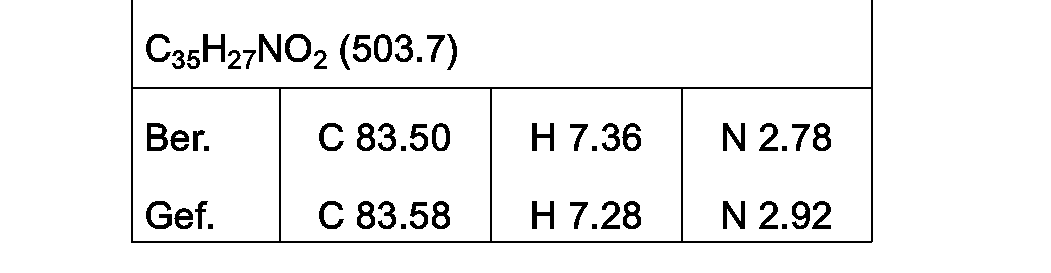
- 230 mg (0.70 mmol) Perylen-3,4-dicarbonsäureanhydrid werden mit 400 mg (1.40 mmol) 10-Aminononadecan (hergestellt gemäss der DE-A4,007,618) und 1.0 g Imidazol unterAr-Schutzatmosphäre wie bei 2c umgesetzt und aufgearbeitet. Nach der Chromatographie mit Chloroform an Kieselgel wird das Reaktionsprodukt mit Petrolether auf Kieselgel aufgezogen, und die rein aliphatischen Nebenprodukte mit ca. 1 I Petrolether ausgewaschen. Das Reaktionsprodukt wird dann mit Toluol eluiert und anschließend aus Pentan extraktiv umkristallisiert. Ausb. 400 mg (85%), Smp. 143-143.5°C. Rf (Kieselgel/CHCI3)= 0.94. UV (CHCl3): λmax (e)= 507nm (31319), 482 (32213), 453 (sh, 17450). Fluoreszenz (CHCl3, Anr. 507 nm) λmax (Irel)= 539 (1), 557 (0.47).

- 300 mg (0.93 mmol) Perylen-3,4-dicarbonsäureanhydrid werden mit 1.5 g (2.15 mmol) Cyclooctylamin und 3 g Imidazol unter Ar-Schutzatmosphäre wie bei 2c 12 h bei 140°C umgesetzt und aufgearbeitet. Nach dem Trocknen im Trockenschrank wird zum Entfernen von nicht umgesetztem Ausgangsmaterial mit 10 proz. Kaliumcarbonatlösung aufgekocht und so lange mit heißem Wasser ausgewaschen, bis das Filtrat farblos abläuft. Das braunrote Produkt wird bei 120°C im Trockenschrank getrocknet und dann extraktiv aus Ethanol umkristallisiert. Ausb. 290 mg (72%) dunkelrotes Kristallpulver ohne Feststofffluoreszenz, Schmp. 342-343°C, Rf (CHCI3/Kieselgel)= 0.78. UV (CHCl3): λmax (e)= 506 nm (32000), 484 (32100), 264 (35200). Fluoreszenz (CHCI3) λmax (Irel)= 511 nm, 542 (1), 573 (sh, 0.51).

- 190 mg (0.56 mmol) Perylen-3,4-dicarbonsäureanhydrid werden mit 140 mg (1.28 mmol) Cyclododecylamin und 2.0 g Imidazol unter Ar-Schutzatmosphäre wie bei 2c umgesetzt und aufgearbeitet. Nach der Chromatographie mit Chloroform an Kieselgel wird das Reaktionsprodukt mit Toluol extraktiv umkristallisiert. Ausb. 190 mg (66%), Schmp. 285°C, Rf (CHCl3/Kieselgel)= 0.58. UV (CHCl3): λmax (∈): 454 (Schulter, 19085), 484 (32630), 507 (32015). Fluoreszenz (CHCl3, Anr. 584 nm) λmax (Irel)= 538 (1), 572 (sh, 0.44).

- 190 mg (0.56 mmol) Perylen-3,4-dicarbonsäureanhydrid werden mit 0.85 ml (1.40 mmol) 2-Aminoethanol und 1.18g g Imidazol unterAr-Schutzatmosphäre wie bei 2c 96 h umgesetzt und aufgearbeitet. Nach dem Trocknen im Trockenschrank wird zum Entfernen von nicht umgesetztem Ausgangsmaterial mit 10 proz. Kaliumcarbonatlösung aufgekocht und so lange mit heißem Wasser ausgewaschen, bis das Filtrat farblos abläuft. Das braunrote Produkt wird bei 120°C im Trockenschrank getrocknet und dann extraktiv aus Toluol umkristallisiert. Ausb. 50 mg (23%), Schmp. >260°C. UV (CHCl3): λmax =489nm, 509. Fluoreszenz (CHCl3, Anr. 489 nm) λmax (Irel)= 546nm (1), 579 (sh, 0.46).

- Man mischt 0.70 g (2.17 mmol) Perylen-3,4-dicarbonsäureanhydrid mit 0.49 g (3.28 mmol) 4-t-Butylanilin, 3.00 g Imidazol und 0.10 g Zinkacetatdihydrat und erhitzt die Mischung 5 h lang auf 140-150°C. Noch heiss versetzt man die Mischung mit 100 ml Ethanol und gibt dann noch 200 ml 10% Salzsäure zu. Die rote Suspension wird so lange erhitzt, bis aller Ethanol abgedampft ist, dann saugt man ab. Der rotbraune Rückstand wird mit 10% Kaliumcarbonatlösung ausgekocht, dann saugt man heiss ab und spült einige Male mit heissem dest. Wasser nach. Der rote Rückstand wird im Trockenschrank bei 120°C getrocknet und anschliessend mit Toluol/Methanol-Mischung extraktiv umkristallisiert. Man erhält so 0.80 g (81%) rotes N-(4-t-Butylphenyl)-perylen-3,4-dicarboximid, das eine rote Festkörperfluoreszenz zeigt. Smp. >330°C. Rf(CHCl3/Kieselgel)= 0.35.

- Man mischt 0.30g (0.93 mmol) Perylen-3,4-dicarbonsäureanhydrid mit 0.24 g (2.80mmol) Cyclopentylamin und 3 g Imidazol und erhitzt die Mischung unter Stickstoff 4 h lang auf 145°C. Das Reaktionsprodukt wird mit Ethanol aus dem Kolben gewaschen, dann mit 100 ml 10% Salzsäure versetzt und so lange gekocht, dass kein Ethanol mehr enthalten ist. Das ausgefallene Produkt wird abgesaugt, mit Kaliumcarbonatlösung ausgekocht, abgesaugt und mit heissem dest. Wasser gewaschen. Durch Ansäuern des Filtrats mit konz. Salzsäure kann 60 mg (20%) Perylen-3,4-dicarbonsäureanhydrid zurückgewonnen werden. Der rote Rückstand wird 3 mal mit Methanol extraktiv umkristallisiert und dann im Trockenschrank bei 120°C getrocknet. Ausb. 0.22 g (61 %) dunkelrote Nädelchen mit starker roter Festkörperfluoreszenz, Smp. >315°C. Rf (CHCI3/Kieselgel)= 0.18. UV (CHCl3): λmax (e)= 506 (31013), 485 (31425), 355 (3050), 336 (3000), 319 (2680), 264 (34268), 256 (Sh., 18100). Fluoreszenz (CHCl3): λmax (Irel)= 541(1), 572 (Sh., 0.49).

- Man mischt 0.30 g (0.93 mmol) Perylen-3,4-dicarbonsäureanhydrid mit 0.28 g (2.8 mmol) Cyclohexylamin und 3 g Imidazol und erhitzt unter Stickstoff 3h lang auf 140°C. Das Reaktionsprodukt wird mit Ethanol aus dem Kolben gewaschen, mit 200 ml 10% Salzsäure versetzt und so lange gekocht, bis kein Ethanol mehr enthalten ist. Der Rückstand wird abgesaugt, mit Kaliumcarbonatlösung gekocht und wiederum abgesaugt. Der Rückstand wird mit heissem Wasser gewaschen bis das Filtrat kaum mehr gefärbt ist und dann im Trockenschrank bei 120°C getrocknet. Das so erhaltene orange glänzende Pulver wird zweimal mit Methanol extraktiv umkristallisiert, Ausb. 0.30 g (80%) orange Kriställchen, starke rote Festkörperfluoreszenz, Smp. 370-372°C. Rf (CHCl3/Kieselgel)= 0.41. UV (CHCl3): λmax (e)= 505 (29970), 483 (30309), 354 (3160), 336 (3160), 294 (3300), 264 (29090). Fluoreszenz (CHCl3): λmax (Irel)= 539 (1), 567 (0.51).

- Man mischt 0.30g (0.93 mmol) Perylen-3,4-dicarbonsäureanhydrid mit 0.32 g (2.83 mmol) Cycloheptylamin und 3 g Imidazol und erhitzt die Mischung unter Argon 4 h lang auf 150°C. Das Reaktionsprodukt wird mit Ethanol aus dem Kolben gewaschen, mit 200 ml 10% Salzsäure versetzt und abgesaugt. Der Rückstand wird mit Kaliumcarbonatlösung ausgekocht, abgesaugt und mit heissem dest. Wasser so lange gewaschen, bis das Filtrat farblos abläuft. Das so erhaltene Produkt wird im Trockenschrank bei 120°C getrocknet und anschliessend aus Methanol extraktiv umkristallisiert. Ausb. 0.24 g (62%) orange Kristalle mit roter Festkörperfluoreszenz, Smp. 354-355°C, Rf (CHCl3/Kieselgel)= 0.79. UV (CHCl3): λmax (e)= 505 (30370), 483 (30967), 353 (3170), 336 (3170), 295 (3460), 264 (29047). Fluoreszenz (CHCl3): λmax (Irel)= 529 (1), 568 (0.48).

- Man mischt 0.20g (0.93 mmol) Perylen-3,4-dicarbonsäureanhydrid mit 0.47g (1.9 mmol) 2,5-Di-t-butyl-4-nitroanilin, 0.20g Zinkacetatdihydrat und 4g Imidazol und erhitzt die Mischung unterArgon 22h lang auf 170°C. Das Produkt wird mit Ethanol aus dem Kolben gewaschen, mit 2N Salzsäure versetzt und dann solange gekocht, bis alles Ethanol verdampft ist. Man saugt ab, wäscht zweimal mit Wasser nach und kocht dann die Mischung mit 10% Kaliumcarbonatlösung. Es wird wiederum heiss abgesaugt und mehrmals mit heissem Wasser nachgewaschen, bis das ablaufende Filtrat nicht mehr gelb gefärbt ist. Der Rückstand wird im Trockenschrank bei 120°C getrocknet und dann mit Toluol über Kieselgel chromatographiert. Die so erhaltene Lösung wird über eine D5-Fritte filtriert, um etwaig anhaftendes Kieselgel zu entfernen. Ausb. 0.09g (26%) rotes Pulver mit roter Festkörperfluoreszenz, Smp. >360°C, Rf (CHCl3/Kieselgel)= 0.31, UV (CHCl3): λmax (e)= 514 (24450), 489 (25850), 356 (3100), 265 (33790). Fluoreszenz (CHCig): λmax (Irel)= 543 (1), 576 (0.45).

- 300 mg (0.6 mmol) N-(1-Hexylheptyl)-perylen-3,4-dicarbonsäureanhydrid-9,10-dicarboximid und 6 ml 12 proz. KOH werden im Autoklaven (in Anlehnung an Bull. Chem. Soc. Jpn. 1981, 54, 1575) 22 h auf 205°C erhitzt. Nach dem Erkalten wird abgesaugt und zweimal mit Wasser gewaschen. Aus dem verbleibenden Rückstand (20 mg) lassen sich durch Chromatographie mit Chloroform an Kieselgel neben wenig Perylen 10 mg (4%) Dicarbonsäureimid 2c erhalten.
-
- a) Umsetzung von Perylen-3,4-dicarboximid mit Hexylbromid und Kaliumcarbonat in Dimethylformamid: Man stellt eine Suspension aus 0.30 g (=0.93 mmol) Perylen-3,4-dicarboximid mit 0.52 g (=4 mmol) wasserfreiem Kaliumcarbonat und 0.31 g (=1.86 mmol) Hexylbromid in 20 ml abs. Dimethylformamid her und rührt die Mischung über Nacht bei Raumtemperatur. Zur Aufarbeitung fügt man 300 ml Wasser zu, saugt den roten Niederschlag ab und wäscht mit Wasser nach. Das so erhaltene Produkt besteht laut IR-Spektrum nur zu einem sehr geringen Teil aus dem erwarteten N-(1-Hexyl)-perylen-3,4-carboximid, der grösste Teil ist nicht umgesetztes Ausgangsprodukt.
- b) Umsetzung von Perylen-3,4-dicarboximid mit Hexylbromid und KOH in Dimethylsulfoxyd: Man stellt eine Suspension aus 0.16 g(=0.50 mmol) Perylen-3,4-carboximid und 0.28 g (=4.25 mmol) Kaliumhydroxid Plätzchen in 20 ml getrocknetem Dimethylsulfoxyd her und tropft dann 0.33g (=2.00 mmol) 1-Bromhexan dazu. Man rührt die Mischung 66 h lang bei Raumtemperatur, wobei eine Farbänderung von dunkelrot nach rotbraun beobachtet werden kann. Nach Beendigung der Reaktion gibt man 150 ml dest. Wasser dazu, saugt dann das ausgefallene rotbraune Produkt ab und wäscht mit gesättigter Kochsalzlösung und dest. Wasser nach. Der Rückstand wird bei 120°C im Trockenschrank getrocknet. Ein IR-Spektrum zeigt, dass es sich hauptsächlich um eine Mischung aus N-(1-Hexyl)-perylen-3,4-dicarboximid und Perylen-3,4-dicarboximid handelt. Durch chromatographische Filtration mit Chloroform über Kieselgel können die beiden Produkte getrennt werden, das N-(1-Hexyl)-perylen-3,4-dicarboximid wird anschliessend nochmals mit Chloroform über Kieselgel chromatographiert. Als erste Fraktion erhält man 20 mg eines gelben Produkts, das sich durch Dünnschichtchromatographie als nicht einheitlich erweist. Das NMR-Spektrum zeigt, dass die Produkte Hexylreste enthalten, so dass es sich hierbei wahrscheinlich um verschiedene Perylencarbonsäureamide und -ester handeln dürfte. Wegen der zu kleinen Unterschiede im Rf-Wert unterbleibt eine weitere Reinigung. Als zweite Fraktion erhält man 60 mg (=30%) N-(1-Hexyl)-perylen-3,4-dicarboximid als rotes Pulver, Smp. >350°C. Rf (CHClalKieselgel) = 0.61.
- Man suspendiert 0.40g (1.25mmol) Perylen-3,4-dicarboximid und 0.45g (8 mmol) KOH-Pulver in 30 ml DMSO, fügt 1.38 g 1-Bromtetradekan dazu und rührt die Mischung 90 h bei Raumtemperatur. Zur Fällung gibt man 300 ml dest. Wasser dazu, saugt das ausgefallene Produkt ab und wäscht mit dest. Wasser und verdünnter Natriumchloridlösung. Durch chromatographische Filtration und anschliessender Säulenchromatographie jeweils mit Chloroform über Kieselgel erhält man eine gelbe und eine rote Fraktion. Die gelbe Fraktion enthält laut Dünnschichtchromatographie mit Xylol/Petrolether 3:2 über Kieselgel 3 Produkte mit so ähnlichem Rf-Wert, dass eine weitere Reinigung nicht vorgenommen wird. Ausb. 30 mg. Die rote Fraktion erweist sich durch Farbvergleich als N-(1-Tetradecyl)-perylen-3,4-carboximid. Ausb. 30 mg (5%) rotes Pulver mit starker Festkörperfluoreszenz. Rf (CHCl3/Kieselgel)= 0.81.
- Man suspendiert 0.40 g (1.25 mmol) Perylen-3,4-dicarboximid in 25 ml abs. Methanol, gibt 0.17 g (1.87 mmol) Natriummethylat dazu und rührt die Mischung 0.5 h lang bei Raumtemperatur. Anschliessend wird das Lösungsmittel abrotiert, 20ml abs. N-Methylpyrrolidon und 0.54g (2.81mmol) 1-Bromoctan dazgegeben und 23 h bei Raumtemperatur gerührt. Das N-Methylpyrrolidon wird im Vakuum abrotiert, der rote Rückstand wird mehrfach über eine 20 cm lange Säule mit Chloroform über Kieselgel Flashchromatographiert. Hierbei bleibt nicht reagiertes Perylen-3,4-carboximid am Startpunkt hängen, es können darüberhinaus noch eine gelbe und eine rote Fraktion erhalten werden. Die rote Fraktion erweist sich im NMR-Spektrum als N-(1-Octyl)-perylen-3,4-dicarboximid und wird anschliessend mit Methanol extraktiv umkristallisiert. Ausb. 60% rote Kriställchen mit roter Festkörperfluoreszenz.
- Man suspendiert 0.40 g (1.25 mmol) Perylen-3,4-dicarboximid in 25 ml abs. Methanol, gibt 0.13 g (1.43 mmol) Natriummethylat dazu und rührt die Mischung 0.5 h lang bei Raumtemperatur. Anschliessend wird das Lösungsmittel abrotiert, 20 ml abs. N-Methylpyrrolidon und 0.74 g (2.80 mmol) 7-Tridecylbromid werden dazugegeben und 23 h bei Raumtemperatur gerührt. Das N-Methylpyrrolidon wird im Vakuum abrotiert, der rote Rückstand wird mehrfach über eine 20 cm lange Säule mit Chloroform über Kieselgel Flashchromatographiert. Hierbei bleibt nicht reagiertes Perylen-3,4-dicarboximid am Startpunkt hängen, es können darüberhinaus noch eine gelbe und eine rote Fraktion erhalten werden. Die rote Fraktion erweist sich durch Vergleich mit einer Probe als gewünschtes N-(7-Tridecyl)-perylen-3,4-dicarboximid, Ausb. 15 mg (2.4%), die gelbe Fraktion erweist sich im Dünnschichtchromatogramm (Xylol/Petrolether 3:2) als aus 3 Produkten bestehend; eine weitere Reinigung wird wegen der wenig unterschiedlichen R,Werten nicht durchgeführt.
- 510 mg (1.0 mmol) N-(2,5-Di-tert-butylphenyl)-perylen-3,4-dicarboximid (2b) und 1.4 g (18 mmol) KOH (85 proz.) werden in 47 ml tert-Butylalkohol susupendiert und unter Rühren 2 h gekocht. Es entsteht dabei eine hellorange gefärbte Lösung, deren Farbe langsam nach Gelb umschlägt. Dabei fällt ein rein gelber Niederschlag von Perylen-3-carbonsäure-4-N-(2,5-di-tert-butylphenyl)carboxamid Kaliumsalz (8) aus, der sehr gut in Wasser löslich ist und in Lösung intensiv gelbgrün fluoresziert. Die Suspension der rohen Reaktionslösung wird in der Hitze tropfenweise mit 100 ml 50 proz. Essigsäure versetzt. Es entsteht dabei eine rotorange Susupension, die noch 2 h bei Raumtemperatur gerührt und dann abgesaugt wird. Der so erhaltene rotbraune Feststoff wird im Trockenschrank bei 120°C getrocknet und dann mit 200 ml 10 proz. Kaliumcarbonatlösung gekocht und mehrfach mit warmen Wasser gewaschen, bis das Waschwasser farblos abläuft. Der Filtrationsrückstand besteht im wesentlichen aus N-(2,5-Di-tert-butylphenyl)-perylen-3,4-carboximid (2a) (Ausb. 27%). Aus den wäßrigen Phasen kristallisiert beim Abkühlen Perylen-3,4-dicarbonsäure Kaliumsalz aus (Schmp. >250°C. UV (H20): λmax (e): 450 (28110), 424 (23490), 402 (sh, 11870). Fluoreszenz (H20, sehr stark) λmax (Irel): 465 (1), 491 (0.98).
-

- Die vereinigten, heißen, wäßrigen Phasen, erhalten gemäss Beispiel 19, werden mit Eisessig angesäuert. Zum Zusammenballen des Niederschlags wird kurz aufgekocht und dann abgesaugt. Ausb. 220 mg (67%), Schmp. >260°C. Rf (CHCl3/Kieselgel)= 0.16. UV (CHCl3): λmax (e): 472 (sh); 487 (32900); 508 (29910). Fluoreszenz (CHCl3): λmax (Irel)A= 544 (1), 578 (0.46).

- 530 mg (1.04 mmol) N-(2,5-Di-tert-butylphenyl)-perylen-3,4-carboximid (2b) werden zu Perylen-3-carbonsäure-4-N-(2,5-di-tert-butylphenyl)carboxamid Kaliumsalz (8) umgesetzt, das dann im 10 ml N-Methylpyrrolidon gelöst wird. Man erwärmt auf 30°C, tropft in die warme Lösung langsam eine Mischung von 1.00 ml (3.20 mmol) Methyliodid in 5 ml N-Methylpyrrolidon. Nach 48 h destilliert man das Lösungsmittel im Vakuum ab, nimmt den Rückstand in Chloroform auf, filtriert und chromatographiert mit Chloroform an Kieselgel. Als erste Fraktion wird N-(2,5-Di-tert-butylphenyl)-perylen-3,4-carboximid (2a) erhalten (30 mg, 6%). Der Ester wird als zweite Fraktion erhalten. Ausb. 260 mg (45%), Schmp. 297-298°C. Rf(CHCl3/Kieselgel)= 0.36. UV (CHCl3): λmax (e): 459 (27940), 430 (23980), 409 (sh, 10500), 259 (30240). Fluoreszenz (CHCl3) λmax: 482, 501 (sh).

- Man mischt 0.30 g (0.66 mmol) N-(4-t-Butylphenyl)-perylen-3,4-carboximid mit 0.94 g KOH-Plätzchen, gibt 32 ml t-Butanol dazu und kocht 2 h lang, wobei man eine Umfärbung von orangerot nach orange beobachten kann. Nach dem Abkühlen wird der orange Niederschlag abgesaugt, in 20ml N-Methylpyrrolidon gelöst und mit 1 ml Methyljodid 2.25 h lang gerührt. Das Lösungsmittel wird abdestilliert und der dunkelgelbe Rückstand durch Säulenchromatographie mit Chloroform über Kieselgel und anschliessenderchromatographischen Umkristallisation aus Petrolether gereinigt. Ausb. 0.14 g (42%) gelbe Kriställchen mit hellroter Festkörperfluoreszenz, Smp. 272°C. Rf (Essigester/Kieselgel)= 0.74.
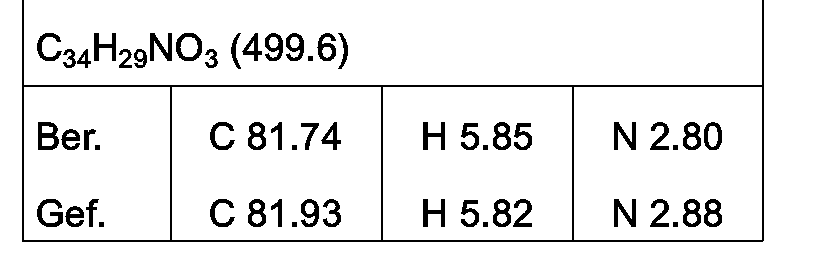
- Man mischt in Anlehnung an Bull. Chem. Soc. Jpn. 1981, 54, 1575, 380 mg (1.20 mmol) Perylen-3,4-dicarbonsäureanhydrid mit 600 mg (5.88 mmol) Neopentandiamin, gibt 15 ml dest. Wasser hinzu und rührt 1 h bei Raumtemperatur. Danach kocht man 3 h unter Rückfluss, wobei sich langsam eine rote Suspension bildet. Diese versetzt man mit 50 ml einer 5 proz. KOH-Lösung, kocht einmal auf, saugt ab und wäscht zweimal mit Wasser und dann mit Ethanol. Der orangefarbene Rückstand wird bei 120°C im Trockenschrank getrocknet und aus Methanol extraktiv umkristallisiert. Ausb: 320 mg (70%) orangefarbenes Pulver mit roter Feststofffluoreszenz, Schmp. 273-274°C. UV (CHCI3) λmax (e)= 259 nm (22400), 266 (30900), 339 (3160), 353 (2770), 484 (28100), 506 (30000). Fluores zenz (CHCl3): λmax (Irel)= 541 nm (1), 573 (0.80).


- Man suspendiert 400 mg (1.24 mmol) Perylen-3,4-dicarbonsäureanhydrid, 0.17 g Zinkacetatdihydrat, 590 mg (5.46 mmol) o-Phenylendiamin in 10 ml Chinolin und erhitzt alles unter Argon 5.5 h auf 210°C. Bei Reaktionsende gibt man 30 ml Ethanol zu, kocht die Mischung auf und filtriert dann ab. Das dunkelrot gefärbte Produkt wird mit Salzsäure angesäuert, abgesaugt, mit Wasser nachgewaschen und dann im Trockenschrank bei 120°C getrocknet. Danach kristallisiert man mit Toluol dreimal extraktiv um. Ausb. 480 mg braunviolettes Pulver, Schmp. >370°C. UV (CHCl3): λmax (∈rel)= 549 nm (0.55), 522 (0.71), 492 (Sh, 0.49), 354 (0.17), 342 (0.16), 286 (0.75), 270 (1), 262 (0.96), 255 (0.95). Fluoreszenz (CHCl3): λmax (Irel)= 588nm.

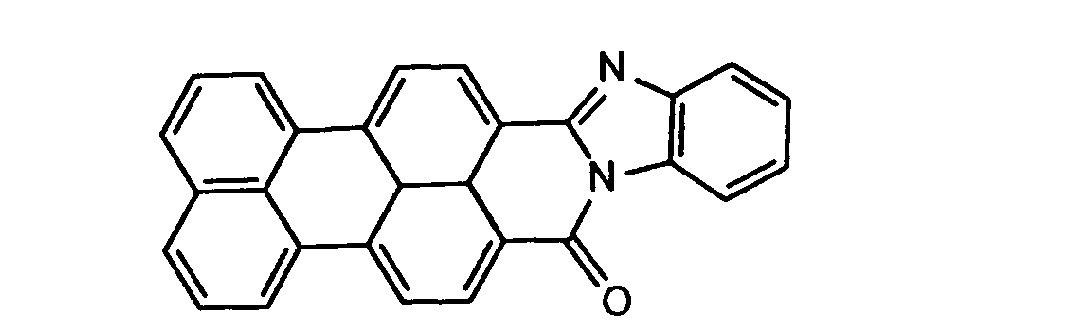
- Analog zu Bull. Chem. Soc. Jpn. 1981, 54, 1575 mischt man 0.30 g (0.93 mmol) Perylen-3,4-dicarbonsäureanhydrid mit 0.26 g (1.1 mmol) 2-Amino-4-t-butylanilindihydrochlorid, 5.00 g Imidazol und 0.13 g Zinkacetatdihydrat und erhitzt die Mischung erst 4 h lang auf 140°C und dann weitere 2 h auf 185°C. Die Reaktionsmischung wird mit Ethanol aus dem Kolben gewaschen, mit200 ml 10% Salzsäure versetzt und dann so lange erhitzt, bis aller Ethanol verdampft ist. Der violette Niederschlag wird abgesaugt, mit dest. Wasser gewaschen und dann im Trockenschrank bei 120°C getrocknet. Das Produkt wird zweifach aus Methanol extraktiv umkristallisiert. Ausb. 55% braunes Pulver, im Strich violett. Das 1H-NMR-Spektrum zeigt, dass man ein Gemisch aus den zwei möglichen Isomeren erhalten hat, die jedoch nicht getrennt werden. Smp. >370°C. UV (CHCl3): λmax (e)= 552 nm (Sh, 24480), 525 (31592), 498 (Sh, 23800), 355 (7600), 344 (7600), 327 (5000), 289 (23587), 273 (30308), 265 (Sh, 27889). Fluoreszenz (CHCl3): λmax (Irel) = 546 nm (Sh, 0.13), 593 (1).

- Man mischt 0.25g (0.78 mmol) Perylen-3,4-dicarbonsäureanhydrid mit 0.25g (1.56 mmol) 2,3-Diamino-naphthalin, 0.10g Zinkacetatdihydrat in 10 ml Chinolin und erhitzt die Mischung unter Argon 2.5 Stunden lang auf 200°C. Das Chinolin wird im Vakuum abdestilliert, der Rückstand wird mit Ethanol herausgewaschen und dann mit 2N Salzsäure versetzt. Der Ethylalkohol wird abgedampft, der dunkle Niederschlag wird abgesaugt und wird anschliessend mehrmals mit Salzsäure und Wasser gewaschen. Der Rückstand wird mit 2N Kaliumcarbonatlösung ausgekocht, abfiltiriert, mit Wasser gewaschen und dann im Trockenschrank bei 120°C getrocknet. Das so erhaltenen violette, sehr schwerlösliche Kristallpulver wird mit Toluol viermal extraktiv umkristallisiert und dann im Trockenschrank bei 120°C getrocknet. Ausb. 0.28g (81 %), Smp. >360°C. UV (CHCl3): λmax (E)= 570 nm (0.128), 533 (0.198), 514 (0.201), 484 (0.16), 381 (0.083), 359 (0.089), 324 (0.106), 312 (0.117), 264 (0.401). Fluoreszenz (CHCl3): λmax (Irel) = 541 nm (1), 585 (0.57).


- Man suspendiert 0.20 g (0.62 mmol) Perylen-3,4-dicarbonsäureanhydrid und 0.05 g (0.93mmol) Natriummethylat in 8 ml abs. Methanol und rührt die Suspension 0.5 h lang bei Raumtemperatur, wobei sie sich von braun nach gelb umfärbt. Das Lösungsmittel wird abrotiert, dann gibt man 10 ml N-Methylpyrrolidon und 0.09 ml (1.4 mmol) Methyljodid dazu und rührt 48 h bei Raumtemperatur. Zu der orange-gelben Lösung gibt man 50 ml Wasser, saugt dann das ausgefallene Produkt ab und trocknet im Trockenschrank bei 120°C. Das so erhaltene gelbe Produkt ist laut Dünnschichtchromatogramm (CHClalKieselgel) fast sauber. Es wird durch eine chromatographische Filtration mit Chloroform über Kieselgel von einem schnelllaufenden Produkt getrennt und dann mit Essigester heruntergewaschen. Ausb. 0.18 g (79%), Smp. 256-257°C. Rf (CHCI3/Silikagel)= 0.07. UV (CHCl3): λmax (e)= 460 nm (25920), 438 (23925), 340 (1920), 329 (1910), 260 (31217). Fluoreszenz (CHCI3, Anr. 489nm) λmax (Irel)= 483 nm (1), 507 (0.81). MS (70eV): m/z (%)= 370 (3.65), 369 (23.59), 368 (M+, 100), 338 (10.68), 337 (M+-CH3O, 46.20), 323 (8.69), 322 (M+-CH3O-CH3, 36.35), 294 (11.65), 278 (11.79), 250 (23.13), 238 (9.73), 237 (7.77), 168 (9.21), 125 (13.73).
- Man suspendiert 0.18g (0.56 mmol) Perylen-3,4-dicarbonsäureanhydrid in 10 ml getrocknetem n-Propanol, gibt 0.15g (1.43 mmol) Kalium-t-butylat dazu und rührt die Suspension 0.5 Stunden lang bei Raumtemperatur unter Feuchtigkeitsausschluss. Während des Reaktionsverlaufes kann eine Umfärbung von braun nach gelb beobachtet werden, wobei der Niederschlag in Lösung geht. Danach destilliert man das Lösungsmittel ab, fügt erst 10 ml N-Methylpyrrolidon und dann 0.20 ml (2.4 mmol) 1-Brompropan dazu und rührt die gelbe Lösung 17 Stunden bei Raumtemperatur. Das Lösungsmittel wird im Vakuum abdestilliert, der gelbe Rückstand wird mit Chloroform über Kieselgel chromatographiert. Ausb. 0.16 g (68%), Smp. 253°C, Rf (CHCI3/Silikagel)= 0.48. UV (CHCI3): λmax (e)= 460 nm (27944), 437 (23875), 340 (1900), 327 (2050), 260 (32991). Fluoreszenz (CHCl3): λmax (Irel)= 482 nm (1), 509 (0.69), Festkörperfluoreszenz: λmax=595nm.

- Man suspendiert (in Anlehnung an Acta. Chim. Scand. 1983, B37, 65) 120 mg (240 mmol) N-1-Hexylheptyl- perylen-3,4-dicarboximid in 1 ml Acetanhydrid und gibt bei 0°C eine Mischung aus 0.057 ml konz. Salpetersäure in 0.15 ml Acetanhydrid zu. Nach 2 h läßt man die Mischung langsam auf Raumtemperatur erwärmen und rührt weitere 72 h. Man dampft das dunkelrote Produkt im Vakuum ein und chromatographiert den Rückstand mit Chloroform über Kieselgel. Als erste Fraktion erhält man gemäss 1H-NMR (CDCl3) eine Mischung aus 60% N-(1-Hexylheptyl)-perylen-3,4-dicarboximid und 40% N-(1-Hexylheptyl)-2-nitro-perylen-3,4-dicar- boximid, die jedoch chromatographisch nicht getrennt werden können (RfWert 0.85; Chloroform/Kieselgel). Als zweite Fraktion wird gemäss 1H-NMR (CDCl3) N-(1-Hexylheptyl)-9-nitro-perylen-3,4-dicarboximid eluiert.
- Man löst 500 mg (1.00 mmol) N-(1-Hexylheptyl)-perylen-3,4-dicarboximid in 100 ml Dichlormethan, und gibt bei völliger Dunkelheit (Ausschluß von Tageslicht!) 2.9 ml einer Lösung von Stickstoffdioxyd in Dichlormethan (15.7 g N02 pro Liter, 1.00 mmol). Man läßt dann die Mischung 17.75 h unter Ausschluß von Licht bei Raumtemperatur stehen und dampft dann das Dichlormethan mit dem Rotationsverdampfer ab. Ein Dünnschichtchromatogramm (Chloroform /Kieselgel) zeigt, daß der erhaltene Rückstand hauptsächlich aus 2 Verbindungen mit den Rf-Werten 0.89 und 0.73 besteht. Die Substanz mit dem größeren Rf-Wert ist nicht umgesetztes Ausgangsmaterial, von dem durch Säulenchromatographie (Chloroform/Kieselgel) 210 mg (42%) zurückgewonnen werden können. Die 2. Chromatographie-Fraktion wird durch extraktive Umkristallisation aus Methanol gereinigt. Ausb. 300 mg (55%) weinrote Nadeln (Strukturbeleg durch 1H-NMR-, COSY-, und NOESY-Spektren) Schmp. 184-185°C. Rf (Chloroform/Kieselgel)= 0.73. UV (CHCl3): λmax (e)= 510 nm (34344), 483 nm (30844), 357 nm (breit, 4470). Fluoreszenz (CHCl3): λamx= 549 nm.
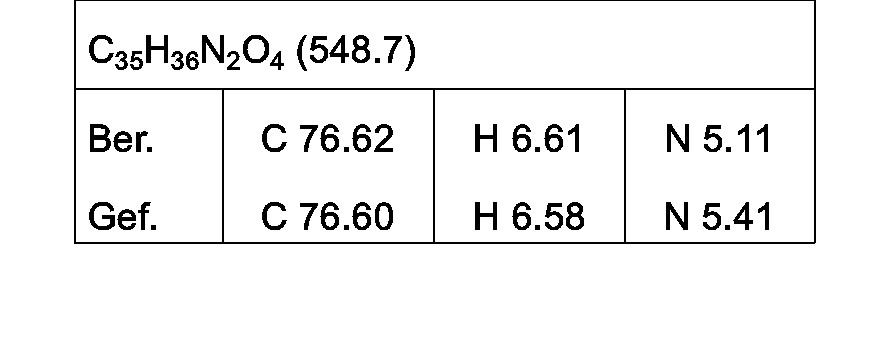
- Man löst (in Anlehnung an Acta. Chim. Scand. 1983, B37, 65) unter der Einwirkung von Tageslicht 250 mg (0.49 mmol) N-(2,5-Di-tert-butyl-phenyl)-perylen-3,4-dicarboximid in 17 ml Dichlormethan und gibt dann 1.5 ml einer Lösung von N02 in Dichlormethan zu, die 15.7 g/I enthält (0.5 mmol). Nach einer Reaktionszeit von 17 h bei Raumtemperaturwird das Lösungsmittel mit dem Rotationsverdampfer abgedampft. Ein Dünnschichtchromatogramm (Chloroform/Kieselgel) zeigt, daß der erhaltene Rückstand hauptsächlich aus 3 Farbstoffen mit den RrWerten 0.27, 0.38 und 0.49 besteht, wobei es sich bei der Verbindung mit dem RrWert von 0.38 um das Ausgangsmaterial handelt, wie ein Vergleich mit einer authentischen Probe ergibt. Das Rohprodukt wird mit Chloroform über Kieselgel chromatographiert, wobei man 80 mg (32%) N-(2,5-Di-tert-butylphenyl)-perylen-3,4-dicarboximid zurückgewinnen kann. Durch mehrfache Chromatographie mit Chloroform über Kieselgel und anschließende extraktive Umkristallisation mit Methanol konnte die Verbindung mit einem Rf-Wert von 0.49 rein erhalten und durch 1H-, COSY- und NOESY-NMR-Spektren als 1-Nitro-N-(2,5-di-t-butyl-phenyl)-perylen-3,4-dicarboximid identifiziert werden. Ausb. 20 mg (7%), Smp. 331-335°C (Zers.). Rf(Chloroform/Kie-selgel)= 0.49. UV (CHCl3): λmax (e): 514 (25290), 409 (breit, 4350), 356 (breit, 6250).

- Man löst (in Anlehnung an Acta. Chim. Scand. 1983, B37, 65) 430 mg (0.85 mmol) N-(2,5-Di-tert-butylphenyl)-perylen-3,4-dicarboximid in 25 ml Dichlormethan und gibt zu der roten Lösung 10 µl Methansulfonsäure. Dazu gibt man dann tropfenweise 5 ml einer Lösung von 15.7 g Distickstofftetroxyd im Liter Dichlor- methan (0.85 mmol), worauf sie sich sofort nach weinrot umfärbt. Die Lösung läßt man über Nacht s tehen und dampft dann das Dichlor-methan mit dem Rotationsverdampfer ab. Aus einem Dünnschichtchromatogramm (Chloroform/Kieselgel) des weinroten Rückstandes ist die Bildung von 4 Hauptprodukten und einigen Nebenproduk-ten zu ersehen. Der Rückstand wird mit Chloroform über Kieselgel chromatographiert, wobei alle 4 Hauptprodukte rein erhalten werden können. Nacheinander werden folgende Fraktionen erhalten:
- 1. Fraktion: 60 mg eines weinroten Pulvers, das durch Extraktion mit Essigester und mehrfache Chromatographie mit Chloroform über Kieselgel weiter gereinigt wird. Ausb. 30 mg (5%) 1,6-Dinitro-N-(1-hexylheptyl)-perylen-3,4-carboximid (durch NMR- und MS- Spektren identifiziert), Schmp. 142-144°C, Rf
(Chloroform/Kieselgel)= 0.81. UV (CH Cl3): λmax= 508, 482. Fluoreszenz (CHCl3):λmax (Irel)= 541 (1), 573 (sh, 0.72).
- 2. Fraktion: verunreinigtes 9-Nitro-N-(1-hexylheptyl)-perylen-3,4-carboximid.
- 3. Fraktion: 0.22g einer weinroten Substanz, die entsprechend den 1H-NMR-Spektrum aus 81% 9-Nitro-N-(1-hexylheptyl)-perylen-3,4-dicarboximid und 19% 2,5-Dinitro-N-(1-hexylheptyl)-perylen-3,4-dicarboximid besteht. Diese können jedoch weder durch Säulenchromatographie mit Chloroform oder Toluol an Kieselgel oder durch fraktionierte Kristallisation aus Acetonitril oder anderen Lösungsmitteln rein erhalten werden.
- 4. Fraktion: 130 mg einer dunkelroten Substanz die mit Methanol extraktiv umkristallisiert wird. Man erhält
90 mg (25 %) dun-kelrote Kristalle, die durch ein 1H- und ein NOESY-NMR-Spektrum als 9,10-Dinitro-N-(1-hexylheptyl)-perylen-3,4-dicarboximid identifiziert werden, Schmp. 245-246°C. Rf (Chloroform/Kieselgel)= 0.54. UV (CHCl 3 ): λ max (e)= 506 nm (58015), 474 (40792), 446 (16730).
- Man löst (in Anlehnung an Acta. Chim. Scand. 1983, B37, 65) 0.75g (1.47mmol) N-(2,5-Di-t-butylphenyl)-perylen-3,4-dicarboximid in 30 ml abs. Dichlormethan und fügt dann unter Lichtausschluss 6.94 ml (1.48 mmol) einer Lösung dazu, die 19.5 g/I N02 in Dichlormethan enthält. Die rote Lösung lässt man über Nacht bei Raumtemperatur stehen und rotiert dann ein. Ein Dünnschichtchromatogramm mit Chloroform über Kieselgel zeigt das Vorhandensein von 3 Verbindungen mit den Rf-Werten von 0.43, 0.32 und 0.18. Bei der Verbindung mit dem Rf-Wert von 0.32 handelt es sich um das Ausgangsprodukt, wie ein Vergleich mit einer Probe ergibt. Die Verbindung mit dem Rf-Wert von 0.43 kann durch wiederholte Flashchromatographie mit Chloroform über Kieselgel (0.04-0.063mm) und anschliessender extraktiver Umkristallisation aus Methanol rein erhalten werden und durch 1H-, COSY- und NOESY-NMR-Spektren als 1-Nitro-N-(2,5- di-t-butyl-phenyl)-perylen-3,4-dicarbox- imid identifiziert werden. Ausb. 0.08g (10%) weinrotes Pulver, Smp. >335°C. Rf (Chloroform/Kieselgel)= 0.43. UV (CHCl3): λmax (e): 511 (27690), 409 (breit, 5105), 357 (breit, 7170), 267 (26710).

- Die Verbindung mit dem Rf-Wert von 0.18 kann durch fraktionierte Flashchromatographie mit Chloroform über Kieselgel (0.04-0.63 mm) und durch zweimalige extraktive Umkristallisation aus Essigester isoliert und durch 1H-, COSY- und NOESY-NMR-Spektren als 9-Nitro-N-(2,5-di-t-butyl-phenyl)-perylen-3,4-dicarboximid identifiziert werden. Ausb. 0.26g (32%) rotes Pulver, leichte orange Festkörperfluoreszenz. Smp. >365°C, Rf (CHCl3/Kieselgel) 0.18. UV (CHCl3) λmax (e): 512 (35590), 484 (32104), 358 (4920), 347 (4680), 262 (30924), 255 (29495). Fluoreszenz (CHCl3) λmax (Irel.): 549.

- Des weiteren können 0.27g (36%) N-(2,5-Di-t-butylphenyl)-perylen-3,4-dicarboximid zurückgewonnen werden.
- Man suspendiert 100 mg (0.18 mmol) 9-Nitro-N-(1-hexylheptyl)-perylen-3,4-dicarboximid (10) in 15 ml Eisessig, gibtdann 80 mg (0.72 mmol) Eisenstaub zu und kocht die rote Suspension 4.5 h unter Rückfluß, wobei man eine langsame Umfärbung von rot über rot-braun und lila nach dunkellila beobachten kann. Zu der abgekühlten, violetten Lösung gibt man zuerst Wasser und neutralisiert dann mit 10 proz. KOH. Die jetzt rötlichlila gefärbte Suspension wird mit Chloroform dreimal ausgeschüttelt, die vereinigten organischen Phasen werden mit wasserfreiem Natriumsulfat getrocknet und dann einrotiert. Laut Dünnschichtchromatogramm (Chloroform/Kieselgel) besteht das erhaltene lilafarbige Produkt aus 2 Hauptprodukten mit den RfWerten von 0.02 und 0.43. Dieses wird mit Chloroform über Kieselgel chromatographisch filtriert, bis keine violette Lösung mehr austritt. Das rot gefärbte Kieselgel wird mit Chloroform extrahiert, wobei man nach dem Einrotieren 50 mg rotes Pulver erhält, das anschließend mit Methanol extraktiv umkristallisiert wird. Ausb. an 9-Acetamido-N-(1-hexylheptyl)-perylen-3,4-dicarboximid 30 mg (30%), Schmp. >230°C; ab 172-175°C
Braunfärbung. R f (CHCl3/Eisessig 20:1; Kieselgel)= 0.90. UV (CHCl3): λmax (e)= 506nm (31589, breit), 356 (2995). Fluoreszenz (CHCl3): λmax= 574 nm (breit).
- Man suspendiert 100 mg (0.18 mmol) 9-Nitro-N-(1-hexylheptyl)-perylen-3,4-dicarboximid und 70 mg Eisenpulver in 30 ml Ethanol und gibt dann langsam 2 ml konz. Salzsäure zu. Die Mischung wird 1 h lang unter Rückfluß erhitzt, wobei man eine Umfärbung nach gelbbraun feststellen kann. Man neutralisiert die Mischung mit KOH, saugt den dunklen Niederschlag ab und trocknet ihn bei 120°C im Trockenschrank. Ein Dünnschichtchromatogramm (Chloroform/Kieselgel) zeigt, daß 2 Substanzen mit den RrWerten von 0.21 und 0.32 entstanden sind. Man chromatographiert mit Chloroform über Kieselgel, wobei man als erste Fraktion 10 mg eines blau gefärbten Pulvers erhält. Die besteht entsprechend dem NMR- und Massenspektren wahrscheinlich aus zwei Azoverbindungen mit sehr hohen Massenzahlen. Die zweite Fraktion ist 9-Amino-N-(1-hexylheptyl)-perylen-3,4-dicarboximid, Ausb. 80 mg (85%) blaues Pulver, Schmp. 211°C, Rf(Chloroform/Kieselgel)= 0.20. UV (CHCl3): λmax (e)= 554 nm (27940), 375 (4903), 356 (5412), 277 (29123), 262 (23798). Fluoreszenz (CHCl3): λmax= 642 nm (schwach).
- Man mischt 190 mg (0.37 mmol) 9-Amino-N'-(1-hexylheptyl)-perylen-3,4-carboximid mit 2 g Ameisensäure und gibt dann 40 mg 37 %ige wässrige Formaldehyd-Lösung zu. Diese Suspension wird 18 h auf 75-80°C erhitzt, wobei man eine Umfärbung von Rot nach Blau beobachten kann. Durch die Zugabe von 20 ml 50 %iger KOH-Lösung wird das violette Produkt ausgefällt. Man rührt noch 1 h, saugt dann das Produkt ab, wäscht mit Wasser nach und trocknet im Trockenschrank. Durch wiederholte Chromatographie des Produkts mit Chloroform über Kieselgel können 2 Substanzen mit den Rf-Werten 0.92 und 0.51 isoliert werden. Die Substanz mit dem grösseren Rf-Wert kann durch 1H-NMR-Spektroskopie als 9-N,N-Dimethylamino-N'-(1-hexylheptyl)-perylen-3,4-carboximid (70 mg=39 %), die Substanz mit dem kleineren Rf-Wert durch Vergleich der Dünnschichtchromatogramme und 1H-NMR-Spektren als Ausgangsprodukt (40 mg=48 %) identifiziert werden. Ausb.: 70 mg (39 %), Schmp.: 168-169°C UV (CHCl3): λmax (e)=542 (26400), 506 sh (21000), 382 (3000), 357 (3200), 269 (25800), 262 (25700). Fluoreszenz (CHCl3): λmax (Irel)=662.

- Man löst (in Anlehnung an Dyes and Pigments 1991, 16, 19) 410 mg (1.0 mmol) N-(1-Hexylheptyl)-perylen-3,4-dicarboximid (2c) in 70 ml Chlorbenzol, erwärmt auf 40°C und gibt dann schnell eine Lösung von 100µl (4 mmol) Brom in 10 ml Chlorbenzol zu der orangen Lösung, die sich sofort nach Weinrot umfärbt. Man rührt die Lösung 2.5 h lang bei 40-50°C und dampft dann das Chlorbenzol mit dem Rotationsverdampfer ab. Ein Dünnschichtchromatogramm (Toluol/Kieselgel) zeigt die Anwesenheit von 4 Produkten, wobei eines mit dem Rf-Wert von 0.77 das Hauptprodukt darstellt. Der Rückstand wird mit Toluol über Kieselgel 8 mal chromatographiert, wobei 30 mg (7%) N-(1-Hexylheptyl)-perylen-3,4-dicarboximid erhalten werden. Als Vorlauf wird ein rein gelbes Produkt isoliert, das entprechend dem Massenspektrum vielfach (2-5) bromierte N-(1-Hexylheptyl)-perylen-3,4-dicarboximide sind. Eine chromatographische Trennung der Verbindungen gelingt nicht. Die Hauptfraktion wird mit Pentan extraktiv umkristallisiert. Ausb. 310 mg (65%) oranges Pulver, das eine starke Festkörperfluoreszenz aufweist, Schmp. 186-187°C. Rf (Chloroform/Kieselgel)= 0.77. UV (CHCl3): λmax (e)= 508 (35675), 484 (33985). Fluoreszenz (CHCI3) λmax (Irel)= 540 (1), 568 (Sh, 0.49). Die Stellung des Bromatoms kann hierbei durch eine Kombination von 1H-, NOESY- und COSY-NMR-Spektren aufgeklärt werden.
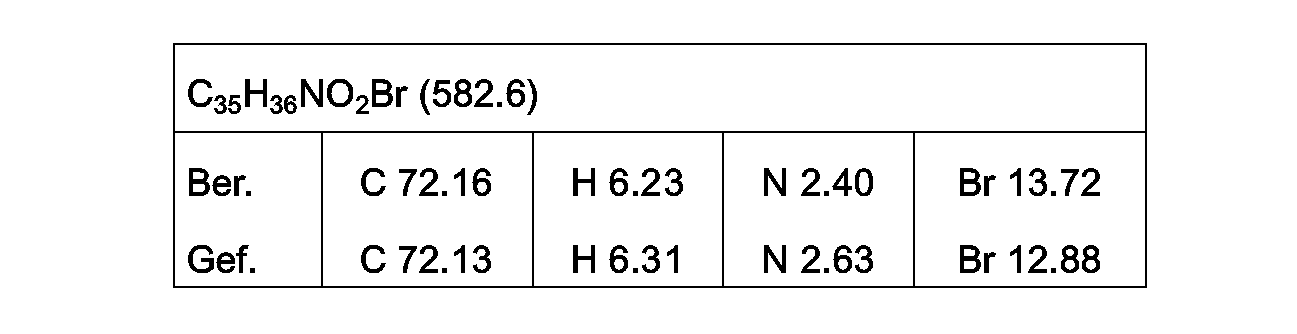
- Man löst 650 mg (1.28 mmol) N-(2,5-Di-tert-butyl-phenyl)-perylen-3,4-dicarboximid (2b) in 100 ml Chlorbenzol, vermischt die rote Lösung mit 650 mg wasserfreiem Kaliumcarbonat und tropft dann zu der Mischung 0.30 ml Brom in 10 ml Chlorbenzol zu. Man rührt 2 h lang bei 40-50°C, erhöht dann die Temperatur für weitere 5 h auf 50-60°C und dampft dann das Chlorbenzol mit dem Rotationsverdampfer ab, wobei auch noch erhebliche Mengen an Brom mit entfernt werden. Ein Dünnschichtchromatogramm (Toluol/Kieselgel) zeigt kein Ausgangsprodukt mehr im erhaltenen Rückstand an, das nur sehr schwer zu entfernen wäre. Durch mehrmalige säulenchromatographische Trennungen mit Chloroform über Kieselgel können 610 mg oranges Pulver erhalten werden, das mit Essigester extraktiv umkristallisiert wird. Ausb. 570 mg (77%) orangefarbene Nädelchen, die eine leichte Festkörperfluoreszenz aufweisen, Schmp. >320°C. Rf (CHCl3/Kieselgel)= 0.43. UV (CHCl3): λmax (e)= 511 nm (36058), 486 (35564), 357 (3430). Fluoreszenz (CHCl3): λmax (Irel)= 542 nm (1), 572 Die Stellung des Bromsubstituenten konnte durch Vergleich mit dem Spektrum von 9-Brom-N-(1-hexylheptyl)-perylen-3,4-dicarboximid und 1H-Spektren bestimmt werden. Das Substi-tutionsmuster der Vergleichssubstanz wurde durch eine Kombination von COSY- und NOESY-Spektren bestimmt.

- (Aus der Vorfraktion läßt sich nach mehrmaliger Säulenchromatographie mit Chloroform über Kieselgel wenig einer weiteren roten Substanz dünnschichtchromatographisch (Chloroform/Kieselgel) rein erhalten. Das Massenspektrum ergibt eine Molekülmasse von 667 mit dem typischen Isotopenmuster von 3 Bromatomen. Die Substanz zeigt jedoch ein ganz ähnliches UV/Vis-Absorptions- und Fluoreszenzspektrum wie 9-Brom-N-(2,5-di-tert-butyl-phenyl)-perylen-3,4-carboximid so daß der Chromophor auf jeden Fall erhalten geblieben sein muß.)
- Die oben erwähnte Verbindung zeigt in ausgewählten Lösungsmitteln geordnet nach steigender Polarität (z.B. gemäss der ET30-Skala) eine ausgeprägte Solvatochromie, indem mit der Erhöhung der Polarität des Lösungsmittels sowohl das UV- als auch das Fluoreszenz-Absorptionsmaximum batochrom verschoben sind. Dies ist beispielsweise aus den entsprechenden Werten in Toluol, im Vergleich zu Ethanol ersichtlich:

- Mit den erwähnten Verbindungen, hergestellt gemäss Beispiel 1 bzw. gemäss Beispiel 7, wird Polyethylenterephthalat (MeiinarO 890, ICI) in 0.03% Konzentration gefärbt. Die brilliant orangen Ausfärbungen sind während 5 min bei 300°C wärmestabil; zeigen nach DIN 53775 keine Migration in PVC (24h, 80°C); und weisen eine ausgezeichnete Lichtbeständigkeit nach ISO 105-A02 (5 greyscale nach 500h) auf.
Claims (22)


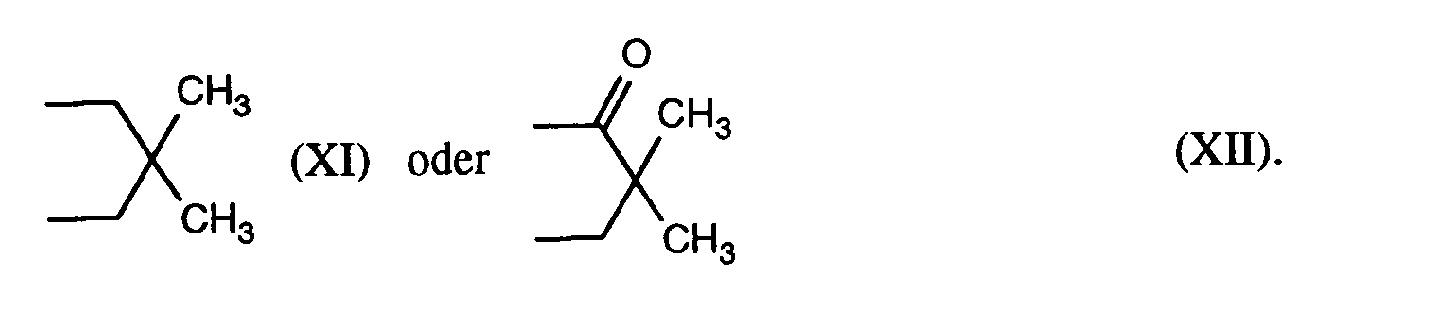

Applications Claiming Priority (3)
| Application Number | Priority Date | Filing Date | Title |
|---|---|---|---|
| CH340193 | 1993-11-12 | ||
| CH340193 | 1993-11-12 | ||
| CH3401/93 | 1993-11-12 |
Publications (3)
| Publication Number | Publication Date |
|---|---|
| EP0657436A2 true EP0657436A2 (de) | 1995-06-14 |
| EP0657436A3 EP0657436A3 (de) | 1995-07-19 |
| EP0657436B1 EP0657436B1 (de) | 2001-12-12 |
Family
ID=4255191
Family Applications (1)
| Application Number | Title | Priority Date | Filing Date |
|---|---|---|---|
| EP94810637A Expired - Lifetime EP0657436B1 (de) | 1993-11-12 | 1994-11-03 | Verfahren zur Herstellung von Perylen-3,4-dicarbonsäurederivaten |
Country Status (6)
| Country | Link |
|---|---|
| US (1) | US5650513A (de) |
| EP (1) | EP0657436B1 (de) |
| JP (2) | JP3634415B2 (de) |
| CA (1) | CA2135556A1 (de) |
| DE (1) | DE59410008D1 (de) |
| TW (1) | TW279860B (de) |
Cited By (17)
| Publication number | Priority date | Publication date | Assignee | Title |
|---|---|---|---|---|
| EP0698649A1 (de) * | 1994-08-26 | 1996-02-28 | Basf Aktiengesellschaft | Verwendung von thermoplastisch verarbeitbaren, langzeitstabilen elektrolumineszenten Materialien |
| WO1996022331A1 (de) * | 1995-01-20 | 1996-07-25 | Basf Aktiengesellschaft | Verfahren zur herstellung und reinigung von perylen-3,4-dicarbonsäureimiden |
| WO1997046533A1 (de) * | 1996-06-05 | 1997-12-11 | Basf Aktiengesellschaft | Verfahren zur herstellung von perylen-3,4-dicarbonsäureimiden |
| EP0854144A1 (de) * | 1997-01-14 | 1998-07-22 | Ciba SC Holding AG | Herstellung von Perylen-3,4-dicarbon-säureanhydriden |
| WO1998031678A1 (en) * | 1997-01-14 | 1998-07-23 | Ciba Specialty Chemicals Holding Inc. | Preparation of perylene-3,4-dicarboxylic anhydrides |
| WO2001016109A1 (de) * | 1999-08-27 | 2001-03-08 | Basf Aktiengesellschaft | Thermochrome rylenfarbstoffe |
| WO2002068538A3 (de) * | 2001-02-22 | 2002-10-31 | Basf Ag | Thermochrome rylenfarbstoffe |
| EP1172417A3 (de) * | 2000-07-14 | 2004-01-07 | Clariant International Ltd. | Verfahren zur Herstellung von feinteiligen, opaken Partikeln |
| WO2004029028A2 (de) | 2002-09-20 | 2004-04-08 | Basf Aktiengesellschaft | 9-cyanosubstituierte perylen-3,4-dicarbonsäuremonoimide als farbstoffe |
| WO2008101895A3 (de) * | 2007-02-19 | 2009-09-17 | Basf Se | Verfahren zur herstellung von pigment rot 149 |
| EP2110237A1 (de) * | 2008-04-16 | 2009-10-21 | Kuraray Europe GmbH | Photoluminiszierende Zwischenschichtfolien für Verbundverglasungen |
| WO2009141387A1 (de) * | 2008-05-23 | 2009-11-26 | Basf Se | Chinoide rylendicarboximide als ir-absorber |
| US7799920B2 (en) | 2004-11-09 | 2010-09-21 | Basf Aktiengesellschaft | Method for producing perylene-3,4-dicarboxylic acid imides |
| WO2018134261A1 (en) | 2017-01-18 | 2018-07-26 | Basf Se | Fluorescent colorants based on cyanoaryl-substituted naphthoylenebenzimidazole compounds |
| WO2019121602A1 (en) | 2017-12-19 | 2019-06-27 | Basf Se | Cyanoaryl substituted benz(othi)oxanthene compounds |
| WO2019243286A1 (en) | 2018-06-22 | 2019-12-26 | Basf Se | Photostable cyano-substituted boron-dipyrromethene dye as green emitter for display and illumination applications |
| CN112778137A (zh) * | 2021-01-08 | 2021-05-11 | 山东师范大学 | 一种端位硝化的3,4-苝二羧酸酯类化合物及其合成方法与应用 |
Families Citing this family (37)
| Publication number | Priority date | Publication date | Assignee | Title |
|---|---|---|---|---|
| DE19949382A1 (de) | 1999-10-13 | 2001-04-19 | Basf Ag | Verwendung feinteiliger, farbstoffhaltiger Polymerisate PF als farbgebenden Bestandteil in kosmetischen Mitteln |
| JP2001348494A (ja) * | 2000-06-09 | 2001-12-18 | Teijin Chem Ltd | 光学用樹脂組成物および光記録媒体基板 |
| US6391104B1 (en) | 2000-12-01 | 2002-05-21 | Bayer Corporation | Perylene pigment compositions |
| JP4544757B2 (ja) * | 2001-02-23 | 2010-09-15 | 三井化学株式会社 | 有機電界発光素子 |
| US6692562B2 (en) | 2002-03-08 | 2004-02-17 | Sun Chemical Corporation | Process for making perylene pigment compositions |
| WO2005089094A2 (en) * | 2003-11-21 | 2005-09-29 | The Board Of Regents Of The University And Community College System Of Nevada | Materials and methods for the preparation of anisotropically-ordered solids |
| CN1918239B (zh) † | 2004-02-11 | 2010-05-05 | 巴斯福股份公司 | 黑色苝系颜料 |
| FR2868776B1 (fr) * | 2004-04-13 | 2008-04-18 | Servier Lab | Nouveau procede de synthese de derives de la 1,3-dihydro- 2h-3-benzazepin-2-one, et application a la synthese de l'ivabradine et de ses sels d'addition a un acide pharmaceutiquement acceptable |
| DE102004029385A1 (de) * | 2004-06-17 | 2006-06-08 | Wella Ag | Verwendung von fluoreszierenden Perylenverbindungen zur Behandlung menschlicher Haare |
| EP1802623A1 (de) * | 2004-10-12 | 2007-07-04 | Novo Nordisk A/S | 11beta-hydroxysteroid-dehydrogenase-typ-1-aktive spiroverbindungen |
| WO2007051811A2 (en) * | 2005-11-01 | 2007-05-10 | Transtech Pharma | Pharmaceutical use of substituted amides |
| EA200801243A1 (ru) * | 2005-11-01 | 2008-10-30 | Транстек Фарма | Фармацевтическое применение замещенных амидов |
| EP2007722A1 (de) * | 2006-03-21 | 2008-12-31 | High Point Pharmaceuticals, LLC | Adamantanderivate zur behandlung des metabolischen syndroms |
| EP2010479A1 (de) | 2006-04-07 | 2009-01-07 | High Point Pharmaceuticals, LLC | An der 11 beta-hydroxysteroiddehydrogenase vom typ 1 aktive verbindungen |
| WO2007144394A2 (en) * | 2006-06-16 | 2007-12-21 | High Point Pharmaceuticals, Llc. | Pharmaceutical use of substituted piperidine carboxamides |
| US8048908B2 (en) * | 2006-07-13 | 2011-11-01 | High Point Pharmaceuticals, Llc | 11β-hydroxysteroid dehydrogenase type 1 active compounds |
| EP1878721A1 (de) * | 2006-07-13 | 2008-01-16 | Novo Nordisk A/S | 4-Piperidylbenzamide als Inhibitoren der 11-beta-hydroxysteroiddehydrogenase Typ 1 |
| WO2008086404A1 (en) * | 2007-01-10 | 2008-07-17 | Albany Molecular Research, Inc. | 5-pyridinone substituted indazoles |
| US8334305B2 (en) * | 2007-02-23 | 2012-12-18 | High Point Pharmaceuticals, Llc | N-adamantyl benzamides as inhibitors of 11-β-hydroxysteroid dehydrogenase |
| ZA200904916B (en) | 2007-02-23 | 2010-09-29 | High Point Pharmaceuticals Llc | N-adamantyl benzamides as inhibitors of 11-beta-hydroxysteroid dehydrogenase |
| EP2146952A1 (de) * | 2007-02-23 | 2010-01-27 | High Point Pharmaceuticals, LLC | N-adamantylbenzamide als inhibitoren von 11-beta-hydroxysteroiddehydrogenase |
| US20110003856A1 (en) * | 2007-02-23 | 2011-01-06 | Soren Ebdrup | N-adamantyl benzamides as inhibitors of 11-beta-hydroxysteroid dehydrogenase |
| US8153798B2 (en) * | 2007-03-09 | 2012-04-10 | High Point Pharmaceuticals, Llc | Indole- and benzimidazole amides as hydroxysteroid dehydrogenase inhibitors |
| CA2681934A1 (en) * | 2007-03-28 | 2008-10-02 | High Point Pharmaceuticals, Llc | 11beta-hsd1 active compounds |
| JP2010523692A (ja) * | 2007-04-11 | 2010-07-15 | ハイ ポイント ファーマシューティカルズ,リミティド ライアビリティ カンパニー | 新規合成物 |
| ES2393230T3 (es) * | 2007-04-24 | 2012-12-19 | High Point Pharmaceuticals, Llc | Uso farmacéutico de amidas sustituidas |
| CN101861311A (zh) * | 2007-07-21 | 2010-10-13 | 阿尔巴尼分子研究公司 | 5-吡啶酮取代的吲唑 |
| US8299354B2 (en) * | 2008-08-19 | 2012-10-30 | Sabic Innovative Plastics Ip B.V. | Luminescent solar collector |
| US8304647B2 (en) * | 2008-08-19 | 2012-11-06 | Sabic Innovative Plastics Ip B.V. | Luminescent solar collector |
| US8304645B2 (en) * | 2008-08-19 | 2012-11-06 | Sabic Innovative Plastics Ip B.V. | Luminescent solar collector |
| US8314325B2 (en) * | 2008-08-19 | 2012-11-20 | Sabic Innovative Plastics Ip B.V. | Luminescent solar collector |
| US8404892B2 (en) | 2010-05-27 | 2013-03-26 | Eastman Kodak Company | Aromatic amic acid salts and compositions |
| CN105399631A (zh) * | 2015-12-17 | 2016-03-16 | 山东师范大学 | 3,4-苝二羧酸酯类化合物及其合成方法和应用 |
| CN114315717B (zh) * | 2022-01-02 | 2023-06-27 | 桂林理工大学 | 一种苝单酰亚胺二甲酸二酯-柔性桥-苯并菲树枝状化合物及其制备方法 |
| CN115466392B (zh) * | 2022-09-13 | 2023-07-14 | 中国科学技术大学 | 一种苝酰亚胺笼型聚倍半硅氧烷聚合物材料及其制备和荧光调控方法 |
| CN117205829A (zh) * | 2023-09-04 | 2023-12-12 | 恒光新材料(江苏)股份有限公司 | 一釜法腈制叔胺的方法及所用反应装置 |
| WO2025237878A1 (en) | 2024-05-13 | 2025-11-20 | Sun Chemical B.V. | Low bleeding perylene black pigments and process for producing the same |
Family Cites Families (8)
| Publication number | Priority date | Publication date | Assignee | Title |
|---|---|---|---|---|
| GB272528A (de) * | 1900-01-01 | |||
| DE486491C (de) * | 1926-06-10 | 1929-11-18 | I G Farbenindustrie Akt Ges | Verfahren zur Darstellung von Perylen und Abkoemmlingen desselben |
| US3557233A (en) * | 1968-03-14 | 1971-01-19 | American Cyanamid Co | Aromatic hydrocarbons substituted by phenylethynyl groups |
| BE795035A (fr) * | 1972-02-07 | 1973-08-06 | Ugine Kuhlmann | Pigments amino-imidiques |
| DE2512516C2 (de) * | 1975-03-21 | 1985-01-03 | Basf Ag, 6700 Ludwigshafen | Perylen-3,4,9,10-tetracarbonsäureester |
| DE3526249A1 (de) * | 1985-07-23 | 1987-01-29 | Hoechst Ag | Elektrophotographisches aufzeichnungsmaterial |
| DE9214577U1 (de) * | 1992-10-28 | 1993-12-16 | Mayer, Herbert, 87700 Memmingen | Dampferzeuger |
| DE4236885A1 (de) * | 1992-10-31 | 1994-05-05 | Basf Ag | Quaterrylentetracarbonsäureimide |
-
1994
- 1994-11-02 TW TW083110094A patent/TW279860B/zh active
- 1994-11-03 DE DE59410008T patent/DE59410008D1/de not_active Expired - Lifetime
- 1994-11-03 EP EP94810637A patent/EP0657436B1/de not_active Expired - Lifetime
- 1994-11-10 CA CA002135556A patent/CA2135556A1/en not_active Abandoned
- 1994-11-10 US US08/337,917 patent/US5650513A/en not_active Expired - Lifetime
- 1994-11-11 JP JP27688294A patent/JP3634415B2/ja not_active Expired - Fee Related
-
2004
- 2004-08-03 JP JP2004226562A patent/JP3784816B2/ja not_active Expired - Fee Related
Cited By (26)
| Publication number | Priority date | Publication date | Assignee | Title |
|---|---|---|---|---|
| US5736596A (en) * | 1994-08-26 | 1998-04-07 | Basf Aktiengesellschaft | Use of thermoplastic electroluminescent materials which are stable for an extended period |
| EP0698649A1 (de) * | 1994-08-26 | 1996-02-28 | Basf Aktiengesellschaft | Verwendung von thermoplastisch verarbeitbaren, langzeitstabilen elektrolumineszenten Materialien |
| WO1996022331A1 (de) * | 1995-01-20 | 1996-07-25 | Basf Aktiengesellschaft | Verfahren zur herstellung und reinigung von perylen-3,4-dicarbonsäureimiden |
| WO1997046533A1 (de) * | 1996-06-05 | 1997-12-11 | Basf Aktiengesellschaft | Verfahren zur herstellung von perylen-3,4-dicarbonsäureimiden |
| EP0854144A1 (de) * | 1997-01-14 | 1998-07-22 | Ciba SC Holding AG | Herstellung von Perylen-3,4-dicarbon-säureanhydriden |
| WO1998031678A1 (en) * | 1997-01-14 | 1998-07-23 | Ciba Specialty Chemicals Holding Inc. | Preparation of perylene-3,4-dicarboxylic anhydrides |
| WO2001016109A1 (de) * | 1999-08-27 | 2001-03-08 | Basf Aktiengesellschaft | Thermochrome rylenfarbstoffe |
| US6486319B1 (en) | 1999-08-27 | 2002-11-26 | Basf Aktiengesellschaft | Thermochromic rylene dyes |
| EP1172417A3 (de) * | 2000-07-14 | 2004-01-07 | Clariant International Ltd. | Verfahren zur Herstellung von feinteiligen, opaken Partikeln |
| CN100400601C (zh) * | 2001-02-22 | 2008-07-09 | 巴斯福股份公司 | 热致变色的并苯染料 |
| US6890377B2 (en) | 2001-02-22 | 2005-05-10 | Basf Aktiengesellschaft | Thermochromic rylene dyes |
| WO2002068538A3 (de) * | 2001-02-22 | 2002-10-31 | Basf Ag | Thermochrome rylenfarbstoffe |
| WO2004029028A2 (de) | 2002-09-20 | 2004-04-08 | Basf Aktiengesellschaft | 9-cyanosubstituierte perylen-3,4-dicarbonsäuremonoimide als farbstoffe |
| US7446198B2 (en) | 2002-09-20 | 2008-11-04 | Basf Aktiengesellschaft | 9-Cyano-substituted perylene-3, 4-dicarboxylic monoimides |
| US7550606B2 (en) | 2002-09-20 | 2009-06-23 | Basf Aktiengesellschaft | 9-cyano-substituted perylene-3,4-dicarboxylic acid monoimides |
| US7799920B2 (en) | 2004-11-09 | 2010-09-21 | Basf Aktiengesellschaft | Method for producing perylene-3,4-dicarboxylic acid imides |
| WO2008101895A3 (de) * | 2007-02-19 | 2009-09-17 | Basf Se | Verfahren zur herstellung von pigment rot 149 |
| US10287435B2 (en) | 2007-02-19 | 2019-05-14 | Basf Se | Preparation of Pigment Red 149 |
| EP2110237A1 (de) * | 2008-04-16 | 2009-10-21 | Kuraray Europe GmbH | Photoluminiszierende Zwischenschichtfolien für Verbundverglasungen |
| WO2009141387A1 (de) * | 2008-05-23 | 2009-11-26 | Basf Se | Chinoide rylendicarboximide als ir-absorber |
| US9493422B2 (en) | 2008-05-23 | 2016-11-15 | Basf Se | Quinoid rylenedicarboximides as IR absorbers |
| WO2018134261A1 (en) | 2017-01-18 | 2018-07-26 | Basf Se | Fluorescent colorants based on cyanoaryl-substituted naphthoylenebenzimidazole compounds |
| WO2019121602A1 (en) | 2017-12-19 | 2019-06-27 | Basf Se | Cyanoaryl substituted benz(othi)oxanthene compounds |
| US11236101B2 (en) | 2017-12-19 | 2022-02-01 | Basf Se | Cyanoaryl substituted benz(othi)oxanthene compounds |
| WO2019243286A1 (en) | 2018-06-22 | 2019-12-26 | Basf Se | Photostable cyano-substituted boron-dipyrromethene dye as green emitter for display and illumination applications |
| CN112778137A (zh) * | 2021-01-08 | 2021-05-11 | 山东师范大学 | 一种端位硝化的3,4-苝二羧酸酯类化合物及其合成方法与应用 |
Also Published As
| Publication number | Publication date |
|---|---|
| JP3784816B2 (ja) | 2006-06-14 |
| DE59410008D1 (de) | 2002-01-24 |
| TW279860B (de) | 1996-07-01 |
| EP0657436B1 (de) | 2001-12-12 |
| US5650513A (en) | 1997-07-22 |
| JPH07188178A (ja) | 1995-07-25 |
| JP2004323534A (ja) | 2004-11-18 |
| CA2135556A1 (en) | 1995-05-13 |
| EP0657436A3 (de) | 1995-07-19 |
| JP3634415B2 (ja) | 2005-03-30 |
Similar Documents
| Publication | Publication Date | Title |
|---|---|---|
| EP0657436B1 (de) | Verfahren zur Herstellung von Perylen-3,4-dicarbonsäurederivaten | |
| Feiler et al. | Synthesis of perylene‐3, 4‐dicarboximides—Novel highly photostable fluorescent dyes | |
| EP1373272B1 (de) | Tert.-alkylphenoxysubstituierte polycyclische verbindungen | |
| DE4338784A1 (de) | Perylen-3,4-dicarbonsäureimide - neue hoch lichtechte Fluoreszenzfarbstoffe | |
| EP0638613B1 (de) | Perylenamidinimid-Farbstoffe, ein Verfahren zu deren Herstellung und deren Verwendung | |
| DE19848555A1 (de) | Neue Fluoreszenzfarbstoffe durch Kern-Erweiterung von Perylen-3,4:9,10-tetracarbonsäurebisimiden | |
| EP0654506B1 (de) | Verfahren zur Herstellung synergistischer Pigmentgemische | |
| DE3926563A1 (de) | Sulfonsaeuregruppenhaltige perylenverbindungen, verfahren zu ihrer herstellung und ihre verwendung | |
| EP0711812B1 (de) | Verfahren zur Herstellung von Perylenimiden, neue di-, tri- und tetrachromophore Perylenfarbstoffe und deren Verwendung | |
| EP0504872A1 (de) | Innere Salze von Perylenverbindungen, Verfahren zu deren Herstellung und ihre Verwendung | |
| EP0769532B1 (de) | Naphthalinlactamimid-Fluoreszenzfarbstoffe | |
| EP0896964A2 (de) | Perylenhydrazidimide als Carbonylderivatisierungsreagenzien | |
| DE4018830A1 (de) | Synthese und verwendung von nicht-symmetrisch substituierten perylen-fluoreszenzfarbstoffen | |
| EP0854144B1 (de) | Herstellung von Perylen-3,4-dicarbonsäureanhydriden | |
| DE1297259B (de) | Verfahren zur Herstellung von Farbstoffen | |
| DE69902818T2 (de) | Naphthalenehydrazamimide und perylenhydrazamimide | |
| WO2004076562A1 (de) | Wasserlösliche, fluoreszierende perylentetracarbonsäurebisimide | |
| DE1569753C3 (de) | Komplexverbindungen der Kobaltphthalocyaninreihe | |
| EP0206281B1 (de) | Verfahren zum überführen von rohen Isoindolinpigmenten in eine Pigmentform | |
| DE1794136A1 (de) | Verfahren zur Herstellung von tertiaer-alkylgruppenhaltigen Phthalocyaninfarbstoffen | |
| DE2220744C3 (de) | Derivate der l,l'-Dinaphthyl-4,4', 5,5',8,8'-hexacarbonsäure, Verfahren zu deren Herstellung und ihre Verwendung | |
| DE4327273A1 (de) | Perylenamidinimid-Farbstoffe | |
| DE2901096A1 (de) | Phtalonderivate, verfahren zu ihrer herstellung und ihre verwendung | |
| EP0174575A2 (de) | Basische Farbstoffe, ihre Herstellung und ihre Verwendung zum Färben von Cellulose | |
| DE2314875C3 (de) | Verfahren zur Herstellung von 4-Amino-1,8- naphthalsäureimid-3-sulfonsäuren, 4-Amino-1,8-naphthalsäureimid-3-sulfonsäuren und ihre Verwendung zum Färben von natürlichen und synthetischen Polyamidfasern |
Legal Events
| Date | Code | Title | Description |
|---|---|---|---|
| PUAI | Public reference made under article 153(3) epc to a published international application that has entered the european phase |
Free format text: ORIGINAL CODE: 0009012 |
|
| PUAL | Search report despatched |
Free format text: ORIGINAL CODE: 0009013 |
|
| AK | Designated contracting states |
Kind code of ref document: A2 Designated state(s): CH DE FR GB LI |
|
| RAX | Requested extension states of the european patent have changed |
Free format text: LT;LV |
|
| AK | Designated contracting states |
Kind code of ref document: A3 Designated state(s): CH DE FR GB LI |
|
| 17P | Request for examination filed |
Effective date: 19951223 |
|
| RAX | Requested extension states of the european patent have changed |
Free format text: LT |
|
| RAP1 | Party data changed (applicant data changed or rights of an application transferred) |
Owner name: CIBA SC HOLDING AG |
|
| RAP3 | Party data changed (applicant data changed or rights of an application transferred) |
Owner name: CIBA SPECIALTY CHEMICALS HOLDING INC. |
|
| 17Q | First examination report despatched |
Effective date: 19970228 |
|
| GRAG | Despatch of communication of intention to grant |
Free format text: ORIGINAL CODE: EPIDOS AGRA |
|
| RTI1 | Title (correction) |
Free format text: PROCESS FOR THE PREPARATION OF PERYLENE-3,4-DICARBOXYLIC ACID DERIVATIVES |
|
| GRAG | Despatch of communication of intention to grant |
Free format text: ORIGINAL CODE: EPIDOS AGRA |
|
| GRAH | Despatch of communication of intention to grant a patent |
Free format text: ORIGINAL CODE: EPIDOS IGRA |
|
| GRAH | Despatch of communication of intention to grant a patent |
Free format text: ORIGINAL CODE: EPIDOS IGRA |
|
| GRAA | (expected) grant |
Free format text: ORIGINAL CODE: 0009210 |
|
| AK | Designated contracting states |
Kind code of ref document: B1 Designated state(s): CH DE FR GB LI |
|
| REG | Reference to a national code |
Ref country code: CH Ref legal event code: EP |
|
| REG | Reference to a national code |
Ref country code: GB Ref legal event code: IF02 |
|
| GBT | Gb: translation of ep patent filed (gb section 77(6)(a)/1977) |
Effective date: 20011212 |
|
| REF | Corresponds to: |
Ref document number: 59410008 Country of ref document: DE Date of ref document: 20020124 |
|
| ET | Fr: translation filed | ||
| PGFP | Annual fee paid to national office [announced via postgrant information from national office to epo] |
Ref country code: FR Payment date: 20021017 Year of fee payment: 9 |
|
| PGFP | Annual fee paid to national office [announced via postgrant information from national office to epo] |
Ref country code: CH Payment date: 20021018 Year of fee payment: 9 |
|
| PLBE | No opposition filed within time limit |
Free format text: ORIGINAL CODE: 0009261 |
|
| STAA | Information on the status of an ep patent application or granted ep patent |
Free format text: STATUS: NO OPPOSITION FILED WITHIN TIME LIMIT |
|
| PGFP | Annual fee paid to national office [announced via postgrant information from national office to epo] |
Ref country code: GB Payment date: 20021105 Year of fee payment: 9 |
|
| 26N | No opposition filed | ||
| PG25 | Lapsed in a contracting state [announced via postgrant information from national office to epo] |
Ref country code: GB Free format text: LAPSE BECAUSE OF NON-PAYMENT OF DUE FEES Effective date: 20031103 |
|
| PG25 | Lapsed in a contracting state [announced via postgrant information from national office to epo] |
Ref country code: LI Free format text: LAPSE BECAUSE OF NON-PAYMENT OF DUE FEES Effective date: 20031130 Ref country code: CH Free format text: LAPSE BECAUSE OF NON-PAYMENT OF DUE FEES Effective date: 20031130 |
|
| GBPC | Gb: european patent ceased through non-payment of renewal fee |
Effective date: 20031103 |
|
| REG | Reference to a national code |
Ref country code: CH Ref legal event code: PL |
|
| PG25 | Lapsed in a contracting state [announced via postgrant information from national office to epo] |
Ref country code: FR Free format text: LAPSE BECAUSE OF NON-PAYMENT OF DUE FEES Effective date: 20040730 |
|
| REG | Reference to a national code |
Ref country code: FR Ref legal event code: ST |
|
| PGFP | Annual fee paid to national office [announced via postgrant information from national office to epo] |
Ref country code: DE Payment date: 20091120 Year of fee payment: 16 |
|
| REG | Reference to a national code |
Ref country code: DE Ref legal event code: R119 Ref document number: 59410008 Country of ref document: DE Effective date: 20110601 Ref country code: DE Ref legal event code: R119 Ref document number: 59410008 Country of ref document: DE Effective date: 20110531 |
|
| PG25 | Lapsed in a contracting state [announced via postgrant information from national office to epo] |
Ref country code: DE Free format text: LAPSE BECAUSE OF NON-PAYMENT OF DUE FEES Effective date: 20110531 |