EP0657446B1 - Verfahren zur Herstellung von optisch aktiven Erythro-3-amino-1,2-epoxy-Verbindungen - Google Patents
Verfahren zur Herstellung von optisch aktiven Erythro-3-amino-1,2-epoxy-Verbindungen Download PDFInfo
- Publication number
- EP0657446B1 EP0657446B1 EP94118538A EP94118538A EP0657446B1 EP 0657446 B1 EP0657446 B1 EP 0657446B1 EP 94118538 A EP94118538 A EP 94118538A EP 94118538 A EP94118538 A EP 94118538A EP 0657446 B1 EP0657446 B1 EP 0657446B1
- Authority
- EP
- European Patent Office
- Prior art keywords
- amino
- carbon atoms
- optionally substituted
- group
- general formula
- Prior art date
- Legal status (The legal status is an assumption and is not a legal conclusion. Google has not performed a legal analysis and makes no representation as to the accuracy of the status listed.)
- Expired - Lifetime
Links
- 0 *C(C(CP)N)O Chemical compound *C(C(CP)N)O 0.000 description 4
Classifications
-
- C—CHEMISTRY; METALLURGY
- C07—ORGANIC CHEMISTRY
- C07D—HETEROCYCLIC COMPOUNDS
- C07D303/00—Compounds containing three-membered rings having one oxygen atom as the only ring hetero atom
- C07D303/02—Compounds containing oxirane rings
- C07D303/36—Compounds containing oxirane rings with hydrocarbon radicals, substituted by nitrogen atoms
-
- C—CHEMISTRY; METALLURGY
- C07—ORGANIC CHEMISTRY
- C07C—ACYCLIC OR CARBOCYCLIC COMPOUNDS
- C07C309/00—Sulfonic acids; Halides, esters, or anhydrides thereof
- C07C309/63—Esters of sulfonic acids
- C07C309/64—Esters of sulfonic acids having sulfur atoms of esterified sulfo groups bound to acyclic carbon atoms
- C07C309/65—Esters of sulfonic acids having sulfur atoms of esterified sulfo groups bound to acyclic carbon atoms of a saturated carbon skeleton
- C07C309/66—Methanesulfonates
-
- C—CHEMISTRY; METALLURGY
- C07—ORGANIC CHEMISTRY
- C07C—ACYCLIC OR CARBOCYCLIC COMPOUNDS
- C07C309/00—Sulfonic acids; Halides, esters, or anhydrides thereof
- C07C309/63—Esters of sulfonic acids
- C07C309/72—Esters of sulfonic acids having sulfur atoms of esterified sulfo groups bound to carbon atoms of six-membered aromatic rings of a carbon skeleton
- C07C309/73—Esters of sulfonic acids having sulfur atoms of esterified sulfo groups bound to carbon atoms of six-membered aromatic rings of a carbon skeleton to carbon atoms of non-condensed six-membered aromatic rings
Definitions
- the erythro-3-amino-1,2-epoxy compounds according to the present invention have been used as a starting material for synthesizing medicinal intermediates. For example, they are employed as a useful intermediate in the synthesis of an HIV protease inhibitor (see EP 432694).
- erythro-3-amino-1,2-epoxy compounds include the following ones:
- the present invention relates to a process for producing an optically active erythro-3-amino-1,2-epoxy compound represented by the following general formula (3): wherein R1 represents a hydrocarbon residue having 3 to 12 carbon atoms optionally having substituents which do not affect the present reaction ; and R 2 represents an amino optionally protected by optionally substituted lower alkanoyl groups having 1 to 8 carbon atoms, optionally substituted lower alkoxy carbonyl groups having 1 to 8 carbon atoms or optionally substituted aralkoxy carbonyl groups, provided that when the carbon atom at the *3-position has an S configuration, then the carbon atom at the *2-position has an S configuration, and when the carbon atom at the *3-position has an R configuration, then the carbon atom at the *2-position has an R configuration, characterized by reducing an optically active threo-3-amino-2-substituted butyrate derivative represented by the following general formula (1): wherein R1 is as defined above R
- the present invention relates to an optically active threo-3-amino-2-substituted-1-butanol derivative represented by the following general formula (4): wherein R1 represents a hydrocarbon residue having 3 to 12 carbon atoms optionally having substituents which do not affect the reaction specified above and in claim 1; R 21 represents an amino protected by optionally substituted lower alkanoyl groups having 1 to 8 carbon atoms, optionally substituted lower alkoxycarbonyl groups having 1 to 8 carbon atoms or optionally substituted aralkoxycarbonyl groups; and R3 represents a hydrocarbon residue having 1 to 12 carbon atoms optionally having substituents which do not affect the reaction specified above and in claim 1, provided that when the carbon atom at the *3-position has an S configuration, then the carbon atom at the *2-position has an R configuration, and when the carbon atom *3-position has an R configuration, then the carbon atom at the *2-position has an S configuration.
- R1 represents a hydrocarbon residue having 3 to 12 carbon
- an erythro-3-amino-1,2-epoxy compound having a desired configuration can be selectively and efficiently obtained in a high yield by using a threo-3-amino-2-hydroxy-butyric acid derivative as a starting compound.
- hydrocarbon residue having 3 to 12, preferably 3 to 8, carbon atoms represented by the group R1 in the general formulae (1) to (3) in the present invention either saturated or unsaturated, linear or cyclic ones or combinations thereof are usable.
- alkyl, aryl and aralkyl groups may be cited. These hydrocarbon residues optionally have substituents which do not affect the present reaction.
- the preferable alkyl groups include those having 3 to 8 carbon atoms such as n-propyl, isopropyl, n-butyl, isobutyl, sec-butyl, tert-butyl, pentyl and hexyl groups.
- the cycloalkyl groups include cyclopropyl, cyclobutyl, cyclopentyl and cyclohexyl groups.
- the aryl groups include optionally substituted phenyl and naphthyl groups such as phenyl, C 1 -C 8 alkyl-substituted phenyl such as p-tolyl, C 1 -C 8 alkoxy-substituted phenyl such as 4-methoxyphenyl, halogen-substituted phenyl such as 4-chlorophenyl, 1-naphthyl and 2-naphthyl groups.
- lower alkyl and “lower alkoxy” as used herein mean those having 1 to 8, preferably 1 to 4, carbon atoms, and the same will apply hereinbelow.
- group R1 is a cyclic hydrocarbon group having 6 carbon atoms.
- the protected amino group represented by the group R2 in the general formulae (1) to (3) is defined as in claim 1.
- Examples of the protecting group thereof are as follows: (1) optionally substituted C 1 -C 8 alkanoyl groups (e.g., formyl, acetyl, propionyl and trifluoroacetyl groups); (2) optionally substituted C 1 -C 8 alkoxycarbonyl groups (e.g., tert-butoxycarbonyl and tert-amyloxycarbonyl groups) and optionally substituted aralkyloxycarbonyl groups (e.g., p-nitrobenzyloxycarbonyl and benzyloxycarbonyl groups).
- the preferable examples are optionally substituted C 1 -C 8 alkanoyl groups, optionally substituted C 1 -C 8 alkoxycarbonyl groups or optionally substituted aralkyloxycarbonyl groups.
- the more preferable specific examples are tert-butoxycarbonyl and benzyloxycarbonyl.
- Examples of the protected amino group represented by the group R21 in the formula (4) include the same ones as those cited in the case of the group R2 except a phthalyl-protected amino group.
- Preferable examples of the hydrocarbon residues having 1 to 12 carbon atoms represented by the groups R3 and R4 are C 1 -C 8 alkyl groups having 1 to 8, more preferably 1 to 4, carbon atoms (e.g., methyl, ethyl, propyl and butyl groups) and aryl groups.
- the aryl groups the same ones as those cited in the case of the group R1 may be cited.
- the preferable examples are phenyl or C 1 -C 8 alkyl-substituted phenyl groups.
- the reduction of the butyrate derivative of the general formula (1) into an alcohol can be usually effected by dissolving the compound of the general formula (1) in a solvent and then treating it with an appropriate reducing agent.
- the solvent is not particularly restricted so long as the compound (1) is soluble therein, it is preferable to use a polar solvent such as an alcohol or an ether.
- reduction may be effected under relatively mild conditions with the use of a reducing compound of an element of the boron group such as a reducing boron compound or a reducing aluminum compound (e.g., boron hydride compound or aluminum hydride compound) or with the use of diborane.
- the reducing agent is used in an amount of from 1 to 10 equivalents, preferably from 2 to 5 equivalents, based on the reactant.
- a boron hydride compound when used as the reducing agent, for example, it may be added either in the form of a solid as such or in the form of a solution. In the case of a reducing agent which can be hardly obtained, it may be generated in situ, for example, in the reaction solution and employed in the reaction.
- a lower alcohol such as methanol, ethanol or isopropanol, or an ether such as tetrahydrofuran or a mixture thereof is used as a reaction solvent.
- the reaction is carried out at a temperature in the range of -20°C to the reflux temperature of the solvent (for example, about 80°C), preferably from 5 to 30°C.
- ethanol is employed as the solvent.
- a solution of calcium chloride is added to a solution of sodium borohydride to thereby form calcium borohydride in situ which is then employed in the reaction.
- the reaction is carried out at a temperature in the range of -20°C to room temperature (30°C), preferably from -10 to 10°C.
- an ether such as diethyl ether or tetrahydrofuran is employed as the solvent.
- the reaction is carried out at a temperature in the range of -10°C to the reflux temperature of the solvent (for example, about 80°C), preferably 20 to 30°C so as to prevent the occurrence of side reactions.
- the reaction mixture is treated in accordance with the conventional method to thereby give the compound of the general formula (2).
- the reaction mixture is treated by appropriately combining procedures commonly employed in the art, e.g., concentration, extraction and crystallization.
- the compound of the general formula (2) can be isolated. More particularly, in the case where a water-soluble alcohol solvent is used, the pH value of the reaction mixture is adjusted to 2 to 6, preferably 3 to 5, by using a mineral acid such as hydrochloric acid or an organic acid such as citric acid.
- the target compound is extracted with a water-insoluble solvent such as ethyl acetate. Then the extract is concentrated and a solvent, in which the target compound is insoluble, is added thereto.
- the target compound can be crystallized.
- the compound of the general formula (2) may not be isolated but used in the subsequent step as such.
- the compound of the general formula (2) is epoxidized by, for example, dissolving the compound (2) in an inert solvent and reacting it in the presence of a base to thereby induce condensation and epoxidation.
- the base to be used in the epoxidation of the compound of the general formula (2) is, for example, an alkali metal compound or an alkaline earth metal compound. It is preferable to use an alkali metal alcoholate, preferably a lower alcoholate having 1 to 6 carbon atoms, such as potassium tert-butylate or sodium ethylate, an alkali metal hydride such as sodium hydride or potassium hydride, an alkali metal hydroxide such as sodium hydroxide or potassium hydroxide, or an alkali metal carbonate such as potassium carbonate or sodium carbonate.
- an alkali metal alcoholate preferably a lower alcoholate having 1 to 6 carbon atoms, such as potassium tert-butylate or sodium ethylate
- an alkali metal hydride such as sodium hydride or potassium hydride
- an alkali metal hydroxide such as sodium hydroxide or potassium hydroxide
- an alkali metal carbonate such as potassium carbonate or sodium carbonate.
- an alkali metal carbonate such as potassium carbonate or sodium carbonate from among the compounds as cited above, since the use of a strong base would sometimes induce a side reaction depending on the reaction conditions and thus lower the yield of the target product.
- the amount of the base is not particularly restricted. It is recommended to use the base in an amount of from 1 to 4 equivalents, preferably from 1 to 2 equivalents, based on the reactant, i.e., the compound of the formula (2) and to effect the reaction at a temperature in the range of 0 to 60°C, preferably 20 to 30°C.
- polar solvents for example, ketones such as acetone, ethers such as dioxane, tetrahydrofuran or ethylene glycol dimethyl ether, amides such as N,N-dimethylformamide or N,N-dimethylacetamide, lower alkyl sulfoxides such as dimethyl sulfoxide, and alcohols such as ethanol or methanol are usable. It is preferable to use a lower alcohol such as methanol.
- the alkali metal carbonate may be suspended in the solvent as such, or water may be added to dissolve it.
- the reaction mixture is neutralized with a dilute mineral acid such as dilute sulfuric acid or dilute hydrochloric acid or an aqueous solution of a carboxylic acid such as citric acid or acetic acid.
- a dilute mineral acid such as dilute sulfuric acid or dilute hydrochloric acid
- a carboxylic acid such as citric acid or acetic acid.
- the extractant is distilled off.
- the compound of the general formula (3) can be obtained.
- These compounds of the general formula (1) can be obtained by the method described in Japanese Patent Publication (Kokoku) No. 51578/1986 or in accordance therewith. Namely, in the presence of an organic base (e.g., pyridine or its derivative such as dimethylpyridine or a tertiary alkylamine such as triethylamine), an alkyl ester of an N-protected-3(S)-amino-2(R)-hydroxy-4-C 3-12 hydrocarbon residue (e.g., phenyl or cyclohexyl)-butyric acid is reacted with a halogenoalkyl or arylsulfonyl compound (e.g., a halogenomethanesulfonyl or p-toluenesulfonyl halogenide).
- an organic base e.g., pyridine or its derivative such as dimethylpyridine or a tertiary alkylamine such as triethylamine
- the extract was washed successively with 50 ml of 2 N hydrochloric acid and 50 ml of a saturated aqueous solution of sodium chloride, dehydrated over anhydrous sodium sulfate and filtered. After distilling off the solvent, 32.5 g of methyl N-benzyloxycarbonyl-3(S)-amino-2(R)-p-toluenesulfonyloxy-4-phenylbutyrate was obtained as a pale yellow, oily substance.
Landscapes
- Chemical & Material Sciences (AREA)
- Organic Chemistry (AREA)
- Organic Low-Molecular-Weight Compounds And Preparation Thereof (AREA)
- Epoxy Compounds (AREA)
Claims (13)
- Verfahren zur Herstellung einer optisch aktiven Erythro-3-amino-1,2-epoxy-Verbindung, dargestellt durch die folgende allgemeine Formel (3):worin R1 ein Kohlenwasserstoffrest mit 3 bis 12 Kohlenstoffatomen, wahlweise mit Substituenten, die die vorliegende Reaktion nicht beeinträchtigen, darstellt; und R2 Amino, wahlweise geschützt durch wahlweise substituierte niedere Alkanoylgruppen mit 1 bis 8 Kohlenstoffatomen, wahlweise substituierte niedere Alkoxycarbonylgruppen mit 1 bis 8 Kohlenstoffatomen oder wahlweise substituierte Alalkoxycarbonylgruppen darstellt,

mit der Maßgabe, daß, wenn das Kohlenstoffatom an der *3-Position die S-Konfiguration aufweist, das Kohlenstoffatom an der *2-Position die S-Konfiguration besitzt und wenn das Kohlenstoffatom an der *3-Position die R-Konfiguration aufweist, das Kohlenstoffatom an der *2-Position die R-Konfiguration aufweist,
dadurch gekennzeichnet, daß ein optisch aktives threo-3-amino-2-substituiertes Butyrat-Derivat, dargestellt durch die folgende allgemeine Formel (1):worin R1 wie oben definiert ist, R2 Amino, geschützt durch wahlweise substituierte niedere Alkanoylgruppen mit 1 bis 8 Kohlenstoffatomen, wahlweise substituierte niedere Alkoxycarbonylgruppen mit 1 bis 8 Kohlenstoffatomen oder wahlweise substituierte Aralkoxycarbonylgruppen darstellt; R3 ein Kohlenwasserstoffrest mit 1 bis 12 Kohlenstoffatomen, wahlweise mit Substituenten, die die vorliegende Reaktion nicht beeinträchtigen, darstellt; und R4 einen Esterrest darstellt,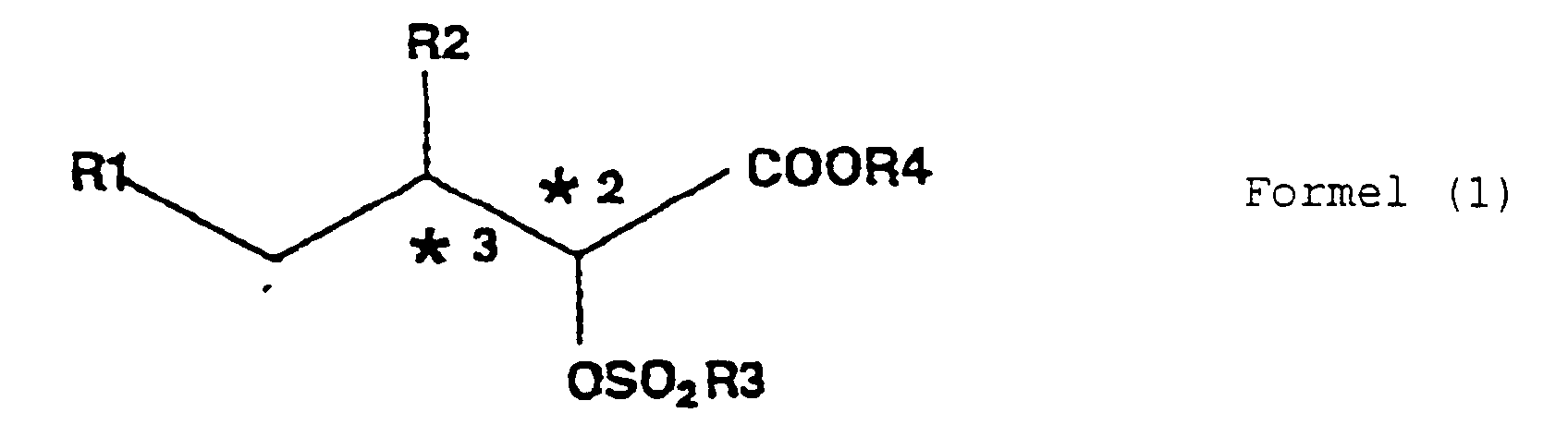
mit der Maßgabe, daß, wenn das Kohlenstoffatom an der *3-Position die S-Konfiguration aufweist, das Kohlenstoffatom an der *2-Position die R-Konfiguration aufweist, und wenn das Kohlenstoffatom an der *3-Position die R-Konfiguration aufweist, das Kohlenstoffatom an der *2-Position die S-Konfiguration aufweist,
reduziert wird, und das erhaltene optisch aktive threo-3-amino-2-substituierte 1-Butanol-Derivat, dargestellt durch die folgende allgemeine Formel (2):worin R1, *2 und *3 jeweils wie oben definiert sind, R2 Amino, geschützt durch wahlweise substituierte niedere Alkanoylgruppen mit 1 bis 8 Kohlenstoffatomen, wahlweise substituierte niedere Alkoxycarbonylgruppen mit 1 bis 8 Kohlenstoffatomen oder wahlweise substituierte Aralkoxycarbonylgruppen darstellt,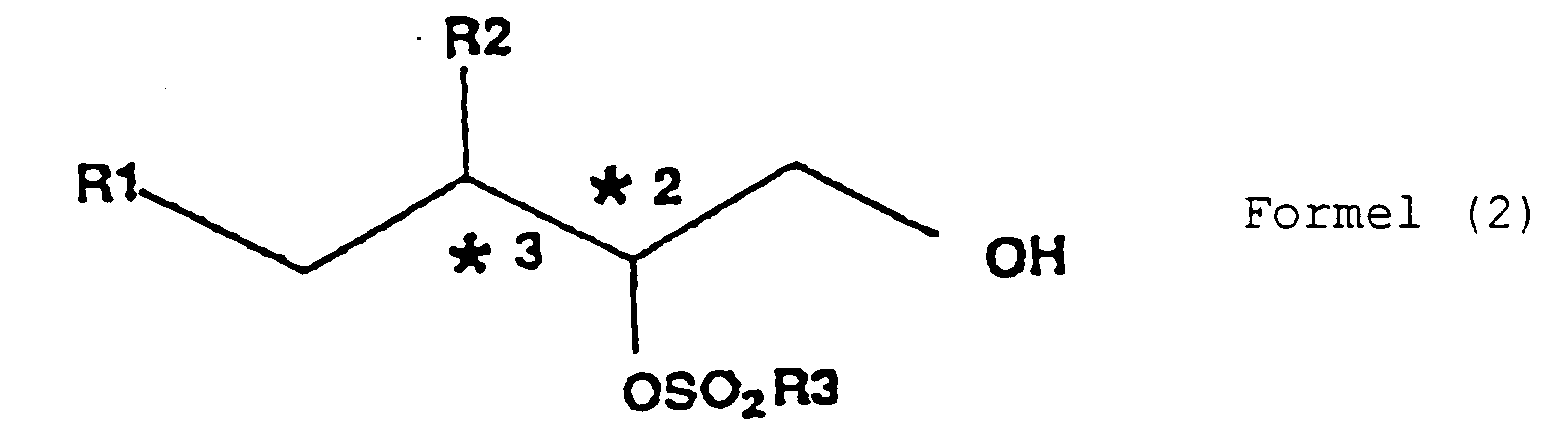
anschließend in Gegenwart einer Base epoxidiert wird, um dabei die Zielverbindung der allgemeinen Formel (3) zu ergeben. - Verfahren nach Anspruch 1, worin R1 ein Kohlenwasserstoffrest mit 3 bis 8 Kohlenstoffatomen ist, der wahlweise Substituenten aufweist, die die vorliegende Reaktion nicht beeinträchtigen.
- Verfahren nach Anspruch 1, worin R1 ein Kohlenwasserstoffrest mit 6 Kohlenstoffatomen ist, wahlweise mit Substituenten, die die vorliegende Reaktion nicht beeinträchtigen.
- Verfahren nach Anspruch 1, worin R1 Cyclohexyl oder Phenyl ist.
- Verfahren nach Anspruch 1, worin die Gruppe R1 Cyclohexyl oder Phenyl ist, und die Gruppe R2 tert-Butoxycarbonyl oder Benzyloxycarbonyl ist.
- Verfahren nach irgendeinem der Ansprüche 1 bis 5, worin die Gruppe R3 niederes Alkyl mit 1 bis 8 Kohlenstoffatomen oder ein niederes Alkyl(C1-C8)-substituiertes Phenyl ist.
- Verfahren nach irgend einem der Ansprüche 1 bis 6, worin das Reduktionsmittel für die Verbindung der allgemeinen Formel (1) ein Reduktionsmittel eines Elementes der Bor-Gruppe ist.
- Verfahren nach irgend einem der Ansprüche 1 bis 7, worin das Reduktionsmittel für die Verbindung der allgemeinen Formel (1) eine Bor-Hydrid-Verbindung ist.
- Verfahren nach irgendeinem der Ansprüche 1 bis 8, worin die Verbindung der allgemeinen Formel (2) in Gegenwart eines Alkalimetallcarbonates epoxidiert wird.
- Optisch aktives threo-3-amino-2-substituiertes 1-Butanol-Derivat, dargestellt durch die folgende allgemeine Formel (4):worin R1 ein Kohlenwasserstoffrest mit 3 bis 12 Kohlenstoffatomen, wahlweise mit Substituenten, die die Reaktion nach Anspruch 1 nicht beeinträchtigen, darstellt; R21 Amino, geschützt durch wahlweise substituierte niedere Alkanoylgruppen mit 1 bis 8 Kohlenstoffatomen, wahlweise substituierte niedere Alkoxycarbonylgruppen mit 1 bis 8 Kohlenstoffatomen oder wahlweise substituierte Aralkyloxycarbonylgruppen darstellt; und R3 einen Kohlenwasserstoffrest mit 1 bis 12 Kohlenstoffatomen, wahlweise mit Substituenten, die die vorliegende Reaktion nicht beeinträchtigen, darstellt, mit der Maßgabe, daß, wenn das Kohlenstoffatom an der *3-Position die S-Konfiguration besitzt, das Kohlenstoffatom an der *2-Position die R-Konfiguration besitzt, und wenn das Kohlenstoffatom an der *3-Position die R-Konfiguration besitzt, das Kohlenstoffatom an der *2-Position die S-Konfiguration besitzt.

- Optisch aktives threo-3-amino-4-phenyl-2-substituiertes 1-Butanol-Derivat nach Anspruch 10, worin die Gruppe R1 in der Verbindung, dargestellt durch die allgemeine Formel (4) Phenyl ist.
- Optisch aktives threo-3-amino-4-phenyl-2-substituiertes 1-Butanol oder threo-3-amino-4-cyclohexyl-2-substituiertes 1-Butanol-Derivat nach Anspruch 10, worin in der allgemeinen Formel (4) die Gruppe R1 Phenyl oder Cyclohexyl ist, die Gruppe R21 Amino, geschützt durch wahlweise substituierte niedere Alkanoylgruppen mit 1 bis 8 Kohlenstoffatomen, wahlweise substituierte niedere Alkoxycarbonylgruppen mit 1 bis 8 Kohlenstoffatomen oder wahlweise substituierte Aralkyloxycarbonylgruppen ist, und die Gruppe R3 niederes Alkyl mit 1 bis 8 Kohlenstoffatomen oder ein niederes Alkyl(C1-C8)-substituiertes Phenyl ist.
- Optisch aktives threo-3-amino-4-phenyl-2-substituiertes 1-Butanol oder threo-3-amino-4-cyclohexyl-2-substituiertes 1-Butanol-Derivat nach Anspruch 10, worin in der allgemeinen Formel (4) die Gruppe R1 Phenyl oder Cyclohexyl ist, die Gruppe R21 Amino, geschützt durch tert-Butoxycarbonyl oder Benzyloxycarbonyl ist.
Applications Claiming Priority (2)
| Application Number | Priority Date | Filing Date | Title |
|---|---|---|---|
| JP33915893 | 1993-12-06 | ||
| JP339158/93 | 1993-12-06 |
Publications (2)
| Publication Number | Publication Date |
|---|---|
| EP0657446A1 EP0657446A1 (de) | 1995-06-14 |
| EP0657446B1 true EP0657446B1 (de) | 1998-05-13 |
Family
ID=18324795
Family Applications (1)
| Application Number | Title | Priority Date | Filing Date |
|---|---|---|---|
| EP94118538A Expired - Lifetime EP0657446B1 (de) | 1993-12-06 | 1994-11-25 | Verfahren zur Herstellung von optisch aktiven Erythro-3-amino-1,2-epoxy-Verbindungen |
Country Status (4)
| Country | Link |
|---|---|
| US (1) | US5488118A (de) |
| EP (1) | EP0657446B1 (de) |
| DE (1) | DE69410222T2 (de) |
| ES (1) | ES2116513T3 (de) |
Families Citing this family (9)
| Publication number | Priority date | Publication date | Assignee | Title |
|---|---|---|---|---|
| US5693847A (en) * | 1995-04-19 | 1997-12-02 | Vertex Pharmaceuticals Incorporated | Heteroatom functionalized α-methyl ketones |
| JP3300200B2 (ja) * | 1995-06-20 | 2002-07-08 | 株式会社日立製作所 | 回転電機及び電動車両 |
| US5886433A (en) * | 1995-09-13 | 1999-03-23 | Hitachi, Ltd. | Dynamoelectric machine |
| JP4250335B2 (ja) | 1998-01-28 | 2009-04-08 | 日本化薬株式会社 | 光学活性スレオ−3−アミノ−1,2−エポキシ体の製造法 |
| DE69918050T2 (de) * | 1998-08-25 | 2005-06-30 | Kaneka Corp. | Verfahren zur herstellung von (2r,3s)-3-amino-1,2-oxiran |
| KR100339831B1 (ko) * | 1999-08-18 | 2002-06-07 | 김태성 | 신규의 에틸 아지리딘 유도체 및 그 제조방법 |
| GB2369356B (en) * | 2000-09-18 | 2004-02-04 | Phoenix Chemicals Ltd | Process |
| USD490822S1 (en) | 2002-10-01 | 2004-06-01 | Nippon Kayaku Kabushiki Kaisha | Housing for a gas generator for a vehicle airbag device |
| USD499746S1 (en) | 2003-05-22 | 2004-12-14 | Nippon Kayaku Kabushiki Kaisha | Gas generator for an air bag system |
Family Cites Families (6)
| Publication number | Priority date | Publication date | Assignee | Title |
|---|---|---|---|---|
| WO1989010350A1 (en) * | 1988-04-21 | 1989-11-02 | Ici Australia Operations Proprietary Limited | Preparation of an epoxide |
| CA1340588C (en) * | 1988-06-13 | 1999-06-08 | Balraj Krishan Handa | Amino acid derivatives |
| JP2834501B2 (ja) * | 1989-11-25 | 1998-12-09 | 鐘淵化学工業株式会社 | 3,4―エポキシ酪酸エステルの製法および中間体 |
| JP2735326B2 (ja) * | 1989-12-02 | 1998-04-02 | 鐘淵化学工業株式会社 | 3‐ピロリジノールの製造法 |
| GB8927915D0 (en) * | 1989-12-11 | 1990-02-14 | Hoffmann La Roche | Novel alcohols |
| US5097049A (en) * | 1990-05-03 | 1992-03-17 | Eli Lilly And Company | Process and intermediates for chiral epoxides |
-
1994
- 1994-11-25 ES ES94118538T patent/ES2116513T3/es not_active Expired - Lifetime
- 1994-11-25 DE DE69410222T patent/DE69410222T2/de not_active Expired - Fee Related
- 1994-11-25 EP EP94118538A patent/EP0657446B1/de not_active Expired - Lifetime
- 1994-11-28 US US08/345,074 patent/US5488118A/en not_active Expired - Lifetime
Also Published As
| Publication number | Publication date |
|---|---|
| DE69410222D1 (de) | 1998-06-18 |
| US5488118A (en) | 1996-01-30 |
| DE69410222T2 (de) | 1998-09-17 |
| EP0657446A1 (de) | 1995-06-14 |
| ES2116513T3 (es) | 1998-07-16 |
Similar Documents
| Publication | Publication Date | Title |
|---|---|---|
| US4582918A (en) | Preparation of intermediates for (threo)-1-aryl-2-acylamido-3-fluoro-1-propanols | |
| US4973750A (en) | Preparation of (threo)-1-aryl-2-acylamido-3-fluoro-1-propanols | |
| EP0595345B1 (de) | Verfahren zur Herstellung von Alanylglutamin | |
| EP1840125B1 (de) | Zwischenprodukte für die Herstellung von Dioxan-2-alkylcarbamaten | |
| US5488118A (en) | Process for producing optically active erythro-3-amino-1,2-epoxy compound | |
| EP0452143A2 (de) | Herstellungsverfahren für optisch aktive 3-Hydroxypyrrolidinderivate | |
| EP1052257B1 (de) | Verfahren zur herstellung optisch aktiver threo-3-amino-1,2-epoxyverbindungen | |
| JPWO1999038855A1 (ja) | 光学活性スレオ−3−アミノ−1,2−エポキシ体の製造法 | |
| KR100491748B1 (ko) | 광학활성 에리스로-3-아미노-2-히드록시부티르산에스테르류및 해당 부티르산류의 제조방법 | |
| CA2306741A1 (en) | Process for the preparation of (2r, 3s)-3-amino-1,2-oxirane | |
| JP3032442B2 (ja) | 光学活性エリスロ−3−アミノ−1,2−エポキシ体の製造法 | |
| KR100519691B1 (ko) | 알킬옥시 퓨라논 유도체의 제조방법, 상기 방법으로 얻은화합물 및 상기 화합물의 용도 | |
| KR0163770B1 (ko) | 3,4-에폭시부티레이트의 제조 방법 및 이를 위한 중간체 | |
| JPWO2000044706A1 (ja) | α−アミノケトン類の製造方法 | |
| US4677214A (en) | Intermediates for preparation of (threo)-1-aryl-2-acylamido-3-fluoro-1-propanols | |
| JP2008528529A (ja) | ビタミンb1の前駆体の製造方法 | |
| GB2363379A (en) | Processes for the preparation of alpha-aminoketones | |
| JPWO2000053571A1 (ja) | α−アミノケトン類の製造方法 | |
| KR100241263B1 (ko) | N-알킬옥시카르보닐-베타-알킬술포닐발린 화합물의 제조방법 | |
| KR100192855B1 (ko) | 부분입체 이성체적으로 순수한 반합성 n-글리시딜안트라사이클린의 입체선택적 제조방법 | |
| FR2590894A1 (fr) | Derives d'acide amino-4 butanoique, leur procede de preparation et leur utilisation | |
| EP1346979A1 (de) | Verfahren zur herstellung von n-geschützten aminoalkoholen und n-geschützen aminoepoxiden | |
| KR20030055304A (ko) | 보호된 1-(1-아미노알킬)-옥시란의 제조 방법 | |
| EP0003847A1 (de) | Derivate von Biphenylylglycin und deren Salze mit Basen | |
| HK42192A (en) | Preparation of (threo)-1-aryl-2-acylamido-3-fluoro-1-propanols |
Legal Events
| Date | Code | Title | Description |
|---|---|---|---|
| PUAI | Public reference made under article 153(3) epc to a published international application that has entered the european phase |
Free format text: ORIGINAL CODE: 0009012 |
|
| AK | Designated contracting states |
Kind code of ref document: A1 Designated state(s): CH DE ES FR GB IE IT LI |
|
| 17P | Request for examination filed |
Effective date: 19950811 |
|
| 17Q | First examination report despatched |
Effective date: 19960207 |
|
| GRAG | Despatch of communication of intention to grant |
Free format text: ORIGINAL CODE: EPIDOS AGRA |
|
| GRAG | Despatch of communication of intention to grant |
Free format text: ORIGINAL CODE: EPIDOS AGRA |
|
| GRAG | Despatch of communication of intention to grant |
Free format text: ORIGINAL CODE: EPIDOS AGRA |
|
| GRAG | Despatch of communication of intention to grant |
Free format text: ORIGINAL CODE: EPIDOS AGRA |
|
| GRAH | Despatch of communication of intention to grant a patent |
Free format text: ORIGINAL CODE: EPIDOS IGRA |
|
| GRAH | Despatch of communication of intention to grant a patent |
Free format text: ORIGINAL CODE: EPIDOS IGRA |
|
| GRAA | (expected) grant |
Free format text: ORIGINAL CODE: 0009210 |
|
| AK | Designated contracting states |
Kind code of ref document: B1 Designated state(s): CH DE ES FR GB IE IT LI |
|
| REG | Reference to a national code |
Ref country code: CH Ref legal event code: EP |
|
| REF | Corresponds to: |
Ref document number: 69410222 Country of ref document: DE Date of ref document: 19980618 |
|
| ITF | It: translation for a ep patent filed | ||
| REG | Reference to a national code |
Ref country code: ES Ref legal event code: FG2A Ref document number: 2116513 Country of ref document: ES Kind code of ref document: T3 |
|
| ET | Fr: translation filed | ||
| REG | Reference to a national code |
Ref country code: IE Ref legal event code: FG4D Free format text: 80316 |
|
| PLBE | No opposition filed within time limit |
Free format text: ORIGINAL CODE: 0009261 |
|
| STAA | Information on the status of an ep patent application or granted ep patent |
Free format text: STATUS: NO OPPOSITION FILED WITHIN TIME LIMIT |
|
| 26N | No opposition filed | ||
| REG | Reference to a national code |
Ref country code: GB Ref legal event code: IF02 |
|
| PGFP | Annual fee paid to national office [announced via postgrant information from national office to epo] |
Ref country code: IE Payment date: 20070924 Year of fee payment: 14 |
|
| PGFP | Annual fee paid to national office [announced via postgrant information from national office to epo] |
Ref country code: ES Payment date: 20071130 Year of fee payment: 14 |
|
| PGFP | Annual fee paid to national office [announced via postgrant information from national office to epo] |
Ref country code: CH Payment date: 20071123 Year of fee payment: 14 Ref country code: IT Payment date: 20071128 Year of fee payment: 14 |
|
| PGFP | Annual fee paid to national office [announced via postgrant information from national office to epo] |
Ref country code: GB Payment date: 20071026 Year of fee payment: 14 Ref country code: FR Payment date: 20071119 Year of fee payment: 14 |
|
| PGFP | Annual fee paid to national office [announced via postgrant information from national office to epo] |
Ref country code: DE Payment date: 20080117 Year of fee payment: 14 |
|
| REG | Reference to a national code |
Ref country code: CH Ref legal event code: PFA Owner name: NIPPON KAYAKU KABUSHIKI KAISHA Free format text: NIPPON KAYAKU KABUSHIKI KAISHA#11-2, FUJIMI 1-CHOME CHIYODA-KU#TOKYO 102 (JP) -TRANSFER TO- NIPPON KAYAKU KABUSHIKI KAISHA#11-2, FUJIMI 1-CHOME CHIYODA-KU#TOKYO 102 (JP) |
|
| REG | Reference to a national code |
Ref country code: CH Ref legal event code: PL |
|
| GBPC | Gb: european patent ceased through non-payment of renewal fee |
Effective date: 20081125 |
|
| REG | Reference to a national code |
Ref country code: IE Ref legal event code: MM4A |
|
| PG25 | Lapsed in a contracting state [announced via postgrant information from national office to epo] |
Ref country code: IT Free format text: LAPSE BECAUSE OF NON-PAYMENT OF DUE FEES Effective date: 20081125 |
|
| REG | Reference to a national code |
Ref country code: FR Ref legal event code: ST Effective date: 20090731 |
|
| PG25 | Lapsed in a contracting state [announced via postgrant information from national office to epo] |
Ref country code: LI Free format text: LAPSE BECAUSE OF NON-PAYMENT OF DUE FEES Effective date: 20081130 Ref country code: IE Free format text: LAPSE BECAUSE OF NON-PAYMENT OF DUE FEES Effective date: 20081125 Ref country code: DE Free format text: LAPSE BECAUSE OF NON-PAYMENT OF DUE FEES Effective date: 20090603 Ref country code: CH Free format text: LAPSE BECAUSE OF NON-PAYMENT OF DUE FEES Effective date: 20081130 |
|
| PG25 | Lapsed in a contracting state [announced via postgrant information from national office to epo] |
Ref country code: GB Free format text: LAPSE BECAUSE OF NON-PAYMENT OF DUE FEES Effective date: 20081125 |
|
| REG | Reference to a national code |
Ref country code: ES Ref legal event code: FD2A Effective date: 20081126 |
|
| PG25 | Lapsed in a contracting state [announced via postgrant information from national office to epo] |
Ref country code: ES Free format text: LAPSE BECAUSE OF NON-PAYMENT OF DUE FEES Effective date: 20081126 |
|
| PG25 | Lapsed in a contracting state [announced via postgrant information from national office to epo] |
Ref country code: FR Free format text: LAPSE BECAUSE OF NON-PAYMENT OF DUE FEES Effective date: 20081130 |