EP0657807A1 - Verfahren und System zur effizienten Befehlsbearbeitung in einem Datenverarbeitungssystem mit mehreren Vorausholungseinheiten - Google Patents
Verfahren und System zur effizienten Befehlsbearbeitung in einem Datenverarbeitungssystem mit mehreren Vorausholungseinheiten Download PDFInfo
- Publication number
- EP0657807A1 EP0657807A1 EP94308198A EP94308198A EP0657807A1 EP 0657807 A1 EP0657807 A1 EP 0657807A1 EP 94308198 A EP94308198 A EP 94308198A EP 94308198 A EP94308198 A EP 94308198A EP 0657807 A1 EP0657807 A1 EP 0657807A1
- Authority
- EP
- European Patent Office
- Prior art keywords
- prefetch
- instruction
- memory banks
- instructions
- elements
- Prior art date
- Legal status (The legal status is an assumption and is not a legal conclusion. Google has not performed a legal analysis and makes no representation as to the accuracy of the status listed.)
- Withdrawn
Links
Images


Classifications
-
- G—PHYSICS
- G06—COMPUTING OR CALCULATING; COUNTING
- G06F—ELECTRIC DIGITAL DATA PROCESSING
- G06F9/00—Arrangements for program control, e.g. control units
- G06F9/06—Arrangements for program control, e.g. control units using stored programs, i.e. using an internal store of processing equipment to receive or retain programs
- G06F9/30—Arrangements for executing machine instructions, e.g. instruction decode
- G06F9/38—Concurrent instruction execution, e.g. pipeline or look ahead
- G06F9/3802—Instruction prefetching
- G06F9/3814—Implementation provisions of instruction buffers, e.g. prefetch buffer; banks
-
- G—PHYSICS
- G06—COMPUTING OR CALCULATING; COUNTING
- G06F—ELECTRIC DIGITAL DATA PROCESSING
- G06F9/00—Arrangements for program control, e.g. control units
- G06F9/06—Arrangements for program control, e.g. control units using stored programs, i.e. using an internal store of processing equipment to receive or retain programs
- G06F9/30—Arrangements for executing machine instructions, e.g. instruction decode
- G06F9/30003—Arrangements for executing specific machine instructions
- G06F9/3005—Arrangements for executing specific machine instructions to perform operations for flow control
- G06F9/30061—Multi-way branch instructions, e.g. CASE
-
- G—PHYSICS
- G06—COMPUTING OR CALCULATING; COUNTING
- G06F—ELECTRIC DIGITAL DATA PROCESSING
- G06F9/00—Arrangements for program control, e.g. control units
- G06F9/06—Arrangements for program control, e.g. control units using stored programs, i.e. using an internal store of processing equipment to receive or retain programs
- G06F9/30—Arrangements for executing machine instructions, e.g. instruction decode
- G06F9/38—Concurrent instruction execution, e.g. pipeline or look ahead
- G06F9/3802—Instruction prefetching
-
- G—PHYSICS
- G06—COMPUTING OR CALCULATING; COUNTING
- G06F—ELECTRIC DIGITAL DATA PROCESSING
- G06F9/00—Arrangements for program control, e.g. control units
- G06F9/06—Arrangements for program control, e.g. control units using stored programs, i.e. using an internal store of processing equipment to receive or retain programs
- G06F9/30—Arrangements for executing machine instructions, e.g. instruction decode
- G06F9/38—Concurrent instruction execution, e.g. pipeline or look ahead
- G06F9/3802—Instruction prefetching
- G06F9/3804—Instruction prefetching for branches, e.g. hedging, branch folding
-
- G—PHYSICS
- G06—COMPUTING OR CALCULATING; COUNTING
- G06F—ELECTRIC DIGITAL DATA PROCESSING
- G06F9/00—Arrangements for program control, e.g. control units
- G06F9/06—Arrangements for program control, e.g. control units using stored programs, i.e. using an internal store of processing equipment to receive or retain programs
- G06F9/30—Arrangements for executing machine instructions, e.g. instruction decode
- G06F9/38—Concurrent instruction execution, e.g. pipeline or look ahead
- G06F9/3836—Instruction issuing, e.g. dynamic instruction scheduling or out of order instruction execution
- G06F9/3851—Instruction issuing, e.g. dynamic instruction scheduling or out of order instruction execution from multiple instruction streams, e.g. multistreaming
Definitions
- ROPE ring of prefetch elements
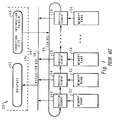
- ROPE architecture 20 includes " M " number of prefetch elements 22 , 24 , 26 , and 28 , for fetching instructions from an associated memory bank.
- the determination of the number of prefetch elements (i.e., the number " M ") required for a particular application of the ROPE architecture is discussed below in greater detail.
- Memory banks 30-36 are each associated with one prefetch element 22-28 , respectively, and are utilized for storing instructions only. Separate data memory banks may be provided for storing program variables or other temporary or variable data.
- An advantage of this ROPE architecture is that memory banks 30-36 may be implemented by memory devices which require a relatively long period of time to fetch data when compared to the cycle time of the CPU which receives the instructions.
- cycle time means the minimum duration between two successive instruction requests by the CPU.
- prefetch elements 22-28 fetch instructions from memory banks 30-36 , such instructions are placed on instruction bus 38 at an appropriate time determined by logic circuits within prefetch elements 22-28 and control signals on control bus 40 .
- Instruction bus 38 is coupled to data path 42 , which is part of CPU 44 .
- Control bus 40 receives control information 46 , which may include condition bits and the instruction pointer, from CPU 44 .
- Instructions stored within memory banks 30-36 may be very large.
- the instruction word may be 512 bits wide, and include a plurality of fields. One of such fields contains an instruction to be executed by CPU 44 . Other fields in the instruction word may contain instructions addressed to one of prefetch elements 22-28 , such as a command to initiate a prefetch.
- ROPE architecture 20 is capable of supplying data path 42 with one instruction per cycle time, even after the execution of a multiway conditional branch.
- One instruction per cycle time is placed on instruction bus 38 by a selected prefetch element.
- Prefetch elements 22-28 are selected to place an instruction on instruction bus 38 by an "activate" token.
- Such an activate token is a particular message or bit pattern that signifies permission to place an instruction on instruction bus 38 .
- a prefetch element is not permitted to place an instruction on instruction bus 38 unless that prefetch element holds the activate token. Since only one prefetch element holds the activate token at a given time, only one prefetch element is permitted to place instruction data on instruction bus 38 at any given time.
- the activate token is passed from one prefetch element to a next adjacent prefetch element, via control bus 40 , continuing in this manner until all of the M prefetch elements have received the activate token, and all prefetch elements have been allowed one cycle time to place a single instruction on instruction bus 38 .
- the process continues around the ring of prefetch elements, where the first prefetch element is again permitted to place an instruction on instruction bus 38 , without allowing a cycle time to pass without placing an instruction on instruction bus 38 .
- prefetch element 22 places a single instruction from memory bank 30 onto instruction bus 38 , which may then be received by data path 42 . Thereafter, the activate token is passed from prefetch element 22 to prefetch element 24 , and prefetch element 24 is allowed to place an instruction from memory bank 32 on instruction bus 38 during the next cycle time. Once prefetch element 28 has received the activate token and placed an instruction from memory bank 36 on instruction bus 38 , the activate token may be passed around the ring to prefetch element 22 . In such a manner, the process of executing non-branch instructions may continue indefinitely.
- prefetch elements 22-28 typically begin the process of fetching an instruction from an associated memory bank several cycle times before that prefetch element receives the activate token and is required to place the fetched instruction on instruction bus 38 . Therefore, a "prefetch token" is utilized to initiate a memory access by a selected prefetch element holding such a prefetch token. Prefetch tokens are passed to prefetch elements several cycle times before a prefetch element receives the activate token.
- the prefetch element holding the prefetch token precedes the prefetch element holding the activate token, in the ring of prefetch elements, by a number of prefetch elements at least equal to the number of cycle times required to fetch an instruction from memory banks 30-36 .
- prefetch element 28 holds the activate token, and is currently placing an instruction on instruction bus 38
- the prefetch token is typically located several prefetch elements ahead in the ring of prefetch elements.
- a prefetch element such as prefetch element 26
- holding the prefetch token may begin fetching an instruction from memory bank 34 three cycle times before the time the activate token may be received by prefetch element 26 .
- the number of prefetch elements by which the prefetch token precedes the activate token depends upon the speed of memory utilized in memory banks 30-36 and the cycle time of the CPU.
- the prefetch token precedes the activate token by a number of prefetch elements equivalent to the number of cycle times required to fetch an instruction from a memory bank.
- multiple prefetch elements within the group of M prefetch elements 22-28 , must begin to fetch an instruction in anticipation of placing a fetched instruction on instruction bus 38 during the cycle time immediately after the CPU determines which branch in the program will be executed. For example, if a three-way branch is forthcoming, three prefetch elements will receive three different prefetch tokens, each of which instructs a prefetch element to begin fetching an instruction from its associated memory bank.
- one of the three prefetch elements will receive the activate token, and that prefetch element will place the next instruction on instruction bus 38 , thereby enabling the CPU to continue executing instructions in the selected branch without waiting for instructions to be fetched from memory.
- the two prefetch units that were not activated are then made available to receive new prefetch instructions.
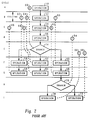
- FIG. 2 there is depicted a prefetch schedule for performing a series of operations and branch instructions in a data processing system utilizing a plurality of prefetch elements as illustrated in the architecture of Figure 1 .
- a sequence of nine cycle times, cycles A-I are depicted vertically.
- operations 50-72 and branch instructions 74 and 76 may be executed within CPU 44 (see Figure 1 ), depending upon which branch is taken at branch instructions 74 and 76 .
- operations 50-72 are able to complete execution within one cycle time.
- Branch instruction 74 illustrates a multiway branch instruction, which, in this example, is a three-way branch instruction. Therefore, after cycle E , the program may execute operation 58 , or operation 62 , or operation 66 , depending upon the outcome of tests performed at branch instruction 74 . Multiway branches are made possible by CPUs which may execute a set of prespecified tests during a single cycle time. For example, branch instruction 74 may determine whether the result of operation 56 is less than zero, equal to zero or greater than zero, and then branch accordingly. Thus, operation 58 may be executed if the result of operation 56 is less than zero, or operation 62 may be executed if the result of operation 56 is equal to zero, or operation 66 may be executed if the result of operation 56 is greater than zero.
- prefetch elements 22-28 provide address signals to associated memory banks 30-36 , respectively, and receive instruction words during subsequent cycle times. If the speed of memory banks 30-36 is such that four cycle times are required to fetch an instruction, then an instruction prefetch operation, which is conducted by prefetch elements 22-28 , must be initiated four cycle times before the instruction is to be placed on instruction bus 38 . Therefore, as illustrated in Figure 2 , instruction fetches 80-98 are initiated four cycle times before they are placed on instruction bus 38 . As illustrated in cycle B , three instruction fetches 82-86 are initiated in anticipation of branch instruction 74 , which is a three-way branch instruction.
- instruction fetch 80 is complete, instruction fetches 82-94 are in process, and instruction fetches 96 and 98 have just been initiated.
- instruction fetch 80 is complete, instruction fetches 82-94 are in process, and instruction fetches 96 and 98 have just been initiated.
- ten instruction fetches which are conducted utilizing ten prefetch elements, are in various stages of operation.
- additional instruction prefetches which are not illustrated, may be performed during cycle E for operations which follow operations 60 , 64 , 70 , and 72 .
- instruction fetches for operations 50-56 are not shown in Figure 2 .
- a method for executing instructions in a central processing unit of a data processing system comprising the steps of: providing M prefetch elements for prefetching instructions; coupling a group of N memory banks to each one of the M prefetch elements; sequentially storing a plurality of instruction words in each group of N memory banks; in response to a selected prefetch element receiving a prefetch token, sequentially fetching the plurality of instruction words from the group of N memory banks utilizing the selected prefetch element; and sequentially executing the fetched plurality of instruction words utilizing the central processing unit in the data processing system.
- a system for executing instructions in a central processing unit of a data processing system comprising: a central processing unit for executing instructions; a plurality of memory banks for storing the instructions; an instruction bus coupled to the central processing unit for transferring the instructions to the central processing unit; a control bus coupled to the central processing unit for transferring control data; and a plurality of prefetch elements, each of the plurality of prefetch elements coupled to a subgroup of the plurality of memory banks, to the instruction bus, and to the control bus, each of the plurality of prefetch elements for fetching the instructions from the subgroup of the plurality of memory banks and transferring the instructions to the instruction bus in response to receiving the control data via the control bus.
- the present invention thus provides a method and system for efficiently executing instructions in a data processing system having multiple instruction prefetch elements. Furthermore the present invention provides a prefetch element capable of providing a CPU with a plurality of instructions at the rate of one instruction per cycle time. Still furthermore the present invention provides a data processing system architecture having multiple prefetch elements that is less expensive to manufacture, comprises fewer components, and provides substantially similar performance to prior art architectures having multiple prefetch elements.
- a data processing system having a plurality of prefetch elements are provided for prefetching instructions from a group of memory arrays coupled to each prefetch element.
- a plurality of instruction words are sequentially stored in each group of memory arrays coupled to each prefetch element.
- the selected prefetch element sequentially recalls instruction words from the group of memory arrays coupled to the selected prefetch element. Thereafter, the selected prefetch element transfers the sequence of instruction words to a central processing unit at a rate of one instruction word per cycle time.
- a plurality of prefetch elements may initiate instruction fetching so that the proper instruction may be executed during the cycle time immediately following the conditional branch instruction.
- a group of memory banks to each prefetch element, and limiting the location of branch instructions to the last memory bank in the group of memory banks, the number of prefetch elements required to implement a data processing system having substantially similar performance to the prior art architecture is reduced.
- video memories are utilized to store instruction words, and provide such instruction words to the CPU at the rate of one instruction word per cycle time.
- a data processing system 110 which includes processor 112 , keyboard 116 , and display 114 .
- Keyboard 116 is coupled to processor 112 via cable 118 .
- Display 114 includes display screen 120 , which may be implemented utilizing a cathoray tube (CRT), a liquid crystal display (LCD), an electroluminescent panel, or the like.
- Data processing system 110 also includes pointing device 122 which may be implemented utilizing a track ball, joystick, touch sensitive tablet or screen, or as illustrated in Figure 2 , a mouse. Pointing device 122 may be utilized to move a pointer or cursor on display screen 120 .
- pointing device 122 may be utilized to move a pointer or cursor on display screen 120 .
- FIG 4 depicts a more detailed high-level block diagram further illustrating the major components of data processing system 110 of Figure 3 .
- Data processing system 110 is controlled primarily by instructions, in the form of software, executed within central processing unit (CPU) 44 .
- CPU 44 is coupled to display 114 , which is utilized to display text and graphics, and possibly animated graphics or video.
- CPU 44 is also coupled to user input device 132 , which is utilized to receive input from a data processing system user.
- User input device 132 may include keyboard 116 and pointing device 122 , as illustrated in Figure 3 .
- Memory 134 and direct access storage device (DASD) 136 may be utilized for storing application programs (i.e., software) and data sets.
- DASD direct access storage device
- memory 134 is divided into memory banks for storing instructions, and separate data memory banks for storing program variables or other temporary or variable data.
- the organization of memory 134 , and the method and system for coupling memory 134 to CPU 44 , will be described below in greater detail with reference to Figures 5 and 6 .
- Peripheral devices 138 may also be included in data processing system 110 .
- Such peripheral devices may include communications devices (i.e., modems or network adapters), or an audio output device for use during a multimedia presentation.
- Control information 46 which may be generated within CPU 44 , is coupled to control bus 40 .
- Control information 46 may include condition bits, which are set or cleared as a result of operations or tests performed in the registers of CPU 44 , and instruction pointer data, which may indicate the memory address of the next instruction to be received by data path 42 within CPU 44 .
- Prefetch elements 150-154 are utilized to place instructions on instruction bus 38 in response to receiving an activate token via control bus 40 .
- Such an activate token is either passed from one prefetch element to a next prefetch element during a non-branch mode of instruction execution, or, in a branch mode of instruction execution, is generated within a prefetch element that was previously designated a possible target of a branch instruction. After that designated prefetch element determines that it is the target of the branch instruction, and that the next software instructions following the branch are stored in memory banks associated with that prefetch element, an activate token is generated within that prefetch element.
- a plurality of memory banks are coupled to each prefetch element 150-154 .
- memory banks 156 and 158 are coupled to prefetch element 150
- memory banks 160 and 162 are coupled to prefetch element 152
- memory banks 164 and 166 are coupled to prefetch element 154 .
- more than two memory banks may be coupled to any one prefetch element.
- a single prefetch element may provide two or more sequential instructions to data path 42 .
- the location of branch instructions which may be stored in the memory banks associated with a prefetch element, should be restricted to the last memory bank associated with a particular prefetch element.
- the location of branch instructions may be restricted to memory bank 158 , 162 , and 166 . This restriction placed on the location of branch instructions prevents the execution of a sequence of consecutive branch instructions, and reduces the maximum rate of branching to one branch every other cycle time.
- one non-branch instruction stored in memory bank 156 must be executed before executing another instruction, which may be a branch instruction, stored in memory bank 158 . If the execution of a non-branch instruction is not needed between two branch instructions, then the compiler may insert a "no-op," or no-operation instruction.
- the number of prefetch elements required may be significantly reduced. For example, in a data processing system which permits three-way branching and requires four cycle times before providing an instruction to instruction bus 38 , 12 prefetch elements are required. If a branch operation is limited to one branch in every two cycle times, the number of prefetch elements required may be reduced to six. This reduction in the number of prefetch elements required is a result of prefetch elements becoming available to prefetch instructions during the non-branch operation executed between two branch instructions. Additional prefetch elements may also become available as a result of prefetch operations which may be abandoned because selected prefetch elements were fetching instructions a branch in the program that was not selected by a previous branch instruction. If a program should require two consecutive branch operations, a "no-op", or no-operation instruction may be inserted between the two branch instructions.
- a data processing system having a reduced number of prefetch elements may be able to sustain two or three consecutive branch operations, while not being able to sustain a continuous sequence of branch operations.
- the hardware savings produced by reducing the number of prefetch elements is directly proportional to the number of memory banks associated with each prefetch element, and the number of non-branch instructions executed between two branch instructions which limits the frequency of branch operations. If memory banks 156-166 are relatively slow devices, the maximum number of instructions provided by a prefetch element 150-154 is limited to the number of memory banks associated with each prefetch element. Thus, in the example of Figure 5 , prefetch elements 150-154 may provide a maximum of two sequential instructions to instruction bus 38 before another prefetch element becomes active.
- prefetch elements 170-172 are coupled to instruction bus 38 and control bus 40 for providing instructions to data path 42 within CPU 44 .
- Each prefetch element 170-172 receives instructions from a plurality of memory banks, each of which outputs a single bit of an n -bit instruction word.
- prefetch element 170 is coupled to the serial output of n -memory banks 174-180
- prefetch element 172 is coupled to the serial output of n -memory banks 182-188 .
- Memory banks 174-180 and 182-188 may be implemented utilizing any one of several known multi-port dynamic random access memories (DRAMs), also called video DRAMs, which include a random access memory array coupled to an on-chip shift register having a high-speed serial output port.
- DRAMs multi-port dynamic random access memories
- Each video DRAM has one port for random access and another port for providing fast serial output from the on-chip shift register.
- the random access port conforms to the signal and timing requirements of a standard DRAM, and the on-chip shift register supports high speed serial output. Additionally, the clock rate of the random access portion may be much slower, and independent from, the clock rate of the serial output portion.
- each prefetch element provides the same address to the n -memory banks associated with that prefetch element. Thereafter, a single bit, output from the serial output port of each of the n -memory banks, is received by the prefetch element to form a single n -bit instruction word.
- prefetch element 170 provides address signals to memory banks 174-180 . Thereafter, the serial output of the shift registers within memory banks 174-180 each provide a single bit which comprises an n -bit instruction word.
- prefetch element 170 may load an entire word comprising several bits of information into the shift registers of memory banks 174-180 , several n -bit instructions may be sequentially loaded into register 190 within prefetch element 170 and transferred to instruction bus 38 at the rate of one instruction per cycle time. This is a result of the fact that instructions may be shifted out of memory banks 174-180 at several times the speed at which memory words are addressed and loaded into the shift register within memory banks 174-180 .
- the shift register within memory banks 174-180 are 256 bits wide, then 256 consecutive instructions may be shifted out of the memory banks and loaded into register 190 and placed on instruction bus 38 at the rate of one instruction per cycle time.
- the fact that several instructions may be shifted out of memory banks 174-180 at the rate of one instruction per cycle time allows other prefetch elements to prepare for a forthcoming multiway branch, thus reducing the number of prefetch elements required. For example, assume that C -cycles are required to fetch an instruction from memory. After C +1 cycles have been provided to instruction bus 38 by a particular prefetch element, all other prefetch elements within the data processing system may be idle and available to begin prefetching instructions.
- a data processing system having B +1 prefetch elements may support a B -way conditional branch every C -cycles without causing CPU 44 to wait for an instruction following a B -way branch.
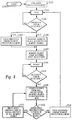
- Block 202 illustrates the fact that this process is conducted within each prefetch element.
- the prefetch element enters into an idle state, as depicted at block 204 .
- the prefetch unit remains idle until a prefetch token has been received, as illustrated at block 206 and the "no" branch from block 206 to block 204 .
- a prefetch element may receive a prefetch token under one of two different circumstances.
- a prefetch token may be received from a preceding prefetch element in the ring of prefetch elements. Receiving a prefetch token from a preceding prefetch element is typical in a non-branching mode of operation.
- a prefetch command is issued via control bus 40 (see Figure 5 ).
- Such prefetch commands are issued to all possible targets of the forthcoming branch operation.
- three prefetch commands are issued to three different prefetch elements.
- data path 42 may receive the appropriate instruction following the branch instruction within the cycle time immediately after the branch instruction.
- the prefetch element provides a first address to the first associated memory bank, as depicted at block 208 . Thereafter, the prefetch element reads an instruction from the first memory bank, as illustrated at block 210 .
- the prefetch element reads an instruction from the first memory bank, as illustrated at block 210 .
- the prefetch element As the prefetch element provides a first address to the first associated memory bank, the prefetch element also passes an appropriate prefetch token, containing an appropriate prefetch address, to the next prefetch element in the ring of prefetch elements during the next cycle time, as illustrated at block 211 . If the last prefetch element is passing the prefetch token to the first prefetch element in the ring of prefetch elements, the prefetch address information contained in the prefetch token may be incremented. If a branch instruction is forthcoming, additional prefetch tokens may be created as the prefetch token is passed.
- the prefetch element is ready to place that instruction on instruction bus 38 , as depicted at block 212 .
- the prefetch element may begin to calculate the address of the second instruction stored in the second memory bank, if the address of the second instruction is different from the address of the first instruction, as illustrated at block 214 . Thereafter, the prefetch element provides the second address to the second memory bank, as depicted at block 216 . After what may be several cycle times later, the prefetch element reads an instruction from the second memory bank, as illustrated at block 218 .
- the prefetch element determines whether or not an activate token has been received. If an activate token has not been received, the process iteratively passes to block 220 until such time as an activate token has been received.
- the prefetch element transfers the first instruction to the instruction bus during a first cycle time, as illustrated at block 222 . Thereafter, the process determines whether or not a second cycle time has begun, as depicted at block 224 . If a second cycle time has not begun, the process iterates until such time as a second cycle time has begun, as illustrated by the "no" branch from block 224 .
- the prefetch element transfers a second instruction to the instruction bus during a second cycle time, as illustrated at block 226 .
- Such a second instruction is read from the second memory bank prior to the second cycle time, as illustrated in block 218 .
- the process may pass an activate token to the next prefetch element during the next cycle time, as depicted at block 228 . If the next cycle time follows a branch instruction, the active prefetch element will be determined by the group of prefetch elements previously designated as possible targets of the branch, from information present on control bus 40 . Finally, the process passes to block 204 , wherein the prefetch element returns to an idle state, and becomes available to receive another prefetch token.
- FIG. 8 there is depicted a high-level logic flowchart which illustrates the process utilized by each prefetch element to fetch a sequence of instructions from a plurality of memory banks having serial outputs in accordance with the method and system of the present invention.
- the process begins at block 230 , and is conducted within each prefetch element, as illustrated at block 232 .
- the prefetch element is placed in an idle state, as depicted at block 234 .
- the prefetch element determines whether or not a prefetch token has been received. If a prefetch token has not been received, the prefetch element remains in the idle state, as depicted by the "no" branch from block 236 .
- the prefetch element If the prefetch element has received a prefetch token, the prefetch element provides an address to all memory banks associated with the prefetch element, as depicted at block 238 .
- a prefetched token may be received from a prior prefetch element in the ring of prefetch elements, or as a result of a prefetch command issued to all possible targets of a forthcoming branch operation.
- the memory banks load their respective internal shift registers with the instruction word stored at the location addressed, as illustrated at block 240 .
- Those persons skilled in the art should recognize that several cycle times may be required between the time the associated memory banks receive an address (see block 238 ) and the time the internal shift registers have been loaded with the addressed instruction word (see block 240 ).
- the prefetch element As the prefetch element provides the address to all associated memory banks, the prefetch element also passes an appropriate prefetch token, containing an appropriate prefetch address, to the next prefetch element in the ring of prefetch elements during the next cycle time, as illustrated at block 242 . If the last prefetch element is passing the prefetch token to the first prefetch element in the ring of prefetch elements, the prefetch address information contained in the prefetch token may be incremented. If a branch instruction is forthcoming, additional prefetch tokens may be created as the prefetch token is passed.
- the prefetch element After the memory banks have loaded the internal shift registers, the prefetch element enters a ready state, as depicted at block 244 . After the prefetch element is ready, the prefetch element determines whether or not an activate token has been received, as illustrated at block 246 . If an activate token has not been received, the prefetch element remains in the ready state, as indicated by the "no" branch from block 246 .
- the prefetch element transfers bits read from all associated memory banks to the instruction bus, as depicted at block 248 . During such a transfer, one bit from each associated memory bank is utilized to form an n -bit instruction word, as described with reference to Figure 6 . Once the prefetch element has transferred such an instruction word to the instruction bus, the prefetch element determines whether or not additional instructions to be placed on the instruction bus are stored in the memory banks.
- the prefetch element provides a shift clock to shift the next instruction word to the serial outputs of all associated memory banks, as depicted at block 252 . Thereafter, the next instruction word is transferred to the instruction bus during the next consecutive cycle time.
- the prefetch element is able to provide a sequence of instructions to instruction bus 38 (see Figure 6 ).
- This sequence of instructions may comprise a number of instruction words equal to the number of bits loaded into the internal shift registers of the associated memory banks.
- the sequence of instruction words may be 256 instructions in length if a typical video DRAM is utilized to implement memory banks 174-180 (see Figure 6 ).
- the prefetch element may pass an activate token to the next prefetch element during the next cycle time, as depicted at block 254 . If the next cycle time follows a branch instruction, the active prefetch element will be determined by the group of prefetch elements previously designated as possible targets of the branch, from information present on control bus 40 . Finally, the prefetch element returns to the idle state, as illustrated at block 234 .
- the internal shift register of memory banks 174-180 may contain a large number of bits (i.e., 256 or 512 bits), it may be advantageous to utilize a video DRAM design having an address input tap capable of tapping the shift register at different locations.
- the tap feature may permit bit output to begin with bit 16 , or bit 32 for example. Since instruction sequences are typically three to five instructions in length, such a tap feature permits more efficient utilization of the video DRAM storage capacity.
- nibble-mode DRAMs require a considerable time to respond to a memory fetch, such memories are capable of fetching words stored in several consecutive locations at a rate which may be one word per cycle time. If nibble-mode DRAMs are utilized to implement memory banks associated with a prefetch element, consecutive instruction words may be stored in consecutive memory locations. Thus, when a prefetch element becomes active, a sequence of instruction words may be provided to data path 42 at the rate of one instruction word per cycle time. After the sequence of instruction words has been transferred to instruction bus 38 , the activate token may pass to the next prefetch element, where an additional sequence of instructions may be provided.
- nibble-mode DRAMs are utilized, the data processing system memory architecture would be similar to the architecture illustrated in Figure 1 , wherein a single memory bank is associated with each prefetch element. Even though the architecture may be similar to that illustrated in Figure 1 , the nibble-mode DRAMs provide the additional capability of fetching a plurality of instructions at a rate of one instruction per cycle time; the prior art shown in Figure 1 does not have this capability.
Landscapes
- Engineering & Computer Science (AREA)
- Software Systems (AREA)
- Theoretical Computer Science (AREA)
- Physics & Mathematics (AREA)
- General Engineering & Computer Science (AREA)
- General Physics & Mathematics (AREA)
- Multimedia (AREA)
- Advance Control (AREA)
- Memory System Of A Hierarchy Structure (AREA)
- Executing Machine-Instructions (AREA)
Applications Claiming Priority (2)
| Application Number | Priority Date | Filing Date | Title |
|---|---|---|---|
| US16449793A | 1993-12-09 | 1993-12-09 | |
| US164497 | 1993-12-09 |
Publications (1)
| Publication Number | Publication Date |
|---|---|
| EP0657807A1 true EP0657807A1 (de) | 1995-06-14 |
Family
ID=22594757
Family Applications (1)
| Application Number | Title | Priority Date | Filing Date |
|---|---|---|---|
| EP94308198A Withdrawn EP0657807A1 (de) | 1993-12-09 | 1994-11-08 | Verfahren und System zur effizienten Befehlsbearbeitung in einem Datenverarbeitungssystem mit mehreren Vorausholungseinheiten |
Country Status (2)
| Country | Link |
|---|---|
| US (2) | US5634025A (de) |
| EP (1) | EP0657807A1 (de) |
Cited By (1)
| Publication number | Priority date | Publication date | Assignee | Title |
|---|---|---|---|---|
| WO1999023564A1 (en) * | 1997-10-31 | 1999-05-14 | Koninklijke Philips Electronics N.V. | Prefetch management in cache memory |
Families Citing this family (21)
| Publication number | Priority date | Publication date | Assignee | Title |
|---|---|---|---|---|
| US5768629A (en) | 1993-06-24 | 1998-06-16 | Discovision Associates | Token-based adaptive video processing arrangement |
| US6119213A (en) * | 1995-06-07 | 2000-09-12 | Discovision Associates | Method for addressing data having variable data width using a fixed number of bits for address and width defining fields |
| US5774737A (en) * | 1995-10-13 | 1998-06-30 | Matsushita Electric Industrial Co., Ltd. | Variable word length very long instruction word instruction processor with word length register or instruction number register |
| US5796998A (en) * | 1996-11-21 | 1998-08-18 | International Business Machines Corporation | Apparatus and method for performing branch target address calculation and branch prediciton in parallel in an information handling system |
| US5887151A (en) * | 1997-07-10 | 1999-03-23 | Emc Corporation | Method and apparatus for performing a modified prefetch which sends a list identifying a plurality of data blocks |
| US6170051B1 (en) | 1997-08-01 | 2001-01-02 | Micron Technology, Inc. | Apparatus and method for program level parallelism in a VLIW processor |
| US6167506A (en) * | 1997-11-17 | 2000-12-26 | Advanced Micro Devices, Inc. | Replacing displacement in control transfer instruction with encoding indicative of target address, including offset and target cache line location |
| US6055580A (en) * | 1998-05-29 | 2000-04-25 | 3Com Corporation | System for transferring length round down to cache line multiple capable to determine type of read request which selects and reads portion of prefetched data in memory |
| JP3867427B2 (ja) * | 1999-01-11 | 2007-01-10 | ソニー株式会社 | プロセッサ装置および集積回路 |
| US6453407B1 (en) * | 1999-02-10 | 2002-09-17 | Infineon Technologies Ag | Configurable long instruction word architecture and instruction set |
| US6651245B1 (en) * | 2000-10-03 | 2003-11-18 | Sun Microsystems, Inc. | System and method for insertion of prefetch instructions by a compiler |
| KR100490657B1 (ko) * | 2000-12-30 | 2005-05-24 | 주식회사 하이닉스반도체 | 메모리 출력능력의 가변제어 장치 및 방법 |
| KR100578233B1 (ko) * | 2000-12-30 | 2006-05-12 | 주식회사 하이닉스반도체 | 동기식메모리장치의 데이터 입출력 가변제어장치 |
| US6799264B2 (en) * | 2001-02-20 | 2004-09-28 | Koninklijke Philips Electronics N.V. | Memory accelerator for ARM processor pre-fetching multiple instructions from cyclically sequential memory partitions |
| US20050253858A1 (en) * | 2004-05-14 | 2005-11-17 | Takahide Ohkami | Memory control system and method in which prefetch buffers are assigned uniquely to multiple burst streams |
| US7526633B2 (en) * | 2005-03-23 | 2009-04-28 | Qualcomm Incorporated | Method and system for encoding variable length packets with variable instruction sizes |
| US8127049B1 (en) | 2008-03-12 | 2012-02-28 | Matrox Graphics Inc. | Input/output pin allocation for data streams of variable widths |
| US8566496B2 (en) * | 2010-12-03 | 2013-10-22 | Lsi Corporation | Data prefetch in SAS expanders |
| US9525630B2 (en) * | 2011-08-02 | 2016-12-20 | Cavium, Inc. | Method and apparatus for assigning resources used to manage transport operations between clusters within a processor |
| EP3037957A4 (de) * | 2013-08-19 | 2017-05-17 | Shanghai Xinhao Microelectronics Co. Ltd. | Puffersystem und verfahren auf der basis eines befehlscachespeichers |
| US20220107812A1 (en) * | 2020-09-09 | 2022-04-07 | Ascenium, Inc. | Highly parallel processing architecture using dual branch execution |
Citations (3)
| Publication number | Priority date | Publication date | Assignee | Title |
|---|---|---|---|---|
| EP0180237A2 (de) * | 1984-11-01 | 1986-05-07 | Fujitsu Limited | Datenverarbeitungssystem mit Vorausschausteuerung |
| EP0444601A2 (de) * | 1990-02-26 | 1991-09-04 | Nec Corporation | Speicherzugriffssteuerung |
| EP0570164A1 (de) * | 1992-05-11 | 1993-11-18 | Matsushita Electric Industrial Co., Ltd. | Verschachtelter Speichersystem |
Family Cites Families (6)
| Publication number | Priority date | Publication date | Assignee | Title |
|---|---|---|---|---|
| US4873629A (en) * | 1984-06-20 | 1989-10-10 | Convex Computer Corporation | Instruction processing unit for computer |
| US4777587A (en) * | 1985-08-30 | 1988-10-11 | Advanced Micro Devices, Inc. | System for processing single-cycle branch instruction in a pipeline having relative, absolute, indirect and trap addresses |
| US5109348A (en) * | 1987-09-14 | 1992-04-28 | Visual Information Technologies, Inc. | High speed image processing computer |
| US5129060A (en) * | 1987-09-14 | 1992-07-07 | Visual Information Technologies, Inc. | High speed image processing computer |
| US4888679A (en) * | 1988-01-11 | 1989-12-19 | Digital Equipment Corporation | Method and apparatus using a cache and main memory for both vector processing and scalar processing by prefetching cache blocks including vector data elements |
| US4951246A (en) * | 1989-08-08 | 1990-08-21 | Cray Research, Inc. | Nibble-mode dram solid state storage device |
-
1994
- 1994-04-18 US US08/228,973 patent/US5634025A/en not_active Expired - Fee Related
- 1994-11-08 EP EP94308198A patent/EP0657807A1/de not_active Withdrawn
-
1996
- 1996-11-20 US US08/754,595 patent/US5737576A/en not_active Expired - Fee Related
Patent Citations (3)
| Publication number | Priority date | Publication date | Assignee | Title |
|---|---|---|---|---|
| EP0180237A2 (de) * | 1984-11-01 | 1986-05-07 | Fujitsu Limited | Datenverarbeitungssystem mit Vorausschausteuerung |
| EP0444601A2 (de) * | 1990-02-26 | 1991-09-04 | Nec Corporation | Speicherzugriffssteuerung |
| EP0570164A1 (de) * | 1992-05-11 | 1993-11-18 | Matsushita Electric Industrial Co., Ltd. | Verschachtelter Speichersystem |
Non-Patent Citations (3)
| Title |
|---|
| GARCIA: "Instruction buffer design", IBM TECHNICAL DISCLOSURE BULLETIN., vol. 20, no. 11B, April 1978 (1978-04-01), NEW YORK US, pages 4832 - 4833 * |
| GROHOSKI: "Machine organisation of the IBM RISC System/6000 processor", IBM JOURNAL OF RESEARCH AND DEVELOPMENT, vol. 34, no. 1, January 1990 (1990-01-01), pages 37 - 58, XP000128179 * |
| NICOLAU AND KARPLUS: "ROPE: a statically scheduled supercomputer architecture", 1ST INTERNATIONAL CONFERENCE ON SUPERCOMPUTING SYSTEMS, 16 December 1985 (1985-12-16), ST. PETERSBURG, FL,US, pages 158 - 168, XP000212091 * |
Cited By (3)
| Publication number | Priority date | Publication date | Assignee | Title |
|---|---|---|---|---|
| WO1999023564A1 (en) * | 1997-10-31 | 1999-05-14 | Koninklijke Philips Electronics N.V. | Prefetch management in cache memory |
| US6134633A (en) * | 1997-10-31 | 2000-10-17 | U.S. Philips Corporation | Prefetch management in cache memory |
| KR100593582B1 (ko) * | 1997-10-31 | 2006-06-28 | 코닌클리케 필립스 일렉트로닉스 엔.브이. | 캐시 메모리에서의 프리페치 관리 장치 |
Also Published As
| Publication number | Publication date |
|---|---|
| US5737576A (en) | 1998-04-07 |
| US5634025A (en) | 1997-05-27 |
Similar Documents
| Publication | Publication Date | Title |
|---|---|---|
| US5737576A (en) | Method and system for efficient instruction execution in a data processing system having multiple prefetch units | |
| US5499350A (en) | Vector data processing system with instruction synchronization | |
| US7146489B2 (en) | Methods for intelligent caching in an embedded DRAM-DSP architecture | |
| US5313551A (en) | Multiport memory bypass under software control | |
| US5293500A (en) | Parallel processing method and apparatus | |
| US6112295A (en) | High frequency pipeline decoupling queue with non-overlapping read and write signals within a single clock cycle | |
| EP0684561B1 (de) | Synchronisationssystem und verfahren in einem datencachesystem mit aufgeteiltem pegel | |
| US5887183A (en) | Method and system in a data processing system for loading and storing vectors in a plurality of modes | |
| US5179372A (en) | Video Random Access Memory serial port access | |
| US5121360A (en) | Video random access memory serial port access | |
| KR100346515B1 (ko) | 수퍼파이프라인된수퍼스칼라프로세서를위한임시파이프라인레지스터파일 | |
| US5440717A (en) | Computer pipeline including dual-ported, content-addressable writebuffer | |
| US6513125B1 (en) | Multi-phase multi-access pipeline memory system in which the pipeline memory can decode addresses issued by one processor while simultaneously accessing memory array by other processor | |
| US5765007A (en) | Microinstruction sequencer having multiple control stores for loading different rank registers in parallel | |
| US5404486A (en) | Processor having a stall cache and associated method for preventing instruction stream stalls during load and store instructions in a pipelined computer system | |
| US5226166A (en) | Parallel operation processor with second command unit | |
| US5434986A (en) | Interdependency control of pipelined instruction processor using comparing result of two index registers of skip instruction and next sequential instruction | |
| US5897654A (en) | Method and system for efficiently fetching from cache during a cache fill operation | |
| EP0983556B1 (de) | Prozessor -steuergerät zur beschleunigung der befehlsausgaberate | |
| US4430708A (en) | Digital computer for executing instructions in three time-multiplexed portions | |
| EP0797803B1 (de) | Verkettung von teilstücken für einen vektorprozessor | |
| US6075931A (en) | Method for efficient implementation of multi-ported logic FIFO structures in a processor | |
| US5363490A (en) | Apparatus for and method of conditionally aborting an instruction within a pipelined architecture | |
| US6405233B1 (en) | Unaligned semaphore adder | |
| GB2399901A (en) | Method for using a reduced width instruction set in an active memory device |
Legal Events
| Date | Code | Title | Description |
|---|---|---|---|
| PUAI | Public reference made under article 153(3) epc to a published international application that has entered the european phase |
Free format text: ORIGINAL CODE: 0009012 |
|
| AK | Designated contracting states |
Kind code of ref document: A1 Designated state(s): DE FR GB |
|
| 17P | Request for examination filed |
Effective date: 19951024 |
|
| STAA | Information on the status of an ep patent application or granted ep patent |
Free format text: STATUS: THE APPLICATION HAS BEEN WITHDRAWN |
|
| 18W | Application withdrawn |
Withdrawal date: 19960927 |