EP0658033A2 - Autocommutateur privé - Google Patents
Autocommutateur privé Download PDFInfo
- Publication number
- EP0658033A2 EP0658033A2 EP19940116609 EP94116609A EP0658033A2 EP 0658033 A2 EP0658033 A2 EP 0658033A2 EP 19940116609 EP19940116609 EP 19940116609 EP 94116609 A EP94116609 A EP 94116609A EP 0658033 A2 EP0658033 A2 EP 0658033A2
- Authority
- EP
- European Patent Office
- Prior art keywords
- private branch
- branch exchange
- control unit
- loudspeaker
- hands
- Prior art date
- Legal status (The legal status is an assumption and is not a legal conclusion. Google has not performed a legal analysis and makes no representation as to the accuracy of the status listed.)
- Withdrawn
Links
- 230000011664 signaling Effects 0.000 claims description 13
- 230000003111 delayed effect Effects 0.000 claims description 2
- 230000003287 optical effect Effects 0.000 claims 1
- 239000011159 matrix material Substances 0.000 description 4
- 238000010586 diagram Methods 0.000 description 3
- 230000004913 activation Effects 0.000 description 2
- 238000013475 authorization Methods 0.000 description 2
- 230000001419 dependent effect Effects 0.000 description 2
- 238000001514 detection method Methods 0.000 description 2
- 230000000717 retained effect Effects 0.000 description 2
- 230000003213 activating effect Effects 0.000 description 1
- 238000011156 evaluation Methods 0.000 description 1
- 238000000034 method Methods 0.000 description 1
- 230000008672 reprogramming Effects 0.000 description 1
- 230000001960 triggered effect Effects 0.000 description 1
Images
Classifications
-
- H—ELECTRICITY
- H04—ELECTRIC COMMUNICATION TECHNIQUE
- H04M—TELEPHONIC COMMUNICATION
- H04M3/00—Automatic or semi-automatic exchanges
- H04M3/42—Systems providing special services or facilities to subscribers
- H04M3/42314—Systems providing special services or facilities to subscribers in private branch exchanges
-
- H—ELECTRICITY
- H04—ELECTRIC COMMUNICATION TECHNIQUE
- H04M—TELEPHONIC COMMUNICATION
- H04M9/00—Arrangements for interconnection not involving centralised switching
-
- H—ELECTRICITY
- H04—ELECTRIC COMMUNICATION TECHNIQUE
- H04Q—SELECTING
- H04Q3/00—Selecting arrangements
- H04Q3/58—Arrangements providing connection between main exchange and sub-exchange or satellite
- H04Q3/62—Arrangements providing connection between main exchange and sub-exchange or satellite for connecting to private branch exchanges
- H04Q3/625—Arrangements in the private branch exchange
Definitions
- the invention relates to a telephone private branch exchange with a central unit and with a plurality of telephone sets, at least one of which has a programmable control unit and a loudspeaker / hands-free device.
- a known feature is the so-called direct call, in which the calling subscriber, by entering a certain code on his telephone, can ensure that the call is not signaled to the called subscriber, but rather that a loudspeaker / speakerphone is available in the called subscriber's set. Facility is turned on directly, so that a connection is made without the help of the called party.
- this feature can only be activated by the calling subscriber and is only activated for the respective call. The corresponding coding must be re-entered each time for further direct calls.
- the object of the invention is therefore to develop the known telephone private branch exchange in such a way that the control of the calls as direct calls can be influenced by the called subscriber on his or her telephone.
- control unit controls the loudspeaker / hands-free facility of its own telephone set in a predetermined manner when there are incoming calls after inputting certain codes.
- the advantage of the private branch exchange according to the invention lies in particular in the fact that the control of the loudspeaker / hands-free device of one's own telephone set for switching through a caller as a direct call is no longer dependent on the specifications of the calling subscriber, but on each programmable telephone apparatus with loudspeaker / hands-free Setup for all incoming calls is definable. This increases the convenience of use of the system, and the user can decide by coding his device whether all calls to this device should arrive directly via the loudspeaker device.
- the private branch exchange is particularly preferably designed such that the control unit, after entering a first code, switches on the loudspeaker / hands-free device for all incoming calls instead of the usual call signaling. This enables the called subscriber to decide whether calls should be signaled as normal calls or whether they activate the speakerphone / handsfree facility as direct calls.
- the telephone set in question can thus easily be used as a hands-free or announcement device without the called subscriber having to accept an incoming call.
- a simple switch-off of this feature by means of which the call signaling is switched on again, is advantageously possible by entering a second code and applies to all subsequent calls.
- the central unit of the private branch exchange must contain a programmable central control unit, which is particularly preferably designed in such a way that it is at least partially programmable from the telephone sets.
- the ringing voltage can be applied to the called telephone set for a first or for a second predetermined period of time.
- the programming of the central control unit takes place particularly advantageously by entering a third coding on a programmable telephone set, by means of which the own control unit is also programmed, and by entering a fourth coding on the calling telephone set.
- the call voltages of different durations that can be generated in this way make it possible, after entering the third coding, to selectively switch on the loudspeaker / hands-free device of the called programmable telephone set as a function of the duration of the call voltage present. If the duration of the ringing voltage applied falls below a predetermined minimum time, the call is signaled. If the minimum time is exceeded, the loudspeaker / hands-free device on the called telephone set is switched on directly by its correspondingly programmed control unit.
- the central control unit can be programmed so that it only generates call signals of the same duration.
- the power is taken from the called telephone set and thus from the loudspeaker / hands-free device after the call has ended.
- This function can preferably be triggered by hanging up the calling telephone set.
- a listening tone is particularly preferably delayed by a predetermined time period through the loudspeaker / hands-free device .
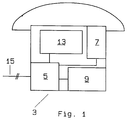
- the telephone set 3 shown in FIG. 1 can be connected to a telephone private branch exchange 1 (see FIG. 2) via a two-wire line 15. This two-wire line is connected to a control unit 5 in the telephone set 3.
- the control unit 5 is also connected to a loudspeaker / hands-free device 7, a call signaling 9 and a display and control panel 13 of the telephone set 3.
- the control unit 5 processes the codes entered on the display and control panel, controls the call signaling 9, the loudspeaker / hands-free device 7 and the displays of the display and control panel 13.
- the control unit 5 controls the connection to the telephone Private branch exchange 1.
- control unit 5 If a first coding is entered via the display and control panel 13, the control unit 5 is programmed such that it switches on the loudspeaker / hands-free device 7 instead of the call signaling 9 when an incoming call is received.
- the control unit 5 of the telephone set 3 is designed so that the set programming is retained even when the supply of the set is switched off until it is canceled or modified by the input of a corresponding new coding, so that even after the supply has been switched off by the subscriber circuit 17b the next call from a subscriber to one of the Programming triggers corresponding call detection and evaluation by the control device 5.
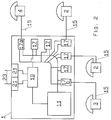
- the block diagram of the telephone private branch exchange shown in FIG. 2 shows a central unit 1 to which a plurality of telephone sets 2, 3, 4 are connected.
- a subscriber circuit 17, 17a, 17b is provided in the central unit 1 for each connectable telephone set 2, 3, 4.
- the subscriber circuits 17, 17a, 17b are connected to a central control unit 11 and a switching matrix 19. Furthermore, the switching matrix 19 is connected to the central control unit 11, so that the central control unit 11 can act on the switching matrix and on the subscriber circuits 17.
- the office-side connection of the private branch exchange takes place via exchange circuits 21 to which exchange lines 23 from the telephone network are connected.
- the telephone set 3 If the first coding is now entered on the telephone set 3, then a call from the calling telephone set 4 will not trigger the usual call signaling 9, but rather for an immediate activation of the Loudspeaker / hands-free device 7 (see FIG. 1). After the loudspeaker / hands-free device 7 is switched on, it emits an audible tone which signals the called subscriber that the loudspeaker / hands-free device 7 is now switched on. In this operating mode set by the first coding, the telephone set 3 is blocked for incoming outside calls by appropriate programming of the central control unit 11.
- incoming calls are reported again via the call signaling 9 and the telephone set 3 can be reached again by reprogramming the central control unit 11 for incoming outside calls within the scope of its usual outside line authorization.
- the central control unit 11 of the central unit 1 is programmed such that it is dependent on a fourth coding which is entered by the calling telephone set 4. Can generate call signals of different durations.
- the fourth coding to be entered by the calling apparatus 4 corresponds to a special key or a selection code, roughly comparable to the actuation of an earth key or the choice of the dialing code zero for outside line access for fully authorized devices.
- the central control unit 11 After entering the fourth coding, the central control unit 11 sends a call signal of a predetermined length to the called telephone set 3 via the subscriber circuit 17b.
- the duration of this long call signal is preferably in the range of seconds.
- the control unit 5 of the telephone set 3 is programmed so that it reports the call via the call signaling 9 or the loudspeaker / hands-free device 7 switches on immediately, depending on the duration of the ringing voltage applied.
- the time period for the detection of a long call, which leads to the activation of the loudspeaker / hands-free device 7, lies in the range of z. B. three seconds, so that by entering the fourth coding on the calling telephone 4 and the resulting delivery of a long call signal to the called telephone 3, the speakerphone / hands-free device 7 is switched on directly.
- the central control unit 11 of the central unit 1 If the fourth coding is not entered on the calling telephone set 4, the central control unit 11 of the central unit 1 generates a short ringing signal which, in the case of the called telephone set, leads to the control unit 5 activating the call signaling 9.
- the called telephone set 3 is de-energized by means of the subscriber circuit 17b and the loudspeaker / hands-free device 7 is thus switched off.
- the programming of the control unit 5 is retained, however, so that a distinction in the call length is possible again with a next call.
Landscapes
- Engineering & Computer Science (AREA)
- Signal Processing (AREA)
- Physics & Mathematics (AREA)
- Astronomy & Astrophysics (AREA)
- General Physics & Mathematics (AREA)
- Computer Networks & Wireless Communication (AREA)
- Sub-Exchange Stations And Push- Button Telephones (AREA)
- Interconnected Communication Systems, Intercoms, And Interphones (AREA)
Applications Claiming Priority (2)
| Application Number | Priority Date | Filing Date | Title |
|---|---|---|---|
| DE19934341025 DE4341025A1 (de) | 1993-12-02 | 1993-12-02 | Fernsprech-Nebenstellenanlage |
| DE4341025 | 1993-12-02 |
Publications (1)
| Publication Number | Publication Date |
|---|---|
| EP0658033A2 true EP0658033A2 (fr) | 1995-06-14 |
Family
ID=6503963
Family Applications (1)
| Application Number | Title | Priority Date | Filing Date |
|---|---|---|---|
| EP19940116609 Withdrawn EP0658033A2 (fr) | 1993-12-02 | 1994-10-21 | Autocommutateur privé |
Country Status (2)
| Country | Link |
|---|---|
| EP (1) | EP0658033A2 (fr) |
| DE (1) | DE4341025A1 (fr) |
Cited By (1)
| Publication number | Priority date | Publication date | Assignee | Title |
|---|---|---|---|---|
| EP0781023A3 (fr) * | 1995-12-22 | 2002-11-06 | Deutsche Telekom AG | Echange de données bidirectionnel (protocole) entre un central de télécommunication et un dispositif terminal |
Families Citing this family (1)
| Publication number | Priority date | Publication date | Assignee | Title |
|---|---|---|---|---|
| KR0151447B1 (ko) * | 1994-09-16 | 1998-11-02 | 김광호 | 스피커 폰의 통화로 자동 형성 전화장치 및 그 제어방법 |
Family Cites Families (6)
| Publication number | Priority date | Publication date | Assignee | Title |
|---|---|---|---|---|
| US4172967A (en) * | 1975-10-08 | 1979-10-30 | James John Porter | Automatic answering device for use in live speech communication and circuit components thereof |
| DE3125472C2 (de) * | 1981-06-29 | 1986-09-04 | Siemens AG, 1000 Berlin und 8000 München | Verfahren zum Abfragen und Ändern von den Teilnehmerstellen zugeordneten Leistungsmerkmalen in einer zentralgesteuerten Fernsprechnebenstellenanlage |
| DE3315899C2 (de) * | 1983-05-02 | 1985-12-12 | Telefonbau Und Normalzeit Gmbh, 6000 Frankfurt | Verfahren zur Zuordnung von Anschlußdaten für Fernsprechteilnehmeranschlüsse |
| US4689813A (en) * | 1984-11-13 | 1987-08-25 | Fortel, Inc. | Speakerphone telephone answering machine |
| DE3503560A1 (de) * | 1985-02-02 | 1986-08-07 | Horst Dipl.-Ing. Kopetzky (FH), 8025 Unterhaching | Digitale fernsprech-nebenstellenanlage mit mikroprozessorsteuerung |
| US4912757A (en) * | 1989-01-19 | 1990-03-27 | Cellucom, Inc. | Paging system |
-
1993
- 1993-12-02 DE DE19934341025 patent/DE4341025A1/de not_active Withdrawn
-
1994
- 1994-10-21 EP EP19940116609 patent/EP0658033A2/fr not_active Withdrawn
Cited By (1)
| Publication number | Priority date | Publication date | Assignee | Title |
|---|---|---|---|---|
| EP0781023A3 (fr) * | 1995-12-22 | 2002-11-06 | Deutsche Telekom AG | Echange de données bidirectionnel (protocole) entre un central de télécommunication et un dispositif terminal |
Also Published As
| Publication number | Publication date |
|---|---|
| DE4341025A1 (de) | 1995-06-08 |
Similar Documents
| Publication | Publication Date | Title |
|---|---|---|
| DE4425395A1 (de) | Kommunikationssystem | |
| EP0432746B1 (fr) | Terminal de telecommunication | |
| EP0749228A2 (fr) | Dispositif de commande de traitement d'un appel arrivant | |
| DE2946177A1 (de) | Hausanlage zur uebertragung von informationen | |
| DE69317597T2 (de) | Gerät zur Zugriffskontrolle auf eine Fernsprechleitung | |
| EP0658033A2 (fr) | Autocommutateur privé | |
| DE3540301C2 (fr) | ||
| DE3133531C2 (de) | Schaltungsanordnung zum Einstellen der Lautstärke eines aus einem elektroakustischen Wandler bestehenden Anruforgans in Fernsprechapparaten | |
| DE4317701C1 (de) | Telekommunikationssystem mit einer speicherprogrammierten Systemsteuerung und mit einer als Endgerät angeschlossenen Sondereinrichtung | |
| DE4202040A1 (de) | Verfahren zur erleichterung der bedienung von endgeraeten in fernmeldeanlagen | |
| DE4142742C2 (de) | Anlage zur Weiterschaltung eines auf einer ersten Anschlußleitung ankommenden Anrufes über eine zweite Anschlußleitung an einen anderen Fernsprechanschluß | |
| DE3712570C1 (de) | Verfahren zum Aufbauen von Rueckfrageverbindungen in Fernsprechvermittlungsanlagen,insbesondere Fernsprechnebenstellenanlagen | |
| DE3308986C2 (de) | Schaltungsanordnung für eine digitale Fernsprechstation | |
| DE3133935C2 (de) | Schaltungsanordnung für eine Fernsprechstation in Fernsprechnebenstellenanlagen mit Zustandsanzeige | |
| EP0460404B1 (fr) | Procédé pour la transmission de signaux de données dans des centraux de télécommunication | |
| EP0848529A2 (fr) | Méthode de sélection et d'exécution de fonctions librement programmables d'un appareil téléphonique et appareil téléphonique correspondant | |
| DE2949513C2 (de) | Notrufanlage | |
| DE4006048C2 (fr) | ||
| DE2727248A1 (de) | Verfahren zum betrieb einer telefonanlage | |
| DE3808414A1 (de) | Fernsprech-handapparat mit optischer anzeigevorrichtung | |
| DE3608454C1 (en) | Dialling bar for a telephone device | |
| DE4100722C2 (fr) | ||
| DD295293A5 (de) | Telefonapparat, geeignet fuer den anschluss an verschiedenen fernsprechleitungen | |
| DE2749643C3 (de) | Schaltungsanordnung für Fernsprechnebenstellenanlagen zur Einzelkennzeichnung von besonderen Anrufen an der Abfragestelle | |
| DE4031857A1 (de) | Digitale telekommunikationsanlage |
Legal Events
| Date | Code | Title | Description |
|---|---|---|---|
| PUAI | Public reference made under article 153(3) epc to a published international application that has entered the european phase |
Free format text: ORIGINAL CODE: 0009012 |
|
| AK | Designated contracting states |
Kind code of ref document: A2 Designated state(s): BE DE DK ES FR GB GR IE IT LU NL PT |
|
| STAA | Information on the status of an ep patent application or granted ep patent |
Free format text: STATUS: THE APPLICATION HAS BEEN WITHDRAWN |
|
| 18W | Application withdrawn |
Withdrawal date: 19981120 |