EP0658035B1 - Système et méthode pour fournir des images vidéo sélectionnées à des postes téléphoniques locaux - Google Patents
Système et méthode pour fournir des images vidéo sélectionnées à des postes téléphoniques locaux Download PDFInfo
- Publication number
- EP0658035B1 EP0658035B1 EP94308852A EP94308852A EP0658035B1 EP 0658035 B1 EP0658035 B1 EP 0658035B1 EP 94308852 A EP94308852 A EP 94308852A EP 94308852 A EP94308852 A EP 94308852A EP 0658035 B1 EP0658035 B1 EP 0658035B1
- Authority
- EP
- European Patent Office
- Prior art keywords
- network
- video images
- local telephone
- telephone station
- telephone
- Prior art date
- Legal status (The legal status is an assumption and is not a legal conclusion. Google has not performed a legal analysis and makes no representation as to the accuracy of the status listed.)
- Expired - Lifetime
Links
- 238000000034 method Methods 0.000 title claims description 14
- 230000005540 biological transmission Effects 0.000 claims description 15
- 230000006837 decompression Effects 0.000 claims 1
- 230000006835 compression Effects 0.000 description 5
- 238000007906 compression Methods 0.000 description 5
- 238000010586 diagram Methods 0.000 description 5
- 238000005516 engineering process Methods 0.000 description 5
- 230000011664 signaling Effects 0.000 description 4
- 230000006870 function Effects 0.000 description 3
- 238000013500 data storage Methods 0.000 description 2
- 230000010006 flight Effects 0.000 description 2
- 230000007246 mechanism Effects 0.000 description 2
- 238000012986 modification Methods 0.000 description 2
- 230000004048 modification Effects 0.000 description 2
- 230000008569 process Effects 0.000 description 2
- 238000012545 processing Methods 0.000 description 2
- 238000012546 transfer Methods 0.000 description 2
- 238000013519 translation Methods 0.000 description 2
- 108091006146 Channels Proteins 0.000 description 1
- 238000013459 approach Methods 0.000 description 1
- 230000008859 change Effects 0.000 description 1
- 230000008878 coupling Effects 0.000 description 1
- 238000010168 coupling process Methods 0.000 description 1
- 238000005859 coupling reaction Methods 0.000 description 1
- 230000001419 dependent effect Effects 0.000 description 1
- 238000013461 design Methods 0.000 description 1
- 239000000835 fiber Substances 0.000 description 1
- 230000006872 improvement Effects 0.000 description 1
- 238000012216 screening Methods 0.000 description 1
- 238000013515 script Methods 0.000 description 1
- 239000011800 void material Substances 0.000 description 1
Images
Classifications
-
- H—ELECTRICITY
- H04—ELECTRIC COMMUNICATION TECHNIQUE
- H04N—PICTORIAL COMMUNICATION, e.g. TELEVISION
- H04N21/00—Selective content distribution, e.g. interactive television or video on demand [VOD]
- H04N21/80—Generation or processing of content or additional data by content creator independently of the distribution process; Content per se
- H04N21/81—Monomedia components thereof
- H04N21/812—Monomedia components thereof involving advertisement data
-
- H—ELECTRICITY
- H04—ELECTRIC COMMUNICATION TECHNIQUE
- H04M—TELEPHONIC COMMUNICATION
- H04M11/00—Telephonic communication systems specially adapted for combination with other electrical systems
- H04M11/08—Telephonic communication systems specially adapted for combination with other electrical systems specially adapted for optional reception of entertainment or informative matter
- H04M11/085—Telephonic communication systems specially adapted for combination with other electrical systems specially adapted for optional reception of entertainment or informative matter using a television receiver, e.g. viewdata system
-
- H—ELECTRICITY
- H04—ELECTRIC COMMUNICATION TECHNIQUE
- H04M—TELEPHONIC COMMUNICATION
- H04M3/00—Automatic or semi-automatic exchanges
- H04M3/42—Systems providing special services or facilities to subscribers
- H04M3/4228—Systems providing special services or facilities to subscribers in networks
- H04M3/42306—Number translation services, e.g. premium-rate, freephone or vanity number services
-
- H—ELECTRICITY
- H04—ELECTRIC COMMUNICATION TECHNIQUE
- H04M—TELEPHONIC COMMUNICATION
- H04M3/00—Automatic or semi-automatic exchanges
- H04M3/42—Systems providing special services or facilities to subscribers
- H04M3/487—Arrangements for providing information services, e.g. recorded voice services or time announcements
- H04M3/4872—Non-interactive information services
- H04M3/4878—Advertisement messages
-
- H—ELECTRICITY
- H04—ELECTRIC COMMUNICATION TECHNIQUE
- H04M—TELEPHONIC COMMUNICATION
- H04M3/00—Automatic or semi-automatic exchanges
- H04M3/42—Systems providing special services or facilities to subscribers
- H04M3/487—Arrangements for providing information services, e.g. recorded voice services or time announcements
- H04M3/493—Interactive information services, e.g. directory enquiries ; Arrangements therefor, e.g. interactive voice response [IVR] systems or voice portals
-
- H—ELECTRICITY
- H04—ELECTRIC COMMUNICATION TECHNIQUE
- H04N—PICTORIAL COMMUNICATION, e.g. TELEVISION
- H04N7/00—Television systems
- H04N7/16—Analogue secrecy systems; Analogue subscription systems
- H04N7/162—Authorising the user terminal, e.g. by paying; Registering the use of a subscription channel, e.g. billing
- H04N7/165—Centralised control of user terminal ; Registering at central
-
- H—ELECTRICITY
- H04—ELECTRIC COMMUNICATION TECHNIQUE
- H04Q—SELECTING
- H04Q2213/00—Indexing scheme relating to selecting arrangements in general and for multiplex systems
- H04Q2213/13034—A/D conversion, code compression/expansion
-
- H—ELECTRICITY
- H04—ELECTRIC COMMUNICATION TECHNIQUE
- H04Q—SELECTING
- H04Q2213/00—Indexing scheme relating to selecting arrangements in general and for multiplex systems
- H04Q2213/1309—Apparatus individually associated with a subscriber line, line circuits
-
- H—ELECTRICITY
- H04—ELECTRIC COMMUNICATION TECHNIQUE
- H04Q—SELECTING
- H04Q2213/00—Indexing scheme relating to selecting arrangements in general and for multiplex systems
- H04Q2213/13103—Memory
-
- H—ELECTRICITY
- H04—ELECTRIC COMMUNICATION TECHNIQUE
- H04Q—SELECTING
- H04Q2213/00—Indexing scheme relating to selecting arrangements in general and for multiplex systems
- H04Q2213/13134—Coin boxes, payphone, prepaid
-
- H—ELECTRICITY
- H04—ELECTRIC COMMUNICATION TECHNIQUE
- H04Q—SELECTING
- H04Q2213/00—Indexing scheme relating to selecting arrangements in general and for multiplex systems
- H04Q2213/13292—Time division multiplexing, TDM
-
- H—ELECTRICITY
- H04—ELECTRIC COMMUNICATION TECHNIQUE
- H04Q—SELECTING
- H04Q2213/00—Indexing scheme relating to selecting arrangements in general and for multiplex systems
- H04Q2213/13302—Magnetic elements
-
- H—ELECTRICITY
- H04—ELECTRIC COMMUNICATION TECHNIQUE
- H04Q—SELECTING
- H04Q2213/00—Indexing scheme relating to selecting arrangements in general and for multiplex systems
- H04Q2213/13337—Picturephone, videotelephony
-
- H—ELECTRICITY
- H04—ELECTRIC COMMUNICATION TECHNIQUE
- H04Q—SELECTING
- H04Q2213/00—Indexing scheme relating to selecting arrangements in general and for multiplex systems
- H04Q2213/13376—Information service, downloading of information, 0800/0900 services
Definitions
- This invention relates to a telephone system for providing subscriber selected video images to a local telephone station having a display monitor for receiving and displaying the video images.
- This void in advertising to the international world traveler has been met to a certain degree by placing technologically advanced telephone stations, such as the AT&T Public Phone 2000, in airport terminals and other places such as hotels where these travelers tend to stay.
- These phones not only provide the standard transmitter and receiver for making local and international phone calls but also these phones have a color monitor which displays images such as a company logo for eight to ten seconds, or displays information in a selected language on how to use the phone.
- the Public Phone 2000 has a microprocessor contained in the phone station which controls the color monitor and allows other advanced telephone functions, thus catering to the international world traveler.
- an existing phone having a display monitor to play selected still or video images, such as vendor and subscriber selected advertisements to the world traveller. It would also be desirable to selectively control these images depending on the location of the phone, i.e., the terminal, the time of incoming flights, their origin, and other factors. For example, a local telephone station positioned at an airport terminal may have travelers of different national origin visiting the area where that phone is located depending on what incoming flight has arrived to that terminal. Thus, the displayed advertisements on the monitor should change depending on these different parameters.
- the local telephone stations are grouped closely adjacent to each other.
- US-A-4 797 914 discloses a telephone station that includes a display for displaying a message.
- the display may be programmed from a remote location via a modem contained within the telephone station.
- the telephone station of US-A-4 797 914 is only able to display messages that consist solely of alpha numeric characters. It is not able to display a picture image, whether the image is a still image or a video image.
- US-A-4 953 196 discloses a video telephone that is able to transmit both audio and video data.
- the telephone is provided with video compression means for compressing the video data before it is sent, and it is also provided with video expansion means for de-compressing received video data before displaying the received image.
- US-A-4 720 849 discloses an information display apparatus that is provided with a video disc for storing video advertisements. A user is able to retrieve a selected advertisement and have it displayed on a display. The information display apparatus is further provided with a telephone handset that enables the user to contact a particular advertiser. The selection of stored advertisements can be updated only by removing the existing video disc and replacing it with another video disc.
- US-A-5 218 663 discloses a telephone station that is provided with means for receiving a data-carrying disc such as a CD ROM.
- a user of the system is provided with one or more data carrier that contains stored data of interest to the user. Once the data carrier has been inserted into the telephone station, a user may select one or more stored images to be displayed.
- EP-A-0 337 539 discloses an information system that may display a text message and an accompanying image. The images are stored on a video disc located within the information system.
- a first aspect of the present invention provides a system for providing subscriber selected video images to a local telephone station as claimed in claim 1.
- a second aspect of the present invention provides a method of providing selected video images of a telephone network advertising subscriber to a local telephone station as claimed in claim 9.
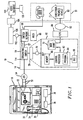
- FIG. 1 there is shown a block diagram of the system indicated generally at 10, arranged in accordance with the present invention for transmitting video images to a local telephone station having a monitor for displaying advertising video images.
- the overall illustrated system shows a telephone switching network, indicated by the dashed outline 14 connected to a local telephone station indicated generally at 16 , which in the foregoing described embodiment is a station having a display monitor 18 ( Figure 3) such as commonly used in the Public Phone 2000, (Phone 2000) presently manufactured and sold by AT&T.
- Figure 3 such as commonly used in the Public Phone 2000, (Phone 2000) presently manufactured and sold by AT&T.
- the foregoing description will proceed with a description of the local telephone station 16, the Phone 2000, which may be used by world travelers arriving at airports and other similar locations such as international hotels in the United States, followed by a description of the network and switching components in the context of the present invention.
- the description will also include the components and elements common to the use of 800 toll free services since many travelers may initially use such services when arriving at an airport terminal.
- the description of the telephone network 14 in conjunction with a description of the 800 toll-free service system components should aid understanding of the overall invention described herein.
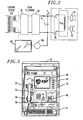
- the phone 16 includes the normal transmitter 20 and receiver 22 contained in the handset 24 which is received in the telephone cradle 26 , where it depresses a conventional switch(es) 28 to activate the "off" state ( Figure 2). When the handset 24 is raised, the dial network is activated, and a dial tone is registered.
- the telephone station also includes a standard speech circuit 30 and ringer circuit 32 as is conventional.
- the phone even though it has a display monitor 18 , is small, and fits into major existing telephone frame-housing members 34 found in the airport terminals and hotels frequented by international travelers. This small size facilitates replacement of older model phones with the Phone 2000.
- the Phone 2000 works from commercially available 120 V AC.
- the phone has a high resolution, nine inch color monitor 18 that displays both graphics and text, 640 X 480 pixels, with 256 VGA color capability.
- the phone includes its own microprocessor 36 , shown in block diagram in Figure 1.
- the monitor 18 would display informational screens for a period of 8-10 seconds each when the phone is not in use. These still images are stored in a memory module 38 , which could be a disk drive, in the phone. In some cases, the data could be downloaded from a central administration point.
- the phone includes menu driven function buttons 40 designed to operate in a manner similar to automatic teller machines. These buttons, which are labeled with an up and down arrow buttons, and, (enter/yes) and (cancel/no) buttons will enable travelers to control feature selection ( Figure 3).
- the phone also includes a volume control button 42 that raises or lowers volume about twenty decibels, five decibels at a time.
- a new call button 44 allows travelers to place a call by simply pressing a new call button after they are finished with their call, thus eliminating the need for reentering their calling card number.
- a standard credit card insert 46 receives the customer's calling card.
- a data port 48 is equipped with an RJ11 modular connector, enabling travelers to connect a lap top computer or portable facsimile machines to the phone, by simply plugging in and following instructions on the screen.
- the grommet 50 on the phone cord identifies the phone as hearing aid compatible and signifies that the person with a hearing aid will not receive any feedback when using the phone.
- the lower part of the phone 16 includes a conventional computer keyboard 51 which is used for data input.
- the local telephone station 16 connects via at least two separate lines 52 (which could also be four lines depending on the system) to a local exchange switch 54 (which may be a 5ESS® Electronic Switching System available from AT&T) typically owned and operated by a Local Exchange Company (LEC). Calls made from the local telephone station are transferred from the local exchange switch 54 to an "originating" switch 56 (which may be a 4ESS' Electronic Switching System available from AT&T). The originating switch is connected into the switched network 58 and routes the call through the network to its destination via the existing phone line system 57 .
- a local exchange switch 54 which may be a 5ESS® Electronic Switching System available from AT&T
- LEC Local Exchange Company
- the network control point used for providing the logic for routing toll-free 800 numbers is illustrated and described.
- Often international travelers call 800 subscribers such as hotels, airlines, and even network providers such as AT&T after they arrive in an airline terminal or hotel.
- the toll-free 800 number call is described for purposes of understanding the network switch system, followed by a more detailed description of the video system of the present invention.
- a calling party initially raises the handset 24 off its cradle 26 , and the local exchange company via the local exchange switch 54 returns the dial tone.
- the calling party then dials a subscriber's 800 number and the call is transmitted to the local exchange switch 54 which verifies the 800 number.
- the switch then forwards the call to the telephone network 14 which services the calls to that 800 number.
- the call is transferred to the originating switch 56.
- the originating switch 56 takes the call and signals back to the local operating company that it has received the call and to maintain the circuit open for voice transmission.
- the originating switch 56 then plays back to the customer the tones for the on-line sound.
- the originating switch launches a query through the conventional common channel signalling network shown by the rectangle and dot-dash line 59 in Figure 1 (CCS7) to the network control point (NCP) 60 which stores the appropriate Inward Wide-Area Telecommunication Service (INWATS) database.
- the INWATS database (IDB) is used to perform a 10-digit 800 to POTS number translation.
- the query typically will include information concerning the dialed number and information identifying the calling party's location, such as an automatic number identification (ANI) for the line serving that location. Other information could also concern the time of day.
- This query typically is made in the form of a data message transmitted to the NCP 60 via the CCS7 network signalling link.
- the network control point 60 includes a control processor 62 which operates under the control of a program 64 stored in memory 66 and a data link controller (DLC) 68 , which operates to transmit and receive data messages to and from switches via a signal transfer point 70 .
- DLC data link controller
- the signal transfer point 70 is a very high capacity, reliable packet switch that transport signalling messages between network nodes such as switches and network control points. They perform routing functions and terminate a large number of signalling links performing protocol processing and routing of a high volume of messages through the links.
- the network control point 60 also includes a main data storage unit 72 which could be a number of memory disk units.
- This data storage unit 72 contains translation data that is used to translate a telephone number accompanying a request message into a primary destination code.
- This destination code could be the address of the destination toll switch or telephone number identifying the called station. If the destination code is a telephone number, then a toll switch in a conventional manner translates the telephone number into an address identifying the destination toll switch.
- the network control point 60 retrieves or "executes" a subscriber record associated with the received dialed number in order to obtain a routing number used to direct the originating switch where to route the call.
- This routing number could be sensitive to call origination locations.
- the subscriber can formulate a routing plan whereby, calls from customers in one region are routed to a first service center in that region, while calls from customers in another region which are placed to the same 800 number can be routed to a second service center in another geographic location.
- the routing number also may contain a code that can be interpreted by the switch 56 as providing multiple, sequential routing choices.
- the originating switch can retrieve the table containing information defining the first choice routing, which is used, if available.
- the table also could contain information defining a second choice routing in the event the first choice is busy, out of service, or otherwise unavailable.
- the table may also include information defining additional routing choices. This is particularly advantageous to provide back-up capability in the event that a particular network element is temporarily inoperative.
- the network subscriber for the 800 services typically has a premises vehicle 80 subscriber's location of business (indicated by dashed line 81 ).
- the premises vehicle 80 is operatively connected to an interface 82 a routing control system 84 as part of the network control point 60 .
- the premises vehicle 80 allows a subscriber to go into the network and make changes to the routing logic.
- the routing manager is a software application that sits presently on a work station situated at the subscriber's location.
- the work station can be any Unix software based work station capable of running a platform manager such as the ATT Platform Manager.
- the routing control system 84 of the network is termed "front end processors" (FEPS) which are interfaced with the network database 72 of the network control point 60 .
- FEPS front end processors
- a non-programmer at the subscriber premises can create a new service by stitching together functional boxes to describe the routing scenario for a call.
- a "call prompter" service may be provided where a calling party is connected to a network services complex 86 (NSCX) having a data base (also referred to as an announcement frame) where announcements are stored ( Figure 1).
- NSCX network services complex
- This host complex is also referred to as the "announcement facility” and receives instructions from the network control point to play an announcement stored in its announcement frame.
- the calling party is connected and switched to the announcement facility 86 which is arranged to interact with the calling party using stored voice scripts so as to play announcements to the calling party and/or collect information from the calling party. This information can then be used for further processing of the call.
- a centralized data base 100 holds digital data corresponding to selected subscriber advertisements of video images.
- This data base could be a number of disk drives, grouped together, to store various advertisements and video images selected by a vendor or network subscriber to be displayed on the monitor 18 of the phone 16 .
- the stored video images correspond to advertisements such as from the network carrier itself (in the present instance ATT), a subscriber of network services (such as a hotel having an 800 number) or other advertising subscriber.
- the data base 100 can be a part of the overall telephone network 14 and interface with network components through data transmission lines 102 as is well known to those skilled in the art. Also, the data base 100 could be a storage facility at a location separate from the network 14 .
- a major drawback of transferring video images over the existing telephone network phone lines 57 is extensive bandwidth required of video and other similar graphic and pictorial images. This has made transmission of video images over the existing phone line system 57 impractical.
- a video data compressor 104 such as an AVP4000 video compression chip set, now available from AT&T, provides the new technology required to compress the video images into data for transmission across the standard network telephone lines 57 .
- the data is typically packetized into discrete packets for transmission through the network by hardware and software 106 known to those skilled in the art. (Naturally, any network facilities can include ISDN fiber facilities).
- the data packets are transferred through the network 14 to the public telephone station 16 where the existing processor 36 has software that rearranges the packets in proper order, decompresses the packets, and displays the images on the monitor 18 .
- the software and hardware used in such process is well known to those skilled in the art. It has been determined that one minute of video to be displayed on a public telephone station 16 such as the Phone 2000 monitor, can be downloaded from the database in compressed packetized form over the existing telephone network lines in about 15 minutes. That one minute video can be played continuously, which is a great improvement over the eight second still frame image currently imaged on the Phone 2000 monitor.
- a plurality of the public telephone stations 16 could be grouped together in a cluster 110 at an airport or hotel and form a single unit. This could save on wiring and is more functional to the location since less physical space is required at busy, crowded airport terminals.
- Each public telephone station in the cluster could play a different video image which plays in a different language, or a separate advertisement video. In this manner, a customer could be interested in different videos playing on different phones. This is especially useful when international flights have arrived at the terminal that includes many different persons of different nationalities that speak different languages.
- the compressed packets could be multiplexed such as by conventional time division multiplexing, using telephone system equipment 112 well known to those skilled in the art.
- the multiplexed signals then are transmitted through the network 14 to the switch 56 .
- the signal is demultiplexed by conventional means 114 and sent via local switch 54 to respective local telephone stations 16 in the cluster 110 where they are rearranged as necessary, and then decompressed.
- the images then are displayed on the monitor 18 .
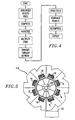
- a video splitting mechanism 120 ( Figure 5) may split the same video several different ways which allows display of the same video on different telephone stations in the cluster.
- the phones do not have to be clustered together for the multiplexing system arrangement as described to be used.
- a controller 130 ( Figure 1) is operatively connected to the image database 102 .
- the controller 130 selects the desired images which are compressed, packetized and transmitted through the telephone network 14 .
- the subscriber (customer) has input to the controller such as by telephone access to a human operator or via a touch tone sequence code which can be developed by those skilled in the art for selecting desired images.
- a local controller 132 may be situated adjacent the cluster 110 for selecting videos that are to be played on the various display monitors 18 .
- the local controller 132 could be positioned at a location adjacent the cluster 110 , or within the cluster, as long as access is provided.
- the location of the controller 132 can be positioned in various numerous locations based on the desire of those skilled in the art.
- the subscriber can use a service such as the toll free 800 service where a calling party callsa subscriber via the 800 service.
- the network control point is queried, and the database in the NCP returns data information stating that the call should be switched to the NCSX facility. Announcements are played indicating the selection of certain keys for generating a touch tone sequence.
- the NCP Upon generation of a selected touch tone sequence, the NCP prompts the image database to transmit preselected video images to the local telephone station 16 .
- Figure 4 illustrates a high level flow chart of the video image transmission to the local telephone station as described above.
Landscapes
- Engineering & Computer Science (AREA)
- Signal Processing (AREA)
- Multimedia (AREA)
- Business, Economics & Management (AREA)
- Marketing (AREA)
- Computer Security & Cryptography (AREA)
- Telephonic Communication Services (AREA)
- Prepayment Telephone Systems (AREA)
- Two-Way Televisions, Distribution Of Moving Picture Or The Like (AREA)
- Telephone Function (AREA)
Claims (15)
- Système pour appliquer des images vidéo sélectionnées sur une station de téléphone locale (16) qui est positionnée au niveau d'un emplacement de réseau partiel (« cluster »), le système comprenant:dans lequel ledit gestionnaire d'aiguillage d'appel (80) est connecté en fonctionnement audit moyen de commande de réseau (60) pour déterminer une logique d'aiguillage de l'appel au travers du moyen de commutation en tant que fonction de différents paramètres d'appel; etun réseau de téléphone (14) qui inclut un système de lignes téléphoniques et un moyen de commutation (56) qui est contenu à l'intérieur dudit système de lignes pour renvoyer des appels qui sont réalisés par une partie appelante depuis une station de téléphone locale (16) par l'intermédiaire du système de lignes téléphoniques et du moyen de commutation (56) jusqu'à un point de destination souhaité;ladite station de téléphone locale (16) étant interfacée sur ledit réseau (14), ladite station de téléphone locale (16) incluant un moniteur d'affichage (18) pour recevoir et afficher des images vidéo qui prennent leur origine depuis un abonné;une base de données d'images (100) dans laquelle une information de données correspondant à des images vidéo est stockée;un moyen de commande (130) pour sélectionner des images vidéo souhaitées à partir de ladite base de données (100) sur la base d'une entrée d'abonné;un moyen (104) pour comprimer les données correspondant aux dites images vidéo selon des paquets de données d'une largeur de bande ou bande passante moindre pour une transmission depuis ladite base de données;un moyen de décompression (36) au niveau de ladite station de téléphone locale (16) pour décomprimer lesdites données comprimées correspondant aux dites images vidéo;un moyen pour afficher les images vidéo sur ledit moniteur d'affichage;un moyen de commande de réseau (60) dans ledit réseau de téléphone (14) et associé audit moyen de commutation (56) pour commander et aiguiller l'appel qui est réalisé depuis la station de téléphone locale au travers dudit moyen de commutation; etun gestionnaire d'aiguillage d'appel (80) qui est localisé en une localisation de bâtiment (81) d'un abonné de réseau, ledit abonné de réseau étant localisé au niveau de la localisation de bâtiment (81) qui est séparée du réseau de téléphone (14),
dans lequel ledit moyen de commande de réseau (60) inclut un moyen pour interagir avec la partie appelante et pour répondre à une séquence de tonalités tactiles sélectionnée qui est entrée par la partie appelante via un mini-clavier au niveau de ladite station de téléphone locale (16) pour aiguiller l'appel sur la base de données d'images (100) et pour demander à ladite base de données d'images (100) de transmettre une image vidéo sélectionnée sur ladite station de téléphone locale (16). - Système selon la revendication 1, comprenant:une pluralité de stations de téléphone locales (16) qui sont groupées selon un voisinage proche les unes par rapport aux autres pour former un réseau partiel local (110), dans lequel chaque station est interfacée sur ledit réseau, chaque station incluant également un moniteur d'affichage pour recevoir et afficher des images vidéo d'un abonné;un moyen (112) pour multiplexer lesdits paquets pour une transmission multiplexée au travers dudit réseau; etun moyen (114) pour démultiplexer lesdits paquets multiplexés selon des paquets individuels pour une transmission sur des stations de téléphone locales respectives qui sont situées à l'intérieur dudit réseau partiel.
- Système selon la revendication 1 ou 2, dans lequel la ou chaque station de téléphone locale inclut un combiné (24) qui est reçu à l'intérieur d'un berceau (26) et qui inclut un moyen de commutation (28) dans ladite station de téléphone locale pour mener à terme l'affichage desdites images vidéo après que le combiné (24) de la station de téléphone locale (16) est relevé de son berceau (26).
- Système selon la revendication 1, 2 ou 3, dans lequel ladite ou chaque station de téléphone locale (16) inclut un microprocesseur (36) pour commander le fonctionnement du moniteur d'affichage.
- Système selon la revendication 2, dans lequel les stations dudit réseau partiel de stations de téléphone (16) sont groupées pour former une unique unité.
- Système selon la revendication 2, dans lequel ledit moyen de commande est localisé à proximité de ladite localisation de réseau partiel.
- Système selon la revendication 2, dans lequel ledit moyen de commande est localisé à proximité de ladite localisation de base de données.
- Système selon la revendication 1 et comprenant en outre:un moyen (102) pour réaliser un interfaçage avec ladite base de données d'images (100) et ledit réseau de téléphone (14) pour permettre une transmission de données correspondant aux dites images vidéo depuis ladite base de données (100) dans ledit réseau (13);un moyen pour transmettre lesdits paquets de données d'une largeur de bande ou bande passante moindre depuis ladite base de données (100) par l'intermédiaire dudit moyen d'interface (102) et dudit système de lignes téléphoniques dans ladite station de téléphone locale (16).
- Système selon la revendication 1, dans lequel la base de données d'images (100) est contenue à l'intérieur du réseau de téléphone (14).
- Procédé d'application d'images vidéo sélectionnées sur une station de téléphone locale (16) qui est positionnée au niveau d'une localisation de réseau partiel, le procédé comprenant:la sélection de données correspondant à des images vidéo à partir d'une base de données d'images (100) sur la base d'une entrée d'abonné sur un moyen de commande (130);la compression des données correspondant aux images vidéo tout en mettant sous paquets les données comprimées selon des paquets de données comprimés d'une largeur de bande ou bande passante moindre;la transmission des paquets de données comprimés par l'intermédiaire du réseau de téléphone;la commutation des paquets de données par l'intermédiaire du réseau de téléphone sur la station de téléphone locale;la décompression des données correspondant aux images vidéo dans la station de téléphone locale (16);tout en déterminant également une logique d'aiguillage d'un appel au travers du réseau de téléphone (14) en fonction de différents paramètres d'appel en provenance d'un gestionnaire d'aiguillage d'appel (80) qui est localisé au niveau d'une localisation de bâtiment (81) qui est séparée du réseau de téléphone (14) et qui lui est connectée en fonctionnement,la commande de l'aiguillage de l'appel qui est réalisé depuis la station de téléphone locale (16) au travers du réseau de téléphone (14) en interrogeant une base de données de commande de réseau (60),l'interaction avec un appelant et la réponse à une séquence de tonalités tactiles sélectionnée qui est entrée par la partie appelante pour aiguiller l'appel sur la base de données d'images (100) pour une transmission sur la station de téléphone locale (16) d'images vidéo sélectionnées; etl'affichage des images vidéo sur un moniteur d'affichage (18) de la station de téléphone.
- Procédé selon la revendication 10, dans lequel l'affichage d'images vidéo est terminé en relevant le combiné (24) de la station de téléphone locale (16) de son berceau (26).
- Procédé selon la revendication 10 ou 11, incluant la commande du fonctionnement du moniteur d'affichage vidéo (18) par un microprocesseur (16) qui est contenu à l'intérieur de la station de téléphone locale (16).
- Procédé selon la revendication 10, 11 ou 12, incluant la commande de la sélection des images vidéo en une localisation à proximité de la localisation de réseau partiel.
- Procédé selon la revendication 10, 11 ou 12, incluant la commande de la sélection des images vidéo en une localisation à proximité de la localisation de base de données.
- Procédé selon la revendication 10 et comprenant en outre les étapes de multiplexage des paquets de données, de transmission des paquets de données comprimés et multiplexés par l'intermédiaire du réseau de téléphone sur le commutateur (56), de démultiplexage des paquets de données et de renvoi des paquets de données démultiplexés sur la station de téléphone locale (16).
Applications Claiming Priority (2)
| Application Number | Priority Date | Filing Date | Title |
|---|---|---|---|
| US08/166,496 US5515424A (en) | 1993-12-13 | 1993-12-13 | System and method for providing selected video images to local telephone stations |
| US166496 | 1993-12-13 |
Publications (3)
| Publication Number | Publication Date |
|---|---|
| EP0658035A2 EP0658035A2 (fr) | 1995-06-14 |
| EP0658035A3 EP0658035A3 (fr) | 1998-06-24 |
| EP0658035B1 true EP0658035B1 (fr) | 2004-04-14 |
Family
ID=22603561
Family Applications (1)
| Application Number | Title | Priority Date | Filing Date |
|---|---|---|---|
| EP94308852A Expired - Lifetime EP0658035B1 (fr) | 1993-12-13 | 1994-11-30 | Système et méthode pour fournir des images vidéo sélectionnées à des postes téléphoniques locaux |
Country Status (7)
| Country | Link |
|---|---|
| US (1) | US5515424A (fr) |
| EP (1) | EP0658035B1 (fr) |
| JP (2) | JP3129926B2 (fr) |
| CN (1) | CN1072876C (fr) |
| CA (1) | CA2135414C (fr) |
| DE (1) | DE69433710D1 (fr) |
| SG (1) | SG91241A1 (fr) |
Cited By (2)
| Publication number | Priority date | Publication date | Assignee | Title |
|---|---|---|---|---|
| US6851048B2 (en) | 1997-01-13 | 2005-02-01 | Micro Ear Technology, Inc. | System for programming hearing aids |
| US6888948B2 (en) | 1997-01-13 | 2005-05-03 | Micro Ear Technology, Inc. | Portable system programming hearing aids |
Families Citing this family (60)
| Publication number | Priority date | Publication date | Assignee | Title |
|---|---|---|---|---|
| US6323894B1 (en) | 1993-03-12 | 2001-11-27 | Telebuyer, Llc | Commercial product routing system with video vending capability |
| US7019770B1 (en) | 1993-03-12 | 2006-03-28 | Telebuyer, Llc | Videophone system for scrutiny monitoring with computer control |
| US5495284A (en) | 1993-03-12 | 1996-02-27 | Katz; Ronald A. | Scheduling and processing system for telephone video communication |
| US20030185356A1 (en) | 1993-03-12 | 2003-10-02 | Telebuyer, Llc | Commercial product telephonic routing system with mobile wireless and video vending capability |
| US5812647A (en) * | 1993-06-14 | 1998-09-22 | New North Media Inc. | Display based marketing message control system and method |
| US7310072B2 (en) | 1993-10-22 | 2007-12-18 | Kopin Corporation | Portable communication display device |
| US5873068A (en) * | 1994-06-14 | 1999-02-16 | New North Media Inc. | Display based marketing message control system and method |
| FR2728131B1 (fr) * | 1994-12-13 | 1997-01-24 | Syseca Sa | Console interactive de reception de television |
| CA2172559A1 (fr) * | 1995-03-24 | 1996-09-25 | Barry H. Schwab | Systeme interactif numerique sur d'identification de produits et d'operations de vente |
| US5606361A (en) * | 1995-05-10 | 1997-02-25 | Davidsohn; John | Videophone interactive mailbox facility system and method of processing information |
| USD382913S (en) * | 1995-10-16 | 1997-08-26 | Dearkland James R | Advertising frame for a coin telephone access door |
| US5835130A (en) * | 1995-12-08 | 1998-11-10 | Sony Corporation | Video telephony system with hold program |
| US6650998B1 (en) | 1996-03-11 | 2003-11-18 | At&T Corp. | Information Search System for enabling a user of a user terminal to search a data source |
| US6577714B1 (en) | 1996-03-11 | 2003-06-10 | At&T Corp. | Map-based directory system |
| DE19610010A1 (de) | 1996-03-14 | 1997-09-18 | Sel Alcatel Ag | Einrichtung und Dienst zur Übertragung von Videobilddaten sowie Einrichtung zur Übertragung von Anforderungssignalen |
| US5857014A (en) * | 1996-05-31 | 1999-01-05 | Rockwell International Corporation | System and method for establishing communications between a remote computer and a computer service provider using a telephonic switch |
| US7321354B1 (en) | 1996-10-31 | 2008-01-22 | Kopin Corporation | Microdisplay for portable communication systems |
| US6486862B1 (en) | 1996-10-31 | 2002-11-26 | Kopin Corporation | Card reader display system |
| US6677936B2 (en) | 1996-10-31 | 2004-01-13 | Kopin Corporation | Color display system for a camera |
| US7372447B1 (en) | 1996-10-31 | 2008-05-13 | Kopin Corporation | Microdisplay for portable communication systems |
| US7787647B2 (en) | 1997-01-13 | 2010-08-31 | Micro Ear Technology, Inc. | Portable system for programming hearing aids |
| US6314169B1 (en) * | 1997-02-06 | 2001-11-06 | Poweroasis, Inc. | Power and telecommunications access vending machine |
| US6216111B1 (en) | 1997-03-19 | 2001-04-10 | Walker Digital, Llc | System and method for telemarketing presentations |
| US5937037A (en) * | 1998-01-28 | 1999-08-10 | Broadpoint Communications, Inc. | Communications system for delivering promotional messages |
| US6552704B2 (en) | 1997-10-31 | 2003-04-22 | Kopin Corporation | Color display with thin gap liquid crystal |
| US6909419B2 (en) * | 1997-10-31 | 2005-06-21 | Kopin Corporation | Portable microdisplay system |
| US6476784B2 (en) | 1997-10-31 | 2002-11-05 | Kopin Corporation | Portable display system with memory card reader |
| US6396531B1 (en) | 1997-12-31 | 2002-05-28 | At+T Corp. | Set top integrated visionphone user interface having multiple menu hierarchies |
| US6229810B1 (en) | 1997-12-31 | 2001-05-08 | At&T Corp | Network server platform for a hybrid fiber twisted pair local loop network service architecture |
| US6366863B1 (en) | 1998-01-09 | 2002-04-02 | Micro Ear Technology Inc. | Portable hearing-related analysis system |
| US6377246B1 (en) * | 1998-01-16 | 2002-04-23 | Lucent Technologies Inc. | Article comprising a computer-style keyboard |
| US6009150A (en) * | 1998-01-28 | 1999-12-28 | Broadpoint Commuications, Inc. | Call processing method for delivering promotional messages |
| USD419996S (en) * | 1998-08-12 | 2000-02-01 | Evans Consoles Inc. | Telephone |
| US7272217B1 (en) | 1998-12-16 | 2007-09-18 | At&T Corp. | Telecommunications call time slicing system and method |
| WO2000060450A1 (fr) * | 1999-04-07 | 2000-10-12 | Khyber Technologies Corporation | Dispositif portable de calcul, de communication et de divertissement equipe d'un processeur central integre dans un combine amovible |
| US6793619B1 (en) | 1999-06-09 | 2004-09-21 | Yaacov Blumental | Computer-implemented method and system for giving a user an impression of tactile feedback |
| US7093286B1 (en) | 1999-07-23 | 2006-08-15 | Openwave Systems Inc. | Method and system for exchanging sensitive information in a wireless communication system |
| DK1252799T3 (da) | 2000-01-20 | 2012-01-23 | Starkey Lab Inc | Fremgangsmåde og apparat til tilpasning af høreapparater |
| BR0100363A (pt) * | 2000-02-08 | 2001-10-02 | Kovecom Co Ltd | Método de propaganda e sistema para propiciar serviço de anúncio e telefonema |
| EP1148756A1 (fr) * | 2000-03-28 | 2001-10-24 | Ascom AG | Méthode pour la délivrance de données dans un réseau de télécommunication et central correspondant |
| GB0011747D0 (en) * | 2000-05-17 | 2000-07-05 | Butterworth Martyn | Improvements related to telecoms |
| US6829233B1 (en) | 2000-07-26 | 2004-12-07 | At&T Corp. | Internet telephony with interactive information |
| DE10049342A1 (de) * | 2000-10-05 | 2002-04-11 | Fred Fuggenthaler | Verfahren zur Verbreitung akustischer Werbung |
| CA2326368A1 (fr) * | 2000-11-20 | 2002-05-20 | Adexact Corporation | Methode et systeme de presentation, de gestion, de rapport et de distribution ciblee de contenu |
| USD458914S1 (en) | 2000-12-20 | 2002-06-18 | Marconi Communications Limited | Telephone |
| EP1229711A1 (fr) * | 2001-02-02 | 2002-08-07 | BRITISH TELECOMMUNICATIONS public limited company | Dispositif de publicité |
| JP2002245342A (ja) * | 2001-02-21 | 2002-08-30 | Nec Corp | 広告システム及び広告表示方法及びプログラム |
| DE10111970A1 (de) * | 2001-03-13 | 2002-09-26 | Siemens Ag | Verfahren und Vorrichtung zum Ermöglichen der zeitlich abwechselnden Anzeige von Inhalten auf einem Mobilfunkendgerät |
| DE10205576B4 (de) * | 2002-02-11 | 2004-04-15 | Siemens Ag | Verfahren und System zur flexiblen Definition graphischer Informationen an Kommunikationsendgeräten |
| USD478881S1 (en) | 2002-03-27 | 2003-08-26 | Marconi Communications, Inc. | Videophone |
| USD485811S1 (en) | 2002-06-18 | 2004-01-27 | Thomas H. Hesse | Video conference station |
| US20050014560A1 (en) * | 2003-05-19 | 2005-01-20 | Yacob Blumenthal | Method and system for simulating interaction with a pictorial representation of a model |
| DE10326461A1 (de) * | 2003-06-12 | 2004-12-30 | Deutsche Telekom Ag | Kontaktsensitive Displaywerbung |
| US7762945B2 (en) * | 2004-10-13 | 2010-07-27 | E.B.T. Interactive Ltd. | Computer-implemented method and system for providing feedback during sex play |
| USD558702S1 (en) | 2006-01-17 | 2008-01-01 | Multimedia Telesys, Inc. | Mobile video cabinet |
| CA2601662A1 (fr) | 2006-09-18 | 2008-03-18 | Matthias Mullenborn | Interface sans fil pour programmer des dispositifs d'aide auditive |
| US8265241B2 (en) * | 2007-02-07 | 2012-09-11 | Rowe Roger A | Apparatus for citizen requests for assistance |
| GB0720217D0 (en) * | 2007-10-16 | 2007-11-28 | Intellprop Ltd | Telecommunications services apparatus and method |
| US10097875B2 (en) | 2011-05-25 | 2018-10-09 | Echostar Technologies L.L.C. | Apparatus, systems and methods for presentation management of erotica-related media content |
| KR101521615B1 (ko) * | 2013-04-22 | 2015-05-21 | 이승철 | 가변경로를 이용하여 다른 장치와의 결합에 의한 전자회로를 구현하는 다면체 유닛 장치 및 이를 이용한 전자회로 구현방법 |
Family Cites Families (17)
| Publication number | Priority date | Publication date | Assignee | Title |
|---|---|---|---|---|
| DE3221683C2 (de) * | 1982-06-04 | 1989-02-02 | Siemens AG, 1000 Berlin und 8000 München | Nachrichtenvermittlungssystem, insbesondere Fernsprechvermittlungssystem, mit zentralen Speichereinrichtungen für digitale Sprachsignale |
| DE3379886D1 (en) * | 1983-06-29 | 1989-06-22 | Segre Amar Leonello | System and method for the transmission of messages to a subscriber's set through a subscriber's line connected to it |
| GB2155278B (en) * | 1984-01-18 | 1987-02-25 | Chescom Service Eng Kk | Information display apparatus |
| JPS61255187A (ja) * | 1985-05-08 | 1986-11-12 | I S S:Kk | ビデオテツクス通信システムの端末機器側でビデオテツクス画面情報と動画/静止画映像を連動してデイスプレイに表示する方法および装置 |
| JP2664665B2 (ja) * | 1985-06-27 | 1997-10-15 | ソニー株式会社 | 利用者端末装置 |
| US4943995A (en) * | 1986-10-08 | 1990-07-24 | At&T Bell Laboratories | Semi-automated customer information system |
| US4953196A (en) * | 1987-05-13 | 1990-08-28 | Ricoh Company, Ltd. | Image transmission system |
| US4797914A (en) * | 1987-06-17 | 1989-01-10 | North American Industries, Inc. | Telephone display |
| US4850007A (en) * | 1987-06-25 | 1989-07-18 | American Telephone And Telegraph Company | Telephone toll service with advertising |
| US4899292A (en) * | 1988-03-02 | 1990-02-06 | Image Storage/Retrieval Systems, Inc. | System for storing and retrieving text and associated graphics |
| IT8820158A0 (it) * | 1988-04-11 | 1988-04-11 | Telema S R L | Sistema telematico di imformazione e comunicazione pubblicitaria per ambienti a grande afflusso di pubblico. |
| FR2653623B1 (fr) * | 1989-10-20 | 1995-12-22 | Jean Pierre Dufour | Procede permettant a l'abonne demandeur de telephoner gratuitement a l'abonne de son choix moyennant une ecoute publicitaire. |
| US5130792A (en) * | 1990-02-01 | 1992-07-14 | Usa Video Inc. | Store and forward video system |
| US5062136A (en) * | 1990-09-12 | 1991-10-29 | The United States Of America As Represented By The Secretary Of The Navy | Telecommunications system and method |
| DE69129521T2 (de) * | 1990-09-17 | 1998-11-26 | Canon K.K., Tokio/Tokyo | Datenübertragungsgerät |
| EP0493084B1 (fr) * | 1990-12-26 | 1997-06-04 | Canon Kabushiki Kaisha | Appareil de communication multi-média |
| US5218633A (en) * | 1992-02-11 | 1993-06-08 | Bell Atlantic Network Services, Inc. | Enhanced access to telecommunications network |
-
1993
- 1993-12-13 US US08/166,496 patent/US5515424A/en not_active Expired - Lifetime
-
1994
- 1994-11-09 CA CA002135414A patent/CA2135414C/fr not_active Expired - Fee Related
- 1994-11-30 EP EP94308852A patent/EP0658035B1/fr not_active Expired - Lifetime
- 1994-11-30 DE DE69433710T patent/DE69433710D1/de not_active Expired - Lifetime
- 1994-11-30 SG SG9604571A patent/SG91241A1/en unknown
- 1994-12-09 JP JP06331014A patent/JP3129926B2/ja not_active Expired - Fee Related
- 1994-12-09 CN CN94112925A patent/CN1072876C/zh not_active Expired - Fee Related
-
2000
- 2000-05-19 JP JP2000147415A patent/JP2001024796A/ja active Pending
Cited By (4)
| Publication number | Priority date | Publication date | Assignee | Title |
|---|---|---|---|---|
| US6851048B2 (en) | 1997-01-13 | 2005-02-01 | Micro Ear Technology, Inc. | System for programming hearing aids |
| US6888948B2 (en) | 1997-01-13 | 2005-05-03 | Micro Ear Technology, Inc. | Portable system programming hearing aids |
| US7054957B2 (en) | 1997-01-13 | 2006-05-30 | Micro Ear Technology, Inc. | System for programming hearing aids |
| US7451256B2 (en) | 1997-01-13 | 2008-11-11 | Micro Ear Technology, Inc. | Portable system for programming hearing aids |
Also Published As
| Publication number | Publication date |
|---|---|
| EP0658035A2 (fr) | 1995-06-14 |
| SG91241A1 (en) | 2002-09-17 |
| US5515424A (en) | 1996-05-07 |
| DE69433710D1 (de) | 2004-05-19 |
| CN1115934A (zh) | 1996-01-31 |
| JP3129926B2 (ja) | 2001-01-31 |
| EP0658035A3 (fr) | 1998-06-24 |
| CA2135414C (fr) | 1998-12-29 |
| JPH07212488A (ja) | 1995-08-11 |
| CN1072876C (zh) | 2001-10-10 |
| JP2001024796A (ja) | 2001-01-26 |
| CA2135414A1 (fr) | 1995-06-14 |
Similar Documents
| Publication | Publication Date | Title |
|---|---|---|
| EP0658035B1 (fr) | Système et méthode pour fournir des images vidéo sélectionnées à des postes téléphoniques locaux | |
| US5416831A (en) | System for communicating with an ADSI-compatible telephone via a service circuit node | |
| US6209025B1 (en) | Integrated video system | |
| US6608891B1 (en) | System and method for providing network information service | |
| US5528672A (en) | Telephone system with subscriber selected audio and image announcements | |
| EP0981236B1 (fr) | Système de menu vocal amélioré avec un menu de texte | |
| US4897866A (en) | Telecommunication system with subscriber controlled feature modification | |
| US6052439A (en) | Network server platform telephone directory white-yellow page services | |
| US5701419A (en) | Telecommunications service creation apparatus and method | |
| CA2091259A1 (fr) | Systeme d'affichage pour les telecommunications | |
| US6970556B2 (en) | Multi-media communication system having programmable speed dial control indicia | |
| NZ290315A (en) | Communications system wherein a calling station, put on hold by a called station, hears recorded message | |
| US5835130A (en) | Video telephony system with hold program | |
| CA2195899C (fr) | Systeme de communications video et methode pour l'etablissement automatique de communications video au moyen d'un commutateur telephonique | |
| CA2317283A1 (fr) | Musique multimedia pour abonne mis en attente | |
| US7903692B2 (en) | Devices, systems and methods for delivering text messages | |
| KR20010012170A (ko) | 대화형 디스플레이시스템 | |
| CA2206880A1 (fr) | Systeme et methode servant a etablir la communication entre un ordinateur eloigne et un fournisseur de services par l'intermediaire d'un commutateur telephonique | |
| AU772014B2 (en) | Interactive system for enabling TV shopping | |
| US6381319B1 (en) | Apparatus for querying a central service | |
| JPH10200622A (ja) | 回線端末装置 | |
| JPH07245751A (ja) | テレビ電話装置およびその動作方法 |
Legal Events
| Date | Code | Title | Description |
|---|---|---|---|
| PUAI | Public reference made under article 153(3) epc to a published international application that has entered the european phase |
Free format text: ORIGINAL CODE: 0009012 |
|
| AK | Designated contracting states |
Kind code of ref document: A2 Designated state(s): DE ES FR GB |
|
| PUAL | Search report despatched |
Free format text: ORIGINAL CODE: 0009013 |
|
| AK | Designated contracting states |
Kind code of ref document: A3 Designated state(s): DE ES FR GB |
|
| 17P | Request for examination filed |
Effective date: 19981209 |
|
| 17Q | First examination report despatched |
Effective date: 20010404 |
|
| GRAP | Despatch of communication of intention to grant a patent |
Free format text: ORIGINAL CODE: EPIDOSNIGR1 |
|
| RAP1 | Party data changed (applicant data changed or rights of an application transferred) |
Owner name: THE COOPER UNION FOR THE ADVANCEMENT OF SCIENCE AN |
|
| GRAS | Grant fee paid |
Free format text: ORIGINAL CODE: EPIDOSNIGR3 |
|
| GRAA | (expected) grant |
Free format text: ORIGINAL CODE: 0009210 |
|
| AK | Designated contracting states |
Kind code of ref document: B1 Designated state(s): DE ES FR GB |
|
| PG25 | Lapsed in a contracting state [announced via postgrant information from national office to epo] |
Ref country code: FR Free format text: LAPSE BECAUSE OF FAILURE TO SUBMIT A TRANSLATION OF THE DESCRIPTION OR TO PAY THE FEE WITHIN THE PRESCRIBED TIME-LIMIT Effective date: 20040414 |
|
| REG | Reference to a national code |
Ref country code: GB Ref legal event code: FG4D |
|
| REF | Corresponds to: |
Ref document number: 69433710 Country of ref document: DE Date of ref document: 20040519 Kind code of ref document: P |
|
| PG25 | Lapsed in a contracting state [announced via postgrant information from national office to epo] |
Ref country code: DE Free format text: LAPSE BECAUSE OF FAILURE TO SUBMIT A TRANSLATION OF THE DESCRIPTION OR TO PAY THE FEE WITHIN THE PRESCRIBED TIME-LIMIT Effective date: 20040715 |
|
| PG25 | Lapsed in a contracting state [announced via postgrant information from national office to epo] |
Ref country code: ES Free format text: LAPSE BECAUSE OF FAILURE TO SUBMIT A TRANSLATION OF THE DESCRIPTION OR TO PAY THE FEE WITHIN THE PRESCRIBED TIME-LIMIT Effective date: 20040725 |
|
| PGFP | Annual fee paid to national office [announced via postgrant information from national office to epo] |
Ref country code: FR Payment date: 20041119 Year of fee payment: 11 |
|
| PLBE | No opposition filed within time limit |
Free format text: ORIGINAL CODE: 0009261 |
|
| STAA | Information on the status of an ep patent application or granted ep patent |
Free format text: STATUS: NO OPPOSITION FILED WITHIN TIME LIMIT |
|
| EN | Fr: translation not filed | ||
| 26N | No opposition filed |
Effective date: 20050117 |
|
| PGFP | Annual fee paid to national office [announced via postgrant information from national office to epo] |
Ref country code: GB Payment date: 20081128 Year of fee payment: 15 |
|
| GBPC | Gb: european patent ceased through non-payment of renewal fee |
Effective date: 20091130 |
|
| PG25 | Lapsed in a contracting state [announced via postgrant information from national office to epo] |
Ref country code: GB Free format text: LAPSE BECAUSE OF NON-PAYMENT OF DUE FEES Effective date: 20091130 |