EP0658877A2 - Dispositif pour le codage de la parole - Google Patents
Dispositif pour le codage de la parole Download PDFInfo
- Publication number
- EP0658877A2 EP0658877A2 EP94119543A EP94119543A EP0658877A2 EP 0658877 A2 EP0658877 A2 EP 0658877A2 EP 94119543 A EP94119543 A EP 94119543A EP 94119543 A EP94119543 A EP 94119543A EP 0658877 A2 EP0658877 A2 EP 0658877A2
- Authority
- EP
- European Patent Office
- Prior art keywords
- speech
- correlation
- auto
- code
- calculating
- Prior art date
- Legal status (The legal status is an assumption and is not a legal conclusion. Google has not performed a legal analysis and makes no representation as to the accuracy of the status listed.)
- Withdrawn
Links
- 230000004044 response Effects 0.000 claims abstract description 77
- 230000015572 biosynthetic process Effects 0.000 claims abstract description 65
- 238000003786 synthesis reaction Methods 0.000 claims abstract description 65
- 239000013598 vector Substances 0.000 claims abstract description 55
- 238000005311 autocorrelation function Methods 0.000 claims abstract description 54
- 238000011156 evaluation Methods 0.000 claims abstract description 21
- 230000007774 longterm Effects 0.000 claims description 44
- 238000000034 method Methods 0.000 claims description 37
- 230000003044 adaptive effect Effects 0.000 claims description 36
- 238000001914 filtration Methods 0.000 claims description 23
- 230000006870 function Effects 0.000 claims description 21
- 238000013139 quantization Methods 0.000 claims description 19
- 238000004364 calculation method Methods 0.000 claims description 8
- 238000001228 spectrum Methods 0.000 abstract description 10
- 230000014509 gene expression Effects 0.000 description 48
- 230000008569 process Effects 0.000 description 9
- 238000012545 processing Methods 0.000 description 5
- 238000012546 transfer Methods 0.000 description 5
- 230000000694 effects Effects 0.000 description 4
- 230000005540 biological transmission Effects 0.000 description 3
- 238000007796 conventional method Methods 0.000 description 3
- 238000004891 communication Methods 0.000 description 2
- 238000010586 diagram Methods 0.000 description 2
- 230000009467 reduction Effects 0.000 description 2
- 238000010420 art technique Methods 0.000 description 1
- 230000015556 catabolic process Effects 0.000 description 1
- 238000006731 degradation reaction Methods 0.000 description 1
- 230000006866 deterioration Effects 0.000 description 1
- 238000002474 experimental method Methods 0.000 description 1
- 239000011159 matrix material Substances 0.000 description 1
Images




Classifications
-
- G—PHYSICS
- G10—MUSICAL INSTRUMENTS; ACOUSTICS
- G10L—SPEECH ANALYSIS TECHNIQUES OR SPEECH SYNTHESIS; SPEECH RECOGNITION; SPEECH OR VOICE PROCESSING TECHNIQUES; SPEECH OR AUDIO CODING OR DECODING
- G10L25/00—Speech or voice analysis techniques not restricted to a single one of groups G10L15/00 - G10L21/00
- G10L25/90—Pitch determination of speech signals
-
- G—PHYSICS
- G10—MUSICAL INSTRUMENTS; ACOUSTICS
- G10L—SPEECH ANALYSIS TECHNIQUES OR SPEECH SYNTHESIS; SPEECH RECOGNITION; SPEECH OR VOICE PROCESSING TECHNIQUES; SPEECH OR AUDIO CODING OR DECODING
- G10L19/00—Speech or audio signals analysis-synthesis techniques for redundancy reduction, e.g. in vocoders; Coding or decoding of speech or audio signals, using source filter models or psychoacoustic analysis
- G10L19/04—Speech or audio signals analysis-synthesis techniques for redundancy reduction, e.g. in vocoders; Coding or decoding of speech or audio signals, using source filter models or psychoacoustic analysis using predictive techniques
- G10L19/08—Determination or coding of the excitation function; Determination or coding of the long-term prediction parameters
- G10L19/12—Determination or coding of the excitation function; Determination or coding of the long-term prediction parameters the excitation function being a code excitation, e.g. in code excited linear prediction [CELP] vocoders
-
- G—PHYSICS
- G10—MUSICAL INSTRUMENTS; ACOUSTICS
- G10L—SPEECH ANALYSIS TECHNIQUES OR SPEECH SYNTHESIS; SPEECH RECOGNITION; SPEECH OR VOICE PROCESSING TECHNIQUES; SPEECH OR AUDIO CODING OR DECODING
- G10L19/00—Speech or audio signals analysis-synthesis techniques for redundancy reduction, e.g. in vocoders; Coding or decoding of speech or audio signals, using source filter models or psychoacoustic analysis
- G10L2019/0001—Codebooks
- G10L2019/0002—Codebook adaptations
-
- G—PHYSICS
- G10—MUSICAL INSTRUMENTS; ACOUSTICS
- G10L—SPEECH ANALYSIS TECHNIQUES OR SPEECH SYNTHESIS; SPEECH RECOGNITION; SPEECH OR VOICE PROCESSING TECHNIQUES; SPEECH OR AUDIO CODING OR DECODING
- G10L19/00—Speech or audio signals analysis-synthesis techniques for redundancy reduction, e.g. in vocoders; Coding or decoding of speech or audio signals, using source filter models or psychoacoustic analysis
- G10L2019/0001—Codebooks
- G10L2019/0013—Codebook search algorithms
Definitions
- This invention relates to a speech coding systems, and more particularly, to a speech coding apparatus for encoding a speech signal in a high quality at a low bit rate, especially at 8-4 kb/s.
- CELP Code Excited LPC Coding
- code-excited linear prediction High quality speech at low bit rates
- M. Schroeder and B. S. Atal(ICASSP Proc. 85, pp. 937-940, 1985; hereinafter referred to as the "reference No. 1” is known as a coding system in which a speech signal is coded at a low bit rate of 8-4 kb/s.
- an encoding process is carried out at a transmission side in the following procedure. First, for every frame (for example, 20 ms), spectrum parameters representing frequency characteristics of the speech signal are extracted(short-term prediction).
- each frame is subdivided into narrower subframes (for example, 5 ms).
- a pitch parameter representing a wide interval correlation(pitch correlation) is extracted from past speech source signals and the long-term prediction of a speech signal in the subframe is carried out with the pitch parameter.
- a code vector and a gain which minimize the error power between a synthesized signal generated using the code vector extracted from a noise signal (code vector) which is composed of pre-prepared types of quantization codes, and a residual signal obtained by the long-term prediction, are decided.
- the index representing the type of the decided code vector, the decided gain, the spectrum parameter, and the pitch parameter are transmitted.
- a signal z[n] is derived by executing a weighting for compensation of an auditory sense to, and subtraction of a past influence signal from, an inputted speech signal x[n].
- a synthesized signal Hej[n] is calculated by driving with a code vector ej[n] of a quantization code j, a synthesis filter H composed of spectrum parameters, obtained by the short-term prediction, quantized, and inversely quantized.
- a quantization code j which minimizes Ej representing an error energy between the signal z[n] and the synthesized signal Hej[n], as defined in the following expression, is obtained.
- Ns indicates the length of the subframe and H indicates a matrix implementing the synthesis filter.
- the expression (1) is expanded as follows, A numerator Cj in the second term in the above expression (2) is a cross-correlation and a denominator Gj is an auto-correlation, and they are calculated with following expressions (3) and (4) respectively. The above auto-correlation and cross-correlation are calculated after Hej[n] is calculated by driving the synthesis filter (i.e. filtering).
- the number of filtering operations carried out is equal to the size of a code book. Therefore, the quantity of operations, that is, the number of times of product and sum operations(multiply and add operations) for processing one frame becomes vast as seen from the following expression, (M ⁇ N+N+N) ⁇ 2 B (5) where M denotes an order of the synthesis filter, N denotes a length of the frame, and B denotes the number of bits of the speech source.
- a method for calculating a cross-correlation with an inverse filtering and calculating an auto-correlation with an auto-correlation approximation method as described in a paper titled "EFFICIENT PROCEDURES FOR FINDING THE OPTIMUM INNOVATION IN STOCASTIC CODERS" by I. M. Transco and B. S. Atal (ICASSP Proc., p. 2375, 1986; hereinafter referred to as the "reference No. 2" is well known as the method to obtain a code with the reduced quantity of operations.
- a cross-correlation and an auto-correlation are derived as follows.
- a value given by the following expression is calculated at first. This process is referred to as an inverse filtering.
- h[n] represents an impulse response of the synthesis filter.
- the cross-correlation is calculated with the following expression using the value obtained from the above expression (6).
- the filtering process is carried out only once in calculating the impulse response of the synthesis filter and in the above expression (6) so that the quantity of product and sum operations in each frame for calculating the cross-correlation is given by the following expression (8), M ⁇ I ⁇ sf+ (N s - I+ 1) ⁇ I ⁇ sf 1 2 I ⁇ (I+ 1) ⁇ sf+ N ⁇ 2 B (8) where sf denotes the number of the subframes in a frame.
- the auto-correlation function is calculated with the following approximation expression (9) as described in the reference No.2, where hh[i] indicates an ith order auto-correlation function of the impulse response of the synthesis filter, Rj[i] indicates an ith order auto-correlation function of the code vector ej[n], and I indicates the order of the impulse response of the synthesis filter.
- the order I is usually set to a value of 21 or so in consideration of an attenuation of the impulse response of the synthesis filter.
- a transfer function of the synthesis filter is generally represented as an all-pole type 1/A(Z), however it is approximated with an impulse response of limited order (for example, 21) to reduce the quantity of operations.
- the auto-correlation function may be calculated with a smaller quantity of operations without filtering process.
- the auto-correlation is calculated with a quantity of product and sum operations as expressed in the following expression. 1 2 I ⁇ ( I + 1 ) ⁇ sf+ I ⁇ 2 B ⁇ sf (10) Accordingly, with the above expressions (7) and (9), the quantity of product and sum operations is given by the following expression (11).
- MOPS illion Operations Per Second
- the above described approximation method reduces the quantity of operations in case of searching for the speech source code book in the data ROM which contains the auto-correlation functions of the speech sources, however, the additional number of product and sum operations given by the following expression is needed in case of searching for a code book, such as an adaptive code book, in which a speech source varies by every subframe to be coded, so that the auto-correlation function must be calculated for each code.
- the present invention provides a speech coding apparatus comprising: a speech analyzing unit for deciding, in every predetermined interval of a speech signal, codes of short-term prediction parameters representing frequency characteristics of the speech signal, an impulse response calculating unit for calculating an impulse response of a speech synthesis filter generated with the short-term prediction parameters, an inverse filter unit for filtering the speech signal inversely with the impulse response, an adaptive code book for storing an input signal fed to the speech synthesis filter generated within a past speech coding interval, a long-term prediction speech source for generating from the adaptive code book a long-term prediction source representing a pitch correlation of the speech signal, a cross-correlation calculating unit for calculating a cross-correlation between the speech signal and an output signal of the speech synthesis filter fed with said long-term prediction speech source as an input, an auto-correlation calculating unit of an impulse response for calculating an auto-correlation of the impulse response of the speech synthesis filter to an order of Ismall being less than a length
- One of the features of the present invention is that the auto-correlations are calculated with an auto-correlation function approximation order set to a value of an Ismall being less than the length of the impulse response of the synthesis filter.
- the present invention in the second aspect provides a speech coding apparatus comprising: a speech analyzing unit for deciding, in every predetermined interval of a speech signal, codes of short-term prediction parameters representing frequency characteristics of the speech signal, an adaptive code book for storing an input signal fed to a speech synthesis filter generated in a past speech coding interval, an adaptive code book searching unit for deciding an optimum code from said adaptive code book, an impulse response calculating unit for calculating an impulse response of said speech synthesis filter generated from said short-term prediction parameters, an auto-correlation function calculating unit of an impulse response for calculating an auto-correlation function of the impulse response of said speech synthesis filter to an order of Ismall less than the length of the impulse response, a speech source code book comprising speech source signals and quantization codes indicating residual signals after the long-term prediction, a code vector generating unit for generating a code vector from said speech source code book, an auto-correlation function calculating unit of a code vector for obtaining an auto-correlation function of said code vector to the
- the present invention in the third aspect provides a speech coding apparatus comprising: a speech analyzing unit for deciding in every predetermined interval of a speech signal codes of short-term prediction parameters representing frequency characteristics of the speech signal, an impulse response calculating unit for calculating an impulse response of a speech synthesis filter generated with said short-term prediction parameters, an inverse filter unit for inversely filtering said speech signal with said impulse response, an adaptive code book for storing an input signal fed to said speech synthesis filter generated in a past speech coding interval, a long-term prediction speech source generating unit for generating from said adaptive code book a long-term prediction speech source representing a pitch correlation of said speech signal, a cross-correlation calculating unit for calculating a cross-correlation between said speech signal and an output signal of said speech synthesis filter with said long-term prediction speech sources being fed to said speech synthesis filter as an input, an optimum code deciding unit for deciding an optimum long-term prediction code based on said cross-correlation, a speech source code book comprising speech source
- the present invention in the fourth aspect provides a speech coding apparatus comprising: a speech analyzing unit for deciding in every predetermined interval of a speech signal codes of short-term prediction parameters representing frequency characteristics of the speech signal, an adaptive code book for storing an input signal fed to a speech synthesis filter generated in a past speech coding interval, an adaptive code book searching unit for deciding an optimum code from said adaptive code book, an impulse response calculating unit for calculating an impulse response of said speech synthesis filter generated with said short-term prediction parameters, a speech source code book comprising speech source signals and quantization codes indicating residual signals after the long-term prediction, a code vector generating unit for generating a code vector from said speech source code book, an inverse filter unit for inversely filtering said speech signal with said impulse responses, a cross-correlation calculating unit for calculating a cross-correlation between said speech signal and an output signal of said speech synthesis filter with said code vectors being fed to said speech synthesis filter as an input, and an optimum code deciding unit for deciding an
- the present invention in the above first and second aspects, provides a speech coding apparatus preferably comprising an approximation order deciding unit for deciding an order of Ismall for calculating an auto-correlation for each interval of a speech signal to be coded.
- a value of the auto-correlation approximation order of Ismall smaller than the length of an impulse response of a synthesis filter I accomplishes the significant reduction in the quantity of product and sum operations in a calculation of an auto-correlation, reduces the quantity of product and sum operations in an auto-correlation for each code, and also prevents tone quality from being degraded.
- the present invention quickly obtains an auto-correlation function of a code vector by table lookup of a speech source auto-correlation code book in which auto-correlation values of a speech source code book are stored beforehand, reduces the quantity of operations in a calculation of an auto-correlation by using a value of an approximation order of Ismall smaller than a length of an impulse response, reduces the number of auto-correlation functions of impulse responses of a synthesis filter, and reduces the memory capacity of a ROM in the speech source auto-correlation code book.
- the present invention significantly reduces the quantity of operations, as shown in the above Table 2, by setting the auto-correlation approximation order Ismall to 1 and representing an evaluation function only by cross-correlations without degradation of tone quality.
- the present invention provides a speech coding apparatus which reduces the quantity of product and sum operations for an auto-correlation and efficiently prevents tone quality from being degraded by variably controlling, according to the characteristics of coded speech signals, the auto-correlation approximation order Ismall with an approximation order deciding circuit.
- the approximation order is set to I being equal to the length of the impulse response of the synthesis filter.
- the present invention has been developed based on the knowledge by the present inventors that it is not needed to match the approximation order to the length of the impulse response of the synthesis filter I and that the auto-correlation may well be approximated with good accuracy even by a very small value Ismall.
- the present invention by setting the approximation order of an auto-correlation to Ismall less than the length of the impulse response of the synthesis filter I, the quantities of operations required for calculating an auto-correlation function of the speech source and the impulse response and for calculating an auto-correlation of the synthesized signal are reduced.
- the present invention may reduce a memory capacity required for calculating the auto-correlation function of the speech source and the impulse response.
- the evaluation function may be calculated only with the cross-correlation if the approximation order Ismall is set to 1, so that the quantity of product and sum operations for calculating the auto-correlation may be reduced significantly.
- the approximation order Ismall may be variably controlled according to characteristics of the coded speech signal.
- Fig. 1 is a schematic diagram showing a speech coding and decoding apparatus according to the present invention.
- a component (1) shown in the left side and a component (2) shown in right side represent a coding circuit (encoder) and a decoding circuit (decoder) respectively.
- encoder encoder
- decoding circuit decoder
- An input terminal 100 is an speech input terminal of an encoder.
- a buffer circuit 110 is a circuit for storing a speech signal.
- An LPC analyzing circuit 120 is a circuit for extracting an LPC coefficient, that is, a spectrum parameter of the speech signal.
- a parameter quantization circuit 130 is a circuit for quantizing the LPC coefficient.
- a weighting circuit 140 is a circuit for weighting to the speech signal for compensating an auditory sense.
- An adaptive code book 150 is a circuit for storing past speech sources.
- An adaptive code book searching circuit 160 is a circuit for searching for a long-term prediction parameter.
- a speech source code book 170 is a code book in which code vectors representing long-term prediction residuals, the length of which is equal to the length of subframes, are being stored.
- This book 170 may be either a noise code book or a learning code book in which learning is made by a vector quantization (VQ) algorithm.
- VQ vector quantization
- a speech source code book searching circuit 180 is a circuit for deciding an optimum code vector from the speech source code book 170.
- a gain code book 190 is a code book in which long-term prediction speech sources and parameters representing gain terms in the code vector are stored.
- a gain code book searching circuit 200 is a circuit for deciding a long-term prediction speech source and a quantization gain of the code vector from the gain code book 190.
- a multiplexer 210 is a circuit for combining code series to output them.
- a demultiplexer 220 is a circuit for decoding the encoded codes into code series.
- a synthesis filter 230 is a circuit for reproducing a speech signal from a generated speech source and a speech synthesis filter.
- An output terminal 240 is an speech output terminal of a decoder.
- a speech signal is inputted through the input port 100 and stored in the buffer 110.
- the LPC analyzing circuit 120 calculates an LPC coefficient representing spectrum characteristics of the speech signal.
- the spectrum parameter (LPC coefficient) obtained by the LPC analyzing circuit 120 is quantized by the parameter quantizing circuit 130.
- the quantized code of the LPC coefficient is sent to the multiplexer 210 and the quantized code is inversely quantized to be used in the subsequent coding processes.
- the speech signal stored in the buffer 110 is weighted for compensation of an auditory sense with the LPC coefficient quantized/inversely quantized by the weighting circuit 140 to be used in the subsequent code book searching.
- Code book searching is executed with the adaptive code book 150, the speech source code book 170, and the gain code book 190 respectively.
- the adaptive code book searching circuit 160 executes a long-term prediction, decides a long-term prediction parameter representing a pitch correlation, transfers the code of the long-term prediction parameter to the multiplexer 210, and generates a long-term prediction speech source.
- the operation of the circuit 160 according to the present invention will be described in detail later.
- the speech source code book searching circuit 180 searches in the speech source code book to decide a speech source code, generates a code vector, and transfers the speech source code to the multiplexer 210.
- the gain code book searching circuit 200 calculates gains of the two speech sources and transfers each gain code to the multiplexer 210.
- the mulltiplexer 210 combines each code to convert the combined code into and thus outputs a transmission code.
- This code is supplied to the demultiplexer 220 which in turn decomposes the inputted transmission code into each code. It generates a filter from the code representing the LPC factor and transfers it to the synthesis filter 230.
- a long-term prediction speech source is generated from the code representing the long-term prediction parameters with the adaptive code book 150, a code vector is generated from the speech source code with the speech source code book 170, and the gains of the code vectors of the adaptive code book 150 and the speech source code book 170 are calculated from the gain code.
- An input signal fed to the synthesis filter is generated by multiplying each speech source with the gain term.
- the synthesis filter 230 synthesizes a speech signal with the input signal.
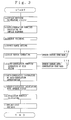
- Fig.2 the processing procedure in the adaptive code book searching circuit 160 is shown as a first embodiment of the present invention.
- (a) is a step for calculating an impulse response of a speech synthesis filter from an order of 0 to I- 1.
- step (a) an impulse response of the synthesis filter h[0] ⁇ h(I- 1] is derived and in (o), an auto-correlation function from an order of 0 to Ismall- 1 is calculated. Then in the step (b), an inverse filtering is performed.
- the step (d1) generates a long-term prediction speech source (ej[n]) corresponding to each code (e.g. j) with the adaptive code book.
- the step (f) calculates an auto-correlation Gj with the auto-correlation function of the speech source (Rj[i]) obtained in the step (e1) and the auto-correlation function of the synthesis filtering (hh[i]) by the auto-correlation approximation method, as expressed in the above expression (9).
- the auto-correlation Gj is calculated to an order of Ismall less than the length of the impulse response I to reduce the quantities of operations (I in the above expression (9) is equal to Ismall). Setting Ismall to a lower order reduces the quantities of operations in a calculation of the auto-correlation Gj, the auto-correlation function of the impulse responses obtained in the step (a), and the auto-correlation function of the speech source in the step (e1). Further, it reduces RAM regions.
- the step (g) calculates a cross-correlation Cj with the output of the inverse filtering.
- the step (h1) calculates an evaluation function as expressed in the above expression (2) with the obtained auto-correlation and cross-correlation.
- the step (i) decides a code for minimizing the evaluation function as an optimum code.
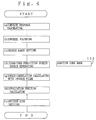
- (d2) is a step for generating a code vector corresponding to each code with a speech source code book 170.
- (e2) is a step for generating an auto-correlation function of the speech source and calculating an auto-correlation function corresponding to each search code by table lookup method into a speech source auto-correlation code book 175.
- Other steps are the same as those shown in Fig.2.
- the step (a) calculates an impulse response of the synthesis filter and the step (o) calculates its auto-correlation functions from an order of 0 to Ismall - 1.
- the step (b) then executes an inverse filtering.
- the step (c) sets the range within which the code book is searched for and the processes by the steps (d1) to (h1) are executed for each search code.
- the step (d2) generates a code vector corresponding to each code from the speech source code book 170.
- the step (e2) calculates an auto-correlation function of the code vector from an order of 0 to Ismall- 1. Unlike the adaptive code book, values contained in the speech source code book are predetermined. As a result thereof, the auto-correlation values of the code vectors are stored beforehand in the speech source auto-correlation code book 175 and the auto-correlation function of the code vector is obtained by referring to a speech source auto-correlation code book 175.
- An auto-correlation Gj is calculated with the auto-correlation function of the speech source and the auto-correlation function of the synthesis filter by the auto-correlation approximation method.
- the auto-correlation Gj is calculated to an order Ismall less than the length of the impulse response I to reduce the quantity of operations. Setting Ismall to a lower order reduces the quantity of operations for calculating the auto-correlation Gj and the number of the auto-correlation functions of the impulse response obtained in the step (a). Furthermore, it reduces the memory capacity of the ROM in the speech source auto-correlation code book 175.
- the step (g) calculates a cross-correlation Cj with the output of the inverse filter.
- the step (h1) calculates an evaluation function with the obtained auto-correlation and cross-correlation.
- the step (i) decides a code which minimizes the evaluation function as the optimum code.
- the adaptive code book searching circuit 160 includes a step (h2) for calculating evaluation function only with cross-correlations.
- Other modules used in the present embodiment are the same as the ones used in the first embodiment.
- the difference between the present embodiment and the first embodiment is that in the present embodiment, the evaluation function is expressed only by a cross-correlation, so that the calculation of an auto-correlation function of an impulse response, a code book for an auto-correlation function of the speech source, and the calculation of an auto-correlations are not required. As a result thereof, a smaller quantity of operations are needed.
- the present embodiment corresponds to the first embodiment in which the order Ismall is set to 1.
- Fig.5 there is shown a flow chart of the speech source code book searching circuit 180.
- an evaluation function is represented only by a cross-correlation.
- a calculation of an auto-correlation function of the impulse response and auto-correlations, and speech source auto-correlation function code book are not required, so that a smaller quantity of operations and less memory capacity are needed.
- the order Ismall is set to 1. Experiment has shown that even when the order Ismall is set to 1 and no auto-correlation is calculated, there exists no special deterioration in coded speech signals.
- Fig.6 and Fig.7 show the process procedures in the adaptive code book searching circuit 160 according to another embodiment.
- a step (m) is added to the above described first or second embodiment.
- the step (m) is a circuit to decide the approximation order Ismall of an auto-correlation and sets a value of Ismall according to characteristics of encoded speech signals.
- a value of Ismall is a variable to search a code book and need not be transmitted.
- the approximation order Ismall is varied according to characteristics of coded speech signals such as voiced or unvoiced ones.
- the invention is described using the LPC analyzing circuit, however other analyzing methods such as the BURG method for extracting a spectrum parameter may accomplish the same effect.
- the invention is described using the LPC coefficient, however it is obvious that other spectrum parameters such as PARCOR coefficient or the LSP (Line Spectrum Pair) coefficient may accomplish the same effect.
- the speech source code book searching circuit is of a single-stage structure, however a multi-stage structured speech source code book searching circuit may as a matter of course accomplish the same effect.
- the above expression (10) may be replaced with the following expression (13) by using, preferably in the CELP method, with a value of the auto-correlation approximation order Ismall being smaller than the length of an impulse response I. (I ⁇ I small- 1 2 I small ⁇ (I small- 1)) ⁇ sf+ I small ⁇ 2 B ⁇ sf (13)
- I ⁇ I small- 1 2 I small ⁇ (I small- 1) ⁇ sf+ I small ⁇ 2 B ⁇ sf
- the quantity of product and sum operations of an auto-correlation function for each code given by the above expression (12) is replaced with the following expression (14).
Landscapes
- Engineering & Computer Science (AREA)
- Computational Linguistics (AREA)
- Signal Processing (AREA)
- Health & Medical Sciences (AREA)
- Audiology, Speech & Language Pathology (AREA)
- Human Computer Interaction (AREA)
- Physics & Mathematics (AREA)
- Acoustics & Sound (AREA)
- Multimedia (AREA)
- Compression, Expansion, Code Conversion, And Decoders (AREA)
Applications Claiming Priority (2)
| Application Number | Priority Date | Filing Date | Title |
|---|---|---|---|
| JP5342140A JP2979943B2 (ja) | 1993-12-14 | 1993-12-14 | 音声符号化装置 |
| JP342140/93 | 1993-12-14 |
Publications (1)
| Publication Number | Publication Date |
|---|---|
| EP0658877A2 true EP0658877A2 (fr) | 1995-06-21 |
Family
ID=18351440
Family Applications (1)
| Application Number | Title | Priority Date | Filing Date |
|---|---|---|---|
| EP94119543A Withdrawn EP0658877A2 (fr) | 1993-12-14 | 1994-12-09 | Dispositif pour le codage de la parole |
Country Status (3)
| Country | Link |
|---|---|
| EP (1) | EP0658877A2 (fr) |
| JP (1) | JP2979943B2 (fr) |
| CA (1) | CA2137880A1 (fr) |
Cited By (5)
| Publication number | Priority date | Publication date | Assignee | Title |
|---|---|---|---|---|
| WO1997045830A3 (fr) * | 1996-05-24 | 1998-02-05 | Philips Electronics Nv | Procede de codage de la parole et appareil de reproduction de la parole codee |
| EP0756268A3 (fr) * | 1995-07-27 | 1998-05-27 | Nec Corporation | Codeur des signaux vocaux capable d'élargir la grandeur de la table des codes sans agrandir le numéro des bits transmis |
| EP0806761A3 (fr) * | 1996-05-07 | 1998-09-23 | Texas Instruments Inc. | Améliorations concernant les traitements des signaux vocaux |
| EP0820052A3 (fr) * | 1996-03-29 | 2000-04-19 | Mitsubishi Denki Kabushiki Kaisha | Système de codage et de transmission de parole |
| WO2002099788A1 (fr) * | 2001-06-06 | 2002-12-12 | Qualcomm Incorporated | Reduction de la capacite de memoire requise de recherche de vecteurs de livre de codes |
Family Cites Families (1)
| Publication number | Priority date | Publication date | Assignee | Title |
|---|---|---|---|---|
| FI98104C (fi) * | 1991-05-20 | 1997-04-10 | Nokia Mobile Phones Ltd | Menetelmä herätevektorin generoimiseksi ja digitaalinen puhekooderi |
-
1993
- 1993-12-14 JP JP5342140A patent/JP2979943B2/ja not_active Expired - Fee Related
-
1994
- 1994-12-09 EP EP94119543A patent/EP0658877A2/fr not_active Withdrawn
- 1994-12-12 CA CA002137880A patent/CA2137880A1/fr not_active Abandoned
Cited By (8)
| Publication number | Priority date | Publication date | Assignee | Title |
|---|---|---|---|---|
| EP0756268A3 (fr) * | 1995-07-27 | 1998-05-27 | Nec Corporation | Codeur des signaux vocaux capable d'élargir la grandeur de la table des codes sans agrandir le numéro des bits transmis |
| US6006178A (en) * | 1995-07-27 | 1999-12-21 | Nec Corporation | Speech encoder capable of substantially increasing a codebook size without increasing the number of transmitted bits |
| EP0820052A3 (fr) * | 1996-03-29 | 2000-04-19 | Mitsubishi Denki Kabushiki Kaisha | Système de codage et de transmission de parole |
| EP0806761A3 (fr) * | 1996-05-07 | 1998-09-23 | Texas Instruments Inc. | Améliorations concernant les traitements des signaux vocaux |
| WO1997045830A3 (fr) * | 1996-05-24 | 1998-02-05 | Philips Electronics Nv | Procede de codage de la parole et appareil de reproduction de la parole codee |
| WO2002099788A1 (fr) * | 2001-06-06 | 2002-12-12 | Qualcomm Incorporated | Reduction de la capacite de memoire requise de recherche de vecteurs de livre de codes |
| US6789059B2 (en) | 2001-06-06 | 2004-09-07 | Qualcomm Incorporated | Reducing memory requirements of a codebook vector search |
| CN100336101C (zh) * | 2001-06-06 | 2007-09-05 | 高通股份有限公司 | 减少对于码本搜索的存储要求的装置和方法 |
Also Published As
| Publication number | Publication date |
|---|---|
| JP2979943B2 (ja) | 1999-11-22 |
| JPH07168596A (ja) | 1995-07-04 |
| CA2137880A1 (fr) | 1995-06-15 |
Similar Documents
| Publication | Publication Date | Title |
|---|---|---|
| US5208862A (en) | Speech coder | |
| EP0409239B1 (fr) | Procédé pour le codage et le décodage de la parole | |
| EP0497479B1 (fr) | Méthode et appareil de génération d'information pour accélérer une recherche dans un dictionnaire de représentant à faible densité | |
| EP0504627B1 (fr) | Méthode et dispositif de codage de paramètres de voix | |
| US5140638A (en) | Speech coding system and a method of encoding speech | |
| CA2202825C (fr) | Codeur vocal | |
| US20110270608A1 (en) | Method and apparatus for receiving an encoded speech signal | |
| US6249758B1 (en) | Apparatus and method for coding speech signals by making use of voice/unvoiced characteristics of the speech signals | |
| EP0704836B1 (fr) | Dispositif de quantification vectorielle | |
| EP0657874B1 (fr) | Codeur de voix et procédé pour chercher des livres de codage | |
| EP0501421B1 (fr) | Système de codage de parole | |
| US5682407A (en) | Voice coder for coding voice signal with code-excited linear prediction coding | |
| EP0654909A1 (fr) | Codeur-decodeur predictif lineaire a excitation par codes | |
| US20050114123A1 (en) | Speech processing system and method | |
| US5926785A (en) | Speech encoding method and apparatus including a codebook storing a plurality of code vectors for encoding a speech signal | |
| US5526464A (en) | Reducing search complexity for code-excited linear prediction (CELP) coding | |
| WO1997005602A1 (fr) | Procede et equipement de generation et de codage de racines carrees de spectres de raies | |
| US5797119A (en) | Comb filter speech coding with preselected excitation code vectors | |
| EP0810584A2 (fr) | Codeur de signal | |
| EP0724252B1 (fr) | Codeur de parole du type CELP comprenant un prédicteur à long terme amélioré | |
| EP0658877A2 (fr) | Dispositif pour le codage de la parole | |
| US5884252A (en) | Method of and apparatus for coding speech signal | |
| US5666464A (en) | Speech pitch coding system | |
| EP0694907A2 (fr) | Codeur de parole | |
| EP1355298B1 (fr) | Codeur-décodeur prédictif linéaire à excitation par codes |
Legal Events
| Date | Code | Title | Description |
|---|---|---|---|
| PUAI | Public reference made under article 153(3) epc to a published international application that has entered the european phase |
Free format text: ORIGINAL CODE: 0009012 |
|
| AK | Designated contracting states |
Kind code of ref document: A2 Designated state(s): DE FR GB |
|
| STAA | Information on the status of an ep patent application or granted ep patent |
Free format text: STATUS: THE APPLICATION HAS BEEN WITHDRAWN |
|
| 18W | Application withdrawn |
Withdrawal date: 19970128 |