EP0658959A2 - Elektrischer Verbinder mit vorgespanntem Kontakt - Google Patents
Elektrischer Verbinder mit vorgespanntem Kontakt Download PDFInfo
- Publication number
- EP0658959A2 EP0658959A2 EP94116803A EP94116803A EP0658959A2 EP 0658959 A2 EP0658959 A2 EP 0658959A2 EP 94116803 A EP94116803 A EP 94116803A EP 94116803 A EP94116803 A EP 94116803A EP 0658959 A2 EP0658959 A2 EP 0658959A2
- Authority
- EP
- European Patent Office
- Prior art keywords
- contact
- housing
- connector
- electrical
- length
- Prior art date
- Legal status (The legal status is an assumption and is not a legal conclusion. Google has not performed a legal analysis and makes no representation as to the accuracy of the status listed.)
- Withdrawn
Links
Images
Classifications
-
- H—ELECTRICITY
- H01—ELECTRIC ELEMENTS
- H01R—ELECTRICALLY-CONDUCTIVE CONNECTIONS; STRUCTURAL ASSOCIATIONS OF A PLURALITY OF MUTUALLY-INSULATED ELECTRICAL CONNECTING ELEMENTS; COUPLING DEVICES; CURRENT COLLECTORS
- H01R13/00—Details of coupling devices of the kinds covered by groups H01R12/70 or H01R24/00 - H01R33/00
- H01R13/02—Contact members
- H01R13/22—Contacts for co-operating by abutting
- H01R13/24—Contacts for co-operating by abutting resilient; resiliently-mounted
- H01R13/2464—Contacts for co-operating by abutting resilient; resiliently-mounted characterized by the contact point
-
- H—ELECTRICITY
- H01—ELECTRIC ELEMENTS
- H01R—ELECTRICALLY-CONDUCTIVE CONNECTIONS; STRUCTURAL ASSOCIATIONS OF A PLURALITY OF MUTUALLY-INSULATED ELECTRICAL CONNECTING ELEMENTS; COUPLING DEVICES; CURRENT COLLECTORS
- H01R12/00—Structural associations of a plurality of mutually-insulated electrical connecting elements, specially adapted for printed circuits, e.g. printed circuit boards [PCB], flat or ribbon cables, or like generally planar structures, e.g. terminal strips, terminal blocks; Coupling devices specially adapted for printed circuits, flat or ribbon cables, or like generally planar structures; Terminals specially adapted for contact with, or insertion into, printed circuits, flat or ribbon cables, or like generally planar structures
- H01R12/70—Coupling devices
- H01R12/77—Coupling devices for flexible printed circuits, flat or ribbon cables or like structures
- H01R12/79—Coupling devices for flexible printed circuits, flat or ribbon cables or like structures connecting to rigid printed circuits or like structures
-
- H—ELECTRICITY
- H01—ELECTRIC ELEMENTS
- H01R—ELECTRICALLY-CONDUCTIVE CONNECTIONS; STRUCTURAL ASSOCIATIONS OF A PLURALITY OF MUTUALLY-INSULATED ELECTRICAL CONNECTING ELEMENTS; COUPLING DEVICES; CURRENT COLLECTORS
- H01R4/00—Electrically-conductive connections between two or more conductive members in direct contact, i.e. touching one another; Means for effecting or maintaining such contact; Electrically-conductive connections having two or more spaced connecting locations for conductors and using contact members penetrating insulation
- H01R4/26—Connections in which at least one of the connecting parts has projections which bite into or engage the other connecting part in order to improve the contact
Definitions
- the invention relates to electrical connectors and particularly to such connectors for use in information handling systems (computers).
- US Patents 5,106,311 (Yodogawa et al.), 5,181,854 (Masuda) and 5,199,882 (Bates et al.) all describe various types of electrical connectors for having flexible or the like cables positioned therein to effect contact therewith in a predetermined manner.
- US Patent 5,215,471 (Raymond et al.), an electrical connector is described wherein tapered plugs or the like are individually positioned within respective receiving portions of the connector's housing.
- US Patent 5,237,743 (Busacco et al.), there is defined a method of forming a conductive end portion on a flexible circuit member for use in an electrical connector, wherein the end portion is adaptive for including dendritic conductive elements (e.g., palladium) on a protruding edge thereof for electrically connecting to associated conductor members (e.g., pads on a printed circuit board or electronic module).
- dendritic conductive elements e.g., palladium
- associated conductor members e.g., pads on a printed circuit board or electronic module.
- the preferred method for providing these dendritic elements is electroplating, which may be provided in accordance with the procedure defined in Canadian patent 1,121,011. Still another process is defined in US Patent 5,185,073 (Bindra et al.).
- US Patents 5,185,073 and 5,237,743, in addition to Canadian patent 1,121,011, are all assigned to the assignee of the present invention and are incorporated herein by
- the connector in 5,248,262 may utilize the dendritic elements formed in accordance with the unique method taught in US Patent 5,237,743.
- US Patent 5,248,262 is assigned to the same assignee as the present invention and is also incorporated herein by reference.
- an electrical connector for electrically connecting at least one external electrical conductor (e.g., a conductor pad on a printed circuit board) to a second conducting element such as an electrical cable or the like, which second element may be positioned within the invention's housing.
- the connector as defined herein provides such connecting to this external conductor in a substantially non-wiping manner while assuring stationary positioning of the connector's housing relative to the conductor being so connected, or, alternatively, fixed positioning of the external conductor and movement of the connector with respect thereto. Such stationary positioning eliminates the need for added structure to permit housing movement while still assuring effective coupling to the respective conductor.
- an electrical connector for being electrically coupled to at least one electrical conductor.
- the connector comprises a housing having a chamber therein, and at least one electrical contact positioned within the housing and including a tip portion protruding from the housing for engaging the electrical conductor.
- the contact includes an initial overall first length and corresponding first width prior to being positioned within the housing.
- the housing engages the contact at three spaced locations so as to preload the contact to the extent that it will possess a second length and corresponding second width, this second width, significantly, being greater than the first width prior to contact positioning.
- the contact When contact occurs between the protruding tip and associated electrical conductor, the contact is disengaged at at least one part thereof and moved to a different location so as to accommodate the compressive forces provided during conductor engagement while still substantially preventing sliding (wiping) type of engagement between the protruding tip and conductor.
- the present invention represents a buckling beam type of contact which is preloaded within the connector's housing to create a geometric condition which greatly reduces the forces exerted on the contact by the connector's housing during contact compression (engagement with the associated external conductor).
- the forces exerted on the contact by the housing are low enough such that, due to friction, sliding (wiping) will be substantially prevented at the contact's tip portion and external conductor interface.
- substantially prevented is thus meant to include a condition whereby very minimal movement, as defined, e.g., in greater detail hereinbelow, may still cocur. Such minimal movement, however, is allowable while still permitting effective connection in the manner taught herein.
- the invention does not require a movable connector housing to assure a substantially non-sliding type of electrical connection.
- the invention is thus able to utilize the aforedefined dendritic contact elements on the tip portion of the invention's contact to thereby benefit from the established advantages of such elements, while not causing harm to these elements.
- the connector of the invention does not require the use of such dendritic contact elements, in that the invention's contact may still provide effective connection (including of the substantially non-sliding type) with the associated external conductor in an effective manner without the use of such elements.
- the invention is thus not limited solely to the use of dendritic elements as part of the contact structure.
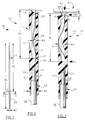
- FIG. 1 there is shown an electrical contact 11 adapted for use in the present invention.
- contact 11 is designed for being positioned within a housing 13 (FIGS. 2 and 3) to define an electrical connector 15 in accordance with the teaching hereof.
- housing 13 is readily adapted for having several (e.g., up to fifty and more) such contacts therein, depending on the operational requirements for the invention.
- connector 15 will include several such contacts spacedly positioned within the housing in accordance with an established patterned array. Such a pattern may be rectangular having the aforementioned total contacts located in spaced rows thereof. Should several such contacts be used, it is preferred that these be spacedly positioned from the nearest adjacent contact at a minimum distance of about 0.050 inch.
- Contact 11 is shown in FIG. 1 prior to positioning within housing 13, and, as illustrated, in a non-stressed configuration. That is, contact 11 is not preformed with a bowed or other curved shape or the like, particularly along the contacting portions thereof.
- housing 13 serves to provide preloading of the contact 11 when so positioned therein in order to provide the significant advantages defined herein.
- contact 11 has an original, unstressed overall length (OL), which, in one embodiment of the invention, was about 0.400 inch. Of this total, overall length, contact 11 includes what is referred to as a free length (FL) which, as understood from FIGS. 2 and 3, represents the portion of contact 11 particularly designed for movement during contact engagement and housing preload. Thus, the remaining length of contact 11, as shown in FIGS. 2 and 3, is securely retained (captured) by the housing as shown. Such retention occurs below the location identified by the letter P in FIGS. 1 and 2.
- OL original, unstressed overall length
- FL free length
- contact 11 includes a first width (W1) which represents the overall total width for the contact in the unstressed position prior to positioning with housing 13.
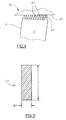
- contact 11 has a thickness (dimension T) and is of a substantially rectangular cross-sectional configuration.
- contact 11 possessed a first width (W1) of about 0.003 inch and corresponding thickness (T) of about 0.025 inch.
- Contact 11 is preferably comprised of metallic material, a preferred example being beryllium copper.
- the above configuration is not meant to limit the invention in that other configurations (including, e.g., round) are acceptable.
- housing 13 is of two-part construction, these parts referenced by the numerals 19 and 21 in the drawings. Both parts 19 and 21 are sealed together to compress the lower part of contact 11 in the manner shown.
- Cable 23 Retained within the lower part of housing 11 is a cable 23, designed for being electrically connected to the lower end portion 25 of contact 11.
- Cable 23 preferably includes a terminal end 27 which is directly coupled (e.g., soldered or welded) to end portion 25, this coupling preferably occurring prior to closure of parts 19 and 21.
- Cable 23 further includes a sheath portion 29 of a suitable dielectric material, e.g., Teflon, which extends from the lower part of housing 13 in the manner shown.
- Teflon is a trademark of E. I. duPont deNemours and Company.
- the terminal end 27 was preferably of cylindrical configuration, having an outer diameter of about 0.010 inch, while sheath portion 29 was also cylindrical and possessed an outer diameter of about 0.035 inch.
- Contact 11 is shown in the embodiment of FIG. 2 as being in a preloaded or prestressed condition, such preloading being the result of positive engagement of the contact by housing 13 at least at three locations (L01, L02 and L03).
- L01 is understood to be similar to point P, L02 representing a tapered protrusion from the back wall 31 of housing 13, and L03 being a reverse (or opposing) pointed portion on the uppermost end of housing 13.
- housing 13 possessed an overall thickness (TH, in FIG. 2) of about 0.050 inch. The corresponding overall length for this housing having such width was about 0.575 inch.
- the preloaded contact 11 is configured as a result of housing engagement in the manner defined to assume a bent or curved configuration for the upper part thereof. That is, the original free length (FL), as described in FIG. 1, has been reduced somewhat to what is referred to as a preload length (PL) (FIG. 2).
- the preload length (PL) was about 0.275 inch from a corresponding free length of about 0.280 inch.
- a reduction of about 0.4 to about 5.4 percent may occur when using contact and housing members possessing the dimensions cited herein.
- a preferred reduction of 1.8 percent will occur.
- the overall width (W1) for contact 11 has now been increased to a greater width (W2) which, significantly, constitutes only a relatively small percentage of the free length (FL). It has been determined that in order to provide the desired properties herein (substantially non-wiping, effective engagement) that a second width in the range of about 3.5 percent to about 13 percent of this free length is desired. In a preferred embodiment, this percentage is about 7.0 percent.
- W2 the new width for contact 11 while in a preloaded, yet non-engaging orientation with an external conductor, is within the range of about 0.010 inch to about 0.036 inch.
- housing 13 is comprised of a dielectric material, a preferred example being Ryton (PPS). (Rayton is a trademark of Phillips Petroleum Company.) It is understood that other plastic materials are readily adaptable for use with the present invention.
- the spacings between engagement locations L01 and L02 and L02 and L03 are the same, e.g., 0.125 inch. This is not meant to limit the invention, however, in that other spacings, including those wherein one distance is significantly greater than the other, are acceptable.
- connector 15 is shown in an actuated position wherein contact is made between a tip portion 41 of contact 11 and an external conductor 43 on an external circuit member 45.
- contact 11 is designed for being electrically coupled to many different types of electrical conductors.
- conductor 43 may comprise a metallic (e.g., copper) flat pad on a circuit board or similar substrate.
- tip portion 41 engages this conductor in the manner shown such that the terminal, edge portion of the invention's contact engages the corresponding surface of the external conductor at a relatively small angle to a normal line from this service.
- a relatively small angle is meant that the terminal or tip portion 41 will engage the corresponding flat surface 47 (FIG.
- housing 13 is designed for remaining stationary relative to the movement of the associated electrical circuit member (45) such that this member can move toward and engage the protruding tip portion 41 of contact 11 in the manner shown. It is also within the scope of the invention to fixedly position the respective circuit member and move the connector housing (and contact 41) to effect engagement as shown. Preferably, however, housing 13 is positively retained, e.g., within a holder or the like, along with other, similar housings to assure contact between the large number (described above) of such contacts and a corresponding number of conductors.
- AL was about 0.265 inch, or about 95 percent of the original free length (FL).
- a frictional force (f) is also present to resist sliding movement of tip portion 41 (e.g., to the right in FIG. 3).
- This force is counteracted by a housing engagement force (F1) exerted by an upper, tipped portion 44 of housing 13 at location L03.
- F1 is shown in FIG. 3 as well, and occurs at a distance aL from a surface 47 (FIG. 4) of conductor 43.
- contact 11 assumes a greater width (W3) in FIG. 3 from the preload width W2 of FIG. 2.
- W3 was as great as 0.040 inch, for an increase of as great as 1300 percent from the original width (W1).
- ⁇ s for a dendritic plated surface against a plated (e.g., with gold) surface is typically greater than 1. For this situation, if R1 ⁇ N, sliding by tip 41 will not occur. For the same situation, an equivalent way of expressing this is, if Z is less than ⁇ s , sliding will not occur. For the case where Z is greater than ⁇ s , some sliding will occur, with the maximum amount of contact wipe occurring when ⁇ s approaches a value of zero.
- housing 11 is designed in such a manner to facilitate such disengagement, while still assuring engagement at the remaining, opposing two locations L01 and L03.
- tip portion 41 of contact 11 is shown to include a plurality of dendritic elements 61 located on an upper, edge surface 63 of tip portion 41.
- these dendritic elements are preferably metallic (e.g., palladium) growth crystals formed in accordance with known methods in the art, including, e.g., those defined in US Patent 5,185,073 and Canadian Patent 1,121,011. Again, these patents are incorporated herein by reference. It is also within the scope of the invention to provide similar dendritic elements on surface 47 of conductor 43, such that an intermesh of such elements will occur, thus providing an even more effective type of electrical connection.
- an electrical connector wherein at least one electrical contact is located therein which is capable of being preloaded as a result of positive engagement at predetermined locations along the contact such that contact between the contact's protruding tip portion and a respective electrical conductor will effectively occur in a substantially non-sliding (non-wiping) type of engagement, while still assuring that the housing may remain stationary with respect to the associated circuit member being engaged or, alternatively, the conductor remain stationary and the connector (with contact) moved thereto.
Landscapes
- Coupling Device And Connection With Printed Circuit (AREA)
Applications Claiming Priority (2)
| Application Number | Priority Date | Filing Date | Title |
|---|---|---|---|
| US168749 | 1993-12-16 | ||
| US08/168,749 US5399101A (en) | 1993-12-16 | 1993-12-16 | Electrical connector with preloaded contact |
Publications (2)
| Publication Number | Publication Date |
|---|---|
| EP0658959A2 true EP0658959A2 (de) | 1995-06-21 |
| EP0658959A3 EP0658959A3 (de) | 1996-07-24 |
Family
ID=22612777
Family Applications (1)
| Application Number | Title | Priority Date | Filing Date |
|---|---|---|---|
| EP94116803A Withdrawn EP0658959A3 (de) | 1993-12-16 | 1994-10-25 | Elektrischer Verbinder mit vorgespanntem Kontakt. |
Country Status (3)
| Country | Link |
|---|---|
| US (1) | US5399101A (de) |
| EP (1) | EP0658959A3 (de) |
| JP (1) | JP2908707B2 (de) |
Families Citing this family (9)
| Publication number | Priority date | Publication date | Assignee | Title |
|---|---|---|---|---|
| US5632631A (en) | 1994-06-07 | 1997-05-27 | Tessera, Inc. | Microelectronic contacts with asperities and methods of making same |
| US6024579A (en) * | 1998-05-29 | 2000-02-15 | The Whitaker Corporation | Electrical connector having buckling beam contacts |
| US6650133B1 (en) * | 2000-10-25 | 2003-11-18 | Intel Corporation | Method and apparatus for buckling beam testing |
| US6844747B2 (en) * | 2001-03-19 | 2005-01-18 | International Business Machines Corporation | Wafer level system for producing burn-in/screen, and reliability evaluations to be performed on all chips simultaneously without any wafer contacting |
| JP2007066575A (ja) * | 2005-08-29 | 2007-03-15 | Denso Corp | コネクタの実装構造及び実装方法 |
| JP2008293746A (ja) * | 2007-05-23 | 2008-12-04 | Japan Aviation Electronics Industry Ltd | コネクタ |
| DE102011076962A1 (de) * | 2011-06-06 | 2012-12-06 | Robert Bosch Gmbh | Direktsteckelement, insbesondere für ein Fahrzeugsteuergerät |
| JP5952626B2 (ja) * | 2012-04-19 | 2016-07-13 | 矢崎総業株式会社 | 基板コネクタ |
| JP2015210886A (ja) * | 2014-04-24 | 2015-11-24 | 富士通コンポーネント株式会社 | コネクタ、及び、コンタクト |
Family Cites Families (17)
| Publication number | Priority date | Publication date | Assignee | Title |
|---|---|---|---|---|
| US3961834A (en) * | 1974-06-19 | 1976-06-08 | A & P Products Incorporated | Bow contact and connector using the same |
| IT1112620B (it) * | 1977-04-15 | 1986-01-20 | Ibm | Connettore elettrico perfezionato |
| FR2387529A1 (fr) * | 1977-04-15 | 1978-11-10 | Ibm | Contacts et connexions electriques a dendrites |
| JPS5538440U (de) * | 1978-09-05 | 1980-03-12 | ||
| JPS6035791B2 (ja) * | 1982-12-10 | 1985-08-16 | モレツクス・インコ−ポレ−テツド | 電気接続端子 |
| JPS61131382A (ja) * | 1984-11-29 | 1986-06-19 | アンプ インコ−ポレ−テツド | 電気コネクタ |
| US5033977A (en) * | 1987-10-13 | 1991-07-23 | Minnesota Mining & Manufacturing Co. | Electrical connector and fixture for four-sided integrated circuit device |
| US4871315A (en) * | 1988-03-30 | 1989-10-03 | Burndy Corporation | Ribbon cable connector |
| US5185073A (en) * | 1988-06-21 | 1993-02-09 | International Business Machines Corporation | Method of fabricating nendritic materials |
| US4948379A (en) * | 1989-03-17 | 1990-08-14 | E. I. Du Pont De Nemours And Company | Separable, surface-mating electrical connector and assembly |
| US5215471A (en) * | 1989-06-13 | 1993-06-01 | General Datacomm, Inc. | Electrical connectors having tapered spring contact elements for direct mating to holes |
| JPH0635415Y2 (ja) * | 1989-10-06 | 1994-09-14 | コネクタ | |
| JPH0675415B2 (ja) * | 1991-03-15 | 1994-09-21 | 山一電機株式会社 | リードレス形icパッケージ用接続器 |
| JPH0597063U (ja) * | 1991-04-15 | 1993-12-27 | モレックス インコーポレーテッド | 電気コネクタ |
| US5199882A (en) * | 1992-03-19 | 1993-04-06 | Amp Incorporated | Elastomeric wire to pad connector |
| US5248262A (en) * | 1992-06-19 | 1993-09-28 | International Business Machines Corporation | High density connector |
| US5237743A (en) * | 1992-06-19 | 1993-08-24 | International Business Machines Corporation | Method of forming a conductive end portion on a flexible circuit member |
-
1993
- 1993-12-16 US US08/168,749 patent/US5399101A/en not_active Expired - Fee Related
-
1994
- 1994-09-29 JP JP6234713A patent/JP2908707B2/ja not_active Expired - Lifetime
- 1994-10-25 EP EP94116803A patent/EP0658959A3/de not_active Withdrawn
Also Published As
| Publication number | Publication date |
|---|---|
| US5399101A (en) | 1995-03-21 |
| EP0658959A3 (de) | 1996-07-24 |
| JPH07211378A (ja) | 1995-08-11 |
| JP2908707B2 (ja) | 1999-06-21 |
Similar Documents
| Publication | Publication Date | Title |
|---|---|---|
| US5044980A (en) | High density and multiple insertion connector | |
| EP0574715B1 (de) | Verfahren zur Herstellung eines leitenden Endbereichs einer flexiblen Leiterplatte | |
| EP0623248B2 (de) | Elektrischer verbinder mit blech als steckkontaktmaterial | |
| US5112235A (en) | Electrical connector | |
| US6902425B2 (en) | Electrical connector for flexible printed circuit board | |
| US5248262A (en) | High density connector | |
| US5046966A (en) | Coaxial cable connector assembly | |
| EP0363170B1 (de) | Federnd gestützter, selbsttragender, kontaktstiftaufnehmender elektrischer Doppelbalkenkontakt | |
| US6106305A (en) | Elastomeric connector having a plurality of fine pitched contacts, a method for connecting components using the same and a method for manufacturing such a connector | |
| JPS6157667B2 (de) | ||
| EP2439817A2 (de) | Elektrischer Steckverbinder | |
| US5399101A (en) | Electrical connector with preloaded contact | |
| CN1159665A (zh) | 薄断面表面可装式电气接插组件 | |
| JPH067500B2 (ja) | 電気コネクタ・アセンブリ | |
| US5135412A (en) | Hold-down terminal | |
| US4445742A (en) | Electrical cable connector | |
| US12308546B2 (en) | Connector for a flat flexible cable | |
| US4252393A (en) | Electrical connector for strip conductors | |
| EP0967683A1 (de) | Verbinder für ein flaches Koaxialkabel | |
| US11394145B2 (en) | Electrical connector | |
| KR100507907B1 (ko) | 표면 장착 커넥터 리드 | |
| US6000973A (en) | Electrical connector with plug contact elements of plate material | |
| US6129573A (en) | ZIF FFC connector having a strain relief | |
| US3961834A (en) | Bow contact and connector using the same | |
| US6517361B1 (en) | Preset bend providing strain relief in an electric connector |
Legal Events
| Date | Code | Title | Description |
|---|---|---|---|
| PUAI | Public reference made under article 153(3) epc to a published international application that has entered the european phase |
Free format text: ORIGINAL CODE: 0009012 |
|
| AK | Designated contracting states |
Kind code of ref document: A2 Designated state(s): DE FR GB |
|
| 17P | Request for examination filed |
Effective date: 19951024 |
|
| PUAL | Search report despatched |
Free format text: ORIGINAL CODE: 0009013 |
|
| AK | Designated contracting states |
Kind code of ref document: A3 Designated state(s): DE FR GB |
|
| STAA | Information on the status of an ep patent application or granted ep patent |
Free format text: STATUS: THE APPLICATION HAS BEEN WITHDRAWN |
|
| 18W | Application withdrawn |
Withdrawal date: 19961029 |