EP0659021A2 - Detektion von globaler Translation zwischen Bildern - Google Patents
Detektion von globaler Translation zwischen Bildern Download PDFInfo
- Publication number
- EP0659021A2 EP0659021A2 EP94203625A EP94203625A EP0659021A2 EP 0659021 A2 EP0659021 A2 EP 0659021A2 EP 94203625 A EP94203625 A EP 94203625A EP 94203625 A EP94203625 A EP 94203625A EP 0659021 A2 EP0659021 A2 EP 0659021A2
- Authority
- EP
- European Patent Office
- Prior art keywords
- correlation
- images
- vector
- global
- frame
- Prior art date
- Legal status (The legal status is an assumption and is not a legal conclusion. Google has not performed a legal analysis and makes no representation as to the accuracy of the status listed.)
- Granted
Links
Images

Classifications
-
- H—ELECTRICITY
- H04—ELECTRIC COMMUNICATION TECHNIQUE
- H04N—PICTORIAL COMMUNICATION, e.g. TELEVISION
- H04N5/00—Details of television systems
- H04N5/14—Picture signal circuitry for video frequency region
- H04N5/144—Movement detection
- H04N5/145—Movement estimation
-
- G—PHYSICS
- G06—COMPUTING OR CALCULATING; COUNTING
- G06T—IMAGE DATA PROCESSING OR GENERATION, IN GENERAL
- G06T7/00—Image analysis
- G06T7/20—Analysis of motion
- G06T7/262—Analysis of motion using transform domain methods, e.g. Fourier domain methods
-
- H—ELECTRICITY
- H04—ELECTRIC COMMUNICATION TECHNIQUE
- H04N—PICTORIAL COMMUNICATION, e.g. TELEVISION
- H04N19/00—Methods or arrangements for coding, decoding, compressing or decompressing digital video signals
- H04N19/50—Methods or arrangements for coding, decoding, compressing or decompressing digital video signals using predictive coding
- H04N19/503—Methods or arrangements for coding, decoding, compressing or decompressing digital video signals using predictive coding involving temporal prediction
- H04N19/51—Motion estimation or motion compensation
- H04N19/523—Motion estimation or motion compensation with sub-pixel accuracy
-
- H—ELECTRICITY
- H04—ELECTRIC COMMUNICATION TECHNIQUE
- H04N—PICTORIAL COMMUNICATION, e.g. TELEVISION
- H04N19/00—Methods or arrangements for coding, decoding, compressing or decompressing digital video signals
- H04N19/50—Methods or arrangements for coding, decoding, compressing or decompressing digital video signals using predictive coding
- H04N19/503—Methods or arrangements for coding, decoding, compressing or decompressing digital video signals using predictive coding involving temporal prediction
- H04N19/51—Motion estimation or motion compensation
- H04N19/527—Global motion vector estimation
-
- H—ELECTRICITY
- H04—ELECTRIC COMMUNICATION TECHNIQUE
- H04N—PICTORIAL COMMUNICATION, e.g. TELEVISION
- H04N19/00—Methods or arrangements for coding, decoding, compressing or decompressing digital video signals
- H04N19/50—Methods or arrangements for coding, decoding, compressing or decompressing digital video signals using predictive coding
- H04N19/503—Methods or arrangements for coding, decoding, compressing or decompressing digital video signals using predictive coding involving temporal prediction
- H04N19/51—Motion estimation or motion compensation
- H04N19/547—Motion estimation performed in a transform domain
Definitions
- the present invention relates to the detection of global translations between images and is more particularly concerned with a digital processing method for such detection to sub-pixel accuracy between images which are related either temporally or spatially.
- Images may, for example, comprise part or all of a time-varying sequence, or the colour separations of a single image.
- Typical applications for the method of the present invention include the automatic detection and correction, to high accuracy, of spatial unsteadiness occurring in a time-varying sequence of images which have originated from motion picture film, the automatic alignment of pairs of images of the same subject taken at different times, and the automatic registration of colour separations of a single image.
- the second class of algorithms can be referred to as 'motion estimation' algorithms.
- the present invention belongs to this second class.
- Motion estimation algorithms have the advantage of versatility in this particular application. They can be implemented on any image set independent of its source or history.
- Motion estimation algorithms may be broadly divided into three types:-
- the matching is implemented in the spatial domain, based on either maximum cross-correlation or minimum mean square error.
- the method is amenable to efficient hardware implementation by the application of hierarchical searching techniques.
- luminance, L is a function of spatial position, ( x , y ) and time, t , it is required that:- Expanding this, and neglecting higher order terms yields: Estimates for may be obtained by placing constraints on the smoothness of the image flow, both spatially and temporally. Typically, the spatial and temporal gradients of the luminance signal are approximated from the output from local spatial high-pass filtering and the inter frame difference of corresponding pixel values respectively. This is described in “ Methods for Measuring Small Displacements of Television Images ", C Cafforio et al, IEEE Transactions on Information Theory, IT-22, 5, 573-579 (1976).
- Phase correlation is based in the principle that x-y translations in the spatial domain correspond to phase shifts in the Fourier domain.
- the phase shift at each frequency may be calculated as follows:- where F and G are the two-dimensional Fourier transforms of blocks f , g in corresponding positions from neighbouring frames in the input sequence, or from colour separations of the same image.
- the inverse transform of ⁇ ( u , v ) generates a correlation surface which contains spikes (more precisely, sinc functions which result from the effective window in the Fourier domain) at positions corresponding to an x-y displacement, and where the height of the spikes is related to the number of pixels within the block which have moved with that displacement.
- the method used in spatio-temporal constraint or gradient matching algorithms is robust in generating vectors of sub-pixel accuracy only where the displacement is small - for example, of the order of one pixel.
- the principles which underpin this method render it suitable for the generation of motion vectors on a local (pixel by pixel) rather than a global (block by block) basis.
- motion estimation techniques based on the assumptions of optical flow are not appropriate for the detection of global translations.
- Phase correlation can be demonstrated to be extremely robust in the presence of frame-independent noise (which is spread across the entire correlation surface), and independent movement within the scene (which generally manifests itself as low-amplitude independent spikes in the correlation surface which can be separated without adverse effect on the spike corresponding to a global displacement).
- phase correlation appears to be the most suitable approach to estimate displacements where a single global vector is required per frame.
- phase correlation yields a correlation surface which is sampled at the sampling rate of the input data, and hence, in its simplest form, generates vectors to pixel accuracy. It is possible to perform a two-dimensional interpolation over the correlation surface in an attempt either to reconstruct a continuous correlation surface and subsequently to estimate the position of the peak to sub-pixel accuracy, or in a single step, to estimate the corresponding position of a peak in an equivalent continuous surface.
- blocks are selected from the pair of images at corresponding pixel positions.
- corresponding blocks contain picture information from slightly different areas of the image.
- the signals input to the phase correlation are sampled, hence the phase-difference signals in the Fourier domain are repeated centred around multiples of the sampling frequency. If these 'repeat spectra' are filtered out using a window with a cut-off frequency at the input nyquist frequency, then the inverse transform of the window is effectively convolved with the sampled correlation surface. Alternatively, if the phase-difference signal with 'repeat spectra', and hence the discontinuities which occur at the nyquist frequency, is inverse transformed, these discontinuities produce errors in the correlation surface. As a result of these errors in the reconstructed surface, displacement vectors are generated which are only accurate to around 0.5 of a pixel.
- the extension of the phase correlation technique comprises a Fourier domain correlation method.
- the image may then be realigned according to the global displacement vector by means of spatial interpolation to sub-pixel accuracy using a method as described, for example, in US-A-5 243 433.
- a method of detecting global translations between two images comprising the steps of:-
- step b) includes applying a threshold to the at least one displacement vector to provide an indication of suitable vector(s).
- n a normalisation factor which lies between the values of 0 and 1 is employed.
- the method is a weighted hybrid between phase correlation and Fourier domain cross-correlation as a function of n .
- partially normalised phase correlation is applied to a number of, corresponding sub-blocks of an appropriate size in the pair of images.
- a set of vectors is obtained from the generated correlation surfaces. This set may comprise all vectors which correspond to peaks of height greater than a pre-specified value, or the vectors which correspond to the peak of the greatest height for each correlation surface, or vectors selected according to some other appropriate measure. Of this set of vectors, a single vector is selected, by some appropriate measure, which most accurately represents the global displacement between the two frames being correlated to pixel accuracy. A two-dimensional quadratic interpolation is then performed on the correlation surface which generated that global displacement vector to achieve a vector to sub-pixel accuracy.
- phase correlation is extremely robust due to the spiky nature of the correlation surface, to noise and independent movement within the scene. Hence vectors can be generated with high confidence - but only to pixel accuracy.
- cross-correlation generates a correlation surface which is smooth and substantially less robust to noise.
- the present invention can be used to determine displacements or translations between pairs of image frames due to movement from frame to frame which is not due to movement of image detail.
- the translation to be measured may be from the colour separations of a single image and then the translation is required to effect the correct alignment of the colour images when the frames are reconstructed to produce a full colour final image.
- the result is a single vector ( x + ⁇ x , y + ⁇ y ) for each pair of successive frames which corresponds to the sub-pixel displacement between them.
- calculations for the phase correlation may be reduced by storing the Fourier coefficients from the second frame of each pair for use when that frame becomes the first of the subsequent pair, or alternatively, by storing the Fourier coefficients for some reference frame in the sequence.
- Figure 1 illustrates the overall apparatus which can be used to effect correction for global translation.
- the apparatus comprises an image store 10, a phase correlation device 12, a reference frame stores 14 and a spatial interpolation unit 16.
- the reference frame store 14 store Fourier coefficients derived from a reference frame.
- This reference frame may be the first frame of a sequence of frames, the subsequent frames being corrected to be in alignment with the first frame.
- the spatial interpolation unit 16 operates on the principle as described in US-A-5 243 433 discussed above, to provide the necessary correction.
- an input image frame to which global translation correction is to be applied is input into the image store 10.
- the input image is then fed to the phase correlation device 12.
- Fourier coefficients values are input into the device 12 from the store 14 so that correlation between the reference frame and the input frame can be achieved.
- an output global displacement vector is obtained which gives the correction which is to be applied to the input image frame in the spatial interpolation unit 16 to compensate for the translation between that input image frame and the reference frame.
- the phase correlation device 12 may comprise a VME bus card and FFT/DSP chips programmed to carry out the desired correlation functions.
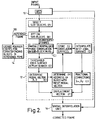
- FIG. 2 illustrates the steps of the preferred method in more detail. Components of the apparatus already mentioned are referenced the same.
- a reference frame is chosen against which all subsequent frames are aligned.
- the first frame, the reference frame is input to the frame store 10, and is fed to the phase correlation device 12 indicated by the dotted line in Figure 2.
- the first step carried out on this frame is the selection of sub-blocks values as shown by box (A). These values are passed to box (B) where the Fourier coefficients are determined. These coefficients are stored in reference frame store 14 (as shown by line 100).
- the apparatus is now ready to detect global translation and then provide the global displacement vector for feeding to the spatial interpolation unit 16.
- An input image frame to be corrected is input to the frame store 10. As with the reference frame, it is input to the phase correlation device 12 where the sub-blocks are selected in box (A), Fourier transformation of these sub-blocks is carried out in box (B) and then partially normalised phase correlation of the sub-block pairs is carried out in box (C) using the stored Fourier coefficients from reference frame store 14.
- This correlation provides a correlation surface with peaks corresponding to correlation between the input image frame and the reference image frame.
- a threshold is then applied to the correlation surface to determine the peaks, as described previously, in box (D).
- the modal vector is then determined in box (E) from the peaks determined in box (D) together with the address of the block which generated the modal vector - the modal vector x , y being fed to box (F).
- box (J) is then fed into box (F) to provide the displacement vector for the spatial interpolation unit 16.
- the input image frame from the frame store 10 is also fed to the spatial interpolation unit to effect correction on the input image.
Landscapes
- Engineering & Computer Science (AREA)
- Multimedia (AREA)
- Signal Processing (AREA)
- Physics & Mathematics (AREA)
- Mathematical Physics (AREA)
- Computer Vision & Pattern Recognition (AREA)
- General Physics & Mathematics (AREA)
- Theoretical Computer Science (AREA)
- Image Analysis (AREA)
Applications Claiming Priority (2)
| Application Number | Priority Date | Filing Date | Title |
|---|---|---|---|
| GB9325922 | 1993-12-18 | ||
| GB939325922A GB9325922D0 (en) | 1993-12-18 | 1993-12-18 | Detection of global translations between images |
Publications (3)
| Publication Number | Publication Date |
|---|---|
| EP0659021A2 true EP0659021A2 (de) | 1995-06-21 |
| EP0659021A3 EP0659021A3 (de) | 1995-10-11 |
| EP0659021B1 EP0659021B1 (de) | 2000-03-29 |
Family
ID=10746848
Family Applications (1)
| Application Number | Title | Priority Date | Filing Date |
|---|---|---|---|
| EP94203625A Expired - Lifetime EP0659021B1 (de) | 1993-12-18 | 1994-12-14 | Detektion von globaler Translation zwischen Bildern |
Country Status (4)
| Country | Link |
|---|---|
| EP (1) | EP0659021B1 (de) |
| JP (1) | JPH07200832A (de) |
| DE (1) | DE69423708T2 (de) |
| GB (1) | GB9325922D0 (de) |
Cited By (11)
| Publication number | Priority date | Publication date | Assignee | Title |
|---|---|---|---|---|
| EP0765088A3 (de) * | 1995-09-22 | 1998-12-02 | Tektronix, Inc. | Videosignalbewegungsschätzung mit fraktionierten Pixeln |
| WO2003023718A1 (en) * | 2001-09-07 | 2003-03-20 | Nline Corporation | System and method for registering images |
| WO2003023714A1 (en) * | 2001-09-07 | 2003-03-20 | Nline Corporation | System and method for correlated noise removal in complex imaging systems |
| WO2003081918A1 (en) * | 2002-03-25 | 2003-10-02 | Visioprime Ltd. | Video codec with hierarchical motion estimation in the wavelet domain |
| WO2003039161A3 (en) * | 2001-10-29 | 2004-03-18 | Parthusceva Ltd | Method and apparatus for motion estimation in a sequence of digital images |
| GB2394543A (en) * | 2002-10-25 | 2004-04-28 | Univ Bristol | Positional measurement of a feature within an image |
| WO2006026214A1 (en) * | 2004-08-31 | 2006-03-09 | Hewlett-Packard Development Company L.P. | Measuring sub-wavelength displacements |
| GB2439984A (en) * | 2006-07-11 | 2008-01-16 | Tandberg Television Asa | Motion estimation using 2D correlation in the transform domain |
| EP2079037A3 (de) * | 2008-01-09 | 2010-07-28 | Sonavation, Inc. | Verfahren und System zur Ausrichtung mit einem Überstreichungsaufnehmer gewonnener Bilder durch Fourier-Phasenanalsyse |
| EP2359335A4 (de) * | 2008-11-20 | 2012-08-01 | Ati Technologies Ulc | Adaptive frequenzbereichsfilterung für phasenebenenkorrelation |
| US8792559B2 (en) | 2010-10-26 | 2014-07-29 | Sony Corporation | Method to improve accuracy and reliability of motion estimated with phase correlation |
Family Cites Families (3)
| Publication number | Priority date | Publication date | Assignee | Title |
|---|---|---|---|---|
| DE3877105D1 (de) * | 1987-09-30 | 1993-02-11 | Siemens Ag, 8000 Muenchen, De | |
| DE4007851A1 (de) * | 1989-08-24 | 1991-02-28 | Thomson Brandt Gmbh | Verfahren zur bewegungskompensation in einem bewegtbildcoder oder -decoder |
| FR2667712B1 (fr) * | 1990-10-09 | 1994-08-26 | Thomson Csf | Procede et dispositif de recalage d'images utilisant une correlation de phase avec ponderation pour determiner un decalage. |
-
1993
- 1993-12-18 GB GB939325922A patent/GB9325922D0/en active Pending
-
1994
- 1994-12-14 EP EP94203625A patent/EP0659021B1/de not_active Expired - Lifetime
- 1994-12-14 DE DE69423708T patent/DE69423708T2/de not_active Expired - Lifetime
- 1994-12-19 JP JP6314518A patent/JPH07200832A/ja active Pending
Cited By (18)
| Publication number | Priority date | Publication date | Assignee | Title |
|---|---|---|---|---|
| EP0765088A3 (de) * | 1995-09-22 | 1998-12-02 | Tektronix, Inc. | Videosignalbewegungsschätzung mit fraktionierten Pixeln |
| WO2003023718A1 (en) * | 2001-09-07 | 2003-03-20 | Nline Corporation | System and method for registering images |
| WO2003023714A1 (en) * | 2001-09-07 | 2003-03-20 | Nline Corporation | System and method for correlated noise removal in complex imaging systems |
| US6763142B2 (en) | 2001-09-07 | 2004-07-13 | Nline Corporation | System and method for correlated noise removal in complex imaging systems |
| US6873354B2 (en) | 2001-09-07 | 2005-03-29 | Nline Corporation | System and method for registering complex images |
| WO2003039161A3 (en) * | 2001-10-29 | 2004-03-18 | Parthusceva Ltd | Method and apparatus for motion estimation in a sequence of digital images |
| US7280594B2 (en) | 2001-10-29 | 2007-10-09 | Parthuseeva Ltd. | Method and apparatus for motion estimation in a sequence of digital images |
| WO2003081918A1 (en) * | 2002-03-25 | 2003-10-02 | Visioprime Ltd. | Video codec with hierarchical motion estimation in the wavelet domain |
| US8718403B2 (en) | 2002-10-25 | 2014-05-06 | Imetrum Limited | Positional measurement of a feature within an image |
| GB2394543A (en) * | 2002-10-25 | 2004-04-28 | Univ Bristol | Positional measurement of a feature within an image |
| WO2006026214A1 (en) * | 2004-08-31 | 2006-03-09 | Hewlett-Packard Development Company L.P. | Measuring sub-wavelength displacements |
| US7283677B2 (en) | 2004-08-31 | 2007-10-16 | Hewlett-Packard Development Company, L.P. | Measuring sub-wavelength displacements |
| GB2439984A (en) * | 2006-07-11 | 2008-01-16 | Tandberg Television Asa | Motion estimation using 2D correlation in the transform domain |
| EP2079037A3 (de) * | 2008-01-09 | 2010-07-28 | Sonavation, Inc. | Verfahren und System zur Ausrichtung mit einem Überstreichungsaufnehmer gewonnener Bilder durch Fourier-Phasenanalsyse |
| EP2359335A4 (de) * | 2008-11-20 | 2012-08-01 | Ati Technologies Ulc | Adaptive frequenzbereichsfilterung für phasenebenenkorrelation |
| CN102282848B (zh) * | 2008-11-20 | 2015-04-29 | Ati技术无限责任公司 | 用于相平面关联的自适应频域滤波 |
| US8792559B2 (en) | 2010-10-26 | 2014-07-29 | Sony Corporation | Method to improve accuracy and reliability of motion estimated with phase correlation |
| US9374507B2 (en) | 2010-10-26 | 2016-06-21 | Sony Corporation | Method to improve accuracy and reliability of motion estimated with phase correlation |
Also Published As
| Publication number | Publication date |
|---|---|
| EP0659021B1 (de) | 2000-03-29 |
| GB9325922D0 (en) | 1994-02-23 |
| DE69423708T2 (de) | 2000-10-26 |
| JPH07200832A (ja) | 1995-08-04 |
| DE69423708D1 (de) | 2000-05-04 |
| EP0659021A3 (de) | 1995-10-11 |
Similar Documents
| Publication | Publication Date | Title |
|---|---|---|
| JP3301763B2 (ja) | ディジタルビデオ信号の画像シーケンスにおける不所望の全体的画像不安定性の推定方法 | |
| US6285711B1 (en) | Block matching-based method for estimating motion fields and global affine motion parameters in digital video sequences | |
| JP3226539B2 (ja) | ビデオ画像処理 | |
| US8078010B2 (en) | Method and device for video image processing, calculating the similarity between video frames, and acquiring a synthesized frame by synthesizing a plurality of contiguous sampled frames | |
| EP0261137B1 (de) | Fernsehbild-bewegungsmessung | |
| US5070403A (en) | Video signal interpolation | |
| EP0512422A2 (de) | Verfahren zur zeitlichen adaptiven Filterung von verrauschten Bildsequenzen | |
| US9210445B2 (en) | Method and apparatus for periodic structure handling for motion compensation | |
| EP0739129A2 (de) | System und Verfahren zum Herstellen von Standbildern hoher Qualität mittels Videobildern nach dem Zeilensprungverfahren | |
| KR100330797B1 (ko) | 블록매칭을이용한모션추정방법및장치 | |
| JPH0325119B2 (de) | ||
| US20080212687A1 (en) | High accurate subspace extension of phase correlation for global motion estimation | |
| EP0659021B1 (de) | Detektion von globaler Translation zwischen Bildern | |
| KR20040050906A (ko) | 모션 추정을 위한 장치 및 방법 | |
| EP0998139A2 (de) | Korrektur von Verzerrungen in einem Bildaufnahmesystem | |
| US5953079A (en) | Machine method for compensating for non-linear picture transformations, E.G. zoom and pan, in a video image motion compensation system | |
| US7751591B2 (en) | Dominant motion analysis | |
| GB2165417A (en) | Measurement and correction of film unsteadiness in a video signal | |
| Vlachos | Simple method for estimation of global motion parameters using sparse translational motion vector fields | |
| US20090002553A1 (en) | Video Processing | |
| GB2236449A (en) | Motion estimation for television signals | |
| EP0659022A2 (de) | Detektion von globaler Translation zwischen Bildern | |
| US5703650A (en) | Method of and device for estimating motion in a video signal | |
| Thomas | Distorting the time axis: motion-compensated image processing in the studio | |
| Grammalidis et al. | Temporal frame interpolation for stereoscopic sequences using object-based motion estimation and occlusion detection |
Legal Events
| Date | Code | Title | Description |
|---|---|---|---|
| PUAI | Public reference made under article 153(3) epc to a published international application that has entered the european phase |
Free format text: ORIGINAL CODE: 0009012 |
|
| AK | Designated contracting states |
Kind code of ref document: A2 Designated state(s): DE FR GB |
|
| PUAL | Search report despatched |
Free format text: ORIGINAL CODE: 0009013 |
|
| AK | Designated contracting states |
Kind code of ref document: A3 Designated state(s): AT BE CH DE DK ES FR GB GR IE IT LI LU MC NL PT SE |
|
| 17P | Request for examination filed |
Effective date: 19960325 |
|
| 17Q | First examination report despatched |
Effective date: 19980113 |
|
| GRAG | Despatch of communication of intention to grant |
Free format text: ORIGINAL CODE: EPIDOS AGRA |
|
| GRAG | Despatch of communication of intention to grant |
Free format text: ORIGINAL CODE: EPIDOS AGRA |
|
| GRAH | Despatch of communication of intention to grant a patent |
Free format text: ORIGINAL CODE: EPIDOS IGRA |
|
| RBV | Designated contracting states (corrected) |
Designated state(s): DE FR GB |
|
| GRAH | Despatch of communication of intention to grant a patent |
Free format text: ORIGINAL CODE: EPIDOS IGRA |
|
| GRAA | (expected) grant |
Free format text: ORIGINAL CODE: 0009210 |
|
| RAP1 | Party data changed (applicant data changed or rights of an application transferred) |
Owner name: EASTMAN KODAK COMPANY Owner name: KODAK LIMITED |
|
| AK | Designated contracting states |
Kind code of ref document: B1 Designated state(s): DE FR GB |
|
| REF | Corresponds to: |
Ref document number: 69423708 Country of ref document: DE Date of ref document: 20000504 |
|
| ET | Fr: translation filed | ||
| PLBE | No opposition filed within time limit |
Free format text: ORIGINAL CODE: 0009261 |
|
| STAA | Information on the status of an ep patent application or granted ep patent |
Free format text: STATUS: NO OPPOSITION FILED WITHIN TIME LIMIT |
|
| 26N | No opposition filed | ||
| REG | Reference to a national code |
Ref country code: GB Ref legal event code: IF02 |
|
| PGFP | Annual fee paid to national office [announced via postgrant information from national office to epo] |
Ref country code: GB Payment date: 20101123 Year of fee payment: 17 |
|
| PGFP | Annual fee paid to national office [announced via postgrant information from national office to epo] |
Ref country code: FR Payment date: 20111205 Year of fee payment: 18 |
|
| PGFP | Annual fee paid to national office [announced via postgrant information from national office to epo] |
Ref country code: DE Payment date: 20111230 Year of fee payment: 18 |
|
| GBPC | Gb: european patent ceased through non-payment of renewal fee |
Effective date: 20121214 |
|
| REG | Reference to a national code |
Ref country code: FR Ref legal event code: ST Effective date: 20130830 |
|
| REG | Reference to a national code |
Ref country code: DE Ref legal event code: R119 Ref document number: 69423708 Country of ref document: DE Effective date: 20130702 |
|
| PG25 | Lapsed in a contracting state [announced via postgrant information from national office to epo] |
Ref country code: DE Free format text: LAPSE BECAUSE OF NON-PAYMENT OF DUE FEES Effective date: 20130702 |
|
| PG25 | Lapsed in a contracting state [announced via postgrant information from national office to epo] |
Ref country code: FR Free format text: LAPSE BECAUSE OF NON-PAYMENT OF DUE FEES Effective date: 20130102 Ref country code: GB Free format text: LAPSE BECAUSE OF NON-PAYMENT OF DUE FEES Effective date: 20121214 |