EP0659689A2 - Eliminer des dispersions - Google Patents
Eliminer des dispersions Download PDFInfo
- Publication number
- EP0659689A2 EP0659689A2 EP94810685A EP94810685A EP0659689A2 EP 0659689 A2 EP0659689 A2 EP 0659689A2 EP 94810685 A EP94810685 A EP 94810685A EP 94810685 A EP94810685 A EP 94810685A EP 0659689 A2 EP0659689 A2 EP 0659689A2
- Authority
- EP
- European Patent Office
- Prior art keywords
- filter
- reaction part
- reaction
- waste water
- recycled
- Prior art date
- Legal status (The legal status is an assumption and is not a legal conclusion. Google has not performed a legal analysis and makes no representation as to the accuracy of the status listed.)
- Withdrawn
Links
- 239000006185 dispersion Substances 0.000 title claims abstract description 25
- 238000006243 chemical reaction Methods 0.000 claims abstract description 58
- 239000002351 wastewater Substances 0.000 claims abstract description 54
- 239000003973 paint Substances 0.000 claims abstract description 18
- 238000002156 mixing Methods 0.000 claims abstract description 13
- 238000000034 method Methods 0.000 claims abstract description 10
- 239000002245 particle Substances 0.000 claims abstract description 10
- 239000007787 solid Substances 0.000 claims abstract description 10
- 238000005189 flocculation Methods 0.000 claims abstract description 6
- 230000016615 flocculation Effects 0.000 claims abstract description 6
- 239000004744 fabric Substances 0.000 claims description 9
- 239000008399 tap water Substances 0.000 claims description 7
- 235000020679 tap water Nutrition 0.000 claims description 7
- 230000008569 process Effects 0.000 claims description 4
- 239000004033 plastic Substances 0.000 claims description 3
- 229920003023 plastic Polymers 0.000 claims description 3
- 240000000491 Corchorus aestuans Species 0.000 claims description 2
- 235000011777 Corchorus aestuans Nutrition 0.000 claims description 2
- 235000010862 Corchorus capsularis Nutrition 0.000 claims description 2
- 239000000835 fiber Substances 0.000 claims description 2
- 238000011144 upstream manufacturing Methods 0.000 claims description 2
- 238000004064 recycling Methods 0.000 claims 1
- 239000000839 emulsion Substances 0.000 abstract description 12
- XLYOFNOQVPJJNP-UHFFFAOYSA-N water Substances O XLYOFNOQVPJJNP-UHFFFAOYSA-N 0.000 description 21
- 239000003795 chemical substances by application Substances 0.000 description 15
- 239000010865 sewage Substances 0.000 description 8
- 238000010422 painting Methods 0.000 description 7
- 238000003756 stirring Methods 0.000 description 4
- 238000004140 cleaning Methods 0.000 description 3
- 239000003344 environmental pollutant Substances 0.000 description 3
- 239000003960 organic solvent Substances 0.000 description 3
- 231100000719 pollutant Toxicity 0.000 description 3
- 238000003825 pressing Methods 0.000 description 3
- 239000000523 sample Substances 0.000 description 3
- 240000008821 Menyanthes trifoliata Species 0.000 description 2
- 235000004443 Ricinus communis Nutrition 0.000 description 2
- 230000008901 benefit Effects 0.000 description 2
- 230000001419 dependent effect Effects 0.000 description 2
- 238000009826 distribution Methods 0.000 description 2
- 230000007613 environmental effect Effects 0.000 description 2
- 230000036541 health Effects 0.000 description 2
- 239000002184 metal Substances 0.000 description 2
- 239000002904 solvent Substances 0.000 description 2
- 238000005406 washing Methods 0.000 description 2
- 239000004698 Polyethylene Substances 0.000 description 1
- 239000000654 additive Substances 0.000 description 1
- 230000015572 biosynthetic process Effects 0.000 description 1
- 239000003153 chemical reaction reagent Substances 0.000 description 1
- 239000003086 colorant Substances 0.000 description 1
- 238000010276 construction Methods 0.000 description 1
- 238000007865 diluting Methods 0.000 description 1
- 238000007599 discharging Methods 0.000 description 1
- 238000004043 dyeing Methods 0.000 description 1
- 230000000694 effects Effects 0.000 description 1
- 238000001704 evaporation Methods 0.000 description 1
- 230000008020 evaporation Effects 0.000 description 1
- 238000001914 filtration Methods 0.000 description 1
- 230000004992 fission Effects 0.000 description 1
- 239000008394 flocculating agent Substances 0.000 description 1
- 239000011521 glass Substances 0.000 description 1
- 230000005484 gravity Effects 0.000 description 1
- 229930195733 hydrocarbon Natural products 0.000 description 1
- 150000002430 hydrocarbons Chemical class 0.000 description 1
- 239000012535 impurity Substances 0.000 description 1
- 239000007788 liquid Substances 0.000 description 1
- 239000000463 material Substances 0.000 description 1
- 239000007769 metal material Substances 0.000 description 1
- 239000004745 nonwoven fabric Substances 0.000 description 1
- 230000002093 peripheral effect Effects 0.000 description 1
- -1 polyethylene Polymers 0.000 description 1
- 229920000573 polyethylene Polymers 0.000 description 1
- 238000002360 preparation method Methods 0.000 description 1
- 238000005086 pumping Methods 0.000 description 1
- 239000000376 reactant Substances 0.000 description 1
- 230000009257 reactivity Effects 0.000 description 1
- 238000004062 sedimentation Methods 0.000 description 1
- 238000001179 sorption measurement Methods 0.000 description 1
- 238000003860 storage Methods 0.000 description 1
- 239000000126 substance Substances 0.000 description 1
- 229920002994 synthetic fiber Polymers 0.000 description 1
- 239000002699 waste material Substances 0.000 description 1
- 238000004065 wastewater treatment Methods 0.000 description 1
- 239000002759 woven fabric Substances 0.000 description 1
Images


Classifications
-
- B—PERFORMING OPERATIONS; TRANSPORTING
- B01—PHYSICAL OR CHEMICAL PROCESSES OR APPARATUS IN GENERAL
- B01D—SEPARATION
- B01D21/00—Separation of suspended solid particles from liquids by sedimentation
- B01D21/0018—Separation of suspended solid particles from liquids by sedimentation provided with a pump mounted in or on a settling tank
-
- B—PERFORMING OPERATIONS; TRANSPORTING
- B01—PHYSICAL OR CHEMICAL PROCESSES OR APPARATUS IN GENERAL
- B01D—SEPARATION
- B01D21/00—Separation of suspended solid particles from liquids by sedimentation
- B01D21/0012—Settling tanks making use of filters, e.g. by floating layers of particulate material
-
- B—PERFORMING OPERATIONS; TRANSPORTING
- B01—PHYSICAL OR CHEMICAL PROCESSES OR APPARATUS IN GENERAL
- B01D—SEPARATION
- B01D21/00—Separation of suspended solid particles from liquids by sedimentation
- B01D21/01—Separation of suspended solid particles from liquids by sedimentation using flocculating agents
-
- C—CHEMISTRY; METALLURGY
- C02—TREATMENT OF WATER, WASTE WATER, SEWAGE, OR SLUDGE
- C02F—TREATMENT OF WATER, WASTE WATER, SEWAGE, OR SLUDGE
- C02F1/00—Treatment of water, waste water, or sewage
- C02F1/52—Treatment of water, waste water, or sewage by flocculation or precipitation of suspended impurities
-
- C—CHEMISTRY; METALLURGY
- C02—TREATMENT OF WATER, WASTE WATER, SEWAGE, OR SLUDGE
- C02F—TREATMENT OF WATER, WASTE WATER, SEWAGE, OR SLUDGE
- C02F2103/00—Nature of the water, waste water, sewage or sludge to be treated
- C02F2103/14—Paint wastes
Definitions
- the invention relates to a method and a device for removing dispersions, in particular emulsion paints, and corresponding solid particles from waste water, according to the preamble of patent claims 1 and 2.
- Brushes, rollers and other painting tools for applying dispersions are cleaned in a filled with water Vessel placed.
- the solid particles of the emulsion paint for example detached from the brush hair, sink to the bottom as a result of gravity and reach the sewage when the vessel is rinsed and from there, like discarded remains of emulsion paints, also directly into the sewage system.
- the inventor has set himself the task of creating a method and a device of the type mentioned at the outset which allow a professional and environmentally friendly disposal of dispersions, in particular emulsion paints, and corresponding solid particles containing waste water in a simple and economical manner.
- flocculants which are reaction release agents.
- reaction release agents are generally powdery preparations based on modified gap adsorption reactants. Fission reagents and additives can be optimally distributed, which significantly increases their chemical reactivity.
- pollutants are also adsorptively removed from the wastewater by being finely distributed by chemical reaction and integrated in the coagulate, the flocculation.
- the flocculation essentially takes place in that dispersions or waste water contaminated with dispersions are mixed with constant stirring, preferably 5-10 g / l, in particular about 10 g / l, of at least one suitable reaction separating agent known per se. After about 5 to 10 min, in particular 6 to 7 min, of thorough mixing of the reaction release agent, highly visible flakes form which, in contrast to a dispersion, can be separated off, preferably by filtration, decanting or sedimentation.
- a baffle In the peripheral region of a reaction vessel with rotating contents, a baffle can be arranged in such a way that a funnel is formed as in an outlet. This accelerates the homogeneous mixing in by leaps and bounds.
- All wastewater cleaned with dispersion residues according to the invention have a pollutant content below the legally prescribed limit values, for example for hydrocarbons below 20 mg / l, in particular when additional corresponding reaction release agents are added, which is why the cleaned wastewater can be discharged into the public sewage system without any problems.
- the cleaned wastewater is expediently not discharged, but recycled and used again for diluting dispersions or for cleaning brushes, rollers or the like.
- Tools contaminated with dispersion paint residues for example painting equipment. These devices are placed on a grate above or in the reaction container itself.
- reaction release agent is usually added to the contaminated wastewater in batches by adding a quantity of reaction release agent to be calculated for a specific reaction vessel volume.
- the waste water with the flocculated product can be filtered immediately or after storage in a dirty water tank.
- the flocculation can also take place continuously, in a flow-through process.
- a certain flow rate of eg wastewater containing emulsion paint per At least one reaction release agent is metered in continuously.
- the reaction release agent is homogeneously mixed into the waste water. After a few minutes, flocculation occurs, which is separated off continuously or discontinuously.
- a device for the batchwise disposal of waste water contaminated with dispersion residues comprises two containers one on top of the other, these lying on a frame at a distance or being stackable at a distance.
- the devices can be operated purely manually, semi-automatically or fully automatically.
- the device according to the invention can also be used to dispose of oil-containing wastewater without dispersion residues, for example industrial, garage, printing or dyeing wastewater, by mixing in appropriate reaction release agents known per se.
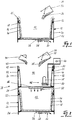
- FIG. 1 shows a known filter part 10 with a support frame 12, a container 14 stored therein with a water-permeable support basket located at a distance and a filter cloth 18 lying thereon.
- the support frame 12 consists, for example, of three or four metallic posts 20, an upper round support ring 22 and three lower side supports 24.
- the container 14 suitably consists of natural-colored polyethylene with a useful volume of e.g. 55 1.
- the container is arranged at a distance from the floor and has a central drain 26 with a manually or magnetically actuated drain valve 28.
- a drain hose 30 leads the cleaned waste water into the sewage system.
- the carrier basket arranged at a distance in the container 14 must on the one hand be highly water-permeable and on the other hand support the filter cloth 18.
- a perforated plate, a slotted plate or a rigid grid with sufficient mechanical strength is suitable for this.
- sheet metal does not only include metallic materials, but also corresponding mechanically strong plastics.
- the filter cloth 18 a woven or non-woven fabric, consists of natural or artificial fibers which, in addition to having sufficient tear resistance, are chemically inert.
- the dimensions of the filter cloth 18 allow the upper edge 15 of the container 14 to roll over.
- a kettle 32 is shown with a carrying handle 34 in the pouring position.
- a reaction vessel the solid particles were previously flocculated out of the dispersion-containing waste water by adding a reaction separating agent while stirring.
- the boiler 32 can be a vessel which happens to be in place or an empty paint container which is filled with the dispersion to be discarded and / or the contaminated waste water.
- the number of revolutions per minute of the stirrer is, for example, in the range from 700 to 1000 / min.
- the wastewater treated with flocculated product 36 is slowly emptied into the filter part 10.
- a disposal device 38 corresponding to the device according to the invention according to FIG. 2, essentially two support frames 12, each with a container 14, are arranged one above the other, in the present case by inserting the support frames 12.
- containers 14 with feet arranged on a support ring or molded on the container this results in the stacking at a distance without a support frame 12.
- the upper container 14 has neither carrier basket 16 nor filter cloth 18, it is designed as a reaction part 40.
- a kettle 32 With a kettle 32, untreated discarded emulsion paints and / or dispersion-containing waste water 35 are emptied into the container 14 of the reaction part 40. This process can be repeated any number of times within the limits of the volume ratios between container 14 and boiler 32.
- the material 35 to be treated can also be pumped into the container 14 of the reaction part 40 via a line (not shown).
- a flocculant 42 in particular a reaction release agent
- a measuring cup 44 in the emptying position.
- the flocculant 42 can also be added by means of a continuous or non-continuous metering device, for example via a fluidizable pouring channel, a metering drawer or a metering piston.
- a hydraulic mixer 46 designed as a built-in unit is attached to a post 20 of the upper support frame 12.
- this comprises a pump 48, which draws in cleaned waste water (68 in FIG. 5) and / or tap water via the drain hose 30 of the filter part 10.
- the drain hose 30 leading to the pump 48 is not completely drawn.
- the recycled waste water is injected by the pump 48 through outlet openings 50 into the dispersion-containing waste water in the reaction part 40.
- the recycled water is preferably sprayed out in different directions, which results in thorough mixing. Pump heads of this type are known per se, for example from sewerage cleaning systems.
- the pump 48 which is suspended via a linkage 52, is operated in a processor-controlled manner via a switch-on button 54 or in the case of further developed devices.
- a conventional agitator can also be plugged in as a built-in unit, which comprises a mechanically driven agitator.
- the upper container 14 of the reaction part 40 also has an outlet 56 which can be closed with a valve, slide or the like.
- the drain opens, the waste water with the flocculated residues flows into the filter part 10, which is indicated by arrows 58.
- the hydraulic mixer 46 in the reaction part 40 is activated by manually actuating the button 54 and at the same time the corresponding reaction separating agent 42 with a concentration of approximately 10 g / l is sprinkled in by hand using a measuring cup 44 .
- the switch-off takes place automatically.
- the outlet 56 drains the water with the flocculated residues from the reaction part 40 into the filter part 10 by opening an unrecognizable shutoff valve.
- the outlet 56 of the upper container 14 is closed again.
- the prewashing of tools corresponds in principle to FIG. 5 and is not shown here.
- FIG 3 shows the container 14 of a reaction part 40 suspended from a vertical stand 60 with a base plate 62.
- the container 14 suspended on a support ring 64 (not visible) can be pivoted about an axis A of the stand 60.
- the filter part 10 at the bottom is exposed, which is indicated by a broken line to the reference number.
- Reaction 10 and filter part 40 have the same outer diameter and the same size container 14.
- the filter cloth 18 (FIGS. 1, 2) can be removed without problems.
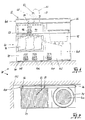
- a hydraulic mixer 46 supported by two diagonally arranged webs 66 anchored in the side wall of the container 14, is suspended in a container 14 of the reaction part 40 shown in FIG. 4.
- the outlet openings 50 of the pump 48 are designed such that the water 68 or tap water recycled to the filter part 10 (FIGS. 1, 2) is sprayed out in the direction of the arrows. If all the arrows representing the ejected recycled water 68 deviate from the radial direction in the same direction of rotation, the liquid container content is set into a rotational movement.
- a baffle 94 has the effect that the water flowing in the direction of arrow 95 forms a local rotation funnel 96, which improves the mixing of the flocculant by leaps and bounds.
- the water can also be sprayed out in different directions, as a result of which rotation in the reaction vessel 14 is prevented.
- a collecting trough 78 Arranged below the filter bags 76 is a collecting trough 78 which receives the cleaned waste water 68.
- a float or probe 80 mounted at an adjustable level initiates the drainage or pumping of the cleaned waste water 68 as soon as its surface has reached the corresponding level.
- a corresponding float or a corresponding probe 80 can also be used to determine a minimum level of the cleaned wastewater.
- a pump recycles the cleaned wastewater 68 and guides it over a hose, which is also not visible, in the area above the reaction part 40.
- An adjustable outlet 82 has a shower or nozzle bar 84 which carries the recycled water 68 and / or optionally tap water into the above open reaction part 40 injects.
- Painter tools 86 which are contaminated with residues of emulsion paints and can be cleaned with the recycled water 68 and / or tap water, can be arranged on a grate 84 shown in broken lines, for example as a perforated plate, slotted plate or grid. A brush is indicated as a representative of the painting tools 86.
- FIG. 6 is a fully automatic removal device of dispersions and corresponding solid particles from wastewater and for pre-rinsing painting tools. 6, 7 essentially correspond to FIG. 5 discussed above in detail.
- This device is used primarily in connection with existing pits or large containers in connection with stacking containers and separators under existing washing troughs. It is also suitable for use on construction sites.
- the device is equipped with circulating water, so the cleaned wastewater is recycled. With an electrical connection of 230 V, an hourly output of 200 - 300 l waste water is achieved.
- FIG. 6 has an elongated compartment with a pouring basin 98. Above this pouring basin 98, although not shown, there is a closable outflow 82, as above the filter part 10.
- a grate 100 is also arranged above this pouring basin 98.
- a stacking container 102 with a stacking container pump 104 and an exchangeable solids separator 110 are arranged below the pouring basin 98.
- a pump 48 operates the hydraulic mixer 46 with outlet openings 50 for the cleaned, recycled wastewater 68.
- the cleaned, recycled wastewater also flows via the shower 83 onto painting tools (not shown) and can clean these without problems, which contaminates them Water is cleaned again.
- An emptying pump 106 conveys non-recycled cleaned waste water via an outlet 26 into the sewage system. With 108 connections for cold and / or hot water are indicated.
- the device according to the invention can have feet 47 or castors and can be installed in a fixed or mobile manner.
- the device is preferably installed in the area of a wall corner 112.
- the present invention makes it possible in a simple and economical way to prevent the discharge of residues of emulsion paints or waste water contaminated with emulsion paints into the sewage system.
- the solid particles are flocculated together with any other pollutants and filtered off.
- the now solid, cleanly separated waste materials can be disposed of without any problems.
Landscapes
- Chemical & Material Sciences (AREA)
- Chemical Kinetics & Catalysis (AREA)
- Separation Of Suspended Particles By Flocculating Agents (AREA)
Applications Claiming Priority (2)
| Application Number | Priority Date | Filing Date | Title |
|---|---|---|---|
| CH3613/93 | 1993-12-03 | ||
| CH361393 | 1993-12-03 |
Publications (2)
| Publication Number | Publication Date |
|---|---|
| EP0659689A2 true EP0659689A2 (fr) | 1995-06-28 |
| EP0659689A3 EP0659689A3 (fr) | 1995-10-25 |
Family
ID=4259751
Family Applications (1)
| Application Number | Title | Priority Date | Filing Date |
|---|---|---|---|
| EP94810685A Withdrawn EP0659689A3 (fr) | 1993-12-03 | 1994-12-02 | Eliminer des dispersions. |
Country Status (1)
| Country | Link |
|---|---|
| EP (1) | EP0659689A3 (fr) |
Cited By (1)
| Publication number | Priority date | Publication date | Assignee | Title |
|---|---|---|---|---|
| CN113045047A (zh) * | 2021-03-29 | 2021-06-29 | 江西清绿环保有限公司 | 一种喷漆废水净化循环系统 |
Family Cites Families (7)
| Publication number | Priority date | Publication date | Assignee | Title |
|---|---|---|---|---|
| US4191655A (en) * | 1977-07-07 | 1980-03-04 | Betz Laboratories, Inc. | Dewatering composition |
| JPS54123245A (en) * | 1978-03-17 | 1979-09-25 | Honda Motor Co Ltd | Treatment of painting booth circulating water containing water paint |
| US4225433A (en) * | 1978-10-02 | 1980-09-30 | Petro-Canada Exploration Inc. | Filtration of hot water extraction process whole tailings |
| IT8022905V0 (it) * | 1980-09-23 | 1980-09-23 | Prandoni Alfredo | Apparecchiatura per la depurazione di acque industriali e simili. |
| DE3942561C1 (fr) * | 1989-08-22 | 1991-01-10 | Hans-Georg Dipl.-Ing. 8434 Berching De Huber | |
| DE59003902D1 (de) * | 1990-06-23 | 1994-01-27 | Piepho Abwassertech Ralf F | Transportable Vorrichtung zur Reinigung von Abwässern jeglicher Art. |
| AU629069B2 (en) * | 1990-11-27 | 1992-09-24 | Seetal Spray Booth Pty Ltd | Waste water filtration |
-
1994
- 1994-12-02 EP EP94810685A patent/EP0659689A3/fr not_active Withdrawn
Cited By (2)
| Publication number | Priority date | Publication date | Assignee | Title |
|---|---|---|---|---|
| CN113045047A (zh) * | 2021-03-29 | 2021-06-29 | 江西清绿环保有限公司 | 一种喷漆废水净化循环系统 |
| CN113045047B (zh) * | 2021-03-29 | 2022-11-04 | 江西清绿环保有限公司 | 一种喷漆废水净化循环系统 |
Also Published As
| Publication number | Publication date |
|---|---|
| EP0659689A3 (fr) | 1995-10-25 |
Similar Documents
| Publication | Publication Date | Title |
|---|---|---|
| DE69115490T2 (de) | Entwässerungssystem zum entfernen von schlamm | |
| EP0713418B1 (fr) | Procede et dispositif permettant d'extraire du sable contenu dans des eaux usees chargees en sable et en substances organiques | |
| WO1993000853A1 (fr) | Nettoyeur mobile de sols | |
| EP0282906B1 (fr) | Séparateur de graisses | |
| DE3787097T2 (de) | Verfahren und vorrichtung zur abtrennung fester teilchen aus einer flüssigkeit. | |
| EP0463195B1 (fr) | Dispositif transportable de purification d'eaux résiduelles de toutes sortes | |
| DE4415473A1 (de) | Reinigungsmaschine für Malerwalzen | |
| DE4023434A1 (de) | Verfahren zur separierung von kunststoffmaterialien | |
| EP0659689A2 (fr) | Eliminer des dispersions | |
| AT410543B (de) | Vorrichtung zum kontinuierlichen trennen von aufschwimmbaren und sedimentierbaren stoffen aus damit verunreinigtem wasser | |
| EP0668247B1 (fr) | Dispositif pour le traitement de boue aqueuse | |
| DE2727181A1 (de) | Wascheinrichtung fuer zerkleinerte kunststoff-folien und -baender | |
| DE4013979A1 (de) | Vorrichtung zum vorreinigen von verschmutztem wasser | |
| DE9320862U1 (de) | Entsorgung von Dispersionen | |
| AT404356B (de) | Reinigungsvorrichtung für mit lack-, beiz- und/oder klebersystem verschmutztes brauchwasser | |
| EP0085425A2 (fr) | Installation pour recyclage du béton | |
| CH671217A5 (fr) | ||
| EP0613707B1 (fr) | Installation de nettoyage notamment pour le traitement d'eau de lavage contenant de la peinture et de la colle | |
| DE29509510U1 (de) | Farbabwasserreiniger | |
| AT405278B (de) | Kombinierte vorrichtung zum abscheiden von feststoffen und fetten | |
| DE4109742A1 (de) | Vorrichtung zum reinigen des insbesondere in spritzkabinen umlaufenden wassers und spritzkabine mit einer solchen vorrichtung | |
| DE4105036C2 (de) | Verfahren und Vorrichtung zur Abwasseraufbereitung | |
| DE3918285A1 (de) | Verfahren und vorrichtung zum spuelen (reinigen) von mischvorrichtungen fuer mehrkomponenten-kunststoffe, insbesondere polyurethan | |
| DE1517661A1 (de) | Vorrichtung zur Entfernung von synthetischen Reinigungsmitteln und anderen Stoffen aus waessrigen Loesungen | |
| CH686080A5 (de) | Vorrichtung zur Entsorgung des beim Reinigen von Malerutensilien anfallenden Abwassers. |
Legal Events
| Date | Code | Title | Description |
|---|---|---|---|
| PUAI | Public reference made under article 153(3) epc to a published international application that has entered the european phase |
Free format text: ORIGINAL CODE: 0009012 |
|
| AK | Designated contracting states |
Kind code of ref document: A2 Designated state(s): AT BE CH DE FR GB IT LI LU NL SE |
|
| PUAL | Search report despatched |
Free format text: ORIGINAL CODE: 0009013 |
|
| AK | Designated contracting states |
Kind code of ref document: A3 Designated state(s): AT BE CH DE FR GB IT LI LU NL SE |
|
| STAA | Information on the status of an ep patent application or granted ep patent |
Free format text: STATUS: THE APPLICATION IS DEEMED TO BE WITHDRAWN |
|
| 18D | Application deemed to be withdrawn |
Effective date: 19960426 |