EP0660104A2 - Vorrichtung zur Untersuchung von Sedimenten im Harn - Google Patents
Vorrichtung zur Untersuchung von Sedimenten im Harn Download PDFInfo
- Publication number
- EP0660104A2 EP0660104A2 EP94120700A EP94120700A EP0660104A2 EP 0660104 A2 EP0660104 A2 EP 0660104A2 EP 94120700 A EP94120700 A EP 94120700A EP 94120700 A EP94120700 A EP 94120700A EP 0660104 A2 EP0660104 A2 EP 0660104A2
- Authority
- EP
- European Patent Office
- Prior art keywords
- particle
- urinary
- particles
- item
- predetermined
- Prior art date
- Legal status (The legal status is an assumption and is not a legal conclusion. Google has not performed a legal analysis and makes no representation as to the accuracy of the status listed.)
- Withdrawn
Links
- 230000002485 urinary effect Effects 0.000 title claims abstract description 72
- 239000013049 sediment Substances 0.000 title claims description 39
- 239000002245 particle Substances 0.000 claims abstract description 264
- 238000000034 method Methods 0.000 claims description 19
- 210000002700 urine Anatomy 0.000 claims description 19
- 238000012937 correction Methods 0.000 claims description 11
- 239000007788 liquid Substances 0.000 claims description 9
- 238000013528 artificial neural network Methods 0.000 claims description 7
- 230000006872 improvement Effects 0.000 claims description 3
- 238000004062 sedimentation Methods 0.000 claims 13
- 238000001514 detection method Methods 0.000 abstract description 3
- 238000012545 processing Methods 0.000 description 10
- 210000004027 cell Anatomy 0.000 description 9
- 210000003743 erythrocyte Anatomy 0.000 description 8
- 230000003287 optical effect Effects 0.000 description 6
- 238000004364 calculation method Methods 0.000 description 4
- 230000008569 process Effects 0.000 description 4
- 230000000877 morphologic effect Effects 0.000 description 3
- 206010028980 Neoplasm Diseases 0.000 description 2
- 201000011510 cancer Diseases 0.000 description 2
- 238000006243 chemical reaction Methods 0.000 description 2
- 239000003086 colorant Substances 0.000 description 2
- 210000000981 epithelium Anatomy 0.000 description 2
- 238000005259 measurement Methods 0.000 description 2
- 230000002969 morbid Effects 0.000 description 2
- 210000003097 mucus Anatomy 0.000 description 2
- 239000004065 semiconductor Substances 0.000 description 2
- 230000000007 visual effect Effects 0.000 description 2
- 241000894006 Bacteria Species 0.000 description 1
- FAPWRFPIFSIZLT-UHFFFAOYSA-M Sodium chloride Chemical compound [Na+].[Cl-] FAPWRFPIFSIZLT-UHFFFAOYSA-M 0.000 description 1
- 206010047571 Visual impairment Diseases 0.000 description 1
- 230000002159 abnormal effect Effects 0.000 description 1
- 230000002411 adverse Effects 0.000 description 1
- 238000004458 analytical method Methods 0.000 description 1
- 230000008859 change Effects 0.000 description 1
- 238000010276 construction Methods 0.000 description 1
- 238000007796 conventional method Methods 0.000 description 1
- 230000008878 coupling Effects 0.000 description 1
- 238000010168 coupling process Methods 0.000 description 1
- 238000005859 coupling reaction Methods 0.000 description 1
- 239000013078 crystal Substances 0.000 description 1
- 238000005516 engineering process Methods 0.000 description 1
- 210000002919 epithelial cell Anatomy 0.000 description 1
- 239000000284 extract Substances 0.000 description 1
- 239000011521 glass Substances 0.000 description 1
- 210000004276 hyalin Anatomy 0.000 description 1
- 239000004615 ingredient Substances 0.000 description 1
- 238000012986 modification Methods 0.000 description 1
- 230000004048 modification Effects 0.000 description 1
- 230000001537 neural effect Effects 0.000 description 1
- 210000002569 neuron Anatomy 0.000 description 1
- 238000005070 sampling Methods 0.000 description 1
- 238000000926 separation method Methods 0.000 description 1
- 239000011780 sodium chloride Substances 0.000 description 1
- 238000010186 staining Methods 0.000 description 1
- 238000012360 testing method Methods 0.000 description 1
Images



Classifications
-
- G—PHYSICS
- G01—MEASURING; TESTING
- G01N—INVESTIGATING OR ANALYSING MATERIALS BY DETERMINING THEIR CHEMICAL OR PHYSICAL PROPERTIES
- G01N33/00—Investigating or analysing materials by specific methods not covered by groups G01N1/00 - G01N31/00
- G01N33/48—Biological material, e.g. blood, urine; Haemocytometers
- G01N33/483—Physical analysis of biological material
- G01N33/487—Physical analysis of biological material of liquid biological material
- G01N33/493—Physical analysis of biological material of liquid biological material urine
-
- G—PHYSICS
- G01—MEASURING; TESTING
- G01N—INVESTIGATING OR ANALYSING MATERIALS BY DETERMINING THEIR CHEMICAL OR PHYSICAL PROPERTIES
- G01N15/00—Investigating characteristics of particles; Investigating permeability, pore-volume or surface-area of porous materials
- G01N15/10—Investigating individual particles
- G01N15/14—Optical investigation techniques, e.g. flow cytometry
Definitions
- the present invention relates to a urinary sediment examining apparatus, and more particularly to a urinary sediment examining apparatus suitable for classifying particles suspended in a urinary sample.
- the observation power is switched over according to particle items to be classified. In reporting the results of examination, they need to expressed so as to include the number of particles in a high power field of view, the number of particles in a low power field of view and the number of particles in a whole field of view according to particle items as described in "URINARY SEDIMENT EXAMINATION METHOD" published by The Association of Japan Clinical and Medical Examination Technologists, August 14, 1991.
- an apparatus in which the particles are optically analyzed by conducting a liquid including the particles suspended therein through a flow cell.
- a liquid sample is conducted through a flow passage having a special shape and therein optical still images of the particles in the sample are produced.
- morphological features of the particles can be extracted by converting the optical still images into electronic images to analyze them, and hence the particles in urine can be classified on the basis of the extracted morphological features.
- the particles can be sub-classified into classes of visual recognition characteristics on the basis of the morphological analysis of the particles using the optical still images.
- the particles can be classified in detail according to a specified order such as sizes, colors or the like.
- the classification work of the technical expert of examination is partially automated by conducting the urine through the flow cell to produce the still images of the particles and to convert the same into electronic images.
- An object of the present invention is to provide a urine sediment examining apparatus suitable for automatically classifying particles suspended in a liquid sample with high accuracy and high efficiency.
- Another object of the present invention is to provide a urinary sediment examination apparatus suitable for efficiently obtaining accurate examination data on particle items predetermined to need manual data correction manually designated by an operator when the particles cannot be classified automatically or when the automatically classified result needs to be precisely classified further.
- a urinary sediment examining apparatus comprising means for passing through a predetermined position a liquid sample in which particles are suspended, means for detecting a particle passed through the predetermined position, means for designating an particle item predetermined to need automatic classification, and means for producing an image of the detected particle and determining whether the detected particle is to be classified as the designated particle item on the basis of the image.
- a technical expert of examination or operator can exclude the particles adversely affecting the classification accuracy thereof and the particles inefficient to classification from the objects for automatic classification and can select the other particles as the objects for automatic classification, and hence the particles selected as the objects for automatic classification in such a manner can be performed automatic classification with high accuracy and high efficiency.
- a urinary sediment examining apparatus having means for detecting particles suspended in a urinary sample, means for producing images of the detected particles and means for classifying the detected particles on the basis of the images, the improvement comprising means for registering object fields of view predetermined corresponding to particle items predetermined to need manual data correction in advance, and means for designating at least one of the particle items, the particle classifying means being adapted to produce data of the detected particles classified as the designated particle item, the data being for the registered object field of view corresponding to the designated particle item.
- the measured volume of the urinary sample in the low power field of view is generally 10 or more times that in the high power field of view. Therefore, the number of particles per unit measured urinary sample volume appearing only in the high power field of view is required to be calculated on the basis of the measured volume of the urinary sample in the high power field of view since, if it is calculated on the basis of the sum of the measured volumes of the urinary sample in both high and low power fields of view, it calculated less than one tenth of the actual number.
- the present invention is capable of solving such a problem, since the data of the detected particles classified as the designated particle item are for the registered object field of view corresponding to the designated particle item.
- FIG.1 light emitted from a flash lamp 1 of microscope light source passes along an optical axis 9 of a microscope, converged by a field lens 2, and focused a condenser lens 3 on a liquid sample or urinary sample 13 passed through a flow cell 4.
- the light beam 10 from the light source 1 is restricted by a view aperture 11 and an opening aperture 12.
- Images of particles suspended in the sample are formed at an image forming position 6 by an objective lens 5 and are focused on an image pickup surface of a TV camera 8 by a focusing lens 7.
- the TV camera is usually of a CCD type because of low after-image.
- Flash timing of the flash lamp 1 is controlled by a detecting signal of a particle detecting system.
- a light beam from a semiconductor laser 15 continuously oscillating is converted into a parallel light beam by a collimator lens 17, and converged only in one direction by a cylindrical lens 18.
- the focusing position of the laser beam is at the sample passed through the flow cell, and the laser beam is directed to the focusing position by a reflecting mirror 19 and a small size reflecting mirror 14.
- the particles in the sample is passed across the laser beam, this laser light is scattered, and the scattered light is collected by the microscope objective lens 5 used for image pickup of the particle image, and reflected by a beam splitter 20.
- the reflected scattered light is limited in the observed region in the sample passed through the flow cell by an aperture 21, and converted into an electric signal by a light detector 22 to obtain particle detection signals.
- the semiconductor laser 15 always glows to monitor particles in the sample passed through the detecting region any time.
- the particle is judged as a particle to be image-processed and a flash lamp flashing control circuit 23 controls a flash lamp drive circuit 27 such that the flash lamp 1 glows when the particle comes into a certain position in the image pickup region of the TV camera 8.
- An image processing control circuit 26 performs control to write the image signals after A/D converting into an image memory 25 and the image processing thereafter.
- a feature extracting circuit 28 extracts primary parameters of the particles such as shape, color, size and so on.
- the image processing control circuit 26 inputs secondary parameters produced by calculation using the primary parameters and combination of these into a recognition circuit 29.
- the recognition circuit 29 classifies the particles using a neural network of Rammelhart type.
- a central processing part 30 judges from the classified results based on a preset condition whether the image is necessary to be stored and stores the images into an image memory part 31 if the image is needed to be stored.
- the central processing part 30 instructs the recognition circuit 29 whether the classification is required or not.
- FIG.2 shows a lay-out on the screen instructing input provided to realize the present invention.
- An particle item name input area 40 is that in which the particle item name to be designated can be displayed.
- the particle item names displayed for example, leucocyte, erythrocyte, epithelium, cast, crystal, bacteria, etc, are updated unit by unit according to the input from the key board where one unit is representative of the predetermined number of the particle item names which may be one, two or three.
- the technical expert of examination sets using the automatic classification designating area 41 whether the automatic classification is required or not. For example, the technical expert of examination inputs "yes” so that it is displayed when the automatic classification is required and inputs "no" so that it is displayed when the automatic classification not required.
- FIG.3 shows an example of judging conditions on whether automatic classification is preformed or not.
- FIG.3(A) schematically illustrates an image 42 of erythrocytes.
- FIG.3(B) illustrates an image 43 of a cast.
- Most of images 42 of erythrocytes are generally observed as torus-shaped or circular particles as shown in FIG.3-(a). In such a case, since relation between the size or area and the length of periphery is nearly constant, it is possible to judge that the detected particle is an erythrocyte.
- the particle itself is formed of different ingredients such as corpuscle, epithelium and so on, and is not constant in size nor in shape. Since for clinical identification it is necessary to depend on image itself, the judgement whether automatic classification is performed is set as "no", and the judgement of technical expert of examination is required. Although the judging condition on whether automatic classification is performed or not in FIG.3 is considered as an example, lack of necessary condition for selection other than the above determines an object as "no" in the judgement on whether automatic classification is performed or not.
- Step 50 After detecting particles in Step 50, an image of the particle is taken in and expressed with binary values in Step 51. Calculation is executed on feature parameters using the image data expressed with the binary values to perform recognition (Step 52). In Step 52, feature parameters such as diameter, length of periphery and area of the particle are calculated and further a ratio of diameter to area is calculated using these values. Judgement on whether automatic classification is required or not (Step 53) is executed according to the designated information shown in FIG.2 in each particle item.
- the data of the detected particles is classified as OTHERS (Step 55) if the answer in step 53 is "no" and classified as the particle item designated to need automatic classification (Step 54) if the answer in step 53 is "yes”.
- step 56 whether classifying has been completed or not is judged. If the answer is "yes”, the flow ends and if the answer is "no", the flow returns to the first step.
- steps from Step 53 to Step 55 there are several methods considered to realize the judgement on whether automatic classification is required or not. The following are examples.
- Step 53 to Step 55 Methods of judging whether automatic classification is required or not from Step 53 to Step 55 will be described below in detail.
- FIG.5 shows an embodiment to realize judgement on whether automatic classification is required or not without taking the feature parameters into consideration.
- the particle image 60 is judged as an erythrocyte and the particle image 61 is judged as a cast. That is, the particle image 60 is judged as an erythrocyte since the lengths of diagonal lines a1 and a2 are nearly equal to each other.
- the particle image 61 is judged as a cast since the length of diagonal line b2 is n (n is lager than 1) times as large as the length of diagonal line b1.
- the judgement on whether automatic classification is required or not can be realized by classifying the particles as OTHERS when the feature parameter is n times. (the item (1) in the methods of judging whether automatic classification is required or not described above). Further, by temporarily saving the results of automatic classification using these feature parameters, the results may be stored particle item by particle item according to the specification on whether automatic classification is required or not.
- FIG.6 shows an embodiment to realize judgement on whether automatic classification is required or not according to a method where the particle is classified but is not counted as a designated particle item.
- a feature parameter is calculated in Step 71, and then the particle item name is judged in Step 72.
- Steps 73, 75 and 77 is judgement for each of the particle items on whether automatic classification is required or not, and the information designated in the input area 41 in FIG.2 is used in this judgement. If judged as NO in any one of Steps 73, 75 and 77, the particle is not stored as the designated particle item for automatic classification since the process in Step 74, 76 or 78 is not executed. (the particle item (2) in the methods of judging whether automatic classification is required or not described above.)
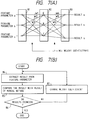
- FIG.7(A) shows the improvement in classification accuracy by changing the weight coefficient, and shows an example of a three-stage neural network.
- Feature parameters for example, are input to an input stage 81.
- the feature parameters may be a diameter, length of periphery, area and so on.
- a middle stage 82 is provided to calculates values to be added to elements d, e and f each.
- the value d is a sum of products of the qualities a, b and c and the weight coefficients w1, w2 and w3, respectively.
- an output stage 83 is to indicates the results of classification g, h and q which may be the number corresponding to the particle item names.
- the value g is a sum of products of the elements in the middle stage d, e and f and the weight coefficients w4, w5 and w6, respectively.
- the classified results are put out from the output stage 83 as values of results.
- the weight coefficients change the results of classification, and proper changes in the weight coefficients improve the accuracy.
- the weight coefficients in this embodiment are given as parameters and are rewritable.
- the result is extracted from the neural network in Step 85 shown in FIG.7(B). In Step 85, the obtained result is compared with a result obtained from a manual method.
- the weight coefficients are changed. By repeating this procedure particle item by particle item, the accuracy in the classification result is improved. Further, since the item judged as NO in the judgement on whether automatic classification is required or not is not classified if the weight coefficients with concerning to the particle item, the item can be put off from the particle items to be classified automatically. Furthermore, although the updating of the weight coefficients is equivalent to the neural learning, it does not take much time and is efficient if the updating is performed only limited items.
- FIG.8 shows a screen to register detailed particle item names to classify the particle items automatically classified by an optical image produced by the embodiment according to the present invention.
- Input areas 91, 92, 93 and 94 are to interconnect between a key in the key board and a particle item, the particle item is designated by pushing the key in the key board when classifying images.
- Input areas 95 and 96 are areas for inputting particle item names and can be input the particle item names necessary for manual classification. By using this screen, the manual classification can be used with combining with the automatic classification.
- the power of the TV camera is changed by switching the focusing lens 7 if necessary since in the processing described above the sizes of the particles in urine has a wide measuring range of less than 1 ⁇ m in diameter to larger than 200 ⁇ m.
- the central processing unit 30 displays the image of the particles as well as the judged result of the apparatus on the display 32.
- the technical expert or operator looks at the judged result of the apparatus and the image displayed on the display 32 and corrects the result from the data input unit 33 if necessary.
- the central processing unit 30 executes a data calculation in the process described below using the input data and then puts out the result.
- the object field of view predetermined corresponding to the particle items predetermined to need manual data correction are registered in advance by the technical expert or operator and are set on a condition setting screen shown in FIG.9.
- FIG.9 shows the condition setting screen concerning the particle items predetermined to need manual data correction.
- the letter HPF expresses a high power field of view (usually 400 times), LPF expressing a low power field of view (usually 100 times), WF expressing a whole field of view.
- the particle concentration that is, the number of particles of the particle item i per unit volume C i can be expressed by Equation 1.
- C i (N li ⁇ f l /V l )+(N hi ⁇ f h /V h ), where
- the reporting form of the urinary sediment examination other than the particle concentration described above is qualitative data (-, ⁇ , +, ++, +++ and so on) to qualitatively express the number or the particle concentration of particles in the object field of view. That is, since the volume of the urinary sample in the object field of view is known and is set in advance (or can be set by being arbitrarily input by the technical expert or operator), the number of said particles in the object field of view can be obtained by multiplying the particle concentration by the set volume of the urinary sample in the object field of view to be put out.
- the qualitative data is put out such a manner that which range the obtained particle concentration belongs to by inputting each of boundary values (particle concentration) of -, ⁇ , +, ++, +++ and so on in advance.
- the volume of the urinary sample in the object field of view or the boundary values may be set so as to keep the continuity of data with those in the past method.
- spindle epithelial cell expresses the particle item name, HPF expressing the object field of view, 0.45 expressing the volume of the urinary sample in the object field of view.
- the symbol "-" expresses below 0.5, "+” expressing above 1.1 and below 2.2, “++” expressing above 2.2 and below 4.5, and "+++” expressing above 4.5.
- the other item numbers the same as above.
- the examination becomes further efficient by eliminating data inputting work using a separate apparatus. Furthermore, since the volume of the urinary sample in the object field of view or the qualitative data conversion value can be arbitrary set, the examination data having the continuity with past data can be provided.
Landscapes
- Health & Medical Sciences (AREA)
- Life Sciences & Earth Sciences (AREA)
- Chemical & Material Sciences (AREA)
- Engineering & Computer Science (AREA)
- Biomedical Technology (AREA)
- Physics & Mathematics (AREA)
- General Physics & Mathematics (AREA)
- Immunology (AREA)
- Pathology (AREA)
- Urology & Nephrology (AREA)
- General Health & Medical Sciences (AREA)
- Biochemistry (AREA)
- Analytical Chemistry (AREA)
- Medicinal Chemistry (AREA)
- Food Science & Technology (AREA)
- Biophysics (AREA)
- Hematology (AREA)
- Molecular Biology (AREA)
- Dispersion Chemistry (AREA)
- Investigating Or Analysing Biological Materials (AREA)
Applications Claiming Priority (4)
| Application Number | Priority Date | Filing Date | Title |
|---|---|---|---|
| JP333264/93 | 1993-12-27 | ||
| JP33326493 | 1993-12-27 | ||
| JP38742/94 | 1994-03-09 | ||
| JP6038742A JPH07248328A (ja) | 1994-03-09 | 1994-03-09 | 尿沈渣検査装置 |
Publications (2)
| Publication Number | Publication Date |
|---|---|
| EP0660104A2 true EP0660104A2 (de) | 1995-06-28 |
| EP0660104A3 EP0660104A3 (de) | 1995-08-09 |
Family
ID=26378030
Family Applications (1)
| Application Number | Title | Priority Date | Filing Date |
|---|---|---|---|
| EP94120700A Withdrawn EP0660104A3 (de) | 1993-12-27 | 1994-12-27 | Vorrichtung zur Untersuchung von Sedimenten im Harn. |
Country Status (1)
| Country | Link |
|---|---|
| EP (1) | EP0660104A3 (de) |
Family Cites Families (6)
| Publication number | Priority date | Publication date | Assignee | Title |
|---|---|---|---|---|
| US5008185A (en) * | 1985-11-04 | 1991-04-16 | Cell Analysis Systems, Inc. | Methods and apparatus for the quantitation of nuclear proteins |
| US5016283A (en) * | 1985-11-04 | 1991-05-14 | Cell Analysis Systems, Inc. | Methods and apparatus for immunoploidy analysis |
| US5257182B1 (en) * | 1991-01-29 | 1996-05-07 | Neuromedical Systems Inc | Morphological classification system and method |
| CA2084099C (en) * | 1991-12-06 | 1996-06-18 | James V. Bacus | Method and apparatus for automated cell analysis |
| EP0556971B1 (de) * | 1992-02-18 | 1999-12-08 | Hitachi, Ltd. | Gerät und Verfahren zur Untersuchung von Teilchen in einem Fluid |
| JP3165247B2 (ja) * | 1992-06-19 | 2001-05-14 | シスメックス株式会社 | 粒子分析方法及び装置 |
-
1994
- 1994-12-27 EP EP94120700A patent/EP0660104A3/de not_active Withdrawn
Also Published As
| Publication number | Publication date |
|---|---|
| EP0660104A3 (de) | 1995-08-09 |
Similar Documents
| Publication | Publication Date | Title |
|---|---|---|
| US5715182A (en) | Device for the classification and examination of particles in fluid | |
| JPH0991430A (ja) | パターン認識装置 | |
| JP5380026B2 (ja) | 標本撮像装置 | |
| CN102768271B (zh) | 样本分析方法及综合样本分析仪 | |
| JP4085297B2 (ja) | 尿中有形成分分類装置 | |
| JP4346923B2 (ja) | 標的細胞自動探索システム | |
| JP2007133859A (ja) | 生体組織の試料および体液の試料の自動顕微鏡支援検査方法 | |
| EP1065496A2 (de) | Verfahren und Vorrichtung zur Gewinnung getrennter Abbildungen aus einer Vielzahl von Chromogenen in einer biologischen Probe | |
| WO1991002329A1 (en) | A method and an apparatus for differentiating a sample of biological cells | |
| WO2005121863A1 (en) | Automated diagnosis of malaria and other infections | |
| US12026880B2 (en) | Fluorescence image display method and fluorescence image analyzer | |
| JP3924870B2 (ja) | 有形成分分析装置及び有形成分分析方法 | |
| JPH11132937A (ja) | 生体に関する粒子画像分類システム | |
| US12135322B2 (en) | In-vitro method for determining a cell type of a white blood cell without labeling | |
| JP2826448B2 (ja) | フロー式粒子画像解析方法およびフロー式粒子画像解析装置 | |
| JP3165309B2 (ja) | 粒子画像解析装置 | |
| EP0660104A2 (de) | Vorrichtung zur Untersuchung von Sedimenten im Harn | |
| JP2010151523A (ja) | 粒子画像解析方法および装置 | |
| JPH10302067A (ja) | パターン認識装置 | |
| JPH0989752A (ja) | 尿沈渣検査装置 | |
| JPH07286954A (ja) | 細胞自動分類装置 | |
| Ravkin et al. | Automated microscopy system for detection and genetic characterization of fetal nucleated red blood cells on slides | |
| JPH05249103A (ja) | 血液細胞分析器 | |
| JPH10104229A (ja) | 有形成分分析装置 | |
| US5162234A (en) | Automatic blood cell particle pattern judging method |
Legal Events
| Date | Code | Title | Description |
|---|---|---|---|
| PUAI | Public reference made under article 153(3) epc to a published international application that has entered the european phase |
Free format text: ORIGINAL CODE: 0009012 |
|
| PUAL | Search report despatched |
Free format text: ORIGINAL CODE: 0009013 |
|
| 17P | Request for examination filed |
Effective date: 19941227 |
|
| AK | Designated contracting states |
Kind code of ref document: A2 Designated state(s): DE IT |
|
| AK | Designated contracting states |
Kind code of ref document: A3 Designated state(s): DE IT |
|
| STAA | Information on the status of an ep patent application or granted ep patent |
Free format text: STATUS: THE APPLICATION IS DEEMED TO BE WITHDRAWN |
|
| 18D | Application deemed to be withdrawn |
Effective date: 20020702 |