EP0660210A2 - Verfahren und Vorrichtung zum Test, zur Überwachung und Verbesserung der Effizienz eines Herstellungsprozesses - Google Patents
Verfahren und Vorrichtung zum Test, zur Überwachung und Verbesserung der Effizienz eines Herstellungsprozesses Download PDFInfo
- Publication number
- EP0660210A2 EP0660210A2 EP94309672A EP94309672A EP0660210A2 EP 0660210 A2 EP0660210 A2 EP 0660210A2 EP 94309672 A EP94309672 A EP 94309672A EP 94309672 A EP94309672 A EP 94309672A EP 0660210 A2 EP0660210 A2 EP 0660210A2
- Authority
- EP
- European Patent Office
- Prior art keywords
- complexity
- data
- manufacturing process
- simulation model
- values
- Prior art date
- Legal status (The legal status is an assumption and is not a legal conclusion. Google has not performed a legal analysis and makes no representation as to the accuracy of the status listed.)
- Withdrawn
Links
Images


Classifications
-
- G—PHYSICS
- G05—CONTROLLING; REGULATING
- G05B—CONTROL OR REGULATING SYSTEMS IN GENERAL; FUNCTIONAL ELEMENTS OF SUCH SYSTEMS; MONITORING OR TESTING ARRANGEMENTS FOR SUCH SYSTEMS OR ELEMENTS
- G05B19/00—Program-control systems
- G05B19/02—Program-control systems electric
- G05B19/418—Total factory control, i.e. centrally controlling a plurality of machines, e.g. direct or distributed numerical control [DNC], flexible manufacturing systems [FMS], integrated manufacturing systems [IMS] or computer integrated manufacturing [CIM]
- G05B19/41885—Total factory control, i.e. centrally controlling a plurality of machines, e.g. direct or distributed numerical control [DNC], flexible manufacturing systems [FMS], integrated manufacturing systems [IMS] or computer integrated manufacturing [CIM] characterised by modeling, simulation of the manufacturing system
-
- G—PHYSICS
- G05—CONTROLLING; REGULATING
- G05B—CONTROL OR REGULATING SYSTEMS IN GENERAL; FUNCTIONAL ELEMENTS OF SUCH SYSTEMS; MONITORING OR TESTING ARRANGEMENTS FOR SUCH SYSTEMS OR ELEMENTS
- G05B2219/00—Program-control systems
- G05B2219/30—Nc systems
- G05B2219/32—Operator till task planning
- G05B2219/32015—Optimize, process management, optimize production line
-
- G—PHYSICS
- G05—CONTROLLING; REGULATING
- G05B—CONTROL OR REGULATING SYSTEMS IN GENERAL; FUNCTIONAL ELEMENTS OF SUCH SYSTEMS; MONITORING OR TESTING ARRANGEMENTS FOR SUCH SYSTEMS OR ELEMENTS
- G05B2219/00—Program-control systems
- G05B2219/30—Nc systems
- G05B2219/32—Operator till task planning
- G05B2219/32338—Use new conditions for model, check, calculate if model meets objectives
-
- G—PHYSICS
- G05—CONTROLLING; REGULATING
- G05B—CONTROL OR REGULATING SYSTEMS IN GENERAL; FUNCTIONAL ELEMENTS OF SUCH SYSTEMS; MONITORING OR TESTING ARRANGEMENTS FOR SUCH SYSTEMS OR ELEMENTS
- G05B2219/00—Program-control systems
- G05B2219/30—Nc systems
- G05B2219/32—Operator till task planning
- G05B2219/32356—For diagnostics
-
- G—PHYSICS
- G05—CONTROLLING; REGULATING
- G05B—CONTROL OR REGULATING SYSTEMS IN GENERAL; FUNCTIONAL ELEMENTS OF SUCH SYSTEMS; MONITORING OR TESTING ARRANGEMENTS FOR SUCH SYSTEMS OR ELEMENTS
- G05B2219/00—Program-control systems
- G05B2219/30—Nc systems
- G05B2219/32—Operator till task planning
- G05B2219/32385—What is simulated, manufacturing process and compare results with real process
-
- Y—GENERAL TAGGING OF NEW TECHNOLOGICAL DEVELOPMENTS; GENERAL TAGGING OF CROSS-SECTIONAL TECHNOLOGIES SPANNING OVER SEVERAL SECTIONS OF THE IPC; TECHNICAL SUBJECTS COVERED BY FORMER USPC CROSS-REFERENCE ART COLLECTIONS [XRACs] AND DIGESTS
- Y02—TECHNOLOGIES OR APPLICATIONS FOR MITIGATION OR ADAPTATION AGAINST CLIMATE CHANGE
- Y02P—CLIMATE CHANGE MITIGATION TECHNOLOGIES IN THE PRODUCTION OR PROCESSING OF GOODS
- Y02P90/00—Enabling technologies with a potential contribution to greenhouse gas [GHG] emissions mitigation
- Y02P90/02—Total factory control, e.g. smart factories, flexible manufacturing systems [FMS] or integrated manufacturing systems [IMS]
-
- Y—GENERAL TAGGING OF NEW TECHNOLOGICAL DEVELOPMENTS; GENERAL TAGGING OF CROSS-SECTIONAL TECHNOLOGIES SPANNING OVER SEVERAL SECTIONS OF THE IPC; TECHNICAL SUBJECTS COVERED BY FORMER USPC CROSS-REFERENCE ART COLLECTIONS [XRACs] AND DIGESTS
- Y10—TECHNICAL SUBJECTS COVERED BY FORMER USPC
- Y10S—TECHNICAL SUBJECTS COVERED BY FORMER USPC CROSS-REFERENCE ART COLLECTIONS [XRACs] AND DIGESTS
- Y10S706/00—Data processing: artificial intelligence
- Y10S706/902—Application using ai with detail of the ai system
- Y10S706/903—Control
- Y10S706/904—Manufacturing or machine, e.g. agricultural machinery, machine tool
Definitions
- the present invention relates to manufacturing processes and in particular to methods and apparatus for the testing, monitoring and improvement of the effectiveness of such manufacturing processes.
- the effectiveness of a manufacturing operation is influenced by a number of factors which taken together can be characterised as the complexity of the process. Management's ability to cope with this complexity is a major determinant in how well the operation meets its objectives. The need is therefore for a set of measures that will provide management with the appropriate information with which to decide how and where best to apply their efforts to make these operations more controllable.
- Algorithmic complexity is defined as the number of steps or iterations to arrive at a pre-defined goal; or to reach an acceptably close approximation to it.
- the first is a mathematical objection which requires a candidate to exhibit certain properties to qualify as a measure, in a mathematical sense.
- the "number of observations" technique does not fulfil these requirements.
- the second is a practical consideration in that the structure of algorithmic complexity does not allow the contribution made by separate factors contributing to the overall complexity of a manufacturing process to be isolated and aggregated.
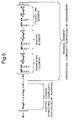
- the new measure or index we propose is derived from the application of measure theory to the concept of algorithmic complexity and has the structure of entropy. It can be expressed by the formula shown in Figure 5.
- a manufacturing process for making one or more products will in general comprise a number of stages. Such stages require the presence of a resource to execute the work.
- “Resource” in this context means anything which advances the production process, e.g. for converting a product at one stage in its manufacture to a modified form at a subsequent stage in its manufacture.
- a resource may be a single machine or a whole work centre comprising a number of machines or operations.
- Each resource may at any time during operation of the process, be in one of a number of states i.e. in a set up (idling and ready to make), make or broken down (machine malfunction, absent workers, producing reject products or reworking products), state. These states are referred to as "resource states”. Additionally, due to the differing speeds of operation of each resource, there may be queues of time varying length at the inputs to each resource.
- the resource states along with the queues in front of the resource form a barrier to the progress of parts through the system.
- the number of barriers i.e. the number of resources and queues
- the size of each barrier measured (queue structure plus all the resource states). In this way a complexity index can be derived.
- the overall complexity of a process is the sum of its structural complexity i.e. those elements which may be controlled by planning, and its residual operational complexity i.e. those elements which require management.
- Operational complexity may be described by the dynamic relationships between the resource states, queue lengths (bottlenecks) and the product mix i.e. the number of unique products to be made, of all the resources in the process.
- the formula shown in Figure 5 has a structure that allows all the factors affecting the complexity of a manufacturing process to be separately identified.
- the formula for complexity exhibits the key elements, i.e. a structural element, which may be controlled with proper planning, a breakdown element, which includes all the factors that prevent a resource from operating as intended, a queuing element and a product mix element.
- the complexity, H, of a manufacturing system is a measure of that system's success in achieving desired goals, such as producing specified quantities of complex articles in a given time, despite the inherent complexity of the system.
- the inherent complexity of a manufacturing system which we refer to hereafter as the "structural complexity" has three basic components i.e. the structure of the article to be produced, the structure of the process to be used to make the article, together forming the structural element of the formula referred to above, and the range of articles to be manufactured (the product mix element of the formula). These components interact and the contributions of each are not easy to separate.
- Operational complexity reflects the constantly changing operational environment of the process and is what is observed. It differs from structural complexity in two important ways. Firstly, as we said above operational complexity measures how well the system is coping, while structural complexity only assesses the potential of the manufacturing operation. Secondly, operational complexity includes all the things that can go wrong in the day to day operation, such as breakdowns, reworks, rejects and absenteeism, and it also includes a control element. The control element allows a measurable goal such as schedule adherence or due date performance to alter the structural complexity of the system so as to reduce complexity.
- apparatus for optimising the design of a manufacturing process in order to achieve predetermined goals includes: a computer simulation model of the structural elements of a manufacturing process pre-programmed to operate according to predetermined flow and sequencing rules and data describing the required product mix and to output, during operation, data on request relating to breakdowns and queues at various resources within the process; means for calculating first values of complexity and constituent elements thereof from the output data of the computer simulation model and second values of complexity and constituent elements thereof from similar data relating to the real manufacturing process in operation; and, means for comparing said first and second values and for selecting improvement data in accordance with the result of that comparison from an improvement rules database and for providing said improvement data to said computer simulation model so as to cause a modification of the model.
- simulation model the means for calculating and the means for comparing may be realised in a single multi-tasking computer.
- the values of complexity and constituent elements thereof may be calculated in accordance with the formula given in Figure 5 of the accompanying drawings.
- the computer simulation model may, for example, be the FACTOR/AIM (registered Trade Mark) manufacturing simulation software supplied by Pritsker Corporation of Indiana USA which allows a user to build an accurate representation of any manufacturing process.
- a user of AIM may build a model of a process graphically, with symbols to represent machines, operators, conveyors, automatic goods vehicles, fixtures, robots, buffers, shifts, breakdowns, maintenance etc.
- machine states and other parameters may be displayed or transferred to another program, such as the complexity calculation program.
- the fundamental premise on which the model and thus the apparatus and methods are based is that the declared operational goals of the manufacturing system can be achieved through a reduction of the impact of unwanted complexity and that any increase in complexity increases the time taken to make a product and the reliability of the process.
- Reduction of the impact of unwanted complexity may be achieved by the direct application of operational control so as to change operational complexity or through a simplification of the structure which will change its structural complexity.
- the methods seek to do both in a systematic way and the apparatus provides the means for doing it.
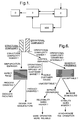
- Figure 1 shows the essential elements of apparatus according to our invention, for the testing, monitoring and improvement of a manufacturing process (not shown).
- the apparatus may be regarded as computer aided manufacturing process design, or redesign, equipment and includes a simulation model, S, a complexity calculator, C, and a knowledge based system, KBS.
- the simulation model, S is the AIM manufacturing simulation software, supplied by Pritsker Corporation, set up on a conventional desk top computer to represent a model of the manufacturing process under examination, or a similar simulation model.
- the model will run in accordance with predetermined flow and sequencing rules built into it by the supplier.
- a display D associated with the computer may display pictorially the process in operation or data relating to the process.
- the complexity calculator, C is a processor programmed to calculate values of H, and its constituent elements, using the formula of Figure 5 and data from the simulation model or external sensors (not shown) relating to resource states and queue lengths at each resource point in the modelled or real process respectively.
- the knowledge based system KBS is a combined data base and processor containing predetermined rules for improving a process dependent on absolute and relative values of H and its constituent elements. These rules are a consequence of the theoretical analysis that leads to the derivation of the formula in Figure 5.
- the operation of the equipment assumes the AIM software in the simulation model S has been set up previously to represent as appropriately as possible the process under investigation.
- the complexity calculator C provides a first set of values for H and its constituent elements using data from the sensors monitoring the real process and a second set of values of H and its constituent elements using that data in the simulation model S.
- the first and second values of H are compared. If the values differ by more than a predetermined limit the simulation model is adjusted and the calculations and comparisons are repeated. These steps are repeated until the values of H differ by less than the predetermined limit, thus validating the simulation model S as an acceptable representation of the real process.
- the KBS then analyses the respective contributions of the constituent elements of the overall complexity H of the real process and selects corresponding rules for changing the process from a look-up table containing rules and H element profiles. This analysis is described in more detail below.
- the KBS then provides data to change the simulation model in accordance with the selected rules.
- the simulation model S is then run and its performance is measured by the KBS against predetermined objectives of the process e.g. meeting a specified demand for a number of products in a given time. If the simulated performance is unsatisfactory as determined with reference to the quantified goals and predetermined acceptable variations therein, the KBS recommends further process changes in the simulation model. When simulated performance is acceptable the changes introduced in the simulation model are put into practice in the real process.
- FIG. 2 is a more detailed example of our invention and shows complexity responsive apparatus interfaced by a series of electronic sensors (not shown) to machines (not shown) employed in a manufacturing plant (not shown).
- the sensors comprise a plurality of static data sensors, a set of system breakdown sensors, a set of queue length sensors and a set of operational state sensors.
- the first of these sets of sensors (which may be a simple keyboard device) provides structural data about the factory, whilst the other three sets of sensors provide operational information about the manufacturing operation as it proceeds.
- the outputs 2, 4, 6 and 8 from the structural data, systems breakdown, queue length and resource state sets of sensors are connected to
- a main Central Processor Unit (CPU) 18 is configured such that it receives inputs from the four databases 10, 12, 14 and 16 via switches 36, 38, 40 and 42 respectively.
- the main C.P.U. 18 is pre-programmed to calculate, from the value of said inputs, values for the complexity and its constituent elements of processes of the manufacturing plant and to output these values, (expressed as equivalent product processes, EPP's), to an input of a second C.P.U., or computation means, 20 comprising a knowledge based system (KBS).
- KBS knowledge based system
- the KBS 20 is also connected to receive inputs from
- the data selected from these data bases is dependant on the EPP data received from the main C.P.U. 18 and describes the changes required to improve the efficiency of the said manufacturing process and the procedures for achieving them.
- An output from the KBS 20 is fed via switch 46 to a simulator 30 connected also to receive inputs via a switch 44 from the main C.P.U. 18 and via a switch 48 from a logic database 34, containing information relating to criteria comprising rules relating to queuing, batching, priorities, and data such as calendar dates and shift patterns required to build a simulation model.
- the simulator 30 is additionally connected to a simulation display 32 and via separate outputs 52, 54, 56 and 58 to the switched output lines of the factory database 10, the system breakdown database 12, the queue length database 14 and the operational state database 16 respectively.
- These simulator outputs, 52, 54,56 and 58 provide modified inputs to the main C.P.U. 18 to simulate the effects of changes in the manufacturing process criteria stored in the said databases 10, 12, 14 and 16.
- the function of the simulator means 30 is to provide a representation or model of the production process using change control commands received from the KBS 20.
- a comparison of the simulator's outputs inputted to the main C.P.U. 18, enables a quantitative evaluation of the effects of the KBS change commands, and their subsequent modifications on the efficiency of the manufacturing process under consideration.
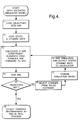
- the operation of the apparatus of Figure 1 will now be described and may be followed with the aid of the diagram showing the preparatory validation steps to be taken and the operational flow chart of Figures 2 and 3 respectively.
- the simulator 30 is initially set up to represent the manufacturing system to be tested and monitored, as closely as possible.
- the apparatus is then prepared for operation carrying out the steps shown in Figure 2 in sequence.
- switches 36, 38, 40, 42, 44 are closed, thus enabling data transfer between the respective data bases and the main C.P.U. 18, and switches 46 and 48 are opened thus disconnecting the inputs to the simulator means 30 from the KBS 20 and the logic input database 34
- switch 44 is opened and the apparatus is configured for its primary purpose of establishing and modifying the manufacturing complexity of the process under evaluation.
- the simulator 30 is also programmed to output information via lines 52, 54, 56 and 58, into the main C.P.U. unit 18, simulating inputs from the databases 10, 12, 14, 16 respectively, whose associated switches 36, 38, 40 and 42 are opened to enable the simulation results to be used for a recalculation of H and its constituent elements and a repeat of Steps 13, 14 and 15..
- the main C.P.U. 18 again calculates, using the formula of Figure 5 a value for the complexity and constituent elements of the simulated manufacturing process based on change commands supplied from the KBS 20 and the additional inputs from databases 22, 24, 28 and 34.
- the result of this complexity calculation in the main C.P.U. 18 is compared in the KBS 20 with a previously stored complexity value required to meet the objectives specified in database 28.
- Step 19 If the required reduction in the complexity of the process has not been achieved, then the information passes once again through the KBS 20 with all its additional inputs and into the simulation phase 30 to enable a simulator output 52, 54, 56 and 58 to be fed back into the main C.P.U. 18 to complete a further iteration in the process. If however the required reduction in manufacturing process complexity has been achieved then the process proceeds to Step 19.
- Step 19 The changes recommended by the KBS 20 and displayed by the simulation model 30 on the display 32 are then put into practice in the real manufacturing process.
Landscapes
- Engineering & Computer Science (AREA)
- Manufacturing & Machinery (AREA)
- General Engineering & Computer Science (AREA)
- Quality & Reliability (AREA)
- Physics & Mathematics (AREA)
- General Physics & Mathematics (AREA)
- Automation & Control Theory (AREA)
- General Factory Administration (AREA)
- Management, Administration, Business Operations System, And Electronic Commerce (AREA)
Applications Claiming Priority (2)
| Application Number | Priority Date | Filing Date | Title |
|---|---|---|---|
| GB9326354 | 1993-12-23 | ||
| GB939326354A GB9326354D0 (en) | 1993-12-23 | 1993-12-23 | Methods and apparatus for the testing,monitoring and improvement of manufacturing process effectiveness |
Publications (2)
| Publication Number | Publication Date |
|---|---|
| EP0660210A2 true EP0660210A2 (de) | 1995-06-28 |
| EP0660210A3 EP0660210A3 (de) | 1996-09-04 |
Family
ID=10747139
Family Applications (1)
| Application Number | Title | Priority Date | Filing Date |
|---|---|---|---|
| EP94309672A Withdrawn EP0660210A3 (de) | 1993-12-23 | 1994-12-22 | Verfahren und Vorrichtung zum Test, zur Überwachung und Verbesserung der Effizienz eines Herstellungsprozesses. |
Country Status (3)
| Country | Link |
|---|---|
| US (1) | US5617321A (de) |
| EP (1) | EP0660210A3 (de) |
| GB (1) | GB9326354D0 (de) |
Cited By (14)
| Publication number | Priority date | Publication date | Assignee | Title |
|---|---|---|---|---|
| WO1997039390A1 (fr) * | 1996-04-18 | 1997-10-23 | O P M Conseil | Procede et equipement pour l'optimisation de la production |
| EP0997800A1 (de) * | 1998-10-29 | 2000-05-03 | Endress + Hauser Gmbh + Co. | Gerät zur Verwendung in einem industriellen Prozess und Anlage mit solchen Geräten sowie Verfahren zum Simulieren des Betriebs einer solchen Anlage |
| WO2000043847A1 (en) * | 1999-01-21 | 2000-07-27 | Rosemount Inc. | Industrial process device management system |
| WO2000073860A1 (de) * | 1999-06-01 | 2000-12-07 | Siemens Aktiengesellschaft | Verfahren, anordnung und computerprogramm zum entwurf eines technischen systems |
| US6381508B1 (en) | 1997-04-15 | 2002-04-30 | MARRIE STéPHANE | Process and equipment for optimizing production |
| WO2002067974A1 (en) | 2001-02-28 | 2002-09-06 | Uvnaes-Moberg Kerstin | Use of oxytocin for the preparation of a pharmaceutical composition against cancer in situ and cervicitis |
| WO2002044928A3 (en) * | 2000-12-01 | 2003-11-20 | Dallas Fort Worth Technology I | System for allocating resources in a process system and method of operating the same |
| WO2003059582A3 (en) * | 2001-12-27 | 2004-06-03 | Prophet Control Systems Ltd | Program robots with off-line design |
| WO2003092128A3 (en) * | 2001-10-18 | 2004-11-18 | Lockheed Corp | Method to optimize generation of ultrasound using mathematical modeling for laser ultrasound inspection |
| US7110956B1 (en) * | 1996-05-28 | 2006-09-19 | Texas Instruments Incorporated | Capability predictor |
| WO2012140216A1 (en) | 2011-04-14 | 2012-10-18 | Pep-Tonic Medical Ab | Pharmaceutical composition |
| WO2013009610A1 (en) * | 2011-07-08 | 2013-01-17 | Intelligrated Headquarters Llc | Integrated simulation technology |
| WO2012006700A3 (pt) * | 2010-07-15 | 2013-10-10 | Instituto Nacional Da Propriedade Industrial | Sistema e processo para análise e otimização de desempenho de execução de um ou mais projetos |
| CN113039494A (zh) * | 2018-11-13 | 2021-06-25 | Abb瑞士股份有限公司 | 用于将机器学习应用于应用的方法和系统 |
Families Citing this family (20)
| Publication number | Priority date | Publication date | Assignee | Title |
|---|---|---|---|---|
| SE9304246L (sv) * | 1993-12-22 | 1995-06-23 | Asea Brown Boveri | Förfarande vid övervakning av multivariata processer |
| US5754222A (en) * | 1996-03-08 | 1998-05-19 | Eastman Kodak Company | Visual characterization using display model |
| US5850339A (en) * | 1996-10-31 | 1998-12-15 | Giles; Philip M. | Analysis of data in cause and effect relationships |
| US6317654B1 (en) | 1999-01-29 | 2001-11-13 | James William Gleeson | Control of crude refining by a method to predict lubricant base stock's ultimate lubricant preformance |
| US6295485B1 (en) | 1999-01-29 | 2001-09-25 | Mobil Oil Corporation | Control of lubricant production by a method to predict a base stock's ultimate lubricant performance |
| JP3732053B2 (ja) * | 1999-09-27 | 2006-01-05 | 株式会社日立製作所 | 製造職場の不良の起こし易さ評価方法及びその装置、製品の組立作業不良率評価方法及びその装置並びに記録媒体 |
| US7480629B2 (en) * | 2000-03-29 | 2009-01-20 | Ge Medical Systems Information Technologies, Inc. | Computer process for modeling flow of patients through hospital units |
| US6792400B2 (en) * | 2000-12-18 | 2004-09-14 | General Motors Corporation | Visualization of complex system interactions |
| US7047099B2 (en) * | 2001-06-19 | 2006-05-16 | Applied Materials Inc. | Integrating tool, module, and fab level control |
| US7082345B2 (en) * | 2001-06-19 | 2006-07-25 | Applied Materials, Inc. | Method, system and medium for process control for the matching of tools, chambers and/or other semiconductor-related entities |
| ITMI20011340A1 (it) * | 2001-06-26 | 2002-12-26 | Ausimont Spa | Pfpe aventi almeno un terminale alchiletereo e relativo processo dipreparazione |
| US6549864B1 (en) | 2001-08-13 | 2003-04-15 | General Electric Company | Multivariate statistical process analysis systems and methods for the production of melt polycarbonate |
| US20040236706A1 (en) * | 2003-04-30 | 2004-11-25 | Fitch James Chester | Automated machinery lubrication service and maintenance planning system |
| JP4244768B2 (ja) * | 2003-09-30 | 2009-03-25 | 株式会社日立製作所 | 不良影響度評価方法および設計支援システム |
| US7882057B1 (en) * | 2004-10-04 | 2011-02-01 | Trilogy Development Group, Inc. | Complex configuration processing using configuration sub-models |
| US7899763B2 (en) * | 2007-06-13 | 2011-03-01 | International Business Machines Corporation | System, method and computer program product for evaluating a storage policy based on simulation |
| US20090055156A1 (en) * | 2007-08-24 | 2009-02-26 | Rockwell Automation Technologies, Inc. | Using commercial computing package models to generate motor control code |
| JP4856728B2 (ja) * | 2009-02-05 | 2012-01-18 | インターナショナル・ビジネス・マシーンズ・コーポレーション | アセンブリデータの作成を支援する装置及び方法 |
| US8666533B2 (en) * | 2009-10-09 | 2014-03-04 | Siemens Product Lifecycle Management Software Inc. | System, method, and interface for virtual commissioning of press lines |
| US20140254897A1 (en) * | 2013-03-06 | 2014-09-11 | Tektronix, Inc. | Design verification and diagnostics for image devices |
Family Cites Families (5)
| Publication number | Priority date | Publication date | Assignee | Title |
|---|---|---|---|---|
| US4796194A (en) * | 1986-08-20 | 1989-01-03 | Atherton Robert W | Real world modeling and control process |
| US5077661A (en) * | 1989-05-03 | 1991-12-31 | Hewlett-Packard Company | Assignment-dependent resource allocation method |
| US5155679A (en) * | 1989-12-18 | 1992-10-13 | Hewlett-Packard Company | Set-up optimization for flexible manufacturing systems |
| US5140537A (en) * | 1990-05-21 | 1992-08-18 | Hewlett-Packard Company | Modeling a factory with human operators and validating the model |
| US5402367A (en) * | 1993-07-19 | 1995-03-28 | Texas Instruments, Incorporated | Apparatus and method for model based process control |
-
1993
- 1993-12-23 GB GB939326354A patent/GB9326354D0/en active Pending
-
1994
- 1994-12-22 EP EP94309672A patent/EP0660210A3/de not_active Withdrawn
- 1994-12-22 US US08/362,263 patent/US5617321A/en not_active Expired - Fee Related
Cited By (19)
| Publication number | Priority date | Publication date | Assignee | Title |
|---|---|---|---|---|
| WO1997039390A1 (fr) * | 1996-04-18 | 1997-10-23 | O P M Conseil | Procede et equipement pour l'optimisation de la production |
| FR2747603A1 (fr) * | 1996-04-18 | 1997-10-24 | Opm Conseil | Procede et equipement pour l'optimisation de la production |
| US7110956B1 (en) * | 1996-05-28 | 2006-09-19 | Texas Instruments Incorporated | Capability predictor |
| US6381508B1 (en) | 1997-04-15 | 2002-04-30 | MARRIE STéPHANE | Process and equipment for optimizing production |
| EP0997800A1 (de) * | 1998-10-29 | 2000-05-03 | Endress + Hauser Gmbh + Co. | Gerät zur Verwendung in einem industriellen Prozess und Anlage mit solchen Geräten sowie Verfahren zum Simulieren des Betriebs einer solchen Anlage |
| WO2000043847A1 (en) * | 1999-01-21 | 2000-07-27 | Rosemount Inc. | Industrial process device management system |
| US6490493B1 (en) | 1999-01-21 | 2002-12-03 | Rosemount Inc. | Industrial process device management software |
| WO2000073860A1 (de) * | 1999-06-01 | 2000-12-07 | Siemens Aktiengesellschaft | Verfahren, anordnung und computerprogramm zum entwurf eines technischen systems |
| WO2002044928A3 (en) * | 2000-12-01 | 2003-11-20 | Dallas Fort Worth Technology I | System for allocating resources in a process system and method of operating the same |
| WO2002067974A1 (en) | 2001-02-28 | 2002-09-06 | Uvnaes-Moberg Kerstin | Use of oxytocin for the preparation of a pharmaceutical composition against cancer in situ and cervicitis |
| WO2003092128A3 (en) * | 2001-10-18 | 2004-11-18 | Lockheed Corp | Method to optimize generation of ultrasound using mathematical modeling for laser ultrasound inspection |
| WO2003059582A3 (en) * | 2001-12-27 | 2004-06-03 | Prophet Control Systems Ltd | Program robots with off-line design |
| WO2012006700A3 (pt) * | 2010-07-15 | 2013-10-10 | Instituto Nacional Da Propriedade Industrial | Sistema e processo para análise e otimização de desempenho de execução de um ou mais projetos |
| WO2012140216A1 (en) | 2011-04-14 | 2012-10-18 | Pep-Tonic Medical Ab | Pharmaceutical composition |
| WO2013009610A1 (en) * | 2011-07-08 | 2013-01-17 | Intelligrated Headquarters Llc | Integrated simulation technology |
| US8731722B2 (en) | 2011-07-08 | 2014-05-20 | Intelligrated Headquarters Llc | Integrated simulation technology |
| US9280619B2 (en) | 2011-07-08 | 2016-03-08 | Intelligrated Headquarters, Llc | Integrated simulation technology |
| CN113039494A (zh) * | 2018-11-13 | 2021-06-25 | Abb瑞士股份有限公司 | 用于将机器学习应用于应用的方法和系统 |
| US12547928B2 (en) | 2018-11-13 | 2026-02-10 | Abb Schweiz Ag | Method and a system for applying machine learning to an application |
Also Published As
| Publication number | Publication date |
|---|---|
| US5617321A (en) | 1997-04-01 |
| EP0660210A3 (de) | 1996-09-04 |
| GB9326354D0 (en) | 1994-02-23 |
Similar Documents
| Publication | Publication Date | Title |
|---|---|---|
| US5617321A (en) | Methods and apparatus for the testing, monitoring and improvement of manufacturing process effectiveness | |
| Kljajic et al. | Simulation approach to decision assessment in enterprises | |
| Uzsoy et al. | A review of production planning and scheduling models in the semiconductor industry part II: Shop-floor control | |
| Persson et al. | Performance simulation of supply chain designs | |
| Chen | A fuzzy back propagation network for output time prediction in a wafer fab | |
| Alrabghi et al. | A novel approach for modelling complex maintenance systems using discrete event simulation | |
| Ayağ | A hybrid approach to machine-tool selection through AHP and simulation | |
| US5140537A (en) | Modeling a factory with human operators and validating the model | |
| Longo et al. | An application of modeling and simulation to support industrial plants design | |
| Chang et al. | Experimental investigation of real-time scheduling in flexible manufacturing systems | |
| Joseph et al. | Evaluation of routing flexibility of a flexible manufacturing system using simulation modelling and analysis | |
| Pfleeger | Design and analysis in software engineering: the language of case studies and formal experiments | |
| Pfleeger et al. | Design and analysis in software engineering | |
| CN112654943B (zh) | 制造系统设计辅助装置 | |
| US20220171908A1 (en) | Support system and support method supporting system construction | |
| Monch et al. | Simulation-based assessment of batching heuristics in semiconductor manufacturing | |
| Chen et al. | Fuzzy-neural approaches with example post-classification for estimating job cycle time in a wafer fab | |
| Reiner | Supply chain management research methodology using quantitative models based on empirical data | |
| US7801705B2 (en) | Mass on model | |
| Mukherjee et al. | Introducing a fuzzy model for cost cognizant software test case prioritization | |
| Chen | Predicting wafer-lot output time with a hybrid FCM–FBPN approach | |
| Davies | The quality gurus | |
| Schützko et al. | Predictive analytics for project management | |
| Maram et al. | Selection of software in manufacturing operations using analytic hierarchy process | |
| Dixit et al. | Quantifying the influence of FMS on the productivity of a firm |
Legal Events
| Date | Code | Title | Description |
|---|---|---|---|
| PUAI | Public reference made under article 153(3) epc to a published international application that has entered the european phase |
Free format text: ORIGINAL CODE: 0009012 |
|
| AK | Designated contracting states |
Kind code of ref document: A2 Designated state(s): BE DE FR GB LU NL |
|
| PUAL | Search report despatched |
Free format text: ORIGINAL CODE: 0009013 |
|
| AK | Designated contracting states |
Kind code of ref document: A3 Designated state(s): BE DE FR GB LU NL |
|
| 17P | Request for examination filed |
Effective date: 19970304 |
|
| 17Q | First examination report despatched |
Effective date: 19970801 |
|
| STAA | Information on the status of an ep patent application or granted ep patent |
Free format text: STATUS: THE APPLICATION IS DEEMED TO BE WITHDRAWN |
|
| 18D | Application deemed to be withdrawn |
Effective date: 19991002 |