EP0660301B1 - Verhinderung von Artefackten bei Sprachkodierern auf CELP-Basis - Google Patents
Verhinderung von Artefackten bei Sprachkodierern auf CELP-Basis Download PDFInfo
- Publication number
- EP0660301B1 EP0660301B1 EP94850222A EP94850222A EP0660301B1 EP 0660301 B1 EP0660301 B1 EP 0660301B1 EP 94850222 A EP94850222 A EP 94850222A EP 94850222 A EP94850222 A EP 94850222A EP 0660301 B1 EP0660301 B1 EP 0660301B1
- Authority
- EP
- European Patent Office
- Prior art keywords
- input signal
- speech
- signals
- encoder
- celp
- Prior art date
- Legal status (The legal status is an assumption and is not a legal conclusion. Google has not performed a legal analysis and makes no representation as to the accuracy of the status listed.)
- Expired - Lifetime
Links
Images


Classifications
-
- G—PHYSICS
- G10—MUSICAL INSTRUMENTS; ACOUSTICS
- G10L—SPEECH ANALYSIS TECHNIQUES OR SPEECH SYNTHESIS; SPEECH RECOGNITION; SPEECH OR VOICE PROCESSING TECHNIQUES; SPEECH OR AUDIO CODING OR DECODING
- G10L19/00—Speech or audio signals analysis-synthesis techniques for redundancy reduction, e.g. in vocoders; Coding or decoding of speech or audio signals, using source filter models or psychoacoustic analysis
- G10L19/012—Comfort noise or silence coding
-
- G—PHYSICS
- G10—MUSICAL INSTRUMENTS; ACOUSTICS
- G10L—SPEECH ANALYSIS TECHNIQUES OR SPEECH SYNTHESIS; SPEECH RECOGNITION; SPEECH OR VOICE PROCESSING TECHNIQUES; SPEECH OR AUDIO CODING OR DECODING
- G10L19/00—Speech or audio signals analysis-synthesis techniques for redundancy reduction, e.g. in vocoders; Coding or decoding of speech or audio signals, using source filter models or psychoacoustic analysis
- G10L19/04—Speech or audio signals analysis-synthesis techniques for redundancy reduction, e.g. in vocoders; Coding or decoding of speech or audio signals, using source filter models or psychoacoustic analysis using predictive techniques
- G10L19/08—Determination or coding of the excitation function; Determination or coding of the long-term prediction parameters
- G10L19/12—Determination or coding of the excitation function; Determination or coding of the long-term prediction parameters the excitation function being a code excitation, e.g. in code excited linear prediction [CELP] vocoders
-
- G—PHYSICS
- G10—MUSICAL INSTRUMENTS; ACOUSTICS
- G10L—SPEECH ANALYSIS TECHNIQUES OR SPEECH SYNTHESIS; SPEECH RECOGNITION; SPEECH OR VOICE PROCESSING TECHNIQUES; SPEECH OR AUDIO CODING OR DECODING
- G10L19/00—Speech or audio signals analysis-synthesis techniques for redundancy reduction, e.g. in vocoders; Coding or decoding of speech or audio signals, using source filter models or psychoacoustic analysis
- G10L19/04—Speech or audio signals analysis-synthesis techniques for redundancy reduction, e.g. in vocoders; Coding or decoding of speech or audio signals, using source filter models or psychoacoustic analysis using predictive techniques
- G10L19/08—Determination or coding of the excitation function; Determination or coding of the long-term prediction parameters
- G10L19/12—Determination or coding of the excitation function; Determination or coding of the long-term prediction parameters the excitation function being a code excitation, e.g. in code excited linear prediction [CELP] vocoders
- G10L19/135—Vector sum excited linear prediction [VSELP]
-
- G—PHYSICS
- G10—MUSICAL INSTRUMENTS; ACOUSTICS
- G10L—SPEECH ANALYSIS TECHNIQUES OR SPEECH SYNTHESIS; SPEECH RECOGNITION; SPEECH OR VOICE PROCESSING TECHNIQUES; SPEECH OR AUDIO CODING OR DECODING
- G10L19/00—Speech or audio signals analysis-synthesis techniques for redundancy reduction, e.g. in vocoders; Coding or decoding of speech or audio signals, using source filter models or psychoacoustic analysis
- G10L2019/0001—Codebooks
- G10L2019/0004—Design or structure of the codebook
- G10L2019/0005—Multi-stage vector quantisation
-
- G—PHYSICS
- G10—MUSICAL INSTRUMENTS; ACOUSTICS
- G10L—SPEECH ANALYSIS TECHNIQUES OR SPEECH SYNTHESIS; SPEECH RECOGNITION; SPEECH OR VOICE PROCESSING TECHNIQUES; SPEECH OR AUDIO CODING OR DECODING
- G10L21/00—Speech or voice signal processing techniques to produce another audible or non-audible signal, e.g. visual or tactile, in order to modify its quality or its intelligibility
- G10L21/02—Speech enhancement, e.g. noise reduction or echo cancellation
- G10L21/0208—Noise filtering
- G10L21/0216—Noise filtering characterised by the method used for estimating noise
- G10L2021/02168—Noise filtering characterised by the method used for estimating noise the estimation exclusively taking place during speech pauses
Definitions
- the present invention generally relates to digital voice communications and, more particularly, to the removal of swirl artifacts from code excited linear prediction (CELP) based coders, such as vector-sum excited linear predictive (VSELP) coders, when operating in background noise consisting of low or medium levels of non-periodic signals.
- CELP code excited linear prediction
- VSELP vector-sum excited linear predictive
- Codebook Excited Linear Prediction is a technique for speech encoding.
- the basic technique consists of searching a codebook of randomly distributed excitation vectors for that vector which produces an output sequence (when filtered through pitch and linear predictive coding (LPC) short-term synthesis filters) that is closest to the input sequence.
- LPC linear predictive coding
- all of the candidate excitation vectors in the codebook must be filtered with both the pitch and LPC synthesis filters to produce a candidate output sequence that can then be compared to the input sequence.
- LPC linear predictive coding
- VSELP Vector-Sum Excited Linear Predictive Coding
- QPSK differential quadrature phase shift keying
- TDMA time division, multiple access
- the current VSELP codebook search method is disclosed in U.S. Patent No. 4,817,157 by Gerson.
- Gerson addresses the problem of extremely high computational complexity for exhaustive codebook searching.
- the Gerson technique is based on the recursive updating of the VSELP criterion function using a Gray code ordered set of vector sum code vectors.
- the optimal code vector is obtained by exhasutively searching through the set of Gray code ordered code vector set.
- EIA Electronnic Industries Association published in August 1991 the EIA/TIA Interim Standard PN2759 for the dual-mode mobile station, base station cellular telephone system compatibility standard. This standard incorporates the Gerson VSELP codebook search method.
- the CELP based coders which use LPC coefficients to model input speech, work well for clean signals; however, when background noise is present in the input signal, the coders do a poor job of modelling the signal. This results in some artifacts at the receiver after decoding. These artifacts, referred to a swirl artifacts, considerably degrade the perceived quality of the transmitted speech.
- a CELP based coder such as a VSELP coder
- the low frequency components of the input signal are removed when no speech is detected, thus removing the swirl artifacts during silence periods. This results in a better perception of the speech at the receiver.
- the invention uses a voice activity detector (VAD) which distinguishes between a periodic signal, like speech, and a non-periodic signal, like noise.
- VAD voice activity detector
- This VAD uses most of the VSELP coder internal parameters to determine the speech or non-speech conditions. More particularly, the VSELP coder tends to determine pitch information from a non-periodic input signal even though the actual input signal does not have any periodicity. This determination of pitch from a no speech signal is what generates the swirly signal artifact in the reproduced signal at the receiver.
- a high pass filter is applied to the input signal to remove the pitch information for which the VSELP coder searches. Removing pitch information allows only the code search process that generates the speech frame information. Alternatively, the VSELP coder can be made to declare a no pitch condition and continue processing without pitch information.
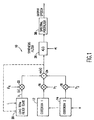
- FIG. 1 a block diagram of the speech decoder 10 utilizing two VSELP excitation codebooks 12 and 14 as set out in the EIA/TIA Interim Standard , cited above.
- Each of these code books is typically implemented in read only memory (ROM) containing M basis vectors of length N , where M is the number of bits in the codeword and N is the number of samples in the vector.
- Codebook 12 receives an input code I and provides an output vector.
- Codebook 14 receives an input code H and provides an output vector. Each of these vectors is scaled by corresponding gain terms ⁇ 1 and ⁇ 2 , respectively, in multipliers 16 and 18.
- long term filter state memory 20 typically in the form of a random access memory (RAM) receives an input lag code, L , and provides an output, b L (n) , representing the long term filter state. This too is scaled by a gain term b in multiplier 22. The outputs from the three multipliers 16, 18 and 22 are combined by summer 24 to form an excitation signal, ex ( n ). This combined excitation signal is fed back to update the long term filter state memory 20, as indicated by the dotted line. The excitation signal is also applied to the linear predictive code (LPC) synthesis filter 26, represented by the z-transform 1 A(z) . The transfert function of the synthesis filter 26 is time variant controlled by the short-term filter coefficients a i .
- LPC linear predictive code
- adaptive spectral postfilter 28 After reconstructing the speech signal with the synthesis filter 26, and adaptive spectral postfilter 28 is applied to enhance the quality of the reconstructed speech.
- the adaptive spectral postfilter is the final processing step in the speech decoder, and the digital output speech signal is input to a digital-to-analog (D/A) converter (not shown) to generate the analog signal which is amplified and reproduced by a speaker.
- D/A digital-to-analog
- Figure 2 is a block diagram of the encoder 30 for generating the codewords I and H , the lag L , and the gains ⁇ , ⁇ 1 and ⁇ 2, which are transmitted to the decoder shown in Figure 1.
- the encoder includes two VSELP excitation codebooks 32 and 34, similar to the codebooks 12 and 14.
- Codebook 32 receives an input code I and provides an output vector.
- Codebook 34 receives an input code H and provides an output vector. Each of these vectors is scaled by corresponding gain terms ⁇ 1 and ⁇ 2 , respectively, in multipliers 36 and 38.
- long term filter state memory 40 receives an input lag code, L , and provides an output, b L ( n ), representing the long term filter state.
- This too is scaled by a gain term ⁇ in multiplier 42.
- the outputs from the three multipliers 36, 38 and 42 are combined by summer 44 to form an excitation signal, ex(n) .
- This combined excitation signal is applied to the weighted synthesis filter 46, represented by the z-transform H(z) .
- This is an all pole filter and is the bandwidth expanded synthesis filter 1 A( ⁇ -1 z) .
- the output of the synthesis filter 46 is the vector p'(n) .
- the sampled speech signal s ( n ) is input to a weighting filter 48, having a transfer function represented by the z-transform W(z) , to generate the weighted speech vector p(n).
- p(n) is the weighted input speech for the subframe minus the zero input response of the weighted synthesis filter 46.
- the vector p'(n) is subtracted from the weighted speech vector p(n) in subtractor 50 to generate a difference signal e(n) .
- the signal e(n) is subjected to a sum of squares analysis in block 52 to generate an output that is the total weighted error which is input to error minimization process 54.
- the error minimization process selects the lag L and the codewords I and H , sequentially (one at a time), to minimize the total weighted error.
- the improvement to the basic VSELP coder is shown in Figure 3, to which reference is now made.
- the input signal is digitized by an analog-to-digital (A/D) converter 54 and supplied to one pole of a switch 56.
- the digitized input signal is also supplied via a high pass filter 58 to a second pole of the switch 56.
- the switch 56 is controlled to select either the digitized input signal or the high pass filtered output from filter 58 by a voice activity detector (VAD) 60.
- VAD voice activity detector
- the output of the switch 56 is supplied to the VSELP coder 62.
- the VAD 60 receives as inputs the original digitized input signal and an output of the VSELP coder 62.
- DSP digital signal processor
- the VSELP coder 62 determines pitch and input signal transfer function (i.e., reflection coefficients).
- the VAD 60 uses the reflection coefficients generated by the VSELP coder 62 and the input signal in order to generate a decision of speech (i.e., a TRUE output) or no speech (i.e., a FALSE output).
- the TRUE output causes the switch 56 to select the digitized input signal from the A/D converter 54, but a FALSE output causes the switch 56 to select the high pass filtered output from high pass filter 58.
- the VAD 60 uses the reflection coefficients from the VSELP coder 62 in determining current frame LPC coefficients, and these LPC coefficients and previously determined LPC coefficient histories are averaged and stored in a buffer.
- the original 160 input samples are 500 Hz highpass filtered and used in determining the auto-correlation function (ACF), and this ACF and previously determined ACFs are stored in a buffer.
- ACF auto-correlation function
- This data is used by the VAD 60 to determine whether speech is present or not.
- the architecture of this detection process is shown in Figure 4, to which reference is now made.
- the input digitized speech is input to a speech buffer 64 which, in a preferred embodiment, stores 160 samples of speech.
- the speech samples 65 from the speech buffer 64 are supplied to the frame parameters function 66 and to the residual and pitch detector function 68.
- the frame parameters function 66 uses the VSELP reflection coefficients in determining current frame LPC coefficients 67 to the pitch detector function 68, and the pitch detector function 68 outputs a Boolean variable 69 which is true when pitch is detected over a speech frame. Existence of a periodic signal is determined in pitch detector function 68.
- the frame parameters function 66 also provides an output 70 which is the current and last three frames of the auto-correlation functions (ACF) and an output 71 which is five sets of LPC coefficients based on the average ACF functions.
- ACF auto-correlation functions
- the output 71 is supplied to the mean residual power function 72 which, in turn, generates an output 73 representing the current residual power.
- This output 73 is input to the noise classification function 74, as is the Boolean variable 69.
- the noise classification function 74 generates as its output the noise LPC coefficients 75 which, together with the output 70 from the frame parameters function 66, is input to the adaptive filtering and energy computation function 76, the output of which is the current residual power 77.
- the VAD decision function 78 generates the speech/no speech decision output 79.
- the VAD 60 is basically an energy detector.
- the energy of the filtered signal is compared with a threshold, and speech is detected whenever the threshold is detected.
- a FALSE output of the VAD 60 causes the input to the VSELP coder 62 to be from the high pass filter 58, thereby removing the low frequency (i.e., pitch) components of the input signal and thus removing the swirl artifacts that would otherwise be generated by the VSELP coder 62 during silence periods.
Landscapes
- Engineering & Computer Science (AREA)
- Computational Linguistics (AREA)
- Signal Processing (AREA)
- Health & Medical Sciences (AREA)
- Audiology, Speech & Language Pathology (AREA)
- Human Computer Interaction (AREA)
- Physics & Mathematics (AREA)
- Acoustics & Sound (AREA)
- Multimedia (AREA)
- Compression, Expansion, Code Conversion, And Decoders (AREA)
Claims (8)
- System zur Verhinderung von Wirbel-Artefakten bei einem Sprachcodierer (62) auf CELP(code excited linear prediction)-Basis, gekennzeichnet durch:einen Schalter (56), der zur Aufnahme eines Eingangssignals angeschlossen ist, das periodische und nicht periodische Signale enthält;ein HP(high pass)-Filter (58), das ebenfalls zur Aufnahme des genannten Eingangssignals angeschlossen ist und zur Beseitigung von niedrigfrequenten Komponenten des Eingangssignals dient, wobei der Schalter zur selektiven Zuführung des Eingangssignals oder eines Ausgangssignals vom HP-Filter zum CELP-Sprachcodierer steuerbar ist; undeinen Detektor (60), der zur Aufnahme des genannten Eingangssignals sowie von Information aus dem CELP-Sprachcodierer angeschlossen ist und ein Ausgangssignal erzeugt, das die Anwesenheit von periodischen Signalen im Eingangssignal anzeigt, wobei der Detektor den genannten Schalter steuert, um das Eingangssignal mit dem CELP-Sprachcodierer zu verbinden, sobald periodische Signale ermittelt werden, und das Ausgangssignal vom HP-Filter mit dem CELP-Sprachcodierer zu verbinden, sobald keine periodischen Signale ermittelt werden.
- System nach Patentanspruch 1, dadurch gekennzeichnet, daß der CELP-Sprachcodierer (62) ein VSELP (vector-sum excited linear predictive)-Sprachcodierer (62) ist.
- System nach Patentanspruch 1 oder 2, dadurch gekennzeichnet, daß der Detektor vom CELP-Sprachcodierer Reflexionskoeffizienten (66) empfängt und ein Energieniveau (76) des Eingangssignals festlegt, um eine Bestimmung der Anwesenheit von periodischen Signalen im Eingangssignal durchzuführen.
- System nach einem der vorhergehenden Patentansprüche, dadurch gekennzeichnet, daß die periodischen Signale sprachartig sind und die nicht periodischen Signale geräuschartig sind, und der Detektor (60) ein sprachaktiver Detektor (VAD) ist.
- System nach einem der vorhergehenden Patentansprüche, dadurch gekennzeichnet, daß die durch das HP-Filter beseitigten niedrigfrequenten Komponenten einer Tonstufeninformation (pitch information) entsprechen.
- System nach einem der vorhergehenden Patentsprüche, dadurch gekennzeichnet, daß weiters ein an den Detektor sowie den CELP-Sprachcodierer angeschlossener Regeleingang vorgesehen ist, der den CELP-Sprachcodierer anweist, gefilterte Eingangssignale ohne Tonstufeninformation zu codieren, wenn keine periodischen Signale ermittelt werden, und Eingangssignale mit Tonstufeninformation zu codieren, wenn periodische Signale ermittelt werden.
- Verfahren zur Verhinderung von Wirbel-Artefakten bei einem Sprachcodierer (62) auf CELP-Basis, gekennzeichnet durch folgende Schritte:Abtasten eines Eingangssignals und Umwandlung der Eingangssignalabtastwerte in digitale Werte (54), wobei das Eingangssignal periodische sowie nicht periodische Signale enthält, und die periodischen Signale sprachartige Signale sind und die nicht periodischen Signale geräuschartige Signale sind;HP-Filterung (58) der digitalen Werte des Eingangssignals, um niedrigfrequente Komponenten von Abtastwerten des Eingangssignals zu beseitigen, wobei diese niedrigfrequenten Komponenten einer Tonstufeninfomation entsprechend;Bestimmung der Anwesenheit von sprachartigen Signalen im genannten Eingangssignal unter Verwendung eines sprachaktivierten Detektors (VAD) (60), der zur Aufnahme der digitalen Werte des Eingangssignals und Information von CELP-Sprachcodierer angeschlossen ist; undselektive Zuführung (56) der digitalen Werte des Eingangssignals oder der HP-gefilterten digitalen Werte zum CELP-Sprachcodierer, wobei die digitalen Werte des Eingangssignals mit dem CELP-Sprachcodierer verbunden sind sobald sprachartige Signale ermittelt werden, und die HP-gefilterten digitalen Werte mit dem CELP-Sprachcodierer verbunden sind, sobald keine sprachartigen Signale ermittelt werden.
- Verfahren nach Patentanspruch 7, gekennzeichnet durch selektive Veranlassung des CELP-Sprachcodierers zur Angabe eines Nicht-Tonstufenzustandes, wenn durch den VAD geräuschartige Signale ermittelt werden wobei der CELP-Sprachcodierer die Verarbeitung von digitalen Werten des Eingangssignals ohne Tonstufeninformation fortsetzt, jedoch bei Ermittlung von sprachartigen Signalen durch den VAD die Verarbeitung von digitalen Werten des Eingangssignals mit Tonstufeninformation aufnimmt.
Applications Claiming Priority (2)
| Application Number | Priority Date | Filing Date | Title |
|---|---|---|---|
| US16978993A | 1993-12-20 | 1993-12-20 | |
| US169789 | 1998-10-09 |
Publications (2)
| Publication Number | Publication Date |
|---|---|
| EP0660301A1 EP0660301A1 (de) | 1995-06-28 |
| EP0660301B1 true EP0660301B1 (de) | 1996-06-05 |
Family
ID=22617182
Family Applications (1)
| Application Number | Title | Priority Date | Filing Date |
|---|---|---|---|
| EP94850222A Expired - Lifetime EP0660301B1 (de) | 1993-12-20 | 1994-12-12 | Verhinderung von Artefackten bei Sprachkodierern auf CELP-Basis |
Country Status (7)
| Country | Link |
|---|---|
| US (1) | US5633982A (de) |
| EP (1) | EP0660301B1 (de) |
| CN (1) | CN1113586A (de) |
| AT (1) | ATE139050T1 (de) |
| CA (1) | CA2136891A1 (de) |
| DE (1) | DE69400229D1 (de) |
| FI (1) | FI945915L (de) |
Cited By (1)
| Publication number | Priority date | Publication date | Assignee | Title |
|---|---|---|---|---|
| RU2289858C2 (ru) * | 2002-06-27 | 2006-12-20 | Самсунг Электроникс Ко., Лтд. | Способ и устройство кодирования аудиосигнала с использованием извлечения гармоник |
Families Citing this family (14)
| Publication number | Priority date | Publication date | Assignee | Title |
|---|---|---|---|---|
| JP3522012B2 (ja) * | 1995-08-23 | 2004-04-26 | 沖電気工業株式会社 | コード励振線形予測符号化装置 |
| GB2312360B (en) * | 1996-04-12 | 2001-01-24 | Olympus Optical Co | Voice signal coding apparatus |
| AUPO170196A0 (en) * | 1996-08-16 | 1996-09-12 | University Of Alberta | A finite-dimensional filter |
| JP3593839B2 (ja) * | 1997-03-28 | 2004-11-24 | ソニー株式会社 | ベクトルサーチ方法 |
| KR100261254B1 (ko) * | 1997-04-02 | 2000-07-01 | 윤종용 | 비트율 조절이 가능한 오디오 데이터 부호화/복호화방법 및 장치 |
| US6122271A (en) * | 1997-07-07 | 2000-09-19 | Motorola, Inc. | Digital communication system with integral messaging and method therefor |
| JP3235543B2 (ja) * | 1997-10-22 | 2001-12-04 | 松下電器産業株式会社 | 音声符号化/復号化装置 |
| KR100335609B1 (ko) * | 1997-11-20 | 2002-10-04 | 삼성전자 주식회사 | 비트율조절이가능한오디오부호화/복호화방법및장치 |
| US7072832B1 (en) * | 1998-08-24 | 2006-07-04 | Mindspeed Technologies, Inc. | System for speech encoding having an adaptive encoding arrangement |
| US6240386B1 (en) * | 1998-08-24 | 2001-05-29 | Conexant Systems, Inc. | Speech codec employing noise classification for noise compensation |
| US6954727B1 (en) * | 1999-05-28 | 2005-10-11 | Koninklijke Philips Electronics N.V. | Reducing artifact generation in a vocoder |
| US7013268B1 (en) * | 2000-07-25 | 2006-03-14 | Mindspeed Technologies, Inc. | Method and apparatus for improved weighting filters in a CELP encoder |
| US6983242B1 (en) * | 2000-08-21 | 2006-01-03 | Mindspeed Technologies, Inc. | Method for robust classification in speech coding |
| US7170855B1 (en) * | 2002-01-03 | 2007-01-30 | Ning Mo | Devices, softwares and methods for selectively discarding indicated ones of voice data packets received in a jitter buffer |
Family Cites Families (10)
| Publication number | Priority date | Publication date | Assignee | Title |
|---|---|---|---|---|
| US5276765A (en) * | 1988-03-11 | 1994-01-04 | British Telecommunications Public Limited Company | Voice activity detection |
| US5233660A (en) * | 1991-09-10 | 1993-08-03 | At&T Bell Laboratories | Method and apparatus for low-delay celp speech coding and decoding |
| US5236745A (en) * | 1991-09-13 | 1993-08-17 | General Electric Company | Method for increasing the cyclic spallation life of a thermal barrier coating |
| US5214708A (en) * | 1991-12-16 | 1993-05-25 | Mceachern Robert H | Speech information extractor |
| US5410632A (en) * | 1991-12-23 | 1995-04-25 | Motorola, Inc. | Variable hangover time in a voice activity detector |
| US5495555A (en) * | 1992-06-01 | 1996-02-27 | Hughes Aircraft Company | High quality low bit rate celp-based speech codec |
| US5327520A (en) * | 1992-06-04 | 1994-07-05 | At&T Bell Laboratories | Method of use of voice message coder/decoder |
| US5426719A (en) * | 1992-08-31 | 1995-06-20 | The United States Of America As Represented By The Department Of Health And Human Services | Ear based hearing protector/communication system |
| US5307405A (en) * | 1992-09-25 | 1994-04-26 | Qualcomm Incorporated | Network echo canceller |
| US5459814A (en) * | 1993-03-26 | 1995-10-17 | Hughes Aircraft Company | Voice activity detector for speech signals in variable background noise |
-
1994
- 1994-11-29 CA CA002136891A patent/CA2136891A1/en not_active Abandoned
- 1994-12-12 DE DE69400229T patent/DE69400229D1/de not_active Expired - Lifetime
- 1994-12-12 AT AT94850222T patent/ATE139050T1/de not_active IP Right Cessation
- 1994-12-12 EP EP94850222A patent/EP0660301B1/de not_active Expired - Lifetime
- 1994-12-15 FI FI945915A patent/FI945915L/fi not_active Application Discontinuation
- 1994-12-19 CN CN94112982A patent/CN1113586A/zh active Pending
-
1996
- 1996-10-21 US US08/734,210 patent/US5633982A/en not_active Expired - Lifetime
Cited By (1)
| Publication number | Priority date | Publication date | Assignee | Title |
|---|---|---|---|---|
| RU2289858C2 (ru) * | 2002-06-27 | 2006-12-20 | Самсунг Электроникс Ко., Лтд. | Способ и устройство кодирования аудиосигнала с использованием извлечения гармоник |
Also Published As
| Publication number | Publication date |
|---|---|
| DE69400229D1 (de) | 1996-07-11 |
| EP0660301A1 (de) | 1995-06-28 |
| CN1113586A (zh) | 1995-12-20 |
| FI945915A0 (fi) | 1994-12-15 |
| US5633982A (en) | 1997-05-27 |
| CA2136891A1 (en) | 1995-06-21 |
| ATE139050T1 (de) | 1996-06-15 |
| FI945915A7 (fi) | 1995-06-21 |
| FI945915L (fi) | 1995-06-21 |
Similar Documents
| Publication | Publication Date | Title |
|---|---|---|
| EP0698877B1 (de) | Postfilter und Verfahren zur Postfilterung | |
| EP1125285B1 (de) | Verbesserung der periodizität eines breitbandsignals | |
| EP0660301B1 (de) | Verhinderung von Artefackten bei Sprachkodierern auf CELP-Basis | |
| US5491771A (en) | Real-time implementation of a 8Kbps CELP coder on a DSP pair | |
| US5729655A (en) | Method and apparatus for speech compression using multi-mode code excited linear predictive coding | |
| US5867814A (en) | Speech coder that utilizes correlation maximization to achieve fast excitation coding, and associated coding method | |
| JP3392412B2 (ja) | 音声コーディング装置及び音声エンコーディング方法 | |
| KR100421648B1 (ko) | 음성코딩을 위한 적응성 표준 | |
| US5884251A (en) | Voice coding and decoding method and device therefor | |
| US6205423B1 (en) | Method for coding speech containing noise-like speech periods and/or having background noise | |
| US5797119A (en) | Comb filter speech coding with preselected excitation code vectors | |
| US5657419A (en) | Method for processing speech signal in speech processing system | |
| US6397178B1 (en) | Data organizational scheme for enhanced selection of gain parameters for speech coding | |
| EP1688918A1 (de) | Sprachdekodierung | |
| EP0984433A2 (de) | Rauschunterdrückung in einer Sprachkommunikationseinheit und Betriebsverfahren | |
| US6175817B1 (en) | Method for vector quantizing speech signals | |
| JPH10149200A (ja) | 線形予測符号化装置 | |
| KR20000013870A (ko) | 음성 부호화기에서 피치 예측을 이용한 오류 프레임 처리 방법및 그를 이용한 음성 부호화 방법 | |
| JPH06274199A (ja) | 音声符号化装置 | |
| JPH07248795A (ja) | 音声処理装置 | |
| JPH05249999A (ja) | 学習型音声符号化装置 | |
| JPH07248796A (ja) | 音声処理装置 | |
| JPH0784598A (ja) | 音声処理装置 |
Legal Events
| Date | Code | Title | Description |
|---|---|---|---|
| PUAI | Public reference made under article 153(3) epc to a published international application that has entered the european phase |
Free format text: ORIGINAL CODE: 0009012 |
|
| AK | Designated contracting states |
Kind code of ref document: A1 Designated state(s): AT BE CH DE DK ES FR GB GR IT LI NL SE |
|
| 17P | Request for examination filed |
Effective date: 19950517 |
|
| 17Q | First examination report despatched |
Effective date: 19950808 |
|
| GRAH | Despatch of communication of intention to grant a patent |
Free format text: ORIGINAL CODE: EPIDOS IGRA |
|
| GRAA | (expected) grant |
Free format text: ORIGINAL CODE: 0009210 |
|
| AK | Designated contracting states |
Kind code of ref document: B1 Designated state(s): AT BE CH DE DK ES FR GB GR IT LI NL SE |
|
| PG25 | Lapsed in a contracting state [announced via postgrant information from national office to epo] |
Ref country code: NL Free format text: LAPSE BECAUSE OF FAILURE TO SUBMIT A TRANSLATION OF THE DESCRIPTION OR TO PAY THE FEE WITHIN THE PRESCRIBED TIME-LIMIT Effective date: 19960605 Ref country code: LI Effective date: 19960605 Ref country code: IT Free format text: LAPSE BECAUSE OF FAILURE TO SUBMIT A TRANSLATION OF THE DESCRIPTION OR TO PAY THE FEE WITHIN THE PRE;WARNING: LAPSES OF ITALIAN PATENTS WITH EFFECTIVE DATE BEFORE 2007 MAY HAVE OCCURRED AT ANY TIME BEFORE 2007. THE CORRECT EFFECTIVE DATE MAY BE DIFFERENT FROM THE ONE RECORDED.SCRIBED TIME-LIMIT Effective date: 19960605 Ref country code: GR Free format text: LAPSE BECAUSE OF FAILURE TO SUBMIT A TRANSLATION OF THE DESCRIPTION OR TO PAY THE FEE WITHIN THE PRESCRIBED TIME-LIMIT Effective date: 19960605 Ref country code: FR Effective date: 19960605 Ref country code: DK Effective date: 19960605 Ref country code: CH Effective date: 19960605 Ref country code: BE Effective date: 19960605 Ref country code: AT Effective date: 19960605 |
|
| REF | Corresponds to: |
Ref document number: 139050 Country of ref document: AT Date of ref document: 19960615 Kind code of ref document: T |
|
| REF | Corresponds to: |
Ref document number: 69400229 Country of ref document: DE Date of ref document: 19960711 |
|
| PG25 | Lapsed in a contracting state [announced via postgrant information from national office to epo] |
Ref country code: SE Effective date: 19960905 |
|
| PG25 | Lapsed in a contracting state [announced via postgrant information from national office to epo] |
Ref country code: DE Effective date: 19960906 |
|
| PG25 | Lapsed in a contracting state [announced via postgrant information from national office to epo] |
Ref country code: ES Free format text: LAPSE BECAUSE OF FAILURE TO SUBMIT A TRANSLATION OF THE DESCRIPTION OR TO PAY THE FEE WITHIN THE PRESCRIBED TIME-LIMIT Effective date: 19960916 |
|
| EN | Fr: translation not filed | ||
| NLV1 | Nl: lapsed or annulled due to failure to fulfill the requirements of art. 29p and 29m of the patents act | ||
| PGFP | Annual fee paid to national office [announced via postgrant information from national office to epo] |
Ref country code: BE Payment date: 19961129 Year of fee payment: 3 |
|
| PGFP | Annual fee paid to national office [announced via postgrant information from national office to epo] |
Ref country code: ES Payment date: 19961211 Year of fee payment: 3 |
|
| REG | Reference to a national code |
Ref country code: CH Ref legal event code: PL |
|
| PLBE | No opposition filed within time limit |
Free format text: ORIGINAL CODE: 0009261 |
|
| STAA | Information on the status of an ep patent application or granted ep patent |
Free format text: STATUS: NO OPPOSITION FILED WITHIN TIME LIMIT |
|
| 26N | No opposition filed | ||
| PG25 | Lapsed in a contracting state [announced via postgrant information from national office to epo] |
Ref country code: GB Free format text: LAPSE BECAUSE OF NON-PAYMENT OF DUE FEES Effective date: 19981212 |
|
| GBPC | Gb: european patent ceased through non-payment of renewal fee |
Effective date: 19981212 |