EP0660443A1 - Connecteur électrique avec dispositif de retention amélioré - Google Patents
Connecteur électrique avec dispositif de retention amélioré Download PDFInfo
- Publication number
- EP0660443A1 EP0660443A1 EP95200108A EP95200108A EP0660443A1 EP 0660443 A1 EP0660443 A1 EP 0660443A1 EP 95200108 A EP95200108 A EP 95200108A EP 95200108 A EP95200108 A EP 95200108A EP 0660443 A1 EP0660443 A1 EP 0660443A1
- Authority
- EP
- European Patent Office
- Prior art keywords
- tip
- post
- faces
- face
- electrical connector
- Prior art date
- Legal status (The legal status is an assumption and is not a legal conclusion. Google has not performed a legal analysis and makes no representation as to the accuracy of the status listed.)
- Granted
Links
Images

Classifications
-
- H—ELECTRICITY
- H01—ELECTRIC ELEMENTS
- H01R—ELECTRICALLY-CONDUCTIVE CONNECTIONS; STRUCTURAL ASSOCIATIONS OF A PLURALITY OF MUTUALLY-INSULATED ELECTRICAL CONNECTING ELEMENTS; COUPLING DEVICES; CURRENT COLLECTORS
- H01R12/00—Structural associations of a plurality of mutually-insulated electrical connecting elements, specially adapted for printed circuits, e.g. printed circuit boards [PCB], flat or ribbon cables, or like generally planar structures, e.g. terminal strips, terminal blocks; Coupling devices specially adapted for printed circuits, flat or ribbon cables, or like generally planar structures; Terminals specially adapted for contact with, or insertion into, printed circuits, flat or ribbon cables, or like generally planar structures
- H01R12/50—Fixed connections
- H01R12/51—Fixed connections for rigid printed circuits or like structures
- H01R12/55—Fixed connections for rigid printed circuits or like structures characterised by the terminals
- H01R12/58—Fixed connections for rigid printed circuits or like structures characterised by the terminals terminals for insertion into holes
-
- H—ELECTRICITY
- H01—ELECTRIC ELEMENTS
- H01R—ELECTRICALLY-CONDUCTIVE CONNECTIONS; STRUCTURAL ASSOCIATIONS OF A PLURALITY OF MUTUALLY-INSULATED ELECTRICAL CONNECTING ELEMENTS; COUPLING DEVICES; CURRENT COLLECTORS
- H01R12/00—Structural associations of a plurality of mutually-insulated electrical connecting elements, specially adapted for printed circuits, e.g. printed circuit boards [PCB], flat or ribbon cables, or like generally planar structures, e.g. terminal strips, terminal blocks; Coupling devices specially adapted for printed circuits, flat or ribbon cables, or like generally planar structures; Terminals specially adapted for contact with, or insertion into, printed circuits, flat or ribbon cables, or like generally planar structures
- H01R12/70—Coupling devices
- H01R12/7005—Guiding, mounting, polarizing or locking means; Extractors
- H01R12/7011—Locking or fixing a connector to a PCB
- H01R12/7064—Press fitting
-
- H—ELECTRICITY
- H01—ELECTRIC ELEMENTS
- H01R—ELECTRICALLY-CONDUCTIVE CONNECTIONS; STRUCTURAL ASSOCIATIONS OF A PLURALITY OF MUTUALLY-INSULATED ELECTRICAL CONNECTING ELEMENTS; COUPLING DEVICES; CURRENT COLLECTORS
- H01R13/00—Details of coupling devices of the kinds covered by groups H01R12/70 or H01R24/00 - H01R33/00
- H01R13/02—Contact members
- H01R13/04—Pins or blades for co-operation with sockets
- H01R13/05—Resilient pins or blades
-
- H—ELECTRICITY
- H05—ELECTRIC TECHNIQUES NOT OTHERWISE PROVIDED FOR
- H05K—PRINTED CIRCUITS; CASINGS OR CONSTRUCTIONAL DETAILS OF ELECTRIC APPARATUS; MANUFACTURE OF ASSEMBLAGES OF ELECTRICAL COMPONENTS
- H05K3/00—Apparatus or processes for manufacturing printed circuits
- H05K3/30—Assembling printed circuits with electric components, e.g. with resistors
- H05K3/306—Assembling printed circuits with electric components, e.g. with resistors with lead-in-hole components
- H05K3/308—Adaptations of leads
Definitions
- This invention relates to electrical connectors of the type having a connector body and a plurality of posts extending out of one side of the connector body for mounting to a circuit board.
- this invention relates to an improved retention feature for such electrical connectors for temporarily holding the electrical connector in place on a printed circuit board prior to soldering.
- US-A-4 847 588 discloses an electrical connector with a retention feature in which the posts of the connector are offset in the form of a crimp to create frictional forces against the side wall of the through hole of the circuit board onto which the electrical connector is mounted.
- the discloses retention feature relies entirely on friction, and does not provide any latching force tending to secure the electrical connector in position on the circuit board.
- each pin of the connector is formed to create a latching force against the bottom surface of the circuit board on which the electrical connector is mounted. See for example US-A-3 524 108 and JP-U-57-86270.
- Such below the board retention features can provide an audible click when the connector is seated on the circuit board, and some users regard below the board retention features as more stable.
- pin headers In the past, posts have been press fit into connector bodies such as pin headers.
- Pin headers often include either shrouded or shroudless plastic bodies which define preformed through holes into which the posts are press fit for retention in order to form a header assembly.
- the dimensions of the through holes and the posts are selected such that the corners of the posts interfere with the through holes, thereby retaining the posts in the connector body by a force fit.
- the present invention is directed to an improved tip geometry that in the preferred embodiments described below, meets the following objectives:
- the present invention consists in an electrical connector as defined in claim 1.
- an electrical connector of the type including a connector body and a plurality of posts extending out of one side of the connector body for mounting to a circuit board, each of said posts defining a tip, and a centerline, wherein the connector is mounted on a circuit board of the type comprising a pair of spaced, parallel surfaces and a plurality of through holes extending therebetween and intersecting the surfaces at corners, and wherein each of the posts is received in a respective one of the through holes, there being at least one retention feature, each formed on a selected one of the posts, said retention feature comprising a bent portion of the post comprising a first portion extending from the centerline to an apex, and a second portion extending from the apex to the tip, said retention feature being configured such that the apex is situated outside of the respective through hole, and the first portion contacts the circuit board at the respective corner between the through hole and the surface opposite the connector body; said second portion
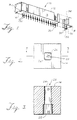
- FIG. 1 shows a general view of an electrical connector 10 which incorporates a presently preferred embodiment of this invention.
- the electrical connector 10 as shown is a header which comprises a connector body 12 molded of a suitable plastic material.
- the body 12 includes a base 14 and integrally molded side walls 16 and standoffs 18. Rows of through holes are preformed in the base 14 during the molding operation.
- FIGS 2 and 3 show further details of one of the through holes 20 of the base 14, which includes a round portion 22 and an out-of-round portion 24 that includes two pairs of opposed faces 26.
- each through hole 20 is formed with a single core pin that forms both the round portion 22 and the out-of-round portion 24, thereby eliminating any internal mating lines (and possible misalignment) within the through hole 20.
- the electrical connector 10 also includes an array of posts 30, 30'.
- Each of the posts 30, 30' defines a first end 32 and an opposed second end 34.
- the first ends 32 are adapted to be inserted into through holes of a printed circuit board while the second ends 34 are adapted to mate with a mating connector (not shown).
- the four corner posts 30' are provided with a retention feature as described below.
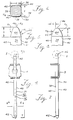
- each of the posts 30 defines a cross-section which comprises two pairs of opposed post faces 38 that intersect at post edges 40 extending parallel to the centerline 36.
- each of the post edges 40 is curved with a radius of curvature which is at least about one fifth of the maximum face to face dimension.
- the maximum face to face dimension is about 0.0635cm (0.025 inches) and the radius of curvature is at least about 0.0127cm (0.005 inches).
- Figures 4 and 7 show one of the posts 30 mounted in a bandolier B which is used to position and retain the posts 30 for forming, plating and press fit operations in the conventional manner.
- Each end of the posts 30, 30' defines a tip 42 which is shaped to provide the advantages described above.
- the features of the tip 42 described below facilitate insertion of the tip 42 into the through hole 20 and provide improved mating between the mating end and the socket of a mating connector (not shown).
- each tip 42 defines four converging tip faces 44 which converge from the body of the post 30 toward a nose 46.
- the nose 46 may be flat or radiused as desired.
- each of the tip faces 44 is shaped as a section of a cylinder and is convex outwardly with a radius of curvature that is preferably greater than the maximum face to face dimension of the post 30.
- Each of the tip faces 44 is aligned with a respective one of the post faces 38 and is joined thereto at a tip-to-body edge 48. Because of the convexity of the tip faces 44, there is a smooth transition between each of the tip faces 44 and the aligned post face 38.
- adjacent ones of the tip faces 44 intersect at tip edges 50 which are convex outwardly and which intersect the radiused post edges 40 at tip-to-body corners 52.
- the convexly shaped tip edges 50 cooperate with the radiused post edges 40 to provide a smooth transition and to substantially eliminate protruding corners that might tend to skive the through hole 20 of the body 12 during assembly.
- an alternate geometry for the tip 42' includes tip faces 44' substantially as described above which meet at a nose 46'.
- intermediate surfaces 56' are provided which taper toward the nose 46'.
- Each of the intermediate surfaces 56' is interposed between two adjacent tip faces 44' such that the intermediate surfaces 56' are rotated by 45 degrees with respect to the tip faces 44'.
- the tip edges 50' curve inwardly toward the tip faces 44'.
- the intermediate surfaces 56' provide a number of advantages. First, they reduce the prominence of the tip-to-body corners 52', thereby reducing skiving problems as described below. Furthermore, because the tip edges 50' curve inwardly toward the tip faces 44', debris tends to be wiped away to the outside of the tip 42' during mating. Furthermore, the shape of the tip faces 44' allows high pressure cleaning of a mating receptacle during mating. In alternative embodiments the tip faces 44' and the intermediate surfaces 56' may be all convex, all planar, or some may be convex and some planar.
- the posts 30 are press fit into the through holes 20 of the body 12, by passing the tips 42, 42' through the through holes 20 in a conventional press-fit operation.
- the tip geometries 42, 42' described above provide advantages during the press-fit operation. Because the tip-to-body corners 52, 52' and the tip-to-body edges 48, 48' are relieved, there is a reduced tendency for the tips 42, 42' to skive plastic out of the body 12 as the tips 42, 42' pass through the through hole 20. Because of the cooperation between the shape of the posts 30 and the shape of the through holes 20, maximum stresses on the body 12 around the through holes 20 are reduced, and maximum insertion forces are reduced as well. Furthermore, because the mating end 54 is shaped as described above, mating forces are reduced as well.
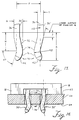
- FIG. 13 shows an enlarged end view of the connector 10 and two of the corner posts 30'.
- Figure 14 shows a cross-sectional view of the electrical connector 10 mounted in a circuit board 60 prior to soldering.
- the circuit board 60 defines top and bottom surfaces 62, 64 and through holes 66 extending therebetween.
- the through holes 66 are generally cylindrical, and the intersection region between the through holes 66 and the surfaces 62, 64 defines corners 68.
- At least one and preferably pairs of the posts 30' are bent to provide a retention feature 70.
- the bent portion of each of the posts 30' defines a first portion 72 which diverges away from the centerline 36 to an apex 74.
- the bent post also defines a second portion 76 which extends from the apex 74 to the tip 42.
- the first and second portions 72, 76 are configured such that the apex 74 is positioned to one side of the centerline 36, but the tip 42 is positioned on the centerline 36.
- the radiused post edges 40 provide rounded contacting surfaces that contact the corners 68 as the retention feature 70 is inserted into the through hole 66.
- each of the retention features 70 creates a latching force tending to pull the electrical connector 10 into contact with the top surface 62.
- the retention features 70 function below the board to latch the electrical connector 10 in place, an audible click may be heard when the electrical connector 10 is seated on the circuit board 60.
- This latching type retention feature as more stable than retention features which rely solely on friction within the through hole 66.
- the retention feature 70 has surprisingly been found to function properly with circuit board through holes 66 having a wide range of diameters, without unacceptable damage to the tin plating that is typically present in the through hole. This surprising result is believed to be directly attributable to the cooperation between the geometry of the first and second portions 72, 76 and the geometry of the radiused post edges 40. The resulting retention feature reduces damage to the through hole plating and functions without any undesirable increase in the length of the post 30' extending below the bottom surface 64 of the circuit board 60.
- the retention feature 70 can be used both with straight headers as shown and right angle headers (not shown). Furthermore, the retention feature 70 can be used on single posts or on pairs of posts as shown in which the apex is 74 offset with respect to the centerline 36. Depending upon the application, the apexes 74 may be offset toward one another, away from one another, or at some angle with respect to one another. Furthermore, the retention feature 70 is well suited for use in headers having one, two, or three or more rows of posts 30.
- the posts 30, 30' may be formed from drawn, radiused phosphor bronze wire such as UNS C51000, Temper 3H.
- the body 12 may be molded of any suitable material such as a glass filled nylon or a liquid crystal polymer.
- Table 1 provides presently preferred dimensions, using reference symbols defined in Figures 5, 6, 8 and 13.
- TABLE 1 Reference Symbol ( Figures ) Dimension Or Angle cms (inches) degrees A 0.05842 (0.023) B 0.04572 (0.018) C 0.02413 (0.0095) D 0.06452 (0.0245) E 0.06452 (0.0245) F 0.254 (0.100) G 0.09652 (0.038) H 0.19558 (0.077) I 0.06452 (0.0245) J 0.0508 (0.020) K 0.29718 (0.117) L1 70° 46 L2 13° 35 R1 0.3302 (0.130) R2 0.01778 (0.007) R3 0.09398 (0.037) R4 0.01524 (0.006) R5 0.1784 (0.055) Note that the length of the tip A is less than the maximum face to face dimension D, E.
- the round portion 22 in this preferred embodiment has a diameter of 0.07036cm (0.0277 inches), and the out-of-round portion 24 in this preferred embodiment defines a maximum diagonal dimension of 0.07036cm (0.0277 inches), and a maximum dimension between opposed faces 26 of 0.05969 cm (0.0235) inches).
- the posts 30, 30' define a maximum diagonal dimension of 0.074168cm (0.0292 inches). These dimensions have been found to provide excellent post retention without excessive post insertion forces or excessive stresses to the body 12.
- the tip 42 is formed in a multi-step operation which combines coining and shearing operations, using vertically moving dies.
- first step an upper one of the tip faces 44 in coined downwardly. This pushes excess metal laterally.
- the two side tip faces 44 shown in profile in Figure 5 are sheared into the desired convex shape.
- the upper and lower tip faces shown in profile in Figure 8 are coined (the upper tip face for the second time and the lower tip face for the first time) to the final convex shape.
- This approach provides the desired tip geometry while requiring only dies that move vertically.
- the first ends 32 are typically tin plated to facilitate soldering, and the second ends 34 are typically gold plated to facilitate mating operations.
- plating details for the first and second ends do not form part of this invention, and are therefore not described in greater detail here.
- This preferred embodiment has been designed for use with through holes 66 having a diameter of 0.1016 cm ⁇ (0.040 ⁇ 0.003 inches) in a circuit board 60 having a thickness of 0.15748 cm ⁇ 0.01778 cm (0.062 ⁇ 0.007 inches). Throughout these tolerance ranges the connector 10 can be inserted with an insertion force of no more than 4.54 kg (10 pounds), and adequate retention forces are obtained. Surprisingly, this has been achieved with stiff posts of the type described above, without damage to the tin plating at the corners 68.
- the present invention may readily be adapted to square posts of other dimensions and to rectangular posts.
- Other forming techniques such as rolling and cutting operations may be used to form the tip, and the radiused post edges may be compressively or otherwise formed only in desired regions of the post.
Landscapes
- Coupling Device And Connection With Printed Circuit (AREA)
- Multi-Conductor Connections (AREA)
- Connections Arranged To Contact A Plurality Of Conductors (AREA)
- Connector Housings Or Holding Contact Members (AREA)
Applications Claiming Priority (5)
| Application Number | Priority Date | Filing Date | Title |
|---|---|---|---|
| US70343391A | 1991-05-17 | 1991-05-17 | |
| US703433 | 1991-05-17 | ||
| US701929 | 1991-05-17 | ||
| US07/701,929 US5122075A (en) | 1991-05-17 | 1991-05-17 | Electrical connector with improved retention feature |
| EP92304040A EP0514066B1 (fr) | 1991-05-17 | 1992-05-05 | Connecteur électrique avec dispositif de rétention amélioré |
Related Parent Applications (1)
| Application Number | Title | Priority Date | Filing Date |
|---|---|---|---|
| EP92304040.6 Division | 1992-05-05 |
Publications (2)
| Publication Number | Publication Date |
|---|---|
| EP0660443A1 true EP0660443A1 (fr) | 1995-06-28 |
| EP0660443B1 EP0660443B1 (fr) | 1997-10-22 |
Family
ID=27106873
Family Applications (2)
| Application Number | Title | Priority Date | Filing Date |
|---|---|---|---|
| EP92304040A Expired - Lifetime EP0514066B1 (fr) | 1991-05-17 | 1992-05-05 | Connecteur électrique avec dispositif de rétention amélioré |
| EP95200108A Expired - Lifetime EP0660443B1 (fr) | 1991-05-17 | 1992-05-05 | Connecteur électrique |
Family Applications Before (1)
| Application Number | Title | Priority Date | Filing Date |
|---|---|---|---|
| EP92304040A Expired - Lifetime EP0514066B1 (fr) | 1991-05-17 | 1992-05-05 | Connecteur électrique avec dispositif de rétention amélioré |
Country Status (3)
| Country | Link |
|---|---|
| EP (2) | EP0514066B1 (fr) |
| JP (1) | JPH05174886A (fr) |
| DE (2) | DE69222874T2 (fr) |
Families Citing this family (4)
| Publication number | Priority date | Publication date | Assignee | Title |
|---|---|---|---|---|
| DE4218431C2 (de) * | 1992-06-04 | 1995-04-20 | Cannon Electric Gmbh | Einrichtung zur Verbindung eines Steckverbinders mit einer Leiterplatte |
| GB2271221B (en) * | 1992-09-30 | 1996-07-03 | Thomas & Betts Corp | Electrical connector |
| DE4321065A1 (de) * | 1993-06-24 | 1995-01-19 | Phoenix Contact Gmbh & Co | Anschlußleiste |
| JP6960748B2 (ja) * | 2017-03-07 | 2021-11-05 | ヒロセ電機株式会社 | 電気コネクタおよび電気コネクタ組立体 |
Citations (4)
| Publication number | Priority date | Publication date | Assignee | Title |
|---|---|---|---|---|
| FR2450510A1 (fr) * | 1979-02-28 | 1980-09-26 | Souriau & Cie | Perfectionnements aux jeux de contacts pour connecteurs electriques |
| US4557549A (en) * | 1980-06-30 | 1985-12-10 | The Charles Stark Draper Laboratory, Inc. | Connector device |
| US4679890A (en) * | 1984-06-25 | 1987-07-14 | American Telephone And Telegraph Company, At&T Bell Laboratories | Connector contact terminal |
| EP0232103A2 (fr) * | 1986-01-29 | 1987-08-12 | E.I. Du Pont De Nemours And Company | Agencement de broche et alvéole de prise de courant électrique pour connecteurs à fiches et douilles |
Family Cites Families (3)
| Publication number | Priority date | Publication date | Assignee | Title |
|---|---|---|---|---|
| US3162721A (en) * | 1960-07-26 | 1964-12-22 | Illinois Tool Works | Component lead-locking arrangement |
| NL6612497A (fr) * | 1966-09-06 | 1968-03-07 | ||
| CA1282847C (fr) * | 1986-03-05 | 1991-04-09 | Ray C. Doutrich | Connecteur electrique a cale-broches |
-
1992
- 1992-05-05 EP EP92304040A patent/EP0514066B1/fr not_active Expired - Lifetime
- 1992-05-05 DE DE69222874T patent/DE69222874T2/de not_active Expired - Lifetime
- 1992-05-05 DE DE69207261T patent/DE69207261T2/de not_active Expired - Lifetime
- 1992-05-05 EP EP95200108A patent/EP0660443B1/fr not_active Expired - Lifetime
- 1992-05-18 JP JP4148928A patent/JPH05174886A/ja active Pending
Patent Citations (4)
| Publication number | Priority date | Publication date | Assignee | Title |
|---|---|---|---|---|
| FR2450510A1 (fr) * | 1979-02-28 | 1980-09-26 | Souriau & Cie | Perfectionnements aux jeux de contacts pour connecteurs electriques |
| US4557549A (en) * | 1980-06-30 | 1985-12-10 | The Charles Stark Draper Laboratory, Inc. | Connector device |
| US4679890A (en) * | 1984-06-25 | 1987-07-14 | American Telephone And Telegraph Company, At&T Bell Laboratories | Connector contact terminal |
| EP0232103A2 (fr) * | 1986-01-29 | 1987-08-12 | E.I. Du Pont De Nemours And Company | Agencement de broche et alvéole de prise de courant électrique pour connecteurs à fiches et douilles |
Also Published As
| Publication number | Publication date |
|---|---|
| EP0514066A1 (fr) | 1992-11-19 |
| EP0660443B1 (fr) | 1997-10-22 |
| DE69222874D1 (de) | 1997-11-27 |
| JPH05174886A (ja) | 1993-07-13 |
| DE69222874T2 (de) | 1998-02-26 |
| DE69207261D1 (de) | 1996-02-15 |
| EP0514066B1 (fr) | 1996-01-03 |
| DE69207261T2 (de) | 1996-08-01 |
Similar Documents
| Publication | Publication Date | Title |
|---|---|---|
| US5122075A (en) | Electrical connector with improved retention feature | |
| US5139446A (en) | Electrical connector assembly | |
| US4874338A (en) | Receptacle box terminal with improved contact area | |
| EP0664581B1 (fr) | Connecteur à profil bas pour l'interconnexion de deux cartes de circuits imprimés | |
| US5584709A (en) | Printed circuit board mounted electrical connector | |
| EP0543278B1 (fr) | Connecteur électrique à profile bas | |
| US6312296B1 (en) | Electrical connector having enhanced retention of contacts in a housing | |
| DE69012459T2 (de) | Elektrischer Steckverbinder. | |
| EP0660445B1 (fr) | Connecteur électrique à retenue des contacts | |
| US5702257A (en) | Electrical connector and terminal therefor | |
| US4984996A (en) | Printed circuit board edge connector | |
| US5184962A (en) | Electrical spring contact | |
| US5571033A (en) | Electrical connector having press-fit contacts for circuit board mounting | |
| CA2328658C (fr) | Contact de connecteur et methode de fabrication | |
| JPH11502053A (ja) | 電気リセプタクル組立体及びそのためのばねコンタクト | |
| US5860838A (en) | Tangle-preventive mechanism in three contact pieces type contact | |
| US20050070139A1 (en) | Press fit pin | |
| EP0660443B1 (fr) | Connecteur électrique | |
| US5322461A (en) | Electrical connector with posts having improved tip geometry | |
| US4778396A (en) | Electrical connector having compliant posts and improved insertion characteristics | |
| US5194022A (en) | Elecrical connector | |
| US5102356A (en) | Electrical connector having board retention means | |
| DE68919987T2 (de) | Zylindrische Miniaturendkontaktbüchse. | |
| EP0139786B1 (fr) | Connecteur à fiche ainsi qu'un boîtier isolant et des contacts pour celui-ci | |
| EP0354064A2 (fr) | Connecteur électrique multibroche du type à faible force d'insertion |
Legal Events
| Date | Code | Title | Description |
|---|---|---|---|
| PUAI | Public reference made under article 153(3) epc to a published international application that has entered the european phase |
Free format text: ORIGINAL CODE: 0009012 |
|
| AC | Divisional application: reference to earlier application |
Ref document number: 514066 Country of ref document: EP |
|
| AK | Designated contracting states |
Kind code of ref document: A1 Designated state(s): DE FR GB |
|
| 17P | Request for examination filed |
Effective date: 19951228 |
|
| GRAG | Despatch of communication of intention to grant |
Free format text: ORIGINAL CODE: EPIDOS AGRA |
|
| 17Q | First examination report despatched |
Effective date: 19961106 |
|
| GRAH | Despatch of communication of intention to grant a patent |
Free format text: ORIGINAL CODE: EPIDOS IGRA |
|
| GRAH | Despatch of communication of intention to grant a patent |
Free format text: ORIGINAL CODE: EPIDOS IGRA |
|
| RBV | Designated contracting states (corrected) |
Designated state(s): DE FR GB |
|
| GRAA | (expected) grant |
Free format text: ORIGINAL CODE: 0009210 |
|
| AC | Divisional application: reference to earlier application |
Ref document number: 514066 Country of ref document: EP |
|
| AK | Designated contracting states |
Kind code of ref document: B1 Designated state(s): DE FR GB |
|
| ET | Fr: translation filed | ||
| REF | Corresponds to: |
Ref document number: 69222874 Country of ref document: DE Date of ref document: 19971127 |
|
| PLBE | No opposition filed within time limit |
Free format text: ORIGINAL CODE: 0009261 |
|
| STAA | Information on the status of an ep patent application or granted ep patent |
Free format text: STATUS: NO OPPOSITION FILED WITHIN TIME LIMIT |
|
| 26N | No opposition filed | ||
| PGFP | Annual fee paid to national office [announced via postgrant information from national office to epo] |
Ref country code: GB Payment date: 19990406 Year of fee payment: 8 |
|
| PG25 | Lapsed in a contracting state [announced via postgrant information from national office to epo] |
Ref country code: GB Free format text: LAPSE BECAUSE OF NON-PAYMENT OF DUE FEES Effective date: 20000505 |
|
| GBPC | Gb: european patent ceased through non-payment of renewal fee |
Effective date: 20000505 |
|
| PGFP | Annual fee paid to national office [announced via postgrant information from national office to epo] |
Ref country code: FR Payment date: 20110607 Year of fee payment: 20 |
|
| PGFP | Annual fee paid to national office [announced via postgrant information from national office to epo] |
Ref country code: DE Payment date: 20110527 Year of fee payment: 20 |
|
| REG | Reference to a national code |
Ref country code: DE Ref legal event code: R071 Ref document number: 69222874 Country of ref document: DE |
|
| REG | Reference to a national code |
Ref country code: DE Ref legal event code: R071 Ref document number: 69222874 Country of ref document: DE |
|
| PG25 | Lapsed in a contracting state [announced via postgrant information from national office to epo] |
Ref country code: DE Free format text: LAPSE BECAUSE OF EXPIRATION OF PROTECTION Effective date: 20120508 |