EP0660587B1 - Procédé réversible de compression vidéo - Google Patents
Procédé réversible de compression vidéo Download PDFInfo
- Publication number
- EP0660587B1 EP0660587B1 EP94111246A EP94111246A EP0660587B1 EP 0660587 B1 EP0660587 B1 EP 0660587B1 EP 94111246 A EP94111246 A EP 94111246A EP 94111246 A EP94111246 A EP 94111246A EP 0660587 B1 EP0660587 B1 EP 0660587B1
- Authority
- EP
- European Patent Office
- Prior art keywords
- data
- compression
- marker
- bytes
- block
- Prior art date
- Legal status (The legal status is an assumption and is not a legal conclusion. Google has not performed a legal analysis and makes no representation as to the accuracy of the status listed.)
- Expired - Lifetime
Links
- 238000000034 method Methods 0.000 title claims description 54
- 230000002441 reversible effect Effects 0.000 title claims description 40
- 238000007906 compression Methods 0.000 title description 68
- 230000006835 compression Effects 0.000 title description 62
- 238000013144 data compression Methods 0.000 claims description 23
- 230000006837 decompression Effects 0.000 claims description 23
- 239000003550 marker Substances 0.000 description 51
- 230000015654 memory Effects 0.000 description 23
- 108010077524 Peptide Elongation Factor 1 Proteins 0.000 description 11
- 102000010292 Peptide Elongation Factor 1 Human genes 0.000 description 11
- 108010077519 Peptide Elongation Factor 2 Proteins 0.000 description 10
- 238000010586 diagram Methods 0.000 description 9
- 230000002411 adverse Effects 0.000 description 8
- 238000007639 printing Methods 0.000 description 7
- 230000008569 process Effects 0.000 description 5
- 238000012545 processing Methods 0.000 description 5
- 238000013459 approach Methods 0.000 description 4
- 230000007246 mechanism Effects 0.000 description 4
- 230000000737 periodic effect Effects 0.000 description 4
- 230000003044 adaptive effect Effects 0.000 description 2
- 230000004075 alteration Effects 0.000 description 2
- 230000008901 benefit Effects 0.000 description 2
- 230000015572 biosynthetic process Effects 0.000 description 2
- 230000000903 blocking effect Effects 0.000 description 2
- 230000004048 modification Effects 0.000 description 2
- 238000012986 modification Methods 0.000 description 2
- 230000009471 action Effects 0.000 description 1
- 230000006978 adaptation Effects 0.000 description 1
- 230000003466 anti-cipated effect Effects 0.000 description 1
- 230000002457 bidirectional effect Effects 0.000 description 1
- 230000008859 change Effects 0.000 description 1
- 238000004891 communication Methods 0.000 description 1
- 238000010276 construction Methods 0.000 description 1
- 230000003247 decreasing effect Effects 0.000 description 1
- 238000013461 design Methods 0.000 description 1
- 230000000694 effects Effects 0.000 description 1
- 230000006870 function Effects 0.000 description 1
- PWPJGUXAGUPAHP-UHFFFAOYSA-N lufenuron Chemical compound C1=C(Cl)C(OC(F)(F)C(C(F)(F)F)F)=CC(Cl)=C1NC(=O)NC(=O)C1=C(F)C=CC=C1F PWPJGUXAGUPAHP-UHFFFAOYSA-N 0.000 description 1
- 239000000463 material Substances 0.000 description 1
- 230000037361 pathway Effects 0.000 description 1
- 230000009467 reduction Effects 0.000 description 1
- 230000002829 reductive effect Effects 0.000 description 1
- 230000003068 static effect Effects 0.000 description 1
- 238000003786 synthesis reaction Methods 0.000 description 1
- 230000003936 working memory Effects 0.000 description 1
Images







Classifications
-
- H—ELECTRICITY
- H03—ELECTRONIC CIRCUITRY
- H03M—CODING; DECODING; CODE CONVERSION IN GENERAL
- H03M7/00—Conversion of a code where information is represented by a given sequence or number of digits to a code where the same, similar or subset of information is represented by a different sequence or number of digits
- H03M7/30—Compression; Expansion; Suppression of unnecessary data, e.g. redundancy reduction
- H03M7/3084—Compression; Expansion; Suppression of unnecessary data, e.g. redundancy reduction using adaptive string matching, e.g. the Lempel-Ziv method
- H03M7/3088—Compression; Expansion; Suppression of unnecessary data, e.g. redundancy reduction using adaptive string matching, e.g. the Lempel-Ziv method employing the use of a dictionary, e.g. LZ78
-
- H—ELECTRICITY
- H03—ELECTRONIC CIRCUITRY
- H03M—CODING; DECODING; CODE CONVERSION IN GENERAL
- H03M7/00—Conversion of a code where information is represented by a given sequence or number of digits to a code where the same, similar or subset of information is represented by a different sequence or number of digits
- H03M7/30—Compression; Expansion; Suppression of unnecessary data, e.g. redundancy reduction
- H03M7/46—Conversion to or from run-length codes, i.e. by representing the number of consecutive digits, or groups of digits, of the same kind by a code word and a digit indicative of that kind
- H03M7/48—Conversion to or from run-length codes, i.e. by representing the number of consecutive digits, or groups of digits, of the same kind by a code word and a digit indicative of that kind alternating with other codes during the code conversion process, e.g. run-length coding being performed only as long as sufficientlylong runs of digits of the same kind are present
-
- H—ELECTRICITY
- H04—ELECTRIC COMMUNICATION TECHNIQUE
- H04N—PICTORIAL COMMUNICATION, e.g. TELEVISION
- H04N1/00—Scanning, transmission or reproduction of documents or the like, e.g. facsimile transmission; Details thereof
- H04N1/41—Bandwidth or redundancy reduction
Definitions
- the present invention relates to data compression and decompression methods, more particularly, to a data compression and decompression methods that allows for decompression in the reverse direction.
- Data compression systems are known in the prior art that encode a stream of digital data signals into compressed digital code signals and decode the compressed digital code signals back into the original data.
- Data compression refers to any process that attempts to convert data in a given format into an alternative format requiring less space than the original.
- the objective of data compression systems is to effect a savings in the amount of storage required to hold or the amount of time required to transmit a given body of digital information.
- a general purpose digital data compression system should satisfy certain criteria.
- the system should have reciprocity.
- the decoded and original data must be identical and indistinguishable with respect to each other.
- the property of reciprocity is synonymous to that of strict noiselessness used in information theory. Some applications do not require strict adherence to the property of reciprocity. One such application in particular is when dealing with graphical data. Because the human eye is not that sensitive to noise, some alteration or loss of information during the compression de-compression process is acceptable.
- the system should provide sufficient performance with respect to the data rates provided by and accepted by the devices with which the data compression and de-compression systems are communicating.
- the rate at which data can be compressed is determined by the input data processing rate into the compression system, typically in millions of bytes per second (megabytes/sec). Sufficient performance is necessary to maintain the data rates achieved in present day disk, tape and communication systems which rates typically exceed one megabyte/sec. Thus, the data compression and de-compression system must have enough data throughput so as to not adversely affect the overall system.
- the performance of data compression and de-compression systems is typically limited by the computations necessary to compress and de-compress and the speed of the system components such as, random access memory (RAM), and the like, utilized to store statistical data and guide the compression and de-compression process. Performance for a compression device is characterized by the number of processor cycles required per input character under the compressor. The fewer the number of cycles, the higher the performance.
- compression effectiveness is characterized by the compression ratio.
- the compression ratio is the ratio of data size in uncompressed form divided by the size in compressed form.
- Compression effectiveness is determined by how effectively the compression procedure uses the redundancy in the input data.
- redundancy occurs both in the nonuniform usage of individual symbology, for example, digits, bytes, or characters, and in frequent recurrence of symbol sequences, such as common words, blank record fields and the like.
- Huffman procedure maps full length segments of symbols into variable length words.
- the Huffman data compression procedure suffers from two limitations. Firstly, the Huffman procedure operates under the constraint that the input data to be compressed be parsed into fixed length segments of symbols. Although the Huffman procedure provides the best compression ratio that can be obtained under these constraints, when the constraint is relaxed it is possible to obtain significantly better compression ratios by utilizing other procedures.
- Huffman coding requires full knowledge of the statistical characteristic of the source data. The Huffman procedure operates under the assumption that the probability with which each fixed length input segment occurs is known. This requirement of the Huffman procedure can in practice, be satisfied by the use of an adaptive version of the procedure which accumulates the necessary statistics during processing of the data. This, however, is cumbersome, and requires considerable working memory space and performs sub-optimally during adaptation.
- the Tunstall algorithm which maps variable length segments of symbols into fixed length binary words, is complimentary to the Huffman procedure with the fixed length constraints now applied to the output segments instead of the input segments.
- the Tunstall procedure requires a foreknowledge of the source data probabilities. Again this foreknowledge requirement can be satisfied to some degree by utilizing an adaptive version which accumulates the statistics during processing of the data.
- the Lempel-Ziv procedure maps variable length segments of the symbols into variable length binary words. It is asymptotically optimal when there are no constraints on the input or output segments.
- the input data string is parsed into adaptively grown segments, each segment consisting of an exact copy of an earlier portion of the input string suffixed by one new symbol from the input data.
- the copy which is to be made is the longest possible and is not constrained to coincide with any earlier parsed segment.
- the code word which replaces the segment in the output contains information consisting of a pointer to where there earlier copied portion begins, the length of the copy, and the new symbol.
- RLE run length encoding
- duplex printing printers which provide duplex printing require that the second page printed be printed from top to bottom and right to left.
- duplex printer is the LaserJet printer produced by the assignee of the present invention.
- Duplexing mechanism 50 includes a reversing roller 52 and a slave roller 54 that are, respectively positioned on each side of a reversing path 56.
- An imprinting path extension 24' communicates with imprinting path 24 within the laser printer and is opened when duplex operation is desired. When in that position, select lever 34 closes off output pathway 36 thereby preventing a media sheet from exiting the printer during the duplex printing portion of the cycle.
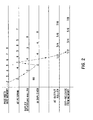
- a timing diagram is illustrated for the duplexing system.
- the horizontal axis of the chart of Fig. 2 indicated increments of time and each line of the chart indicates a specific station in the laser printer, and the numbers above each line indicate when the page bearing that number arise at that station.
- the first line of chart Fig. 2 indicates that the pages are received serially from a connected computer not shown. Note, that no printing action is commenced at PC drum 26 until both pages 1 and 2 are stored in memory, at which time, page 2 is printed first.
- page 2 then proceeds through reversing roller 52 and passes into the lower portion of the duplexer mechanism 50.
- the sheet bearing page 2 is then transported past PC drum 26 to enable page 1 to be printed on its front side.
- the duplexer printed media sheet bearing page 1 and 2 is then passed to output roller 38 where it exits onto output tray 40 and is released from memory.
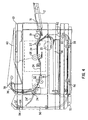
- Fig. 3 shows that as the printed media cycled through the duplexer to print the second page, which is actually page 1, the bottom is first presented to PC drum 26.
- Figs. 3 and 4 By following the paper path through Figs. 3 and 4, one would also see that printing now takes place from right to left.
- a duplex printer such as the one described and shown in Fig. 2, requires data for the second page printed be presented to the printer PC drum 26 in the reverse order.
- US-A-5 151 797 relates to an image forming apparatus for an image formation in accordance with first image data acquired by a forward movement of a scanner in an image reading unit of the image forming apparatus and further in accordance with second image data acquired by a return movement of the scanner.
- the first and second image data are stored into a storing means.
- the first image data is read in a first reading order from the storing means and the second image data is read in a second reading order from the storing means wherein the second reading order is opposite to the first reading order.
- US-A-4 568 983 relates to the compression and decompression of image data.
- the bidirectional decoding of encoded data blocks is possible by utilization of fixed-length coded words, a forced definition of at least the first and the last data word of each strip of coded words as text and the utilization of synchronization code words.
- the synchronization words indicate characteristics of coded data to be decoded when decompressed in the forward direction, while in the reverse direction the synchronization words verify characteristics of the information just decoded.
- FIG. 1 is a side schematic diagram of a printer with a duplexing mechanism attached.
- FIG. 2 is a timing diagram helpful in understanding the operation of the printer.
- FIG. 3 is the printer shown in Fig. 1 at a further point in its operation.
- FIG. 4 is the printer shown in Fig. 3 at a further point in its operation.
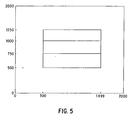
- FIG. 5 shows a graphical window with a relatively simple line art object therein.
- FIG. 6 gives an RLE encoding arrangement that could be used with the present invention.
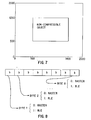
- FIG. 7 shows a similar graphical window as that shown in FIG. 5, however, the object therein is not compressible.
- FIG. 8 one possible representation of the mark used in FIG 13.
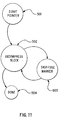
- FIG. 9 shows the state diagram used to compress data in accordance with the present invention.
- FIG. 10 is a state diagram used when decompressing data in the reverse direction.
- FIG. 11 is a state diagram used when decompressing data in the forward direction.
- FIG. 12 represents the data when a fixed blocking size is used without markers.
- FIG. 13 shows the markers being used in accordance with the present invention.
- FIG: 14 is a high level functional diagram of a printer system that uses the present invention.
- data compression is the process of converting data from one format to a second where the second format requires less space.
- Previous data'compression schemes all assume that the data would be decompressed in the forward direction. While this is most often true, some special applications require decompression of the data in the reverse direction.
- the present invention allows for decompression in either the forward or reverse directions. Such reversibility can be accomplished in one of two primary ways.
- a periodic marker can be placed in the compressed data stream.
- Each marker contains information necessary to decode a block of the compressed data and possibly the location of the next marker.
- the decompression can be guided in either the forward or reverse direction.
- FIG. 5 a region to be compressed is shown in figure 5.
- the area of figure 5 is described as a two-dimension X-Y coordinate system.
- a computer system uses a similar two-dimensional arrangement to describe its screen.
- a printer system may also use such a arrangement.
- the object is displayed, or printed, as a series of dots known in the art as pixels.
- each point (x, y) represent a unique pixel. Assuming that each pixel requires one byte, then the region of figure 5 requires 2001*2001 or 4,004,001 bytes memory.
- RLE uses a count field and an identifier field.
- an RLE byte is divided into two nibbles each with four bits.
- the first four bits represent an RLE code, while the last four bits are a function of the RLE code. If the first nibble contains a value of 1 to 12, then the second nibble defines a pattern that is repeated 1 to 12 times.
- RLE code 13
- the second nibble defines the number of black words.
- an RLE code of 14 the second nibble defines the number of white words.
- an RLE code of 15 signals that there are COUNT bytes of un-compressed data following.
- Table 2 shows memory content for the same line as table 1 however, in table 2 the above RLE compression scheme is used. In table 2, memory contents are shown on the right-hand side with the values shown in hexadecimal. Because the left-hand side no longer corresponds to the x value, it gives a count of duplicate values.
- the white portion from 0 to 499 is encoded by noting that it contains 500 bytes of white.
- white is encoded using two bytes, herein referred to as words.
- the white section is comprised of 250 words of white.
- white words are encoded with [14][COUNT]. Because the present definition of COUNT is limited to a 4-bit nibble, the maximum value that COUNT can hold is 15. Therefore the question is, how many 15 word chunks are necessary to describe 500 bytes. Dividing 250 by 15 yields 16.67.
- the remaining 20 bytes, or 10 words, of the white line are encoded in the single byte [14][10] or 'EA' hex.
- the first region which required 500 bytes to store with no compression, now only requires 17 bytes to store.
- the black line from 500 to 1499 is encoded into 33 bytes of 'DF' ([13][15]) and one byte of 'D5' ([13][5]) thereby reducing the original 1000 bytes to 34 bytes.
- the white section from 1500 to 2000 is encoded into 16 bytes of 'EF' and one byte of 'EB'. Adding up the memory requirements shows that the compression ratio is: 2001/68 ⁇ 29.43 to 1.
- the simple box of figure 5 has been replaced with a non-compressible object.
- This arrangement is used to demonstrate how RLE compression handles non-compressible material.
- the line can be considered as containing three sections, white from 0 to 499, un-compressible from 500-1499, and white again from 1500 to 2000.
- the first white section compresses to 16 bytes of 'EF' and one byte of 'EA'.
- Compression of the second white line produces 16 bytes of 'EF' and one byte of 'EB'. Because the section from 500 to 1499 has been defined as non-compressible, no compression is performed.
- raster data can be stored in a maximum packet of 15 bytes with a compression code as a type of header of 'FF' ([15][15]).
- a compression code as a type of header of 'FF' ([15][15]).
- the 1000 bytes of raster data is divided into 15 byte packets.
- the 1000 bytes are divided by 15 to get 66.67.
- the table has 66 packets with a header value of 'FF' followed by 15 bytes of raster data and one packet with a header value of 'FA' followed by 10 bytes of raster data.
- un-compressible portions require more space to store in a compressed format then does the original data. Specifically, the portion from 500 to 1499 originally required 1000 bytes to store. Using the present example compression scheme, that same portion now requires 1067 bytes to store. However, compression of the entire line does reduce memory requirements by: 2001/1101 ⁇ 1.82 to 1.
- Decompression is accomplished by reading a byte from memory, interpreting the code and executing the proper instruction.
- the first byte 'EF' is read and interpreted as meaning write 15 words of white.
- the byte 'FF' means the next 15 bytes are uncompressed data. It is this uncompressed code that makes reverse decompression of RLE impossible. For example, when attempting to decompress in the reverse direction, the first byte read is 'EB'. But it is impossible, without additional information to determine if 'EB' is a valid RLE code or if it is raster data.
- the compressed code is divided into known block sizes and a marker is placed at the beginning of the block. This mark describes the type of data in the forthcoming block or in the alternative, the marker could describe the type of data in the previous block.
- a marker is shown in figure 8.
- the marker shown in figure 8 encodes the status of each of the eight bytes in a single bit of the marker.
- the first bit of the marker is set to a one.
- Compression of data including the markers is relatively simple as shown in figure 9.
- the data is compressed into X-byte blocks 601. In the present example, X has been chosen as eight.
- the marker is created and stored in the data stream 602. If the embodiment uses pre-markers, that is the marker describes the forthcoming block, then the marker is placed into the data stream before the compressed data. If, in the alternative, the embodiment uses post-markers, then the marker is placed into the data stream after the compressed data.
- the end pointer is retrieved 701.
- the pointer is adjusted to find the last marker 702. If the embodiment uses pre-markers, the pointer is adjusted to point to the last marker. If the embodiment uses post-markers, the last byte should be a marker describing the previous block of data.
- the block of data is decompressed in the forward direction into a buffer 703. Once the block has been decompressed, the buffer is read backwards 704 thereby generating the data in the reverse direction. It should be noted that taking into consideration that by definition, a single RLE code decodes into a number of identical bytes, therefore, the use of a buffer becomes optional. Without the buffer, each RLE code is decoded directly into the output stream.
- the same data as compressed in Table 3 is shown in Table 4.
- the marker of Fig. 8 is used.
- the compressed data be broken into eight byte blocks. Referring to Table 4, the first byte is a marker 'FF'. Because the next eight bytes are all RLE codes, the marker has all eight bits set to one. This is also true for the second marker.
- the compression routine When the data becomes un-compressible, the compression routine must break the compressed data into eight byte blocks plus a marker at the start of each block. As a result of this requirement, the un-compressible data can only be stored in eight byte blocks or less.
- the third marker has a value of '80' Hex or 1000 0000 binary. Interpreting this marker shows that the first byte ('EA') is a valid RLE code and that the last seven bytes are raster.
- the fourth marker '00' signifies that all eight bytes are raster. By simple arithmetic it can be shown that 124 blocks of eight bytes and one byte are necessary to describe the un-compressible region.
- next marker '7F' signifies that the one remaining raster byte follows, with seven bytes of RLE codes.
- an optional ending marker pointing to the last valid marker is shown. Omission of the ending marker necessitates the determination of the last marker's position by dividing the compressed file size by nine and adjusting for any remainder.
- a second embodiment uses a similar method, except that the markers are excluded.
- the block sized is fixed.
- the primary modification necessary to decode this embodiment is that the encoder must insure that the beginning byte of each block is a valid RLE byte and not a raster data byte. Such an arrangement may require raster data be broken into more packets then would nominally be necessary to encode.
- Decompressing this arrangement is similar to that shown in figure 10. First, the end pointer is retrieved 701. Next, the pointer is adjusted to align with the start of the last block 702. The block of data is decompressed in the forward direction into a buffer 703. Once the block has been decompressed, the buffer is read backwards 704 thereby generating the data in the reverse direction.
- Table 5 Use of the arrangement of figure 12 is shown in Table 5.
- This table uses a blocking size of 16 because such a size matches the maximum block size for un-compressible data. Looking at the table shows that only two lines are different from that of Table 3, namely, the first line of un-compressible data has been decreased by one and the last line of un-compressible data has been increased by one. Again, either an ending marker can be used or the last block can be calculated as described above. Thus, in this example, if the ending marker is omitted, the file size for a reversible compression arrangement is the same as the non-reversible. Depending on the input data the reversible compressed file may not be the same size as the non-reversible.
- This particular arrangement of RLE codes, block size, and markers have been chosen to aid the reader in understanding the present invention. Such information is not meant to limit the present invention to using this arrangement.
- Yet another embodiment uses the marker as a backwards pointer as shown in figure 13.
- a pointer could point backwards to the beginning of a block or the start of a line, or any other point in the data.
- the encoder must insure that the pointer points back to a valid RLE byte and not a raster data byte.
- the primary advantage of this embodiment is the increased and variable block size, which produces a comparable reduction in the number of markers used, thus improving the compression ratio. Decompression in the forward direction is shown in figure 11.
- the marker would generally be skipped over 502.
- the LZ78 compression scheme can also be modified to allow reverse decompression.
- One embodiment uses markers embedded in the compressed data as described earlier. A marker is placed in the data whenever a change is made to the dictionary. Furthermore, the marker provides an offset to the next marker. By using the markers, the decompressor can reconstruct the dictionary in the forward direction. Once the decompressor reaches the desired point, decompression begins. The block is decompressed into a buffer and the buffer is read backwards thereby outputting the data in the reverse direction. Decompression in the forward direction must ignore the markers. Because markers require additional space to store, this embodiment adversely affects the compression ratio.
- Another embodiment does not require the use of markers. By eliminating the markers, the compression ratio is not adversely affected. However, the dictionary must be reconstructed in the forward direction. Reconstruction of the dictionary requires that the data be read forward only for the purpose of constructing the dictionary. Once the decompressor reaches the desired point, decompression begins. The block is decompressed into a buffer and the buffer is read backwards. Decompression in the forward direction is unaffected. This embodiment does not adversely affect the compression ratio, however, additional processing time is necessary to reconstruct the dictionary thereby adversely affecting the performance.
- a duplex printer As was stated earlier one particular application that makes use of the reversible data compression method is a duplex printer. Referring to Fig. 14, a generic block diagram of one such printer is shown. Note that APPLICATION PROGRAM 1400 shown in Fig. 14 is not part of the printer system.
- application program 1400 sends data to the printer system using a high level printer control language 1401.
- CPU 1402 retrieves the data from the high level printer control language 1401 and rasterizes that data in an uncompressed format into memory 1403.
- the CPU retrieves the uncompressed rasterized information from 1403, passes it through compressor 1405, which then stores the compressed image back into memory 1404.
- DMA 1406 under control of CPU 1402 retrieves the compressed image from memory 1404.
- the compressed image is then transferred to decompressor 1408, which performs the decompression algorithm.
- the output of decompressor 1408 is fed to video chip 1407 which modulates laser 1409 in accordance with the uncompressed image information.
- application program 1400 is completely removed from the decision as to when a compressed image stored in 1404 must be read in the reverse direction by DMA 1406 and decompressed in the reverse direction by decompressor 1408. By insulating the application program 1400 such programs are not unnecessarily complicated.
- the second arrangement is an effort to minimize the cost of the printer system itself.
- Such an arrangement uses only memory 1404, DMA 1406, decompressor 1408, video chip 1407 and laser diode 1409. Because the printer system does not contain a CPU, application program 1400 must implement the entire compression algorithm. However, the application program does not need to have foreknowledge of whether the compressed image is to be printed in the forward or reverse direction. Both DMA 1406 and decompressor 1408 must know whether the image is to be decompressed in the reverse direction. DMA 1406 needs to know this so that it can retrieve the compressed image in the reverse direction from memory location 1404. Decompressor 1408 must know the direction as well so that it can properly apply the correct algorithm.
- Additional throughput between application program 1400 and the printer system can be accomplished by allowing the application program 1400 to rasterize data and then compress it prior to sending it to the printer system.
- the application program can compress the rasterized information and then embed it in the proper page description language prior to transmitting it to the high level PCL block 1401.
- CPU 1402 retrieves the page description language instruction it will decode the instruction to mean that the following information is compressed, rasterized data.
- CPU 1402 bypasses this step of compression and directly places the compressed data into compressed image memory 1404.
- DMA 1406 again retrieves the compressed image from 1404 transmitting it to decompressor 1408 which decompresses it and passes it onto video chip 1407 and laser diode 1409.
- application program 1400 must still compress the rasterized information prior to sending it to the printer system.
- application program 1400 is not required to manage the memory of the printer system as it would be with the second approach.
- DMA 1406 retrieves the compressed image from memory 1404 and, as before, feeds it to decompressor 1408 which decompresses the compressed image.
- This arrangement may significantly reduce the cost of the printer system since CPU 1402 is no longer necessary. However, such an arrangement does place an additional burden on application program 1400 to rasterize and compress the image.
- HEX compression Byte Value
- EF 7 EF 8 EF 1 (MARKER) 80 1 EA 1 [7 BYTES OF RASTER] 1 (MARKER) 00 1 [8 BYTES OF RASTER] 1 (MARKER) 00 1 [8 BYTES OF RASTER] 1 (MARKER) 00 1 (MARKER) 7F 1 [1 BYTE OF RASTER] 1 EF 2 EF ... EF 8 EF 1 (MARKER) FF 1 EF 2 EF ... EF 7 EF 8 EF 1 (MARKER) 80 1 EF 1 EB 1 (MARKER) 02
Landscapes
- Engineering & Computer Science (AREA)
- Theoretical Computer Science (AREA)
- Multimedia (AREA)
- Signal Processing (AREA)
- Compression, Expansion, Code Conversion, And Decoders (AREA)
- Image Processing (AREA)
- Compression Of Band Width Or Redundancy In Fax (AREA)
Claims (1)
- Procédé de compression et de décompression de données pour comprimer des données originales en des données comprimées et décomprimer lesdites données comprimées en des données inverses, selon lequel lesdites données inverses sont lesdites données originales dans l'ordre inverse, ledit procédé comprenant l'étape consistant à :caractérisé en ce quecomprimer (601) lesdites données originales en des données comprimées, comprenant une pluralité de blocs ayant une taille fixe et incluant un premier bloc et un dernier bloc,ledit procédé comprend en outre les étapes consistant à :chaque bloc commence par des données de codage ; etcommencer par ledit dernier bloc,récupérer (701,702) ledit bloc à partir de ladite pluralité de blocs;décomprimer (703) ledit bloc et mémoriser des données décomprimées correspondantes dans une direction d'avance dans des moyens formant tampon;lire (704) lesdits moyens formant tampons dans une direction inverse par rapport à ladite direction d'avance; etrépéter lesdites étapes de récupération (701,702), de décompression (703) et de lecture (704) pour tous les blocs de ladite pluralité de blocs dans l'ordre allant du dernier bloc au premier bloc.
Applications Claiming Priority (2)
| Application Number | Priority Date | Filing Date | Title |
|---|---|---|---|
| US17131593A | 1993-12-20 | 1993-12-20 | |
| US171315 | 1993-12-20 |
Publications (3)
| Publication Number | Publication Date |
|---|---|
| EP0660587A2 EP0660587A2 (fr) | 1995-06-28 |
| EP0660587A3 EP0660587A3 (fr) | 1996-11-13 |
| EP0660587B1 true EP0660587B1 (fr) | 1999-05-12 |
Family
ID=22623298
Family Applications (1)
| Application Number | Title | Priority Date | Filing Date |
|---|---|---|---|
| EP94111246A Expired - Lifetime EP0660587B1 (fr) | 1993-12-20 | 1994-07-19 | Procédé réversible de compression vidéo |
Country Status (3)
| Country | Link |
|---|---|
| EP (1) | EP0660587B1 (fr) |
| JP (1) | JP3283150B2 (fr) |
| DE (1) | DE69418441T2 (fr) |
Families Citing this family (1)
| Publication number | Priority date | Publication date | Assignee | Title |
|---|---|---|---|---|
| US11995039B2 (en) * | 2021-05-10 | 2024-05-28 | Longsand Limited | Partial decompression for rapid file or sub-file access |
Citations (1)
| Publication number | Priority date | Publication date | Assignee | Title |
|---|---|---|---|---|
| US4568983A (en) * | 1983-12-07 | 1986-02-04 | The Mead Corporation | Image data compression/decompression |
Family Cites Families (4)
| Publication number | Priority date | Publication date | Assignee | Title |
|---|---|---|---|---|
| JPS62298280A (ja) * | 1986-06-18 | 1987-12-25 | Ricoh Co Ltd | 画像符号化方法 |
| JPH02198266A (ja) * | 1989-01-27 | 1990-08-06 | Toshiba Corp | 画像形成装置 |
| JPH03227179A (ja) * | 1990-01-31 | 1991-10-08 | Sony Corp | 画像データ処理装置 |
| JP3134424B2 (ja) * | 1991-10-31 | 2001-02-13 | ソニー株式会社 | 可変長符号化方法及び装置 |
-
1994
- 1994-07-19 EP EP94111246A patent/EP0660587B1/fr not_active Expired - Lifetime
- 1994-07-19 DE DE1994618441 patent/DE69418441T2/de not_active Expired - Fee Related
- 1994-12-19 JP JP31500894A patent/JP3283150B2/ja not_active Expired - Fee Related
Patent Citations (1)
| Publication number | Priority date | Publication date | Assignee | Title |
|---|---|---|---|---|
| US4568983A (en) * | 1983-12-07 | 1986-02-04 | The Mead Corporation | Image data compression/decompression |
Also Published As
| Publication number | Publication date |
|---|---|
| EP0660587A3 (fr) | 1996-11-13 |
| JP3283150B2 (ja) | 2002-05-20 |
| DE69418441T2 (de) | 1999-11-25 |
| EP0660587A2 (fr) | 1995-06-28 |
| JPH07202712A (ja) | 1995-08-04 |
| DE69418441D1 (de) | 1999-06-17 |
Similar Documents
| Publication | Publication Date | Title |
|---|---|---|
| US5745608A (en) | Storing data compressed with arithmetic coding in non-contiguous memory | |
| US5611024A (en) | Data compression of bit map images | |
| EP0846373B1 (fr) | Procede et appareil de compression et de decompression de donnees d'images | |
| US5886655A (en) | Arithmetic coding context model that accelerates adaptation for small amounts of data | |
| US5857035A (en) | Arithmetic coding compressor for encoding multiple bit values | |
| US6597812B1 (en) | System and method for lossless data compression and decompression | |
| US5016009A (en) | Data compression apparatus and method | |
| AU637826B2 (en) | Improved data compression apparatus | |
| US5414425A (en) | Data compression apparatus and method | |
| US5710561A (en) | Method and apparatus for double run-length encoding of binary data | |
| JP3211640B2 (ja) | 2値化画像の圧縮のための二次元的方法およびシステム | |
| US5694125A (en) | Sliding window with big gap data compression system | |
| CA2168284C (fr) | Appareil et methode de compression et de decompression de donnees numeriques | |
| US5680601A (en) | Compression system for reducing the occurrence of a literal prefix | |
| US5901251A (en) | Arithmetic coding compressor using a context model that is adaptive to variable length patterns in bi-level image data | |
| EP0660587B1 (fr) | Procédé réversible de compression vidéo | |
| US5880688A (en) | Arithmetic coding context model that adapts to the amount of data | |
| EP0797348A2 (fr) | Modèle monodimensionnel de contexte pour l'encodage en entropie des images numériques en demi-teinte avec codage arithméthique | |
| JP3266419B2 (ja) | データ圧縮・伸長方式 | |
| US5745603A (en) | Two dimensional context model obtained without a line buffer for arithmetic coding | |
| GB2305277A (en) | A lossy data compression method | |
| JPH10108026A (ja) | 非可逆データ圧縮方法 | |
| JPH05193200A (ja) | 印字装置 |
Legal Events
| Date | Code | Title | Description |
|---|---|---|---|
| PUAI | Public reference made under article 153(3) epc to a published international application that has entered the european phase |
Free format text: ORIGINAL CODE: 0009012 |
|
| AK | Designated contracting states |
Kind code of ref document: A2 Designated state(s): DE FR GB IT |
|
| PUAL | Search report despatched |
Free format text: ORIGINAL CODE: 0009013 |
|
| AK | Designated contracting states |
Kind code of ref document: A3 Designated state(s): DE FR GB IT |
|
| 17P | Request for examination filed |
Effective date: 19970121 |
|
| 17Q | First examination report despatched |
Effective date: 19970408 |
|
| GRAG | Despatch of communication of intention to grant |
Free format text: ORIGINAL CODE: EPIDOS AGRA |
|
| GRAG | Despatch of communication of intention to grant |
Free format text: ORIGINAL CODE: EPIDOS AGRA |
|
| GRAH | Despatch of communication of intention to grant a patent |
Free format text: ORIGINAL CODE: EPIDOS IGRA |
|
| GRAH | Despatch of communication of intention to grant a patent |
Free format text: ORIGINAL CODE: EPIDOS IGRA |
|
| GRAA | (expected) grant |
Free format text: ORIGINAL CODE: 0009210 |
|
| ITF | It: translation for a ep patent filed | ||
| AK | Designated contracting states |
Kind code of ref document: B1 Designated state(s): DE FR GB IT |
|
| REF | Corresponds to: |
Ref document number: 69418441 Country of ref document: DE Date of ref document: 19990617 |
|
| ET | Fr: translation filed | ||
| PLBE | No opposition filed within time limit |
Free format text: ORIGINAL CODE: 0009261 |
|
| STAA | Information on the status of an ep patent application or granted ep patent |
Free format text: STATUS: NO OPPOSITION FILED WITHIN TIME LIMIT |
|
| 26N | No opposition filed | ||
| REG | Reference to a national code |
Ref country code: GB Ref legal event code: 732E |
|
| REG | Reference to a national code |
Ref country code: FR Ref legal event code: TP |
|
| REG | Reference to a national code |
Ref country code: GB Ref legal event code: IF02 |
|
| PGFP | Annual fee paid to national office [announced via postgrant information from national office to epo] |
Ref country code: FR Payment date: 20050718 Year of fee payment: 12 |
|
| PGFP | Annual fee paid to national office [announced via postgrant information from national office to epo] |
Ref country code: IT Payment date: 20060731 Year of fee payment: 13 |
|
| REG | Reference to a national code |
Ref country code: FR Ref legal event code: ST Effective date: 20070330 |
|
| PGFP | Annual fee paid to national office [announced via postgrant information from national office to epo] |
Ref country code: DE Payment date: 20070831 Year of fee payment: 14 |
|
| PGFP | Annual fee paid to national office [announced via postgrant information from national office to epo] |
Ref country code: GB Payment date: 20070727 Year of fee payment: 14 |
|
| PG25 | Lapsed in a contracting state [announced via postgrant information from national office to epo] |
Ref country code: FR Free format text: LAPSE BECAUSE OF NON-PAYMENT OF DUE FEES Effective date: 20060731 |
|
| GBPC | Gb: european patent ceased through non-payment of renewal fee |
Effective date: 20080719 |
|
| PG25 | Lapsed in a contracting state [announced via postgrant information from national office to epo] |
Ref country code: DE Free format text: LAPSE BECAUSE OF NON-PAYMENT OF DUE FEES Effective date: 20090203 |
|
| PG25 | Lapsed in a contracting state [announced via postgrant information from national office to epo] |
Ref country code: GB Free format text: LAPSE BECAUSE OF NON-PAYMENT OF DUE FEES Effective date: 20080719 |
|
| PG25 | Lapsed in a contracting state [announced via postgrant information from national office to epo] |
Ref country code: IT Free format text: LAPSE BECAUSE OF NON-PAYMENT OF DUE FEES Effective date: 20070719 |