EP0660687B1 - Methods for providing localized therapeutic heat to biological tissues and fluids using gas filled liposomes - Google Patents
Methods for providing localized therapeutic heat to biological tissues and fluids using gas filled liposomes Download PDFInfo
- Publication number
- EP0660687B1 EP0660687B1 EP92912455A EP92912455A EP0660687B1 EP 0660687 B1 EP0660687 B1 EP 0660687B1 EP 92912455 A EP92912455 A EP 92912455A EP 92912455 A EP92912455 A EP 92912455A EP 0660687 B1 EP0660687 B1 EP 0660687B1
- Authority
- EP
- European Patent Office
- Prior art keywords
- liposomes
- gas
- fluids
- liquid
- use according
- Prior art date
- Legal status (The legal status is an assumption and is not a legal conclusion. Google has not performed a legal analysis and makes no representation as to the accuracy of the status listed.)
- Expired - Lifetime
Links
Images

Classifications
-
- A—HUMAN NECESSITIES
- A61—MEDICAL OR VETERINARY SCIENCE; HYGIENE
- A61K—PREPARATIONS FOR MEDICAL, DENTAL OR TOILETRY PURPOSES
- A61K9/00—Medicinal preparations characterised by special physical form
- A61K9/10—Dispersions; Emulsions
- A61K9/127—Synthetic bilayered vehicles, e.g. liposomes or liposomes with cholesterol as the only non-phosphatidyl surfactant
-
- A—HUMAN NECESSITIES
- A61—MEDICAL OR VETERINARY SCIENCE; HYGIENE
- A61K—PREPARATIONS FOR MEDICAL, DENTAL OR TOILETRY PURPOSES
- A61K41/00—Medicinal preparations obtained by treating materials with wave energy or particle radiation ; Therapies using these preparations
- A61K41/0028—Disruption, e.g. by heat or ultrasounds, sonophysical or sonochemical activation, e.g. thermosensitive or heat-sensitive liposomes, disruption of calculi with a medicinal preparation and ultrasounds
-
- A—HUMAN NECESSITIES
- A61—MEDICAL OR VETERINARY SCIENCE; HYGIENE
- A61K—PREPARATIONS FOR MEDICAL, DENTAL OR TOILETRY PURPOSES
- A61K41/00—Medicinal preparations obtained by treating materials with wave energy or particle radiation ; Therapies using these preparations
- A61K41/0052—Thermotherapy; Hyperthermia; Magnetic induction; Induction heating therapy
-
- A—HUMAN NECESSITIES
- A61—MEDICAL OR VETERINARY SCIENCE; HYGIENE
- A61K—PREPARATIONS FOR MEDICAL, DENTAL OR TOILETRY PURPOSES
- A61K47/00—Medicinal preparations characterised by the non-active ingredients used, e.g. carriers or inert additives; Targeting or modifying agents chemically bound to the active ingredient
- A61K47/50—Medicinal preparations characterised by the non-active ingredients used, e.g. carriers or inert additives; Targeting or modifying agents chemically bound to the active ingredient the non-active ingredient being chemically bound to the active ingredient, e.g. polymer-drug conjugates
- A61K47/69—Medicinal preparations characterised by the non-active ingredients used, e.g. carriers or inert additives; Targeting or modifying agents chemically bound to the active ingredient the non-active ingredient being chemically bound to the active ingredient, e.g. polymer-drug conjugates the conjugate being characterised by physical or galenical forms, e.g. emulsion, particle, inclusion complex, stent or kit
- A61K47/6921—Medicinal preparations characterised by the non-active ingredients used, e.g. carriers or inert additives; Targeting or modifying agents chemically bound to the active ingredient the non-active ingredient being chemically bound to the active ingredient, e.g. polymer-drug conjugates the conjugate being characterised by physical or galenical forms, e.g. emulsion, particle, inclusion complex, stent or kit the form being a particulate, a powder, an adsorbate, a bead or a sphere
- A61K47/6925—Medicinal preparations characterised by the non-active ingredients used, e.g. carriers or inert additives; Targeting or modifying agents chemically bound to the active ingredient the non-active ingredient being chemically bound to the active ingredient, e.g. polymer-drug conjugates the conjugate being characterised by physical or galenical forms, e.g. emulsion, particle, inclusion complex, stent or kit the form being a particulate, a powder, an adsorbate, a bead or a sphere the form being a microcapsule, nanocapsule, microbubble or nanobubble
-
- A—HUMAN NECESSITIES
- A61—MEDICAL OR VETERINARY SCIENCE; HYGIENE
- A61K—PREPARATIONS FOR MEDICAL, DENTAL OR TOILETRY PURPOSES
- A61K49/00—Preparations for testing in vivo
- A61K49/22—Echographic preparations; Ultrasonic imaging preparations
- A61K49/222—Echographic preparations; Ultrasonic imaging preparations characterised by a special physical form, e.g. emulsions, liposomes
- A61K49/223—Microbubbles, hollow microspheres, free gas bubbles, gas microspheres
-
- A—HUMAN NECESSITIES
- A61—MEDICAL OR VETERINARY SCIENCE; HYGIENE
- A61K—PREPARATIONS FOR MEDICAL, DENTAL OR TOILETRY PURPOSES
- A61K49/00—Preparations for testing in vivo
- A61K49/22—Echographic preparations; Ultrasonic imaging preparations
- A61K49/222—Echographic preparations; Ultrasonic imaging preparations characterised by a special physical form, e.g. emulsions, liposomes
- A61K49/227—Liposomes, lipoprotein vesicles, e.g. LDL or HDL lipoproteins, micelles, e.g. phospholipidic or polymeric
-
- A—HUMAN NECESSITIES
- A61—MEDICAL OR VETERINARY SCIENCE; HYGIENE
- A61K—PREPARATIONS FOR MEDICAL, DENTAL OR TOILETRY PURPOSES
- A61K9/00—Medicinal preparations characterised by special physical form
- A61K9/10—Dispersions; Emulsions
- A61K9/127—Synthetic bilayered vehicles, e.g. liposomes or liposomes with cholesterol as the only non-phosphatidyl surfactant
- A61K9/1277—Preparation processes; Proliposomes
-
- A—HUMAN NECESSITIES
- A61—MEDICAL OR VETERINARY SCIENCE; HYGIENE
- A61K—PREPARATIONS FOR MEDICAL, DENTAL OR TOILETRY PURPOSES
- A61K9/00—Medicinal preparations characterised by special physical form
- A61K9/10—Dispersions; Emulsions
- A61K9/127—Synthetic bilayered vehicles, e.g. liposomes or liposomes with cholesterol as the only non-phosphatidyl surfactant
- A61K9/1277—Preparation processes; Proliposomes
- A61K9/1278—Post-loading, e.g. by ion or pH gradient
-
- A—HUMAN NECESSITIES
- A61—MEDICAL OR VETERINARY SCIENCE; HYGIENE
- A61N—ELECTROTHERAPY; MAGNETOTHERAPY; RADIATION THERAPY; ULTRASOUND THERAPY
- A61N7/00—Ultrasound therapy
-
- A—HUMAN NECESSITIES
- A61—MEDICAL OR VETERINARY SCIENCE; HYGIENE
- A61N—ELECTROTHERAPY; MAGNETOTHERAPY; RADIATION THERAPY; ULTRASOUND THERAPY
- A61N7/00—Ultrasound therapy
- A61N7/02—Localised ultrasound hyperthermia
-
- A—HUMAN NECESSITIES
- A61—MEDICAL OR VETERINARY SCIENCE; HYGIENE
- A61B—DIAGNOSIS; SURGERY; IDENTIFICATION
- A61B17/00—Surgical instruments, devices or methods
- A61B2017/00681—Aspects not otherwise provided for
- A61B2017/00707—Dummies, phantoms; Devices simulating patient or parts of patient
- A61B2017/00716—Dummies, phantoms; Devices simulating patient or parts of patient simulating physical properties
-
- A—HUMAN NECESSITIES
- A61—MEDICAL OR VETERINARY SCIENCE; HYGIENE
- A61B—DIAGNOSIS; SURGERY; IDENTIFICATION
- A61B17/00—Surgical instruments, devices or methods
- A61B17/22—Implements for squeezing-off ulcers or the like on inner organs of the body; Implements for scraping-out cavities of body organs, e.g. bones; for invasive removal or destruction of calculus using mechanical vibrations; for removing obstructions in blood vessels, not otherwise provided for
- A61B2017/22082—Implements for squeezing-off ulcers or the like on inner organs of the body; Implements for scraping-out cavities of body organs, e.g. bones; for invasive removal or destruction of calculus using mechanical vibrations; for removing obstructions in blood vessels, not otherwise provided for after introduction of a substance
- A61B2017/22088—Implements for squeezing-off ulcers or the like on inner organs of the body; Implements for scraping-out cavities of body organs, e.g. bones; for invasive removal or destruction of calculus using mechanical vibrations; for removing obstructions in blood vessels, not otherwise provided for after introduction of a substance ultrasound absorbing, drug activated by ultrasound
-
- A—HUMAN NECESSITIES
- A61—MEDICAL OR VETERINARY SCIENCE; HYGIENE
- A61M—DEVICES FOR INTRODUCING MEDIA INTO, OR ONTO, THE BODY; DEVICES FOR TRANSDUCING BODY MEDIA OR FOR TAKING MEDIA FROM THE BODY; DEVICES FOR PRODUCING OR ENDING SLEEP OR STUPOR
- A61M2202/00—Special media to be introduced, removed or treated
- A61M2202/04—Liquids
- A61M2202/0468—Liquids non-physiological
- A61M2202/0476—Oxygenated solutions
-
- A—HUMAN NECESSITIES
- A61—MEDICAL OR VETERINARY SCIENCE; HYGIENE
- A61N—ELECTROTHERAPY; MAGNETOTHERAPY; RADIATION THERAPY; ULTRASOUND THERAPY
- A61N7/00—Ultrasound therapy
- A61N7/02—Localised ultrasound hyperthermia
- A61N2007/025—Localised ultrasound hyperthermia interstitial
Definitions
- the present invention relates to the use of ultrasonic energy to heat biological tissues and fluids, and more specifically, to the use of hyperthermia potentiators, such as gas filled liposomes prepared by a vacuum drying gas instillation method, and/or gas filled liposomes substantially devoid of liquid in the interior thereof, in combination with ultrasound to facilitate the selective heating of the tissues and fluids.
- hyperthermia potentiators such as gas filled liposomes prepared by a vacuum drying gas instillation method, and/or gas filled liposomes substantially devoid of liquid in the interior thereof, in combination with ultrasound to facilitate the selective heating of the tissues and fluids.
- the use of the ultrasound induced heat serves to increase blood flow to the affected regions, resulting in various beneficial effects.
- the temperature of the tumorous tissue rises, generally at a higher rate than in normal tissue. As this temperature reaches above about 43°C, the tumorous cells begin to die and, if all goes well, the tumor eventually disappears.
- Ultrasound induced heat treatment of biological tissues and fluids is known in the art as hyperthermic ultrasound.
- hyperthermia ultrasound technique The non-invasive nature of the hyperthermia ultrasound technique is one of its benefits. Nonetheless, in employing hyperthermic ultrasound, certain precautions must be taken. Specifically, one must be careful to focus the ultrasound energy on only the areas to be treated, in an attempt to avoid heat-induced damage to the surrounding, non-targeted, tissues. In the treatment of tumors, for example, when temperatures exceeding about 43°C are reached, damage to the surrounding normal tissue is of particular concern. This concern with over heating the non-target tissues thus places limits on the use of hyperthermic ultrasound. Such therapeutic treatments would clearly be more effective and more widely employed if a way of targeting the desired tissues and fluids, and of maximizing the heat generated in those targeted tissues, could be devised.
- the present invention is directed toward improving the effectiveness and utility of hyperthermic ultrasound by providing agents capable of promoting the selective heating of targeted tissues and body fluids.
- EP-A-0243947 describes acoustic shock wave targeting of drug delivery in patients.
- acoustic shock waves generated outside a patient's body are focused upon selected target zones within the body to cause release of biologically active substances from liposomes administered to the patient.
- the present invention provides the use of a hyperthermia potentiator comprising gas-filled liposomes obtainable by a vacuum drying gas instillation method in the preparation of a composition for use in heat treating biological tissues and fluids by administering the hyperthermia potentiator to said tissues and fluids and applying ultrasound thereto.
- the present invention also provides the use of a hyperthermia potentiator comprising gas-filled liposomes substantially devoid of liquid in the interior thereof in the preparation of a composition for use in heat treating biological tissues and fluids by administering the hyperthermia potentiator to said tissues and fluids and applying ultrasound thereto.
- hyperthermic ultrasound becomes a better, more selective and more effective therapeutic method for the treatment of tumours, inflammation, and arthritis, as well as various conditions.
- the vacuum drying gas instillation method which may be employed to prepare both the gas filled liposomes prepared by the vacuum drying gas instillation method, and the gas filled liposomes substantially devoid of liquid in the interior thereof, contemplates the following process.
- the liposomes are placed under negative pressure (that is, reduced pressure or vacuum pressure).
- the liposomes are incubated under that negative pressure for a time sufficient to remove substantially all liquid from the liposomes, thereby resulting in substantially dried liposomes.
- the liposomes are at least about 90% devoid of liquid, preferably at least about 95% devoid of liquid, most preferably about 100% devoid of liquid.
- the liposomes are instilled with selected gas by applying the gas to the liposomes until ambient pressures are achieved, thus resulting in the subject vacuum dried gas instilled liposomes of the present invention, and the gas filled liposomes of the invention substantially devoid of liquid in the interior thereof.
- substantially devoid of liquid in the interior thereof as used herein, it is meant liposomes having an interior that is at least about 90% devoid of liquid, preferably at least about 95% devoid of liquid, most preferably about 100% devoid of liquid.
- the liposomes of the invention exhibit intense ecogenicity on ultrasound, result in good heating of surrounding tissues and/or fluids on ultrasound, are highly stable to pressure, and/or possess a long storage life either when stored dry or suspended in a liquid medium.
- the ecogenicity of the liposomes allows the monitoring of the liposomes following administration to a patient to determine the presence of liposomes in a desired region.
- the ability of the liposomes to result in heating of the surrounding region is of obvious importance to the therapeutic applications of the invention.
- the stability of the liposomes is also of great practical importance.
- the subject liposomes tend to have greater stability during storage than other gas filled liposomes produced via known procedures such as pressurization or other techniques.
- conventionally prepared liposomes often are essentially devoid of gas, the gas having diffused out of the liposomes and/or the liposomes having ruptured and/or fused, resulting in a concomitant loss in heating potential.
- gas filled liposomes of the present invention generally have a shelf life stability of greater than about three weeks, preferably a shelf life stability of greater than about four weeks, more preferably a shelf life stability of greater than about five weeks, even more preferably a shelf life stability of greater than about three months, and often a shelf life stability that is even much longer, such as over six months, twelve months or even two years.
- the liposomes subjected to the vacuum drying gas instillation method of the invention may be prepared using any one of a variety of conventional liposome preparatory techniques which will be apparent to those skilled in the art. These techniques include freeze-thaw, as well as techniques such as sonication, chelate dialysis, homogenization, solvent infusion, microemulsification, spontaneous formation, solvent vaporization, French pressure cell technique, controlled detergent dialyzing, and others.
- the size of the liposomes can be adjusted, if desired, prior to vacuum drying and gas instillation, by a variety of procedures including extrusion, filtration, sonication, homogenization, employing a laminar stream of a core of liquid introduced into an immiscible sheath of liquid, and similar methods, in order to modulate resultant liposomal biodistribution and clearance, with extrusion under pressure through pores of defined size being the preferred means of adjusting the size of the liposomes.
- extrusion under pressure through pores of defined size being the preferred means of adjusting the size of the liposomes.
- the materials which may be utilized in preparing liposomes to be employed in the vacuum drying gas instilla-tion method of the present invention include any of the materials or combinations thereof known to those skilled in the art as suitable for liposome construction.
- the lipids used may be of either natural or synthetic origin.
- Such materials include, but are not limited to, lipids such as fatty acids, lysolipids, dipalmitoylphosphatidylcholine, phosphatidylcholine, phosphatidic acid, sphingomyelin, cholesterol, cholesterol hemisuccinate, tocopherol hemisuccinate, phosphatidylethanolamine, phosphatidyl-inositol, lysolipids, sphingomyelin, glycosphingolipids, glucolipids, glycolipids, sulphatides, lipids with ether and ester-linked fatty acids, polymerized lipids, diacetyl phosphate, stearylamine, distearoylphosphatidylcholine, phosphatidylserine, sphingomyelin, cardiolipin, phospholipids with short chain fatty acids of 6-8 carbons in length, synthetic phospholipids with asymmetric acyl chains (e.g.,
- lipids which are in the gel state (as compared with the liquid crystalline state) at the temperature at which the vacuum drying gas instillation is performed.
- phase transition temperatures of various lipids will be readily apparent to those skilled in the art and are described, for example, in Liposome Technology , Gregoriadis, G., ed., Vol. I, pp. 1-18 (CRC Press, Inc. Boca Raton, FL 1984).
- any liposome membrane although not required, is beneficial to providing highly stable liposomes.
- at least a small amount it is meant about 1 mole percent of the total lipid.
- Suitable negatively charged lipids will be readily apparent to those skilled in the art, and include, for example phosphatidylserine and fatty acids. Most preferred for the combined reasons of ultimate hyperthermia potentiation, ecogenicity, and stability following the vacuum drying gas instillation process are liposomes prepared from dipalmitoylphosphatidylcholine.
- dipalmitoylphosphatidylcholine liposomes may be prepared by suspending dipalmitoylphosphatidylcholine lipids in phosphate buffered saline or water, and heating the lipids to about 50°C, a temperature which is slightly above the 45°C temperature required for transition of the dipalmitoyl- phosphatidylcholine lipids from a gel state to a liquid crystalline state, to form liposomes.
- the liposomes may then be mixed gently by hand while keeping the liposome solution at a temperature of about 50°C.
- Extrusion of dipalmitoylphosphatidylcholine liposomes through polycarbonate filters of defined size may, if desired, be employed to make liposomes of a more homogeneous size distribution.
- a device useful for this technique is an extruder device (Extruder DeviceTM, Lipex Biomembranes, Vancouver, Canada) equipped with a thermal barrel so that extrusion may be conveniently accomplished above the gel state-liquid crystalline transition temperature for lipids.
- freeze-thaw procedures may be used to produce either oligolamellar or unilamellar dipalmitoyl-phosphatidylcholine liposomes. After the freeze-thaw procedures, extrusion procedures as described above may then be performed on the liposomes.
- the liposomes thus prepared may then be subjected to the vacuum drying gas instillation process of the present invention, to produce the vacuum dried gas instilled liposomes, and the gas filled liposomes substantially devoid of liquid in the interior thereof, of the invention.
- the liposomes are placed into a vessel suitable for subjecting to the liposomes to negative pressure (that is, reduced pressure or vacuum conditions). Negative pressure is then applied for a time sufficient to remove substantially all liquid from the liposomes, thereby resulting in substantially dried liposomes.
- negative pressure that is, reduced pressure or vacuum conditions
- 93 kPa 700 mm Hg
- 101 kPa 760 mm Hg
- a selected gas is applied to the liposomes to instill the liposomes with gas until ambient pressures are achieved, thereby resulting in the vacuum dried gas instilled liposomes of the invention, and in the gas filled liposomes substantially devoid of liquid in the interior thereof.
- gas instillation occurs slowly, that is, over a time period of at least about 4 hours, most preferably over a time period of between about 4 and about 8 hours.
- gases include air, nitrogen, carbon dioxide, oxygen, argon, xenon, neon, helium, or any and all combinations thereof.
- Other suitable gases will be apparent to those skilled in the art, the gas chosen being only limited by the proposed application of the liposomes.
- the liposomes may be cooled, prior to subjecting the liposomes to negative pressure, and such cooling is preferred.
- the liposomes are cooled to below 0°C, more preferably to between about - 10°C and about -20°C, and most preferably to -10°C, prior to subjecting the liposomes to negative pressure.
- the liposomes temperature is then preferably increased to above 0°C, more preferably to between about 10°C and about 20°C, and most preferably to 10°C, until substantially all of the liquid has been removed from the liposomes and the negative pressure is discontinued, at which time the temperature is then permitted to return to room temperature.
- cryoprotectants are trehalose, glycerol, polyethyleneglycol (especially polyethyleneglycol of molecular weight 400), raffinose, sucrose, and sorbitol, with trehalose being particularly preferred.
- the liposomes of the invention are highly stable to changes in pressure. Because of this characteristic, extrusion of the liposomes through filters of defined pore size following vacuum drying and gas instillation can be carried out, if desired, to create liposomes of relatively homogeneous and defined pore size.
- the liposomes of the present invention may be suspended in an aqueous solution, such as a saline solution (for example, a phosphate buffered saline solution), or simply water, and stored preferably at a temperature of between about 2°C and about 10°C, preferably at about 4°C.
- a saline solution for example, a phosphate buffered saline solution
- the water is sterile.
- the liposomes are stored in a hypertonic saline solution (e.g., about 0.3 to about 0.5% NaCl), although, if desired, the saline solution may be isotonic.
- the solution also may be buffered, if desired, to provide a pH range of pH 6.8 to pH 7.4.
- Suitable buffers include, but are not limited to, acetate, citrate, phosphate and bicarbonate. Dextrose may also be included in the suspending media. Preferably, the aqueous solution is degassed (that is, degassed under vacuum pressure) prior to suspending the liposomes therein. Bacteriostatic agents may also be included with the liposomes to prevent bacterial degradation on storage.
- Suitable bacteriostatic agents include but are not limited to benzalkonium chloride, benzethonium chloride, benzoic acid, benzyl alcohol, butylparaben, cetylpyridinium chloride, chlorobutanol, chlorocresol, methylparaben, phenol, potassium benzoate, potassium sorbate, sodium benzoate and sorbic acid.
- One or more antioxidants may further be included with the gas filled liposomes to prevent oxidation of the lipid. Suitable antioxidants include tocopherol, ascorbic acid and ascorbyl palmitate. Liposomes prepared in the various foregoing manners may be stored for at least several weeks or months.
- Liposomes of the present invention may alternatively, if desired, be stored in their dried, unsuspended form, and such liposomes also have a shelf life of greater than several weeks or months.
- the liposomes of the present invention stored either way, generally have a shelf life stability of greater than about three weeks, preferably a shelf life stability of greater than about four weeks, more preferably a shelf life stability of greater than about five weeks, even more preferably a shelf life stability of greater than about three months, and often a shelf life stability that is even much longer, such as over six months, twelve months or even two years.
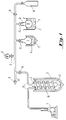
- FIG. 1 a preferred apparatus for vacuum drying liposomes and instilling a gas into the dried liposomes.
- the apparatus is comprised of a vessel 8 for containing liposomes 19.
- the apparatus may include an ice bath 5 containing dry ice 17 surrounding the vessel 8.
- the ice bath 5 and dry ice 17 allow the liposomes to be cooled to below 0°C.
- a vacuum pump 1 is connected to the vessel 8 via a conduit 15 for applying a sustained negative pressure to the vessel.
- the pump 1 is capable of applying a negative pressure of at least 93 kPa (700 mm Hg) and preferably a negative pressure in the range of about 93 kPa (700 mm Hg) to about 101 kPa (760 mm Hg) (gauge pressure).
- a manometer 6 is connected to the conduit 15 to allow monitoring of the negative pressure applied to the vessel 8.
- a series of traps are connected to the conduit 15 to assist in collecting the liquid (and liquid vapor, all collectively referred to herein as liquid) drawn from the liposomes.
- the first trap is preferably comprised of a flask 7 disposed in an ice bath 4 with dry ice 17.
- the second trap is preferably comprised of a column 3 around which tubing 16 is helically arranged. The column 3 is connected to the conduit 15 at its top end and to one end of the tubing 16 at its bottom end. The other end of the tubing 16 is connected to the conduit 15. As shown in Figure 1, an ice bath 2 with dry ice 17 surrounds the column 3 and tubing 16.
- dry ice 17 can be replaced with liquid nitrogen, liquid air or other cryogenic material.
- the ice baths 2 and 4 assist in collecting any liquid and condensing any liquid vapor drawn from the liposomes for collection in the traps.
- the ice traps 2 and 4 are each maintained at a temperature of least about -70°C.
- a stopcock 14 is disposed in the conduit 15 upstream of the vessel 8 to allow a selected gas to be introduced into the vessel 8 and into liposomes 19 from gas bottle 18.
- Apparatus of the present invention are utilized by placing the liposomes 19 into vessel 8.
- ice bath 5 with dry ice 17 is used to lower the temperature of the liposomes to below 0°C, more preferably to between about -10°C and about -20°C, and most preferably to -10°C.
- vacuum pump 1 is turned on. Stopcocks 10, 11, 12 and 13 are then carefully opened to create a vacuum in vessel 8 by means of vacuum pump 1.
- the pressure is gauged by means of manometer 6 until negative pressure of at least 93 kPa (700 mm Hg) and preferably in the range of between about 93 kPa (700 mm Hg) and about 101 kPa (760 mm Hg), is achieved.
- the temperature of ice traps 2 and 4 are each maintained at a temperature of at least about -70°C.
- the desired negative pressure is generally maintained for at least 24 hours as liquid and liquid vapor is removed from the liposomes 19 in vessel 8 and frozen in vessels 3 and 7. Pressure within the system is monitored using manometer 6 and is generally maintained for about 24 to about 72 hours, at which time substantially all of the liquid has been removed from the liposomes.
- stopcock 10 is slowly closed and vacuum pump 1 is turned off.
- Stopcock 14 is then opened gradually and gas is slowly introduced into the system from gas bottle 18 through stopcock 14 via conduit 15 to instill gas into the liposomes 19 in vessel 8.
- the gas instillation occurs slowly over a time period of at least about 4 hours, most preferably over a time period of between about 4 and about 8 hours, until the system reaches ambient pressure.
- the vacuum dried gas instilled liposomes and the gas filled liposomes substantially devoid of liquid in the interior thereof of the present invention have superior characteristics for use as hyperthermia potentiators.
- the subject liposomes provide good heating of surrounding tissues and/or fluids on ultrasound, are highly stable to pressure, and/or generally possess a long storage life either when stored dry or suspended in a liquid medium.
- the hyperthermic potentiators of the present invention are administered to a biological tissue or to biological fluids, whereupon ultrasound is then applied to the biological matter.
- the methods of the invention are particularly useful when employed in relation to such biological matter as tumor tissue, muscle tissue or blood fluid.
- the liposomes employed may be of varying sizes, but preferably are of a size range wherein they have a mean outside diameter between about 30 nanometers and about 10 microns, with the preferable mean outside diameter being about 2 microns.
- liposome size influences biodistribution and, therefore, different size liposomes are selected for various purposes.
- liposome size is generally no larger than about 5 microns, and generally no smaller than about 30 nanometers, in mean outside diameter.
- larger liposomes e.g., between about 2 and about 10 micron mean outside diameter may be employed, if desired.
- the lipids employed may be selected to optimize the particular therapeutic use, minimize toxicity and maximize shelf-life of the product.
- Neutral liposomes composed of either saturated or unsaturated phosphatidylcholine, with or without sterol, such as cholesterol, function quite well as intravascular hyperthermia potentiators entrapping gas.
- a negatively charged lipid such as phosphatidylglycerol, phosphatidylserine or similar materials is added.
- the liposome can be polymerized using polymerizable lipids, or the surface of the liposome can be coated with polymers such as polyethylene glycol so as to protect the surface of the vesicle from serum proteins, or gangliosides such as GM1 can be incorporated within the lipid matrix.
- Liposomes may also be prepared with attached receptors or antibodies to facilitate their targeting to specific cell types such as tumors. Most preferred for reasons of their hyperthermia potentiation and stability are liposomes prepared from dipalmitoylphosphatidyl choline.
- administration may be carried out in various fashions, such as intravascularly, intralymphatically, parenterally, subcutaneously, intramuscularly, intraperitoneally, interstitially, hyperbarically, orally, or intratumorly using a variety of dosage forms, the particular route of administration and the dosage used being dependent upon the type of therapeutic use sought, and the particular potentiating agent employed.
- these hyperthermic potentiating agents may be administered intraarterially.
- dosage is initiated at lower levels and increased until the desired temperature increase effect is achieved.
- the contrast agents of the invention are administered in the form of an aqueous suspension such as in water or a saline solution (e.g., phosphate buffered saline).
- a saline solution e.g., phosphate buffered saline
- the water is sterile.
- the saline solution is a hypertonic saline solution (e.g., about 0.3 to about 0.5% NaCl), although, if desired, the saline solution may be isotonic.
- the solution also may be buffered, if desired, to provide a pH range of pH 6.8 to pH 7.4.
- dextrose may be preferably included in the media.
- the aqueous solution is degassed (that is, degassed under vacuum pressure) prior to suspending the liposomes therein.
- the patient can be any type of mammal, but most preferably is a human.
- the method of the invention is particularly useful in the treatment of tumors, various inflammatory conditions, and arthritis, especially in the treatment of tumors.
- the gas filled liposomes prepared by a vacuum drying gas instillation method and the gas filled liposomes substantially devoid of liquid in the interior thereof accumulate in tumors, particularly in the brain, because of the leaky capillaries and delayed wash-out from the diseased tissues. Similarly, in other regions of the body where tumor vessels are leaky, the hyperthermic potentiating agents will accumulate.
- hyperthermic potentiators of the present invention may be used alone, in combination with one another, or in combination with other therapeutic and/or diagnostic agents.
- the hyperthermic potentiators may be administered in combination with various chemotherapeutic agents.
- any of the various types of ultrasound imaging devices can be employed in the practice of the invention, the particular type or model of the device not being critical to the method of the invention.
- devices specially designed for administering ultrasonic hyperthermia are preferred.
- Such devices are described U.S. Patent Nos. 4,620,546, 4,658,828, and 4,586,512.
- the use of a device designed for administering ultrasonic hyperthermia and incorporating resonant frequency (RF) spectral analyzer is particularly preferred.
- hyperthermic potentiators employed in the methods of the present invention are believed to possess their excellent results because of the following scientific postulates.
- Ultrasonic energy may either be transmitted through a tissue, reflected or absorbed. It is believed that the potentiators of the invention serve to increase the absorption of sound energy within the biological tissues or fluids in which they are present, which results in increased heating, thereby increasing the therapeutic effectiveness of ultrasonic hyperthermia.
- Absorption of sound is believed to be increased in acoustic regions which have a high degree of ultrasonic heterogeneity.
- Soft tissues and fluids with a higher degree of heterogeneity will absorb sound at a higher rate than tissues or fluids which are more homogeneous acoustically.
- the degree of absorption of sound is believed to rise as the difference between the acoustic impedances between the two substances comprising the interface increases.
- the potentiators of the present invention provide high acoustic impedance differences between the potentiators and any surrounding liquids and tissues.
- Intense sonic energy is also believed to cause cavitation and, when cavitation occurs, this in turn is thought to cause intense local heating. Gas bubbles are believed to lower the cavitation threshold, that is, accelerate the process of cavitation during sonication.
- the potentiators of the present invention provide high acoustic impedance differences between the potentiators and the surrounding liquids and tissues, as well as decrease the cavitation threshold, the subject potentiators may act to increase the rate of absorption of ultrasonic energy in the surrounding tissues and fluids and effect a conversion of that energy into local heat. Additionally, the low thermal conductivity of gas may serve to decrease local heat dissipation, with the result that there is both an increase in the rate of heating and an increase in the final equilibrium temperature.
- the potentiators of the present invention may serve to increase the acoustic heterogeneity and generate cavitation nuclei in tumors and tissues thereby acting as a potentiator of heating in ultrasonic hyperthermia. Because the gas creates an acoustic impedance mismatch with adjacent tissues and adjacent fluids, the gas acts to increase the absorption of sound and conversion of the energy into heat in the surrounding tissues and fluids.
- the liposomes of the present invention are believed to differ from the liposomes of the prior art in a number of respects, both in physical and in functional characteristics.
- the liposomes of the invention are substantially devoid of liquid in the interior thereof.
- liposomes in the prior art have been characterized by the presence of an aqueous medium. See , e.g ., Dorland's Illustrated Medical Dictionary , p. 946, 27th ed. (W.B. Saunders Company, Philadelphia 1988).
- the present liposomes surprisingly result in good heating of surrounding tissues and/or fluids on ultrasound, and posses a long storage life, characteristics of obvious importance to the hyperthermic potentiator applications of the invention.
- Examples 1-8 are actual examples that describe the preparation and testing of the vacuum dried gas instilled liposomes, the gas filled liposomes being substantially devoid of any liquid in the interior thereof, of the invention.
- Examples 9-13 are prophetic examples meant to be illustrative of how the invention would operate under the specified conditions.
- Dipalmitoylphosphatidylcholine (1 gram) was suspended in 10 ml phosphate buffered saline, the suspension was heated to about 50°C, and then swirled by hand in a round bottom flask for about 30 minutes. The heat source was removed, and the suspension was swirled for two additional hours, while allowing the suspension to cool to room temperature, to form liposomes.
- the liposomes thus prepared were placed in a vessel in an apparatus similar to that shown in Figure 1 cooled to about -10°C, and then subjected to high negative vacuum pressure. The temperature of the liposomes was then raised to about 10°C. High negative vacuum pressure was maintained for about 48 hours. After about 48 hours, nitrogen gas was gradually instilled into the chamber over a period of about 4 hours, after which time the pressure returned to ambient pressure. The resulting vacuum dried gas instilled liposomes, the gas filled liposomes being substantially devoid of any liquid in the interior thereof, were then suspended in 10 ml of phosphate buffered saline and stored at about 4°C for about three months.
- Example 1 To test the liposomes of Example 1 ultrasonographically, a 250 mg sample of these liposomes was suspended in 300 cc of degassed phosphate buffered saline (that is, degassed under vacuum pressure). The liposomes were then scanned in vitro at varying time intervals with a 7.5 mHz transducer using an Acoustic Imaging Model 5200 scanner (Acoustic Imaging, Phoenix, AZ) and employing the system test software to measure dB reflectivity. The system was standardized prior to testing the liposomes with a phantom of known acoustic impedance. A graph showing dB reflectivity is provided in Figure 2.
- Dipalmitoylphosphatidylcholine (1 gram) and the cryoprotectant trehalose (1 gram) were suspended in 10 ml phosphate buffered saline, the suspension was heated to about 50°C, and then swirled by hand in a round bottom flask for about 30 minutes. The heat source was removed, and the suspension was swirled for about two additional hours, while allowing the suspension to cool to room temperature, to form liposomes.
- the liposomes thus prepared were then vacuum dried and gas instilled, substantially following the procedures shown in Example 1, resulting in vacuum dried gas instilled liposomes, the gas filled liposomes being substantially devoid of any liquid in the interior thereof.
- the liposomes were then suspended in 10 ml of phosphate buffered saline, and then stored at about 4°C for several weeks.
- Example 3 To test the liposomes of Example 3 ultrasonographically, the procedures of Example 2 were substantially followed. The dB reflectivity of the liposomes were similar to the dB reflectivity reported in Example 2.
- Dipalmitoylphosphatidylcholine (1 gram) was suspended in 10 ml phosphate buffered saline, the suspension was heated to about 50°C, and then swirled by hand in a round bottom flask for about 30 minutes. The suspension was then subjected to 5 cycles of extrusion through an extruder device jacketed with a thermal barrel (Extruder DeviceTM, Lipex Biomembranes, Vancouver, Canada), both with and without conventional freeze-thaw treatment prior to extrusion, while maintaining the temperature at about 50°C. The heat source was removed, and the suspension was swirled for about two additional hours, while allowing the suspension to cool to room temperature, to form liposomes.
- Extruder DeviceTM Extruder DeviceTM, Lipex Biomembranes, Vancouver, Canada
- the liposomes thus prepared were then vacuum dried and gas instilled, substantially following the procedures shown in Example 1, resulting in vacuum dried gas instilled liposomes, the gas filled liposomes being substantially devoid of any liquid in the interior thereof.
- the liposomes were then suspended in 10 ml of phosphate buffered saline, and then stored at about 4°C for several weeks.
- Example 5 To test the liposomes of Example 5 ultrasonographically, the procedures of Example 2 were substantially followed. The dB reflectivity of the liposomes were similar to the dB reflectivity reported in Example 2.
- the liposomes suspension of Example 1 was passed through 2 micron polycarbonate filters in an extruder device (Extruder DeviceTM, Lipex Biomembranes, Vancouver, Canada) five times at a pressure of about 4.1 MPa (600 psi). After extrusion treatment, the liposomes were studied ultrasonographically, as described in Example 2. Surprisingly, even after extrusion under high pressure, the liposomes of the invention substantially retained their echogenicity.
- Example 1 The liposomes of Example 1 were scanned by ultrasound using transducer frequencies varying from 3 to 7.5 mHz. The results indicated that at a higher frequency of ultrasound, the echogenicity decays more rapidly, reflecting a relatively high resonant frequency and higher energy associated with the higher frequencies.
- a patient with cancer is administered a dose of gas filled liposomes prepared by a vacuum drying gas instillation method, the liposomes being substantially devoid of liquid in the interior thereof. Accumulation of the liposomes in the tumor is verified ultrasonigraphically. Focused ultrasonic hyperthermia is then administered to the tumor and the liposomes therein. The tumor has an increased rate of heating compared to treatment using ultrasonic hyperthermia without the liposomes.
- An ultrasonic device designed for administering ultrasonic hyperthermia and incorporating an RF spectral analyzer was employed. After gas filled liposomes prepared by a vacuum drying gas instillation method, the liposomes being substantially devoid of liquid in the interior thereof, are delivered intravenously, the RF signal in a lesion in the patient is monitored by the ultrasonic hyperthermia RF spectral analyzer. Even though the concentration of gas filled liposomes may be too dilute to visualize on an image ultrasonographically, the RF spectral analyzer detects a change in the peak of the RF spectrum. The peak in the RF spectrum reflects the harmonic frequency of the gas filled liposomes.
- This data enables the operator to the ultrasonic hyperthermia equipment to adjust the application of the ultrasonic energy to coincide with the maximal intra-lesional concentration of the gas filled liposomes and to evaluate the disappearance of the gas filled liposomes as hyperthermia progresses.
- Assessment of the resonant frequency also allows the operator to adjust the frequency, amplitude, duration and pulse repetition rate to be maximally effective at heating the tumor through the augmenting effects of the bubbles.
- the presence of the gas filled liposomes in the lesion allows the operator to assess the blood flow through the diseased tissues, information of great value in determining the rate of washout of heat from the tumor.
- Information regarding blood flow can be obtained either from simple subjective assessment of the images under real time ultrasound or by quantitative assessment through integration of the peaks in the RF spectrums reflecting the resonant frequencies of the gas filled liposomes.
- Gas filled liposomes prepared by a vacuum drying gas instillation method are administered intravenously to a patient with cancer.
- Ultrasonic hyperthermia is performed with pulses of high energy ultrasound and cavitation occurs at the sites of the bubbles.
- the oxygen increases the rate of formation of free radicals which help to destroy the tumor tissue.
- gas filled liposomes prepared by a vacuum drying gas instillation method are administered intravenously and the patient is then scanned via ultrasound.
- the tumor is simultaneously treated with hyperthermia and radiation therapy.
- the effect of the liposomes and hyperthermia magnifies the effectiveness of the radiation therapy by releasing oxygen to form free radicals generated by the ionizing radiation and also formed by cavitation to improve the response of the tumor to combined radiation and hyperthermia.
- Gas filled liposomes prepared by a vacuum drying gas instillation method are administered intravenously to a patient with cancer.
- Ultrasonic hyperthermia is performed with pulses of high energy ultrasound and cavitation occurs at the sites of the bubbles.
- the argon increases the rate of formation of free radicals which help to destroy the tumor tissue.
Landscapes
- Health & Medical Sciences (AREA)
- General Health & Medical Sciences (AREA)
- Chemical & Material Sciences (AREA)
- Veterinary Medicine (AREA)
- Public Health (AREA)
- Life Sciences & Earth Sciences (AREA)
- Animal Behavior & Ethology (AREA)
- Epidemiology (AREA)
- Medicinal Chemistry (AREA)
- Pharmacology & Pharmacy (AREA)
- Nuclear Medicine, Radiotherapy & Molecular Imaging (AREA)
- Radiology & Medical Imaging (AREA)
- Dispersion Chemistry (AREA)
- Engineering & Computer Science (AREA)
- Biomedical Technology (AREA)
- Physics & Mathematics (AREA)
- Acoustics & Sound (AREA)
- Nanotechnology (AREA)
- Bioinformatics & Cheminformatics (AREA)
- Medicinal Preparation (AREA)
- Pharmaceuticals Containing Other Organic And Inorganic Compounds (AREA)
- Medicines That Contain Protein Lipid Enzymes And Other Medicines (AREA)
- Thermotherapy And Cooling Therapy Devices (AREA)
- Manufacturing Of Micro-Capsules (AREA)
Applications Claiming Priority (3)
| Application Number | Priority Date | Filing Date | Title |
|---|---|---|---|
| US07/716,793 US5209720A (en) | 1989-12-22 | 1991-06-18 | Methods for providing localized therapeutic heat to biological tissues and fluids using gas filled liposomes |
| US716793 | 1991-06-18 | ||
| PCT/US1992/002610 WO1992022249A1 (en) | 1991-06-18 | 1992-03-31 | Methods for providing localized therapeutic heat to biological tissues and fluids using gas filled liposomes |
Publications (3)
| Publication Number | Publication Date |
|---|---|
| EP0660687A1 EP0660687A1 (en) | 1995-07-05 |
| EP0660687A4 EP0660687A4 (en) | 1996-06-26 |
| EP0660687B1 true EP0660687B1 (en) | 1998-10-28 |
Family
ID=24879461
Family Applications (1)
| Application Number | Title | Priority Date | Filing Date |
|---|---|---|---|
| EP92912455A Expired - Lifetime EP0660687B1 (en) | 1991-06-18 | 1992-03-31 | Methods for providing localized therapeutic heat to biological tissues and fluids using gas filled liposomes |
Country Status (10)
| Country | Link |
|---|---|
| US (1) | US5209720A (da) |
| EP (1) | EP0660687B1 (da) |
| JP (1) | JP3053217B2 (da) |
| AT (1) | ATE172625T1 (da) |
| AU (1) | AU661701B2 (da) |
| CA (1) | CA2110487A1 (da) |
| DE (1) | DE69227468T2 (da) |
| DK (1) | DK0660687T3 (da) |
| ES (1) | ES2124733T3 (da) |
| WO (1) | WO1992022249A1 (da) |
Families Citing this family (182)
| Publication number | Priority date | Publication date | Assignee | Title |
|---|---|---|---|---|
| US6088613A (en) | 1989-12-22 | 2000-07-11 | Imarx Pharmaceutical Corp. | Method of magnetic resonance focused surgical and therapeutic ultrasound |
| US5776429A (en) | 1989-12-22 | 1998-07-07 | Imarx Pharmaceutical Corp. | Method of preparing gas-filled microspheres using a lyophilized lipids |
| US5773024A (en) * | 1989-12-22 | 1998-06-30 | Imarx Pharmaceutical Corp. | Container with multi-phase composition for use in diagnostic and therapeutic applications |
| US6146657A (en) | 1989-12-22 | 2000-11-14 | Imarx Pharmaceutical Corp. | Gas-filled lipid spheres for use in diagnostic and therapeutic applications |
| US5469854A (en) | 1989-12-22 | 1995-11-28 | Imarx Pharmaceutical Corp. | Methods of preparing gas-filled liposomes |
| US5149319A (en) * | 1990-09-11 | 1992-09-22 | Unger Evan C | Methods for providing localized therapeutic heat to biological tissues and fluids |
| US5922304A (en) | 1989-12-22 | 1999-07-13 | Imarx Pharmaceutical Corp. | Gaseous precursor filled microspheres as magnetic resonance imaging contrast agents |
| US5705187A (en) * | 1989-12-22 | 1998-01-06 | Imarx Pharmaceutical Corp. | Compositions of lipids and stabilizing materials |
| US6001335A (en) | 1989-12-22 | 1999-12-14 | Imarx Pharmaceutical Corp. | Contrasting agents for ultrasonic imaging and methods for preparing the same |
| US6551576B1 (en) | 1989-12-22 | 2003-04-22 | Bristol-Myers Squibb Medical Imaging, Inc. | Container with multi-phase composition for use in diagnostic and therapeutic applications |
| US20020150539A1 (en) | 1989-12-22 | 2002-10-17 | Unger Evan C. | Ultrasound imaging and treatment |
| US5585112A (en) | 1989-12-22 | 1996-12-17 | Imarx Pharmaceutical Corp. | Method of preparing gas and gaseous precursor-filled microspheres |
| US5580575A (en) | 1989-12-22 | 1996-12-03 | Imarx Pharmaceutical Corp. | Therapeutic drug delivery systems |
| US5352435A (en) * | 1989-12-22 | 1994-10-04 | Unger Evan C | Ionophore containing liposomes for ultrasound imaging |
| US5656211A (en) | 1989-12-22 | 1997-08-12 | Imarx Pharmaceutical Corp. | Apparatus and method for making gas-filled vesicles of optimal size |
| US5305757A (en) | 1989-12-22 | 1994-04-26 | Unger Evan C | Gas filled liposomes and their use as ultrasonic contrast agents |
| US5542935A (en) | 1989-12-22 | 1996-08-06 | Imarx Pharmaceutical Corp. | Therapeutic delivery systems related applications |
| US5733572A (en) | 1989-12-22 | 1998-03-31 | Imarx Pharmaceutical Corp. | Gas and gaseous precursor filled microspheres as topical and subcutaneous delivery vehicles |
| US7083778B2 (en) * | 1991-05-03 | 2006-08-01 | Bracco International B.V. | Ultrasound contrast agents and methods of making and using them |
| US20040208826A1 (en) * | 1990-04-02 | 2004-10-21 | Bracco International B.V. | Ultrasound contrast agents and methods of making and using them |
| USRE39146E1 (en) | 1990-04-02 | 2006-06-27 | Bracco International B.V. | Long-lasting aqueous dispersions or suspensions of pressure-resistant gas-filled microvesicles and methods for the preparation thereof |
| US6989141B2 (en) * | 1990-05-18 | 2006-01-24 | Bracco International B.V. | Ultrasound contrast agents and methods of making and using them |
| US5445813A (en) * | 1992-11-02 | 1995-08-29 | Bracco International B.V. | Stable microbubble suspensions as enhancement agents for ultrasound echography |
| IN172208B (da) | 1990-04-02 | 1993-05-01 | Sint Sa | |
| US6613306B1 (en) | 1990-04-02 | 2003-09-02 | Bracco International B.V. | Ultrasound contrast agents and methods of making and using them |
| US20010024638A1 (en) * | 1992-11-02 | 2001-09-27 | Michel Schneider | Stable microbubble suspensions as enhancement agents for ultrasound echography and dry formulations thereof |
| US5578292A (en) | 1991-11-20 | 1996-11-26 | Bracco International B.V. | Long-lasting aqueous dispersions or suspensions of pressure-resistant gas-filled microvesicles and methods for the preparation thereof |
| US20030194376A1 (en) * | 1990-05-18 | 2003-10-16 | Bracco International B.V. | Ultrasound contrast agents and methods of making and using them |
| AU636481B2 (en) * | 1990-05-18 | 1993-04-29 | Bracco International B.V. | Polymeric gas or air filled microballoons usable as suspensions in liquid carriers for ultrasonic echography |
| US5569180A (en) * | 1991-02-14 | 1996-10-29 | Wayne State University | Method for delivering a gas-supersaturated fluid to a gas-depleted site and use thereof |
| DE69215722T3 (de) | 1991-03-22 | 2001-03-08 | Katsuro Tachibana | Verstärker zur Ultraschalltherapie von Erkrankungen sowie diesen enthaltende flüssige Arzneimittelzusammensetzungen |
| US5205290A (en) | 1991-04-05 | 1993-04-27 | Unger Evan C | Low density microspheres and their use as contrast agents for computed tomography |
| US5874062A (en) | 1991-04-05 | 1999-02-23 | Imarx Pharmaceutical Corp. | Methods of computed tomography using perfluorocarbon gaseous filled microspheres as contrast agents |
| US5409688A (en) * | 1991-09-17 | 1995-04-25 | Sonus Pharmaceuticals, Inc. | Gaseous ultrasound contrast media |
| US6723303B1 (en) | 1991-09-17 | 2004-04-20 | Amersham Health, As | Ultrasound contrast agents including protein stabilized microspheres of perfluoropropane, perfluorobutane or perfluoropentane |
| CA2119129C (en) * | 1991-09-17 | 1999-11-09 | Steven C. Quay | Gaseous ultrasound contrast media and method for selecting gases for use as ultrasound contrast media |
| MX9205298A (es) * | 1991-09-17 | 1993-05-01 | Steven Carl Quay | Medios gaseosos de contraste de ultrasonido y metodo para seleccionar gases para usarse como medios de contraste de ultrasonido |
| IL104084A (en) * | 1992-01-24 | 1996-09-12 | Bracco Int Bv | Long-lasting aqueous suspensions of pressure-resistant gas-filled microvesicles their preparation and contrast agents consisting of them |
| IL108416A (en) | 1993-01-25 | 1998-10-30 | Sonus Pharma Inc | Phase shift colloids as ultrasound contrast agents |
| US5798091A (en) | 1993-07-30 | 1998-08-25 | Alliance Pharmaceutical Corp. | Stabilized gas emulsion containing phospholipid for ultrasound contrast enhancement |
| ES2231775T5 (es) * | 1993-07-30 | 2011-02-02 | Imcor Pharmaceutical Co. | Composición de microburbujas estabilizadas para ecografía. |
| US5433204A (en) * | 1993-11-16 | 1995-07-18 | Camilla Olson | Method of assessing placentation |
| US7083572B2 (en) | 1993-11-30 | 2006-08-01 | Bristol-Myers Squibb Medical Imaging, Inc. | Therapeutic delivery systems |
| PL182223B1 (pl) * | 1993-12-15 | 2001-11-30 | Bracco Research Sa | Biokompatybilna faza rozproszona do otrzymywania srodka kontrastowego do badan ultradzwiekowych, srodek kontrastowy do badan ultradzwiekowych, suchy preparat srodka kontrastowego oraz dwuskladnikowy zestaw do otrzymywania srodka kontrastowego do badan ultradzwiekowych PL PL PL |
| US5588962A (en) * | 1994-03-29 | 1996-12-31 | Boston Scientific Corporation | Drug treatment of diseased sites deep within the body |
| US5736121A (en) | 1994-05-23 | 1998-04-07 | Imarx Pharmaceutical Corp. | Stabilized homogenous suspensions as computed tomography contrast agents |
| US6743779B1 (en) | 1994-11-29 | 2004-06-01 | Imarx Pharmaceutical Corp. | Methods for delivering compounds into a cell |
| US20020048596A1 (en) * | 1994-12-30 | 2002-04-25 | Gregor Cevc | Preparation for the transport of an active substance across barriers |
| US5830430A (en) | 1995-02-21 | 1998-11-03 | Imarx Pharmaceutical Corp. | Cationic lipids and the use thereof |
| US6176842B1 (en) * | 1995-03-08 | 2001-01-23 | Ekos Corporation | Ultrasound assembly for use with light activated drugs |
| US6210356B1 (en) * | 1998-08-05 | 2001-04-03 | Ekos Corporation | Ultrasound assembly for use with a catheter |
| US5558092A (en) * | 1995-06-06 | 1996-09-24 | Imarx Pharmaceutical Corp. | Methods and apparatus for performing diagnostic and therapeutic ultrasound simultaneously |
| US5997898A (en) | 1995-06-06 | 1999-12-07 | Imarx Pharmaceutical Corp. | Stabilized compositions of fluorinated amphiphiles for methods of therapeutic delivery |
| CA2218541A1 (en) * | 1995-06-07 | 1996-12-19 | Imarx Pharmaceutical Corp. | Novel targeted compositions for diagnostic and therapeutic use |
| US6521211B1 (en) * | 1995-06-07 | 2003-02-18 | Bristol-Myers Squibb Medical Imaging, Inc. | Methods of imaging and treatment with targeted compositions |
| US6033645A (en) | 1996-06-19 | 2000-03-07 | Unger; Evan C. | Methods for diagnostic imaging by regulating the administration rate of a contrast agent |
| US5804162A (en) | 1995-06-07 | 1998-09-08 | Alliance Pharmaceutical Corp. | Gas emulsions stabilized with fluorinated ethers having low Ostwald coefficients |
| US6139819A (en) | 1995-06-07 | 2000-10-31 | Imarx Pharmaceutical Corp. | Targeted contrast agents for diagnostic and therapeutic use |
| US6231834B1 (en) | 1995-06-07 | 2001-05-15 | Imarx Pharmaceutical Corp. | Methods for ultrasound imaging involving the use of a contrast agent and multiple images and processing of same |
| US5840276A (en) * | 1996-01-11 | 1998-11-24 | Apfel Enterprises, Inc. | Activatable infusable dispersions containing drops of a superheated liquid for methods of therapy and diagnosis |
| DK0904113T3 (da) * | 1996-03-05 | 2004-08-30 | Acusphere Inc | Mikroindkapslede fluorerede gasser til anvendelse som billeddannende midler |
| US5611344A (en) * | 1996-03-05 | 1997-03-18 | Acusphere, Inc. | Microencapsulated fluorinated gases for use as imaging agents |
| AU736301B2 (en) | 1996-05-01 | 2001-07-26 | Imarx Therapeutics, Inc. | Methods for delivering compounds into a cell |
| US5837221A (en) * | 1996-07-29 | 1998-11-17 | Acusphere, Inc. | Polymer-lipid microencapsulated gases for use as imaging agents |
| US6414139B1 (en) | 1996-09-03 | 2002-07-02 | Imarx Therapeutics, Inc. | Silicon amphiphilic compounds and the use thereof |
| PT977597E (pt) | 1996-09-11 | 2003-06-30 | Imarx Pharmaceutical Corp | Metodos melhorados para imagiologia de diagnosticoutilizando um agente de contraste e um vasodil atador |
| US5846517A (en) | 1996-09-11 | 1998-12-08 | Imarx Pharmaceutical Corp. | Methods for diagnostic imaging using a renal contrast agent and a vasodilator |
| US5827533A (en) | 1997-02-06 | 1998-10-27 | Duke University | Liposomes containing active agents aggregated with lipid surfactants |
| US6090800A (en) | 1997-05-06 | 2000-07-18 | Imarx Pharmaceutical Corp. | Lipid soluble steroid prodrugs |
| US6143276A (en) | 1997-03-21 | 2000-11-07 | Imarx Pharmaceutical Corp. | Methods for delivering bioactive agents to regions of elevated temperatures |
| US6120751A (en) | 1997-03-21 | 2000-09-19 | Imarx Pharmaceutical Corp. | Charged lipids and uses for the same |
| US6537246B1 (en) | 1997-06-18 | 2003-03-25 | Imarx Therapeutics, Inc. | Oxygen delivery agents and uses for the same |
| US6676626B1 (en) | 1998-05-01 | 2004-01-13 | Ekos Corporation | Ultrasound assembly with increased efficacy |
| US6582392B1 (en) | 1998-05-01 | 2003-06-24 | Ekos Corporation | Ultrasound assembly for use with a catheter |
| US7452551B1 (en) | 2000-10-30 | 2008-11-18 | Imarx Therapeutics, Inc. | Targeted compositions for diagnostic and therapeutic use |
| US6416740B1 (en) | 1997-05-13 | 2002-07-09 | Bristol-Myers Squibb Medical Imaging, Inc. | Acoustically active drug delivery systems |
| US6548047B1 (en) | 1997-09-15 | 2003-04-15 | Bristol-Myers Squibb Medical Imaging, Inc. | Thermal preactivation of gaseous precursor filled compositions |
| US6623430B1 (en) | 1997-10-14 | 2003-09-23 | Guided Therapy Systems, Inc. | Method and apparatus for safety delivering medicants to a region of tissue using imaging, therapy and temperature monitoring ultrasonic system |
| US6500121B1 (en) | 1997-10-14 | 2002-12-31 | Guided Therapy Systems, Inc. | Imaging, therapy, and temperature monitoring ultrasonic system |
| US6050943A (en) | 1997-10-14 | 2000-04-18 | Guided Therapy Systems, Inc. | Imaging, therapy, and temperature monitoring ultrasonic system |
| US6123923A (en) | 1997-12-18 | 2000-09-26 | Imarx Pharmaceutical Corp. | Optoacoustic contrast agents and methods for their use |
| US20010003580A1 (en) | 1998-01-14 | 2001-06-14 | Poh K. Hui | Preparation of a lipid blend and a phospholipid suspension containing the lipid blend |
| US6200598B1 (en) | 1998-06-18 | 2001-03-13 | Duke University | Temperature-sensitive liposomal formulation |
| US6726925B1 (en) | 1998-06-18 | 2004-04-27 | Duke University | Temperature-sensitive liposomal formulation |
| EP1031347B1 (en) | 1999-01-27 | 2002-04-17 | Idea Ag | Transnasal transport/immunisation with highly adaptable carriers |
| EP1031346B1 (en) | 1999-01-27 | 2002-05-02 | Idea Ag | Noninvasive vaccination through the skin |
| WO2001001962A1 (en) * | 1999-07-05 | 2001-01-11 | Idea Ag. | A method for the improvement of transport across adaptable semi-permeable barriers |
| US7008535B1 (en) | 2000-08-04 | 2006-03-07 | Wayne State University | Apparatus for oxygenating wastewater |
| US7914453B2 (en) | 2000-12-28 | 2011-03-29 | Ardent Sound, Inc. | Visual imaging system for ultrasonic probe |
| US7179449B2 (en) * | 2001-01-30 | 2007-02-20 | Barnes-Jewish Hospital | Enhanced ultrasound detection with temperature-dependent contrast agents |
| WO2002087543A1 (en) * | 2001-05-01 | 2002-11-07 | Biozone Laboratories, Inc. | Sustained release formulations for nifedipine, dextromethorphan, and danazol |
| US7220239B2 (en) | 2001-12-03 | 2007-05-22 | Ekos Corporation | Catheter with multiple ultrasound radiating members |
| US8226629B1 (en) | 2002-04-01 | 2012-07-24 | Ekos Corporation | Ultrasonic catheter power control |
| US7473432B2 (en) * | 2002-10-11 | 2009-01-06 | Idea Ag | NSAID formulations, based on highly adaptable aggregates, for improved transport through barriers and topical drug delivery |
| US6921371B2 (en) * | 2002-10-14 | 2005-07-26 | Ekos Corporation | Ultrasound radiating members for catheter |
| US20060058708A1 (en) * | 2003-12-24 | 2006-03-16 | Gill Heart | Method and apparatus for ultrasonically increasing the transportation of therapeutic substances through tissue |
| US7341569B2 (en) * | 2004-01-30 | 2008-03-11 | Ekos Corporation | Treatment of vascular occlusions using ultrasonic energy and microbubbles |
| US8235909B2 (en) | 2004-05-12 | 2012-08-07 | Guided Therapy Systems, L.L.C. | Method and system for controlled scanning, imaging and/or therapy |
| US8012457B2 (en) * | 2004-06-04 | 2011-09-06 | Acusphere, Inc. | Ultrasound contrast agent dosage formulation |
| US9011336B2 (en) | 2004-09-16 | 2015-04-21 | Guided Therapy Systems, Llc | Method and system for combined energy therapy profile |
| US7824348B2 (en) * | 2004-09-16 | 2010-11-02 | Guided Therapy Systems, L.L.C. | System and method for variable depth ultrasound treatment |
| US7393325B2 (en) | 2004-09-16 | 2008-07-01 | Guided Therapy Systems, L.L.C. | Method and system for ultrasound treatment with a multi-directional transducer |
| US8444562B2 (en) | 2004-10-06 | 2013-05-21 | Guided Therapy Systems, Llc | System and method for treating muscle, tendon, ligament and cartilage tissue |
| US7530958B2 (en) * | 2004-09-24 | 2009-05-12 | Guided Therapy Systems, Inc. | Method and system for combined ultrasound treatment |
| US8535228B2 (en) | 2004-10-06 | 2013-09-17 | Guided Therapy Systems, Llc | Method and system for noninvasive face lifts and deep tissue tightening |
| US10864385B2 (en) | 2004-09-24 | 2020-12-15 | Guided Therapy Systems, Llc | Rejuvenating skin by heating tissue for cosmetic treatment of the face and body |
| US20120165848A1 (en) | 2010-08-02 | 2012-06-28 | Guided Therapy Systems, Llc | System and method for treating cartilage |
| US20060122508A1 (en) | 2004-10-06 | 2006-06-08 | Guided Therapy Systems, L.L.C. | Method and system for noninvasive face lifts and deep tissue tightening |
| DK3287170T3 (da) * | 2004-10-06 | 2019-02-04 | Guided Therapy Systems Llc | System til kontrolleret varmebehandling af humant overfladevæv |
| US8690778B2 (en) | 2004-10-06 | 2014-04-08 | Guided Therapy Systems, Llc | Energy-based tissue tightening |
| US11235179B2 (en) | 2004-10-06 | 2022-02-01 | Guided Therapy Systems, Llc | Energy based skin gland treatment |
| US9694212B2 (en) | 2004-10-06 | 2017-07-04 | Guided Therapy Systems, Llc | Method and system for ultrasound treatment of skin |
| US7758524B2 (en) * | 2004-10-06 | 2010-07-20 | Guided Therapy Systems, L.L.C. | Method and system for ultra-high frequency ultrasound treatment |
| US20060111744A1 (en) * | 2004-10-13 | 2006-05-25 | Guided Therapy Systems, L.L.C. | Method and system for treatment of sweat glands |
| US9827449B2 (en) | 2004-10-06 | 2017-11-28 | Guided Therapy Systems, L.L.C. | Systems for treating skin laxity |
| US11883688B2 (en) | 2004-10-06 | 2024-01-30 | Guided Therapy Systems, Llc | Energy based fat reduction |
| US8133180B2 (en) | 2004-10-06 | 2012-03-13 | Guided Therapy Systems, L.L.C. | Method and system for treating cellulite |
| EP2279698A3 (en) | 2004-10-06 | 2014-02-19 | Guided Therapy Systems, L.L.C. | Method and system for non-invasive cosmetic enhancement of stretch marks |
| US11724133B2 (en) | 2004-10-07 | 2023-08-15 | Guided Therapy Systems, Llc | Ultrasound probe for treatment of skin |
| US11207548B2 (en) | 2004-10-07 | 2021-12-28 | Guided Therapy Systems, L.L.C. | Ultrasound probe for treating skin laxity |
| US20060079868A1 (en) * | 2004-10-07 | 2006-04-13 | Guided Therapy Systems, L.L.C. | Method and system for treatment of blood vessel disorders |
| CA2584475A1 (en) * | 2004-11-12 | 2006-05-18 | Idea Ag | Extended surface aggregates in the treatment of skin conditions |
| JP2008536562A (ja) * | 2005-04-12 | 2008-09-11 | イコス コーポレイション | 空洞形成推進面が設けられた超音波カテーテル |
| EP1875327A2 (en) | 2005-04-25 | 2008-01-09 | Guided Therapy Systems, L.L.C. | Method and system for enhancing computer peripheral saftey |
| US10548659B2 (en) | 2006-01-17 | 2020-02-04 | Ulthera, Inc. | High pressure pre-burst for improved fluid delivery |
| US8518069B2 (en) | 2005-09-07 | 2013-08-27 | Cabochon Aesthetics, Inc. | Dissection handpiece and method for reducing the appearance of cellulite |
| US9011473B2 (en) | 2005-09-07 | 2015-04-21 | Ulthera, Inc. | Dissection handpiece and method for reducing the appearance of cellulite |
| CA2621535A1 (en) * | 2005-09-07 | 2007-03-15 | The Foundry, Inc. | Apparatus and method for disrupting subcutaneous structures |
| US9358033B2 (en) | 2005-09-07 | 2016-06-07 | Ulthera, Inc. | Fluid-jet dissection system and method for reducing the appearance of cellulite |
| US7967763B2 (en) * | 2005-09-07 | 2011-06-28 | Cabochon Aesthetics, Inc. | Method for treating subcutaneous tissues |
| US9486274B2 (en) * | 2005-09-07 | 2016-11-08 | Ulthera, Inc. | Dissection handpiece and method for reducing the appearance of cellulite |
| US20080200864A1 (en) * | 2005-12-02 | 2008-08-21 | Cabochon Aesthetics, Inc. | Devices and methods for selectively lysing cells |
| US20080195036A1 (en) * | 2005-12-02 | 2008-08-14 | Cabochon Aesthetics, Inc. | Devices and methods for selectively lysing cells |
| US9248317B2 (en) * | 2005-12-02 | 2016-02-02 | Ulthera, Inc. | Devices and methods for selectively lysing cells |
| US20080200863A1 (en) * | 2005-12-02 | 2008-08-21 | Cabochon Aesthetics, Inc. | Devices and methods for selectively lysing cells |
| US20080197517A1 (en) * | 2005-12-02 | 2008-08-21 | Cabochon Aesthetics, Inc. | Devices and methods for selectively lysing cells |
| US20080014627A1 (en) * | 2005-12-02 | 2008-01-17 | Cabochon Aesthetics, Inc. | Devices and methods for selectively lysing cells |
| US7885793B2 (en) | 2007-05-22 | 2011-02-08 | International Business Machines Corporation | Method and system for developing a conceptual model to facilitate generating a business-aligned information technology solution |
| US20070232987A1 (en) * | 2006-02-22 | 2007-10-04 | Vicente Diaz | One-hand-operated ultrasound transducer and method for delivering a controlled and uniform distribution of a sterile or a non-sterile topical reagent to skin for use in diagnostic, therapeutic, and aesthetic therapies |
| EP2015846A2 (en) | 2006-04-24 | 2009-01-21 | Ekos Corporation | Ultrasound therapy system |
| US9566454B2 (en) | 2006-09-18 | 2017-02-14 | Guided Therapy Systems, Llc | Method and sysem for non-ablative acne treatment and prevention |
| EP3103522A1 (en) * | 2006-09-19 | 2016-12-14 | Guided Therapy Systems, L.L.C. | System for treating muscle, tendon, ligament and cartilage tissue |
| US9241683B2 (en) | 2006-10-04 | 2016-01-26 | Ardent Sound Inc. | Ultrasound system and method for imaging and/or measuring displacement of moving tissue and fluid |
| US10182833B2 (en) | 2007-01-08 | 2019-01-22 | Ekos Corporation | Power parameters for ultrasonic catheter |
| PT2152167T (pt) * | 2007-05-07 | 2018-12-10 | Guided Therapy Systems Llc | Métodos e sistemas para acoplamento e focagem de energia acústica utilizando um componente acoplador |
| US20150174388A1 (en) | 2007-05-07 | 2015-06-25 | Guided Therapy Systems, Llc | Methods and Systems for Ultrasound Assisted Delivery of a Medicant to Tissue |
| JP2010526589A (ja) | 2007-05-07 | 2010-08-05 | ガイデッド セラピー システムズ, エル.エル.シー. | 音響エネルギーを使用してメディカントを調節するための方法およびシステム |
| ES2471118T3 (es) | 2007-06-22 | 2014-06-25 | Ekos Corporation | Método y aparato para el tratamiento de hemorragias intracraneales |
| US8439940B2 (en) | 2010-12-22 | 2013-05-14 | Cabochon Aesthetics, Inc. | Dissection handpiece with aspiration means for reducing the appearance of cellulite |
| EP2231024A4 (en) * | 2007-12-14 | 2015-03-18 | Ekos Corp | ULTRASOUND PULSE SHAPING |
| US12102473B2 (en) | 2008-06-06 | 2024-10-01 | Ulthera, Inc. | Systems for ultrasound treatment |
| KR102479936B1 (ko) | 2008-06-06 | 2022-12-22 | 얼테라, 인크 | 초음파 치료 시스템 |
| GB0811856D0 (en) * | 2008-06-27 | 2008-07-30 | Ucl Business Plc | Magnetic microbubbles, methods of preparing them and their uses |
| CA2748362A1 (en) | 2008-12-24 | 2010-07-01 | Michael H. Slayton | Methods and systems for fat reduction and/or cellulite treatment |
| WO2010135469A1 (en) * | 2009-05-19 | 2010-11-25 | Endra, Inc. | Thermoacoustic system for analyzing tissue |
| US9358064B2 (en) | 2009-08-07 | 2016-06-07 | Ulthera, Inc. | Handpiece and methods for performing subcutaneous surgery |
| US11096708B2 (en) | 2009-08-07 | 2021-08-24 | Ulthera, Inc. | Devices and methods for performing subcutaneous surgery |
| JP5463548B2 (ja) * | 2009-09-08 | 2014-04-09 | 学校法人福岡大学 | 超音波治療用リポソーム及び超音波治療促進用リポソーム |
| JP5463549B2 (ja) * | 2009-09-08 | 2014-04-09 | 学校法人福岡大学 | 超音波治療用リポソーム及び超音波治療促進用リポソーム |
| US8715186B2 (en) * | 2009-11-24 | 2014-05-06 | Guided Therapy Systems, Llc | Methods and systems for generating thermal bubbles for improved ultrasound imaging and therapy |
| EP2566522A4 (en) * | 2010-05-03 | 2015-10-28 | Univ Health Network | IMAGING AND ACTIVATED AGENT FOR RADIATION THERAPY AND METHOD AND SYSTEM FOR RADIOTHERAPY |
| US8845624B2 (en) | 2010-06-25 | 2014-09-30 | Alcon LexSx, Inc. | Adaptive patient interface |
| US9504446B2 (en) | 2010-08-02 | 2016-11-29 | Guided Therapy Systems, Llc | Systems and methods for coupling an ultrasound source to tissue |
| US8857438B2 (en) | 2010-11-08 | 2014-10-14 | Ulthera, Inc. | Devices and methods for acoustic shielding |
| US20130012816A1 (en) | 2011-07-10 | 2013-01-10 | Guided Therapy Systems, Llc | Methods and systems for controlling acoustic energy deposition into a medium |
| KR20190080967A (ko) | 2011-07-11 | 2019-07-08 | 가이디드 테라피 시스템스, 엘.엘.씨. | 조직에 초음파원을 연결하는 시스템 및 방법 |
| US9263663B2 (en) | 2012-04-13 | 2016-02-16 | Ardent Sound, Inc. | Method of making thick film transducer arrays |
| US9510802B2 (en) | 2012-09-21 | 2016-12-06 | Guided Therapy Systems, Llc | Reflective ultrasound technology for dermatological treatments |
| CN204637350U (zh) | 2013-03-08 | 2015-09-16 | 奥赛拉公司 | 美学成像与处理系统、多焦点处理系统和执行美容过程的系统 |
| WO2014146022A2 (en) | 2013-03-15 | 2014-09-18 | Guided Therapy Systems Llc | Ultrasound treatment device and methods of use |
| US20170028227A1 (en) | 2014-04-18 | 2017-02-02 | Ulthera, Inc. | Band transducer ultrasound therapy |
| IL296875A (en) | 2014-12-31 | 2022-12-01 | Lantheus Medical Imaging Inc | Fat-wrapped gas microsphere preparations and related methods |
| CN107708581B (zh) | 2015-06-10 | 2021-11-19 | Ekos公司 | 超声波导管 |
| PT3405294T (pt) | 2016-01-18 | 2023-03-03 | Ulthera Inc | Dispositivo de ultrassom compacto com matriz anular de ultrassom ligada eletricamente de modo periférico a placa de circuito impresso flexível |
| CA3022698A1 (en) | 2016-05-04 | 2017-11-09 | Lantheus Medical Imaging, Inc. | Methods and devices for preparation of ultrasound contrast agents |
| EP3452052A4 (en) * | 2016-05-06 | 2020-04-01 | WRS Nutraceuticals Pty Ltd | AGENT ADMINISTRATION SYSTEM |
| US9789210B1 (en) | 2016-07-06 | 2017-10-17 | Lantheus Medical Imaging, Inc. | Methods for making ultrasound contrast agents |
| CN109562279B (zh) | 2016-08-16 | 2022-03-15 | 奥赛拉公司 | 用于皮肤的美容超声治疗的系统和方法 |
| TW202529848A (zh) | 2018-01-26 | 2025-08-01 | 美商奧賽拉公司 | 用於多個維度中的同時多聚焦超音治療的系統和方法 |
| WO2019164836A1 (en) | 2018-02-20 | 2019-08-29 | Ulthera, Inc. | Systems and methods for combined cosmetic treatment of cellulite with ultrasound |
| CA3116332A1 (en) | 2018-11-30 | 2020-06-04 | Ulthera, Inc. | Systems and methods for enhancing efficacy of ultrasound treatment |
| TWI864044B (zh) | 2019-07-15 | 2024-12-01 | 美商奧賽拉公司 | 用於利用多維度的超音波多焦點剪切波的成像來測量彈性的系統和方法 |
Family Cites Families (24)
| Publication number | Priority date | Publication date | Assignee | Title |
|---|---|---|---|---|
| US4162282A (en) * | 1976-04-22 | 1979-07-24 | Coulter Electronics, Inc. | Method for producing uniform particles |
| DE2967287D1 (en) * | 1978-08-28 | 1984-12-13 | Ricoh Kk | Electrophotographic copying machine |
| US4310505A (en) * | 1979-11-08 | 1982-01-12 | California Institute Of Technology | Lipid vesicles bearing carbohydrate surfaces as lymphatic directed vehicles for therapeutic and diagnostic substances |
| SE7909819L (sv) * | 1979-11-28 | 1981-05-29 | Karl Thore Sterner | Anordning for separering av exkrementer och foderrester i en fiskodlingsbehallare |
| US4657756A (en) * | 1980-11-17 | 1987-04-14 | Schering Aktiengesellschaft | Microbubble precursors and apparatus for their production and use |
| US4533254A (en) * | 1981-04-17 | 1985-08-06 | Biotechnology Development Corporation | Apparatus for forming emulsions |
| EP0068961A3 (fr) * | 1981-06-26 | 1983-02-02 | Thomson-Csf | Dispositif d'échauffement localisé de tissus biologiques |
| DE3374522D1 (da) * | 1982-10-26 | 1987-12-23 | University Of Aberdeen | |
| US4900540A (en) * | 1983-06-20 | 1990-02-13 | Trustees Of The University Of Massachusetts | Lipisomes containing gas for ultrasound detection |
| FR2563725B1 (fr) * | 1984-05-03 | 1988-07-15 | Dory Jacques | Appareil d'examen et de localisation de tumeurs par ultrasons muni d'un dispositif de traitement localise par hyperthermie |
| US4728575A (en) * | 1984-04-27 | 1988-03-01 | Vestar, Inc. | Contrast agents for NMR imaging |
| JPS60255728A (ja) * | 1984-05-31 | 1985-12-17 | Mochida Pharmaceut Co Ltd | 制癌用磁性小胞体組成物の製造法 |
| US4620546A (en) * | 1984-06-30 | 1986-11-04 | Kabushiki Kaisha Toshiba | Ultrasound hyperthermia apparatus |
| US4921706A (en) * | 1984-11-20 | 1990-05-01 | Massachusetts Institute Of Technology | Unilamellar lipid vesicles and method for their formation |
| US4689986A (en) * | 1985-03-13 | 1987-09-01 | The University Of Michigan | Variable frequency gas-bubble-manipulating apparatus and method |
| US4865836A (en) * | 1986-01-14 | 1989-09-12 | Fluoromed Pharmaceutical, Inc. | Brominated perfluorocarbon emulsions for internal animal use for contrast enhancement and oxygen transport |
| US4737323A (en) * | 1986-02-13 | 1988-04-12 | Liposome Technology, Inc. | Liposome extrusion method |
| DE3614657A1 (de) * | 1986-04-30 | 1987-11-05 | Dornier Medizintechnik | Pharmaka enthaltende lipidvesikel, verfahren zu ihrer herstellung und einbringung in den koerper eines lebewesens und freisetzung der in den lipidvesikeln enthaltende pharmaka |
| US4728578A (en) * | 1986-08-13 | 1988-03-01 | The Lubrizol Corporation | Compositions containing basic metal salts and/or non-Newtonian colloidal disperse systems and vinyl aromatic containing polymers |
| DE3741201A1 (de) * | 1987-12-02 | 1989-06-15 | Schering Ag | Ultraschallarbeitsverfahren und mittel zu dessen durchfuehrung |
| US4893624A (en) * | 1988-06-21 | 1990-01-16 | Massachusetts Institute Of Technology | Diffuse focus ultrasound hyperthermia system |
| US5088499A (en) * | 1989-12-22 | 1992-02-18 | Unger Evan C | Liposomes as contrast agents for ultrasonic imaging and methods for preparing the same |
| US5149319A (en) * | 1990-09-11 | 1992-09-22 | Unger Evan C | Methods for providing localized therapeutic heat to biological tissues and fluids |
| US5215680A (en) * | 1990-07-10 | 1993-06-01 | Cavitation-Control Technology, Inc. | Method for the production of medical-grade lipid-coated microbubbles, paramagnetic labeling of such microbubbles and therapeutic uses of microbubbles |
-
1991
- 1991-06-18 US US07/716,793 patent/US5209720A/en not_active Expired - Lifetime
-
1992
- 1992-03-31 AT AT92912455T patent/ATE172625T1/de not_active IP Right Cessation
- 1992-03-31 DK DK92912455T patent/DK0660687T3/da active
- 1992-03-31 WO PCT/US1992/002610 patent/WO1992022249A1/en not_active Ceased
- 1992-03-31 DE DE69227468T patent/DE69227468T2/de not_active Expired - Fee Related
- 1992-03-31 JP JP5500845A patent/JP3053217B2/ja not_active Expired - Fee Related
- 1992-03-31 CA CA002110487A patent/CA2110487A1/en not_active Abandoned
- 1992-03-31 EP EP92912455A patent/EP0660687B1/en not_active Expired - Lifetime
- 1992-03-31 AU AU21496/92A patent/AU661701B2/en not_active Ceased
- 1992-03-31 ES ES92912455T patent/ES2124733T3/es not_active Expired - Lifetime
Also Published As
| Publication number | Publication date |
|---|---|
| US5209720A (en) | 1993-05-11 |
| CA2110487A1 (en) | 1992-12-23 |
| DK0660687T3 (da) | 1999-07-12 |
| AU2149692A (en) | 1993-01-12 |
| JP3053217B2 (ja) | 2000-06-19 |
| ES2124733T3 (es) | 1999-02-16 |
| AU661701B2 (en) | 1995-08-03 |
| DE69227468T2 (de) | 1999-03-25 |
| JPH06508277A (ja) | 1994-09-22 |
| EP0660687A4 (en) | 1996-06-26 |
| WO1992022249A1 (en) | 1992-12-23 |
| DE69227468D1 (de) | 1998-12-03 |
| EP0660687A1 (en) | 1995-07-05 |
| ATE172625T1 (de) | 1998-11-15 |
Similar Documents
| Publication | Publication Date | Title |
|---|---|---|
| US5209720A (en) | Methods for providing localized therapeutic heat to biological tissues and fluids using gas filled liposomes | |
| US5305757A (en) | Gas filled liposomes and their use as ultrasonic contrast agents | |
| US5228446A (en) | Gas filled liposomes and their use as ultrasonic contrast agents | |
| EP0639067B1 (en) | Use of perfluorcarbons for the preparation of potentiators of the ultrasound induced hyperthermia treatment of biological tissues | |
| CA2110490C (en) | Drug delivery systems comprising gas-filled liposomes at least 90% devoid of liquid in their interior | |
| JPH09501410A (ja) | 新規治療薬送達システム | |
| EP0511273A1 (en) | Liposomes as contrast agents for ultrasonic imaging | |
| US20180243418A1 (en) | Systems and methods for targeted cancer therapies | |
| RU2388492C2 (ru) | Фторуглеродный эмульсионный активатор для высокоинтенсивной фокусированной ультразвуковой терапии и его применение | |
| US20010025144A1 (en) | Gas filled liposomes and their use as ultrasonic contrast agents | |
| JP2001515055A (ja) | 造影剤に関する改良 | |
| CA2110491C (en) | Gas filled liposomes and their use as ultrasonic contrast agents | |
| WO2006126244A1 (ja) | ガス封入リポソームの製造法 | |
| EP1104678A2 (en) | Method for hyperthermic potentiation of tissue | |
| JPH10130169A (ja) | 超音波処理用組成物 | |
| AU9136998A (en) | Method for hyperthermic potentiation of tissue | |
| KR20080016576A (ko) | 가스 봉입 리포솜의 제조법 | |
| HK40017554A (en) | Neuroprotective liposome compositions and methods for treatment of stroke |
Legal Events
| Date | Code | Title | Description |
|---|---|---|---|
| PUAI | Public reference made under article 153(3) epc to a published international application that has entered the european phase |
Free format text: ORIGINAL CODE: 0009012 |
|
| 17P | Request for examination filed |
Effective date: 19940118 |
|
| AK | Designated contracting states |
Kind code of ref document: A1 Designated state(s): AT BE CH DE DK ES FR GB GR IT LI LU MC NL SE |
|
| A4 | Supplementary search report drawn up and despatched |
Effective date: 19960509 |
|
| AK | Designated contracting states |
Kind code of ref document: A4 Designated state(s): AT BE CH DE DK ES FR GB GR IT LI LU MC NL SE |
|
| RAP1 | Party data changed (applicant data changed or rights of an application transferred) |
Owner name: IMARX PHARMACEUTICAL CORP. |
|
| RIN1 | Information on inventor provided before grant (corrected) |
Inventor name: UNGER, EVAN C |
|
| 17Q | First examination report despatched |
Effective date: 19970416 |
|
| GRAG | Despatch of communication of intention to grant |
Free format text: ORIGINAL CODE: EPIDOS AGRA |
|
| RAP1 | Party data changed (applicant data changed or rights of an application transferred) |
Owner name: IMARX PHARMACEUTICAL CORP. |
|
| GRAG | Despatch of communication of intention to grant |
Free format text: ORIGINAL CODE: EPIDOS AGRA |
|
| GRAH | Despatch of communication of intention to grant a patent |
Free format text: ORIGINAL CODE: EPIDOS IGRA |
|
| GRAH | Despatch of communication of intention to grant a patent |
Free format text: ORIGINAL CODE: EPIDOS IGRA |
|
| GRAA | (expected) grant |
Free format text: ORIGINAL CODE: 0009210 |
|
| AK | Designated contracting states |
Kind code of ref document: B1 Designated state(s): AT BE CH DE DK ES FR GB GR IT LI LU MC NL SE |
|
| PG25 | Lapsed in a contracting state [announced via postgrant information from national office to epo] |
Ref country code: GR Free format text: LAPSE BECAUSE OF NON-PAYMENT OF DUE FEES Effective date: 19981028 |
|
| REF | Corresponds to: |
Ref document number: 172625 Country of ref document: AT Date of ref document: 19981115 Kind code of ref document: T |
|
| REG | Reference to a national code |
Ref country code: CH Ref legal event code: EP |
|
| REF | Corresponds to: |
Ref document number: 69227468 Country of ref document: DE Date of ref document: 19981203 |
|
| ET | Fr: translation filed | ||
| ITF | It: translation for a ep patent filed | ||
| REG | Reference to a national code |
Ref country code: CH Ref legal event code: NV Representative=s name: PATENTANWAELTE SCHAAD, BALASS, MENZL & PARTNER AG |
|
| REG | Reference to a national code |
Ref country code: ES Ref legal event code: FG2A Ref document number: 2124733 Country of ref document: ES Kind code of ref document: T3 |
|
| PGFP | Annual fee paid to national office [announced via postgrant information from national office to epo] |
Ref country code: SE Payment date: 19990305 Year of fee payment: 8 |
|
| PGFP | Annual fee paid to national office [announced via postgrant information from national office to epo] |
Ref country code: FR Payment date: 19990309 Year of fee payment: 8 |
|
| PGFP | Annual fee paid to national office [announced via postgrant information from national office to epo] |
Ref country code: NL Payment date: 19990329 Year of fee payment: 8 |
|
| PG25 | Lapsed in a contracting state [announced via postgrant information from national office to epo] |
Ref country code: LU Free format text: LAPSE BECAUSE OF NON-PAYMENT OF DUE FEES Effective date: 19990331 Ref country code: DK Free format text: LAPSE BECAUSE OF NON-PAYMENT OF DUE FEES Effective date: 19990331 Ref country code: BE Free format text: LAPSE BECAUSE OF NON-PAYMENT OF DUE FEES Effective date: 19990331 Ref country code: AT Free format text: LAPSE BECAUSE OF NON-PAYMENT OF DUE FEES Effective date: 19990331 |
|
| PG25 | Lapsed in a contracting state [announced via postgrant information from national office to epo] |
Ref country code: ES Free format text: LAPSE BECAUSE OF NON-PAYMENT OF DUE FEES Effective date: 19990405 |
|
| REG | Reference to a national code |
Ref country code: DK Ref legal event code: T3 |
|
| PLBE | No opposition filed within time limit |
Free format text: ORIGINAL CODE: 0009261 |
|
| STAA | Information on the status of an ep patent application or granted ep patent |
Free format text: STATUS: NO OPPOSITION FILED WITHIN TIME LIMIT |
|
| BERE | Be: lapsed |
Owner name: IMARX PHARMACEUTICAL CORP. Effective date: 19990331 |
|
| PG25 | Lapsed in a contracting state [announced via postgrant information from national office to epo] |
Ref country code: MC Free format text: LAPSE BECAUSE OF NON-PAYMENT OF DUE FEES Effective date: 19990930 |
|
| 26N | No opposition filed | ||
| REG | Reference to a national code |
Ref country code: DK Ref legal event code: EBP |
|
| PG25 | Lapsed in a contracting state [announced via postgrant information from national office to epo] |
Ref country code: SE Free format text: LAPSE BECAUSE OF NON-PAYMENT OF DUE FEES Effective date: 20000401 |
|
| PG25 | Lapsed in a contracting state [announced via postgrant information from national office to epo] |
Ref country code: NL Free format text: LAPSE BECAUSE OF NON-PAYMENT OF DUE FEES Effective date: 20001001 |
|
| PG25 | Lapsed in a contracting state [announced via postgrant information from national office to epo] |
Ref country code: FR Free format text: LAPSE BECAUSE OF NON-PAYMENT OF DUE FEES Effective date: 20001130 |
|
| NLV4 | Nl: lapsed or anulled due to non-payment of the annual fee |
Effective date: 20001001 |
|
| EUG | Se: european patent has lapsed |
Ref document number: 92912455.0 |
|
| REG | Reference to a national code |
Ref country code: FR Ref legal event code: ST |
|
| REG | Reference to a national code |
Ref country code: ES Ref legal event code: FD2A Effective date: 20010503 |
|
| REG | Reference to a national code |
Ref country code: GB Ref legal event code: IF02 |
|
| PGFP | Annual fee paid to national office [announced via postgrant information from national office to epo] |
Ref country code: CH Payment date: 20030331 Year of fee payment: 12 |
|
| PG25 | Lapsed in a contracting state [announced via postgrant information from national office to epo] |
Ref country code: LI Free format text: LAPSE BECAUSE OF NON-PAYMENT OF DUE FEES Effective date: 20040331 Ref country code: CH Free format text: LAPSE BECAUSE OF NON-PAYMENT OF DUE FEES Effective date: 20040331 |
|
| REG | Reference to a national code |
Ref country code: CH Ref legal event code: PL |
|
| PGFP | Annual fee paid to national office [announced via postgrant information from national office to epo] |
Ref country code: DE Payment date: 20060323 Year of fee payment: 15 |
|
| PGFP | Annual fee paid to national office [announced via postgrant information from national office to epo] |
Ref country code: GB Payment date: 20060329 Year of fee payment: 15 |
|
| PGFP | Annual fee paid to national office [announced via postgrant information from national office to epo] |
Ref country code: IT Payment date: 20060331 Year of fee payment: 15 |
|
| GBPC | Gb: european patent ceased through non-payment of renewal fee |
Effective date: 20070331 |
|
| PG25 | Lapsed in a contracting state [announced via postgrant information from national office to epo] |
Ref country code: DE Free format text: LAPSE BECAUSE OF NON-PAYMENT OF DUE FEES Effective date: 20071002 |
|
| PG25 | Lapsed in a contracting state [announced via postgrant information from national office to epo] |
Ref country code: GB Free format text: LAPSE BECAUSE OF NON-PAYMENT OF DUE FEES Effective date: 20070331 |
|
| PG25 | Lapsed in a contracting state [announced via postgrant information from national office to epo] |
Ref country code: IT Free format text: LAPSE BECAUSE OF NON-PAYMENT OF DUE FEES Effective date: 20070331 |