EP0661108A2 - Procédé de tri optique de matériau en vrac - Google Patents
Procédé de tri optique de matériau en vrac Download PDFInfo
- Publication number
- EP0661108A2 EP0661108A2 EP94250285A EP94250285A EP0661108A2 EP 0661108 A2 EP0661108 A2 EP 0661108A2 EP 94250285 A EP94250285 A EP 94250285A EP 94250285 A EP94250285 A EP 94250285A EP 0661108 A2 EP0661108 A2 EP 0661108A2
- Authority
- EP
- European Patent Office
- Prior art keywords
- color
- test material
- rejects
- values
- areas
- Prior art date
- Legal status (The legal status is an assumption and is not a legal conclusion. Google has not performed a legal analysis and makes no representation as to the accuracy of the status listed.)
- Granted
Links
Images
Classifications
-
- B—PERFORMING OPERATIONS; TRANSPORTING
- B07—SEPARATING SOLIDS FROM SOLIDS; SORTING
- B07C—POSTAL SORTING; SORTING INDIVIDUAL ARTICLES, OR BULK MATERIAL FIT TO BE SORTED PIECE-MEAL, e.g. BY PICKING
- B07C5/00—Sorting according to a characteristic or feature of the articles or material being sorted, e.g. by control effected by devices which detect or measure such characteristic or feature; Sorting by manually actuated devices, e.g. switches
- B07C5/36—Sorting apparatus characterised by the means used for distribution
- B07C5/363—Sorting apparatus characterised by the means used for distribution by means of air
- B07C5/365—Sorting apparatus characterised by the means used for distribution by means of air using a single separation means
- B07C5/366—Sorting apparatus characterised by the means used for distribution by means of air using a single separation means during free fall of the articles
-
- B—PERFORMING OPERATIONS; TRANSPORTING
- B07—SEPARATING SOLIDS FROM SOLIDS; SORTING
- B07C—POSTAL SORTING; SORTING INDIVIDUAL ARTICLES, OR BULK MATERIAL FIT TO BE SORTED PIECE-MEAL, e.g. BY PICKING
- B07C5/00—Sorting according to a characteristic or feature of the articles or material being sorted, e.g. by control effected by devices which detect or measure such characteristic or feature; Sorting by manually actuated devices, e.g. switches
- B07C5/34—Sorting according to other particular properties
- B07C5/342—Sorting according to other particular properties according to optical properties, e.g. colour
- B07C5/3422—Sorting according to other particular properties according to optical properties, e.g. colour using video scanning devices, e.g. TV-cameras
-
- Y—GENERAL TAGGING OF NEW TECHNOLOGICAL DEVELOPMENTS; GENERAL TAGGING OF CROSS-SECTIONAL TECHNOLOGIES SPANNING OVER SEVERAL SECTIONS OF THE IPC; TECHNICAL SUBJECTS COVERED BY FORMER USPC CROSS-REFERENCE ART COLLECTIONS [XRACs] AND DIGESTS
- Y10—TECHNICAL SUBJECTS COVERED BY FORMER USPC
- Y10S—TECHNICAL SUBJECTS COVERED BY FORMER USPC CROSS-REFERENCE ART COLLECTIONS [XRACs] AND DIGESTS
- Y10S209/00—Classifying, separating, and assorting solids
- Y10S209/939—Video scanning
Definitions
- the invention relates to a method for the optical sorting of bulk material according to the preamble of patent claim 1.
- test material is conveyed on tapes and its image is recorded for testing with a diode line camera or a television camera.
- the signal is preferably recorded in flight, e.g. the test material is transferred from one belt to another belt.
- the test material can be examined from several sides with a defined background.
- the color is also recorded during image acquisition.
- the color is used to detect conspicuous areas in the image.
- the image of the test item is evaluated in step-by-step with the image scanning, so that a test item can be classified immediately after it has passed through the measuring station. This makes it possible to eject the parts in flight using flaps or air nozzles.
- a disadvantage of the known methods is that the detection rate for color-heterogeneous products is low if the detection of conspicuous pixels is limited to the detection of color values that are not contained in the product because there are many different color values in the product. If the detection is expanded to include color values which are also contained in the product, an unbearably high proportion of the error-free product is generally detected as a reject even when extending to colors which rarely occur in the product.
- the light of each pixel is blocked by color filters in front of the detection elements of a line e.g. broken down into the three color components red (R), green (G) and blue (B). It is thereby achieved that a detection of conspicuous pixels (points with color values which rarely occur in the fault-free product) is possible by evaluating the color values (intensities of the respective color components) measured by the line elements. The geometry is then evaluated in terms of local clusters of conspicuous pixels.
- the entire range of possible color values in the color space is divided into several sub-areas, the color space being spanned by the different color components that are measured for each pixel.
- the three color components red, green and blue form a three-dimensional color space.
- Allow classifiers ie means for evaluating the measured values on the basis of predetermined criteria a classification of the measured color values, with a classifier concentrating on only one sub-area and thereby recognizing detection areas in this sub-area for the color-heterogeneous product, that is, coherent areas of conspicuous pixels.
- the reject part is detected as a relatively large area of pixels of the color values of the selected sub-area and can be recognized by the classifier by evaluating this detection area.
- the defect-free product within such a sub-area large areas of conspicuous pixels are generally found only in rare cases, and the number of incorrect detections thus remains small. This improvement in the classification is used in practical application by dividing the committee into typical classes and setting up a classifier for each class, with the classifiers working in parallel during the test.
- the distribution of their color values is learned in the sub-areas in which reject parts are suspected by showing reject parts.
- the bulk material preferably moves in flight past an observation head with a light source and a product signal receiver arranged in the vicinity of the light source.
- the reflected light from each pixel of the test material is transmitted through different color filters of adjacent line elements of a camera line, e.g. a CCD line, the receiver divided into the three colors red (R), green (G) and blue (B).
- the line elements thus measure the brightness of the pixels, also called color values, in their respective spectral ranges. This results in a three-dimensional distribution of color values, the evaluation of which is discussed below using one-dimensional examples.
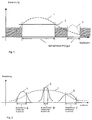
- the test material is measured without rejects in a pre-learning process and the frequency distribution 1 of the color values is determined.
- the test material is also measured without rejects and in a first step a color value range for good test material is determined by placing a threshold 2 based on experience on the frequency distribution 1 of the color values, the intersection between the threshold 2 and the curve of the frequency distribution being derived from the intersection points 1 result in the limits of the test material color value range.
- threshold 2 With the selected setting of threshold 2, pixels will also appear in the case of the error-free test material, which are classified as conspicuous. However, these pixels would erroneously serve as a committee if they clustered into large areas classified. Experience has shown that such an agglomeration in turn occurs preferentially in certain color value ranges. In order to measure these color value ranges, a large area detected in the error-free test material is stored in the learning process and the distribution of its color values is measured. This distribution is introduced as threshold 3 after standardization.
- the color value ranges of the product are divided into sub-ranges.
- each of the classifiers A, B and C working in parallel concentrates only on one sub-area. If the color components of the color-homogeneous reject part are preferably in the selected sub-area, the reject part is detected as a relatively large area and can be recognized by evaluating the detection areas.
- the distributions of the color values of these large areas are measured and introduced as thresholds after their normalization. All color values at which these thresholds 4, 5 and 6 exceed the color value distribution 1 of the test material parts are interpreted as rejects and lead to an error detection.
- the defect-free product large-area detection areas are detected in a color value range covered by a classifier, and the defect-free product is thus classified as a reject.
- these color values in particular, which lead to large-area detection areas in the fault-free product area are learned and recognized as good test material by changing the thresholds.
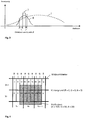
- the threshold 8 shows the Color value distribution of a reject part. Within the color value range determined by threshold 8, error-free test material is classified as a reject.
- the color value distribution of this large-area detection area is measured in the error-free test material and introduced as a threshold 7 after standardization. All color values at which the threshold 7 exceeds the threshold 8 of the reject part are interpreted as belonging to the test material and thus do not lead to an error detection.
- the classification system is doubled.
- One system takes over the test task, while the other system measures the current color value distribution of the product.
- the measurement of the current color value distribution is monitored by the checking classifier so that no color values of the rejects are recorded during this measurement.
- the learning classifier with the newly measured distribution is activated for the test task, while the classifier which has been set to test so far takes over the learning task.
- the test object When the signal is recorded, the test object is illuminated, for example, by two lamps from the direction of the line scan camera.
- the optical axis of the line scan camera lies between the two lamps.
- test material is taken up lying on the conveyor belt.
- the tape is not of a uniform color due to dirt and wear.
- shadows form on the conveyor belt, which leads to a significant expansion of the color value distribution when measuring the error-free test material. For this reason, the test material is observed in flight.
- the background has the color of the test material, which has the advantage that the contrast between the background and the test material is low and therefore the color value distribution of the test material is not significantly expanded by edge effects at the transition from the background to the test material.
- This variant provides the best results in terms of color and spatial resolution.
- the background as a rotating roller, which immediately throws away deposits.
- the shadow of the test material on the background becomes diffuse and, depending on the bulk density, harmless if the rotating roller is installed at a suitable distance from the test material.
- the background can be a cylindrical emitter that emits the color of the test material and is surrounded by a transparent rotating roller that throws away the deposits.
- the background is a dark hole, which has the advantage that the test material can be segmented from the background and there is no impairment due to dirt and shadows.
- segmentation of the test material for example, the form for separating good parts and rejects can be used.
- the line scan camera looks into this container through a slit.
- the width of the slot is adapted to the aperture and focal length of the camera lens and to the distance to the focus plane.
- the light of each pixel is broken down into the three colors red (R), green (G) and blue (B).
- the color components are not ideally measured at the same location, but rather at different locations.
- the color sensors are even located side by side, so that the color sensors see different spatial areas of the measurement object with respect to a pixel.
- the color sensors (R, G, B) are arranged horizontally, while the measurement object moves past this horizontal line from top to bottom.
Landscapes
- Engineering & Computer Science (AREA)
- Multimedia (AREA)
- Sorting Of Articles (AREA)
- Spectrometry And Color Measurement (AREA)
- Epoxy Compounds (AREA)
- Treatment Of Sludge (AREA)
- Crystals, And After-Treatments Of Crystals (AREA)
- Investigating Or Analysing Materials By Optical Means (AREA)
Applications Claiming Priority (2)
| Application Number | Priority Date | Filing Date | Title |
|---|---|---|---|
| DE4345106A DE4345106C2 (de) | 1993-12-28 | 1993-12-28 | Verfahren zum optischen Sortieren von Schüttgut |
| DE4345106 | 1993-12-28 |
Publications (3)
| Publication Number | Publication Date |
|---|---|
| EP0661108A2 true EP0661108A2 (fr) | 1995-07-05 |
| EP0661108A3 EP0661108A3 (fr) | 1997-02-12 |
| EP0661108B1 EP0661108B1 (fr) | 1999-11-03 |
Family
ID=6506597
Family Applications (1)
| Application Number | Title | Priority Date | Filing Date |
|---|---|---|---|
| EP94250285A Expired - Lifetime EP0661108B1 (fr) | 1993-12-28 | 1994-11-25 | Procédé de tri optique de matériau en vrac |
Country Status (7)
| Country | Link |
|---|---|
| US (1) | US5586663A (fr) |
| EP (1) | EP0661108B1 (fr) |
| JP (1) | JP3517292B2 (fr) |
| AT (1) | ATE186242T1 (fr) |
| BR (1) | BR9405268A (fr) |
| CA (1) | CA2136779C (fr) |
| DE (2) | DE4345106C2 (fr) |
Cited By (1)
| Publication number | Priority date | Publication date | Assignee | Title |
|---|---|---|---|---|
| DE19511534A1 (de) * | 1995-03-29 | 1996-10-02 | Fraunhofer Ges Forschung | Verfahren und Vorrichtung zur Erfassung von 3D-Fehlstellen bei der automatischen Inspektion von Oberflächen mit Hilfe farbtüchtiger Bildauswertungssysteme |
Families Citing this family (13)
| Publication number | Priority date | Publication date | Assignee | Title |
|---|---|---|---|---|
| US5577733A (en) * | 1994-04-08 | 1996-11-26 | Downing; Dennis L. | Targeting system |
| DE19511901A1 (de) * | 1995-03-31 | 1996-10-02 | Commodas Gmbh | Vorrichtung und Verfahren zum Sortieren von Schüttgut |
| JPH0943058A (ja) * | 1995-05-23 | 1997-02-14 | Olympus Optical Co Ltd | 色分類装置及び色むら検査装置 |
| EP0775533A3 (fr) * | 1995-11-24 | 1998-06-17 | Elpatronic Ag | Méthode de tri |
| DE19609916A1 (de) * | 1996-03-14 | 1997-09-18 | Robert Prof Dr Ing Massen | Preisgünstiger spektroskopischer Sensor für die Erkennung von Kunststoffen |
| AT3418U1 (de) | 1999-04-30 | 2000-03-27 | Waagner Biro Binder Aktiengese | Verfahren und vorrichtung zum sortieren von altpapier |
| BR0311359A (pt) * | 2002-05-28 | 2007-04-27 | Satake Usa Inc | fonte de iluminação para máquina classificadora |
| MX2008012726A (es) * | 2006-04-04 | 2009-01-16 | 6511660 Canada Inc | Sistema y metodo para identificar y clasificar material. |
| US20110068051A1 (en) * | 2009-05-22 | 2011-03-24 | 6358357 Canada Inc. | Ballistic separator |
| WO2013028196A1 (fr) * | 2011-08-25 | 2013-02-28 | Alliance For Sustainable Energy, Llc | Contrôle continu en ligne de la fabrication de photopiles et de piles à combustible faisant appel à une imagerie par réflectance spectrale |
| DE102012001868B4 (de) | 2012-01-24 | 2018-03-29 | Fraunhofer-Gesellschaft zur Förderung der angewandten Forschung e.V. | Verfahren zum Einrichtung einer dem optischen Identifizieren von Objekten dienender Anlage, Laborbildaufnahmesystem zum Durchführen eines solchen Verfahrens und Anordnung umfassend das Laborbildaufnahmesystem sowie die Anlage |
| US10480935B2 (en) | 2016-12-02 | 2019-11-19 | Alliance For Sustainable Energy, Llc | Thickness mapping using multispectral imaging |
| DE102023113725A1 (de) | 2023-05-25 | 2024-11-28 | Multivac Sepp Haggenmüller Se & Co. Kg | Optimierung der Gut- bzw. Schlechtprodukterkennung für Verpackungsmaschinen |
Family Cites Families (14)
| Publication number | Priority date | Publication date | Assignee | Title |
|---|---|---|---|---|
| US3560758A (en) * | 1968-01-08 | 1971-02-02 | Conductron Corp | Color identification system taking into account the color and reflecting of the base material |
| DE2544703C3 (de) * | 1975-10-07 | 1978-04-06 | Dr.-Ing. Rudolf Hell Gmbh, 2300 Kiel | Verfahren und Schaltungsanordnung zum Erkennen von Farben einer farbigen Fläche |
| US4122951A (en) * | 1977-02-28 | 1978-10-31 | Alaminos Jose I L | Machine for the automatic detection of blemishes in olives and other fruits |
| US4246098A (en) * | 1978-06-21 | 1981-01-20 | Sunkist Growers, Inc. | Method and apparatus for detecting blemishes on the surface of an article |
| IT1205622B (it) * | 1982-12-21 | 1989-03-23 | Illycaffe Spa | Procedimento per effettuare una selezione in un materiale granuliforme e macchina per attuare il procedimento |
| GB2151018B (en) * | 1983-12-06 | 1987-07-22 | Gunsons Sortex Ltd | Sorting machine and method |
| JPS63119887A (ja) * | 1986-11-06 | 1988-05-24 | カネボウ株式会社 | 選別装置 |
| DE3802681C2 (de) * | 1987-01-30 | 1997-01-09 | Fuji Photo Film Co Ltd | Verfahren zur Klassifizierung von Farbvorlagen und Vorrichtung hierfür |
| US5085325A (en) * | 1988-03-08 | 1992-02-04 | Simco/Ramic Corporation | Color sorting system and method |
| EP0342354A3 (fr) * | 1988-04-15 | 1992-01-08 | Tecnostral S.A. Industria E Tecnologia | Dispositif de trí selon la couleur |
| JPH0670590B2 (ja) * | 1988-09-10 | 1994-09-07 | 倉敷紡績株式会社 | 色順判定方式 |
| NL8803112A (nl) * | 1988-12-19 | 1990-07-16 | Elbicon Nv | Werkwijze en inrichting voor het sorteren van een stroom voorwerpen in afhankelijkheid van optische eigenschappen van de voorwerpen. |
| US5062714A (en) * | 1990-02-12 | 1991-11-05 | X-Rite, Incorporated | Apparatus and method for pattern recognition |
| DE4210157C2 (de) * | 1992-03-27 | 1994-12-22 | Bodenseewerk Geraetetech | Verfahren zum Sortieren von Glasbruch |
-
1993
- 1993-12-28 DE DE4345106A patent/DE4345106C2/de not_active Expired - Fee Related
-
1994
- 1994-11-25 AT AT94250285T patent/ATE186242T1/de not_active IP Right Cessation
- 1994-11-25 EP EP94250285A patent/EP0661108B1/fr not_active Expired - Lifetime
- 1994-11-25 DE DE59408885T patent/DE59408885D1/de not_active Expired - Fee Related
- 1994-11-28 CA CA002136779A patent/CA2136779C/fr not_active Expired - Fee Related
- 1994-12-27 BR BR9405268A patent/BR9405268A/pt not_active IP Right Cessation
- 1994-12-28 JP JP33871294A patent/JP3517292B2/ja not_active Expired - Fee Related
- 1994-12-28 US US08/365,489 patent/US5586663A/en not_active Expired - Lifetime
Cited By (3)
| Publication number | Priority date | Publication date | Assignee | Title |
|---|---|---|---|---|
| DE19511534A1 (de) * | 1995-03-29 | 1996-10-02 | Fraunhofer Ges Forschung | Verfahren und Vorrichtung zur Erfassung von 3D-Fehlstellen bei der automatischen Inspektion von Oberflächen mit Hilfe farbtüchtiger Bildauswertungssysteme |
| DE19511534C2 (de) * | 1995-03-29 | 1998-01-22 | Fraunhofer Ges Forschung | Verfahren und Vorrichtung zur Erfassung von 3D-Fehlstellen bei der automatischen Inspektion von Oberflächen mit Hilfe farbtüchtiger Bildauswertungssysteme |
| US6064478A (en) * | 1995-03-29 | 2000-05-16 | Fraunhofer-Gesellschaft Zur Forderung Der Angewandten Forschung E.V. | Method of and apparatus for automatic detection of three-dimensional defects in moving surfaces by means of color vision systems |
Also Published As
| Publication number | Publication date |
|---|---|
| CA2136779C (fr) | 2004-04-06 |
| JP3517292B2 (ja) | 2004-04-12 |
| HK1013038A1 (en) | 1999-08-13 |
| CA2136779A1 (fr) | 1995-06-29 |
| DE4345106A1 (de) | 1995-06-29 |
| US5586663A (en) | 1996-12-24 |
| DE59408885D1 (de) | 1999-12-09 |
| JPH08206611A (ja) | 1996-08-13 |
| EP0661108B1 (fr) | 1999-11-03 |
| BR9405268A (pt) | 1995-09-19 |
| DE4345106C2 (de) | 1995-11-23 |
| ATE186242T1 (de) | 1999-11-15 |
| EP0661108A3 (fr) | 1997-02-12 |
Similar Documents
| Publication | Publication Date | Title |
|---|---|---|
| EP0661108B1 (fr) | Procédé de tri optique de matériau en vrac | |
| DE69637172T2 (de) | Hochgeschwindigkeits sortierapparat für den lebensmittelmassentransport zur optischen inspektion und sortierung von grossvolumigen lebensmitteln | |
| DE69610925T2 (de) | Vorrichtung zur untersuchung von flaschengewinden und verfahren zu deren betrieb | |
| DE60213133T2 (de) | Vorrichtung und verfahren zur erkennung von überlappungen | |
| DE69822608T2 (de) | Binarisierungsverfahren in einem Zeichenerkennungssystem | |
| EP0619905B1 (fr) | Procede et dispositif de controle de la qualite et/ou de classification optiques de plantes | |
| DE3906281A1 (de) | Verfahren und vorrichtung zum optischen ueberpruefen des aussehens chipartiger bauteile und zum sortieren der chipartigen bauteile | |
| EP0682991A2 (fr) | Machine automatique pour le tri, respectivement la classification d'après la forme et la couleur, de petits produits de l'industrie pharmaceutique et des friandises | |
| DE2549457A1 (de) | Einrichtung zur automatischen ueberwachung von fertigprodukten auf fabrikationsfehler | |
| DE69331662T2 (de) | Verfahren und gerät zur automatischen bewertung von getreidekörnern und anderen granularen produkten | |
| DE3587927T2 (de) | Verfahren und Vorrichtung zur automatischen Untersuchung von Tabletten. | |
| EP1030740A1 (fr) | Procede et dispositif pour l'identification et le tri d'objets transportes sur bande | |
| DE2820661C2 (fr) | ||
| DE2937335A1 (de) | Pruefsystem fuer das aeussere erscheinungsbild von gegenstaenden | |
| DE3347472A1 (de) | Verfahren und vorrichtung zum erfassen von radialen reflektierenden behaelterdefekten | |
| DE69413482T2 (de) | Anordnung zur Kontrolle von Hohlglasbehältern | |
| EP0620050B1 (fr) | Dispositif et procédé de tri de produits et d'articles selon leur qualité et leur taille | |
| EP0669527A1 (fr) | Procédé d'extraction de bouteilles réutilisables de leur cycle d'utilisation | |
| EP3468727A1 (fr) | Dispositif de triage et procédé de triage correspondant | |
| DE112005000828B4 (de) | Vorrichtung und Verfahren zur Prüfung von Halbleiter-Wafern | |
| DE3514313C2 (de) | Verfahren und Vorrichtung zur Inspektion und zum Sortieren von Glasbehältern | |
| WO2001023869A1 (fr) | Procede et dispositif pour inspecter la surface d'un feuillard circulant en continu | |
| DE4434475C2 (de) | Verfahren und Vorrichtung zur Qualitätskontrolle eines Gegenstandes, insbesondere einer Compact-Disc | |
| WO2019185184A1 (fr) | Dispositif et procédé pour la détection optique de position d'objets transportés | |
| EP1088601B1 (fr) | Dispositif de mesure et de tri de pièces |
Legal Events
| Date | Code | Title | Description |
|---|---|---|---|
| PUAI | Public reference made under article 153(3) epc to a published international application that has entered the european phase |
Free format text: ORIGINAL CODE: 0009012 |
|
| AK | Designated contracting states |
Kind code of ref document: A2 Designated state(s): AT BE CH DE DK ES FR GB GR IE IT LI LU MC NL PT SE |
|
| RAP1 | Party data changed (applicant data changed or rights of an application transferred) |
Owner name: H.F. & PH.F. REEMTSMA GMBH & CO |
|
| PUAL | Search report despatched |
Free format text: ORIGINAL CODE: 0009013 |
|
| AK | Designated contracting states |
Kind code of ref document: A3 Designated state(s): AT BE CH DE DK ES FR GB GR IE IT LI LU MC NL PT SE |
|
| 17P | Request for examination filed |
Effective date: 19970306 |
|
| RAP1 | Party data changed (applicant data changed or rights of an application transferred) |
Owner name: H.F. & PH.F. REEMTSMA GMBH |
|
| GRAG | Despatch of communication of intention to grant |
Free format text: ORIGINAL CODE: EPIDOS AGRA |
|
| 17Q | First examination report despatched |
Effective date: 19990121 |
|
| GRAG | Despatch of communication of intention to grant |
Free format text: ORIGINAL CODE: EPIDOS AGRA |
|
| GRAH | Despatch of communication of intention to grant a patent |
Free format text: ORIGINAL CODE: EPIDOS IGRA |
|
| GRAH | Despatch of communication of intention to grant a patent |
Free format text: ORIGINAL CODE: EPIDOS IGRA |
|
| GRAA | (expected) grant |
Free format text: ORIGINAL CODE: 0009210 |
|
| AK | Designated contracting states |
Kind code of ref document: B1 Designated state(s): AT BE CH DE DK ES FR GB GR IE IT LI LU MC NL PT SE |
|
| PG25 | Lapsed in a contracting state [announced via postgrant information from national office to epo] |
Ref country code: SE Free format text: THE PATENT HAS BEEN ANNULLED BY A DECISION OF A NATIONAL AUTHORITY Effective date: 19991103 Ref country code: GR Free format text: LAPSE BECAUSE OF NON-PAYMENT OF DUE FEES Effective date: 19991103 Ref country code: ES Free format text: THE PATENT HAS BEEN ANNULLED BY A DECISION OF A NATIONAL AUTHORITY Effective date: 19991103 |
|
| REF | Corresponds to: |
Ref document number: 186242 Country of ref document: AT Date of ref document: 19991115 Kind code of ref document: T |
|
| REG | Reference to a national code |
Ref country code: CH Ref legal event code: EP |
|
| GBT | Gb: translation of ep patent filed (gb section 77(6)(a)/1977) |
Effective date: 19991103 |
|
| PG25 | Lapsed in a contracting state [announced via postgrant information from national office to epo] |
Ref country code: LU Free format text: LAPSE BECAUSE OF NON-PAYMENT OF DUE FEES Effective date: 19991125 Ref country code: AT Free format text: LAPSE BECAUSE OF NON-PAYMENT OF DUE FEES Effective date: 19991125 |
|
| PG25 | Lapsed in a contracting state [announced via postgrant information from national office to epo] |
Ref country code: LI Free format text: LAPSE BECAUSE OF NON-PAYMENT OF DUE FEES Effective date: 19991130 Ref country code: CH Free format text: LAPSE BECAUSE OF NON-PAYMENT OF DUE FEES Effective date: 19991130 |
|
| ITF | It: translation for a ep patent filed | ||
| REF | Corresponds to: |
Ref document number: 59408885 Country of ref document: DE Date of ref document: 19991209 |
|
| PG25 | Lapsed in a contracting state [announced via postgrant information from national office to epo] |
Ref country code: MC Free format text: THE PATENT HAS BEEN ANNULLED BY A DECISION OF A NATIONAL AUTHORITY Effective date: 20000103 |
|
| REG | Reference to a national code |
Ref country code: IE Ref legal event code: FG4D Free format text: GERMAN |
|
| PG25 | Lapsed in a contracting state [announced via postgrant information from national office to epo] |
Ref country code: PT Free format text: LAPSE BECAUSE OF FAILURE TO SUBMIT A TRANSLATION OF THE DESCRIPTION OR TO PAY THE FEE WITHIN THE PRESCRIBED TIME-LIMIT Effective date: 20000203 Ref country code: DK Free format text: LAPSE BECAUSE OF FAILURE TO SUBMIT A TRANSLATION OF THE DESCRIPTION OR TO PAY THE FEE WITHIN THE PRESCRIBED TIME-LIMIT Effective date: 20000203 |
|
| ET | Fr: translation filed | ||
| REG | Reference to a national code |
Ref country code: CH Ref legal event code: PL |
|
| REG | Reference to a national code |
Ref country code: IE Ref legal event code: FD4D |
|
| PLBE | No opposition filed within time limit |
Free format text: ORIGINAL CODE: 0009261 |
|
| STAA | Information on the status of an ep patent application or granted ep patent |
Free format text: STATUS: NO OPPOSITION FILED WITHIN TIME LIMIT |
|
| 26N | No opposition filed | ||
| REG | Reference to a national code |
Ref country code: GB Ref legal event code: IF02 |
|
| NLS | Nl: assignments of ep-patents |
Owner name: REEMTSMA CIGARETTENFABRIKEN GMBH |
|
| REG | Reference to a national code |
Ref country code: FR Ref legal event code: CD |
|
| REG | Reference to a national code |
Ref country code: FR Ref legal event code: TP |
|
| REG | Reference to a national code |
Ref country code: FR Ref legal event code: CA |
|
| PGFP | Annual fee paid to national office [announced via postgrant information from national office to epo] |
Ref country code: NL Payment date: 20071104 Year of fee payment: 14 Ref country code: DE Payment date: 20071122 Year of fee payment: 14 |
|
| PGFP | Annual fee paid to national office [announced via postgrant information from national office to epo] |
Ref country code: IT Payment date: 20071127 Year of fee payment: 14 |
|
| PGFP | Annual fee paid to national office [announced via postgrant information from national office to epo] |
Ref country code: GB Payment date: 20071121 Year of fee payment: 14 Ref country code: FR Payment date: 20071108 Year of fee payment: 14 |
|
| PGFP | Annual fee paid to national office [announced via postgrant information from national office to epo] |
Ref country code: BE Payment date: 20071130 Year of fee payment: 14 |
|
| BERE | Be: lapsed |
Owner name: *REEMTSMA CIGARETTENFABRIKEN G.M.B.H. Effective date: 20081130 |
|
| GBPC | Gb: european patent ceased through non-payment of renewal fee |
Effective date: 20081125 |
|
| PG25 | Lapsed in a contracting state [announced via postgrant information from national office to epo] |
Ref country code: NL Free format text: LAPSE BECAUSE OF NON-PAYMENT OF DUE FEES Effective date: 20090601 |
|
| NLV4 | Nl: lapsed or anulled due to non-payment of the annual fee |
Effective date: 20090601 |
|
| PG25 | Lapsed in a contracting state [announced via postgrant information from national office to epo] |
Ref country code: IT Free format text: LAPSE BECAUSE OF NON-PAYMENT OF DUE FEES Effective date: 20081125 |
|
| REG | Reference to a national code |
Ref country code: FR Ref legal event code: ST Effective date: 20090731 |
|
| PG25 | Lapsed in a contracting state [announced via postgrant information from national office to epo] |
Ref country code: BE Free format text: LAPSE BECAUSE OF NON-PAYMENT OF DUE FEES Effective date: 20081130 |
|
| PG25 | Lapsed in a contracting state [announced via postgrant information from national office to epo] |
Ref country code: DE Free format text: LAPSE BECAUSE OF NON-PAYMENT OF DUE FEES Effective date: 20090603 |
|
| PG25 | Lapsed in a contracting state [announced via postgrant information from national office to epo] |
Ref country code: GB Free format text: LAPSE BECAUSE OF NON-PAYMENT OF DUE FEES Effective date: 20081125 |
|
| PG25 | Lapsed in a contracting state [announced via postgrant information from national office to epo] |
Ref country code: FR Free format text: LAPSE BECAUSE OF NON-PAYMENT OF DUE FEES Effective date: 20081130 |