EP0661299A2 - Composition de catalyseur à base de chrome et procédés pour la polymérisation de l'éthylène les utilisant - Google Patents
Composition de catalyseur à base de chrome et procédés pour la polymérisation de l'éthylène les utilisant Download PDFInfo
- Publication number
- EP0661299A2 EP0661299A2 EP94120701A EP94120701A EP0661299A2 EP 0661299 A2 EP0661299 A2 EP 0661299A2 EP 94120701 A EP94120701 A EP 94120701A EP 94120701 A EP94120701 A EP 94120701A EP 0661299 A2 EP0661299 A2 EP 0661299A2
- Authority
- EP
- European Patent Office
- Prior art keywords
- chromium
- support
- catalyst composition
- hexavalent chromium
- catalyst
- Prior art date
- Legal status (The legal status is an assumption and is not a legal conclusion. Google has not performed a legal analysis and makes no representation as to the accuracy of the status listed.)
- Granted
Links
Images





Classifications
-
- C—CHEMISTRY; METALLURGY
- C08—ORGANIC MACROMOLECULAR COMPOUNDS; THEIR PREPARATION OR CHEMICAL WORKING-UP; COMPOSITIONS BASED THEREON
- C08F—MACROMOLECULAR COMPOUNDS OBTAINED BY REACTIONS ONLY INVOLVING CARBON-TO-CARBON UNSATURATED BONDS
- C08F10/00—Homopolymers and copolymers of unsaturated aliphatic hydrocarbons having only one carbon-to-carbon double bond
- C08F10/02—Ethene
Definitions
- This invention is related to the field of chromium catalyst compositions. This invention is also related to the field of ethylene polymerization processes catalyzed with chromium catalyst compositions.
- ethylene polymer for the purposes of this application shall mean homopolymer(s) comprising ethylene and/or copolymer(s) comprising a major amount of ethylene ( ⁇ 50 mole percent) and a minor amount of comonomer ⁇ 50 mole percent).
- long chain branching gives an ethylene polymer (when compared to ethylene polymers not having long chain branches) a high viscosity under low shear conditions and a low viscosity under high shear conditions. Having a low viscosity under high shear conditions can increase the rate at which the ethylene polymer can be processed, thereby making the process more efficient.
- long chain branching is known to reduce die swell during blowmolding operations and increase bubble stability during film blowing operations. Since long chain branching has such a large affect on the rheological properties, it would be advantageous to be able to control the amount of long chain branching in an ethylene polymer.
- Ethylene polymers produced using chromium catalyst compositions have very low levels of long chain branching. However, even at these low levels, long chain branching has a significant affect on the rheological properties of an ethylene polymer. Therefore, it would be advantageous to be able to control the amount of long chain branching in an ethylene polymer that is produced by a chromium catalyst composition.
- a chromium catalyst composition that comprises
- a process to homopolymerize ethylene, or copolymerize ethylene with a comonomer comprises polymerizing ethylene with the above chromium catalyst composition.
- FIGURE 1 is a graph of the tan delta vs. the weight average molecular weight for ethylene polymers produced from chromium/silica catalysts.
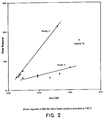
- FIGURE 2 is a graph of the shear response vs. the weight average molecular weight for ethylene polymers produced from chromium/silica catalysts.
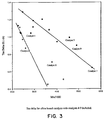
- FIGURE 3 is a graph of the tan delta vs. the weight average molecular weight for ethylene polymers produced from chromium/silica catalysts.
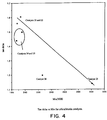
- FIGURE 4 is a graph of the tan delta vs. the weight average molecular weight for ethylene polymers produced from chromium/silica-titania catalysts.
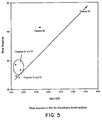
- FIGURE 5 is a graph of the shear response vs. the weight average molecular weight for ethylene polymers produced from chromium/silica-titania catalysts.
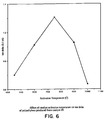
- FIGURE 6 is a graph of the tan delta vs. the activation temperature for ethylene polymers produced from catalyst 29.
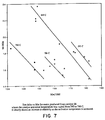
- FIGURE 7 is a graph of the tan delta vs. the weight average molecular weight for ethylene polymers produced from catalyst 26.
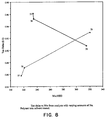
- FIGURE 8 is a graph of the tan delta vs. the weight average molecular weight for ethylene polymers produced with catalysts that have varying amounts of sodium.
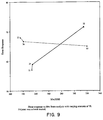
- FIGURE 9 is a graph of the shear response vs. the weight average molecular weight for ethylene polymers produced with catalysts that have varying amounts of sodium.
- FIGURE 10 is a graph of the tan delta vs. the weight average molecular weight for ethylene polymers produced with catalysts that have varying amounts of chromium.
- FIGURE 11 is a graph of the shear response vs. the weight average molecular weight for ethylene polymers produced with catalysts that have varying amounts of chromium.
- FIGURE 12 is a graph of the tan delta vs. the weight average molecular weight for ethylene polymers produced with catalyst 25.
- FIGURE 13 is a graph of the catalyst pore volume vs. the catalyst surface area.
- FIGURE 14 is a graph of the molecular weight distribution for ethylene polymers produced with catalysts that have various levels of chromium.
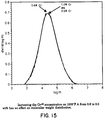
- FIGURE 15 is a graph of the molecular weight distribution for ethylene polymers produced with catalysts that have various levels of chromium.
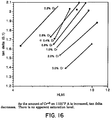
- FIGURE 16 is a graph of the tan delta vs. the high load melt index for ethylene polymers produced with catalyst A.
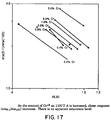
- FIGURE 17 is a graph of the eta ratio vs. the high load melt index for ethylene polymers produced with catalyst A.
- FIGURE 18 is a graph of the eta ratio vs. the surface concentration of hexavalent chromium for ethylene polymers produced with catalyst A.
- FIGURE 19 is a graph of the eta ratio vs. the surface concentration of hexavalent chromium for ethylene polymers produced with catalyst A.
- the chromium catalyst compositions used in this invention comprise a chromium component and a support component.
- the support component is not meant to be construed as an inert component of the chromium catalyst composition.
- the support is generally composed of about 80 to about 100 wt.% silica.
- the remainder, if any, being selected from the group consisting of refractory metal oxides, such as aluminum, boria, magnesia, thoria, zirconia, titania, and mixtures of two or more of these refractory metal oxides. It is preferred however, that the remainder, if any, consists essentially of titania.
- the support can be prepared in accordance with any method known in the art. Suitable methods are disclosed in U.S. patent 3,900,457; 4,081,407; 4,392,990; 4,405,501; 4,735,931; and 4,981,831; the entire disclosures of which are hereby incorporated by reference.
- the support have a surface area to pore volume relationship as follows: 0.5 ⁇ pore volume ⁇ f(SA) wherein the f(SA) is (1.14x10 ⁇ 7)(SA)3 - 1.19x10 ⁇ 4)(SA)2 + (3.19x10 ⁇ 2)(SA) + 0.20 .
- the surface area of the support is from about 50 m2/g to about 500 m2/g. It is more preferred if the surface area if from 100 m2/g to 300 m2/g. If the surface area is substantially greater than 500 m2/g then the polymer produced by this catalyst will not possess the desired amount of long chain branching. If the surface area is substantially less than 50 m2/g then the support cannot carry enough hexavalent chromium to form a high activity catalyst composition. It is also preferred if the pore volume is from about 0.5 to about 2.5 cc/g. However, it is more preferred if the pore volume is from 1 to 2 cc/g. If the pore volume is substantially greater than 2.5 cc/g then the polymer produced by this catalyst composition will not possess the desired amount of long chain branching. If the pore volume is substantially less than 0.5 cc/g than the catalyst composition will have low activity.
- One method to affect the surface area of the support is by contacting the support with aqueous ammonia.
- the aqueous ammonia should have a pH greater than about 7. However, it is preferred if the aqueous ammonia has a pH from about 8 to about 11.
- the support can be contacted with the aqueous ammonia for a time period in the range of about 1 minute to about 100 hours. However, depending on the desired surface area longer contact times tend to produce smaller surface areas.
- the chromium component of the chromium catalyst composition comprises a chromium compound.
- Suitable chromium compounds are chromium nitrate, chromium acetate, and chromium trioxide.
- the amount of chromium compound combined with the support is from about 0.5 wt.% to about 5 wt.%, preferably it is from about 1 wt.% to about 4 wt.%, and most preferably it is 1 wt.% to 3 wt.% based on the combined weight of the chromium compound and the support. If the amount of chromium is substantially greater than 5 wt.% then the activity of the catalyst composition is undesirably low and the resulting polymer has an unacceptable color.
- the amount of chromium is substantially less than 0.5 wt.% then the activity of the catalyst composition is undesirably low and the resulting polymer does not have the desired amount of long chain branching.
- the chromium compound can be combined with the support in any manner known in the art. Examples of combining the chromium compound with the support are disclosed in the above-cited and incorporated patents.
- hexavalent chromium is the preferred catalytic species.
- the surface concentration of the hexavalent chromium on the support must be from about 0.25 to about 1 hexavalent chromium atoms per square nanometer. It is preferred however, if the surface concentration of hexavalent chromium is from 0.4 to 1 hexavalent chromium atom per square nanometer.
- a Group I metal can be contacted with the chromium catalyst composition to further increase the amount of long chain branching in a resulting polymer.
- the amount of the Group I metal to contact with chromium catalyst composition is from about 1 to about 5000 parts per million by weight based on the weight of the chromium catalyst composition. However, it is preferred, if the amount of the Group I metal is from 100 to 3000 parts per million. Sodium and potassium are the preferred Group I metals to use in this regard.
- the chromium catalyst composition can be activated in a variety of ways. In general, activation occurs when the chromium compound is contacted with an oxygen-containing ambient. This contacting should take place at a temperature from about 500°C to about 1000°C. However, the proper temperature range depends on the composition that is to be activated and how that composition will be used.
- the chromium catalyst composition should be activated at a temperature from about 750°C to about 1000°C. However, it is preferred if the chromium catalyst composition in this case is activated at a temperature from about 800°C to about 1000°C. However, it is even more preferred if the chromium catalyst composition is activated at a temperature from 800°C to 925°C. If the chromium catalyst composition is going to be used with a cocatalyst, a lower activation temperature can be used. In this case, the chromium catalyst composition can be activated at a temperature from about 500°C to about 700°C. However, it is preferred if the chromium catalyst composition, in this case, is activated at a temperature from 600°C to 700°C.
- the chromium catalyst composition can be used to homopolymerize ethylene, or copolymerize ethylene with a comonomer.
- a preferred polymerization technique is a slurry polymerization process also known as the particle form process. Such polymerization techniques are well known in the art and are disclosed, for instance, in Norwood, U.S. patent 3,248,179; the entire disclosure of which is hereby incorporated by reference.
- Two preferred polymerization methods for the slurry process are those employing a loop reactor of the type disclosed in Norwood and those utilized in a plurality of stirred reactors either in series, parallel, or combinations thereof, wherein the reaction conditions are different in the different reactors.
- comonomers that can be copolymerized with ethylene should have from three to about 20 carbon atoms in their molecular chain. They can be either linear or branched, but linear comonomers are preferred. Suitable examples of comonomers are propylene, 1-butene, 3-methyl-1-butene, 1-pentene, 3-methyl-1-pentene, 4-methyl-1-pentene, 1-hexene, 3-ethyl-1-hexene, 1-heptene, 1-octene, 1-nonene, 1-decene, and mixtures of two or more said comonomers.
- a trialkylaluminum cocatalyst can be present during the polymerization.
- the alkyl groups of the trialkylaluminum cocatalyst should have from about 1 to about 10 carbon atoms and preferably 2 to 4 carbon atoms. Examples, include but are not limited to, triethylaluminum, tripropylaluminum, and trimethylaluminum. However, most preferred is triethylaluminum.
- the amount of trialkylaluminum cocatalyst used in the polymerization, in parts per million by weight, based on the weight of the diluent in the reactor, is from about 0.01 parts per million to about 20 parts per million, preferably it is from about 0.05 parts per million to about 10 parts per million and most preferably it is from 0.5 to 5 parts per million.
- a trialkylaluminum cocatalyst is not present during the polymerization, a trialkylboron compound should be present.
- the alkyl groups of the trialkylboron cocatalyst should have from about 1 to about 10 carbon atoms and preferably 2 to 4 carbon atoms. Examples include, but are not limited to, triethylboron, tripropylboron, and trimethylboron. However, most preferred is triethylboron.
- the amount of trialkylboron cocatalyst used in a polymerization stated in parts per million by weight, based on the weight of the diluent in the reactor, is from about 0.01 parts per million to about 20 parts per million. Preferably it is from about 0.05 parts per million to about 10 parts per million, and most preferably it is from 0.5 parts per million to 5 parts per million.
- the polymerization temperature should be from about 80°C to about 110°C. However, it is preferred if the reaction polymerization temperature is from 95°C to 105°C. If the temperature is substantially greater than 100°C the reactor can foul and the resulting polymer will not possess the desired amount of long chain branching. If the temperature is substantially less than 80°C the catalyst activity is too low and the resulting polymer has a melt index which is undesirably low.
- the catalysts used in the initial portion of this example are listed in Table 1. All were prepared with 1% chromium and activated at 750°C, in order to determine the relationship of catalyst pore structure to long chain branching. These catalysts consist of commercial polyolefin catalysts, chromatographic silicas, colloidal silicas, and others. Some of the catalysts have low activity, but this selection provides a wide range of pore structures, allowing the pore volume, surface area, and pore size to be studied.
- the resulting polymers were analyzed for long chain branching by comparing the melt rheology (Table 4) and size exclusion chromatography (SEC) data (Table 5) to determine if the resin has higher elasticity than can be justified by the molecular weight.
- SEC size exclusion chromatography
- the M w of the polymer produced from catalyst 18 was estimated from the M v to be 431,000. This places it between family 1 and family 2 in Figures 1 and 2. This could be due to the presence of some long chain branching or to a very broad MWD. Without the SEC it is difficult to say which.
- Catalyst 29 was activated at different temperatures to determine if catalyst activation temperature has any effect on long chain branching. As the activation temperature was increased, the catalyst pore volume and surface area decreased while the average pore radius remained about the same (Table 7). This change in pore structure was minor below 750°C, but it became rapid at higher temperatures.
- the intrinsic viscosities in Table 8 show that the molecular weight of polyethylene decreases as the catalyst activation temperature is increased. Thus, the elasticity of these samples should also decrease as the activation temperature is increased.
- An increase in tan delta in Figure 6 shows that the elasticity is decreasing as expected when the temperature is increased from 450°C to 750°C. However, above 750°C activation, the elasticity begins to increase. This could be due to either a broadening of the molecular weight distribution or to long chain branching.
- Catalysts 32 and 35 were prepared by hydrolysis of tetraethyl orthosilicate, so they have very low Na contents. Each was run with different levels of added sodium.
- the catalyst 25A was run at various reaction temperatures to see if this affected the long chain branching (Table 13). As reaction temperature was increased, M w decreased and the molecular weight distribution narrowed. Figure 12 shows that the polymer produced at 108°C has much higher tan delta and crossover modulus than expected. This suggests that fewer long chain branches are formed at high reaction temperatures. The similarity of the calculated and measured inherent viscosities (Table 13) also suggest that the resin produced at 108°C is behaving more like linear chains.
- the catalysts used in the initial portion of this example were prepared by one of the following methods as designated in Table 1.
- the support was wetted with a solution of methanol containing enough chromium nitrate to give 1% Cr based on the weight of support.
- the methanol was removed by heating at 100°C under vacuum.
- Catalyst 14 was prepared as in Method A, except an aqueous solution of chromium nitrate was used. This gave a catalyst with lower pore volume than catalyst 13 (the base catalyst for catalyst 14) due to contraction of the pores by the surface tension of the water as it evaporated.
- Catalyst 23 was prepared by wetting catalyst 22 with deionized water and drying at 100°C under vacuum to reduce the pore volume.
- Catalysts 5, 7, and 9 were prepared by this method in order to prevent aggregation of the colloidal silica particles during the methanol drying step in Method A.
- the silica (5 g) was placed in an activator tube with a stream of dry nitrogen flowing through it. Then 0.08 mL of chromyl chloride (1.0% Cr based on the weight of silica) was injected into the nitrogen stream below the silica. The chromyl chloride slowly evaporated and was carried by the nitrogen into the silica where it reacted. The fluidizing gas was changed to air and the temperature was raised to 750°C for 3 hr to give the activated catalyst.
- Colloidal silicas are very fluffy and do not fluidize well. This allowed a portion of the chromyl chloride to pass through the silica without reacting. Plasma digestate analysis showed that catalysts 5, 7, and 9 contained only 0.88, 0.73, and 0.50% Cr, respectively.
- Catalyst 32 - Silbond 40 200 mL
- 200 mL, of 1-propanol, and 10 mL of concentrated ammonium hydroxide were stirred for 5 min at room temperature.
- Titanium isopropoxide (10 mL) was added and stirred for 5 min to give 1.5% Ti.
- Deionized water 40 mL was then added and gelation occurred within 30 sec giving a clear gel, which was aged 84 hr at room temperature and 2 hr at reflux. It was then dried at 80°C under vacuum for 24 hr to give the titanated silica.
- This silica was wetted with a solution of chromium nitrate in methanol, and dried at 100°C under vacuum to give 1% Cr.
- Catalyst 35 - Prepared as catalyst 32, except no titanium isopropoxide was added.
- Polymerizations All polymerizations were carried out in a 2.6 L stainless steel reactor. After flushing the reactor with nitrogen and isobutane, 0.05 to 0.10 g of catalyst was charged. This was followed by addition of 600 mL of isobutane, 0.5 mL of 0.5 wt.% TEA in heptane, and an additional 600 mL of isobutane. The reactor was then heated to temperature and the pressure was brought up to the desired level by addition of ethylene. The pressure was maintained at this level throughout the reaction by addition of ethylene at the same rate it was consumed by reaction. Polymerization time was normally 45-60 minutes, depending on the catalyst activity.
- Long chain branching can also be increased by sintering the catalyst to reduce pore volume and surface area. This can be done by adding an alkali metal to reduce the catalyst sintering temperature or by using a higher activation temperature.
- Catalyst A was activated at 1100 and 1500°F. All other catalysts were activated at 1100°F.
- Table 14 some sintering of the high pore volume catalysts occurred at high Cr levels. It is unclear whether the sintering is actually caused by the Cr or by an impurity in the Cr solution. The sintering is most evident in catalyst A where the surface area dropped from 430 m2/g at 0.2% Cr to 303 m2/g at 3.0% Cr. Some sintering also occurred in 1100°F catalyst A and catalyst C. However, with the catalyst C and catalyst D, no sintering appears to have occurred at high Cr levels. This is most likely due to the lower pore volume of catalysts C and D making them more difficult to sinter.
- Table 15 shows the % conversion of Cr+3 to Cr+6 with each catalyst. The % conversion is dependent on the surface area of the catalyst, with the higher surface area catalysts supporting more Cr+6. On all catalysts except catalyst C, approximately 0.75 Cr+6 /nm2 can be supported at 1100°F activation. With catalyst C, the Cr+6 saturation level is approximately 0.70 Cr+6/nm2. When the activation temperature is increased to 1500°F, the saturation level on catalyst A decreases from 0.75 to 0.6-0.65 Cr+6/nm2.
- Figures 14 and 15 show the changes in molecular weight distribution as the Cr concentration is changed on 1500°F A.
- the molecular weight distribution shifts to lower molecular weight as the Cr increases from 0.2 to 0.6 wt%. Above 0.6 wt%, the Cr concentration has no effect on the molecular weight distribution.
- TEA increases the shear response with catalysts activated at low temperatures (Figure 18), but has no effect on shear response at high activation temperatures (Figure 19). TEA appears to increase shear response only when it also increases activity.
- TEB gave a dramatic increase in shear response ( Figures 18 and 19). But unlike TEA, it does not increase the catalyst activity. So the increase in shear response is probably not caused by a higher density of active sites. Instead, it is due to a change in the properties of the active Cr sites.
- Catalyst B support - The catalyst B support was made by the same method described above. The amount of residual Cr found in it was 0.008 wt%.
- Catalyst D - Catalyst C was dried at 150°C for 3 hr while being fluidized with nitrogen. It was then slurried in dry hexane under a nitrogen atmosphere and 15.5 ml of titanium(IV) isopropoxide was added to give 2% Ti on the catalyst C. This was reacted for 2 hr at room temperature with occasional shaking of the flask. The catalyst D was dried at 100°C under a nitrogen atmosphere.
- Rheology Measurements The polyethylene samples were compression molded into plaques at 180°C. Rheological measurements were then made on disk shaped samples which were punched from the plaques. Rheological data was obtained from a Rheometrics Dynamic Spectrometer (Model RMS-7700) at 190°C under a nitrogen atmosphere.
- crossover modulus --G(x)-- is the modulus at the point where the storage modulus --G'-- is equal to the loss modulus --G''--.
Landscapes
- Chemical & Material Sciences (AREA)
- Health & Medical Sciences (AREA)
- Chemical Kinetics & Catalysis (AREA)
- Medicinal Chemistry (AREA)
- Polymers & Plastics (AREA)
- Organic Chemistry (AREA)
- Transition And Organic Metals Composition Catalysts For Addition Polymerization (AREA)
Applications Claiming Priority (2)
| Application Number | Priority Date | Filing Date | Title |
|---|---|---|---|
| US174938 | 1993-12-28 | ||
| US08/174,938 US5576263A (en) | 1993-12-28 | 1993-12-28 | Chromium catalyst compositions and ethylene polymerization processes therewith |
Publications (3)
| Publication Number | Publication Date |
|---|---|
| EP0661299A2 true EP0661299A2 (fr) | 1995-07-05 |
| EP0661299A3 EP0661299A3 (fr) | 1996-07-31 |
| EP0661299B1 EP0661299B1 (fr) | 2001-07-25 |
Family
ID=22638141
Family Applications (1)
| Application Number | Title | Priority Date | Filing Date |
|---|---|---|---|
| EP94120701A Expired - Lifetime EP0661299B1 (fr) | 1993-12-28 | 1994-12-27 | Composition de catalyseur à base de chrome et procédés pour la polymérisation de l'éthylène les utilisant |
Country Status (3)
| Country | Link |
|---|---|
| US (2) | US5576263A (fr) |
| EP (1) | EP0661299B1 (fr) |
| DE (1) | DE69427808T2 (fr) |
Cited By (4)
| Publication number | Priority date | Publication date | Assignee | Title |
|---|---|---|---|---|
| EP0805164A1 (fr) * | 1996-05-01 | 1997-11-05 | Unilever Plc | Support inorganique poreux pour catalyseur |
| EP0882740A1 (fr) * | 1997-06-06 | 1998-12-09 | Fina Research S.A. | Catalyseurs à base de chrome modifiés par titanation pour la production de polyéthylène présentant une plus grande résistance à la fissuration sous contrainte |
| EP0882743A1 (fr) * | 1997-06-06 | 1998-12-09 | Fina Research S.A. | Catalyseurs à base de chrome modifiés par titanation pour la production de polyéthlylène |
| WO2010080106A1 (fr) * | 2008-12-18 | 2010-07-15 | Chevron Phillips Chemical Company Lp | Procédé de production de polymères présentant une distribution des masses moléculaires plus étendue ainsi qu'une distribution inversée des comonomères et de faibles teneurs en ramifications à longue chaîne |
Families Citing this family (22)
| Publication number | Priority date | Publication date | Assignee | Title |
|---|---|---|---|---|
| US5525695A (en) * | 1991-10-15 | 1996-06-11 | The Dow Chemical Company | Elastic linear interpolymers |
| US5895770A (en) * | 1995-02-28 | 1999-04-20 | Pq Corporation | Olefin polymerization catalysts with specific silica supports |
| US6670302B2 (en) | 1997-11-14 | 2003-12-30 | W. R. Grace & Co.-Conn | High pore volume polyolefin catalyst |
| EP0962469A1 (fr) * | 1998-06-05 | 1999-12-08 | Fina Research S.A. | Catalyseur de chrome sur support silice-aluminophosphate, traité avec du titane |
| US6201077B1 (en) * | 1998-12-01 | 2001-03-13 | Phillips Petroleum Company | Process that produces polymers |
| US6174981B1 (en) | 1998-12-17 | 2001-01-16 | Phillips Petroleum Company | Polymerization process |
| US6204346B1 (en) * | 1998-12-17 | 2001-03-20 | Phillips Petroleum Co. | Polymerization process |
| WO2000058369A1 (fr) * | 1999-03-29 | 2000-10-05 | Basf Aktiengesellschaft | Procede de polymerisation d'olefines |
| US6538077B1 (en) * | 1999-11-04 | 2003-03-25 | Phillips Petroleum Company | Polymerization catalyst systems, methods of making and uses therefor |
| US6465586B2 (en) * | 1999-11-12 | 2002-10-15 | Mcdaniel Max P. | Polymerization catalyst and process |
| GB9928176D0 (en) * | 1999-11-29 | 2000-01-26 | Borealis Polymers Oy | Polymer |
| JP4048043B2 (ja) * | 2001-11-02 | 2008-02-13 | 日揮株式会社 | 硫化カルボニル及びシアン化水素の分解触媒及び分解方法 |
| EP1509553A1 (fr) * | 2002-06-06 | 2005-03-02 | ExxonMobil Chemical Patents Inc. | Systeme catalyseur et procede de polymerisation d'olefines |
| JP2009533513A (ja) * | 2006-04-13 | 2009-09-17 | トータル・ペトロケミカルズ・リサーチ・フエリユイ | 低密度および中密度の分岐ポリエチレン |
| US8183173B2 (en) * | 2007-12-21 | 2012-05-22 | Chevron Phillips Chemical Company Lp | Fast activating catalyst |
| US8399580B2 (en) | 2010-08-11 | 2013-03-19 | Chevron Philips Chemical Company Lp | Additives to chromium catalyst mix tank |
| WO2013186025A1 (fr) * | 2012-06-14 | 2013-12-19 | Saudi Basic Industries Corporation | Polymérisation en phase gazeuse d'éthylène |
| US9376511B2 (en) | 2013-03-13 | 2016-06-28 | Chevron Phillips Chemical Company Lp | Polymerization catalysts and polymers |
| US10654948B2 (en) | 2013-03-13 | 2020-05-19 | Chevron Phillips Chemical Company Lp | Radically coupled resins and methods of making and using same |
| US10577440B2 (en) * | 2013-03-13 | 2020-03-03 | Chevron Phillips Chemical Company Lp | Radically coupled resins and methods of making and using same |
| CN114735411B (zh) * | 2017-03-06 | 2024-06-18 | 久益环球地下采矿有限责任公司 | 链式输送机及用于链式输送机的耦接链节 |
| US11377541B2 (en) * | 2019-07-26 | 2022-07-05 | Chevron Phillips Chemical Company Lp | Blow molding polymers with improved cycle time, processability, and surface quality |
Family Cites Families (30)
| Publication number | Priority date | Publication date | Assignee | Title |
|---|---|---|---|---|
| US3135809A (en) * | 1960-07-21 | 1964-06-02 | Southern Res Inst | Isomerization process |
| US4053565A (en) * | 1968-08-06 | 1977-10-11 | National Petro Chemicals Corporation | Silica xerogels |
| US3652215A (en) * | 1968-08-06 | 1972-03-28 | Nat Petro Chemicals Co Inc | Preparation of silica gels |
| GB1294689A (en) * | 1969-10-21 | 1972-11-01 | Nat Distillers Chem Corp | Polymerization process and catalyst therefor |
| US3960826A (en) * | 1973-07-27 | 1976-06-01 | National Petro Chemicals Corporation | Olefin polymerization process |
| US4053435A (en) * | 1975-03-12 | 1977-10-11 | Gulf Research & Development Company | Catalysts for the polymerization of ethylene |
| AU3589578A (en) * | 1977-05-25 | 1979-11-15 | Nat Petro Chem | Supported heat activated chromium containing catalyst containing polymeric h/c aluminate |
| CA1142162A (fr) * | 1979-03-28 | 1983-03-01 | Paul L. Eve | Methode de polymerisation, et produits de cette polymerisation |
| US4472531A (en) * | 1980-01-14 | 1984-09-18 | National Petro Chemicals Corporation | Polymerization catalyst and method of preparing the same |
| US4364855A (en) * | 1980-12-31 | 1982-12-21 | Phillips Petroleum Company | Production of aluminum phosphate from concentrated mass |
| US4405501A (en) * | 1982-01-20 | 1983-09-20 | Phillips Petroleum Company | Aging of chromium-containing gel at high pH |
| US4424139A (en) * | 1982-03-30 | 1984-01-03 | Phillips Petroleum Company | Catalyst comprising a phosphate and with a bis-(cyclopentadienyl)chromium(II) compound |
| US4803253A (en) * | 1982-03-30 | 1989-02-07 | Phillips Petroleum Company | Ethylene polymer produced using a catalyst comprising a phosphate and with a bis-(cyclopentadienyl)chromium(II) compound |
| US4481302A (en) * | 1983-01-27 | 1984-11-06 | Phillips Petroleum Company | Chromium on mixed metal phosphate base with organoboron cocatalyst |
| US5093300A (en) * | 1983-04-04 | 1992-03-03 | Solvay & Cie (Societe Anonyme) | Method for activating a chromium-containing catalyst supported on a silica-containing base |
| US4593009A (en) * | 1984-04-04 | 1986-06-03 | Mobil Oil Corporation | Catalyst composition for polymerizing alpha-olefins |
| US4547557A (en) * | 1984-07-09 | 1985-10-15 | Phillips Petroleum Company | Silica-titania cogel from two-step hydrolysis |
| US4587227A (en) * | 1984-08-13 | 1986-05-06 | Phillips Petroleum Company | Ethylene polymers and chromium catalysts |
| US5155186A (en) * | 1984-12-24 | 1992-10-13 | Phillips Petroleum Company | Ethylene homopolymer and copolymer polymerization process and the products produced therefrom |
| US4732882A (en) * | 1986-01-24 | 1988-03-22 | Mobil Oil Corporation | Catalyst composition for polymerizing alpha-olefins |
| JPH0725829B2 (ja) * | 1986-03-07 | 1995-03-22 | 日本石油株式会社 | エチレン重合体の製造方法 |
| US4788171A (en) * | 1987-02-02 | 1988-11-29 | Philips Petroleum Company | Phosphated calcined alumina |
| US5198400A (en) * | 1987-05-20 | 1993-03-30 | Quantum Chemical Corporation | Mixed chromium catalysts and polymerizations utilizing same |
| CA1307619C (fr) * | 1987-05-20 | 1992-09-15 | Louis J. Rekers | Compositions catalytiques de chrome et polymerisation a l'aide de celles-ci |
| US4981927A (en) * | 1987-05-20 | 1991-01-01 | National Distillers And Chemical Corporation | Chromium catalyst compositions and polymerization utilizing same |
| US5096868A (en) * | 1987-10-21 | 1992-03-17 | Mobil Oil Corporation | Catalyst composition for polymerizing alpha-olefins and alpha-olefins polymerization therewith |
| US4900704A (en) * | 1988-09-29 | 1990-02-13 | Phillips Petroleum Company | Peptized and phosphated inorganic oxides and catalysts supported on said oxides |
| US5006506A (en) * | 1989-12-21 | 1991-04-09 | Mobil Oil Corporation | Modified chromium-containing catalyst composition for polymerizing olefins and method of preparing the catalyst composition |
| US5284811A (en) * | 1990-05-14 | 1994-02-08 | Phillips Petroleum Company | Polymerization catalysts and processes |
| US5208309A (en) * | 1992-01-31 | 1993-05-04 | Phillips Petroleum Company | Linear, very low density polyethylene polymerization process and products thereof |
-
1993
- 1993-12-28 US US08/174,938 patent/US5576263A/en not_active Expired - Lifetime
-
1994
- 1994-12-27 DE DE69427808T patent/DE69427808T2/de not_active Expired - Fee Related
- 1994-12-27 EP EP94120701A patent/EP0661299B1/fr not_active Expired - Lifetime
-
1995
- 1995-05-25 US US08/450,046 patent/US5599887A/en not_active Expired - Lifetime
Cited By (11)
| Publication number | Priority date | Publication date | Assignee | Title |
|---|---|---|---|---|
| EP0805164A1 (fr) * | 1996-05-01 | 1997-11-05 | Unilever Plc | Support inorganique poreux pour catalyseur |
| US5914291A (en) * | 1996-05-01 | 1999-06-22 | Marsden; Christine E | Porous inorganic catalyst support |
| EP0882740A1 (fr) * | 1997-06-06 | 1998-12-09 | Fina Research S.A. | Catalyseurs à base de chrome modifiés par titanation pour la production de polyéthylène présentant une plus grande résistance à la fissuration sous contrainte |
| EP0882743A1 (fr) * | 1997-06-06 | 1998-12-09 | Fina Research S.A. | Catalyseurs à base de chrome modifiés par titanation pour la production de polyéthlylène |
| US6200920B1 (en) | 1997-06-06 | 2001-03-13 | Fina Research, S.A. | Titanated chromium-based catalysts to produce polyethylene |
| US6489428B1 (en) * | 1997-06-06 | 2002-12-03 | Fina Research, S.A. | Titanated chromium-based catalysts to produce polyethylene |
| WO2010080106A1 (fr) * | 2008-12-18 | 2010-07-15 | Chevron Phillips Chemical Company Lp | Procédé de production de polymères présentant une distribution des masses moléculaires plus étendue ainsi qu'une distribution inversée des comonomères et de faibles teneurs en ramifications à longue chaîne |
| KR20110103958A (ko) * | 2008-12-18 | 2011-09-21 | 셰브론 필립스 케미컬 컴퍼니 엘피 | 공단량체 역 분포 및 낮은 수준의 장쇄분지를 가지는 더 넓은 분자량 분포의 중합체 제조방법 |
| US8114946B2 (en) | 2008-12-18 | 2012-02-14 | Chevron Phillips Chemical Company Lp | Process for producing broader molecular weight distribution polymers with a reverse comonomer distribution and low levels of long chain branches |
| US8475899B2 (en) | 2008-12-18 | 2013-07-02 | Chevron Phillips Chemical Company Lp | Process for producing broader molecular weight distribution polymers with a reverse comonomer distribution and low levels of long chain branches |
| EP2703419A1 (fr) * | 2008-12-18 | 2014-03-05 | Chevron Phillips Chemical Company Lp | Procédé de production de polymères à distribution de poids moléculaire plus large avec une distribution inversée des comonomères et de faibles niveaux de ramification à chaîne longue |
Also Published As
| Publication number | Publication date |
|---|---|
| EP0661299B1 (fr) | 2001-07-25 |
| DE69427808D1 (de) | 2001-08-30 |
| DE69427808T2 (de) | 2001-11-22 |
| EP0661299A3 (fr) | 1996-07-31 |
| US5599887A (en) | 1997-02-04 |
| US5576263A (en) | 1996-11-19 |
Similar Documents
| Publication | Publication Date | Title |
|---|---|---|
| EP0661299A2 (fr) | Composition de catalyseur à base de chrome et procédés pour la polymérisation de l'éthylène les utilisant | |
| US6225253B1 (en) | Titanated chromium/silica-aluminophosphate catalyst | |
| US4424320A (en) | Polymerization with a silica base catalyst having titanium incorporated through use of peroxide | |
| EP0166157B1 (fr) | Oxyde d'aluminium silicaté et/ou fluoré | |
| EP2311562B1 (fr) | Production de polyéthylène de poids moléculaire large | |
| US4444965A (en) | Olefin polymerization using chromium on an aluminum phosphate produced from a concentrated mass | |
| US4364855A (en) | Production of aluminum phosphate from concentrated mass | |
| Carrick et al. | Ethylene polymerization with supported bis (triphenylsilyl) chromate catalysts | |
| EP0882740A1 (fr) | Catalyseurs à base de chrome modifiés par titanation pour la production de polyéthylène présentant une plus grande résistance à la fissuration sous contrainte | |
| US5258345A (en) | High-activity polyethylene catalysts | |
| CA1172621A (fr) | Catalyseur et methode de polymerisation | |
| JPS6118921B2 (fr) | ||
| US5561091A (en) | High activity polyethylene catalyst prepared from an alcohol and silicon tetrachloride | |
| EP0421475A2 (fr) | Procédé de polymérisation d'oléfines | |
| KR20020075771A (ko) | 중합 촉매 시스템과 이의 제조방법 및 용도 | |
| US5444132A (en) | Controlled addition of alkali or alkaline earth salts to a chromium oxide catalyst | |
| US4382022A (en) | Silica having titanium incorporated through use of peroxide | |
| US5670438A (en) | Catalyst compositions and catalytic processes | |
| JPH0412285B2 (fr) | ||
| US4436882A (en) | Polymerization process utilizing a catalyst prepared by aging of a chromium-containing gel at high pH | |
| CA1231798A (fr) | Polymeres d'ethylene et catalyseurs au chrome | |
| EP0652904B1 (fr) | Composant catalyseur pour la polymerisation de l'ethylene | |
| EP0457236B1 (fr) | Catalyseur de polymérisation et procédé | |
| US6300272B1 (en) | Catalysts for polyethylene production and use thereof | |
| US5330950A (en) | Mixed Ziegler and chromium catalyst and process for preparing a broad molecular weight distribution HDPE |
Legal Events
| Date | Code | Title | Description |
|---|---|---|---|
| PUAI | Public reference made under article 153(3) epc to a published international application that has entered the european phase |
Free format text: ORIGINAL CODE: 0009012 |
|
| AK | Designated contracting states |
Kind code of ref document: A2 Designated state(s): DE GB |
|
| PUAL | Search report despatched |
Free format text: ORIGINAL CODE: 0009013 |
|
| AK | Designated contracting states |
Kind code of ref document: A3 Designated state(s): DE GB |
|
| 17P | Request for examination filed |
Effective date: 19961205 |
|
| 17Q | First examination report despatched |
Effective date: 19970130 |
|
| GRAG | Despatch of communication of intention to grant |
Free format text: ORIGINAL CODE: EPIDOS AGRA |
|
| GRAG | Despatch of communication of intention to grant |
Free format text: ORIGINAL CODE: EPIDOS AGRA |
|
| GRAG | Despatch of communication of intention to grant |
Free format text: ORIGINAL CODE: EPIDOS AGRA |
|
| GRAH | Despatch of communication of intention to grant a patent |
Free format text: ORIGINAL CODE: EPIDOS IGRA |
|
| GRAH | Despatch of communication of intention to grant a patent |
Free format text: ORIGINAL CODE: EPIDOS IGRA |
|
| GRAA | (expected) grant |
Free format text: ORIGINAL CODE: 0009210 |
|
| AK | Designated contracting states |
Kind code of ref document: B1 Designated state(s): DE GB |
|
| REF | Corresponds to: |
Ref document number: 69427808 Country of ref document: DE Date of ref document: 20010830 |
|
| REG | Reference to a national code |
Ref country code: GB Ref legal event code: IF02 |
|
| PLBE | No opposition filed within time limit |
Free format text: ORIGINAL CODE: 0009261 |
|
| STAA | Information on the status of an ep patent application or granted ep patent |
Free format text: STATUS: NO OPPOSITION FILED WITHIN TIME LIMIT |
|
| 26N | No opposition filed | ||
| PGFP | Annual fee paid to national office [announced via postgrant information from national office to epo] |
Ref country code: GB Payment date: 20071227 Year of fee payment: 14 |
|
| PGFP | Annual fee paid to national office [announced via postgrant information from national office to epo] |
Ref country code: DE Payment date: 20080131 Year of fee payment: 14 |
|
| GBPC | Gb: european patent ceased through non-payment of renewal fee |
Effective date: 20081227 |
|
| PG25 | Lapsed in a contracting state [announced via postgrant information from national office to epo] |
Ref country code: DE Free format text: LAPSE BECAUSE OF NON-PAYMENT OF DUE FEES Effective date: 20090701 |
|
| PG25 | Lapsed in a contracting state [announced via postgrant information from national office to epo] |
Ref country code: GB Free format text: LAPSE BECAUSE OF NON-PAYMENT OF DUE FEES Effective date: 20081227 |