EP0661662A2 - Reconnaissance de caractères optiques et comparaison d'objets assistée par des critères de correspondance progressivement décroissante - Google Patents
Reconnaissance de caractères optiques et comparaison d'objets assistée par des critères de correspondance progressivement décroissante Download PDFInfo
- Publication number
- EP0661662A2 EP0661662A2 EP94118002A EP94118002A EP0661662A2 EP 0661662 A2 EP0661662 A2 EP 0661662A2 EP 94118002 A EP94118002 A EP 94118002A EP 94118002 A EP94118002 A EP 94118002A EP 0661662 A2 EP0661662 A2 EP 0661662A2
- Authority
- EP
- European Patent Office
- Prior art keywords
- amounts
- item
- items
- matching
- source
- Prior art date
- Legal status (The legal status is an assumption and is not a legal conclusion. Google has not performed a legal analysis and makes no representation as to the accuracy of the status listed.)
- Withdrawn
Links
Images


Classifications
-
- G—PHYSICS
- G06—COMPUTING OR CALCULATING; COUNTING
- G06V—IMAGE OR VIDEO RECOGNITION OR UNDERSTANDING
- G06V10/00—Arrangements for image or video recognition or understanding
- G06V10/98—Detection or correction of errors, e.g. by rescanning the pattern or by human intervention; Evaluation of the quality of the acquired patterns
Definitions
- This invention relates to a method of matching numerical amounts in a group of items or source list to entries in a second source list, and more specifically to matching of the optically character recognized courtesy amounts on documents such as checks to amounts on a second source list such as an adding machine tape or a deposit slip.
- Banks receive deposits from businesses which may include a number of checks or a number of credit card charge slips or receipts.
- the deposit also will typically have a deposit slip accompanying it which identifies the date of the transaction, the account of the depositor and the total amount.
- the checks or credit card charge slips typically are accompanied by an adding machine tape providing a listing of the amounts of the checks or charge slips and a total representing the total quantity of those documents.
- Many commercial deposit slips will not have an itemized listing thereon of all the checks being deposited but rather a general entry indicating the total amount of the checks accompanying the deposit slip.
- the adding machine tape typically is required by the bank whenever a single consolidated entry on the deposit slip reflects the aggregate dollar amount of all the checks being deposited.
- the check on the top of the deposit stack may correspond to either the first or last item of the deposit adding machine tape entries.
- a very significant characteristic of a deposit is the sequence of the items being deposited.
- the adding machine tape typically provided to the bank by the depositor is a relatively easily scanned data source due to well defined character shapes and styles and therefore provides a much higher reliability in character recognition than any handwritten item amounts of the checks.
- the adding machine tape amounts generally will correspond to the item amounts in sequence but also may have: item amounts on the tape that do not correspond to the deposited items, such as the typical 0.00 entry or an alphabetic entry printed as the entries are cleared by the adding machine; and the inclusion of erroneous amounts followed by an identical erroneous amount of opposite sign to reverse and cancel the erroneous entry or such other entries as subtotals.
- the bank teller Upon receipt from the depositor, the bank teller will send the deposit consisting of the adding machine tape, deposited checks, and the deposit slip to a bookkeeping operator to be optically scanned in order to store electronic images of these documents in the memory of the scanning apparatus.
- optical character recognition analysis is performed on at least selected portions of the checks, the deposit slip and the supporting adding machine tape.
- the optical character recognition analysis is performed specifically on the courtesy amount field of the checks to determine the dollar amount of each of the instruments being deposited.
- optical character analysis is performed on the deposit slip to determine the total amount of checks being deposited and the entire series of entries on the adding machine tape, as well as the tape total.
- a sequence of numbers or amounts derived from the second source list will be stored within the memory of the scanning apparatus used to optically scan the checks and other supporting documents along with a series of amounts derived from the courtesy amount field of the checks in the deposit.
- FIG. 1 illustrates a representation of a handwritten personal check which has been completed by the maker, John Doe, in the amount of $27.63.
- the check 10 has two fields 12 and 14 used to designate the amount of the instrument.
- the amount expressed by words and numbers in field 12 is commonly referred to as the "legal” amount of the instrument while the numerical amount in field 14 is commonly referred to as the "courtesy” amount.
- banks utilize the "courtesy" amount on the check until such time as it is discovered that the "courtesy” amount and the "legal” amount do not correspond. In that case then the amount in field 12 which has been written in words and numbers is considered the controlling amount.
- most banks rely on the "courtesy” amount because the "courtesy" amount in field 14 has been found to correspond exactly to the amount in field 12 in an extremely high percentage of cases.
- the amount in field 14 is typically scanned with character recognition analysis performed on the scan results because character recognition of numbers is much more reliable than cursive handwriting typically used in field 12.
- An understanding of the characteristics of a typical deposit transaction is helpful in approaching improved character recognition and assistance in automatic reconciliations.
- the amount of each check typically would be summed. The total of the checks then would be typically entered onto a deposit slip or similar document as a complete total for all checks attached thereto.
- the banks require that the stack of checks being deposited be accompanied by an adding machine tape 26 as in FIG. 2 or similar style record that will indicate the amount of each check and the total deposit 36. Since the merchant normally will total the checks on an adding machine prior to recording the amount of the check total onto the deposit slip, the provision of the adding machine tape to the bank is of no substantial burden to the merchant.
- the bank then may compare the amounts in the "courtesy" amount field 14 of check 10 to the amount reflected on the second source, for example, adding machine tape 26; and if all amounts are correct on the adding machine tape 26 and correspond to a deposited item, such as check 10, then the adding machine tape total 36 can be accepted as the total of all checks deposited. This relieves the bank of another bookkeeping step such as repetitively totalling all the amounts on checks included in the deposit.
- images of the checks now are scanned into an optical scanner along with an image of the deposit slip or the adding machine tape's sequence of amounts correspondent to the amounts on the checks and stored in an appropriate memory. An operator then can recall the electronic images of each item in the deposit on a display and visually compare it with the image of the adding machine tape. Once all item amounts on the adding machine tape and the images of the instruments or checks have been matched, then the total of the deposit has been balanced and the deposit then may proceed for further processing.
- the need for the operator to identify each and every entry on the adding machine tape 26 and correlate it with an identical entry in the "courtesy" amount field 14 of the check 10 as part of the deposit may be overcome so long as the character recognition analysis is adequate to positively identify the handwritten amounts in field 14.
- the complete images of each of the deposited amounts continue to be scanned and stored in electronic memory for recall as necessary, the scanned amounts from each item are sequentially stored and analyzed using a character recognition algorithm to produce a list or series of dollar amounts which make up the deposit. This series of amounts, in the order in which they are scanned, are assigned an item sequence number as they appear in column 24 representing the position in the series which each particular dollar amount occupies.
- the contents of the memory of the optical scanning and character recognition equipment may be represented by the column of amounts indicated by reference numeral 16.
- the amount is represented by those characters which are recognized and another symbol for unrecognized characters.
- a caret is inserted in the position where any character is unintelligible to the character recognition algorithm.
- Item amount $46.98 designated with reference numeral 22 illustrates what is known as a substitution error. This type of error is the most serious since the processing equipment does not recognize the error as it does with the rejection errors having the caret. In this case the character scanned and recognized as a "9" in reality was a "4". Thus, a "9" was substituted for another number and became a substitution error.
- the "courtesy" amount is scanned and character recognized as listed in column 16.
- an item sequence number representing the sequential order of each item as it was scanned and character recognized has been assigned to each of the amounts in column 16 and is shown next to the respective item in column 16.
- the second source list represents an adding machine tape 26. The second source list is representative of the figures which were keyed by the clerk to prepare the deposit.
- Another example of an entry on the second source tape 26 which will further affect sequence numbers is amount 34 which is a subtotal of all items preceding it. Since there is no corresponding subtotal to be scanned from any check 10 or similar document, this number 34 then will be an item which can confuse or interfere with the orderly matching of the amounts in column 16 with the entries on the second source listing 26.
- entry 36 which represents the total of all amounts entered into the adding machine 26.
- SeqDelta determines SeqDelta.
- the difference between the sequence numbers in this case, 1 and 2 is 1 or a delta of 1.
- the amounts for item sequence number 3 in column 24 and item sequence number 4 in column 38 are identical and would result in a match with a delta of 1.
- the delta would remain the same for entry 18 and the entry on the second source tape 26 corresponding to sequence number 5.
- item sequence number 7 in column 24 corresponds with a dollar amount of $41.90 which will match with entry 32 on the second source listing 26.
- Entry 32 is assigned a sequence number of 10 due to the additional adding machine entries for the clearing operation 27 which is sequence number 1, and the erroneous entry 28 and the correcting entry 30.
- the net result of these other entries in the second source tape 26 is to increase the delta to 3.
- entry 34 representing the subtotal of all previous entries keyed into the adding machine, the delta between the next corresponding amount on each list 16, 26 becomes 4 and continues at 4 through sequence number 11 in column 24 and sequence number 15 in column 38.
- the average sequence delta or AvgSeqDelta may be calculated by averaging the sequence deltas or SeqDelta, for each of the pairs of items declared preliminary matches.
- the statistical variance VarSeqDelta of the SeqDelta's may be calculated.
- the calculation of the VarSeqDelta value may be computed using the following equation which is a well known relationship in statistical analysis.
- the match class will be determined as either forward or reverse.
- the match class is declared forward in the event that the initial sequence numbers used resulted in the lesser VarSeqDelta and reverse in the event that the reversed sequence numbers resulted in the lesser VarSeqDelta. If there is no significant difference (less than three times) between the VarSeqDelta determined in either of the orders of sequence numbers for the second source list 26, then the match class is declared as "other" and cannot be effectively handled by the algorithms and analysis as described herein and will normally be rejected to manual reconciliation and balancing. This may result if the stack of checks was dropped and were gathered up out of sequence.
- the inverted second source sequence numbers used during the second calculation of the VarSeqDelta are made permanent and are used thereafter as the sequence numbers in the analysis of the two listings of entries.
- N is the total number of second source entries.
- the disclosed technique may be used quite satisfactorily in situations where there are multiple preliminary matches having the same dollar amount in the entries, such as where several checks are listed with the identical amounts. In the event that this occurs, all the entries of identical value are determined and their sequence numbers averaged. Thereafter, the average sequence number of the second source entries having a like amount is used. The result of this averaging is that the contribution of such matches to the calculations of the AvgSeqDelta and VarSeqDelta is weighted by the lesser of the number of items or the number of entries sharing the like amount.
- matches between items in column 16 and entries on the second source tape 26 are declared in subsequent stages according to whether the item amounts and the second source entries meet a set of match criteria.
- the set of match criteria may include, but is not necessarily limited to, combinations of the match elements which are described below. The particular combination for each stage is selected such that the restrictions on making the matches are progressively relaxed as the matching process progresses from earlier stages to successive stages.
- the match elements and their respective states are listed and explained below.
- Sequence Increment The allowable sequence delta or SeqDelta between items and second source entries that may be matched is confined to the AvgSeqDelta plus or minus a specified increment, the increment in turn being a function of VarSeqDelta and the match stage. That is, in general, smaller increments will be specified in earlier stages (in keeping with stricter enforcement match criteria in earlier stages) and smaller increments will be specified when the VarSeqDelta has lower values.
- the likelihood that groups will have items or entries in identical order is based on the fact that the first and last member in each item group have been matched with the first and last member, respectively, of an associated second source entry group with the sequence deltas of said matches being identical and, further, that the sequence deltas of any matched members within any group also are identical to the sequence deltas of the first and last or boundary members of their respective groups.
- Table 1 indicates a stage number or an iteration number in the matching process and each of the columns represent the state of the match criteria for each of the six defined match criteria for each of the stages or iterations: Table 1 Stage Number (1) Item Rejects (2) AMT Rejects (3) Char Cnt Equal (4) Char Subs (5) Seq Inc (6) Match Group 1 NO NO YES NO 2 NO 2 YES NO YES NO 2 NO 3 NO YES YES NO 2 NO 4 YES NO NO NO 2 NO 5 NO YES NO NO NO - YES 6 NO NO YES YES - YES 7 NO NO NO YES NO 3 NO 8 YES NO YES NO 3 NO 9 NO YES YES NO - YES
- the relaxation of the match criteria between stage one and stage two is that the Item Reject criteria changed from a state of NO to YES with all other criteria remaining the same.
- the relaxation of the criteria between stages two and three involves the returning to a NO state for item rejects but the changing of the state to a YES for adding machine tape (AMT) Rejects.
- a similar comparison will show how the match criteria are sequentially and iteratively altered so that the overall stringency of the match criteria is varied and relaxed through subsequent stages of matching. As the total criteria is relaxed, more matches will be declared until either the entire sequence of iterations through stages one through nine has occurred or all items have been matched.
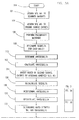
- the process of the subject invention is illustrated in flow diagram form.
- the preferred embodiment of the process is to program a computer to perform the individual process operation.
- a programmer of skill in the art and understanding current state of the art character recognition process may use the process flow of FIG. 3 to program the computer.
- Entry into the process is at the starting point 100.
- the flow progresses from start operation 100 to operation 102 where the sequence numbers 24 of the negotiable instruments or checks, such as check 10, of FIG. 1 are assigned.
- the sequence numbers are assigned to the second source entries as illustrated in column 38.
- a preliminary matching operation is performed at operation 106.
- "courtesy" amounts 14 from the checks 10 are compared with the entries on the second source list 26 in FIG. 2.
- the "courtesy" amounts 14 in column 16 are character recognized.
- the amounts in column 16 which match and correspond exactly with the amounts in the second source tape 26 would be recognized as those matches which are most easily made under the strictest match conditions.
- the SeqDelta is determined for each of the pairs of matched amounts and entries. Once all the SeqDeltas have been determined in operation 108, then the AvgSeqDelta is determined mathematically in operation 110.
- the information necessary to calculate the VarSeqDelta is available and the calculation of VarSeqDelta is accomplished in operation 112 utilizing the relationship set forth in equation 1 above.
- the order of the second source 26 entries is inverted by assigning an inverted sequence number. The assignment of the inverted sequence number is accomplished by the calculation set forth with equation 2 above.
- the SeqDelta for each of the matched pairs of items and entries preliminarily matched in operation 106 is recalculated using the inverted SeqDelta numbers as assigned in operation 114.
- the AvgSeqDelta is redetermined by mathematically averaging the SeqDelta values determined in operation 116, for the inverted listing.
- operation 120 recalculates the VarSeqDelta value for the inverted listing. Thereafter, the ratio of the VarSeqDelta calculated in operation 112 to the VarSeqDelta established in operation 120 is determined. The determination of the ratio in operation 122 then leads to the declaration of a matched class of either FORWARD, REVERSE or OTHER in operation 124.
- FORWARD indicates that the order of the two lists 16, 26 are the same.
- REVERSE indicates the order of the two lists 16, 26 run counter to each other.
- OTHER indicates that the lists 16, 26 do not have sufficient sequence correspondence to be declared either FORWARD or REVERSE.
- the matching of operation 132 is performed in accord with the set match elements; and matches for those item amounts and those entries which match under the requirements of the set match elements are declared matches in operation 134.
- the matched item is removed from the available pool of items in column 16 and the matched entry is removed from the available entries in the listing representing the second source tape 26 so those amounts are no longer available for consideration in future matching operations.
- match criteria is relaxed in accord with predetermined sequence of match criteria settings, and the match criteria is reset to a new set of conditions.
- the match criteria settings for each match criteria and the related settings within each iterative matching stage are shown in Table 1 above.
- a determination is made as to whether further unconsidered match criteria combinations remain to determine matches may be made. If further criteria combinations exist that have not been utilized, the flow branches at that point through the YES path back to where the flow reenters operation 132. This process is a continuous loop through operations 132, 134, 136, 138 and 140 until such time as there are no further criteria combinations which have not been utilized in attempts to make matches. At the point that the determination in operation 140 is in the negative, the match routine illustrated in FIG. 3 is terminated at the end of operation 142. The results of the routine as illustrated in FIG. 3 are now available for further processing operations which are not a part of this process.
- the entries which have rejected numbers or substitution errors may be corrected to the appropriate amount to correspond with the second source dependent upon the availability of computers and associated software which may factor into the process the confidence factors which are typically available in optical character recognition apparatus.
- the recognition assistance provided by progressively decreasing the stringency of the match criteria to permit an ever-increasing number of matches improves the efficiency of the optical scanning and character recognition analysis apparatus in the financial transaction environment. It correspondingly reduces the requirements for human intervention except in cases where the character recognition analysis algorithms are incapable of recognizing the handwritten "courtesy" amounts on checks to a degree that matches may be declared.
- match elements described herein are exemplary of match elements to be considered in an assisted character recognition scheme, either additional or different match elements may be defined by one wishing to utilize other criteria.
- the match elements are exemplary and not intended to limit the process described herein only to those match elements.
- sequence of relaxation is the preferred embodiment for this invention as contemplated by the inventor, the order in which the match element criteria are changed or relaxed during the iterative process of matching may be selected to suit the needs of the individual situation.
Landscapes
- Engineering & Computer Science (AREA)
- Quality & Reliability (AREA)
- Physics & Mathematics (AREA)
- General Physics & Mathematics (AREA)
- Multimedia (AREA)
- Theoretical Computer Science (AREA)
- Character Discrimination (AREA)
- Financial Or Insurance-Related Operations Such As Payment And Settlement (AREA)
Applications Claiming Priority (2)
| Application Number | Priority Date | Filing Date | Title |
|---|---|---|---|
| US175033 | 1993-12-29 | ||
| US08/175,033 US5530773A (en) | 1993-12-29 | 1993-12-29 | Optical character recognition and item matching assisted by progressively decreasing match criteria |
Publications (2)
| Publication Number | Publication Date |
|---|---|
| EP0661662A2 true EP0661662A2 (fr) | 1995-07-05 |
| EP0661662A3 EP0661662A3 (fr) | 1996-07-03 |
Family
ID=22638560
Family Applications (1)
| Application Number | Title | Priority Date | Filing Date |
|---|---|---|---|
| EP94118002A Withdrawn EP0661662A3 (fr) | 1993-12-29 | 1994-11-15 | Reconnaissance de caractères optiques et comparaison d'objets assistée par des critères de correspondance progressivement décroissante. |
Country Status (4)
| Country | Link |
|---|---|
| US (1) | US5530773A (fr) |
| EP (1) | EP0661662A3 (fr) |
| JP (1) | JP2705005B2 (fr) |
| CA (1) | CA2131671A1 (fr) |
Families Citing this family (56)
| Publication number | Priority date | Publication date | Assignee | Title |
|---|---|---|---|---|
| US5848187A (en) * | 1991-11-18 | 1998-12-08 | Compaq Computer Corporation | Method and apparatus for entering and manipulating spreadsheet cell data |
| US6181837B1 (en) | 1994-11-18 | 2001-01-30 | The Chase Manhattan Bank, N.A. | Electronic check image storage and retrieval system |
| AU718390B2 (en) * | 1994-11-18 | 2000-04-13 | Chase Manhattan Bank, N.A., The | Electronic check image storage and retrieval system |
| US6363164B1 (en) | 1996-05-13 | 2002-03-26 | Cummins-Allison Corp. | Automated document processing system using full image scanning |
| US7187795B2 (en) | 2001-09-27 | 2007-03-06 | Cummins-Allison Corp. | Document processing system using full image scanning |
| US7903863B2 (en) | 2001-09-27 | 2011-03-08 | Cummins-Allison Corp. | Currency bill tracking system |
| US8162125B1 (en) | 1996-05-29 | 2012-04-24 | Cummins-Allison Corp. | Apparatus and system for imaging currency bills and financial documents and method for using the same |
| US20050276458A1 (en) | 2004-05-25 | 2005-12-15 | Cummins-Allison Corp. | Automated document processing system and method using image scanning |
| US8478020B1 (en) | 1996-11-27 | 2013-07-02 | Cummins-Allison Corp. | Apparatus and system for imaging currency bills and financial documents and method for using the same |
| US6825940B1 (en) * | 1998-07-01 | 2004-11-30 | Ncr Corporation | Method of processing documents in an image-based document processing system and an apparatus therefor |
| US8701857B2 (en) | 2000-02-11 | 2014-04-22 | Cummins-Allison Corp. | System and method for processing currency bills and tickets |
| JP4742404B2 (ja) * | 2000-05-17 | 2011-08-10 | コニカミノルタビジネステクノロジーズ株式会社 | 画像認識装置、画像形成装置、画像認識方法および画像認識プログラムを記憶したコンピュータ読取り可能な記録媒体 |
| US7647275B2 (en) | 2001-07-05 | 2010-01-12 | Cummins-Allison Corp. | Automated payment system and method |
| US8437529B1 (en) | 2001-09-27 | 2013-05-07 | Cummins-Allison Corp. | Apparatus and system for imaging currency bills and financial documents and method for using the same |
| US8437530B1 (en) | 2001-09-27 | 2013-05-07 | Cummins-Allison Corp. | Apparatus and system for imaging currency bills and financial documents and method for using the same |
| US8428332B1 (en) | 2001-09-27 | 2013-04-23 | Cummins-Allison Corp. | Apparatus and system for imaging currency bills and financial documents and method for using the same |
| US7873576B2 (en) * | 2002-09-25 | 2011-01-18 | Cummins-Allison Corp. | Financial document processing system |
| US8944234B1 (en) | 2001-09-27 | 2015-02-03 | Cummins-Allison Corp. | Apparatus and system for imaging currency bills and financial documents and method for using the same |
| US8433123B1 (en) | 2001-09-27 | 2013-04-30 | Cummins-Allison Corp. | Apparatus and system for imaging currency bills and financial documents and method for using the same |
| US20050144189A1 (en) * | 2002-07-19 | 2005-06-30 | Keay Edwards | Electronic item management and archival system and method of operating the same |
| US7379978B2 (en) * | 2002-07-19 | 2008-05-27 | Fiserv Incorporated | Electronic item management and archival system and method of operating the same |
| US8171567B1 (en) | 2002-09-04 | 2012-05-01 | Tracer Detection Technology Corp. | Authentication method and system |
| US8627939B1 (en) | 2002-09-25 | 2014-01-14 | Cummins-Allison Corp. | Apparatus and system for imaging currency bills and financial documents and method for using the same |
| US20050097046A1 (en) | 2003-10-30 | 2005-05-05 | Singfield Joy S. | Wireless electronic check deposit scanning and cashing machine with web-based online account cash management computer application system |
| JP2006126956A (ja) * | 2004-10-26 | 2006-05-18 | Seiko Epson Corp | 文字認識装置及び方法 |
| US7873200B1 (en) | 2006-10-31 | 2011-01-18 | United Services Automobile Association (Usaa) | Systems and methods for remote deposit of checks |
| US8708227B1 (en) | 2006-10-31 | 2014-04-29 | United Services Automobile Association (Usaa) | Systems and methods for remote deposit of checks |
| CA2677714C (fr) | 2007-03-09 | 2014-12-23 | Cummins-Allison Corp. | Systeme d'imagerie et de traitement de document |
| US8538123B1 (en) | 2007-03-09 | 2013-09-17 | Cummins-Allison Corp. | Apparatus and system for imaging currency bills and financial documents and method for using the same |
| US8417017B1 (en) | 2007-03-09 | 2013-04-09 | Cummins-Allison Corp. | Apparatus and system for imaging currency bills and financial documents and method for using the same |
| US10380559B1 (en) | 2007-03-15 | 2019-08-13 | United Services Automobile Association (Usaa) | Systems and methods for check representment prevention |
| US7849399B2 (en) * | 2007-06-29 | 2010-12-07 | Walter Hoffmann | Method and system for tracking authorship of content in data |
| US9058512B1 (en) | 2007-09-28 | 2015-06-16 | United Services Automobile Association (Usaa) | Systems and methods for digital signature detection |
| US9159101B1 (en) | 2007-10-23 | 2015-10-13 | United Services Automobile Association (Usaa) | Image processing |
| US9892454B1 (en) | 2007-10-23 | 2018-02-13 | United Services Automobile Association (Usaa) | Systems and methods for obtaining an image of a check to be deposited |
| US10380562B1 (en) | 2008-02-07 | 2019-08-13 | United Services Automobile Association (Usaa) | Systems and methods for mobile deposit of negotiable instruments |
| US10504185B1 (en) | 2008-09-08 | 2019-12-10 | United Services Automobile Association (Usaa) | Systems and methods for live video financial deposit |
| US8249328B2 (en) | 2008-12-09 | 2012-08-21 | International Business Machines Corporation | Optical imaging and analysis of a graphic symbol |
| US8452689B1 (en) | 2009-02-18 | 2013-05-28 | United Services Automobile Association (Usaa) | Systems and methods of check detection |
| US10956728B1 (en) | 2009-03-04 | 2021-03-23 | United Services Automobile Association (Usaa) | Systems and methods of check processing with background removal |
| US8478019B1 (en) | 2009-04-15 | 2013-07-02 | Cummins-Allison Corp. | Apparatus and system for imaging currency bills and financial documents and method for using the same |
| US8929640B1 (en) | 2009-04-15 | 2015-01-06 | Cummins-Allison Corp. | Apparatus and system for imaging currency bills and financial documents and method for using the same |
| US8391583B1 (en) | 2009-04-15 | 2013-03-05 | Cummins-Allison Corp. | Apparatus and system for imaging currency bills and financial documents and method for using the same |
| US9779392B1 (en) | 2009-08-19 | 2017-10-03 | United Services Automobile Association (Usaa) | Apparatuses, methods and systems for a publishing and subscribing platform of depositing negotiable instruments |
| US8977571B1 (en) | 2009-08-21 | 2015-03-10 | United Services Automobile Association (Usaa) | Systems and methods for image monitoring of check during mobile deposit |
| US8699779B1 (en) | 2009-08-28 | 2014-04-15 | United Services Automobile Association (Usaa) | Systems and methods for alignment of check during mobile deposit |
| US9129340B1 (en) | 2010-06-08 | 2015-09-08 | United Services Automobile Association (Usaa) | Apparatuses, methods and systems for remote deposit capture with enhanced image detection |
| US10380565B1 (en) | 2012-01-05 | 2019-08-13 | United Services Automobile Association (Usaa) | System and method for storefront bank deposits |
| US10552810B1 (en) | 2012-12-19 | 2020-02-04 | United Services Automobile Association (Usaa) | System and method for remote deposit of financial instruments |
| US9141876B1 (en) | 2013-02-22 | 2015-09-22 | Cummins-Allison Corp. | Apparatus and system for processing currency bills and financial documents and method for using the same |
| US11138578B1 (en) | 2013-09-09 | 2021-10-05 | United Services Automobile Association (Usaa) | Systems and methods for remote deposit of currency |
| US9286514B1 (en) | 2013-10-17 | 2016-03-15 | United Services Automobile Association (Usaa) | Character count determination for a digital image |
| US10402790B1 (en) | 2015-05-28 | 2019-09-03 | United Services Automobile Association (Usaa) | Composing a focused document image from multiple image captures or portions of multiple image captures |
| US11030752B1 (en) | 2018-04-27 | 2021-06-08 | United Services Automobile Association (Usaa) | System, computing device, and method for document detection |
| US11900755B1 (en) | 2020-11-30 | 2024-02-13 | United Services Automobile Association (Usaa) | System, computing device, and method for document detection and deposit processing |
| US12211095B1 (en) | 2024-03-01 | 2025-01-28 | United Services Automobile Association (Usaa) | System and method for mobile check deposit enabling auto-capture functionality via video frame processing |
Family Cites Families (7)
| Publication number | Priority date | Publication date | Assignee | Title |
|---|---|---|---|---|
| US4264808A (en) * | 1978-10-06 | 1981-04-28 | Ncr Corporation | Method and apparatus for electronic image processing of documents for accounting purposes |
| JPS6154563A (ja) * | 1984-08-24 | 1986-03-18 | Hitachi Ltd | 伝票認識方法および装置 |
| US4813077A (en) * | 1986-07-30 | 1989-03-14 | Scan-Optics, Inc. | Sales transaction record processing system and method |
| US5058182A (en) * | 1988-05-02 | 1991-10-15 | The Research Foundation Of State Univ. Of New York | Method and apparatus for handwritten character recognition |
| US5040226A (en) * | 1988-05-31 | 1991-08-13 | Trw Financial Systems, Inc. | Courtesy amount read and transaction balancing system |
| US5040227A (en) * | 1990-03-12 | 1991-08-13 | International Business Machines Corporation | Image balancing system and method |
| US5187351A (en) * | 1990-09-10 | 1993-02-16 | Addmaster Corporation | Processing of bank documents |
-
1993
- 1993-12-29 US US08/175,033 patent/US5530773A/en not_active Expired - Fee Related
-
1994
- 1994-09-08 CA CA002131671A patent/CA2131671A1/fr not_active Abandoned
- 1994-10-28 JP JP26506494A patent/JP2705005B2/ja not_active Expired - Fee Related
- 1994-11-15 EP EP94118002A patent/EP0661662A3/fr not_active Withdrawn
Non-Patent Citations (2)
| Title |
|---|
| IBM TECHNICAL DISCLOSURE BULLETIN, vol. 35, no. 1B, 1 June 1992 pages 22-24, XP 000308958 'AMOUNT RECOGNITION SYSTEM' * |
| RESEARCH DISCLOSURE, no. 313, 1 May 1990 page 383 XP 000114832 'VISUAL VERIFICATION OF OCR REJECTS' * |
Also Published As
| Publication number | Publication date |
|---|---|
| EP0661662A3 (fr) | 1996-07-03 |
| JP2705005B2 (ja) | 1998-01-26 |
| CA2131671A1 (fr) | 1995-06-30 |
| US5530773A (en) | 1996-06-25 |
| JPH07210624A (ja) | 1995-08-11 |
Similar Documents
| Publication | Publication Date | Title |
|---|---|---|
| US5530773A (en) | Optical character recognition and item matching assisted by progressively decreasing match criteria | |
| US5151948A (en) | System and method for processing documents having amounts recorded thereon | |
| US5040227A (en) | Image balancing system and method | |
| US6863214B2 (en) | Image enabled reject repair for check processing capture | |
| US5832463A (en) | Automated system and method for checkless check transaction | |
| US5134564A (en) | Computer aided reconfiliation method and apparatus | |
| US4417136A (en) | Method and apparatus for improving bank operation productivity | |
| US7252224B2 (en) | Front counter and back counter workflow integration | |
| EP0344742B1 (fr) | Système de lecture du montant en chiffres et du calcul du solde d'une transaction | |
| US7461775B2 (en) | Apparatus and methods for processing misread or miskeyed magnetic indicia | |
| US5689579A (en) | Rule-based circuit, method and system for performing item level reconciliation | |
| EP1700249B1 (fr) | Procede et systeme de traitement d'exception de documents micr | |
| US20060219773A1 (en) | System and method for correcting data in financial documents | |
| US20050281450A1 (en) | System and method for correcting data in financial documents | |
| US20150110362A1 (en) | Systems, methods and computer program products for determining document validity | |
| US5187351A (en) | Processing of bank documents | |
| US6769615B2 (en) | Multi-pass merge process for the check processing control system | |
| CA2036274A1 (fr) | Processeur a documents utilisant une methode et un dispositif de detection et de correction des erreurs | |
| JP2017033139A (ja) | 帳票読取装置、帳票読取方法および帳票読取システム | |
| US6796488B1 (en) | Automated system and method for check amount encoding at a point-of-sale | |
| EP0446633A2 (fr) | Dispositif de traitement de documents avec une méthode et appareil d'identification et de correction d'erreurs | |
| JP5304397B2 (ja) | 帳票処理装置及び帳票処理プログラム | |
| JP2908187B2 (ja) | Ocr認識結果の確認及び補正方法 | |
| EP0073113A1 (fr) | Système de traitement de document | |
| JPH08297709A (ja) | 情報データ処理装置及び情報データ処理方法 |
Legal Events
| Date | Code | Title | Description |
|---|---|---|---|
| PUAI | Public reference made under article 153(3) epc to a published international application that has entered the european phase |
Free format text: ORIGINAL CODE: 0009012 |
|
| AK | Designated contracting states |
Kind code of ref document: A2 Designated state(s): DE FR GB |
|
| 17P | Request for examination filed |
Effective date: 19951024 |
|
| PUAL | Search report despatched |
Free format text: ORIGINAL CODE: 0009013 |
|
| AK | Designated contracting states |
Kind code of ref document: A3 Designated state(s): DE FR GB |
|
| STAA | Information on the status of an ep patent application or granted ep patent |
Free format text: STATUS: THE APPLICATION HAS BEEN WITHDRAWN |
|
| 18W | Application withdrawn |
Withdrawal date: 19961125 |