EP0663122B1 - Verfahren und vorrichtung zur verbreitung von einem regionalprogramm in einem gleichwellennetz für ukw rundfunk - Google Patents
Verfahren und vorrichtung zur verbreitung von einem regionalprogramm in einem gleichwellennetz für ukw rundfunk Download PDFInfo
- Publication number
- EP0663122B1 EP0663122B1 EP94922912A EP94922912A EP0663122B1 EP 0663122 B1 EP0663122 B1 EP 0663122B1 EP 94922912 A EP94922912 A EP 94922912A EP 94922912 A EP94922912 A EP 94922912A EP 0663122 B1 EP0663122 B1 EP 0663122B1
- Authority
- EP
- European Patent Office
- Prior art keywords
- programme
- cutaway
- block
- rds
- digital
- Prior art date
- Legal status (The legal status is an assumption and is not a legal conclusion. Google has not performed a legal analysis and makes no representation as to the accuracy of the status listed.)
- Expired - Lifetime
Links
- 238000000034 method Methods 0.000 title claims abstract description 31
- 230000001360 synchronised effect Effects 0.000 title description 22
- 230000005540 biological transmission Effects 0.000 claims description 15
- 238000012163 sequencing technique Methods 0.000 claims description 7
- 238000010586 diagram Methods 0.000 description 9
- 230000008569 process Effects 0.000 description 9
- 238000005070 sampling Methods 0.000 description 8
- 230000006835 compression Effects 0.000 description 7
- 238000007906 compression Methods 0.000 description 7
- 239000003599 detergent Substances 0.000 description 6
- 238000009792 diffusion process Methods 0.000 description 5
- 238000012545 processing Methods 0.000 description 5
- 230000008859 change Effects 0.000 description 4
- 238000003780 insertion Methods 0.000 description 4
- 230000037431 insertion Effects 0.000 description 4
- 230000007704 transition Effects 0.000 description 4
- 102100024594 Histone-lysine N-methyltransferase PRDM16 Human genes 0.000 description 3
- 101000686942 Homo sapiens Histone-lysine N-methyltransferase PRDM16 Proteins 0.000 description 3
- 238000000605 extraction Methods 0.000 description 3
- 239000000203 mixture Substances 0.000 description 3
- 230000005236 sound signal Effects 0.000 description 3
- 238000005174 DCD Raman spectroscopy Methods 0.000 description 2
- 239000000969 carrier Substances 0.000 description 2
- 239000013256 coordination polymer Substances 0.000 description 2
- 230000006837 decompression Effects 0.000 description 2
- 238000001514 detection method Methods 0.000 description 2
- 230000033764 rhythmic process Effects 0.000 description 2
- 101100004933 Arabidopsis thaliana CYP79F1 gene Proteins 0.000 description 1
- 241001269238 Data Species 0.000 description 1
- 102100030771 Ferrochelatase, mitochondrial Human genes 0.000 description 1
- 101000843611 Homo sapiens Ferrochelatase, mitochondrial Proteins 0.000 description 1
- 241000135309 Processus Species 0.000 description 1
- 101150058910 RDS1 gene Proteins 0.000 description 1
- 101100219167 Saccharomyces cerevisiae (strain ATCC 204508 / S288c) BUL1 gene Proteins 0.000 description 1
- 101100140267 Saccharomyces cerevisiae (strain ATCC 204508 / S288c) RDS2 gene Proteins 0.000 description 1
- 101100401000 Saccharomyces cerevisiae MEL2 gene Proteins 0.000 description 1
- 238000009825 accumulation Methods 0.000 description 1
- 230000000903 blocking effect Effects 0.000 description 1
- 238000012937 correction Methods 0.000 description 1
- 125000004122 cyclic group Chemical group 0.000 description 1
- 238000000586 desensitisation Methods 0.000 description 1
- 230000000694 effects Effects 0.000 description 1
- 230000006870 function Effects 0.000 description 1
- 238000012423 maintenance Methods 0.000 description 1
- 230000000116 mitigating effect Effects 0.000 description 1
- 230000000306 recurrent effect Effects 0.000 description 1
- 230000003252 repetitive effect Effects 0.000 description 1
- 230000004044 response Effects 0.000 description 1
- 230000002441 reversible effect Effects 0.000 description 1
- 239000013589 supplement Substances 0.000 description 1
- 238000012360 testing method Methods 0.000 description 1
- 230000001052 transient effect Effects 0.000 description 1
Images


Classifications
-
- H—ELECTRICITY
- H04—ELECTRIC COMMUNICATION TECHNIQUE
- H04H—BROADCAST COMMUNICATION
- H04H20/00—Arrangements for broadcast or for distribution combined with broadcast
- H04H20/65—Arrangements characterised by transmission systems for broadcast
- H04H20/67—Common-wave systems, i.e. using separate transmitters operating on substantially the same frequency
-
- H—ELECTRICITY
- H04—ELECTRIC COMMUNICATION TECHNIQUE
- H04H—BROADCAST COMMUNICATION
- H04H20/00—Arrangements for broadcast or for distribution combined with broadcast
- H04H20/10—Arrangements for replacing or switching information during the broadcast or the distribution
- H04H20/103—Transmitter-side switching
-
- H—ELECTRICITY
- H04—ELECTRIC COMMUNICATION TECHNIQUE
- H04H—BROADCAST COMMUNICATION
- H04H20/00—Arrangements for broadcast or for distribution combined with broadcast
- H04H20/28—Arrangements for simultaneous broadcast of plural pieces of information
Definitions
- the subject of the present invention is a method of broadcasting of at least one dropout program on at least part of an FM network, in particular synchronous, from a main program, said FM network having a FM multiplex with digital blocks.
- Modern broadcast systems must have precise phase relationships between multiplex signals broadcast from different points (e.g. FM synchronous, DAB radionumeric).
- Synchronization in phase of at least one component of an FM multiplex signal can be provided at from an information transport route which is shared between certain signals belonging to the multiplex to be broadcast and the information necessary for the phasing of these signals.
- Some broadcasting stations such as those which spread along motorways and which have a number of FM transmitters for this purpose staggered along a highway, wish to perform local dropouts like traditional FM broadcasters to better target their information.
- a local dropout is intended for momentary broadcasting and over a limited area of a program that differs in whole or in part from the program main. At the end of the dropout, we return to the program main.
- the particular problem of the synchronous FM network is that there is, between the different transmitters, a zone of overlapping which imposes certain constraints during the implementation of the dropout and when returning to the program main.
- EP-A-0 415 132 describes a system of regional dropout of RDS program in which the program selection is done at the receiver after diffusion.
- This selection can only be made if the receiver recognizes the PI code of the transmitter.
- WO-A-93 11616 and WO-A-92 13403 describe a DAB (Digital Audio Broadcasting) system in which the receiver selects a program according to additional data inserted in a program and to identify the issuer of this program.
- DAB Digital Audio Broadcasting
- the subject of the present invention is a method and a system for performing stalls on a FM network, of the type presenting a transport multiplex digital used in particular for synchronous FM broadcast to listeners in analog form a stereo FM frequency multiplex, which allows at least partially reduce the discomfort caused to listeners, this discomfort may in particular be due to interference between transmitters in the same area when dropouts are carried out.
- the FM network can include several zones including each comprises at least one transmitter and said order of dropout may also include information identification of the transmitter (s) affected by the dropout.
- the order to return to the main program can then also include identification information of the transmitter (s) affected by the return to the program main.
- the off-hook program can be an audio program and the chaining parameters can then include at least one indication of the duration of the chaining and / or an attenuation curve.
- the off-hook program can be a digital information program, in particular RDS.
- the digital information of the main program and the off-hook program can be multiplexed in the transport multiplex.
- the number of different RDS frames transmitted is, according to a preferred embodiment, even.
- the digital information of the dropout program may include only said category, and the execution of the stall order can then consist of the digital information falling within said category are taken from the dropout program and in that digital information not belonging to said category is taken from the main program.
- the contents of the main program (audio and / or RDS) and program dropout are identical and, the content of the program dropout becomes different from program content principal after a first predetermined duration.
- the contents of the main program and dropout program can be made identical again beforehand, for a second predetermined period before returning to main program.
- said inserter is arranged so as to also insert into the multiplex of transport, for example in the auxiliary channel, and by example in a third block of said transport multiplex digital, a signal to return to the program main comprising at least one chaining parameter of return to the main program, the mixer being arranged then to execute the return step at a second instant remarkable after the first remarkable moment, by example during a fourth block after the third block.
- At least one said mixer can be, depending on a mode of preferred implementation, located on an emission site supplying at least one transmitter, and preferably supplying a plurality of transmitters.
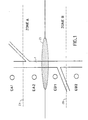
- Figure 1 illustrates the case of an FM network synchronous arranged along motorway lanes 1.
- Figure 1 more particularly represents two diffusion zones called A and B, zone A comprising two transmitters EA1 and EA2, and zone B, comprising two transmitters EB1 and EB2.
- zones A and B two main programs are broadcast which are the same, and on the other hand, it is desired perform local dropouts, for example in the area A.
- the presence of such a dropout necessarily induces a ZI interference zone at the interface between zone A and the zone B (common coverage area of issuers EA2 and EB1).
- a constraint on dropouts is to avoid that produce additional zones of interference ZA and ZB, between, respectively, the transmitters EA1 and EA2, and, between the transmitters EB1 and EB2.
- the program sequences are synchronized in each of the transmitters EA1 and EA2, EB1 and EB2 and they are made with a distribution system digital that carries digital audio information transmitters, and a data channel that contains all local dropout synchronization information multiplexed with other information (for example RDS), this channel and the audio channels being synchronized to the sample close.
- a distribution system digital that carries digital audio information transmitters
- a data channel that contains all local dropout synchronization information multiplexed with other information (for example RDS), this channel and the audio channels being synchronized to the sample close.
- a station radio broadcasts the same program over its entire area blanket.
- the transmitters EA1 and EA2 of zone A and the EB1 and EB2 transmitters in zone B hypothetically broadcast a identical program and there is no interference if its transmitters are synchronized.
- Area B transmitters are assumed to continue broadcasting the same program and those in zone A broadcast another program, the interference zone ZI appears immediately in the part where the signals broadcast by the EA2 transmitter zone A interferes with those emitted by the EB1 transmitter of zone B.
- Interference between zones A and B does not may in any event be limited only by the choice of broadcasting equipment (in particular antennas directives), and using the relief in this part of the network so as to limit the length of the zones interference.
- Interference between transmitters EA1 and EA2 appear for the duration of the dropout in zone A on another program and can become permanent if certain conditions on the modulation phases mainly contained in the multiplex (by example RDS) are not respected when returning to the broadcasting of the same program in zones A and B.
- RDS multiplex
- the technical problem therefore arises of limiting the interference on the one hand during a transitional period during dropout and return to the main program, and on the other hand, to avoid, in the case of modulations digital implemented, cause interference permanent after returning to the main program, and preferably avoid both permanent interference and mistakes.
- additional channels that are associated, in digital transmission systems, audio frequency transmission so as to synchronize the off-hook of the different transmitters, which allows remove the aforementioned transient interference.
- additional channels may also, depending on invention, be used to ensure a return to main program without reversing the phase of digital modulations, which avoids said interference permanent.
- additional channels also called user channels, are governed by particularly by the AES / EBU standard.
- a MUX1 multiplexer receives at an entrance, a first AES / EBU multiplex and containing the main program P more information digital on the user channel, in this case, RDS information, and on a second input, a multiplex AES / EBU with program information stall D.
- the output of the MUX1 multiplexer provides a new AES / EBU multiplex with information from main program P dropout program D and user channel U (digital information) containing the RDS information.
- a CDINS inserter allows data to be inserted ENCH sequence allowing to configure the dropout.
- the output signals from the CDINS inserter are sent to through an RT transmission network to be processed then by a DMX1 demultiplexer capable of providing, separately, the main program P (with channel U) and the dropout program D, each in the form of a multiplex AES / EBU (AES-P, AES-D).
- the programs are mixed in transmitters by the MEL1 mixer if applicable, the output of which S attacks the stereophonic coder of a downstream transmitter.
- the output S of the mixer MEL1 naturally includes the U channel information.
- Figure 3 shows a variant of Figure 2 in which the signal at the output of the MEL2 mixer is subject to compression under the ISO-MPEG standard by compression circuits respectively, ISOCD1 and ISOCD2 for give the multiplex tablets CP and CD, which are then multiplexed into a TRMX multiplexer to provide a AES-C multiplex compressed to 2 Mbits / s which is carried by the RT transport network.
- ISOCD1 and ISOCD2 for give the multiplex tablets CP and CD, which are then multiplexed into a TRMX multiplexer to provide a AES-C multiplex compressed to 2 Mbits / s which is carried by the RT transport network.
- the AES-C multiplex is demultiplexed by the DMX2 demultiplexer of a transmitter (EA1, EA2, EB1, EB2) to give, after decompression, and decoding by the decoder ISODCD, again the main program multiplex P or of the dropout program D, according to the AES / EBU standard, at know (AES-P; AES-D). There is indeed no need to decompress the two multiplex tablets CP and CD.
- the contents of the main audio program and the audio dropout program may be identical to time of execution of the stall order, the content of the audio program of the dropout becoming different from the content of the main program after a predetermined duration.
- the contents of the main program and dropout program can be made identical again from a second predetermined duration.
- a headend transmitter 1 includes a GSY synchronization generator providing synchronization signals on the one hand, to a generator block synchronization GSB, and secondly, to a generator SAP main audio source and an audio source generator secondary SAD.
- the signals of a data generator SDEN sequences are applied to a signal generator RDS G-RDS can deliver multiple RDS programs, including output signals are applied to a data inserter ISND1 which also receives the signal generator output main audio SAP and GSB block generator.
- the outputs of an INSD1 inserter are introduced at the input of a INSD2 inserter which receives the signals from the generator SDEN web data source.
- the output signals INSD2 inserter are applied to an input of a MXAX auxiliary multiplexer which also receives signals output of a CDR encoder according to the ISO-MPEG standard which performs source generator signal compression SAD stall audio.
- the output signals from the MXAX auxiliary multiplexer are supplied to the RT transport to be received and re-issued by a local transmitter 2, for example such as EA1 or EA2 or else EB1 or EB2.
- Each local transmitter includes an auxiliary DMXAX demultiplexer, a DCDSB block synchronization decoding circuit, as well as a sequence of data decoding DCDBE.
- Auxiliary demultiplexer output signals DMXAX are applied to a DCDR decoder realizing the decompression of the stall signals, for example according to the ISO-MPEG standard to reconstruct the AES-D multiplex.
- a MELA audio mixer receives AES-D, AES-P multiplexes as well that the output signals from the DCDSB block decoder and the DCDDE sequence data decoder. Leaving the MELA audio mixer is applied to a data inserter INSD3 which inserts the data decoder output signals DCDDE link.
- the AES-E output multiplex of the INSD3 inserter is applied to a transmission stage of EMR synchronous FM power.
- the data decoder transported by user channels DCDDE provides the data necessary for the audio mixer and all of these data are reinserted into the AES / EBU train which is provided to the EMR stereophonic encoder, especially the data RDS with associated linking information.
- Headend 1 transmitter processes sources digital audio that is provided to the AES / EBU standard at RT transport network. These sources include a program main, and one or more dropout programs local. All digital audio sources have identical sampling frequencies, and in a report simple, which are deduced from that of the generator GSY synchronization.
- Synchronization information (GSB generator block synchronization), RDS data and the data for the dropout programs are inserted in one of the user channels of the interface AES / EBU in accordance with the standard.
- Secondary audio sources are compressed (by example according to ISO-MPEG code) by the CDR encoder to be inserted in the auxiliary information of the interface thanks to the MXAX auxiliary multiplexer. It is also possible to compress the main program to increase the number possible stalls simultaneously with the same speed useful on the transport network (see overview of the figure 2).
- the compressed audio information are restored (DCDR decoder) and sent to a mixer audio which also receives the main program. Relationships phase between the audio data at the input of the mixer MELA must be perfectly mastered with the sample near. Additional data is decoded to drive the sequence of associated audio and RDS programs. A signal for controlling a synchronous FM transmitter is thus issued at the exit.
- the main program and the stall are carried by the same time multiplex digital according to the AES / EBU standard, which is created unique at the head of the network and which is distributed in the form digital to all the sites making up the network.
- a program consists of the audio channel stereophonic, RDS information and possibly other information (for example around 66.5 kHz), which can be introduced into the signal bandwidth FM frequency multiplex.
- the data entered in the lanes interface users must ensure the synchronized sequence of all components of the FM multiplex.
- SB block synchronization is likely ensure the phasing of the different components of multiplex broadcast in each zone. This synchronization block can also ensure the synchronous linking of local dropouts.
- the source of link data sends symmetrically, an order of closing of the sequence.
- COA chaining data of audio channels 1 and audio 2 are multiplexed into channel blocks user viewed with RDS information ( Figure 6).
- One or more packages containing the information are sent in the data channel, which is decoded by a REC-VU receiver.
- Audio programs main AESO and AESA dropout are mixed by a MEL mixer.
- the packet that sends the chain order of the main audio program to the stall program local is sent to block N of the main audio channel for example when the sequence must take place at the beginning of the block N + 1 (or more generally N + p).
- Information concerning this sequence will have been transmitted to zone A mixers (you can have a mixer per issuer or by group of issuers (EA1; EA2; EB1 and EB2)) before the start of the N + 1 block.
- the program for the zone A must be demultiplexed and possibly decompressed.
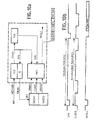
- the sequence of audio channels also leads to switching of RDS programs if necessary ( Figure 7a).
- RDS information relating to each additional audio channel are multiplexed into packets whose addresses are different.
- the contents of packets in block N for example RDS0 relating to the main program and RDSA relating to the program broadcast in zone A, are identical and the modulations RDS carriers from the content of each of these packages are also identical.
- Interference can be avoided when dropout with two audio programs none of which is tablet or both of which are compressed by making them identical program contents at the time of dropping out before the sequencing of the programs and shortly before the return to the main program.
- RDS TA code which only affects a number limited bits in a frame.
- An RDS block consists of 4 frames of 26 bis RDS, and generally RDSO programs and RDSA differ only in the content of a frame (T1 for RDSO and TA for RDSA) per block of 4 RDS frames.
- the block synchronization of user interface channels AES / EBU will, in this case, be a multiple of the duration of the ISO-MPEG frames (24 ms), for example 48 ms or 57 bits RDS.
- RDS groups are made up of 4 frames of 26 bits (T0, T1, T2 and T3). Each frame includes a field 16-bit information and 10-bit information redundancy which serve as frame and block synchronization and error correction code. It is possible not to transmit at the head of the network only useful information (the 16 bits of the information field) and calculate before to issue them redundancy information. Of this way, we only transmit a maximum of 16/26 of the flow total. To make this type of transmission at reduced speed, RDS information should be resynchronized to broadcast from the SB block synchronization of the channels users in each transmitter on the network. To find 76-bit packets, we send a clipping pointer in 76-bit packets (redundancy included) for example.
- the TO frame contains the identification of the program which is systematically repeated in each block, the frame T1 contains traffic information ("Traffic Announcement”) if applicable and others information.
- each AES / EBU block the packets contain RDS information that will be partially disseminated for the duration of the next block.
- Each RDS package contains useful information (16 bits) from 2 or 3 RDS frames, one identification of RDS frames contained in a packet, a pointer to frame the RDS information broadcast relative to block synchronization and information regarding the polarity of NRZI coding. In this way, we can reduce the bit rate transmitted for the RDS application main.
- the information is transmitted useful of the following frames T3, T0 and T1, a pointer to value 21 and the polarity of the first bit broadcast during the block N + 2.
- the RDS information needed for local dropouts generally only relate to codes traffic announcements "Traffic Announcement", contained in T1 frames. In this case, only need to transmit in AES / EBU blocks useful information from new T1 frames and take the content of frames T0, T2 and T3 in the RDS information of the main program.
- the main program and the dropouts are demultiplexed locally by the transmitter and both programs are made available as AES / EBU on the two inputs of a digital mixer addressable 3 which feeds, in programs, the FM transmitter to digital input of each emission site (or each group of sites) constituting the synchronous FM network.
- the two processors are interconnected, by through the DSP host interface which is seen from host processor as an input / output circuit conventional. Both processors receive signals necessary for their operations which will be described below.
- the stall process is preferably, organized in four stages.
- This operation determines the issuers concerned by the next stall operation.
- This operation so-called awareness is carried out with notice sufficient and makes it possible to supply the mixer 3 with the parameters desired mix (e.g. for audio, response, level of attenuation, length of period transition).
- This same awareness-raising operation causes at the level of the digital modulator encoder synchronizable, switching of the RDS packet operated (PNRDS1 to PNRDS2 for example).
- the operation awareness can independently relate to audio and switching the digital data of the multiplex by example RDS data.
- This order causes the RDS encoder to switching of the TA bit, short message which is interpreted and executed by the only aware issuers. This initializes the start of the execution of the mixture by the or the mixers concerned.
- the duration of the dropout is arbitrary.
- This order causes the RDS encoder to additional switching of the TA bit.
- This short message is not interpreted and executed only by sensitized transmitters. This initializes for the affected mixer (s) the reverse operation of the previous one.
- This deselection causes the synchronizable digital modulator encoder level forced switching to RDS packet operation (PN-RDS1) corresponding to the main program.
- the synchronization process used between multiple remote mixers is made implicit by the mode of transport of orders and the principle for their execution (digital multiplex carried by the network of RT transport).
- the information of awareness which involves either physical address explicit of the broadcasting site (or sender), i.e. a number group to which the site will have been assigned before any operation, defines the type of audio mixing (fade chained, broadcast of the dropout program on background sound of the main program etc.) which will be performed and a message number attached to subsequent operations.
- the mixing parameters are decoded by the HSP host processor and transferred to the processing processor of the DSP signal as a quick interrupt so that disrupt as minimally as possible the ongoing treatment.
- the message number is stored for serve as a reference for the interpretation of future orders. Such a rapid interruption avoids interrupting the current program in the DSP.
- a fast shutdown is a process specific to MOTOROLA signal processing processor of the series 56000 which consists of inserting two treatment cycles (two instructions specified by the program based on address of the desired interrupt vector number) in the ongoing treatment. This procedure is initiated by a EN command issued by the HSP host processor.
- HSP host processor receives circuit EM-REC reception, powered by AES-P multiplexes and AES-D, the word clock signal HMT at the frequency audio sampling Fe, and HREF, DT and SYN signals (see fig 8).
- the transceiver transmits the multiplex AES-E transmitter (see fig. 4) which can attack a transmitter Power FM
- the HSP host processor is ready to take into account the first tipping order corresponding to the message number defined previously. he note that so far no synchronization particular is to be respected since it is only preparatory operations for which only a period of notice is to be observed.
- the switching order (II) including as reference information the same message number as that defined in the awareness phase is conveyed in a COA packet associated with synchronization of SB blocks in Classes.
- this information is sent to the processing processor of the DSP signal according to the same procedure as above (fast interruption).
- fast interruption we can consider that, at the time of transmission close, all 3 mixers installed on the network receive this order at the same time. Only those who will have been previously made aware of this issue of message will have to interpret it.
- Synchronization then establishes itself.
- Signal processors of various mixer functions concerned being configured and having received the switching order, test the first (more usually Peme) occurrence of block synchronization Next SB (64 milliseconds) to start, clocked at rhythm of the sampling frequency, the process of mixed.
- This principle based on the synchro block SB guarantees the simultaneous start of the process, while the timing to the rhythm of the sampling frequency audio signals guarantees the identity of its evolution.
- the duration of the mixing is left to the discretion of the operator at the head of the network.
- the process of returning to the main program is organized, in principle, in the same way by an order returned by a user channel COA packet bearing the reference message number, associated with the SB block synchronization in progress at this time and decoded by the HSP host processor, transmitted to the processor signal processing thus preconfigured and executed at the occurrence of the next SB synchro block (or the q-th occurrence) at the rate of the sampling frequency.
- a desensitization order cancels the reference number and the mixing parameters, so as to allow a return in the initial state.
- a digital transmission system has channels for transmitting audio signals and, associated with these channels, additional channels which are at available to users.
- a synoptic of the chain of transmission according to the invention is given in FIG. 8. The diagram is built around a type interface AES / EBU (technical document 3250 of the European Union of Broadcasting and supplement N ° 1 to this technical document).
- the transmission system used can pass all the interface information or a only part of this information. Firstly, it is assumed that all of at least one user channel and the most significant bits of the audio signal are multiplexed in the digital transmission network.
- the digital audio information to be transmitted are provided to the AES / EBU standard.
- Datas additional, for example RDS data is multiplexed in a user interface channel AES / EBU.
- This user channel is formatted according to the standard AES / EBU.
- This formatting is carried out according to the invention by a SYBG block synchronization generator and data are inserted in packets by an INS insertion circuit known per se and corresponding to the planned insertion protocol by the above-mentioned AES / EBU standard.
- the digital information to be transmitted INF is introduced at the input of a REC receiver and an extractor clock clock CLE.
- Receiver provides D data to EM transmitter which transmits in AES / EBU standard in a broadcasting network DR.
- the clock extractor CLE provides a clock signal H to the emitter EM and a clock signal SF1 on the one hand to the SYBG block synchronization generator, on the other hand data frequency generator to insert G and finally to an INS inserter.
- Two data generators receive from generator G a frequency signal SF2 which generates signals for the INS inserter on the one hand DRDS1 and DRDS2 data and secondly signals CLRDS clock.
- RDS generators are synchronized by SF2 and deliver DRDS1 and DRDS2 signals which are identical in the absence of TA in the RDS signal (see standard). These two signals are associated with a single clock CLRDS.
- INS inserter provides EM transmitter with signal SHDLC to be inserted and which is according to an HDLC frame (see the above standard). Note that the techniques are known per se and are provided for by the standard AES / EBU mentioned above.
- a synchronization signal of the blocks is extracted to help identify precisely the remarkable moments of the bit rate and the information carried in packets is decoded to be able to drive waveform generators which are synchronized by block synchronization.
- the signals received from the RD network are at the AES / EBU standard and are introduced at a circuit entry of reception RE in which they are demultiplexed and in which is generated a HREF clock signal.
- the circuit of RE reception provides demultiplexed data signals DT to an MC microcontroller and a detector SYNDET synchronization. It provides the clock signal from HREF reference on the one hand to the detector circuit SYNDET synchronization and secondly to the microcontroller MC.
- SYNDET synchronization detector circuit provides a SYN block synchronization signal to the microcontroller MC.
- a WG waveform generator receives MC microcontroller of the WDT signals corresponding to the shapes wave to generate.
- WG waveform generator produces in a manner known per se an RD read signal introduced in the MC microcontroller.
- the waveform generator WG produces signals (pilot frequency, carrier sounds, RDS signals) which, thus reconstituted and synchronized precisely, are directly usable with the signal of SYN block synchronization to perform for example a mainstream FM radio broadcast from signals received in AES / EBU, and more particularly in the part of a synchronous FM network.
- the user channels of the AES / EBU interface are independent of other contained transmission channels in this interface (digital audio channel, signage).
- Each audio frequency sample is associated a user bit.
- the frequency sampling is Fe
- the blocking of this bit rate can be produced in such a way as to restore all the frequencies necessary for the synchronization of the subcarriers useful for the reconstruction for example of a FM multiplex.
- the RD transport network can allow synthesize with precise phase relationships the pilot frequency at 19 kHz, the subcarrier at 38 kHz, and the if necessary the RDS subcarrier at 57 kHz as well as the RDS information transitions that are 19/16 bit rate kbit / s.
- the user channel On transmission, the user channel is divided into blocks that start with block synchronization (figure 9).
- This SB block synchronization identifies in a simple way a precise moment in the bit rate which is used to drive the waveform generators WG.
- the pilot frequency at 19 kHz and the two sub-carriers mentioned above have a number integer of periods every 1/19 ms.
- RDS information has an integer of bits (19) every 16 ms.
- Synchronization is used to identify an instant precise of each of the sinusoidal signals of the frequency pilot and subcarriers, and for RDS information to identify a particular bit in n x 19 packets bits in the 19/16 kbit / s bit stream.
- the duration of the blocks is chosen as it is a common multiple of 1/19 ms (pilot and subcarriers) and 16 ms (RDS).
- a length that is particularly suitable well to the characteristics of the overall system is 64 ms.
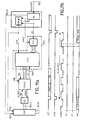
- a such a block is represented in FIGS. 7a and 9.
- the sampling frequency is 32 kHz
- the block contains 2048 bits.
- Information can be multiplexed in accordance with the standard.
- the beginning of the blocks is identified (SB) for example by detecting at least 7 successive followed by a zero. This start of block allows to synchronize waveform generators and build up signals identical multiplexes at all points in the network transmission. This block start also allows synchronize RDS data.
- the duration chosen above of 64 ms corresponds to 76 RDS bits, which allows to introduce in the first block the first 76 bits of a first 104-bit RDS frame (26 x 4), in the block following the 28 remaining bits of the first RDS frame and the first 48 bits of the second RDS frame and so on.
- the duration of a block is n x 16 ms which corresponds to n x 19 RDS bits.
- P1, P2 etc which contain n x 19 bits. It is possible to introduce multiple RDS packets per block, especially two when it there is only one local dropout possible.
- RDS data is provided by SRDS1 and SRDS2 data sources mentioned above. The data extractor allows to demultiplex the data digital inserted into each of the blocks and put them away in memory of an MC microcontroller.
- WG sine wave generators are slaved in phase on the synchronization block SB.
- the SRDS waveform generator must code with the same phase, same bit, at different broadcasting points, the time reference being constituted by the flow binary distributed.
- the RDS bits received in a block N are broadcast for the duration of the next block N + 1.
- the RDS bits of the referenced packet PNRDS1 of the previous block N are available in a memory FIFO first in / first out type and stored in order.
- FIFO memory can have a corresponding size to RDS bits of p successive blocks.
- the bits RDS referenced PNRDS of block N are available at the beginning of block (N + p).
- Block synchronization identifies precisely the output time of the first bit received in the previous block N and transmit it at a specific time relative to block synchronization, i.e. at the end of the block synchronization signal.
- these are the bits of the packet referenced PNRDS2 which are supplied to the FIFO memory.
- program contents main RDS1 and RDS2 stall, are identical, which ensures a logical continuity of dropping out. In these conditions, the stall produces no interference inside areas, for example in ZA and ZB in FIG. 1. It is only then that the content of the program RDS2 stall is changed.
- the first bit of the RDS packet contained in block N is operated by the WG waveform generator from the start of the block (N + 1).
- the RDS information that are operated by the RDS block generator are the same throughout the network relative to block synchronization of the user channel.
- the PNRDS1 data packet (or PNRDS2 in case of stall) constituting the first package inserted in the block N is read at a rate such as the 76 bits it includes occupy the entire duration (64 ms) of the block (N + 1), thus restoring the continuity of the RDS frames.
- the content of the RDS2 program does not become different from the content of the RDS1 program only after the stall operation properly said, the continuity of RDS frames is always preserved.
- the content of the RDS2 program becomes identical to that of the program RDS1 shortly before the end of stall operation, which also ensures the continuity of RDS frames.
- an extractor clock clock CLE receives the INF signal according to the AES / EBU standard and produces a signal SF1 of frequency 32 kHz introduced into the data frequency generator G as well as in a frequency divider by 2048 DIV constituting the circuit SYBG supra.
- the frequency generator G generates a signal SF2 at 19 kHz which is introduced in the SRDS1 generators and SRDS2 of RDS data.
- SF1 signal is also introduced in an MC1 microcontroller (for example 8044 from the company INTEL) which constitutes the INS inserter.
- the divisor of DIV frequency divides SF1 signal by 2048 to produce every 64 ms, a SYN synchronization signal recurrent.
- SRDS1 and SRDS2 generators of RDS data generate data signals DRDS1 and respectively DRDS2 and a CLRDS clock signal at 19 kHz to enable the MC1 microcontroller to produce the SHDLC signal according to a HDLC frame to be inserted into the EM transmitter signals according to the AES / EBU standard.
- a normalized HDLC frame includes a DR start frame flag, an AD address, a CO control byte, INF information field, bits CRC cyclic redundancy check and an end flag DR 'frame.
- SYN synchronization signal is present at the head of the block in the form of a pattern comprising at least seven successive "1s", followed by an "O", each block being able to have a plurality of frames.
- the CLRDS signal allows during this same duration the accumulation of 76 bits RDS.
- the RDS frame can be located at the start of the SHDLC signal block, and it is inserted according to the AES / EBU protocol.
- synchronization reception is carried out as follows.
- the AES / EBU formatted signals supplied by the network distribution from signals transmitted at the head of the network in the EM transmitter are introduced at the circuit input RE receiver.
- the receiver circuit RE provides a signal DT data and a HREF reference clock signal which both are introduced, on the one hand at entries of the SYNDET and other synchronization detection circuit share to inputs of a SIU serial interface circuit associated with a central unit CPU of an MC2 microcontroller (for example 8044 from the company "INTEL").
- Central unity CPU also receives the SYN synchronization signal generated through the SYNDET circuit.
- the selection of RDS packets is carried out by the MC2 microcontroller after the transmitter to which it is attached has been selected.
- the MC2 microcontroller generates for a memory of the FIFO1 sequential shift type on the one hand a signal of reset RS and on the other hand a write signal WR.
- the FIFO1 memory prevents the microcontroller from having to manage each bit of RDS signals.
- Signals corresponding to the RDS user channel are supplied by the microcontroller MC2 to the memory FIFO1 via a BUS1 bus.
- FIFO1 memory receives an RD read signal and generates DRDS signals from RDS data as well as an EF signal to indicate to the microcontroller MC2 that the FIFO1 memory is empty.
- the signal EF indicates that the read operation of the previous block by memory is complete.
- the MC2 microcontroller then generates a reset signal RS from the FIFO1 memory, then a write signal WR.
- the MC2 microcontroller checks that the SYN and EF signals arrive at the same time, and if not it forces resetting RS of the FIFO1 memory.
- a DEC decoder for RDS data receives from the MC2 microcontroller a DRDS signal from RDS data. It generates a CLRDS RD read signal for the FIFO1 memory.
- the DEC decoder provides data and addresses to a DSP signal processor through a BUS2 bus.
- DSP signal processor receives from circuit SYNDET the SYN synchronization signal and the RE receiver a FECH sampling frequency signal (e.g. a multiple of HREF, in particular 256 kHz for HREF at 32 kHz).
- the signal processor DSP delivers on a bus BUS3 the digital signals corresponding to RDS data.
- the DEC decoder also includes a programmable memory PROM in which waveforms are stored and of which operation, will now be described with regard to concerns the generation of RDS waves.
- the signal processor DSP ' (for example a 56001 microcontroller from MOTOROLA) is programmed to generate addresses cyclically for example according to a twelve-bit code A0 ... A11 for cyclically addressing the twelve least significant address bits of a memory programmable PROM (not shown).
- the SYN synchronization signal also resets the above account.
- bit A11 changes value.
- Her detection therefore generates a signal of relevant SY synchronization even if the SYN signal is not present at each period.
- Bit A11 also changes from value when the counter reaches half the count maximum.
- the signal SY therefore has a frequency equal to that of the RDS signal (timing diagram in Figure 10b).
- the three most significant address bits A12, A13, A14 of the programmable memory are addressed using RDS data so as to completely reconstruct and with the correct phase the RDS analog signals.
- Figures 12a and 12b show two network structures in which mixers can be deported to the headend transmitter TR or to TH radio heads.
- the network head TR and / or the TH1, TH2 radio heads being arranged in cascade in the DR broadcasting network, star transmitters for example E1, E2, E3 for the TR headend (L1, L2, L3 bonds); E4, E5 and E6 for the radio head TH1 (connections L4, L5, L6) and E7 and E8 for the head TH2 radio link (L7 and L8 links).
- E1, E2, E3 for the TR headend (L1, L2, L3 bonds)
- E4, E5 and E6 for the radio head TH1 (connections L4, L5, L6) and E7 and E8 for the head TH2 radio link (L7 and L8 links).
- the mixers M1, M2 and M3 are deported to the TR headend and / or TH1 and TH2 wireless heads which reduces the number of mixers compared to the configuration of the Figure 2 (a MEL1 mixer for each transmitter), each mixer M1, M2 and M3 supplying the group of transmitters attached in a star to the TR network head and to the heads microwave TH1 and TH2.
- E3 and E4 for example may belong to the same area and be subject to different dropouts from E1 and E2 on the one hand, and E5 and E6 on the other hand who belong in this hypothesis to two other different areas.
- FIG 12b shows a serial configuration in which each T11, T12, etc. radio head is associated with a transmitter E11, E12, etc ... (links L11, L12, etc ...), and is provided with a remote mixer M11, M12, etc ...
Landscapes
- Engineering & Computer Science (AREA)
- Signal Processing (AREA)
- Circuits Of Receivers In General (AREA)
- Stereo-Broadcasting Methods (AREA)
- Channel Selection Circuits, Automatic Tuning Circuits (AREA)
- Mobile Radio Communication Systems (AREA)
- Radio Relay Systems (AREA)
- Management, Administration, Business Operations System, And Electronic Commerce (AREA)
- Small-Scale Networks (AREA)
- Two-Way Televisions, Distribution Of Moving Picture Or The Like (AREA)
Claims (14)
- Verfahren zum Übertragen eines Audio- oder RDS-Umschaltprogramms über zumindest einen Teil eines FM-Übertragungsnetzes ausgehend von einem Hauptprogramm, wobei Sendevorrichtungen des FM-Netzes durch ein Übertragungsnetz verbunden sind, das einen digitale Blöcke umfassenden Digitalübertragungsmultiplex aufweist, dadurch gekennzeichnet, dass der Digitalübertragungsmultiplex gleichzeitig das Hauptprogramm und das Audio- oder RDS-Umschaltprogramm umfasst und dass das Übertragungsverfahren die Schritte umfasst:Erzeugen von Daten in einem ersten Block N des Digitalübertragungsmultiplex, die die Umschaltverkettung initialisieren, die eine Umschaltanweisung umfasst, undAusführen der Umschaltanweisung bei einem ersten bestimmten Zeitpunkt, der im Verlauf eines zweiten Blocks N+p nach dem ersten Block N liegt, wobei p eine ganze Zahl größer oder gleich 1 ist.
- Verfahren nach Anspruch 1, dadurch gekennzeichnet, dass das Verfahren nach der Übertragung des Umschaltprogramms einen Schritt zum Zurückkehren zu dem Hauptprogramm umfasst, wobei der Schritt die Unterschritte umfasst:Erzeugen von Daten in einem dritten Block des Digitalübertragungsmultiplex, die die Verkettung zur Rückkehr zu dem Hauptprogramm initialisieren, die eine Rückkehranweisung zu dem Hauptprogramm umfasst, undAusführen der Rückkehranweisung zu dem Hauptprogramm bei einem zweiten bestimmten Zeitpunkt, der im Verlauf eines vierten Blocks des Übertragungsmultiplex nach dem dritten Block liegt.
- Verfahren nach einem der Ansprüche 1 oder 2, dadurch gekennzeichnet, dass das FM-Netz eine Vielzahl von Bereichen umfasst, von denen jeder zumindest eine Sendevorrichtung umfasst, und dass die Umschaltanweisung auch eine Information zur Identifikation der durch das Umschalten beeinflussten Sendevorrichtung oder Sendevorrichtungen umfasst.
- Verfahren nach einem der Ansprüche 2 oder 3, dadurch gekennzeichnet, dass die Rückkehranweisung zu dem Hauptprogramm auch eine Information zur Identifikation der durch die Rückkehr zu dem Hauptprogramm beeinflussten Sendevorrichtung oder Sendevorrichtungen umfasst.
- Verfahren nach einem der vorhergehenden Ansprüche, dadurch gekennzeichnet, dass das Umschaltprogramm ein Audio-Programm ist und dass die Verkettungsparameter zumindest eine Angabe der Dauer der Verkettung und eine Dämpfungskurve umfassen.
- Verfahren nach einem der vorhergehenden Ansprüche, dadurch gekennzeichnet, dass das Umschaltprogramm ein Programm digitaler Informationen, insbesondere ein RDS-Programm, ist und dass die digitalen Informationen des Hauptprogramms und des Umschaltprogramms in einem gleichen Digitalzeitmultiplex gemultiplext sind.
- Verfahren nach einem der Ansprüche 1 bis 6, dadurch gekennzeichnet, dass während der Dauer eines Umschaltens die Zahl unterschiedlicher gesendeter RDS-Rahmen gerade ist.
- Verfahren nach einem der Ansprüche 6 oder 7, dadurch gekennzeichnet, dass für lokale Umschaltungen, die lediglich eine Kategorie der digitalen Informationen betreffen, die digitalen Informationen des Umschaltprogramms lediglich diese Kategorie umfassen, und dass die Ausführung der Umschaltanweisung umfasst, dass die digitalen Informationen, die zu dieser Kategorie gehören, in dem Umschaltprogramm erfasst sind, und dass die digitalen Informationen, die nicht zu dieser Kategorie gehören, in dem Hauptprogramm erfasst sind.
- Verfahren nach einem der vorhergehenden Ansprüche, dadurch gekennzeichnet, dass während der Ausführung der Umschaltanweisung die Inhalte des Hauptprogramms und des Umschaltprogramms identisch sind und dass der Inhalt des Umschaltprogramms nach einer ersten vorbestimmten Zeitdauer zu dem Inhalt des Hauptprogramms verschieden wird.
- Verfahren nach einem der vorhergehenden Ansprüche, dadurch gekennzeichnet, dass die Umschaltanweisung und die Rückkehranweisung zu dem Hauptprogramm in einem Hilfsübertragungskanal des Digitalübertragungsmultiplex erzeugt werden.
- System zur Übertragung eines Audio- oder RDS-Umschaltprogramms über zumindest einen Teil eines FM-Übertragungsnetzes ausgehend von einem Hauptprogramm, wobei Sendevorrichtungen des FM-Netzes durch ein Übertragungsnetz verbunden sind, das einen digitale Blöcke umfassenden Digitalübertragungsmultiplex aufweist, wobei das System eine Hauptnetzsendevorrichtung (TR) und eine Vielzahl von Untersendevorrichtungen (E1...E12) umfasst, dadurch gekennzeichnet, dass die Hauptnetzsendevorrichtungeine Erzeugungseinrichtung für Blöcke des Digitalübertragungsmultiplex, der gleichzeitig das Hauptprogramm und das Umschaltprogramm umfasst, undeine Dateneinfügeeinrichtung umfasst, die es ermöglicht, in einen ersten Block N des Digitalübertragungsmultiplex Daten einzufügen, die die Umschaltverkettung initialisieren, die ein Umschaltanweisungssignal umfasst,und dass das Übertragungssystem für jede Untersendevorrichtung (E1...E12) eine Mischvorrichtung umfasst, die es ermöglicht, die Umschaltanweisung bei einem ersten bestimmten Zeitpunkt auszuführen, der im Verlauf eines zweiten Blocks N+p nach dem ersten Block N liegt, wobei p eine ganze Zahl größer oder gleich 1 ist.
- System nach Anspruch 11, dadurch gekennzeichnet, dass die Einfügeeinrichtung eingerichtet ist, in einen dritten Block des Übertragungsmultiplex, der nach dem zweiten Block liegt, Daten einzufügen, die die Rückkehrverkettung zu dem Hauptprogramm initialisieren, die ein Rückkehranweisungssignal zu dem Hauptprogramm umfasst, und dass jede Mischvorrichtung eingerichtet ist, die Rückkehranweisung bei einem zweiten bestimmten Zeitpunkt auszuführen, der im Verlauf eines vierten Blocks des Übertragungsmultiplex nach dem dritten Block liegt.
- System nach Anspruch 11 oder 12, dadurch gekennzeichnet, dass zumindest eine Mischvorrichtung bei einem Sendestandort angeordnet ist, wobei zumindest eine Sendevorrichtung versorgt wird.
- System nach Anspruch 13, dadurch gekennzeichnet, dass der Sendestandort in Sternschaltung eine Vielzahl von Sendevorrichtungen versorgt.
Applications Claiming Priority (3)
| Application Number | Priority Date | Filing Date | Title |
|---|---|---|---|
| FR9309445A FR2708816B1 (fr) | 1993-07-30 | 1993-07-30 | Procédé et système de diffusion d'au moins un programme de décrochage d'un réseau FM notamment synchrone. |
| FR9309445 | 1993-07-30 | ||
| PCT/FR1994/000874 WO1995004409A1 (fr) | 1993-07-30 | 1994-07-12 | Procede et systeme de diffusion d'au moins un programme de decrochage d'un reseau fm notamment synchrone |
Publications (2)
| Publication Number | Publication Date |
|---|---|
| EP0663122A1 EP0663122A1 (de) | 1995-07-19 |
| EP0663122B1 true EP0663122B1 (de) | 2001-10-31 |
Family
ID=9449823
Family Applications (1)
| Application Number | Title | Priority Date | Filing Date |
|---|---|---|---|
| EP94922912A Expired - Lifetime EP0663122B1 (de) | 1993-07-30 | 1994-07-12 | Verfahren und vorrichtung zur verbreitung von einem regionalprogramm in einem gleichwellennetz für ukw rundfunk |
Country Status (10)
| Country | Link |
|---|---|
| EP (1) | EP0663122B1 (de) |
| AT (1) | ATE208108T1 (de) |
| AU (1) | AU7265494A (de) |
| CZ (1) | CZ282635B6 (de) |
| DE (1) | DE69428879T2 (de) |
| ES (1) | ES2166780T3 (de) |
| FR (1) | FR2708816B1 (de) |
| HU (1) | HU216553B (de) |
| SK (1) | SK280971B6 (de) |
| WO (1) | WO1995004409A1 (de) |
Family Cites Families (4)
| Publication number | Priority date | Publication date | Assignee | Title |
|---|---|---|---|---|
| DE3928828A1 (de) * | 1989-08-31 | 1991-03-07 | Grundig Emv | Rds-rundfunkempfaenger mit einer einrichtung zum automatischen wechsel auf ein alternatives regionalprogramm |
| DE4102408A1 (de) * | 1991-01-28 | 1992-08-06 | Grundig Emv | Verfahren zur sender- bzw. regionalkennung in gleichwellennetzen |
| FR2672756B1 (fr) * | 1991-02-12 | 1994-11-18 | Telediffusion Fse | Systeme de radiomessagerie et terminal d'abonne pour recevoir des messages du systeme. |
| DE4138770A1 (de) * | 1991-11-26 | 1993-05-27 | Daimler Benz Ag | Verfahren zur digitalen datenuebertragung im nullsymbol des cofdm-modulationsverfahrens |
-
1993
- 1993-07-30 FR FR9309445A patent/FR2708816B1/fr not_active Expired - Lifetime
-
1994
- 1994-07-12 CZ CZ95760A patent/CZ282635B6/cs not_active IP Right Cessation
- 1994-07-12 ES ES94922912T patent/ES2166780T3/es not_active Expired - Lifetime
- 1994-07-12 HU HU9500882A patent/HU216553B/hu unknown
- 1994-07-12 AU AU72654/94A patent/AU7265494A/en not_active Abandoned
- 1994-07-12 DE DE69428879T patent/DE69428879T2/de not_active Expired - Lifetime
- 1994-07-12 SK SK415-95A patent/SK280971B6/sk not_active IP Right Cessation
- 1994-07-12 AT AT94922912T patent/ATE208108T1/de not_active IP Right Cessation
- 1994-07-12 EP EP94922912A patent/EP0663122B1/de not_active Expired - Lifetime
- 1994-07-12 WO PCT/FR1994/000874 patent/WO1995004409A1/fr not_active Ceased
Also Published As
| Publication number | Publication date |
|---|---|
| WO1995004409A1 (fr) | 1995-02-09 |
| AU7265494A (en) | 1995-02-28 |
| HU9500882D0 (en) | 1995-06-28 |
| CZ282635B6 (cs) | 1997-08-13 |
| CZ76095A3 (en) | 1995-09-13 |
| HUT71147A (en) | 1995-11-28 |
| EP0663122A1 (de) | 1995-07-19 |
| FR2708816B1 (fr) | 1995-09-08 |
| DE69428879T2 (de) | 2002-04-11 |
| FR2708816A1 (fr) | 1995-02-10 |
| ATE208108T1 (de) | 2001-11-15 |
| SK280971B6 (sk) | 2000-10-09 |
| HU216553B (hu) | 1999-07-28 |
| SK41595A3 (en) | 1995-09-13 |
| ES2166780T3 (es) | 2002-05-01 |
| DE69428879D1 (de) | 2001-12-06 |
Similar Documents
| Publication | Publication Date | Title |
|---|---|---|
| EP1943807A1 (de) | Verfahren zum erzeugen und demultiplexen eines optimierten signalbeitrags und regionalisiertes datenausstrahlungssystem | |
| FR2505114A1 (fr) | Systeme de traitement de donnees video de television | |
| EP0077712B1 (de) | Datenverbreitungssystem mit Paketen | |
| FR2915338A1 (fr) | Procede d'emission et de reception de contenus de donnees dans un reseau de communication, produit programme d'ordinateur, moyen de stockage et dispositifs correspondants | |
| EP0027423A1 (de) | Einrichtung zur Verschlüsselung und Entschlüsselung eines digitalen Signals | |
| EP2659613B1 (de) | Verfahren zum senden und empfangen von multimedia-inhalten | |
| JP4274623B2 (ja) | 情報の同期提示方法及び受信機 | |
| EP2030449B1 (de) | Verfahren zum einfügen mindestens einer komponente in einen digitalen strom, entsprechende einfügeeinrichtung und computerprogrammprodukt | |
| EP0663122B1 (de) | Verfahren und vorrichtung zur verbreitung von einem regionalprogramm in einem gleichwellennetz für ukw rundfunk | |
| EP1537747A2 (de) | Synchronisationssystem und verfahren für audiovisuelle programme | |
| EP2243232A1 (de) | Verfahren zur rundsendung eines datenstroms in einem netzwerk mit mehreren sendern sowie computersoftwareprodukt, head-end und system zur anwendung dieses verfahrens | |
| EP2817969B1 (de) | Verfahren zur erzeugung eines stroms aus digitalen paketen am ausgang eines codierers, vorrichtung zur erzeugung einer solchen codierten stroms und system zur verwendung eines solchen codierten stroms | |
| EP1798999B1 (de) | Verfahren zur Verwaltung des Verhaltens einer interaktiven Anwendung während der Übertragung einer Sendung gemäss den DVB-H Standard | |
| EP2865189B1 (de) | Verfahren und vorrichtung zur zeitstempelung eines datenstroms, einfügungsverfahren und -vorrichtung sowie entsprechende computerprogrammprodukte und speichermedium | |
| WO2001008374A1 (fr) | Procedes de transmission et de diffusion de paquets de donnees et recepteurs pour la mise en oeuvre des procedes | |
| FR2848766A1 (fr) | Procede de commutation de signaux numeriques avant emission, commutateur et signal resultant | |
| EP0637412B1 (de) | Verfahren zur übertragung und/oder synchronisierung mindestens einer komponente eines multiplex-signals | |
| FR2677208A1 (fr) | Procede et dispositif d'insertion de voies paquets dans un signal de television a multiplex analogique-numerique. | |
| EP0788716A1 (de) | Multiplexer für digitale nachrichtenpakete, insbesondere für digitales fersehen | |
| FR2926691A1 (fr) | Procede de diffusion de donnees et emetteur dans un reseau sfn | |
| FR2718586A1 (fr) | Diffusion de données cyclique et cellulaire. | |
| FR2914128A1 (fr) | Procede systeme et dispositif de liens plurimedias synchronises radiodiffuses | |
| JPH10210433A (ja) | 音声、画像、その他データを伝送する送信装置と受信装置 | |
| FR2726415A1 (fr) | Multiplexeur de paquets d'informations numeriques, notamment pour la television numerique |
Legal Events
| Date | Code | Title | Description |
|---|---|---|---|
| PUAI | Public reference made under article 153(3) epc to a published international application that has entered the european phase |
Free format text: ORIGINAL CODE: 0009012 |
|
| 17P | Request for examination filed |
Effective date: 19950324 |
|
| AK | Designated contracting states |
Kind code of ref document: A1 Designated state(s): AT BE CH DE DK ES FR GB GR IE IT LI NL PT SE |
|
| 17Q | First examination report despatched |
Effective date: 19981023 |
|
| GRAG | Despatch of communication of intention to grant |
Free format text: ORIGINAL CODE: EPIDOS AGRA |
|
| RTI1 | Title (correction) |
Free format text: METHOD AND SYSTEM FOR BROADCASTING A CUTAWAY PROGRAMME ON AN FM NETWORK, ESPECIALLY A SYNCHRONOUS NETWORK |
|
| GRAG | Despatch of communication of intention to grant |
Free format text: ORIGINAL CODE: EPIDOS AGRA |
|
| GRAH | Despatch of communication of intention to grant a patent |
Free format text: ORIGINAL CODE: EPIDOS IGRA |
|
| GRAH | Despatch of communication of intention to grant a patent |
Free format text: ORIGINAL CODE: EPIDOS IGRA |
|
| GRAH | Despatch of communication of intention to grant a patent |
Free format text: ORIGINAL CODE: EPIDOS IGRA |
|
| ITF | It: translation for a ep patent filed | ||
| GRAA | (expected) grant |
Free format text: ORIGINAL CODE: 0009210 |
|
| AK | Designated contracting states |
Kind code of ref document: B1 Designated state(s): AT BE CH DE DK ES FR GB GR IE IT LI NL PT SE |
|
| PG25 | Lapsed in a contracting state [announced via postgrant information from national office to epo] |
Ref country code: NL Free format text: LAPSE BECAUSE OF FAILURE TO SUBMIT A TRANSLATION OF THE DESCRIPTION OR TO PAY THE FEE WITHIN THE PRESCRIBED TIME-LIMIT Effective date: 20011031 Ref country code: IE Free format text: LAPSE BECAUSE OF FAILURE TO SUBMIT A TRANSLATION OF THE DESCRIPTION OR TO PAY THE FEE WITHIN THE PRESCRIBED TIME-LIMIT Effective date: 20011031 Ref country code: AT Free format text: LAPSE BECAUSE OF FAILURE TO SUBMIT A TRANSLATION OF THE DESCRIPTION OR TO PAY THE FEE WITHIN THE PRESCRIBED TIME-LIMIT Effective date: 20011031 |
|
| REF | Corresponds to: |
Ref document number: 208108 Country of ref document: AT Date of ref document: 20011115 Kind code of ref document: T |
|
| REG | Reference to a national code |
Ref country code: CH Ref legal event code: EP |
|
| GBT | Gb: translation of ep patent filed (gb section 77(6)(a)/1977) |
Effective date: 20011031 |
|
| REF | Corresponds to: |
Ref document number: 69428879 Country of ref document: DE Date of ref document: 20011206 |
|
| REG | Reference to a national code |
Ref country code: IE Ref legal event code: FG4D Free format text: FRENCH |
|
| REG | Reference to a national code |
Ref country code: GB Ref legal event code: IF02 |
|
| PG25 | Lapsed in a contracting state [announced via postgrant information from national office to epo] |
Ref country code: SE Free format text: LAPSE BECAUSE OF FAILURE TO SUBMIT A TRANSLATION OF THE DESCRIPTION OR TO PAY THE FEE WITHIN THE PRESCRIBED TIME-LIMIT Effective date: 20020131 Ref country code: PT Free format text: LAPSE BECAUSE OF FAILURE TO SUBMIT A TRANSLATION OF THE DESCRIPTION OR TO PAY THE FEE WITHIN THE PRESCRIBED TIME-LIMIT Effective date: 20020131 Ref country code: DK Free format text: LAPSE BECAUSE OF FAILURE TO SUBMIT A TRANSLATION OF THE DESCRIPTION OR TO PAY THE FEE WITHIN THE PRESCRIBED TIME-LIMIT Effective date: 20020131 |
|
| NLV1 | Nl: lapsed or annulled due to failure to fulfill the requirements of art. 29p and 29m of the patents act | ||
| REG | Reference to a national code |
Ref country code: ES Ref legal event code: FG2A Ref document number: 2166780 Country of ref document: ES Kind code of ref document: T3 |
|
| REG | Reference to a national code |
Ref country code: GR Ref legal event code: EP Ref document number: 20020400386 Country of ref document: GR |
|
| REG | Reference to a national code |
Ref country code: IE Ref legal event code: FD4D |
|
| PG25 | Lapsed in a contracting state [announced via postgrant information from national office to epo] |
Ref country code: LI Free format text: LAPSE BECAUSE OF NON-PAYMENT OF DUE FEES Effective date: 20020731 Ref country code: CH Free format text: LAPSE BECAUSE OF NON-PAYMENT OF DUE FEES Effective date: 20020731 Ref country code: BE Free format text: LAPSE BECAUSE OF NON-PAYMENT OF DUE FEES Effective date: 20020731 |
|
| PLBE | No opposition filed within time limit |
Free format text: ORIGINAL CODE: 0009261 |
|
| STAA | Information on the status of an ep patent application or granted ep patent |
Free format text: STATUS: NO OPPOSITION FILED WITHIN TIME LIMIT |
|
| 26N | No opposition filed | ||
| BERE | Be: lapsed |
Owner name: *TELEDIFFUSION DE FRANCE Effective date: 20020731 |
|
| REG | Reference to a national code |
Ref country code: CH Ref legal event code: PL |
|
| PGFP | Annual fee paid to national office [announced via postgrant information from national office to epo] |
Ref country code: GB Payment date: 20130626 Year of fee payment: 20 |
|
| PGFP | Annual fee paid to national office [announced via postgrant information from national office to epo] |
Ref country code: GR Payment date: 20130626 Year of fee payment: 20 |
|
| PGFP | Annual fee paid to national office [announced via postgrant information from national office to epo] |
Ref country code: ES Payment date: 20130716 Year of fee payment: 20 Ref country code: DE Payment date: 20130621 Year of fee payment: 20 |
|
| PGFP | Annual fee paid to national office [announced via postgrant information from national office to epo] |
Ref country code: FR Payment date: 20130722 Year of fee payment: 20 |
|
| PGFP | Annual fee paid to national office [announced via postgrant information from national office to epo] |
Ref country code: IT Payment date: 20130628 Year of fee payment: 20 |
|
| REG | Reference to a national code |
Ref country code: DE Ref legal event code: R071 Ref document number: 69428879 Country of ref document: DE |
|
| REG | Reference to a national code |
Ref country code: GB Ref legal event code: PE20 Expiry date: 20140711 |
|
| REG | Reference to a national code |
Ref country code: GR Ref legal event code: MA Ref document number: 20020400386 Country of ref document: GR Effective date: 20140713 |
|
| PG25 | Lapsed in a contracting state [announced via postgrant information from national office to epo] |
Ref country code: DE Free format text: LAPSE BECAUSE OF EXPIRATION OF PROTECTION Effective date: 20140715 |
|
| REG | Reference to a national code |
Ref country code: ES Ref legal event code: FD2A Effective date: 20141120 |
|
| PG25 | Lapsed in a contracting state [announced via postgrant information from national office to epo] |
Ref country code: GB Free format text: LAPSE BECAUSE OF EXPIRATION OF PROTECTION Effective date: 20140711 |
|
| PG25 | Lapsed in a contracting state [announced via postgrant information from national office to epo] |
Ref country code: ES Free format text: LAPSE BECAUSE OF EXPIRATION OF PROTECTION Effective date: 20140713 |