EP0663376B1 - Composition incendiaire et projectile incendiaire dispersant une telle composition - Google Patents
Composition incendiaire et projectile incendiaire dispersant une telle composition Download PDFInfo
- Publication number
- EP0663376B1 EP0663376B1 EP19940402872 EP94402872A EP0663376B1 EP 0663376 B1 EP0663376 B1 EP 0663376B1 EP 19940402872 EP19940402872 EP 19940402872 EP 94402872 A EP94402872 A EP 94402872A EP 0663376 B1 EP0663376 B1 EP 0663376B1
- Authority
- EP
- European Patent Office
- Prior art keywords
- mass
- composition
- incendiary
- magnesium
- nitrate
- Prior art date
- Legal status (The legal status is an assumption and is not a legal conclusion. Google has not performed a legal analysis and makes no representation as to the accuracy of the status listed.)
- Expired - Lifetime
Links
- 239000000203 mixture Substances 0.000 title claims description 145
- 239000000463 material Substances 0.000 claims description 93
- VWDWKYIASSYTQR-UHFFFAOYSA-N sodium nitrate Chemical compound [Na+].[O-][N+]([O-])=O VWDWKYIASSYTQR-UHFFFAOYSA-N 0.000 claims description 40
- FYYHWMGAXLPEAU-UHFFFAOYSA-N Magnesium Chemical compound [Mg] FYYHWMGAXLPEAU-UHFFFAOYSA-N 0.000 claims description 39
- 239000011777 magnesium Substances 0.000 claims description 33
- 229910052749 magnesium Inorganic materials 0.000 claims description 30
- UQSXHKLRYXJYBZ-UHFFFAOYSA-N Iron oxide Chemical compound [Fe]=O UQSXHKLRYXJYBZ-UHFFFAOYSA-N 0.000 claims description 27
- 229910052782 aluminium Inorganic materials 0.000 claims description 25
- XAGFODPZIPBFFR-UHFFFAOYSA-N aluminium Chemical compound [Al] XAGFODPZIPBFFR-UHFFFAOYSA-N 0.000 claims description 25
- 239000002033 PVDF binder Substances 0.000 claims description 24
- 229920002981 polyvinylidene fluoride Polymers 0.000 claims description 24
- 239000003638 chemical reducing agent Substances 0.000 claims description 23
- 150000002430 hydrocarbons Chemical class 0.000 claims description 23
- IWOUKMZUPDVPGQ-UHFFFAOYSA-N barium nitrate Chemical compound [Ba+2].[O-][N+]([O-])=O.[O-][N+]([O-])=O IWOUKMZUPDVPGQ-UHFFFAOYSA-N 0.000 claims description 22
- 229930195733 hydrocarbon Natural products 0.000 claims description 22
- 239000003795 chemical substances by application Substances 0.000 claims description 21
- 239000000020 Nitrocellulose Substances 0.000 claims description 19
- OAICVXFJPJFONN-UHFFFAOYSA-N Phosphorus Chemical compound [P] OAICVXFJPJFONN-UHFFFAOYSA-N 0.000 claims description 19
- 229920001220 nitrocellulos Polymers 0.000 claims description 19
- MWPLVEDNUUSJAV-UHFFFAOYSA-N anthracene Chemical compound C1=CC=CC2=CC3=CC=CC=C3C=C21 MWPLVEDNUUSJAV-UHFFFAOYSA-N 0.000 claims description 18
- 235000010344 sodium nitrate Nutrition 0.000 claims description 18
- 239000004317 sodium nitrate Substances 0.000 claims description 18
- 239000004215 Carbon black (E152) Substances 0.000 claims description 17
- UFWIBTONFRDIAS-UHFFFAOYSA-N Naphthalene Chemical compound C1=CC=CC2=CC=CC=C21 UFWIBTONFRDIAS-UHFFFAOYSA-N 0.000 claims description 16
- 230000000977 initiatory effect Effects 0.000 claims description 16
- QCWXUUIWCKQGHC-UHFFFAOYSA-N Zirconium Chemical compound [Zr] QCWXUUIWCKQGHC-UHFFFAOYSA-N 0.000 claims description 15
- 229910052726 zirconium Inorganic materials 0.000 claims description 15
- -1 Polytetrafluoroethylene Polymers 0.000 claims description 12
- 239000004411 aluminium Substances 0.000 claims description 12
- GDDNTTHUKVNJRA-UHFFFAOYSA-N 3-bromo-3,3-difluoroprop-1-ene Chemical compound FC(F)(Br)C=C GDDNTTHUKVNJRA-UHFFFAOYSA-N 0.000 claims description 11
- 239000011230 binding agent Substances 0.000 claims description 11
- PAWQVTBBRAZDMG-UHFFFAOYSA-N 2-(3-bromo-2-fluorophenyl)acetic acid Chemical compound OC(=O)CC1=CC=CC(Br)=C1F PAWQVTBBRAZDMG-UHFFFAOYSA-N 0.000 claims description 10
- ZOXJGFHDIHLPTG-UHFFFAOYSA-N Boron Chemical compound [B] ZOXJGFHDIHLPTG-UHFFFAOYSA-N 0.000 claims description 10
- 229910052796 boron Inorganic materials 0.000 claims description 10
- OSGAYBCDTDRGGQ-UHFFFAOYSA-L calcium sulfate Chemical compound [Ca+2].[O-]S([O-])(=O)=O OSGAYBCDTDRGGQ-UHFFFAOYSA-L 0.000 claims description 10
- FGIUAXJPYTZDNR-UHFFFAOYSA-N potassium nitrate Chemical compound [K+].[O-][N+]([O-])=O FGIUAXJPYTZDNR-UHFFFAOYSA-N 0.000 claims description 10
- YACLQRRMGMJLJV-UHFFFAOYSA-N chloroprene Chemical compound ClC(=C)C=C YACLQRRMGMJLJV-UHFFFAOYSA-N 0.000 claims description 8
- FJWGYAHXMCUOOM-QHOUIDNNSA-N [(2s,3r,4s,5r,6r)-2-[(2r,3r,4s,5r,6s)-4,5-dinitrooxy-2-(nitrooxymethyl)-6-[(2r,3r,4s,5r,6s)-4,5,6-trinitrooxy-2-(nitrooxymethyl)oxan-3-yl]oxyoxan-3-yl]oxy-3,5-dinitrooxy-6-(nitrooxymethyl)oxan-4-yl] nitrate Chemical compound O([C@@H]1O[C@@H]([C@H]([C@H](O[N+]([O-])=O)[C@H]1O[N+]([O-])=O)O[C@H]1[C@@H]([C@@H](O[N+]([O-])=O)[C@H](O[N+]([O-])=O)[C@@H](CO[N+]([O-])=O)O1)O[N+]([O-])=O)CO[N+](=O)[O-])[C@@H]1[C@@H](CO[N+]([O-])=O)O[C@@H](O[N+]([O-])=O)[C@H](O[N+]([O-])=O)[C@H]1O[N+]([O-])=O FJWGYAHXMCUOOM-QHOUIDNNSA-N 0.000 claims description 7
- ISFLYIRWQDJPDR-UHFFFAOYSA-L barium chlorate Chemical compound [Ba+2].[O-]Cl(=O)=O.[O-]Cl(=O)=O ISFLYIRWQDJPDR-UHFFFAOYSA-L 0.000 claims description 7
- 239000002360 explosive Substances 0.000 claims description 7
- 229920001343 polytetrafluoroethylene Polymers 0.000 claims description 7
- 239000004810 polytetrafluoroethylene Substances 0.000 claims description 7
- WATWJIUSRGPENY-UHFFFAOYSA-N antimony atom Chemical compound [Sb] WATWJIUSRGPENY-UHFFFAOYSA-N 0.000 claims description 6
- 229920001577 copolymer Polymers 0.000 claims description 6
- 238000002844 melting Methods 0.000 claims description 6
- 230000008018 melting Effects 0.000 claims description 6
- 229910052787 antimony Inorganic materials 0.000 claims description 5
- 235000011132 calcium sulphate Nutrition 0.000 claims description 5
- 235000010333 potassium nitrate Nutrition 0.000 claims description 5
- 239000004323 potassium nitrate Substances 0.000 claims description 5
- 239000001175 calcium sulphate Substances 0.000 claims description 4
- 238000002485 combustion reaction Methods 0.000 claims description 4
- 239000003380 propellant Substances 0.000 claims description 4
- 239000007787 solid Substances 0.000 claims description 4
- FPBWSPZHCJXUBL-UHFFFAOYSA-N 1-chloro-1-fluoroethene Chemical group FC(Cl)=C FPBWSPZHCJXUBL-UHFFFAOYSA-N 0.000 claims description 3
- 230000005540 biological transmission Effects 0.000 claims description 3
- 239000003999 initiator Substances 0.000 claims description 3
- 238000002156 mixing Methods 0.000 claims description 3
- 239000000843 powder Substances 0.000 claims description 3
- 238000004200 deflagration Methods 0.000 claims description 2
- CPLXHLVBOLITMK-UHFFFAOYSA-N magnesium oxide Inorganic materials [Mg]=O CPLXHLVBOLITMK-UHFFFAOYSA-N 0.000 claims description 2
- 230000037452 priming Effects 0.000 claims 13
- 229940079938 nitrocellulose Drugs 0.000 claims 6
- 229910052710 silicon Inorganic materials 0.000 claims 2
- 239000010703 silicon Substances 0.000 claims 2
- YIXJRHPUWRPCBB-UHFFFAOYSA-N magnesium nitrate Inorganic materials [Mg+2].[O-][N+]([O-])=O.[O-][N+]([O-])=O YIXJRHPUWRPCBB-UHFFFAOYSA-N 0.000 claims 1
- SZVJSHCCFOBDDC-UHFFFAOYSA-N iron(II,III) oxide Inorganic materials O=[Fe]O[Fe]O[Fe]=O SZVJSHCCFOBDDC-UHFFFAOYSA-N 0.000 description 18
- 239000006185 dispersion Substances 0.000 description 12
- 239000002019 doping agent Substances 0.000 description 11
- 239000012634 fragment Substances 0.000 description 11
- 238000006243 chemical reaction Methods 0.000 description 9
- 150000001875 compounds Chemical class 0.000 description 9
- 238000011068 loading method Methods 0.000 description 9
- 230000001590 oxidative effect Effects 0.000 description 9
- 235000013980 iron oxide Nutrition 0.000 description 8
- 239000007800 oxidant agent Substances 0.000 description 8
- VLTRZXGMWDSKGL-UHFFFAOYSA-M perchlorate Inorganic materials [O-]Cl(=O)(=O)=O VLTRZXGMWDSKGL-UHFFFAOYSA-M 0.000 description 8
- VLTRZXGMWDSKGL-UHFFFAOYSA-N perchloric acid Chemical compound OCl(=O)(=O)=O VLTRZXGMWDSKGL-UHFFFAOYSA-N 0.000 description 8
- 229920002449 FKM Polymers 0.000 description 7
- ZLMJMSJWJFRBEC-UHFFFAOYSA-N Potassium Chemical compound [K] ZLMJMSJWJFRBEC-UHFFFAOYSA-N 0.000 description 7
- 239000011591 potassium Substances 0.000 description 7
- 229910052700 potassium Inorganic materials 0.000 description 7
- CSCPPACGZOOCGX-UHFFFAOYSA-N Acetone Chemical compound CC(C)=O CSCPPACGZOOCGX-UHFFFAOYSA-N 0.000 description 6
- 229910002651 NO3 Inorganic materials 0.000 description 6
- 239000004809 Teflon Substances 0.000 description 6
- 229920006362 Teflon® Polymers 0.000 description 6
- YXFVVABEGXRONW-UHFFFAOYSA-N Toluene Chemical compound CC1=CC=CC=C1 YXFVVABEGXRONW-UHFFFAOYSA-N 0.000 description 6
- AXZAYXJCENRGIM-UHFFFAOYSA-J dipotassium;tetrabromoplatinum(2-) Chemical compound [K+].[K+].[Br-].[Br-].[Br-].[Br-].[Pt+2] AXZAYXJCENRGIM-UHFFFAOYSA-J 0.000 description 6
- YNPNZTXNASCQKK-UHFFFAOYSA-N phenanthrene Chemical compound C1=CC=C2C3=CC=CC=C3C=CC2=C1 YNPNZTXNASCQKK-UHFFFAOYSA-N 0.000 description 6
- 229920001296 polysiloxane Polymers 0.000 description 6
- 229910001487 potassium perchlorate Inorganic materials 0.000 description 6
- NHNBFGGVMKEFGY-UHFFFAOYSA-N Nitrate Chemical compound [O-][N+]([O-])=O NHNBFGGVMKEFGY-UHFFFAOYSA-N 0.000 description 5
- ZJRXSAYFZMGQFP-UHFFFAOYSA-N barium peroxide Chemical compound [Ba+2].[O-][O-] ZJRXSAYFZMGQFP-UHFFFAOYSA-N 0.000 description 5
- 238000009826 distribution Methods 0.000 description 5
- 230000035945 sensitivity Effects 0.000 description 5
- 239000002904 solvent Substances 0.000 description 5
- QVGXLLKOCUKJST-UHFFFAOYSA-N atomic oxygen Chemical compound [O] QVGXLLKOCUKJST-UHFFFAOYSA-N 0.000 description 4
- DSAJWYNOEDNPEQ-UHFFFAOYSA-N barium atom Chemical compound [Ba] DSAJWYNOEDNPEQ-UHFFFAOYSA-N 0.000 description 4
- JEIPFZHSYJVQDO-UHFFFAOYSA-N iron(III) oxide Inorganic materials O=[Fe]O[Fe]=O JEIPFZHSYJVQDO-UHFFFAOYSA-N 0.000 description 4
- 239000007788 liquid Substances 0.000 description 4
- 229910052760 oxygen Inorganic materials 0.000 description 4
- 239000001301 oxygen Substances 0.000 description 4
- 239000002245 particle Substances 0.000 description 4
- 229910052788 barium Inorganic materials 0.000 description 3
- 230000000694 effects Effects 0.000 description 3
- 230000008020 evaporation Effects 0.000 description 3
- 238000001704 evaporation Methods 0.000 description 3
- 238000004519 manufacturing process Methods 0.000 description 3
- IDCPFAYURAQKDZ-UHFFFAOYSA-N 1-nitroguanidine Chemical compound NC(=N)N[N+]([O-])=O IDCPFAYURAQKDZ-UHFFFAOYSA-N 0.000 description 2
- IWNZKMGBKBEPSO-UHFFFAOYSA-N 4-[(4-hydroxyphenyl)-phenylmethylidene]cyclohexa-2,5-dien-1-one Chemical compound C1=CC(O)=CC=C1C(C=1C=CC=CC=1)=C1C=CC(=O)C=C1 IWNZKMGBKBEPSO-UHFFFAOYSA-N 0.000 description 2
- QGZKDVFQNNGYKY-UHFFFAOYSA-O Ammonium Chemical compound [NH4+] QGZKDVFQNNGYKY-UHFFFAOYSA-O 0.000 description 2
- 229910000831 Steel Inorganic materials 0.000 description 2
- DVARTQFDIMZBAA-UHFFFAOYSA-O ammonium nitrate Chemical compound [NH4+].[O-][N+]([O-])=O DVARTQFDIMZBAA-UHFFFAOYSA-O 0.000 description 2
- 238000007906 compression Methods 0.000 description 2
- 230000006835 compression Effects 0.000 description 2
- 239000000470 constituent Substances 0.000 description 2
- 238000005336 cracking Methods 0.000 description 2
- 238000004090 dissolution Methods 0.000 description 2
- 125000002573 ethenylidene group Chemical group [*]=C=C([H])[H] 0.000 description 2
- 239000012530 fluid Substances 0.000 description 2
- 238000009472 formulation Methods 0.000 description 2
- 238000013467 fragmentation Methods 0.000 description 2
- 238000006062 fragmentation reaction Methods 0.000 description 2
- 239000007789 gas Substances 0.000 description 2
- 239000008187 granular material Substances 0.000 description 2
- 238000000034 method Methods 0.000 description 2
- CEOCDNVZRAIOQZ-UHFFFAOYSA-N pentachlorobenzene Chemical compound ClC1=CC(Cl)=C(Cl)C(Cl)=C1Cl CEOCDNVZRAIOQZ-UHFFFAOYSA-N 0.000 description 2
- 239000004033 plastic Substances 0.000 description 2
- 229920003023 plastic Polymers 0.000 description 2
- VKJKEPKFPUWCAS-UHFFFAOYSA-M potassium chlorate Chemical compound [K+].[O-]Cl(=O)=O VKJKEPKFPUWCAS-UHFFFAOYSA-M 0.000 description 2
- 239000011347 resin Substances 0.000 description 2
- 229920005989 resin Polymers 0.000 description 2
- 230000035939 shock Effects 0.000 description 2
- 239000010959 steel Substances 0.000 description 2
- JBWKIWSBJXDJDT-UHFFFAOYSA-N triphenylmethyl chloride Chemical compound C=1C=CC=CC=1C(C=1C=CC=CC=1)(Cl)C1=CC=CC=C1 JBWKIWSBJXDJDT-UHFFFAOYSA-N 0.000 description 2
- HZAXFHJVJLSVMW-UHFFFAOYSA-N 2-Aminoethan-1-ol Chemical compound NCCO HZAXFHJVJLSVMW-UHFFFAOYSA-N 0.000 description 1
- IUVCFHHAEHNCFT-INIZCTEOSA-N 2-[(1s)-1-[4-amino-3-(3-fluoro-4-propan-2-yloxyphenyl)pyrazolo[3,4-d]pyrimidin-1-yl]ethyl]-6-fluoro-3-(3-fluorophenyl)chromen-4-one Chemical compound C1=C(F)C(OC(C)C)=CC=C1C(C1=C(N)N=CN=C11)=NN1[C@@H](C)C1=C(C=2C=C(F)C=CC=2)C(=O)C2=CC(F)=CC=C2O1 IUVCFHHAEHNCFT-INIZCTEOSA-N 0.000 description 1
- GJCOSYZMQJWQCA-UHFFFAOYSA-N 9H-xanthene Chemical compound C1=CC=C2CC3=CC=CC=C3OC2=C1 GJCOSYZMQJWQCA-UHFFFAOYSA-N 0.000 description 1
- KWOLFJPFCHCOCG-UHFFFAOYSA-N Acetophenone Natural products CC(=O)C1=CC=CC=C1 KWOLFJPFCHCOCG-UHFFFAOYSA-N 0.000 description 1
- OYPRJOBELJOOCE-UHFFFAOYSA-N Calcium Chemical compound [Ca] OYPRJOBELJOOCE-UHFFFAOYSA-N 0.000 description 1
- 241000252505 Characidae Species 0.000 description 1
- 206010061218 Inflammation Diseases 0.000 description 1
- VHOQXEIFYTTXJU-UHFFFAOYSA-N Isobutylene-isoprene copolymer Chemical compound CC(C)=C.CC(=C)C=C VHOQXEIFYTTXJU-UHFFFAOYSA-N 0.000 description 1
- PWHULOQIROXLJO-UHFFFAOYSA-N Manganese Chemical compound [Mn] PWHULOQIROXLJO-UHFFFAOYSA-N 0.000 description 1
- 229920000459 Nitrile rubber Polymers 0.000 description 1
- SNIOPGDIGTZGOP-UHFFFAOYSA-N Nitroglycerin Chemical compound [O-][N+](=O)OCC(O[N+]([O-])=O)CO[N+]([O-])=O SNIOPGDIGTZGOP-UHFFFAOYSA-N 0.000 description 1
- 239000000006 Nitroglycerin Substances 0.000 description 1
- XYFCBTPGUUZFHI-UHFFFAOYSA-N Phosphine Chemical compound P XYFCBTPGUUZFHI-UHFFFAOYSA-N 0.000 description 1
- 239000004698 Polyethylene Substances 0.000 description 1
- PJANXHGTPQOBST-VAWYXSNFSA-N Stilbene Natural products C=1C=CC=CC=1/C=C/C1=CC=CC=C1 PJANXHGTPQOBST-VAWYXSNFSA-N 0.000 description 1
- QAOWNCQODCNURD-UHFFFAOYSA-L Sulfate Chemical compound [O-]S([O-])(=O)=O QAOWNCQODCNURD-UHFFFAOYSA-L 0.000 description 1
- ATJFFYVFTNAWJD-UHFFFAOYSA-N Tin Chemical compound [Sn] ATJFFYVFTNAWJD-UHFFFAOYSA-N 0.000 description 1
- HCHKCACWOHOZIP-UHFFFAOYSA-N Zinc Chemical compound [Zn] HCHKCACWOHOZIP-UHFFFAOYSA-N 0.000 description 1
- 150000008062 acetophenones Chemical class 0.000 description 1
- 239000000654 additive Substances 0.000 description 1
- 239000000853 adhesive Substances 0.000 description 1
- 238000004026 adhesive bonding Methods 0.000 description 1
- 230000032683 aging Effects 0.000 description 1
- 150000001298 alcohols Chemical class 0.000 description 1
- 150000001299 aldehydes Chemical class 0.000 description 1
- 125000001931 aliphatic group Chemical group 0.000 description 1
- 230000009172 bursting Effects 0.000 description 1
- NTXGQCSETZTARF-UHFFFAOYSA-N buta-1,3-diene;prop-2-enenitrile Chemical compound C=CC=C.C=CC#N NTXGQCSETZTARF-UHFFFAOYSA-N 0.000 description 1
- 239000011575 calcium Substances 0.000 description 1
- 229910052791 calcium Inorganic materials 0.000 description 1
- 238000005266 casting Methods 0.000 description 1
- 239000002131 composite material Substances 0.000 description 1
- 238000001816 cooling Methods 0.000 description 1
- 125000004122 cyclic group Chemical group 0.000 description 1
- 238000010908 decantation Methods 0.000 description 1
- 238000010586 diagram Methods 0.000 description 1
- 230000037213 diet Effects 0.000 description 1
- 235000005911 diet Nutrition 0.000 description 1
- 238000009792 diffusion process Methods 0.000 description 1
- 229920001971 elastomer Polymers 0.000 description 1
- 239000000806 elastomer Substances 0.000 description 1
- 230000001747 exhibiting effect Effects 0.000 description 1
- 230000006355 external stress Effects 0.000 description 1
- 238000001125 extrusion Methods 0.000 description 1
- 238000011049 filling Methods 0.000 description 1
- 230000004907 flux Effects 0.000 description 1
- 239000000446 fuel Substances 0.000 description 1
- JLYXXMFPNIAWKQ-GNIYUCBRSA-N gamma-hexachlorocyclohexane Chemical compound Cl[C@H]1[C@H](Cl)[C@@H](Cl)[C@@H](Cl)[C@H](Cl)[C@H]1Cl JLYXXMFPNIAWKQ-GNIYUCBRSA-N 0.000 description 1
- 229960003711 glyceryl trinitrate Drugs 0.000 description 1
- 238000005469 granulation Methods 0.000 description 1
- 230000003179 granulation Effects 0.000 description 1
- 238000001033 granulometry Methods 0.000 description 1
- 230000004054 inflammatory process Effects 0.000 description 1
- VBMVTYDPPZVILR-UHFFFAOYSA-N iron(2+);oxygen(2-) Chemical class [O-2].[Fe+2] VBMVTYDPPZVILR-UHFFFAOYSA-N 0.000 description 1
- 150000002576 ketones Chemical class 0.000 description 1
- 239000011133 lead Substances 0.000 description 1
- 229910000464 lead oxide Inorganic materials 0.000 description 1
- QDLAGTHXVHQKRE-UHFFFAOYSA-N lichenxanthone Natural products COC1=CC(O)=C2C(=O)C3=C(C)C=C(OC)C=C3OC2=C1 QDLAGTHXVHQKRE-UHFFFAOYSA-N 0.000 description 1
- 229960002809 lindane Drugs 0.000 description 1
- 239000011572 manganese Substances 0.000 description 1
- 235000002908 manganese Nutrition 0.000 description 1
- AMWRITDGCCNYAT-UHFFFAOYSA-L manganese oxide Inorganic materials [Mn].O[Mn]=O.O[Mn]=O AMWRITDGCCNYAT-UHFFFAOYSA-L 0.000 description 1
- 229910052751 metal Inorganic materials 0.000 description 1
- 239000002184 metal Substances 0.000 description 1
- 239000003960 organic solvent Substances 0.000 description 1
- 125000000369 oxido group Chemical group [*]=O 0.000 description 1
- 229920000573 polyethylene Polymers 0.000 description 1
- 229920001195 polyisoprene Polymers 0.000 description 1
- 229920002635 polyurethane Polymers 0.000 description 1
- 239000004814 polyurethane Substances 0.000 description 1
- 238000002360 preparation method Methods 0.000 description 1
- 239000002994 raw material Substances 0.000 description 1
- 238000007789 sealing Methods 0.000 description 1
- 230000001235 sensitizing effect Effects 0.000 description 1
- 239000002893 slag Substances 0.000 description 1
- 239000008247 solid mixture Substances 0.000 description 1
- 238000007711 solidification Methods 0.000 description 1
- 230000008023 solidification Effects 0.000 description 1
- PJANXHGTPQOBST-UHFFFAOYSA-N stilbene Chemical compound C=1C=CC=CC=1C=CC1=CC=CC=C1 PJANXHGTPQOBST-UHFFFAOYSA-N 0.000 description 1
- 235000021286 stilbenes Nutrition 0.000 description 1
- 239000000126 substance Substances 0.000 description 1
- OMMLUKLXGSRPHK-UHFFFAOYSA-N tetramethylbutane Chemical compound CC(C)(C)C(C)(C)C OMMLUKLXGSRPHK-UHFFFAOYSA-N 0.000 description 1
- 230000008719 thickening Effects 0.000 description 1
- WFKWXMTUELFFGS-UHFFFAOYSA-N tungsten Chemical compound [W] WFKWXMTUELFFGS-UHFFFAOYSA-N 0.000 description 1
- 229910052721 tungsten Inorganic materials 0.000 description 1
- 239000010937 tungsten Substances 0.000 description 1
- 229910052720 vanadium Inorganic materials 0.000 description 1
- GPPXJZIENCGNKB-UHFFFAOYSA-N vanadium Chemical compound [V]#[V] GPPXJZIENCGNKB-UHFFFAOYSA-N 0.000 description 1
- 239000011800 void material Substances 0.000 description 1
- 229910052725 zinc Inorganic materials 0.000 description 1
- 239000011701 zinc Substances 0.000 description 1
Images


Classifications
-
- F—MECHANICAL ENGINEERING; LIGHTING; HEATING; WEAPONS; BLASTING
- F42—AMMUNITION; BLASTING
- F42B—EXPLOSIVE CHARGES, e.g. FOR BLASTING, FIREWORKS, AMMUNITION
- F42B12/00—Projectiles, missiles or mines characterised by the warhead, the intended effect, or the material
- F42B12/02—Projectiles, missiles or mines characterised by the warhead, the intended effect, or the material characterised by the warhead or the intended effect
- F42B12/36—Projectiles, missiles or mines characterised by the warhead, the intended effect, or the material characterised by the warhead or the intended effect for dispensing materials; for producing chemical or physical reaction; for signalling ; for transmitting information
- F42B12/44—Projectiles, missiles or mines characterised by the warhead, the intended effect, or the material characterised by the warhead or the intended effect for dispensing materials; for producing chemical or physical reaction; for signalling ; for transmitting information of incendiary type
-
- C—CHEMISTRY; METALLURGY
- C06—EXPLOSIVES; MATCHES
- C06B—EXPLOSIVES OR THERMIC COMPOSITIONS; MANUFACTURE THEREOF; USE OF SINGLE SUBSTANCES AS EXPLOSIVES
- C06B33/00—Compositions containing particulate metal, alloy, boron, silicon, selenium or tellurium with at least one oxygen supplying material which is either a metal oxide or a salt, organic or inorganic, capable of yielding a metal oxide
-
- C—CHEMISTRY; METALLURGY
- C06—EXPLOSIVES; MATCHES
- C06C—DETONATING OR PRIMING DEVICES; FUSES; CHEMICAL LIGHTERS; PYROPHORIC COMPOSITIONS
- C06C9/00—Chemical contact igniters; Chemical lighters
Definitions
- the field of the present invention is that incendiary compositions and projectiles using such compositions.
- Incendiary compositions of known type are generally intended to be projected on a target using a vector.
- Incendiary materials exhibiting such characteristics are most often hydrocarbons gelled and doped.
- hydrocarbons present very high reaction heats from 33.5 to 41.9 KJ / g (from 8 to 10 Kcal / g). They are gelled and doped with substances pyrotechnics (such as redox couples), in order to improve their operating characteristics (combustion time, reaction temperature, ignition sensitivity, ability to transmit to support the calories produced).
- pyrotechnics such as redox couples
- the dispersion is carried out by means of an explosive cane arranged in the axis of the incendiary charge.
- the thermal effect produced by the explosive cane must also ensure initiation of the incendiary composition.
- Patent FR2624962 thus describes a head incendiary military whose composition is everything first dispersed by means of a sliding piston then initiated.
- US2534215 describes an ammunition comprising an incendiary fluid inside which are distributed grains which are ignited by the fluid incendiary and which are intended to increase efficiency of it.
- Patent DE302600 shows a composition incendiary associated with an ignition composition particular including perchlorate, nitrated hydrocarbon and sawdust.
- the goal here is to improve ignition and effectiveness of the incendiary composition.
- the ignition composition is either separated from the incendiary composition is mixed with it.
- Patent DE1171319 describes a composition incendiary which may include granules of material fuel having both an agent function thickening and allowing a re-ignition of the incendiary if it goes out.
- Patent US3881968 describes a bomb incendiary containing a composition associating the naphthalene with an ignition material (magnesium / Teflon) which vaporizes naphthalene to disperse it through orifice of the bomb. The initiation of naphthalene intervenes in contact with air after its dispersion. If these documents suggest compositions to improved incendiary efficiency, they do not allow to jointly solve the problems of dispersion and that of the initiation of an incendiary composition to solid state.
- an ignition material magnesium / Teflon
- incendiary composition proposed by the invention is both easy to disperse and to initiate.
- this incendiary material may be associated with 5 to 15% by mass of a ignition composition comprising 30% by mass of magnesium, 54% by mass of polytetrafluoroethylene (or Teflon) and 16% by mass of a chlorofluoroethylene copolymer (known as Viton brand).
- a ignition composition comprising 30% by mass of magnesium, 54% by mass of polytetrafluoroethylene (or Teflon) and 16% by mass of a chlorofluoroethylene copolymer (known as Viton brand).
- this incendiary material may be associated with 5 to 15% by mass of a ignition composition comprising 16% by mass of boron, 50% by mass of Sodium Nitrate and 34% by mass of Nitrocellulose.
- this incendiary material may be associated with 5 to 15% by mass of a ignition composition comprising 36% by mass of Magnesium, 28% by mass of Barium Nitrate, 28% by mass of ammonium perchlorate and 8% by mass of Polyvinylidene fluoride (PVDF).
- a ignition composition comprising 36% by mass of Magnesium, 28% by mass of Barium Nitrate, 28% by mass of ammonium perchlorate and 8% by mass of Polyvinylidene fluoride (PVDF).
- this incendiary material may be associated with 10 to 15% by mass of a ignition composition comprising 36% by mass of Magnesium, 28% by mass of iron oxide (Fe3O4), 28% by mass of ammonium nitrate and 8% by mass of polyfluoride vinylidene (PVDF).
- a ignition composition comprising 36% by mass of Magnesium, 28% by mass of iron oxide (Fe3O4), 28% by mass of ammonium nitrate and 8% by mass of polyfluoride vinylidene (PVDF).
- the subject of the invention is also a incendiary projectile comprising such a composition in place in a containment envelope which breaks when from initiating the projectile to release the composition and also comprising pyrotechnic means ensuring cracking of the incendiary charge and initiation of a part of the grains of the ignition material, the means pyrotechnics being sized so that they do not can break the containment
- These pyrotechnic means will include a ignition composition arranged along an axis of the projectile and which extends from a front part of the envelope over at least part of the total length of the loading.
- the ignition composition extends over a length between 20 and 50% of the total length of the load.
- the ignition composition will be initiated using a transmission cord, itself lit by a initiator carried by a rear part of the envelope.
- the envelope includes a closing cover of its front part having a concave profile oriented towards the front of the projectile.
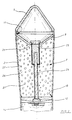
- a projectile incendiary 1 includes an envelope 2, made of aluminum, and whose diameter regularly increases by one rear part 3 to a front part 4.
- the front part 4 of the envelope 2 receives a ballistic warhead 5 fixed to the envelope, for example by threading.
- the rear part 3 of the envelope carries a in a known manner a tail (not shown), and possibly a propulsion system (not shown).
- the projectile thus constitutes a rocket intended to be fired by a launcher, in particular a light launcher without recoil.
- Envelope 2 defines a housing 6 to inside which a load is set up 7 of an incendiary composition.
- Housing 6 is closed at the rear end 3 by a rear cover 8 and at the end 4 by a front cover 9.
- the front and rear covers are fixed on envelope 2 by means of pins for example radial. Sealing means are provided between the wall of the casing 2 and the covers 8 and 9, they consist for example of elastomer cords 10 and 11 in place at the time of assembly. We will be able to choose to make these cords a material of the type silicone.
- the front cover 9 is separated from the load 7 by a layer 28 of resin.
- the latter has function of filling the gaps during the manufacture of the loading by casting as will be explained by the after.
- the rear cover 8 carries a housing in which is set up an initiator or relay pyrotechnic 12. Conventionally, this relay is arranged opposite an opening 13 of a rocket 14, so that it can be ignited by a primer 15, when the latter is brought by a flap 26 in its aligned position (position shown in Figure 1).
- a tube 16 made of steel of a few tenths of a mm thick, is arranged along the axis of XX 'symmetry of the projectile, it is fixed on the one hand by thread in a thread 17 of the rear cover 8, and on the other hand to the rear face of a housing cylindrical 18.
- the cylindrical housing 18, made of sheet metal of steel, is itself slidably adjusted in a hole 19, made in the front cover 9.
- connection between the tube 16 and the housing 18 is obtained by an annular crimp 20 of the end of the tube 16 on the bottom of the housing 18.
- a plug 21 is supported by a shoulder 22 on the front cover 9, it is fixed by gluing on the cover 9.
- the case 18 extends in the load 7 over a length L1 from the front cover 9.
- the length L1 is preferably chosen to be understood between 20 and 50% of the total length L2 of the loading 7 for reasons which will be specified by the after.
- vents 23 regularly distributed over its entire surface cylindrical. These vents have the function of allowing ignition of the incendiary charge as it will explained later. They are closed in a way known by metallic flakes, made for example by sticking a sheet of tin on the cylindrical surface internal of the housing 18.
- the tube 16 contains a cord 24 of transmission and fast ignition which is constituted by example by a pyrotechnic composition placed in a polyethylene sheath.
- Case 18 contains a composition ignition and dispersion pyrotechnics 25, charged with bulk, and which is constituted by the association of one or several reducers and one or more oxidants.
- reducer (s) from the following materials: Zirconium, Aluminum atomized and of small granulometry, Magnesium.
- oxidant s
- the oxidant (s) from the following materials: Potassium Perchlorate, Nitrate of Barium, Sodium Nitrate, Barium Peroxide.
- composition 25 An axial cavity is provided inside composition 25 to receive one end of the cord 24.
- the incendiary composition 7 comprises a incendiary material 26 inside which are uniformly distributed grains 27 of a material ignition.
- the incendiary material is made up essentially by one or more hydrocarbons to which are added additives, such as agents sensitizers, adhesion agents, mixtures oxidizers and reducers.
- composition will preferably comprise 30 to 78% by mass of incendiary material.
- a dopant redox / reducing mixture having preferably a negative oxygen balance (or of a doping reducing agent associating during the reaction with air oxygen).
- the reducer will be chosen from the materials following: Aluminum, Zirconium, Magnesium.
- the oxidant will be chosen from the following materials: Tungsten, Zinc, Lead, Manganese or iron oxides, Calcium sulphate, Polytetrafluoroethylene.
- Ammonium perchlorate Nitrocellulose, Nitroguanidine, Ammonium nitrate.
- oxidizers with a low melting point like Sodium Nitrate, Nitrate of Barium, Barium Peroxide, Nitrate of Potassium, Potassium Chlorate and Chlorate Barium.
- adhesion agent chosen from the compounds following: chloroprenes, silicones, fluorinated silicones, polyisoprenes, copolymers isobutylene-isoprene and butadiene-acrylonitrile copolymers.
- a binder chosen from the following compounds: Polyvinylidene fluoride (PVDF), Polytetrafluoroethylene (PTFE), Polyurethanes, Viton (Registered trademark to designate the copolymers of Chlorofluoroethylene).
- PVDF Polyvinylidene fluoride
- PTFE Polytetrafluoroethylene
- Viton (Registered trademark to designate the copolymers of Chlorofluoroethylene).
- This reducer will be by example chosen from the following compounds: Phosphorus red, Antimony, Boron, Vanadium.
- Hydrocarbon Naphthalene 30% to 60% (preferably 35%),
- Oxidizing / reducing dopant mixture Aluminum (particle size 10 micrometers) 12 to 18% (preferably 15%) and Magnesium 7% to 15% (preferably 10%), the oxidant here consists of the oxygen in the air and the sodium nitrate cited among the sensitizers.
- Adhesion agent Chloroprene 4 to 8% (preferably 5%)
- Hydrocarbon Phenanthrene 30% to 70% (preferably 35%)
- Oxidizing / reducing dopant mixture Magnesium 5 to 15% (preferably 10%), Zirconium 5% to 12% (preferably 10%), Calcium sulfate 5 to 12% (preferably 10%),
- Potassium nitrate 5 to 10% (preferably 5%)
- Nitrocellulose 5 to 20% preferably 10%
- Barium Chlorate 5 to 10% (preferably 5%).
- Additional reducers Red phosphorus 5 to 15% (preferably 10%) and Antimony 5 to 10% (preferably 5%).
- Hydrocarbon Anthracene 30% to 70% (preferably 33%),
- Oxidizing / reducing dopant mixture Aluminum (particle size 10 micrometers) 10 to 16% (preferably 10%), Zirconium 5% to 12% (preferably 10%) and Iron Oxide (Fe3O4) 5 to 8% (preferably 7%),
- Adhesion agent Chloroprene 4 to 8% (preferably 5%)
- Hydrocarbon Anthracene 30% to 70% (preferably 30%),
- Oxidizing / reducing dopant mixture Aluminum (particle size 10 micrometers) 10 to 15% (preferably 10%), Magnesium 8% to 12% (preferably 10%) and Iron Oxide (Fe3O4) 5 to 12% (preferably 8%),
- Adhesion agent Silicone from 4 to 8% (preferably 5%).
- Binder PVDF 5 to 12% (preferably 10%).
- the material constituting the grains 27 of the ignition material is chosen on the one hand according to its ability to initiate incendiary material 26 chosen, and secondly according to its own sensitivity to flame and hot gases, since this material must itself be initiated by the composition 25.
- the rate of propagation of the reaction of the grain material 27 will be chosen between 1m / s and 3000m / s, to ensure rapid initiation from close close to the grains 27 before the envelope 2 bursts.
- the grains 27 of the ignition material will calibrated with an average dimension between 0.1mm and 10mm and preferably between 3 and 6mm.
- the shape of grains can be any but will preferably be spherical or spheroidal.
- the ignition material that forms the grains may consist of an explosive capable of take an explosive diet (propagation speed of reaction between 300m / s and 3000m / s) when is subjected to heat flow.
- the ignition material may also be consisting of a propellant powder (single, double or multibases), based on nitroguanidine nitrocellulose or of nitroglycerin.
- the ignition material can finally be consisting of a pyrotechnic composition, the operating mode is either lively combustion or a blast.
- the ignition material from the pyrotechnic compositions consisting of one or more reducers chosen from the following materials: Aluminum, Magnesium, Zirconium.
- oxidants chosen from the following compounds: Sodium Nitrate, Barium Nitrate, Potassium Nitrate, Barium Peroxide, Potassium Chlorate, Barium Chlorate, Teflon (Registered trademark).
- This redox / reducing composition will be optionally with a sensitizing compound like Nitrocellulose or Ammonium Perchlorate, and may include a binder such as PVDF (Polyfluoride of Vinylidene) or Viton (registered trademark).
- a sensitizing compound like Nitrocellulose or Ammonium Perchlorate
- a binder such as PVDF (Polyfluoride of Vinylidene) or Viton (registered trademark).
- composition is then granulated (passage to through a sieve whose mesh void is adapted to the desired particle size).
- the mass ratio between all the grains 27 and the incendiary material 26 will depend on the sensitivity of the incendiary composition and characteristics of the constituent material of the grains.
- the preferred proportions will be those of a mixture of 5 to 15% by mass of ignition material and 95 to 85% by mass of incendiary material.
- Incendiary composition according to example M1 of 85 to 95% by mass
- Ignition composition according to example A1 from 5 to 15% by mass.
- Incendiary composition according to example M2 of 85 to 95% by mass
- Ignition composition according to example A2 from 5 to 15% by mass.
- Incendiary composition according to example M3 of 85 to 95% by mass
- Ignition composition according to example A3 from 5 to 15% by mass.
- Incendiary composition according to example M4 of 85 to 90% by mass
- Ignition composition according to example A4 from 10 to 15% by mass.
- the rocket 14 initiates the relay 12.
- the latter turns on the cord 24 which has the function of quickly initiating the ignition and dispersion composition 25 (with a delay less than 2ms) without disturbing the loading incendiary 7.
- Ignition composition 25 generates gases hot and flames coming out of the case 18 through the vents 23.
- the ignition composition 25 is dimensioned so as not to be able to break the confinement achieved by the casing 2 and the front and rear covers 8 and 9.
- the envelope 2 which ensured the containment of the beginning of the reaction, breaks and the incendiary charge is dispersed outside in the form of fragments.
- Each fragment has a part of material incendiary 26 carrying one or more ignition grains 27 who are initiated and who in turn ensure ignition of the incendiary material 26.
- the distribution of ignition grains within the incendiary composition thus makes it possible to resolve the problem of the dispersion of the composition in the form of flaming fragments thanks to the chronology of load operation. Indeed, it is the initiation step by step of the ignition grains which ensures the fragmentation of the incendiary charge then the bursting of the envelope.
- Each fragment of composition that is dispersed thus takes its own source of initiation under the form of one or more grains of ignition material ignited disposed on the surface of the incendiary material. This ensures ignition of the incendiary material after the fragments are dispersed.
- composition incendiary proposed by the invention is little sensitive to external stresses (shocks, vibrations), since the most sensitive part (the grains of ignition material) is embedded in a insensitive material (incendiary material).
- the housing 18 is carried by the front cover 9 and that it extends in the loading 7 over a length L1 of less than 50% of the total length L2 of the load 7.
- Such an arrangement has the effect of advancing the initiation reaction of the charge in a direction which is both radial around the housing 18, and axial of the part front 4 towards the rear part 3 of the projectile.
- the envelope 2 and the covers 8 and 9 could for example be made of material plastic or composite, for example coiled filamentary.
- Envelope 2 may have primers of breaks of particular shapes in order to give a particular distribution for the fragments of the incendiary composition.
- Figure 2 gives an example of a variant in which the front cover 9 has a conical shape converging towards the rear part 3 of the projectile.
- This shape is particularly well suited to radial dispersion upon impact of the projectile on a target.
- the cone of the lid opens and this deformation has the effect of pushing back the load incendiary towards the rear and to favor its dispersion radial.
- Figure 3 summarizes the different phases of a particular method of manufacturing a projectile according to the invention.
- a second thermostatically controlled enclosure E2 receives through an orifice supply O1 all incendiary material from E1. It also receives through an orifice supply O2 the ignition grains from a distribution system S.
- Distribution system S provides mass of 27 grains which is necessary for mass incendiary supplied by E1.
- a stirrer A homogenizes the mixture of grains 27 and incendiary material 26.
- valve V By means of valve V, it flows into this envelops the quantity of incendiary composition required (phase P1).
- phase P2 Let cool and solidify the composition, then place a layer 28 of resin to fill the clearances after cooling (phase P2).
- the envelope containing the load is then ready to receive other elements so as to constitute the incendiary projectile 1 (rocket, warhead, empennage, propellant ).
- composition incendiary including a binder, carry out the loading by cold or hot compression.
Landscapes
- Chemical & Material Sciences (AREA)
- Engineering & Computer Science (AREA)
- Organic Chemistry (AREA)
- Materials Engineering (AREA)
- Metallurgy (AREA)
- Chemical Kinetics & Catalysis (AREA)
- General Chemical & Material Sciences (AREA)
- Combustion & Propulsion (AREA)
- General Engineering & Computer Science (AREA)
- Air Bags (AREA)
- Compositions Of Macromolecular Compounds (AREA)
Description
- comme Hydrocarbure: de 30% à 60% de Naphtalène et de préférence 35%,
- comme mélange réducteur dopant: de 12 à 18% d'Aluminium (de préférence 15%) et de 7% à 15% de Magnésium (de préférence 10%),
- comme sensibilisant: de 5 à 25% de Perchlorate d'ammonium (de préférence 15%) et de 5 à 12% de Nitrate de sodium (de préférence 10%),
- comme agent d'adhérence: de 4 à 8% de Chloroprène (de préférence 5%),
- comme réducteur complémentaire: de 7 à 15% de Phosphore rouge (de préférence 10%).
- comme Hydrocarbure: de 30% à 70% de Phénantrène (de préférence 35%),
- comme mélange oxydo/réducteur dopant: de 5% à 15% de Magnésium (de préférence 10%), de 5 à 12% de Zirconium (de préférence 10%) et de 5 à 12% de Sulfate de Calcium (de préférence 10%),
- comme sensibilisant: de 5 à 10% de Nitrate de Potassium (de préférence 5%), de 5 à 20% de Nitrocellulose (de préférence 10%) et de 5 à 10% de Chlorate de Baryum (de préférence 5%),
- comme réducteur complémentaire: de 5 à 15% de Phosphore rouge (de préférence 10%) et de 5 à 10% d'Antimoine (de préférence 5%).
- comme Hydrocarbure: de 30% à 70% d'Anthracène (de préférence 33%),
- comme mélange oxydo/réducteur dopant: de 10% à 16% d'Aluminium (de préférence 10%), de 5 à 12% de Zirconium (de préférence 10%) et de 5 à 8% d'oxyde de fer (Fe3O4) (de préférence 7%),
- comme sensibilisant: de 5 à 10% de Nitrate de Baryum (de préférence 10%) et de 5 à 25% de nitrate d'ammonium (de préférence 15%),
- comme réducteur complémentaire: de 7 à 15% de Phosphore rouge (de préférence 10%),
- comme agent d'adhérence: de 4 à 8% de Chloroprène (de préférence 5%).
- comme Hydrocarbure: de 30% à 70% d'Anthracène (de préférence 30%),
- comme mélange oxydo/réducteur dopant: de 10% à 15% d'Aluminium (de préférence 10%), de 8 à 12% de Magnésium (de préférence 10%) et de 5 à 12% d'oxyde de fer (Fe3O4) (de préférence 8%),
- comme sensibilisant: de 5 à 15% de Nitrate de sodium (de préférence 7%) et de 5 à 15% de Nitrocellulose (de préférence 10%),
- comme réducteur complémentaire: de 5 à 10% de Phosphore rouge (de préférence 5%) et 5 à 10% de Bore (de préférence 5%),
- comme liant : de 5 à 12% de Polyfluorure de vinylidène (PVDF) (de préférence 10%),
- comme agent d'adhérence de 4 à 8% de Silicone (de préférence 5%).
- la figure 1 est une vue partielle en coupe axiale d'un projectile incendiaire selon un premier mode de réalisation de l'invention,
- la figure 2 est une vue partielle en coupe axiale d'un projectile incendiaire selon une variante de réalisation de l'invention.
- la figure 3 est un schéma présentant les différentes phases d'un procédé particulier de réalisation d'un projectile selon l'invention.
- les organiques aliphatiques ramifiés (tel le tétra méthylbutane),
- les organiques cycliques (tel l'héxachlorocyclohexane),
- les aromatiques (tels le chlorotriphénylméthane, le pentachlorobenzène, le stilbène, le benzaurin, le xanthène),
- les polyaromatiques (tel le naphtalène, l'anthracène, le phénantrène),
- les alcools (tel l'aminoéthanol),
- les aldéhydes,
- les cétones (tel l'acétophénone substituée).
les Oxydes de Tungstène, de Zinc, de Plomb, de Manganèse ou de fer, le sulfate de Calcium, le Polytétrafluoréthylène.
Naphtalène 30% à 60% (de préférence 35%),
Aluminium (granulométrie 10 micromètres) 12 à 18% (de préférence 15%) et Magnésium 7% à 15% (de préférence 10%), l'oxydant est ici constitué par l'oxygène de l'air et le nitrate de sodium cité parmi les sensibilisants.
Perchlorate d'ammonium 5 à 25% (de préférence 15%) et Nitrate de sodium 5 à 12% (de préférence 10%),
Chloroprène 4 à 8% (de préférence 5%)
Phosphore rouge 7 à 15% (de préférence 10%).
Phénantrène 30% à 70% (de préférence 35%),
Magnésium 5 à 15% (de préférence 10%), Zirconium 5% à 12% (de préférence 10%), Sulfate de Calcium 5 à 12% (de préférence 10%),
Nitrate de Potassium 5 à 10% (de préférence 5%), Nitrocellulose 5 à 20% (de préférence 10%) et Chlorate de Baryum 5 à 10% (de préférence 5%).
Phosphore rouge 5 à 15% (de préférence 10%) et Antimoine 5 à 10% (de préférence 5%).
Anthracène 30% à 70% (de préférence 33%),
Aluminium (granulométrie 10 micromètres) 10 à 16% (de préférence 10%), Zirconium 5% à 12% (de préférence 10%) et Oxyde de Fer (Fe3O4) 5 à 8% (de préférence 7%),
Nitrate de Baryum 5 à 10% (de préférence 10%) et Nitrate d'ammonium 5 à 25% (de préférence 15%),
Chloroprène 4 à 8% (de préférence 5%)
Phosphore rouge 7 à 15% (de préférence 10%).
Anthracène 30% à 70% (de préférence 30%),
Aluminium (granulométrie 10 micromètres) 10 à 15% (de préférence 10%), Magnésium 8% à 12% (de préférence 10%) et Oxyde de Fer (Fe3O4) 5 à 12% (de préférence 8%),
Nitrate de Sodium 5 à 15% (de préférence 7%) et Nitrocellulose 5 à 15% (de préférence 10%).
Phosphore rouge 5 à 10% (de préférence 5%) et Bore 5 à 10% (de préférence 5%),
Silicone de 4 à 8% (de préférence 5%).
PVDF 5 à 12% (de préférence 10%).
Aluminium, Magnésium, Zirconium.
Nitrate de Sodium, Nitrate de Baryum, Nitrate de Potassium, Peroxyde de Baryum, Chlorate de Potassium, Chlorate de Baryum, Téflon (Marque déposée).
- dissolution du liant copolymère dans un solvant organique approprié (acétone ou toluène par exemple),
- introduction du ou des réducteurs puis du ou des oxydants,
- malaxage jusqu'à homogénéisation,
- évaporation du solvant (par exemple par dépression en combinaison azéotropique avec un produit adapté).
- on dissous à température ambiante un liant dans un solvant adapté (acétone, toluène),
- on mélange oxydants et réducteurs avec le liant
- on fait évaporer le solvant (température de 30 à 60°C),
- on granule la composition,
- on étuve la composition pour évacuer les traces de solvant.
Claims (19)
- Composition incendiaire constituée par le mélange d'un matériau incendiaire (26) à l'état solide et d'un matériau d'allumage sous forme de grains (27) uniformément répartis dans le matériau incendiaire, composition caractérisée en ce qu'elle est constituée par le mélange de 5 à 25% en masse de matériau d'allumage et de 95 à 75% en masse de matériau incendiaire et de préférence par un mélange de 5 à 15% en masse de matériau d'allumage et de 95 à 85% en masse de matériau incendiaire, le matériau incendiaire comportant un mélange de :la dimension moyenne des grains du matériau d'allumage étant comprise entre 0,1 et 10 mm et préférentiellement comprise entre 3 et 6mm, le matériau d'allumage étant choisi de façon à pouvoir initier le matériau incendiaire, et étant constitué par un explosif susceptible de prendre un régime déflagrant lorsqu'il est soumis à un flux thermique, ou bien par une poudre propulsive ou encore par une composition pyrotechnique dont le mode de fonctionnement est soit une combustion vive soit une déflagration, composition choisie parmi les compositions suivantes :30 à 78% en masse d'hydrocarbures,10 à 30 % en masse d'un réducteur ou couple oxydo/réducteur dopant à l'état finement divisé,5 à 25 % en masse d'un sensibilisant,5 à 15% en masse d'un réducteur complémentaire formant des oxydes à bas point de fusion,0 à 10% en masse d'un agent d'adhérence,0 à 15% en masse d'un liant,Magnésium / Polytétrafluoroéthylène / copolymère de chlorofluoroéthylène,Bore / Nitrate de Sodium / Nitrocellulose,Magnésium / Nitrate de Baryum / Perchlorate d'ammonium / Polyfluorure de vinylidène,Magnésium / Oxyde de fer (Fe3O4) / Nitrate d'ammonium / Polyfluorure de vinylidène.
- Composition selon la revendication 1, caractérisée en ce que la densité apparente des grains est sensiblement égale à celle du matériau incendiaire seul.
- Composition selon une des revendications 1 ou 2, caractérisée en ce que le matériau incendiaire comporte :comme Hydrocarbure: de 30% à 60% de Naphtalène,comme mélange réducteur dopant: de 12 à 18% d'Aluminium et de 7% à 15% de Magnésium,comme sensibilisant: de 5 à 25% de Perchlorate d'ammonium et de 5 à 12% de Nitrate de sodium.comme agent d'adhérence: de 4 à 8% de Chloroprène,comme réducteur complémentaire: de 7 à 15% de Phosphore rouge.
- Composition selon la revendication 3, caractérisée en ce que le matériau incendiaire comporte :35% de Naphtalène,15% d'Aluminium et 10% de Magnésium,15% de Perchlorate d'ammonium et 10% de Nitrate de sodium,5% de Chloroprène,10% de Phosphore rouge.
- Composition selon une des revendications 3 ou 4, caractérisée en ce qu'elle comporte :85 à 95% en masse de matériau incendiaire,5 à 15% en masse d'une composition d'allumage comprenant 30% en masse de Magnésium, 54% en masse de polytétrafluoroéthylène et 16% en masse de copolymère de chlorofluoroéthylène.
- Composition selon une des revendications 1 ou 2, caractérisée en ce que le matériau incendiaire comporte :comme Hydrocarbure: de 30% à 70% de Phénantrène,comme mélange oxydo/réducteur dopant: de 5% à 15% de Magnésium, de 5 à 12% de Zirconium et de 5 à 12% de Sulfate de Calcium,comme sensibilisant: de 5 à 10% de Nitrate de Potassium, de 5 à 20% de Nitrocellulose et de 5 à 10% de Chlorate de Baryum.comme réducteur complémentaire: de 5 à 15% de Phosphore rouge et de 5 à 10% d'Antimoine.
- Composition selon la revendication 6, caractérisée en ce que le matériau incendiaire comporte :35% de Phénantrène,10% de Magnésium, 10% de Zirconium et 10% de Sulfate de Calcium,5% de Nitrate de Potassium, 10% de Nitrocellulose et 5% de Chlorate de Baryum.10% de Phosphore rouge et 5% d'Antimoine.
- Composition selon une des revendications 6 ou 7, caractérisée en ce qu'elle comporte :85 à 95% en masse de matériau incendiaire,5 à 15% en masse d'une composition d'allumage comprenant 16% en masse de Bore, 50% en masse de Nitrate de Sodium et 34% en masse de Nitrocellulose.
- Composition selon une des revendications 1 ou 2, caractérisée en ce que le matériau incendiaire comporte :comme Hydrocarbure: de 30% à 70% d'Anthracène,comme mélange oxydo/réducteur dopant: de 10% à 16% d'Aluminium, de 5 à 12% de Zirconium et de 5 à 8% d'oxyde de fer (Fe3O4),comme sensibilisant: de 5 à 10% de Nitrate de Baryum et de 5 à 25% de nitrate d'ammonium,comme réducteur complémentaire: de 7 à 15% de Phosphore rouge,comme agent d'adhérence: de 4 à 8% de Chloroprène.
- Composition selon la revendication 9, caractérisée en ce que le matériau incendiaire comporte :33% d'Anthracène,10% d'Aluminium, 10% de Zirconium et 7% d'oxyde de fer (Fe3O4),10% de Nitrate de Baryum et 15% de nitrate d'ammonium,10% de Phosphore rouge,5% de Chloroprène.
- Composition selon une des revendications 9 ou 10, caractérisée en ce qu'elle comporte :85 à 95% en masse de matériau incendiaire,5 à 15% en masse d'une composition d'allumage comprenant 36% en masse de Magnésium, 28% en masse de Nitrate de Baryum, 28% en masse de Perchlorate d'ammonium et 8% en masse de Polyfluorure de vinylidène.
- Composition selon une des revendications 1 ou 2, caractérisée en ce que le matériau incendiaire comporte :comme Hydrocarbure: de 30% à 70% d'Anthracène,comme mélange oxydo/réducteur dopant: de 10% à 15% d'Aluminium, de 8 à 12% de Magnésium et de 5 à 12% d'oxyde de fer (Fe3O4),comme sensibilisant: de 5 à 15% de Nitrate de sodium et de 5 à 15% de Nitrocellulose,comme réducteur complémentaire: de 5 à 10% de Phosphore rouge et 5 à 10% de Bore,comme liant : de 5 à 12% de Polyfluorure de vinylidène,comme agent d'adhérence de 4 à 8% de Silicone.
- Composition selon la revendication 12, caractérisée en ce que le matériau incendiaire comporte :30% d'Anthracène;10% d'Aluminium, 10% de Magnésium et 8% d'oxyde de fer (Fe3O4),7% de Nitrate de sodium et 10% de Nitrocellulose,5% de Phosphore rouge et 5% de Bore,10% de Polyfluorure de vinylidène,5% de Silicone.
- Composition selon une des revendications 12 ou 13, caractérisée en ce qu'elle comporte :85 à 90% en masse de matériau incendiaire,10 à 15% en masse d'une composition d'allumage comprenant 36% en masse de Magnésium, 28% en masse d'Oxyde de fer, 28% en masse de Nitrate d'ammonium et 8% en masse de Polyfluorure de vinylidène.
- Projectile du type incendiaire et comportant une composition selon une quelconque des revendications 1 à 14, caractérisé en ce que la composition est mise en place dans une enveloppe de confinement (2) qui se rompt lors de l'initiation du projectile pour libérer la composition et en ce qu'il comporte des moyens pyrotechniques assurant une fissuration du chargement incendiaire et une initiation d'une partie des grains (27) du matériau d'allumage, les moyens pyrotechniques étant dimensionnés de telle sorte qu'ils ne puissent rompre l'enveloppe de confinement (2).
- Projectile selon la revendication 15, caractérisé en ce que les moyens pyrotechniques comprennent une composition d'allumage (25) disposée suivant un axe du projectile et qui s'étend depuis une partie avant de l'enveloppe sur au moins une partie de la longueur totale du chargement.
- Projectile selon la revendication 16, caractérisé en ce que la composition d'allumage (25) s'étend sur une longueur comprise entre 20 et 50% de la longueur totale du chargement.
- Projectile selon la revendication 17, caractérisé en ce que la composition d'allumage (25) est initiée au moyen d'un cordeau de transmission (24) lui même allumé par un initiateur porté par une partie arrière de l'enveloppe.
- Projectile selon une des revendications 15 à 18, caractérisé en ce que l'enveloppe comporte un couvercle de fermeture (9) de sa partie avant présentant un profil concave orienté vers l'avant du projectile.
Applications Claiming Priority (2)
| Application Number | Priority Date | Filing Date | Title |
|---|---|---|---|
| FR9315204 | 1993-12-17 | ||
| FR9315204A FR2714050B1 (fr) | 1993-12-17 | 1993-12-17 | Composition incendiaire et projectile incendiaire dispersant une telle composition. |
Publications (2)
| Publication Number | Publication Date |
|---|---|
| EP0663376A1 EP0663376A1 (fr) | 1995-07-19 |
| EP0663376B1 true EP0663376B1 (fr) | 1999-03-10 |
Family
ID=9454048
Family Applications (1)
| Application Number | Title | Priority Date | Filing Date |
|---|---|---|---|
| EP19940402872 Expired - Lifetime EP0663376B1 (fr) | 1993-12-17 | 1994-12-13 | Composition incendiaire et projectile incendiaire dispersant une telle composition |
Country Status (3)
| Country | Link |
|---|---|
| EP (1) | EP0663376B1 (fr) |
| DE (1) | DE69416998T2 (fr) |
| FR (1) | FR2714050B1 (fr) |
Families Citing this family (2)
| Publication number | Priority date | Publication date | Assignee | Title |
|---|---|---|---|---|
| DE19548544A1 (de) * | 1995-12-23 | 1997-06-26 | Dynamit Nobel Ag | Initialsprengstoff-freie Anzündmischung |
| US6599379B2 (en) * | 2001-04-12 | 2003-07-29 | Dmd Systems, Llc | Low-smoke nitroguanidine and nitrocellulose based pyrotechnic compositions |
Family Cites Families (8)
| Publication number | Priority date | Publication date | Assignee | Title |
|---|---|---|---|---|
| DE302420C (fr) * | ||||
| DE302600C (fr) * | ||||
| US2534215A (en) * | 1942-02-12 | 1950-12-19 | Maurice E Barker | Thermit ammunition |
| DE1171319B (de) * | 1961-07-17 | 1964-05-27 | Buck K G Chemische Und Tech Qu | Verdickungsmittel fuer fluessige, brennbare aromatische Kohlenwasserstoffe und/oder Schwefelkohlenstoff |
| US3730093A (en) * | 1966-12-27 | 1973-05-01 | North American Rockwell | Explosive apparatus |
| US3881968A (en) * | 1973-06-22 | 1975-05-06 | Willard F Simpson | Incendiary comprising naphthalene and Mg-tetrafluoroethylene |
| DE4116877A1 (de) * | 1991-05-23 | 1992-11-26 | Diehl Gmbh & Co | Verfahren zur herstellung eines gaserzeugenden satzes fuer einen airbag |
| FR2684178B1 (fr) * | 1991-11-26 | 1995-05-12 | Lacroix E Tous Artifices | Tete incendiaire. |
-
1993
- 1993-12-17 FR FR9315204A patent/FR2714050B1/fr not_active Expired - Fee Related
-
1994
- 1994-12-13 EP EP19940402872 patent/EP0663376B1/fr not_active Expired - Lifetime
- 1994-12-13 DE DE1994616998 patent/DE69416998T2/de not_active Expired - Fee Related
Also Published As
| Publication number | Publication date |
|---|---|
| FR2714050A1 (fr) | 1995-06-23 |
| DE69416998D1 (de) | 1999-04-15 |
| EP0663376A1 (fr) | 1995-07-19 |
| FR2714050B1 (fr) | 1996-02-09 |
| DE69416998T2 (de) | 1999-07-08 |
Similar Documents
| Publication | Publication Date | Title |
|---|---|---|
| CN1023511C (zh) | 用于无起爆药雷管的起爆元件 | |
| AU2001228616B2 (en) | Infra-red emitting decoy flare | |
| FR2867555A1 (fr) | Projectiles a matiere reactive renforces, et procedes relatifs a ces projectiles | |
| EP0467774B1 (fr) | Projectile à effet destructif explosant par impact | |
| EP1275930B1 (fr) | Allumeur de sécurité pour élément de munition pyrotechnique susceptible d'être soumis à un échauffement lent. | |
| FR2671617A1 (fr) | Charge creuse a dispositif deviateur des ondes de detonation. | |
| US10415938B2 (en) | Propellant | |
| EP0694755B1 (fr) | Projectile explosif | |
| FR2534369A1 (fr) | Projectile explosif perforant encartouche | |
| EP1306643B1 (fr) | Détonateur optique basse énergie | |
| EP1659359B1 (fr) | Munition ou composant de munition comprenant un matériau énergétique structural | |
| EP1742009B1 (fr) | Dispositif d'amorçage comprenant une composition explosive pour allumage thermique par source laser | |
| EP0890819B1 (fr) | Munition de marquage coloré | |
| GB2354060A (en) | Infra-red emitting decoy flare | |
| EP0663376A1 (fr) | Composition incendiaire et projectile incendiaire dispersant une telle composition | |
| FR2627272A1 (fr) | Enveloppe metallique d'une munition destinee a contenir une charge explosive confinee et procede pour sa fabrication | |
| FR2763120A1 (fr) | Corps de sous-munition pour la production de brouillard | |
| EP3663703B1 (fr) | Tête militaire perforante | |
| FR2635774A1 (fr) | Comprime fumigene supportant une forte charge et possedant une action de camouflage a large bande spectrale | |
| FR2666646A1 (fr) | Corps incendiaire, notamment d'obus, fusee ou bombe, comprenant une charge de mitraille incendiaire. | |
| EP4632314A1 (fr) | Cordeau d allumage en combustion à puissance renforcée | |
| FR2633283A1 (fr) | Utilisation d'une composition de chauffage metallothermique pour chauffer des fragments de metal a point de fusion eleve dans une charge de mitraille incendiaire | |
| EP2615077B1 (fr) | Activation de compositions énergétiques par mélange magnétique | |
| FR3013826A1 (fr) | Munition a letalite reduite | |
| EP2192376B1 (fr) | Dispositif propulsif à progressivité regulée |
Legal Events
| Date | Code | Title | Description |
|---|---|---|---|
| PUAI | Public reference made under article 153(3) epc to a published international application that has entered the european phase |
Free format text: ORIGINAL CODE: 0009012 |
|
| AK | Designated contracting states |
Kind code of ref document: A1 Designated state(s): BE DE ES GB IT SE |
|
| 17P | Request for examination filed |
Effective date: 19950915 |
|
| 17Q | First examination report despatched |
Effective date: 19960320 |
|
| GRAG | Despatch of communication of intention to grant |
Free format text: ORIGINAL CODE: EPIDOS AGRA |
|
| GRAG | Despatch of communication of intention to grant |
Free format text: ORIGINAL CODE: EPIDOS AGRA |
|
| GRAH | Despatch of communication of intention to grant a patent |
Free format text: ORIGINAL CODE: EPIDOS IGRA |
|
| GRAH | Despatch of communication of intention to grant a patent |
Free format text: ORIGINAL CODE: EPIDOS IGRA |
|
| GRAA | (expected) grant |
Free format text: ORIGINAL CODE: 0009210 |
|
| AK | Designated contracting states |
Kind code of ref document: B1 Designated state(s): BE DE ES GB IT SE |
|
| PG25 | Lapsed in a contracting state [announced via postgrant information from national office to epo] |
Ref country code: IT Free format text: LAPSE BECAUSE OF FAILURE TO SUBMIT A TRANSLATION OF THE DESCRIPTION OR TO PAY THE FEE WITHIN THE PRESCRIBED TIME-LIMIT;WARNING: LAPSES OF ITALIAN PATENTS WITH EFFECTIVE DATE BEFORE 2007 MAY HAVE OCCURRED AT ANY TIME BEFORE 2007. THE CORRECT EFFECTIVE DATE MAY BE DIFFERENT FROM THE ONE RECORDED. Effective date: 19990310 Ref country code: ES Free format text: THE PATENT HAS BEEN ANNULLED BY A DECISION OF A NATIONAL AUTHORITY Effective date: 19990310 |
|
| GBT | Gb: translation of ep patent filed (gb section 77(6)(a)/1977) |
Effective date: 19990310 |
|
| REF | Corresponds to: |
Ref document number: 69416998 Country of ref document: DE Date of ref document: 19990415 |
|
| PG25 | Lapsed in a contracting state [announced via postgrant information from national office to epo] |
Ref country code: BE Free format text: LAPSE BECAUSE OF NON-PAYMENT OF DUE FEES Effective date: 19991231 |
|
| PLBE | No opposition filed within time limit |
Free format text: ORIGINAL CODE: 0009261 |
|
| STAA | Information on the status of an ep patent application or granted ep patent |
Free format text: STATUS: NO OPPOSITION FILED WITHIN TIME LIMIT |
|
| 26N | No opposition filed | ||
| BERE | Be: lapsed |
Owner name: GIAT INDUSTRIES Effective date: 19991231 |
|
| REG | Reference to a national code |
Ref country code: GB Ref legal event code: IF02 |
|
| PGFP | Annual fee paid to national office [announced via postgrant information from national office to epo] |
Ref country code: SE Payment date: 20041125 Year of fee payment: 11 Ref country code: DE Payment date: 20041125 Year of fee payment: 11 |
|
| PGFP | Annual fee paid to national office [announced via postgrant information from national office to epo] |
Ref country code: GB Payment date: 20041130 Year of fee payment: 11 |
|
| PG25 | Lapsed in a contracting state [announced via postgrant information from national office to epo] |
Ref country code: GB Free format text: LAPSE BECAUSE OF NON-PAYMENT OF DUE FEES Effective date: 20051213 |
|
| PG25 | Lapsed in a contracting state [announced via postgrant information from national office to epo] |
Ref country code: SE Free format text: LAPSE BECAUSE OF NON-PAYMENT OF DUE FEES Effective date: 20051214 |
|
| PG25 | Lapsed in a contracting state [announced via postgrant information from national office to epo] |
Ref country code: DE Free format text: LAPSE BECAUSE OF NON-PAYMENT OF DUE FEES Effective date: 20060701 |
|
| EUG | Se: european patent has lapsed | ||
| GBPC | Gb: european patent ceased through non-payment of renewal fee |
Effective date: 20051213 |