EP0663616B1 - Strahlungsempfindliches Material und Verfahren zur Herstellung eines Musters - Google Patents
Strahlungsempfindliches Material und Verfahren zur Herstellung eines Musters Download PDFInfo
- Publication number
- EP0663616B1 EP0663616B1 EP19940309847 EP94309847A EP0663616B1 EP 0663616 B1 EP0663616 B1 EP 0663616B1 EP 19940309847 EP19940309847 EP 19940309847 EP 94309847 A EP94309847 A EP 94309847A EP 0663616 B1 EP0663616 B1 EP 0663616B1
- Authority
- EP
- European Patent Office
- Prior art keywords
- sensitive material
- expressed
- copolymer
- resist
- radiation sensitive
- Prior art date
- Legal status (The legal status is an assumption and is not a legal conclusion. Google has not performed a legal analysis and makes no representation as to the accuracy of the status listed.)
- Expired - Lifetime
Links
- 0 CC1C(CC2CCCCC2)CC1CC* Chemical compound CC1C(CC2CCCCC2)CC1CC* 0.000 description 6
- KDZAHOWOSSCKGU-UHFFFAOYSA-N C(C1)C(C2)C3C1CC2C3 Chemical compound C(C1)C(C2)C3C1CC2C3 KDZAHOWOSSCKGU-UHFFFAOYSA-N 0.000 description 1
Images


Classifications
-
- G—PHYSICS
- G03—PHOTOGRAPHY; CINEMATOGRAPHY; ANALOGOUS TECHNIQUES USING WAVES OTHER THAN OPTICAL WAVES; ELECTROGRAPHY; HOLOGRAPHY
- G03F—PHOTOMECHANICAL PRODUCTION OF TEXTURED OR PATTERNED SURFACES, e.g. FOR PRINTING, FOR PROCESSING OF SEMICONDUCTOR DEVICES; MATERIALS THEREFOR; ORIGINALS THEREFOR; APPARATUS SPECIALLY ADAPTED THEREFOR
- G03F7/00—Photomechanical, e.g. photolithographic, production of textured or patterned surfaces, e.g. printing surfaces; Materials therefor, e.g. comprising photoresists; Apparatus specially adapted therefor
- G03F7/004—Photosensitive materials
- G03F7/039—Macromolecular compounds which are photodegradable, e.g. positive electron resists
-
- C—CHEMISTRY; METALLURGY
- C08—ORGANIC MACROMOLECULAR COMPOUNDS; THEIR PREPARATION OR CHEMICAL WORKING-UP; COMPOSITIONS BASED THEREON
- C08K—Use of inorganic or non-macromolecular organic substances as compounding ingredients
- C08K5/00—Use of organic ingredients
- C08K5/36—Sulfur-, selenium-, or tellurium-containing compounds
- C08K5/37—Thiols
- C08K5/375—Thiols containing six-membered aromatic rings
-
- G—PHYSICS
- G03—PHOTOGRAPHY; CINEMATOGRAPHY; ANALOGOUS TECHNIQUES USING WAVES OTHER THAN OPTICAL WAVES; ELECTROGRAPHY; HOLOGRAPHY
- G03F—PHOTOMECHANICAL PRODUCTION OF TEXTURED OR PATTERNED SURFACES, e.g. FOR PRINTING, FOR PROCESSING OF SEMICONDUCTOR DEVICES; MATERIALS THEREFOR; ORIGINALS THEREFOR; APPARATUS SPECIALLY ADAPTED THEREFOR
- G03F7/00—Photomechanical, e.g. photolithographic, production of textured or patterned surfaces, e.g. printing surfaces; Materials therefor, e.g. comprising photoresists; Apparatus specially adapted therefor
- G03F7/004—Photosensitive materials
- G03F7/0045—Photosensitive materials with organic non-macromolecular light-sensitive compounds not otherwise provided for, e.g. dissolution inhibitors
-
- G—PHYSICS
- G03—PHOTOGRAPHY; CINEMATOGRAPHY; ANALOGOUS TECHNIQUES USING WAVES OTHER THAN OPTICAL WAVES; ELECTROGRAPHY; HOLOGRAPHY
- G03F—PHOTOMECHANICAL PRODUCTION OF TEXTURED OR PATTERNED SURFACES, e.g. FOR PRINTING, FOR PROCESSING OF SEMICONDUCTOR DEVICES; MATERIALS THEREFOR; ORIGINALS THEREFOR; APPARATUS SPECIALLY ADAPTED THEREFOR
- G03F7/00—Photomechanical, e.g. photolithographic, production of textured or patterned surfaces, e.g. printing surfaces; Materials therefor, e.g. comprising photoresists; Apparatus specially adapted therefor
- G03F7/004—Photosensitive materials
- G03F7/039—Macromolecular compounds which are photodegradable, e.g. positive electron resists
- G03F7/0392—Macromolecular compounds which are photodegradable, e.g. positive electron resists the macromolecular compound being present in a chemically amplified positive photoresist composition
Definitions
- the present invention relates to a radiation sensitive material and a process for forming a pattern using the same.
- circuit patterns have become smaller in size, approaching submicron dimensions and even smaller. Formation of a pattern in a submicron dimension essentially requires lithography. In lithography a thin film resist is deposited on to a substrate to be processed, and is selectively exposed and developed to form a resist pattern. With this resist pattern as a mask, dry etching is conducted and then the resist is removed to obtain a required pattern. As an exposure source for lithography, ultraviolet radiation was originally used, but as circuit patterns approach submicron sizes, far ultraviolet radiation (e.g. electron beams, X rays, etc.) with short wavelengths, are used as exposure sources.
- far ultraviolet radiation e.g. electron beams, X rays, etc.
- resist materials having high resolution, high sensitivity and good dry-etching resistance are required.
- alicyclic groups are adamantane, norbornane, perhydroantracene, cyclohexane, tricyclo [5.2.1.0 2,6 ] decane etc., and adamantyl groups are suitable (see Japanese Patent Laid-Open Publication No. 39665/1992).
- composition ratio which gives dry etching resistance comparable to that of phenol resin-based and novolak resin-based resists, e.g., above 50 mol% of alicyclic unit, because of high hydrophobicity and rigidity of the resists, diffusion of protonic acid as a catalyst is hindered, which results in lower amplification, smaller amounts of carboxylic acid being generated, and lower solubility to a developer of an alkaline aqueous solution.
- resists lack adhesiveness, and, in addition, their resist films are rigid because of inclusion of alicyclic groups. As a rasult, strain caused to the resist films become larger, and the resist films have a greater tendency to peel off. Accordingly stable pattern characteristics cannot be obtained. This is also a problem.
- an object of the present invention is to provide a radiation sensitive material for an excimer laser lithography, having good transparency arid etching resistance, is highly sensitive, has good adhesion and to provide a method for forming a circuit pattern using the radiation sensitive material.
- Another object of the present invention is to provide a method for forming a pattern which can produce a protective film from even a non-phenol based polymer of low polarity, and which can have stable pattern characteristics.
- a radiation sensitive material comprising: a copolymer expressed by a general formula (where Y represents an alicyclic group; R 1 and R 2 represent CH 3 or H, and at least one of R 1 and R 2 is H; and R 4 represents an alkyl group); and a substance generating an acid by application of radiation.
- the copolymer includes, by 40 - 70 mol%, a unit structure including alicyclic groups.
- a radiation sensitive material comprising a terpolymer expressed by a general formula (where Y represents alicyclic group; Z represents -C(CH 3 ) 2 R 4 , R 1 , R 2 , and R 3 represent CH 3 or H; and R 4 represents an alkyl group); and a substance generating an acid by application of radiation.
- the terpolymer includes the unit structure having carboxyl in the range of 5-35 mol%.
- a radiation sensitive material comprising :
- the terpolymer includes hydroxyethyl methacrylate by above 5 mol%.
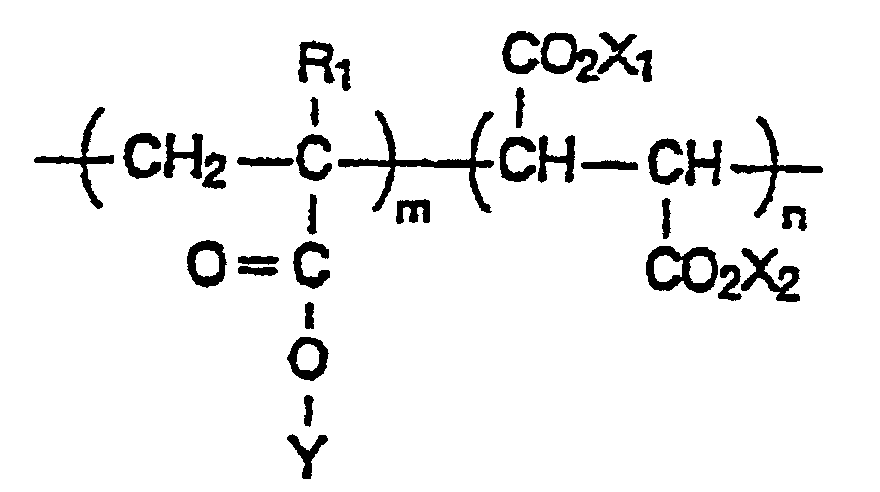
- the above-described object of the present invention is additionally achieved with a copolymer expressed by a general formula (where X 1 and X 2 represent -C(CH 3 ) 2 R 4 , Y represents an alicyclic group; R 1 represent CH 3 or H; and R 4 represents an alkyl group); and a substance genarating an acid by application of radiation.
- a radiation sensitive material comprising:
- a radiation sensitive material comprising:
- Groups which generate alkali soluble groups in the presence of acid are, an ester group, t-butyl group, tetrahydropyranyl group, ⁇ , ⁇ -dimethylbenzyl group, 3-oxocyclohexyl group, etc., and groups which are released in the presence of protonic acid can be used.
- groups without benzene rings are suitable.
- t-butyl group, tetrahydropyranyl group, 3-oxocyclohexyl group are more preferable.
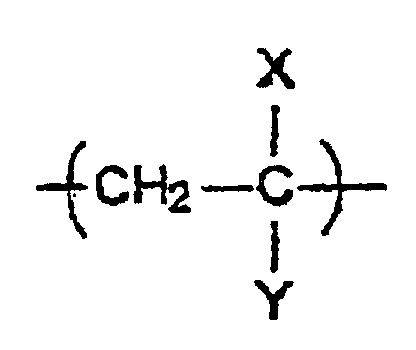
- the unit structure (where at least one of X and Y is nitrile group) is acrylonitrile or methacrylonitrite.
- the copolymer includes the acrylonitrile or methacrylonitrile by 10-70 mol%.
- the invention also provides a method for forming a pattern comprising the steps of: preparing a resist of the above-described radiation sensitive material, applying the resist to a substrate to be processed; prebaking the resist film and then selectively exposing the resist on the substrate to radiation to generate said acid; and post exposure baking and then developing the resist on the substrate to form the pattern.
- Developing of the resist on the substrate to form the pattern is preferably carried out by a developer which is a mixed liquid of an organic alkaline aqueous solution and isopropyl alcohol to form the pattern, the isopropyl alcohol preferably constituting 5-95% by vol, of the developer.
- the radiation sensitive material comprises: a copolymer including a unit structure including alicyclic groups, e.g. adamantyl groups, norbornyl group, and a unit structure generating an alkali soluble group in the presence of an acid, and a substance generating an acid by application of radiation.
- a substance generating an acid by application of radiation used in the above-described radiation sensitive material i.e. an acid generating substance can be provided by:
- the radiation sensitive material embodying the invention comprising a copolymer expressed by the following general formula one of R1 and R2 at the ⁇ positions is not a methyl group, which is bulky and very hydrophobic, but a proton, which is small-sized and less hydrophobic. Accordingly the copolymer is then less hydrophobic and less rigid. Consequently the copolymer is more compatible with and permeable to a developer, while a protonic acid catalyst can be more diffusible. Development is therefore easier, resulting in higher sensitivity and stable patterning characteristics.
- this copolymer contains a unit structure containing alicyclic groups by 40-70 mol%.
- the composition with below 40 mol% of the unit structure sufficient dry etching resistance cannot be obtained.
- the composition with above 70 mol% of the unit structure makes patterning difficult because of a small amount of t-butyl, a photosensitive group.
- the radiation sensitive material according to the first general embodiment of the invention and whose copolymer comprises a methacrylic or acrylic acid unit expressed by the following general formula can have higher sensitivity and stable patterning characteristics because of the carboxylic acid contained in the copolymer, which is an effective hydrophilic group.
- the copolymer originally containing carboxylic acid becomes an alkaline aqueous solution only by substitution of the sensitive groups by a small amount of carboxylic acid. Accordingly, high sensitivity and stable patterning are characteristics can be obtained.
- the terpolymer contains carboxylic acid, which is hydrophilic, because the terpolymer also contains alicyclic groups, which are very hydrophobic.
- the terpolymer contains carboxylic acid by above 5 mol% and below 35 mol%. This is because, with a carboxylic acid content of below 5 mol%, the effect is not exhibited, and with a carboxylic acid content of above 35 mol%, even non-exposed portions are dissolved and thus patterning is impossible.
- the copolymer contains hydroyethyl methacrylate as hydrophilic group, whereby, as in the case that the copolymer contains carboxylic acid, the copolymer has. higher hydrophilicity, and thus is more compatible with a developer and is permeable, resulting in higher solubility.
- the terpolymer contains alicyclic groups, which are very hydrophobic, it is very effective that the terpolymer contains hydroxyethyl methacrylate as a hydrophilic group.
- the terpolymer contains hydroxyethyl methacrylate by above 5 mol% because the effect is not exhibited with a content of hydroxyethyl methacrylate below 5 mol%.
- the radiation sensitive material according to the third general embodiment of the invention and comprising a copolymer including a unit structure expressed by the following general formula and more particularly comprising a copolymer expressed by the following general formula both include a unit structure expressed by whereby a larger number of sensitive groups are available per unit structure, with the result that higher sensitivity can be obtained, resulting in stable patterning characteristics.
- the radiation sensitive material according to the third general embodiment of the invention and comprising a copolymer including a unit structure expressed by the following formula and that more particularly comprising a copolymer expressed by the following general formula contains a relatively large number of sensitive groups per unit structure, and this enables relatively high sensitivity and stable patterning characteristics to be obtained.
- the radiation sensitive material according to the fifth general embodiment of the invention and comprising a copolymer including a unit structure expressed by the following general formula can have improved adhesiveness and stable patterning characteristics because of the nitrile groups, which have high polarity.
- the unit structure including nitrile groups is acrylonitrile or methacrylonitrile
- its content is preferably 10-70 mol%. When its content is below 10 mol%, sufficient adhesiveness cannot be obtained, and when its content is above 70 mol%, sufficient sensitivity cannot be obtained.
- Typical of groups generating alkali soluble groups in the presence of an acid are t-butyl ester, t-amyl ester, t-butyl ether, t-BOC, tetrahydropyranyl, tetrahydropyranyl ether, 3-oxocyclohexyl ester or dimethlbenzyl ester.
- a resist is formed of the above-described radiation sensitive material, and the resist is applied onto a substrate to be processed, prebaked, exposed, postbaked and developed, and is subjected to other treatments, whereby a submicron dimension pattern can be formed stably.
- Chemical amplifying resists have the intrinsic problem that protonic acid becomes inactive on the surface layers due to contamination by environmental amine, etc. Consequently solubility differences take place between the surface and inner layers, which is a serious factor that hinders stable patterning.
- Hydrocarbons which are very hydrophobic, especially adamantyl groups, t-butyl groups, etc., are effective to hinder dissolution in developers, and are very effective at making the surface insoluble.
- a mixed liquid of an organic alkaline aqueous solution and isopropyl alcohol is preferably used as a developer, whereby solubility is much improved and smaller solubility differences between the surface and inner layers can be obtained, so allowing stable patterning.
- Isopropyl alcohol is the most effective alcohol to be added as methanol and ethanol cause cracks, and peeling takes place.
- the use of this liquid mixture developer raised the sensitivity by one or more places and reduced strain caused upon development, so that the adhesiveness was much improved.
- the developer contains isopropyl alcohol by 5 - 95 vol%. This is because content of isopropyL alcohol by below 5 mol% does not improve the sensitivity, and content above 95 mol% easily causes cracks and crazes.
- FIGs. 1, and 2A to 2G An example of the semiconductor fabrication method according to the present invention will be explained with reference to FIGs. 1, and 2A to 2G.
- a resist film 16 is applied to the semiconductor substrate 10 with a polycrystalline silicon film 14 formed on (Step S11), and prebaked (Step S12) (FIG. 2B).
- Step S13, FIG. 2C the semiconductor substrate 10 with the resist film 16 deposited on is exposed through a mask 18 for selective exposure.
- the resist film 16 is developed with a developer (Step S15) and patterned. Subsequently the semiconductor substrate 10 is rinsed with deionized water (Step S16). Thus the patterned resist film 16 is formed on the semiconductor substrate 10 (FIG. 2D).
- the polycrystalline silicon film 14 is etched by reactive ion etching (FIG. 2E).
- ion implantation is conducted with the polycrystalline silicon film 14 as a mask to form a source / drain diffusion 20, and a MOS transistor including the polycrystalline silicon film 14 as a gate electrode is fabricated (Fig. 2G).
- FIGs. 3, and 4A to 4H Another example of the semiconductor fabrication method according to the present invention will be explained with reference to FIGs. 3, and 4A to 4H.
- a resist film 16 is applied to the semiconductor substrate 10 with a polycrystalline silicon film 14 formed on (Step S21), and prebaked (Step S22, FIG. 4B).
- a protecting film 20 (top coat) is applied onto the semiconductor substrate 10 by spin coating (step S23), and prebaked (Step S24, Fig. 4C)
- Step S25, FIG. 4D the semiconductor substrate 10 with the resist film 16 and the protecting film 20 deposited on is exposed through a mask 18 for selective exposure.
- Step S26 chemical solution which can dissolve the protecting film 20 is applied onto the semiconductor substrate 10 by spin coating, and the protecting film 20 is stripped (Step S27, Fig. 4E).
- the resist film 16 is developed with a developer (Step S28) and patterned. Subsequently the semiconductor substrate 10 is rinsed with deionized water (Step S29). Thus the patterned resist film 16 is formed on the semiconductor substrate 10 (FIG. 4F).
- the polycrystalline silicon film 14 is etched by reactive ion etching (FIG. 4G).
- subsequently ion implantation is conducted with the polycrystalline silicon film 14 as a mask to form a source / drain diffusion 20, and a MOS transistor including the polycrystalline silicon film 14 as a gate electrode is fabricated.
- micronized semiconductor device can be fabricated by excimer laser lithography, which can provide highly sensitive, stable patterning characteristics.
- triphenylsulfonium hexafluoroantimonate expressed by the following structural formula was added as an acid generating substance by 15 wt% to the thus-synthesized copolymer, and a cyclohexanone solution was prepared.
- This solution was applied by spin coating in a 0.7 ⁇ m-thickness onto a wafer coated with hard-baked novolak resin, and prebaked for 100 seconds on a hot plate at 60°C.
- a threshold energy Eth of the radiation dose for this exposure was 50 mJ/cm 2 .
- a 0.45 ⁇ m-wide L & S (line and space) pattern was formed at a 130 mJ/cm 2 radiation dose.
- triphenylsulfonium hexafluoroantimonate expressed by the following structural formula was added as an acid generating substance by 15 wt% to the thus-synthesized copolymer, and a cyclohexanone solution was prepared.
- This solution was applied by spin coating in a 0.7 ⁇ m-thickness onto a wafer coated with hard-baked novolak resin, and prebaked for 100 seconds on a hot plate of 60°C.
- the thus-prepared resist film on the wafer was exposed by KrF excimer stepper and then was subjected to PEB at 100°C for 60 seconds. Subsequently the resist was developed for 60 seconds by NMD-3, which is an alkaline aqueous solution and rinsed by deionized water for 30 seconds. A threshold energy Eth of the radiation dose for this exposure was 81 mJ/cm 2 . A 0.50 ⁇ m-wide L & S pattern was formed.
- triphenylsulfonium hexafluoroantimonate expressed by the following structural formula was added as an acid generating substance by 15 wt% to the thus-synthesized copolymer, and a cyclohexanone solution was prepared.
- This solution was applied by spin coating in a 0.7 ⁇ m-thickness onto a wafer coated with hard-baked novolak resin, and prebaked for 100 seconds on a hot plate of 60°C.
- the thus-prepared resist film on the wafer was exposed by KrF excimer stepper and then was subjected to PEB at 100°C for 60 seconds. Subsequently the resist was developed for 60 seconds by NMD-3, which is an alkaline aqueous solution and rinsed by deionized water for 30 seconds. A threshold energy Eth of the radiation dose for this exposure was 37 mJ/cm 2 . A 0.50 ⁇ m-wide L & S pattern was formed.
- triphenylsulfonium hexafluoroantimonate expressed by the following structural formula was added as an acid generating substance by 15 wt% to the thus-synthesized copolymer, and a cyclohexanone solution was prepared.
- This solution was applied by spin coating in a 0.7 ⁇ m-thickness onto a wafer coated with hard-baked novolak resin, and prebaked for 100 seconds on a hot plate of 60°C.
- the thus-prepared resist film on the wafer was exposed by KrF excimer stepper and then was subjected to PEB at 100°C for 60 seconds. Subsequently the resist was developed for 60 seconds by NMD-3, which is an alkaline aqueous solution and rinsed by deionized water for 30 seconds. The development did not advance, and no pattern was formed.
- triphenylsulfonium hexafluoroantimonate expressed by the following structural formula was added as an acid generating substance by 15 wt% to the thus-synthesized copolymer, and a cyclohexanone solution was prepared.
- This solution was applied by spin coating in a 0.7 ⁇ m-thickness onto a wafer coated with hard-baked novolak resin, and prebaked for 100 seconds on a hot plate of 60°C.
- the thus-prepared resist film on the wafer was exposed by KrF excimer stepper and then was subjected to PEB at 100°C for 60 seconds. Subsequently the resist was developed for 60 seconds by NMD-3, which is an alkaline aqueous solution and rinsed by deionized water for 30 seconds. An exposed region was reduced to about 10 % at a radiation dose of 102 mJ/cm 2 , but the residual film did not disappear even at higher exposures.
- Dimethyladamantyl acrylate monomer, and t-butyl methacrylate monomer were loaded by 1:1, and a 5 mol/l toluene solution was prepared.
- 20 mol% of AIBN (azoisobutylo nitrile) was added as a polymerization initiator. Then polymerization was reacted at 80°C for 8 hours, and precipitation purification followed.
- a copolymer expressed by the following structural formula and having a 47:53 composition ratio, a 3650 weight-averaged molecular weight and a 1.64 degree of dispersion was prepared. A thermal analysis showed that the glass transition temperature of this polymer was 66°C.
- triphenylsulfonium hexafluoroantimonate expressed by the following structural formula was added as an acid generating substance by 15 wt% to the thus-synthesized copolymer, and a cyclohexanone solution was prepared.
- This solution was applied by spin coating in a 0.7 ⁇ m-thickness onto a wafer coated with hard-baked novolak resin, and prebaked for 100 seconds on a hot plate of 60°C.
- the thus-prepared resist film on the wafer was exposed by KrF excimer stepper and then was subjected to PEB at 100°C for 60 seconds. Subsequently the resist was developed for 60 seconds by NMD-3, which is an alkaline aqueous solution and rinsed by deionized water for 30 seconds.
- a threshold energy Eth of the radiation dose for this exposure was 81 mJ/cm 2 .
- a minimum resolution was a 0.35 ⁇ m-wide L & S.
- Dimethyladamantyl acrylate monomer, and t-butyl acrylate monomer were loaded by 1:1, and a 5 mol/l toluene solution was prepared.
- 20 mol% of AIBN (azoisobutylo nitrile) was added as a polymerization initiator. Then polymerization was reacted at 80°C for 8 hours, and precipitation purification followed.
- a copolymer expressed by the following structural formula and having a 50:50 composition ratio, a 4050 weight-averaged molecular weight and a 1.71 degree of dispersion was prepared. A thermal analysis showed that the glass transition temperature of this polymer was 47°C.
- triphenylsulfonium hexafluoroantimonate expressed by the following structural formula was added as an acid generating substance by 15 wt% to the thus-synthesized copolymer, and a cyclohexanone solution was prepared.
- This solution was applied by spin coating in a 0.7 ⁇ m-thickness onto a wafer coated with hard-baked novolak resin, and prebaked for 100 seconds on a hot plate of 60°C.
- the thus-prepared resist film on the wafer was exposed by KrF excimer stepper and then was subjected to PEB at 100°C for 60 seconds. Subsequently the resist was developed for 60 seconds by NMD-3, which is an alkaline aqueous solution and rinsed by deionized water for 30 seconds.
- a threshold energy Eth of the radiation dose for this exposure was 81 mJ/cm 2 .
- a minimum resolution was a 0.30 ⁇ m-wide L & S.
- Adamantyl methacrylate monomer, and t-butyl methacrylate monomer were loaded by 3:7, and a 5 mol/l toluene solution was prepared.
- 20 mol% of AIBN (azoisobutylo nitrile) was added as a polymerization initiator. Then polymerization was reacted at 80°C for 8 hours, and precipitation purification followed.
- a copolymer expressed by the following structural formula and having a 30:70 composition ratio, a 8400 weight-averaged molecular weight and a 1.61 degree of dispersion was prepared. No glass transition temperature of this polymer was not found by a thermal analysis.
- triphenylsulfonium hexafluoroantimonate expressed by the following structural formula was added as an acid generating substance by 15 wt% to the thus-synthesized copolymer, and a cyclohexanone solution was prepared.
- This solution was applied by spin coating in a 0.7 ⁇ m-thickness onto a wafer coated with hard-baked novolak resin, and prebaked for 100 seconds on a hot plate of 60°C.
- the thus-prepared resist film on the wafer was exposed by KrF excimer stepper and then was subjected to PEB at 100°C for 60 seconds. Subsequently the resist was developed for 60 seconds by NMD-3, which is an alkaline aqueous solution and rinsed by deionized water for 30 seconds.
- a threshold energy Eth of the radiation dose for this exposure was 81 mJ/cm 2 .
- a minimum resolution was a 0.50 ⁇ m-wide L & s, and smaller patterns peeled off and could not be found.
- Adamantyl methacrylate monomer, t-butyl methacrylate monomer and methacrylic acid were loaded by 2:1:1.
- 0.5 mol/l 1,4-dioxane solution was used, and 20 mol% of AIBN was added as a polymerization initiator.
- polymerization was reacted at 80°C for 8 hours, and precipitation purification with n-hexane followed.
- a terpolymer expressed by the following structural formula and having a 59:27:14 composition ratio, a 6242 weight-averaged molecular weight and a 2.14 degree of dispersion was prepared.
- triphenylsulfonium hexafluoroantimonate expressed by the following structural formula was added as an acid generating substance by 15 wt% to the thus-synthesized copolymer, and a cyclohexanone solution was prepared.
- This solution was applied by spin coating in a 0.7 ⁇ m-thickness onto a wafer coated with hard-baked novolak resin, and prebaked for 100 seconds on a hot plate.
- the thus-prepared resist film on the wafer was exposed by KrF excimer stepper and then was subjected to PEB at 100°C for 60 seconds. Subsequently the resist was developed for 60 seconds by NMD-3, which is an alkaline aqueous solution and rinsed by deionized water for 30 seconds. A threshold energy Eth of the radiation dose for this exposure was 100 mJ/cm 2 . A 0.45 ⁇ m-wide L & S pattern was formed.
- a profile of the 1 ⁇ m hole pattern prepared according to Example 6 was observed. The result of the observation was no unsolved superficial layer was found. Even when the resist film was exposed and then left for 45 minutes, and was subjected to PEB, the pattern was not formed.
- triphenylsulfonium hexafluoroantimonate expressed by the following structural formula was added as an acid generating substance by 15 wt% to the thus-synthesized copolymer, and a cyclohexanone solution was prepared.
- This solution was applied by spin coating in a 0.7 ⁇ m-thickness onto a wafer coated with hard-baked novolak resin, and prebaked for 100 seconds on a hot plate.
- the thus-prepared resist film on the wafer was exposed by KrF exoimer stepper and then was subjected to PEB at 100°C for 60 seconds. Subsequently the resist was developed for 60 seconds by NMD-3, which is an alkaline aqueous solution and rinsed by deionized water for 30 seconds.
- a threshold energy Eth of the radiation dose for this exposure was 50 J/cm 2 .
- a 0.45 ⁇ m wide L & S pattern was formed at 130 mJ/cm 2 .
- the profile of a 1 ⁇ m hole pattern had "eaves" of an unsolved superficial layer.
- Adamantyl methacrylate monomer, t-butyl methacrylate monomer and methacrylic acid were loaded by 2:1:1, and 0.5 mol/l 1,4-dioxane solution was prepared.
- 20 mol% of AIBN was added as a polymerization initiator. Then polymerization was reacted at 80°C for about 8 hours, and precipitation purification with n-hexane followed.
- a terpolymer expressed by the following structural formula and having a 53:27:20 composition ratio, a 4523 weight-averaged molecular weight and a 1.92 degree of dispersion was prepared.
- triphenylsulfonium hexafluoroantimonate expressed by the following structural formula was addled as an acid generating substance by 15 wt% to the thus-synthesized copolymer, and a cyclohexanone solution was prepared.
- This solution was applied by spin coating in a 0.7 ⁇ m-thickness onto a wafer coated with hard-baked novolak resin, and prebaked for 100 seconds on a hot plate of 130°C.
- the thus-prepared resist film on the wafer was exposed by KrF excimer stepper and then was subjected to PEB at 130°C for 60 seconds. Subsequently the resist was immersed for 90 seconds in an NMD-3 solution, an alkaline aqueous solution, diluted by a 20-time amount of deionized water and developed, and then rinsed with deionized water for 30 seconds.
- the threshold energy Eth of the radiation dose for this exposure was 57 mJ/cm 2 .
- a 0.30 ⁇ m-wide L & S pattern was formed.
- Adamantyl methacrylate monomer, t-butyl methacrylate monomer and methacrylic acid were loaded by 2:1:4, and 0.5 mol/l 1,4-dioxane solution was prepared.
- 20 mol% of AIBN was added as a polymerization initiator. Then polymerization was reacted at 80°C for about 8 hours, and precipitation purification with n-hexane followed.
- a terpolymer expressed by the following structural formula and having a 43:31:36 composition ratio, a 4115 weight-averaged molecular weight and a 1.95 degree of dispersion was prepared.
- triphenylsulfonium hexafluoroantimonate expressed by the following structural formula was added as an acid generating substance by 15 wt% to the thus-synthesized copolymer, and a cyclohexanone solution was prepared.
- This solution was applied by spin coating in a 0.7 ⁇ m-thickness onto a wafer coated with hard-baked novolak resin, and prebaked for 100 seconds on a hot plate of 130°C.
- the thus-prepared reeist film on the wafer was exposed by KrF excimer stepper and then was subjected to PEB at 130°C for 60 seconds. Subsequently the resist was immersed for 90 seconds in an NMD-3 solution, an alkaline solution, diluted by a 20-time amount of deionized water, and the resist film disappeared.
- the thus-prepared resist film was exposed by a KrF excimer stepper and was subjected to PEB at 130°C for 60 seconds. Subsequently the resist film was developed with an aqueous solution of 2.38 % of TMAH (tetramethyl ammonium hydroxide). The radiation dose for this exposure was 110 mJ/cm 2 . A 0.4 ⁇ m-wide L & S pattern was resolved.
- TMAH tetramethyl ammonium hydroxide
- the thus-prepared resist film was exposed by a KrF excimer stepper and was subjected to PEB at 130°C for 60 seconds. Subsequently the resist film was developed with an aqueous solution of 2.38 % of TMAH (tetramethylammonium hydroxide). The radiation dose for this exposure was 40 mJ/cm 2 . A 0.4 ⁇ m-wide L & S pattern was resolved.
- TMAH tetramethylammonium hydroxide
- adamantyl methacrylate-t-butyl methacrylate copolymer expressed by the following structural formula and having a composition ratio of 61:39, a 7900 weight-average molecular weight and a 1.82 degree of dispersion
- 15 wt% of triphenylsulfonium hexafluoroantimonate expressed by the following structural formula was added as an acid generating substance to prepare a cyclohexanone solution.
- This solution was applied, by spin ooating, to a wafer coated with hard-baked novolak and baked on a hot plate of 60°C for 100 seconds. And a 0.65 ⁇ m-thickness resist film was formed.
- the thus-prepared resist film was exposed by a KrF excimer stepper and was subjected to PEB at 100°C for 60 seconds. Subsequently the resist film was developed with an aqueous solution of 2.38 % of TMAH (tetramethylammonium hydroxide). The radiation dose for this exposure was 40 mJ/cm 2 . A 0.4 ⁇ m-wide L & S pattern was resolved, but the pattern could not be reproduced.
- TMAH tetramethylammonium hydroxide
- the copolymer expressed by the following structural formula and having a composition ratio of 59:41, a weight-average molecular weight of 9357 and a 2.44 degree of dispersion was prepared.
- triphenylsulfonium hexafluoroantimonate expressed by the following structural formula was added as an acid generating substance by 15 wt% to the thus-synthesized copolymer, and a cyclohexanone solution was prepared.
- This solution was applied, in a 0.7 ⁇ m-thickness by spin coating, to an HMDS treated Si wafer, and prebaked for 100 seconds on a hot plate of 60°C.
- the thus-prepared resist film on the wafer was exposed by KrF excimer stepper and then was subjected to PEB at 100°C for 60 seconds. Subsequently the resist was developed for 60 seconds with NMD-3, which is a alkaline aqueous solution, and then rinsed with deionized water for 30 seconds.
- the threshold energy Eth of the radiation dose for this exposure was 5.6 mJ/cm 2 .
- a resolution was a 0.7 ⁇ m-wide L & S pattern.
- the copolymer expressed by the following structural formula and having a composition ratio of 59:41, a weight-average molecular weight of 6061 and a 1.24 degree of dispersion was prepared.
- triphenylsulfonium haxafluoroantimonate expressed by the following structural formula was added as an acid generating substance by 15 wt% to the thus-synthesized copolymer, and a cyclohexanone solution was prepared.
- This solution was applied, in a 7 ⁇ m-thickness by spin coating, to an HMDS treated Si wafer, and prebaked for 100 seconds on a hot plate of 60°C.
- the thus-prepared resist film on the wafer was exposed by KrF excimer stepper and then was subjected to PEB at 100°C for 60 seconds. subsequently the resist was. developed for 60 seconds with NMD-3, which is a alkaline aqueous solution, and then rinsed with deionized water for 30 seconds.
- the threshold energy Eth of the radiation dose for this exposure was 25.1 mJ/cm 2 .
- a minimum resolution was a 0.5 ⁇ m-wide L & S pattern.
- triphenylsulfonium hexafluoroantimonate expressed by the following structural formula was added as an acid generating substance by 15 wt% to the thus-synthesized copolymer, and a cyclohexanone solution was prepared.
- This solution was applied, in a 0.7 ⁇ m-thickness by spin coating, to an HMDS treated wafer, and prebaked for 100 seconds on a hot plate of 60°C.
- the thus-prepared resist film on the wafer was exposed by KrF excimer stepper and then was subjected to PEB at 100°C for 60 seconds. Subsequently the resist was developed for 60 seconds with NMD-3, which is a alkaline aqueous solution, and then rinsed with deionized water for 30 seconds.
- the threshold energy Eth of the radiation dose for this exposure was 5 mJ/cm 2 .
- a resolution was a 0.5 ⁇ m-wide L & S pattern.
- adamnatylacrylate - t-butyl methacrylate copolymer expressed by the following structural formula and having a composition ratio of 30:70, a weight-averaged molecular weight of 844 and a 1.61 degree of dispersion, 15 wt% of triphenylsulfonium hexafluoroantimonate expressed by the following structural formula as a polymerization initiator was added, and a cyclohexanone solution was prepared. This solution was applied, by spin coating, to a wafer coated with hard-baked novolak and baked on a hot plate of 60°C for 100 seconds. And a 0.7 ⁇ m-thickness resist film was formed.
- the thus-prepared resist film on the wafer was exposed by KrF excimer stepper, then subjected to PEB at 100°C for 60 seconds, and developed with a 2.38% TMAH aqueous solution,
- the threshold energy Eth of the radiation dose for this exposure was 15 mJ/cm 2 .
- the thus-prepared resist film on the wafer was exposed by KrF excimer stepper, and then immersed in 2.38% TMAH aqueous solution for 60-seconds for development.
- a 0.7 ⁇ m-wide L & S pattern was resolved at a 250 mJ/cm 2 radiation dose.
- Adamantyl methacrylate monomer and t-butyl methacrylate monomer were loaded by 1:1, and 5 mol/l toluene solution was prepared. 20 mol% of AIBN was added as a polymerization initiator. Then polymerization was effected at 80°C for about 8 hours, and precipitation purification with methanol followed. A copolymer expressed by the following structural formula and having a 59:41 composition ratio, a 3351 weight-average molecular weight and a 1.31 degree of dispersion was prepared. No glass transition temperature of this polymer was found by a thermal analysis.
- triphenylsulfonium hexafluoroantimonate expressed by the following structural formula was added as an acid generating substance by 15 wt% to the thus-synthesized copolymer, and a cyclohexanone solution was prepared.
- This solution was applied by spin coating in a 0.7 ⁇ m-thickness onto a wafer coated with hard-baked novolak resin, and prebaked for 100 seconds on a hot plate of 60°C.
- the thus-prepared resist film on the wafer was exposed by KrF excimer stepper and then was subjected to PEB at 100°C for 60 seconds. Subsequently the resist was developed for 60 seconds with mixed liquid of an alkaline aqueous solution, NMD-3 and isopropyl alcohol mixed by a volume ratio of 1:1, and rinsed with deionized water for 30 seconds.
- the threshold energy Eth of the radiation dose for this exposure was 8 mJ/cm 2 .
- the minimum resolved pattern was a 0.30 ⁇ m-wide L & S.
- Example 14 The same process as in Example 14 was conducted.
- the mixed liquid in Example 18 was replaced by mixed liquid of NMD-3 and isopropyl alcohol mixed by a volume ratio of 3:3 was used.
- a 0.40 ⁇ m-wide L & S pattern was resolved at a 42 mJ/cm 2 radiation dose.
- Example 14 The same process as in Example 14 was conducted.
- the mixed liquid in Example 18 was replaced by mixed liquid of NMD-3 and isopropyl alcohol mixed by a volume ratio of 9:1 was used.
- a 0.40 ⁇ m-wide L & S pattern was resolved at a 98 mJ/cm 2 radiation dose.
- Example 14 The same process as in Example 14 was conducted. As a developer, the mixed liquid in Example 14 was replaced by isopropyl alcohol. A pattern completely peeled off.
- 2-norbornyl methacrylate monomer, t-butyl methacrylate monomer, and methacrylic acid were loaded in a ratio of 2:1:1.
- 0.5 mol/1 of a solvent, 1,4-dioxane and 20 mol% of a polymerization initiator AIBN were added, and polymerization took place for about 9 hours at 80°C.
- precipitation purification was conducted with n-hexane.
- a terpolymer expressed by the following structural formula and having a composition ratio of 56:31:13 and a 5833 weight-average molecular weight and 2.34 degree of dispersion was prepared.
- the thus-prepared resist film on the wafer was exposed by a KrF excimer stepper and then subjected to PEB at 100°C for 60 seconds. Subsequently the resist was developed for 60 seconds with NMD-3, an alkali aqueous solution, and then rinsed with deionized water for 30 seconds.
- the threshold energy Eth of the radiation dose for this exposure was 63 mJ/cm 2 .
- a minimum resolution was a 0.35 ⁇ m-wide L & S pattern.
- Di-t-butyl itaconate monomer and cyclohexyl methacrylate monomer were loaded in a 3:1 ration, and 20 mol% of MAIB was added. Then bulk polymerization took place at 80°C for about 10.5 hours. The bulk polymerization was followed by precipitation purification with methanol. And the copolymer expressed by the following structural formula and having a 52:48 composition ratio, a 6923 weight-average molecular, weight and a 2.12 degree of dispersion was prepared.
- the thus-prepared resist film on the wafer was exposed by a KrF excimer stepper and then subjected to PEB at 100°C for 60 seconds. Subsequently the resist was developed for 60 seconds with NMD-3, an alkali aqueous solution, and then rinsed with deionized water for 30 seconds.
- the threshold energy Eth of the radiation dose for this exposure was 9.52 mJ/cm 2 .
- a minimum resolution was a 0.5 ⁇ m-wide L & S pattern.
- a 15 wt% cyclohexanone solution of t-butyl methacrylate - adamantyl acrylate - methacrylic acid terpolymer expressed by the following structural formula and having a 40:40:20 composition ratio was prepared.
- Triphenylsulfonium hexafluoroantimonate as an acid generating substance was added to the solution by 2 wt% to the copolymer, and a resist solution was prepared.
- This resist solution was applied to an HMDS treated Si wafer by spin coating, and the wafer was prebaked for 100 seconds on a hot plate at 100°C, and a 0.7 ⁇ m-thickness resist film was formed.
- a solution of 5 wt% of polyolefine resin in p-cymene was applied onto the wafer by spin coating and baked for 100 seconds on a hot plate at 100°C, and a 0.2 ⁇ m-thickness protecting film was formed.
- the thus-coated resist film on the wafer was exposed by a KrF excimer stepper and was subjected to PEB at 150°C for 60 seconds. Then cyclohexane was applied onto the wafer by spin coating, and the protecting film was removed.
- the wafer was immersed for 60 seconds in a 2.38 % TMAH aqueous solution for development.
- a 15 wt% cyclohexanone solution of t-butyl methacrylate - adamantyl acrylate copolymer expressed by the following structural formula and having a 50:50 composition ratio was prepared.
- Triphenylsulfonium hexafluoroantimonate as an acid generating substance was added to the solution by 2 wt% to the copolymer, and a resist solution was prepared.
- This resist solution was applied to an HMDS treated Si wafer by spin coating, and the wafer was prebaked for 100 seconds on a hot plate at 100°C, and a 0.7 ⁇ m-thickness resist film was formed.
- a solution of 5 wt% of polyolefine resin in p-cymene was applied onto the wafer by spin coating, then the resist thin film was resolved.
- a 15 wt% cyclohexanone solution of t-butyl methacrylate - adamantyl acrylate - methacrylic acid terpolymer expressed by the following structural formula and having a 40:40:20 composition ratio was prepared.
- Triphenylsulfonium hexafluoroantimonate as an acid generating substance was added to the solution by. 2 wt% to the copolymer, and a resist solution was prepared.
- This resist solution was applied to an HMDS treated Si wafer by spin coating, and the wafer was prebaked for 100 seconds on a hot plate at 100°C, and a 0.7 ⁇ m-thickness resist film was formed.
- a solution of 5 wt% of polyolefine resin in xylene was applied onto the wafer by spin coating, then the resist film was resolved.
- a 15 wt% cyclohexanone solution of t-butyl methacrylate - norbornyl methacrylate - hydroxyethyl methacrylate terpolymer expressed by the following structural formula and having a 30:40:30 composition ratio was prepared.
- Triphenylsulfonium hexafluoroantimonate as an acid generating substance was added to the solution by 5 wt% to the copolymer, and a resist solution was prepared.
- This resist solution was applied to an HMDS treated Si wafer by spin coating, and the wafer was prebaked for 100 seconds on a hot plate at 100°C, and a 0.7 ⁇ m-thickness resist film was formed.
- a solution of 5 wt% of polydiene resin in 1-dacene expressed by the following structural formula was applied onto the wafer by spin coating and baked for 100 seconds on a hot plate at 100°C, and a 0.2 ⁇ m-thickness protecting film was formed.
- the thus-coated resist film on the wafer was exposed by a KrF excimer stepper and was subjected to PEB at 150°C for 60 seconds. Then cyclohexane was applied onto the wafer by spin coating, and the protecting film was stripped.
- the wafer was immersed for 60 seconds in a 2.38 % TMAH aqueous solution for development.
- a 15 wt% cyclohexanone solution of t-butyl methacrylate - norbornyl methacrylate copolymer expressed by the following structural formula and having a 45:55 composition ratio was prepared.
- Triphenylsulfonium hexafluoroantimonate as an acid generating substance was added to the solution by 2 wt% to the copolymer, and a resist solution was prepared.
- This resist solution was applied to an HMDS treated Si wafer by spin coating, and the wafer was prebaked for 100 seconds on a hot plate at 100°C, and a 0.7 ⁇ m-thickness resist film was formed.
- a 15 wt% cyclohexanone solution of t-butyl methacrylate - norbornyl methacrylate - hydroxyethyl methacrylate terpolymer expressed by the following structural formula and having a 30:40:30 composition ratio was prepared.
- Triphenylsulfonium hexafluoroantimonate as an acid generating substance was added to the solution by 5 wt% to the copolymer, and a resist solution was prepared.
- This resist solution was applied to an HMDS treated Si wafer by spin coating, and the wafer was prebaked for 100 seconds on a hot plate at 100°C, and a 0.7 ⁇ m-thickness resist film was formed.
- the thus-coated resist film on the wafer was exposed by a KrF excimer stepper without application of a protecting film and was subjected to PEB at 150°C for 60 seconds.
- the wafer was immersed for 60 seconds in a 2.38 % TMAH aqueous solution for development.
Landscapes
- Physics & Mathematics (AREA)
- Spectroscopy & Molecular Physics (AREA)
- General Physics & Mathematics (AREA)
- Chemical & Material Sciences (AREA)
- Health & Medical Sciences (AREA)
- Chemical Kinetics & Catalysis (AREA)
- Medicinal Chemistry (AREA)
- Polymers & Plastics (AREA)
- Organic Chemistry (AREA)
- Materials For Photolithography (AREA)
- Photosensitive Polymer And Photoresist Processing (AREA)
- Addition Polymer Or Copolymer, Post-Treatments, Or Chemical Modifications (AREA)
Claims (15)
- Strahlungsempfindliches Material, welches umfasst:ein Copolymer, das durch eine allgemeine Formelausgedrückt wird (worin Y eine alicyclische Gruppe repräsentiert; R1 und R2 CH3 oder H repräsentieren, und zumindest eines von R1 und R2 H ist; und R4 eine Alkyl-Gruppe repräsentiert) ; und
 eine Substanz, die durch das Aufbringen von Strahlung eine Säure generiert.
 - Strahlungsempfindliches Material nach Anspruch 1, bei welchem das Copolymer zu 40 bis 70 Mol-% eine Struktureinheit einschließt, die alicyclische Gruppen einschließt.
- Strahlungsempfindliches Material, welches umfasst:ein Terpolymer, das durch eine allgemeine Formelausgedrückt wird (worin Y eine alicyclische Gruppe repräsentiert; Z -C(CH3)2R4,
 repräsentiert; R1, R2 und R3 CH3 oder H repräsentieren; und R4 eine Alkyl-Gruppe repräsentiert); und
 eine Substanz, die durch das Aufbringen von Strahlung eine Säure generiert.
 - Strahlungsempfindliches Material nach Anspruch 3, bei welcher das Terpolymer eine Struktureinheit einschließt, die Carboxyl zu über 5 Mol-% und unter 35 Mol-% einschließt.
- Strahlungsempfindliches Material, welches umfasst:ein Terpolymer, das durch eine allgemeine Formelausgedrückt wird (worin Y eine alicyclische Gruppe repräsentiert; und Z -C(CH3)2R4,
 repräsentiert; R1 und R2 CH3 oder H repräsentieren; und R4 eine Alkyl-Gruppe repräsentiert); und
 eine Substanz, die durch das Aufbringen von Strahlung eine Säure generiert.
 - Strahlungsempfindliches Material nach Anspruch 5, bei welcher das Terpolymer eine Struktureinheit einschließt, die Hydroxyethylmethacrylat zu über 5 Mol-% einschließt.
- Strahlungsempfindliches Material, welches umfasst:ein Copolymer, das durch eine allgemeine Formelausgedrückt wird (worin X1 und X2 -C(CH3)2R4,
 oder
oder repräsentieren; Y eine alicyclische Gruppe repräsentiert; R1 CH3 oder H repräsentiert; und R4 eine Alkyl-Gruppe repräsentiert); und
 eine Substanz, die durch das Aufbringen von Strahlung eine Säure generiert.
 - Strahlungsempfindliches Material, welches umfasst:ein Copolymer, das durch eine allgemeine Formelausgedrückt wird (worin X1 und X2 -C(CH3)2R4,
 oder
oder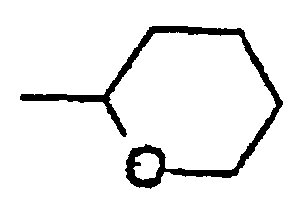 repräsentieren; Y eine alicyclische Gruppe repräsentiert; R1 CH3 oder H repräsentiert; und R4 eine Alkyl-Gruppe repräsentiert); und
 eine Substanz, die durch das Aufbringen von Strahlung eine Säure generiert.
 - Strahlungsempfindliches Material, welches umfasst:wobei das Copolymer eine alicyclische Gruppe einschließt.ein Copolymer, das einschließt:eine Struktureinheit, die durch die allgemeine Formelausgedrückt wird (worin zumindest eines von X und Y eine Nitril-Gruppe ist); und
 eine Struktureinheit, die eine Alkali-lösliche Gruppe in Anwesenheit einer Säure generiert; undeine Substanz, die durch das Aufbringen von Strahlung eine Säure generiert,
 - Strahlungsempfindliches Material nach Anspruch 9, bei welchem das Copolymer tert.Butyl-Gruppen einschließt.
- Strahlungsempfindliches Material nach Anspruch 9 oder 10, bei welchem die Struktureinheit(worin zumindest eines von X und Y eine Nitril-Gruppe ist) eine Acrylnitril- oder Methacrylnitril-Gruppe ist.
- Strahlungsempfindliches Material nach Anspruch 11, bei welchem das Copolymer die Acrylnitril- oder Methacrylnitril-Gruppe zu 10 bis 70 Mol-% einschließt.
- Verfahren zur Bildung eines Musters, welches die Schritte umfasst:Herstellen eines Resists aus einem strahlungsempfindlichen Material nach einem der vorhergehenden Ansprüche;Aufbringen des Resists auf einem zu verarbeitenden Substrat;Vorbacken des Substrats und dann selektives Belichten des Resists auf dem Substrat mit Strahlung, um die genannte Säure zu generieren; undNachbacken des Substrats, und dann Entwickeln des Resists auf dem Substrat, um das Muster zu bilden.
- Verfahren zur Bildung eines Musters nach Anspruch 13, bei welchem das Entwickeln des Resists auf dem Substrat mit einem Entwickler bewirkt wird, der eine gemischte Flüssigkeit aus einer organischen alkalischen wässerigen Lösung und Isopropylalkohol ist.
- Verfahren zur Bildung eines Musters nach Anspruch 14, bei welchem der Entwickler den Isopropylalkohol zu 5 bis 95 Vol.-% enthält.
Priority Applications (1)
| Application Number | Priority Date | Filing Date | Title |
|---|---|---|---|
| EP02008746A EP1248150A3 (de) | 1993-12-28 | 1994-12-28 | Strahlungsempfindliches Material und Verfahren zur Herstellung eines Musters |
Applications Claiming Priority (3)
| Application Number | Priority Date | Filing Date | Title |
|---|---|---|---|
| JP337434/93 | 1993-12-28 | ||
| JP33743493 | 1993-12-28 | ||
| JP33743493 | 1993-12-28 |
Related Child Applications (1)
| Application Number | Title | Priority Date | Filing Date |
|---|---|---|---|
| EP02008746A Division EP1248150A3 (de) | 1993-12-28 | 1994-12-28 | Strahlungsempfindliches Material und Verfahren zur Herstellung eines Musters |
Publications (3)
| Publication Number | Publication Date |
|---|---|
| EP0663616A2 EP0663616A2 (de) | 1995-07-19 |
| EP0663616A3 EP0663616A3 (de) | 1997-07-16 |
| EP0663616B1 true EP0663616B1 (de) | 2002-10-30 |
Family
ID=18308598
Family Applications (2)
| Application Number | Title | Priority Date | Filing Date |
|---|---|---|---|
| EP02008746A Withdrawn EP1248150A3 (de) | 1993-12-28 | 1994-12-28 | Strahlungsempfindliches Material und Verfahren zur Herstellung eines Musters |
| EP19940309847 Expired - Lifetime EP0663616B1 (de) | 1993-12-28 | 1994-12-28 | Strahlungsempfindliches Material und Verfahren zur Herstellung eines Musters |
Family Applications Before (1)
| Application Number | Title | Priority Date | Filing Date |
|---|---|---|---|
| EP02008746A Withdrawn EP1248150A3 (de) | 1993-12-28 | 1994-12-28 | Strahlungsempfindliches Material und Verfahren zur Herstellung eines Musters |
Country Status (3)
| Country | Link |
|---|---|
| EP (2) | EP1248150A3 (de) |
| KR (1) | KR0153807B1 (de) |
| DE (1) | DE69431618T2 (de) |
Cited By (1)
| Publication number | Priority date | Publication date | Assignee | Title |
|---|---|---|---|---|
| US7592123B2 (en) | 2003-06-05 | 2009-09-22 | Tokyo Ohka Kogyo Co., Ltd. | Resin for photoresist composition, photoresist composition and method for forming resist pattern |
Families Citing this family (30)
| Publication number | Priority date | Publication date | Assignee | Title |
|---|---|---|---|---|
| US6200725B1 (en) | 1995-06-28 | 2001-03-13 | Fujitsu Limited | Chemically amplified resist compositions and process for the formation of resist patterns |
| KR100206664B1 (ko) * | 1995-06-28 | 1999-07-01 | 세키사와 다다시 | 화학증폭형 레지스트 조성물 및 레지스트 패턴의 형성방법 |
| US6090526A (en) * | 1996-09-13 | 2000-07-18 | Shipley Company, L.L.C. | Polymers and photoresist compositions |
| EP0877293B1 (de) | 1997-05-09 | 2004-01-14 | Fuji Photo Film Co., Ltd. | Positiv arbeitende lichtempfindliche Zusammensetzung |
| DE69803117T2 (de) | 1997-05-12 | 2002-10-02 | Fuji Photo Film Co., Ltd. | Positiv arbeitende Resistzusammensetzung |
| US6077643A (en) * | 1997-08-28 | 2000-06-20 | Shipley Company, L.L.C. | Polymers and photoresist compositions |
| US6057083A (en) * | 1997-11-04 | 2000-05-02 | Shipley Company, L.L.C. | Polymers and photoresist compositions |
| US6165674A (en) * | 1998-01-15 | 2000-12-26 | Shipley Company, L.L.C. | Polymers and photoresist compositions for short wavelength imaging |
| JPH11231541A (ja) * | 1998-02-17 | 1999-08-27 | Daicel Chem Ind Ltd | 放射線感光材料及びそれを使用したパターン形成方法 |
| KR100547078B1 (ko) | 1998-05-25 | 2006-01-31 | 다이셀 가가꾸 고교 가부시끼가이샤 | 포토레지스트용 화합물 및 포토레지스트용 수지 조성물 |
| CN1190706C (zh) * | 1998-08-26 | 2005-02-23 | 住友化学工业株式会社 | 一种化学增强型正光刻胶组合物 |
| US6136501A (en) * | 1998-08-28 | 2000-10-24 | Shipley Company, L.L.C. | Polymers and photoresist compositions comprising same |
| KR100613308B1 (ko) * | 1998-09-10 | 2006-08-17 | 도레이 가부시끼가이샤 | 포지형 감방사선성 조성물 |
| US6312867B1 (en) * | 1998-11-02 | 2001-11-06 | Shin-Etsu Chemical Co., Ltd. | Ester compounds, polymers, resist compositions and patterning process |
| KR20000047909A (ko) * | 1998-12-10 | 2000-07-25 | 마티네즈 길러모 | 이타콘산 무수물 중합체 및 이를 함유하는 포토레지스트조성물 |
| US6770413B1 (en) | 1999-01-12 | 2004-08-03 | Shipley Company, L.L.C. | Hydroxyphenyl copolymers and photoresists comprising same |
| US6692888B1 (en) | 1999-10-07 | 2004-02-17 | Shipley Company, L.L.C. | Copolymers having nitrile and alicyclic leaving groups and photoresist compositions comprising same |
| US6492086B1 (en) * | 1999-10-08 | 2002-12-10 | Shipley Company, L.L.C. | Phenolic/alicyclic copolymers and photoresists |
| EP1117003B1 (de) | 2000-01-17 | 2012-06-20 | Shin-Etsu Chemical Co., Ltd. | Verfahren zur Herstellung von chemisch verstärkter Resistzusammensetzung |
| US6379861B1 (en) * | 2000-02-22 | 2002-04-30 | Shipley Company, L.L.C. | Polymers and photoresist compositions comprising same |
| JP3502327B2 (ja) * | 2000-04-19 | 2004-03-02 | 松下電器産業株式会社 | パターン形成材料及びパターン形成方法 |
| US6306554B1 (en) | 2000-05-09 | 2001-10-23 | Shipley Company, L.L.C. | Polymers containing oxygen and sulfur alicyclic units and photoresist compositions comprising same |
| US6946233B2 (en) * | 2001-07-24 | 2005-09-20 | Shin-Etsu Chemical Co., Ltd. | Polymer, resist material and patterning method |
| US7326509B2 (en) * | 2001-08-20 | 2008-02-05 | Nissan Chemical Industries, Ltd. | Composition for forming anti-reflective coating for use in lithography |
| JP4188265B2 (ja) | 2003-10-23 | 2008-11-26 | 東京応化工業株式会社 | レジスト組成物およびレジストパターン形成方法 |
| CN100468194C (zh) * | 2005-05-25 | 2009-03-11 | 苏州瑞红电子化学品有限公司 | 193nm远紫外光刻胶及其制备方法 |
| TWI477909B (zh) | 2006-01-24 | 2015-03-21 | Fujifilm Corp | 正型感光性組成物及使用它之圖案形成方法 |
| JP2007225647A (ja) | 2006-02-21 | 2007-09-06 | Tokyo Ohka Kogyo Co Ltd | 超臨界現像プロセス用レジスト組成物 |
| TWI475323B (zh) * | 2006-03-14 | 2015-03-01 | Fujifilm Corp | 正型光阻組成物及使用它之圖案形成方法 |
| CN103885300B (zh) * | 2014-03-19 | 2016-01-27 | 南京晶奥微光电技术有限公司 | 一种疏水表面光刻工艺 |
Family Cites Families (5)
| Publication number | Priority date | Publication date | Assignee | Title |
|---|---|---|---|---|
| EP0476865A1 (de) * | 1990-08-31 | 1992-03-25 | Wako Pure Chemical Industries Ltd | Resistmaterial und Verfahren zur Herstellung eines Bildes unter Verwendung desselben |
| JPH04184345A (ja) * | 1990-11-19 | 1992-07-01 | Fujitsu Ltd | レジストパターンの形成方法 |
| US5102771A (en) * | 1990-11-26 | 1992-04-07 | Minnesota Mining And Manufacturing Company | Photosensitive materials |
| JPH04350657A (ja) * | 1991-05-28 | 1992-12-04 | Shin Etsu Chem Co Ltd | レジスト材 |
| US5318850A (en) * | 1991-11-27 | 1994-06-07 | General Electric Company | UV curable abrasion-resistant coatings with improved weatherability |
-
1994
- 1994-12-28 KR KR1019940038354A patent/KR0153807B1/ko not_active Expired - Lifetime
- 1994-12-28 EP EP02008746A patent/EP1248150A3/de not_active Withdrawn
- 1994-12-28 DE DE1994631618 patent/DE69431618T2/de not_active Expired - Lifetime
- 1994-12-28 EP EP19940309847 patent/EP0663616B1/de not_active Expired - Lifetime
Cited By (2)
| Publication number | Priority date | Publication date | Assignee | Title |
|---|---|---|---|---|
| US7592123B2 (en) | 2003-06-05 | 2009-09-22 | Tokyo Ohka Kogyo Co., Ltd. | Resin for photoresist composition, photoresist composition and method for forming resist pattern |
| US7829259B2 (en) | 2003-06-05 | 2010-11-09 | Tokyo Ohka Kogyo Co., Ltd. | Resin for photoresist composition, photoresist composition and method for forming resist pattern |
Also Published As
| Publication number | Publication date |
|---|---|
| EP0663616A3 (de) | 1997-07-16 |
| EP1248150A3 (de) | 2003-11-05 |
| KR0153807B1 (ko) | 1998-11-16 |
| DE69431618D1 (de) | 2002-12-05 |
| DE69431618T2 (de) | 2003-04-03 |
| EP0663616A2 (de) | 1995-07-19 |
| EP1248150A2 (de) | 2002-10-09 |
Similar Documents
| Publication | Publication Date | Title |
|---|---|---|
| EP0663616B1 (de) | Strahlungsempfindliches Material und Verfahren zur Herstellung eines Musters | |
| US6790589B2 (en) | Radiation sensitive material and method for forming pattern | |
| JP3751065B2 (ja) | レジスト材料及びレジストパターンの形成方法 | |
| JP3380128B2 (ja) | レジスト材料及びレジストパターンの形成方法 | |
| JP3568599B2 (ja) | 放射線感光材料及びパターン形成方法 | |
| KR100257456B1 (ko) | 레지스트패턴 형성방법 | |
| US7361447B2 (en) | Photoresist polymer and photoresist composition containing the same | |
| JP3948795B2 (ja) | 放射線感光材料及びそれを用いたパターン形成方法 | |
| TW200301847A (en) | Positive-working photoimageable bottom antireflective coating | |
| JPH11119434A (ja) | レジスト材料及びレジストパターンの形成方法 | |
| US6235448B1 (en) | Photoresist monomers, polymers thereof, and photoresist compositions containing the same | |
| JP3979726B2 (ja) | レジスト材料及びレジストパターンの形成方法 | |
| JP3444326B2 (ja) | 遠紫外線用ポジ型レジスト組成物 | |
| JP3803313B2 (ja) | レジスト材料及びレジストパターンの形成方法 | |
| KR100254482B1 (ko) | 방사선감광재료및패턴형성방법 | |
| JP4437991B2 (ja) | 半導体集積回路用遠紫外線感光材料用樹脂の製造方法、及び半導体パターンの形成方法 | |
| JP3919806B2 (ja) | レジスト材料及びレジストパターンの形成方法 | |
| KR100557610B1 (ko) | 신규한 포토레지스트 단량체, 그의 중합체 및 이를 함유하는 포토레지스트 조성물 | |
| JPH10301285A (ja) | レジスト材料及びレジストパターンの形成方法 | |
| JP4111844B2 (ja) | 放射線感光材料用樹脂、放射線感光材料、及び半導体回路 | |
| JP2002194029A (ja) | 放射線感光材料用樹脂、その製造方法、及び放射線感光材料を用いた半導体用パターン | |
| JP2006091898A (ja) | レジスト材料及びレジストパターンの形成方法 | |
| KR100240907B1 (ko) | 방사선 감광재료 및 패턴형성방법 | |
| KR20000065815A (ko) | 화학증폭형 레지스트 조성물 |
Legal Events
| Date | Code | Title | Description |
|---|---|---|---|
| PUAI | Public reference made under article 153(3) epc to a published international application that has entered the european phase |
Free format text: ORIGINAL CODE: 0009012 |
|
| AK | Designated contracting states |
Kind code of ref document: A2 Designated state(s): DE FR GB |
|
| PUAL | Search report despatched |
Free format text: ORIGINAL CODE: 0009013 |
|
| AK | Designated contracting states |
Kind code of ref document: A3 Designated state(s): DE FR GB |
|
| 17P | Request for examination filed |
Effective date: 19970923 |
|
| 17Q | First examination report despatched |
Effective date: 19980714 |
|
| GRAG | Despatch of communication of intention to grant |
Free format text: ORIGINAL CODE: EPIDOS AGRA |
|
| GRAG | Despatch of communication of intention to grant |
Free format text: ORIGINAL CODE: EPIDOS AGRA |
|
| GRAG | Despatch of communication of intention to grant |
Free format text: ORIGINAL CODE: EPIDOS AGRA |
|
| GRAH | Despatch of communication of intention to grant a patent |
Free format text: ORIGINAL CODE: EPIDOS IGRA |
|
| GRAH | Despatch of communication of intention to grant a patent |
Free format text: ORIGINAL CODE: EPIDOS IGRA |
|
| GRAA | (expected) grant |
Free format text: ORIGINAL CODE: 0009210 |
|
| AK | Designated contracting states |
Kind code of ref document: B1 Designated state(s): DE FR GB |
|
| REG | Reference to a national code |
Ref country code: GB Ref legal event code: FG4D |
|
| REF | Corresponds to: |
Ref document number: 69431618 Country of ref document: DE Date of ref document: 20021205 |
|
| ET | Fr: translation filed | ||
| PLBE | No opposition filed within time limit |
Free format text: ORIGINAL CODE: 0009261 |
|
| STAA | Information on the status of an ep patent application or granted ep patent |
Free format text: STATUS: NO OPPOSITION FILED WITHIN TIME LIMIT |
|
| 26N | No opposition filed |
Effective date: 20030731 |
|
| REG | Reference to a national code |
Ref country code: GB Ref legal event code: 732E |
|
| REG | Reference to a national code |
Ref country code: FR Ref legal event code: TP |
|
| REG | Reference to a national code |
Ref country code: FR Ref legal event code: CD Ref country code: FR Ref legal event code: CA |
|
| PGFP | Annual fee paid to national office [announced via postgrant information from national office to epo] |
Ref country code: DE Payment date: 20131224 Year of fee payment: 20 Ref country code: GB Payment date: 20131227 Year of fee payment: 20 |
|
| PGFP | Annual fee paid to national office [announced via postgrant information from national office to epo] |
Ref country code: FR Payment date: 20131209 Year of fee payment: 20 |
|
| REG | Reference to a national code |
Ref country code: DE Ref legal event code: R071 Ref document number: 69431618 Country of ref document: DE |
|
| REG | Reference to a national code |
Ref country code: DE Ref legal event code: R071 Ref document number: 69431618 Country of ref document: DE |
|
| REG | Reference to a national code |
Ref country code: GB Ref legal event code: PE20 Expiry date: 20141227 |
|
| PG25 | Lapsed in a contracting state [announced via postgrant information from national office to epo] |
Ref country code: GB Free format text: LAPSE BECAUSE OF EXPIRATION OF PROTECTION Effective date: 20141227 |