EP0663741A2 - Adaptive Kodierungsvorrichtung für digitale Tonsignale - Google Patents
Adaptive Kodierungsvorrichtung für digitale Tonsignale Download PDFInfo
- Publication number
- EP0663741A2 EP0663741A2 EP94120952A EP94120952A EP0663741A2 EP 0663741 A2 EP0663741 A2 EP 0663741A2 EP 94120952 A EP94120952 A EP 94120952A EP 94120952 A EP94120952 A EP 94120952A EP 0663741 A2 EP0663741 A2 EP 0663741A2
- Authority
- EP
- European Patent Office
- Prior art keywords
- digital audio
- audio signal
- power density
- spectrum
- input digital
- Prior art date
- Legal status (The legal status is an assumption and is not a legal conclusion. Google has not performed a legal analysis and makes no representation as to the accuracy of the status listed.)
- Ceased
Links
- 230000003044 adaptive effect Effects 0.000 title 1
- 230000005236 sound signal Effects 0.000 claims abstract description 66
- 238000001228 spectrum Methods 0.000 claims abstract description 58
- 230000000873 masking effect Effects 0.000 claims abstract description 21
- 238000000034 method Methods 0.000 description 7
- 230000008447 perception Effects 0.000 description 5
- 101001080825 Homo sapiens PH and SEC7 domain-containing protein 1 Proteins 0.000 description 3
- 101001080808 Homo sapiens PH and SEC7 domain-containing protein 2 Proteins 0.000 description 3
- 102100027472 PH and SEC7 domain-containing protein 1 Human genes 0.000 description 3
- 102100027455 PH and SEC7 domain-containing protein 2 Human genes 0.000 description 3
- 230000005540 biological transmission Effects 0.000 description 3
- 230000006835 compression Effects 0.000 description 3
- 238000007906 compression Methods 0.000 description 3
- 238000010586 diagram Methods 0.000 description 3
- 238000006243 chemical reaction Methods 0.000 description 1
- 238000005259 measurement Methods 0.000 description 1
- 238000012986 modification Methods 0.000 description 1
- 230000004048 modification Effects 0.000 description 1
- 238000005070 sampling Methods 0.000 description 1
Images

Classifications
-
- G—PHYSICS
- G10—MUSICAL INSTRUMENTS; ACOUSTICS
- G10L—SPEECH ANALYSIS TECHNIQUES OR SPEECH SYNTHESIS; SPEECH RECOGNITION; SPEECH OR VOICE PROCESSING TECHNIQUES; SPEECH OR AUDIO CODING OR DECODING
- G10L19/00—Speech or audio signals analysis-synthesis techniques for redundancy reduction, e.g. in vocoders; Coding or decoding of speech or audio signals, using source filter models or psychoacoustic analysis
- G10L19/002—Dynamic bit allocation
-
- H—ELECTRICITY
- H04—ELECTRIC COMMUNICATION TECHNIQUE
- H04B—TRANSMISSION
- H04B1/00—Details of transmission systems, not covered by a single one of groups H04B3/00 - H04B13/00; Details of transmission systems not characterised by the medium used for transmission
- H04B1/66—Details of transmission systems, not covered by a single one of groups H04B3/00 - H04B13/00; Details of transmission systems not characterised by the medium used for transmission for reducing bandwidth of signals; for improving efficiency of transmission
- H04B1/665—Details of transmission systems, not covered by a single one of groups H04B3/00 - H04B13/00; Details of transmission systems not characterised by the medium used for transmission for reducing bandwidth of signals; for improving efficiency of transmission using psychoacoustic properties of the ear, e.g. masking effect
-
- G—PHYSICS
- G10—MUSICAL INSTRUMENTS; ACOUSTICS
- G10L—SPEECH ANALYSIS TECHNIQUES OR SPEECH SYNTHESIS; SPEECH RECOGNITION; SPEECH OR VOICE PROCESSING TECHNIQUES; SPEECH OR AUDIO CODING OR DECODING
- G10L19/00—Speech or audio signals analysis-synthesis techniques for redundancy reduction, e.g. in vocoders; Coding or decoding of speech or audio signals, using source filter models or psychoacoustic analysis
- G10L19/04—Speech or audio signals analysis-synthesis techniques for redundancy reduction, e.g. in vocoders; Coding or decoding of speech or audio signals, using source filter models or psychoacoustic analysis using predictive techniques
- G10L19/16—Vocoder architecture
- G10L19/18—Vocoders using multiple modes
- G10L19/22—Mode decision, i.e. based on audio signal content versus external parameters
Definitions
- the present invention relates to a digital audio encoding system; and, more particularly, to an improved digital audio encoding system capable of providing an encoded audio signal with a minimum distortion measured in accordance with the human auditory perception.
- the quality of the decoded audio signal is largely dictated by the compression technique employed for the encoding thereof.
- the digital audio encoding system is provided with a plurality of encoders employing different compression techniques, a corresponding number of decoders and an audio distortion measuring device.
- the encoders are arranged in a parallel fashion in order to carry out the encoding of the input digital audio signal simultaneously; and each of the decoders is coupled to its corresponding encoder for the decoding of the encoded digital audio signal therefrom.
- the digital audio encoding system selectively generates one of the encoded digital audio signals which causes a least audio distortion.
- Audio distortions are usually measured in terms of “Total Harmonic Distortion(THD)” and “Signal to Noise Ratios(SNR)", wherein said THD is a RMS(root-mean-square) sum of all the individual harmonic-distortion components and/or IMD's(Intermodulation Distortions) which consist of sum and difference products generated when two or more signals pass through an encoder; and said SNR represents the ratio between the amplitude of an input digital signal and the amplitude of an error signal.
- THD Total Harmonic Distortion
- SNR Signal to Noise Ratios
- THD or SNR measurement is a physical value which has no direct bearing on the human auditory faculty or perception; and, accordingly, the conventional digital audio encoding system having such audio distortion measuring device has a limited ability to provide an encoded digital audio signal which best reflects the human auditory perception.
- a novel system for encoding an input digital audio signal having a plurality of frames which comprises: M number of encoding means arranged in parallel for encoding the input digital audio signal in a current frame, respectively; M number of decoding means arranged in parallel for decoding each of the encoded digital audio signals, respectively; first estimation means for estimating a power density spectrum of a difference signal between the input digital audio signal and each of the decoded digital audio signals; second estimation means for estimating a power density spectrum of the input digital audio signal in the current frame and for determining a masking threshold thereof based on the power density spectrum of the input digital audio signal; third estimation means for estimating a set of perceptual spectrum distances based on the power density spectrum for each of the difference signals and the frequency masking threshold; and means for selecting an encoded digital audio signal having a smallest perceptual spectrum distance.
- FIG. 1 there is shown a block diagram illustrating a digital audio encoding system 100 in accordance with the present invention.
- the encoding system 100 comprises an encoding device 10, a decoding device 20, a first and a second power density spectrum estimation units 30 and 34, a masking threshold estimation unit 40, a perceptual spectrum distance estimator 50, a comparator 60, a selector 70 and a formatting circuit 80.
- An input digital audio signal x(n,i) of an ith frame, or a current frame, which includes N samples, i.e., n 0, 1, 2,..,N-1, is applied to the encoding device 10 which is adapted to perform an encoding operation of the input digital audio signal at a predetermined bit rate, wherein N is a positive integer and one frame includes L, e.g.,32, subbands.
- a "frame” used herein denotes a part of the digital audio signal which corresponds to a fixed number of audio samples and is a processing unit for the encoding and decoding of the digital audio signal.
- the encoding device 10 includes a plurality of encoders, e.g., two encoders 10A and 10B, which are coupled in a parallel manner in order to simultaneously receive the input digital audio signal of the current frame and encode the input digital audio signal by using various compression techniques.
- a plurality of encoders e.g., two encoders 10A and 10B, which are coupled in a parallel manner in order to simultaneously receive the input digital audio signal of the current frame and encode the input digital audio signal by using various compression techniques.
- the encoder 10A may carry out an encoding operation of the input digital audio signal of the ith frame by employing an intra-frame bit allocation technique which adaptively assigns bits to each subband included within one frame based on a perceptual entropy for each of the subbands therein, and the encoder 10B may perform an encoding operation of the input digital audio signal by using an inter-frame bit allocation technique which adaptively assigns bits to each frame included within a predetermined group of frames based on a perceptual entropy for each frame; and, alternatively, the encoders 10A and 10B may include non-uniform and uniform quantizers, respectively.
- FFT Fast Fourier Transform
- the encoded digital audio signal from each of the encoders is applied to the selector 70 and the decoding device 20 which includes a plurality of decoders, e.g., 20A and 20B.
- Each of the decoders is adapted to decode a corresponding encoded digital audio signal from the encoders.
- the decoded digital audio signals y1(n,i) and y2(n,i) from the decoders 20A and 20B are applied to the first and second power density spectrum estimation units 30 and 34, respectively, wherein each of said power density spectrum estimation units includes a subtractor 31(35) and a power density spectrum estimator 32(36), respectively.
- PCM pulse code modulation
- the difference signal is provided to the power density spectrum estimator 32 which serves to carry out the Fast Fourier Transform conversion thereof from the time domain to the frequency domain.
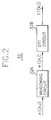
- the power density spectrum estimator 32 includes a windowing circuit 32A and a Fast Fourior Transform(FFT) circuit 32B.
- the windowing circuit 32A receives the difference signal e1(n,i) from the subtracter 31; and performs the windowing process by multiplying the difference signal e1(n,i) with a predetermined hanning window.
- the second power density spectrum unit 34 is substantially identical to the first power density spectrum unit 30 excepting that the power density spectrum E2(k,i) for a difference signal e2(n,i) representative of the difference between the input digital audio signal x(n,i) and the decoded digital audio signal y2(n,i) from the decoder 20B is calculated therein.
- the power density spectrum E2(k,i) for the difference signal e2(n,i) can be obtained by windowing the difference signal e2(n,i) with the hanning window h(n) as is done for the difference signal e1(n,i) in Eq.(4).
- the masking threshold estimation unit 40 is adapted to receive the input digital audio signal x(n,i) of the ith frame and to estimate the masking threshold thereof.
- the masking threshold estimation unit 40 includes a power density spectrum estimator 41 and a masking threshold estimator 42.
- the power density spectrum estimator 41 is substantially identical to the power density spectrum estimator included in the first or second power density spectrum estimation unit excepting that the power density spectrum X(k,i) of the input digital audio signal x(n,i) for the ith frame is calculated therein.
- the power density spectrum of the input digital audio signal, X(k,i), estimated at the power density spectrum estimator 41 is then provided to the masking threshold estimator 42 which serves to estimate a masking threshold depending on the power density spectrum of the input digital audio signal.
- the masking threshold represents an audible limit closely reflecting the human auditory perception, which is a sum of the intrinsic audible limit or threshold of a sound and an increment caused by the presence of another(masking) contemporary sound in the frequency domain, as described in an article, which is incorporated herein by reference, entitled “Coding of Moving Pictures and Associated Audio", ISO/IEC/JTC1/SC29/WG11 NO501 MPEG 93 (July, 1993), wherein the so-called Psychoacoustic Models I and II are discussed for the calculation of the masking threshold.
- Psychoacoustic Model I is advantageously employed in the masking threshold estimator 42.
- the power density spectrums E1(k,i) and E2(k,i) and the masking threshold M(k,i) are simultaneously provided to the perceptual spectrum distance estimator 50 which is adapted to derive first and second perceptual spectrum distances PSD1(i) and PSD2(i) representative of the audio distortions for the power density spectrums E1(k,i) and E2(k,i) as perceived by the human auditory faculty with the masking effect taken into consideration.
- the first perceptual spectrum distance PSD1(i) for the power density spectrum E1(k,i) from the power density spectrum estimator 32 may be represented as: wherein k and i are the same as previously defined.
- the second perceptual spectrum distance PSD2(i) for the power density spectrum E2(k,i) from the power density spectrum estimator 36 may be defined as: wherein k and i are the same as previously defined.
- the perceptual spectrum distance for the ith frame is estimated by the power density spectrum of the difference signal which exceeds the masking threshold.
- the first and second perceptual spectrum distances PSD1(i) and PSD2(i) are applied to the comparator 60 which serves to generate a selection signal identifying a least distorted digital audio signal among the two encoded digital audio signals from the encoders, e.g., 10A and 10B, by comparing their perceptual spectrum distances.
- the selection signal from the comparator 60 is then provided to the selector 70 and the formatting circuit 80.
- the selector 70 selects the least distorted digital audio signal among the encoded digital audio signals from the encoders to thereby provide the selected audio signal to the formatting circuit 80.
- the selection signal from the comparator 60 and the selected audio signal from the selector 70 formatted and transmitted to a transmitter(not shown) for the transmission thereof.
Landscapes
- Engineering & Computer Science (AREA)
- Signal Processing (AREA)
- Computer Networks & Wireless Communication (AREA)
- Computational Linguistics (AREA)
- Health & Medical Sciences (AREA)
- Audiology, Speech & Language Pathology (AREA)
- Human Computer Interaction (AREA)
- Physics & Mathematics (AREA)
- Acoustics & Sound (AREA)
- Multimedia (AREA)
- Compression, Expansion, Code Conversion, And Decoders (AREA)
- Signal Processing For Digital Recording And Reproducing (AREA)
Applications Claiming Priority (2)
| Application Number | Priority Date | Filing Date | Title |
|---|---|---|---|
| KR9400758 | 1994-01-18 | ||
| KR1019940000758A KR970005131B1 (ko) | 1994-01-18 | 1994-01-18 | 인간의 청각특성에 적응적인 디지탈 오디오 부호화장치 |
Publications (2)
| Publication Number | Publication Date |
|---|---|
| EP0663741A2 true EP0663741A2 (de) | 1995-07-19 |
| EP0663741A3 EP0663741A3 (de) | 1998-08-19 |
Family
ID=19375774
Family Applications (1)
| Application Number | Title | Priority Date | Filing Date |
|---|---|---|---|
| EP94120952A Ceased EP0663741A3 (de) | 1994-01-18 | 1994-12-30 | Adaptive Kodierungsvorrichtung für digitale Tonsignale |
Country Status (5)
| Country | Link |
|---|---|
| US (1) | US5649052A (de) |
| EP (1) | EP0663741A3 (de) |
| JP (1) | JPH0856163A (de) |
| KR (1) | KR970005131B1 (de) |
| CN (1) | CN1116348A (de) |
Cited By (2)
| Publication number | Priority date | Publication date | Assignee | Title |
|---|---|---|---|---|
| EP1175030A3 (de) * | 2000-07-07 | 2002-10-23 | Nokia Corporation | Verfahren und Vorrichtung für die perzeptuelle Tonkodierung von einem mehrkanal Tonsignal mit Verwendung der kaskadierten diskreten Cosinustransformation oder der modifizierten diskreten Cosinustransformation |
| EP1393303A4 (de) * | 2001-05-11 | 2009-08-05 | Nokia Corp | Zwischenkanal-signalredundanzentfernung bei der wahrnehmungsbezogenen audiocodierung |
Families Citing this family (24)
| Publication number | Priority date | Publication date | Assignee | Title |
|---|---|---|---|---|
| JP3082625B2 (ja) * | 1995-07-15 | 2000-08-28 | 日本電気株式会社 | 音声信号処理回路 |
| US5794199A (en) * | 1996-01-29 | 1998-08-11 | Texas Instruments Incorporated | Method and system for improved discontinuous speech transmission |
| KR100251453B1 (ko) * | 1997-08-26 | 2000-04-15 | 윤종용 | 고음질 오디오 부호화/복호화장치들 및 디지털다기능디스크 |
| US6161088A (en) * | 1998-06-26 | 2000-12-12 | Texas Instruments Incorporated | Method and system for encoding a digital audio signal |
| US6499010B1 (en) * | 2000-01-04 | 2002-12-24 | Agere Systems Inc. | Perceptual audio coder bit allocation scheme providing improved perceptual quality consistency |
| IT1314626B1 (it) * | 2000-04-21 | 2002-12-20 | Ik Multimedia Production Srl | Procedimento per la codifica e la decodifica di flussi di dati,rappresentanti suoni in forma digitale, all'interno di un |
| AU2001273326A1 (en) * | 2000-07-11 | 2002-01-21 | Mediaflow, Llc | System and method for calculating an optimum display size for a visual object |
| DE10150519B4 (de) * | 2001-10-12 | 2014-01-09 | Hewlett-Packard Development Co., L.P. | Verfahren und Anordnung zur Sprachverarbeitung |
| US7333930B2 (en) * | 2003-03-14 | 2008-02-19 | Agere Systems Inc. | Tonal analysis for perceptual audio coding using a compressed spectral representation |
| US8588291B2 (en) * | 2003-09-22 | 2013-11-19 | Broadcom Corporation | Multiple decode user interface |
| US7706777B2 (en) * | 2003-09-23 | 2010-04-27 | Broadcom Corporation | Secure user interface in a shared resource environment |
| KR20060131793A (ko) * | 2003-12-26 | 2006-12-20 | 마츠시타 덴끼 산교 가부시키가이샤 | 음성ㆍ악음 부호화 장치 및 음성ㆍ악음 부호화 방법 |
| DE102004007200B3 (de) * | 2004-02-13 | 2005-08-11 | Fraunhofer-Gesellschaft zur Förderung der angewandten Forschung e.V. | Audiocodierung |
| WO2006030340A2 (en) * | 2004-09-17 | 2006-03-23 | Koninklijke Philips Electronics N.V. | Combined audio coding minimizing perceptual distortion |
| US7720013B1 (en) * | 2004-10-12 | 2010-05-18 | Lockheed Martin Corporation | Method and system for classifying digital traffic |
| CN1321400C (zh) * | 2005-01-18 | 2007-06-13 | 中国电子科技集团公司第三十研究所 | 客观音质评价中基于噪声掩蔽门限算法的巴克谱失真测度方法 |
| US7573912B2 (en) * | 2005-02-22 | 2009-08-11 | Fraunhofer-Gesellschaft Zur Foerderung Der Angewandten Forschunng E.V. | Near-transparent or transparent multi-channel encoder/decoder scheme |
| US7692686B1 (en) * | 2006-02-21 | 2010-04-06 | Xfrm Incorporated | Method and apparatus for coding format autodetection testing |
| US8711372B2 (en) * | 2006-08-31 | 2014-04-29 | Ricoh Co., Ltd. | Techniques for image segment accumulation in document rendering |
| GB0915766D0 (en) * | 2009-09-09 | 2009-10-07 | Apt Licensing Ltd | Apparatus and method for multidimensional adaptive audio coding |
| CN102393986B (zh) * | 2011-08-11 | 2013-05-08 | 重庆市科学技术研究院 | 基于音频判别的盗伐检测方法、装置及系统 |
| KR20130093783A (ko) * | 2011-12-30 | 2013-08-23 | 한국전자통신연구원 | 오디오 객체 전송 장치 및 방법 |
| US9774974B2 (en) * | 2014-09-24 | 2017-09-26 | Electronics And Telecommunications Research Institute | Audio metadata providing apparatus and method, and multichannel audio data playback apparatus and method to support dynamic format conversion |
| US10923135B2 (en) * | 2018-10-14 | 2021-02-16 | Tyson York Winarski | Matched filter to selectively choose the optimal audio compression for a metadata file |
Family Cites Families (4)
| Publication number | Priority date | Publication date | Assignee | Title |
|---|---|---|---|---|
| GB2165654B (en) * | 1984-10-12 | 1988-05-25 | Yue Lin Thomas Hong | Method and apparatus for evaluating auditory distortions of an audio system |
| US5115469A (en) * | 1988-06-08 | 1992-05-19 | Fujitsu Limited | Speech encoding/decoding apparatus having selected encoders |
| US5230003A (en) * | 1991-02-08 | 1993-07-20 | Ericsson-Ge Mobile Communications Holding, Inc. | Decoding system for distinguishing different types of convolutionally-encoded signals |
| KR960009936B1 (ko) * | 1992-10-07 | 1996-07-25 | 대우전자 주식회사 | 오디오 신호의 왜곡 측정장치 및 방법 |
-
1994
- 1994-01-18 KR KR1019940000758A patent/KR970005131B1/ko not_active Expired - Fee Related
- 1994-12-28 JP JP6338815A patent/JPH0856163A/ja active Pending
- 1994-12-29 US US08/366,144 patent/US5649052A/en not_active Expired - Fee Related
- 1994-12-30 EP EP94120952A patent/EP0663741A3/de not_active Ceased
-
1995
- 1995-01-18 CN CN95101253A patent/CN1116348A/zh active Pending
Cited By (2)
| Publication number | Priority date | Publication date | Assignee | Title |
|---|---|---|---|---|
| EP1175030A3 (de) * | 2000-07-07 | 2002-10-23 | Nokia Corporation | Verfahren und Vorrichtung für die perzeptuelle Tonkodierung von einem mehrkanal Tonsignal mit Verwendung der kaskadierten diskreten Cosinustransformation oder der modifizierten diskreten Cosinustransformation |
| EP1393303A4 (de) * | 2001-05-11 | 2009-08-05 | Nokia Corp | Zwischenkanal-signalredundanzentfernung bei der wahrnehmungsbezogenen audiocodierung |
Also Published As
| Publication number | Publication date |
|---|---|
| JPH0856163A (ja) | 1996-02-27 |
| EP0663741A3 (de) | 1998-08-19 |
| KR950024443A (ko) | 1995-08-21 |
| US5649052A (en) | 1997-07-15 |
| KR970005131B1 (ko) | 1997-04-12 |
| CN1116348A (zh) | 1996-02-07 |
Similar Documents
| Publication | Publication Date | Title |
|---|---|---|
| US5649052A (en) | Adaptive digital audio encoding system | |
| US5537510A (en) | Adaptive digital audio encoding apparatus and a bit allocation method thereof | |
| JP3926399B2 (ja) | オーディオ信号コーディング中にノイズ置換を信号で知らせる方法 | |
| EP0918407B1 (de) | Skalierbares stereo Tonkodierungs- und Tondekodierungsverfahren und Vorrichtung dafür | |
| US4815134A (en) | Very low rate speech encoder and decoder | |
| EP0663740A2 (de) | Vorrichtung zur adaptiven Kodierung von digitalen Tonsignalen aus mehreren Kanälen | |
| US5717764A (en) | Global masking thresholding for use in perceptual coding | |
| US6438525B1 (en) | Scalable audio coding/decoding method and apparatus | |
| US6349284B1 (en) | Scalable audio encoding/decoding method and apparatus | |
| JP2756515B2 (ja) | 可聴信号の知覚符号化方法および音声信号伝送方法 | |
| EP0721257B1 (de) | Bitverteilung für Mehrkanal-Audiokodierer auf Grund von wahrnehmungsgebundener Entropie | |
| US5982817A (en) | Transmission system utilizing different coding principles | |
| EP0720148A1 (de) | Verfahren zur gewichteten Geräuschfilterung | |
| US5737721A (en) | Predictive technique for signal to mask ratio calculations | |
| AU751077B2 (en) | Audio coder utilising repeated transmission of packet portion | |
| JP3827720B2 (ja) | 差分コーディング原理を用いる送信システム | |
| JP3297238B2 (ja) | 適応的符号化システム及びビット割当方法 | |
| KR970006827B1 (ko) | 오디오신호 부호화장치 | |
| KR960012477B1 (ko) | 인지 정보량을 이용한 적응적 스테레오 디지탈 오디오 부호화 및 복호화장치 | |
| KR0144297B1 (ko) | 적응적 디지탈 오디오 부호화 장치 | |
| KR960003454B1 (ko) | 적응적 스테레오 디지탈 오디오 부호화장치 | |
| KR0181054B1 (ko) | 다수개의 채널들로부터의 입력 디지탈 오디오 신호들을 적응적으로 부호화하는 장치 | |
| KR960012476B1 (ko) | 디지탈 오디오 부호화 장치의 프레임별 비트 할당장치 | |
| KR970006825B1 (ko) | 오디오신호 부호화장치 | |
| KR0181061B1 (ko) | 적응 디지탈 오디오 부호화 장치 및 그의 비트 할당방법 |
Legal Events
| Date | Code | Title | Description |
|---|---|---|---|
| PUAI | Public reference made under article 153(3) epc to a published international application that has entered the european phase |
Free format text: ORIGINAL CODE: 0009012 |
|
| AK | Designated contracting states |
Kind code of ref document: A2 Designated state(s): DE FR GB NL |
|
| PUAL | Search report despatched |
Free format text: ORIGINAL CODE: 0009013 |
|
| AK | Designated contracting states |
Kind code of ref document: A3 Designated state(s): DE FR GB NL |
|
| 17P | Request for examination filed |
Effective date: 19990202 |
|
| 17Q | First examination report despatched |
Effective date: 20000602 |
|
| GRAG | Despatch of communication of intention to grant |
Free format text: ORIGINAL CODE: EPIDOS AGRA |
|
| STAA | Information on the status of an ep patent application or granted ep patent |
Free format text: STATUS: THE APPLICATION HAS BEEN REFUSED |
|
| 18R | Application refused |
Effective date: 20021021 |