EP0664325A2 - Wärmehärtbares Beschichtungssystem - Google Patents
Wärmehärtbares Beschichtungssystem Download PDFInfo
- Publication number
- EP0664325A2 EP0664325A2 EP95100569A EP95100569A EP0664325A2 EP 0664325 A2 EP0664325 A2 EP 0664325A2 EP 95100569 A EP95100569 A EP 95100569A EP 95100569 A EP95100569 A EP 95100569A EP 0664325 A2 EP0664325 A2 EP 0664325A2
- Authority
- EP
- European Patent Office
- Prior art keywords
- acid
- coating system
- carbon atoms
- mol parts
- functional polyester
- Prior art date
- Legal status (The legal status is an assumption and is not a legal conclusion. Google has not performed a legal analysis and makes no representation as to the accuracy of the status listed.)
- Granted
Links
- 229920001187 thermosetting polymer Polymers 0.000 title claims abstract description 9
- 239000008199 coating composition Substances 0.000 title 1
- 238000000576 coating method Methods 0.000 claims abstract description 51
- 239000011248 coating agent Substances 0.000 claims abstract description 33
- QQVIHTHCMHWDBS-UHFFFAOYSA-N isophthalic acid Chemical compound OC(=O)C1=CC=CC(C(O)=O)=C1 QQVIHTHCMHWDBS-UHFFFAOYSA-N 0.000 claims abstract description 20
- 229920001225 polyester resin Polymers 0.000 claims abstract description 19
- 239000004645 polyester resin Substances 0.000 claims abstract description 19
- 125000004432 carbon atom Chemical group C* 0.000 claims abstract description 16
- 239000000654 additive Substances 0.000 claims abstract description 10
- -1 aromatic dicarboxylic acids Chemical class 0.000 claims abstract description 10
- 239000011230 binding agent Substances 0.000 claims abstract description 9
- 150000001875 compounds Chemical class 0.000 claims abstract description 9
- 239000004593 Epoxy Substances 0.000 claims abstract description 8
- OFOBLEOULBTSOW-UHFFFAOYSA-N Malonic acid Chemical compound OC(=O)CC(O)=O OFOBLEOULBTSOW-UHFFFAOYSA-N 0.000 claims abstract description 8
- 239000003431 cross linking reagent Substances 0.000 claims abstract description 8
- 238000000034 method Methods 0.000 claims abstract description 7
- 229920005989 resin Polymers 0.000 claims abstract description 7
- 239000011347 resin Substances 0.000 claims abstract description 7
- PUPZLCDOIYMWBV-UHFFFAOYSA-N (+/-)-1,3-Butanediol Chemical compound CC(O)CCO PUPZLCDOIYMWBV-UHFFFAOYSA-N 0.000 claims abstract description 6
- 230000001588 bifunctional effect Effects 0.000 claims abstract description 6
- 150000002009 diols Chemical class 0.000 claims abstract description 6
- 239000011241 protective layer Substances 0.000 claims abstract description 6
- 239000000178 monomer Substances 0.000 claims abstract description 5
- 150000001991 dicarboxylic acids Chemical class 0.000 claims abstract description 3
- 239000000155 melt Substances 0.000 claims abstract description 3
- KKEYFWRCBNTPAC-UHFFFAOYSA-N Terephthalic acid Chemical compound OC(=O)C1=CC=C(C(O)=O)C=C1 KKEYFWRCBNTPAC-UHFFFAOYSA-N 0.000 claims description 20
- 239000002253 acid Substances 0.000 claims description 19
- WNLRTRBMVRJNCN-UHFFFAOYSA-N adipic acid Chemical compound OC(=O)CCCCC(O)=O WNLRTRBMVRJNCN-UHFFFAOYSA-N 0.000 claims description 16
- 235000011037 adipic acid Nutrition 0.000 claims description 8
- 239000001361 adipic acid Substances 0.000 claims description 8
- ZFSLODLOARCGLH-UHFFFAOYSA-N isocyanuric acid Chemical compound OC1=NC(O)=NC(O)=N1 ZFSLODLOARCGLH-UHFFFAOYSA-N 0.000 claims description 7
- 238000004519 manufacturing process Methods 0.000 claims description 7
- 239000004971 Cross linker Substances 0.000 claims description 6
- SLCVBVWXLSEKPL-UHFFFAOYSA-N neopentyl glycol Chemical compound OCC(C)(C)CO SLCVBVWXLSEKPL-UHFFFAOYSA-N 0.000 claims description 6
- 125000001931 aliphatic group Chemical group 0.000 claims description 4
- 239000003795 chemical substances by application Substances 0.000 claims description 4
- QYQADNCHXSEGJT-UHFFFAOYSA-N cyclohexane-1,1-dicarboxylate;hydron Chemical compound OC(=O)C1(C(O)=O)CCCCC1 QYQADNCHXSEGJT-UHFFFAOYSA-N 0.000 claims description 4
- BDJRBEYXGGNYIS-UHFFFAOYSA-N nonanedioic acid Chemical compound OC(=O)CCCCCCCC(O)=O BDJRBEYXGGNYIS-UHFFFAOYSA-N 0.000 claims description 4
- CXMXRPHRNRROMY-UHFFFAOYSA-N sebacic acid Chemical compound OC(=O)CCCCCCCCC(O)=O CXMXRPHRNRROMY-UHFFFAOYSA-N 0.000 claims description 4
- ARCGXLSVLAOJQL-UHFFFAOYSA-N trimellitic acid Chemical compound OC(=O)C1=CC=C(C(O)=O)C(C(O)=O)=C1 ARCGXLSVLAOJQL-UHFFFAOYSA-N 0.000 claims description 4
- 239000000945 filler Substances 0.000 claims description 3
- 239000000049 pigment Substances 0.000 claims description 3
- WMRCTEPOPAZMMN-UHFFFAOYSA-N 2-undecylpropanedioic acid Chemical compound CCCCCCCCCCCC(C(O)=O)C(O)=O WMRCTEPOPAZMMN-UHFFFAOYSA-N 0.000 claims description 2
- 238000007872 degassing Methods 0.000 claims description 2
- GYZLOYUZLJXAJU-UHFFFAOYSA-N diglycidyl ether Chemical group C1OC1COCC1CO1 GYZLOYUZLJXAJU-UHFFFAOYSA-N 0.000 claims description 2
- 230000009477 glass transition Effects 0.000 claims description 2
- 239000003381 stabilizer Substances 0.000 claims description 2
- 238000009503 electrostatic coating Methods 0.000 claims 1
- 238000005245 sintering Methods 0.000 claims 1
- 238000002360 preparation method Methods 0.000 abstract description 2
- 230000032683 aging Effects 0.000 description 17
- 239000000843 powder Substances 0.000 description 17
- LYCAIKOWRPUZTN-UHFFFAOYSA-N Ethylene glycol Chemical compound OCCO LYCAIKOWRPUZTN-UHFFFAOYSA-N 0.000 description 15
- 230000032050 esterification Effects 0.000 description 12
- 238000005886 esterification reaction Methods 0.000 description 12
- 229920000728 polyester Polymers 0.000 description 9
- 238000006243 chemical reaction Methods 0.000 description 7
- 239000003054 catalyst Substances 0.000 description 6
- 230000000052 comparative effect Effects 0.000 description 5
- 239000000463 material Substances 0.000 description 5
- 239000000203 mixture Substances 0.000 description 5
- 238000003756 stirring Methods 0.000 description 5
- 238000009472 formulation Methods 0.000 description 4
- 239000003973 paint Substances 0.000 description 4
- 150000007513 acids Chemical class 0.000 description 3
- 229920000647 polyepoxide Polymers 0.000 description 3
- 229920000642 polymer Polymers 0.000 description 3
- 238000003860 storage Methods 0.000 description 3
- 150000001298 alcohols Chemical class 0.000 description 2
- 229920006125 amorphous polymer Polymers 0.000 description 2
- 125000003118 aryl group Chemical group 0.000 description 2
- ISAOCJYIOMOJEB-UHFFFAOYSA-N benzoin Chemical compound C=1C=CC=CC=1C(O)C(=O)C1=CC=CC=C1 ISAOCJYIOMOJEB-UHFFFAOYSA-N 0.000 description 2
- 238000004132 cross linking Methods 0.000 description 2
- 238000006731 degradation reaction Methods 0.000 description 2
- 238000004821 distillation Methods 0.000 description 2
- 230000000694 effects Effects 0.000 description 2
- 238000005516 engineering process Methods 0.000 description 2
- 125000003700 epoxy group Chemical group 0.000 description 2
- 239000012948 isocyanate Substances 0.000 description 2
- 150000002513 isocyanates Chemical class 0.000 description 2
- 229910052757 nitrogen Inorganic materials 0.000 description 2
- 239000012860 organic pigment Substances 0.000 description 2
- 239000004848 polyfunctional curative Substances 0.000 description 2
- PXGZQGDTEZPERC-UHFFFAOYSA-N 1,4-cyclohexanedicarboxylic acid Chemical compound OC(=O)C1CCC(C(O)=O)CC1 PXGZQGDTEZPERC-UHFFFAOYSA-N 0.000 description 1
- GVNWZKBFMFUVNX-UHFFFAOYSA-N Adipamide Chemical compound NC(=O)CCCCC(N)=O GVNWZKBFMFUVNX-UHFFFAOYSA-N 0.000 description 1
- OWYWGLHRNBIFJP-UHFFFAOYSA-N Ipazine Chemical compound CCN(CC)C1=NC(Cl)=NC(NC(C)C)=N1 OWYWGLHRNBIFJP-UHFFFAOYSA-N 0.000 description 1
- 235000000126 Styrax benzoin Nutrition 0.000 description 1
- 244000028419 Styrax benzoin Species 0.000 description 1
- 235000008411 Sumatra benzointree Nutrition 0.000 description 1
- 150000001252 acrylic acid derivatives Chemical class 0.000 description 1
- 150000007933 aliphatic carboxylic acids Chemical class 0.000 description 1
- 229910052782 aluminium Inorganic materials 0.000 description 1
- XAGFODPZIPBFFR-UHFFFAOYSA-N aluminium Chemical compound [Al] XAGFODPZIPBFFR-UHFFFAOYSA-N 0.000 description 1
- 150000008064 anhydrides Chemical class 0.000 description 1
- 229960002130 benzoin Drugs 0.000 description 1
- 239000006085 branching agent Substances 0.000 description 1
- 150000001735 carboxylic acids Chemical class 0.000 description 1
- 230000015556 catabolic process Effects 0.000 description 1
- 239000013065 commercial product Substances 0.000 description 1
- 238000005336 cracking Methods 0.000 description 1
- 230000006866 deterioration Effects 0.000 description 1
- 230000018109 developmental process Effects 0.000 description 1
- 238000001035 drying Methods 0.000 description 1
- 238000005265 energy consumption Methods 0.000 description 1
- 150000002118 epoxides Chemical class 0.000 description 1
- 239000003822 epoxy resin Substances 0.000 description 1
- 238000001125 extrusion Methods 0.000 description 1
- 125000000524 functional group Chemical group 0.000 description 1
- 239000011521 glass Substances 0.000 description 1
- 125000003055 glycidyl group Chemical group C(C1CO1)* 0.000 description 1
- 235000019382 gum benzoic Nutrition 0.000 description 1
- LNEPOXFFQSENCJ-UHFFFAOYSA-N haloperidol Chemical compound C1CC(O)(C=2C=CC(Cl)=CC=2)CCN1CCCC(=O)C1=CC=C(F)C=C1 LNEPOXFFQSENCJ-UHFFFAOYSA-N 0.000 description 1
- 238000010438 heat treatment Methods 0.000 description 1
- 239000004615 ingredient Substances 0.000 description 1
- 238000009434 installation Methods 0.000 description 1
- 230000002427 irreversible effect Effects 0.000 description 1
- 229910052751 metal Inorganic materials 0.000 description 1
- 239000002184 metal Substances 0.000 description 1
- 238000002156 mixing Methods 0.000 description 1
- OKRNLSUTBJUVKA-UHFFFAOYSA-N n,n,n',n'-Tetrakis(2-hydroxyethyl)adipamide Chemical compound OCCN(CCO)C(=O)CCCCC(=O)N(CCO)CCO OKRNLSUTBJUVKA-UHFFFAOYSA-N 0.000 description 1
- 239000012299 nitrogen atmosphere Substances 0.000 description 1
- 230000003287 optical effect Effects 0.000 description 1
- 238000007539 photo-oxidation reaction Methods 0.000 description 1
- 229920000058 polyacrylate Polymers 0.000 description 1
- 238000006068 polycondensation reaction Methods 0.000 description 1
- 229920005862 polyol Polymers 0.000 description 1
- 150000003077 polyols Chemical class 0.000 description 1
- 238000001556 precipitation Methods 0.000 description 1
- BDERNNFJNOPAEC-UHFFFAOYSA-N propan-1-ol Chemical compound CCCO BDERNNFJNOPAEC-UHFFFAOYSA-N 0.000 description 1
- 238000010992 reflux Methods 0.000 description 1
- 230000002441 reversible effect Effects 0.000 description 1
- 229920006395 saturated elastomer Polymers 0.000 description 1
- 239000002904 solvent Substances 0.000 description 1
- 239000007921 spray Substances 0.000 description 1
- 239000000126 substance Substances 0.000 description 1
- 230000002123 temporal effect Effects 0.000 description 1
- 230000008646 thermal stress Effects 0.000 description 1
- XLYOFNOQVPJJNP-UHFFFAOYSA-N water Substances O XLYOFNOQVPJJNP-UHFFFAOYSA-N 0.000 description 1
- 239000001993 wax Substances 0.000 description 1
Classifications
-
- C—CHEMISTRY; METALLURGY
- C09—DYES; PAINTS; POLISHES; NATURAL RESINS; ADHESIVES; COMPOSITIONS NOT OTHERWISE PROVIDED FOR; APPLICATIONS OF MATERIALS NOT OTHERWISE PROVIDED FOR
- C09D—COATING COMPOSITIONS, e.g. PAINTS, VARNISHES OR LACQUERS; FILLING PASTES; CHEMICAL PAINT OR INK REMOVERS; INKS; CORRECTING FLUIDS; WOODSTAINS; PASTES OR SOLIDS FOR COLOURING OR PRINTING; USE OF MATERIALS THEREFOR
- C09D167/00—Coating compositions based on polyesters obtained by reactions forming a carboxylic ester link in the main chain; Coating compositions based on derivatives of such polymers
- C09D167/02—Polyesters derived from dicarboxylic acids and dihydroxy compounds
-
- C—CHEMISTRY; METALLURGY
- C09—DYES; PAINTS; POLISHES; NATURAL RESINS; ADHESIVES; COMPOSITIONS NOT OTHERWISE PROVIDED FOR; APPLICATIONS OF MATERIALS NOT OTHERWISE PROVIDED FOR
- C09D—COATING COMPOSITIONS, e.g. PAINTS, VARNISHES OR LACQUERS; FILLING PASTES; CHEMICAL PAINT OR INK REMOVERS; INKS; CORRECTING FLUIDS; WOODSTAINS; PASTES OR SOLIDS FOR COLOURING OR PRINTING; USE OF MATERIALS THEREFOR
- C09D5/00—Coating compositions, e.g. paints, varnishes or lacquers, characterised by their physical nature or the effects produced; Filling pastes
- C09D5/03—Powdery paints
-
- Y—GENERAL TAGGING OF NEW TECHNOLOGICAL DEVELOPMENTS; GENERAL TAGGING OF CROSS-SECTIONAL TECHNOLOGIES SPANNING OVER SEVERAL SECTIONS OF THE IPC; TECHNICAL SUBJECTS COVERED BY FORMER USPC CROSS-REFERENCE ART COLLECTIONS [XRACs] AND DIGESTS
- Y10—TECHNICAL SUBJECTS COVERED BY FORMER USPC
- Y10S—TECHNICAL SUBJECTS COVERED BY FORMER USPC CROSS-REFERENCE ART COLLECTIONS [XRACs] AND DIGESTS
- Y10S525/00—Synthetic resins or natural rubbers -- part of the class 520 series
- Y10S525/934—Powdered coating composition
Definitions
- the invention relates to thermosetting coating systems based on linear carboxyl-functional polyester (PES) resins made from bifunctional monomer units and polyfunctional epoxy compounds and / or ⁇ -hydroxyalkylamides, their production and use, and protective layers from these coating systems.
- PES linear carboxyl-functional polyester
- Thermosetting coating systems generally consist of binder resin and crosslinking agent, pigments and additives and / or fillers.
- the crosslinking and thus the curing in the heat takes place via polyaddition or polycondensation reactions between functional groups contained in the binder systems.
- Typical binder systems are epoxy resins / hardeners, polyester / epoxies, polyester / isocyanates, polyester / ⁇ -hydroxyalkylamides, acrylates / isocyanates.
- Physical aging is understood to mean the temporal change in the markoscopic properties of polymers in the glass state under constant ambient conditions, caused by a non-equilibrium state in the polymer. In contrast to chemical aging, in which irreversible changes such as degradation reactions or chain breaks caused by thermal degradation or photooxidation occur in the material, physical aging is reversible.
- the phenomenon of physical aging can be suppressed by increasing the baking temperature, by increasing the baking time, by an excess of crosslinking agents or by incorporating so-called branching agents, i.e. Acids or alcohols with a functionality greater than 2, in the underlying polyester resin.
- branching agents i.e. Acids or alcohols with a functionality greater than 2
- An increase in the baking temperature or a longer baking time is associated with higher energy consumption and sometimes with color changes.
- An excess of crosslinkers is also to be rejected from an economic point of view and is associated with higher costs. From a technical point of view, the installation of branches in the polyester resin is not recommended as it is associated with a deterioration in the flow properties.
- thermosetting coating systems with branching-free polyester resins should therefore be provided.
- thermosetting coating system according to claim 1 the method according to claim 12, the use according to claim 13 and by the protective layer according to claim 14.
- the object is achieved in particular by a coating system made from linear carboxyl-functional polyester resins from bifunctional monomer units and crosslinking agents, the isophthalic acid making up a maximum of 10 molar parts of all acid units.
- the heat-curable coating system according to the invention thus consists of a specific saturated polyester as a binder resin, which is distinguished in a special way in that it is composed of bifunctional aliphatic and / or cycloaliphatic diols and aliphatic and / or cycloaliphatic and / or aromatic dicarboxylic acids, the amount being Isophthalic acid is less than 10 mole parts, based on the total amount of acid.
- the carboxyl-functional polyester resin contains a minimum of 90 mol parts of other aromatic, aliphatic or cycloaliphatic dicarboxylic acids, terephthalic acid as aromatic dicarboxylic acid, adipic acid, azelaic acid, Sebacic acid and dodecanedicarboxylic acid as aliphatic or cyclohexanedicarboxylic acid as cycloaliphatic dicarboxylic acid are preferred.
- the polyester resins in addition to terephthalic acid, ie generally in addition to the aromatic dicarboxylic acids, are composed of 3 to 9 mol parts of aliphatic dicarboxylic acids having at least 6 carbon atoms, adipic acid being particularly preferred and / or 3 to 9 mol parts of cycloaliphatic Dicarboxylic acid, with 1,4-cyclohexanedicarboxylic acid being particularly preferred.
- the diols of the polyester resin consist of at least 50 mol parts of at least one branched aliphatic diol with 4 to 12 C atoms and at most 50 mol parts of at least one linear aliphatic diol with 2 to 22 C atoms and at least one cycloaliphatic diol 6 to 16 carbon atoms, 2,2-dimethyl-1,3-propanediol being preferred as the branched diol.
- Suitable crosslinker components are epoxy compounds with at least 2 epoxy groups and / or ⁇ -hydroxyalkylamides with at least 2 hydroxyalkylamide groups.
- Preferred monomeric polyepoxy compounds are glycidyl ethers of cyanuric or isocyanuric acid or glycidyl esters of polycarboxylic acids. Terephthalic acid, trimellitic acid or mixtures thereof are preferred. Trisglycidyl isocyanurate (TGIC) is particularly preferred.
- TGIC Trisglycidyl isocyanurate
- Bis [N, N'-di ( ⁇ -hydroxyethyl] adipamide (Primid XL 552 from Rohm and Haas) is particularly unsuitable as a ⁇ -hydroxyalkylamide compound.
- the polyester resin has an acid number of 15 to 100 [mg KOH / g], an OH number of at most 10 [mg KOH / g] and a glass transition temperature T g of greater than 45 ° C.
- the additives customary for the production and use of powder coatings can additionally be present in the coating system according to the invention be.
- additives from the group of accelerators, pigments, fillers, leveling and degassing agents, heat, UV and / or HALS stabilizers or triboadditives and, if necessary, matting additives, such as Waxes.
- the carboxyl-functional polyester resins according to the invention are prepared in a known manner by heating all of the monomeric components together in the presence of conventional esterification catalysts to a temperature of up to about 250 ° C. and separating off the water of reaction formed, or by a two-stage process in which, in a first stage, in the presence of an excess of polyol hydroxyl-functional polyester is formed and in a second stage this is reacted with one or more polybasic carboxylic acids or their anhydrides to form a carboxyl-functional polyester resin.
- the powder coating materials of the invention are preferably produced in the melt by extrusion of all formulation components together at temperatures between 90 and 130 ° C. The extrudate is then cooled, ground and sieved to a grain size smaller than 100 microns.
- other processes for the production of powder coatings are also suitable, e.g. Mixing the formulation components in solution and subsequent precipitation or removal of the solvents by distillation.
- the powder coatings according to the invention are applied by the processes customary for powder coatings, e.g. by means of electrostatic spray devices e.g. according to the corona or tribo system or according to the fluidized bed method.
- the powder coatings proposed according to the present invention are sufficiently stable in storage and, after crosslinking, have a very high temperature of 140 to 200 ° C good flow and mechanical properties. They are also characterized by good weather and UVB resistance and particularly good aging resistance.
- the preparation and the properties of the carboxyl-functional, specific polyester resins and the powder coatings are shown below by way of example.
- the formulation ingredients are dry mixed in a Henschel mixer at 700 rpm for 30 seconds and then extruded on a Buss co-kneader (PLK 46) at a jacket temperature of 100 ° C., cooled screw and a screw rotation of 150 rpm.
- the extrudate is cooled, ground and sieved to less than 90 ⁇ m.
- the paint tests are carried out on aluminum sheets (Q-panel AL-36 5005 H 14/08 (0.8 mm)) at a baking temperature of 180 ° C and a baking time of 10 minutes.
- the paint film thickness is approx. 90 ⁇ m.
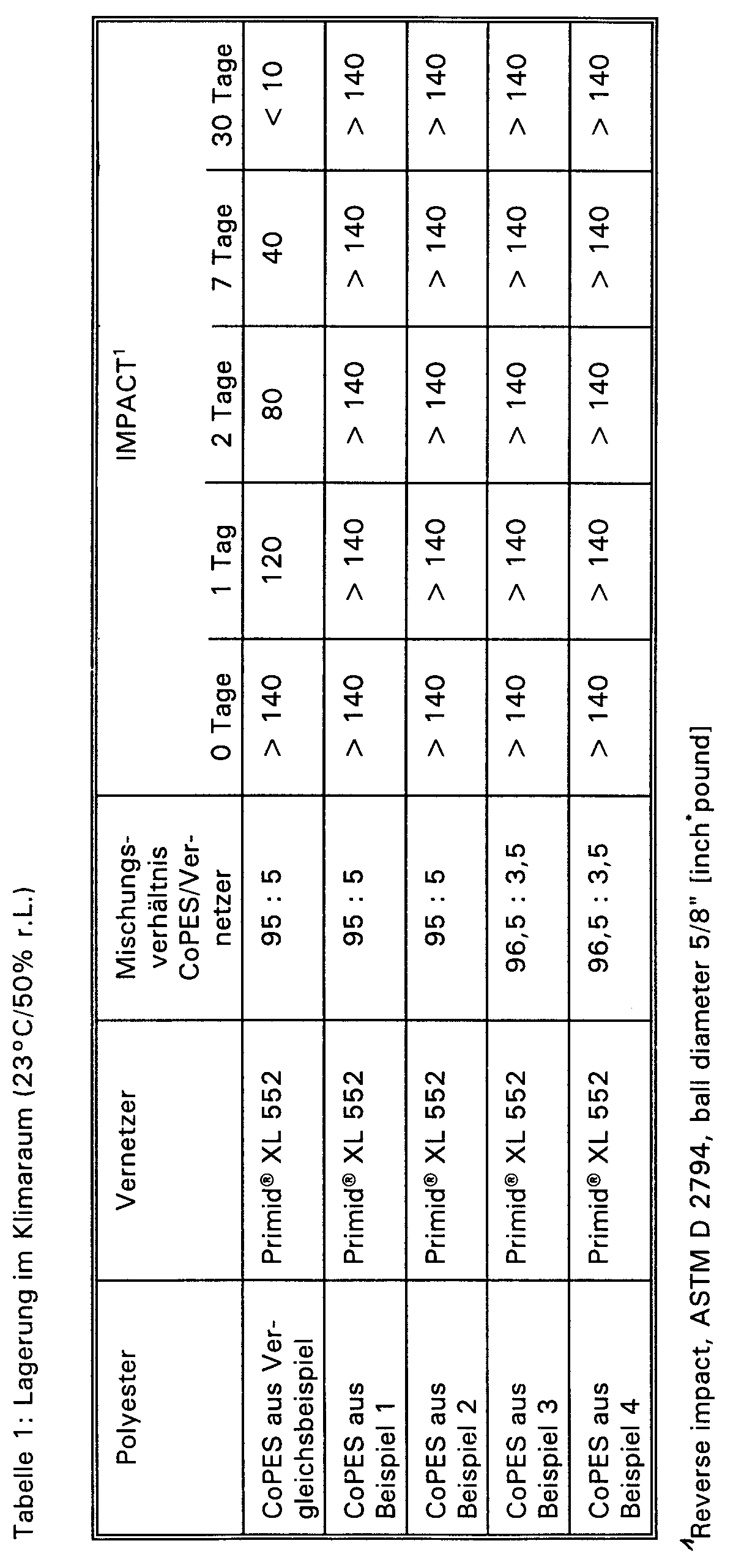
- Table 1 shows the changes in impact over time as a test criterion for physical aging after storage in a climatic room at 23 ° C and 50% relative humidity.
- Table 2 shows the changes in the impact over time as a test criterion for physical aging after storage in a drying cabinet at 50 ° C.
Landscapes
- Chemical & Material Sciences (AREA)
- Life Sciences & Earth Sciences (AREA)
- Engineering & Computer Science (AREA)
- Materials Engineering (AREA)
- Wood Science & Technology (AREA)
- Organic Chemistry (AREA)
- Chemical Kinetics & Catalysis (AREA)
- Paints Or Removers (AREA)
- Application Of Or Painting With Fluid Materials (AREA)
- Fertilizers (AREA)
- Manufacturing Of Electric Cables (AREA)
- Polyesters Or Polycarbonates (AREA)
Abstract
Description
- Die Erfindung betrifft wärmehärtbare Beschichtungssysteme auf Basis von linearen carboxylfunktionellen Polyester(PES)-Harzen aus bifunktionellen Monomerbausteinen und polyfunktionellen Epoxyverbindungen und/oder β-Hydroxyalkylamiden, deren Herstellung und Verwendung sowie Schutzschichten aus diesen Beschichtungssystemen.
- Wärmehärtbare Beschichtungssysteme bestehen im allgemeinen aus Bindemittelharz und Vernetzer, Pigmenten sowie Additiven und/oder Füllstoffen. Die Vernetzung und damit die Härtung in der Wärme erfolgt über Polyadditions- oder Polykondensationsreaktionen zwischen in den Bindemittelsystemen enthaltenden funktionellen Gruppen. Typische Bindemittelsysteme sind Epoxyharze/Härter, Polyester/Epoxide, Polyester/Isocyanate, Polyester/β-Hydroxyalkylamide, Acrylate/Isocyanate.
- Die makroskopischen Eigenschaften von gehärteten Pulverlackfilmen verändern sich mit der Zeit. Dieses Phänomen ist bei polymeren Werkstoffen seit längerer Zeit unter dem Begriff physikalische Alterung bekannt (L.C.E. Struik: Physical Aging in Amorphous Polymers and other Materials, Verlag Elsevier, 1978).
- Unter physikalischer Alterung versteht man die zeitliche Veränderung der markoskopischen Eigenschaften von Polymeren im Glaszustand bei konstanten Umgebungsbedingungen, hervorgerufen durch einen Nicht-Gleichgewichtszustand im Polymeren. Im Unterschied zur chemischen Alterung, bei der irreversible Änderungen wie Abbaureaktionen oder Kettenbrüche, hervorgerufen durch thermischen Abbau oder Photooxidation, im Material auftreten, ist die physikalische Alterung reversibel.
- Als Beispiele für Veränderungen durch physikalische Alterung seien Veränderungen der elektrischen und optischen Kenngrößen, sowie Veränderungen der mechanischen Eigenschaften genannt, welche für Lackfilme am wichtigsten sind. Obwohl bei Lackfilmen allgemein bekannt, schien dieses Phänomen bisher keine allzugroßen Probleme zu bereiten.
- Durch den vermehrten Einsatz von organischen Pigmenten und die hohen Anforderungen an Pulverbeschichtungen in der Precoating Metal- und Coil-Coating-Technologie, insbesondere wenn die beschichteten Teile nachträglich verformt werden, gewinnt dieses Phänomen und die Mittel zu dessen Beseitigung an Interesse. Ein anderes interessantes Anwendungsgebiet für Pulverlacke mit verbesserter Beständigkeit gegenüber physikalischer Alterung sind Transparentlacke als Schutzschichten gegen Rissbildung.
- L.C.E. Struik beschreibt in dem vorgenannten Buch "Physical Aging in Amorphous Polymers and other Materials" das Phänomen der physikalischen Alterung allgemein anhand von Polymeren. Bisher gibt es nur wenige Literaturstellen, die sich mit dem Phänomen der physikalischen Alterung von organischen Beschichtungen oder im speziellen Pulverlacken befassen (P.J. Greidanus, Porc. 19th Fatipec Congress, Aachen, 1, 485 (1988) und D.Y. Perera and P. Schutyser: Effect of Physical Aging on Thermal Stress Development in Powder Coatings, XIX International Conference in Organic Coating Science and Technology, Athen, 1993). In diesen Publikationen werden nur die physikalischen Grundlagen und die Auswirkungen der physikalischen Alterung gemessen und beschrieben, jedoch wird keine Lösung dieses Problems vorgeschlagen.
- Bei Pulverlacken auf Basis von carboxylfunktionellen Polyestern und Polyepoxiden und/oder β-Hydroxyalkylamiden als Vernetzer, kann das Phänomen der physikalischen Alterung zurückgedrängt werden durch Erhöhung der Einbrenntemperatur, durch Verlängerung der Einbrennzeit, durch einen Überschuß an Vernetzer oder durch den Einbau von sogenannten Verzweigern, d.h. Säuren oder Alkoholen mit einer Funktionalität größer 2, in das zugrundeliegende Polyesterharz. Eine Erhöhung der Einbrenntemperatur oder eine Verlängerung der Einbrennzeit ist mit höherem Energieverbrauch und teilweise mit Farbveränderungen verbunden. Ein Überschuß an Vernetzer ist ebenfalls aus ökonomischer Sicht abzulehnen und mit höheren Kosten verbunden. Der Einbau von Verzweigern in das Polyesterharz ist aus technischer Sicht nicht zu empfehlen, da er mit einer Verschlechterung der Verlaufseigenschaften verbunden ist.
- Die der Erfindung zugrundeliegende Aufgabe ist somit die Überwindung der vorgenannten Nachteile des Standes der Technik, d.h. es sollen daher wärmehärtbare Beschichtungssysteme mit verzweigerfreien Polyesterharzen bereitgestellt werden.
- Diese Aufgabe wird durch das wärmehärtbare Beschichtungssystem gemäß Anspruch 1, das Verfahren gemäß Anspruch 12, die Verwendung nach Anspruch 13 sowie durch die Schutzschicht nach Anspruch 14 gelöst.
- In den Unteransprüchen sind vorteilhafte Ausführungsformen der Erfindung enthalten. Die Aufgabe wird speziell gelöst durch ein Beschichtungssystem aus linearen carboxylfunktionellen Polyesterharzen aus bifunktionellen Monomerbausteinen und Vernetzer, wobei die Isophthalsäure maximal 10 Mol-Teile aller Säurebausteine ausmacht.
- Es wurde festgestellt, daß überraschenderweise bei Pulverlacken auf Basis linearer carboxylfunktioneller Polyester, d.h. solchen, bei denen die Funktionalität der verwendeten Säuren und Alkoholen kleiner oder gleich 2 ist, und polyfunktionellen Epoxyden und/oder β-Hydroxyalkylamiden als Vernetzer oder Härter eine deutliche Verbesserung der Beständigkeit gegenüber der physikalischen Alterung erreicht werden kann.
- Das erfindungsgemäße wärmehärtbare Beschichtungssystem besteht somit aus einem spezifischen gesättigten Polyester als Bindemittelharz, welcher sich dadurch in besonderer Weise auszeichnet, daß er aus bifunktionellen aliphatischen und/oder cycloaliphatischen Diolen und aliphatischen und/oder cycloaliphatischen und/oder aromatischen Dicarbonsäuren aufgebaut ist, wobei die Menge an Isophthalsäure kleiner als 10 Mol-Teile, bezogen auf die gesamte Säuremenge ist.
- Das carboxylfunktionelle Polyesterharz enthält minimal 90 Mol-Teile anderer aromatischer, aliphatischer oder cycloaliphatischer Dicarbonsäuren, wobei Terephthalsäure als aromatische Dicarbonsäure, Adipinsäure, Azelainsäure, Sebazinsäure und Dodecandicarbonsäure als aliphatische oder Cyclohexandicarbonsäure als cycloaliphatische Dicarbonsäure bevorzugt sind. In einer bevorzugten Ausführungsform sind die Polyesterharze, neben Terephthalsäure, d.h. allgemein neben den aromatischen Dicarbonsäuren, aus 3 bis 9 Mol-Teilen aliphatischer Dicarbonsäuren mit mindestens 6 C-Atomen, wobei Adipinsäure besonders bevorzugt ist, und/oder 3 bis 9 Mol-Teilen cycloaliphatischer Dicarbonsäure, wobei 1,4-Cyclohexandicarbonsäure besonders bevorzugt ist, aufgebaut.
- Die Diole des Polyesterharzes bestehen zu mindestens 50 Mol-Teilen aus mindestens einem verzweigten aliphatischen Diol mit 4 bis 12 C-Atomen sowie zu maximal 50 Mol-Teilen aus mindestens einem linearen aliphatischen Diol mit 2 bis 22 C-Atomen und mindestens einem cycloaliphatischen Diol mit 6 bis 16 C-Atomen, wobei als verzweigtes Diol 2,2-Dimethyl-1,3-propandiol bevorzugt ist.
- Als Vernetzerkomponete eignen sich Epoxyverbindungen mit mindestens 2 Epoxygruppen und/oder β-Hydroxyalkylamide mit mindestens 2 Hydroxyalkylamidgruppen. Bevorzugte monomere Polyepoxyverbindungen sind Glycidylether der Cyanur- oder der Isocyanursäure oder Glycidylester von Polycarbonsäuren. Dabei sind Terephthalsäure, Trimellithsäure oder Mischungen davon bevorzugt. Besonders bevorzugt ist Trisglycidylisocyanurat (TGIC). Als β-Hydroxyalkylamidverbindungeignet sich Bis[N,N'-di(β-hydroxyethyl]adipamid (Primid XL 552 der Firma Rohm and Haas) in besonderer Weise.
- In einer bevorzugten Ausführungsform des Beschichtungssystems hat das Polyesterharz eine Säurezahl von 15 bis 100 [mg KOH/g], eine OH-Zahl von maximal 10 [mg KOH/g] und eine Glasumwandlungstemperatur Tg von größer als 45 °C.
- Im erfindungsgemäßen Beschichtungssystem können die für die Herstellung und die Verwendung von Pulverlacken üblichen Additive zusätzlich vorhanden sein.
- Dabei handelt es sich um Additive aus der Gruppe Beschleuniger, Pigmente, Füllstoffe, Verlauf- und Entgasungsmittel, Hitze-, UV- und/oder HALS-Stabilisatoren oder Triboadditive sowie erforderlichenfalls um Mattierungsadditive, wie z.B. Wachse.
- Die Herstellung der erfindungsgemäßen carboxylfunktionellen Polyesterharze erfolgt nach bekannter Art durch gemeinsames Erhitzen sämtlicher monomeren Komponenten in Anwesenheit üblicher Veresterungskatalysatoren auf eine Temperatur bis ca 250 °C und Abtrennen des entstandenen Reaktionswassers oder nach einem zweistufigen Verfahren, bei welchem in einer ersten Stufe in Gegenwart eines Polyolüberschusses ein hydroxylfunktioneller Polyester gebildet wird und in einer zweiten Stufe dieser mit einer oder mehreren mehrbasischen Carbonsäuren oder deren Anhydride zu einem carboxylfunktionellen Polyesterharz umgesetzt wird.
- Die Herstellung der erfindungsgemäßen Pulverlacke erfolgt vorzugsweise in der Schmelze durch gemeinsame Extrusion sämtlicher Formulierungsbestandteile bei Temepraturen zwischen 90 bis 130 °C. Das Extrudat wird anschließend abgekühlt, gemahlen und auf eine Korngröße kleiner als 100 µm abgesiebt. Grundsätzlich sind auch andere Verfahren zur Herstellung der Pulverlacke geeignet, wie z.B. Vermischen der Formulierungsbestandteile in Lösung und anschließende Ausfällung oder destillative Entfernung der Lösemittel.
- Die Applikation der erfindungsgemäßen Pulverlacke erfolgt nach den für Pulverlacke üblichen Verfahren z.B. mittels elektrostatischen Sprühvorrichtungen z.B. nach dem Corona- oder dem Tribo-System oder nach dem Wirbelbett-Verfahren.
- Die nach der vorliegenden Erfindung vorgeschlagenen Pulverlacke sind genügend lagerstabil und besitzen nach der Vernetzung bei 140 bis 200 °C sehr gute Verlauf- und mechanische Eigenschaften. Sie zeichnen sich weiter durch gute Witterungs- und UVB-Beständigkeit und besonders gute Alterungsbeständigkeit aus. Die Herstellung und die Eigenschaften der carboxylfunktionellen, spezifischen Polyesterharze sowie der Pulverlacke werden nachfolgend beispielhaft dargestellt.
- In einen 2-l-Veresterungsreaktor, versehen mit Temperaturfühler, Rührer, Rückflußkolonne und Destillationsbrücke, werden 391,8 g (3,76 Mol) 2,2-Dimethyl-1,3-propanol und 27,5 g (0,44 Mol) Ethylenglykol vorgelegt und bei 140 °C unter einer, während der ganzen Reaktion aufrechterhaltenen inerten Stickstoffatmosphäre aufgeschmolzen.
- Unter Rühren werden 515,5 g (3,10 Mol) Terephthalsäure, 110,5 g (0,67 Mol) Isophthalsäure und 0,1 g eines Sn-haltigen Veresterungskatalysators zugegeben und die Innentemperatur wird schrittweise auf 235 °C erhöht. Die Reaktion wird fortgesetzt bis kein Destillat mehr entsteht und die Säurezahl weniger als 10 mg KOH/g beträgt.
- Danach werden 73,6 g (0,44 Mol) Isophthalsäure und 32,4 g (0,22 Mol) Adipinsäure zugegeben, und die Veresterung wird bis zum Erreichen der gewünschten Säurezahl von ca. 33 mg KOH/g fortgesetzt. Ein Teil dieser 2. Stufe wird unter vermindertem Druck (< 100 mbar) durchgeführt.
- Analog zu dem Vergleichsbeispiel werden 352,9 g (3,39 Mol) 2,2-Dimethyl-1,3-propandiol und 56,2 g (0,91 Mol) Ethylenglykol aufgeschmolzen.
- Unter Rühren werden 639,3 g (3,85 Mol) Terephthalsäure und 0,1 g eines Sn-haltigen Veresterungskatalysators zugegeben. Die Reaktion wird fortgesetzt bis kein Destillat mehr entsteht, und die Säurezahl weniger als 10 mg KOH/g beträgt.
- Danach werden 56,4 g (0,34 Mol) Isophthalsäure und 49,6 g (0,34 Mol) Adipinsäure zugegeben, und die Veresterung wird bis zum Erreichen der gewünschten Säurezahl von ca. 33 mg KOH/g fortgesetzt.
- Analog zu dem Vergleichsbeispiel werden 347,8 g (3,34 Mol) 2,2-Dimethyl-1,3-propandiol und 55,4 g (0,89 Mol) Ethylenglykol aufgeschmolzen.
- Unter Rühren werden 630 g (3,79 Mol) Terephthalsäure und 0,1 g eines Sn-haltigen Veresterungskatalysators zugegeben. Die Reaktion wird fortgesetzt bis kein Destillat mehr entsteht, und die Säurezahl weniger als 10 mg KOH/g beträgt.
- Danach werden 37,1 g (0,22 Mol) Isophthalsäure und 32,6 g (0,22 Mol) Adipinsäure und 38,4 g (0,22 Mol) Cyclohexandicarbonsäure zugegeben, und die Veresterung wird bis zum Erreichen der gewünschten Säurezahl von ca. 33 mg KOH/g fortgesetzt.
- Analog zu dem Vergleichsbeispiel werden 366,7 g (3,52 Mol) 2,2-Dimethyl-1,3-propandiol und 55,7 g (0,90 Mol) Ethylenglykol aufgeschmolzen.
- Unter Rühren werden 633,7 g (3,82 Mol) Terephthalsäure und 0,1 g eines Sn-haltigen Veresterungskatalysators zugegeben. Die Reaktion wird fortgesetzt bis kein Destillat mehr entsteht, und die Säurezahl weniger als 10 mg KOH/g beträgt.
- Danach werden 55,9 g (0,34 Mol) Isophthalsäure und 49,2 g (0,34 Mol) Adipinsäure zugegeben, und die Veresterung wird bis zum Erreichen der gewünschten Säurezahl von ca. 22 mg KOH/g fortgesetzt.
- Analog zu dem Vergleichsbeispiel werden 364,5 g (3,50 Mol) 2,2-Dimethyl-1,3-propandiol und 55,4 g (0,89 Mol) Ethylenglykol aufgeschmolzen.
- Unter Rühren werden 630 g (3,79 Mol) Terephthalsäure und 0,1 g eines Sn-haltigen Veresterungskatalysators zugegeben. Die Reaktion wird fortgesetzt bis kein Destillat mehr entsteht, und die Säurezahl weniger als 10 mg KOH/g beträgt.
- Danach werden 37,1 g (0,22 Mol) Isophthalsäure, 32,6 g (0,22 Mol) Adipinsäure und 38,4 g (0,22 Mol) Cyclohexandicarbonsäure zugegeben, und die Veresterung wird bis zum Erreichen der gewünschten Säurezahl von ca. 22 mg KOH/g fortgesetzt.
- Für sämtliche in Tabelle 1 beschriebenen Pulverlacke wurde die nachfolgende Formulierung verwendet. Bei den Pulverlacken in Tabelle 2 wurde noch zusätzlich DT 3126 der Firma Ciba Geigy als Beschleuniger verwendet.
Gewichtsteile 948 Bindemittel 15 Resiflow PV 88 1) 7 Benzoin 30 Organisches Pigment 1) Verlaufmittel auf Polyacrylat-Basis, Handelsprodukt der Firma Worleè-Chemie GmbH - Die Formulierungsbestandteile werden in einem Henschel-Mischer bei 700 Upm während 30 Sekunden trocken gemischt und anschließend auf einem Buss-Co-Kneter (PLK 46) bei einer Manteltemperatur von 100 °C, gekühlter Schnecke und einer Schneckenumdrehung von 150 Upm extrudiert. Das Extrudat wird gekühlt, gemahlen und auf kleiner als 90 µm abgesiebt.
- Die lacktechnischen Prüfungen erfolgen auf Aluminiumblechen (Q-panel AL-36 5005 H 14/08 (0,8 mm)) bei einer Einbrenntemperatur von 180 °C und einer Einbrennzeit von 10 Minuten. Die Lackfilmdicke beträgt ca. 90 µm.
- Tabelle 1 zeigt die zeitlichen Veränderungen des Impacts als Testkriterium für die physikalische Alterung nach der Lagerung im Klimaraum bei 23 °C und 50 % relativer Luftfeuchtigkeit.
- Tabelle 2 zeigt die zeitlichen Veränderungen des Impacts als Testkriterium für die physikalische Alterung nach der Lagerung im Trockenschrank bei 50 °C.

Claims (14)
- Wärmehärtbares Beschichtungssystem auf Basis von carboxylfunktionellen Polyester-Harzen, polyfunktionellen Epoxyverbindungen und/oder β-Hydroxyalkylamiden als Vernetzer sowie gegebenenfalls weiteren üblichen Additiven, dadurch gekennzeichnet, daß das Beschichtungssystem als Bindemittelharz mindestens ein lineares carboxylfunktionelles Polyesterharz aus bifunktionellen Monomerbausteinen aus- maximal 10 Mol-Teilen Isophthalsäure und- mindestens 90 Mol-Teilen mindestens einer weiteren Dicarbonsäure aus der Gruppe aromatische Dicarbonsäuren mit 8 bis 16 C-Atomen, aliphatische Dicarbonsäuren mit 6 bis 22 C-Atomen und cycloaliphatische Dicarbonsäuren mit 8 bis 16 C-Atomen, und- mindestens 50 Mol-Teilen mindestens eines verzweigten aliphatischen Diols mit 4 bis 12 C-Atomen und- maximal 50 Mol-Teilen mindestens eines linearen aliphatischen Diols mit 2 bis 22 C-Atomen und/oder mindestens eines cycloaliphatischen Diols mit 6 bis 16 C-Atomen,enthält.
- Beschichtungssystem nach Anspruch 1, dadurch gekennzeichnet, daß die Additive aus der Gruppe Beschleuniger, Pigmente, Füllstoffe, Verlaufsstoffe, Entgasungsmittel, Hitze-, UV-, Stabilisatoren, Mattierungs- und Tribo-Additive ausgewählt sind
- Beschichtungssystem nach Anspruch 1, dadurch gekennzeichnet, daß der Vernetzer eine monomere Epoxyverbindung ist.
- Beschichtungssystem nach Anspruch 3, dadurch gekennzeichnet, daß der Vernetzer ein Glycidylester einer Polycarbonsäure ist.
- Beschichtungssystem nach Anspruch 3, dadurch gekennzeichnet, daß der Vernetzer ein Glycidylether der Cyanursäure oder Isocyanursäure ist.
- Beschichtungssystem nach Anspruch 4, dadurch gekennzeichnet, daß die Polycarbonsäure Trimellithsäure oder Terephthalsäure ist.
- Beschichtungssystem nach Anspruch 1, dadurch gekennzeichnet, daß der Vernetzer ein β-Hydroxyalkylamid mit mindestens zwei Hydroxyalkylamidgruppen ist.
- Beschichtungssystem nach Anspruch 1, dadurch gekennzeichnet, daß das verzweigte aliphatische Diol 2,2-Dimethyl-1,3-propandiol ist.
- Beschichtungssystem nach Anspruch 1, dadurch gekennzeichnet, daß die Dicarbonsäure ausgewählt ist aus der Gruppe Terephthalsäure, Adipinsäure, Azelainsäure, Sebazinsäure, Dodecandicarbonsäure oder Cyclohexandicarbonsäure.
- Beschichtungssystem nach einem der vorhergehenden Ansprüche, dadurch gekennzeichnet, daß der Anteil der aliphatischen Dicarbonsäure und/oder der cycloaliphatischen Dicarbonsäure, neben den aromatischen Dicarbonsäuren, 3 bis 9 Mol-Teile beträgt.
- Beschichtungssystem nach einem der vorhergehenden Ansprüche, dadurch gekennzeichnet, daß das carboxylfunktionelle Polyesterharz eine Säurezahl von 15 bis 100 mg KOH/g und eine OH-Zahl von maximal 10 mg KOH/g sowie eine Glasumwandlungstemperatur von größer als 45 °C hat.
- Verfahren zur Herstellung von wärmehärtbaren Beschichtungssystemen auf Basis von linearen carboxylfunktionellen Polyesterharzen aus bifunktionellen Monomerbausteinen, dadurch gekennzeichnet, daß das Bindemittelharz, der mindestens eine Vernetzer aus der Gruppe polyfunktionelle Epoxyverbindungen und β-Hydroxyalkylamide und gegebenenfalls weitere übliche Additive nach den Ansprüchen 1 bis 11 in der Schmelze bei 90 bis 130 °C gemischt, extrudiert, ausgetragen, granuliert, gemahlen und auf eine Korngröße von kleiner als 100 µm abgesiebt werden.
- Verwendung des wärmehärtbaren Beschichtungssystems gemäß den Ansprüchen 1 bis 11 zur Herstellung von Überzügen bzw. Schutzschichten durch Wirbelsintern, elektrostatisches Beschichten.
- Schutzschicht herstellbar aus dem Beschichtungssystem gemäß den Ansprüchen 1 bis 11.
Applications Claiming Priority (2)
| Application Number | Priority Date | Filing Date | Title |
|---|---|---|---|
| DE4401438A DE4401438C2 (de) | 1994-01-19 | 1994-01-19 | Wärmehärtbares Beschichtungssystem, dessen Herstellung und Verwendung |
| DE4401438 | 1994-01-19 |
Publications (3)
| Publication Number | Publication Date |
|---|---|
| EP0664325A2 true EP0664325A2 (de) | 1995-07-26 |
| EP0664325A3 EP0664325A3 (de) | 1995-10-18 |
| EP0664325B1 EP0664325B1 (de) | 1999-04-28 |
Family
ID=6508230
Family Applications (1)
| Application Number | Title | Priority Date | Filing Date |
|---|---|---|---|
| EP95100569A Expired - Lifetime EP0664325B1 (de) | 1994-01-19 | 1995-01-17 | Wärmehärtbares Beschichtungssystem |
Country Status (12)
| Country | Link |
|---|---|
| US (1) | US6313234B1 (de) |
| EP (1) | EP0664325B1 (de) |
| JP (1) | JP3565930B2 (de) |
| KR (1) | KR0148335B1 (de) |
| AT (1) | ATE179447T1 (de) |
| AU (1) | AU662864B2 (de) |
| CA (1) | CA2140378C (de) |
| DE (2) | DE4401438C2 (de) |
| ES (1) | ES2131221T3 (de) |
| NZ (1) | NZ270274A (de) |
| TW (1) | TW270930B (de) |
| ZA (1) | ZA95402B (de) |
Cited By (6)
| Publication number | Priority date | Publication date | Assignee | Title |
|---|---|---|---|---|
| EP0936261A3 (de) * | 1998-02-16 | 2002-03-13 | Ems-Inventa Ag | Wärmehärtbare Beschichtungsmasse |
| EP1253174A1 (de) * | 2001-04-25 | 2002-10-30 | Mitsubishi Gas Chemical Company, Inc. | Verfahren zur Herstellung von Pulverbeschichtungsstoff aus Polyester |
| EP1319698A1 (de) * | 2001-12-12 | 2003-06-18 | Dsm N.V. | Verfahren zum Auftragen von Schmelzmasse |
| WO2004000958A1 (en) * | 2002-06-19 | 2003-12-31 | Surface Specialties, S.A. | Semi-gloss powder coating compositions |
| US7192994B2 (en) | 2001-04-25 | 2007-03-20 | Mitsubishi Gas Chemical Co., Inc. | Method of producing polyester powdery coating material |
| EP2548930A1 (de) | 2011-07-22 | 2013-01-23 | EMS-Patent AG | Wärmehärtbares Beschichtungssystem, Verfahren zu dessen Herstellung sowie dessen Anwendung |
Families Citing this family (8)
| Publication number | Priority date | Publication date | Assignee | Title |
|---|---|---|---|---|
| GB9814437D0 (en) * | 1998-07-03 | 1998-09-02 | Ici Plc | Coating composition |
| AT411687B (de) * | 1998-12-07 | 2004-04-26 | Tigerwerk Lack U Farbenfabrik | Pulverbeschichtungssysteme, verfahren zu ihrer herstellung, ihre verwendung zur herstellung von überzügen, polyesterharz hiefür |
| JP3803784B2 (ja) * | 1999-02-25 | 2006-08-02 | 大日本インキ化学工業株式会社 | 粉体塗料用組成物 |
| US6787188B1 (en) | 2000-10-02 | 2004-09-07 | Imperial Chemical Industries Plc | Coating composition |
| JP4640132B2 (ja) * | 2005-11-22 | 2011-03-02 | カシオ計算機株式会社 | プロジェクタ |
| EP2949721B1 (de) | 2013-01-23 | 2018-07-18 | Adeka Corporation | Antistatisches mittel, zusammensetzung mit dem antistatischen mittel, antistatische harzzusammensetzung und formkörper |
| ES2703582T3 (es) | 2014-07-25 | 2019-03-11 | Dsm Ip Assets Bv | Recubrimientos de polvo mates |
| WO2022159617A1 (en) * | 2021-01-21 | 2022-07-28 | Ppg Industries Ohio, Inc. | A coating composition |
Family Cites Families (23)
| Publication number | Priority date | Publication date | Assignee | Title |
|---|---|---|---|---|
| DE1905825A1 (de) * | 1969-02-06 | 1970-10-15 | Metallgesellschaft Ag | Verfahren zur Herstellung von Kunststoffueberzuegen aus Polyester |
| US3723572A (en) * | 1970-03-13 | 1973-03-27 | Albert Ag Chem Werke | Synthetic resins |
| BE838160A (fr) * | 1976-02-02 | 1976-05-28 | Nouvelles resines polyesters acides et produits de revetements en poudre prepares a partir de ces resines | |
| DE2621656A1 (de) | 1976-05-15 | 1977-12-01 | Dynamit Nobel Ag | Haertbare pulverfoermige ueberzugsmittel |
| NL164082C (nl) | 1978-10-31 | 1980-11-17 | Unilever Nv | Poederlak. |
| NL8204205A (nl) * | 1982-10-29 | 1984-05-16 | Dsm Resins Bv | Polyester en de toepassing daarvan in poederlak. |
| US4525504A (en) * | 1983-10-24 | 1985-06-25 | Eastman Kodak Company | Stabilized polyester compositions suitable for outdoor applications |
| DE3740932A1 (de) * | 1987-12-03 | 1989-06-15 | Bayer Ag | Verfahren zur herstellung von polyestern und ihre verwendung als bindemittel oder bindemittelkomponente in pulverlacken |
| US4801680A (en) * | 1987-12-30 | 1989-01-31 | Ppg Industries, Inc. | Hydroxyalkylamide powder coating curing system |
| JPH07113074B2 (ja) * | 1988-03-18 | 1995-12-06 | 日本石油株式会社 | ポリエチレン系樹脂組成物 |
| DE3936973A1 (de) | 1989-03-11 | 1991-05-08 | Hoechst Ag | Haertbare, pulverfoermige mischungen |
| US4933429A (en) | 1989-03-13 | 1990-06-12 | General Electric Company | Method for preparing polyester-polyepoxide compositions of high melt viscosity |
| DE69025635T2 (de) | 1989-03-23 | 1996-11-21 | Dsm Nv | Pulverfarbe und Polyesterharz für Pulverfarben |
| US4999388A (en) | 1989-09-14 | 1991-03-12 | General Electric Company | Branched polyester resin composition having enhanced melt viscosity |
| US5006612A (en) * | 1989-10-18 | 1991-04-09 | Cargill, Incorporated | Polyesters for powder coating resins using an intermediate having low process viscosity |
| KR950012768B1 (ko) * | 1989-12-28 | 1995-10-21 | 고려화학주식회사 | 저온 경화형 폴리에스테르 수지의 제조방법 및 이를 함유하는 분체도료 조성물 |
| GB9006737D0 (en) * | 1990-03-26 | 1990-05-23 | Courtaulds Coatings Ltd | Coating compositions |
| JP2810500B2 (ja) | 1990-07-03 | 1998-10-15 | 日本ペイント株式会社 | 粉体塗料 |
| US5097006A (en) * | 1990-11-21 | 1992-03-17 | U C B S.A. | Weatherable powder coating compositions |
| US5266657A (en) * | 1991-05-29 | 1993-11-30 | Rohm And Haas Company | Monocarboxylic acid power coating curing systems |
| US5245003A (en) * | 1992-01-23 | 1993-09-14 | Eastman Kodak Company | Ternary mixtures of glycols and water that retain fluidity at ambient temperatures |
| US5280089A (en) * | 1992-02-03 | 1994-01-18 | Ferro Corporation | Polyester-acrylic graft polymers for use in powder coatings |
| GB9205137D0 (en) * | 1992-03-10 | 1992-04-22 | Scott Bader Co | Anti-popping agents for powder coating compositions |
-
1994
- 1994-01-19 DE DE4401438A patent/DE4401438C2/de not_active Expired - Fee Related
- 1994-12-22 NZ NZ270274A patent/NZ270274A/en not_active IP Right Cessation
-
1995
- 1995-01-17 CA CA002140378A patent/CA2140378C/en not_active Expired - Lifetime
- 1995-01-17 TW TW084100365A patent/TW270930B/zh not_active IP Right Cessation
- 1995-01-17 DE DE59505735T patent/DE59505735D1/de not_active Expired - Lifetime
- 1995-01-17 ES ES95100569T patent/ES2131221T3/es not_active Expired - Lifetime
- 1995-01-17 EP EP95100569A patent/EP0664325B1/de not_active Expired - Lifetime
- 1995-01-17 KR KR1019950000663A patent/KR0148335B1/ko not_active Expired - Lifetime
- 1995-01-17 AT AT95100569T patent/ATE179447T1/de active
- 1995-01-18 ZA ZA95402A patent/ZA95402B/xx unknown
- 1995-01-18 JP JP00591795A patent/JP3565930B2/ja not_active Expired - Lifetime
- 1995-01-18 AU AU10280/95A patent/AU662864B2/en not_active Expired
- 1995-06-06 US US08/469,171 patent/US6313234B1/en not_active Expired - Lifetime
Cited By (6)
| Publication number | Priority date | Publication date | Assignee | Title |
|---|---|---|---|---|
| EP0936261A3 (de) * | 1998-02-16 | 2002-03-13 | Ems-Inventa Ag | Wärmehärtbare Beschichtungsmasse |
| EP1253174A1 (de) * | 2001-04-25 | 2002-10-30 | Mitsubishi Gas Chemical Company, Inc. | Verfahren zur Herstellung von Pulverbeschichtungsstoff aus Polyester |
| US7192994B2 (en) | 2001-04-25 | 2007-03-20 | Mitsubishi Gas Chemical Co., Inc. | Method of producing polyester powdery coating material |
| EP1319698A1 (de) * | 2001-12-12 | 2003-06-18 | Dsm N.V. | Verfahren zum Auftragen von Schmelzmasse |
| WO2004000958A1 (en) * | 2002-06-19 | 2003-12-31 | Surface Specialties, S.A. | Semi-gloss powder coating compositions |
| EP2548930A1 (de) | 2011-07-22 | 2013-01-23 | EMS-Patent AG | Wärmehärtbares Beschichtungssystem, Verfahren zu dessen Herstellung sowie dessen Anwendung |
Also Published As
| Publication number | Publication date |
|---|---|
| AU1028095A (en) | 1995-07-27 |
| DE59505735D1 (de) | 1999-06-02 |
| ATE179447T1 (de) | 1999-05-15 |
| JPH07216298A (ja) | 1995-08-15 |
| AU662864B2 (en) | 1995-09-14 |
| KR0148335B1 (ko) | 1998-11-02 |
| JP3565930B2 (ja) | 2004-09-15 |
| US6313234B1 (en) | 2001-11-06 |
| EP0664325B1 (de) | 1999-04-28 |
| DE4401438C2 (de) | 1997-09-18 |
| CA2140378A1 (en) | 1995-07-20 |
| ES2131221T3 (es) | 1999-07-16 |
| KR950023687A (ko) | 1995-08-18 |
| EP0664325A3 (de) | 1995-10-18 |
| NZ270274A (en) | 1995-10-26 |
| TW270930B (de) | 1996-02-21 |
| ZA95402B (en) | 1995-09-26 |
| DE4401438A1 (de) | 1995-07-20 |
| CA2140378C (en) | 2001-04-03 |
Similar Documents
| Publication | Publication Date | Title |
|---|---|---|
| EP0698645B1 (de) | Wärmehärtbare Beschichtungsmassen | |
| EP0664325B1 (de) | Wärmehärtbares Beschichtungssystem | |
| DE69208639T2 (de) | Beschichtungsverfahren zur Verhinderung der Filiform-Korrosion von Metallteilen | |
| DE2558295A1 (de) | Vernetzbare massen auf der basis von gesaettigten polyestern und ihre verwendung als bindemittel fuer pulverisierte anstrichstoffe | |
| WO2008068068A1 (de) | Lagerstabile pulverlackzusammensetzungen basierend auf säuregruppenhaltigen polyestern, ihre herstellung und ihre verwendung für trübungsarme und flexible pulverlacke | |
| DE3201749C2 (de) | ||
| DE4335845C3 (de) | Wärmehärtende Beschichtungsmasse, deren Herstellung und Verwendung | |
| EP0744421A2 (de) | Pulverlack für matte Beschichtungen | |
| EP0698629B1 (de) | Epoxidfreies, wärmehärtbares Beschichtungssystem | |
| EP1121394A1 (de) | Hitzehärtbare pulverbeschichtungssysteme | |
| DE3786618T2 (de) | Verfahren zur Beschichtung von Substraten mit wärmehärtbaren Beschichtungszusammensetzungen mit hohem Feststoffgehalt auf der Basis von Epoxyden Polyolen und Anhydriden. | |
| DE2310055B2 (de) | Verwendung einer waermehaertenden harzzusammensetzung fuer pulverfarben bzw. -anstriche | |
| DE2232084B2 (de) | Pulverförmige überzugsmittel | |
| DE3247839C3 (de) | Hitzehärtbare Überzugsmasse | |
| EP1848782B1 (de) | Hitzehärtbare pulverlackzusammensetzung sowie zu ihrer herstellung verwendbares polyesterharz | |
| EP0656024B1 (de) | Verfahren zur herstellung von pulverlacken und nach diesem verfahren hergestellte pulverlacke | |
| EP1261670B1 (de) | Wärmehärtbare beschichtungsmassen | |
| EP0936261B1 (de) | Wärmehärtbare Beschichtungsmasse | |
| WO2005120724A1 (de) | Verfahren zum beschichten elektrisch leitfähiger substrate | |
| DE3509322C2 (de) | Verwendung von einem Lack zum Schutz von Kunststoffteilen von Kraftfahrzeugen | |
| EP1491567A2 (de) | Carboxyfunktionelle Vernetzer für epoxyfunktionelle Pulverlackbindemittel | |
| EP0855433B1 (de) | Polyester Pulverbeschichtungszusammensetzung ohne Schleierbildung | |
| DE602005002038T2 (de) | Epoxidpolymerzuschlagstoffe für pulverlacke | |
| WO1999029785A2 (de) | Für witterungsbeständige beschichtungen geeignete pulverlackzusammensetzungen |
Legal Events
| Date | Code | Title | Description |
|---|---|---|---|
| PUAI | Public reference made under article 153(3) epc to a published international application that has entered the european phase |
Free format text: ORIGINAL CODE: 0009012 |
|
| 17P | Request for examination filed |
Effective date: 19950331 |
|
| AK | Designated contracting states |
Kind code of ref document: A2 Designated state(s): AT CH DE ES FR GB IT LI NL PT SE |
|
| PUAL | Search report despatched |
Free format text: ORIGINAL CODE: 0009013 |
|
| AK | Designated contracting states |
Kind code of ref document: A3 Designated state(s): AT CH DE ES FR GB IT LI NL PT SE |
|
| 17Q | First examination report despatched |
Effective date: 19970509 |
|
| GRAG | Despatch of communication of intention to grant |
Free format text: ORIGINAL CODE: EPIDOS AGRA |
|
| GRAG | Despatch of communication of intention to grant |
Free format text: ORIGINAL CODE: EPIDOS AGRA |
|
| GRAH | Despatch of communication of intention to grant a patent |
Free format text: ORIGINAL CODE: EPIDOS IGRA |
|
| GRAH | Despatch of communication of intention to grant a patent |
Free format text: ORIGINAL CODE: EPIDOS IGRA |
|
| GRAA | (expected) grant |
Free format text: ORIGINAL CODE: 0009210 |
|
| AK | Designated contracting states |
Kind code of ref document: B1 Designated state(s): AT CH DE ES FR GB IT LI NL PT SE |
|
| REF | Corresponds to: |
Ref document number: 179447 Country of ref document: AT Date of ref document: 19990515 Kind code of ref document: T |
|
| REG | Reference to a national code |
Ref country code: CH Ref legal event code: EP |
|
| ITF | It: translation for a ep patent filed | ||
| REF | Corresponds to: |
Ref document number: 59505735 Country of ref document: DE Date of ref document: 19990602 |
|
| ET | Fr: translation filed | ||
| GBT | Gb: translation of ep patent filed (gb section 77(6)(a)/1977) |
Effective date: 19990616 |
|
| REG | Reference to a national code |
Ref country code: ES Ref legal event code: FG2A Ref document number: 2131221 Country of ref document: ES Kind code of ref document: T3 |
|
| REG | Reference to a national code |
Ref country code: PT Ref legal event code: SC4A Free format text: AVAILABILITY OF NATIONAL TRANSLATION Effective date: 19990528 |
|
| PLBE | No opposition filed within time limit |
Free format text: ORIGINAL CODE: 0009261 |
|
| STAA | Information on the status of an ep patent application or granted ep patent |
Free format text: STATUS: NO OPPOSITION FILED WITHIN TIME LIMIT |
|
| 26N | No opposition filed | ||
| REG | Reference to a national code |
Ref country code: GB Ref legal event code: IF02 |
|
| REG | Reference to a national code |
Ref country code: CH Ref legal event code: PUE Owner name: EMS-PATENT AG Free format text: EMS-INVENTA AG#SELNAUSTRASSE 16#8001 ZUERICH (CH) -TRANSFER TO- EMS-PATENT AG#REICHENAUERSTRASSE#7013 DOMAT/EMS (CH) |
|
| REG | Reference to a national code |
Ref country code: PT Ref legal event code: PC4A Owner name: EMS-PATENT AG, CH Effective date: 20070712 |
|
| REG | Reference to a national code |
Ref country code: GB Ref legal event code: 732E |
|
| NLS | Nl: assignments of ep-patents |
Owner name: EMS-PATENT AG Effective date: 20070711 |
|
| NLT1 | Nl: modifications of names registered in virtue of documents presented to the patent office pursuant to art. 16 a, paragraph 1 |
Owner name: UHDE INVENTA-FISCHER AG |
|
| REG | Reference to a national code |
Ref country code: FR Ref legal event code: TP |
|
| PGFP | Annual fee paid to national office [announced via postgrant information from national office to epo] |
Ref country code: CH Payment date: 20131216 Year of fee payment: 20 Ref country code: PT Payment date: 20131219 Year of fee payment: 20 |
|
| PGFP | Annual fee paid to national office [announced via postgrant information from national office to epo] |
Ref country code: NL Payment date: 20140121 Year of fee payment: 20 Ref country code: SE Payment date: 20140121 Year of fee payment: 20 Ref country code: DE Payment date: 20140122 Year of fee payment: 20 |
|
| PGFP | Annual fee paid to national office [announced via postgrant information from national office to epo] |
Ref country code: AT Payment date: 20140113 Year of fee payment: 20 Ref country code: IT Payment date: 20140129 Year of fee payment: 20 Ref country code: ES Payment date: 20140129 Year of fee payment: 20 Ref country code: FR Payment date: 20140123 Year of fee payment: 20 |
|
| PGFP | Annual fee paid to national office [announced via postgrant information from national office to epo] |
Ref country code: GB Payment date: 20140121 Year of fee payment: 20 |
|
| REG | Reference to a national code |
Ref country code: DE Ref legal event code: R071 Ref document number: 59505735 Country of ref document: DE |
|
| REG | Reference to a national code |
Ref country code: PT Ref legal event code: MM4A Free format text: MAXIMUM VALIDITY LIMIT REACHED Effective date: 20150117 |
|
| REG | Reference to a national code |
Ref country code: NL Ref legal event code: V4 Effective date: 20150117 |
|
| REG | Reference to a national code |
Ref country code: CH Ref legal event code: PL |
|
| REG | Reference to a national code |
Ref country code: GB Ref legal event code: PE20 Expiry date: 20150116 |
|
| REG | Reference to a national code |
Ref country code: SE Ref legal event code: EUG |
|
| REG | Reference to a national code |
Ref country code: AT Ref legal event code: MK07 Ref document number: 179447 Country of ref document: AT Kind code of ref document: T Effective date: 20150117 |
|
| PG25 | Lapsed in a contracting state [announced via postgrant information from national office to epo] |
Ref country code: PT Free format text: LAPSE BECAUSE OF EXPIRATION OF PROTECTION Effective date: 20150126 |
|
| PG25 | Lapsed in a contracting state [announced via postgrant information from national office to epo] |
Ref country code: GB Free format text: LAPSE BECAUSE OF EXPIRATION OF PROTECTION Effective date: 20150116 |
|
| REG | Reference to a national code |
Ref country code: ES Ref legal event code: FD2A Effective date: 20150826 |
|
| PG25 | Lapsed in a contracting state [announced via postgrant information from national office to epo] |
Ref country code: ES Free format text: LAPSE BECAUSE OF EXPIRATION OF PROTECTION Effective date: 20150118 |