EP0664502A2 - Schwingkreis - Google Patents
Schwingkreis Download PDFInfo
- Publication number
- EP0664502A2 EP0664502A2 EP95102887A EP95102887A EP0664502A2 EP 0664502 A2 EP0664502 A2 EP 0664502A2 EP 95102887 A EP95102887 A EP 95102887A EP 95102887 A EP95102887 A EP 95102887A EP 0664502 A2 EP0664502 A2 EP 0664502A2
- Authority
- EP
- European Patent Office
- Prior art keywords
- voltage
- capacitor
- constant current
- circuit
- current
- Prior art date
- Legal status (The legal status is an assumption and is not a legal conclusion. Google has not performed a legal analysis and makes no representation as to the accuracy of the status listed.)
- Ceased
Links
Images






Classifications
-
- H—ELECTRICITY
- H03—ELECTRONIC CIRCUITRY
- H03B—GENERATION OF OSCILLATIONS, DIRECTLY OR BY FREQUENCY-CHANGING, BY CIRCUITS EMPLOYING ACTIVE ELEMENTS WHICH OPERATE IN A NON-SWITCHING MANNER; GENERATION OF NOISE BY SUCH CIRCUITS
- H03B5/00—Generation of oscillations using amplifier with regenerative feedback from output to input
-
- G—PHYSICS
- G05—CONTROLLING; REGULATING
- G05F—SYSTEMS FOR REGULATING ELECTRIC OR MAGNETIC VARIABLES
- G05F3/00—Non-retroactive systems for regulating electric variables by using an uncontrolled element, or an uncontrolled combination of elements, such element or such combination having self-regulating properties
- G05F3/02—Regulating voltage or current
- G05F3/08—Regulating voltage or current wherein the variable is DC
- G05F3/10—Regulating voltage or current wherein the variable is DC using uncontrolled devices with non-linear characteristics
- G05F3/16—Regulating voltage or current wherein the variable is DC using uncontrolled devices with non-linear characteristics being semiconductor devices
- G05F3/20—Regulating voltage or current wherein the variable is DC using uncontrolled devices with non-linear characteristics being semiconductor devices using diode- transistor combinations
- G05F3/26—Current mirrors
- G05F3/265—Current mirrors using bipolar transistors only
-
- G—PHYSICS
- G05—CONTROLLING; REGULATING
- G05F—SYSTEMS FOR REGULATING ELECTRIC OR MAGNETIC VARIABLES
- G05F3/00—Non-retroactive systems for regulating electric variables by using an uncontrolled element, or an uncontrolled combination of elements, such element or such combination having self-regulating properties
- G05F3/02—Regulating voltage or current
- G05F3/08—Regulating voltage or current wherein the variable is DC
- G05F3/10—Regulating voltage or current wherein the variable is DC using uncontrolled devices with non-linear characteristics
- G05F3/16—Regulating voltage or current wherein the variable is DC using uncontrolled devices with non-linear characteristics being semiconductor devices
- G05F3/20—Regulating voltage or current wherein the variable is DC using uncontrolled devices with non-linear characteristics being semiconductor devices using diode- transistor combinations
- G05F3/22—Regulating voltage or current wherein the variable is DC using uncontrolled devices with non-linear characteristics being semiconductor devices using diode- transistor combinations wherein the transistors are of the bipolar type only
- G05F3/222—Regulating voltage or current wherein the variable is DC using uncontrolled devices with non-linear characteristics being semiconductor devices using diode- transistor combinations wherein the transistors are of the bipolar type only with compensation for device parameters, e.g. Early effect, gain, manufacturing process, or external variations, e.g. temperature, loading, supply voltage
- G05F3/227—Regulating voltage or current wherein the variable is DC using uncontrolled devices with non-linear characteristics being semiconductor devices using diode- transistor combinations wherein the transistors are of the bipolar type only with compensation for device parameters, e.g. Early effect, gain, manufacturing process, or external variations, e.g. temperature, loading, supply voltage producing a current or voltage as a predetermined function of the supply voltage
-
- H—ELECTRICITY
- H03—ELECTRONIC CIRCUITRY
- H03K—PULSE TECHNIQUE
- H03K3/00—Circuits for generating electric pulses; Monostable, bistable or multistable circuits
- H03K3/02—Generators characterised by the type of circuit or by the means used for producing pulses
- H03K3/023—Generators characterised by the type of circuit or by the means used for producing pulses by the use of differential amplifiers or comparators, with internal or external positive feedback
- H03K3/0231—Astable circuits
-
- H—ELECTRICITY
- H03—ELECTRONIC CIRCUITRY
- H03K—PULSE TECHNIQUE
- H03K4/00—Generating pulses having essentially a finite slope or stepped portions
- H03K4/06—Generating pulses having essentially a finite slope or stepped portions having triangular shape
- H03K4/08—Generating pulses having essentially a finite slope or stepped portions having triangular shape having sawtooth shape
- H03K4/48—Generating pulses having essentially a finite slope or stepped portions having triangular shape having sawtooth shape using as active elements semiconductor devices
- H03K4/50—Generating pulses having essentially a finite slope or stepped portions having triangular shape having sawtooth shape using as active elements semiconductor devices in which a sawtooth voltage is produced across a capacitor
- H03K4/501—Generating pulses having essentially a finite slope or stepped portions having triangular shape having sawtooth shape using as active elements semiconductor devices in which a sawtooth voltage is produced across a capacitor the starting point of the flyback period being determined by the amplitude of the voltage across the capacitor, e.g. by a comparator
- H03K4/502—Generating pulses having essentially a finite slope or stepped portions having triangular shape having sawtooth shape using as active elements semiconductor devices in which a sawtooth voltage is produced across a capacitor the starting point of the flyback period being determined by the amplitude of the voltage across the capacitor, e.g. by a comparator the capacitor being charged from a constant-current source
Definitions
- the present invention relates to an oscillating circuit controlled by a constant current circuit, the oscillating circuit capable of being used as a variable-frequency clock generator in a battery-powered computer.
- the operating voltage is reduced in operation modes not requiring high speed, e.g. mode selection prior to arithmetic processing, together with lowering the clock signal frequency.
- the lower operating voltage and lower clock signal frequency both help to reduce power consumption.
- one of the following techniques is used for changing the clock signal frequency.
- the first is to provide multiple oscillators for generating clock signals of different frequencies, and to select a suitable one of the oscillators when performing, for example, a high-speed operation such as arithmetic processing or a low-speed operation such as mode selection.
- the second is to provide a single oscillator of a relatively high frequency, and obtain a desired low frequency by demultiplying the high frequency.
- both these techniques involve drawbacks of requiring extra hardware such as oscillators and selecting circuits, and of increase in the cost of the computers.
- Another drawback of the conventional techniques is that the clock frequency cannot be continuously varied.
- an oscillating circuit comprising a capacitor; a charging circuit coupled with a constant current circuit and charging said capacitor with a current which is equivalent to the current flowing through an output transistor in the constant current circuit; switching means connected in parallel with said capacitor; and detection means for detecting the voltage across said capacitor and instructing said switching means to open if the voltage reaches a lower predetermined voltage and to close if the voltage reaches a higher predetermined voltage.
- An embodiment of the present invention may provide an oscillating circuit capable of generating clock signals of higher frequency for operations such as arithmetic processing and of lower frequency for operations such as mode selection, with a simple circuit configuration and at low cost.
- An embodiment of the present invention may also provide an oscillating circuit which generates higher or lower frequency clock signals in response to a change in the power source voltage.
- An embodiment of the present invention may also provide an oscillating circuit whose oscillation frequency can be continuously changed by changing the voltage of a power supply.
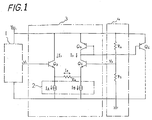
- FIG. 1 A constant current circuit which can be used in the present invention is shown in Fig. 1, which comprises a reference voltage source block 1, a differential amplifier block 3 including a constant current supplying source block 2 and a resistor R4, and a voltage dividing block 4 for dividing a power source voltage V cc .
- Differential amplifier block 3 comprises transistors Q3 and Q5, e.g. bipolar transistors each having a collector connected to the power source voltage V cc and an emitter connected to one of the constant current supplying sources I A and I B .
- the base (gate means) of the transistor Q3 is supplied with a reference voltage V1 from the reference voltage source block 1 and the base of transistor Q5 is supplied with a divided voltage V2 of power source voltage V cc from the node of resistors R2 and R3 constituting the voltage dividing block 4.
- the resistor R4 is connected between the emitters of the transistors Q3 and Q5. Hence, a current I2 dependent on the difference between the voltages V1 and V2 flows through the collector of transistor Q5.
- the transistor Q4 provided between the power voltage source V cc and the collector of transistor Q5 constitutes a current mirror in co-operation with the transistor Q6.
- the transistors Q4 and Q6 are bipolar transistors, for example, each having an emitter connected to the power voltage source V cc and their bases connected to each other. The base of the transistor Q4 is also connected to its collector.
- the fundamental configuration of an oscillating circuit of the present invention is as shown in figure 2, which comprises a current integration block 6 and a charge-discharge control block 7.
- the current integration block 6 includes aforementioned transistor Q6 constituting a current mirror 5, and a capacitor C0 connected between the collector of the transistor Q6 and ground potential source.
- the capacitor C0 is charged with a current I4 which is substantially equal to the current I2 flowing through the transistor Q4, and the potential V0 at a terminal of the capacitor C0 increases with the charging.
- the charge-discharge control block 7 includes a voltage detection circuit D1 and a switch means SW.
- the voltage detection circuit D1 detects the voltage V0 of the capacitor C0 and instructs the switch means SW to close on detecting V0 higher than a first predetermined voltage (V S1 ) and to open on detecting V0 lower than a second predetermined voltage (V S2 ).
- V S1 a first predetermined voltage
- V S2 a second predetermined voltage
- the capacitor C0 is subject to be charged or discharged along with the ON-OFF operation of the switch means SW, and V0 changes as a triangular wave of a constant frequency.
- the frequency can be varied by changing the power source voltage V cc as described later.
- V2 the power source voltage
- V2 becomes larger than V1
- the current I2 increases while the current I1 decreases.
- the current I3 flows through the resistor R4 from the transistor Q5 to the constant current supplying source I A .
- V cc V4
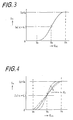
- I2 can be changed continuously with V cc so as to be larger than I B in a range where V cc >V4 and to be smaller than I B in a range where V cc ⁇ V4.
- the current I4 to charge the capacitor C0 of the oscillating circuit is equal to I2 flowing through the transistor Q4 in the constant current circuit of figure 1, due to the function of the current mirror comprising the transistors Q4 and Q6.
- the rate of charging the capacitor C0 depends on the current I2 which can be controlled by changing the power source voltage V cc .
- the rate of discharging the capacitor C0 is constant regardless of the change of V cc . Therefore, the frequency of oscillating circuit of figure 2 changes according to the change of the power source voltage V cc .
- FIG. 5 shows exemplary waveforms of the signal output from the oscillating circuit of figure 2, corresponding to aforementioned specific V cc s of V3, V4 and V5, and figure 6 shows the change in the frequency f of the output signal with respect to the change of V cc .
- V S1 and V S2 represent the maximum and minimum of the voltages V0 at an end of the capacitor C0, respectively, which are detected by the voltage detection circuit D1 as described above with reference to figure 2.
- V S1 is a voltage V0 where the discharging of the capacitor C0 initiates
- V S2 is a voltage V0 where the charging of the capacitor C0 initiates.
- the rise time of the output signal decreases as V cc increases, while the fall time of the signal is constant because it only depends on the resistance inherent in the switching means SW shown in figure 2.
- V cc V3
- the frequency of the output signal is zero as shown in figures 5 and 6, because the current I4 becomes zero and the capacitor C0 is not charged.
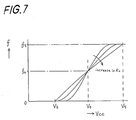
- the slope of V cc -I2 characteristic curve becomes gentle by increasing the resistance of the resistor R4. Accordingly, the slope of V cc -f characteristic curve shown in figure 6 becomes gentle with the increase of R4 as shown in figure 7.
- the circuit of figure 2 can be a variable frequency oscillator. It is obvious that if R4 is decreased to zero, the slope of V cc -I2 characteristic curve of figure 4, and hence, the slope of V cc -f characteristic curve of figure 7 become so steep that the circuit of figure 2 could not be used as a variable frequency oscillator.
- FIG. 10 is a diagram showing the fundamental configurations of another constant current circuit which can be used in the invention.
- the circuit comprising a reference voltage source 1, a differential amplifier block 3 and a voltage dividing block 4 for dividing power source voltage V cc , is almost the same as the circuit of figure 1, except for that the figure 10 circuit includes only one constant current supplying source I D connected to a point on the resistor R4, the point dividing R4 into two parts R41 and R42.
- the constant current circuit of figure 10 has the same characteristics as that of the circuit of figure 1.
- the feature of R4 to change the slope of the V cc -I2 characteristics is also provided.
- R4 is not equally divided, ie. R41 ⁇ R42 the V cc -I2 characteristic curve regarding the circuit shifts along the V cc axis, wherein the direction and amount of the shift depends on the ratio R41/R42.
- the first embodiment of the present invention is shown in figure 11, comprising a constant current circuit and an oscillating circuit which have configurations respectively based on those of figures 1 and 2.
- This embodiment circuit is provided with an additional constant current supplying block 8 including a current mirror comprising transistor Q7 and Q8,both bipolar transistors,for example, and a constant current supplying source I c connected to the collector of the transistor Q8.
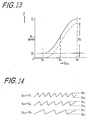
- the current I4 for charging the capacitor C0 is increased by the current I c such as represented by I4 ⁇ I2 + I c .
- the current I4 shifts larger by I c as shown in figure 12, wherein the dotted line represents the original V cc -I4 characteristic curve corresponding to that in figure 3.
- the second embodiment of the present invention is shown in figure 15, comprising a constant current circuit and an oscillating circuit which have configurations respectively based on those of figures 1 and 2.
- This embodiment circuit has an additional constant current supplying source I0 connected in series to the switching means SW in the charge-discharge control block 7. With the addition of the constant current supplying source I0, the current flowing through the switching means SW during discharging the capacitor C0 is increased or decreased.
- the ratio of the time for discharging to the time for charging of the capacitor C0 is represented by 1/(n-1), wherein n represents a positive number larger than 1.
- the rise time to fall time ratio of the signal output from the circuit of figure 15 can be controlled, depending on the current capacity of the constant current supplying source I0.
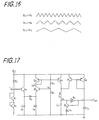
- the third embodiment of the present invention is shown in figure 17, comprising a constant current circuit and an oscillating circuit which have configurations respectively based on those of figures 1 and 2.
- This embodiment circuit includes constant current supplying sources I c and I0 introduced by the preceding embodiments described respectively with reference to figures 11 and 15.
- the transistors Q1 and Q2 both bipolar transistors, for example, and a resistor R1 constitute a source of reference voltage V1.
- the base-emitter junction voltage of the transistors Q1 and Q2 which are connected to each other in series and supplied with a bias current is used as a constant voltage source.
- a transistor Q9 is used as a switching means and a Schmitt circuit D2 is used as a voltage detection circuit, respectively corresponding to those denoted by reference symbols SW and D1 in figure 11 and 15.
- the Schmitt circuit D2 converts triangular pulse signals into rectangular pulse signals thanks to the waveform shaping function thereof based on the inherent hysteresis characteristics between the input and output.
- the V cc -I4 characteristics and the V cc -f characteristics of the circuit of figure 17 are as shown in figures 18 and 19, respectively.
- the Schmitt circuit D2 has two threshold values of a high level S H , and a low level S L . and jumps the output F out thereof to high level V H . if V0 increases up to the high level threshold S H . Hence, the transistor Q9 turns on and the capacitor C0 is discharged. Accodingly, the voltage V0 decreases but the output remains at high level V H . When the voltage V0 reaches the low level threshold S L . the Schmitt circuit D2 jumps the output F out to low level V L . As a result, the transistor Q9 turns off and the capacitor C0 is stopped from discharging and begins charging by the current I4.
- any of the above embodiment circuits can be incorporated in a monolithic integrated circuit, therefore, they are suitably applied to computers like notebook-sized personal computers powered by batteries, hence, resulting in power savings of the computers by lowering the clock signal frequency and the power voltage during operations such as mode selection.
- the feature of variable frequency clock signals with the use of a single oscillating circuit, attained by the present invention also results in the reduction of hardware and production cost, while improving the reliability of the computers.
- resistor any device or circuit element (or combination of elements) having the desired property of resistance, capacitance, etc.
- the present invention concerns an oscillating circuit whose oscillation frequency can be varied with change of a constant current circuit output current I2, suitable for use in portable computers.
- the constant current circuit output current I2 can be varied with change of a power source voltage V cc .
- the oscillating circuit comprises a capacitor charged by current I2, a switching means for discharging the capacitor when closed, and a voltage detecting means operating to close or open the switching means according to the voltage at one end of the capacitor.
- the switching means switches on and off to generate pulses with a frequency depending on I2, hence, depending on V cc .
- a suitable constant current circuit comprises bipolar transistors coupled to form a differential amplifier wherein one of the transistors is supplied with a reference voltage and the other is supplied with a divided voltage of the power source voltage V cc , and a resistor connecting the emitters of the transistors is provided for controlling the slope of the V cc -I2 characteristic curve of the constant current circuit.
Landscapes
- Engineering & Computer Science (AREA)
- Microelectronics & Electronic Packaging (AREA)
- Physics & Mathematics (AREA)
- Power Engineering (AREA)
- Electromagnetism (AREA)
- General Physics & Mathematics (AREA)
- Radar, Positioning & Navigation (AREA)
- Automation & Control Theory (AREA)
- Nonlinear Science (AREA)
- Dc-Dc Converters (AREA)
- Inductance-Capacitance Distribution Constants And Capacitance-Resistance Oscillators (AREA)
- Electronic Switches (AREA)
- Control Of Electrical Variables (AREA)
- Continuous-Control Power Sources That Use Transistors (AREA)
- Amplifiers (AREA)
- Networks Using Active Elements (AREA)
Applications Claiming Priority (3)
| Application Number | Priority Date | Filing Date | Title |
|---|---|---|---|
| JP2256294A JP2763393B2 (ja) | 1990-09-26 | 1990-09-26 | 定電流回路および発振回路 |
| JP256294/90 | 1990-09-26 | ||
| EP91116347A EP0477907B1 (de) | 1990-09-26 | 1991-09-25 | Konstantstromschaltung und ein Schwingkreis gesteuert durch dieselbe |
Related Parent Applications (1)
| Application Number | Title | Priority Date | Filing Date |
|---|---|---|---|
| EP91116347.5 Division | 1991-09-25 |
Publications (2)
| Publication Number | Publication Date |
|---|---|
| EP0664502A2 true EP0664502A2 (de) | 1995-07-26 |
| EP0664502A3 EP0664502A3 (de) | 1997-08-06 |
Family
ID=17290663
Family Applications (2)
| Application Number | Title | Priority Date | Filing Date |
|---|---|---|---|
| EP95102887A Ceased EP0664502A3 (de) | 1990-09-26 | 1991-09-25 | Schwingkreis. |
| EP91116347A Expired - Lifetime EP0477907B1 (de) | 1990-09-26 | 1991-09-25 | Konstantstromschaltung und ein Schwingkreis gesteuert durch dieselbe |
Family Applications After (1)
| Application Number | Title | Priority Date | Filing Date |
|---|---|---|---|
| EP91116347A Expired - Lifetime EP0477907B1 (de) | 1990-09-26 | 1991-09-25 | Konstantstromschaltung und ein Schwingkreis gesteuert durch dieselbe |
Country Status (6)
| Country | Link |
|---|---|
| US (1) | US5146188A (de) |
| EP (2) | EP0664502A3 (de) |
| JP (1) | JP2763393B2 (de) |
| KR (1) | KR950005155B1 (de) |
| CA (1) | CA2052248C (de) |
| DE (1) | DE69118798T2 (de) |
Families Citing this family (9)
| Publication number | Priority date | Publication date | Assignee | Title |
|---|---|---|---|---|
| EP0689731A1 (de) * | 1993-03-17 | 1996-01-03 | National Semiconductor Corporation | Frequenz Verschiebung Schaltung für Schaltregler |
| US5349286A (en) * | 1993-06-18 | 1994-09-20 | Texas Instruments Incorporated | Compensation for low gain bipolar transistors in voltage and current reference circuits |
| US5619125A (en) * | 1995-07-31 | 1997-04-08 | Lucent Technologies Inc. | Voltage-to-current converter |
| US6441693B1 (en) * | 2001-03-20 | 2002-08-27 | Honeywell International Inc. | Circuit for voltage to linear duty cycle conversion |
| DE10121821B4 (de) * | 2001-05-04 | 2004-04-08 | Infineon Technologies Ag | Frequenzregelschaltung |
| DE10259384B3 (de) * | 2002-12-18 | 2004-05-13 | Siemens Ag | Vorrichtung zur Ermittlung des Energiezustandes eines Energiespeichers eines mobilen Datenträgers |
| JP5762755B2 (ja) * | 2010-01-18 | 2015-08-12 | ローム株式会社 | 発光素子の駆動回路およびそれを用いた発光装置 |
| JP6576306B2 (ja) | 2016-06-28 | 2019-09-18 | 三菱電機株式会社 | 電圧電流変換回路および負荷駆動回路 |
| CN109002076B (zh) * | 2017-06-07 | 2021-10-29 | 苏州瀚宸科技有限公司 | 电阻电流镜像电路、rssi电路及芯片 |
Family Cites Families (8)
| Publication number | Priority date | Publication date | Assignee | Title |
|---|---|---|---|---|
| US3870971A (en) * | 1973-03-17 | 1975-03-11 | Victor Company Of Japan | Circuit arrangement of voltage controlled oscillator |
| US3831113A (en) * | 1973-06-01 | 1974-08-20 | Rca Corp | Relaxation oscillator |
| DE2912492A1 (de) * | 1979-03-29 | 1980-10-09 | Siemens Ag | Monolithisch integrierbarer rechteckimpulsgenerator |
| US4471326A (en) * | 1981-04-30 | 1984-09-11 | Rca Corporation | Current supplying circuit as for an oscillator |
| NL8302215A (nl) * | 1983-06-22 | 1985-01-16 | Philips Nv | Stroombronschakeling. |
| JPS60263507A (ja) * | 1984-06-11 | 1985-12-27 | Nec Corp | 発振回路 |
| JPH0659024B2 (ja) * | 1985-12-23 | 1994-08-03 | 日本電気株式会社 | 時定数回路 |
| US4667146A (en) * | 1986-10-10 | 1987-05-19 | Tektronix, Inc. | Voltage-controlled push-pull current source |
-
1990
- 1990-09-26 JP JP2256294A patent/JP2763393B2/ja not_active Expired - Lifetime
-
1991
- 1991-09-25 EP EP95102887A patent/EP0664502A3/de not_active Ceased
- 1991-09-25 US US07/765,272 patent/US5146188A/en not_active Expired - Fee Related
- 1991-09-25 CA CA002052248A patent/CA2052248C/en not_active Expired - Fee Related
- 1991-09-25 EP EP91116347A patent/EP0477907B1/de not_active Expired - Lifetime
- 1991-09-25 DE DE69118798T patent/DE69118798T2/de not_active Expired - Fee Related
- 1991-09-26 KR KR1019910016770A patent/KR950005155B1/ko not_active Expired - Fee Related
Also Published As
| Publication number | Publication date |
|---|---|
| DE69118798D1 (de) | 1996-05-23 |
| JP2763393B2 (ja) | 1998-06-11 |
| EP0664502A3 (de) | 1997-08-06 |
| JPH04133113A (ja) | 1992-05-07 |
| DE69118798T2 (de) | 1996-09-05 |
| CA2052248A1 (en) | 1992-03-27 |
| EP0477907B1 (de) | 1996-04-17 |
| EP0477907A3 (en) | 1993-06-30 |
| KR920007320A (ko) | 1992-04-28 |
| US5146188A (en) | 1992-09-08 |
| KR950005155B1 (ko) | 1995-05-19 |
| EP0477907A2 (de) | 1992-04-01 |
| CA2052248C (en) | 1994-07-26 |
Similar Documents
| Publication | Publication Date | Title |
|---|---|---|
| JP2531742B2 (ja) | 電圧制御発振回路 | |
| US4977381A (en) | Differential relaxation oscillator | |
| KR20050070110A (ko) | 용량성 전하 펌프 | |
| EP0477907B1 (de) | Konstantstromschaltung und ein Schwingkreis gesteuert durch dieselbe | |
| US4513258A (en) | Single input oscillator circuit | |
| US6891443B2 (en) | Oscillator | |
| US6211744B1 (en) | Ring oscillator having an externally adjustable variable frequency | |
| US4904960A (en) | Precision CMOS oscillator circuit | |
| JPS60263507A (ja) | 発振回路 | |
| JPH0786839A (ja) | 移相器及びそれを用いたfm受信機 | |
| JP2999781B2 (ja) | 発振回路 | |
| JP3345209B2 (ja) | 逓倍回路 | |
| JP4244397B2 (ja) | Pll回路 | |
| JPH04267620A (ja) | 三角波発振回路 | |
| KR920004916B1 (ko) | 구형파의 위상 지연회로 | |
| JPH06216722A (ja) | 三角波発振回路 | |
| JPH0740666B2 (ja) | Pll回路 | |
| JPH0360514A (ja) | 電圧制御発振回路 | |
| KR930008429B1 (ko) | 가변 주파수 전압제어 발진회로 | |
| SU738107A1 (ru) | Мультивибратор | |
| JP3794080B2 (ja) | Pll回路 | |
| JP3136736B2 (ja) | 発振回路 | |
| KR920002427B1 (ko) | 주파수밴드패스용 전압제어발진기 | |
| JPH01289311A (ja) | のこぎり波発振器段 | |
| JP3004701B2 (ja) | 電圧制御発振器 |
Legal Events
| Date | Code | Title | Description |
|---|---|---|---|
| PUAI | Public reference made under article 153(3) epc to a published international application that has entered the european phase |
Free format text: ORIGINAL CODE: 0009012 |
|
| AC | Divisional application: reference to earlier application |
Ref document number: 477907 Country of ref document: EP |
|
| AK | Designated contracting states |
Kind code of ref document: A2 Designated state(s): DE FR GB |
|
| PUAL | Search report despatched |
Free format text: ORIGINAL CODE: 0009013 |
|
| AK | Designated contracting states |
Kind code of ref document: A3 Designated state(s): DE FR GB |
|
| 17P | Request for examination filed |
Effective date: 19980129 |
|
| 17Q | First examination report despatched |
Effective date: 19990830 |
|
| GRAG | Despatch of communication of intention to grant |
Free format text: ORIGINAL CODE: EPIDOS AGRA |
|
| STAA | Information on the status of an ep patent application or granted ep patent |
Free format text: STATUS: THE APPLICATION HAS BEEN REFUSED |
|
| 18R | Application refused |
Effective date: 20020523 |