EP0664724B1 - Verfahren für die gewinnung und die umpufferung und/oder einengung von gelösten makromolekülen eines makromolekülgemisches - Google Patents
Verfahren für die gewinnung und die umpufferung und/oder einengung von gelösten makromolekülen eines makromolekülgemisches Download PDFInfo
- Publication number
- EP0664724B1 EP0664724B1 EP93923461A EP93923461A EP0664724B1 EP 0664724 B1 EP0664724 B1 EP 0664724B1 EP 93923461 A EP93923461 A EP 93923461A EP 93923461 A EP93923461 A EP 93923461A EP 0664724 B1 EP0664724 B1 EP 0664724B1
- Authority
- EP
- European Patent Office
- Prior art keywords
- macromolecules
- liquid chromatography
- hollow
- eluate
- membrane module
- Prior art date
- Legal status (The legal status is an assumption and is not a legal conclusion. Google has not performed a legal analysis and makes no representation as to the accuracy of the status listed.)
- Expired - Lifetime
Links
- 229920002521 macromolecule Polymers 0.000 title claims abstract description 43
- 239000000203 mixture Substances 0.000 title claims abstract description 14
- 238000000034 method Methods 0.000 title claims description 19
- 239000012528 membrane Substances 0.000 claims abstract description 33
- 238000004811 liquid chromatography Methods 0.000 claims abstract description 28
- 239000007853 buffer solution Substances 0.000 claims description 20
- 239000000126 substance Substances 0.000 claims description 12
- 230000002255 enzymatic effect Effects 0.000 claims description 8
- 238000001514 detection method Methods 0.000 claims description 6
- 239000002904 solvent Substances 0.000 claims description 4
- 239000000758 substrate Substances 0.000 claims description 3
- 150000003384 small molecules Chemical class 0.000 claims description 2
- 239000000835 fiber Substances 0.000 claims 5
- 238000009434 installation Methods 0.000 claims 3
- 239000012510 hollow fiber Substances 0.000 abstract description 44
- 238000011084 recovery Methods 0.000 abstract description 2
- 238000000502 dialysis Methods 0.000 description 14
- 238000002360 preparation method Methods 0.000 description 10
- 238000000926 separation method Methods 0.000 description 9
- 230000003139 buffering effect Effects 0.000 description 8
- 238000004587 chromatography analysis Methods 0.000 description 8
- 239000000385 dialysis solution Substances 0.000 description 4
- XLYOFNOQVPJJNP-UHFFFAOYSA-N water Substances O XLYOFNOQVPJJNP-UHFFFAOYSA-N 0.000 description 4
- 150000001875 compounds Chemical class 0.000 description 3
- 239000003792 electrolyte Substances 0.000 description 3
- 238000000605 extraction Methods 0.000 description 3
- 239000000243 solution Substances 0.000 description 3
- 102000003855 L-lactate dehydrogenase Human genes 0.000 description 2
- 108700023483 L-lactate dehydrogenases Proteins 0.000 description 2
- 239000002202 Polyethylene glycol Substances 0.000 description 2
- LCTONWCANYUPML-UHFFFAOYSA-M Pyruvate Chemical compound CC(=O)C([O-])=O LCTONWCANYUPML-UHFFFAOYSA-M 0.000 description 2
- 238000011001 backwashing Methods 0.000 description 2
- 210000004369 blood Anatomy 0.000 description 2
- 239000008280 blood Substances 0.000 description 2
- 238000006243 chemical reaction Methods 0.000 description 2
- 239000000470 constituent Substances 0.000 description 2
- 238000002523 gelfiltration Methods 0.000 description 2
- 210000003734 kidney Anatomy 0.000 description 2
- 239000007788 liquid Substances 0.000 description 2
- BOPGDPNILDQYTO-NNYOXOHSSA-N nicotinamide-adenine dinucleotide Chemical compound C1=CCC(C(=O)N)=CN1[C@H]1[C@H](O)[C@H](O)[C@@H](COP(O)(=O)OP(O)(=O)OC[C@@H]2[C@H]([C@@H](O)[C@@H](O2)N2C3=NC=NC(N)=C3N=C2)O)O1 BOPGDPNILDQYTO-NNYOXOHSSA-N 0.000 description 2
- 229930027945 nicotinamide-adenine dinucleotide Natural products 0.000 description 2
- 229920001223 polyethylene glycol Polymers 0.000 description 2
- 150000003839 salts Chemical class 0.000 description 2
- 102000004190 Enzymes Human genes 0.000 description 1
- 108090000790 Enzymes Proteins 0.000 description 1
- 230000005526 G1 to G0 transition Effects 0.000 description 1
- JVTAAEKCZFNVCJ-UHFFFAOYSA-M Lactate Chemical compound CC(O)C([O-])=O JVTAAEKCZFNVCJ-UHFFFAOYSA-M 0.000 description 1
- 229920002684 Sepharose Polymers 0.000 description 1
- 229930006000 Sucrose Natural products 0.000 description 1
- CZMRCDWAGMRECN-UGDNZRGBSA-N Sucrose Chemical compound O[C@H]1[C@H](O)[C@@H](CO)O[C@@]1(CO)O[C@@H]1[C@H](O)[C@@H](O)[C@H](O)[C@@H](CO)O1 CZMRCDWAGMRECN-UGDNZRGBSA-N 0.000 description 1
- XSQUKJJJFZCRTK-UHFFFAOYSA-N Urea Chemical compound NC(N)=O XSQUKJJJFZCRTK-UHFFFAOYSA-N 0.000 description 1
- LEHOTFFKMJEONL-UHFFFAOYSA-N Uric Acid Chemical compound N1C(=O)NC(=O)C2=C1NC(=O)N2 LEHOTFFKMJEONL-UHFFFAOYSA-N 0.000 description 1
- TVWHNULVHGKJHS-UHFFFAOYSA-N Uric acid Natural products N1C(=O)NC(=O)C2NC(=O)NC21 TVWHNULVHGKJHS-UHFFFAOYSA-N 0.000 description 1
- 238000001042 affinity chromatography Methods 0.000 description 1
- 238000004458 analytical method Methods 0.000 description 1
- 210000001124 body fluid Anatomy 0.000 description 1
- 239000010839 body fluid Substances 0.000 description 1
- 239000004202 carbamide Substances 0.000 description 1
- 150000001720 carbohydrates Chemical class 0.000 description 1
- 235000014633 carbohydrates Nutrition 0.000 description 1
- 210000004027 cell Anatomy 0.000 description 1
- 239000003153 chemical reaction reagent Substances 0.000 description 1
- 239000003795 chemical substances by application Substances 0.000 description 1
- 238000013375 chromatographic separation Methods 0.000 description 1
- 239000012141 concentrate Substances 0.000 description 1
- 238000011109 contamination Methods 0.000 description 1
- 230000001934 delay Effects 0.000 description 1
- 238000009792 diffusion process Methods 0.000 description 1
- 238000010790 dilution Methods 0.000 description 1
- 239000012895 dilution Substances 0.000 description 1
- 238000009826 distribution Methods 0.000 description 1
- 230000000694 effects Effects 0.000 description 1
- 238000010828 elution Methods 0.000 description 1
- 238000005516 engineering process Methods 0.000 description 1
- 238000002474 experimental method Methods 0.000 description 1
- 239000012530 fluid Substances 0.000 description 1
- 238000005194 fractionation Methods 0.000 description 1
- 238000001641 gel filtration chromatography Methods 0.000 description 1
- 230000003993 interaction Effects 0.000 description 1
- 238000004255 ion exchange chromatography Methods 0.000 description 1
- 239000003014 ion exchange membrane Substances 0.000 description 1
- 150000002500 ions Chemical class 0.000 description 1
- 238000004519 manufacturing process Methods 0.000 description 1
- 230000002503 metabolic effect Effects 0.000 description 1
- 238000002156 mixing Methods 0.000 description 1
- 230000003287 optical effect Effects 0.000 description 1
- 230000003204 osmotic effect Effects 0.000 description 1
- 230000035699 permeability Effects 0.000 description 1
- 239000002504 physiological saline solution Substances 0.000 description 1
- 210000002381 plasma Anatomy 0.000 description 1
- 238000002331 protein detection Methods 0.000 description 1
- 230000000717 retained effect Effects 0.000 description 1
- 239000000523 sample Substances 0.000 description 1
- 239000012488 sample solution Substances 0.000 description 1
- 239000005720 sucrose Substances 0.000 description 1
- 229940116269 uric acid Drugs 0.000 description 1
- DGVVWUTYPXICAM-UHFFFAOYSA-N β‐Mercaptoethanol Chemical compound OCCS DGVVWUTYPXICAM-UHFFFAOYSA-N 0.000 description 1
Images
Classifications
-
- B—PERFORMING OPERATIONS; TRANSPORTING
- B01—PHYSICAL OR CHEMICAL PROCESSES OR APPARATUS IN GENERAL
- B01D—SEPARATION
- B01D61/00—Processes of separation using semi-permeable membranes, e.g. dialysis, osmosis or ultrafiltration; Apparatus, accessories or auxiliary operations specially adapted therefor
- B01D61/24—Dialysis ; Membrane extraction
- B01D61/243—Dialysis
-
- B—PERFORMING OPERATIONS; TRANSPORTING
- B01—PHYSICAL OR CHEMICAL PROCESSES OR APPARATUS IN GENERAL
- B01D—SEPARATION
- B01D15/00—Separating processes involving the treatment of liquids with solid sorbents; Apparatus therefor
- B01D15/08—Selective adsorption, e.g. chromatography
-
- G—PHYSICS
- G01—MEASURING; TESTING
- G01N—INVESTIGATING OR ANALYSING MATERIALS BY DETERMINING THEIR CHEMICAL OR PHYSICAL PROPERTIES
- G01N30/00—Investigating or analysing materials by separation into components using adsorption, absorption or similar phenomena or using ion-exchange, e.g. chromatography or field flow fractionation
- G01N30/96—Investigating or analysing materials by separation into components using adsorption, absorption or similar phenomena or using ion-exchange, e.g. chromatography or field flow fractionation using ion-exchange
-
- G—PHYSICS
- G01—MEASURING; TESTING
- G01N—INVESTIGATING OR ANALYSING MATERIALS BY DETERMINING THEIR CHEMICAL OR PHYSICAL PROPERTIES
- G01N30/00—Investigating or analysing materials by separation into components using adsorption, absorption or similar phenomena or using ion-exchange, e.g. chromatography or field flow fractionation
- G01N30/02—Column chromatography
- G01N30/84—Preparation of the fraction to be distributed
- G01N2030/8429—Preparation of the fraction to be distributed adding modificating material
- G01N2030/8435—Preparation of the fraction to be distributed adding modificating material for chemical reaction
Definitions
- the invention relates to a device for the extraction and buffering and / or concentration of dissolved macromolecules of a macromolecule mixture, consisting of a liquid chromatography system and at least one hollow fiber membrane module arranged in the outflow line of the liquid chromatography system.
- the standard repertoire of biochemical work includes the various chromatographic methods, in which the different mass, shape, affinity, charge or polarity of the molecules is used for the separation.
- Liquid chromatography systems are used in ion exchange, gel filtration or affinity chromatography to separate macromolecule mixtures into their individual components.
- the eluate of a liquid chromatography system contains low-molecular substances, for example salts, which were used to cancel the interactions between the macromolecules and the stationary phase of the chromatography column. These substances have to be removed from the eluate after chromatography, since they are used for example in the downstream detection or can interfere with further treatment and are therefore undesirable in the preparations.
- the so-called “discontinuous equilibrium dialysis” is used in preparative biochemistry to remove the low molecular weight components from the eluate of the liquid chromatography system and to exchange the buffer solution containing the macromolecule mixture.
- the eluate with the molecular species contained therein is filled into a dialysis tube, which is closed at both ends by means of clips.
- the walls of the dialysis tube consist of a semipermeable membrane which allows low-molecular substances, for example water or salts, to pass through, while macromolecules are retained.
- the electrolytes or other low-molecular substances contained in the eluate can diffuse through the membrane until the osmotic equilibrium is reached.
- the dialysis tube filled with eluate is left to float for several hours in a vessel which contains a large volume of water or buffer solution. If the external fluid is replaced sufficiently frequently, the low molecular weight components can be completely removed or the buffer solution can be exchanged.
- a device is known from EP-B1-00 58 168 in which a hollow fiber membrane reactor is used after the liquid chromatography system.
- the eluate of the liquid chromatography system is treated with reagents which are intended to react with constituent groups of the samples and / or the flow agent for the purpose of better and faster analysis.
- This device is not suitable for the production of biochemical preparations.
- the preparation of preparations which contain labile macromolecules proves to be very problematic with this device, since the macromolecules must remain in the buffer solution during the time required for the complete removal of the low molecular weight constituents from the eluate could cause significant loss of activity of the preparation.
- the macromolecules remain in the reactor for too long, the macromolecules separated by means of liquid chromatography can diffuse together again in the buffer solution. This is a considerable disadvantage both in the preparative extraction of macromolecules and in particular in the analytical separation thereof.
- the hollow fiber membrane disclosed here is an ion exchange membrane that is particularly permeable to electrolytes.
- their permeability to compounds that are not electrolytes is very low. For this reason, the membrane is not suitable for the exchange of buffer solutions containing such compounds.
- Hollow fiber membrane modules as are common in dialysis technology for kidney dialysis, are also not suitable for buffering and / or concentrating the eluate of a liquid chromatography system which contains the separated macromolecules in a specific order.
- Such hollow fiber membrane modules contain numerous (up to 8,000) relatively short (200 to 300 mm) hollow fibers. The quotient of the number of hollow fibers and the length of the hollow fibers is thus 27 to 40 mm ⁇ 1.
- the aim is to have as large an area as possible for the diffusion of the low-molecular substances contained in the blood (metabolic products such as urea, uric acid, ions, etc.) into the dialysis fluid to make available and to ensure an even blood distribution on the multitude of hollow fibers.
- the object of the invention is to further develop the device of the generic type in such a way that the residence times of the macromolecular species in the buffer solution are significantly reduced and the buffering and / or concentration of the buffer solution is carried out continuously and the outlay on equipment is reduced without the separation achieved by liquid chromatography the macromolecules are thereby completely or partially canceled.
- the object is achieved in that the hollow fiber membrane module contains hollow fibers made of semipermeable membranes that are impermeable to macromolecules but allow small molecules to pass through, and that the quotient of the number of these hollow fibers and the effective hollow fiber length is 0. 5 mm ⁇ 1 and the inside diameter of a hollow fiber should not exceed 0.25 mm.
- the hollow fibers of the hollow fiber membrane module according to the invention are significantly longer and their number is much lower, which causes the macromolecules separated by means of liquid chromatography to split up the various hollow fibers of the hollow fiber membrane module are not mixed inadmissibly.
- the prescribed inner diameter upper limit of the individual hollow fibers also prevents the separated macromolecules from mixing when flowing through the individual hollow fibers.
- the device according to the invention has the advantage that, when used, the concentration and / or the buffering takes place at the same time as the chromatography, for the entire eluate virtually "on line", in one and the same process step.
- the invention further relates to a method for the recovery and the buffering and / or concentration of dissolved macromolecules of a macromolecule mixture using the device explained above, in which the withdrawal and / or exchange of the buffer solution is carried out continuously by removing the hollow fibers of the hollow fiber membrane module from the eluate flowed through from the liquid chromatography system and washed around in countercurrent by low-molecular substances dissolved in solvents.
- the method according to the invention has the advantage that the concentration and / or the buffering takes place very early and immediately after the sequential separation in the liquid chromatography system and continuously, for the entire eluate in one and the same step of the countercurrent dialysis.
- the process for concentration and / or buffering is considerably accelerated and can be carried out in a single unit, namely in a hollow fiber membrane suitable for countercurrent dialysis.
- the required outlay on equipment is also considerably reduced.
- a particularly advantageous development of the method according to the invention provides that the solvent which is conducted in countercurrent to the eluate contains specific low molecular weight substrates for the enzymatic detection. This makes it possible to obtain information about the macromolecule species contained in the sequence of the eluate in one and the same process step. With this enzymatic detection, there is also no reaction with the macromolecular substances to be examined, which should reach the preparation to be obtained without damage.
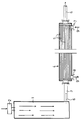
- the liquid chromatography system is designated in its entirety by reference number 1.
- the liquid chromatography system 1 has an inlet 2 at the top and an outlet 3 at the bottom.
- a suitable buffer solution to be separated mixture of macromolecular substances for. B. a body fluid entered.
- the macromolecule species present in the mixture flowing through are sequentially added in a known manner and, if necessary, diluted and / or mixed with low molecular weight substances.
- the different macromolecule species emerge at the outlet 3 in a staggered form, ie sequentially.
- the eluate emerging at the outlet 3 still contains the buffer solutions added before or during the separation, which are undesirable or even harmful for the preparations to be obtained.
- a hollow fiber membrane module 4 is connected to the outlet 3 of the liquid chromatography system 1, in which the withdrawal and / or exchange of buffer solutions is carried out by countercurrent dialysis.
- This hollow fiber membrane module is provided in its interior with a plurality of hollow fibers 5, which are semi-permeable, i.e. permeable only to low-molecular substances, but are impermeable to macromolecular substances.
- the cavities of these hollow fibers 5 are traversed by the eluate of the liquid chromatography system 1 in the direction of the arrows 6.
- the hollow fibers 5 are washed over their entire length in the opposite direction to the arrows 6 by a dialysis liquid, the composition of which allows the buffer solutions in the eluate to be influenced in a targeted manner, i.e. either withdraw or replace.
- the dialysis fluid can also contain specific low molecular weight substrates for the enzymatic detection.
- the hollow fiber membrane module according to the invention provides that on the one hand the quotient from the Number of hollow fibers 5 and the effective length of the hollow fibers is less than 0.5 mm ⁇ 1 and on the other hand the inner diameter of each hollow fiber is less than 0.25 mm.
- the dialysis fluid is entered into the hollow fiber membrane module through the housing connections 7 and 8.
- the direction of flow is indicated by arrows 9.
- All connections of the hollow fiber membrane module 4 can be designed as quick-release plug-in or screw connections. This makes it possible to quickly replace the module 4 and replace it with another one or, if necessary, to interconnect several modules 4 in a suitable manner.
- a mixture of biological macromolecules e.g. Crude cell extract is obtained by gel filtration e.g. separated by chromatography using Sephracryl S-2000 HR.
- the dilution of the sample solution which is inevitable due to the separation principle, is reversed by concentration using a downstream hollow fiber membrane module.
- buffer solution is withdrawn from the eluate via the semipermeable membrane and the macromolecules are concentrated.
- a mixture of biological macromolecules e.g. Blood plasma is determined by covalent chromatography e.g. separated by chromatography using thiol-Sepharose.
- a downstream hollow fiber membrane module can then contain the substances necessarily added to the eluate for the separation, e.g. Remove ⁇ -mercaptoethanol and 2-thiopyridyl groups, which make subsequent optical protein detection impossible.
- For backwashing e.g. physiological saline buffer solution used.
- Example 1 or 2 The experiment listed in Example 1 or 2 is supplemented in such a way that the hollow fiber membrane module is followed by a second one in series.
- B NADH and pyruvate dialyzed into the buffer solution.
- the enzyme lactate dehydrogenase can then be photometrically e.g. at 340 nm about the loss of NADH, which occurs in the enzymatic conversion of pyruvate to lactate by lactate dehydrogenase, can be detected.
Landscapes
- Chemical & Material Sciences (AREA)
- Health & Medical Sciences (AREA)
- Analytical Chemistry (AREA)
- Chemical Kinetics & Catalysis (AREA)
- Life Sciences & Earth Sciences (AREA)
- General Physics & Mathematics (AREA)
- Engineering & Computer Science (AREA)
- Physics & Mathematics (AREA)
- Urology & Nephrology (AREA)
- Biochemistry (AREA)
- General Health & Medical Sciences (AREA)
- Water Supply & Treatment (AREA)
- Immunology (AREA)
- Pathology (AREA)
- Separation Using Semi-Permeable Membranes (AREA)
- Medicines That Contain Protein Lipid Enzymes And Other Medicines (AREA)
- Treatment Of Liquids With Adsorbents In General (AREA)
- Manufacture Of Porous Articles, And Recovery And Treatment Of Waste Products (AREA)
- Separation, Recovery Or Treatment Of Waste Materials Containing Plastics (AREA)
Description
- Die Erfindung betrifft eine Vorrichtung für die Gewinnung und die Umpufferung und/oder Einengung von gelösten Makromolekülen eines Makromolekülgemisches, bestehend aus einer Flüssigchromatographieanlage und mindestens einem in der Abströmleitung der Flüssigchromatographieanlage angeordneten Hohlfasermembranmodul.
- Zum Standardrepertoire biochemischen Arbeitens gehören die verschiedenen chromatographischen Methoden, bei denen die unterschiedliche Masse, Form, Affinität, Ladung oder Polarität der Moleküle zur Trennung ausgenutzt wird. Flüssigchromatographieanlagen werden bei der Ionenaustauscher-, Gelfiltrations- oder Affinitätschromatographie verwendet, um Makromolekülgemische in ihre einzelnen Bestandteile zu trennen.
- Das Eluat einer Flüssigchromatographieanlage enthält über die einzelnen Bestandteile des Makromolekülgemisches hinaus niedermolekulare Substanzen, beispielsweise Salze, die zur Aufhebung der Interaktionen zwischen den Makromolekülen und der stationären Phase der Chromatographiesäule verwendet wurden. Diese Substanzen müssen nach der Chromatographie dem Eluat entzogen werden, da sie beispielsweise bei der nachgeschalteten Detektion oder bei der weiteren Behandlung stören können und daher in den Präparationen unerwünscht sind.
- Zur Entfernung der niedermolekularen Bestandteile aus dem Eluat der Flüssigchromatographieanlage sowie zum Austausch der das Makromolekülgemisch enthaltenden Pufferlösung wird in der präparativen Biochemie die sogenannte "diskontinuierliche Gleichgewichtdialyse" angewandt. Bei diesem Verfahren wird das Eluat mit den darin enthaltenen Molekülspezies in einen Dialyseschlauch eingefüllt, der an beiden Enden mittels Klammern verschlossen wird. Die Wände des Dialyseschlauchs bestehen aus einer semipermeablen Membran, die niedermolekulare Substanzen, beispielsweise Wasser oder Salze, durchläßt, während Makromoleküle zurückgehalten werden. So können die im Eluat enthaltenen Elektrolyte oder andere niedermolekulare Substanzen durch die Membran diffundieren, bis das osmotische Gleichgewicht erreicht wird. Man läßt den mit Eluat gefüllten Dialyseschlauch mehrere Stunden lang in einem Gefäß schwimmen, das ein großes Volumen Wasser bzw. Pufferlösung enthält. Bei ausreichend häufigem Auswechseln der Außenflüssigkeit können die niedermolekularen Bestandteile vollständig entzogen werden bzw. die Pufferlösung ausgetauscht werden.
- Bei der Auftrennung von Makromolekülen nach ihrer Größe mittels Gelfiltration stellt sich weniger das oben erläuterte Problem einer Verunreinigung der Präparation mit unerwünschten niedermolekularen Verbindungen; vielmehr werden die Makromoleküle bei der Elution aus der Chromatographiesäule stark verdünnt. Dieses Problem tritt auch häufig bei anderen chromatographischen Trennverfahren auf. Zur Einengung des Eluats werden dann als Dialyseflüssigkeit konzentrierte Lösungen hochmolekularer Substanzen (beispielsweise Polyethylenglykol) eingesetzt, die eine hohe Affinität zu Wasser aufweisen, der makromolekularen Lösung Wasser entziehen und durch die Dialysemembran nicht diffundieren können.
- Das geschilderte Vorgehen ist umständlich und erfordert einen erheblichen zeitlichen und apparativen Aufwand. Insbesondere wenn zur Trennung der einzelnen Makromolekülspezies das Eluat auf eine Vielzahl von einzelnen Behältern aufgeteilt wird (Fraktionierung), erweist sich das Verfahren als nahezu unpraktikabel. Die bei dieser Verfahrensweise unvermeidlichen Zeitverzögerungen sind besonders dann nachteilig, wenn die empfindlichen Makromoleküle zu lange in einer ungeeigneten Pufferlösung verbleiben. Dieses Problem stellt sich häufig bei enzymatischen Präparationen: oft ist das Enzym so labil, daß die aufwendigen Verfahrensschritte bei der Umpufferung und/oder Einengung durch Dialyse zu großen Verlusten an der enzymatischen Aktivität des Präparates führen.
- Es ist aus der EP-B1-00 58 168 eine Vorrichtung bekannt, bei der im Anschluß an die Flüssigchromatographieanlage ein Hohlfasermembranreaktor eingesetzt wird. In diesem Hohlfasermembranreaktor wird das Eluat der Flüssigchromatographieanlage mit Reagenzien behandelt, die zum Zwecke einer besseren und schnelleren Analyse mit Bestandteilsgruppen der Proben und/oder des Fließmittels reagieren sollen.
- Diese Vorrichtung ist für die Gewinnung von biochemischen Präparaten nicht geeignet. Insbesondere die Gewinnung von Präparaten, die labile Makromoleküle enthalten, erweist sich mit dieser Vorrichtung als sehr problematisch, da während der Zeit, die zum vollständigen Entzug der niedermolekularen Bestandteile aus dem Eluat benötigt wird, die Makromoleküle in der Pufferlösung verweilen müssen, was zu erheblichen Verlusten der Aktivität des Präparates führen könnte. Weiterhin wird durch die zu lange Verweilzeit der Makromoleküle im Reaktor bewirkt, daß die mittels Flüssigchromatographie getrennten Makromoleküle in der Pufferlösung wieder zusammendiffundieren können. Dieses ist sowohl bei der präparativen Gewinnung von Makromolekülen als insbesondere auch bei der analytischen Trennung derselben von erheblichem Nachteil.
- Darüber hinaus sind aus der US-A-4 794 088 ein Verfahren und eine Vorrichtung bekannt, mittels derer eine Probe, die Bestandteile von niedrigem und mittlerem Molekulargewicht enthält, sowohl analysiert als auch mit Hilfe der Flüssigchromatographie in diese Bestandteile aufgetrennt wird. Bei der hier offenbarten Hohlfasermembran handelt es sich um eine Ionen-Austauschmembran, die besonders durchlässig für Elektrolyte ist. Ihre Permeabilität für Verbindungen, die keine Elektrolyte sind (beispielsweise niedermolekulare Kohlenhydrate wie Saccharose) ist jedoch sehr gering. Aus diesem Grund ist die Membran zum Austausch von Pufferlösungen, die solche Verbindungen enthalten, nicht geeignet.
- Auch Hohlfasermembranmodule, wie sie in der Dialysetechnik für die Nierendialyse üblich sind, eignen sich nicht zur Umpufferung und/oder Einengung des Eluats einer Flüssigchromatographieanlage, welches die getrennten Makromoleküle in einer bestimmten Reihenfolge enthält. Solche Hohlfasermembranmodule enthalten zahlreiche (bis zu 8.000) verhältnismäßig kurze (200 bis 300 mm) Hohlfasern. Der Quotient aus der Anzahl der Hohlfasern und der Hohlfaserlänge liegt hier also bei 27 bis 40 mm⁻¹. Ziel ist es dabei, eine möglichst große Fläche für die Diffusion der im Blut enthaltenen niedermolekularen Substanzen (Stoffwechselprodukte wie Harnstoff, Harnsäure, Ionen u.a.) in die Dialyseflüssigkeit zur Verfügung zu stellen und für eine gleichmäßige Blutverteilung auf die Vielzahl der Hohlfasern zu sorgen. Die Anwendung eines solchen Moduls bei der Gewinnung und Umpufferung und/oder Einengung eines Eluats aus einer Flüssigchromatographieanlage hätte zur Folge, daß die durch die Flüssigchromatographie getrennten Makromoleküle gleichmäßig auf die Vielzahl der Hohlfasern verteilt würden und die vorhandene Trennung dadurch ganz oder teilweise aufgehoben wurde. Die Verwendung eines solchen Hohlfasermembranmoduls für den in der Erfindung angestrebten Zweck wäre also im Prinzip unvorteilhaft.
- Aufgabe der Erfindung ist es, die Vorrichtung der gattungsgemäßen Art dahingehend weiterzubilden, daß die Verweilzeiten der Makromolekülespezies in der Pufferlösung wesentlich verkürzt werden und die Umpufferung und/oder Einengung der Pufferlösung kontinuierlich durchgeführt und der apparative Aufwand verringert wird, ohne daß die durch Flüssigchromatographie erreichte Trennung der Makromoleküle dadurch ganz oder teilweise wieder aufgehoben wird.
- Die Aufgabe wird ausgehend von der Vorrichtung nach dem Gattungsbegriff erfindungsgemäß dadurch gelöst, daß das Hohlfasermembranmodul Hohlfasern aus semipermeablen Membranen enthält, die für Makromoleküle undurchlässig sind aber kleine Moleküle durchlassen, und daß der Quotient aus der Anzahl dieser Hohlfasern und der effektiven Hohlfaserlänge den Wert 0,5 mm⁻¹ und der Innendurchmesser einer Hohlfaser den Wert 0,25 mm nicht überschreiten.
- Im Vergleich zu den Hohlfasermembranmodulen für die Nierendialyse sind die Hohlfasern des erfindungsgemäßen Hohlfasermembranmoduls deutlich länger und ihre Anzahl viel niedriger, was bewirkt, daß die mittels Flüssigchromatographie aufgetrennten Makromoleküle bei der Aufteilung auf die verschiedenen Hohlfasern des Hohlfasermembranmoduls nicht unzulässig vermischt werden. Die vorgeschriebene Innendurchmesser-Obergrenze der einzelnen Hohlfasern verhindert darüber hinaus, daß sich die aufgetrennten Makromoleküle bei der Durchströmung der einzelnen Hohlfasern vermischen.
- Die Vorrichtung gemäß der Erfindung hat den Vorteil, daß bei ihrem Einsatz die Einengung und/oder die Umpufferung zeitgleich mit der Chromatographie erfolgt, und zwar für das gesamte Eluat quasi "on line", in ein und demselben Verfahrensschritt.
- Gegenstand der Erfindung ist weiterhin ein Verfahren für die Gewinnung und die Umpufferung und/oder Einengung von gelösten Makromolekülen eines Makromolekülgemisches unter Verwendung der oben erläuterten Vorrichtung, bei dem der Entzug und/oder der Austausch der Pufferlösung kontinuierlich erfolgt, indem die Hohlfasern des Hohlfasermembranmoduls vom Eluat aus der Flüssigchromatographieanlage durchströmt und im Gegenstrom von in Lösungsmitteln gelösten niedermolekularen Substanzen umspült werden.
- Das Verfahren gemäß der Erfindung hat den Vorteil, daß die Einengung und/oder die Umpufferung sehr frühzeitig unmittelbar im Anschluß an die sequentielle Trennung in der Flüssigchromatographieanlage und kontinuierlich erfolgt, und zwar für das gesamte Eluat in ein und demselben Verfahrensschritt der Gegenstrom-Dialyse. Hierdurch wird das Verfahren zur Einengung und/oder Umpufferung erheblich beschleunigt und kann in einem einzigen Aggregat erfolgen, nämlich in einer für die Gegenstrom-Dialyse geeigneten Hohlfasermembran. Infolgedessen reduziert sich bei Anwendung des Verfahrens gemäß der Erfindung auch der erforderliche apparative Aufwand erheblich.
- Eine besonders vorteilhafte Weiterbildung des Verfahrens gemäß der Erfindung sieht vor, daß das im Gegenstrom zum Eluat geführte Lösungsmittel spezifische niedermolekulares Substrate für die enzymatische Detektion enthält. Hierdurch ist es möglich, in ein und demselben Verfahrensschritt Information über die in der Sequenz des Eluats enthaltenen Makromolekülspezies zu erhalten. Bei dieser enzymatischen Detektion kommt es ebenfalls nicht zu einer Reaktion mit den zu untersuchenden makromolekularen Substanzen, die unbeschadet in das zu gewinnende Präparat gelangen sollen.
- Drei Ausführungsbeispiele der Erfindung werden im folgenden anhand der Zeichnung näher erläutert, die schematisch den Aufbau einer Flüssigchromatographieanlage mit nachgeschaltetem Hohlfasermembranmodul zeigt.
- In der Zeichnung ist die Flüssigchromatographieanlage in ihrer Gesamtheit mit dem Bezugszeichen 1 bezeichnet. Die Flüssigchromatographieanlage 1 weist oben einen Einlauf 2 und unten eine Auslauf 3 auf. In den Einlauf 2 wird das mit einer geeigneten Pufferlösung versetzte zu trennende Gemisch von makromolekularen Substanzen, z. B. eine Körperflüssigkeit, eingegeben. Im Inneren der Flüssigchromatographieanlage 1 werden die in dem durchfließenden Gemisch vorhandenen Makromolekülspezies in bekannter Weise sequentiell versetzt und dabei eventuell verdünnt und/oder mit niedermolekularen Substanzen vermischt. Am Auslauf 3 treten die verschiedenen Makromolekülspezies in zeitlich versetzter Form, d.h. sequentiell aus. Das am Ausfluß 3 austretende Eluat enthält allerdings noch die zuvor oder während der Trennung zugesetzten Pufferlösungen, die für die zu gewinnenden Präparate unerwünscht oder sogar schädlich sind.
- Um dem Eluat die unerwünschten oder sogar schädlichen Substanzen der Pufferlösung zu entziehen oder zu ersetzen, ist an den Ausfluß 3 der Flüssigchromatographieanlage 1 ein Hohlfasermembranmodul 4 angeschlossen, in welchem der Entzug und/oder der Austausch von Pufferlösungen durch eine Gegenstrom-Dialyse vorgenommen wird.
- Dieses Hohlfasermembranmodul ist in seinem Inneren mit einer Vielzahl von Hohlfasern 5 versehen, die semipermeabel, d.h. nur für niedermolekulare Substanzen durchlässig, für makromolekulare Substanzen indessen undurchlässig sind. Die Hohlräume dieser Hohlfasern 5 werden von dem Eluat der Flüssigchromatographieanlage 1 in Richtung der Pfeile 6 durchströmt. Gleichzeitig werden die Hohlfasern 5 über ihre gesamte Länge in Gegenrichtung zu den Pfeilen 6 von einer Dialyse-Flüssigkeit umspült, deren Zusammensetzung es gestattet, die durch im Eluat befindlichen Pufferlösungen gezielt zu beeinflussen, d.h. entweder zu entziehen oder zu ersetzen. Gegebenenfalls kann die Dialyse-Flüssigkeits auch spezifische niedermolekulare Substrate für die enzymatische Detektion enthalten.
- Um einen ausreichenden Kontakt zwischen dem die Hohlfasern 5 durchströmenden Eluat und der im Gegenstrom geführten Dialyse-Flüssigkeit herzustellen, aber gleichzeitig die Aufhebung der durch die Flüssigchromatographie erreichten Trennung der Makromoleküle zu vermeiden, ist beim Hohlfasermembranmodul gemäß der Erfindung vorgesehen, daß einerseits der Quotient aus der Anzahl der Hohlfasern 5 und der wirksamen Länge der Hohlfasern kleiner als 0,5 mm⁻¹ und andererseits der Innendurchmesser jeder Hohlfaser kleiner als 0,25 mm ist.
- Die Dialyse-Flüssigkeit wird durch die Gehäuseanschlüsse 7 und 8 in das Hohlfasermembranmodul eingegeben. Die Strömungsrichtung ist durch die Pfeile 9 gekennzeichnet.
- Sämtliche Anschlüsse des Hohlfasermembranmodules 4 können als schnell lösbare Steck- oder Schraubanschlüsse ausgebildet sein. Hierdurch ist es möglich, das Modul 4 schnell auszuwechseln und durch ein anderes zu ersetzen oder gegebenenfalls mehrere Module 4 in geeigneter Weise miteinander zu verschalten.
- Das Verfahren gemäß der Erfindung wird im folgenden anhand von drei konkreten Ausführungsbeispielen erläutert, von denen das erste sich auf eine Einengung der die Makromoleküle enthaltenden Pufferlösung, das zweite auf eine Umpufferung und das dritte auf eine zusätzliche enzymatische Detektion bezieht:
- Ein Gemisch aus biologischen Makromolekülen, z.B. Zellrohextrakt wird durch Gelfiltration z.B. mittels Sephracryl S-2000 HR chromatographisch aufgetrennt. Die dabei durch das Trennprinzip unvermeidliche Verdünnung der Probelösung wird durch Konzentrierung mittels eines nachgeschalteten Hohlfasermembranmoduls wieder rückgängig gemacht. Es wird eine 20%ige wässrige, hygroskopische Polyethylenglykollösung (MG=20.000) zur Gegenspülung verwendet. Dadurch wird dem Eluat über die semipermeable Membran Pufferlösung entzogen und somit die Aufkonzentrierung der Makromoleküle bewirkt.
- Ein Gemisch aus biologischen Makromolekülen z.B. Blutplasma wird durch kovalente Chromatographie z.B. mittels Thiol-Sepharose chromatographisch aufgetrennt. Ein nachgeschaltetes Hohlfasermembranmodul kann dann die für die Trennung notwendigerweise dem Eluat zugefügten Substanzen wie z.B. β-Mercaptoethanol und 2-Thiopyridyl-Gruppen, die eine nachfolgende optische Proteindetektion unmöglich machen, wieder entfernen. Zur Gegenspülung wird dabei z.B. physiologische Kochsalzpufferlösung verwendet.
- Das im Beispiel 1 oder 2 aufgeführte Experiment wird derart ergänzt, daß dem Hohlfasermembranmodul ein zweites in Serie nachgeschaltet wird. Hier wird im Gegenstrom z. B. NADH und Pyruvat in die Pufferlösung eindialysiert. Nach der Passage des Moduls kann dann im Eluat das Enzym Lactatdehydrogenase photometrisch z.B. bei 340 nm über den Verlust von NADH, der bei der enzymatischen Umsetzung von Pyruvat zu Lactat durch Lactatdehydrogenase auftritt, nachgewiesen werden.
Claims (3)
- Vorrichtung für die Gewinnung und die Umpufferung und/oder Einengung von gelösten Makromolekülen eines Makromolekülgemisches, bestehend aus einer Flüssigchromatographieanlage und mindestens einem in der Abströmleitung der Flüssigchromatographieanlage angeordneten Hohlfasermembranmodul,
dadurch gekennzeichnet,
daß das Hohlfasermembranmodul Hohlfasern aus semipermeablen Membranen enthält, die für Makromoleküle undurchlässig sind aber kleine Moleküle durchlassen, und daß der Quotient aus der Anzahl dieser Hohlfasern und der effektiven Hohlfaserlänge den Wert 0,5 mm⁻¹ und der Innendurchmesser einer Hohlfaser den Wert 0,25 mm nicht überschreiten. - Verfahren für die Gewinnung und die Umpufferung und/oder Einengung von gelösten Makromolekülen eines Makromolekülgemisches unter Verwendung einer Vorrichtung nach Anspruch 1, dadurch gekennzeichnet, daß der Entzug und/oder der Austausch der Pufferlösung kontinuierlich erfolgt, indem die Hohlfasern des Hohlfasermembranmoduls vom Eluat aus der Flüssigchromatographieanlage durchströmt und im Gegenstrom von in Lösungsmitteln gelösten niedermolekularen Substanzen umspült werden.
- Verfahren nach Anspruch 2, dadurch gekennzeichnet, daß das im Gegenstrom zum Eluat geführte Lösungsmittel spezifische niedermolekulare Substrate für die enzymatische Detektion enthält.
Applications Claiming Priority (3)
| Application Number | Priority Date | Filing Date | Title |
|---|---|---|---|
| DE4234728 | 1992-10-15 | ||
| DE4234728A DE4234728A1 (de) | 1992-10-15 | 1992-10-15 | Verfahren für die Gewinnung und die Umpufferung und/oder Einengung von gelösten Makromolekülen eines Makromolekülegemisches |
| PCT/EP1993/002827 WO1994008684A1 (de) | 1992-10-15 | 1993-10-13 | Verfahren für die gewinnung und die umpufferung und/oder einengung von gelösten makromolekülen eines makromolekülgemisches |
Publications (2)
| Publication Number | Publication Date |
|---|---|
| EP0664724A1 EP0664724A1 (de) | 1995-08-02 |
| EP0664724B1 true EP0664724B1 (de) | 1996-03-13 |
Family
ID=6470497
Family Applications (1)
| Application Number | Title | Priority Date | Filing Date |
|---|---|---|---|
| EP93923461A Expired - Lifetime EP0664724B1 (de) | 1992-10-15 | 1993-10-13 | Verfahren für die gewinnung und die umpufferung und/oder einengung von gelösten makromolekülen eines makromolekülgemisches |
Country Status (7)
| Country | Link |
|---|---|
| US (1) | US5578204A (de) |
| EP (1) | EP0664724B1 (de) |
| JP (1) | JPH08505467A (de) |
| AT (1) | ATE135248T1 (de) |
| CA (1) | CA2147134A1 (de) |
| DE (2) | DE4234728A1 (de) |
| WO (1) | WO1994008684A1 (de) |
Cited By (1)
| Publication number | Priority date | Publication date | Assignee | Title |
|---|---|---|---|---|
| CN106255542A (zh) * | 2014-02-17 | 2016-12-21 | 拜耳公司 | 用于从蛋白质溶液的连续缓冲或介质交换的超滤单元 |
Families Citing this family (10)
| Publication number | Priority date | Publication date | Assignee | Title |
|---|---|---|---|---|
| IL115941A (en) * | 1995-11-09 | 1998-10-30 | Weizmann Kiryat Membrane Prod | Multi-stage membrane system and process |
| US5961834A (en) * | 1996-12-23 | 1999-10-05 | Bio-Rad Laboratories, Inc. | Simple micro method for concentration and desalting utilizing a hollow fiber, with special reference to capillary electrophoresis |
| US6379973B1 (en) | 1999-03-05 | 2002-04-30 | The United States Of America As Represented By The Department Of Health And Human Services | Chromatographic separation apparatus and method |
| JP4520621B2 (ja) * | 2000-11-01 | 2010-08-11 | 信和化工株式会社 | クロマトグラフィー用分離カラム、固相抽出用媒体、及びクロマトグラフィーの試料注入システム |
| JP2007507721A (ja) * | 2003-09-30 | 2007-03-29 | クロンバ,インコーポレーテッド | クロマトグラフィー及びサンプル調製のためのマルチキャピラリーカラム |
| US20070017870A1 (en) | 2003-09-30 | 2007-01-25 | Belov Yuri P | Multicapillary device for sample preparation |
| FI117179B (fi) * | 2004-01-23 | 2006-07-14 | Environics Oy | Kaasukromatografi |
| EP2274098B1 (de) * | 2008-03-28 | 2013-12-25 | Biotix, Inc. | Multikapillare probenvorbereitungsvorrichtungen und verfahren zur verarbeitung von analyten |
| US11287403B2 (en) * | 2016-01-07 | 2022-03-29 | Board Of Regents, The University Of Texas System | Ion chromatography system and methods utilizing a weak acid or weak base extraction device |
| US20250304618A1 (en) * | 2022-06-10 | 2025-10-02 | Astrazeneca Ab | Methods for unified concentration and buffer exchange |
Family Cites Families (17)
| Publication number | Priority date | Publication date | Assignee | Title |
|---|---|---|---|---|
| JPS50160474A (de) * | 1974-06-21 | 1975-12-25 | ||
| DE2724918A1 (de) * | 1977-06-02 | 1978-12-14 | Thomae Gmbh Dr K | Gewinnung und reinigung von humaninterferon |
| US4195073A (en) * | 1977-10-27 | 1980-03-25 | Hoffmann-La Roche Inc. | Radioimmunoassay of alpha 1 fetoprotein |
| US4474664A (en) * | 1980-01-16 | 1984-10-02 | The Dow Chemical Company | Ion analysis method and apparatus |
| US4448691A (en) * | 1980-09-02 | 1984-05-15 | The Dow Chemical Company | Liquid chromatographic method and apparatus with hollow fiber device for post-column derivatization |
| WO1982000773A1 (en) * | 1980-09-02 | 1982-03-18 | Chemical Co Dow | Liquid chromatographic method and apparatus with hollow fiber device for post-column derivatization |
| US4751004A (en) * | 1981-09-18 | 1988-06-14 | The Dow Chemical Company | Liquid chromatographic method and apparatus with a packed tube membrane device for post-column derivatization/suppression reactions |
| US4529521A (en) * | 1983-08-26 | 1985-07-16 | The Dow Chemical Company | Method and apparatus for analyzing latexes |
| JPS60231613A (ja) * | 1984-04-28 | 1985-11-18 | Terumo Corp | T細胞とb細胞の分離方法およびその分離材ならびにその分離装置 |
| JPS6270757A (ja) * | 1985-09-25 | 1987-04-01 | Toyo Soda Mfg Co Ltd | 液体クロマトグラフイ−による分離・分析方法及び分離・分析装置 |
| US4732686A (en) * | 1985-12-19 | 1988-03-22 | The Dow Chemical Company | Weak eluant ion chromatography |
| US4751189A (en) * | 1986-03-11 | 1988-06-14 | Dionex Corporation | Method for balancing background conductivity for ion chromatography |
| JPH0725800B2 (ja) * | 1987-04-10 | 1995-03-22 | 雪印乳業株式会社 | 硫酸エステル化物を用いて乳からラクトフエリンを分離、精製する方法 |
| SE8802126D0 (sv) * | 1988-06-07 | 1988-06-07 | Pharmacia Ab | Apparatus for flow field flow fractionation |
| DE68922562T2 (de) * | 1988-09-26 | 1996-01-04 | Waters Investments Ltd | Verfahren und Vorrichtung zur Aufbereitung von Proben für die Ionenanalyse. |
| US4957620A (en) * | 1988-11-15 | 1990-09-18 | Hoechst Celanese Corporation | Liquid chromatography using microporous hollow fibers |
| US5160627A (en) * | 1990-10-17 | 1992-11-03 | Hoechst Celanese Corporation | Process for making microporous membranes having gel-filled pores, and separations methods using such membranes |
-
1992
- 1992-10-15 DE DE4234728A patent/DE4234728A1/de not_active Withdrawn
-
1993
- 1993-10-13 EP EP93923461A patent/EP0664724B1/de not_active Expired - Lifetime
- 1993-10-13 DE DE59301915T patent/DE59301915D1/de not_active Expired - Fee Related
- 1993-10-13 US US08/416,902 patent/US5578204A/en not_active Expired - Fee Related
- 1993-10-13 WO PCT/EP1993/002827 patent/WO1994008684A1/de not_active Ceased
- 1993-10-13 AT AT93923461T patent/ATE135248T1/de not_active IP Right Cessation
- 1993-10-13 JP JP6509627A patent/JPH08505467A/ja active Pending
- 1993-10-13 CA CA002147134A patent/CA2147134A1/en not_active Abandoned
Cited By (2)
| Publication number | Priority date | Publication date | Assignee | Title |
|---|---|---|---|---|
| CN106255542A (zh) * | 2014-02-17 | 2016-12-21 | 拜耳公司 | 用于从蛋白质溶液的连续缓冲或介质交换的超滤单元 |
| CN106255542B (zh) * | 2014-02-17 | 2019-11-12 | 拜耳公司 | 用于从蛋白质溶液的连续缓冲或介质交换的超滤单元 |
Also Published As
| Publication number | Publication date |
|---|---|
| ATE135248T1 (de) | 1996-03-15 |
| WO1994008684A1 (de) | 1994-04-28 |
| JPH08505467A (ja) | 1996-06-11 |
| DE59301915D1 (de) | 1996-04-18 |
| DE4234728A1 (de) | 1994-04-21 |
| CA2147134A1 (en) | 1994-04-28 |
| US5578204A (en) | 1996-11-26 |
| EP0664724A1 (de) | 1995-08-02 |
Similar Documents
| Publication | Publication Date | Title |
|---|---|---|
| DE69828517T2 (de) | Methode zur dns-isolierung. | |
| DE3782086T2 (de) | Fluessigkeit/fluessigkeit-extraktionen mit mikroporoesen membranen. | |
| DE69616546T2 (de) | Vorrichtung zur reinigung und modifizierung von peptiden | |
| EP0664724B1 (de) | Verfahren für die gewinnung und die umpufferung und/oder einengung von gelösten makromolekülen eines makromolekülgemisches | |
| EP0156961B1 (de) | Verfahren zur Herstellung hochgereinigter, stromafreier, hepatitissicherer Human- und Tierhämoglobinlösungen | |
| EP1609800B1 (de) | Verfahren zur Extraktion von biologischem Material | |
| DE4029557C2 (de) | Verfahren, Gerät und Trennsäule für eine Flüssigkeitschromatographie | |
| DE2241513B2 (de) | Verfahren zur analytischen Be Stimmung der Sequenzen eines Poly nucleotids | |
| DE10216975B4 (de) | Verfahren und Vorrichtung zur Bereitstellung von Gas für die Isotopenverhältnisanalyse | |
| EP0307737B1 (de) | Verfahren zur Abtrennung von biotechnologisch hergestellten Wertstoffen aus einer Fermenterbrühe durch Querstrom-Mikro-und/oder Ultrafiltration | |
| EP0776374A1 (de) | Verfahren und vorrichtung zur bestimmung der aktivität von enzymen in flüssigkeiten, beziehungsweise der konzentration und/oder aktivität von inhibitoren in flüssigkeiten | |
| DE3490085C2 (de) | Verfahren und Vorrichtung zum Spalten von Desoxyribonucleins{ure | |
| DE69022471T2 (de) | Probenübertragungsverfahren. | |
| DE2632149A1 (de) | Verfahren und vorrichtung zur extraktion und trennung von stoffen durch fluessig-fluessig-austausch | |
| DE2845797C2 (de) | ||
| DE60128144T2 (de) | Vorrichtung und verfahren zur trennung von molekülen und bewegung von fluiden mittels elektrophorese | |
| DE102016209904A1 (de) | Verfahren und mikrofluidische Vorrichtung zum Verarbeiten einer Probe biologischen Materials | |
| DE4041411A1 (de) | Chromatographieverfahren zum analysieren biologischer proben und mit einem solchen verfahren arbeitender fluessigphasenchromatographie-anlaysator | |
| DE69025135T2 (de) | Verfahren zur Analyse von Catecholamin | |
| DE60031891T2 (de) | Reinigungsverfahren für säulen zur passenden ionischen polynukleotidchromatographie | |
| EP1278834B1 (de) | Verfahren für die komplexe nukleinsäureanalytik | |
| EP1498492A1 (de) | Probenzubereitungseinheit | |
| DE3545624A1 (de) | Verfahren zur vakuum-verdampfungskristallisation | |
| DE19817081B4 (de) | Filtereinheit zur mehrstufigen Separation von biologischen Zellsuspensionen und Lösungen | |
| DD269162A1 (de) | Anordnung zur on-line-erfassung physikalischer, chemischer und biologischer prozessgroessen |
Legal Events
| Date | Code | Title | Description |
|---|---|---|---|
| PUAI | Public reference made under article 153(3) epc to a published international application that has entered the european phase |
Free format text: ORIGINAL CODE: 0009012 |
|
| 17P | Request for examination filed |
Effective date: 19950515 |
|
| AK | Designated contracting states |
Kind code of ref document: A1 Designated state(s): AT BE CH DE DK ES FR GB GR IE IT LI LU MC NL PT SE |
|
| 17Q | First examination report despatched |
Effective date: 19950810 |
|
| GRAA | (expected) grant |
Free format text: ORIGINAL CODE: 0009210 |
|
| AK | Designated contracting states |
Kind code of ref document: B1 Designated state(s): AT BE CH DE DK ES FR GB GR IE IT LI LU MC NL PT SE |
|
| PG25 | Lapsed in a contracting state [announced via postgrant information from national office to epo] |
Ref country code: NL Free format text: LAPSE BECAUSE OF FAILURE TO SUBMIT A TRANSLATION OF THE DESCRIPTION OR TO PAY THE FEE WITHIN THE PRESCRIBED TIME-LIMIT Effective date: 19960313 Ref country code: IT Free format text: LAPSE BECAUSE OF FAILURE TO SUBMIT A TRANSLATION OF THE DESCRIPTION OR TO PAY THE FEE WITHIN THE PRE;WARNING: LAPSES OF ITALIAN PATENTS WITH EFFECTIVE DATE BEFORE 2007 MAY HAVE OCCURRED AT ANY TIME BEFORE 2007. THE CORRECT EFFECTIVE DATE MAY BE DIFFERENT FROM THE ONE RECORDED.SCRIBED TIME-LIMIT Effective date: 19960313 Ref country code: GR Free format text: LAPSE BECAUSE OF FAILURE TO SUBMIT A TRANSLATION OF THE DESCRIPTION OR TO PAY THE FEE WITHIN THE PRESCRIBED TIME-LIMIT Effective date: 19960313 Ref country code: ES Free format text: THE PATENT HAS BEEN ANNULLED BY A DECISION OF A NATIONAL AUTHORITY Effective date: 19960313 Ref country code: DK Effective date: 19960313 Ref country code: BE Effective date: 19960313 |
|
| REF | Corresponds to: |
Ref document number: 135248 Country of ref document: AT Date of ref document: 19960315 Kind code of ref document: T |
|
| REG | Reference to a national code |
Ref country code: IE Ref legal event code: FG4D Free format text: 67616 |
|
| REF | Corresponds to: |
Ref document number: 59301915 Country of ref document: DE Date of ref document: 19960418 |
|
| REG | Reference to a national code |
Ref country code: CH Ref legal event code: NV Representative=s name: PATENTANWALTSBUREAU BOSSHARD UND LUCHS |
|
| PG25 | Lapsed in a contracting state [announced via postgrant information from national office to epo] |
Ref country code: SE Effective date: 19960613 |
|
| PG25 | Lapsed in a contracting state [announced via postgrant information from national office to epo] |
Ref country code: PT Effective date: 19960614 |
|
| ET | Fr: translation filed | ||
| GBT | Gb: translation of ep patent filed (gb section 77(6)(a)/1977) |
Effective date: 19960620 |
|
| NLV1 | Nl: lapsed or annulled due to failure to fulfill the requirements of art. 29p and 29m of the patents act | ||
| PG25 | Lapsed in a contracting state [announced via postgrant information from national office to epo] |
Ref country code: LU Free format text: LAPSE BECAUSE OF NON-PAYMENT OF DUE FEES Effective date: 19961031 |
|
| PG25 | Lapsed in a contracting state [announced via postgrant information from national office to epo] |
Ref country code: IE Free format text: LAPSE BECAUSE OF NON-PAYMENT OF DUE FEES Effective date: 19961107 |
|
| REG | Reference to a national code |
Ref country code: IE Ref legal event code: FD4D Ref document number: 67616 Country of ref document: IE |
|
| PLBE | No opposition filed within time limit |
Free format text: ORIGINAL CODE: 0009261 |
|
| STAA | Information on the status of an ep patent application or granted ep patent |
Free format text: STATUS: NO OPPOSITION FILED WITHIN TIME LIMIT |
|
| 26N | No opposition filed | ||
| PG25 | Lapsed in a contracting state [announced via postgrant information from national office to epo] |
Ref country code: MC Effective date: 19970430 |
|
| REG | Reference to a national code |
Ref country code: GB Ref legal event code: IF02 |
|
| PGFP | Annual fee paid to national office [announced via postgrant information from national office to epo] |
Ref country code: GB Payment date: 20021011 Year of fee payment: 10 |
|
| PGFP | Annual fee paid to national office [announced via postgrant information from national office to epo] |
Ref country code: AT Payment date: 20021028 Year of fee payment: 10 |
|
| PGFP | Annual fee paid to national office [announced via postgrant information from national office to epo] |
Ref country code: FR Payment date: 20021030 Year of fee payment: 10 |
|
| PGFP | Annual fee paid to national office [announced via postgrant information from national office to epo] |
Ref country code: CH Payment date: 20021031 Year of fee payment: 10 |
|
| PGFP | Annual fee paid to national office [announced via postgrant information from national office to epo] |
Ref country code: DE Payment date: 20021217 Year of fee payment: 10 |
|
| PG25 | Lapsed in a contracting state [announced via postgrant information from national office to epo] |
Ref country code: GB Free format text: LAPSE BECAUSE OF NON-PAYMENT OF DUE FEES Effective date: 20031013 Ref country code: AT Free format text: LAPSE BECAUSE OF NON-PAYMENT OF DUE FEES Effective date: 20031013 |
|
| PG25 | Lapsed in a contracting state [announced via postgrant information from national office to epo] |
Ref country code: LI Free format text: LAPSE BECAUSE OF NON-PAYMENT OF DUE FEES Effective date: 20031031 Ref country code: CH Free format text: LAPSE BECAUSE OF NON-PAYMENT OF DUE FEES Effective date: 20031031 |
|
| PG25 | Lapsed in a contracting state [announced via postgrant information from national office to epo] |
Ref country code: DE Free format text: LAPSE BECAUSE OF NON-PAYMENT OF DUE FEES Effective date: 20040501 |
|
| GBPC | Gb: european patent ceased through non-payment of renewal fee |
Effective date: 20031013 |
|
| REG | Reference to a national code |
Ref country code: CH Ref legal event code: PL |
|
| PG25 | Lapsed in a contracting state [announced via postgrant information from national office to epo] |
Ref country code: FR Free format text: LAPSE BECAUSE OF NON-PAYMENT OF DUE FEES Effective date: 20040630 |
|
| REG | Reference to a national code |
Ref country code: FR Ref legal event code: ST |