EP0665155B1 - Verfahren zum Betrieb eines Streckennetzes - Google Patents
Verfahren zum Betrieb eines Streckennetzes Download PDFInfo
- Publication number
- EP0665155B1 EP0665155B1 EP95250005A EP95250005A EP0665155B1 EP 0665155 B1 EP0665155 B1 EP 0665155B1 EP 95250005 A EP95250005 A EP 95250005A EP 95250005 A EP95250005 A EP 95250005A EP 0665155 B1 EP0665155 B1 EP 0665155B1
- Authority
- EP
- European Patent Office
- Prior art keywords
- conflict
- route
- overlap
- train
- vehicles
- Prior art date
- Legal status (The legal status is an assumption and is not a legal conclusion. Google has not performed a legal analysis and makes no representation as to the accuracy of the status listed.)
- Expired - Lifetime
Links
- 238000000034 method Methods 0.000 title claims description 21
- 238000011156 evaluation Methods 0.000 claims description 24
- 230000003466 anti-cipated effect Effects 0.000 claims 3
- 230000015572 biosynthetic process Effects 0.000 description 4
- 230000008569 process Effects 0.000 description 4
- 230000002123 temporal effect Effects 0.000 description 4
- 230000003111 delayed effect Effects 0.000 description 3
- 238000009825 accumulation Methods 0.000 description 2
- 238000013459 approach Methods 0.000 description 2
- 230000008901 benefit Effects 0.000 description 2
- 230000008859 change Effects 0.000 description 2
- 238000011161 development Methods 0.000 description 2
- 230000006978 adaptation Effects 0.000 description 1
- 230000009286 beneficial effect Effects 0.000 description 1
- 238000004891 communication Methods 0.000 description 1
- 230000006735 deficit Effects 0.000 description 1
- 230000001934 delay Effects 0.000 description 1
- 238000001514 detection method Methods 0.000 description 1
- 230000004069 differentiation Effects 0.000 description 1
- 238000004090 dissolution Methods 0.000 description 1
- 230000007613 environmental effect Effects 0.000 description 1
- 230000009467 reduction Effects 0.000 description 1
- 238000000926 separation method Methods 0.000 description 1
- 239000002904 solvent Substances 0.000 description 1
- 238000012549 training Methods 0.000 description 1
Images



Classifications
-
- B—PERFORMING OPERATIONS; TRANSPORTING
- B61—RAILWAYS
- B61L—GUIDING RAILWAY TRAFFIC; ENSURING THE SAFETY OF RAILWAY TRAFFIC
- B61L27/00—Central railway traffic control systems; Trackside control; Communication systems specially adapted therefor
- B61L27/10—Operations, e.g. scheduling or time tables
- B61L27/14—Following schedules
-
- B—PERFORMING OPERATIONS; TRANSPORTING
- B61—RAILWAYS
- B61L—GUIDING RAILWAY TRAFFIC; ENSURING THE SAFETY OF RAILWAY TRAFFIC
- B61L27/00—Central railway traffic control systems; Trackside control; Communication systems specially adapted therefor
- B61L27/10—Operations, e.g. scheduling or time tables
- B61L27/16—Trackside optimisation of vehicle or train operation
-
- B—PERFORMING OPERATIONS; TRANSPORTING
- B61—RAILWAYS
- B61L—GUIDING RAILWAY TRAFFIC; ENSURING THE SAFETY OF RAILWAY TRAFFIC
- B61L3/00—Devices along the route for controlling devices on the vehicle or train, e.g. to release brake or to operate a warning signal
- B61L3/16—Continuous control along the route
- B61L3/22—Continuous control along the route using magnetic or electrostatic induction; using electromagnetic radiation
- B61L3/225—Continuous control along the route using magnetic or electrostatic induction; using electromagnetic radiation using separate conductors along the route
- B61L2003/226—German inductive continuous train control, called 'Linienzugbeeinflussung' [LZB]
Definitions
- the invention relates to a method for operating a Route network for several track-bound, in particular rail-bound vehicles.
- the route network includes several individual sections of the route by a control system monitored in a manner known per se and for example as required for vehicle traffic Routes can be configured.
- the route sections only with one the actual state Attribute (occupancy). If thus one of two vehicles to be used simultaneously common section of the route from the first Vehicle is provided with an assignment request, the emerging conflict only through a change in behavior of the second vehicle (which the assignment request expressed later) can be resolved.
- the well-known process has an inflexibility that, for example cause unnecessarily large schedule deviations can.
- the object of the invention is therefore to create a method for operating a route network, the with the highest possible network utilization and flexibility reliable network operation guaranteed.
- An essential aspect of the method according to the invention is that from the data on the route sections Occupancy registration - if necessary also taking into account the vehicle-specific boundary conditions such as the type of vehicle and thus z.
- the to expected punctuality - a realistic forecast for the section assignment is made possible.
- everyone Route segment assigned to the vehicle-specific occupancy time frame go far in their information content beyond a simple busy / busy message.
- Based the time interval of the occupancy time frame for different Vehicles can check the traffic density and any conflicts with other vehicles automatically detect. It is checked whether there are occupancy times for different vehicles for the same or the same route section (s) overlap in time.
- Affect vehicles for neighboring sections of the route can advantageously further conflict development be forecast particularly realistically.
- the expected course of the conflict is one of assigned to several predefined conflict case patterns (Classification). From the conflict resolution measures that predefined for the classified conflict case pattern are, taking into account the situation-specific Circumstances (e.g. availability of required Alternative routes, hereinafter also called “hard Boundary conditions "denotes) the realizable conflict resolution measures determined.
- conflict resolution measures, the z. B. occupied during the conflict period Dodge route require, are not realizable classified.
- Another advantage of the method according to the invention is in the easily automatable selection of the ones to be used Conflict resolution measure from the as realizable classified conflict resolution measures.
- This selection takes place after a predeterminable evaluation z. B. in Form of a hierarchical priority list with in one Predeterminable ranking (priority) predefined evaluation criteria. It starts with the highest Assessment criterion checked whether at least one of the feasible Conflict resolution measures met the criterion. If not, this criterion is automatically given up and by the following (as a new valid) criterion replaced. If the valid evaluation criterion of several Conflict resolution measures are preferred selected the conflict resolution measure that also the subsequent criterion met. The selected conflict resolution measure leads - if necessary - to the configuration the sections of the route (e.g.
- a particularly realistic formation of the occupancy time frame taking into account both driving behavior of the vehicle as well as the performance of the configurable elements of the route sections and the Control system succeeds after advantageous further training the invention in that the occupancy time frame in each case at least from the sum of the driving time of the vehicle from entering until leaving the respective route section and the one for configuration of the route section required time become.
- Figure 2 illustrates a conflict between a first traveling at a speed of 90 km / h Vehicle (train) 1 and one with significantly higher speed of 160 km / h driving second vehicle (Train) 2 Vehicle movements as path-time lines L1, L2 (train 1, train 2) with path axis s and running from right to left time axis t running from top to bottom.
- L1, L2 train 1, train 2
- an elementary conflict signal generates that both an indication of the conflicted route section (e.g. 7) as also contains an indication of the degree of overlap.
- the Elemental conflict signals for neighboring sections of the route (7 to 16) are evaluated together because the individual elementary conflict signals on the temporal Overlap of occupancy time frames R107 / R207 to R116 / R216 based, which assigned the same trains 1, 2 are.
- the recognizable between the Route sections 6 to 12 steadily increasing degree of overlap signals that the present Conflict course KV for a so-called accession conflict (ALK) is.
- the present conflict case is therefore in Differentiation from other possible conflicts (e.g. threading conflict) as belonging to the class “accrued conflicts" classified. For this conflict case "accrued conflict” are different as explained below Conflict resolution measures specified.
- Figure 3 shows taking into account that for conflict resolution selectable locations (branch A and train stations B, C, D) possible Conflict resolution measures M1, M2, M3, M4; the first Measure M1 is the slower train 1 in the area of branch A before entering the together with route sections 6 to 17 to be used for train 2 slow down or stop. The train 2 can then at undiminished speed (as shown by the dashed line Drive through line L2 indicated). this means however, a comparatively long waiting time for the Train 1, as can be seen from the distance between the lines L1 and L1 ' is (cross-hatched occupancy time frame R106 ').
- the applicable evaluation criteria (hereinafter also Strategies or "soft boundary conditions”) z.
- B. the locally applicable driving regulations, Rankings, waiting time regulations, types of trains (e.g. Extra trains) and / or train loads.
- Figure 4 shows an example in hierarchical order (predeterminable) evaluation criteria for an accidental conflict ALK and for one "Accumulation before train end" conflict AVZ. Highest ranking criterion is in both cases of conflict "Keep Connections". Second priority, however, has “Minimally disturb incoming train” or “unnecessary overtaking” avoid. "High quality has priority” refers on the train class (e.g. priority of an IC train over a local train).
- the term cross-country / short-run refers the distance still to be covered.
- the ratings include last Criterion a criterion (e.g. "first first” / the accumulating one Train waits for the section of the route to be traveled is free), which in any case is a conflict resolution allows.
- last Criterion a criterion (e.g. "first first” / the accumulating one Train waits for the section of the route to be traveled is free), which in any case is a conflict resolution allows.
- FIG. 5 shows in detail the conflict resolution measure M3 in station C already explained in connection with FIG. 3, which is preferred in this description example with regard to the evaluation with the highest priority ("keep connections") according to FIG. 4, because for train 1 in station C. a punctual arrival with a subsequent waiting time t w1 is required.
- This assessment criterion (keep track of train 1) is only met by measure M3. If this highest ranking criterion (FIG. 4) could not be met by any of the feasible conflict resolution measures, the conflict resolution measures would be evaluated with regard to the ranking criterion (minimally disrupting move 2). Measure M1 would meet this criterion.
- the conflict resolution measure M3 with an overtaking in station C provides that train 2 in route sections 6, 7 slightly reduces its speed V 2 (line L2 '), so that it is delayed by a stop time t ST2 and passes station C without stopping. He can then increase his speed in order to again approach the undelayed speed line L2 indicated by the dashed line.
- the train 1 stops on a siding in the station C during the waiting time t W1 at least until the occupancy time frame R112 'connects to the occupancy time frame R212' without overlap.
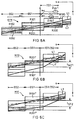
- FIG. 6A shows two trains 1, 2, from their individual vehicles Data about the expected time and duration a future assignment of the following common Route sections GS1, GS2 in route section GS2 Case of conflict is recognizable (crossing of the time-way line L1 of train 1 with L2 of train 2). Because of the individual route sections lying before threading E. Occupancy time frames assigned to IS1, IS2 R100, R200 and the common sections GS1, GS2 assigned, overlapping occupancy time frames R101, R201; R102, R202 becomes the present one Conflict case as a conflict case pattern "threading conflict" SFAO classified. Such a conflict can also occur when a train starts again at a station.
- a possible conflict resolution measure M10 assigned to the conflict case pattern "threading conflict” is that the (slower) train 1 (FIG. 6A) is delayed until the common route section GS1 first traveled by train 2 is released again; the train 1 then enters the route section GS1 without overlap of its occupancy time frame R101 'with the occupancy time frame R201' of train 2.
- the delay (recognizable by the line L1 'in FIG. 6B that initially drops off from the dashed line L1) in train 1 results in a total waiting time for train 1 before threading E of t wz1 .
- FIG. 6C shows an alternative conflict resolution measure M11 in the case of the “threading conflict” conflict pattern.
- the faster train 2 is delayed by a stub time t St2 before threading E so that an overlap of the occupancy time frames R101 ′′, R201 ′′ is avoided at least in the first common route section GS1. Due to the different speeds, there may be another overlap in subsequent sections of the route.
- the conflict resolution measure M11 outlined in FIG. 6C is selected, for example, if, according to the evaluations (FIG. 4), "keeping connections" has the highest priority for the train 1 and the connection station is, for example, at the end of the common route section GS1.
- Figure 7 explains in summary (schematically) essential Process steps of the method according to the invention.
- the elementary conflicts summarized according to trains involved Based on the detection of individual elemental conflicts due to the temporal overlap of the occupancy time frame calculated in advance from the vehicle-specific data (Figure 1) are the elementary conflicts summarized according to trains involved. From the move A summary is made of the elementary conflicts according to predefined conflict case patterns (e.g. Accumulation conflict ALK, threading conflict EFK). From the given and the possibilities of conflict resolution sites (e.g. train stations) taking into account conflict resolution measures, the respective conflict case patterns and conflict locations are assigned to those conflict resolution measures determined (Figure 3), taking into account realizable in the respective conflict environment are.
- the possible conflict resolution measures are for the respective conflict resolution location (e.g. train stations B, C, D) assigned to existing solvents.
- the guidance system 20 can, for example, be influenced by a line train also on controls 23, 24 of the vehicles 1, 2 act to change the speed.
- one Control device that is part of the control system 20 or can be formed separately, are vehicle-specific Data fed in, for example, by radio.
- the Vehicle-specific data result from the schedule routes to be provided for vehicles 1, 2 and through vehicle-specific properties (e.g. vehicle length, speed limits, accrued delays), which may also apply via communication points arranged on the track side can be transferred and updated. From the vehicle-specific The control unit calculates data as explained the assigned to the individual route sections vehicle-specific occupancy time frame.
Landscapes
- Engineering & Computer Science (AREA)
- Mechanical Engineering (AREA)
- Train Traffic Observation, Control, And Security (AREA)
- Electric Propulsion And Braking For Vehicles (AREA)
- Lighting Device Outwards From Vehicle And Optical Signal (AREA)
- Stored Programmes (AREA)
- Electrical Discharge Machining, Electrochemical Machining, And Combined Machining (AREA)
- Paper (AREA)
- Input Circuits Of Receivers And Coupling Of Receivers And Audio Equipment (AREA)
- Transition And Organic Metals Composition Catalysts For Addition Polymerization (AREA)
- Radar Systems Or Details Thereof (AREA)
Applications Claiming Priority (2)
| Application Number | Priority Date | Filing Date | Title |
|---|---|---|---|
| DE4403037 | 1994-01-28 | ||
| DE4403037A DE4403037C2 (de) | 1994-01-28 | 1994-01-28 | Verfahren zum Betrieb eines Streckennetzes |
Publications (3)
| Publication Number | Publication Date |
|---|---|
| EP0665155A2 EP0665155A2 (de) | 1995-08-02 |
| EP0665155A3 EP0665155A3 (de) | 1997-08-06 |
| EP0665155B1 true EP0665155B1 (de) | 2002-10-09 |
Family
ID=6509207
Family Applications (1)
| Application Number | Title | Priority Date | Filing Date |
|---|---|---|---|
| EP95250005A Expired - Lifetime EP0665155B1 (de) | 1994-01-28 | 1995-01-10 | Verfahren zum Betrieb eines Streckennetzes |
Country Status (5)
| Country | Link |
|---|---|
| EP (1) | EP0665155B1 (da) |
| AT (1) | ATE225728T1 (da) |
| DE (1) | DE4403037C2 (da) |
| DK (1) | DK0665155T3 (da) |
| FI (1) | FI111924B (da) |
Families Citing this family (6)
| Publication number | Priority date | Publication date | Assignee | Title |
|---|---|---|---|---|
| DE19652407C1 (de) * | 1996-12-06 | 1998-06-25 | Siemens Ag | Verfahren und Vorrichtung zur Energieversorgung eines Fahrbetriebs mit einer Anzahl von Schienenfahrzeugen |
| DE19726542B4 (de) * | 1997-05-07 | 2004-04-22 | Schwanhäußer, Wulf, Prof. Dr.-Ing. | Verfahren zur Steuerung und Sicherung eines fahrplangebundenen Verkehrssystems |
| US8805605B2 (en) | 2011-05-09 | 2014-08-12 | General Electric Company | Scheduling system and method for a transportation network |
| JP5882831B2 (ja) * | 2012-05-22 | 2016-03-09 | 株式会社日立製作所 | 列車及び移動体の表示方法、運行把握装置、及び運行管理システム |
| DE102015218987A1 (de) * | 2015-09-30 | 2017-03-30 | Siemens Aktiengesellschaft | Sicherungsverfahren für ein Gleisstreckennetz |
| FR3056543B1 (fr) * | 2016-09-29 | 2022-04-08 | Sncf Reseau | Procede et systeme de regulation de circulation de vehicules ferroviaires, voie ferree mettant en œuvre un tel procede ou un tel systeme |
Family Cites Families (2)
| Publication number | Priority date | Publication date | Assignee | Title |
|---|---|---|---|---|
| US4122523A (en) * | 1976-12-17 | 1978-10-24 | General Signal Corporation | Route conflict analysis system for control of railroads |
| US5177684A (en) * | 1990-12-18 | 1993-01-05 | The Trustees Of The University Of Pennsylvania | Method for analyzing and generating optimal transportation schedules for vehicles such as trains and controlling the movement of vehicles in response thereto |
-
1994
- 1994-01-28 DE DE4403037A patent/DE4403037C2/de not_active Expired - Fee Related
-
1995
- 1995-01-10 AT AT95250005T patent/ATE225728T1/de not_active IP Right Cessation
- 1995-01-10 DK DK95250005T patent/DK0665155T3/da active
- 1995-01-10 EP EP95250005A patent/EP0665155B1/de not_active Expired - Lifetime
- 1995-01-25 FI FI950320A patent/FI111924B/fi active
Also Published As
| Publication number | Publication date |
|---|---|
| DE4403037A1 (de) | 1995-08-17 |
| FI950320A0 (fi) | 1995-01-25 |
| ATE225728T1 (de) | 2002-10-15 |
| EP0665155A3 (de) | 1997-08-06 |
| DE4403037C2 (de) | 1998-08-27 |
| EP0665155A2 (de) | 1995-08-02 |
| FI111924B (fi) | 2003-10-15 |
| DK0665155T3 (da) | 2003-02-10 |
| FI950320L (fi) | 1995-07-29 |
Similar Documents
| Publication | Publication Date | Title |
|---|---|---|
| DE19726542B4 (de) | Verfahren zur Steuerung und Sicherung eines fahrplangebundenen Verkehrssystems | |
| DE69821437T2 (de) | Fahrzeugverkehrssteuerungssystem | |
| DE69814276T2 (de) | Rechnergestütztes Konfliktlösungsverfahren für Eisenbahnnetz | |
| DE3930425A1 (de) | Verfahren zum dirigieren des laufs eines sich bewegenden objekts | |
| DE102018216082A1 (de) | Verfahren zur kooperativen Manöverabstimmung | |
| EP3782869A1 (de) | Verfahren zur steuerung eines zugs innerhalb eines zugsicherungssystems, zugsicherungssystem | |
| EP0665155B1 (de) | Verfahren zum Betrieb eines Streckennetzes | |
| EP1097077A2 (de) | Verfahren zur datenreduktion im bahnbetrieb | |
| EP3197744B1 (de) | Verfahren zum durchführen eines automatischen zugverkehrs und zugverkehrssystem zum durchführen eines automatischen zugverkehrs | |
| EP3964419A1 (de) | Übertragung von daten zwischen einem spurgebundenen fahrzeug und einer landseitigen einrichtung | |
| DE19944310A1 (de) | Verfahren und System zur Priorisierung des öffentlichen Personennahverkehrs | |
| DE102010048675A1 (de) | Prognostizieren von Phasenübergängen an ineinander übergehenden Stauphasen | |
| DE102022106338A1 (de) | Anpassen eines Fahrverhaltens eines autonomen Fahrzeugs | |
| EP3768567B1 (de) | Verfahren zur disposition oder steuerung der bewegungen einer mehrzahl von fahrzeugen über ein netzwerk von verkehrswegen | |
| DE102015218971A1 (de) | Sicherungsverfahren für ein Gleisstreckennetz | |
| DE3408521A1 (de) | Einrichtung zum optimieren der fahrweise spurgefuehrter fahrzeuge bei automatischem fahrbetrieb | |
| DE10101652B4 (de) | Verfahren zur verkehrsstörungsreduzierenden Beeinflussung des Fahrverhaltens von Fahrzeugen | |
| DE102004031525A1 (de) | Verfahren bei der Sicherung des Fahrbetriebes | |
| DE19907466C1 (de) | Verfahren zum Sichern der Zugfolge im Schienenverkehr | |
| DE19501993C2 (de) | Verfahren und Einrichtung zur sicherheitsrelevanten Erfassung und Verarbeitung von Zustandsinformationen dezentraler oder zentraler Steuereinrichtungen von Fahrwegelementen entlang eines Fahrwegs auf Triebfahrzeugen | |
| DE19620357C1 (de) | Verfahren zur Erzeugung einer Beidrückempfehlung für die Steuerung einer Beidrückeinrichtung | |
| EP4071028B1 (de) | Verhinderung einer kollision eines schienenfahrzeuges an einem knotenpunkt in einem cbtc system | |
| EP0551972B1 (de) | Einrichtung zur Zugbeeinflussung im Eisenbahnwesen | |
| WO2024088680A1 (de) | Verfahren und system zum koordinieren von autonomen fahrzeugen in wenigstens einem verkehrsbereich | |
| DE19931967A1 (de) | Anordnung zur Fahrtregelung eines Zuges auf einer Fahrstrecke |
Legal Events
| Date | Code | Title | Description |
|---|---|---|---|
| PUAI | Public reference made under article 153(3) epc to a published international application that has entered the european phase |
Free format text: ORIGINAL CODE: 0009012 |
|
| AK | Designated contracting states |
Kind code of ref document: A2 Designated state(s): AT CH DK LI |
|
| PUAL | Search report despatched |
Free format text: ORIGINAL CODE: 0009013 |
|
| AK | Designated contracting states |
Kind code of ref document: A3 Designated state(s): AT CH DK LI |
|
| 17P | Request for examination filed |
Effective date: 19970902 |
|
| GRAG | Despatch of communication of intention to grant |
Free format text: ORIGINAL CODE: EPIDOS AGRA |
|
| GRAG | Despatch of communication of intention to grant |
Free format text: ORIGINAL CODE: EPIDOS AGRA |
|
| GRAH | Despatch of communication of intention to grant a patent |
Free format text: ORIGINAL CODE: EPIDOS IGRA |
|
| 17Q | First examination report despatched |
Effective date: 20020415 |
|
| GRAH | Despatch of communication of intention to grant a patent |
Free format text: ORIGINAL CODE: EPIDOS IGRA |
|
| GRAA | (expected) grant |
Free format text: ORIGINAL CODE: 0009210 |
|
| AK | Designated contracting states |
Kind code of ref document: B1 Designated state(s): AT CH DK LI |
|
| REF | Corresponds to: |
Ref document number: 225728 Country of ref document: AT Date of ref document: 20021015 Kind code of ref document: T |
|
| REG | Reference to a national code |
Ref country code: CH Ref legal event code: EP |
|
| REG | Reference to a national code |
Ref country code: CH Ref legal event code: NV Representative=s name: SIEMENS SCHWEIZ AG |
|
| REG | Reference to a national code |
Ref country code: DK Ref legal event code: T3 |
|
| PLBE | No opposition filed within time limit |
Free format text: ORIGINAL CODE: 0009261 |
|
| STAA | Information on the status of an ep patent application or granted ep patent |
Free format text: STATUS: NO OPPOSITION FILED WITHIN TIME LIMIT |
|
| 26N | No opposition filed |
Effective date: 20030710 |
|
| PGFP | Annual fee paid to national office [announced via postgrant information from national office to epo] |
Ref country code: AT Payment date: 20041215 Year of fee payment: 11 |
|
| PGFP | Annual fee paid to national office [announced via postgrant information from national office to epo] |
Ref country code: DK Payment date: 20050107 Year of fee payment: 11 |
|
| PGFP | Annual fee paid to national office [announced via postgrant information from national office to epo] |
Ref country code: CH Payment date: 20050408 Year of fee payment: 11 |
|
| PG25 | Lapsed in a contracting state [announced via postgrant information from national office to epo] |
Ref country code: AT Free format text: LAPSE BECAUSE OF NON-PAYMENT OF DUE FEES Effective date: 20060110 |
|
| PG25 | Lapsed in a contracting state [announced via postgrant information from national office to epo] |
Ref country code: LI Free format text: LAPSE BECAUSE OF NON-PAYMENT OF DUE FEES Effective date: 20060131 Ref country code: DK Free format text: LAPSE BECAUSE OF NON-PAYMENT OF DUE FEES Effective date: 20060131 Ref country code: CH Free format text: LAPSE BECAUSE OF NON-PAYMENT OF DUE FEES Effective date: 20060131 |
|
| REG | Reference to a national code |
Ref country code: DK Ref legal event code: EBP |
|
| REG | Reference to a national code |
Ref country code: CH Ref legal event code: PL |